
Tummy tuck scar treatment begins before the incision is ever made. For Canadian patients considering the tummy tuck procedure at AKM Clinic, scar quality depends on surgical planning, incision placement, wound tension, silicone care, light-based recovery support, and disciplined sun protection after returning home.
A tummy tuck scar cannot be removed entirely. That is the honest starting point. The goal is to place it low, protect it early, support collagen remodelling, and manage it consistently until it matures.
For patients travelling from Toronto, Vancouver, Montreal, Calgary, or Ottawa, the scar plan also needs to fit real life. That means long-haul travel, Canadian seasonal UV exposure, winter clothing friction, summer swimwear planning, and follow-up with a local dermatologist when needed.
Quick Summary: Tummy tuck scars cannot be eliminated, but they can often be planned, managed, and refined so they become much less visible over time. The most important factors are low incision placement, early wound protection, silicone sheets or gels, LLLT-supported healing, sun protection, and consistent follow-up once you return to Canada.
The first 6 weeks protect the incision. The next 6 to 12 months determine how the scar colour, thickness, and texture mature.
Table of Contents
Why Tummy Tuck Scars Exist — and Where They Sit?
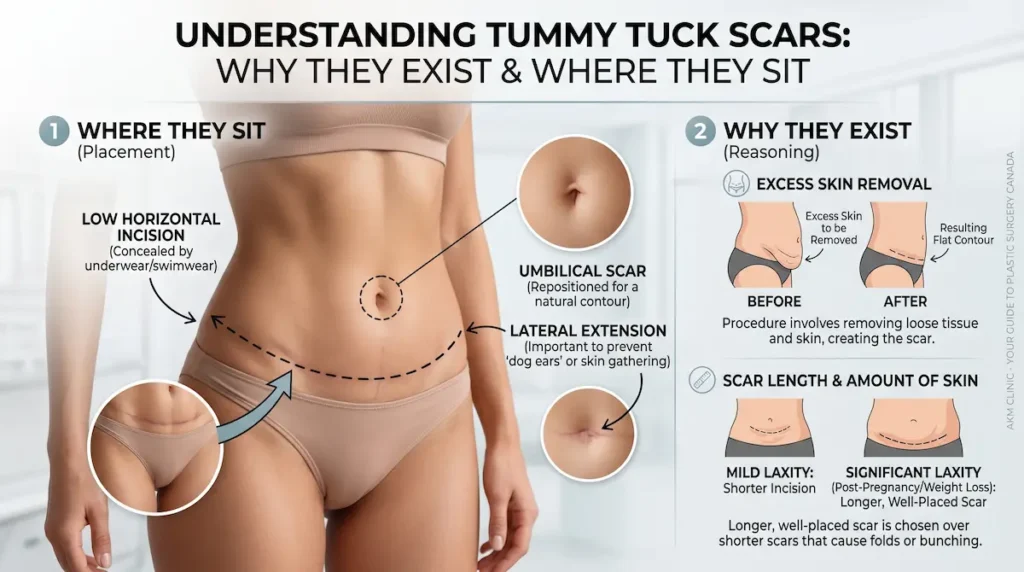
A tummy tuck removes excess abdominal skin, which means the surgeon must create an incision long enough to remove that skin safely. This section explains why the scar exists, where it is normally placed, and why scar position matters as much as scar length.
Anatomical Reality of the Abdominoplasty Incision
A tummy tuck, or abdominoplasty, reshapes the abdomen by removing loose skin and tightening the abdominal wall when needed. The skin removal is what creates the scar. There is no true scarless tummy tuck when meaningful skin excision is required.
The main incision usually runs low across the lower abdomen. Its length depends on the amount of loose skin, the patient’s anatomy, and whether the procedure is mini, full, extended, or combined with liposuction.
A patient with mild lower-abdominal laxity may have a shorter incision. A post-pregnancy or post-weight-loss patient usually needs a longer one because more skin must be removed to avoid bunching at the sides.
The trade-off is straightforward. A longer, well-placed scar is often better than a shorter scar that leaves visible folds, puckering, or uneven skin tension.
Why Low-and-Lateral Placement Matters
Scar placement is a planning decision. At AKM Clinic, the scar is designed to sit low enough that it can usually be covered by underwear, bikini bottoms, or fitted clothing. This is especially important for Canadian patients who want a discreet result after returning to work or social life.
A low scar also reduces daily visibility. You may see it when changing, applying silicone sheets, or checking healing progress, but it should not dominate your abdomen in regular clothing.
The lateral ends matter too. If the incision stops too early in a patient who has skin excess toward the hips, the skin can gather at the sides. This can create “dog ears,” which belong in the revision category rather than routine scar care.
For the dog ears, wide scars, and asymmetry revision angle, see our tummy tuck revision guide. This article stays focused on scar minimization and scar treatment after a well-planned primary procedure.
The Umbilical Scar Consideration
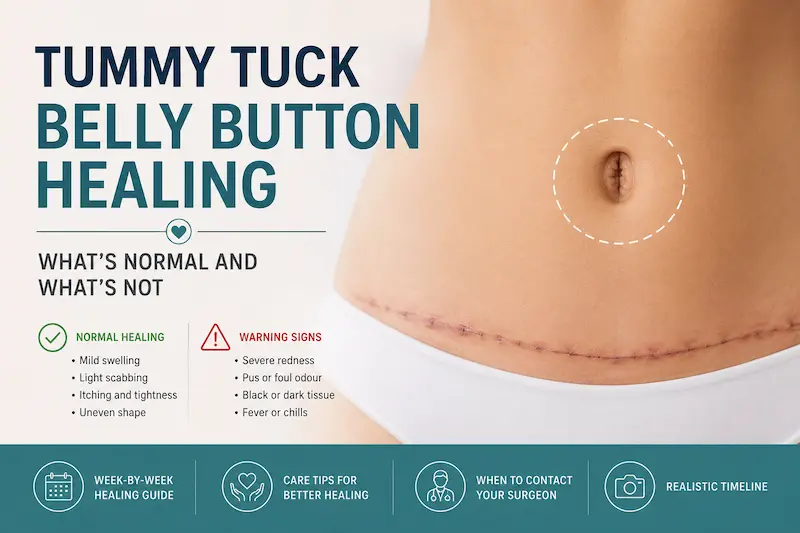
A full tummy tuck usually includes repositioning the belly button. That creates a second scar around the umbilicus, although it is typically much smaller than the lower abdominal incision.
The goal is not to hide the belly button scar completely. The goal is to place it inside the natural contour of the umbilicus so it does not look circular, stretched, or surgically obvious.
Patients often focus on the long lower scar and forget the belly button. A natural-looking umbilicus matters because it is visible in swimwear, gym clothing, and fitted summer clothing.
In Canadian summer months, this area also needs UV protection. Fresh scar tissue can darken with sun exposure, even through partial shade or light clothing.
The Biology of Scar Healing
Scar healing is not a single event. It is a staged biological process that starts with wound closure and continues for up to a year or longer. Understanding this timeline helps patients avoid panic during the red, raised, or firm stages of normal maturation.
Initial Wound Closure to Mature Scar
In the first days after surgery, the body focuses on sealing the incision. This is the inflammatory phase. The scar may look red, tender, or slightly raised, and the surrounding area can feel tight.
Over the next several weeks, collagen begins to accumulate. Collagen is necessary for strength, but early collagen is not organized. This is why a young scar can look firm, pink, and more visible than expected.
Scar maturation happens gradually. The collagen fibres flatten and reorganize, redness fades, and the scar becomes softer. Most tummy tuck scars change significantly between Month 3 and Month 12.
Early scar appearance does not predict the final result. A scar that looks dark or firm at Week 6 may still mature beautifully with proper care.
Hypertrophic vs Keloid Risks
Hypertrophic scars are raised scars that stay within the original incision line. They are more common than keloids and often improve with silicone, time, pressure, and light-based treatments.
Keloid scars grow beyond the original wound boundary. They are less common after tummy tuck surgery, but risk can be higher in patients with a personal or family history of keloids, especially across certain skin types.
This distinction matters. A thick scar is not automatically a keloid. Many early tummy tuck scars look raised during the collagen-building phase and later flatten.
Patients with a known history of keloids should disclose this during consultation. Scar strategy can then be adjusted before surgery rather than treated reactively months later.
Individual Variation Factors
Two patients can have the same surgeon and the same scar protocol yet heal differently. Genetics play a major role. Skin type, age, nutrition, smoking history, diabetes, immune status, and sun exposure all influence scar quality.
Mechanical tension is another major factor. If the incision is under too much pull, collagen production can become more aggressive, making the scar thicker or wider.
Canadian lifestyle patterns also matter. A patient returning to desk work in Toronto may protect the incision more easily than someone resuming childcare, winter shovelling, or physically demanding work in Alberta.
Good scar care is not about one product. It is a sequence of small decisions repeated over months.
“Scar quality is shaped by two forces: the placement and closure we create in surgery, and the consistency of care the patient maintains afterward. A low, well-closed incision still needs protection, silicone, and sun discipline to mature well.”
Preventive Scar Care: Day 0 to Week 6
The first 6 weeks are about protection, not perfection. During this stage, the incision is still gaining strength, so scar treatment focuses on clean wound care, controlled compression, reduced tension, and avoiding activities that pull on the lower abdomen.
Wound Care Protocol
Early wound care should follow your surgeon’s instructions exactly. This is not the stage for experimenting with oils, acids, exfoliants, or over-the-counter creams marketed for “fast scar removal.”
The incision needs a clean, stable environment. Dressings should be changed as directed, and the area should be checked for unusual redness, drainage, odour, increasing warmth, or worsening pain.
A small amount of tightness, mild redness, or tenderness can be normal. A sudden change is different. That should be reported to the surgical team rather than managed at home.
For Canadian patients recovering after the flight home, a simple photo routine can help. Take clear pictures in the same lighting once or twice a week, then share them with your AKM patient advocate if anything changes.
Compression Garment Role
A compression garment does not “erase” scars. Its role is more practical. It helps reduce swelling, supports the abdominal tissues, and limits unnecessary movement across the incision line.
Less movement can mean less tension. Less tension gives the scar a better chance to mature as a fine line rather than widening under mechanical stress.
Garment fit matters. If the garment folds, rolls, digs into the incision, or creates sharp pressure across the scar, it can irritate healing tissue. The goal is even support, not aggressive squeezing.
For broader activity, garment, and sleeping-position advice, see our general tummy tuck recovery guidance. This article stays focused on scar-specific decisions.
Avoiding Tension on the Incision
Tension is one of the biggest enemies of scar quality. The lower abdominal incision is vulnerable because standing fully upright, lifting, coughing, stretching, and twisting can all pull across the wound.
In the early weeks, many patients walk slightly bent at the waist. That posture can feel awkward, but it protects the incision from unnecessary strain.
Canadian patients with young children need a clear lifting plan before travelling. Lifting a toddler too early can place more stress on the scar than a short walk around the house.
Work demands should also be considered. Desk work is usually easier to adapt than nursing shifts, retail work, construction, personal training, or frequent winter driving in heavy clothing.
| Scar Timeline | What the Scar May Look Like | Recommended Focus | What to Avoid |
|---|---|---|---|
| Day 0 | Covered by dressings; swelling and tightness expected | Protect the incision and follow dressing instructions | Touching, stretching, or applying non-prescribed products |
| Week 1 | Red or pink incision line; mild tenderness possible | Clean wound care and controlled movement | Lifting, twisting, smoking, and garment pressure on the incision |
| Week 4 | Scar may look firmer, darker, or more raised | Begin silicone if cleared by the surgeon | Judging final scar quality too early |
| Month 3 | Scar may still be pink, firm, or uneven in colour | Continue silicone, massage if cleared, and sun protection | Unprotected UV exposure or aggressive massage |
| Month 6 | Scar usually begins flattening and fading | Assess whether maturation is progressing normally | Stopping care because the scar is “good enough” |
| Month 12 | Scar is closer to mature colour and texture | Consider dermatologist review if thick, dark, or raised | Assuming revision is needed without specialist assessment |
Silicone Sheets and Topical Treatments
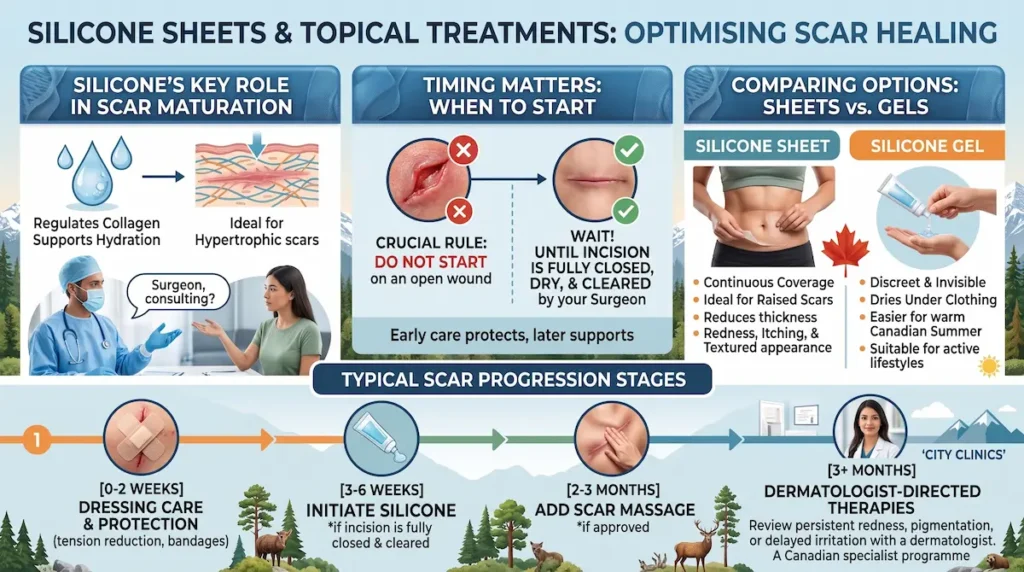
Silicone is one of the most commonly recommended scar-care tools because it supports hydration and helps regulate collagen behaviour during scar maturation. This section explains when silicone is useful, how sheets differ from gels, and why timing matters.
Silicone gel sheeting has been used in scar therapy for decades, especially for raised or hypertrophic scars. Patients should still wait until the incision is fully closed and cleared by the surgeon before starting silicone care. For clinical background on silicone scar therapy, see this peer-reviewed review on silicone adhesives for scar reduction.
Silicone Sheet Mechanism and Timing
Silicone sheets create a controlled, hydrated environment over the scar. This can help reduce thickness, redness, itching, and raised texture during the remodelling phase.
Silicone should not be started on an open wound. The incision must be fully closed, dry, and cleared by the surgical team first.
Many patients begin silicone use several weeks after surgery, but timing varies. Starting too early can irritate the incision. Starting too late may still help, but it can miss part of the most active collagen phase.
Consistency matters more than the brand. A high-quality silicone sheet used regularly is usually more helpful than a drawer full of products used randomly.
Topical Scar Gels Comparison
Silicone gels can be useful when sheets are difficult to wear. Some patients prefer gel because it dries under clothing and may feel easier during warm Canadian summer months.
Sheets usually provide more continuous coverage. Gels are more discreet. The right choice depends on skin sensitivity, daily clothing, scar location, and whether the patient can maintain regular use.
Many non-silicone scar creams promise dramatic fading. Be careful. Products with fragrance, acids, or irritating botanicals can cause redness that makes a scar look worse.
A simple rule works well: do not apply anything to a healing tummy tuck scar unless your surgeon or dermatologist has cleared it.
When to Start Each Modality
Scar care should progress in stages. Early care protects the incision. Silicone supports scar maturation. Massage, light-based treatments, and dermatologist-directed therapies come later if needed.
Typical sequencing may look like this:
- Day 0 to Week 2: dressing care, incision protection, and tension reduction.
- Week 3 to Week 6: silicone may begin if the incision is fully closed and cleared.
- Month 2 to Month 3: gentle scar massage may be added if approved.
- Month 3 onward: persistent redness, thickness, or pigmentation can be reviewed with a dermatologist.
Patients in Toronto, Vancouver, Montreal, and Calgary often have access to dermatology clinics that offer scar support. A Canadian dermatologist can help monitor hypertrophic change, pigment issues, or delayed irritation once you are home.
AKM’s long-term virtual follow-up programme also supports scar monitoring at 1, 3, 6, and 12 months. That continuity matters because the scar will keep changing long after the initial surgical trip is complete.
LLLT and Light-Based Scar Refinement
Light-based recovery support can help scar tissue mature in a more controlled way. This section explains how Low-Level Laser Therapy fits into tummy tuck scar treatment, why timing matters, and how Canadian patients can continue appropriate scar care after returning home.
How LLLT Speeds Scar Maturation
Low-Level Laser Therapy, or LLLT, uses specific wavelengths of light to stimulate cellular activity without heating or damaging the tissue. In scar care, the goal is not to “burn off” the scar. The goal is to support healthier collagen organization.
After a tummy tuck, scar tissue is actively remodelling for months. LLLT may help reduce redness, calm inflammation, and support the energy demands of healing cells during that remodelling phase.
This is different from aggressive resurfacing lasers. LLLT is non-ablative. It does not peel the skin or create a new wound.
For patients who want a broader explanation of this technology across surgical scars, see our guide to LLLT laser therapy for scar minimization across procedures.
AKM’s LLLT Integration in the Recovery Week
AKM Clinic integrates LLLT into the post-operative recovery plan when clinically appropriate. This is part of the clinic’s broader recovery approach, not a casual add-on.
The system uses 424 medical-grade semiconductor laser diodes at a 650 nm wavelength. That “soft laser” energy is designed to stimulate cellular ATP production without generating heat.
For tummy tuck patients, LLLT is most relevant to incision recovery, redness control, and early scar maturation. It may also support surrounding tissue healing after body contouring.
You can read more about AKM’s LLLT recovery technology and how it fits into the clinic’s recovery standards for international patients.
Continuity Options Once Back in Canada
Once you return to Canada, LLLT continuity depends on access. Toronto, Vancouver, Montreal, Calgary, and Ottawa have dermatology, physiotherapy, and medical-aesthetic clinics offering different forms of light-based therapy.
Not every red-light device is equivalent to clinical LLLT. Wavelength, power density, treatment distance, session duration, and device quality all matter.
Home-use devices may be useful for general skin support, but they should not replace medical scar assessment. A raised, itchy, painful, or darkening scar needs professional review.
A practical approach is to continue silicone, sun protection, and follow-up photography first. If the scar remains unusually red, raised, or thick by Month 3 to Month 6, discuss dermatologist-guided laser or light-based options.
When Scar Revision Becomes Necessary?
Most tummy tuck scars improve with time and disciplined care. Some do not. This section explains when scar care has likely plateaued, how scar revision differs from routine scar treatment, and when the issue belongs in a revision-surgery conversation.
Indicators That Primary Scar Care Has Plateaued
A scar should not be judged too early. At Month 1 or Month 2, redness and firmness can still be normal. By Month 6 to Month 12, the pattern becomes clearer.
Scar care may have plateaued if the scar remains thick, rope-like, widened, painful, itchy, or visibly darker than surrounding skin despite consistent treatment.
Other concerns include scar tethering, contour pulling, or a scar that sits higher than planned because of healing tension. These issues need assessment rather than guesswork.
A Canadian dermatologist can help distinguish pigmentation, hypertrophic scarring, keloid tendency, irritation, and infection-related changes. Each one requires a different plan.
Surgical Scar Revision Techniques
Scar revision removes or reworks an unsatisfactory scar so the tissue can be closed again under better conditions. It does not erase the scar. It creates a new opportunity for improved healing.
Revision may involve excising the widened scar, re-closing the incision in layers, reducing tension, or combining surgical correction with silicone, LLLT, or fractional laser afterward.
Scar revision is usually not considered until the scar has matured enough to judge properly. In many cases, this means waiting close to 12 months unless there is a functional or medical concern.
For a broader discussion beyond abdominoplasty, see our cross-procedural scar revision overview.
How AKM Approaches Scar Revision
AKM’s scar revision approach starts with diagnosis. A wide scar, hypertrophic scar, dog ear, asymmetry, and contour irregularity are not the same problem.
If the main issue is scar colour or texture, non-surgical options may be more appropriate. If the scar is widened because of tension or poor closure, surgical revision may be considered.
If the scar is linked to dog ears, abdominal asymmetry, residual loose skin, or contour imbalance, the case moves beyond scar treatment. For the dog ears, wide scars, and asymmetry revision angle, see our revision guide for tummy tuck correction.
This distinction protects patients from over-treatment. A scar problem should receive scar treatment. A revision problem should be planned as revision surgery.

Canadian Climate and Sun Exposure Considerations
Scar care does not happen in a neutral environment. Canadian weather changes how patients dress, move, sweat, moisturize, and protect healing skin. This section explains why UV exposure, seasonal clothing, and summer activities matter during the first year of tummy tuck scar treatment.
Why Canadian Seasonal UV Variation Matters
Fresh scar tissue is more reactive to ultraviolet exposure than mature skin. UV can darken a scar, prolong redness, and make pigmentation harder to correct later.
This is especially relevant for patients who have surgery in winter and feel “safe” because the abdomen is covered. The scar may still be immature when summer arrives in June, July, or August.
Health Canada advises Canadians to use sunscreen and other sun-safety steps to protect skin from harmful ultraviolet radiation. For a healing tummy tuck scar, that guidance is especially relevant during the first 12 months of scar maturation. See Health Canada’s sun safety guidance.
Snow reflection can also increase UV exposure during winter travel or outdoor activity. The abdomen is usually covered, but any exposed healing skin should still be protected.
Canadian patients planning surgery around winter holidays, March break, or summer vacation should build scar protection into the calendar, not treat it as an afterthought.
SPF Discipline for the First 12 Months
For the first year, the scar should be protected from direct sun. If the incision area may be exposed, use broad-spectrum SPF and physical coverage whenever possible.
Sunscreen is helpful, but clothing is more reliable. Swimwear, high-waisted bottoms, UV-protective fabric, and shade reduce the chance of post-inflammatory hyperpigmentation.
Do not use tanning beds on or near a healing scar. A scar that darkens during maturation can take much longer to fade, especially in deeper skin tones.
If your tummy tuck scar sits low enough, most regular clothing will cover it well. That is one reason incision planning and scar placement are discussed during consultation rather than after surgery.
Pool, Beach, and Exposed-Clothing Planning
Patients often ask when they can return to pools, lakes, saunas, and beaches. The answer depends on incision closure, infection risk, swelling, and surgeon clearance.
Swimming too early can expose the incision to bacteria and movement stress. Even after the wound closes, sun exposure remains a separate concern.
For many Canadian patients, the safest approach is to separate “healed enough to swim” from “safe to expose the scar.” You may be cleared for water before the scar is ready for UV exposure.
If pricing context is part of your planning, AKM lists procedure-specific figures on its tummy tuck pricing in CAD page. Scar-care products and follow-up needs should be considered separately from the surgical fee.
Frequently Asked Questions: Tummy Tuck Scar Treatment
These questions cover the concerns Canadian patients most often raise during tummy tuck scar consultations. The answers are general educational guidance and should not replace a surgeon’s individualized instructions.
How visible will my scar be at 1 year?
At 1 year, many tummy tuck scars are flatter, paler, and softer than they were at Month 3. Some remain pink, brown, or slightly raised for longer, especially in patients prone to pigmentation or hypertrophic scarring.
The final appearance depends on incision placement, closure technique, genetics, tension, silicone use, UV protection, and whether complications occurred during healing.
When can I start silicone sheets?
Silicone sheets usually begin only after the incision is fully closed, dry, and cleared by the surgeon. Starting too early can irritate the wound or trap moisture against skin that is not ready.
Many patients start silicone several weeks after surgery. Your timeline may differ, so surgeon clearance matters more than a generic calendar.
Does LLLT help post-op scars?
LLLT may support scar maturation by calming inflammation and stimulating cellular repair activity. It is not a scar eraser, and it should be viewed as one part of a larger scar plan.
The foundation remains surgical placement, low tension, clean wound care, silicone, sun protection, and time.
Can I have a hidden scar?
A tummy tuck scar can often be placed low enough to hide under underwear or swimwear. It cannot be made invisible.
The word “hidden” should refer to placement under clothing, not the biological disappearance of the scar. Honest scar planning is better than unrealistic promises.
What if I develop a keloid?
If you develop a true keloid, you should be assessed by a dermatologist or surgeon. Keloids may require treatments such as silicone, steroid injections, pressure therapy, laser-based care, or surgical revision in selected cases.
Do not self-diagnose a keloid early. Many raised scars are hypertrophic scars, which behave differently and often improve with conservative care.
How long should I avoid sun on my scar?
Plan for strict scar sun protection for at least 12 months. Some patients continue protecting the area longer if the scar remains pink, brown, or reactive.
Use clothing first, then sunscreen as backup. This is especially important during Canadian summer travel, cottage weekends, beach trips, and outdoor exercise.
Will my Canadian dermatologist help with scar care?
Yes. A Canadian dermatologist can help monitor scar thickness, redness, pigmentation, irritation, and keloid risk after you return home.
AKM’s virtual follow-up can work alongside local care. This is useful for patients in Toronto, Vancouver, Montreal, Calgary, Ottawa, and smaller Canadian cities where in-person follow-up in Istanbul is not practical.
If you are researching tummy tuck scar treatment because you already have a wide, painful, or raised scar from a previous surgery, your next step may be diagnostic review rather than buying more products. A virtual consultation can help determine whether your concern is routine scar maturation, dermatologist-managed scar care, or a true revision issue.
Medical Disclaimer: This page is provided for general educational purposes only and does not replace an in-person medical consultation, diagnosis, or personalized treatment plan. All surgery carries risks, and outcomes vary between individuals. Suitability for a tummy tuck surgery, procedure selection, and anesthesia choice can only be determined after a full clinical assessment by a qualified surgeon. Always follow your clinician’s instructions and seek urgent medical attention if you develop concerning symptoms during recovery.