





A weak or receding chin can change how the whole face is perceived. It may make the nose look larger, soften the jawline, or create the illusion of a double chin even at a healthy weight. Chin augmentation corrects this imbalance through either a chin implant or sliding genioplasty. At AKM Clinic in Istanbul, we assess the chin, nose, lips, and neck together before recommending the right structural option for your profile.
Table of Contents
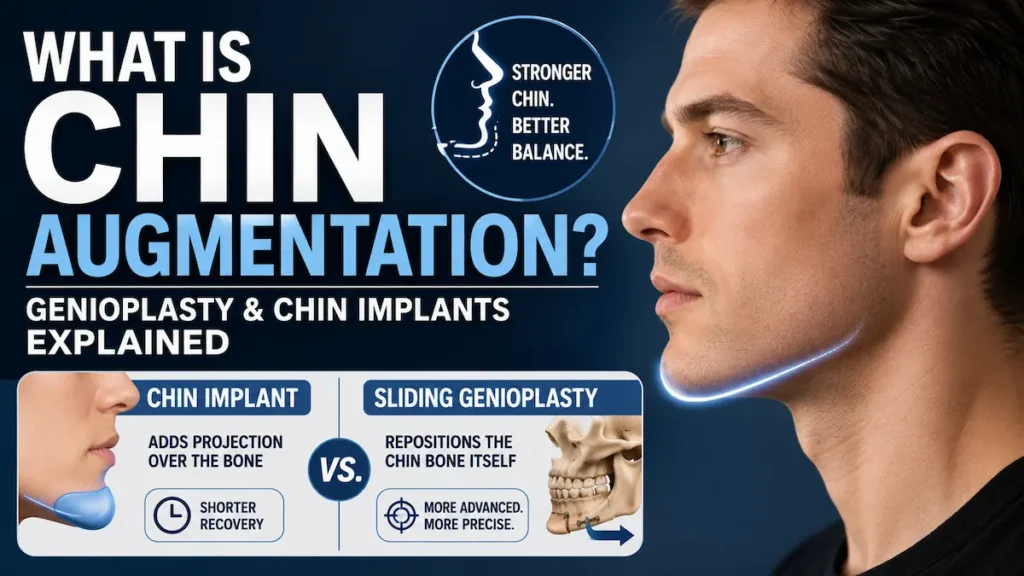
What Is Chin Augmentation? (Genioplasty & Chin Implants Explained)
Chin augmentation strengthens a weak or receding chin to improve facial balance. It can be done with a chin implant, which adds projection over the bone, or with sliding genioplasty, which repositions the chin bone itself. Temporary filler is a non-surgical option, but it does not create the same structural change.
How Chin Augmentation Works
Chin augmentation adds projection, shape, or definition to the lower third of the face. The goal is not to create an exaggerated jawline. The goal is proportion.
For some patients, that means placing a carefully selected implant over the chin bone. For others, it means moving the chin bone forward, downward, upward, or slightly sideways through sliding genioplasty.
Our approach begins with profile analysis. We look at the relationship between the chin, lower lip, nose, jawline, and neck. A small change in chin projection can make the face look more balanced without changing the patient’s identity.
Chin Augmentation Terminology: Genioplasty, Chin Implant, and Mentoplasty
The terms can be confusing at first. “Chin augmentation” is the broad patient-facing term. It includes both implant-based and bone-based correction.
“Genioplasty” usually refers to surgery on the chin bone. In most aesthetic contexts, this means sliding genioplasty, where the lower chin bone is cut, repositioned, and secured with small plates or screws.
A “chin implant” is different. It uses a silicone or porous implant placed over the existing bone. It does not move the bone itself.
“Mentoplasty” is another medical term for chin reshaping. The American Society of Plastic Surgeons describes chin surgery as reshaping the chin through implant enhancement or bone-based reduction, which is why the terms genioplasty and mentoplasty often appear together in patient research.
Why a Weak Chin Affects Your Whole Profile
The chin acts like an anchor for the lower face. When it is under-projected, nearby features can look out of balance.
- The nose may appear more prominent from the side.
- The jawline may look less defined.
- The neck may look fuller than it actually is.
- The lower face may appear shorter or less structured.
This is why chin augmentation is often discussed with rhinoplasty or neck lift surgery. In profile surgery, one feature rarely exists in isolation.
“A chin that is only a few millimetres under-projected can make the nose look larger and the neck look softer. The best result comes from profile planning, not from treating the chin as a separate object.”
The Two Surgical Routes: Implant vs Sliding Genioplasty
There are two main surgical ways to enhance the chin. A chin implant is usually best for mild to moderate horizontal deficiency. It is shorter, simpler, and can be removed or changed if needed.
Sliding genioplasty is more advanced. It is used when the bone needs to move in a more complex way. This may include severe retrusion, vertical imbalance, asymmetry, or a long-face pattern.
Both options can look natural. The right choice depends on anatomy, not preference alone.
Benefits of Chin Augmentation
Chin augmentation can improve more than the chin itself. By strengthening the lower third of the face, it can create better profile balance, sharper jawline definition, and a more proportionate relationship between the chin, nose, lips, and neck.
Balanced Facial Profile
Most patients do not want a “new face.” They want their profile to look more balanced. Chin augmentation can improve the relationship between the forehead, nose, lips, and chin.
This is especially important for Canadian patients who have already researched nose surgery and realized that the chin may be part of the same profile concern.
Stronger Jawline Definition
A better-positioned chin can make the jawline look clearer from the front and side. It can also improve the transition between the lower face and neck.
This benefit is not only aesthetic. For many patients, it makes the face look more confident in photos, video calls, and professional settings.
Reduced “Double Chin” Illusion
Some patients think they need neck liposuction when the deeper issue is chin retrusion. A weak chin can make the area under the chin look fuller, even when fat volume is modest.
In these cases, chin augmentation may improve neck contour. For stronger definition, it may be combined with targeted neck liposuction or a neck lift.
Improved Side-Profile Photos
Side-profile photos often reveal chin imbalance before front-facing photos do. A recessed chin can make the face look less structured from the side.
After chin augmentation, many patients notice that their profile looks cleaner, calmer, and more proportionate. The result should not announce surgery. It should look like the face was always meant to sit that way.
Masculinization or Refinement Depending on the Patient
For male patients, chin augmentation can strengthen the lower face and support a more defined jawline. For female patients, the goal is often softer profile refinement rather than a square or heavy chin.
We design the change around sex, facial width, ethnicity, and personal goals. A strong result is not the same as an oversized result.
Am I a Good Candidate for Chin Augmentation?
The best candidates for chin augmentation have a weak, recessed, short, or under-projected chin that affects overall facial balance. Candidacy depends on chin position, bite alignment, soft-tissue thickness, health status, and whether the concern is cosmetic, skeletal, or dental in origin.
Chin Deficiency and Retrusion Assessment
You may be a good candidate for chin augmentation if your chin sits behind the ideal facial profile line. This is often called chin retrusion, chin deficiency, or a weak chin.
Patients usually notice it in side-profile photos first. The chin may look too small for the nose, too short for the lower face, or too recessed for the jawline.
During your consultation, we assess the chin from multiple angles. We look at horizontal projection, vertical height, symmetry, jawline transition, and how the chin relates to the lips and nose.
Chin-Lip-Nose Aesthetic Proportions
Chin augmentation is never just about the chin. The lower face must work with the lips, nose, and neck.
A chin that is too recessed can make the upper lip look more prominent. It can also make a balanced nose appear larger than it really is.
We use profile analysis to understand whether the chin needs forward projection, vertical length, width, or asymmetry correction. This helps us avoid over-correction.
“The safest chin result is the one that respects the whole profile. If we only chase projection, we risk making the chin look separate from the face.”
Male Candidates: Jawline Masculinization
Male patients often seek chin augmentation because the lower face lacks definition. A stronger chin can support a more masculine jawline, especially when paired with healthy neck contour.
The goal is not always a square, heavy chin. Some men need projection. Others need width. Some need both.
For men with mild to moderate deficiency, a chin implant may create enough structure. For severe retrusion or vertical imbalance, sliding genioplasty may be the better structural choice.
Female Candidates: Profile Refinement
Female chin augmentation usually focuses on refinement rather than size. A small increase in projection can bring the lower face into balance without creating a harsh jawline.
We consider facial width, nose shape, lip position, and the natural softness of the lower face. A well-planned result should look elegant, not oversized.
For many female patients, the ideal result is subtle. Friends may notice that the face looks more balanced, but they should not immediately identify the chin as the reason.
When Chin Work Should Pair With Rhinoplasty
Chin augmentation is commonly discussed during rhinoplasty planning. A recessed chin can make the nose look larger from the side.
Some patients think they need a more dramatic nose reduction. After profile analysis, they may realize that a smaller chin is part of the imbalance.
When chin augmentation and rhinoplasty are planned together, the goal is profile harmony. This can create a more balanced change than treating the nose alone.
Dental and Bite Considerations
Chin augmentation improves the shape of the chin. It does not correct a bite problem, jaw misalignment, or skeletal orthodontic issue.
If your lower jaw is significantly recessed, if your bite does not meet properly, or if you have functional chewing concerns, orthognathic jaw surgery may be more appropriate than aesthetic chin surgery.
We screen for this before recommending treatment. If jaw surgery is the better medical route, we will not present chin augmentation as a substitute.
When Chin Augmentation Is Not Recommended
Chin augmentation may not be appropriate if expectations are unrealistic, facial growth is incomplete, or the patient has an untreated bite problem.
It may also be delayed if there is active infection, poor oral hygiene, uncontrolled medical disease, or recent facial trauma.
For filler patients, we also look at filler history. Heavy or poorly placed filler can distort assessment and may need to dissolve before surgical planning.
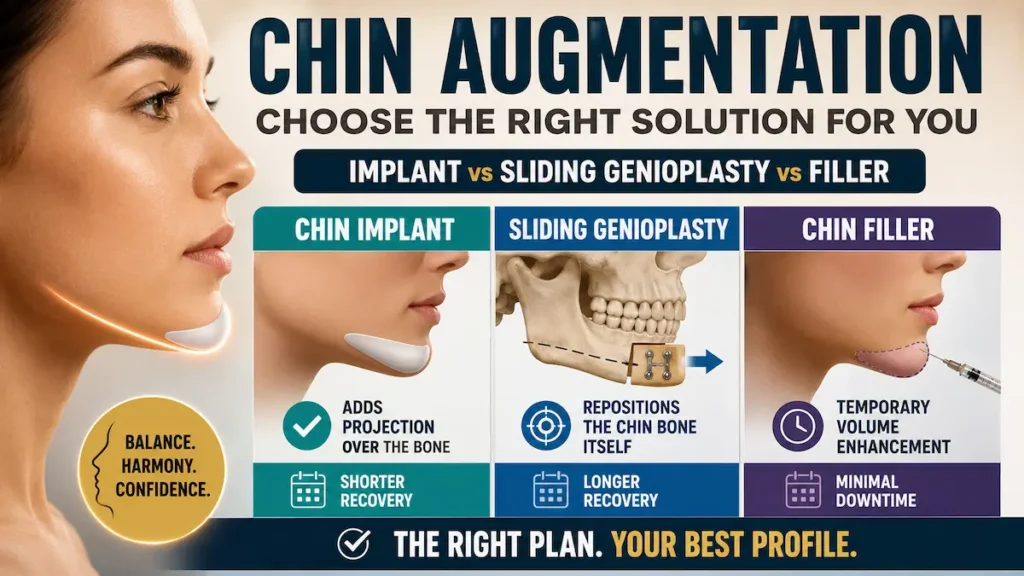
Chin Implant vs Sliding Genioplasty vs Filler: The Decision Framework
Chin implants, sliding genioplasty, and filler all improve chin projection, but they solve different problems. The safest plan depends on whether the patient needs temporary contouring, implant-based projection, or true bone repositioning for a more structural correction.
The Three-Option Decision Overview
There are three common ways to improve chin projection: implant, sliding genioplasty, and filler. They are not interchangeable.
A chin implant adds shape over the existing bone. Sliding genioplasty moves the bone itself. Filler adds temporary soft-tissue volume.
The right option depends on how much correction is needed, whether the chin is vertically short or long, and whether the patient wants a reversible or bone-based solution. A 2023 systematic review in PubMed on chin augmentation techniques also emphasizes that technique selection and complication prevention depend on understanding each method’s specific risks.
| Method | Permanence | Correction Range | Recovery | Cost Pattern | Best Candidate |
|---|---|---|---|---|---|
| Chin Implant | Long-lasting; removable or replaceable | Mild to moderate horizontal projection | Usually shorter than genioplasty | Lower than sliding genioplasty | Recessed chin with good bite and stable facial proportions |
| Sliding Genioplasty | Permanent bone repositioning | Moderate to severe retrusion; vertical or asymmetry correction | Longer than implant recovery | Higher due to bone work and fixation | Patients needing skeletal movement, not just added projection |
| Chin Filler | Temporary; usually 12–18 months | Minor contouring only | Minimal downtime | Lower per session, but repeated maintenance | Patients testing a small change or correcting mild soft-tissue contour |
Chin Implant: Silicone or Medpor Over the Bone
A chin implant is placed over the front of the chin bone to add projection and shape. It does not cut or move the bone.
This option is often suitable for mild to moderate horizontal deficiency. It works well when the patient has a stable bite, normal vertical facial height, and needs projection rather than skeletal repositioning.
The main advantages are practical. Chin implant surgery is usually shorter than sliding genioplasty, the recovery is often easier, and the implant can be changed or removed if clinically necessary.
The limitation is also clear. An implant cannot shorten a long chin, lengthen a short lower face, or correct major asymmetry as precisely as bone movement can.
Sliding Genioplasty: Bone Osteotomy
Sliding genioplasty is a bone-based procedure. The surgeon cuts the chin bone, moves it into a new position, and secures it with small plates and screws.
It can move the chin forward, backward, upward, downward, or slightly sideways. This makes it more versatile than an implant for complex chin imbalance.
It is often better for severe retrusion, long-face patterns, vertical chin problems, or asymmetry. It is also useful for patients who do not want an implant.
The tradeoff is complexity. Sliding genioplasty takes longer, recovery is usually more involved, and the cost is higher than implant-based chin augmentation.
“A chin implant is excellent when the issue is projection. Sliding genioplasty is stronger when the problem is skeletal proportion, vertical height, or asymmetry.”
Non-Surgical Chin Filler: Honest Framing
Chin filler can be useful, but it is not a structural fix. It adds temporary soft-tissue volume in front of the chin.
For a patient with a very mild deficiency, filler may improve contour for 12–18 months. It can also help someone “test” whether extra chin projection suits their face.
Filler does not move bone. It cannot correct a severe recessed chin, vertical imbalance, bite-related jaw deficiency, or major asymmetry.
Repeated filler can also become costly over time. Some patients spend more on maintenance over several years than they would have spent on a surgical correction.
“Filler can preview a small chin change, but it should not be sold as the same thing as surgery. A structural deficiency needs a structural plan.”
How We Choose: Deficiency Severity and Face Length
Our decision starts with the patient’s anatomy. We ask three questions.
- Is the problem mild, moderate, or severe?
- Is the issue horizontal projection only, or does vertical height also need correction?
- Does the chin imbalance come from the chin itself, the jaw, the bite, or the nose-chin relationship?
If the issue is mild and soft-tissue based, filler may be enough. If the chin needs moderate forward projection with good facial proportions, a chin implant may be the most efficient option.
If the patient needs larger movement, vertical correction, asymmetry correction, or a no-implant solution, sliding genioplasty may be the better recommendation.
This is why we offer both implant-based and bone-based options. The patient should not have to fit the surgeon’s only technique.
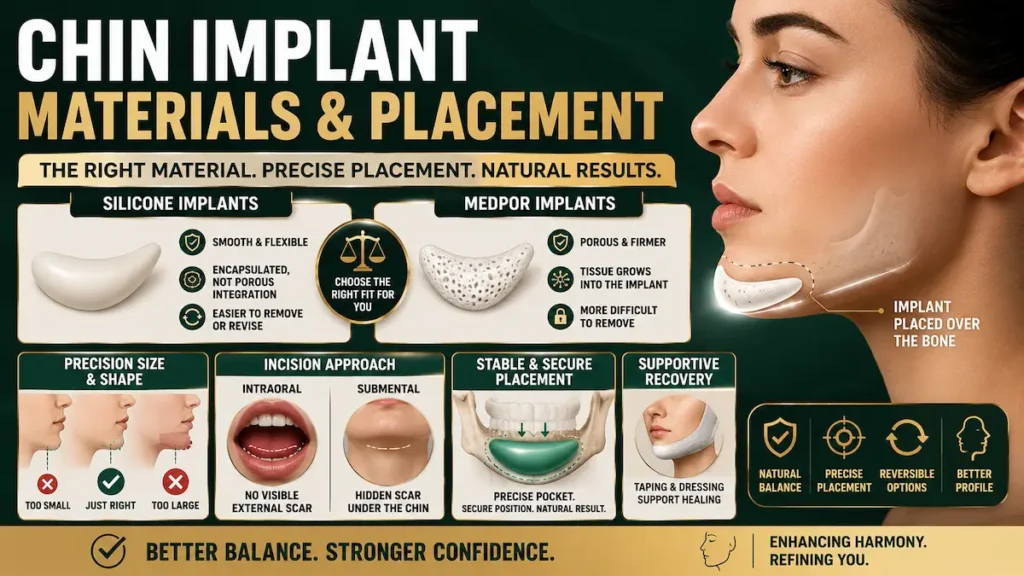
Chin Implant Materials and Placement
Chin implant results depend on more than implant size. Material choice, incision route, pocket control, and fixation all affect how natural, stable, reversible, and proportionate the final result will be.
Silicone Chin Implants
Silicone is the most common material used for chin implants. It is smooth, flexible, and available in different shapes and sizes.
For many patients, silicone offers the best balance of structure and reversibility. If the implant needs to be changed later, removal is usually more straightforward than with porous materials.
Silicone does not “melt” into the bone. It sits in a carefully created pocket over the chin bone, where it adds projection and shape.
This is often the preferred option for patients who want a predictable profile change without bone surgery.
Medpor Chin Implants
Medpor is a porous polyethylene material. Its surface allows soft tissue to grow into the implant over time.
This can create strong stability. It may be useful in selected patients who need firm integration and a more fixed implant position.
The tradeoff is reversibility. Because tissue grows into the implant, removal can be more involved than silicone removal.
We discuss this difference clearly during consultation. The best implant is not the most aggressive one. It is the safest fit for the patient’s anatomy and long-term goals.
| Material | Texture | Integration | Reversibility | Best For |
|---|---|---|---|---|
| Silicone | Smooth and flexible | Encapsulated by tissue, not porous integration | Usually easier to remove or revise | Most standard chin implant candidates |
| Medpor | Porous and firmer | Soft tissue grows into the implant | More difficult to remove | Selected patients who need stronger fixation |
Implant Sizing and Shape Selection
Implant sizing is one of the most important parts of chin augmentation. A few millimetres can change the whole lower face.
An implant that is too small may not correct the profile enough. An implant that is too large can look heavy, masculine, or separate from the face.
We choose size based on the patient’s profile, facial width, soft-tissue thickness, and desired level of projection. Male and female patients often need different design logic.
The goal is balance. We do not size the chin in isolation.
“A good chin implant should disappear into the face. The viewer should notice better balance, not the edge of an implant or an oversized lower face.”
Intraoral vs Submental Placement
Chin implants can be placed through an incision inside the mouth or through a small incision under the chin. Each approach has advantages.
The intraoral approach avoids an external skin scar. The incision sits inside the lower lip area, so scar visibility is not a concern.
The submental approach uses a small incision hidden under the chin. It can offer direct access and precise pocket control, especially in some implant cases.
The right approach depends on anatomy, implant type, surgeon preference, and infection-risk planning. We explain the tradeoff before surgery.
How Chin Implants Are Secured
A chin implant must sit in a stable pocket. If the pocket is too loose, the implant can shift. If it is too tight or poorly positioned, the result may look asymmetric.
Our surgeons create the implant pocket directly over the chin bone. The implant is positioned to match the midline and support the intended projection.
Some implants are secured with sutures or small fixation points. Others remain stable because the pocket is precise and the implant shape fits the bone.
Post-operative taping or dressing may also be used in the early recovery phase. This supports the implant while swelling begins to settle.
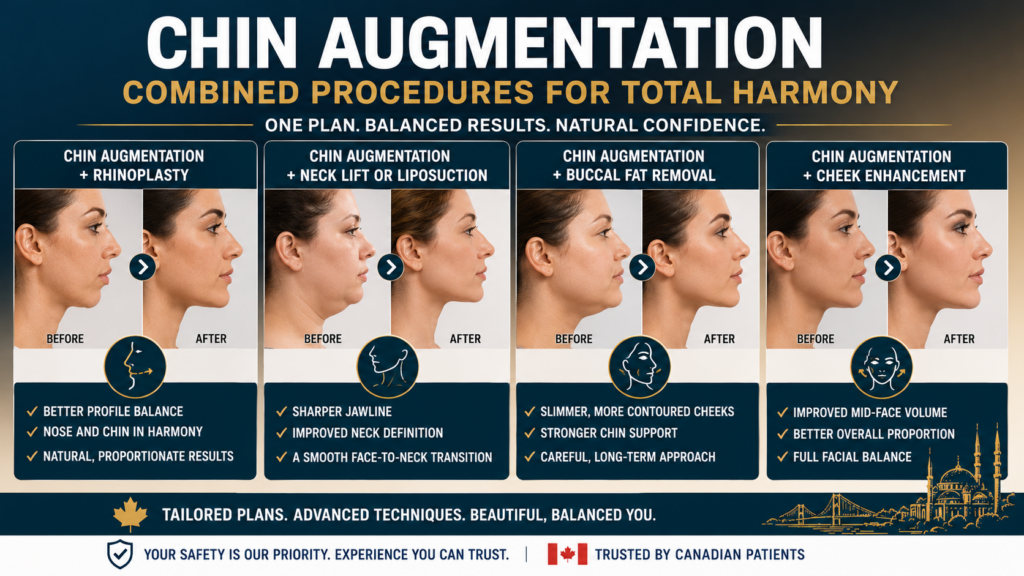
Combined Procedures: Chin Augmentation + Other Treatments
Chin augmentation is often part of a larger profile-balance plan. When appropriate, it can be combined with rhinoplasty, neck lift, liposuction, buccal fat removal, or cheek enhancement to improve facial harmony without overcorrecting one feature.
Chin Augmentation + Rhinoplasty: Profile Harmony
Chin augmentation and rhinoplasty are one of the most common profile-balance combinations. A weak chin can make the nose appear larger, so treating the nose alone may not create the desired proportion.
When performed together, the goal is not a dramatic change in both areas. It is balanced adjustment.
Patients considering this combination can review our rhinoplasty in Turkey guide for more detail.
Chin Augmentation + Neck Lift or Liposuction
A stronger chin can sharpen the transition between the face and neck. If excess fat or skin laxity is also present, chin augmentation may be paired with neck lift surgery or liposuction.
This combination can be useful for patients who describe a soft jawline, double-chin appearance, or unclear cervicomental angle.
The surgical plan must be conservative. Overdoing both chin projection and neck reduction can create an artificial lower-face result.
Chin Augmentation + Buccal Fat Removal
Chin augmentation may be combined with buccal fat removal in selected patients who have a round lower face and weak profile structure.
This combination requires caution. Buccal fat removal is permanent, and over-removal can age the face.
For suitable candidates, chin augmentation supports structure while buccal fat removal refines cheek fullness. The plan should respect long-term ageing, not only the current trend.
Chin + Cheek Augmentation: Full Facial Balance
Some patients have both chin retrusion and mid-face flatness. In these cases, chin-only correction may improve the lower face but leave the overall profile incomplete.
Cheek enhancement, fat transfer, or other facial balancing procedures may be discussed when mid-face support is also lacking.
The decision should be individualized. More procedures do not automatically mean a better face.
Anesthesia for Chin Augmentation: Local/Sedation or General
Anesthesia for chin augmentation depends on the technique. Chin implant surgery may be suitable for local anesthesia with sedation, while sliding genioplasty usually requires general anesthesia because it involves planned bone movement and fixation.
Chin Implant Anesthesia
Chin implant surgery can often be performed with local anesthesia and sedation. This keeps the patient comfortable without requiring the same level of anesthesia used for bone surgery.
For isolated implant surgery, this can mean a shorter procedure and a simpler early recovery. It is not always the right choice, but it is common for suitable candidates.
We decide based on the surgical plan, patient comfort, medical history, and whether other procedures are being combined in the same session.
Sliding Genioplasty Anesthesia
Sliding genioplasty is usually performed under general anesthesia. This is because the surgery involves cutting and repositioning the chin bone.
Bone work requires controlled conditions, stable monitoring, and precise surgical access. General anesthesia allows the surgeon to work safely while the patient remains fully comfortable.
For Canadian patients, we review anesthesia history before travel. This includes medication use, previous anesthesia reactions, smoking status, and relevant medical conditions.
Pre-Anesthesia Assessment for Canadian Patients
Before surgery, every patient completes pre-operative medical testing. This may include blood work, anesthesia review, and medical clearance depending on age and health history.
We also ask about prescription medications, supplements, anticoagulants, allergies, and prior dental or jaw surgery.
If you have a family physician in Canada, we recommend discussing international elective surgery before travel. This is especially important if you have cardiovascular risk factors, diabetes, sleep apnea, or clotting history.
A safer operation begins before the operating room.
AKM Anesthesiology Team Credentials
Our anesthesia planning is integrated into the full surgical pathway. The goal is not only comfort during surgery, but safe recovery after surgery.
Chin augmentation may be short compared with larger body procedures, but it still requires careful monitoring. Airway, blood pressure, oxygenation, and post-operative nausea prevention all matter.
For patients travelling back to Canada, anesthesia choice also affects early mobility, hydration, and readiness for the return flight.
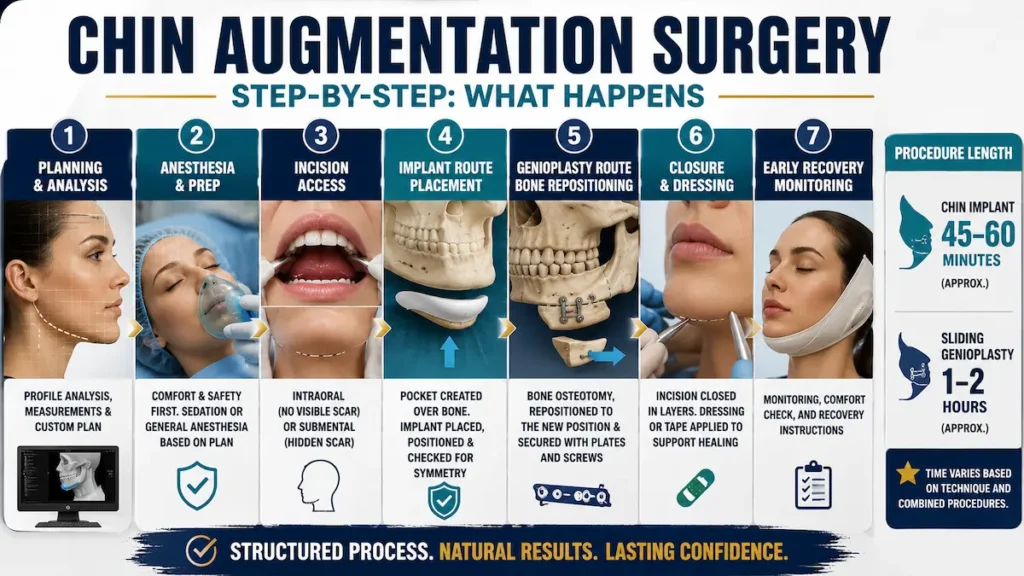
Step-by-Step: What Happens During Chin Augmentation Surgery?
Chin augmentation follows a structured surgical plan: profile analysis, anesthesia, incision, implant placement or bone repositioning, closure, and early recovery monitoring. Each step is tailored to whether the patient is having a chin implant, sliding genioplasty, or a combined facial procedure.
Pre-Operative Profile Analysis and Planning
Before surgery, we finalize the surgical plan in person. This includes profile analysis, chin measurements, facial photography, and review of the original virtual consultation.
For implant patients, we confirm implant shape and size. For sliding genioplasty patients, we confirm the planned bone movement and fixation strategy.
We also review combined procedures. Chin augmentation paired with rhinoplasty, neck liposuction, or facial contouring requires a single facial balance plan.
Anesthesia
The anesthesia plan begins once pre-operative checks are complete. Chin implant patients may receive local anesthesia with sedation, while sliding genioplasty patients usually receive general anesthesia.
Comfort is important, but safety is the priority. The anesthesia team monitors the patient throughout the procedure.
After anesthesia takes effect, the surgical area is cleaned and prepared under sterile conditions.
Incision: Intraoral or Submental
The surgeon creates access through either an intraoral incision inside the mouth or a submental incision under the chin.
An intraoral incision leaves no external scar. A submental incision creates a small hidden scar beneath the chin, often placed in a natural crease.
Each route has a role. The surgeon chooses the approach that gives the safest access and the most accurate result for the patient’s anatomy.
Implant Route: Pocket Creation and Implant Placement
For a chin implant, the surgeon creates a pocket over the chin bone. This pocket must match the implant size closely.
The implant is inserted and positioned on the midline. The surgeon checks projection, symmetry, and how the implant supports the lower face.
If the implant sits correctly, the incision is closed in layers. A dressing or supportive tape may be placed to reduce early movement and swelling.
Genioplasty Route: Bone Osteotomy and Repositioning
For sliding genioplasty, the surgeon accesses the chin bone and performs a controlled osteotomy. This means the lower portion of the chin bone is cut in a planned line.
The bone segment is then moved to the desired position. It may be advanced, shortened, lengthened, or adjusted for asymmetry.
Once the position is correct, the bone is secured with small plates and screws. This fixation allows the bone to heal in its new position.
Sliding genioplasty is more complex than implant surgery, but it offers powerful structural correction when the anatomy requires it.
Closure
After the implant or bone movement is complete, the incision is closed carefully. Intraoral incisions usually use dissolvable sutures.
Submental incisions are closed in layers to support a fine scar. Scar care begins after the initial healing phase.
Before the patient leaves the operating area, the team checks bleeding, dressing, comfort, and early recovery stability.
Procedure Length
An isolated chin implant often takes about 45 to 60 minutes. The exact time depends on incision route, implant type, and whether another procedure is being performed.
Sliding genioplasty usually takes 1 to 2 hours. It may take longer if asymmetry correction or combined facial surgery is included.
Combined surgery is planned carefully so that operating time stays appropriate. We do not add procedures simply for convenience.
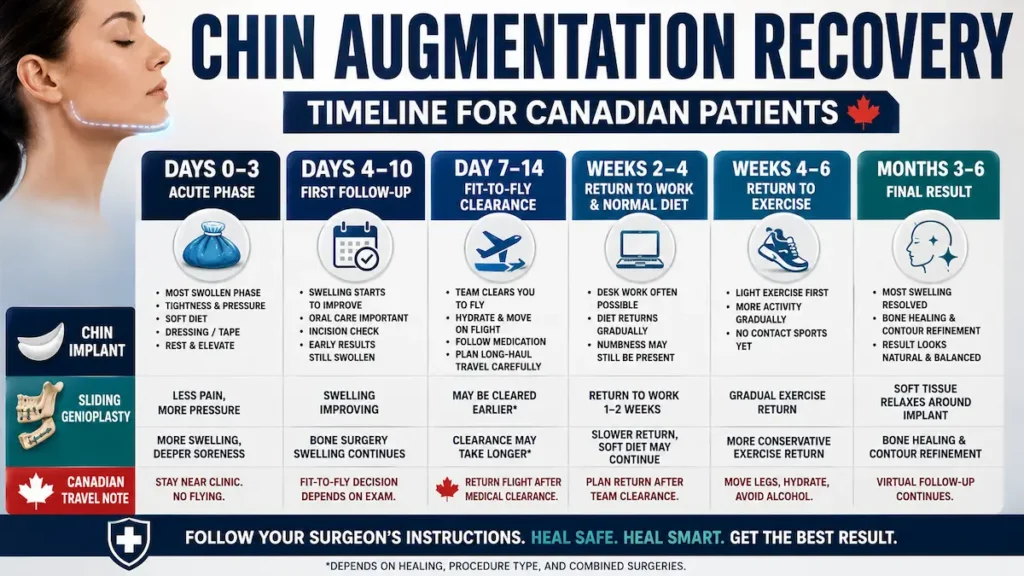
Chin Augmentation Recovery: Timeline for Canadian Patients
Recovery after chin augmentation varies by technique. Chin implant patients usually have a shorter and lighter recovery, while sliding genioplasty patients need more time for swelling reduction, soft-tissue settling, and bone healing before final profile definition appears.
Days 0–3: Acute Phase, Swelling, Tape, and Soft Diet
The first three days are usually the most swollen phase after chin augmentation. This is normal. The chin may feel tight, firm, or slightly numb.
Patients with a chin implant usually experience pressure more than sharp pain. Sliding genioplasty patients may feel deeper soreness because the bone has been repositioned.
A soft diet is often recommended during the early phase, especially when the incision is inside the mouth. Soups, smoothies, yogurt, eggs, and soft pasta are easier than chewing firm foods.
- Sleep with your head elevated.
- Avoid pressure on the chin.
- Use prescribed medication exactly as directed.
- Keep intraoral incisions clean if your surgeon used that route.
- Avoid smoking and vaping, as they can slow healing.
Supportive tape or dressing may be used to control swelling and stabilize the early result. Do not remove it unless your clinical team instructs you to do so.
Days 4–10: First Follow-Up and Suture Care
By days 4 to 10, swelling usually begins to shift downward and soften. Bruising, if present, often changes colour during this period.
For chin implant patients, this is when the early profile becomes easier to see. It will still look swollen. Do not judge the final result yet.
If the incision is intraoral, oral hygiene matters. You may be asked to rinse gently after meals and avoid hard or spicy foods that irritate the incision.
If the incision is submental, the small under-chin incision will be checked. Scar care begins only after the skin has sealed and the surgeon confirms it is safe.
Our HBOT/LLLT Recovery Protocol
Recovery is not only about waiting for swelling to fade. It is also about supporting tissue repair in the safest way possible.
We use Hyperbaric Oxygen Therapy (HBOT) and Low-Level Laser Therapy (LLLT) as part of our advanced recovery approach for suitable surgical patients. HBOT increases oxygen availability in healing tissues, while LLLT supports cellular repair and inflammation control.
This matters for Canadian patients because long-haul travel adds physical stress. A patient flying back to Toronto, Vancouver, Calgary, or Montreal needs swelling control, hydration, mobility, and fit-to-fly clearance planned before departure.
For deeper detail on our healing technology, patients can review our technology and standards page and our guide on Hyperbaric Oxygen Therapy benefits.
Day 7–14: Fit-to-Fly Clearance for Canadian Return Travel
Most Canadian patients should not plan their return flight based only on how they feel. Fit-to-fly clearance should come from the surgical team.
Chin implant patients may be cleared earlier than sliding genioplasty patients, depending on swelling, incision healing, and whether other procedures were combined.
Long-haul flights from Istanbul to Canada require planning. You will need to move your legs during the flight, stay hydrated, avoid alcohol, and follow medication instructions.
If you are combining chin augmentation with rhinoplasty, neck lift, or liposuction, the return-flight timeline may change. Combined procedures require a more conservative travel plan.
Our flight safety after surgery guide explains how we think about cabin pressure, swelling, circulation, and long-haul travel after elective procedures.
Week 2–4: Return to Work and Normal Diet
Many chin implant patients return to desk-based work within one to two weeks. This depends on swelling, bruising, camera-facing work, and personal comfort.
Sliding genioplasty recovery can be slower. Bone surgery usually creates more swelling and may require a longer soft-food period.
By weeks 2 to 4, patients often feel more socially comfortable. The chin may still feel firm, and lower-lip or chin numbness may still be present.
Normal diet returns gradually. Do not rush chewing if your surgeon has advised caution, especially after genioplasty.
Week 4–6: Return to Exercise
Light walking starts early, but heavy exercise should wait. Increased blood pressure can worsen swelling or increase bruising risk in the first weeks.
Most patients gradually return to more active exercise around weeks 4 to 6, depending on the procedure and healing progress.
Contact sports require a longer delay. The chin should not be exposed to impact while the implant pocket is stabilizing or the bone is healing.
For sliding genioplasty, exercise clearance may be more conservative. Bone healing must be respected.
Month 3–6: Final Result and Swelling Resolution
Chin augmentation results improve slowly. Early swelling can make the chin look larger, firmer, or more projected than it will later.
By three months, most swelling has settled. By six months, the result usually looks much closer to final.
For chin implants, the soft tissue relaxes around the implant. For sliding genioplasty, the bone continues healing in its new position.
Small changes may continue beyond six months. This is normal. The final result should look integrated with the face, not added on.
| Recovery Stage | Chin Implant | Sliding Genioplasty | Canadian Travel Note |
|---|---|---|---|
| Days 0–3 | Swelling, tightness, dressing or tape | More swelling, soft diet, deeper soreness | Stay near clinic; do not fly yet |
| Days 4–10 | Follow-up, swelling starts improving | Follow-up, oral care, bone-surgery swelling | Fit-to-fly decision depends on exam |
| Weeks 2–4 | Desk work often possible | Slower return, soft diet may continue | Return to Canada usually planned after clearance |
| Weeks 4–6 | Gradual exercise return | More conservative exercise return | Avoid contact sports after travel |
| Months 3–6 | Result looks more settled | Bone healing and contour refinement | Virtual follow-up continues |
Safety, Risks, and Scars of Chin Augmentation
Chin augmentation is generally well tolerated in suitable candidates, but it is still surgery. Patients should understand swelling, bruising, scar placement, temporary numbness, implant malposition, asymmetry, infection, and bone-healing considerations before choosing treatment.
Common Side Effects: Swelling, Bruising, Tightness, and Temporary Numbness
Chin augmentation is a surgical procedure, so some side effects are expected. Swelling and tightness are the most common.
Bruising may appear along the chin, lower lip, or upper neck. It usually improves over the first two weeks.
Temporary numbness can happen because the mental nerve supplies sensation to the lower lip and chin. This is usually temporary, but patients must understand that nerve-related symptoms can take time to settle.
Sliding genioplasty carries a higher nerve-sensation consideration than a simple implant because the surgery works closer to bone and nerve pathways.
Chin Implant Scar Reality: Submental vs Intraoral
Scar visibility depends on the incision route. An intraoral incision sits inside the mouth, so there is no external skin scar.
A submental incision creates a small scar under the chin. It is usually placed in a discreet location and becomes less noticeable as it matures.
No incision is truly “scarless.” A better question is whether the scar can be placed and managed in a way that makes it hard to see in normal life.
We discuss scar location before surgery. Patients should know where the incision will be, how it will heal, and what scar care may involve.
For more detail on scar support after aesthetic surgery, see our guide on minimizing scars with LLLT laser.
Chin Implant Gone Wrong: Malposition, Asymmetry, or Over-Projection
Patients often search “chin implant gone wrong” because they worry about an obvious or poorly positioned result. The fear is valid.
The most common avoidable problems are implant malposition, asymmetry, oversized projection, visible implant edges, or a chin that does not match the rest of the face.
These problems usually come from poor planning, incorrect sizing, weak pocket control, or treating the chin without analysing the full profile.
Our prevention strategy is simple: profile planning first, conservative sizing, careful implant pocket creation, and surgeon-led decision-making.
“Most unnatural chin implant results are not caused by the implant itself. They are caused by choosing the wrong size, the wrong pocket, or the wrong patient for an implant.”
Sliding Genioplasty Risks: Bone Healing, Plate Fixation, and Nerve Sensation
Sliding genioplasty is more powerful than an implant, but it is also more complex. The bone must heal in its new position.
Risks include swelling, temporary numbness, asymmetry, infection, delayed bone healing, and hardware-related concerns. These are uncommon, but they must be discussed honestly.
Plate and screw fixation is designed to hold the chin segment while the bone heals. Most patients do not feel the hardware in daily life.
If a patient has significant dental or jaw alignment concerns, aesthetic genioplasty may not be the right standalone procedure. In that case, orthognathic assessment may be needed.
How Our Sterile Protocol and Surgeon-Led Planning Reduce Risk
Risk reduction begins with patient selection. We do not recommend an implant when the patient needs bone movement. We do not recommend genioplasty when a simpler implant can safely meet the goal.
We also use a regulated surgical pathway: pre-operative testing, sterile operating standards, surgeon-led planning, and structured aftercare.
For international patients, continuity matters. We provide English-language instructions, post-operative medication guidance, and virtual follow-up after the patient returns to Canada.
The goal is not to pretend risk does not exist. The goal is to identify risk early, reduce it where possible, and respond quickly if healing does not follow the expected pattern.
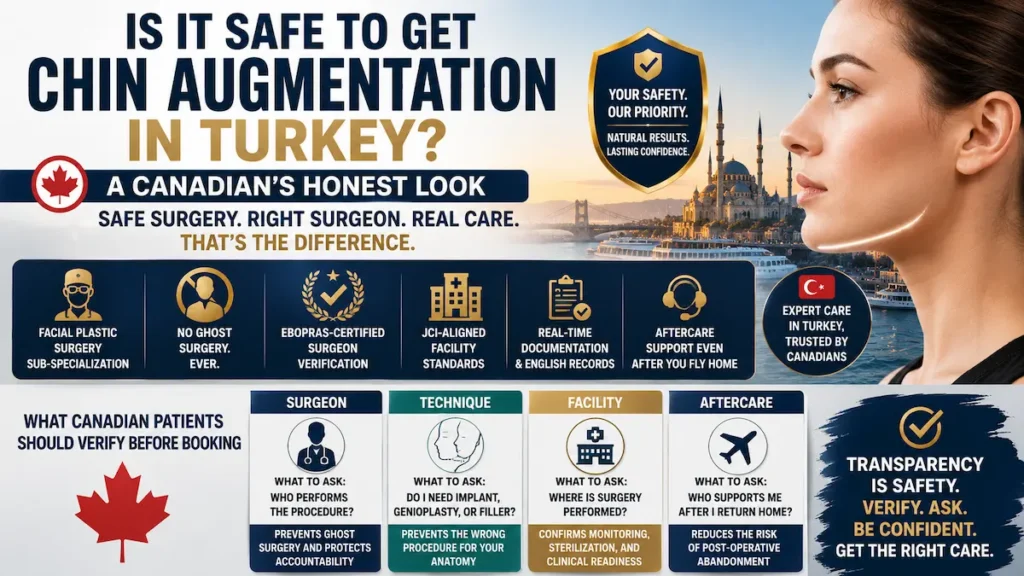
Is It Safe to Get Chin Augmentation in Turkey? A Canadian’s Honest Look
Chin augmentation in Turkey can be safe when the procedure is performed by qualified surgeons in a regulated clinical setting with clear aftercare. Canadian patients should verify the surgeon, facility, technique plan, documentation, and follow-up process before booking surgery abroad.
The Turkey Cosmetic Surgery Reality: How AKM Differs
Canadian patients are right to ask safety questions before travelling for chin augmentation. A lower price should never be the reason to ignore surgeon credentials, facility standards, or aftercare planning.
The Government of Canada’s guidance on medical care outside Canada reminds travellers that all medical and surgical procedures carry risk, and that follow-up planning is especially important when care happens abroad.
The safest way to think about surgery in Turkey is not “Turkey versus Canada.” The better question is: who is operating, where is the surgery performed, and what happens if you need support after you fly home?
At AKM Clinic, we work through a surgeon-led pathway. Your treatment plan, implant selection, surgical route, and follow-up schedule are built around your anatomy rather than a fixed package.
Facial Plastic Surgery Sub-Specialization
Chin augmentation sits at the intersection of facial aesthetics, skeletal proportion, and soft-tissue balance. It should not be planned as a simple “add projection” procedure.
A surgeon must understand how the chin affects the nose, lips, jawline, and neck. This is especially important when chin augmentation is combined with rhinoplasty or neck contouring.
We assess whether the patient needs an implant, sliding genioplasty, filler, or no chin procedure at all. That last option matters. Good judgment includes knowing when not to operate.
Ghost Surgery in Turkey Facial Procedures: How to Avoid It
One of the biggest international-surgery concerns is “ghost surgery.” This means the patient believes one surgeon is operating, but another person performs part or all of the procedure.
Canadian patients should ask direct questions before booking:
- Who is the surgeon of record?
- Will the same surgeon perform the operation?
- Where will the surgery take place?
- What credentials does the surgeon hold?
- Will I receive English-language medical records?
We encourage these questions. A trustworthy clinic should not be offended by verification.
For a deeper checklist, read our guide on ghost surgery in Turkey.
EBOPRAS-Certified Surgeon Verification
Canadian patients are familiar with the Royal College of Physicians and Surgeons of Canada. International surgery requires a different credential framework, but the verification principle is the same.
Look for board-level training, documented facial surgery experience, and recognized professional memberships. A clinic should be able to explain how its surgeon credentials compare with Canadian expectations.
For chin augmentation, the surgeon should also show experience in facial profile work, not only general cosmetic surgery.
Our surgeon section and credential resources explain how Canadian patients can review training, specialty focus, and surgical standards before making a decision.
AKM’s JCI-Aligned Standards and Real-Time Documentation
Facility safety matters as much as technique. Chin augmentation may be shorter than larger body surgery, but it still requires sterile conditions, monitoring, and a clear emergency pathway.
We operate through a regulated clinical environment with strict sterilization protocols, pre-operative testing, and structured recovery checks. This reduces preventable risk.
Patients also receive post-operative instructions in English. These records help if a Canadian family physician, dentist, or local specialist needs to understand what was done.
Our broader safety framework is detailed on our technology and standards page.
What Canadian Patients Should Verify Before Booking
Before booking chin augmentation abroad, Canadian patients should verify four things: surgeon, facility, plan, and aftercare.
| Verification Area | What to Ask | Why It Matters |
|---|---|---|
| Surgeon | Who performs the procedure? | Prevents ghost surgery and protects accountability |
| Technique | Do I need implant, genioplasty, or filler? | Prevents the wrong procedure for your anatomy |
| Facility | Where is surgery performed? | Confirms monitoring, sterilization, and clinical readiness |
| Aftercare | Who supports me after I return to Canada? | Reduces the risk of post-operative abandonment |
If a clinic avoids these questions, that is a warning sign. Transparency is part of safety.
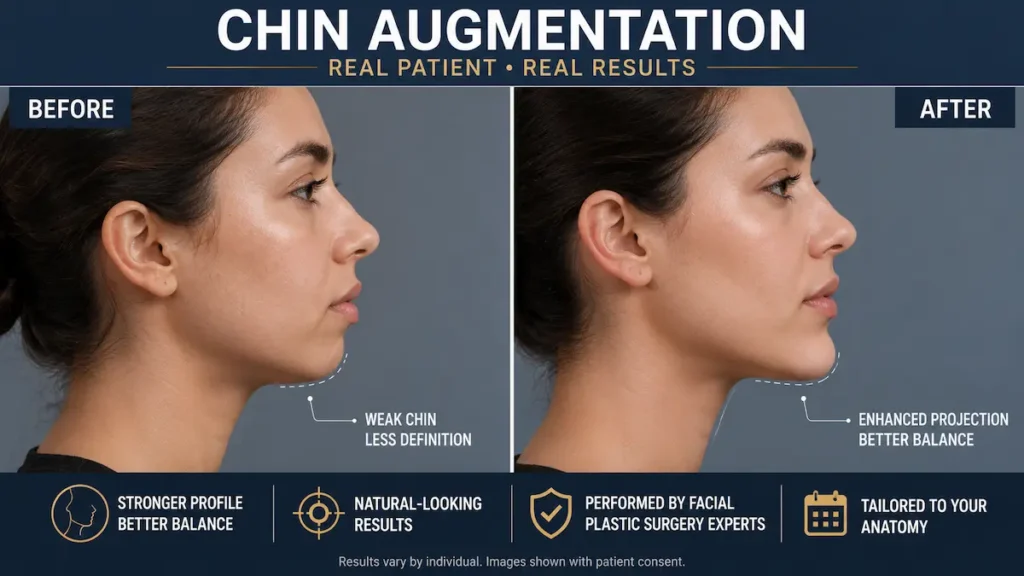
Chin Augmentation Before and After: Realistic Expectations and Results
The goal of chin augmentation is better proportion, not an exaggerated chin. A natural result should improve profile balance, jawline definition, and lower-face structure while still looking consistent with the patient’s sex, ethnicity, facial width, and overall anatomy.
Chin Implant Before and After: Realistic Outcomes
A well-planned chin implant can create a cleaner profile, stronger jawline, and more balanced lower face. The result should not look like an attached object.
Most implant patients are seeking mild to moderate improvement. The best before-and-after result often looks subtle from the front and more noticeable from the side.
The most natural result comes from correct sizing. Oversized chin implants can create a heavy, artificial, or overly masculine look.
We use the patient’s facial width, soft-tissue thickness, nose projection, and neck angle to guide sizing. This is why two patients with the same “weak chin” may need different implants.
Genioplasty Before and After: Bone Repositioning Results
Sliding genioplasty can create a more powerful change because it moves the chin bone itself. It can improve projection, vertical height, and some asymmetry patterns.
Before-and-after photos for genioplasty may show a bigger structural difference than implant photos. That does not mean genioplasty is always better.
It means it is more appropriate for the right candidate. If the problem is skeletal, bone movement can be the more logical solution.
Sliding Genioplasty Before and After: Greater Correction
Sliding genioplasty is often chosen when the chin is severely recessed or vertically imbalanced. It can also help when the patient wants no implant material.
The recovery is usually longer than implant recovery. Swelling may persist for several months, and numbness can take time to improve.
The advantage is control. The surgeon can move the bone in a planned direction rather than simply adding volume over it.
Male vs Female Chin Augmentation Results
Male and female chin goals are often different. Male patients may want more lower-face strength, jawline structure, and projection.
Female patients may want softer profile balance, better side-profile proportion, or a subtle correction that does not widen the chin too much.
Ethnicity also matters. A natural-first result should respect the patient’s facial identity rather than copying one universal chin shape.
Our philosophy is “Rejuvenation, not alteration.” In chin augmentation, that means profile balance without making the lower face look disconnected from the rest of the face.
Is It Permanent? Implant and Genioplasty Longevity
Chin implants are designed to be long-lasting. They do not dissolve like filler, and many patients keep them for many years.
They can still be revised, changed, or removed if needed. That reversibility is one reason implant-based augmentation remains popular.
Sliding genioplasty is different. Since the bone is repositioned and heals in its new location, the result is considered permanent.
Ageing will still continue. Skin laxity, weight changes, and neck soft-tissue changes can affect how the lower face looks over time.
Before & After Gallery
Before-and-after photos help patients understand realistic projection changes, swelling, and facial balance. They should be reviewed carefully, not emotionally.
Look for patients with similar chin deficiency, facial width, and nose-chin relationship. A result that looks ideal on one face may not suit another.
During consultation, we explain which examples are relevant to your anatomy. Patients can also review broader facial results and patient stories through our professional plastic surgery reviews.
“Before-and-after photos are useful only when the anatomy is comparable. The question is not ‘Do I like this result?’ It is ‘Does this plan make sense for my face?’”
Chin Augmentation Cost 2026: Turkey vs Canada
Canadian patients researching chin implant cost often compare Toronto, Vancouver, Calgary, and Montreal private clinic quotes against Istanbul pricing. The difference is not only the surgical fee. In Canada, anesthesia, facility use, consultation, medication, imaging, and follow-up may be billed separately, which can make the final quote less predictable.
At AKM Clinic, Chin Implants (Mentoplasty) are CAD $4,800, while Sliding Genioplasty is CAD $5,450. Sliding genioplasty costs more because it involves controlled bone movement and fixation rather than implant placement alone. For selected patients, Non-Surgical Chin Augmentation is CAD $1,400, but filler is temporary and cannot replace structural correction.
By comparison, private chin implant pricing in Toronto, Vancouver, Calgary, or Montreal often ranges from CAD $6,000–$12,000 once anesthesia and facility costs are included. Canadian sliding genioplasty can be higher because it involves bone work, fixation, and more complex surgical planning.
For the full cost breakdown, see our chin aesthetics cost guide. The right price comparison is not just “Canada vs Turkey”; it is whether the quote includes surgeon fees, anesthesia, facility costs, medications, transfers, hotel support, and follow-up.
Canadian-dollar pricing shown for planning clarity; your coordinator will confirm the final payment details before booking. International flights and personal spending are not included.
| Location | Typical Chin Implant Cost | Notes |
|---|---|---|
| Toronto | CAD $8,000–$12,000 | Facility and anesthesia may be billed separately |
| Vancouver | CAD $8,500–$12,000 | Private clinic pricing varies by surgeon and facility |
| Calgary | CAD $8,000–$10,000 | Quote structure may differ by clinic |
| Montreal | CAD $8,500–$10,000 | Consultation and follow-up policies vary |
| AKM Clinic Istanbul | CAD $4,800 for Chin Implants / CAD $5,450 for Sliding Genioplasty | Technique-level pricing from AKM Chin Aesthetics cost reference |
How to Find the Best Chin Augmentation Surgeon in Turkey: A Canadian Patient’s Checklist
The right chin augmentation surgeon should understand both facial aesthetics and structural chin correction. Canadian patients should look for board-level credentials, facial surgery experience, implant and genioplasty capability, transparent documentation, and a clear follow-up pathway after returning home.
EBOPRAS Certification and RCPSC Equivalency
Canadian patients often understand the importance of RCPSC certification at home. When researching surgery abroad, the same logic applies: credentials must be verifiable, structured, and relevant to the procedure.
The Canadian Society of Plastic Surgeons’ guidance on choosing a surgeon is a useful reference point for specialist standards in Canada, while the Royal College of Physicians and Surgeons of Canada’s eligibility and exams framework remains the familiar national specialist framework for many Canadian patients.
EBOPRAS and other European board-level credentials are not the same organization as the RCPSC, but they serve a similar purpose: they show that the surgeon has completed structured specialist training and assessment.
Our credential framework is explained in more detail in our guide to plastic surgeon board certification.
| Credential Framework | Region | What It Signals | Why It Matters for Canadians |
|---|---|---|---|
| RCPSC | Canada | Canadian specialist training and fellowship standard | Familiar benchmark for Canadian patients |
| EBOPRAS / European Board-Level Certification | Europe | Structured specialist training and assessment | Useful international equivalency framework |
| ABPS / ABFPRS | United States | American board-level plastic or facial plastic surgery credential | Helpful comparison for North American patients |
Facial Sub-Specialization and Chin Augmentation Volume
Chin augmentation is not only a small implant procedure. It is facial profile surgery.
The surgeon should understand lower-face proportion, chin-lip-nose balance, jawline contour, and neck transition. This is especially important when the patient is considering rhinoplasty or neck contouring at the same time.
Ask how often the surgeon performs chin implants, sliding genioplasty, and combined profile procedures. A surgeon who performs only one option may recommend that option too often.
Both-Technique Capability: Implant and Genioplasty
A strong chin augmentation surgeon should be able to explain both implant-based and bone-based correction. This protects you from a one-size-fits-all plan.
If a clinic offers only filler, it may under-treat a structural deficiency. If it offers only implants, it may miss cases that need sliding genioplasty.
At AKM Clinic, we evaluate whether the patient needs filler, implant, genioplasty, or no chin procedure. The recommendation should come from anatomy, not from a limited menu.
Profile-Harmony Assessment: Chin, Nose, and Neck Together
Many patients arrive asking about one feature. The face rarely works that way.
A recessed chin can make the nose look larger. A soft neck can make the chin look weaker. A chin implant that is too strong can make the lips look smaller.
During planning, we assess the whole profile. We look at the nose, lips, chin, jawline, and neck before deciding how much projection is safe and natural.
“The best chin augmentation surgeon is not the one who always adds the largest implant. It is the one who knows when a smaller correction protects the whole face.”
Real Patient Reviews and Before/After Documentation
Before booking, review real patient experiences, before-and-after examples, and communication quality. A technically good procedure still needs safe follow-up.
For international patients, reviews should mention coordination, aftercare, language support, and responsiveness after surgery.
You can learn more about our patient experience through our professional plastic surgery reviews page.
Aftercare Continuity From Istanbul to Canada
Aftercare matters most after you leave Istanbul. Canadian patients need a clear follow-up pathway when they return home.
Our programme includes virtual follow-up at planned milestones and access to the coordination team for healing questions. We also provide English-language instructions that can be shared with a Canadian family physician if needed.
Our team includes patient hosts and coordinators who help with scheduling, medication instructions, transportation, and communication between the patient and clinical team.
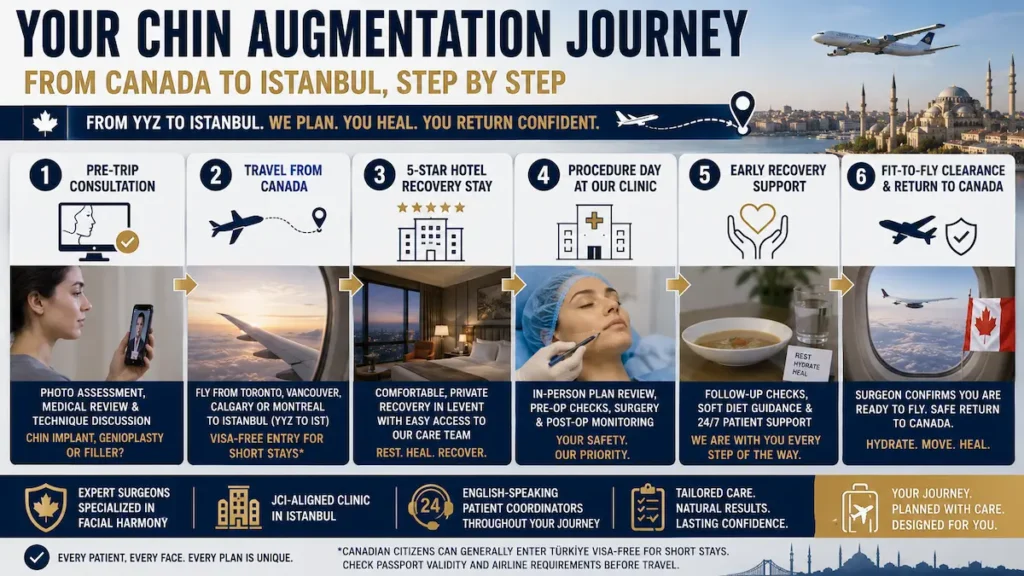
Your Chin Augmentation Journey From Canada: From YYZ to Istanbul, Step by Step
For Canadian patients, chin augmentation planning begins before travel. The process includes virtual assessment, medical review, travel coordination, in-person surgical planning in Istanbul, procedure-day care, early recovery support, and fit-to-fly clearance before returning to Canada.
Pre-Trip Consultation: Photo Assessment and Technique Discussion
Your journey begins before you book a flight. We review your photos, medical history, goals, and profile concerns through a virtual consultation.
We may ask for front, side, three-quarter, and smiling photos. These help us evaluate the chin, lips, nose, jawline, and neck together.
At this stage, we discuss whether chin implant, sliding genioplasty, filler, or a different facial procedure makes the most sense.
Travel Logistics From Toronto, Vancouver, Calgary, and Montreal
Most Canadian patients travel through Istanbul Airport. Flight routes vary by city and season, so patients should confirm current schedules before booking.
Patients travelling from Toronto or Montreal often have more direct-route options. Vancouver, Calgary, and other Canadian cities may require one connection depending on airline schedules.
Canadian citizens can generally enter Türkiye visa-free for short stays, but passport validity and airline rules should be checked before travel.
Our patient journey guide explains the travel sequence from consultation to return flight.
5-Star Hotel Recovery Stay in Levent
After arrival, patients are transferred to the hotel or clinic according to the schedule. Recovery should be calm, predictable, and close to the care team.
Our partner hotel environment supports early recovery with privacy, comfort, and access to the coordination team. This matters after facial surgery because swelling, diet, and sleep position require planning.
For chin augmentation, patients should keep soft foods available and avoid pressure on the chin during the early recovery period.
Procedure Day at Our Istanbul Clinic
On procedure day, the surgical plan is reviewed again in person. This includes implant size, incision route, or genioplasty movement if bone repositioning is planned.
Pre-operative checks are completed before surgery. The anesthesia plan is confirmed with the clinical team.
After surgery, patients are monitored before returning to the hotel or hospital room, depending on the procedure and combined-treatment plan.
You can learn more about the setting on our Istanbul clinic page.
Fit-to-Fly Clearance and Return Travel
Return travel should be based on healing, not convenience. The surgeon must confirm that swelling, incision healing, and comfort level are appropriate for a long-haul flight.
During the flight, patients should stay hydrated, avoid alcohol, walk periodically, and follow medication instructions.
Sliding genioplasty patients may need a more conservative return plan than implant patients. Combined procedures may also extend the recommended stay.
Chin Implant Augmentation Frequently Asked Questions (FAQ):
These answers cover the questions Canadian patients most often ask before chin augmentation, including technique choice, recovery, scars, cost, provincial health plan coverage, travel insurance, and whether chin surgery can be safely combined with other facial procedures.
What’s the difference between a chin implant and sliding genioplasty?
A chin implant adds projection over the existing chin bone. Sliding genioplasty moves the chin bone itself.
Implants are often better for mild to moderate horizontal deficiency. Sliding genioplasty is better for more complex skeletal issues, including severe retrusion, vertical imbalance, or asymmetry.
Is chin filler as good as a chin implant?
No. Chin filler can improve minor contour temporarily, but it does not move bone or create the same structural support as an implant or sliding genioplasty.
It can be useful as a short-term preview for selected patients. It should not be presented as equivalent to surgery.
Will I have visible scars?
If the incision is intraoral, there is no external skin scar. If the incision is submental, there will be a small scar under the chin.
Submental scars usually fade well when placed carefully and managed properly, but no external incision is truly scar-free.
Should I get chin augmentation with my rhinoplasty?
Possibly. If your chin is recessed, rhinoplasty alone may not fully balance your side profile.
We assess chin-nose harmony before recommending combined surgery. Some patients need only rhinoplasty, some need chin augmentation, and some benefit from both.
Does OHIP, MSP, AHCIP, or RAMQ cover chin augmentation?
Cosmetic chin augmentation is generally not covered by Canadian provincial health plans such as OHIP, MSP, AHCIP, or RAMQ.
Coverage may be different for medically necessary jaw or bite correction, such as orthognathic surgery. That is a different clinical pathway from elective chin augmentation.
How much does a chin implant cost in Toronto vs Istanbul?
Toronto private clinic pricing for chin implants often ranges from CAD $6,000–$12,000 when anesthesia and facility costs are included.
At AKM Clinic, Chin Implants are CAD $4,800, while Sliding Genioplasty is CAD $5,450. Final treatment choice depends on anatomy, implant type, and whether bone movement is required.
Does Canadian travel insurance cover complications from elective chin augmentation in Turkey?
Many Canadian travel insurance policies exclude elective cosmetic surgery and complications related to it. You should review your policy carefully before booking and ask the insurer direct written questions.
To reduce this concern, AKM Clinic provides complimentary complication insurance for all patients. This is separate from standard Canadian travel insurance and is designed to add an extra layer of protection around your surgical care. Your coordinator will explain the coverage terms, limits, and required documentation before you confirm your booking.
What happens if a chin implant goes wrong?
The response depends on the problem. Implant malposition, oversizing, asymmetry, infection, or dissatisfaction may require monitoring, medication, revision, implant change, or removal.
The best prevention is correct planning before the first surgery: proper sizing, profile analysis, sterile technique, and surgeon-led pocket creation.
Is a chin implant permanent, or does it need replacing?
A chin implant is long-lasting and does not dissolve like filler. It does not usually need routine replacement on a fixed schedule.
It can be revised, exchanged, or removed if the patient’s anatomy, goals, or medical situation changes.
How long is recovery?
Many chin implant patients feel socially comfortable within one to two weeks, though swelling continues to improve for several months.
Sliding genioplasty recovery is usually longer because bone healing is involved. Final contour may take three to six months to settle.
Can chin augmentation fix my “weak jaw” look for photos?
It can help if the “weak jaw” appearance comes from chin retrusion or poor lower-face projection.
If the issue is jaw width, neck fat, bite position, or skin laxity, chin augmentation alone may not be enough. Profile assessment determines the right plan.
Can I combine chin augmentation with rhinoplasty or a neck lift in one trip?
Yes, selected patients can combine chin augmentation with rhinoplasty, neck lift, or liposuction in one surgical trip.
The decision depends on health status, surgical time, recovery demands, and whether the combined plan creates a safer and more balanced result.
Medical Disclaimer: This page is for educational purposes only and does not replace medical advice. Chin augmentation, chin implants, sliding genioplasty, and facial filler all carry risks and require individualized assessment. Results vary by anatomy, healing, technique, implant choice, and surgical planning. Canadian patients should speak with a qualified health care professional or family physician before travelling for elective surgery abroad.