



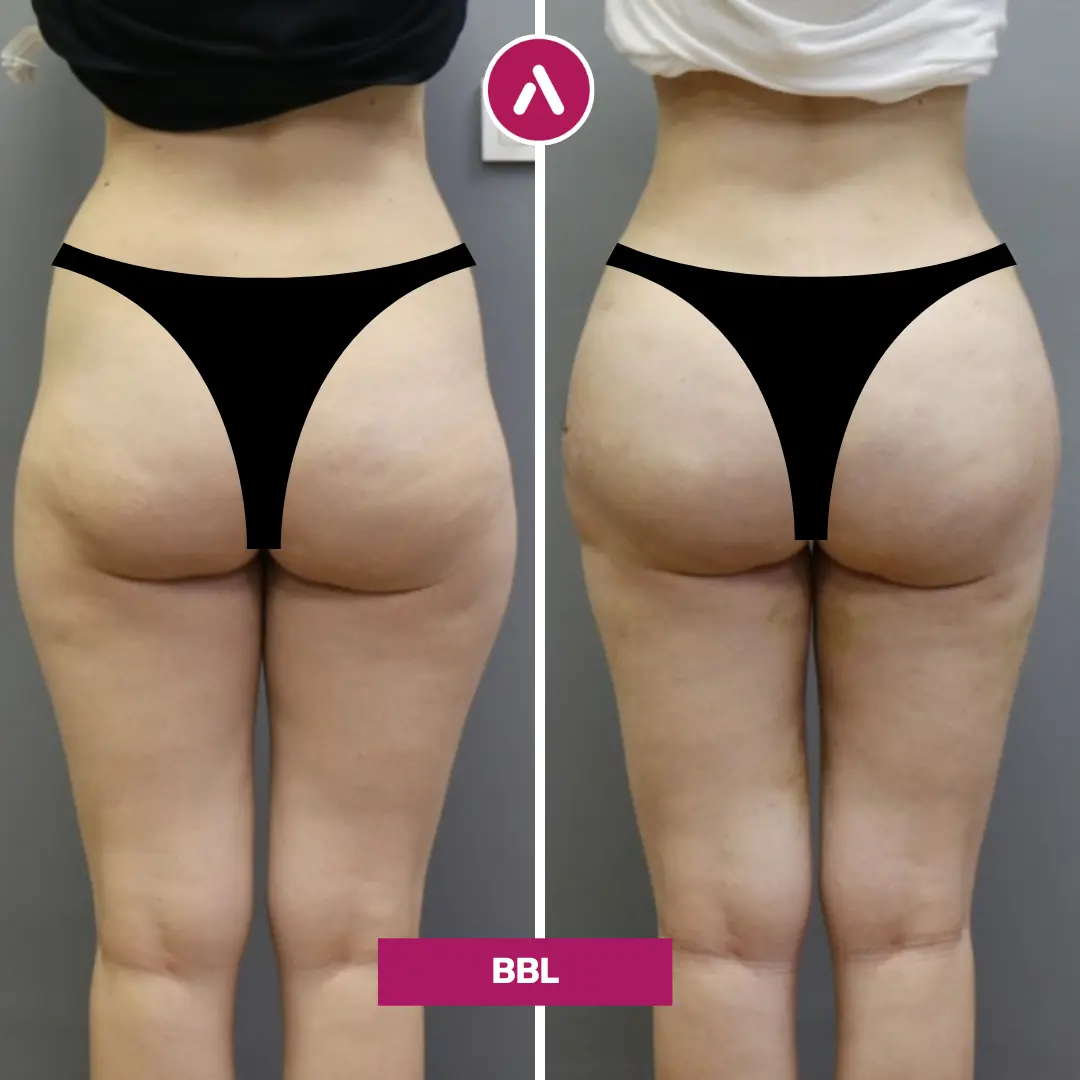
Canadians considering a BBL often balance three questions at once: safety, proportion, and the reality of flying home after surgery. This guide explains how Brazilian Butt Lift surgery works, why ultrasound-guided fat placement matters, and how we structure the full experience for patients travelling from Toronto, Vancouver, Montreal, Calgary, and Ottawa. We focus on the concerns Canadian patients raise most often: fat embolism prevention, skinny BBL candidacy, realistic fat retention, CAD pricing, and safe return-flight planning.
Table of Contents
What Is a BBL (Brazilian Butt Lift)?
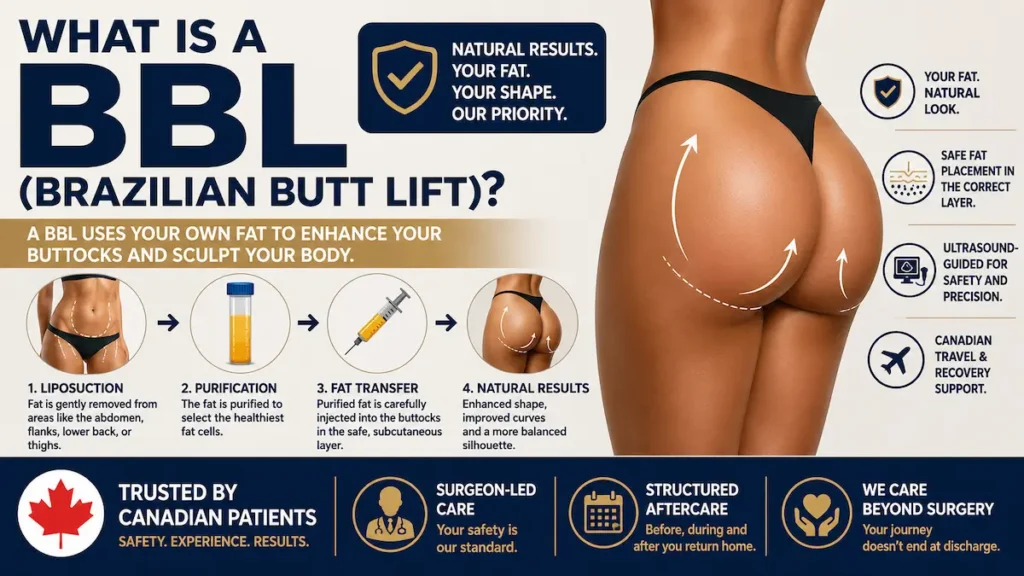
A BBL, or Brazilian Butt Lift, is a body contouring procedure that uses liposuction to harvest fat from the midsection and transfer it into the buttocks for natural augmentation. At AKM Clinic in Istanbul, we plan BBL surgery around proportion, fat safety, and Canadian return-travel needs.
The procedure is not simply about increasing buttock size. A well-planned BBL reshapes the waist, flanks, lower back, and buttocks together. That is why many Canadian patients describe the goal as a more balanced silhouette, not an exaggerated change.
The medical definition: gluteal augmentation via autologous fat transfer
A Brazilian Butt Lift is a form of gluteal augmentation using autologous fat transfer. “Autologous” means the tissue comes from your own body. We remove fat through liposuction, purify it, and inject selected fat cells into carefully planned areas of the buttocks and hips.
The donor fat usually comes from areas where contouring creates the greatest visual effect:
- Abdomen
- Flanks
- Lower back
- Waistline
- Outer thighs, when appropriate
This dual approach is what makes the bbl procedure different from implant-only buttock augmentation. The body is sculpted around the buttocks first, so projection and waist definition work together. For many patients, the slimmer midsection is as important as the added gluteal shape.
At AKM Clinic, our Natural-First approach guides every fat transfer plan. We do not pursue an overfilled or artificial look. Our goal is proportionate enhancement that looks consistent with your frame, your hips, and your natural movement.
How modern BBL differs from older buttock augmentation methods
Older buttock augmentation often relied on silicone implants or aggressive fat placement without today’s safety discipline. Modern BBL surgery is more anatomy-focused. It requires careful fat harvesting, controlled purification, and conservative injection into the appropriate tissue plane.
That distinction matters. A BBL is only as safe as the surgeon’s respect for anatomy. Fat should not be injected into or beneath the gluteal muscle because that deeper zone is associated with the most serious historical BBL risks.
Modern planning focuses on three clinical priorities:
- Shape: building a smooth transition from waist to hip to buttock.
- Safety: respecting the subcutaneous layer as the intended injection zone.
- Longevity: protecting transferred fat cells so more of them survive.
For Canadian patients who have seen mixed stories online, this is the key point: a BBL is not one standardized operation. Technique, patient selection, fat volume, injection plane, and recovery discipline all affect safety and final outcome.
Why Canadian patients searching bbl turkey choose ultrasound-guided specialists
Canadian patients searching bbl turkey are usually not looking for a shortcut. Most have already compared private clinic options in Ontario, British Columbia, Alberta, or Quebec. They want a surgeon-led international surgical programme with transparent planning, structured aftercare, and clear safety protocols.
BBL requires particular caution because the procedure has a known historical risk profile. This is why we emphasize ultrasound-guided planning and subcutaneous fat placement. Real-time imaging helps confirm the tissue layer during fat transfer, which is one reason informed patients increasingly ask about this technique before booking.
Our Istanbul-based programme is built for patients travelling long distances. That means we consider not only the surgical day, but also the return flight, sitting restrictions, swelling, compression garments, and follow-up once you are back in Canada.
For Canadians, the decision is usually practical and evidence-driven. They want natural shape, strong safety standards, and a care team that understands what it means to recover after a 10+ hour international flight.
Benefits of a BBL — What Canadian Patients Actually Achieve
A BBL can improve body proportion by combining fat removal and fat transfer in one surgical plan. The goal is not only a fuller buttock. It is a smoother, more balanced relationship between the waist, hips, lower back, and gluteal area.
For Canadian patients, the most valued outcome is often subtle: clothing fits better, the waist appears more defined, and the buttocks look naturally fuller without implants. This aligns with our Natural-First philosophy. We aim for enhancement that feels believable for your frame.
Natural-looking gluteal projection without implants
The main benefit of a Brazilian Butt Lift is that it uses your own fat instead of a synthetic implant. This can create a softer feel and a more natural transition between the buttocks, hips, and thighs. For many patients, that is the appeal.
Implants can be appropriate for selected patients, especially when there is not enough donor fat. But fat transfer allows us to refine shape in smaller increments. We can place fat into areas such as the upper buttock, lateral hip dip region, or central projection zone depending on your anatomy.
Natural-looking projection depends on restraint. Adding too much volume can distort proportion and compromise the result. We would rather create a balanced silhouette than chase a trend that may not suit your body.
Surgeon Insight: “A Natural-First BBL is not measured only by volume. It is measured by whether the waist, hips, and buttocks look like they belong to the same body.”
Dual-zone improvement: midsection contouring and buttock enhancement
BBL has a dual-zone benefit. Liposuction reduces selected fat deposits around the waist, abdomen, flanks, or lower back, while purified fat is used to enhance the buttocks. This can create a stronger hourglass effect than buttock augmentation alone.
The waist-to-hip relationship is especially important. A moderate fat transfer may look more dramatic when the lower back and flanks are contoured properly. In other words, the shape often comes from both subtraction and addition.
At AKM Clinic, we plan donor-site liposuction as part of the aesthetic result. We do not treat fat harvest as a technical step only. The contour of the abdomen, waistline, and back must support the final gluteal shape.
This approach may appeal to patients who feel that exercise has improved strength but not changed body proportion. Surgery can reshape areas that do not respond predictably to diet or training.
Hourglass silhouette restoration after pregnancy or weight changes
Pregnancy, weight fluctuation, and aging can change the waist, hips, and buttocks in different ways. Some patients lose gluteal volume. Others develop stubborn flank or lower-back fat that makes the buttocks look flatter than they are.
A BBL can restore a more balanced silhouette by transferring fat from areas of excess to areas of volume loss. This is why the procedure is sometimes included in a broader body contouring plan, especially when patients also consider tummy tuck, breast lift, or Mommy Makeover surgery.
The best candidates are not seeking a completely different body. They usually want their clothes to sit better and their proportions to feel more aligned. That distinction helps us keep the result measured.
Our planning considers your starting anatomy. Pelvic width, skin quality, fat distribution, and muscle tone all affect what can be achieved safely. A realistic plan protects both the result and the recovery.
Clothing fit, athletic proportion, and long-term confidence
Many Canadian patients describe BBL goals in practical terms. They want jeans to fit without a waist gap. They want dresses to sit more smoothly. They want swimwear, gym clothes, and workwear to feel less frustrating.
These benefits are personal, but they are also anatomical. A slimmer waist and fuller buttock can change how clothing falls across the hips. This can create a more athletic or feminine outline without relying on implants.
Long-term confidence depends on stable expectations. A BBL does not stop aging, replace fitness, or guarantee a fixed volume forever. Some transferred fat will be reabsorbed during recovery, and the final shape depends on healing, weight stability, and post-operative behaviour.
When planned carefully, the result can feel quietly transformative. The best outcome is not the one that looks most obvious. It is the one that feels proportionate, comfortable, and consistent with your body.
Am I a Good Candidate for a BBL?
A good BBL candidate has enough donor fat for safe transfer, stable health, and realistic expectations about final volume. This procedure works best when body contouring and buttock enhancement are planned together. We assess the waist, abdomen, flanks, lower back, hip dips, skin quality, and gluteal shape before recommending surgery. For Canadian patients, we also consider travel readiness because recovery includes sitting restrictions, compression garments, and a long return flight.
BMI considerations and minimum harvestable fat requirement
BBL depends on available donor fat. If there is not enough fat to harvest safely, the result may be too subtle or the surgeon may need to remove fat from areas that should not be over-treated. We do not force a BBL plan when the anatomy does not support it.
Most candidates have enough fat in at least two donor zones, such as the abdomen, flanks, lower back, or outer thighs. The goal is not simply to collect fat. We need healthy fat cells that can survive the transfer process and contribute to a stable long-term shape.
BMI is only one screening tool. Two patients with the same BMI may have very different fat distribution. During your virtual consultation, we review photos from multiple angles and ask about weight stability, previous surgeries, and your preferred level of projection.
The skinny BBL question — what low-BMI Canadian patients need to know
A skinny BBL is designed for patients with lower body fat who want subtle contouring rather than high-volume augmentation. It can be a good option when the goal is hip-dip smoothing, modest projection, or a more athletic waist-to-hip transition. It is not the right choice for patients expecting dramatic volume.
Low-BMI patients require conservative planning. We may harvest smaller amounts from multiple donor areas instead of taking too much from one zone. This protects skin smoothness and avoids the over-liposuction look that can make a result appear irregular.
Some slim patients are better candidates for butt implants, a supercharged BBL, or no surgery at all. We explain those limits clearly. A safe plan is more important than promising a result your body cannot support.
Health prerequisites: cardiovascular fitness, smoking, and bleeding disorders
BBL is elective surgery, so your baseline health matters. We screen for cardiovascular disease, clotting history, uncontrolled diabetes, anemia, immune concerns, medication risks, and smoking status. These factors can affect anesthesia safety, wound healing, and fat graft survival.
Smoking is a major concern. Nicotine reduces blood flow and can interfere with tissue oxygenation. Because transferred fat relies on new blood supply, we require strict nicotine avoidance before and after surgery.
Patients with a personal or family history of blood clots need special evaluation. The return flight to Canada adds a second layer of planning because long-haul travel can increase clot risk after major body contouring surgery.
Stable weight requirement and realistic fat survival expectations
We prefer patients to be within approximately 5 kg of their target weight for at least six months. Significant weight loss after BBL can shrink transferred fat cells. Significant weight gain can enlarge both treated and untreated fat cells, sometimes changing the result in ways patients did not expect.
Fat survival is never 100%. A portion of transferred fat is naturally reabsorbed during recovery, especially in the first few months. This is normal.
We plan volume with that biology in mind. The final shape depends on fat quality, injection technique, oxygenation, pressure avoidance, and your recovery behaviour. That is why sitting discipline matters so much.
Canadian-specific family physician consultation before travel
We encourage Canadian patients to speak with their family physician before international surgery, especially if they have a history of clotting issues, anemia, diabetes, cardiovascular disease, or previous anesthesia problems. This does not replace our medical screening. It adds another layer of safety.
Your family physician may also help document baseline health and review medications that need to be paused before surgery. Common examples include blood thinners, certain supplements, and medications that increase bleeding risk.
After surgery, we provide English-language documentation that can be shared with your Canadian provider. This supports continuity of care once you return home.
When BBL is not recommended
We may decline BBL when the risk profile is too high or the expected result is not realistic. Examples include insufficient donor fat, active smoking, uncontrolled medical conditions, unstable weight, unrealistic volume goals, or a history that raises concern for clotting complications.
We also avoid unsafe volume requests. More fat is not always better. Overfilling can increase pressure, reduce fat survival, distort proportion, and compromise the Natural-First result.
A responsible consultation should sometimes end with “not yet” or “not this procedure.” That honesty protects patients.
BBL Techniques Compared: Ultrasound-Guided vs Standard vs Skinny vs Non-Surgical
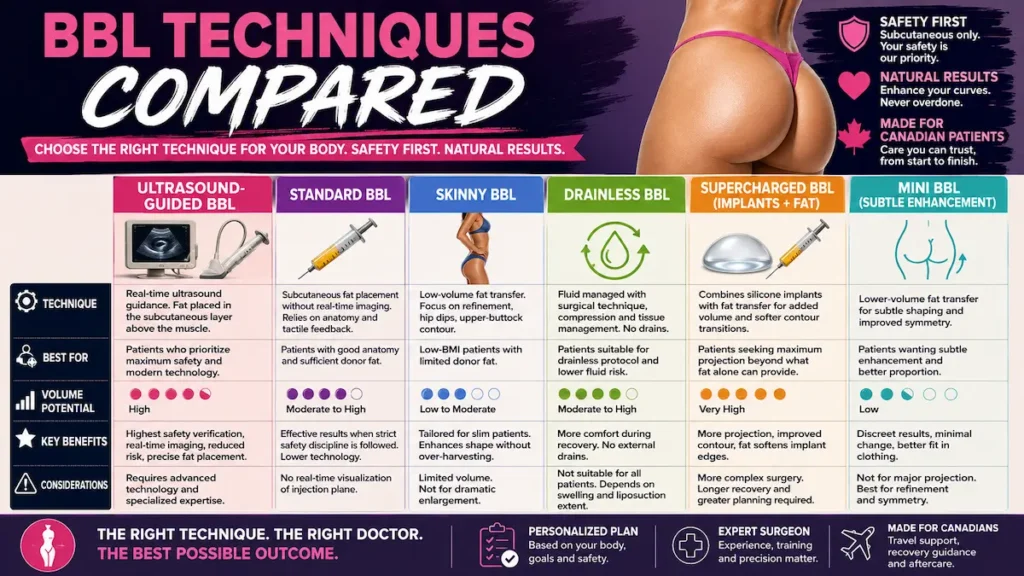
BBL techniques differ in how fat is harvested, processed, and placed. They also differ in safety profile, candidacy, and expected volume. Canadian patients often arrive with questions about ultrasound-guided BBL, skinny BBL, mini BBL, non surgical BBL, and bbl vs implants. We compare these options directly so the decision is based on anatomy and safety, not social media trends.
Ultrasound-Guided BBL — the modern safety standard
Ultrasound-guided BBL uses real-time imaging during fat transfer. This helps the surgeon confirm the injection plane and keep fat in the subcutaneous layer, above the gluteal muscle. That matters because deep muscle injection is associated with the most serious historical BBL complications.
At AKM Clinic, we position ultrasound guidance as a safety protocol, not a cosmetic upgrade. The goal is controlled subcutaneous fat injection with visible confirmation of tissue depth. For Canadian patients concerned about fat embolism, this is one of the most important technique questions to ask during consultation.
For a deeper safety explanation, see our guide to ultrasound technology and BBL risk reduction.
Standard BBL — subcutaneous-zone-only injection
A standard BBL also uses subcutaneous fat placement, but without real-time ultrasound visualization. The surgeon relies on anatomical knowledge, cannula direction, and tactile feedback. This can be appropriate only when strict safety discipline is followed.
We still prioritize conservative volume, controlled fat grafting, and anatomy-led planning. The difference is that ultrasound-guided BBL adds another layer of confirmation. For many Canadian patients, that extra verification is reassuring.
Skinny BBL — adapted strategy for low-BMI candidates
A skinny BBL is designed for patients who have limited donor fat. The aim is usually refinement, not dramatic enlargement. We may focus on hip dips, upper-buttock contour, or subtle projection rather than high-volume change.
This technique requires restraint. Over-harvesting a slim patient can create visible irregularities, especially around the abdomen or flanks. We protect the donor areas as carefully as we plan the transfer zones.
Drainless BBL — fluid management without external drains
A drainless BBL may be appropriate when fluid management can be handled through surgical technique, compression, and controlled tissue handling. Not every patient is suitable. The decision depends on liposuction extent, swelling risk, and tissue response.
Some patients prefer a drainless protocol for comfort during hotel recovery. We only recommend it when it does not compromise safety or post-operative monitoring.
Supercharged BBL — implants plus fat transfer
A supercharged BBL combines silicone buttock implants with fat transfer. This may help patients who want more projection than their donor fat can provide. It is a more complex procedure than fat transfer alone.
The fat helps soften implant edges and improve contour transitions. The implant provides volume that fat alone cannot achieve. This option requires careful candidacy review and a longer discussion about risks, recovery, and long-term maintenance.
V-Shape to Heart-Shape BBL
Some patients have a naturally narrow lower buttock or a V-shaped frame. A V-Shape to Heart-Shape BBL focuses on improving the transition from waist to hip and lower buttock. The goal is a softer, more balanced outline.
This is not only about central projection. It often requires strategic hip and lateral buttock fat placement. We assess pelvic width, hip dips, and lower-back contour before recommending this approach.
Mini BBL — subtle fat transfer for smaller enhancement
A mini BBL is a lower-volume version of the procedure. It may suit patients who want mild shaping, better symmetry, or a modest improvement in clothing fit. It is not designed for major projection.
Mini BBL planning can be useful for patients who want discretion. It can also suit patients who have enough fat for refinement but not enough for a full-volume transformation.
Non-surgical BBL — fillers and limitations
A non surgical BBL usually refers to injectable fillers or biostimulatory products. These can create temporary volume, but they do not contour the waist or remove donor fat. They also require repeat treatment.
For patients who want a meaningful change in waist-to-hip proportion, surgery is usually more effective. Non-surgical options may suit patients who want only a small temporary adjustment.
BBL vs implants — when fat transfer is not enough
The bbl vs implants decision depends on donor fat, skin quality, desired projection, and tolerance for implant-related maintenance. Fat transfer feels natural and reshapes donor areas. Implants can provide volume when donor fat is limited.
For a full decision tree, see our BBL implants vs fat transfer guide for Canadian patients. Patients who need implant-based augmentation can also review our butt implants in Turkey page.
| Technique | Best For | Main Advantage | Key Limitation |
|---|---|---|---|
| Ultrasound-guided BBL | Safety-focused patients | Real-time layer confirmation | Requires specialist equipment and training |
| Standard BBL | Patients with adequate fat and moderate goals | Natural fat-based enhancement | No real-time imaging confirmation |
| Skinny BBL | Low-BMI patients | Subtle shaping | Limited volume potential |
| Mini BBL | Patients wanting discreet refinement | Smaller recovery burden | Less projection |
| Supercharged BBL | Patients with limited fat but higher projection goals | Implant volume plus fat-softened contour | More complex recovery and implant considerations |
| Non-surgical BBL | Temporary minor enhancement | No surgery | No waist contouring and repeat treatments required |
Combined Procedures — One Trip from Canada
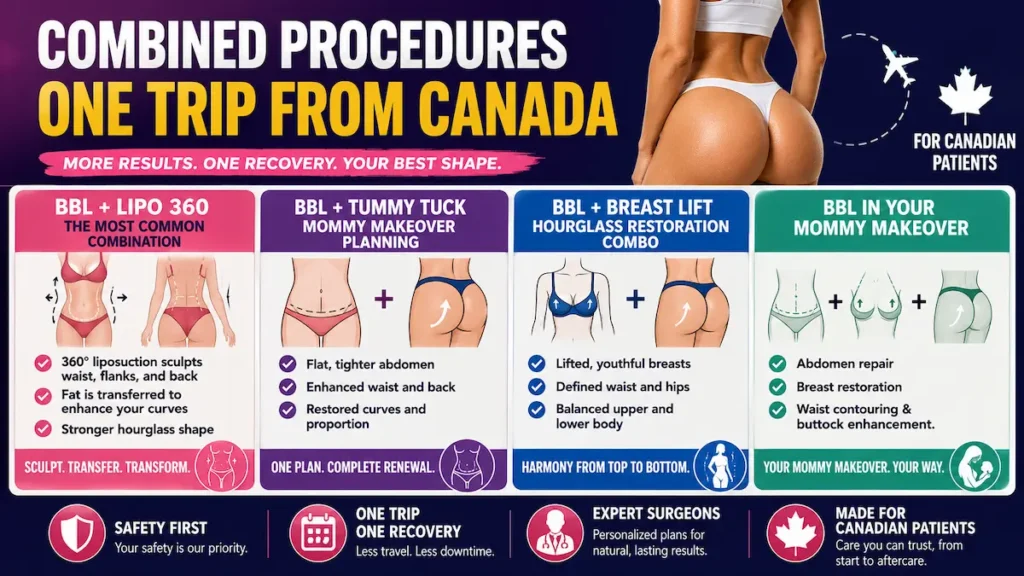
Many Canadian patients choose BBL as part of a broader body contouring plan. Combining procedures can reduce repeated anesthesia exposure, travel time, and separate recovery periods. The safest combination depends on surgical duration, positioning, BMI, and your recovery support plan after returning home.
BBL + Lipo 360 — the most common combination
BBL is naturally linked to liposuction because fat must be harvested before transfer. Lipo 360 contours the abdomen, flanks, waist, and lower back to create a stronger frame for the buttocks. This is why many patients choose the Lipo 360 + BBL package.
For a deeper explanation of fat-harvest contouring, see our liposuction in Turkey guide.
BBL + Tummy Tuck — Mommy Makeover planning
BBL and tummy tuck can be considered together when pregnancy or weight change has affected both the abdomen and gluteal contour. This combination requires careful planning because tummy tuck recovery and BBL sitting restrictions can conflict.
Some patients are better served by staging the procedures. Others may qualify for a carefully planned combined pathway. We review this during consultation and may direct patients to our Mommy Makeover in Turkey guide or tummy tuck surgery in Turkey page.
BBL + Breast Lift — hourglass restoration combo
Patients seeking upper and lower body balance may combine BBL with breast lift. This can restore body proportion after pregnancy, weight loss, or aging. The goal is not excess volume. It is harmony between the waist, hips, buttocks, and chest.
Our Breast Lift + BBL + 360 Lipo package is designed for this full-silhouette approach. Patients comparing breast options can also review our breast lift mastopexy guide.
BBL as a Mommy Makeover component
BBL may be included in a Mommy Makeover when the patient wants waist contouring, buttock shaping, abdominal repair, and breast restoration in one coordinated plan. This is highly individualized.
We may recommend the Breast Lift + Tummy Tuck + BBL package for selected candidates. For others, a staged approach is safer and more comfortable.
Anesthesia for BBL
BBL is usually performed under general anesthesia because the procedure combines liposuction, fat processing, and buttock fat transfer in one session. Patient positioning also matters. Many stages require prone or side positioning, so airway protection and continuous monitoring are central to safety.
For Canadian patients, anesthesia planning begins before travel. We review medical history, medications, previous anesthesia reactions, clotting risks, and baseline fitness. This allows our team to decide whether BBL is appropriate and whether any additional pre-operative clearance is needed.
General anesthesia as the standard for full BBL
General anesthesia is the standard for most full BBL surgery because it allows controlled comfort during liposuction and fat transfer. The procedure can involve several donor zones, including the abdomen, flanks, lower back, and thighs. These areas cannot be treated comfortably or safely with minimal anesthesia in most patients.
General anesthesia also helps the surgical and anesthesia teams control movement during critical fat injection steps. Stillness is important when the surgeon is working in precise tissue planes. That precision supports safer subcutaneous fat injection.
We discuss anesthesia openly during consultation. The goal is not simply to “get through” surgery. The goal is to keep your body stable while our team performs a controlled, anatomy-led procedure.
Why awake-BBL may be offered only in selected cases
Some patients ask whether BBL can be performed awake. Selected lower-volume contouring cases may qualify for local anesthesia with IV sedation, but this is not suitable for every patient. The decision depends on anxiety tolerance, donor-site extent, target volume, BMI, and surgical duration.
An awake approach should never be used to force a complex procedure into a lighter anesthesia model. If the fat harvest is extensive or the transfer plan requires multiple positioning changes, general anesthesia may be safer and more predictable.
Patients interested in body contouring under local anesthesia can review our awake high-definition liposuction page. For broader context on awake fat-harvest procedures, our Awake Lipo in Turkey guide explains how local anesthesia protocols differ from full BBL planning.
Airway protection during prone positioning
BBL requires careful positioning. During fat harvest and transfer, patients may be placed face-down or turned to one side. This makes airway planning more important than in procedures performed only on the back.
Our anesthesia team monitors oxygen levels, blood pressure, heart rhythm, ventilation, and temperature throughout the operation. These are not optional details. They are part of safe surgical practice, especially for body contouring patients travelling internationally.
Canadian patients can compare this safety mindset with the standards described by the Canadian Anesthesiologists’ Society. We use that reference point because our patients expect the same level of rigour they would ask for in a Canadian surgical setting.
Canadian patient pre-flight tolerance assessment
Before you fly to Istanbul, we assess whether your body is likely to tolerate surgery and travel safely. We review your health history, smoking status, medications, height, weight, prior operations, and any history of blood clots. If needed, we ask for additional testing before you book flights.
This pre-flight assessment is especially important for BBL because recovery involves sitting restrictions and long-haul travel. The return flight from Istanbul to Canada can exceed 10 hours, depending on your city and route. We plan with that reality in mind.
If your risk profile is not suitable, we will say so. A responsible international surgical programme should be willing to decline unsafe candidates.
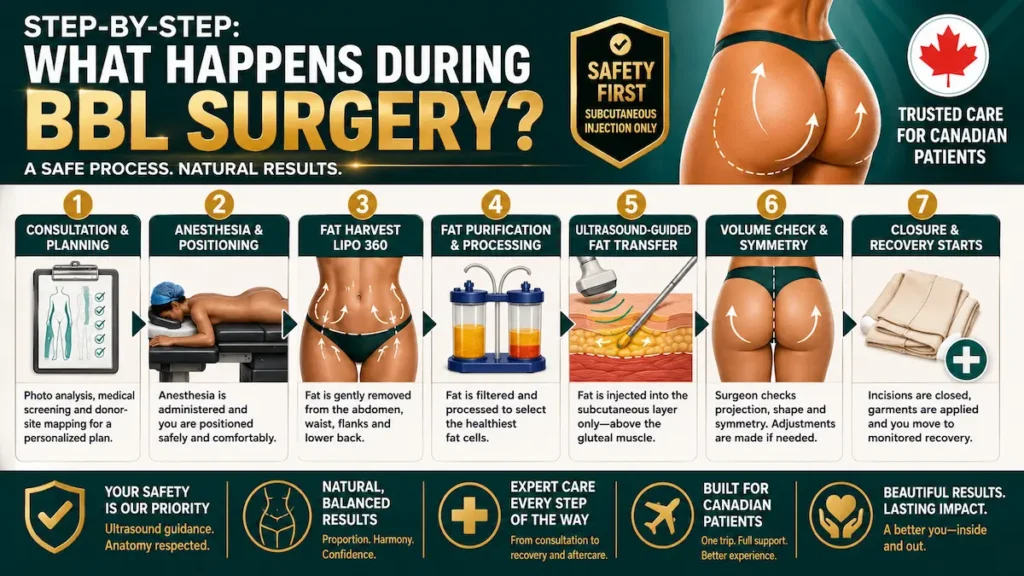
Step-by-Step: What Happens During BBL Surgery?
BBL surgery follows a structured sequence: planning, anesthesia, fat harvest, purification, transfer, symmetry check, and recovery monitoring. Each stage affects the final result. Each stage also affects safety.
We do not treat BBL as a simple volume procedure. The surgical plan must respect anatomy, donor-site contour, fat survival biology, and the safe injection zone. This is why our consultation process is detailed before the patient arrives in Istanbul.
Pre-operative consultation, photo analysis, and donor-site mapping
Planning begins with photo assessment and medical screening. We review front, side, back, and oblique views to understand waist shape, hip dips, lower-back contour, buttock projection, and donor-fat distribution. This helps us design a tailored clinical protocol.
During the in-person consultation in Istanbul, we confirm the plan and mark donor zones. These markings guide liposuction and fat placement. They also help us keep the result balanced from both front and back views.
Patients often arrive with inspiration photos. We use them to understand aesthetic preference, not to copy another body. Your anatomy sets the safe range.
Anesthesia administration and prone positioning protocol
Once pre-operative checks are complete, anesthesia begins under continuous monitoring. The operating team positions your body to allow controlled access to donor areas and transfer zones. Padding is used to protect pressure points.
Positioning is planned before fat injection begins. This matters because the surgeon must maintain a safe cannula angle and controlled tissue depth. It also protects breathing mechanics and circulation while you are under anesthesia.
Fat harvest via Lipo 360
Fat harvest is usually performed with Lipo 360, targeting the abdomen, waist, flanks, and lower back. These donor areas help create the frame for the final buttock result. The waistline is shaped before volume is added.
We use controlled liposuction to preserve smoothness. Over-harvesting can create dents, waves, or loose-looking skin. Good BBL surgery requires donor-site restraint as much as transfer-site skill.
Fat purification and processing
Harvested fat cannot be injected immediately without preparation. It must be filtered and processed so that healthier fat cells are selected for transfer. Excess fluid, blood, and damaged tissue are removed.
This step supports fat grafting success. Cleaner, healthier fat is more likely to survive once transferred. It also allows the surgeon to inject more predictably.
Ultrasound-guided injection into subcutaneous tissue only
The fat transfer stage is the safety-critical moment. In ultrasound-guided BBL, real-time imaging helps confirm that fat is placed in the subcutaneous layer, above the gluteal muscle. This is the intended safe zone.
We do not inject into the gluteal muscle. That discipline is central to modern BBL safety. The surgeon uses controlled cannula movement, conservative volume, and ultrasound confirmation to reduce avoidable risk.
Surgeon Insight: “Ultrasound guidance matters because it turns a hidden tissue plane into a visible one. For BBL, knowing exactly where the fat is going is a safety priority.”
Volume confirmation, symmetry assessment, and closure
After fat placement, the surgeon checks projection, hip contour, and symmetry. Small adjustments may be made before closure. The goal is balanced shape, not maximum size.
Incisions are closed, compression garments are applied, and drains may be used when clinically appropriate. You then move to monitored recovery before returning to the hospital room or hotel pathway defined in your surgical plan.
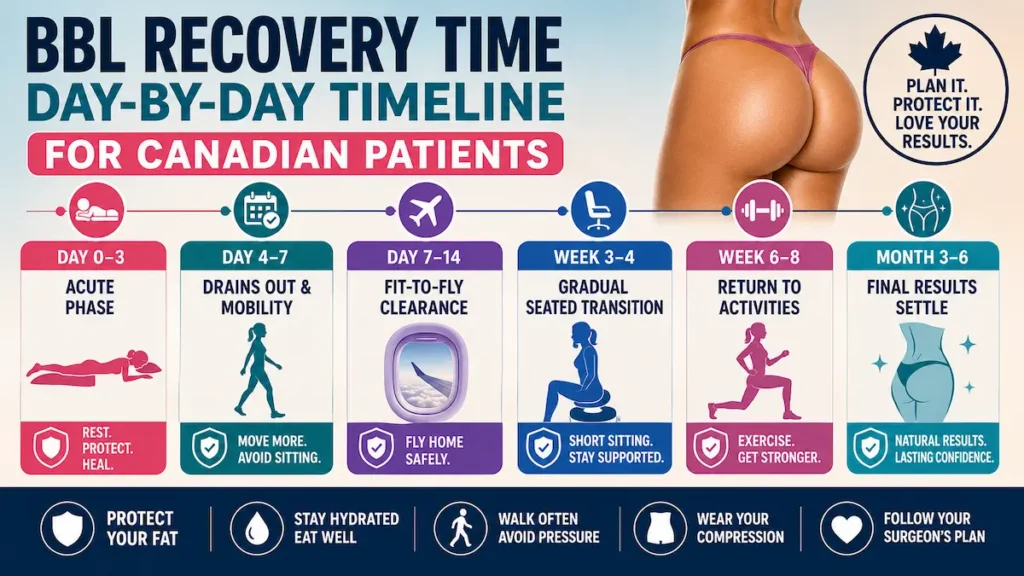
BBL Recovery Time: Day-by-Day Timeline for Canadian Patients
BBL recovery is different from many other body contouring procedures because you must protect the transferred fat while your body builds new blood supply. Swelling, bruising, compression garments, and donor-site soreness are expected. The sitting restriction is the part most Canadian patients need to plan carefully.
For patients returning to Toronto, Vancouver, Montreal, Calgary, or Ottawa, recovery planning must include the long-haul flight home. A bbl flight back is not only a travel question. It is part of the medical recovery plan.
Day 0–3: the acute phase and BBL pillow protocol
The first three days are the most restricted. You will rest mostly on your stomach or sides to avoid pressure on the newly transferred fat. Sitting directly on the buttocks is not recommended during this phase.
A bbl pillow helps shift pressure toward the thighs instead of the buttocks. It does not make unlimited sitting safe. It is a tool for short, necessary sitting moments, such as transport or bathroom transitions.
During this phase, patients usually experience swelling, bruising, tightness, drainage from small incision sites, and soreness in donor areas. The liposuction sites may feel more uncomfortable than the buttocks themselves.
Our team monitors hydration, walking, compression garment fit, pain control, and early circulation. Short assisted walks are encouraged because gentle movement supports blood flow and helps reduce clot risk.
Day 4–7: drains-out milestone and progressive mobility
By days four to seven, swelling and bruising usually remain visible, but patients often move more comfortably. If drains were used, removal may occur during this window depending on output and clinical assessment. Not every BBL requires drains.
You will still avoid direct sitting. Side-lying, stomach-lying, and modified standing positions remain important. We teach patients how to move from bed to standing without placing sudden pressure on the grafted areas.
This phase is also when compression garment adjustments may be needed. A garment that is too tight over the buttocks can create unwanted pressure. A garment that is too loose may not support the liposuction areas properly.
Canadian patients should not use this week for sightseeing. Recovery comes first. The safest itinerary is clinic, hotel, short walks, hydration, nutrition, and rest.
Our HBOT/LLLT Recovery Protocol
We use recovery technologies to support healing after body contouring procedures. Hyperbaric Oxygen Therapy, known as HBOT, helps increase oxygen delivery to healing tissues. Low-Level Laser Therapy, or LLLT, supports cellular energy production and soft-tissue recovery.
For BBL patients, tissue oxygenation matters because transferred fat cells need a healthy environment to survive. The goal is not to “force” fat survival. The goal is to reduce avoidable stress during the early healing period.
LLLT may help reduce donor-site inflammation and support incision maturation. This can be useful after Lipo 360 because the abdomen, waist, flanks, and lower back may all be healing at the same time.
Our technology standards page explains how we integrate HBOT, LLLT, VASER, and JCI-aligned clinical protocols into surgical recovery: AKM Clinic technology and safety standards.
Surgeon Insight: “BBL recovery is not passive. Oxygenation, pressure avoidance, hydration, walking, and compression discipline all influence how predictably the transferred fat settles.”
Day 7–14: fit-to-fly clearance with sitting restrictions
Most Canadian patients should plan return travel only after surgeon clearance. For BBL, we commonly discuss a day 10–14 return window because the sitting restriction makes early travel more complicated than with many facial procedures.
The bbl flight back requires practical planning:
- Use a BBL pillow as instructed.
- Choose an aisle seat when possible.
- Stand and walk during permitted intervals.
- Avoid prolonged direct pressure on the buttocks.
- Keep compression garments properly positioned.
- Hydrate and avoid alcohol during travel.
Some patients consider premium economy or business class so they can adjust position more easily. This is not a luxury recommendation. For selected patients, it can be a comfort and pressure-management strategy on a long route.
For Canadian patients, return-flight planning should begin before booking the surgery date. We help coordinate timing so your hotel stay, post-operative check, and flight clearance align.
Week 3–4: compression garment and gradual seated transition
By weeks three and four, many patients can begin short, controlled sitting with guidance. This does not mean normal sitting has fully resumed. The transferred fat is still stabilizing.
Compression garments are usually still part of the routine. The garment supports liposuction healing and helps swelling resolve more evenly. It should not create hard pressure across the buttocks.
Patients may return to light desk work if they can modify sitting. A standing desk, kneeling chair, or frequent position changes may help. Commuting on the TTC, GO Transit, SkyTrain, or driving long distances may still be uncomfortable.
At this stage, the result may look uneven or swollen. That is normal. The body is still absorbing fluid and adjusting to the transferred fat.
Week 6–8: return to normal sitting and exercise
Most patients begin a more normal sitting routine around weeks six to eight, depending on healing and surgeon guidance. Exercise also returns gradually. High-impact glute training should not restart too early.
Walking usually comes first. Light cardio may follow. Strength training, heavy lower-body workouts, and direct glute pressure need specific clearance.
Weight stability becomes increasingly important in this phase. Transferred fat behaves like fat elsewhere in the body. It can shrink with significant weight loss or enlarge with weight gain.
Month 3–6: final fat retention and volume stabilization
By three to six months, swelling has reduced significantly and fat retention becomes easier to judge. Some early volume loss is expected. This does not mean the procedure failed.
Most patients see the buttocks settle into a softer, more natural contour during this window. The waistline also becomes more defined as liposuction swelling continues to resolve.
For natural-result expectations after recovery, our Natural-Looking Awake BBL Results guide explains how clinic choice, patient selection, and conservative planning affect the final shape.
The final result depends on technique and recovery behaviour. Pressure avoidance, nutrition, hydration, walking, compression discipline, and stable weight all matter.
Brazilian Butt Lift Safety & Risks — An Honest Discussion
BBL safety deserves a more direct discussion than most cosmetic procedures. The procedure has a known historical risk profile, mainly because unsafe fat placement can lead to fat entering large blood vessels. We address this concern openly because informed Canadian patients should understand both the risk and the safeguards.
At AKM Clinic, safety begins with patient selection, conservative volume planning, subcutaneous-only fat placement, and ultrasound-guided confirmation when indicated. No cosmetic procedure is risk-free. The goal is to reduce avoidable risk through disciplined technique and structured recovery planning.
Why BBL historically carried higher mortality risk
The main historical danger in BBL surgery is pulmonary fat embolism. This can happen when fat is injected too deeply, enters injured veins, and travels to the lungs. It is rare, but it is serious.
This is why modern BBL safety focuses less on “how much volume” and more on “where the fat is placed.” Safe planning begins with respect for anatomy.
How fat embolism happens
Fat embolism risk is linked to deep injection near or into the gluteal muscle. Large vessels are found in deeper planes. If fat enters those vessels, it can travel through the bloodstream.
We do not inject into the gluteal muscle. Our protocol is built around fat placement in the subcutaneous layer, above the muscle. This is the safer target zone for modern fat grafting.
Why subcutaneous-only placement matters
Subcutaneous fat injection means fat is placed in the fatty layer under the skin and above the gluteal muscle. This layer allows contouring while avoiding deeper vascular structures. It also supports a softer, more natural bbl before and after result.
The technique requires discipline. A surgeon must resist unsafe volume requests, maintain the correct cannula plane, and stop when the tissues no longer accept fat safely.
Why ultrasound-guided injection is the modern safety protocol
Ultrasound-guided BBL adds real-time visual confirmation during fat transfer. The Aesthetic Society’s gluteal fat grafting safety advisory supports ultrasound monitoring of cannula location during injection as a patient safety measure.
For Canadian patients researching “is BBL safe,” this is one of the most relevant consultation questions. Ask whether the clinic can confirm the injection plane, not only whether it “uses safe technique.”
For more detail, our ultrasound-guided BBL safety guide explains how imaging supports safer fat placement. You can also review The Aesthetic Society’s advisory on gluteal fat grafting safety.
Common short-term effects
Most BBL patients experience swelling, bruising, donor-site soreness, firmness, temporary numbness, and difficulty sitting. Drainage from small incision sites can occur in the first days. These effects are expected and usually improve gradually.
The liposuction areas may feel more uncomfortable than the buttocks. This surprises many patients. We prepare you for that before surgery.
Rare but serious complications
Serious complications can include fat embolism, hematoma, seroma, infection, skin irregularity, asymmetry, fat necrosis, wound-healing problems, and blood clots. These risks are uncommon, but they must be discussed before consent.
Canadian patients should also understand that elective cosmetic surgery abroad may not be covered by standard travel insurance. We advise reviewing insurance documents before travel.
Why “botched BBL” outcomes happen
Poor BBL outcomes often come from unsafe volume goals, weak patient selection, excessive liposuction, deep fat injection, poor compression management, or limited follow-up. Marketing pressure can also push patients toward results that do not suit their anatomy.
We avoid this approach. Our Natural-First philosophy prioritizes proportion, safety, and long-term stability over trend-driven size.
How AKM Clinic addresses each documented risk factor
We reduce risk through pre-operative screening, surgeon-led planning, ultrasound-guided placement when appropriate, sterile fat processing, conservative volume limits, compression review, early walking, and structured follow-up. Our procedures take place in a JCI-accredited hospital partner environment.
For institutional safety standards, see our JCI accreditation and hospital safety guide for Canadians.
Patient selection rigour — who we decline and why
We may decline patients with insufficient donor fat, active nicotine use, unstable weight, unrealistic volume goals, uncontrolled medical conditions, or elevated clotting risk. This is not a rejection. It is responsible surgical judgement.
A safe BBL starts before the operating room. Sometimes the safest recommendation is a different procedure, a staged plan, or no surgery.
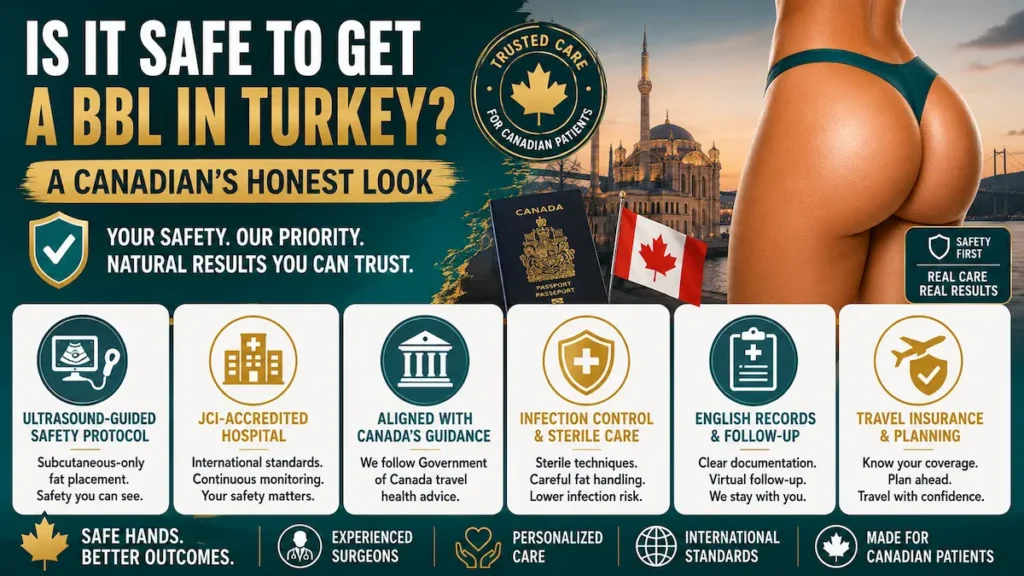
Is It Safe to Get a BBL in Turkey? A Canadian’s Honest Look
Getting a BBL in Turkey can be safe when the clinic uses qualified surgeons, accredited hospital facilities, ultrasound-guided or subcutaneous-only protocols, and structured follow-up. It can be unsafe when the decision is based only on price, social media images, or high-volume marketing.
The Government of Canada warns that medical care abroad can involve complications, antibiotic-resistant infections, incomplete records, and follow-up challenges after returning home. We take those warnings seriously and build our Canadian patient pathway around documentation, prevention, and continuity of care.
How our ultrasound-guided protocol aligns with modern BBL safety standards
Modern BBL safety focuses on avoiding deep muscle injection. Ultrasound guidance helps confirm the cannula plane during fat placement. This supports the subcutaneous-only approach that informed patients now expect from a safety-first BBL provider.
JCI-accredited facility and intra-operative monitoring
Our BBL procedures are performed in a JCI-accredited hospital partner setting. During surgery, anesthesia and surgical teams monitor airway, oxygenation, circulation, temperature, positioning, and fluid balance. These details matter during prone body contouring surgery.
What Government of Canada travel health guidance means for elective surgery
Canada’s travel health guidance does not ban patients from seeking care abroad. It asks them to understand risk. We support that approach by providing English-language records, discharge instructions, medication guidance, and planned virtual follow-ups after you return home.
You can review the Government of Canada page on travelling outside Canada to receive medical care.
Infection prevention and sterile fat-graft handling
Fat transfer requires careful sterile handling. Harvested fat is living tissue. It must be processed in a controlled environment and transferred using sterile equipment, clean technique, and appropriate timing.
We use hospital-based protocols for instrument sterilization, operative field preparation, antibiotic planning, and post-operative wound care. This matters for every surgical patient, but especially for Canadian patients who will continue recovery far from Istanbul.
Canadian family physician follow-up after returning home
Before you leave Istanbul, we provide English-language post-operative instructions. These include medication details, incision care, compression guidance, sitting restrictions, and red-flag symptoms. You can share these records with your Canadian family physician if follow-up is needed.
Your family physician does not replace your AKM surgical team. They can support local assessment if you develop fever, calf pain, unusual swelling, incision drainage, or worsening discomfort after returning home.
English-language records and ultrasound documentation
Medical records help reduce the follow-up gap that Canadian patients worry about after surgery abroad. We provide documentation that explains what was performed, how much fat was transferred, which donor areas were treated, and what recovery instructions apply.
When ultrasound-guided BBL is performed, documentation can also note the safety protocol used. This helps your Canadian provider understand the surgical pathway if they need to review your care later.
Travel insurance and elective cosmetic surgery limitations
Many standard Canadian travel insurance policies exclude complications related to elective cosmetic surgery. Patients should read policy wording carefully before booking. This is not a minor detail.
We encourage patients to ask insurers direct questions before travel:
- Does the policy cover elective cosmetic surgery complications?
- Does it cover emergency hospital care abroad after a planned procedure?
- Does it cover flight changes if recovery takes longer than expected?
- Does it cover post-operative blood clot evaluation?
A safe plan includes medical screening, clear documentation, realistic recovery timing, and financial preparation for unexpected care needs.
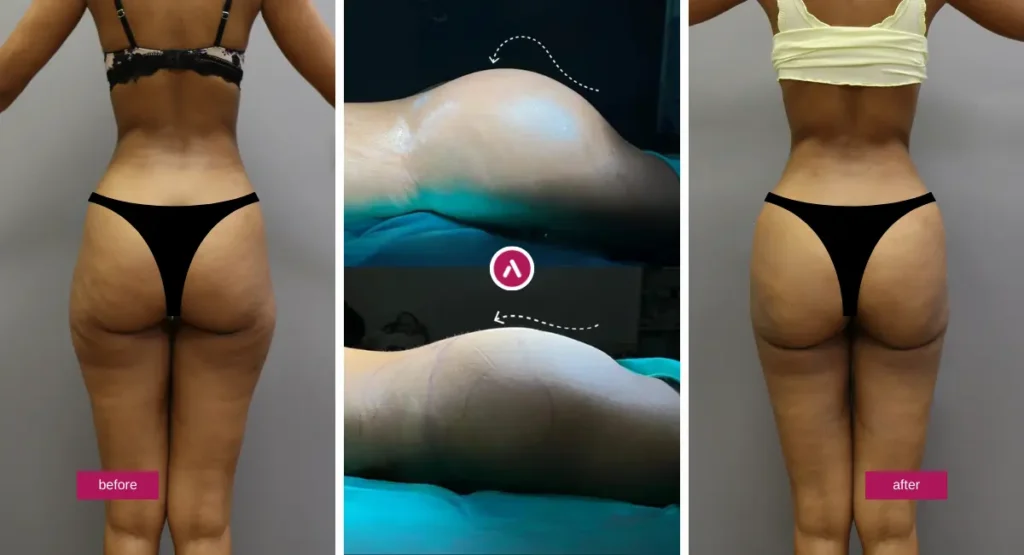
BBL Before and After — Fat Retention Science and 10-Year Reality
A BBL is not a permanent “set volume” procedure. It is a fat grafting procedure, and fat grafting depends on biology. Some transferred fat survives, some is naturally absorbed, and the final contour depends on your body, technique, pressure avoidance, oxygenation, and weight stability.
We discuss this clearly because realistic expectations protect satisfaction. A natural bbl should improve proportion, not create a result that conflicts with your frame. The best long-term outcome usually looks balanced from every angle.
What “Natural-First” means for BBL
Our Natural-First approach means we prioritize proportion over maximum size. We assess your waist, pelvis, hip dips, buttock projection, thigh transition, and skin quality before deciding how much fat should be transferred.
This approach is especially important for Canadian patients who want visible improvement without an exaggerated silhouette. A proportionate BBL can still be meaningful. It can define the waist, soften hip dips, and improve clothing fit while remaining believable.
We avoid overfilling. Excessive volume can increase pressure, reduce fat survival, and make the result look trend-driven rather than anatomical.
Fat retention rates explained
Most patients retain a portion of the transferred fat, not all of it. A common planning range is that approximately 60–70% of injected fat may survive, although individual results vary. The first three to six months are the most important period for judging stabilization.
Fat survival depends on several factors:
- Fat quality and processing
- Injection technique
- Blood supply in the recipient tissue
- Smoking and nicotine avoidance
- Pressure avoidance during recovery
- Stable nutrition and weight
Early volume loss is expected. This is why the first-month result should not be treated as final.
BBL after 10 years — the long-term reality Canadian patients ask about
BBL after 10 years depends mostly on fat survival, aging, and weight stability. Surviving fat cells behave like fat cells elsewhere in the body. They can shrink if you lose significant weight or enlarge if you gain weight.
A stable patient may maintain a softened version of the surgical result for many years. The shape will still age with the body. Skin elasticity, hormones, pregnancy, menopause, fitness habits, and weight changes can all influence the long-term contour.
We frame BBL as long-term body contouring, not a fixed lifetime guarantee. That is the honest answer.
Before and after documentation
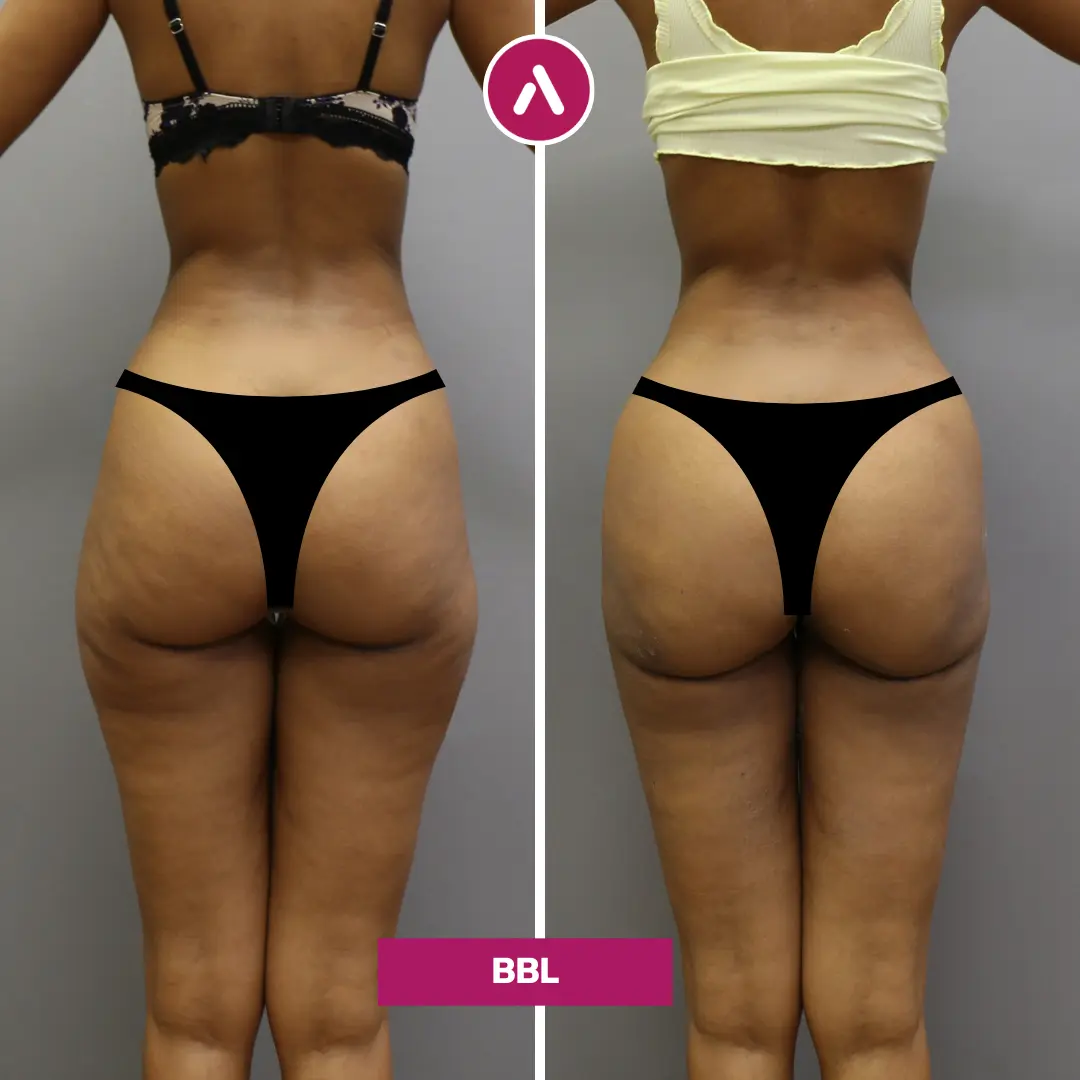
Before and after photography helps patients understand what BBL can realistically change. The most useful comparisons show the full body from the back, side, and oblique angles. Close-up photos alone can be misleading.
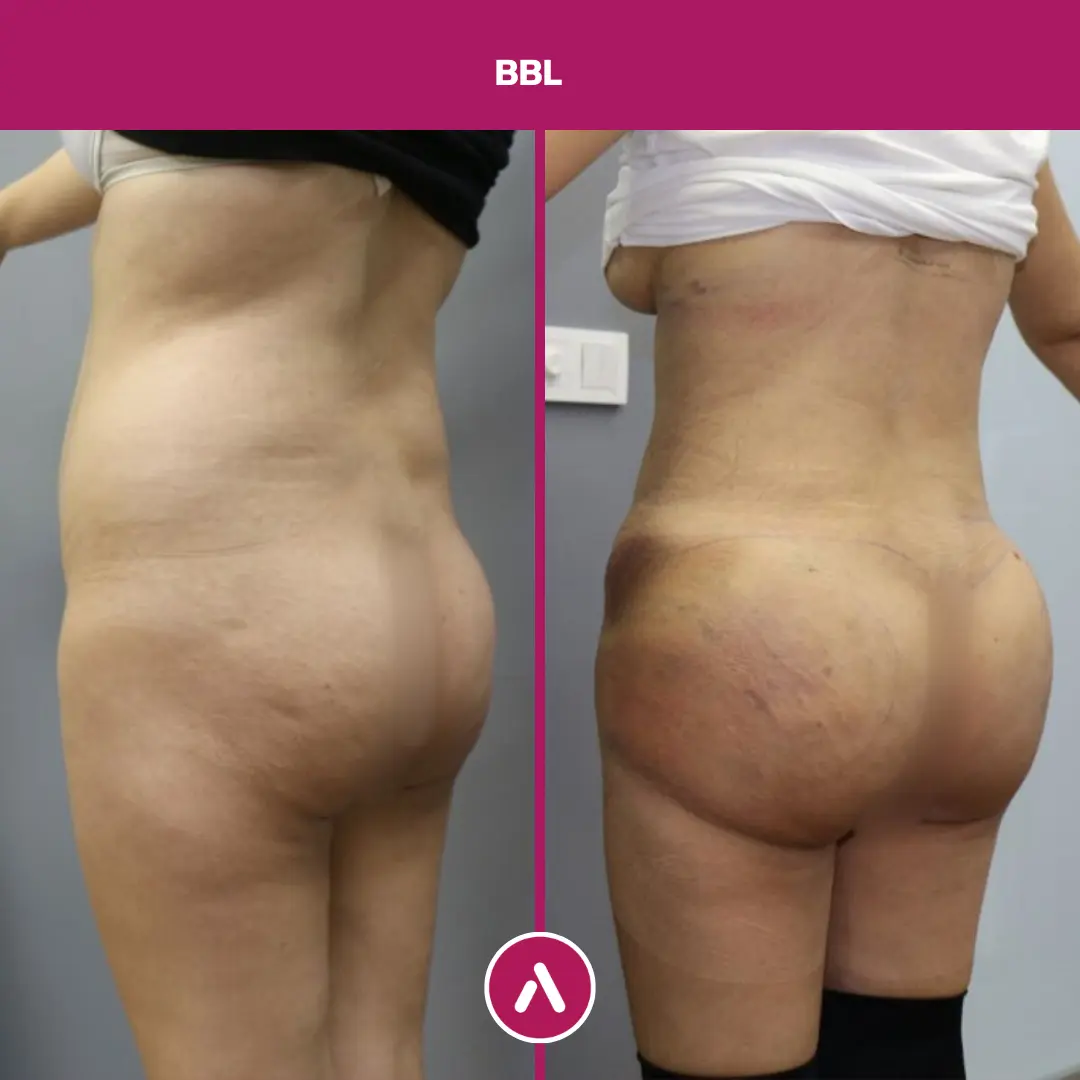
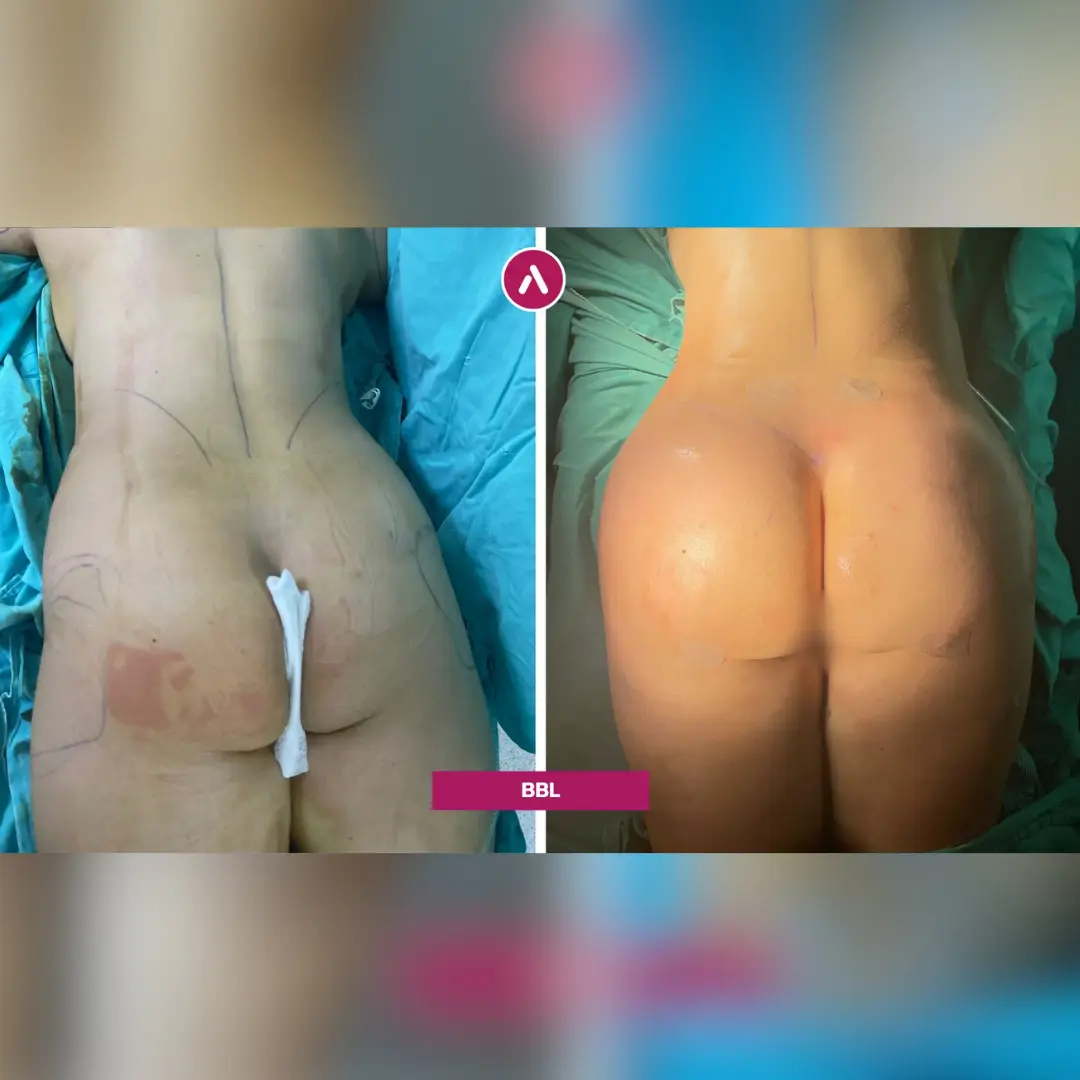
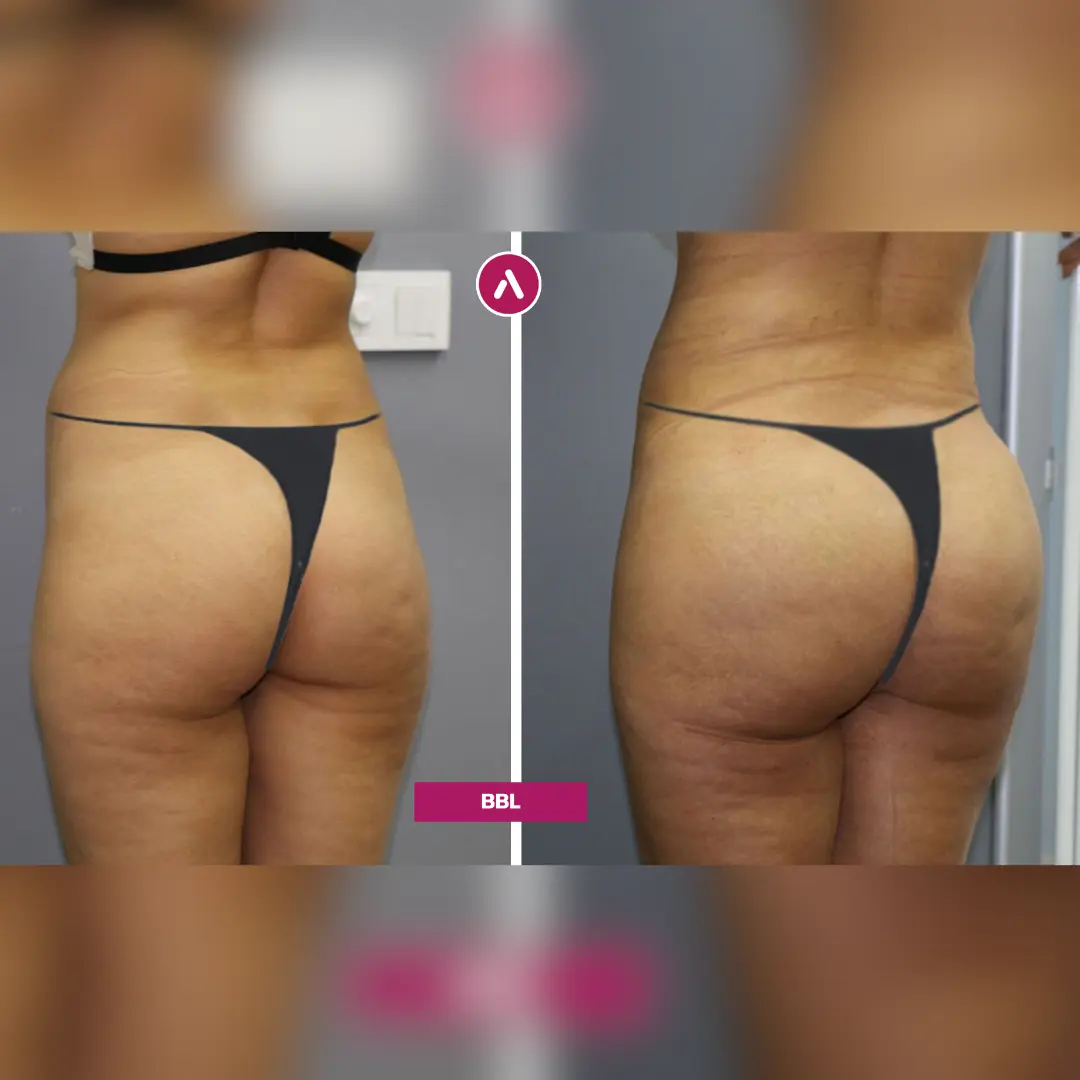
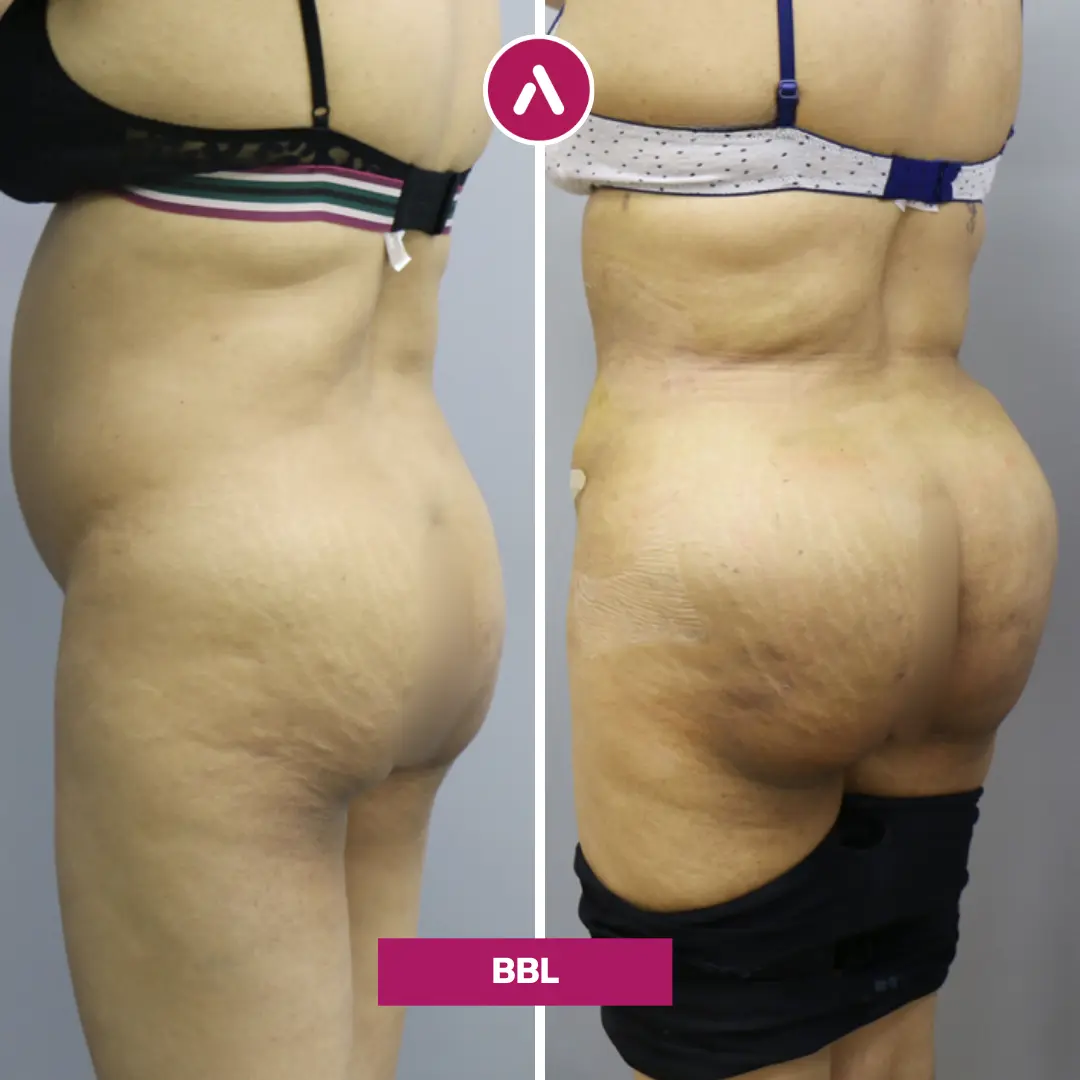
When reviewing bbl before and after images, look for proportion. The waist, hips, buttocks, thighs, and lower back should look connected. A strong brazilian butt lift before and after result should not look like a separate body part was added.
You can review visual examples through our BBL before and after gallery. For more outcome context, our natural-looking BBL results guide explains why conservative planning often produces the most believable silhouette.
Why early volume drops before stabilizing
Early swelling can make the buttocks look larger than the final result. As swelling resolves and some transferred fat is absorbed, the volume usually decreases. This is normal.
Patients sometimes worry when the result changes in the first weeks. We prepare you for this. Final assessment belongs closer to the three-to-six-month window, not week two.
Surgeon Insight: “A BBL result should be judged after swelling settles and fat stabilizes. Early volume is not the final result, and overfilling to chase that early look is not a safe strategy.”
Lifestyle factors that affect long-term fat retention
Long-term results depend partly on you. Weight stability protects the shape. Nicotine avoidance supports blood flow. Strength training can improve gluteal tone, but intense exercise should resume only after clearance.
Nutrition also matters. Severe dieting after BBL can reduce transferred fat volume. Rapid weight gain can enlarge fat cells unevenly.
The most predictable long-term results come from stable habits. Surgery creates the contour. Recovery and lifestyle help maintain it.
BBL Cost 2026: Turkey vs Canada
Canadian patients searching how much is a bbl in canada or bbl cost canada often find that private clinic quotes in Toronto, Vancouver, or Montreal sit well above the comparable all-inclusive programme in Istanbul. The key comparison is not price alone. It is whether the programme includes surgeon-led planning, hospital standards, ultrasound-guided safety protocol options, and structured follow-up.
Our all-inclusive BBL programme starts at CAD $7,500 for the standard subcutaneous BBL. The ultrasound-guided BBL is CAD $7,900, reflecting the real-time imaging protocol used to confirm fat placement in the safer subcutaneous zone. The combined Lipo 360 + BBL package is CAD $8,850, including 4 nights at our 5-star partner hotel, VIP transfers, and 24/7 patient advocacy.
By comparison, bbl toronto private clinic quotes often range from CAD $14,000–$22,000 for the surgical fee alone. Anesthesia, facility, compression garments, drain care, and follow-up may be billed separately. Many patients searching how much is a bbl in turkey find that the Istanbul all-inclusive total remains below their domestic surgical-fee-only estimate.
For the full Canadian dollar cost breakdown, including hidden-fee comparison and ultrasound-guided vs unguided protocol pricing, see our detailed BBL cost guide for Canadian patients.
Our most requested option is the all-inclusive BBL package at CAD $7,500, with Lipo 360 + BBL available at CAD $8,850 for full midsection contouring.
How to Find the Best BBL Surgeon in Turkey: A Canadian Patient’s Checklist
Canadian patients often begin their research by searching for the best bbl surgeon in canada, then comparing bbl toronto, Vancouver, Montreal, Calgary, and Edmonton options. That is a reasonable starting point. The next step is more specific: compare surgeon experience with ultrasound-guided BBL protocols, not just general cosmetic surgery experience.
The best bbl surgeon in turkey for your case should be able to explain anatomy, fat embolism prevention, subcutaneous-only fat placement, volume limits, and aftercare. They should also be willing to say no when the requested result is unsafe. That judgement matters as much as technical skill.
EBOPRAS certification and RCPSC equivalency
Canadian patients are used to credential language such as RCPSC, FRCSC, and provincial college registration. In Turkey, the credentialing pathway is different, so equivalency must be explained clearly. EBOPRAS certification is commonly used as a European board-level benchmark for plastic, reconstructive, and aesthetic surgery.
When we discuss surgeon qualifications with Canadian patients, we translate international credentials into familiar reference points. We do not ask you to accept unknown titles without context. You should understand who is operating, what training they hold, and which hospital standards support the procedure.
For Canadian credential context, patients can review the Royal College of Physicians and Surgeons of Canada’s specialist certification framework. For domestic plastic surgery standards, the Canadian Society of Plastic Surgeons’ guidance on choosing a surgeon is another useful comparison point.
Ultrasound-guided BBL volume as a quality marker
General BBL experience is not the same as ultrasound-guided BBL experience. Ask how often the surgeon uses ultrasound, whether it is used during fat injection, and how the team documents the injection plane. These are practical questions, not technical trivia.
Ultrasound-guided volume matters because the safety standard is linked to real-time layer awareness. A surgeon who performs high volumes of unguided BBLs may not offer the same safety protocol as a surgeon who regularly works with imaging support.
During consultation, ask for a clear explanation of how the surgeon confirms subcutaneous placement. The answer should be specific. Vague reassurance is not enough.
Aesthetic Society Task Force protocol adherence
Modern BBL safety discussions often reference gluteal fat grafting safety guidance from international aesthetic surgery organizations. The key principle is consistent: avoid deep muscle injection and maintain safer fat placement. Ultrasound guidance supports that discipline.
A safety-focused surgeon should be able to explain the protocol without defensiveness. They should also explain what they will not do. For BBL, that includes refusing unsafe volume requests and avoiding injection into the gluteal muscle.
This is where the consultation reveals the clinic’s culture. A responsible team talks about limits before talking about size.
ISAPS membership and continuing education in fat-grafting safety
International society membership is not a guarantee of a good result, but it can signal continuing education and exposure to global safety discussions. For BBL, this matters because standards have evolved over time.
Ask whether the surgeon follows current fat-grafting safety updates, attends international aesthetic surgery meetings, and can explain how their technique has changed as BBL safety evidence has matured.
Credential review should include both training and behaviour. The surgeon’s current protocol matters more than an old certificate on a wall.
What to ask during a virtual consultation
Your virtual consultation should answer the questions that affect safety and outcome. Prepare them before the call. A strong clinic will welcome informed questions.
- Will my BBL be ultrasound-guided?
- Will fat be placed only in the subcutaneous layer?
- How do you decide my safe transfer volume?
- How much donor fat do I realistically have?
- Am I a skinny BBL candidate or a poor BBL candidate?
- How will my return flight to Canada be planned?
- What records will I receive before I leave Istanbul?
- Who do I contact after returning home?
You should leave the consultation with a clear clinical plan, not only a price. If the discussion focuses only on package cost and photos, keep looking.
Red flags Canadian patients should watch for
Some warning signs should make Canadian patients pause. These include clinics that promise extreme volume, avoid discussing fat embolism, cannot explain the injection plane, do not offer ultrasound guidance, or refuse to identify the surgeon of record.
Other red flags include no medical screening, no discussion of smoking, no clot-risk review, no written aftercare plan, and no English-language discharge documents. BBL requires structured care.
A responsible surgeon should protect you from unsafe choices. If every request is approved immediately, that is not patient-centred care.
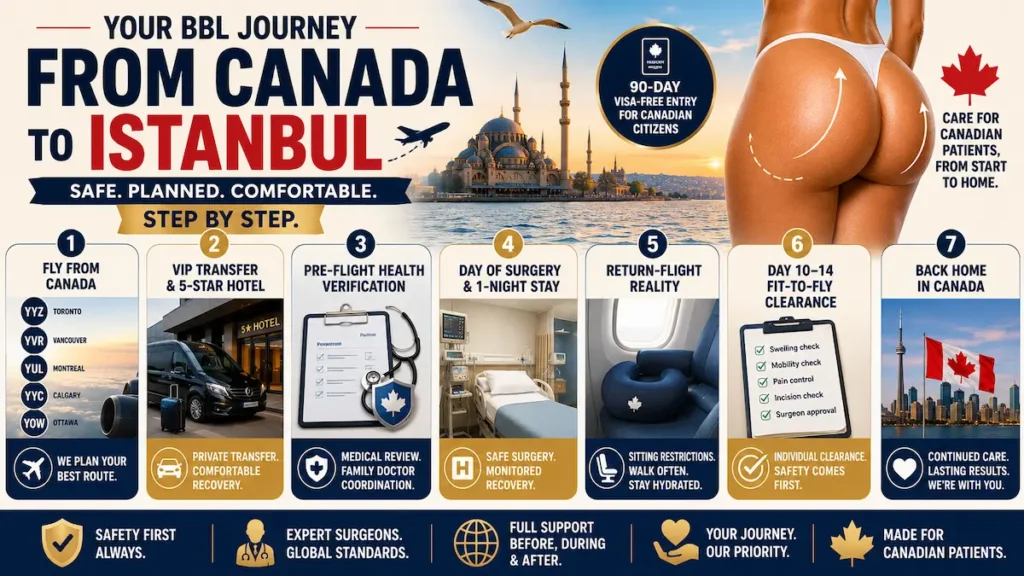
Your BBL Journey from Canada: From YYZ to Istanbul, Step by Step
A safe BBL journey is planned before you leave Canada. The surgery itself is only one part of the pathway. We also plan health screening, flights, hotel recovery, post-operative checks, sitting restrictions, and long-haul return travel.
Canadian patients often appreciate this structure because it reduces uncertainty. You know what happens before arrival, during surgery week, and after you return home. That is essential for a procedure where pressure avoidance and mobility planning affect recovery.
Flight options from YYZ, YVR, YUL, YYC, and YOW to Istanbul
Patients commonly travel from Toronto Pearson (YYZ), Vancouver (YVR), Montreal (YUL), Calgary (YYC), and Ottawa (YOW). Some routes are direct, while others require a connection through Europe or another Canadian hub. Airline schedules change, so patients should confirm current options before booking.
We recommend choosing flights that protect recovery rather than simply selecting the lowest fare. Shorter layovers, easier seat access, and arrival timing can all affect comfort after surgery.
For BBL, the return flight matters even more than the outbound flight. You will need a pressure-management plan, a BBL pillow, permission to stand when safe, and enough time before travel for fit-to-fly clearance.
90-day visa-free entry for Canadian citizens
Canadian ordinary passport holders are exempt from a visa for tourism-related travel to Türkiye for up to 90 days in any 180-day period, according to Türkiye’s official foreign ministry visa information. Patients should still confirm current entry rules before booking because border requirements can change.
Canada’s travel advice for Türkiye also notes passport validity requirements. Regular Canadian passports must be valid for at least 150 days from the date of entry. Airlines may apply stricter rules, so check both government and airline guidance before travel.
VIP transfer and 5-star hotel accommodation
After arrival in Istanbul, our team coordinates private transfer from the airport to your hotel. This reduces the need to navigate transport while tired from a long flight. It also keeps the schedule predictable before consultation and pre-operative testing.
Our BBL care pathway includes hotel recovery planning. The hotel environment matters because you will need space to rest on your stomach or side, manage garments, walk briefly, and avoid direct sitting.
Patients can review broader logistics through our Canadian patient journey guide and our Istanbul clinic overview.
Pre-flight health verification and Canadian family physician coordination
Before travelling, we review your health history and may request blood tests or additional medical clearance. Canadian patients with clotting history, anemia, diabetes, cardiovascular concerns, or prior anesthesia issues should also speak with their family physician before booking.
This step helps avoid preventable problems. It also gives your Canadian provider a baseline record before you leave the country.
After surgery, we provide English-language instructions that can be shared locally if needed. That documentation supports continuity of care once you are back in Canada.
Day-of-surgery and one-night hospital stay protocol
On surgery day, you complete final checks before anesthesia. The surgical plan is reviewed again, donor zones are confirmed, and the BBL pressure-avoidance plan is reinforced.
Many BBL patients stay one night under observation, depending on the full surgical plan. Monitoring after body contouring supports hydration, pain control, early walking, garment review, and drain management if drains are used.
The first night is not only about comfort. It is about controlled recovery during the most vulnerable post-operative window.
The BBL return-flight reality — sitting restrictions for the 10+ hour Canada return
A long return flight after BBL requires more planning than most cosmetic surgery travel. You cannot simply sit normally for 10 or more hours. Pressure on transferred fat can affect comfort and may influence fat survival during early recovery.
Your return-flight strategy may include:
- Waiting until day 10–14 when clinically appropriate.
- Using your BBL pillow exactly as instructed.
- Choosing an aisle seat for easier standing breaks.
- Walking during safe intervals.
- Wearing compression garments correctly.
- Avoiding alcohol and dehydration during travel.
- Considering premium economy or lie-flat seating when feasible.
Long-distance air travel can increase venous thromboembolism risk, including DVT and pulmonary embolism, according to Thrombosis Canada clinical guidance. This is why we take walking, hydration, compression, and fit-to-fly timing seriously for BBL patients.
Typical day 10–14 fit-to-fly clearance
Fit-to-fly timing is individualized. Many BBL patients should plan around a day 10–14 return window, but the final decision depends on swelling, mobility, pain control, drain status, incision appearance, and your surgeon’s assessment.
Do not book a return flight that leaves no flexibility. Recovery can vary. A safer itinerary allows room for an extra day if your body needs it.
Before departure, we review warning signs, garment use, sitting restrictions, flight movement, and follow-up scheduling. The goal is a return to Canada that protects both safety and the final result.
Brazilian Butt Lift Frequently Asked Questions (FAQ):
Canadian patients usually ask BBL questions in three categories: safety, logistics, and value. These answers are designed to help you prepare for a structured consultation, not to replace one. Your final recommendation depends on your anatomy, medical history, donor fat, recovery support, and travel timing.
Does OHIP, MSP, RAMQ, or AHCIP cover BBL?
No. BBL is an elective cosmetic procedure, so provincial health plans such as OHIP, MSP, RAMQ, and AHCIP do not typically cover it. Public coverage is reserved for medically necessary or reconstructive care, not appearance-focused gluteal augmentation.
You should also assume that related costs, such as travel, compression garments, hotel recovery, and follow-up after elective cosmetic surgery, are private-pay expenses. If you are unsure, confirm directly with your provincial plan before booking.
How do I arrange follow-up care when I return to Canada?
We provide English-language discharge instructions before you leave Istanbul. These include medication guidance, incision care, sitting restrictions, compression garment instructions, warning signs, and follow-up timing.
Your AKM team remains your surgical follow-up point. Your Canadian family physician may help with local assessment if you develop fever, calf pain, unusual swelling, incision drainage, or worsening discomfort after returning home.
Are AKM’s surgeons’ credentials and ultrasound-guided protocol recognized by Canadian boards?
Canadian boards do not “approve” individual overseas surgeries in the same way they regulate Canadian physicians. The better question is whether the training, facility standards, and safety protocols can be compared to Canadian expectations.
We explain European board-level credentials, hospital accreditation, surgeon-of-record accountability, and ultrasound-guided BBL protocol in language Canadian patients can evaluate. You should ask about these points directly before booking any clinic abroad.
What if I have complications after returning home?
Contact your AKM patient coordinator first unless it is an emergency. For urgent symptoms, such as chest pain, shortness of breath, severe calf pain, high fever, sudden asymmetry, or rapidly worsening swelling, seek emergency care in Canada immediately.
We provide medical records to support local care when needed. This helps reduce the follow-up gap that can occur after surgery abroad.
Can I do a BBL with a low BMI?
Possibly. Low-BMI patients may qualify for a skinny BBL if they have enough donor fat for safe harvest and realistic expectations about volume. The goal is usually subtle shaping, hip-dip improvement, or mild projection.
If donor fat is too limited, we may recommend a different plan. That may include no surgery, staged contouring, or butt implants for selected patients.
How long do BBL results actually last?
Surviving transferred fat can last for many years, but the result changes with weight, aging, hormones, and skin quality. BBL is long-term body contouring, not a fixed-volume guarantee.
Stable weight, nicotine avoidance, healthy nutrition, and pressure avoidance during early recovery help protect the result. Major weight loss or gain can change the shape.
What does fat retention rate mean?
Fat retention rate describes how much transferred fat survives after the early healing period. Some fat cells establish blood supply and remain. Others are naturally absorbed by the body.
A common planning range is approximately 60–70% survival, but individual results vary. Final contour is usually easier to judge after three to six months.
Can I sit on a long flight after BBL?
You should not sit normally on a long flight during early BBL recovery. Most Canadian patients need a BBL pillow, aisle-seat planning, standing breaks, hydration, compression garment discipline, and surgeon clearance before travel.
Many patients plan return travel around day 10–14, depending on healing. Fit-to-fly timing is individualized.
What is the difference between ultrasound-guided BBL and regular BBL?
Ultrasound-guided BBL uses real-time imaging during fat transfer to help confirm the injection plane. The goal is to keep fat in the subcutaneous layer, above the gluteal muscle.
A regular BBL may still use a subcutaneous-only technique, but without real-time imaging confirmation. For safety-focused Canadian patients, ultrasound guidance is an important protocol question.
Is BBL safer in Turkey than other international destinations?
Safety depends on the clinic, surgeon, hospital setting, anesthesia team, ultrasound protocol, and aftercare system. Turkey is not automatically safer than every other destination, and no country guarantees safety by location alone.
At AKM Clinic, we position Istanbul as the right choice when patients want JCI-accredited hospital infrastructure, surgeon-led planning, ultrasound-guided protocol options, and structured follow-up for international patients.
Can BBL be combined with tummy tuck or breast surgery?
Yes, selected patients can combine BBL with tummy tuck, breast lift, breast augmentation, or broader Mommy Makeover planning. The decision depends on surgical time, positioning conflicts, BMI, clot risk, and recovery support.
BBL and tummy tuck require special planning because tummy tuck recovery favours a flexed position while BBL recovery requires buttock pressure avoidance. Some patients are safer with staged surgery.
What is a BBL pillow and how do I use it?
A BBL pillow shifts pressure from the buttocks to the thighs during short necessary sitting periods. It does not make unlimited sitting safe. It is a recovery tool, not a permission slip to sit normally.
We show you how to use the pillow before you travel home. Correct use is especially important on the return flight to Canada.
Why is skinny BBL different from regular BBL?
Skinny BBL uses smaller fat volumes and more selective donor-site harvesting. It is designed for low-BMI patients who want refinement rather than dramatic enlargement.
The main limitation is volume. A skinny BBL can improve proportion, but it cannot create high projection when the body does not have enough donor fat.
How do I start the consultation process from Canada?
You begin with a virtual consultation and photo review. We assess donor fat, body proportions, medical history, travel readiness, and your preferred outcome.
If BBL appears appropriate, we provide a tailored clinical protocol, CAD-first pricing guidance, hotel and transfer planning, and the timeline required for recovery before your return flight.
Medical disclaimer: This page is for educational purposes only and does not replace a medical consultation, diagnosis, or individualized surgical advice. BBL carries risks, including rare but serious complications. Your candidacy, surgical plan, anesthesia pathway, recovery timeline, and travel clearance must be confirmed by a qualified medical team after full assessment.