


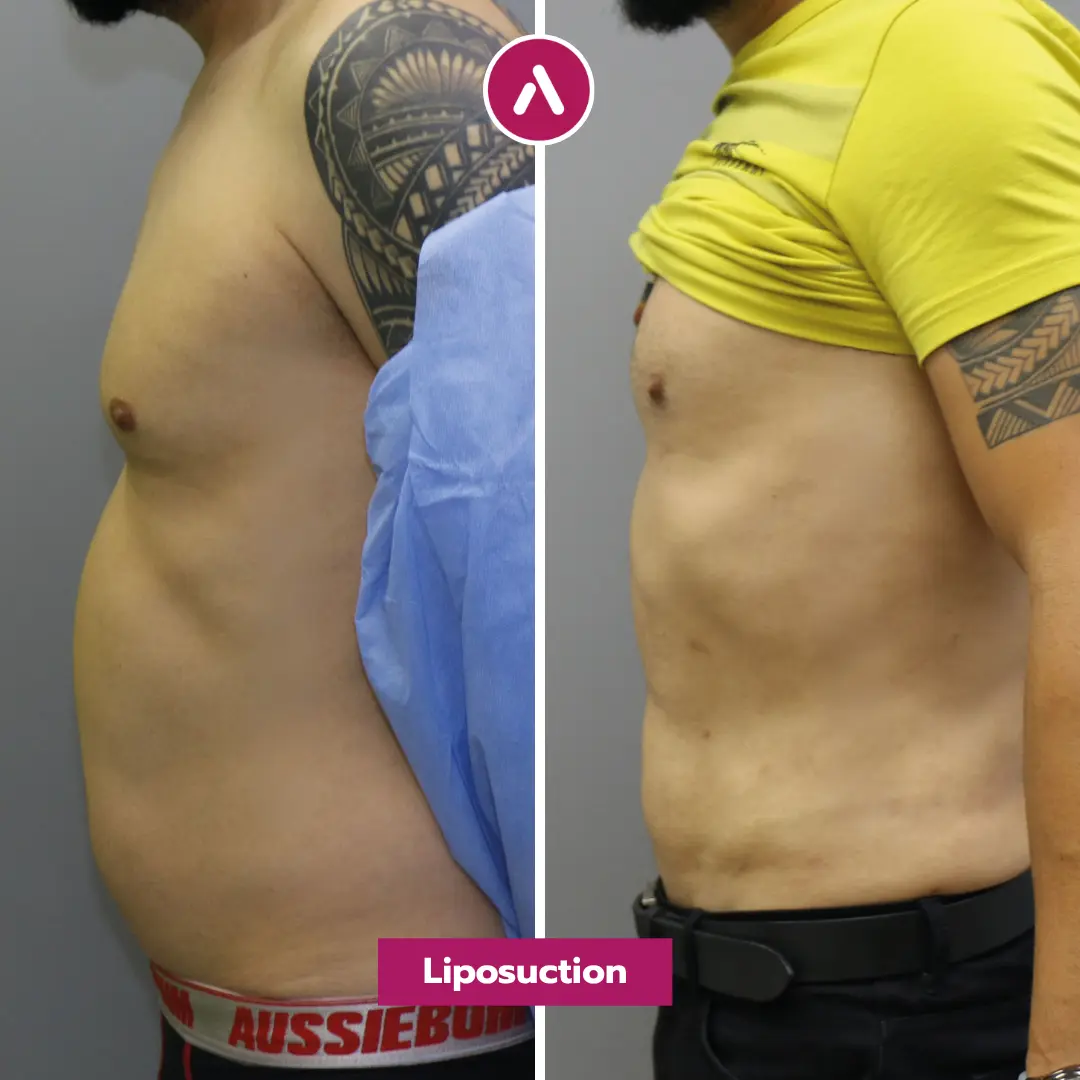
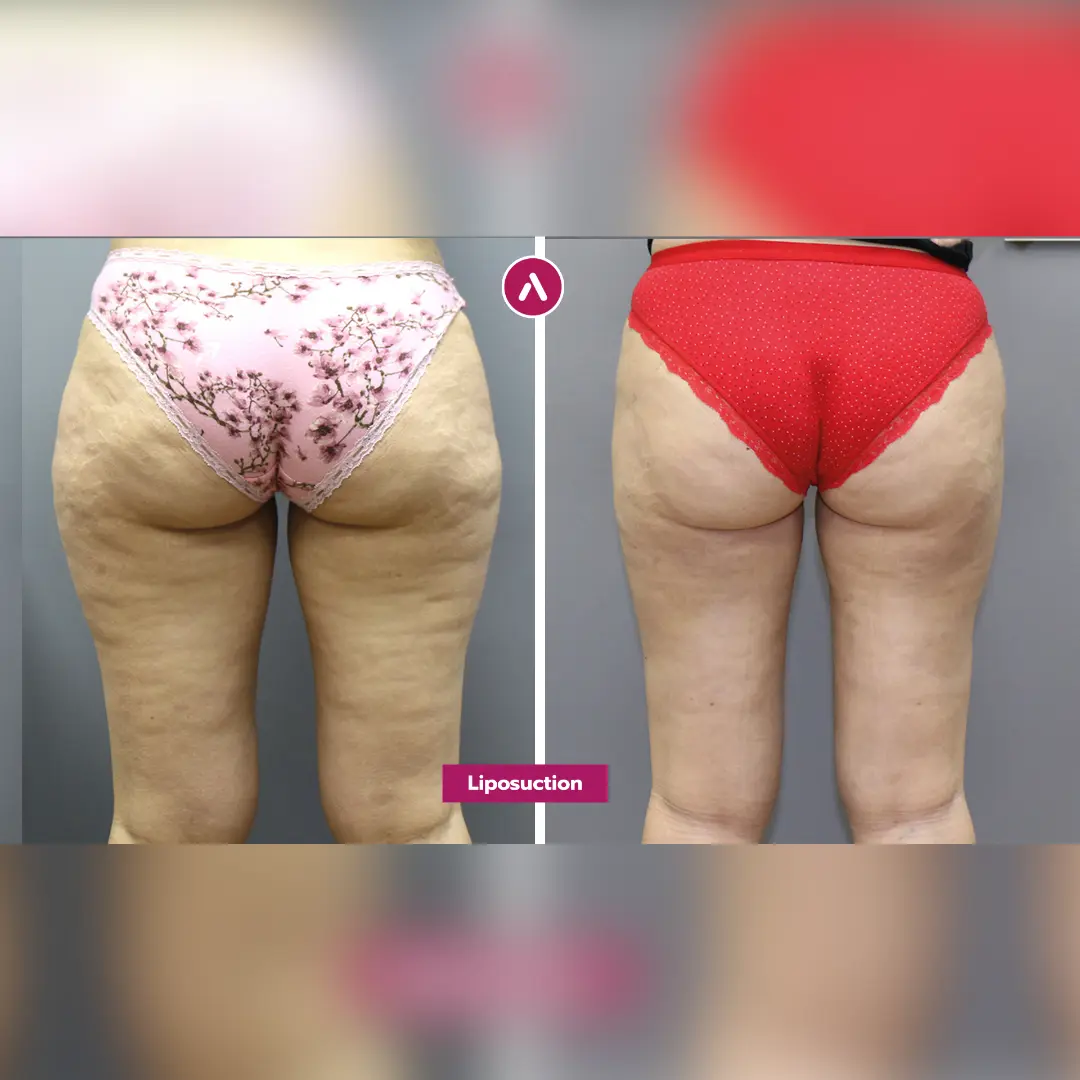
Canadians considering liposuction are usually not looking for weight loss; they are looking for more precise body contouring when diet, exercise, and stable weight have not corrected localized fat. This guide explains how liposuction works, how VASER, Lipo 360, high-definition, and awake approaches differ, and why Canadian patients compare Istanbul with Toronto, Vancouver, Calgary, and Montreal private clinics before deciding. We will also cover cost, recovery, safety, fit-to-fly timing, and what makes our Natural-First body contouring philosophy different. Our goal is clarity before commitment.
Table of Contents
What Is Liposuction?
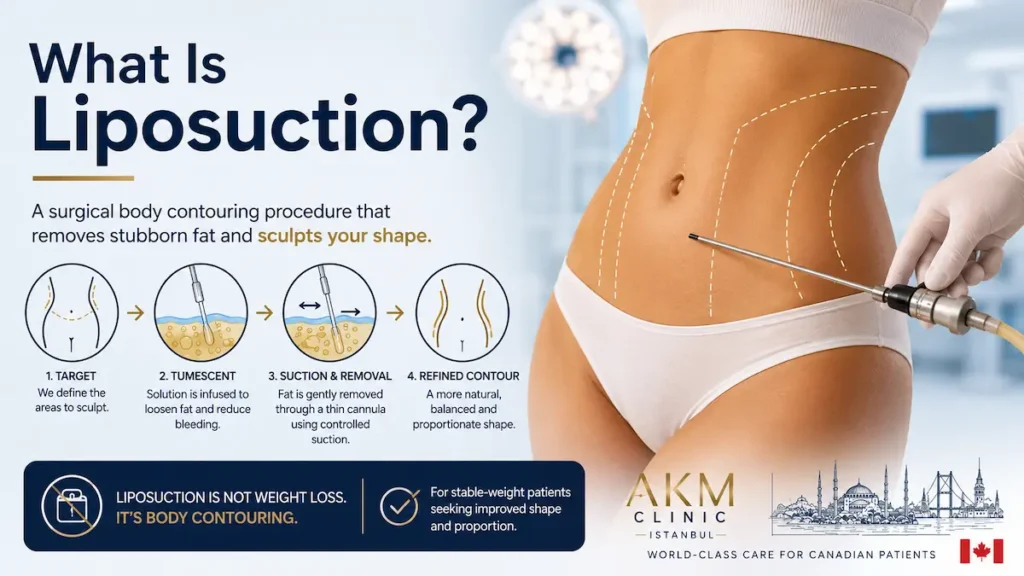
Liposuction is a surgical body contouring procedure that removes localized fat through small cannula incisions using suction-assisted, tumescent, VASER, laser, or high-definition techniques. It is not a weight-loss procedure. At AKM Clinic in Istanbul, we tailor liposuction for Canadian patients seeking refined, natural-looking contour improvement.
Liposuction, often shortened to “lipo,” is designed for patients who are close to their stable weight but still have stubborn fat deposits in specific areas. Common treatment zones include the abdomen, flanks, lower back, arms, inner thighs, chin, and submental area beneath the jaw. The procedure changes contour, not body identity. That distinction matters.
Our approach is based on proportion, anatomy, and skin quality. We do not treat liposuction as a shortcut for weight loss or as a one-size-fits-all procedure. For Canadian patients travelling to Istanbul, the first consultation focuses on whether fat removal alone is enough, or whether skin tightening, tummy tuck, BBL, or another body contouring plan would create a more reliable result.
That is why this page begins with technique and candidacy rather than price. Cost matters, especially for patients comparing private quotes in Toronto or Vancouver, but the safest result starts with correct procedure selection.
How Liposuction Works — Cannula, Suction, and Tumescent Solution
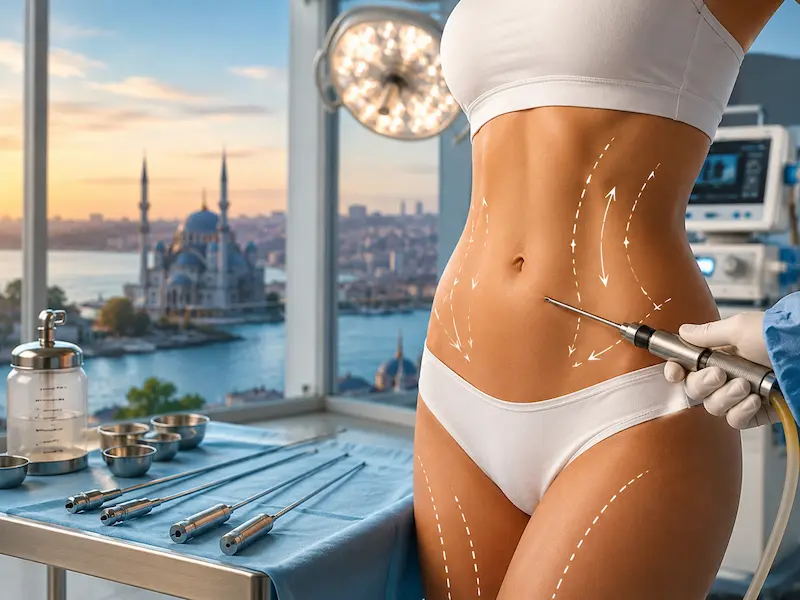
Modern liposuction begins with careful marking while the patient is standing. These markings show where fat should be reduced, where natural shadows should remain, and how the final contour should transition into surrounding areas. The goal is not simply to “remove fat.” The goal is to sculpt.
During surgery, we place small incisions in discreet locations near the treatment zone. A sterile fluid called tumescent solution is then introduced into the fatty layer. This solution helps separate fat cells, reduce bleeding, and make the tissue easier to contour with controlled cannula movement.
A cannula is a thin surgical tube connected to suction. The surgeon moves it through the fatty layer in planned passes, removing fat gradually and symmetrically. In VASER liposuction, ultrasound energy first emulsifies the fat before removal, which can be helpful for fibrous areas and high-definition sculpting.
Technique matters because aggressive fat removal can create contour irregularities, dents, or loose skin. We use measured volume reduction, anatomical planning, and conservative contour blending to support smoother transitions. A good lipo result should look like the patient became more proportionate, not surgically hollowed out.
What Liposuction Is Not — Body Contouring vs Weight Loss
Liposuction is not a treatment for obesity, metabolic disease, or generalized weight gain. It removes selected fat cells from targeted areas, but it does not change eating patterns, hormone balance, or total-body weight regulation. Patients who expect the scale to change dramatically are usually not ideal candidates.
The best candidates are already weight-stable and want contour refinement. For example, a patient may have a stable BMI, exercise regularly, and still retain fat around the flanks or lower abdomen. In that situation, liposuction can address a shape problem that lifestyle changes may not fully correct.
Skin quality is just as important as fat volume. If the skin has good elasticity, it can retract more predictably after fat removal. If the patient has loose abdominal skin, stretch marks, or muscle separation after pregnancy, a tummy tuck in Turkey may be a more appropriate procedure than liposuction alone.
This honest distinction protects patients from under-treatment. Removing fat from an area with poor skin support can make looseness more visible. During virtual assessment, we evaluate photos, medical history, weight stability, and skin tone before recommending any surgical pathway.
From Tumescent Liposuction to VASER and High-Definition Body Sculpting
Liposuction has evolved significantly from older suction-only methods. Traditional suction-assisted liposuction remains useful for many patients, but modern body contouring often combines tumescent fluid, energy-assisted fat separation, and artistic definition planning. These differences affect recovery, precision, and final contour.
VASER liposuction uses ultrasound energy to loosen fat before removal. This can reduce mechanical trauma in selected cases and gives the surgeon more control when sculpting the abdomen, flanks, back, chest, or arms. For patients seeking athletic contour, the technique may be used as part of high-definition liposuction.
Lipo 360 is different from single-area lipo. It treats the torso circumferentially, usually including the abdomen, waist, flanks, and lower back. This matters because contour is three-dimensional. A flat abdomen with untreated flanks can still look unbalanced from the side or back.
As an umbrella guide, this page explains the main decision framework. For patients who want a deeper technical comparison of VASER and athletic sculpting, our dedicated VASER High-Definition Liposuction in Turkey page covers that sub-technique in more detail. For patients interested in local anesthesia and faster early mobility, our Awake High-Definition Liposuction page explains the awake pathway.
Benefits of Liposuction
Liposuction can refine body shape when localized fat remains despite stable weight, regular activity, and realistic lifestyle habits. The benefit is not measured only by how much fat is removed. It is measured by whether the treated area looks more balanced with the rest of the body.
For many Canadian patients, the most frustrating fat deposits are resistant rather than excessive. They may appear around the abdomen, waist, lower back, arms, thighs, or under the chin. Liposuction can help when the concern is contour rather than the number on the scale.
Our Natural-First approach applies to body procedures as much as facial surgery. We aim for proportion, not overcorrection. The most successful results look like the patient’s own body, refined.
This is why candidacy and technique selection matter. A patient seeking subtle waist definition may need a different plan than someone considering Lipo 360, VASER liposuction, or liposuction as part of a BBL or Mommy Makeover.
Sculpting Stubborn Fat Resistant to Diet and Exercise
The main benefit of liposuction is targeted fat reduction. This is different from general weight loss. Weight loss reduces fat across the body, while liposuction focuses on specific areas that do not respond evenly.
Common examples include lower abdominal fullness after weight stabilization, flanks that soften the waistline, inner thigh fullness that affects clothing fit, or submental fat that blurs the jawline. These concerns can be present even in patients who are active and medically healthy.
During assessment, we look at three things:
- Whether the fat is localized and pinchable.
- Whether the skin can retract after fat removal.
- Whether the patient’s expectations match what liposuction can safely achieve.
This last point is important. Removing too much fat can create contour problems, especially in thin patients or areas with weak skin support. We prefer a balanced reduction that improves shape while preserving smooth transitions.
For Canadian patients comparing private clinic consultations, this distinction can prevent disappointment. A higher-volume fat removal plan is not automatically a better plan. Safe sculpting is usually more conservative than social media suggests.
Body Proportion and Silhouette Refinement
Liposuction can improve how one body area relates to another. A patient may not need major volume reduction, but they may want the waist, abdomen, back, or arms to sit more naturally within their overall frame. This is where proportion becomes the focus.
Lipo 360 is often chosen because it treats the torso as a three-dimensional structure. Instead of removing fat from only the front of the abdomen, we assess the waist, flanks, lower back, and side profile together. This can create a more continuous contour.
High-definition liposuction takes this concept further. It aims to reveal underlying muscle lines by reducing fat around natural anatomical borders. That technique requires careful judgment. Too much definition can look artificial, especially for patients who want a softer, Canadian-natural aesthetic.
We tailor the target based on the patient’s anatomy, not a template. A professional from Toronto returning to work after recovery may want discreet waist refinement. A fitness-focused patient from Vancouver may prefer a more athletic abdominal contour.
Both goals are valid. They require different surgical planning.
Clothing Fit, Confidence, and Natural-Looking Definition
Many patients describe liposuction goals in practical terms. They want jeans to sit more comfortably at the waist. They want fitted shirts to look smoother. They want less fullness under the chin in photos and video calls.
These everyday changes matter because body contouring is often about consistency. Patients may feel that one area does not match the effort they put into the rest of their body. Liposuction can help align the visible contour with their stable lifestyle.
Natural-looking definition is the guiding principle. We do not chase extreme waist narrowing, exaggerated abdominal etching, or hollowed limbs. Those results can age poorly and may draw attention for the wrong reasons.
A refined outcome should respect the patient’s sex, height, bone structure, skin thickness, and long-term weight pattern. This is especially relevant for Canadian patients who want improvement without looking “overdone” at work, with family, or in their community.
The best compliment after liposuction is often simple: the body looks fitter, more balanced, and still recognizably yours.
Liposuction as a Support Procedure for BBL and Mommy Makeover
Liposuction is frequently used on its own, but it also supports other body contouring procedures. For a BBL in Turkey, liposuction harvests fat from the abdomen, waist, back, or thighs before that fat is purified and transferred to the buttocks. The quality of the harvest affects the final contour.
For a Mommy Makeover in Turkey, liposuction may refine the flanks, waist, or upper abdomen after tummy tuck and breast restoration planning. It helps blend the surgical result rather than treating only one isolated area.
In some cases, liposuction is paired with skin tightening technologies or surgical excision. This is common when patients have both fat fullness and mild skin looseness. When skin laxity is more advanced, liposuction alone is not enough.
We explain these boundaries early. Combining procedures can be efficient, but it must be medically appropriate. One anesthesia and one recovery can be useful only when the combined plan remains safe.
Am I a Good Candidate for Liposuction?
A good liposuction candidate is close to their stable weight, medically fit for surgery, and concerned about localized fat rather than overall weight loss. The procedure works best when the skin has enough elasticity to retract after fat removal. It is not ideal for every body type.
During your virtual assessment, we evaluate photos from multiple angles, medical history, medication use, previous surgery, smoking status, and weight stability. We also ask what bothers you most in daily life. A clear goal helps us decide whether liposuction alone is appropriate.
Canadian patients often arrive after comparing several options: private lipo quotes in Toronto, non-surgical fat reduction clinics, gym-based transformation plans, or tummy tuck consultations. Our role is to identify which path fits the anatomy. Sometimes the safest recommendation is not liposuction.
Good surgery starts with good selection.
Skin Elasticity, BMI, and Weight Stability
Skin elasticity is one of the strongest predictors of a smooth liposuction result. When fat is removed, the overlying skin must adapt to the smaller contour. Younger patients often have stronger retraction, but age alone does not decide candidacy.
We assess elasticity by looking for stretch marks, loose folds, crepey texture, previous pregnancy changes, and how the skin behaves around the treatment zone. A patient with firm skin and localized fat usually has a better lipo response than a patient with loose skin and minimal fat.
BMI also matters, but it is not the only factor. Liposuction is safest when patients are near a stable, healthy weight and do not need large-volume fat removal. We typically look for weight stability for at least 3 to 6 months before surgery.
Major weight changes after liposuction can alter the result. Fat cells removed from one area do not usually regenerate in the same way, but remaining fat cells can enlarge if weight increases. That is why long-term stability is part of the surgical plan.
Localized Fat vs Generalized Adiposity
Liposuction is designed for localized fat deposits. These are specific areas that remain fuller than surrounding zones despite a stable routine. Examples include flanks, lower abdomen, inner thighs, upper arms, back rolls, or submental liposuction under the chin.
Generalized adiposity is different. If a patient has weight distributed widely across the body, liposuction cannot safely replace weight loss. Removing fat from several large areas in one session can increase surgical stress and compromise contour quality.
We prefer to work with focused treatment plans. This may mean one area, Lipo 360, or a staged approach depending on volume, skin support, and overall health. The safest contouring plan is not always the largest plan.
Patients sometimes ask whether liposuction can create an athletic look without fitness habits. It cannot. High-definition liposuction can reveal contours that are already supported by muscle structure, but it cannot build muscle or replace conditioning.
Lipedema as a Distinct Medical Indication
Lipedema is not ordinary weight gain. It is a chronic fat-distribution condition that usually affects the legs, hips, buttocks, or arms, and it may cause pain, easy bruising, heaviness, and disproportionate swelling. Patients often report that dieting does not change the affected areas.
Lipedema liposuction requires a different mindset than cosmetic lipo. The goal may include symptom relief, mobility improvement, and limb-shape management, not only aesthetic refinement. It also requires careful medical history review and realistic expectations.
Canadian patients searching for lipedema liposuction Canada price often find limited access, long waits, and variable coverage depending on province and documentation. Coverage under provincial health plans is not guaranteed. Many patients are told the procedure is cosmetic even when symptoms affect quality of life.
At AKM Clinic, we evaluate lipedema concerns carefully and distinguish them from localized cosmetic fat. If the pattern suggests lipedema, we may recommend additional documentation from your Canadian family physician, vascular specialist, or lymphatic therapist before travel.
Who Should Not Get Liposuction
Liposuction is not appropriate for patients with unstable weight, poorly controlled medical conditions, active smoking, untreated clotting disorders, or unrealistic expectations. We also avoid surgery when the requested fat removal volume would create unnecessary risk.
Patients with significant loose skin may be disappointed by liposuction alone. Removing fat can sometimes make looseness more visible, especially around the lower abdomen, inner thighs, upper arms, or neck. In those cases, skin excision may be more reliable.
We may decline or delay surgery when a patient has:
- Recent major weight loss that is still changing.
- Planned pregnancy or major upcoming weight change.
- Untreated anemia, uncontrolled diabetes, or heart disease.
- Heavy nicotine use that affects healing.
- Expectations based on edited social media images.
This is not about being restrictive. It is about protecting the patient and the result.
When Tummy Tuck Is the Better Option
Some patients ask for liposuction when they actually need abdominal wall repair or skin removal. This is common after pregnancy, C-section delivery, or major weight loss. If the issue is loose skin, muscle separation, or a hanging lower abdominal fold, liposuction cannot correct it fully.
A tummy tuck addresses skin excess and can repair diastasis recti, the separation of abdominal muscles that creates a persistent bulge. Liposuction may still be added to refine the waist or flanks, but it is not the core treatment in these cases.
Canadian patients often find this decision confusing because both procedures can involve the abdomen. The simplest distinction is this: liposuction removes fat; tummy tuck removes skin and repairs structure.
For a deeper decision framework, our Tummy Tuck vs Liposuction guide explains when each option is more appropriate and how combined planning works for body contouring patients.
Liposuction Techniques Compared: Traditional vs VASER vs Laser vs HD vs Non-Surgical
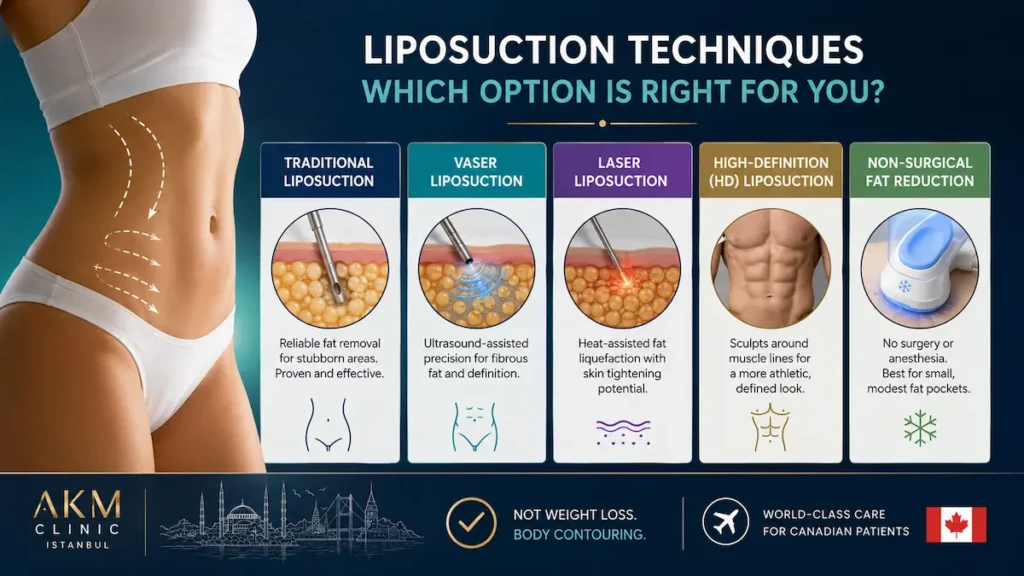
There is no single “best” liposuction technique for every patient. The right method depends on fat density, skin elasticity, treatment area, desired definition, anesthesia tolerance, and whether liposuction is being performed alone or as part of a combined procedure. A thoughtful comparison prevents over-treatment.
Canadian patients often arrive with strong opinions after reading about VASER liposuction, laser liposuction, Lipo 360, non-surgical liposuction, or CoolSculpting. Those options are not interchangeable. Each has a different role, limitation, and recovery profile.
At AKM Clinic, we select technique based on anatomy first. We do not recommend VASER, high-definition sculpting, or awake lipo simply because they sound advanced. We recommend them only when they improve safety, precision, or final contour.
The table below gives the practical overview. The H3 sections that follow explain how each option works.
| Technique | Best For | Key Advantage | Main Limitation |
|---|---|---|---|
| Traditional suction-assisted liposuction | Localized fat in patients with good skin tone | Reliable, direct fat removal | Less helpful for fibrous fat or HD sculpting |
| Tumescent liposuction | Most modern liposuction cases | Reduced bleeding and easier fat removal | Still depends heavily on surgeon technique |
| VASER liposuction | Fibrous fat, male lipo, HD body contouring | Ultrasound-assisted fat emulsification | Requires experienced hands to avoid over-definition |
| Laser liposuction | Small areas with mild skin tightening goals | Heat-assisted fat liquefaction | Thermal risk if used aggressively |
| Non-surgical fat reduction | Small, modest fat pockets | No surgery or anesthesia | Less predictable and more limited contour change |
Traditional Suction-Assisted Liposuction
Traditional suction-assisted liposuction removes fat mechanically through a cannula connected to suction. It remains useful for many patients, especially when the goal is moderate contour reduction rather than high-definition sculpting. Simple does not mean outdated.
The success of this method depends on controlled cannula movement, symmetrical planning, and respect for the superficial fat layer. Removing fat too close to the skin can cause dents, waviness, or irregular shadows. This is why surgeon judgment matters more than the device name.
Traditional lipo may be appropriate for abdomen, flanks, thighs, arms, or back areas when fat is not overly fibrous. It can also be combined with other body contouring procedures when the treatment plan is conservative and medically safe.
Tumescent Liposuction
Tumescent liposuction refers to the use of diluted local anesthetic and adrenaline-containing fluid before fat removal. The fluid expands the fat layer, reduces bleeding, and improves cannula glide. Most modern lipo techniques use some form of tumescent infiltration.
This step is especially helpful for Canadian patients travelling after surgery because reduced bleeding and tissue trauma may support smoother early recovery. It does not eliminate swelling, bruising, or drainage. Those are normal parts of the healing process.
Tumescent technique can be used with traditional suction, VASER, laser-assisted lipo, or awake protocols. It is not a competing method as much as a foundational part of safe liposuction planning.
VASER Liposuction
VASER liposuction uses ultrasound energy to emulsify fat before suction removal. This can make fat easier to remove from fibrous zones such as the male chest, upper abdomen, flanks, back, or areas previously treated with surgery. It can also support high-definition liposuction when the anatomy is suitable.
The advantage is precision. VASER can help the surgeon separate fat more selectively, which may reduce mechanical force compared with suction-only methods. This is valuable in body sculpting, but it is not automatically better for every patient.
Overuse can create an overly etched or artificial appearance. Our planning stays aligned with proportion and long-term wearability. For the full technical breakdown, see our dedicated VASER High-Definition Liposuction in Turkey guide.
Laser Liposuction
Laser liposuction uses heat energy to liquefy fat before removal. SmartLipo is one example. Some patients are attracted to laser lipo because of claims around skin tightening, but results depend on skin quality, treatment area, and thermal control.
Laser-assisted methods may be useful for smaller zones where mild tightening is desired. They are less ideal when larger-volume sculpting or circumferential Lipo 360 is needed. Heat is not risk-free.
We assess laser-based approaches carefully because excessive thermal energy can increase the risk of burns, firmness, or uneven healing. For patients with meaningful skin laxity, surgical tightening may be more reliable than energy-based promises.
High-Definition Liposuction
High-definition liposuction is a sculpting technique that removes fat around natural muscle borders to create more visible definition. It is most often used for the abdomen, waist, chest, arms, and flanks. The goal is controlled athletic contour, not exaggerated etching.
This technique requires careful patient selection. It works best when the patient already has good muscle tone and a moderate fat layer covering the anatomy. If the patient has weak skin elasticity or low muscle definition, HD lipo may not create the look they expect.
We use high-definition planning conservatively. Some patients want crisp abdominal lines. Others want a softer waist transition that still looks natural in office clothing, swimwear, and everyday life.
Lipo 360 — Circumferential Body Contouring
Lipo 360 treats the torso as a full circle rather than a front-only abdomen. The usual zones include the upper and lower abdomen, flanks, waist, and lower back. This gives a more balanced contour from the front, side, and back.
This approach is useful when patients feel their waist lacks shape from multiple angles. Treating only the abdomen may flatten the front but leave fullness around the flanks or back. Lipo 360 addresses that mismatch.
Our 360 Liposuction all-inclusive package is often selected by Canadian patients who want torso contouring in one planned surgical session. It includes the clinical and logistical elements needed for recovery in Istanbul before returning to Canada.
Non-Surgical Liposuction and CoolSculpting Comparison
Non-surgical liposuction is a common search term, but it is not true liposuction. Treatments such as CoolSculpting reduce small fat pockets without incisions or anesthesia, but the contour change is more limited and less predictable than surgical fat removal.
CoolSculpting vs liposuction is a practical decision. Non-surgical treatment may suit a patient with a small, isolated bulge and no urgency. Liposuction is more appropriate when the patient wants a visible, sculpted change across a defined area.
Non-surgical methods also do not treat loose skin or muscle separation. If a patient has abdominal laxity after pregnancy or weight loss, neither CoolSculpting nor liposuction alone will fully correct the problem.
Tummy Tuck vs Liposuction Decision Framework
The key difference is structural. Liposuction removes fat. A tummy tuck removes excess skin and can repair separated abdominal muscles. The two procedures may overlap in the abdomen, but they solve different problems.
Choose liposuction when the main concern is localized fat and the skin is likely to retract. Choose tummy tuck when the main concern is loose skin, hanging lower abdominal tissue, C-section scar distortion, or diastasis recti.
Some patients need both. Liposuction can refine the flanks while tummy tuck corrects the front abdominal wall. Our tummy tuck vs liposuction decision guide explains this choice in more detail for Canadian body contouring patients.
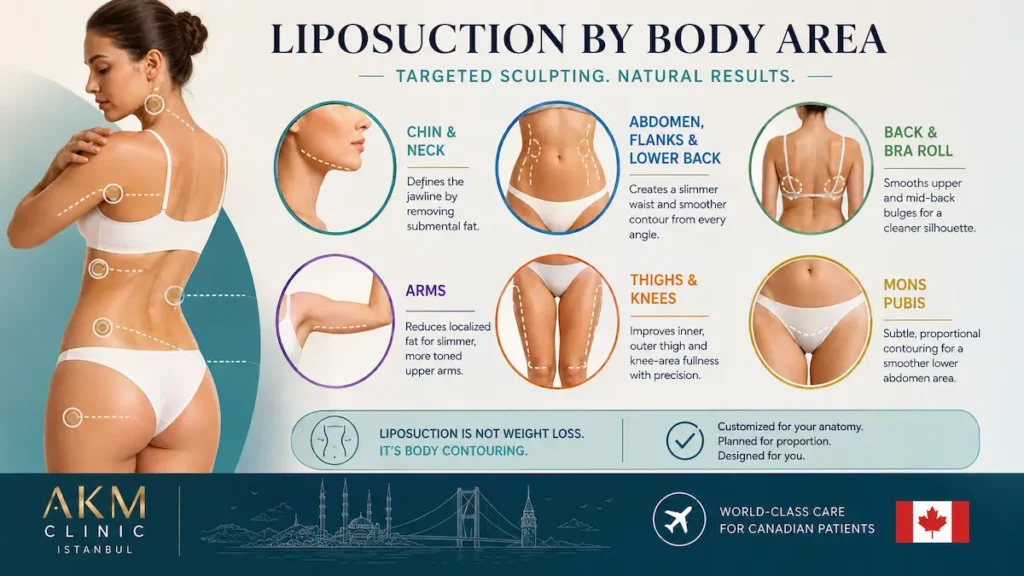
Liposuction by Body Area: Anatomical Approach to Sculpting
Each liposuction area behaves differently. Fat density, skin thickness, nerve sensitivity, and swelling patterns vary between the abdomen, chin, arms, thighs, and back. A safe plan respects those differences.
We do not use the same cannula strategy for every zone. Submental liposuction under the chin requires fine control near the jawline. Lipo 360 requires broad contour blending across the waist and back. Arm liposuction requires caution because skin looseness can become more visible after fat removal.
Canadian patients often ask for one area by name, such as chin liposuction or arm liposuction, but the consultation may reveal a broader contour issue. We assess the body in relation to surrounding structures before deciding how much fat to remove.
Abdomen, Flanks, and Lower Back
The abdomen and flanks are the most common liposuction zones. Patients often describe stubborn lower-belly fullness, waist softness, or lower-back rolls that persist despite exercise. These areas can respond well when the skin has enough elasticity.
Lipo 360 may be better than front-only abdominal lipo when fat wraps around the waistline. Treating the torso circumferentially helps avoid an uneven result where the abdomen looks flatter but the side profile remains full.
After pregnancy or major weight loss, we check carefully for loose skin and diastasis recti. If those are present, a tummy tuck may be safer and more predictable than aggressive abdominal lipo.
Chin and Submental Liposuction
Chin liposuction, also called submental liposuction, removes fat beneath the chin and along the upper neck. It can improve jawline definition when the issue is fat fullness rather than loose neck skin or platysmal banding.
This is a small area, but it requires precision. Over-removal can create uneven shadows, while under-treatment may leave the jawline soft. We evaluate skin quality, chin projection, and neck angle before recommending this procedure.
Some patients are better suited to a neck lift or combined approach. Our neck liposuction vs neck lift guide explains when fat removal is enough and when structural tightening is needed.
Arm Liposuction
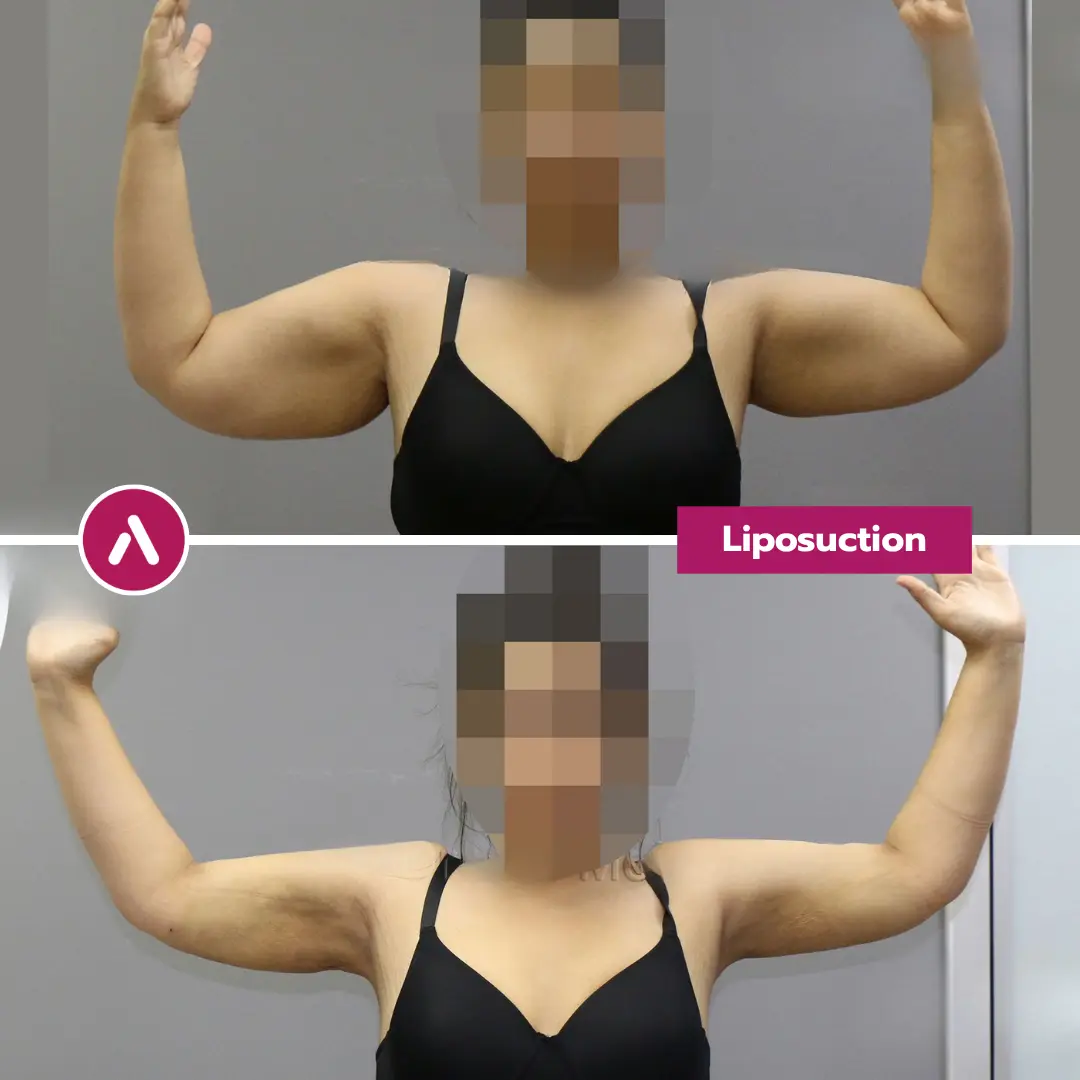
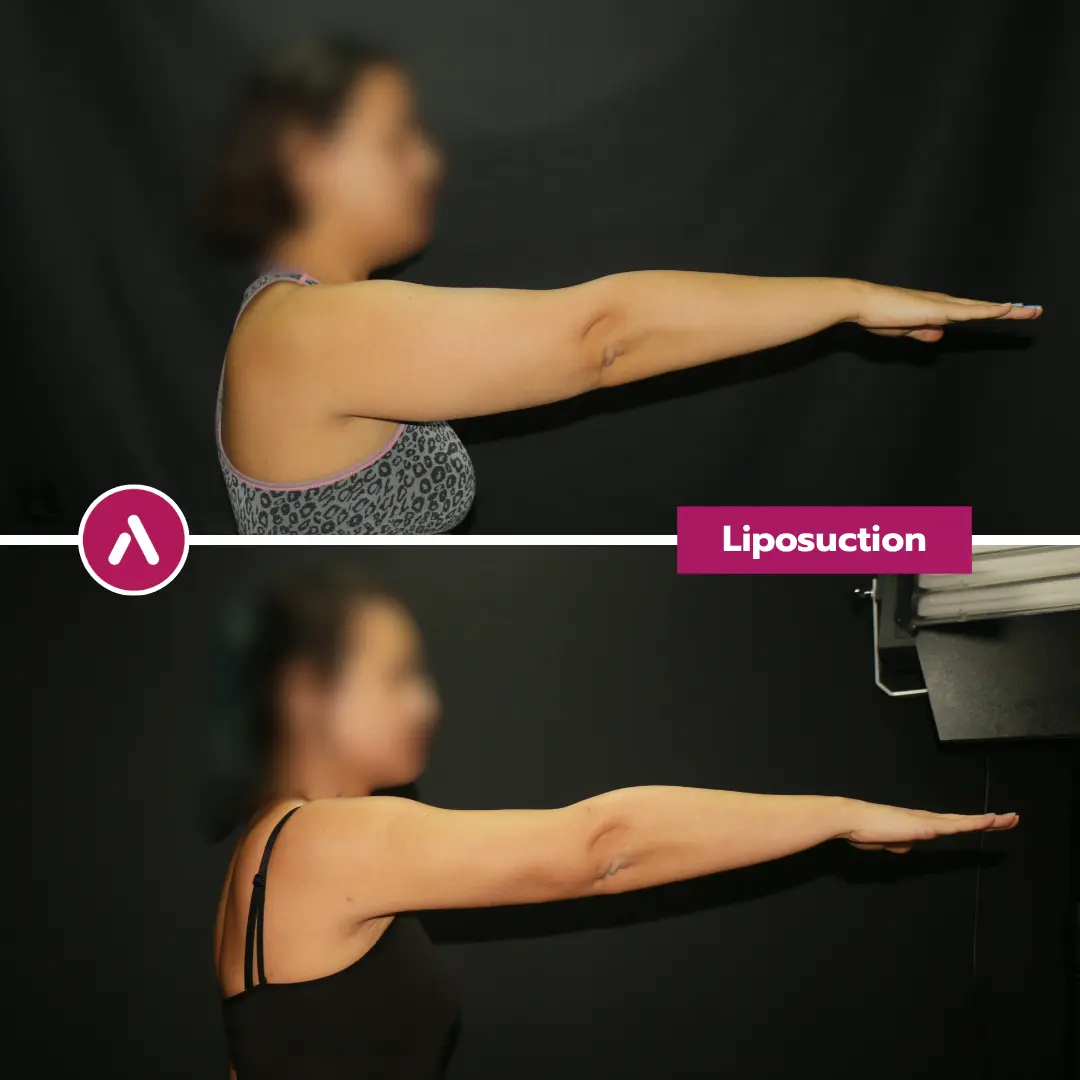
Arm liposuction can reduce localized fat in the upper arms when the skin still has enough elasticity to contract. It is most appropriate for patients who feel the arms look fuller than the rest of their frame but do not have major hanging skin.
Skin quality is the deciding factor. If the arm has significant laxity, liposuction alone may create a smaller but looser appearance. In that case, an arm lift in Turkey may be more appropriate, or liposuction may be used as a support procedure.
We place small incisions in discreet locations and use conservative fat reduction to avoid contour grooves. The aim is a slimmer, smoother upper arm that still looks natural in motion.
Thigh, Inner Thigh, and Knee Liposuction
Thigh liposuction requires restraint because the skin can be thinner and less forgiving than the abdomen. Inner thighs, outer thighs, and knees each need a different cannula angle and volume strategy. Small changes can be meaningful here.
Inner thigh liposuction may improve rubbing, clothing fit, or disproportionate fullness. Outer thigh treatment may help with silhouette balance. Knee-area liposuction is subtle and should be performed only when the fat is clearly localized.
Patients with skin looseness after weight loss may need a thigh lift in Turkey instead of fat removal alone. During assessment, we look at skin texture, cellulite, laxity, and the patient’s long-term weight pattern.
Neck, Cheek, and Jawline Liposuction
Lower-face liposuction can help selected patients with fat fullness under the chin, along the jawline, or in the lower cheek area. It is not a replacement for a facelift or neck lift when the issue is skin laxity or muscle banding.
Younger patients with good skin recoil usually respond better to submental liposuction than patients with advanced neck looseness. In patients over 40, we assess the platysma muscle, jowls, skin thickness, and neck angle before recommending fat removal.
Small-area facial lipo must be conservative. Over-removal can create hollowing or uneven shadows. Our Natural-First approach favours definition that improves the jawline without making the face look deflated.
Back, Bra-Roll, and Mons Pubis
Back and bra-roll liposuction can smooth fullness around the upper or mid-back. These areas often contain fibrous fat, so VASER liposuction may be considered when tissue density makes traditional suction less efficient.
Mons pubis liposuction is a smaller, private-area contouring procedure. It may be requested after weight change, pregnancy, C-section scarring, or tummy tuck planning. The goal is proportional flattening, not aggressive reduction.
These areas are often treated as part of a broader body contouring plan. We assess how each zone relates to the waist, abdomen, hips, and clothing line before recommending an isolated or combined approach.
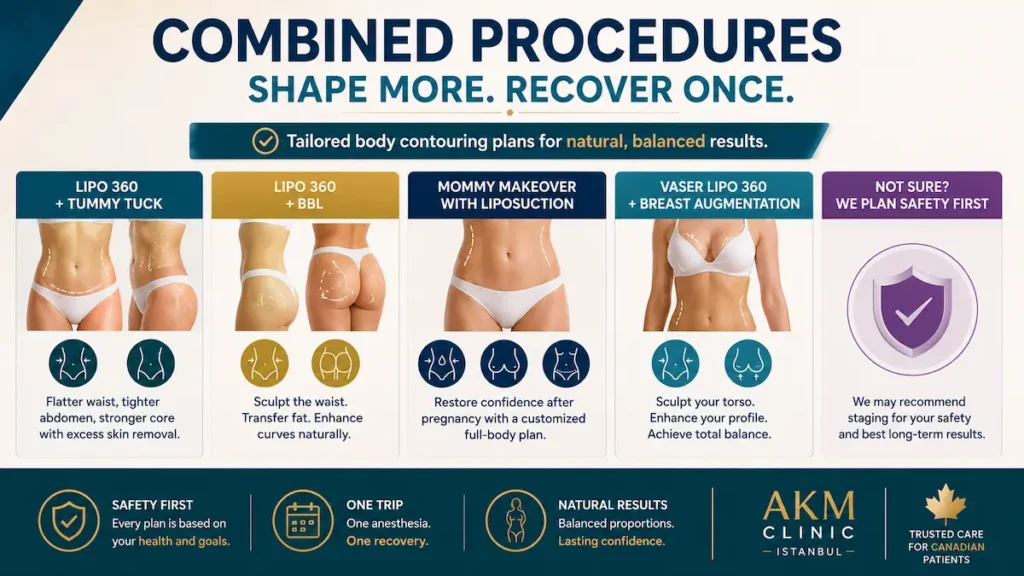
Combined Procedures: Lipo 360, BBL, Mommy Makeover, and Tummy Tuck
Liposuction is often part of a broader body contouring plan. It may be used to define the waist, harvest fat for transfer, refine surrounding areas after skin removal, or create smoother transitions between treatment zones. The benefit is efficiency, but only when the combined plan remains medically safe.
Canadian patients often ask whether one trip can address multiple concerns. Sometimes it can. The answer depends on treatment area, anesthesia time, expected recovery burden, and fit-to-fly planning.
We prefer careful combinations over excessive combinations. One anesthesia and one recovery can be useful, but not if the surgical plan becomes too long or too physically demanding. Safety decides the limit.
Lipo 360 + Tummy Tuck
Lipo 360 and tummy tuck can work well together when a patient has both circumferential fat fullness and loose abdominal skin. Liposuction refines the waist and flanks, while tummy tuck removes excess skin and repairs abdominal muscle separation when needed.
This combination is common after pregnancy or major weight change. It is not the same as liposuction alone. Recovery is longer because skin removal and muscle repair require more protection than fat removal.
Patients considering this pathway should review our tummy tuck surgery in Turkey page before deciding between lipo, tummy tuck, or both.
Lipo 360 + BBL
Lipo 360 is the foundation of many BBL procedures because it harvests fat from the torso and improves the waist-to-hip transition. The liposuction portion shapes the donor area; the fat-transfer portion enhances the buttocks.
The result depends on both steps. Poor waist sculpting can limit the hourglass effect, even if fat transfer is performed well. Safe BBL planning also requires disciplined fat placement and realistic volume goals.
Canadian patients considering this combination can review the Lipo 360 + BBL package to understand how the combined pathway is structured.
Liposuction as a Mommy Makeover Component
In a Mommy Makeover, liposuction is often used to refine the flanks, waist, upper abdomen, back, or thighs. It complements breast restoration and tummy tuck rather than replacing them. The goal is a balanced postpartum restoration plan.
For Canadian mothers, recovery planning is especially important. Childcare, lifting restrictions, school drop-offs, and household help must be arranged before travel. Liposuction may feel like the “smaller” part of the bundle, but it still adds swelling and garment requirements.
Patients exploring this path can compare component options in our all-inclusive Mommy Makeover package.
VASER Lipo 360 + Breast Augmentation
Some patients combine torso sculpting with breast augmentation to improve overall proportion. This can be appropriate when the patient wants waist refinement and upper-body volume restoration in one trip.
The combination must be planned around anesthesia duration and recovery comfort. Compression garments, breast support, sleep position, and flight readiness all need to work together.
For patients considering this pairing, our VASER Lipo 360 + Breast Augmentation package outlines the combined clinical pathway.
When Not to Combine Procedures
Combining procedures is not always better. We may recommend staging when the patient needs large-volume liposuction, multiple surgical zones, extensive skin removal, or has medical risk factors that make a long operation less appropriate.
Staging can improve safety and contour precision. It also allows the body to recover before the next step. This may be the more responsible plan for patients who want several major changes.
A safe surgical plan should feel tailored, not forced. If a combination increases risk without enough benefit, we will explain why.
Anesthesia Options: General, Twilight, Tumescent-Only Local, and Awake
Anesthesia selection depends on treatment area, expected fat volume, patient health, and whether liposuction is combined with another procedure. A single small zone may not require the same anesthesia plan as Lipo 360 or BBL fat harvesting. Safety drives the decision.
Canadian patients often ask whether awake liposuction is safer or easier. It can be a good option for selected patients, but it is not appropriate for every case. Larger multi-area procedures usually require deeper anesthesia for comfort and operating conditions.
We explain anesthesia clearly before travel so patients know what to expect. This includes fasting instructions, monitoring, early walking, and fit-to-fly planning after surgery.
General Anesthesia for Multi-Area and Lipo 360 Cases
General anesthesia is commonly used for Lipo 360, larger-volume liposuction, and cases combined with BBL, tummy tuck, or breast surgery. It allows controlled monitoring while the surgical team works across multiple areas safely.
For Canadian patients, the concern is usually recovery after anesthesia and the long return flight. We manage this through pre-operative screening, careful fluid management, compression, early walking, and fit-to-fly clearance before departure.
General anesthesia may be the safer choice when the procedure is extensive. Comfort matters, but so does precision. If a patient moves or experiences discomfort during a large-area procedure, contour quality and safety can be affected.
Twilight + Tumescent Local for Selected Cases
Twilight sedation combines light IV sedation with local anesthetic infiltration. It may be appropriate for moderate liposuction in selected patients, especially when fewer areas are treated. The patient is relaxed but not fully under general anesthesia.
Tumescent solution remains part of the technique. It helps reduce bleeding, improves fat separation, and provides local anesthetic effect in the surgical field. The combination can support a smoother early recovery in appropriate cases.
We do not choose twilight sedation only for convenience. We choose it when the treatment area, expected duration, and patient anxiety profile make it medically sensible.
Awake Liposuction — When Local Anesthesia Makes Sense
Awake liposuction uses local anesthesia with or without light sedation. It can reduce early grogginess and support faster walking after surgery, but it requires a calm patient and a suitable treatment plan. Not every patient is awake-eligible.
Awake high-definition liposuction is especially technique-sensitive because the surgeon needs patient comfort, stillness, and precise contour control. For patients considering this pathway, our Awake High-Definition Liposuction page explains candidacy, pain control, and early recovery in depth.
Canadian patients often ask whether awake lipo is painful. Sensation should be pressure and movement, not sharp pain. Our Awake Lipo in Turkey guide explains what patients typically feel during local anesthesia liposuction.
How We Select Anesthesia by Area and Volume
We match anesthesia to the procedure rather than forcing every patient into one model. A small submental case may be suitable for local anesthesia. Lipo 360, BBL harvesting, or combined Mommy Makeover planning usually needs a deeper approach.
We consider procedure length, expected fat volume, patient anxiety, medical history, airway safety, and post-operative mobility. We also consider the patient’s travel plan back to Canada, including flight duration and DVT risk.
The safest anesthesia plan is the one that supports steady surgery, predictable recovery, and clear post-operative monitoring. We review this during consultation before confirming the surgical pathway.
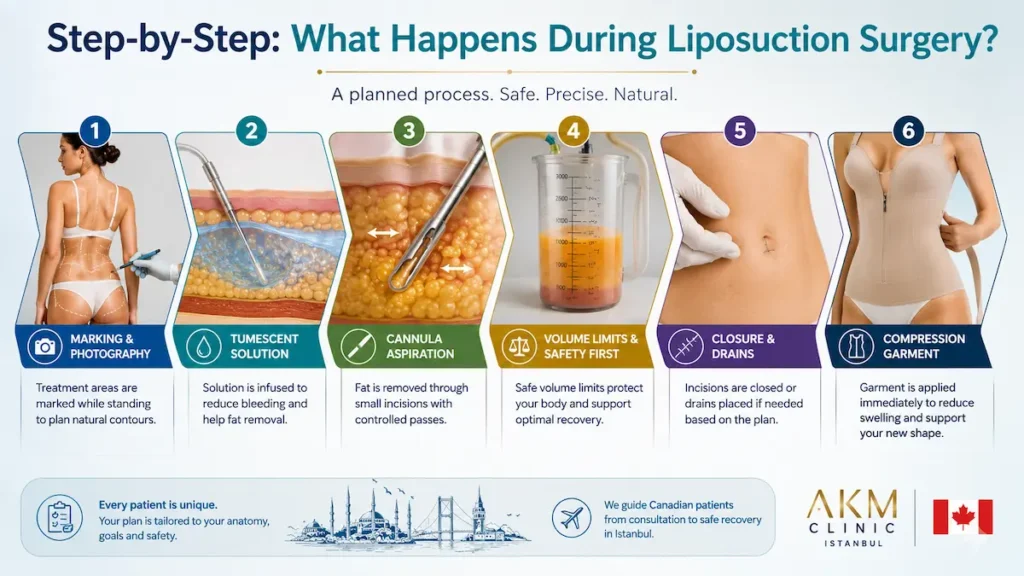
Step-by-Step: What Happens During Liposuction Surgery?
Liposuction is a planned sequence, not a simple fat-removal session. Each step affects safety, contour smoothness, bruising, swelling, and recovery. For Canadian patients travelling to Istanbul, we review this pathway before arrival so there are no surprises on surgery day.
The exact sequence depends on the technique used. Traditional lipo, VASER liposuction, Lipo 360, chin liposuction, and high-definition liposuction all share the same foundation, but the marking, anesthesia, cannula pattern, and compression plan differ. We tailor the plan to the patient’s anatomy.
Before surgery begins, our team confirms the treatment zones, medical history, lab results, medications, and post-operative travel timing. Safety checks happen before contouring starts.
Pre-Operative Markings and Photography
Markings are made while the patient is standing because fat distribution changes when lying down. We mark fullness, natural waist shadows, asymmetries, and transition zones. This is especially important for Lipo 360 and high-definition liposuction.
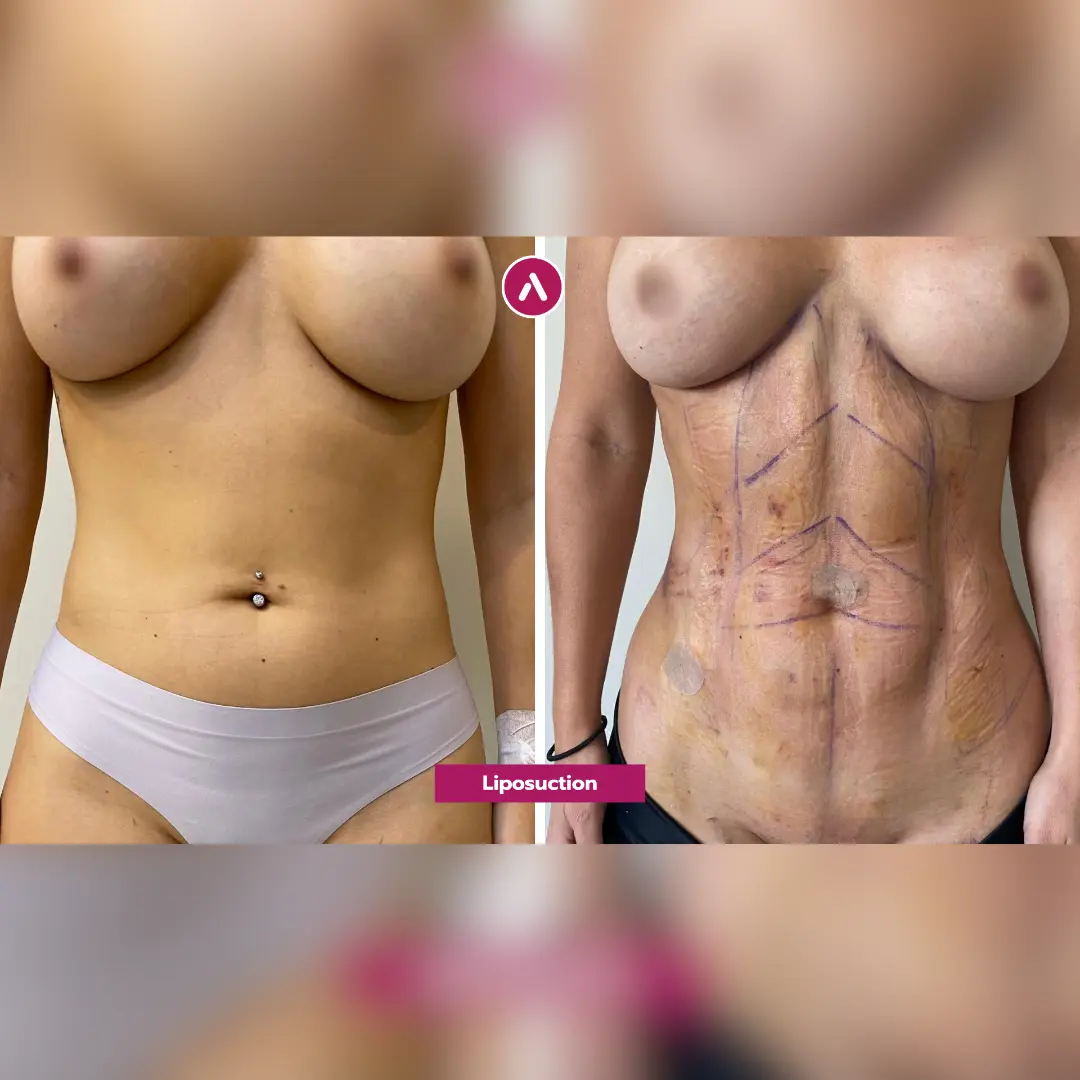
Pre-operative photos create a clinical record and help guide the contouring plan. They also support honest before-and-after comparison later. Liposuction before and after photos should show posture, lighting, angles, and garment-free contour clearly.
We also confirm whether the patient wants subtle refinement, stronger definition, or support for another procedure such as BBL or tummy tuck. A clear plan reduces over-treatment.
Tumescent Solution Infiltration
After anesthesia begins, tumescent solution is placed into the fatty layer. This fluid helps reduce bleeding, separates fat more safely, and makes cannula movement more controlled. It also contributes to early post-operative drainage.
Drainage after liposuction can feel surprising if patients are not prepared. It is usually expected during the first 24 to 48 hours, especially after larger-area procedures. Compression garments help manage swelling and fluid movement.
The amount of fluid used is calculated carefully. Fluid balance matters in liposuction because excessive infiltration or removal can increase stress on the body.
Cannula Insertion and Fat Aspiration
Small incisions are placed near the treatment area. A cannula then passes through the fat layer in controlled patterns. The goal is even reduction, smooth blending, and preservation of the superficial layer that supports skin texture.
For VASER cases, ultrasound energy may be applied before suction to emulsify fat. This can be helpful in fibrous zones or when sharper contour definition is planned. The device supports the technique; it does not replace surgical judgment.
Fat aspiration is measured throughout the procedure. We track volume by area and compare both sides to reduce asymmetry. In body contouring, balance is more important than maximum removal.
Volume Limits and Multi-Stage Planning
Safe liposuction has limits. Removing too much fat in one session can increase fluid shifts, bruising, anemia risk, and recovery difficulty. Large-volume requests may require staging rather than one aggressive procedure.
This matters for patients seeking abdomen, flanks, back, thighs, and arms all at once. A staged plan may be safer and produce better contour control. We explain this clearly during consultation.
Patients sometimes compare clinics by promised litres removed. That is the wrong metric. A safer question is: how much fat can be removed while preserving smooth contour, skin support, and post-operative mobility?
Closure, Drains, and Compression Garment Placement
At the end of surgery, incisions are closed or managed depending on drainage strategy, treatment area, and technique. Compression garments are placed immediately to reduce swelling and support the new contour. Fit matters.
Some patients need drains, especially when liposuction is combined with tummy tuck or broader body contouring. Others do not. We explain drain care before discharge and review removal timing before fit-to-fly clearance.
Compression is not optional. It supports fluid control, comfort, and contour stabilization during the early healing period.
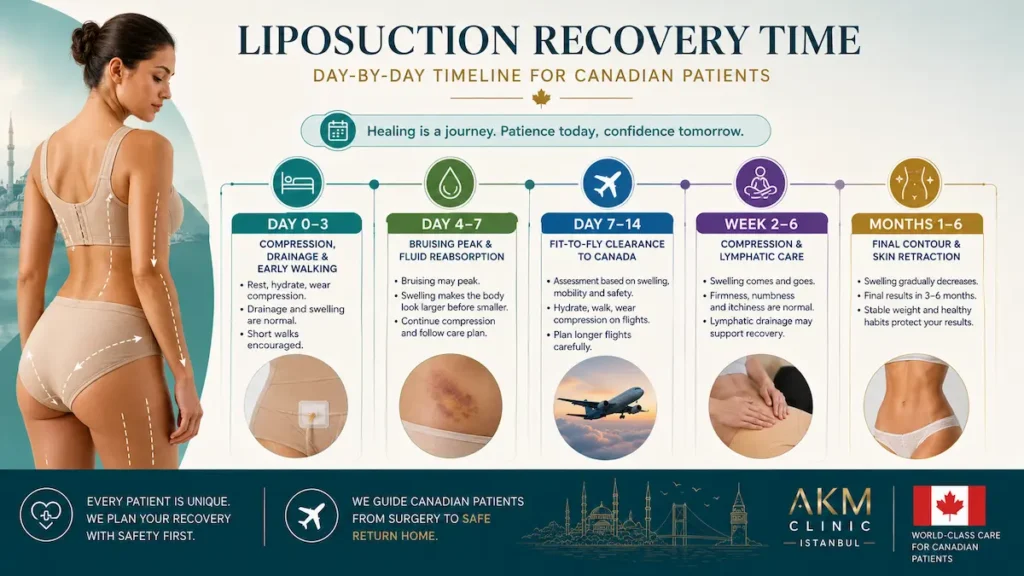
Liposuction Recovery Time: Day-by-Day Timeline for Canadian Patients
Liposuction recovery is usually manageable, but it requires discipline. Swelling, bruising, drainage, firmness, and fatigue are expected during the first phase. Most patients walk the same day, but they should not confuse mobility with full recovery.
Canadian patients must also plan for the return flight. A 10-hour flight to Toronto or Montreal is different from a short domestic trip. Compression, hydration, walking breaks, and fit-to-fly clearance are part of the medical plan.
Recovery varies by technique and area. Chin liposuction heals differently from Lipo 360. A combined BBL or Mommy Makeover changes the timeline further.
Day 0–3 — Compression, Drainage, and Early Walking
The first three days focus on rest, hydration, compression, and gentle walking. Swelling begins quickly. Bruising may appear in treated areas and can spread downward because of gravity.
Drainage from incision points can occur during this period. This is usually tumescent fluid leaving the body. We provide dressings, garment instructions, and support from your patient coordinator.
Short walks are encouraged because they support circulation and reduce stiffness. Patients should avoid long outings, heavy lifting, and alcohol. Recovery should be quiet and structured.
Day 4–7 — Bruising Peak and Fluid Reabsorption
Bruising often peaks during the first week. Swelling may make the body look larger before it looks smaller. This is normal and does not mean the procedure has failed.
Patients begin to feel more comfortable moving around the hotel, but fatigue can still come in waves. Compression garments remain essential. We also check incision sites, swelling patterns, and any areas of firmness.
For patients interested in lymphatic care, our lymphatic drainage massage after lipo guide explains why timing, technique, and therapist experience matter during recovery.
Our HBOT/LLLT Recovery Protocol
We utilize Hyperbaric Oxygen Therapy and Low-Level Laser Therapy to support recovery after body contouring. HBOT increases oxygen delivery to healing tissues, while LLLT stimulates cellular repair using 424 medical-grade semiconductor laser diodes at 650 nm.
For liposuction patients, this may help reduce inflammation, support bruising resolution, and improve comfort during the early recovery window. It is especially useful for Canadian patients preparing for long-haul travel.
Our technology and recovery standards page explains how HBOT, LLLT, VASER systems, and JCI-accredited facility protocols fit into our surgical pathway.
Day 7–14 — Fit-to-Fly Clearance for Return to Canada
Most Canadian liposuction patients are assessed for return-flight readiness between days 7 and 14, depending on treatment area, swelling, mobility, bruising, and whether other procedures were combined. Chin liposuction may clear earlier. Lipo 360 or combined body contouring usually needs more caution.
Fit-to-fly clearance is not only about incision healing. We also assess walking ability, pain control, dizziness, swelling stability, and DVT risk. A patient must be able to move safely during the flight and manage compression garments without help.
For flights back to Toronto, Montreal, Vancouver, Calgary, or Ottawa, we recommend hydration, aisle walking, compression compliance, and avoiding alcohol. Our flight safety after surgery guide explains how Canadian patients should plan long-haul travel after elective surgery.
Week 2–6 — Compression Garment Discipline and Lymphatic Massage
The second phase of recovery is less dramatic but more disciplined. Swelling may come and go. Some areas feel firm, numb, itchy, or uneven. This is common while the tissue reorganizes and fluid resolves.
Compression garments are usually worn for several weeks, depending on treatment extent. The garment should feel supportive, not painfully tight. Poor fit can cause pressure marks, discomfort, or uneven swelling.
Lymphatic drainage massage may help selected patients feel less congested during recovery. It should be gentle and performed by someone familiar with post-liposuction tissue. Aggressive massage can irritate healing areas.
Months 1–6 — Final Contour and Skin Retraction
Early improvement is usually visible within weeks, but the final contour takes months. Swelling gradually decreases, firmness softens, and skin retraction becomes clearer. Most patients see meaningful shape improvement by 6 to 12 weeks.
Final definition can take 3 to 6 months, especially after Lipo 360, VASER liposuction, or high-definition sculpting. Some areas, such as the abdomen and flanks, may hold swelling longer than smaller zones like the chin.
Weight stability remains essential. Liposuction removes selected fat cells, but remaining fat cells can still enlarge with weight gain. The most durable results come from stable nutrition, movement, and realistic long-term habits.
Liposuction Safety & Risks — An Honest Discussion
Liposuction is common, but it is still surgery. Canadian patients should evaluate safety with the same seriousness they would apply to any private surgical procedure in Canada. The safest outcome begins with proper candidacy, surgeon experience, facility standards, and aftercare planning.
We discuss risks directly because informed patients make better decisions. Most side effects are temporary, but rare complications can be serious. The goal is not to create fear. The goal is to show how risk is reduced before, during, and after surgery.
At AKM Clinic, our protocol includes medical screening, controlled fat-removal volumes, sterile operating conditions, JCI-accredited hospital access, compression planning, early walking, and structured virtual follow-up after patients return home.
Common Liposuction Side Effects
Common liposuction side effects include swelling, bruising, soreness, numbness, firmness, temporary asymmetry, and drainage from incision points. These are expected in the early recovery phase. They usually improve gradually rather than overnight.
Some patients feel tightness or burning sensations as nerves recover. Others notice uneven firmness beneath the skin. These changes can be unsettling, but they are often part of normal tissue healing.
Compression, walking, hydration, and follow-up checks help us monitor these changes. Patients should contact our team immediately for increasing pain, one-sided calf swelling, fever, foul drainage, shortness of breath, or sudden dizziness.
Is Liposuction Dangerous? Context and Risk Factors
Liposuction can be dangerous when performed on the wrong candidate, in an under-equipped facility, with excessive fat removal, or without proper post-operative monitoring. It is safer when the procedure is appropriately limited and performed under strict surgical protocols.
Major risks include bleeding, infection, fluid imbalance, deep vein thrombosis, pulmonary embolism, contour irregularity, skin injury, and complications related to anesthesia. These risks are uncommon, but they must be discussed before consent.
Risk increases when patients smoke, have uncontrolled medical conditions, request high-volume removal, or combine too many procedures. We may recommend staging rather than one long operation if that is safer.
Fluid Shifts, DVT, Infection, and Contour Irregularity
Fluid management is central to liposuction safety. Tumescent fluid enters the body, fat and fluid are removed, and swelling develops afterward. This is why surgical teams track volumes carefully during the operation.
DVT risk matters for Canadian patients because of the long return flight. Early walking, compression, hydration, and fit-to-fly clearance reduce this risk. Patients with clotting history may need additional medical review before travel.
Infection prevention depends on sterile technique, proper wound care, and clean recovery conditions. Contour irregularity is reduced through conservative cannula passes, even layering, and avoiding overly superficial fat removal.
Why Volume Limits Matter
Volume limits protect both safety and contour quality. Removing too much fat in one session can increase fluid shifts, anemia risk, swelling, and recovery difficulty. It can also make the treated area look uneven or over-reduced.
Some patients compare clinics by the number of litres promised. That is not a good safety marker. A more responsible question is how much fat can be removed while preserving circulation, skin support, and smooth contour transitions.
We may recommend staging when the requested areas are too extensive for one safe session. This can feel disappointing at first, but staged planning often creates a better long-term result with less physiologic stress.
How We Reduce “Liposuction Gone Wrong” Risk
“Liposuction gone wrong” usually reflects a chain of problems rather than one event. Poor candidate selection, excessive fat removal, weak facility standards, aggressive superficial cannula passes, and limited follow-up can all contribute.
Our prevention strategy starts before surgery. We review medical history, medication use, nicotine exposure, weight stability, skin quality, and realistic expectations. If liposuction is not the right procedure, we say so.
During surgery, we use controlled volume planning, sterile technique, measured fat aspiration, and careful contour blending. After surgery, we rely on compression, early walking, structured check-ups, and virtual follow-up after patients return to Canada.
Is It Safe to Get Liposuction in Turkey? A Canadian’s Honest Look
Liposuction in Turkey can be safe when the patient chooses a qualified surgical team, an accredited facility, and a clinic that provides structured aftercare. It becomes riskier when patients choose based on price alone or accept vague answers about surgeon credentials, hospital standards, or follow-up.
Canadian patients are right to be cautious. The Government of Canada advises travellers to understand the risks of receiving medical care outside Canada, including infection, limited legal recourse, records access, and difficulty arranging follow-up at home. We address these concerns directly in our process.
Our role is not to minimize risk. Our role is to reduce it through proper screening, transparent communication, and a documented clinical pathway from Istanbul to your recovery at home.
JCI-Accredited Surgical Facility Standards
We perform surgery through a JCI-accredited hospital partner. JCI accreditation is an international hospital quality framework that evaluates patient safety systems, infection control, surgical protocols, medication management, and emergency readiness.
For Canadian patients, this matters because the facility must be more than a beautiful clinic. Liposuction involves anesthesia, fluid shifts, sterile instruments, recovery monitoring, and emergency preparedness. The operating environment must support all of that.
You can review JCI’s patient safety framework through Joint Commission International. We also direct patients to our Istanbul clinic and surgical facility overview so they understand where the clinical pathway takes place.
Turkish Ministry of Health Licensure and Canadian Credential Equivalency
Canadian patients are used to provincial oversight through bodies such as CPSO, CPSBC, CPSA, and CMQ. In Turkey, medical facilities and international patient services are regulated through Turkish health care authorities. This is a different system, so credential verification matters.
We explain our surgeon credential framework in Canadian terms. EBOPRAS and European board pathways are best understood as structured specialist certification routes comparable to RCPSC expectations. Canadian patients can review the Royal College of Physicians and Surgeons of Canada’s specialist certification framework when comparing credential routes.
For procedure-specific safety questions, patients may also review the Canadian Society of Plastic Surgeons’ guidance on choosing a surgeon. During consultation, we encourage patients to ask direct questions about surgeon-of-record, hospital access, anesthesia plan, and post-operative escalation.
Sterilization and Infection Prevention
Infection prevention is one of the most important safety concerns in international surgery. We use multi-stage sterilization protocols, sterile operating fields, controlled instrument processing, and post-operative wound-care education. Patients also receive instructions for hotel recovery and travel hygiene.
The World Health Organization provides global guidance on surgical safety and infection prevention through its health care quality programmes. Canadian patients can review broader safety principles through WHO Patient Safety.
After liposuction, incision care is usually simple, but it must be consistent. We provide English-language instructions and explain warning signs such as fever, spreading redness, worsening pain, foul drainage, or shortness of breath.
English Medical Records for Canadian Follow-Up
Patients returning to Canada may need to speak with a family physician, walk-in clinic, urgent care centre, or private nurse. Clear records help. We provide English-language discharge information that outlines the procedure, treated areas, medications, garment instructions, and follow-up timing.
For larger procedures, we also document drain status, incision care, and any special instructions related to flight, walking, compression, or medications. This reduces confusion if the patient seeks assessment after returning home.
Our long-term virtual follow-up programme includes planned check-ins at 1, 3, 6, and 12 months. This helps us monitor contour, swelling, scars, and patient concerns beyond the Istanbul stay.
Travel Insurance and Elective Surgery Limitations
Canadian travel insurance often excludes complications related to elective cosmetic surgery. Patients should read policy wording carefully before travelling. Standard trip insurance may cover lost luggage or flight disruption but not surgical aftercare.
We encourage patients to ask insurers specific questions rather than assuming coverage. Ask whether the policy covers complications after elective surgery abroad, emergency admission, flight changes, or care related to anesthesia.
This is part of informed consent. A safe plan includes surgery, recovery, records, communication, and a realistic understanding of what insurance does and does not cover.
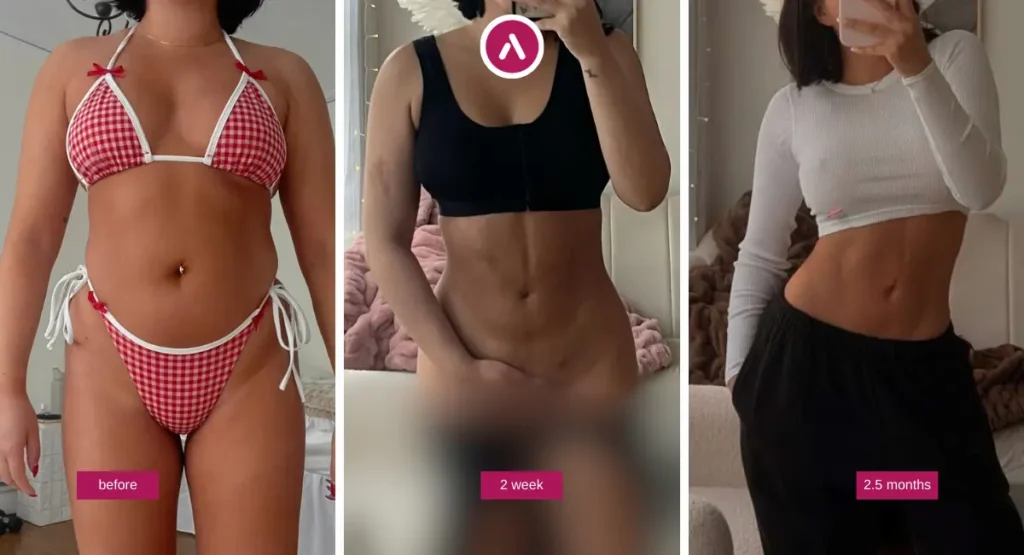
Realistic Expectations: Liposuction Before and After, Scars, and Permanence
Liposuction can create visible contour improvement, but it cannot create a new body type. The best results come from matching the procedure to the patient’s natural frame, skin elasticity, and long-term weight pattern. We set expectations carefully before surgery.
Canadian patients often bring reference photos from social media or clinic galleries. These can be useful for communication, but they should not become promises. Lighting, posture, muscle tone, swelling stage, and photo timing all affect how results look.
Our Natural-First philosophy means we aim for refined proportion rather than aggressive fat removal. The goal is a body contour that looks healthier, smoother, and more balanced.
Liposuction Before and After — What Photos Should Show
High-quality liposuction before and after photos should show the same angle, posture, lighting, and distance. They should also identify how long after surgery the “after” photo was taken. A 6-week result is not the same as a 6-month result.
Early photos may still show swelling, firmness, bruising, or uneven fluid retention. This is why we prefer patients to judge the final contour only after the tissue has had time to settle. Patience matters.
Our liposuction before and after gallery helps patients understand realistic contour changes across different body types and treatment zones.
Lipo 360 Before and After — Circumferential Contour Changes
Lipo 360 before and after results should be judged from the front, side, and back. A good result does not only flatten the abdomen. It improves the waistline, flank transition, lower-back contour, and torso balance.
This is why we photograph circumferential cases from multiple angles. A patient may see the biggest change in side profile or clothing fit rather than only front-view waist reduction.
For many patients, Lipo 360 creates the strongest visible change because it treats the torso as one connected unit. It is still not a substitute for tummy tuck when loose skin or muscle separation is the main issue.
Liposuction Scars — Location, Size, and Maturation
Liposuction scars are usually small because the cannula incisions are short. We place them in discreet locations whenever possible, such as natural creases, garment-covered areas, or less visible transition zones.
Scars may look pink, firm, or slightly raised during early healing. They usually soften and fade over several months. Patients with darker skin tones or a history of hypertrophic scarring may need a more detailed scar-care plan.
Low-Level Laser Therapy can support incision maturation, and silicone-based scar care may be recommended once the skin is fully closed. Scar quality depends on genetics, tension, aftercare, and sun protection.
Is Liposuction Permanent? Fat Cells vs Weight Stability
Liposuction permanently removes selected fat cells from treated areas. Those exact cells do not simply grow back. However, remaining fat cells in the body can still enlarge if the patient gains weight.
This means liposuction is durable, but not immune to lifestyle changes. Major weight gain can alter the treated area and may shift fat storage to untreated zones. Stable habits protect the result.
We explain this clearly because “permanent” can be misunderstood. The fat-cell reduction is permanent. The body still responds to weight change, hormones, ageing, and pregnancy.
Natural-First Body Contouring Philosophy
Our body contouring philosophy is the same as our facial philosophy: rejuvenation, not alteration. We do not aim for extreme waist narrowing, artificial abdominal grooves, or over-reduced limbs.
A refined liposuction result should move naturally, fit the patient’s frame, and age well. It should not require the patient to explain that they had surgery.
This approach is especially important for Canadian patients who want improvement that feels private, professional, and authentic to their lifestyle.
Liposuction Cost 2026: Turkey vs Canada
Canadian patients comparing private body contouring quotes often find that domestic pricing separates surgeon fees, anesthesia, facility fees, compression garments, follow-up, and aftercare. Our pricing structure is designed to be more transparent for patients travelling from Canada.
At AKM Clinic, the 360 Liposuction all-inclusive package is CAD $6,400, including surgery, 3 nights at our 5-star partner hotel, VIP transfers, pre-operative testing, post-operative support, and 24/7 patient advocacy. Technique-level pricing varies by method: tumescent liposuction is CAD $5,200, VASER liposuction is CAD $5,450, power-assisted liposuction is CAD $4,900, and water-assisted liposuction is CAD $6,150.
For the full Canadian dollar breakdown, including technique-by-technique pricing and hidden-fee comparison, see our detailed liposuction cost guide for Canadian patients.
The most common option for Canadian torso contouring is the 360 Liposuction all-inclusive package. Patients considering payment timing can also review our financing plastic surgery in Turkey guide for planning context.
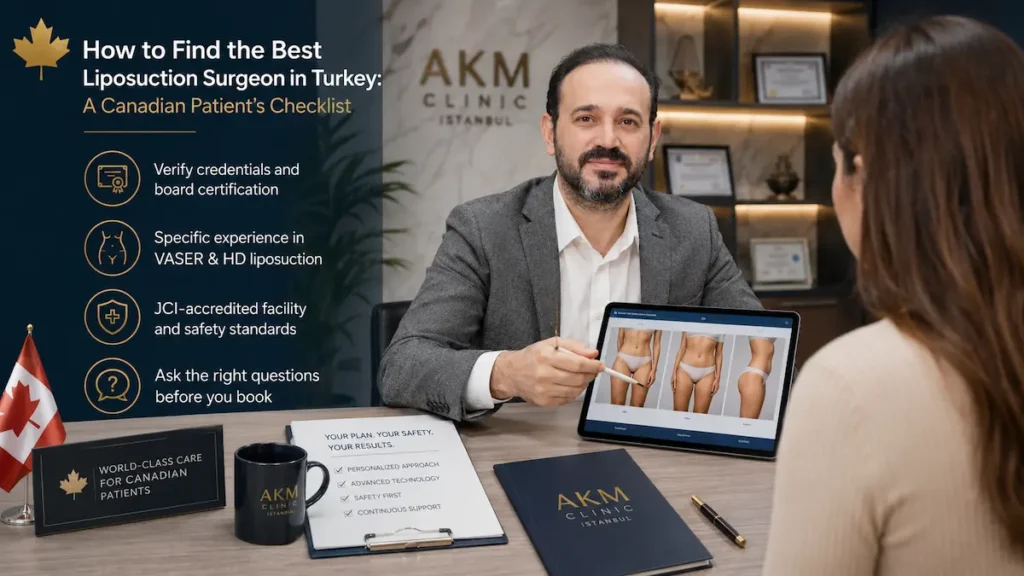
How to Find the Best Liposuction Surgeon in Turkey: A Canadian Patient’s Checklist
Choosing a liposuction surgeon should feel similar to choosing a private surgical provider in Canada: you verify credentials, facility standards, anesthesia safety, technique experience, and follow-up structure. The difference is that international care requires more documentation before you travel. You should never rely on social media photos alone.
Many Canadian patients begin by researching liposuction Toronto, Vancouver, Calgary, or Montreal clinics. After comparing total cost, wait times, technique availability, and aftercare, they may look at liposuction Turkey options. The key is not choosing the fastest or least expensive provider. The key is choosing the safest qualified team.
Our checklist focuses on the questions that matter most for Canadian patients considering surgery abroad.
Surgeon Credentials and RCPSC-Equivalent Verification
In Canada, patients are familiar with specialist certification through the Royal College of Physicians and Surgeons of Canada. When evaluating an international surgeon, the goal is to understand the equivalent training pathway, board status, and procedure-specific experience.
At AKM Clinic, our European Board-Certified Surgeons work within a documented surgical pathway. We explain credentials in Canadian terms, including how European specialist certification compares with RCPSC expectations and how hospital access is structured in Istanbul.
You can review our clinical background, surgical philosophy, and credential framework on our About AKM Clinic page. During consultation, we encourage patients to ask who performs the procedure, where surgery takes place, and how complications are escalated.
VASER and High-Definition Liposuction Experience
Liposuction experience should be specific to the technique you need. A surgeon who performs basic suction-assisted liposuction may not automatically have the same skill set for VASER liposuction, high-definition abdominal sculpting, or Lipo 360.
For VASER and high-definition work, ask how the surgeon avoids over-etching, contour dents, and excessive superficial fat removal. Ask how they decide whether your body type suits athletic definition or a softer contour.
Canadian patients seeking male abdominal definition or athletic torso sculpting may find our male liposuction in Turkey guide helpful. It explains how masculine contouring differs from standard waist refinement.
Facility Standards and Technology Verification
The surgical facility matters as much as the surgeon. Liposuction involves anesthesia, sterile instruments, fluid management, compression planning, and post-operative monitoring. A clinic room is not enough for safe surgical care.
We operate through a JCI-accredited facility and use structured protocols for sterilization, patient monitoring, and recovery support. Our technology standards page explains our use of HBOT, LLLT, VASER systems, and surgical safety protocols.
Before booking any clinic, Canadian patients should ask whether the facility has hospital-level emergency support, licensed anesthesia providers, sterilization documentation, and English-language discharge records.
Red Flags for Canadian Patients
Some warning signs should make you pause. Extremely vague pricing, promises of unlimited fat removal, no named surgeon, no hospital information, or pressure to book quickly are not reassuring. A safe clinic welcomes questions.
Be cautious if a provider:
- Promises dramatic results without reviewing your photos or medical history.
- Cannot explain whether you need liposuction, tummy tuck, or both.
- Uses “maximum litres” as the main selling point.
- Offers combined procedures without discussing anesthesia time.
- Provides no structured follow-up after you return to Canada.
A responsible team may say no, delay surgery, or recommend a different procedure. That honesty protects you.
Questions to Ask Before Booking
Before paying a deposit, prepare a written list of questions. This helps you compare clinics fairly and prevents emotional decision-making. It also gives you a record of what was promised.
- Who is my surgeon of record?
- Which liposuction technique do you recommend for my anatomy, and why?
- How much fat removal is medically reasonable in my case?
- Where will surgery be performed?
- Who provides anesthesia and monitoring?
- What happens if I need medical support after returning to Canada?
For a broader due-diligence framework, our patient education team also recommends reviewing our Canadian patient FAQs before your virtual consultation.
Your Liposuction Journey from Canada: From YYZ to Istanbul, Step by Step
A well-planned surgical trip should feel organized before you leave Canada. You should know your procedure plan, estimated recovery stay, hotel location, transfer schedule, compression garment needs, and return-flight timing. Logistics affect healing.
Our coordinators help Canadian patients prepare for each step, from virtual assessment to airport arrival and post-operative follow-up. You are not expected to manage Istanbul alone while recovering. Our patient hosts, including Hande, Emine, and Khadija, support communication throughout the process.
You can review the full pathway on our patient journey from Canada page. The outline below focuses on liposuction-specific details.
Flight Planning from Toronto, Vancouver, Montreal, Calgary, and Ottawa
Canadian patients commonly travel from Toronto Pearson, Vancouver, Montreal, Calgary, or Ottawa. Direct and one-stop routes to Istanbul vary by season, airline, and schedule. Always confirm current flight options before booking.
For liposuction, the return flight should be planned around swelling, mobility, compression, and fit-to-fly clearance. A longer stay may be recommended for Lipo 360, VASER HD, BBL harvest cases, or combined procedures.
We recommend flexible tickets when possible. This gives you room to adjust if swelling, drain status, or fatigue makes an extra recovery day medically sensible.
90-Day Visa-Free Entry for Canadian Citizens
Canadian passport holders can typically enter Turkey visa-free for short stays of up to 90 days within the permitted travel period. Your passport should have sufficient validity beyond your arrival date. Airline rules may be stricter than entry rules.
Patients with dual citizenship, non-Canadian passports, permanent resident status, or unusual travel documents should verify requirements before booking. Do not assume the same rule applies to every traveller in your household.
We provide scheduling guidance, but immigration rules can change. Check official travel guidance before departure.
VIP Transfers and 5-Star Hotel Recovery
After arrival in Istanbul, private transfers reduce stress and unnecessary walking. This matters after surgery, when fatigue, compression garments, and swelling make simple logistics more demanding.
Our all-inclusive clinical pathway includes private VIP transfers between the airport, hotel, clinic, and hospital. Canadian patients recover at our 5-star hotel partner, The Point Barbaros, in the Levent area. Breakfast is included.
Our hotels and VIP transfers page explains the recovery setting in more detail. The goal is practical comfort, privacy, and proximity to care.
Pre-Flight Health Review and Family Physician Coordination
Before travelling, we ask Canadian patients to share relevant medical history, medications, allergies, smoking status, previous surgeries, and any known clotting concerns. This helps us assess whether liposuction is appropriate and whether additional medical clearance is needed.
We encourage patients to speak with their Canadian family physician before elective surgery abroad, especially if they have anemia, clotting history, diabetes, heart disease, autoimmune conditions, or medication concerns. This conversation helps create a safer bridge between pre-operative planning and follow-up at home.
Patients should also arrange support after returning to Canada. Even if you feel mobile, you may need help with groceries, driving, laundry, childcare, or garment management during the first week home.
Return Flight, Compression Garments, and DVT Prevention
The return flight requires planning. Compression garments should be worn as instructed, and patients should walk the aisle when safe to do so. Hydration is important, and alcohol should be avoided during the flight.
DVT prevention is especially relevant after body contouring because travel from Istanbul to Canada can be long. We assess walking ability, swelling, pain control, and overall recovery before clearing a patient to fly.
For larger procedures, we may recommend an aisle seat, extra recovery days, or upgraded seating if available. The goal is a comfortable return, not the earliest possible departure.
Frequently Asked Questions
These questions reflect what Canadian patients ask most often before travelling to Istanbul for liposuction. Some answers are medical, while others relate to provincial coverage, travel planning, and follow-up at home. We keep the answers practical because good preparation reduces anxiety. Your consultation will refine these answers for your anatomy and health history.
Is liposuction covered by OHIP?
OHIP does not cover cosmetic liposuction. In rare medical situations, such as documented functional impairment or specific reconstructive indications, a Canadian physician may explore provincial pathways, but standard body contouring is private-pay.
Does MSP, RAMQ, or AHCIP cover liposuction?
Most provincial health plans do not cover elective cosmetic liposuction. Coverage rules vary by province and medical indication. Patients in British Columbia, Quebec, Alberta, and other provinces should confirm directly with their provincial plan if the concern is medical rather than cosmetic.
How much is liposuction in Canada compared with Turkey?
Canadian private clinic pricing often separates surgeon fees, anesthesia, facility costs, garments, and follow-up. At AKM Clinic, the 360 Liposuction all-inclusive package is CAD $6,400.
How soon can I fly back to Canada after liposuction?
Many patients are assessed between days 7 and 14, depending on treatment extent and recovery. Smaller areas may clear earlier. Lipo 360, VASER HD, BBL harvest, or combined procedures may require more time before long-haul travel.
Is liposuction safe?
Liposuction can be safe when performed on the right candidate by a qualified surgical team in an accredited facility with proper monitoring and aftercare. Safety depends on patient selection, volume limits, anesthesia planning, and recovery compliance.
Is liposuction dangerous?
It can be dangerous when performed aggressively, on unsuitable candidates, or in facilities without proper surgical standards. Serious risks include infection, fluid imbalance, DVT, pulmonary embolism, contour deformity, and anesthesia complications.
Is liposuction permanent?
Liposuction permanently removes selected fat cells from treated areas. Remaining fat cells can still enlarge with weight gain, and untreated areas can change over time. Stable weight protects the result.
What is the difference between Lipo 360 and regular liposuction?
Regular liposuction may treat one area, such as the abdomen or arms. Lipo 360 treats the torso circumferentially, usually including abdomen, waist, flanks, and lower back for a more complete contour.
Do I need VASER liposuction or traditional liposuction?
VASER may be helpful for fibrous fat, male sculpting, revision zones, or high-definition contouring. Traditional liposuction may be enough for moderate localized fat with good skin tone. Your anatomy decides.
What happens if I gain weight after liposuction?
Weight gain can enlarge remaining fat cells and change the result. The treated area may still store less fat than before, but overall body shape can shift if weight changes significantly.
Can liposuction treat lipedema?
Lipedema liposuction is different from cosmetic liposuction. It may help selected patients with pain, heaviness, disproportionate limb fullness, or mobility concerns, but it requires careful diagnosis, documentation, and treatment planning.
Should I choose tummy tuck or liposuction?
Choose liposuction when the main issue is localized fat and skin elasticity is good. Choose tummy tuck when loose skin, C-section scar distortion, or abdominal muscle separation is the main concern. Some patients need both.
How do I start the process from Canada?
You can begin with a virtual consultation and photo assessment. Our team reviews your goals, health history, treatment zones, and travel timeline before recommending a tailored clinical protocol. You can also review verified patient experiences on our professional plastic surgery reviews page.