





If you have been quietly researching labiaplasty, you deserve clear, clinical answers without judgement or marketing pressure. This guide explains what labiaplasty is, how it differs from vaginoplasty and non-surgical “vaginal rejuvenation,” and why Canadian women may consider it for functional comfort, symmetry, or post-childbirth changes. At AKM Clinic in Istanbul, we perform labiaplasty with a conservative, privacy-first approach led by European Board-Certified Surgeons.
Table of Contents
What Is Labiaplasty? And How It Differs From Vaginal Rejuvenation
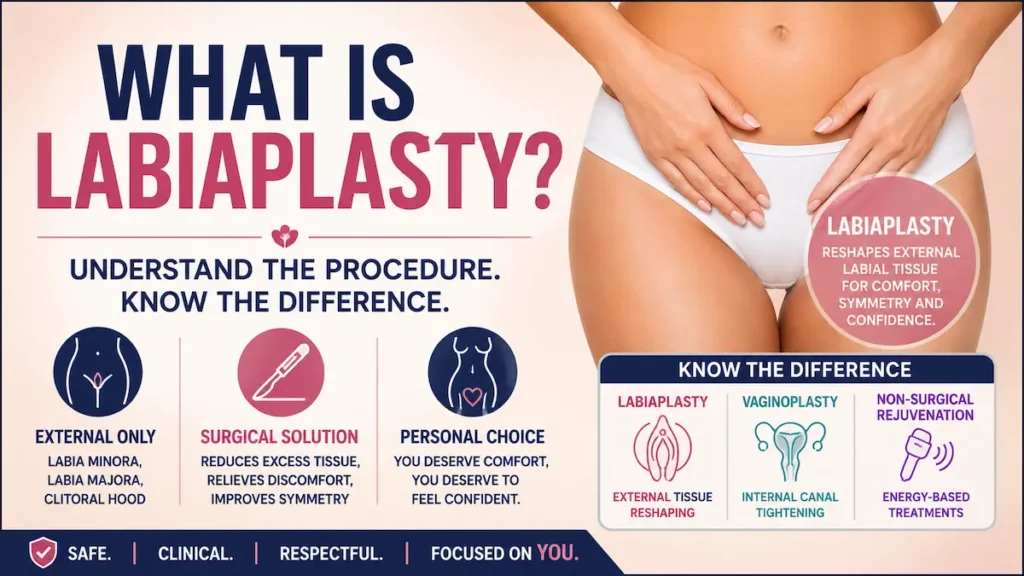
Labiaplasty is a surgical procedure that reshapes the labia minora, the inner lips, or the labia majora, the outer lips, to reduce excess tissue, relieve physical discomfort, or restore symmetry. It is part of “vaginal rejuvenation” but addresses only the external genitalia, not the internal vaginal canal.
The term “vaginal rejuvenation” can be confusing. Canadian patients often see it used for several very different treatments, from external labia reshaping to internal vaginal tightening to laser or radiofrequency treatments. We separate these clearly because each option treats a different concern.
Our approach is clinical and respectful. We do not use trend-based language, and we do not frame labiaplasty as something every woman “needs.” The right question is more precise: does the tissue create discomfort, irritation, hygiene difficulty, asymmetry, or a personal concern that has been thoughtfully considered?
Labiaplasty Defined: Reshaping the Labia Minora and Labia Majora
Labiaplasty most commonly reduces or reshapes the labia minora. These are the inner folds of tissue that may extend beyond the labia majora. Some women naturally have longer, asymmetric, or more visible labia minora. This can be completely normal anatomically, yet still cause symptoms for certain patients.
The procedure can also address the labia majora. This may involve reducing excess outer-lip tissue, improving asymmetry, or restoring a smoother external contour. Labia majora reduction is a different technique from labia minora reduction, so we assess each area separately during consultation.
A well-planned labiaplasty does not aim to erase natural anatomy. Our goal is proportion, comfort, and conservative tissue preservation.
External Genital Anatomy: Labia Minora, Labia Majora, and Clitoral Hood
The labia minora are the inner lips. They protect the vaginal opening and can vary widely in length, shape, colour, and symmetry. Visible labia minora are not automatically abnormal.
The labia majora are the outer lips. They provide the external contour and soft-tissue coverage. Some patients seek labia majora reduction because of bulk, wrinkling, laxity, or asymmetry.
The clitoral hood is the fold of tissue that covers and protects the clitoris. In some cases, clitoral hood reduction is performed with labiaplasty to create balance between the upper and lower external genital area. This must be done conservatively to protect sensation and avoid over-resection.
“Vaginal Rejuvenation” Explained: The Umbrella Term
“Vaginal rejuvenation” is not one procedure. It is a broad marketing term that may include labiaplasty, vaginoplasty, perineoplasty, laser treatments, radiofrequency treatments, or skin-tightening procedures.
Labiaplasty is external. It treats the visible labial tissue. Vaginoplasty is internal. It addresses the vaginal canal and is discussed separately on our vaginoplasty in Turkey page.
Non-surgical energy treatments, such as laser, radiofrequency, or plasma-based skin tightening, do not remove labial tissue. These may help mild laxity in selected cases, but they are not substitutes for surgical labiaplasty. We discuss energy-based options in more detail on our J-Plasma skin tightening page.
| Treatment | Target Area | Surgical? | What It Addresses | Best Next Step |
|---|---|---|---|---|
| Labiaplasty | External labia minora, labia majora, clitoral hood | Yes | Excess labial tissue, asymmetry, chafing, irritation, external contour | Continue with this guide |
| Vaginoplasty | Internal vaginal canal and supporting tissues | Yes | Internal laxity, post-childbirth canal widening, selected functional concerns | Read our vaginoplasty guide |
| Non-Surgical Rejuvenation | Skin or soft-tissue laxity, depending on device | No incision | Mild laxity or texture concerns, not excess labial tissue | Compare energy-based tightening |
What a Labiaplasty Does, and What It Does Not Do
Labiaplasty can reduce tissue that rubs in underwear, exercise clothing, cycling shorts, or swimwear. It can improve asymmetry, reduce pulling during certain activities, and create a more balanced external appearance.
It does not tighten the vaginal canal. It does not treat pelvic floor dysfunction. It does not replace a gynaecological assessment when symptoms may be related to infection, pelvic pain, prolapse, or hormonal changes.
We recommend that Canadian patients speak with their family physician, gynaecologist, or nurse practitioner when symptoms are medical, persistent, or unclear. Surgery should follow a proper diagnosis, not replace one.
Why Canadian Women Choose Labiaplasty: Functional & Aesthetic Reasons
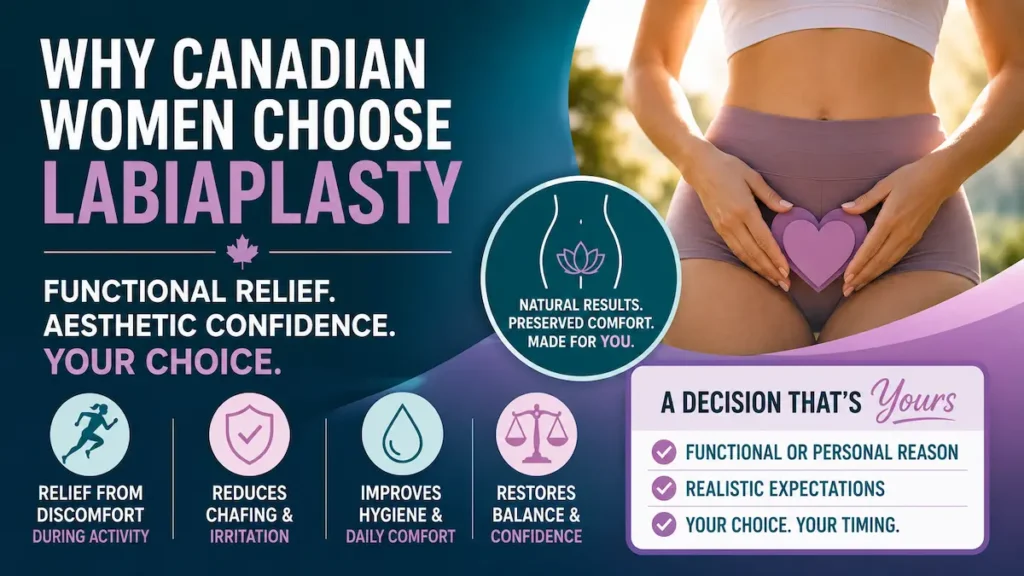
Canadian women consider labiaplasty for many reasons, and those reasons deserve to be discussed with respect. Some are functional. Some are aesthetic. Many patients describe a mix of both.
At AKM Clinic, we start with comfort and anatomy, not trends. We want to understand whether the labial tissue causes daily irritation, activity limitations, hygiene concerns, or asymmetry that affects confidence. Your goals should be personal, stable, and free from external pressure.
Functional Relief: Discomfort During Exercise, Cycling, or Daily Movement
Long or protruding labia minora can rub against clothing during walking, gym workouts, spinning, running, or cycling. Some patients describe pulling, pinching, or a persistent awareness of tissue movement during exercise. This can make otherwise normal activities feel uncomfortable.
For patients who ski, bike, practise yoga, ride horses, or train regularly, the issue may be practical rather than cosmetic. The goal of labiaplasty in these cases is to reduce friction while preserving natural structure and sensation.
We assess this carefully. Not every anatomical variation needs surgery, and not every discomfort symptom comes from labial tissue. If your symptoms suggest infection, pelvic pain, dermatitis, or hormonal change, we may recommend evaluation with your Canadian family physician, nurse practitioner, or gynaecologist before surgery.
Chafing, Hygiene, and Clothing Irritation
Some patients experience irritation in fitted clothing, swimwear, athletic wear, or underwear. Others find that excess tissue makes hygiene more difficult during menstruation or after exercise. These concerns can feel private, but they are common reasons patients ask about labiaplasty.
We use a conservative approach. The aim is not to remove as much tissue as possible. The aim is to reduce the tissue that creates symptoms, preserve protective anatomy, and create a balanced external contour.
This matters because over-resection can cause dryness, irritation, sensitivity changes, and an unnatural appearance. In intimate surgery, restraint is a sign of surgical skill.
Asymmetry and Post-Childbirth or Post-Menopausal Changes
Labial asymmetry is normal. One side is often longer, thicker, or more visible than the other. Surgery becomes reasonable only when the asymmetry creates discomfort, pulling, clothing irritation, or a concern the patient has considered carefully over time.
Childbirth can also change the external genital area. Some women notice stretched labial tissue, changes in contour, or increased discomfort in fitted clothing after delivery. Menopause may contribute to tissue thinning, dryness, and irritation, which should be assessed medically before any cosmetic decision.
For women considering broader post-childbirth restoration, labiaplasty may be discussed alongside body procedures in a mommy makeover in Turkey. We still evaluate each procedure separately. Combining treatments is never automatic.
Aesthetic and Confidence Motivations: A Non-Judgemental Framework
Some patients pursue labiaplasty because they feel self-conscious about external labial shape, size, or asymmetry. That motivation can be valid when it comes from the patient, not from a partner, social media, or a passing trend.
We do not shame aesthetic goals. We also do not magnify normal anatomy into a problem. During consultation, our role is to explain what surgery can change, what it cannot change, and whether your expectations are medically realistic.
A natural result should still look like you. Our Natural-First philosophy applies to intimate surgery as much as facial or body surgery: balanced, conservative, and never over-reduced.
Separating Legitimate Motivation From Trend Pressure
Online language around labiaplasty can be harmful. Terms such as “designer” or trend-based descriptions can make normal anatomy feel unacceptable. We do not use those terms as our clinical voice.
A healthy decision starts with three questions:
- Do I have a functional symptom or a stable personal concern?
- Do I understand the limits, risks, and recovery process?
- Am I choosing this for myself, without pressure from someone else?
If the answer is unclear, waiting is a good decision. Surgery should support your well-being, not respond to anxiety created by comparison.
Am I a Good Candidate for Labiaplasty?
A good candidate for labiaplasty is an adult patient with realistic expectations, stable motivation, and a clear anatomical concern. That concern may be functional, aesthetic, or both. The decision should be made after a confidential medical assessment.
We do not recommend labiaplasty for patients seeking an extreme or standardized appearance. There is no single “correct” labial shape. Healthy anatomy varies widely.
Functional Candidacy
You may be a functional candidate if excess labial tissue causes repeated rubbing, chafing, pinching, pulling, hygiene difficulty, or discomfort during exercise. These symptoms should be consistent, not occasional.
During your consultation, we ask about daily activities, clothing triggers, exercise, childbirth history, prior irritation, and any medical diagnoses. This helps us separate tissue-related discomfort from conditions that need gynaecological care.
Functional candidacy does not mean the procedure is automatically covered by a Canadian provincial plan. Coverage depends on your province, documentation, medical necessity, and local referral pathways. We discuss cost and coverage honestly later in this guide.
Aesthetic Candidacy and Realistic Expectations
You may be an aesthetic candidate if you have a stable, personal concern about labial size, shape, or asymmetry. The concern should be persistent over time and not driven by a recent comment, relationship pressure, or social media comparison.
Labiaplasty can reduce excess tissue and improve symmetry. It cannot create a universal ideal, guarantee a specific appearance, or erase all natural variation. The safest results are conservative.
If you are asking “is labiaplasty worth it,” the answer depends on your symptoms, your expectations, and your comfort with recovery. A thoughtful consultation is more useful than a quick yes or no.
Adult-Only Criteria: Age, Readiness, and Consent
AKM Clinic treats labiaplasty as an adult-only procedure. Patients must be 18 or older and able to give informed consent. We do not frame normal adolescent development as a surgical problem.
Emotional readiness matters. You should understand the surgical plan, the scar pattern, the recovery restrictions, and the possibility of temporary swelling or sensitivity changes. You should also feel comfortable asking private questions.
For patients who feel anxious, our team can slow the process down. You can read our guide on emotional preparation for plastic surgery before deciding whether consultation feels right.
Canadian patients who want a wider professional context may also review guidance from the Society of Obstetricians and Gynaecologists of Canada, which provides Canadian women’s health resources and policy context around sensitive gynaecological topics.
After Childbirth: Timing Considerations
Many women first consider labiaplasty after childbirth. It is usually better to wait until the tissues have healed, swelling has settled, and hormonal changes have stabilized. For breastfeeding patients, timing should be discussed carefully.
If you are considering future pregnancies soon, we may recommend waiting. Pregnancy and delivery can change tissue again. The right timing depends on your symptoms, family plans, and comfort level.
Some patients combine labiaplasty with other procedures after pregnancy, such as tummy tuck, breast lift, or liposuction. We evaluate combined surgery cautiously because safe anesthesia time, mobility, and recovery support matter.
Who Should Wait or Reconsider
Labiaplasty is not right for everyone. We may advise waiting or declining surgery if the concern is new, externally pressured, unrealistic, or linked to untreated body image distress.
You may also need medical assessment first if you have active infection, unexplained pain, vulvar skin disease, uncontrolled diabetes, bleeding disorders, poor wound healing, or nicotine use. Safety comes first.
Our surgeons will decline surgery when it is not in the patient’s best interest. That is part of responsible care.
Labiaplasty Techniques: Trim vs Wedge and Beyond
The safest labiaplasty technique is the one that matches your anatomy, symptoms, and tissue pattern. There is no single method that is best for every patient. A conservative plan protects comfort, sensation, and natural structure.
At AKM Clinic, we evaluate the labia minora, labia majora, clitoral hood, tissue thickness, edge colour, asymmetry, and functional symptoms before recommending a technique. The decision is surgical, not cosmetic guesswork.
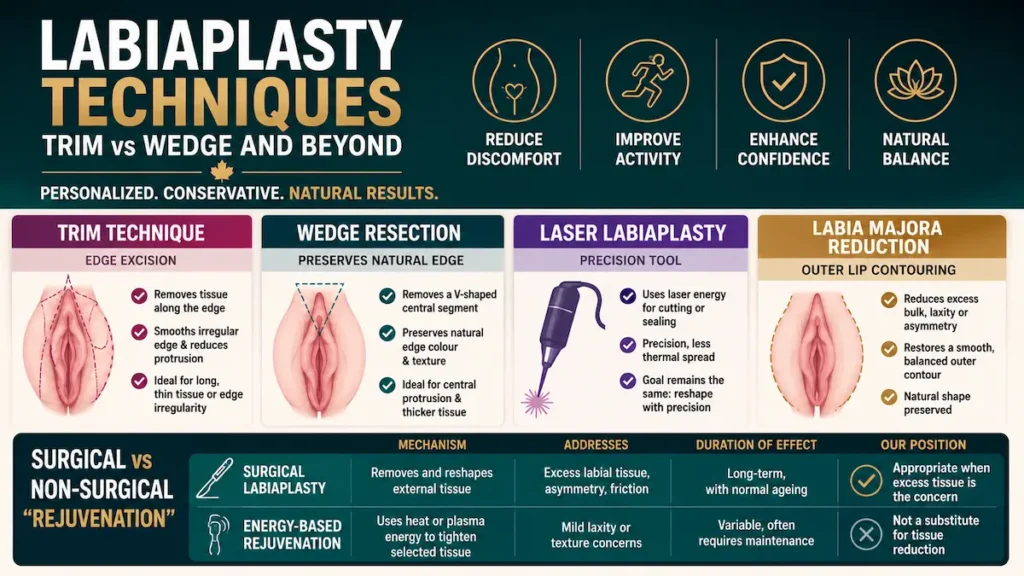
Trim Technique: Edge Excision
The trim technique removes excess tissue along the outer edge of the labia minora. It is often used when the darker or irregular edge itself is part of the patient’s concern, or when the tissue is long and thin.
This method can be precise and efficient. It also places the incision along the labial edge, so careful closure matters. We use fine dissolvable sutures and conservative planning to reduce the risk of over-resection.
Trim labiaplasty may be appropriate for patients who want a smoother edge, reduced protrusion, and relief from friction. It is not appropriate when too much tissue would need to be removed to achieve the goal safely.
Wedge Resection: Preserving the Natural Edge
Wedge labiaplasty removes a V-shaped segment of tissue from the central labia minora, then closes the remaining tissue together. The natural outer edge is preserved.
This can be useful when the patient wants to reduce projection while keeping the original edge colour and texture. It may also suit thicker labial tissue or selected asymmetry cases.
Wedge resection requires strong surgical judgement. If closure is under tension, healing can be slower. That is why we assess tissue thickness, blood supply, and the exact location of excess tissue before choosing this method.
Trim vs Wedge Labiaplasty: How We Choose
The trim vs wedge labiaplasty decision depends on anatomy. We do not choose based on trend, speed, or a fixed clinic preference. We choose based on what preserves tissue best while addressing the patient’s concern.
- Trim may suit patients with edge irregularity, pigmentation concerns, or thin excess tissue along the labial margin.
- Wedge may suit patients who want to preserve the natural edge while reducing central protrusion.
- Combined modification may be considered when asymmetry is complex, but conservative planning remains essential.
“In labiaplasty, the most important decision is not how much tissue to remove. It is how much healthy tissue to preserve. A natural, comfortable result depends on restraint.”
| Technique | Method | Best For | Edge Preserved? | AKM Offers |
|---|---|---|---|---|
| Trim | Removes tissue along the labial edge | Long, thin tissue or edge irregularity | No | Yes |
| Wedge | Removes a V-shaped central segment | Central protrusion with desire to preserve natural edge | Yes | Yes |
| Laser Labiaplasty | Uses laser energy for tissue cutting or sealing | Selected patients where laser precision is useful | Depends on pattern | Yes |
| Labia Majora Reduction | Reduces excess outer-lip tissue | Bulky, lax, or asymmetric labia majora | Not applicable | Yes |
Laser Labiaplasty: Precision Tool, Not a Different Goal
Laser labiaplasty refers to using laser energy as a surgical tool. The goal remains the same: reshape excess external tissue with precision and protect healthy anatomy.
Laser does not make labiaplasty non-surgical. It does not remove the need for planning, closure, recovery, or scar care. The surgeon’s judgement still matters more than the device.
Labia Majora Reduction
Labia majora reduction addresses the outer lips. Some patients have excess bulk, laxity, or asymmetry in the labia majora rather than the labia minora. These concerns require a different technique.
Depending on anatomy, treatment may involve small excisions, tissue reduction, or contouring. We avoid excessive flattening. The goal is a balanced outer contour that still looks natural.
Clitoral Hood Reduction
Clitoral hood reduction may be considered when the upper tissue creates imbalance after labia minora reduction. It should never be treated casually. The area is highly sensitive.
We plan this conservatively and only when it supports the overall result. Protection of sensation and blood supply is the priority.
Surgical Labiaplasty vs Non-Surgical “Rejuvenation”
Non-surgical energy treatments may support mild laxity or texture concerns in selected patients. They cannot remove excess labial tissue. They also cannot correct significant protrusion or asymmetry.
This distinction matters. If your concern is external tissue that rubs, pulls, or extends beyond the labia majora, surgical labiaplasty is the procedure designed for that issue. If your concern is mild skin laxity without excess tissue, an energy-based option may be discussed separately.
| Method | Mechanism | Addresses | Duration of Effect | Our Position |
|---|---|---|---|---|
| Surgical Labiaplasty | Removes and reshapes external tissue | Excess labial tissue, asymmetry, friction | Long-term, with normal ageing | Appropriate when excess tissue is the concern |
| Energy-Based Rejuvenation | Uses heat or plasma energy to tighten selected tissue | Mild laxity or texture concerns | Variable, often requires maintenance | Not a substitute for tissue reduction |
Areas Addressed by Labiaplasty
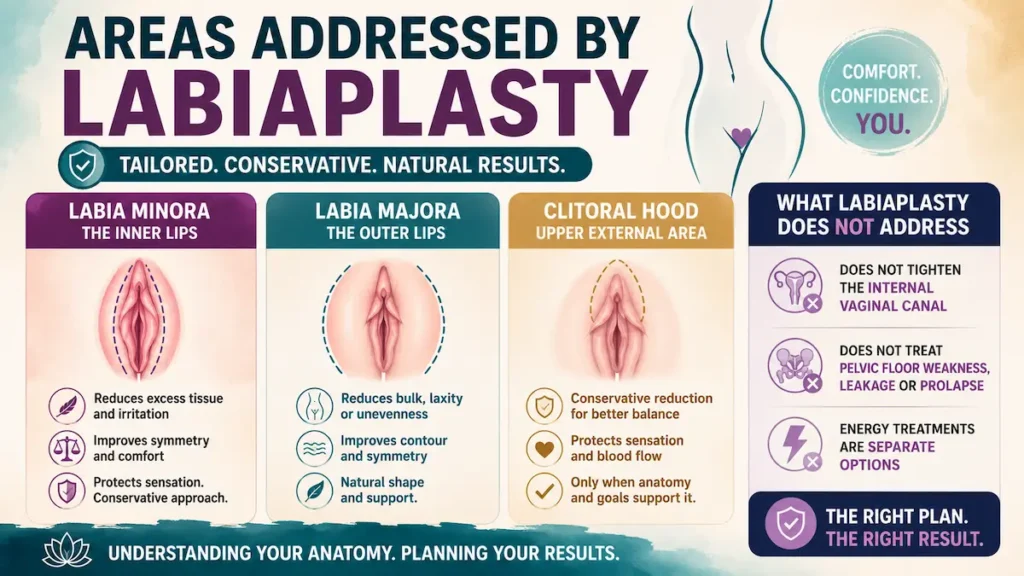
Labiaplasty is not a one-area procedure. The surgical plan depends on which external structures create discomfort, asymmetry, or contour concerns. We assess the labia minora, labia majora, and clitoral hood separately before recommending any technique.
This distinction protects patients from over-treatment. It also helps us avoid using one technique for every anatomy type. Intimate surgery should be tailored, measured, and conservative.
Labia Minora: The Inner Lips
The labia minora are the most common focus of labiaplasty. Some patients have tissue that extends beyond the labia majora, rubs against clothing, or becomes irritated during exercise. Others have asymmetry that makes one side feel more noticeable or uncomfortable.
Labia minora reduction may use a trim or wedge approach. The choice depends on tissue shape, edge quality, asymmetry, and the amount of reduction needed. We avoid aggressive removal because the labia minora have protective and sensory functions.
A conservative result should reduce symptoms without creating dryness, tightness, or an over-reduced appearance. That balance matters.
Labia Majora: The Outer Lips
The labia majora are the outer soft-tissue folds. They can change with age, weight fluctuation, childbirth, hormonal shifts, or natural anatomy. Some patients notice laxity, bulk, unevenness, or a contour that feels uncomfortable in clothing.
Labia majora reduction is different from labia minora labiaplasty. It may involve reducing excess tissue, improving symmetry, or refining the external contour. In selected cases, volume restoration may also be discussed, but only if it fits the patient’s anatomy and goals.
The aim is not a flattened or artificial look. The aim is balanced external support and comfort.
Clitoral Hood: Balancing the Upper External Area
The clitoral hood protects a highly sensitive structure. It may appear proportionally full when labia minora reduction is planned. In those cases, a conservative clitoral hood reduction can create better balance.
This area requires careful judgement. We never treat the clitoral hood as a routine add-on. It is discussed only when anatomy supports it and when the patient understands the goal and the limits.
Preserving sensation is central. Any technique in this area must respect nerve supply, blood flow, and natural protection.
What Labiaplasty Does Not Address
Labiaplasty does not tighten the internal vaginal canal. If your concern is internal laxity after childbirth, vaginal widening, or selected pelvic support concerns, our vaginoplasty in Turkey guide explains that separate procedure.
Labiaplasty also does not treat pelvic floor weakness, urinary leakage, prolapse, or chronic pelvic pain. These concerns require proper medical assessment in Canada before cosmetic or functional surgery is considered.
Energy-based tightening treatments are also separate. If your concern is mild laxity or skin quality rather than excess labial tissue, we may discuss options such as J-Plasma skin tightening as part of a broader consultation.
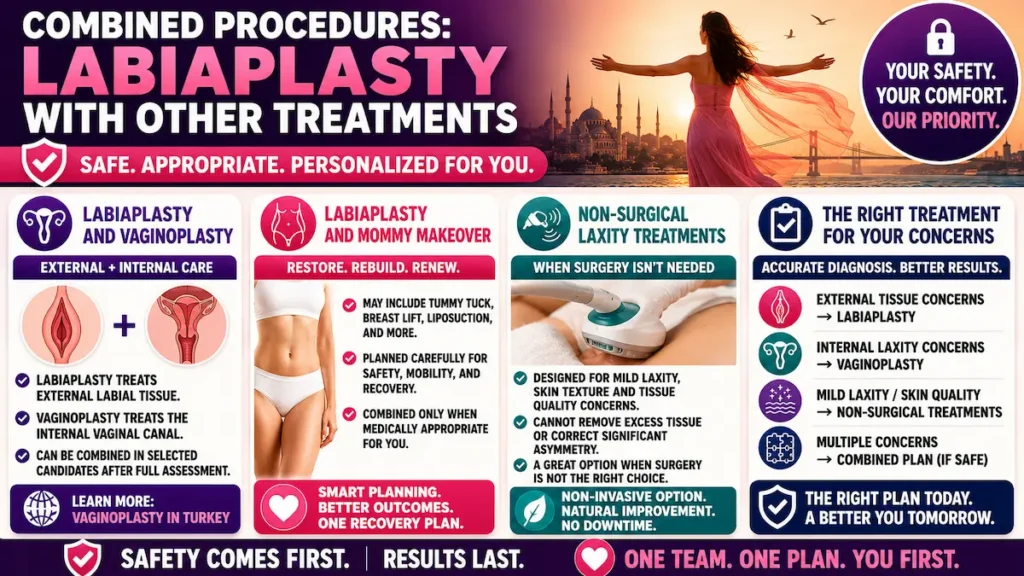
Combined Procedures: Labiaplasty With Other Treatments
Labiaplasty can be performed alone or combined with selected procedures. Combining surgery may reduce total travel and recovery time, but it must be medically appropriate. Safety comes before convenience.
We assess anesthesia duration, mobility, blood clot risk, wound care, and hotel recovery needs before recommending any combined plan.
Labiaplasty and Vaginoplasty
Labiaplasty treats external labial tissue. Vaginoplasty treats the internal vaginal canal. Some post-childbirth patients ask about both, especially when they have external discomfort and internal laxity concerns.
These procedures can be combined in selected candidates, but they are not the same surgery. Each requires its own assessment, technique, and recovery instructions.
You can review the internal procedure on our vaginoplasty in Turkey page or see our labiaplasty and vaginoplasty clinical pathway.
Labiaplasty and Mommy Makeover
Some patients consider labiaplasty after pregnancy alongside abdominal or breast procedures. A combined plan may include tummy tuck, breast lift, liposuction, or other post-childbirth restoration procedures.
This should be planned carefully. Intimate surgery has hygiene and friction restrictions, while body procedures may affect mobility, sitting, garments, and flight timing.
Our mommy makeover and labiaplasty package is considered only after medical review. We do not combine procedures simply because they are available.
When to Consider Non-Surgical Laxity Treatment Instead
If the concern is mild laxity, skin texture, or tissue quality rather than excess external labial tissue, non-surgical energy treatment may be more relevant. This is a different category from labiaplasty.
Energy-based tightening cannot remove protruding labial tissue or correct significant asymmetry. It may support selected laxity concerns when surgery is not needed.
During consultation, we help identify whether your concern is external tissue, internal laxity, skin quality, or a combination. The right diagnosis prevents the wrong treatment.
Anesthesia for Labiaplasty: Local, Sedation, or General
Labiaplasty can often be performed with local anesthesia, with or without sedation. The right option depends on the extent of surgery, patient comfort, medical history, and whether labiaplasty is combined with other procedures.
We discuss anesthesia early because it affects preparation, recovery, and travel planning. Canadian patients also need clear instructions for the flight home, medication use, and post-operative support.
Local Anesthesia
Local anesthesia numbs the surgical area while the patient remains awake. It is commonly used for isolated labiaplasty when the treatment area is limited and the patient feels comfortable with an awake procedure.
The main advantage is a lighter recovery profile. There is no general anesthesia wake-up period, and many patients can return to the hotel the same day after monitoring.
Local anesthesia is not ideal for every patient. If anxiety is high, the case is complex, or multiple areas are treated, sedation or general anesthesia may be safer and more comfortable.
Local Anesthesia With Sedation
Local anesthesia with sedation can help patients feel calmer while maintaining a controlled recovery. This option may suit patients who want more comfort than local anesthesia alone but do not need general anesthesia.
Sedation planning includes a medical review. We assess allergies, prior anesthesia history, medications, and conditions such as sleep apnea, heart disease, or bleeding disorders.
For Canadian travellers, this assessment happens before you fly whenever possible. We want to identify medical concerns early, not on the day of surgery.
General Anesthesia for Combined Procedures
General anesthesia may be recommended when labiaplasty is combined with other procedures, such as vaginoplasty, tummy tuck, breast surgery, or a broader mommy makeover. The goal is safe, coordinated care in one operating plan.
Combined surgery is never automatic. We consider total anesthesia time, mobility after surgery, blood clot risk, hotel recovery support, and fit-to-fly timing. Safety controls the plan.
If general anesthesia is used, the procedure takes place in a monitored clinical setting with pre-operative testing and post-operative observation. Our all-inclusive clinical pathway includes the necessary pre-operative medical checks.
Pre-Anesthesia Assessment for Canadian Patients
Before surgery, we review your medical history, medications, allergies, prior surgeries, and lifestyle factors such as nicotine use. You may be asked to pause certain supplements or medications before travelling, but only with appropriate medical guidance.
We also ask Canadian patients to be transparent about health conditions managed by a family physician, specialist, or nurse practitioner. Good documentation improves safety.
Our team provides clear instructions before your departure date. That includes fasting rules, medication timing, what to pack, and what to avoid before surgery.
“The safest anesthesia plan is the one that fits the patient, not the procedure name. For labiaplasty, we match comfort, medical history, and surgical extent before choosing local anesthesia, sedation, or general anesthesia.”
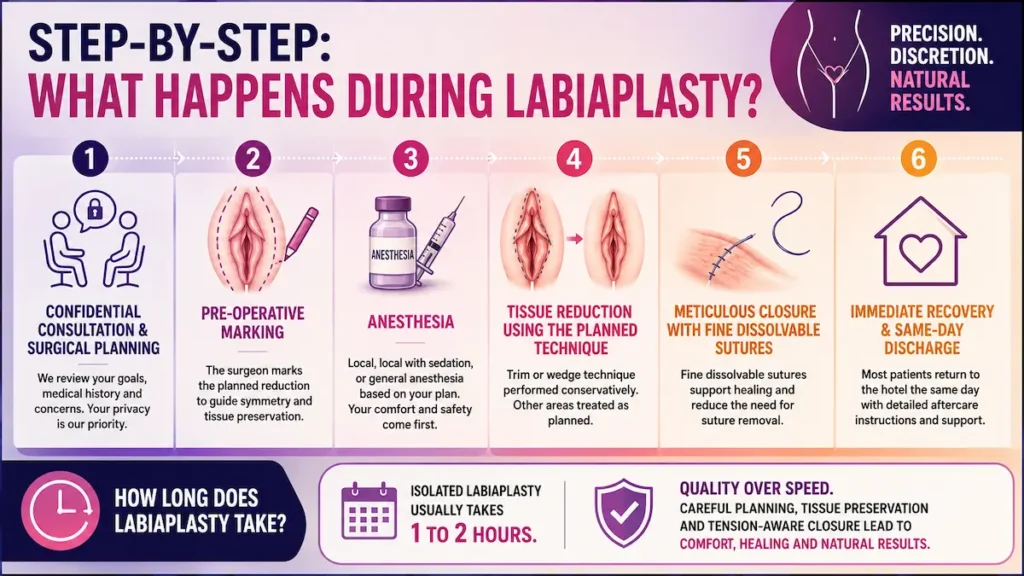
Step-by-Step: What Happens During Labiaplasty?
Knowing the surgical sequence helps reduce anxiety. Labiaplasty is usually a short procedure, but it still requires careful planning, sterile technique, and detailed tissue handling. Precision matters more than speed.
Your exact steps may vary depending on whether you have trim labiaplasty, wedge labiaplasty, labia majora reduction, clitoral hood reduction, or a combined procedure.
Step 1: Confidential Consultation and Surgical Planning
The process begins with a confidential consultation. We review your symptoms, goals, medical history, childbirth history, prior procedures, and any concerns about recovery or privacy.
If photos are needed for surgical planning, they are handled through secure channels with strict discretion. We do not use intimate images for public marketing. Privacy is part of care.
During consultation, we explain which area is being treated and why. We also explain what surgery will not address.
Step 2: Pre-Operative Marking
Before surgery, the surgeon marks the planned tissue reduction. These markings guide symmetry, tissue preservation, and incision placement. The plan is reviewed before anesthesia begins.
Marking is especially important in asymmetry cases. The goal is not to make both sides mathematically identical. The goal is to improve balance while respecting natural anatomy.
Step 3: Anesthesia
Anesthesia is administered according to the agreed plan. This may be local anesthesia, local anesthesia with sedation, or general anesthesia if labiaplasty is part of a larger surgical plan.
Once the area is fully numb and the sterile field is prepared, the surgeon begins. Comfort and monitoring continue throughout the procedure.
Step 4: Tissue Reduction Using the Planned Technique
For trim labiaplasty, excess edge tissue is removed with careful attention to contour and closure tension. For wedge labiaplasty, a central V-shaped segment is removed while preserving the natural edge.
If labia majora reduction or clitoral hood reduction is included, those areas are treated according to the surgical plan. Each step is performed conservatively.
We avoid over-resection. Removing too much tissue can create functional problems, visible imbalance, or sensitivity concerns.
Step 5: Meticulous Closure With Fine Dissolvable Sutures
The incisions are closed with fine dissolvable sutures. These support the tissue while healing begins and reduce the need for suture removal later.
Closure must be delicate. Excessive tension can increase swelling, discomfort, or wound-healing issues. A careful closure supports a smoother recovery.
Step 6: Immediate Recovery and Same-Day Discharge
Most isolated labiaplasty patients are monitored after surgery and return to the hotel the same day. You receive instructions on hygiene, swelling control, clothing, medication, and activity limits.
Our patient hosts stay available for practical questions. For Canadian patients travelling alone, this support is especially important during the first 24 to 72 hours.
How Long Does Labiaplasty Take?
Isolated labiaplasty usually takes about 1 to 2 hours. More complex cases or combined procedures take longer. Time should never be the main measure of quality.
The better measure is whether the tissue was handled carefully, the plan was conservative, and the closure was tension-aware. Those details affect comfort, healing, and long-term results.
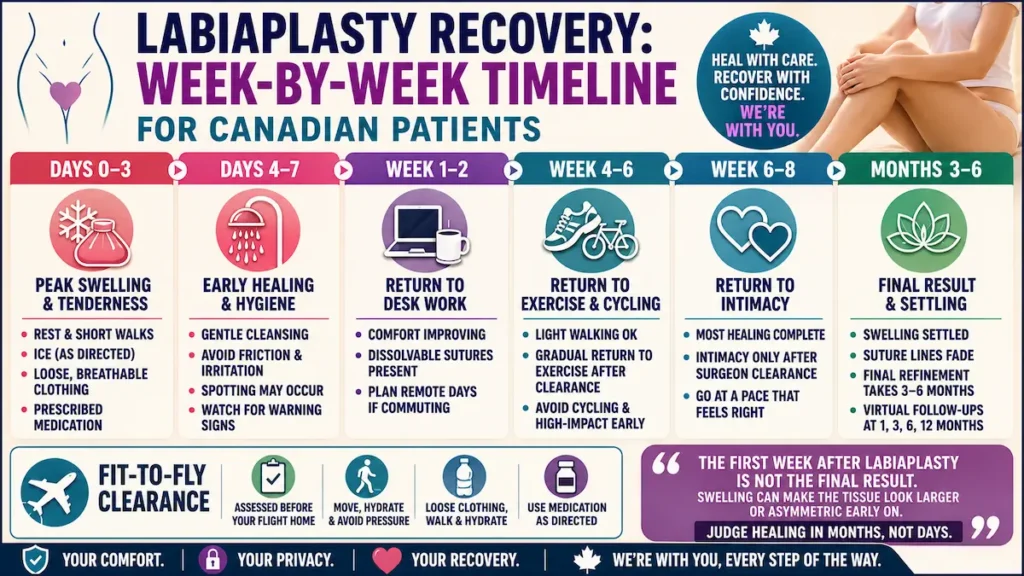
Labiaplasty Recovery: Week-by-Week Timeline for Canadian Patients
Labiaplasty recovery is usually manageable, but it requires patience. Swelling can look more dramatic than patients expect during the first week. That does not mean something is wrong.
Most patients return to light desk work within several days, but exercise, cycling, swimming, and intimacy need a longer pause. We provide written instructions before you leave Istanbul, and our team remains available after you return to Canada.
Days 0–3: Swelling, Ice, Loose Clothing, and Rest
The first three days are the most swollen. You may feel pressure, tenderness, mild stinging, or a bruised sensation. This is expected after labiaplasty surgery.
We usually recommend rest, short walks, loose cotton underwear, and avoiding friction. Ice packs may be used according to your surgeon’s instructions, but they should never be applied directly to the skin.
During this phase, avoid long periods of sitting upright. Reclining slightly can reduce pressure. When you walk, move slowly and keep steps short.
- Wear loose, breathable clothing.
- Avoid tight leggings, jeans, thongs, and shapewear.
- Take prescribed medications exactly as directed.
- Contact our team if pain sharply increases instead of gradually improving.
Days 4–7: Early Healing and Hygiene Protocol
By days 4 to 7, discomfort usually improves, but swelling can still be visible. Some patients notice one side looks more swollen than the other. This can happen because tissue does not heal symmetrically day by day.
Gentle hygiene is important. We give specific instructions for cleansing, drying, and avoiding irritation. You should not scrub the area, use fragranced products, or apply unapproved creams.
Small amounts of spotting can occur early. Heavy bleeding, fever, spreading redness, foul odour, or worsening pain should be reported immediately. It is better to ask early than wait.
Week 1–2: Returning to Desk Work
Many patients can return to remote work or a desk-based role after several days, depending on comfort. If your work involves walking, lifting, uniforms, long commutes, or sitting all day, you may need more time.
Canadian patients should think practically about the first week back home. A long TTC, GO Transit, SkyTrain, or office commute may feel uncomfortable even if you are medically safe. Planning a few remote days can make recovery easier.
Sutures are usually dissolvable. You may feel tiny knots or mild pulling during early healing. Do not trim, pull, or manipulate them unless instructed by the surgical team.
Fit-to-Fly Clearance for Canadian Return Travel
For Canadian travellers, the flight home is part of the recovery plan. Istanbul to Toronto, Vancouver, Montreal, or Calgary is a long-haul route, so comfort, mobility, and swelling control matter.
We assess fit-to-fly readiness before departure. Your surgeon checks the incision area, swelling, bleeding risk, comfort level, and ability to walk. We also explain how to sit, move, and hydrate during the flight.
Our travel guidance is designed to reduce common post-operative flight concerns. You can read more in our flight safety after surgery guide and our post-operative care after flying home guide for Canadian patients.
- Choose loose clothing for the flight.
- Walk briefly in the cabin when safe.
- Hydrate and avoid alcohol.
- Use any prescribed medication only as directed.
- Do not place direct pressure on the surgical area for long periods.
Week 4–6: Return to Exercise and Cycling
Exercise restrictions protect healing tissue. Light walking is encouraged early, but running, cycling, spinning, horseback riding, heavy lifting, and lower-body gym work need a longer pause.
Most patients begin gradual return to exercise around weeks 4 to 6, after surgeon clearance. Cycling and saddle-based activities often need special caution because direct friction can irritate the healing labial edge.
Returning too early can increase swelling, tenderness, spotting, or delayed healing. Feeling impatient is normal. Healing still needs time.
Week 6–8: Return to Intimacy After Surgeon Clearance
Most patients are advised to avoid sexual activity for several weeks after labiaplasty. Many can resume intimacy around week 6 to 8, but only after the surgeon confirms that the tissue is healed enough.
Comfort is the guide, not the calendar alone. If there is tenderness, pulling, swelling, or emotional hesitation, waiting is appropriate. There is no benefit to rushing.
We also recommend open communication with your partner. Intimate recovery is physical and emotional. A respectful pace supports both.
Month 3–6: Final Healed Result and Suture-Line Settling
By three months, most swelling has settled significantly. The tissue usually feels softer, and the suture lines continue to fade. Some firmness or sensitivity can still improve over time.
A healed labiaplasty result is not judged at week one. Early swelling can distort shape and make the area look uneven. Final refinement often takes three to six months.
We schedule long-term virtual follow-ups at 1, 3, 6, and 12 months as part of our comprehensive care programme. This helps us monitor your healing after you return to Canada.
“The first week after labiaplasty is not the final result. Swelling can make the tissue look larger or asymmetric early on. We ask patients to judge healing in months, not days.”
| Recovery Stage | What You May Notice | Typical Guidance |
|---|---|---|
| Days 0–3 | Peak swelling, tenderness, mild bruising | Rest, loose clothing, short walks, prescribed medication |
| Days 4–7 | Swelling continues, early incision healing | Gentle hygiene, avoid friction, monitor for warning signs |
| Week 1–2 | Improved comfort, dissolvable sutures present | Desk work may resume if comfortable |
| Week 4–6 | Less swelling, tissue still maturing | Gradual return to exercise after clearance |
| Week 6–8 | Most tissue healing complete | Intimacy only after surgeon clearance |
| Month 3–6 | Final contour becomes clearer | Long-term follow-up and scar maturation monitoring |
Safety, Risks, Scars & Sensation
Labiaplasty is a delicate procedure. The tissue is sensitive, the anatomy varies widely, and small decisions can affect comfort, symmetry, sensation, and healing. This is why conservative planning matters.
At AKM Clinic, we discuss risks clearly before surgery. A respectful consultation should never minimize possible complications. It should help you understand how we reduce them.
Common Side Effects After Labiaplasty
Swelling is the most common early effect. It can make the tissue look larger, uneven, or firmer than expected during the first days. This usually improves gradually.
Bruising, tenderness, mild spotting, and a pulling sensation around the sutures can also occur. Some patients feel more sensitive on one side than the other. Early asymmetry does not always predict the final result.
Temporary itching can appear as the incision lines heal. Do not scratch the area. If itching becomes intense, painful, or associated with discharge, contact our team for guidance.
- Expected early effects include swelling, bruising, tenderness, and mild spotting.
- Warning signs include fever, heavy bleeding, worsening redness, foul odour, or increasing pain.
- Questions should be asked early, especially after you return to Canada.
Labiaplasty Scars: Where Incisions Sit and How They Heal
Labiaplasty scars are usually placed within naturally textured tissue, which often makes them less visible over time. Scar appearance still depends on technique, closure tension, tissue quality, aftercare, and personal healing biology.
Trim labiaplasty places the incision along the labial edge. Wedge labiaplasty places the incision across the reduced tissue segment while preserving the natural edge. Labia majora reduction creates a different scar pattern, depending on the amount and location of tissue treated.
Early scars may look pink, firm, or slightly raised. This is part of normal scar maturation. Most scars soften and fade over several months, though every patient heals differently.
We use careful closure and recovery guidance to support scar quality. Our scar-minimizing protocols may include Low-Level Laser Therapy where appropriate; our LLLT scar minimization guide explains how laser-based recovery support can help selected surgical patients.
Sensation: What Patients Should Understand
Sensation is one of the most important topics in labiaplasty. Some temporary numbness, tingling, hypersensitivity, or altered feeling can occur while nerves recover from surgery. This often improves as swelling settles.
Permanent sensation change is uncommon, but it is a real risk. The risk increases when too much tissue is removed, when the clitoral hood is treated aggressively, or when anatomy is not respected.
Our technique is conservative for this reason. We focus on reducing the tissue that causes symptoms while preserving protective structure and nerve-sensitive areas. More removal is not automatically better.
“Sensation preservation begins with surgical restraint. The safest labiaplasty plan respects the patient’s anatomy and avoids chasing an extreme appearance.”
Over-Resection: Why Conservative Technique Matters
Over-resection means too much tissue has been removed. It can create dryness, irritation, tightness, sensitivity changes, visible imbalance, or an appearance the patient did not want. It is one of the main reasons people search for botched labiaplasty.
Prevention starts with realistic planning. We do not aim for an over-reduced or standardized look. We also explain when a patient’s goal would require removing more tissue than is medically wise.
Sometimes the safest answer is “no” or “less than you imagined.” That honesty protects long-term comfort.
Infection and Wound-Healing Precautions
Any incision can become infected, even with careful technique. The intimate area also requires thoughtful hygiene because moisture, friction, and bacteria can affect healing. Clear aftercare instructions reduce this risk.
You should avoid swimming, baths, saunas, sexual activity, tight clothing, and intense exercise until cleared. These activities can increase irritation, swelling, or wound stress.
Nicotine use is a major wound-healing concern. Smoking or vaping can reduce blood flow and increase the risk of delayed healing. We may postpone surgery if nicotine use creates an unsafe risk profile.
Evidence-Based Counselling Before Intimate Surgery
Patients considering labiaplasty should receive careful counselling about normal anatomical variation, consent, alternatives, and realistic outcomes. International professional bodies also stress that patients should understand limits and risks before elective genital procedures.
For wider clinical context, the American College of Obstetricians and Gynecologists’ guidance on elective female genital cosmetic surgery provides physician guidance on female genital cosmetic procedures, including the need for careful counselling and informed consent.
How We Reduce Risk at AKM Clinic
Risk reduction begins before you arrive in Istanbul. We review your medical history, medications, allergies, prior procedures, and any conditions that may affect healing. We also ask for honest disclosure about nicotine, supplements, and bleeding history.
Your surgery is performed in a regulated clinical environment with strict sterile protocols. Our technology and safety standards page explains how we use structured sterilization, hospital-grade protocols, and recovery technologies to support international patients.
For Canadian patients, aftercare continuity matters as much as the operation itself. We provide written instructions, 24/7 support access, and long-term virtual follow-ups at 1, 3, 6, and 12 months.
This follow-up structure helps patients avoid feeling abandoned after flying home. It also gives you a direct path to ask private questions during healing.
When to Contact Us During Recovery
You should contact our team if symptoms change suddenly or feel disproportionate. A quick message can prevent unnecessary worry and help us guide you properly.
- Increasing pain after initial improvement
- Heavy bleeding or clots
- Fever, chills, or feeling unwell
- Spreading redness or warmth
- Foul-smelling discharge
- Wound separation or visible opening
- Severe swelling on one side
If you have urgent symptoms after returning to Canada, seek local medical care while also informing our team. International follow-up should support emergency care, not replace it.

Is It Safe to Get Labiaplasty in Turkey? An Honest Look at the “Botched” Fear
Canadian patients are right to ask safety questions before travelling for intimate surgery. Labiaplasty requires precision, conservative judgement, and strong aftercare. The concern is not only where surgery happens; it is who performs it, how the clinic is regulated, and what support exists after you fly home.
Turkey has excellent surgeons and unsafe providers, just like every destination. A safe decision starts with verification. We encourage patients to ask direct questions before booking.
What “Botched Labiaplasty” Actually Means
“Botched labiaplasty” is a broad term. It may describe over-resection, uneven tissue removal, poor scar placement, wound separation, visible asymmetry, persistent discomfort, or a result that does not match the surgical plan.
Some concerns are temporary and improve with healing. Swelling can create early asymmetry, and scar firmness can soften over months. Other concerns may reflect a real surgical issue that needs professional assessment.
The most serious preventable problems often come from aggressive tissue removal or a lack of anatomical respect. This is why our approach is conservative. We would rather leave a natural amount of tissue than create a tight or over-reduced result that affects comfort.
The Turkey Cosmetic Surgery Reality: How AKM Differs
International surgery should never be chosen only because of price. The clinic’s standards, surgeon credentials, facility quality, anesthesia safety, and follow-up system matter more than the destination itself.
At AKM Clinic, we operate through a structured international surgical programme. Your care includes pre-operative review, a regulated surgical environment, private transfers, hotel recovery support, and long-term virtual follow-up after you return to Canada.
We also speak openly about the risks of choosing the wrong provider. Our guide on whether plastic surgery in Turkey is safe explains how Canadian patients can separate accredited surgical clinics from high-volume, poorly supervised operators.
Ghost Surgery: Making Sure Your Surgeon Operates
“Ghost surgery” refers to a situation where the patient believes one surgeon will perform the procedure, but another person performs part or all of it without proper consent. This is a serious trust issue in international surgery.
For labiaplasty, surgeon identity matters. This is not a procedure that should be delegated casually. The anatomy is sensitive, and small technical errors can affect healing, symmetry, and sensation.
Before booking, ask who will perform the consultation, who will mark the tissue, who will operate, and who will manage your aftercare. Our ghost surgery in Turkey guide gives Canadian patients a practical verification framework.
Conservative Surgical Philosophy: The Real Botched-Prevention
The best way to reduce labiaplasty risk is not an extreme technique. It is conservative planning. Over-removal is harder to correct than under-correction.
We evaluate how much tissue can be reduced safely without compromising protection, comfort, or sensation. If the requested result would require unsafe removal, our surgeons will explain why and may decline the plan.
This is part of our Natural-First philosophy. In intimate surgery, natural means comfortable, proportionate, and functional. It does not mean standardized.
“A good labiaplasty result should not look over-reduced. It should feel comfortable, preserve function, and respect the patient’s natural anatomy.”
EBOPRAS-Certified Surgeon Verification
Canadian patients often compare international credentials with RCPSC expectations. EBOPRAS certification represents a structured European surgical standard. It is not the same organization as the Royal College of Physicians and Surgeons of Canada, but it gives patients a serious credential to verify.
Credential verification is especially relevant for intimate surgery. You want a surgeon who can explain trim versus wedge technique, discuss sensation honestly, and decline surgery when expectations are unsafe.
Our plastic surgeon board certification guide explains how Canadian patients can compare EBOPRAS, RCPSC, and other international credential systems before making a decision.
| Credential or Standard | What It Means | Why It Matters for Canadians |
|---|---|---|
| EBOPRAS | European Board certification pathway for plastic, reconstructive, and aesthetic surgery | Shows structured specialist training and examination within a European framework |
| RCPSC | Royal College of Physicians and Surgeons of Canada specialist certification | The familiar Canadian reference point for specialist credentialing |
| JCI-Accredited Facility | International hospital quality and safety accreditation | Supports facility-level safety expectations for Canadian travellers |
| Surgeon-of-Record Transparency | Clear confirmation of who consults, marks, operates, and follows up | Reduces ghost-surgery risk and improves accountability |
What Canadian Patients Should Verify Before Booking
Verification should happen before deposits, flights, and hotel dates. A reputable clinic will answer detailed questions without pressure.
- Who is the surgeon of record?
- What are the surgeon’s board credentials?
- Which labiaplasty techniques are offered?
- How is trim versus wedge chosen?
- Where will the procedure take place?
- What anesthesia options are available?
- How are complications handled after returning to Canada?
- Will you receive written discharge instructions in English?
- Is there 24/7 support after surgery?
- Are before-and-after materials handled privately and with consent?
We built our process around these questions. Our Canadian patients receive a clear surgical plan, private coordination, and a direct support channel before and after travel.
What If Something Feels Wrong After You Return to Canada?
Most labiaplasty recovery concerns are minor and can be addressed through guidance, photos, and virtual follow-up. Still, urgent symptoms should be assessed locally. If you have heavy bleeding, fever, spreading redness, severe pain, or wound separation, seek care in Canada and contact our team at the same time.
We provide long-term virtual follow-up at 1, 3, 6, and 12 months. This allows our surgical team to monitor healing, answer private questions, and guide you through scar maturation and final result timing.
International care should not end when your flight leaves Istanbul. Aftercare is part of safety.
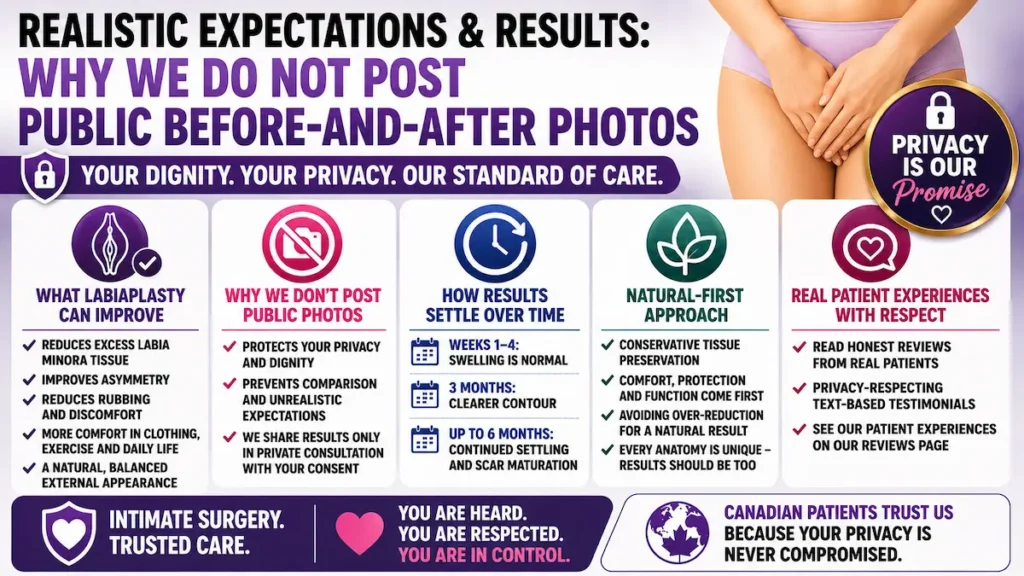
Realistic Expectations & Results: Why We Do Not Post Public Before-and-After Photos
Many patients search for labiaplasty before and after photos before booking a consultation. We understand why. Visual examples can help patients understand what surgery may change.
Intimate surgery is different from facial or body procedures. We do not publish public labiaplasty before-and-after images because patient dignity, consent, and privacy come first. This is not a limitation. It is a standard of care.
What Labiaplasty Results Can Realistically Improve
Labiaplasty can reduce excess labia minora tissue, improve asymmetry, reduce rubbing, and create a more balanced external appearance. In selected patients, it can also improve comfort in clothing, exercise, and daily movement.
The result should still look natural. We do not aim for an over-reduced or standardized appearance. Healthy external genital anatomy varies widely, and a good result respects that variation.
Final labiaplasty results are judged after swelling has settled. Early appearance can be misleading, especially during the first two to four weeks.
Why Public Labiaplasty Before-and-After Pics Are Not Part of Our Marketing
We do not use intimate images to attract attention online. Public before-and-after galleries can create pressure, comparison, and unrealistic expectations. They can also make patients feel exposed.
During a private consultation, we can discuss realistic outcomes in a discreet, consent-based way. Any educational material is handled with strict privacy and only when appropriate. You remain in control of your information.
This policy is especially important for Canadian patients who value discretion. Your consultation, photos, records, and follow-up questions are treated as confidential medical information.
How Healed Labiaplasty Results Settle Over Time
A healed labiaplasty result develops gradually. Swelling can make the tissue look uneven or thicker in the early phase. The edges soften as the sutures dissolve and the scar line matures.
Most patients see a clearer contour by three months. Fine settling can continue for up to six months. Scar maturation may continue beyond that, depending on individual healing.
If one side looks different early, it may simply be healing at a different pace. We monitor this through follow-up rather than judging the result too soon.
Natural-First Aesthetic: Avoiding the Over-Reduced Look
Our Natural-First approach is not limited to facial surgery. In labiaplasty, it means preserving enough tissue for comfort, protection, and a natural appearance.
Over-reduction can create dryness, tightness, sensitivity concerns, and a result that feels less comfortable than before surgery. That is why we plan tissue removal carefully.
Patients sometimes arrive with a very specific image in mind. We listen, but we also explain whether that goal is safe. If a request would compromise function, we will not recommend it.
Text-Based Testimonials and Privacy-Respecting Reviews
Some patients want reassurance from others who travelled for surgery. We provide privacy-respecting reviews and patient experiences where appropriate, without exposing intimate images publicly.
You can read broader patient experiences on our professional plastic surgery reviews page. These reviews help Canadian patients understand our communication style, coordinator support, and follow-up structure.
For labiaplasty, the most meaningful review is often not a public photo. It is whether the patient felt heard, protected, and supported before and after surgery.
“Privacy is not an afterthought in intimate surgery. We would rather protect patient dignity than use sensitive images as marketing material.”
Labiaplasty Cost 2026: Turkey vs Canada
Canadian patients researching labiaplasty cost often compare local private clinic quotes with international options. In Toronto or Vancouver, private labiaplasty pricing can vary widely once surgeon fees, facility fees, anesthesia, follow-up visits, and prescriptions are added.
At AKM Clinic, our all-inclusive labiaplasty clinical pathway is CAD $4,400. This includes the surgical procedure, surgeon fees, anesthesia and facility fees, pre-operative tests, 5-star hotel accommodation, private VIP transfers, post-operative medications, and 24/7 patient support. Canadian-dollar pricing shown for planning clarity; your coordinator will confirm the final payment details before booking.
By comparison, private labiaplasty in Toronto commonly ranges from CAD $6,500 to CAD $8,500 all-in, while Vancouver can range from CAD $7,000 to CAD $9,000. The price difference is narrower than it is for larger facial or body procedures, so the AKM value is not only cost. It is the complete structure: EBOPRAS-certified surgical care, privacy-first coordination, hotel recovery, transfers, and long-term virtual follow-up.
For detailed pricing, inclusions, and technique-level cost notes, see our labiaplasty cost in Turkey guide. You can also review our labiaplasty all-inclusive clinical pathway.
| Location | Typical Labiaplasty Cost | What Is Usually Included | Important Notes |
|---|---|---|---|
| Toronto | CAD $6,500–$8,500 | Often surgeon fee, with facility and anesthesia billed separately or bundled depending on clinic | Follow-up and prescriptions may vary by provider |
| Vancouver | CAD $7,000–$9,000 | Often clinic-dependent; some quotes exclude facility or anesthesia details | Travel, hotel, and recovery support are not included |
| AKM Clinic Istanbul | CAD $4,400 | Surgery, anesthesia, facility fees, tests, hotel, VIP transfers, medications, and support | Canadian-dollar pricing shown for planning clarity; your coordinator will confirm the final payment details before booking. |
Is Labiaplasty Covered in Canada?
Most provincial health plans, including OHIP, MSP, AHCIP, and RAMQ, do not cover labiaplasty when it is considered cosmetic. This is common for elective aesthetic procedures in Canada.
Rare functional exceptions may require physician documentation, referral pathways, and provincial review. These are handled within your province and cannot be guaranteed by an international clinic.
If you believe your concern is medically necessary, speak with your Canadian family physician or gynaecologist before booking private surgery. This can help you understand whether any local pathway exists.
Financing and Budget Planning
Some patients search for labiaplasty finance options because they want predictable planning rather than surprise fees. We provide a clear quote before travel so you know what is included.
Your personal expenses are separate. International flights, meals outside included hotel breakfast, shopping, and optional activities are not part of the surgical quote.
We recommend building a small recovery cushion into your budget. This helps cover extra comfort items, flexible travel changes, or additional time off work if you heal more slowly than expected.
How to Find the Right Labiaplasty Surgeon in Turkey: A Canadian Patient’s Checklist
Choosing a labiaplasty surgeon is not the same as choosing a general cosmetic provider. This procedure requires detailed knowledge of external genital anatomy, conservative planning, scar-aware closure, and careful communication. You should feel respected, not rushed.
Canadian patients often use RCPSC standards as their mental benchmark when evaluating specialist care. When reviewing an international clinic, look for equivalent evidence of structured training, board certification, surgical transparency, and facility safety.
Verify Specialist Credentials
Start with the surgeon’s credentials. Ask whether your surgeon is board certified, what surgical specialty they trained in, and whether they have experience with female genital aesthetic and functional procedures.
Our European Board-Certified Surgeons practise within a structured specialist framework. For Canadian patients comparing systems, the Royal College of Physicians and Surgeons of Canada’s specialist certification framework is the familiar domestic reference point. International credentials should be explained clearly, not hidden behind vague claims.
You can also review our plastic surgeon board certification guide for a deeper explanation of EBOPRAS, RCPSC, and other credential pathways.
| Checklist Item | What to Ask | Why It Matters |
|---|---|---|
| Board credentials | Is the surgeon board certified in a relevant surgical specialty? | Shows structured training and formal assessment |
| Procedure experience | How often does the surgeon perform labiaplasty? | Technique choice depends on anatomy and judgement |
| Technique range | Can the surgeon explain trim, wedge, labia majora reduction, and hood reduction? | One-method clinics may force the wrong technique |
| Facility standards | Where will surgery take place, and what safety protocols are used? | Facility quality affects infection prevention and emergency readiness |
| Aftercare | Who supports you after you return to Canada? | International surgery needs structured follow-up |
Look for Conservative Technique Philosophy
A good labiaplasty surgeon should be comfortable saying no. If a requested result requires unsafe tissue removal, the surgeon should explain the concern and offer a safer plan. This is especially important when patients arrive with images found online.
Technique choice should be individualized. Trim labiaplasty, wedge labiaplasty, laser labiaplasty, labia majora reduction, and clitoral hood reduction solve different problems. They should not be used interchangeably.
Our philosophy is preservation first. We remove only what is needed to reduce symptoms or improve proportion while protecting comfort and natural anatomy.
Ask How Privacy Is Protected
Privacy is not just a website policy. It affects consultation, photography, records, hotel recovery, follow-up, and communication. You should know who can access your images and how they are stored.
At AKM Clinic, intimate images are not used for public marketing. Any visual review is handled through secure, consent-based consultation. Our patient review resources focus on experience, communication, and support without exposing private anatomy.
For many Canadian patients, this discretion is as important as the surgical result. We agree.
Confirm Surgeon-of-Record Transparency
You should know who will consult, mark, operate, and follow up. If a clinic cannot answer those questions clearly, do not proceed. Surgeon-of-record transparency protects consent and accountability.
This is one reason we discuss ghost surgery openly. The patient has the right to understand who is responsible for every stage of care.
Our team confirms your care pathway before you travel. You should never arrive in Istanbul unsure who is performing your procedure.
Review Facility Standards and Aftercare
Facility standards matter even for a short procedure. Sterile technique, anesthesia monitoring, emergency planning, and post-operative instructions reduce risk.
You can review our clinical environment on the Istanbul clinic page and our standards on the technology and safety standards page. These resources explain how we structure care for international patients.
Aftercare should continue after your flight home. Our follow-up programme includes virtual check-ins at 1, 3, 6, and 12 months, with 24/7 support access for urgent concerns.
Use Canadian and International Clinical Resources as Reference Points
Canadian patients often research professional guidance before making a decision. That is appropriate. For intimate surgery, resources from the Society of Obstetricians and Gynaecologists of Canada and the Canadian Society of Plastic Surgeons’ guidance on choosing a surgeon can help frame questions around candidacy, consent, and surgical standards.
International resources can also help patients understand the broader procedure landscape. The International Society of Aesthetic Plastic Surgery’s Find a Surgeon directory publishes global aesthetic surgery resources that can support patient research.
These resources do not replace a consultation. They help you ask better questions. A responsible clinic should welcome informed patients.
“The right labiaplasty surgeon should protect your anatomy, your privacy, and your ability to make an informed decision. Technical skill and patient dignity belong together.”
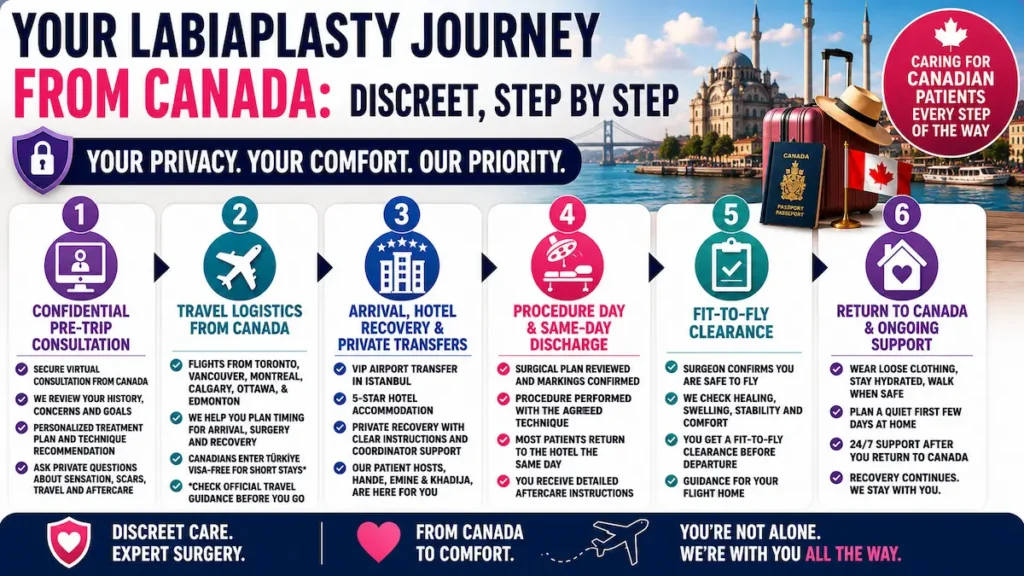
Your Labiaplasty Journey From Canada: Discreet, Step by Step
Travelling for intimate surgery requires careful planning. The goal is to reduce uncertainty before you leave Canada. You should know the clinical plan, the travel logistics, the recovery restrictions, and the support structure.
Our process is designed for discretion. Your coordinator helps organize the non-medical details, while the surgical team focuses on candidacy, technique, and safety.
Confidential Pre-Trip Consultation
Your process begins with a confidential virtual consultation. We review your concerns, medical history, medications, childbirth history, prior surgery, and recovery goals. If photos are required, they are requested through secure channels.
We then explain whether labiaplasty is appropriate and which technique may fit your anatomy. If vaginoplasty, non-surgical tightening, or another option is more relevant, we will say so.
This is also the time to ask private questions about sensation, scars, intimacy, travel, and aftercare. You do not need to wait until you arrive in Istanbul.
Travel Logistics From Canada
Canadian patients commonly travel from Toronto, Vancouver, Montreal, Calgary, Ottawa, or Edmonton. Flight schedules change, so we recommend checking current airline options before booking. Your surgery date should allow enough time for arrival, consultation, surgery, early recovery, and fit-to-fly clearance.
Canadian passport holders can typically enter Türkiye visa-free for short stays, but entry rules can change. Check official travel guidance before departure.
Our patient journey page explains how the process works from initial consultation through return travel.
Arrival, Hotel Recovery, and Private Transfers
After arrival in Istanbul, private VIP transfers bring you from the airport to your hotel or clinic schedule. This reduces stress, especially for patients travelling alone.
Our all-inclusive clinical pathway includes 5-star hotel accommodation. Patients recover in a private setting with clear instructions and coordinator support. You do not need to navigate transport, clinic visits, or medication questions alone.
Our patient hosts, Hande, Emine, and Khadija, support international patients with practical coordination throughout the stay.
Procedure Day and Same-Day Discharge
On procedure day, the surgical plan is reviewed again. Markings are confirmed, anesthesia is administered, and the procedure is performed according to the agreed technique.
Most isolated labiaplasty patients return to the hotel the same day after monitoring. If labiaplasty is combined with a larger procedure, the recovery plan may change.
Before discharge, you receive instructions for hygiene, swelling control, clothing, medication, warning signs, and contact pathways.
Fit-to-Fly Clearance and Return to Canada
Before you leave Istanbul, the surgeon reviews your early healing and confirms whether you are safe to fly. This includes checking swelling, bleeding, incision stability, walking comfort, and medication needs.
For the flight home, wear loose clothing, avoid prolonged pressure, hydrate, and walk briefly when safe. We also recommend planning a quiet first few days after landing in Canada.
You continue to have access to our team after returning home. Recovery does not end at the airport.
Frequently Asked Questions About Labiaplasty in Turkey (FAQ):
What is the difference between labiaplasty and vaginoplasty?
Labiaplasty treats the external genital tissue, usually the labia minora or labia majora. Vaginoplasty treats the internal vaginal canal and supporting tissues. They address different anatomy.
If your concern is external tissue that rubs, protrudes, or feels asymmetric, labiaplasty may be the relevant procedure. If your concern is internal laxity after childbirth, our vaginoplasty in Turkey guide explains that separate option.
Is labiaplasty the same as non-surgical "vaginal rejuvenation"?
No. Labiaplasty is a surgical procedure that reduces or reshapes external labial tissue. Non-surgical "vaginal rejuvenation" usually refers to energy-based treatments that may target mild laxity, moisture, or tissue quality.
Energy-based treatments cannot remove excess labial tissue. They are not substitutes for surgical labiaplasty when protrusion, rubbing, or significant asymmetry is the concern.
Trim or wedge labiaplasty: which technique is better?
Neither technique is universally better. Trim labiaplasty may suit patients with edge irregularity, darker edge concerns, or long thin tissue. Wedge labiaplasty may suit patients who want to preserve the natural edge while reducing central protrusion.
The right technique depends on tissue thickness, asymmetry, blood supply, edge quality, and the amount of reduction needed. We explain the recommendation before surgery so you understand why one method fits your anatomy better than another.
Will labiaplasty affect sensation or sexual function?
Most patients do not lose sexual function after a carefully planned labiaplasty. Temporary numbness, tingling, sensitivity, or altered sensation can occur while swelling settles and nerves recover.
Permanent sensation change is uncommon, but it is possible. The risk is higher when tissue is removed aggressively or when sensitive areas are treated without conservative planning. We prioritize tissue preservation for this reason.
How long is labiaplasty recovery?
Most patients need several quiet days after surgery. Swelling is usually strongest in the first week, and many patients return to desk work within one to two weeks depending on comfort.
Exercise, cycling, swimming, and intimacy require a longer pause. Many patients resume exercise around weeks 4 to 6 and intimacy around weeks 6 to 8, only after surgeon clearance.
Does OHIP, MSP, AHCIP, or RAMQ cover labiaplasty?
Canadian provincial health plans usually do not cover labiaplasty when it is considered cosmetic. This includes OHIP in Ontario, MSP in British Columbia, AHCIP in Alberta, and RAMQ in Quebec.
Rare functional cases may require documentation, referral, and provincial assessment. If you believe your concern is medically necessary, speak with your Canadian family physician or gynaecologist before booking private surgery.
How much does labiaplasty cost in Toronto versus Istanbul?
Private labiaplasty in Toronto often ranges from CAD $6,500 to CAD $8,500 once surgeon, facility, anesthesia, and follow-up costs are considered. Vancouver pricing can sit around CAD $7,000 to CAD $9,000 depending on the clinic.
At AKM Clinic, our all-inclusive labiaplasty clinical pathway is CAD $4,400. It includes surgery, facility fees, anesthesia, pre-operative tests, 5-star hotel accommodation, VIP transfers, medications, and support. Canadian-dollar pricing shown for planning clarity; your coordinator will confirm the final payment details before booking.
Does Canadian travel insurance cover labiaplasty complications abroad?
Many Canadian travel insurance policies exclude elective cosmetic surgery and complications related to it. You should review your policy carefully before booking and ask the insurer direct written questions.
To reduce this concern, AKM Clinic provides complimentary complication insurance for all patients. This is separate from standard Canadian travel insurance and is designed to add an extra layer of protection around your surgical care. Your coordinator will explain the coverage terms, limits, and required documentation before you confirm your booking.
Why does AKM Clinic not show public labiaplasty before-and-after photos?
We do not publish public intimate before-and-after photos because patient dignity and privacy come first. Labiaplasty results can be discussed during a private consultation without using sensitive images as marketing.
This policy protects patients from exposure, comparison pressure, and misuse of intimate imagery. We consider discretion part of ethical care.
What does "botched labiaplasty" mean, and how can it be avoided?
"Botched labiaplasty" may refer to over-resection, poor symmetry, scar problems, wound separation, persistent discomfort, or a result that does not match the surgical plan. Some early concerns are swelling-related and improve with time, but others may reflect a technical problem.
Prevention depends on conservative surgical planning, clear surgeon-of-record transparency, proper facility standards, and realistic expectations. Our surgeons will decline unsafe requests rather than remove too much tissue.
Is there a minimum age for labiaplasty?
Yes. AKM Clinic treats labiaplasty as an adult-only procedure. Patients must be 18 or older and able to provide informed consent.
We do not frame normal adolescent development as a surgical problem. Adult patients should also have stable motivation, realistic expectations, and the ability to understand risks, recovery, and alternatives.
Can I combine labiaplasty with vaginoplasty or a mommy makeover?
Yes, selected patients may combine labiaplasty with vaginoplasty or broader post-childbirth procedures. Combination surgery must be planned carefully because recovery needs can overlap.
We assess anesthesia time, mobility, hygiene, wound care, flight timing, and hotel recovery support before recommending a combined plan. You can review the labiaplasty and vaginoplasty package or the mommy makeover and labiaplasty package for structured options.
Medical Disclaimer: This page is for educational purposes only and does not replace medical advice, diagnosis, or treatment from a qualified health care professional. Labiaplasty is a surgical procedure with risks, including swelling, bleeding, infection, scarring, asymmetry, wound-healing problems, sensation changes, dissatisfaction with appearance, and the possible need for revision. Every patient’s anatomy, healing pattern, medical history, and goals are different. Your candidacy can only be determined after a confidential medical consultation and review by a qualified surgeon.