




Canadian patients considering breast augmentation often face a practical decision: private clinic pricing in Toronto, Vancouver, or Montreal can be high, while consultation availability may be limited. This guide explains breast augmentation from a medical, safety, cost, and travel perspective for Canadians comparing domestic options with AKM Clinic in Istanbul. We focus on the questions that matter most before booking: implant type, placement technique, scar visibility, recovery timing, long-term implant safety, and how your care continues after you return to Canada.
Table of Contents
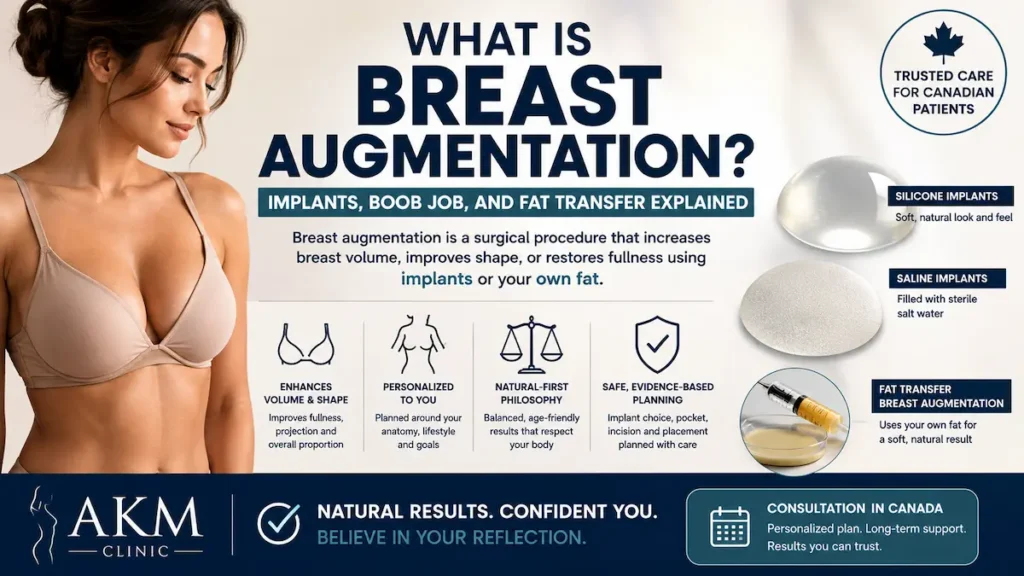
What Is Breast Augmentation? Implants, Boob Job, and Fat Transfer Explained
Breast augmentation is a surgical procedure that increases breast volume, improves breast shape, or restores fullness using implants or the patient’s own fat. It may involve silicone breast implants, saline implants, fat transfer breast augmentation, or a combined approach, depending on anatomy, skin quality, and goals.
Many Canadian patients use different terms for the same decision. Some search for breast augmentation, others search for breast implants, and some use the casual term boob job. In clinical planning, these terms are not identical. Breast augmentation describes the procedure, breast implants describe one method, and “boob job” is a non-medical phrase patients often use online.
At AKM Clinic, we approach breast augmentation as a proportion and anatomy decision, not simply a size increase. Our Natural-First philosophy means we plan implant volume, projection, incision choice, and pocket placement around your chest width, existing breast tissue, lifestyle, and long-term tissue support.
For Canadian patients, this matters because an overly large implant can look obvious, stretch the skin, or increase the chance of needing revision surgery later. A well-planned breast augmentation should look balanced in clothing, age naturally, and respect the patient’s original body frame.
How Breast Augmentation Works: Cosmetic Volume and Shape Restoration
Breast augmentation works by adding volume beneath the breast tissue, beneath the chest muscle, or within a carefully planned surgical pocket between tissue layers. The goal is not only to make the breasts larger. It is to improve contour, upper-pole fullness, symmetry, projection, and overall proportion.
For some patients, the main concern is loss of fullness after pregnancy or breastfeeding. For others, the issue is naturally small breast volume, uneven breast size, or a breast shape that does not match their frame. The right technique depends on whether the breast skin has enough elasticity and whether the nipple position remains appropriate.
Implants remain the most predictable option for noticeable size increase. Fat transfer breast augmentation can create a softer, subtler result, but it depends on having enough donor fat and accepting a smaller volume change. Patients who also have sagging may need breast lift with implants rather than augmentation alone.
Breast Augmentation vs Breast Implants vs “Boob Job”
Breast augmentation is the medical term for surgery that enhances breast size or shape. Breast implants are one tool used to perform that surgery. A boob job is the common search phrase many patients use before they learn the clinical terminology.
This distinction helps during consultation. A patient asking for “a boob job” may actually need several different things: more volume, correction of asymmetry, a lift, implant exchange, or fat transfer. Our role is to translate that visual goal into a safe surgical plan.
We do this by assessing:
- Current breast volume and tissue thickness
- Nipple position and degree of sagging
- Chest wall width and ribcage shape
- Skin elasticity after weight change, pregnancy, or breastfeeding
- Desired cup-size change and long-term implant tolerance
Canadian patients often arrive after comparing breast augmentation Toronto clinics, RealSelf discussions, and Canadian plastic surgery resources. We encourage that research. A better-informed patient usually makes a safer, more realistic implant decision.
From Saline to Silicone to Motiva: How Modern Implant Choices Evolved
Older breast augmentation planning often centred on saline versus silicone implants. Saline implants are filled with sterile salt water, while silicone implants use a cohesive gel designed to feel closer to natural breast tissue. Today, many patients prefer cohesive gel implants because they usually provide a softer, more natural contour.
Modern premium implants have moved beyond basic silicone. At AKM Clinic, we commonly use Motiva Ergonomix implants for patients who want a natural breast augmentation result with advanced shell design, soft movement, and a refined shape profile. Motiva is often chosen by patients who want breast implants that feel less rigid and look less “round” in everyday posture.
Implant choice is never made by brand alone. We consider width, projection, profile, gel behaviour, surface type, and how the implant will interact with your tissue over time. This is especially important for Canadian patients planning long-term follow-up at home, where implant records, lot numbers, and future imaging access should be clearly documented.
Patients interested in implant-free enlargement can review our dedicated guide to fat transfer breast augmentation. That option is useful for subtle enhancement, but it cannot create the same predictable size increase as silicone breast implants.
Benefits of Breast Augmentation for Canadian Patients
Breast augmentation can improve breast volume, contour, and body proportion when it is planned with realistic goals. The most satisfying results usually come from choosing an implant that fits the patient’s frame rather than chasing a specific cup size. For Canadian patients, the decision often involves more than aesthetics: cost, access, implant safety, and long-term follow-up all matter. We build each surgical plan around balanced enhancement, clear implant documentation, and a Natural-First result that still feels like the patient’s own body.
Volume Restoration After Pregnancy, Breastfeeding, or Weight Loss
Pregnancy, breastfeeding, and major weight change can reduce upper-pole fullness, stretch the skin, and leave the breasts looking deflated even when the patient’s overall weight is stable. Exercise can strengthen the chest muscles, but it cannot restore lost glandular volume or reverse skin expansion after breastfeeding. This is where breast augmentation can be useful.
For many mothers, the goal is not to look dramatically different. It is to regain the proportion they had before pregnancy, or to create a softer, more feminine contour that feels natural in clothing. We often hear Canadian patients describe this as wanting to “feel like myself again,” rather than wanting an obvious surgical change.
Implant choice is central to this result. A moderate-profile silicone or Motiva implant may restore fullness without creating an exaggerated upper curve. If the nipple has dropped below the breast crease, augmentation alone may not be enough. In those cases, a breast lift and augmentation can restore both position and volume in one operation.
Asymmetry Correction and More Balanced Proportions
Breast asymmetry is common. One breast may be smaller, sit higher, have a different nipple position, or respond differently to pregnancy and breastfeeding. Mild asymmetry is normal, but visible imbalance can affect clothing fit, swimwear confidence, and how the patient feels in fitted tops.
Breast augmentation can improve asymmetry by using different implant volumes, adjusting pocket position, or combining an implant with a lift on one side. The plan must be precise. Simply placing the same implant in both breasts may preserve the asymmetry rather than correct it.
During consultation, we assess chest-wall shape, breast base width, nipple height, and tissue thickness on each side. We also discuss what can be corrected and what should be accepted as normal human variation. A natural breast augmentation result does not require mathematical symmetry. It requires visual balance.
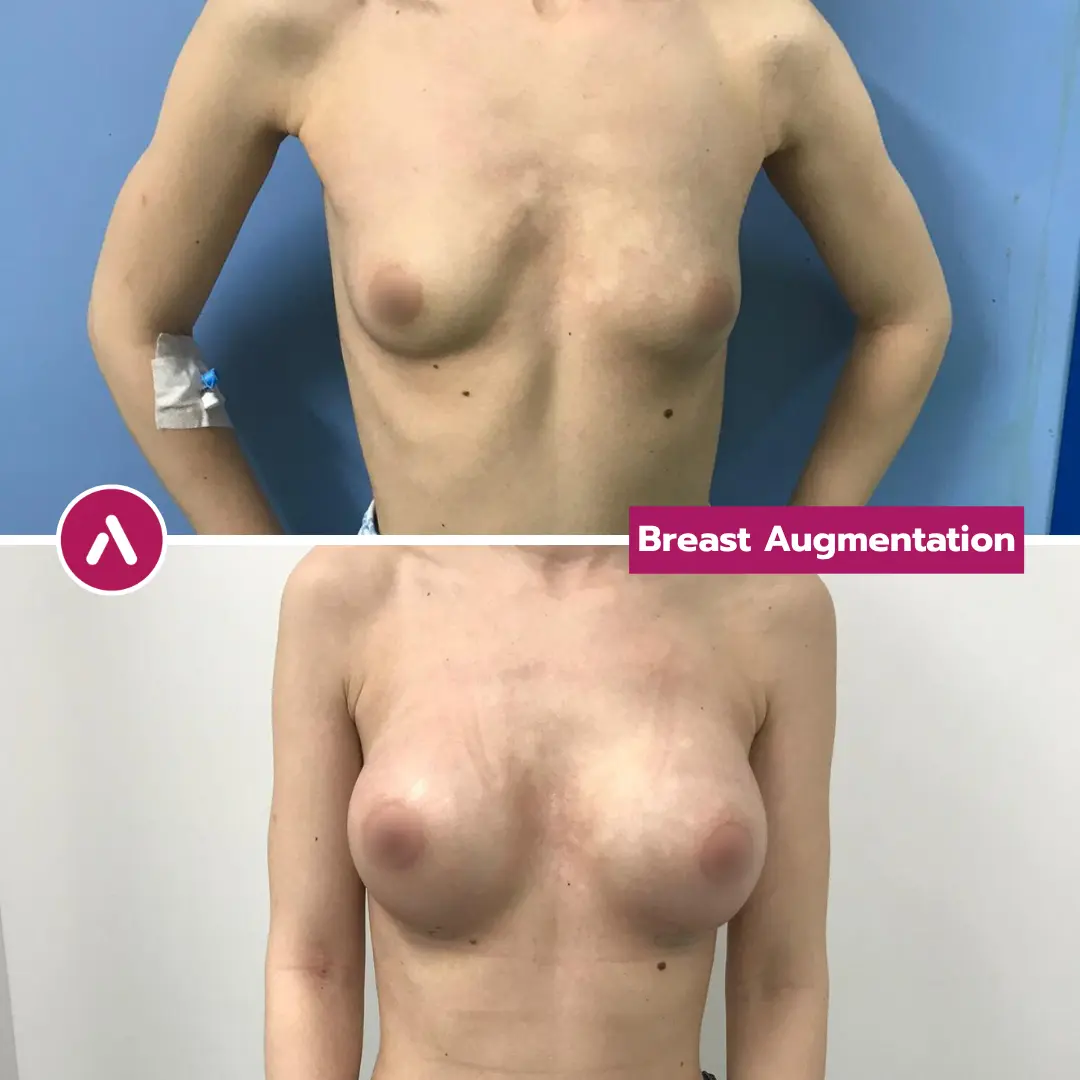
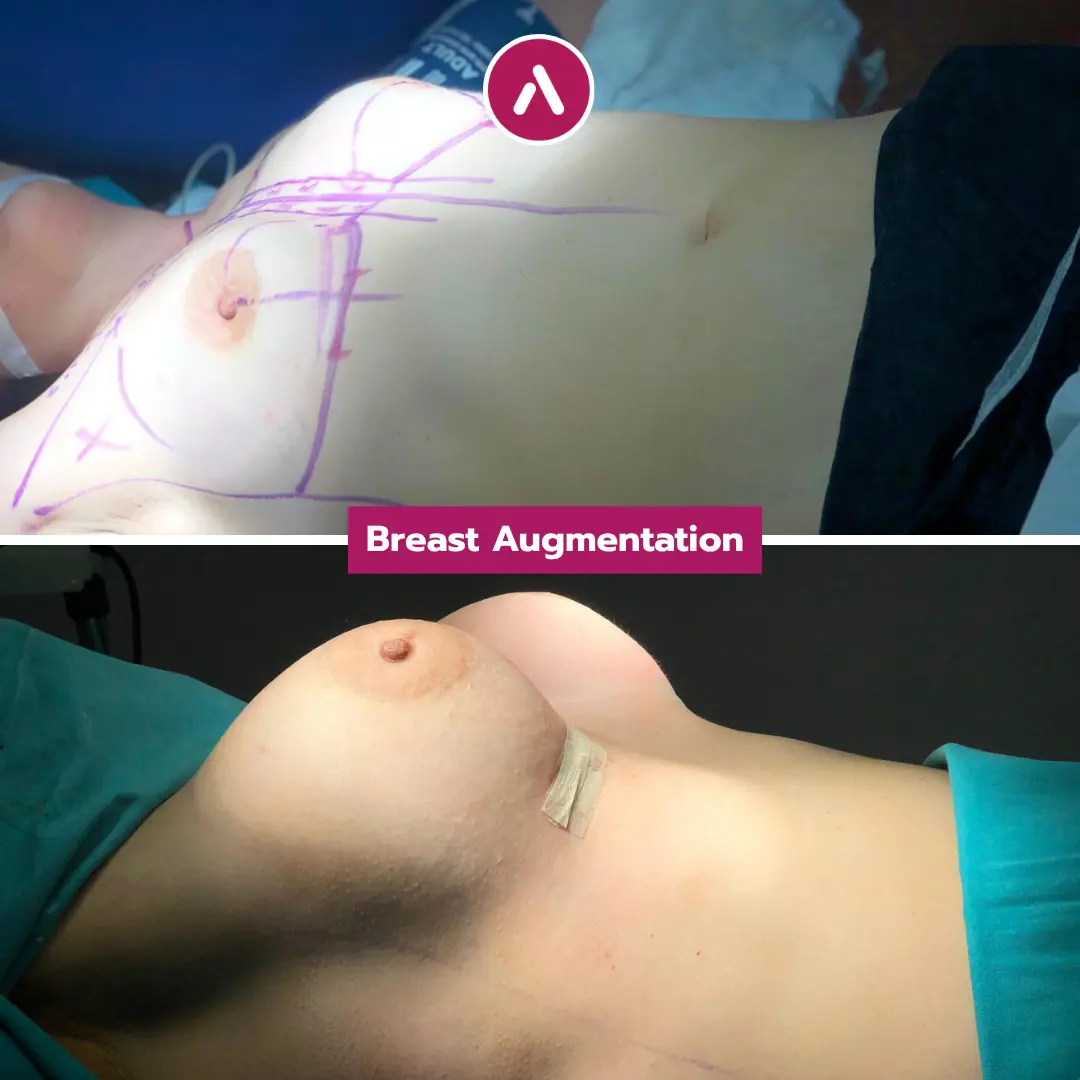
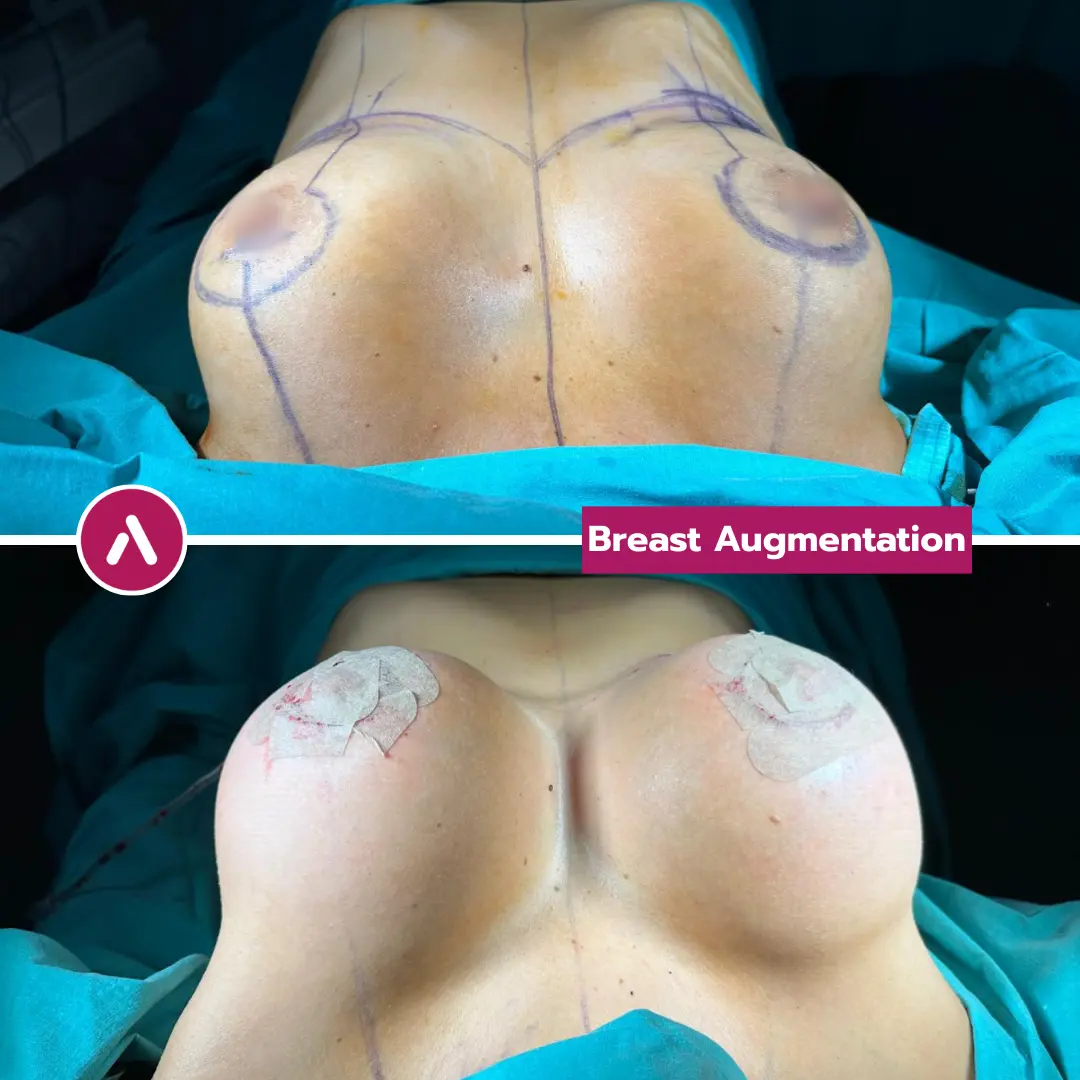
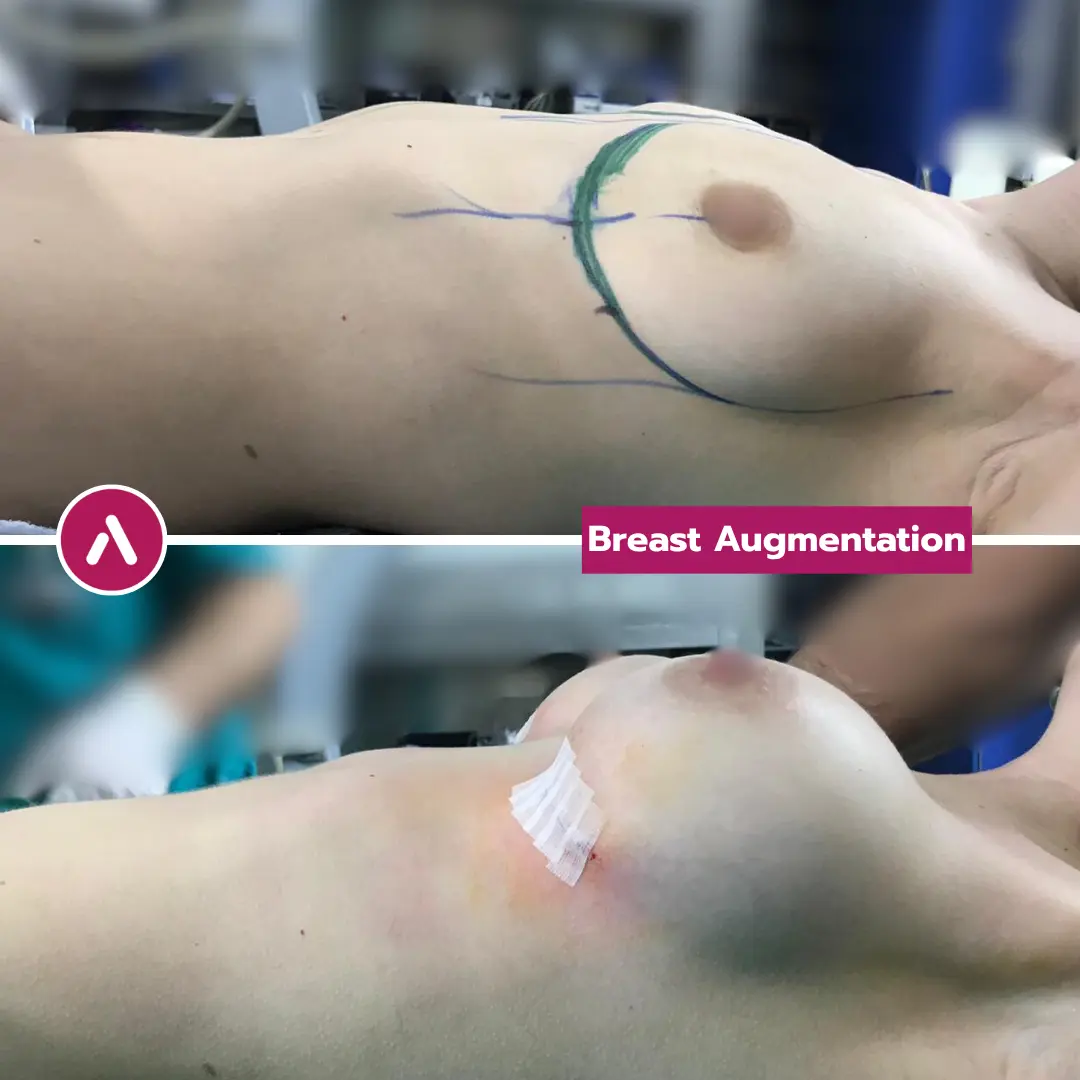
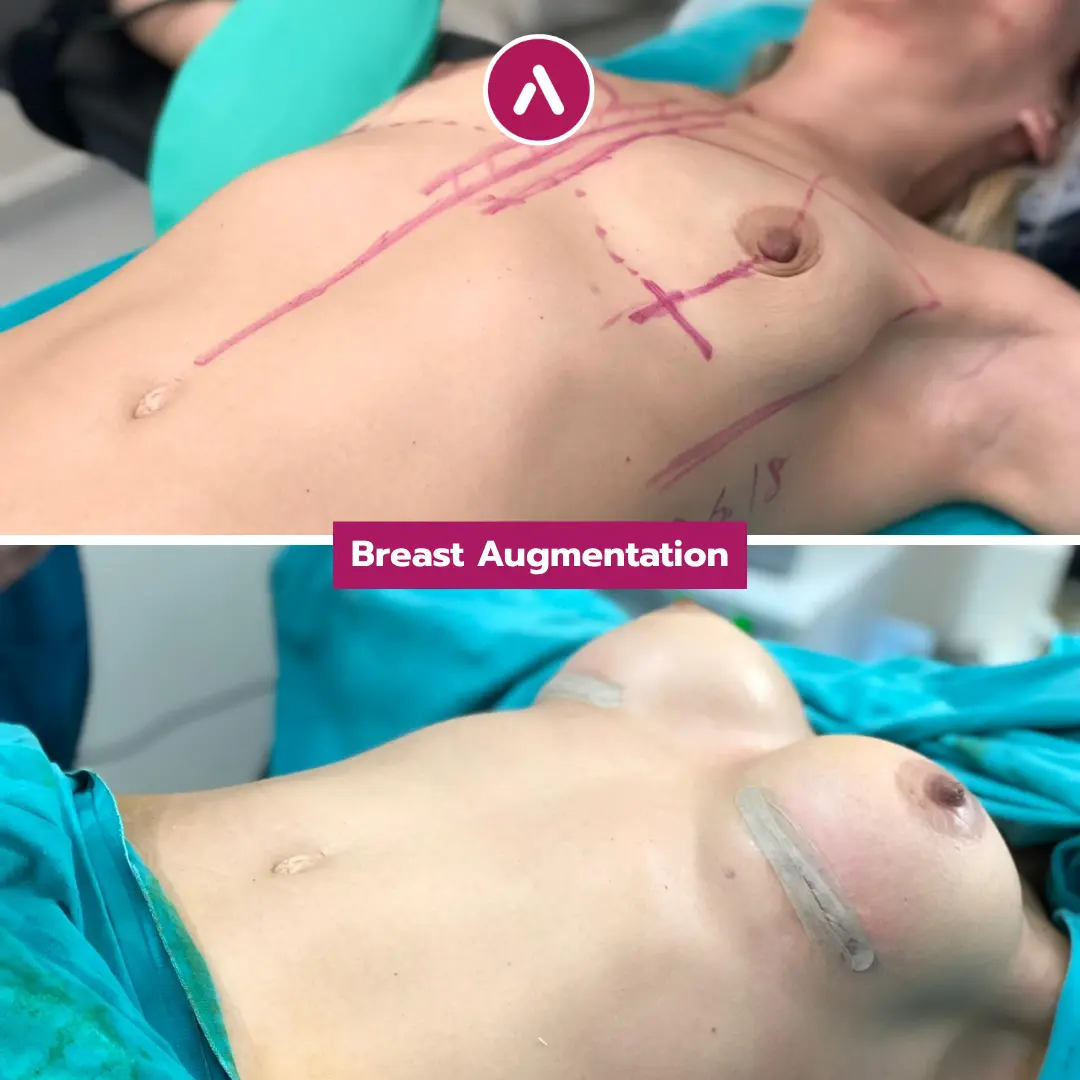
Patients reviewing breast augmentation before and after photos should look beyond size. Useful comparison points include nipple position, breast fold alignment, side-profile projection, and whether the result looks proportionate to the shoulders and waist. Our breast augmentation before and after gallery helps patients evaluate these details before choosing their implant profile.
Confidence, Clothing Fit, and Proportion
Breast augmentation often improves how clothing fits, especially dresses, swimwear, structured tops, and athletic wear. Patients with naturally small breasts may feel that their upper body looks under-balanced compared with their hips or shoulders. Others feel that pregnancy, breastfeeding, or weight loss changed their proportions in a way that no longer feels familiar.
We discuss confidence carefully. Surgery should not be framed as a cure for self-worth, and it should never be used to meet someone else’s expectations. The healthiest candidates usually describe a specific physical concern, understand the limits of surgery, and want a result that feels aligned with their own identity.
For Canadian patients, this often means subtle enhancement rather than dramatic enlargement. A natural breast augmentation should look balanced in a winter sweater, a summer dress, and a professional setting. It should not force the patient into a body shape that feels difficult to maintain over time.
Natural-First Enhancement: Why Subtle Sizing Matters
Our Natural-First approach is central to breast augmentation planning. We do not recommend the largest implant a patient can technically tolerate. We recommend the size, shape, and placement that create a balanced result with the lowest realistic strain on the tissue.
This matters because implant size affects more than appearance. Larger implants can increase skin stretch, visible rippling, breast heaviness, implant descent, and the likelihood of future revision. A smaller or moderate implant often ages better, especially in patients with thin breast tissue or a narrow chest wall.
Natural breast augmentation planning includes several measurements:
- Breast base width
- Skin envelope and elasticity
- Existing breast tissue coverage
- Shoulder, waist, and hip proportion
- Lifestyle, exercise pattern, and long-term comfort
Canadian patients often ask whether they can bring reference photos. We welcome them. Reference images help us understand the visual direction, but measurements decide what is safe and realistic for your anatomy.
Am I a Good Candidate for Breast Augmentation?
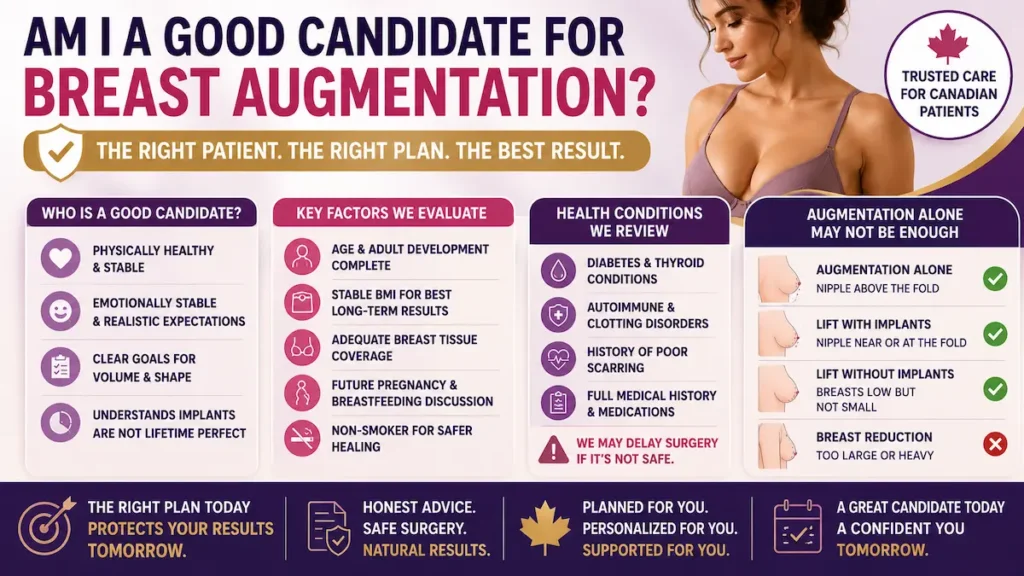
A good candidate for breast augmentation is physically healthy, emotionally stable, and clear about why they want surgery. They should understand that implants can improve volume and shape, but they cannot create perfect symmetry or stop natural aging. We also assess whether augmentation alone is enough, because some patients need a lift, fat transfer, or a staged approach. The safest plan is the one that fits the patient’s tissue, health profile, and long-term expectations.
Age, BMI, and Breast Tissue Requirements
Most breast augmentation candidates are adults whose breast development is complete. In practice, we focus less on age alone and more on health status, anatomy, and expectation alignment. A patient in their 20s may be a good candidate for congenital asymmetry, while a patient in their 40s may be seeking restoration after breastfeeding or weight loss.
BMI also matters. A stable body weight helps protect the final result because major weight gain or loss can change breast shape after surgery. We typically prefer patients to be close to their target weight and stable for several months before travelling to Istanbul.
Breast tissue coverage is another key factor. Patients with thicker tissue may tolerate a wider range of implant placements. Patients with thin tissue need more careful planning to reduce visible implant edges, rippling, or an artificial upper-pole contour.
Breastfeeding Plans and Future Pregnancy
Patients who plan future pregnancy or breastfeeding should discuss timing carefully. Breast augmentation does not automatically prevent breastfeeding, but pregnancy can change breast volume, skin elasticity, and nipple position. These changes may affect the cosmetic result later.
Many Canadian patients choose to wait until they have completed pregnancy and breastfeeding before surgery. This is especially common for mothers considering breast augmentation as part of a mommy makeover. Waiting allows the surgeon to assess the stable breast shape rather than a temporary postpartum contour.
If a patient wants augmentation before having children, we explain incision choice, implant placement, and future breast changes honestly. Inframammary incisions often preserve breast ducts more predictably than periareolar incisions, although every case must be assessed individually.
Smoking, Diabetes, and Health Conditions That May Delay Surgery
Breast augmentation is elective surgery, so timing should favour safety. Smoking is one of the most common reasons we delay or decline surgery. Nicotine reduces blood flow, increases wound-healing risk, and can affect scar quality around the incision.
Diabetes, thyroid disease, autoimmune conditions, clotting disorders, and a history of poor scarring require careful review before travel. These conditions do not automatically exclude every patient, but they may change the anesthesia plan, incision choice, implant placement, or recovery timeline.
We ask Canadian patients to share their full medical history during virtual consultation, including prescriptions, supplements, prior breast imaging, and any family history of breast cancer. If needed, we may recommend a family physician visit in Canada before final travel planning. This protects the surgical result and the patient.
When Augmentation Alone Is Not the Right Procedure
Breast augmentation adds volume, but it does not reliably lift a low nipple position. If the nipple sits at or below the breast crease, an implant alone may create a larger breast that still looks low. This is one of the most common planning mistakes in breast surgery.
Some patients need a breast lift instead of implants. Others need breast lift and augmentation together. The decision depends on skin laxity, nipple height, breast fold position, tissue quality, and whether the patient wants more volume or simply a higher shape.
A simple self-check can help before consultation:
- If your breast volume is low but the nipple is still above the fold, augmentation alone may be enough.
- If your nipple sits near the fold and you want more volume, breast lift with implants may be more appropriate.
- If your breasts feel heavy and low but not small, a breast lift without implants may be the safer choice.
- If you want smaller, lighter breasts, breast reduction may fit your goals better.
We explain these distinctions clearly before surgery. A good plan may not always match the procedure name a patient searched first.
Breast Augmentation Techniques: Saline vs Silicone vs Motiva vs Fat Transfer
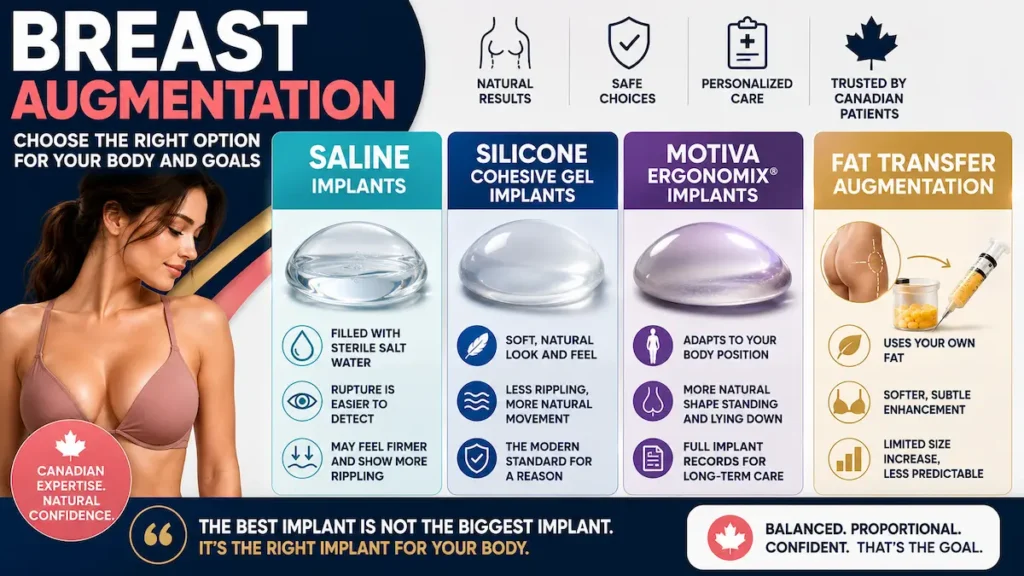
Breast augmentation techniques differ by implant material, implant surface, gel behaviour, shape, pocket placement, and whether fat transfer is included. The safest choice is not the newest or largest option. It is the option that fits the patient’s anatomy, tissue coverage, activity level, and long-term follow-up needs.
Canadian patients often compare silicone vs saline breast implants before they speak with a surgeon. That comparison is useful, but incomplete. Modern planning also includes cohesive gel behaviour, implant projection, Motiva breast implants, teardrop breast implants, and whether a breast lift is needed to position the nipple correctly.
This section gives the decision framework. It is not meant to replace a consultation. Implant selection should be finalized only after measurement, tissue assessment, and a clear discussion of risks.
Saline Implants: Still Useful in Select Cases, but Less Common Today
Saline implants are filled with sterile salt water after insertion. They can be placed through a smaller incision and allow size adjustment during surgery. If a saline implant ruptures, the body absorbs the saline and the breast visibly deflates, which makes rupture easier to detect.
For many patients, saline feels firmer and less natural than cohesive silicone gel. It may also show more rippling, especially in patients with thin breast tissue. This is why saline is no longer the preferred choice for most patients seeking a soft, natural breast augmentation result.
Saline may still be considered for specific patients who want a smaller incision, prefer visible rupture detection, or have a strong personal preference against silicone gel. Even then, the decision must consider tissue thickness, implant position, and desired shape.
Silicone Cohesive Gel Implants: The Modern Standard
Silicone breast implants use a cohesive gel designed to feel closer to natural breast tissue than saline. For many patients, this creates a softer contour, less visible rippling, and a more natural movement pattern. This is why silicone implants are commonly preferred for primary breast augmentation.
The word “silicone” is broad. It does not describe one single implant. Silicone breast implants differ by shell design, gel firmness, projection, base width, surface texture, and shape stability. A moderate cohesive gel may feel soft and mobile, while a firmer form-stable gel may hold its shape more strongly.
During planning, we match the implant to the patient’s tissue. A patient with thin tissue coverage may need a different implant profile than a patient with fuller natural breast tissue. The goal is a stable, attractive result without visible implant edges or excessive upper-pole roundness.
Motiva Ergonomix: Our Premium Implant Choice for Natural Movement
Motiva breast implants are often chosen by patients who want a soft, natural-looking result with modern implant engineering. Motiva Ergonomix implants are designed to behave differently depending on body position. They can look rounder when lying down and more teardrop-like when standing, which helps create a less artificial appearance.
We use Motiva Ergonomix when the patient’s anatomy and goals support that choice. The implant’s soft gel behaviour can be especially useful for Canadian patients who want breast augmentation that looks proportionate in everyday clothing rather than visibly enhanced in every outfit.
Implant quality also matters for long-term follow-up. We provide implant records, brand details, and lot information so patients can keep accurate documentation in Canada. This is important for future imaging, family physician discussions, or possible revision decisions years later.
Surgeon perspective: “The best implant is not the biggest implant. It is the implant that fits the patient’s chest width, tissue coverage, and long-term comfort.”
Teardrop vs Round Implants: Shape Is Only One Part of the Result
Teardrop breast implants are shaped to create more fullness in the lower breast and a softer upper slope. Round implants create more uniform fullness and may produce a fuller upper-pole appearance. Both can look natural when selected correctly.
Patients often assume teardrop implants always look more natural. That is not always true. A round implant in a dual plane or subfascial pocket may look very natural if the patient has good tissue coverage and a moderate implant size. A teardrop implant may be useful when the patient needs more shape control, but it must be selected carefully.
The final appearance depends on multiple factors:
- Implant width and projection
- Existing breast tissue
- Skin elasticity
- Chest-wall shape
- Pocket placement
- Whether a lift is also required
We discuss shape in context. The implant alone does not create the result. The surgical plan does.
Fat Transfer Breast Augmentation: A Softer but Smaller Change
Fat transfer breast augmentation uses liposuction to remove fat from another area of the body, purify it, and inject it into the breasts. This option avoids implants and can create a subtle increase in volume. It may suit patients who want a soft, modest enhancement and have enough donor fat.
The main limitation is predictability. Some transferred fat is reabsorbed by the body, so the final volume is usually smaller than the initial post-operative appearance. Fat transfer also cannot create the same projection or cup-size increase as implants.
For the right candidate, fat transfer can be a refined option. For patients comparing implant-free augmentation, our lipofilling breast guide for Canadian patients explains the technique, fat survival, and candidacy in more detail.
Breast Lift and Augmentation: When Volume and Position Must Be Corrected Together
Breast lift and augmentation combines implant-based volume restoration with surgical repositioning of the nipple and breast tissue. It is used when the patient wants more fullness but also has sagging that an implant alone cannot correct.
This distinction matters. If the breast has descended, placing an implant without a lift can make the breast larger but not more youthful. In some cases, it can make the nipple look even lower relative to the new volume.
A lift adds scars, but it also corrects position. For many post-pregnancy patients, that trade-off produces a better long-term result. Patients deciding between breast lift vs implants can compare options through our breast lift with implants treatment guide.
Breast Lift Alone: When Implants Are Not Needed
Some patients ask for implants because they want a higher, more youthful breast shape. After examination, we may find that volume is not the main problem. The breast may be heavy, low, or stretched, but not truly small.
In that situation, a breast lift alone may be the better choice. A lift reshapes the existing breast tissue, raises the nipple, and removes extra skin. It does not add implant volume, but it can create a firmer and more balanced contour.
This is an important distinction for Canadian patients comparing boob job vs implants online. A “boob job” search can lead to implant information, but the safest operation may be mastopexy, reduction, fat transfer, or a combined plan. The procedure should follow the anatomy, not the search term.
| Technique | Best For | Main Advantage | Main Limitation |
|---|---|---|---|
| Saline implants | Patients wanting visible rupture detection or smaller insertion incision | Adjustable fill volume during surgery | Firmer feel and higher rippling risk in thin tissue |
| Silicone cohesive gel implants | Most primary breast augmentation patients | Soft feel and natural contour | Silent rupture may require imaging follow-up |
| Motiva Ergonomix implants | Patients seeking soft movement and a natural breast slope | Premium gel behaviour with refined shape dynamics | Not every chest-wall shape needs a premium implant |
| Fat transfer breast augmentation | Patients wanting subtle, implant-free volume | Uses the patient’s own tissue | Limited size increase and variable fat survival |
| Implant Brand Category | Clinical Role | Planning Consideration |
|---|---|---|
| Motiva Ergonomix | Premium option for natural movement and soft contour | Often selected for patients who want a subtle, modern breast shape |
| Mentor | Established global implant brand with broad profile options | Useful when a specific width, projection, or gel firmness is preferred |
| Allergan / Natrelle | Recognized implant family with multiple historical product lines | Requires careful surface-type and safety-history review during planning |
Implant Placement: Subfascial vs Dual Plane vs Submuscular
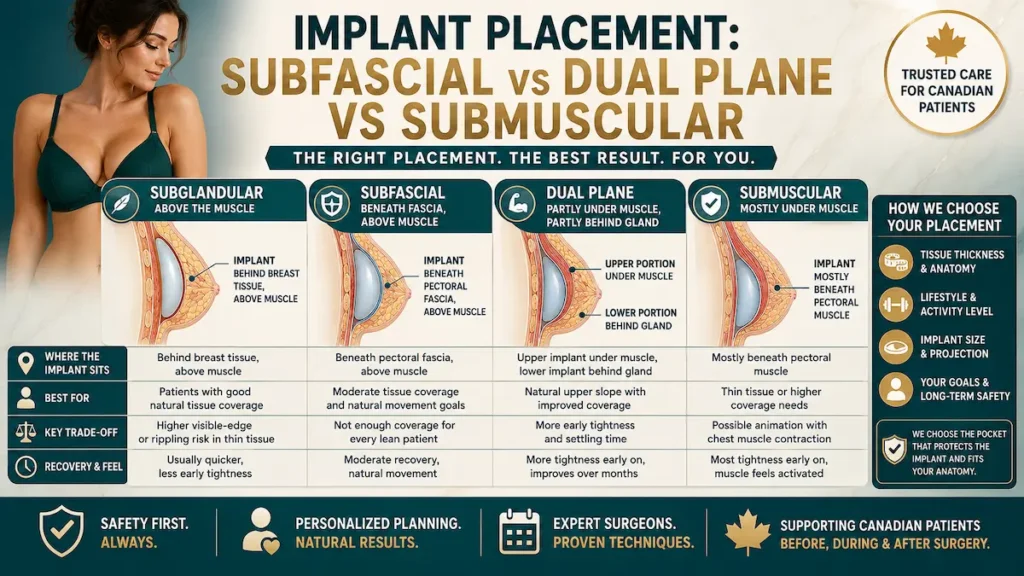
Implant placement affects the look, feel, recovery, and long-term stability of breast augmentation. The implant can sit above the chest muscle, beneath the pectoral fascia, partly under the muscle, or mostly under the muscle. Each position has trade-offs. We select the pocket based on tissue thickness, activity level, desired shape, implant size, and how much natural coverage the patient already has.
Canadian patients often arrive having read that dual plane breast augmentation is the modern standard. It can be an excellent choice, but it is not the only safe choice. Subfascial breast augmentation can also produce refined results in selected patients, especially when soft-tissue coverage and implant sizing are favourable.
Subglandular Placement: Above the Muscle
Subglandular placement positions the implant behind the breast tissue but above the pectoral muscle. Recovery can be quicker because the muscle is not lifted or stretched. This can be appealing for patients who want less early tightness.
The limitation is coverage. If the patient has thin breast tissue, the implant edge may become more visible. Rippling may also be more noticeable, especially with larger implants or very lean body types.
We usually reserve subglandular placement for patients with enough natural tissue coverage and a clear reason to avoid muscle involvement. It is not our default choice for every patient.
Subfascial Placement: A Refined Option for Selected Patients
Subfascial placement positions the implant beneath the thin fascial layer that covers the pectoral muscle, while keeping the implant above the muscle itself. This can provide a little more support and coverage than subglandular placement, without the same degree of muscle disruption as submuscular surgery.
Subfascial breast augmentation can be useful for patients with moderate tissue coverage who want a softer recovery profile and a natural breast movement pattern. It may also reduce animation deformity, which is the movement of the implant when the chest muscle contracts.
This placement is not ideal for every patient. Very thin patients may still need additional muscle coverage, while patients with significant sagging may need a lift rather than a different pocket. We decide after measuring tissue thickness, breast base width, and implant projection.
Dual Plane Breast Augmentation: Muscle Coverage Where It Matters
Dual plane breast augmentation places the upper portion of the implant under the pectoral muscle while allowing the lower portion to sit beneath the breast gland. This gives upper-pole coverage while allowing the lower breast to expand naturally.
Many patients benefit from this approach because it can reduce visible implant edges and create a smoother transition from chest wall to breast. It is especially useful when the patient has mild tissue thinness or wants a natural slope rather than a round upper-pole look.
Dual plane placement can involve more early tightness than subglandular or subfascial placement. The muscle needs time to relax. This is one reason patients see implant settling over several months rather than immediately after surgery.
Surgeon perspective: “Placement is not a trend decision. It is a coverage decision. We choose the pocket that protects the implant and fits the patient’s anatomy.”
Submuscular Placement: When Extra Coverage Is Needed
Submuscular placement positions the implant mostly under the pectoral muscle. This can provide strong soft-tissue coverage for lean patients, patients with very thin breast tissue, or patients at higher risk of visible implant edges.
The trade-off is recovery and movement. Submuscular placement may feel tighter in the early healing period. It may also create animation changes when the chest muscle contracts, especially in athletic patients who train their upper body heavily.
For some patients, this is still the safest and most aesthetic choice. We discuss the activity profile carefully, including gym routines, yoga, Pilates, weight training, and physically demanding work.
How We Choose Placement by Tissue, Lifestyle, and Implant Size
Implant placement is selected by combining measurements with patient priorities. A petite patient with thin tissue and a large implant request needs a different plan than a patient with moderate breast tissue and a modest volume goal. Tissue coverage matters more than cup-size language.
We also consider lifestyle. A patient who does frequent chest training may want to reduce the chance of animation deformity. A patient prioritizing the softest upper-pole transition may accept a slightly longer settling process with dual plane placement.
The safest placement is the one that balances appearance, coverage, recovery, and future revision risk. That balance is different for every patient.
| Placement | Where the Implant Sits | Best For | Key Trade-Off |
|---|---|---|---|
| Subglandular | Behind breast tissue, above muscle | Patients with good natural tissue coverage | Higher visible-edge or rippling risk in thin tissue |
| Subfascial | Beneath pectoral fascia, above muscle | Moderate tissue coverage and natural movement goals | Not enough coverage for every lean patient |
| Dual plane | Upper implant under muscle, lower implant behind gland | Natural upper slope with improved coverage | More early tightness and settling time |
| Submuscular | Mostly beneath pectoral muscle | Thin tissue or higher coverage needs | Possible animation with chest muscle contraction |
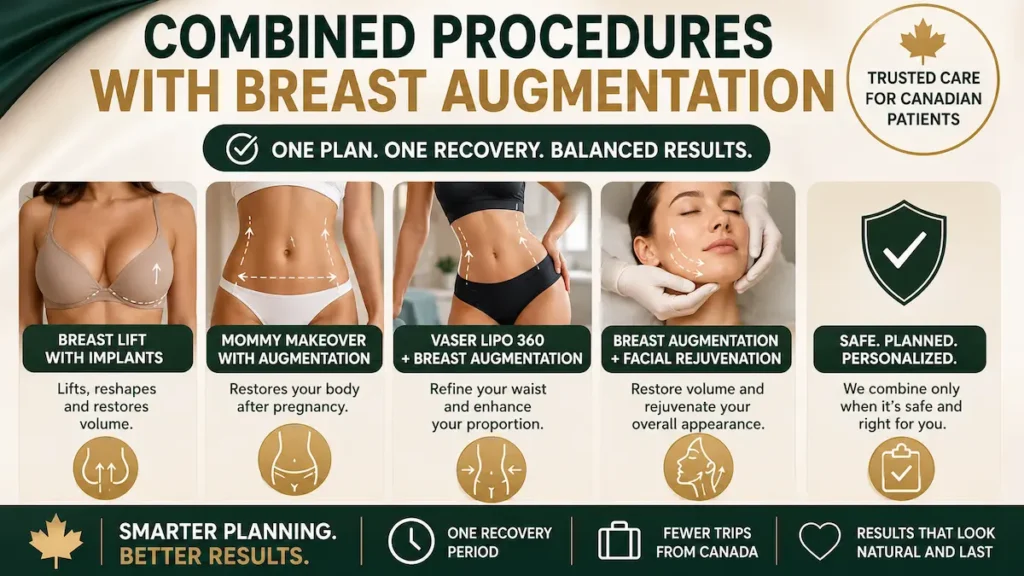
Combined Procedures with Breast Augmentation
Breast augmentation can be performed alone or combined with other procedures when the patient’s health, anatomy, and recovery plan allow it. Combining procedures can reduce the need for multiple anesthesia sessions and separate trips from Canada. It can also increase surgical time and recovery demands, so the decision must be made carefully. We recommend combination surgery only when the combined plan remains medically reasonable and the patient understands the added recovery responsibilities.
Breast Lift with Implants
Breast lift with implants is one of the most common combinations for patients who have both volume loss and breast sagging. The implant restores fullness, while the lift raises the nipple and reshapes the skin envelope. This is especially common after pregnancy, breastfeeding, or significant weight loss.
The trade-off is scarring. A lift may involve a scar around the areola, a vertical scar, or an anchor-shaped scar depending on the degree of sagging. For many patients, those scars are worth it because augmentation alone would not correct nipple position.
Patients comparing this option can review our breast lift and implants package. We also explain the surgical decision in more detail on our breast lift with implants treatment page.
Mommy Makeover with Breast Augmentation
A mommy makeover often includes breast augmentation, tummy tuck, liposuction, or breast lift depending on the patient’s postpartum changes. Breast augmentation restores upper-body volume, while the abdominal procedure addresses skin laxity, muscle separation, and C-section scar concerns.
This combination can be efficient for Canadian mothers who want one recovery period instead of several staged surgeries. It also requires planning. Patients need help with childcare, lifting restrictions, and household support after returning home.
We cover this pathway in our mommy makeover guide for Canadian patients. Patients should avoid choosing a large implant during a mommy makeover unless tissue quality and recovery capacity support it.
VASER Lipo 360 and Breast Augmentation
VASER Lipo 360 and breast augmentation can improve body proportion by refining the waist while restoring breast volume. This combination is popular with patients who want a stronger hourglass effect without a BBL.
VASER technology uses ultrasound energy to help emulsify fat before removal. This can support more precise contouring and may reduce tissue trauma compared with traditional liposuction in selected patients. The recovery includes both chest healing and compression garment discipline for the torso.
Patients interested in body contouring with implants can review the VASER Lipo 360 and breast augmentation package. During consultation, we explain whether the combined recovery is appropriate for the patient’s work, travel, and home support situation.
Breast Augmentation with Facial Rejuvenation
Some patients combine breast augmentation with facial rejuvenation, such as facelift, neck lift, or eyelid surgery. This is usually considered by patients who want broader aesthetic restoration in one trip from Canada.
Combination planning must respect total surgical time and recovery load. A breast augmentation alone has a different recovery profile than a breast augmentation combined with facial surgery. Bruising, swelling, sleep position, and movement restrictions can overlap.
For selected patients, a combined plan may be efficient. For others, staged surgery is safer and more comfortable. We make that recommendation based on health status, procedure length, and how much support the patient will have after returning home.
When Not to Combine Procedures
Combination surgery is not always the best option. We may recommend staging if the patient has higher anesthesia risk, limited recovery support, low pain tolerance, complex breast anatomy, or a procedure list that would make surgery too long.
We may also stage surgery when one result depends on another. For example, a patient with significant weight changes may benefit from body contouring before final breast sizing. A patient unsure about implant volume may prefer breast surgery alone before adding other procedures.
A responsible surgical plan should feel clear, not rushed. One trip can be efficient, but only when it remains medically sensible.
Anesthesia Options: General, Twilight, and Awake Breast Augmentation
Breast augmentation can be performed under different anesthesia models depending on implant placement, surgical complexity, patient health, and anxiety tolerance. Most full implant surgeries are performed under general anesthesia or a carefully monitored sedation protocol. Awake breast augmentation is possible for selected patients, but it requires the right anatomy, the right mindset, and a surgeon experienced in local-anesthesia breast surgery.
General Anesthesia: The Standard for Most Implant Cases
General anesthesia is commonly used for breast augmentation because it allows complete comfort, stable monitoring, and precise pocket creation. This is especially useful when the plan involves dual plane placement, submuscular placement, larger implants, or correction of asymmetry.
For Canadian patients travelling to Istanbul, anesthesia planning begins before arrival. We review medical history, medications, allergies, prior anesthesia experiences, smoking status, and any history of blood clots or heart rhythm issues. If a patient has a complex medical history, we may request family physician input before confirming surgery.
The goal is not simply to “put the patient to sleep.” The goal is controlled physiology, pain prevention, safe breathing, and smooth recovery. Our anesthesia and surgical teams coordinate the plan around the expected procedure length, implant pocket, and post-operative travel timeline.
Twilight Sedation and Local Tumescent Support
Some breast procedures can be performed with lighter sedation and local anesthetic support. Twilight sedation keeps the patient relaxed and comfortable, while local anesthetic reduces pain signals in the surgical field. This model may be useful for selected patients with smaller implant plans or limited revision work.
Twilight sedation is not the same as being fully awake. The patient is monitored throughout the procedure and may remember little or nothing afterward. It can reduce nausea and grogginess for some patients, but it is not appropriate for every implant placement.
We decide this carefully. A patient who needs extensive pocket adjustment, major asymmetry correction, or combined breast lift and augmentation may be safer under general anesthesia. Safety comes before convenience.
Awake Breast Augmentation: A Selective Alternative
Awake breast augmentation uses local anesthesia with carefully managed comfort protocols. It can reduce certain general anesthesia concerns and may allow faster early mobility. It is not a universal replacement for standard implant surgery.
The best candidates are calm, medically appropriate, and comfortable with the idea of being awake during the surgical process. Patients with high anxiety, complex anatomy, very large implant goals, or combined lift procedures may not be good awake candidates.
We cover this pathway in more detail on our dedicated awake breast augmentation page for Canadian patients. For the umbrella breast augmentation guide, the key point is simple: anesthesia should be selected around safety, anatomy, and surgical precision.
Anesthesia Selection by Placement Choice and Implant Size
Implant placement often influences anesthesia choice. Subglandular or subfascial placement may involve less muscle manipulation, while dual plane and submuscular placement require more tissue work. Larger implants can also create more pressure during pocket creation.
We also consider surgical combinations. A patient having breast augmentation alone has a different anesthesia profile than someone combining implants with VASER Lipo 360, a breast lift, or facial surgery. Longer combined procedures require more structured monitoring and recovery planning.
During consultation, we explain the recommended anesthesia model and why it fits the case. Canadian patients should ask direct questions, including:
- Who monitors anesthesia during surgery?
- Will I be intubated?
- How long is the planned procedure?
- How will nausea and pain be controlled?
- When will I be medically cleared to fly home?
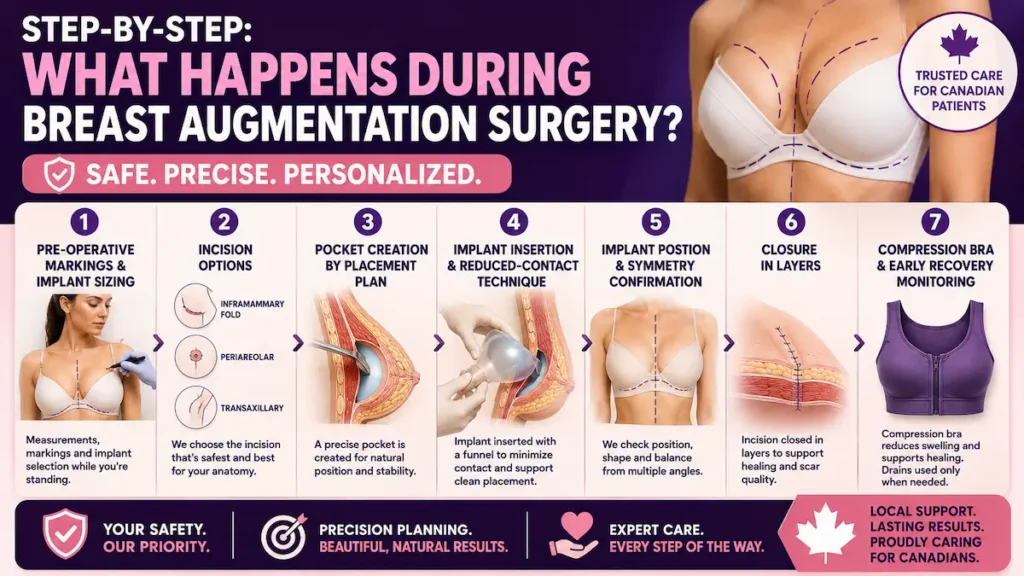
Step-by-Step: What Happens During Breast Augmentation Surgery?
Breast augmentation surgery follows a structured sequence: measurements, markings, anesthesia, incision, pocket creation, implant placement, closure, and early recovery monitoring. Each step affects the final breast shape, scar position, implant stability, and comfort during healing. We explain the process in advance so patients understand what is happening medically, not just cosmetically.
Pre-Operative Markings and Implant Sizing
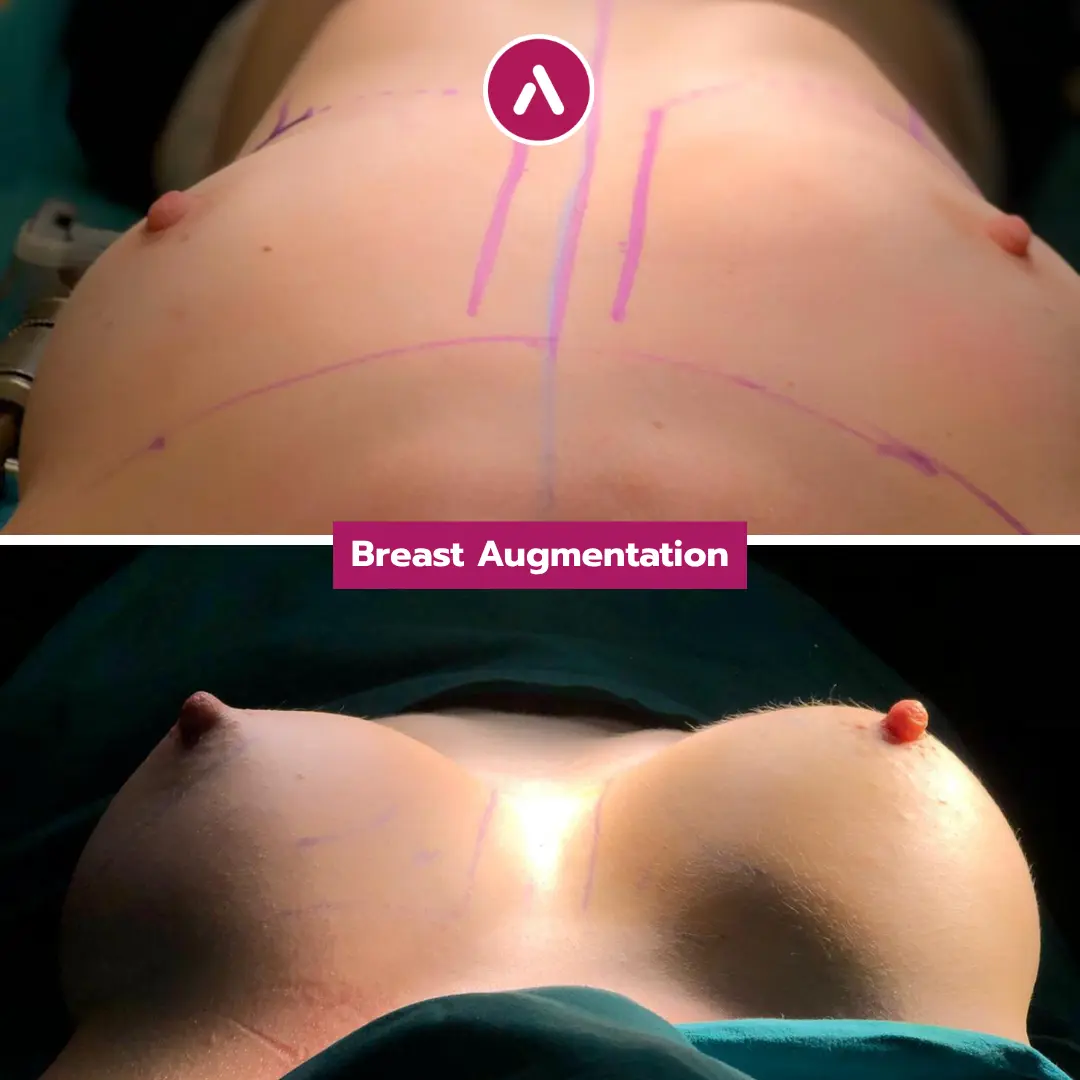
On surgery day, breast augmentation begins with standing measurements and surgical markings. These markings guide the incision, breast fold position, midline, implant pocket, and symmetry adjustments. Planning happens while the patient is upright because breast shape changes when lying down.
We confirm implant size, profile, and placement before anesthesia begins. This is the final checkpoint between the virtual plan and the in-person anatomical assessment. If the tissue behaves differently than expected, we explain the adjustment before proceeding.
Canadian patients often arrive with a preferred cup size in mind. We translate that preference into measurable implant choices: base width, projection, gel behaviour, and how the implant fits the chest wall. Cup size varies by bra brand, so it is not precise enough for surgical planning.
Incision Locations: Inframammary Fold, Periareolar, and Transaxillary
The incision determines where the scar sits and how the implant enters the pocket. The most common choice is the inframammary fold incision, placed in the natural crease under the breast. It gives the surgeon strong control over pocket creation and usually hides well once the breast settles.
A periareolar incision follows the lower edge of the areola. It can be discreet in selected patients, but it may not suit everyone, especially patients concerned about breastfeeding ducts, nipple sensitivity, or areolar scar contrast.
A transaxillary incision enters through the armpit. It keeps the scar off the breast, but implant placement control can be more limited in complex cases. We choose incision location based on safety, visibility, tissue quality, and whether a future revision might be needed.
Pocket Creation by Placement Plan
After the incision, the surgeon creates the implant pocket. This step determines where the implant will sit, how stable it will feel, and how naturally it will transition from the chest wall to the breast. Pocket precision is one of the main differences between a refined result and a result that looks too high, too wide, or too artificial.
In subfascial placement, the pocket is developed beneath the pectoral fascia. In dual plane breast augmentation, the upper pocket includes muscle coverage while the lower pocket allows the breast gland to expand. In submuscular placement, more muscle coverage is used for patients who need additional camouflage.
Bleeding control is handled throughout this stage. Careful tissue handling reduces bruising and helps the pocket remain clean and stable. This supports scar quality and lowers the chance of early implant displacement.
Implant Insertion and Reduced-Contact Technique
Once the pocket is ready, the implant is inserted using a reduced-contact method. Many surgeons use an insertion funnel to limit direct handling of the implant and reduce contact with skin bacteria. This step supports cleaner implant placement and may help reduce contamination risk.
We confirm the implant position from several angles before closure. The goal is balanced cleavage, appropriate lower-pole expansion, and symmetry that respects natural differences between the two sides. A perfect mirror image is not always anatomically possible.
If asymmetry correction is part of the plan, different implant sizes or pocket adjustments may be used. The decision is made to create visual balance, not to force identical measurements where the chest wall itself differs.
Surgeon perspective: “A breast implant should sit in a pocket designed for that patient. The implant does not create the plan; the anatomy creates the plan.”
Closure, Compression Bra, and Early Recovery Monitoring
After the implant position is confirmed, the incision is closed in layers to support scar quality and tissue stability. Dressings are applied, and the patient is fitted with a surgical compression bra. The bra helps control swelling and supports the implants while the pocket begins to heal.
Drains are not required for every breast augmentation. They may be used when combined procedures, revision work, or additional tissue dissection make fluid control useful. We explain this before surgery so patients know what to expect.
Early recovery monitoring includes blood pressure, oxygen level, pain control, nausea prevention, and incision checks. Before returning to the hotel, the patient receives medication instructions, sleeping-position guidance, and contact details for their 24/7 patient advocate.
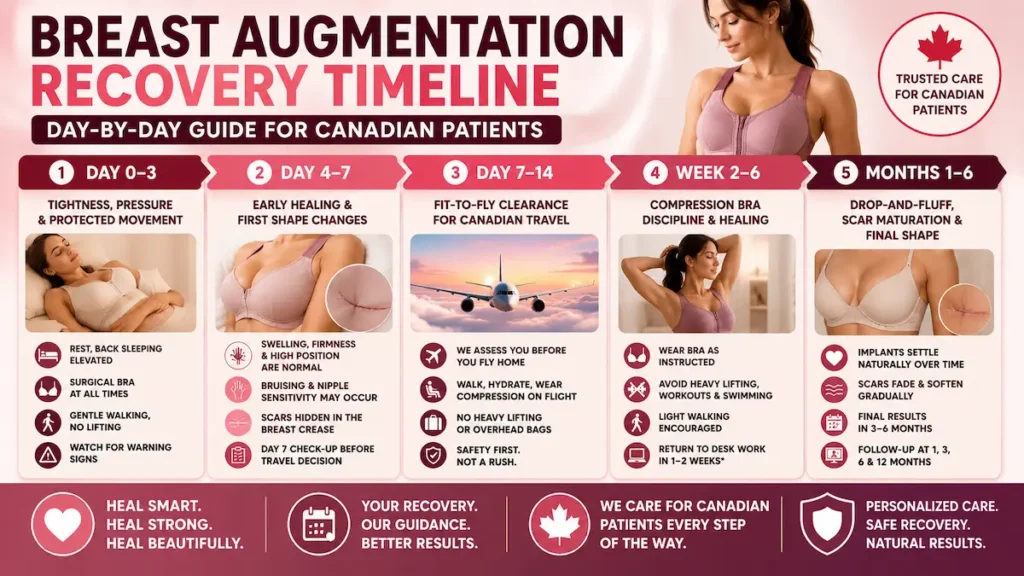
Breast Augmentation Recovery Time: Day-by-Day Timeline for Canadian Patients
Breast augmentation recovery is usually manageable when the patient follows movement restrictions, compression bra rules, and follow-up instructions. Most patients feel tightness, pressure, and upper-chest heaviness during the first week rather than sharp pain. The implants then settle gradually over several months. Canadian patients should plan recovery around both the Istanbul stay and the long return flight home.
Day 0–3: Tightness, Pressure, and Protected Movement
The first 72 hours are the most sensitive part of breast augmentation recovery. Patients usually describe pressure, tightness, and heaviness across the chest rather than sharp pain. This feeling is stronger when the implant is placed under or partly under the muscle.
During this phase, the goal is controlled movement. Gentle walking is encouraged to support circulation, but lifting, pushing, pulling, stretching the arms overhead, and sleeping on the stomach are avoided. Patients should sleep on their back with the upper body slightly elevated.
Your surgical bra must stay in place unless our team instructs otherwise. It helps reduce swelling, supports the pocket, and prevents unnecessary implant movement. Canadian patients returning to a long-haul flight should take this instruction seriously because stable early healing supports safer travel clearance.
We also monitor for warning signs such as one-sided swelling, unusual bleeding, fever, increasing redness, or severe pain that does not respond to medication. These symptoms are uncommon, but they should never be ignored.
Day 4–7: Early Healing and First Shape Changes
By days 4 to 7, many patients feel more mobile. The chest may still feel firm, swollen, and high. This is normal. Implants often sit higher in the early phase because the tissues have not relaxed yet.
Bruising can appear around the incision or lower breast. Some patients also feel temporary nipple sensitivity, numbness, or tingling. These sensations usually improve gradually as swelling decreases and nerve irritation settles.
This is also when patients start asking about boob job scars. Inframammary scars are usually placed within the breast crease, where they are hidden when standing. Early scars may look pink, raised, or firm, but they usually soften and fade over months with proper care.
For most Canadian patients, day 7 is an important checkpoint. We assess incision stability, swelling pattern, pain control, arm mobility, and whether the patient is on track for fit-to-fly clearance. Flying too early is not a badge of strength. It is a medical decision.
Our HBOT and LLLT Recovery Protocol
We use advanced recovery support to reduce inflammation, support tissue repair, and help international patients prepare for safe travel. Hyperbaric Oxygen Therapy, or HBOT, exposes the body to concentrated oxygen in a pressurized chamber. This helps oxygen reach healing tissue more efficiently.
Low-Level Laser Therapy, or LLLT, uses medical-grade 650nm laser diodes to stimulate cellular energy production. In practical terms, it supports bruising reduction, incision maturation, and soft-tissue recovery. It does not replace surgical skill or aftercare discipline, but it can support a smoother healing curve.
For breast augmentation patients, this matters because the surgery involves pocket creation, incision healing, and early tissue adaptation around the implant. Faster inflammation control can make the first week more comfortable and may help patients feel more stable before returning to Canada.
Patients who want to understand the technology behind this protocol can review our AKM Clinic technology and recovery standards. We explain how HBOT, LLLT, JCI-aligned clinical systems, and post-operative monitoring work together inside our international surgical programme.
Day 7–14: Fit-to-Fly Clearance for Canadian Return Travel
Most Canadian patients should plan to remain in Istanbul until we can assess their incisions, swelling, pain control, and mobility. The long flight home is not the same as a short domestic trip. A Toronto or Montreal return flight can take about 10 hours, and Vancouver or Calgary routes may involve longer total travel time with connections.
Before flight clearance, we check that the patient can walk comfortably, breathe deeply, manage pain with oral medication, and move their arms enough for safe travel. We also review warning signs that should prompt urgent contact during the trip home.
Compression is important during this stage. Patients continue wearing the surgical bra as instructed and avoid carrying heavy luggage, lifting overhead bags, or sleeping awkwardly on the plane. A travel companion can be helpful, but our patient advocates also prepare solo travellers with practical instructions before departure.
Cabin pressure does not damage breast implants. The bigger concern is swelling, fatigue, and circulation during a long-haul flight. We usually recommend gentle walking during the flight, hydration, and avoiding alcohol until the early recovery phase has passed.
Week 2–6: Compression Bra Discipline and Implant Settling
Weeks 2 to 6 are the discipline phase. Many patients feel well enough to do more, but the pocket is still healing. This is when overactivity can create unnecessary swelling, discomfort, or implant movement.
The compression bra should be worn exactly as instructed. It supports implant position, protects the incision, and helps control swelling. Underwire bras are usually avoided until the surgeon confirms that the incision and lower breast fold are stable.
Light daily walking is usually encouraged. Upper-body workouts, chest training, heavy lifting, swimming, saunas, and high-impact exercise are delayed. Patients with children should arrange help before travelling, especially if they have toddlers or young children who need lifting.
Canadian patients returning to desk work may feel ready within 7 to 14 days, depending on the procedure and pain level. Physically demanding work needs a longer restriction period. Nurses, teachers, servers, personal trainers, and health care workers should discuss job-specific timing during consultation.
Months 1–6: Drop-and-Fluff, Scar Maturation, and Final Shape
Breast augmentation recovery week by week continues beyond the first month. Early results often look high, firm, or fuller in the upper breast than expected. This is normal. The tissues need time to relax around the implant.
The phrase “drop and fluff” describes the gradual settling process. The implant descends into a more natural position, the lower breast softens, and the overall shape becomes less tight. This process is usually visible over 3 to 6 months.
Scars also mature slowly. A boob job scar may look pink or firm at first, then fade and soften over several months. Scar outcome depends on incision location, skin type, sun exposure, genetics, smoking status, and whether the patient follows scar-care instructions.
Final results should be judged only after swelling, pocket relaxation, and scar maturation have progressed. Early anxiety is common. This is why our long-term virtual follow-up programme includes check-ins at 1, 3, 6, and 12 months after surgery.
Safety and Risks of Breast Augmentation
Breast augmentation is a common elective procedure, but it is still surgery. Patients should understand the normal side effects, the uncommon complications, and the long-term responsibilities that come with implants. We discuss risk openly because informed patients make better choices. Canadian patients should also keep their family physician aware of implant details for future imaging, breast health screening, and long-term follow-up.
Common Short-Term Effects: Bruising, Numbness, and Temporary Asymmetry
Most breast augmentation side effects are temporary. Bruising, swelling, chest tightness, nipple sensitivity changes, and mild asymmetry are expected during early healing. One side may feel tighter or drop more slowly than the other.
Temporary numbness can occur around the nipple, lower breast, or incision. This usually improves as swelling settles and small sensory nerves recover. Some patients notice the opposite sensation: increased sensitivity or tingling.
Early asymmetry should be interpreted carefully. Implants do not settle at exactly the same pace on both sides, especially if the original breasts were uneven. We monitor progress through scheduled virtual follow-ups after the patient returns to Canada.
Capsular Contracture: Why the Implant Pocket Matters
Capsular contracture occurs when the natural scar tissue around an implant becomes unusually firm or tight. Every implant develops a capsule. The concern is when that capsule hardens, distorts the breast shape, or causes discomfort.
Surgeons often describe capsular contracture using grades. Grade I feels soft and looks natural. Grade II feels firmer but looks normal. Grade III looks visibly distorted. Grade IV is firm, distorted, and painful.
Risk reduction begins during surgery. Careful pocket creation, reduced-contact implant insertion, bleeding control, implant selection, and infection prevention all matter. After surgery, patients must follow bra use, activity restriction, and follow-up instructions.
Capsular contracture can sometimes require revision surgery. This is one reason we avoid oversizing implants and document implant details clearly for Canadian follow-up.
Implant Rupture: Silent vs Symptomatic Detection
Implant rupture means the implant shell has failed. With saline implants, rupture is usually obvious because the breast deflates as the saline is absorbed. With silicone breast implants, rupture can be silent because the cohesive gel may remain within the capsule.
Silent rupture is one reason long-term implant follow-up matters. Patients should keep their implant card, operative report, brand details, and lot number. These records help Canadian family physicians, radiologists, and future surgeons understand what was placed.
Symptoms that should be assessed include new breast firmness, shape change, swelling, pain, or a lump. These symptoms do not automatically mean rupture, but they should be evaluated rather than watched indefinitely.
The FDA breast implant patient information explains that implants are not lifetime devices and may require future monitoring, removal, or replacement. We discuss that reality before surgery, not after it.
The FDA advises patients to understand that some of the most serious implant complications are those that lead to further surgery, including rupture, capsular contracture, or breast implant-associated lymphoma diagnosis. We discuss that reality before surgery, not after it.
BIA-ALCL: What Canadian Patients Should Know
Breast implant-associated anaplastic large cell lymphoma, or BIA-ALCL, is a rare type of non-Hodgkin lymphoma that can develop in the capsule and fluid around a breast implant. It is not breast cancer of the breast tissue itself.
Canadian patients can review Health Canada’s breast implant cancer safety information before consultation, especially if they want to understand BIA-ALCL, late swelling, and implant-associated cancer warnings from an official Canadian source.
Health Canada has published patient-facing breast implant safety information on BIA-ALCL and other implant-associated cancers. Canadian patients considering implants should review official guidance before surgery and keep long-term records after surgery.
Surface texture matters. BIA-ALCL risk has been associated mainly with textured implants, especially certain macro-textured devices. Smooth implant surfaces are generally discussed as lower-risk in current patient education, although no implant should be described as risk-free.
At AKM Clinic, we favour modern implant selection, careful sourcing, implant documentation, and conservative planning. Patients receive implant details for their Canadian records. If future swelling, fluid collection, pain, or a new breast lump develops years later, the patient should contact a physician promptly.
Breast Implant Illness: Symptoms, Uncertainty, and Explant Reality
Breast Implant Illness, often called BII, is a term patients use to describe systemic symptoms they believe may be connected to breast implants. Reported symptoms can include fatigue, joint pain, brain fog, rashes, hair changes, headaches, and autoimmune-like complaints.
BII is complex. Some patients report improvement after implant removal, while others continue to have symptoms or later discover another medical cause. We do not dismiss these concerns, and we do not promise that implant removal will solve systemic symptoms.
The responsible approach is informed consent. Patients should understand that breast implants are medical devices, not lifetime devices, and that some patients may choose revision or explant surgery in the future. A clear pre-operative conversation helps patients make that decision with full awareness.
Patients with active autoimmune disease, unexplained systemic symptoms, or strong anxiety about implants may be better suited to delaying surgery, choosing fat transfer, or speaking with their Canadian physician before proceeding. We would rather pause a case than push a patient into a decision they are not comfortable maintaining long term.
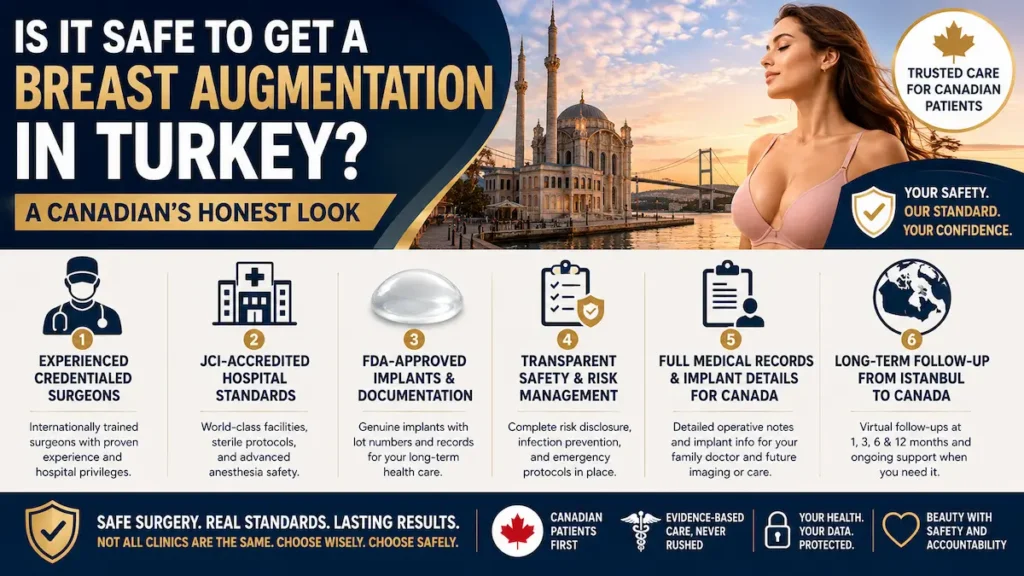
Is It Safe to Get a Breast Augmentation in Turkey? A Canadian’s Honest Look
Breast augmentation in Turkey can be safe when the clinic, surgeon, implant source, hospital facility, and follow-up system meet international standards. It can also be unsafe when patients choose high-volume providers that cannot document surgeon credentials, implant lot numbers, sterile protocols, or post-operative care. We make that distinction clearly because Canadian patients deserve a realistic discussion, not reassurance without evidence.
The Government of Canada’s guidance on medical care outside Canada advises travellers to verify provider credentials, understand follow-up limitations, and obtain medical records before returning home. We agree with that caution. Our role is to show exactly how we reduce those risks through credentialed surgeons, JCI-accredited hospital access, documented implant sourcing, and structured aftercare from Istanbul to Canada.
International Surgical Risk: What Breast Augmentation Patients Should Understand
Every breast augmentation carries risk, whether performed in Toronto, Vancouver, Montreal, Calgary, or Istanbul. The core risks include bleeding, infection, anesthesia reaction, scarring, changes in nipple sensation, capsular contracture, implant rupture, and the possibility of revision surgery.
The difference is not the country alone. The difference is the provider. A safe international surgical programme should show the same elements Canadian patients expect from a private clinic at home:
- Named surgeon accountability
- Hospital-grade sterile systems
- Clear anesthesia monitoring
- Approved implant sourcing
- Written operative records
- Long-term follow-up access
- Emergency escalation protocols
Patients should avoid any clinic that treats breast augmentation like a fast package sale. A legitimate surgical provider should be able to explain implant type, pocket placement, incision choice, sizing logic, and complication management before payment is finalized.
Why Top-Tier Turkish Clinics Differ from High-Volume Surgery Mills
Turkey is a major international surgical destination, but not every clinic operates at the same standard. High-volume surgery mills may rely on aggressive marketing, unclear surgeon assignment, rushed consultations, and limited aftercare. That model is not how we practise.
At AKM Clinic, breast augmentation is planned through a medical consultation process. We evaluate anatomy, tissue quality, health history, implant suitability, and travel-readiness before confirming surgery. We also provide clear records so Canadian patients know exactly what implant was used and how to manage future follow-up.
This documentation is important. If a patient later needs ultrasound, MRI, mammography discussion, revision consultation, or family physician review in Canada, implant details should not be vague. Patients should know their implant brand, size, profile, surface, and lot number.
We also discourage unsafe implant requests. If a requested size places too much strain on tissue, increases visible-edge risk, or makes long-term revision more likely, we explain why. A smaller, well-fitted implant is often the more responsible choice.
AKM’s Implant Sourcing, Hospital Standards, and Surgeon Credentialing
We use FDA-approved implant materials and document implant details for the patient’s long-term medical record. For Canadian patients, this documentation supports future conversations with family physicians, radiologists, and breast imaging providers.
Our surgeries are performed with access to JCI-accredited hospital systems, sterile operating protocols, and structured post-operative monitoring. This matters because breast implants are foreign-body medical devices. Infection prevention, tissue handling, and clean implant insertion are central to long-term safety.
Surgeon credentialing also matters. Canadian patients are familiar with RCPSC standards, provincial colleges, and specialist accountability. In Turkey, patients should verify international equivalency through European Board certification, hospital privileges, and documented surgical experience. Our credential framework is explained in detail on our AKM Clinic surgeon and standards page.
For patients who want a broader risk framework before choosing any international provider, our guide to plastic surgery safety in Turkey for Canadians explains how to assess accreditation, surgeon accountability, infection prevention, and follow-up continuity.
What Canadian Patients Should Verify Before Booking
Before choosing any clinic abroad, Canadian patients should verify the essentials in writing. A safe provider should not hesitate to share the surgeon’s credentials, hospital standards, implant brand, implant surface type, anesthesia plan, and follow-up process.
We recommend asking these questions before paying a deposit:
- Who is my named surgeon?
- Which implant brands do you use?
- Will I receive implant lot numbers and an implant card?
- Where will the surgery be performed?
- Who monitors anesthesia?
- What happens if I develop swelling, infection signs, or severe pain after returning to Canada?
- Will I receive an English operative report before departure?
The Government of Canada advises patients receiving care abroad to obtain medical records before returning home, because those records are needed for follow-up care and if complications occur later. We follow that principle closely. Patients leave Istanbul with written documentation they can share with their Canadian family physician.
Canadian patients should also understand travel insurance limitations before elective surgery. Many standard travel policies exclude planned cosmetic procedures or complications related to elective care. Patients should review coverage before departure and avoid assuming that provincial health plans or travel insurance will cover every post-operative issue abroad.
Medical Records, Implant Documentation, and Follow-Up in Canada
Breast augmentation does not end when the incision closes. It becomes part of the patient’s long-term health record. This is why implant documentation matters so much.
We provide patients with details that support future care, including implant brand, size, profile, placement, incision location, and lot information. These records help if a Canadian physician later orders ultrasound, mammography, MRI, or revision consultation.
Patients should keep a digital and printed copy of their records. They should also tell their Canadian family physician that they have implants, especially before breast imaging. Breast implants do not prevent screening, but imaging teams need to know they are present so they can use appropriate views and technique.
Our long-term virtual follow-up programme includes check-ins at 1, 3, 6, and 12 months. If a concern arises, the patient can contact our team and receive guidance on whether the issue can be monitored virtually or should be assessed locally in Canada.
Health Canada, FDA, and Implant Safety Expectations
Health Canada regulates breast implants as medical devices and monitors safety, effectiveness, and quality after licensing. Canadian patients are right to ask how implants used abroad compare with the standards they expect at home.
We use FDA-approved implant materials and document implant details for the patient. FDA approval is not the same as Health Canada licensing, but it gives patients a recognizable regulatory benchmark. We also discuss implant risks openly, including rupture, capsular contracture, reoperation, implant removal, BIA-ALCL, and the possibility that implants may need replacement in the future.
No ethical surgeon should describe breast implants as lifetime devices. Many patients keep implants for many years without concern, but others need revision earlier because of aesthetic change, pregnancy, weight fluctuation, rupture, capsular contracture, or personal preference.
Patients who want more information on official Canadian device oversight can review Health Canada’s breast implant information before consultation. We encourage this. A patient who understands both benefits and risks is better prepared to choose safely.
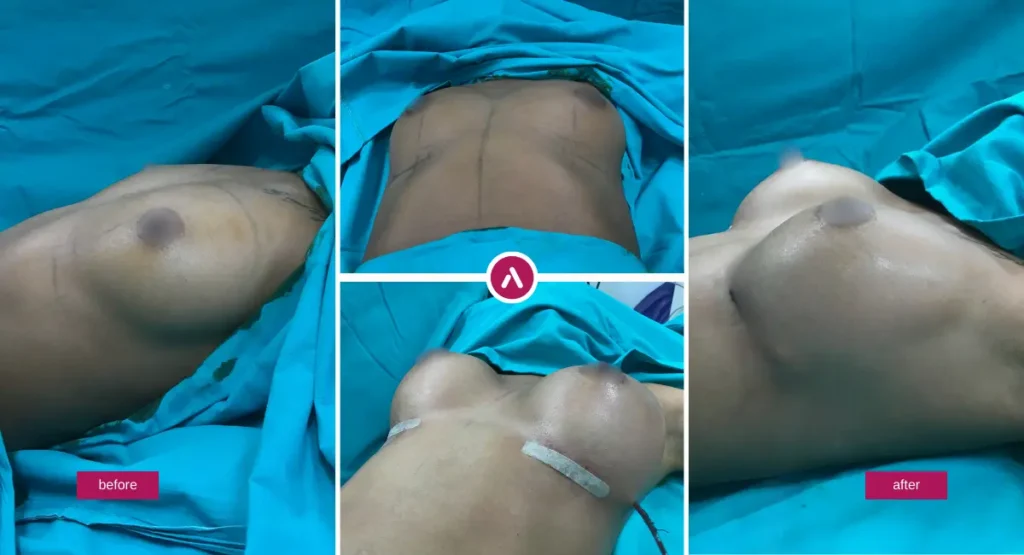
Realistic Expectations: Breast Augmentation Before and After Results
Breast augmentation results should be judged by proportion, softness, symmetry improvement, scar quality, and long-term comfort. A good result does not always mean the largest implant or the most dramatic before-and-after photo. It means the implant fits the patient’s body, respects tissue limits, and ages in a predictable way. We guide Canadian patients toward results that look refined in daily life, not only in a posed photo.
How Long Do Breast Implants Last?
Breast implants should not be described as lifetime devices. Many patients keep their implants for 10 to 15 years or longer, but some need earlier revision because of rupture, capsular contracture, pregnancy changes, weight fluctuation, implant malposition, or personal preference.
The right question is not only “how long do breast implants last?” It is also “how will I monitor them over time?” Patients should keep their implant card, operative report, and follow-up records in a safe place after returning to Canada.
Some patients choose revision because their aesthetic preference changes. Others need medical assessment because of firmness, asymmetry, swelling, pain, or imaging findings. Our breast implant revision guide explains when upsizing, downsizing, exchange, lift, or explant may be considered.
Long-term planning starts during the first surgery. Conservative sizing, clean pocket creation, appropriate placement, and clear documentation can reduce future uncertainty. No implant plan removes all future risk, but careful planning can reduce avoidable revision pressure.
Scar Profile by Incision Choice
Every breast augmentation creates a scar. The goal is to place that scar where it heals predictably and is easy to conceal. For most patients, the inframammary fold incision offers the best balance of access, pocket control, and scar placement.
An inframammary scar usually sits in the breast crease. Early scars may look pink, raised, or firm. Over time, they often soften and fade, although scar quality varies by genetics, skin tone, tension, sun exposure, smoking status, and aftercare.
Periareolar scars can blend into the border of the areola in selected patients, but pigment contrast and nipple sensation concerns must be discussed. Transaxillary scars avoid the breast surface, but they may limit control in some implant placements or future revision procedures.
Patients prone to keloids or hyperpigmentation should tell us during consultation. This is especially relevant for patients with deeper skin tones, including Black, South Asian, Middle Eastern, and mixed-heritage Canadians. For broader breast-surgery scar and representation concerns, our guide to breast surgery outcomes for Black women offers useful context.
Drop and Fluff: Why Early Results Are Not Final Results
Breast implants often look high, tight, or overly firm in the first weeks. This is not the final result. Swelling, muscle tightness, and skin tension all affect the early appearance.
As healing progresses, the implant settles into the pocket and the lower breast softens. Patients often call this “drop and fluff.” The breast looks less tense, the upper slope becomes more natural, and the lower pole rounds out gradually.
The timeline varies. Subglandular and subfascial implants may settle sooner, while dual plane or submuscular implants may need more time because the muscle must relax. Many patients see meaningful softening by 6 to 12 weeks, but final shape can continue changing for 6 months.
Canadian patients should avoid judging the result too early. A breast augmentation recovery week by week photo diary can help, but the most useful comparison is month 1 versus month 3 versus month 6. Early anxiety usually decreases when patients understand the normal settling curve.
Breast Augmentation Before and After Gallery
Before-and-after photos help patients understand implant size, shape, scar placement, symmetry correction, and body proportion. They are most useful when viewed critically. Look at the chest width, shoulder-to-hip balance, nipple position, and whether the implant looks proportional from the front and side.
Patients searching breast augmentation before and after, boob job before and after, or breast implants before and after should avoid comparing themselves to a single idealized image. A result that looks balanced on one person may not fit another patient’s ribcage, skin quality, or lifestyle.
Our breast augmentation before and after gallery is intended to support realistic planning. During consultation, we can discuss which examples are closer to your anatomy and which are not appropriate comparisons.
The strongest result is usually the one that looks believable. Our Natural-First approach prioritizes breast shape that feels integrated with the body rather than an implant that becomes the most visible feature.
Breast Augmentation Cost: Turkey vs Canada 2026
Breast augmentation cost varies by implant brand, implant placement, anesthesia model, hospital setting, and whether a lift or liposuction is added. Canadian patients comparing private clinic quotes in Toronto, Vancouver, Montreal, Calgary, or Edmonton often find that domestic pricing separates surgeon, anesthesia, facility, follow-up, and implant costs into different line items. Our pricing is structured to reduce that uncertainty.
Our all-inclusive breast augmentation programme is CAD $7,350, including the surgical procedure, anesthesia and hospital facility fees, pre-operative medical tests, 5-star hotel accommodation, VIP transfers, post-operative medications, support garments, and 24/7 patient advocacy. By comparison, Canadian private clinics commonly quote several thousand dollars more for the surgical fee alone, with the final total increasing once facility and follow-up charges are added.
| Location | Typical Patient Cost Context | What Patients Should Check |
|---|---|---|
| Toronto / GTA | Often among the highest Canadian private-clinic quotes | Whether implants, anesthesia, facility, and follow-up are included |
| Vancouver | Comparable to major urban private cosmetic surgery pricing | Implant brand, revision policy, and post-op visit costs |
| Montreal | Pricing varies widely by surgeon and facility model | Whether quoted fees include hospital or private surgical centre charges |
| Calgary / Edmonton | Private quotes may be lower than Toronto but still itemized | Travel, accommodation, and follow-up costs if leaving province |
| AKM Clinic, Istanbul | CAD $7,350 all-inclusive clinical pathway | CAD figures reflect the current 2026 exchange context and may vary over time. |
For the full Canadian dollar breakdown, including procedure variants and hidden-fee comparison, see our detailed breast augmentation cost guide for Canadian patients.
The most relevant package for Canadian patients is our all-inclusive breast augmentation package, which includes 4 nights at our 5-star partner hotel. Patients considering payment planning can also review our plastic surgery financing guide for Canadians before deciding whether international care fits their budget.
Provincial health plans such as OHIP, MSP, RAMQ, and AHCIP generally do not cover cosmetic breast augmentation. Coverage may be considered only in limited reconstructive circumstances, such as post-mastectomy reconstruction or congenital deformity correction. Patients should confirm directly with their provincial plan or Canadian physician.
How to Find the Best Breast Augmentation Surgeon in Turkey: A Canadian Patient’s Checklist
Many Canadian patients begin by searching for the best breast augmentation surgeon Toronto clinics offer, then compare those credentials with international options. That is a reasonable process. The key is to compare the right markers: surgeon training, implant documentation, hospital standards, breast surgery experience, and continuity of care after you return to Canada.
At AKM Clinic, we encourage patients to verify credentials before booking. A confident clinic should welcome informed questions. Breast augmentation is not only about choosing an implant size; it is about selecting a surgical team that understands tissue limits, implant safety, pocket planning, and long-term revision prevention.
EBOPRAS and RCPSC: Understanding Credential Equivalency
Canadian patients are familiar with RCPSC certification, provincial colleges, and specialist accountability. In Europe and Turkey, the credentialing language is different, so patients need a translation framework.
Canadian patients can compare international surgeon credential language with the Royal College of Physicians and Surgeons of Canada’s specialist certification framework, the national body associated with specialist certification in Canada. This helps patients understand how international board certification should be evaluated against the Canadian specialist standard they already recognize.
EBOPRAS certification indicates structured European board-level training in plastic, reconstructive, and aesthetic surgery. For Canadian patients, the practical comparison is RCPSC-style specialist verification: not identical systems, but both are formal frameworks for specialist training and professional standards.
Patients should not rely on vague labels such as “cosmetic doctor” or “aesthetic expert.” Ask for the surgeon’s medical specialty, board certification, hospital privileges, and procedure-specific breast surgery experience.
| Credential or Standard | What It Means | Canadian Comparison Point |
|---|---|---|
| EBOPRAS | European board-level plastic surgery certification | Comparable verification purpose to RCPSC specialist standards |
| EAFPS / international fellowship training | Advanced focused training in aesthetic or facial plastic surgery | Similar value to fellowship-level subspecialty exposure |
| JCI-accredited hospital access | External hospital quality and patient safety benchmark | Comparable expectation to regulated Canadian surgical facility standards |
| FDA-approved implant materials | Recognized medical-device safety benchmark | Relevant alongside Health Canada medical device expectations |
Breast Surgery Sub-Specialization Matters
A good breast augmentation surgeon should understand more than implant insertion. They should know when augmentation alone is appropriate, when a lift is necessary, when fat transfer is better, and when a patient should avoid implants entirely.
Ask to see examples that match your body type, not only the clinic’s most dramatic results. A petite patient with thin tissue needs different planning than a post-pregnancy patient with skin laxity. A patient with asymmetry needs different planning than someone with naturally even breast volume.
Experience also shows in restraint. A surgeon who says yes to every implant size is not protecting the patient. Safe breast augmentation often involves explaining why a smaller implant may look better and last longer.
Implant Brand Verification and Lot Number Disclosure
Implant documentation is non-negotiable. Before surgery, patients should know which implant brands the clinic uses. After surgery, they should receive records showing implant size, profile, placement, surface, and lot number.
This protects long-term care. If a patient needs breast imaging, revision surgery, or family physician review in Canada, vague implant information creates unnecessary uncertainty. Clear documentation supports continuity.
We provide implant records as part of our post-operative documentation. Patients should keep these records with their medical files and share them with their Canadian physician when relevant.
Volume of Surgery and Before-and-After Review
Procedure volume matters, but it should not be the only signal. A high number of surgeries is useful only when paired with consistent planning, safe facility standards, and transparent outcomes.
When reviewing before-and-after images, look for cases similar to your anatomy. Pay attention to implant position, side-view projection, scar placement, nipple balance, and whether the result looks proportional. Avoid judging only by cup-size increase.
Our team can guide patients through our professional plastic surgery reviews and procedure galleries so they can evaluate realistic outcomes before choosing an implant profile.
Aftercare Continuity from Istanbul to Canada
A strong surgeon checklist must include aftercare. Breast augmentation patients need support after they leave the operating room, after they leave Istanbul, and after they return to Canada.
We provide 24/7 patient advocacy during the Istanbul stay and structured virtual follow-up at 1, 3, 6, and 12 months. This helps patients manage normal healing questions and identify concerns that require local assessment.
Patients should avoid providers that disappear after discharge. For Canadian patients, distance makes aftercare planning essential. The best surgical plan includes the return-home plan from the beginning.
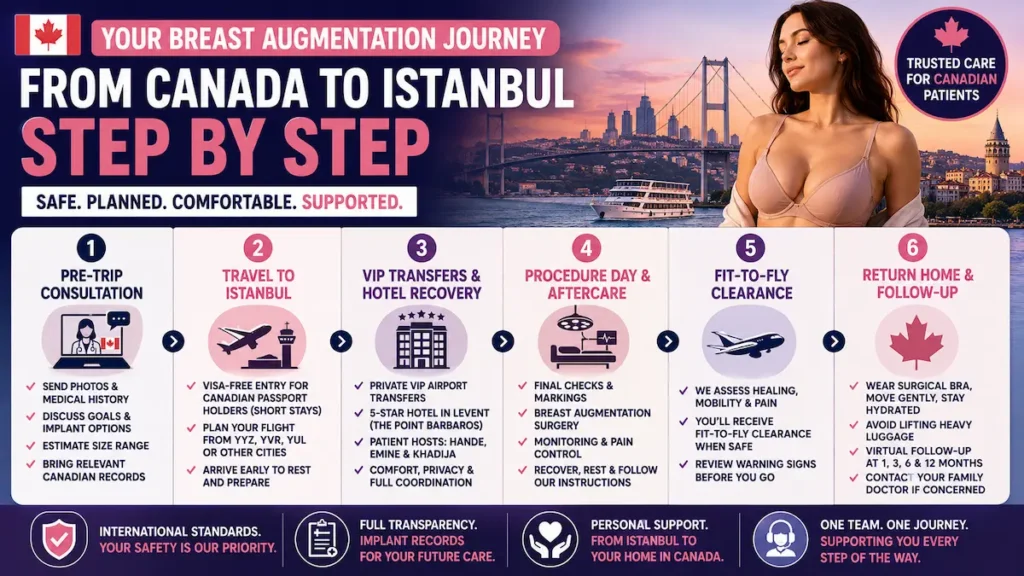
Your Breast Augmentation Journey from Canada: From YYZ to Istanbul, Step by Step
Travelling from Canada for breast augmentation requires more planning than booking a local consultation. The procedure itself is only one part of the experience. Patients also need flight timing, hotel recovery, airport transfers, fit-to-fly clearance, implant records, and follow-up access after returning home. Our clinical pathway is designed to reduce logistical stress so patients can focus on safe recovery.
Pre-Trip Consultation: Photos, Medical History, and Implant Sizing
The process begins with a virtual consultation. Canadian patients submit photos, medical history, medication lists, and breast surgery goals before travelling. We review anatomy, tissue quality, nipple position, asymmetry, and whether augmentation alone is appropriate.
Implant sizing begins during this stage, but it is not finalized from photos alone. We can estimate a safe range, discuss Motiva or Mentor implant options, and explain likely placement. Final sizing is confirmed after in-person measurements in Istanbul.
Patients should also prepare relevant Canadian medical information. This may include recent breast imaging, family physician notes, allergy history, prior anesthesia records, and any history of breast lumps, biopsy, or abnormal screening. Sharing this early helps us plan responsibly.
Flights from Canada, Visa-Free Entry, and Arrival Planning
Canadian passport holders can usually enter Turkey for short stays without a visa, but patients should confirm current entry requirements before booking. Passport validity should also be checked well in advance. Airlines may apply their own document rules.
Many patients travel through Toronto Pearson, Montreal-Trudeau, Vancouver, Calgary, or Ottawa. Direct routes may be available from some cities, while others require a connection. Flight schedules change, so patients should confirm timing with their airline before purchase.
We recommend arriving with enough time for in-person consultation, medical tests, and rest before surgery. A same-day arrival and surgery plan is not appropriate. Travel fatigue matters, especially before anesthesia and elective surgery.
VIP Transfers and 5-Star Hotel Recovery in Levent
After arrival in Istanbul, private VIP transfer is arranged between the airport, hotel, clinic, and hospital. Patients do not need to navigate taxis, language barriers, or unfamiliar neighbourhoods while preparing for surgery.
Our 5-star hotel partner, The Point Barbaros, is selected for comfort, privacy, and proximity to our Levent clinical location. This matters during early recovery because patients may feel tired, swollen, or restricted in arm movement after breast augmentation.
Patient hosts Hande, Emine, and Khadija coordinate practical needs throughout the stay. They help with appointment timing, transport, medication questions, and communication between the patient and clinical team.
Patients travelling alone should tell us in advance. Solo travel is possible for selected breast augmentation patients, but luggage handling, airport movement, and post-operative comfort need extra planning.
Procedure Day and Immediate Post-Operative Care
On procedure day, patients complete final checks, markings, anesthesia review, and consent confirmation. The surgeon reviews the implant plan once more, including size, placement, incision, and whether any adjustment is needed after in-person examination.
After surgery, patients are monitored for pain, nausea, bleeding, breathing, and early incision stability. Most patients wear a surgical bra immediately. Medication instructions and movement restrictions are reviewed before hotel return or hospital discharge.
The first night should be quiet. Patients should avoid unnecessary sightseeing, restaurant plans, or long walks. Breast augmentation recovery is usually manageable, but the first 24 hours should be treated as medical recovery time.
Fit-to-Fly Clearance and Return Travel Logistics
Before returning to Canada, we assess whether the patient is fit to fly. Clearance depends on incision stability, pain control, swelling, mobility, and absence of concerning symptoms. We also confirm that the patient understands warning signs after arrival home.
During the return flight, patients should keep the surgical bra on, avoid lifting luggage, walk gently during the flight, hydrate well, and avoid alcohol. A small pillow can help protect the chest from seatbelt pressure.
Patients should not place heavy carry-on bags in overhead bins. If travelling alone, they should request airport assistance or ask airline staff for help. Protecting the chest during this stage is more important than travelling quickly.
After arriving in Canada, patients continue virtual follow-up with our team. They should also contact their family physician if they develop fever, increasing redness, one-sided swelling, severe pain, shortness of breath, or any concern that needs physical assessment.
For broader logistics, our Canadian patient journey guide explains how consultation, travel coordination, hotel recovery, and long-term follow-up work across the full AKM Clinic pathway.
Frequently Asked Questions About Breast Augmentation in Turkey for Canadians
Canadian patients usually arrive with detailed questions about cost, safety, implants, breastfeeding, recovery, and follow-up after returning home. We answer these questions directly because breast augmentation is both an aesthetic decision and a long-term medical-device decision. These FAQs are not a substitute for consultation, but they help patients prepare better questions before speaking with our team.
How much does a boob job cost in Canada vs Turkey?
The cost difference can be significant. Canadian private clinics often quote separate fees for surgeon, anesthesia, facility, implants, and follow-up. At AKM Clinic, our all-inclusive breast augmentation programme is CAD $7,350, including surgery, 5-star hotel accommodation, VIP transfers, medications, support garments, and 24/7 patient advocacy.
Patients comparing how much is a boob job in Canada should ask whether the quote includes implant cost, facility fees, anesthesia, post-op bras, follow-up visits, and revision policy. A lower-looking quote may not be the final total.
Are breast implants permanent?
No. Breast implants should not be considered lifetime devices. Many patients keep their implants for 10 to 15 years or longer, but some need earlier revision because of rupture, capsular contracture, implant movement, pregnancy changes, weight fluctuation, or preference changes.
Patients should keep implant records and remain aware of long-term breast health. If new swelling, pain, firmness, lump, or breast shape change appears years later, it should be assessed by a physician.
Will I have visible scars after breast augmentation?
Yes, every surgical breast augmentation creates a scar. The goal is to place the scar where it heals well and is easy to conceal. The inframammary fold incision usually hides in the natural breast crease and gives strong pocket-control access.
Scar quality depends on genetics, skin tone, incision tension, sun exposure, smoking status, and aftercare. Early scars may look pink or firm. They usually soften over several months.
How long until I can return to work, lift my arms, and exercise?
Many desk-based patients return to light work within 7 to 14 days, depending on pain, swelling, and implant placement. Patients with physically demanding jobs may need longer. Lifting, pushing, pulling, chest workouts, swimming, and high-impact exercise are restricted until the surgeon clears them.
Arm movement should return gradually. Patients should avoid overhead lifting during early healing, especially while travelling back to Canada. Heavy carry-on luggage is not recommended.
Does OHIP, MSP, RAMQ, or AHCIP cover breast augmentation?
Provincial health plans generally do not cover cosmetic breast augmentation. Coverage may be considered only in limited reconstructive situations, such as post-mastectomy reconstruction, congenital deformity correction, or medically indicated reconstruction.
Patients should confirm directly with their provincial health plan or Canadian physician. Aesthetic enlargement for personal preference is usually private-pay.
What about “free breast implants in Canada”?
Searches for “free breast implants in Canada” usually refer to reconstructive coverage, not cosmetic augmentation. If breast reconstruction is medically indicated after cancer surgery, trauma, or certain congenital conditions, some provincial coverage may apply.
Cosmetic breast augmentation is different. It is not usually covered by provincial Medicare plans. Patients should be cautious with online claims that suggest free cosmetic implants without clear medical criteria.
How much does a boob job cost in Toronto vs Vancouver vs Istanbul?
Toronto and Vancouver private-clinic pricing can vary by surgeon, implant brand, facility model, and follow-up structure. Patients should compare the full invoice, not only the surgeon’s fee. Implant cost, anesthesia, facility fees, surgical bras, medications, and post-op visits may be billed separately.
At AKM Clinic, the all-inclusive breast augmentation programme is CAD $7,350.
Can I breastfeed after breast augmentation?
Many patients can breastfeed after breast augmentation, but no surgeon can guarantee future breastfeeding ability. Incision location, implant placement, original breast anatomy, and individual milk production all matter.
Patients who strongly prioritize future breastfeeding should discuss this during consultation. In many cases, inframammary incisions may be preferred because they avoid cutting through the areolar border, but the best choice depends on anatomy.
What is the difference between teardrop and round implants?
Teardrop implants are shaped to create more lower-pole fullness and a softer upper slope. Round implants provide more uniform fullness. Both can look natural when selected correctly.
The final result depends on more than shape. Implant size, projection, tissue coverage, pocket placement, and whether a lift is needed all influence the breast contour.
Is fat transfer better than implants for natural results?
Fat transfer can be more natural in feel because it uses the patient’s own tissue. It is best for subtle enhancement and mild contour improvement. It cannot usually create the same predictable size increase as implants.
Implants are more reliable for patients seeking a clear cup-size change, stronger projection, or upper-pole fullness. Some patients benefit from composite planning, where implants provide structure and fat transfer softens selected edges.
What is BIA-ALCL, and should I worry about it?
BIA-ALCL is a rare lymphoma associated with the capsule or fluid around a breast implant. It is not breast cancer of the breast tissue itself. The risk has been linked more strongly with textured implants, especially certain macro-textured devices.
Patients should be informed, but not panicked. Ask what implant surface is being used, keep implant records, and contact a physician if late swelling, fluid, pain, or a new lump appears years after surgery.
Is awake breast augmentation safer than general anesthesia?
Awake breast augmentation can reduce some general anesthesia-related concerns for selected patients. It may support faster early mobility and less grogginess. That does not make it automatically safer for every case.
Patients with anxiety, complex anatomy, large implant goals, or combined lift surgery may be better served by general anesthesia. The safest anesthesia is the one that fits the patient’s medical profile and surgical plan.
How do I start the consultation process from Canada?
The first step is a virtual consultation. Patients share photos, medical history, surgery goals, and any prior breast imaging or implant records. We then assess whether breast augmentation, fat transfer, lift with implants, or another option best fits the anatomy.
Our team provides a clear clinical recommendation, estimated implant range, travel timeline, and transparent CAD-first pricing before the patient books. You can begin through our Canadian consultation request page.
Medical Disclaimer: This content is for educational purposes only and does not replace advice from a licensed medical professional. We encourage all prospective patients to consult with their family physician or a Canadian general practitioner before pursuing any elective surgical procedure abroad. Breast implants are medical devices and may require future monitoring, revision, or removal. Content reviewed by the AKM Medical Board.