




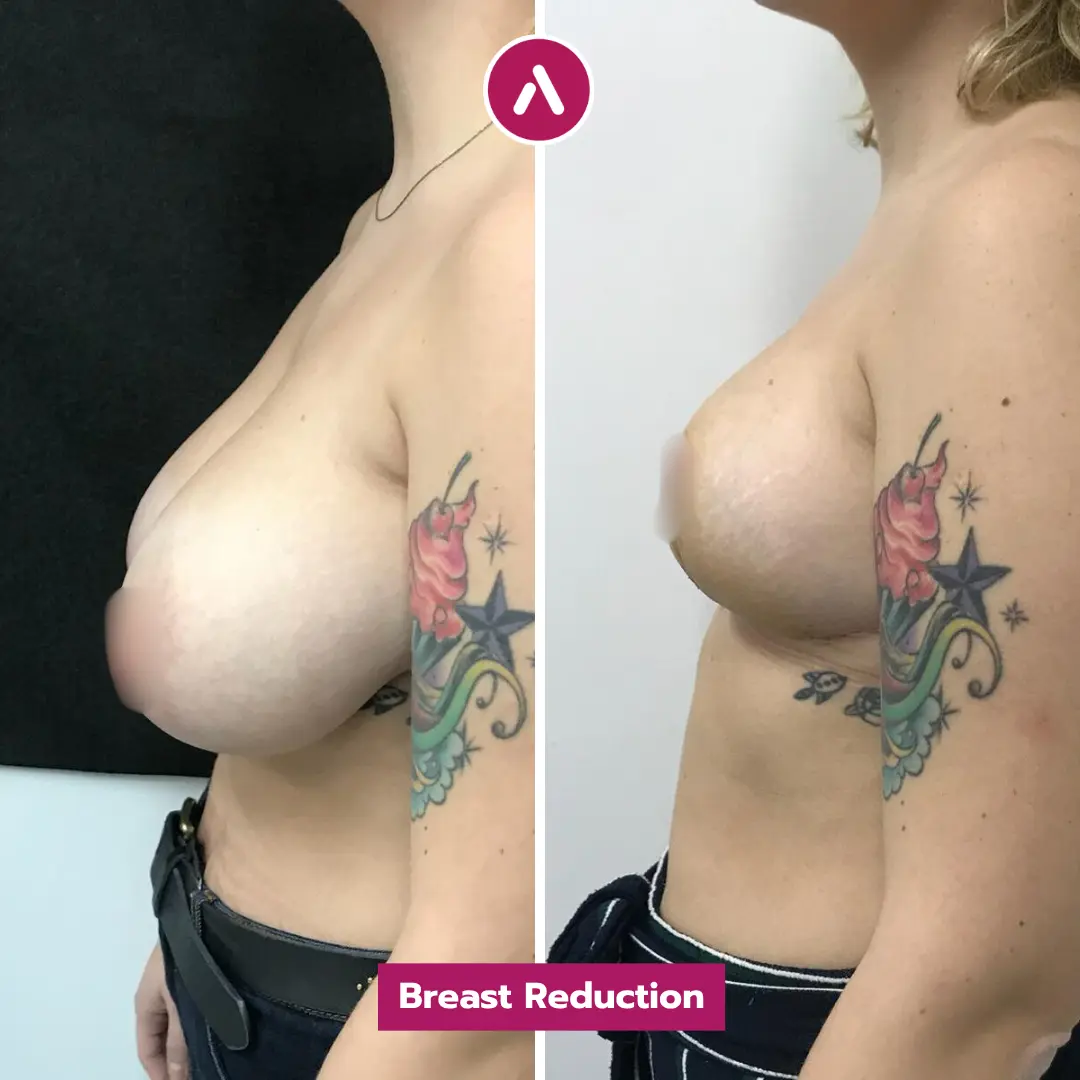
Canadian women considering breast reduction often face a difficult choice. Provincial coverage may be available only when strict medical criteria are met, while private clinics in Ontario, Alberta, and British Columbia can involve high out-of-pocket costs and long scheduling delays. For patients who live with daily back pain, shoulder grooving, skin irritation, or difficulty exercising, waiting years for relief can feel unreasonable.
This guide explains how breast reduction surgery works, who may be a good candidate, how anchor, lollipop, and liposuction-assisted techniques differ, and what Canadian patients should know before choosing surgery abroad. Our goal is to help you make a careful, medically informed decision before travelling to Istanbul.
Table of Contents
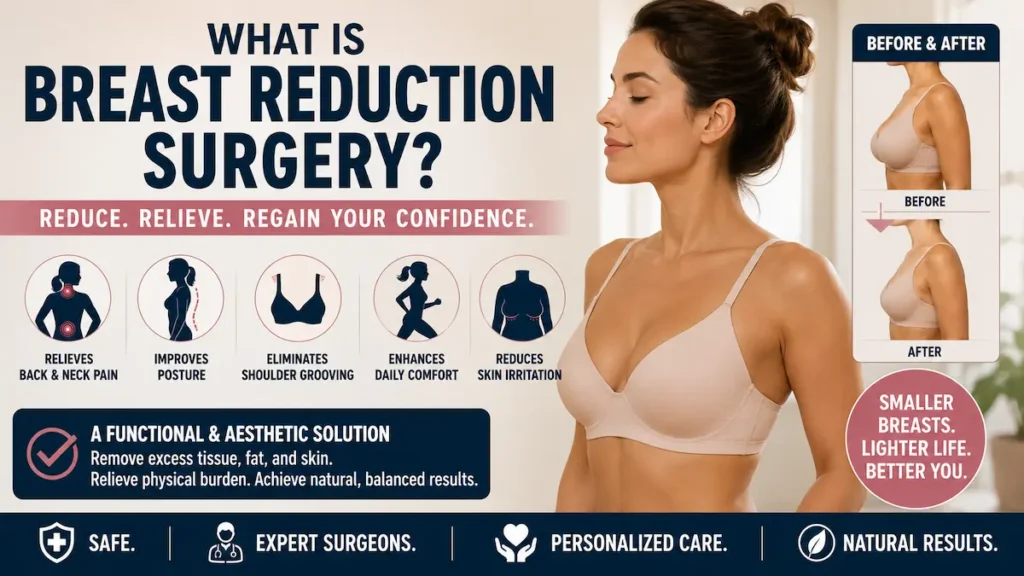
What Is Breast Reduction Surgery? (Reduction Mammoplasty Explained)
Breast reduction surgery, also called reduction mammoplasty, removes excess breast tissue, fat, and skin to reduce breast size and weight. The procedure can relieve macromastia symptoms such as chronic back pain, neck pain, shoulder grooving, posture strain, and skin irritation. It can also reshape the breast and reposition the nipple-areola complex for a more balanced appearance.
At AKM Clinic, we approach breast reduction as both a functional and aesthetic procedure. The goal is not only to make the breasts smaller. The goal is to reduce physical burden while creating a natural breast shape that fits the patient’s frame, lifestyle, and long-term expectations.
How Breast Reduction Works: Tissue, Fat, Skin Removal and Nipple-Areola Repositioning
During breast reduction surgery, our surgeons remove a tailored amount of glandular breast tissue, fat, and stretched skin. The amount removed depends on your symptoms, breast size, skin quality, chest width, and desired final proportion. Most patients need both volume reduction and reshaping.
The nipple-areola complex is usually moved to a higher, more youthful position while remaining attached to a living tissue pedicle. This pedicle preserves blood supply and supports sensation whenever possible. In very large reductions, a free nipple graft may be considered, but this is reserved for selected cases because it changes sensation and breastfeeding expectations.
Reduction Mammoplasty Medical Terminology
You may see breast reduction described as “reduction mammoplasty” in medical documents. “Mammoplasty” refers to breast reshaping, while “reduction” refers to lowering breast volume and weight. The procedure is different from a breast lift, although the two can overlap.
A breast lift mainly treats sagging and nipple position. A breast reduction treats heaviness first. Because reducing breast volume also requires reshaping the skin envelope, most reduction procedures include a lifting effect as part of the surgery.
How Modern Breast Reduction Evolved: Pedicle Techniques and Liposuction Integration
Modern breast reduction is built around pedicle techniques. A pedicle is the tissue bridge that keeps the nipple-areola complex connected to blood vessels and nerves while the breast is reshaped. Common options include superior, inferior, and medial pedicles.
Liposuction may also be used when the breast has a significant fatty component or when side-chest fullness needs refinement. It is not a replacement for tissue removal in patients with dense glandular breasts, but it can improve contour and reduce the need for longer incisions in selected cases.
Benefits of Breast Reduction: Medical and Aesthetic
Breast reduction is one of the few aesthetic procedures where the functional benefits can be as important as the visual change. Many patients seek surgery after years of adapting their posture, clothing, exercise, and daily routines around breast weight. Relief can feel practical before it feels cosmetic.
For Canadian patients, this distinction matters. Some provincial plans may consider reduction mammoplasty when symptoms are documented and medical criteria are met. Patients who do not qualify still may have legitimate pain, mobility, or quality-of-life concerns.
Macromastia Symptom Relief: Back, Neck, and Shoulder Pain
Large, heavy breasts can place constant strain on the upper back, neck, shoulders, and chest wall. This can lead to muscle fatigue, tension headaches, shoulder grooves from bra straps, and posture changes. Some patients also report numbness or tingling from chronic pressure.
Breast reduction reduces the physical load. For many patients, this is the main benefit. The procedure can make standing, walking, desk work, and sleep more comfortable because the upper body no longer has to compensate for excess breast weight.
Posture, Spinal Load, and Daily Comfort
Macromastia can pull the shoulders forward and encourage a rounded upper-back posture. Over time, that compensation can become a habit. Surgery does not replace physiotherapy or posture work, but it can remove the weight that makes those efforts difficult.
Daily comfort often improves in simple ways: easier bra fitting, less skin-on-skin friction, fewer pressure marks, and less pain after long workdays. These small improvements matter. They affect how you move through ordinary life.
Exercise, Clothing, and Lifestyle Improvements
Many patients describe avoiding running, gym classes, swimming, or fitted clothing because breast size makes movement uncomfortable or self-conscious. Breast reduction can make activity easier by reducing bounce, pulling, and chest heaviness.
The aesthetic benefit is also real. The breasts can look more proportional to the shoulders, waist, and hips. Our Natural-First approach focuses on balance rather than overcorrection, so the final size should support comfort while still fitting your body naturally.
Bra Strap Grooving, Skin Irritation, and Intertrigo
Heavy breasts can create deep strap marks on the shoulders. They can also cause moisture, friction, and rashes beneath the breast fold. Some patients develop recurring irritation, especially during warm weather, exercise, or long workdays.
Reduction mammoplasty can reduce this cycle by lowering breast weight and improving breast position. It may also make supportive bras easier to wear, which reduces pressure on the shoulders and upper back.
Identity Restoration After Pregnancy, Weight Change, or Long-Term Discomfort
Many patients do not want to look dramatically different. They want their body to feel manageable again. This is common after pregnancy, breastfeeding, weight fluctuation, or years of living with large breasts that feel out of proportion.
Our philosophy is “Rejuvenation, not alteration.” In breast reduction, that means choosing a size and shape that reduces discomfort while still feeling like you.
Am I a Good Candidate for Breast Reduction?
A good breast reduction candidate has symptoms, anatomy, and expectations that match what the procedure can safely achieve. Breast size alone does not determine candidacy. We also assess breast density, skin quality, nipple position, weight stability, medical history, and whether future pregnancy or breastfeeding is part of your plan.
For Canadian patients, candidacy often includes one extra layer: whether provincial coverage may apply. Some patients qualify through OHIP, MSP, AHCIP, RAMQ, or another provincial plan. Others have real symptoms but do not meet strict criteria, which is why they begin comparing private surgery in Canada with an international surgical programme in Istanbul.
“The strongest breast reduction candidate is not simply the patient with the largest breasts. It is the patient whose symptoms, anatomy, health status, and expectations all point toward safe, meaningful relief.”
Macromastia Symptom Profile and Documented Pain Patterns
Macromastia means the breasts are disproportionately large or heavy for the body frame. Common symptoms include upper back pain, neck tension, shoulder grooving, rashes beneath the breasts, difficulty exercising, and trouble finding supportive bras. These symptoms often build slowly.
Documentation matters. Canadian patients who hope to qualify for provincial coverage often need a family physician record showing persistent symptoms, conservative treatment attempts, and functional limitations. Even when you choose private surgery, this history helps our surgeons understand your medical need and plan the reduction responsibly.
Breast Reduction Size Chart: Setting Realistic Cup-Size Expectations
Patients often ask for a specific cup size. We understand why. Bra sizing feels familiar, but it is not a surgical measurement. A D cup in one brand can fit like a C or DD in another, and cup size changes with band size.
During consultation, we focus on proportion and symptom relief instead of promising a fixed cup size. Your surgeon estimates how much tissue can be removed while preserving breast shape, nipple position, blood supply, and long-term symmetry.
| Starting Situation | Common Goal | Surgical Planning Priority |
|---|---|---|
| Heavy D to DD range | Moderate reduction | Relief with natural upper-pole shape |
| Large E to G range | More significant reduction | Anchor or vertical pattern selection |
| Very large, pendulous breasts | Major weight relief | Nipple blood supply and scar planning |
BMI, Weight Stability, and Surgical Readiness
Weight stability is important. Major weight loss after surgery can change breast shape, loosen the skin envelope, and reduce long-term predictability. A stable weight for several months gives the surgeon a clearer baseline.
BMI is also part of surgical risk assessment. Higher BMI can increase the risk of wound healing delays, anesthesia concerns, and infection. We do not use one number alone to approve or reject a patient, but we do assess overall health, mobility, smoking status, and blood test results before surgery.
Breastfeeding Plans and Future Pregnancy Considerations
Breast reduction may affect breastfeeding. Some patients can breastfeed after surgery, while others produce less milk or cannot breastfeed fully. The risk depends on the technique used, how much tissue is removed, and how the nipple-areola complex is preserved.
If you plan to become pregnant soon, it may be better to delay surgery. Pregnancy and breastfeeding can stretch breast tissue again, change volume, and affect nipple position. Patients who are finished having children often get the most predictable long-term result.
When Breast Reduction Is Not Recommended
Breast reduction may not be appropriate if you have active breast disease, uncontrolled diabetes, significant clotting risk, severe anemia, poor wound healing history, or current nicotine use. Smoking and vaping are especially important because they reduce blood flow to healing tissues.
We may also recommend delaying surgery if expectations are not aligned. Breast reduction can reduce weight, improve proportion, and relieve many symptoms. It cannot create exact cup-size symmetry, erase all scars, or prevent future breast changes from ageing, pregnancy, or weight fluctuation.
Adolescent, Post-Pregnancy, and Post-Menopausal Candidacy Differences
Younger patients may seek breast reduction after years of physical discomfort or social distress. In these cases, breast development must be stable, and the emotional decision should be carefully supported. We take extra care with counselling and long-term expectations.
Post-pregnancy patients often want relief after breast enlargement, stretching, and heaviness from motherhood. Post-menopausal patients may seek reduction after weight change, hormonal shifts, or worsening shoulder and neck pain. Each group can be a good candidate, but the surgical plan differs.
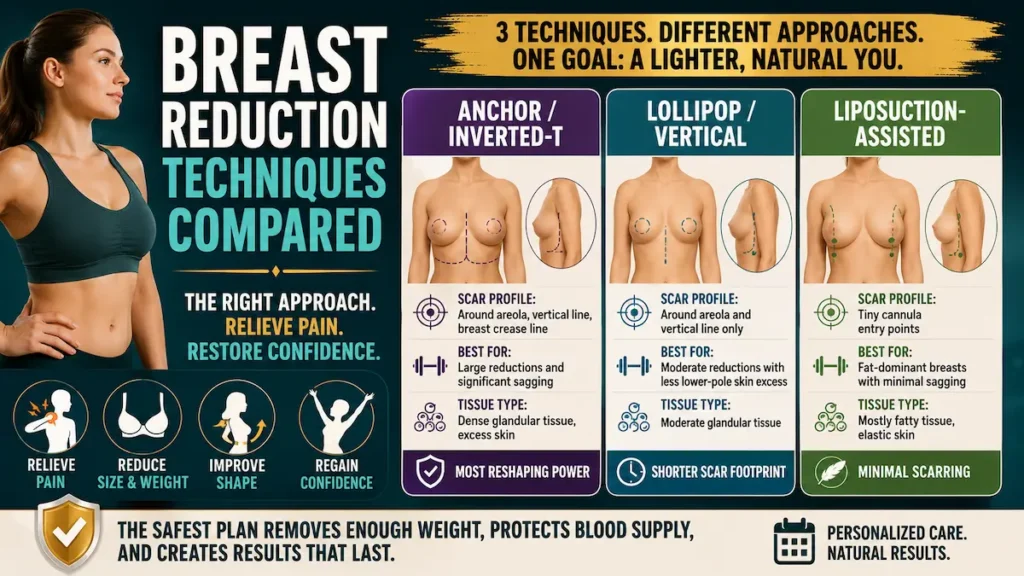
Breast Reduction Techniques and Incision Patterns Compared
Breast reduction is not one single technique. The right approach depends on breast volume, skin excess, nipple position, breast density, and how much tissue must be removed to relieve symptoms. A patient with moderate heaviness may need a different incision pattern than someone with severe macromastia and significant skin stretching.
Our surgeons choose the technique after reviewing photos, symptoms, breast measurements, and your desired final proportion. The goal is safe tissue removal, stable nipple blood supply, controlled scarring, and a breast shape that looks natural on your frame.
The Three-Pattern Decision Framework
Most breast reductions use one of three broad patterns: anchor, lollipop, or liposuction-assisted. Each pattern has a different scar profile and different ability to reshape the breast. The more skin and glandular tissue that must be removed, the more structural control the surgeon needs.
There is no best scar pattern for every patient. A smaller scar is only an advantage if it can safely achieve the needed reduction. Choosing too limited a pattern for a large reduction can create poor shape, persistent heaviness, or widened scars from excessive tension.
| Technique | Scar Profile | Best For | Tissue Type | Recovery Notes | AKM Offers |
|---|---|---|---|---|---|
| Anchor / Inverted-T | Around areola, vertical line, breast crease line | Large reductions and significant sagging | Dense glandular tissue, excess skin | Most reshaping power, longer scar care period | Yes |
| Lollipop / Vertical | Around areola and vertical line only | Moderate reductions with less lower-pole skin excess | Moderate glandular tissue | Shorter scar footprint, needs good skin quality | Yes |
| Liposuction-Assisted | Tiny cannula entry points | Fat-dominant breasts with minimal sagging | Mostly fatty tissue, elastic skin | Less skin removal, limited lifting effect | Yes, for selected patients |
“The safest breast reduction plan is not the one with the shortest scar. It is the one that removes enough weight, protects the nipple blood supply, and creates a breast shape that will hold over time.”
Anchor, or Inverted-T, Breast Reduction for Larger Reductions
The anchor pattern is often used for larger reductions. It includes an incision around the areola, a vertical line down the lower breast, and a horizontal line hidden in the breast crease. This gives the surgeon the most control over tissue removal and skin tightening.
Anchor breast reduction is especially useful when the breasts are heavy, pendulous, or significantly stretched. The trade-off is a longer scar pattern. For many patients, this trade-off is worthwhile because it gives the best chance of meaningful symptom relief and stable reshaping.
Lollipop, or Vertical, Breast Reduction for Moderate Reductions
The lollipop pattern uses an incision around the areola and a vertical line down the lower breast. It avoids the horizontal breast-crease scar used in the anchor pattern. This can make it appealing to patients who need moderate reduction and have good skin elasticity.
This technique works best when the surgeon does not need to remove a large amount of lower-pole skin. If the breast is very heavy or the nipple sits very low, a lollipop pattern may not provide enough control. In that case, an anchor pattern may be safer and more predictable.
Liposuction-Assisted Breast Reduction for Fat-Dominant Breasts
Liposuction-assisted breast reduction removes excess fatty tissue through small cannula entry points. It does not remove large amounts of skin, and it does not reposition the nipple in the same way as anchor or lollipop surgery. For that reason, it is only suitable for selected patients.
This option may fit patients with fatty breast composition, minimal sagging, and good skin contraction. It is not ideal for dense glandular breasts, severe macromastia, or patients who need nipple lifting. We assess breast composition carefully before recommending it.
Bilateral Breast Reduction: Why Both Breasts Are Treated Together
Most breast reductions are bilateral, meaning both breasts are treated in the same operation. Even if one breast is larger, both sides usually need reshaping to create better symmetry. The surgeon may remove different amounts from each side.
This is also why breast reduction requires careful markings before surgery. Standing breast position differs from lying-down position. Pre-operative markings help guide nipple placement, incision planning, and tissue removal while the patient is under anesthesia.
Breast Reduction and Lift: Where Reduction Ends and Mastopexy Begins
Breast reduction and breast lift overlap, but they are not identical. A breast lift mainly raises and reshapes sagging breasts without removing significant volume. A breast reduction removes weight first, then reshapes the breast.
Most reductions include a lifting effect because the nipple-areola complex is repositioned and excess skin is removed. Patients who have sagging without heaviness may be better suited to mastopexy. Patients with pain, shoulder grooving, and excess volume usually need reduction.
Breast Lift vs Breast Reduction: Which Procedure Fits Which Patient?
If your main concern is drooping but your breast volume feels comfortable, a breast lift may be enough. If your breasts feel heavy, painful, or out of proportion, reduction is usually the more appropriate option. Some patients need both principles in one procedure.
The distinction matters for Canadian patients comparing private quotes. A lift and a reduction may look similar on a clinic menu, but the surgical planning is different. A breast lift with implants adds volume, while breast reduction removes volume and weight. Breast augmentation and fat transfer breast augmentation are opposite-direction procedures and should not be confused with reduction mammoplasty.
Superior, Inferior, and Free Nipple Graft Techniques
Pedicle choice describes how the nipple-areola complex remains attached to blood supply while the breast is reshaped. A superior pedicle keeps the main tissue bridge above the nipple. An inferior pedicle keeps it below. The best choice depends on breast anatomy and reduction volume.
In rare major reductions, a free nipple graft may be needed. In that technique, the nipple is removed and reattached as a skin graft. It can help in extreme cases, but it usually reduces sensation and breastfeeding potential, so we only consider it when the anatomy requires it.

Areas Treated: Breast Tissue, Skin, and the Nipple-Areola Complex
Breast reduction changes more than breast size. It treats the internal weight of the breast, the stretched skin envelope, the nipple-areola position, and the side-to-side symmetry of the chest. These layers must be planned together for a result that feels lighter and looks proportional.
Our surgeons do not treat breast reduction as simple tissue removal. Removing too much from the wrong area can flatten the breast or compromise shape. Removing too little may leave the patient with persistent heaviness. The best result balances relief, contour, and long-term tissue support.
Glandular Tissue Removal
Glandular tissue is the dense breast tissue that often contributes to heaviness. In many macromastia patients, this tissue cannot be meaningfully reduced with weight loss alone. Surgery allows the surgeon to remove excess volume directly and reshape what remains.
The amount removed is individualized. Some patients need a moderate reduction to improve proportion. Others require a larger reduction to relieve pain, shoulder pressure, and skin irritation. During consultation, we discuss your symptoms and size goals before estimating the safest removal range.
Skin Excision and Breast Footprint Reshaping
When breasts are heavy for many years, the skin stretches. Once stretched beyond a certain point, skin does not fully contract on its own after volume is removed. This is why skin excision is often necessary.
The skin envelope is reshaped around the smaller breast mound. This creates a lifted appearance and helps reduce sagging. The incision pattern determines how much skin can be removed and where the final scars sit.
Nipple-Areola Repositioning and Blood Supply Preservation
In breast reduction, the nipple-areola complex usually needs to move higher on the breast. This helps create a balanced breast shape and avoids a low, bottom-heavy result. The movement must be precise.
Our priority is preserving blood supply and sensation whenever possible. For most patients, the nipple remains attached to a pedicle of living tissue. This supports healing and protects the nipple-areola complex during repositioning.
Asymmetry Correction When Breasts Are Different Sizes
Most patients have some degree of natural breast asymmetry. One breast may be larger, lower, wider, or more stretched than the other. Breast reduction can improve asymmetry, but perfect mirror-image symmetry is not realistic.
The surgeon may remove different amounts of tissue from each breast or adjust nipple position differently on each side. This is normal. The aim is better balance in clothing and a natural shape, not mathematically identical breasts.
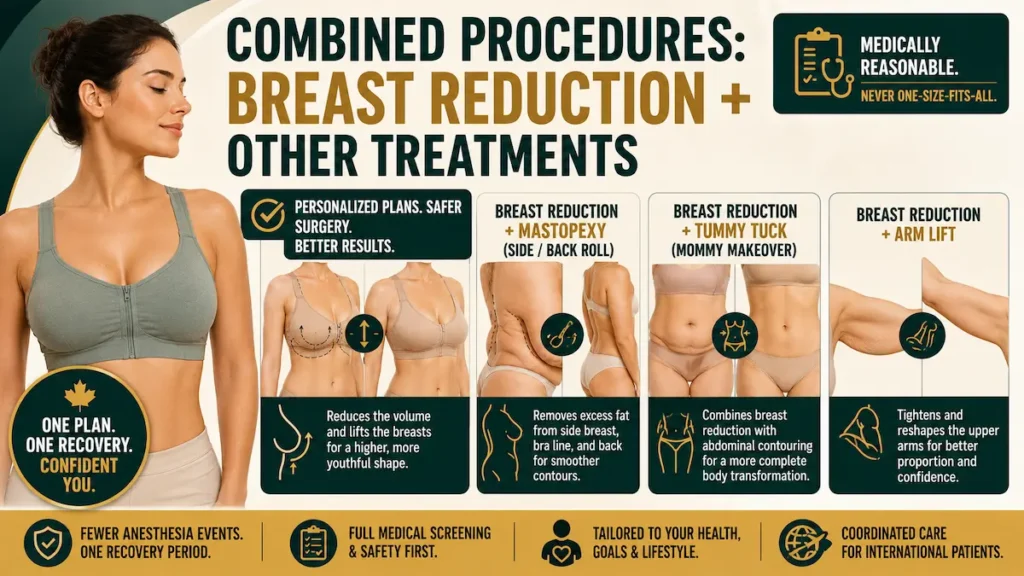
Combined Procedures: Breast Reduction + Other Treatments
Some patients choose breast reduction alone. Others combine it with procedures that address neighbouring areas, such as breast lift refinement, liposuction, tummy tuck, or arm lift. Combining procedures can reduce the number of anesthesia events and recovery periods, but it also increases surgical scope.
We only recommend combination surgery when it is medically reasonable. The plan must respect your health status, blood test results, anesthesia safety, travel timeline, and recovery support. A larger plan is not automatically a better plan.
Breast Reduction + Mastopexy
Breast reduction usually includes a lifting effect because the nipple-areola complex is repositioned and excess skin is removed. In that sense, reduction and mastopexy often overlap. The difference is the primary goal.
If heaviness and pain are the main concerns, reduction leads the plan. If sagging is the main concern and volume is comfortable, a breast lift may be more appropriate. Some patients need both volume reduction and detailed lift reshaping.
Breast Reduction + Liposuction for Side or Back Roll Contouring
Breast heaviness often extends beyond the front of the chest. Some patients also have fullness near the side breast, underarm area, bra line, or upper back. Liposuction can refine these areas when fat distribution contributes to the overall shape.
This is not the same as treating breast tissue. Liposuction improves contour around the breast. Reduction removes internal breast weight. When combined correctly, the result can feel lighter and look more balanced in bras, fitted tops, and swimwear.
Breast Reduction + Tummy Tuck in a Mommy Makeover-Style Plan
Post-pregnancy patients may consider breast reduction with abdominal surgery when breast heaviness and abdominal skin laxity developed together. In selected cases, a tummy tuck may be combined with breast reduction for a more complete body-contouring plan.
This type of combination requires careful screening. Tummy tuck recovery limits standing posture and core movement, while breast reduction limits upper-body movement. The patient must be medically fit and have realistic support during recovery.
Breast Reduction + Arm Lift
Some patients with large breasts also have upper-arm skin laxity after weight loss or ageing. An arm lift may be considered if loose arm skin affects comfort, clothing, or body proportion.
Combining breast reduction and arm lift can make sense for selected patients, but it increases incision care. Both areas need scar support and movement restrictions. We review daily-life demands before recommending this approach.
Anesthesia for Breast Reduction: General Anesthesia Standard
Breast reduction is usually performed under general anesthesia because it is a longer, more involved operation than minor breast contouring. The surgeon must remove tissue, reshape the breast, reposition the nipple-areola complex, and close the incisions in layers. This requires complete patient comfort and controlled operating conditions.
For Canadian patients travelling to Istanbul, anesthesia planning is part of the safety assessment. We review your medical history, medications, allergies, smoking status, blood test results, and travel schedule before approving surgery. The goal is not speed. The goal is safe surgery and a controlled recovery.
Why Breast Reduction Usually Requires General Anesthesia
Breast reduction often takes several hours. The surgeon works on both breasts, manages blood supply, removes tissue, and performs detailed reshaping. General anesthesia keeps the patient fully asleep and comfortable throughout the operation.
Local anesthesia alone is not usually appropriate for a full breast reduction. The surgical field is too broad, and the procedure involves deeper tissue work. General anesthesia allows the surgical team to maintain patient comfort, airway control, and consistent monitoring.
Pre-Anesthesia Assessment for Canadian Patients
Before surgery, we review your health history and request relevant medical information. This may include current medications, previous anesthesia experiences, blood pressure history, clotting history, smoking or vaping status, and any known heart or lung conditions.
Canadian patients should also speak with their family physician if they have chronic conditions or take medications such as blood thinners, diabetes medication, or hormone therapy. A coordinated pre-trip assessment helps reduce avoidable risk.
AKM’s Anesthesia Monitoring and Hospital Protocol
Breast reduction is performed in our JCI-accredited hospital partner facility. During surgery, anesthesia is monitored by a qualified team, and your vital signs are followed continuously. This includes oxygen level, heart rhythm, blood pressure, temperature, and airway status.
We use structured surgical and anesthesia checklists before, during, and after the operation. This matters for international patients. A well-organized hospital pathway reduces confusion, improves documentation, and supports safer recovery before returning to the hotel.
Post-Anesthesia Recovery Before Hotel Transfer
After surgery, you wake in a monitored recovery area. The team checks your pain level, nausea, blood pressure, dressing status, and ability to move safely. You do not leave the facility until the medical team confirms you are stable.
Some patients stay overnight depending on the surgical plan and recovery status. Others may transfer to the hotel when medically cleared. Your patient host and care team coordinate the next steps, including medications, garment instructions, and the first follow-up appointment.
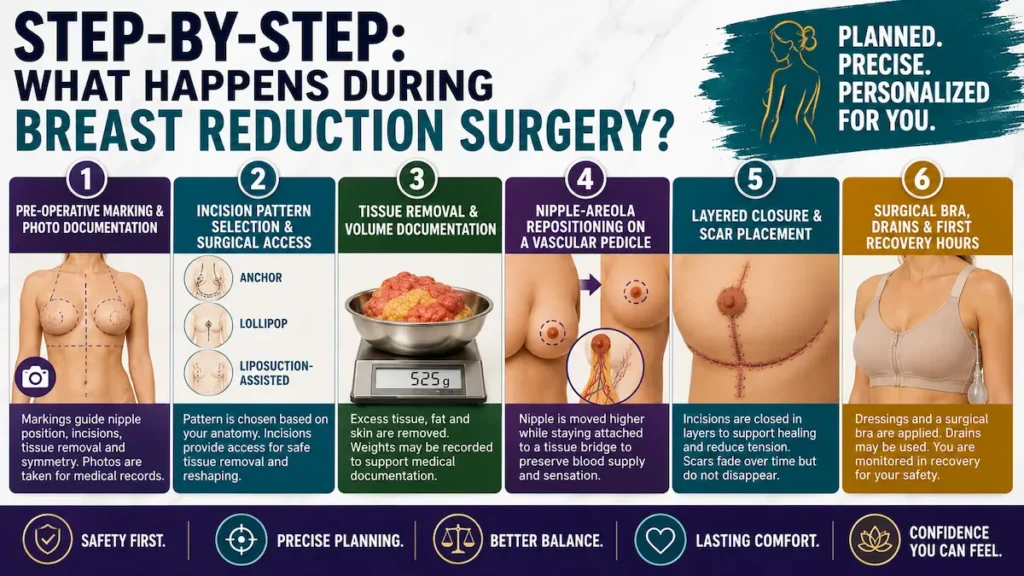
Step-by-Step: What Happens During Breast Reduction Surgery?
Breast reduction follows a structured surgical sequence. Each step is planned before the operation begins, but final adjustments are made in the operating theatre based on symmetry, tissue quality, and the way the breasts respond after tissue removal. This is why pre-operative planning and intra-operative judgement both matter.
For Canadian patients, understanding the sequence helps reduce anxiety. You do not need to know every technical detail, but you should know what happens to your tissue, where the scars are placed, and how your care team checks safety before you return to the hotel.
Pre-Operative Marking and Photo Documentation
Before surgery, your surgeon marks the breasts while you are standing. These markings guide nipple position, incision placement, tissue removal, and symmetry. Standing markings are important because breast position changes when you lie down.
Clinical photographs are also taken for medical documentation. These images help the surgical team plan and later compare healing progress. They are handled as confidential medical records and are not used publicly without written consent.
Incision Pattern Selection and Surgical Access
The selected incision pattern is based on your anatomy. Anchor incisions give the most reshaping control for large reductions. Lollipop incisions may suit moderate reductions. Liposuction-assisted reduction may be used in selected fat-dominant cases with minimal sagging.
Once anesthesia is established, the surgeon follows the planned markings. The incisions provide access to remove tissue, reshape the breast mound, and reposition the nipple-areola complex. Precision at this stage helps reduce unnecessary tension on the final closure.
Tissue Removal and Volume Documentation
The surgeon removes breast tissue, fat, and skin according to the surgical plan. Different amounts may be removed from each breast to improve symmetry. In many cases, the removed tissue is weighed and documented.
This documentation matters for medical clarity. It also helps explain why one side may feel slightly different early in recovery. Healing is not perfectly identical between breasts, especially when pre-operative asymmetry existed.
Nipple-Areola Repositioning on a Vascular Pedicle
The nipple-areola complex is usually moved upward while staying attached to a vascular pedicle. This tissue bridge supports blood flow and can help preserve sensation. The surgeon selects the pedicle based on breast size, nipple position, and reduction volume.
This step requires careful planning. Moving the nipple too far without adequate blood supply can increase risk. Moving it too little can leave the breast looking low or heavy. The goal is a natural, proportional position.
Layered Closure and Scar Placement
After reshaping, the incisions are closed in layers. Internal sutures support the deeper tissue, while the outer skin closure is designed to reduce tension. Better tension control can help scars mature more predictably.
Scar placement depends on the incision pattern. Anchor scars include the breast crease. Lollipop scars do not. In both cases, scars usually fade over time, but they do not disappear completely.
Surgical Bra, Drains When Needed, and First Recovery Hours
At the end of surgery, dressings and a surgical bra are applied. Some patients may need drains to remove fluid during the early healing period. Not every patient requires them.
You then move to the recovery area for monitoring. The team checks pain, nausea, bleeding, blood pressure, and the surgical dressings. Once stable, you continue with the planned hospital or hotel recovery pathway.
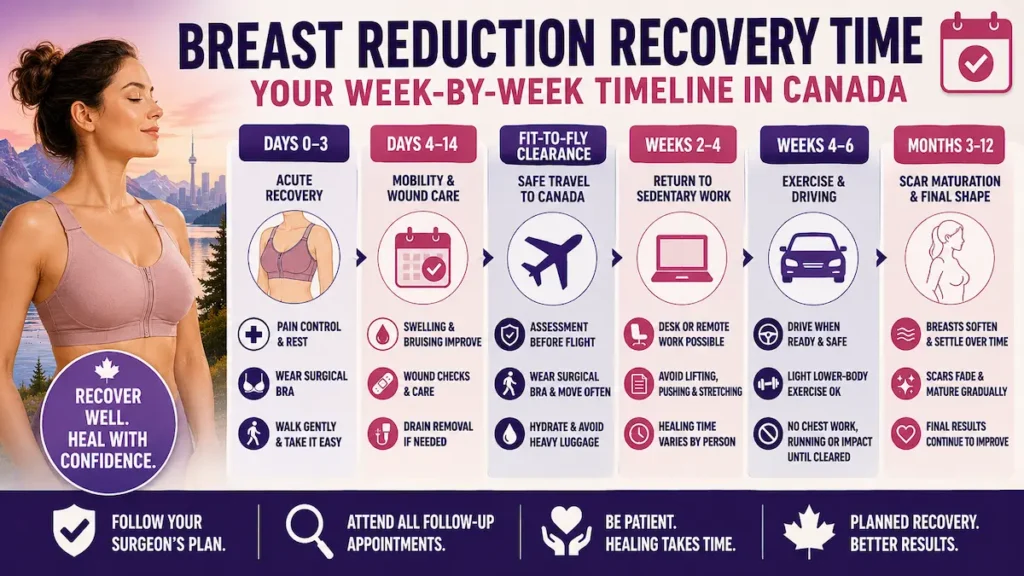
Breast Reduction Recovery Time: Week-by-Week Timeline for Canadian Patients
Recovery after breast reduction is gradual. The first two weeks focus on pain control, wound protection, swelling reduction, and safe movement. Later weeks focus on returning to work, rebuilding activity, and supporting scar maturation.
Canadian patients also need to plan around long-haul travel. Returning home too early can increase discomfort and make follow-up more stressful. We provide fit-to-fly guidance based on your healing, procedure scope, and surgeon assessment.
Days 0–3: Acute Recovery, Pain Control, Surgical Bra
The first days are the most delicate. You may feel tightness, pressure, swelling, and soreness across the chest. Most patients describe discomfort rather than sharp pain, but pain levels vary.
You will wear a surgical bra as instructed. This supports the breasts, reduces pulling on incisions, and helps control swelling. You should walk gently, avoid lifting, and keep your upper body movements small.
Days 4–14: Mobility, Wound Checks, and Drain Removal if Needed
During the second week, swelling and bruising usually begin to settle. You should feel more mobile, but the incisions are still healing. You must avoid heavy lifting, stretching, and sleeping on your stomach.
If drains are used, they are removed when fluid output is low enough. Wound checks are scheduled before your return flight. These checks help confirm that you are healing as expected.
Our HBOT/LLLT Recovery Protocol
We use recovery technologies when appropriate to support healing after surgery. Hyperbaric Oxygen Therapy can increase oxygen delivery to healing tissues and may help reduce inflammation. Low-Level Laser Therapy uses 424 medical-grade semiconductor laser diodes at 650 nm to stimulate cellular repair.
For breast reduction, LLLT is especially relevant for incision care and scar maturation. It does not erase scars. It supports the biological repair process so scars can mature in a calmer, more organized way. You can learn more about our recovery technology on our technology and standards page and in our guide to minimizing scars with LLLT.
Fit-to-Fly Clearance Before Returning to Canada
Flying back to Canada after breast reduction requires planning. Long flights can increase swelling, stiffness, and clot risk after surgery. We review your mobility, pain control, incision condition, and overall stability before clearing you to travel.
You should wear your surgical bra during travel unless your surgeon says otherwise. You should also walk during the flight, hydrate, and avoid lifting heavy carry-on luggage. Our flight safety after surgery guide explains why timing, movement, and hydration matter on long-haul flights.
Weeks 2–4: Return to Sedentary Work
Many patients can return to remote work or desk work after two to three weeks, depending on healing and pain levels. Jobs that involve lifting, patient care, childcare, retail work, or prolonged standing may require longer recovery.
If you work in Canada and need documentation for time off, ask early. We can provide medical documents in English that describe the procedure and recovery expectations without revealing unnecessary personal details.
Weeks 4–6: Exercise and Driving
Driving may resume when you are off strong pain medication, can move your arms safely, and can react quickly. This timing varies. Some patients are ready earlier, while others need more time.
Lower-body exercise may resume gradually once cleared. Upper-body workouts, chest training, running, and high-impact movement should wait until the surgeon approves them. Protect the incisions first.
Months 3–12: Scar Maturation and Final Breast Shape
Breast shape changes for months. Early swelling can make the breasts look high, firm, or boxy. Over time, the tissue softens and settles into a more natural contour.
Scars also mature slowly. They may look pink, firm, or raised at first. Most scars become flatter and lighter over 6 to 12 months, though genetics, skin tone, tension, and aftercare all influence the final appearance.
Safety and Risks of Breast Reduction Surgery
Breast reduction has a high satisfaction profile for many patients, especially when symptoms are significant. Still, it is real surgery. It involves anesthesia, tissue removal, wound healing, scarring, and a recovery period that must be respected.
Our approach is direct: we discuss risks before surgery, not after a problem appears. Canadian patients deserve clear information about bruising, swelling, nipple sensation, wound healing, breastfeeding potential, and what happens if they have a concern after returning home. For general risk categories such as bleeding, infection, poor wound healing, sensation change, and revision possibility, patients can also review the ASPS breast reduction risks and safety guide.
Common Short-Term Effects: Bruising, Swelling, and Numbness
Bruising and swelling are expected after breast reduction. The breasts may feel firm, high, tight, or uneven at first. This does not mean the final result has appeared. Early healing is temporary and often asymmetrical.
Temporary numbness around the nipple, areola, lower breast, or incision lines is also common. Nerves need time to recover after tissue movement. Sensation may improve over months, but some patients can have long-term changes.
Common Problems After Breast Reduction Surgery
The most common problems after breast reduction involve wound healing. Small openings along the incision line, delayed healing at the T-junction, fluid build-up, infection, or thicker scars can occur. These issues are usually manageable when reported early.
Hematoma and seroma are less common but require attention. A hematoma is a blood collection. A seroma is a fluid collection. Both can create pressure, swelling, or asymmetry, which is why follow-up checks matter before you fly home.
Nipple Sensation Changes: Temporary vs Long-Term
Nipple sensation can increase, decrease, or feel different after surgery. Many changes are temporary. Some are long-term. The risk depends on starting breast size, nipple position, reduction volume, and pedicle choice.
We discuss this carefully before surgery because sensation matters to quality of life. A smaller scar pattern does not automatically mean lower sensation risk. Blood supply, nerve preservation, and tissue movement are more important than scar length alone.
“Nipple sensation risk must be explained before surgery. A patient should never discover this trade-off after the operation, especially when a large reduction or major nipple lift is planned.”
Breastfeeding Capacity After Reduction
Breast reduction can affect breastfeeding. Some patients breastfeed successfully after surgery, while others produce less milk or cannot breastfeed fully. The risk is higher when more glandular tissue is removed or when the nipple-areola complex is moved a long distance.
If future breastfeeding is a major priority, tell your surgeon early. Your surgical plan may be adjusted to preserve tissue pathways when possible. Even with careful technique, no ethical surgeon should guarantee breastfeeding ability after reduction mammoplasty.
Breast Reduction Scars: Anchor vs Lollipop Reality
Every breast reduction leaves scars. Anchor reduction creates a longer scar pattern, but it also gives the surgeon more control in large reductions. Lollipop reduction creates a shorter scar pattern, but it works best for moderate reductions with less skin excess.
Scars usually look pink, firm, or raised in the early months. They often soften and fade over 6 to 12 months. We may use Low-Level Laser Therapy as part of scar-support care, but scar quality also depends on genetics, skin tone, tension, and aftercare.
How AKM’s Sterile Protocol Reduces Complication Risk
Breast reduction is performed in our JCI-accredited hospital partner facility with structured operating-room protocols. Sterile technique, pre-operative testing, anesthesia monitoring, and post-operative wound checks all reduce avoidable risk.
We also provide English-language medical documentation for patients returning to Canada. This helps your family physician, walk-in clinic, or local specialist understand what was performed if you need assessment after travelling home.
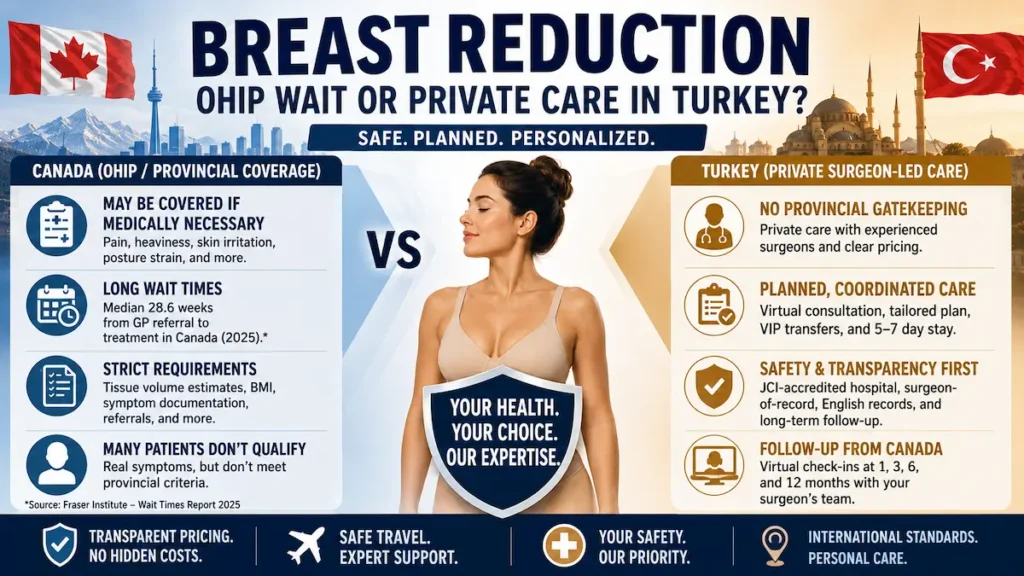
Is It Safe to Get Breast Reduction in Turkey vs OHIP Wait: A Canadian’s Honest Look
Breast reduction is different from many aesthetic procedures because it can be medically necessary. In Canada, public coverage may apply when symptoms and provincial criteria are met. That does not mean every patient with pain automatically qualifies.
Coverage decisions are provincial. Ontario, British Columbia, Alberta, Quebec, and other provinces each use their own process to decide what is medically necessary. Patients should confirm requirements with their provincial plan, family physician, and local surgeon before assuming coverage is available.
When OHIP or Provincial Coverage May Apply
In Ontario, OHIP may cover reduction mammoplasty when the procedure is considered medically necessary rather than cosmetic. Other provinces have similar principles, but the approval pathway and documentation requirements can differ.
Typical factors may include persistent back, neck, or shoulder pain, bra strap grooving, skin irritation beneath the breasts, posture strain, and functional limitations. A referral from a family physician or specialist is often part of the pathway.
Tissue Volume, BMI, and Symptom Documentation Requirements
Many Canadian patients are surprised by how much documentation may be required. A surgeon may need to estimate tissue removal, document symptoms, and show that the surgery is not primarily cosmetic. Some offices also consider BMI, smoking status, breast size, and previous conservative treatments.
Exact rules vary. This is why we do not tell patients to abandon the Canadian system. If you may qualify for provincial coverage, explore that option first. If you do not qualify, private options in Canada and Istanbul become the realistic comparison.
OHIP Breast Reduction Wait Time Reality
Even when coverage is possible, wait times can be long. The Fraser Institute wait times report found a median 28.6-week wait from GP referral to treatment across Canada in 2025, although timing varies by specialty, province, and individual surgeon access.
For a patient with daily pain, skin breakdown, or work limitations, this delay can be more than inconvenient. It can affect sleep, exercise, posture, and mental health. That is where private care becomes part of the decision.
Why Many Canadian Candidates Do Not Qualify
Some patients have real symptoms but fall into a grey zone. They may have pain and heaviness, but not enough estimated tissue removal. They may have significant discomfort but limited family physician documentation. They may have BMI or smoking-related concerns that delay approval.
These patients often feel dismissed because their symptoms are real but their file does not fit the public-coverage pathway. Our role is not to criticize the Canadian system. It is to offer a structured private alternative for patients who have already explored their options.
MSP, AHCIP, RAMQ, and Other Provincial Considerations
British Columbia’s MSP, Alberta’s AHCIP, Quebec’s RAMQ, and other provincial plans may treat medically necessary breast reduction differently. Coverage depends on provincial policy, physician assessment, and whether the procedure is classified as medically necessary.
If you live outside Ontario, ask your family physician how referrals work in your province. You should also ask whether out-of-country elective surgery affects follow-up options. Provincial systems can support urgent care, but they may not cover planned cosmetic revision after private international surgery.
The Turkey Path: Private Surgeon-Led Care Without Provincial Gatekeeping
Choosing breast reduction in Turkey is a private-care decision. It can make sense for patients who do not qualify for provincial coverage, do not want to wait, or prefer a planned international surgical programme with clear pricing and coordinated logistics.
At AKM Clinic, our process begins with a virtual consultation, photo review, medical history, and a tailored clinical plan. We do not approve every patient. If your health profile, expectations, or travel timing make surgery unsafe, we will tell you. For a wider safety framework, see our guide: Is it safe to get plastic surgery in Turkey?
Government of Canada Warnings About Surgery Abroad
The Government of Canada guidance on medical care outside Canada advises travellers to understand risks such as infection, medical record gaps, follow-up challenges, and limits to legal recourse outside Canada. We agree that these risks should be discussed directly.
Our response is structured documentation, English-language discharge instructions, surgeon-of-record clarity, JCI-accredited hospital care, and long-term virtual follow-up. These safeguards do not make surgery risk-free. They help Canadian patients make a more informed decision before travelling.
Ghost Surgery Concerns and Surgeon-of-Record Verification
Canadian patients often worry about “ghost surgery,” where the advertised surgeon is not the person performing the operation. This concern is reasonable. You should know who your surgeon is, what credentials they hold, and what parts of the operation they personally perform.
Our surgeon-of-record protocol is designed to reduce that uncertainty. Your clinical plan is reviewed before surgery, your surgeon is identified, and your procedure is documented. You should never travel internationally without this level of clarity. Our ghost surgery in Turkey guide explains what to verify before booking.
English Records, Follow-Up, and Canadian Family Physician Coordination
After surgery, you receive medical information in English. This can include procedure details, medication instructions, wound care guidance, and follow-up recommendations. Clear records matter when you return to Canada.
We also provide long-term virtual follow-up at 1, 3, 6, and 12 months. If a concern arises after you return home, your Canadian family physician can assess you locally while our team reviews photos and guides the next steps remotely.
| Decision Factor | Provincial Coverage Path | Canadian Private Clinic | AKM Istanbul Path |
|---|---|---|---|
| Eligibility | Requires medical necessity and provincial approval | Private-pay if medically suitable | Private-pay if medically suitable |
| Wait Time | Can be months to years depending on province and surgeon access | Often shorter than public pathway | Scheduled through international clinical coordination |
| Cost to Patient | May be covered if approved | Out-of-pocket CAD private pricing | Transparent CAD reference pricing |
| Follow-Up | Local Canadian system | Local Canadian clinic | Istanbul checks plus virtual follow-up after return |
| Best Fit | Patients who qualify and can wait | Patients who want local private care | Patients seeking structured international private care |
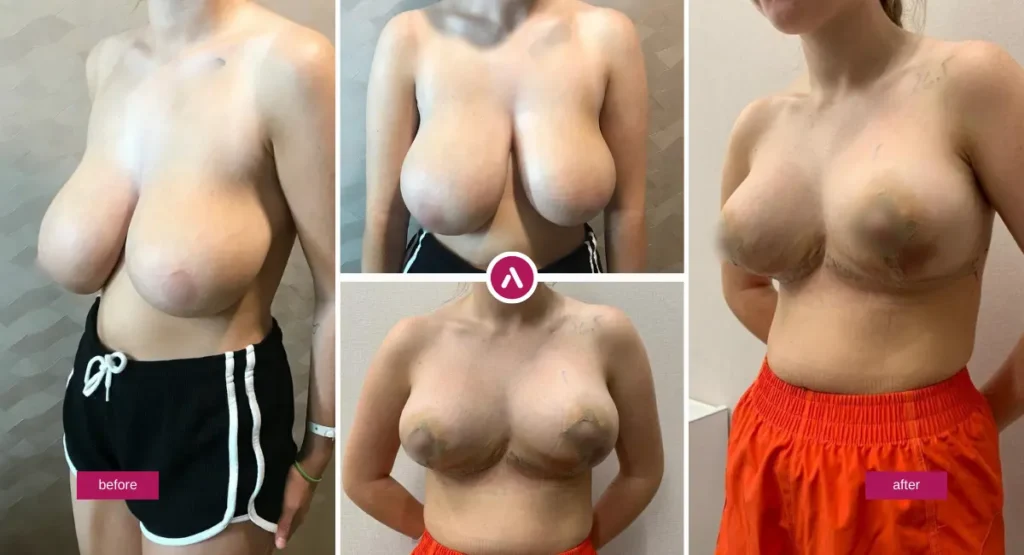
Breast Reduction Before and After: Realistic Expectations and Results
Breast reduction can create meaningful relief, but the best outcomes come from realistic planning. A successful result should feel lighter, more proportional, and easier to live with. It should not be judged only by cup size or early swelling.
We counsel patients carefully before surgery because regret usually comes from mismatched expectations. Some patients wish they had gone smaller. Others wish they had preserved more volume. The right plan balances symptom relief, body proportion, scar acceptance, and long-term breast shape.
Breast Reduction Size Chart: From Starting Cup Size to Realistic Range
Cup size is a helpful conversation tool, but it is not a precise surgical target. Band size, bra brand, breast width, and chest wall shape all affect the final cup. A patient moving from a G cup to a C cup may need a different tissue removal plan than someone moving from a DD to a C.
During consultation, we ask what feels too heavy, what size feels emotionally comfortable, and what activities you want to regain. We then translate that into surgical planning: tissue removal, nipple position, skin tightening, and scar pattern.
| Patient Goal | What It Usually Means Surgically | Expectation to Discuss |
|---|---|---|
| “I want pain relief but still want curves.” | Moderate reduction with natural breast volume preserved | Focus on proportion, not the smallest possible size |
| “I want to be much smaller.” | Larger tissue removal, often anchor pattern | Scar length and shape trade-offs matter |
| “I want to fit clothes better.” | Reduction plus reshaping and nipple repositioning | Final bra size may vary by brand |
What Recovery Week-by-Week Pictures Usually Show
Early recovery photos can be misleading. In the first two weeks, the breasts may look swollen, high, firm, bruised, or uneven. Incision lines may look pink or raised. This is expected and should not be confused with the final result.
By six to twelve weeks, the shape usually softens and becomes more natural. By six to twelve months, scars mature and the breast settles further. Patients should use before-and-after photos as a timeline tool, not as an instant-result promise.
Scar Maturation: 1 Week, 3 Months, 1 Year, and 2 Years
At one week, scars are new and fragile. At three months, they may look darker, thicker, or more noticeable because scar tissue is actively remodelling. This phase can worry patients, but it is common.
At one year, most scars are flatter and lighter. At two years, many scars continue to fade. They never disappear completely. Scar outcome depends on genetics, skin tone, incision tension, sun protection, silicone care, and whether healing complications occurred.
“I Regret My Breast Reduction”: Why It Happens and How to Reduce That Risk
Regret can happen when a patient feels too small, not small enough, overly scarred, or unprepared for sensation changes. It can also happen when the patient expected surgery to solve body image concerns that were not only about breast size.
We reduce this risk through careful counselling. You should understand the scar pattern, size limits, breastfeeding implications, sensation risks, and long-term changes before booking. Breast reduction can be deeply positive, but it must be chosen with clear expectations.
“The most important size conversation is not ‘how small can we go?’ It is ‘what size gives relief while still feeling natural to this patient’s body and identity?’”
Long-Term Stability: Weight, Pregnancy, and Remaining Breast Tissue
Breast reduction removes tissue permanently, but the remaining tissue can still change. Weight gain, pregnancy, breastfeeding, hormonal changes, and menopause can affect volume and skin firmness. Surgery does not freeze the breasts in time.
Maintaining a stable weight helps preserve results. If pregnancy is planned soon, waiting may be wiser. If your weight is stable and your symptoms are consistent, breast reduction can offer long-term comfort and proportion.
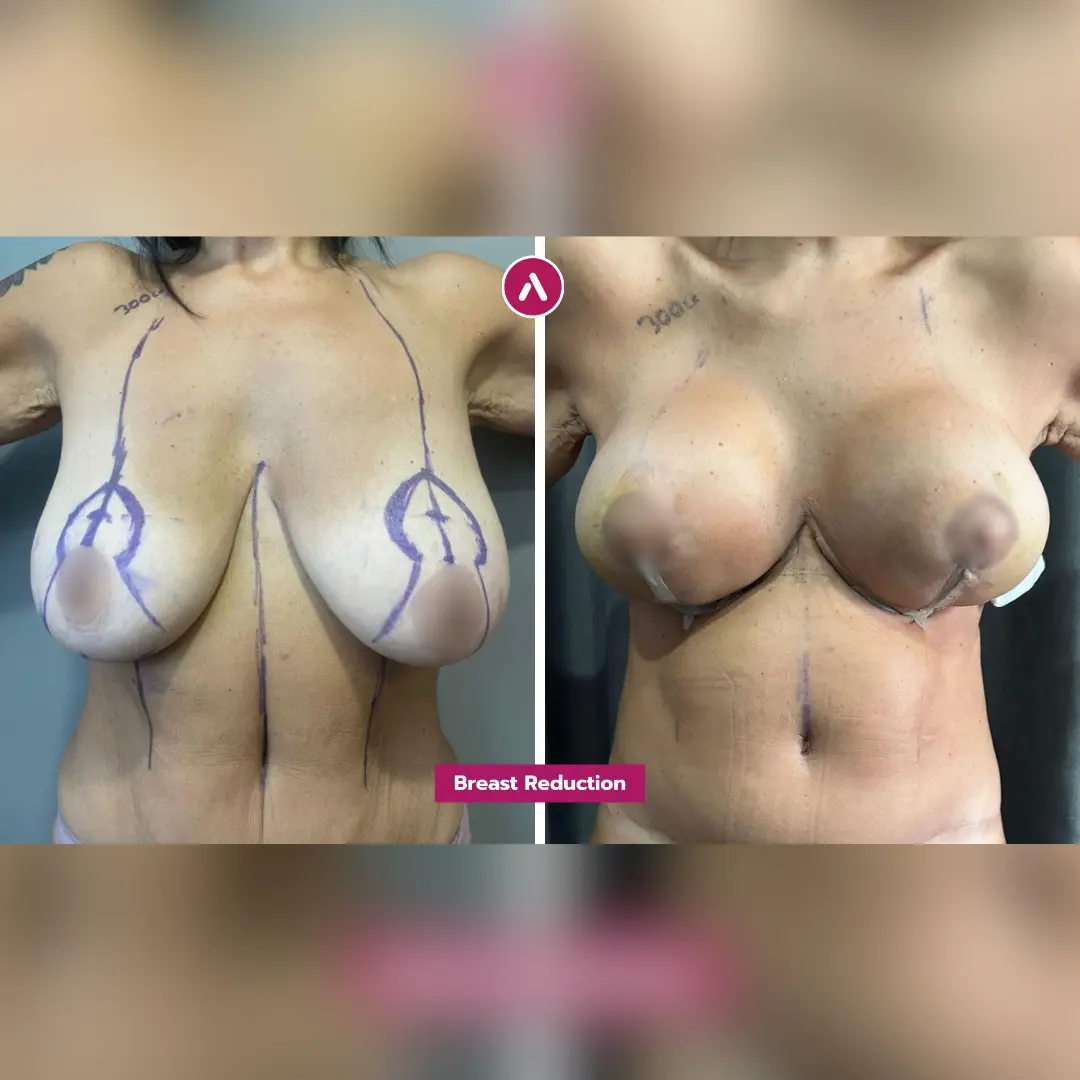
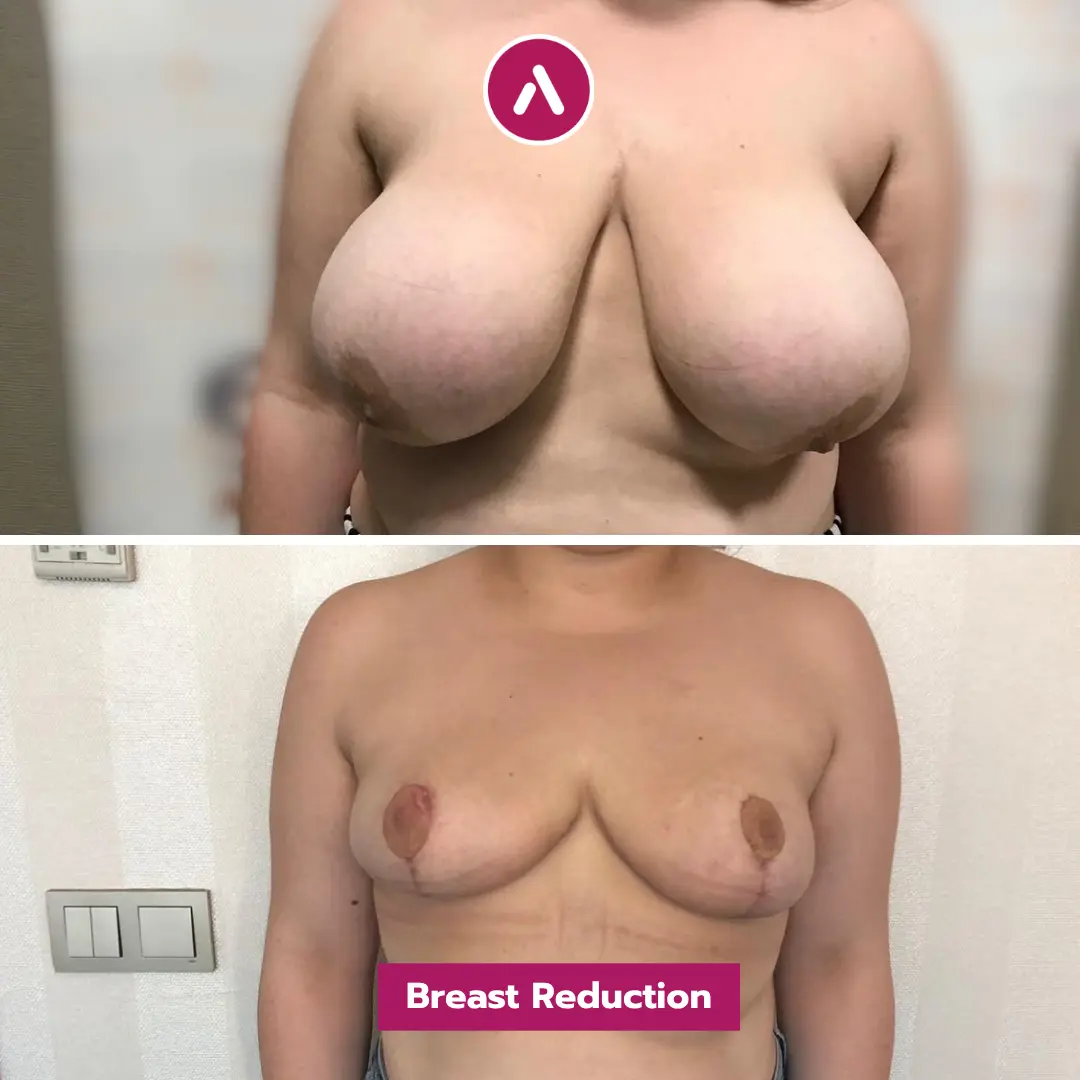
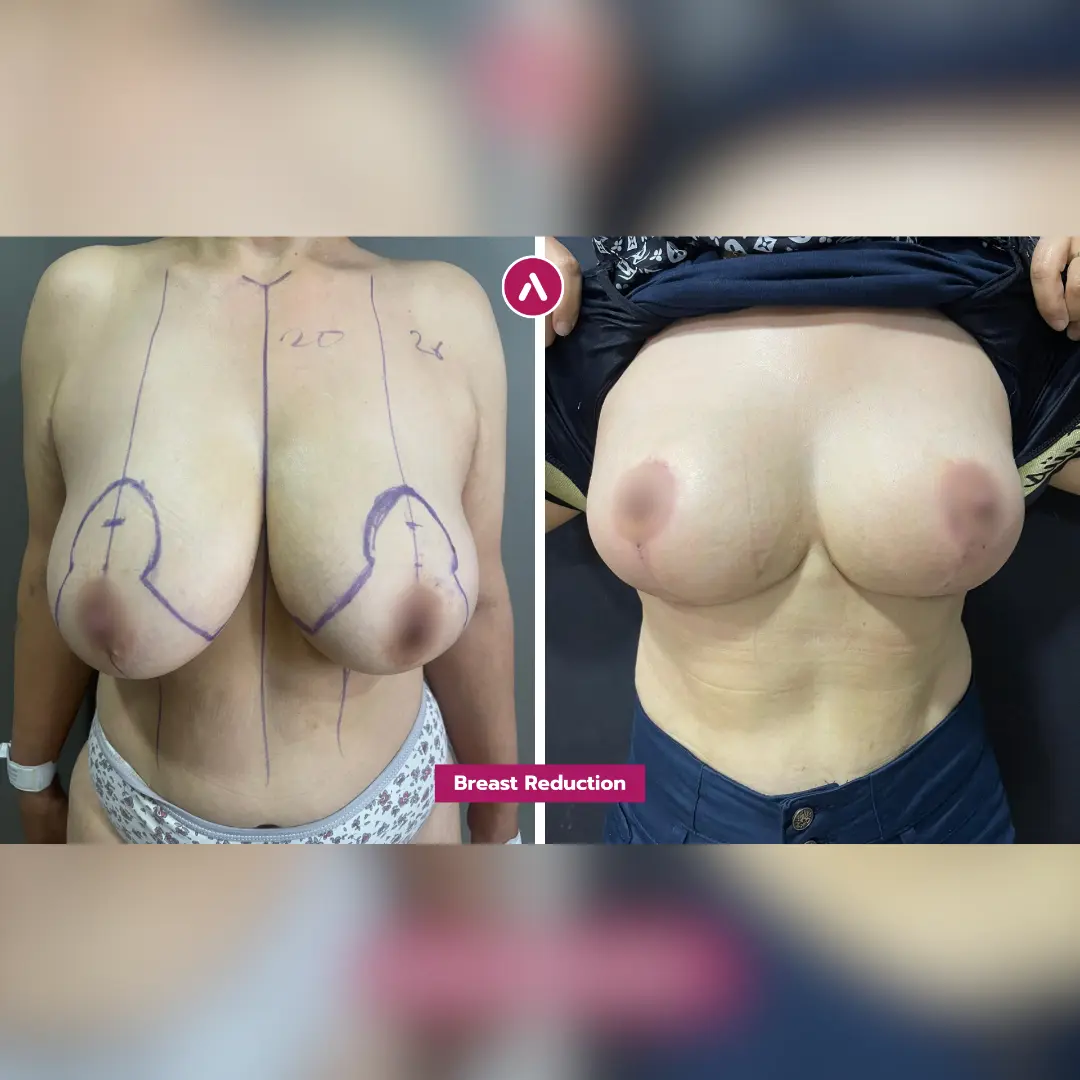
Breast Reduction Before and After Gallery
Before-and-after photos are useful when viewed critically. Look for patients with a similar starting breast size, skin quality, body frame, and reduction goal. A result on someone with different anatomy may not predict your outcome.
For visual research, you can review our breast reduction before and after gallery. For multicultural outcome context, our breast reduction before and after guide for Black women discusses how skin tone, scar maturation, and representation matter in surgical planning.
Breast Reduction Cost 2026: Turkey vs Canada
Canadian patients researching breast reduction surgery in Ontario, Toronto, Calgary, Edmonton, or Winnipeg usually compare three pathways: provincial coverage, Canadian private surgery, and private international surgery. These pathways are not equivalent. Provincial coverage may cost the patient little or nothing if approved, but eligibility can be strict and wait times can be long. Canadian private care avoids the approval process but can be expensive.
At AKM Clinic, technique-level breast reduction pricing starts at CAD $5,450 for Anchor, Vertical/Lollipop, Superior Pedicle, Inferior Pedicle, and Free Nipple Graft techniques. Liposuction-only breast reduction is listed at CAD $4,100 for selected patients with fat-dominant tissue and minimal sagging.
Canadian private clinic pricing varies by city, surgeon, facility, anesthesia, and aftercare structure. Ontario and Toronto patients often compare private quotes against OHIP eligibility, while Calgary, Edmonton, and Winnipeg patients may face different provincial referral pathways. The key is to compare total cost, not just the surgeon fee.
For the full fee breakdown, including procedure variants and Canadian private-clinic comparison context, see our breast reduction cost guide for Canadian patients.
| Location / Pathway | Typical Cost Structure | Important Note |
|---|---|---|
| OHIP / Provincial Coverage | May be covered if medically necessary and approved | Eligibility and wait time vary by province |
| Toronto / Ontario Private | Private-pay surgical fee plus facility and anesthesia variables | Often chosen when OHIP criteria are not met |
| Calgary / Edmonton Private | Private-pay pricing varies by surgeon and facility | Provincial referral pathways differ from Ontario |
| Winnipeg / Manitoba Private | Private-pay or referral-based options depending on case | Patients should confirm local eligibility first |
| AKM Clinic Istanbul | From CAD $5,450 for standard reduction techniques | Includes coordinated international surgical planning and follow-up |
How to Find the Best Breast Reduction Surgeon in Turkey: A Canadian Patient’s Checklist
Choosing a breast reduction surgeon abroad should feel methodical, not rushed. Canadian patients are used to regulated provincial systems, referral pathways, and physician credential checks. International surgery requires the same mindset, with extra attention to documentation, facility standards, aftercare, and surgeon accountability.
The right surgeon should be able to explain why your case needs an anchor, lollipop, liposuction-assisted, or pedicle-based approach. They should also discuss scar placement, nipple sensation, breastfeeding implications, and what happens if healing is slower than expected. Canadian patients can compare credential language against organizations such as the Canadian Society of Plastic Surgeons’ guidance on choosing a surgeon and the Royal College of Physicians and Surgeons of Canada’s specialist certification framework.
EBOPRAS and RCPSC Credential Equivalency
Canadian patients often understand RCPSC certification as a benchmark for specialist training. In Turkey and Europe, credential pathways use different names. EBOPRAS certification and European specialist training are not identical to RCPSC, but they provide a structured international framework for assessing surgical education and professional standards.
Ask how your surgeon’s credentials compare to Canadian expectations. A serious clinic should answer clearly. At AKM Clinic, we explain surgeon training, hospital accreditation, and safety protocols before you book, so you can compare our standards with what you would expect from a private Canadian surgical centre. Our plastic surgeon board certification guide explains how international credentials compare.
| Credential / Standard | What It Signals | Canadian Comparison |
|---|---|---|
| EBOPRAS / European Board Certification | Structured specialist-level surgical standard | Comparable framework to RCPSC specialist expectations |
| JCI-Accredited Hospital Facility | International hospital safety and quality oversight | Comparable safety culture to accredited Canadian hospital settings |
| Turkish Ministry of Health Licensure | Legal authorization to provide medical services in Türkiye | Foreign regulatory equivalent to provincial licensing oversight |
| English Medical Records | Clear discharge and follow-up documentation | Useful for Canadian family physician or local clinic review |
Breast Surgery Volume and Reduction-Specific Case Experience
Breast reduction requires more than general aesthetic skill. The surgeon must understand breast weight, nipple blood supply, scar tension, symmetry, and long-term shape stability. A clinic that performs many breast procedures should still be able to show reduction-specific planning.
Ask whether the surgeon regularly performs anchor, lollipop, liposuction-assisted, and major reduction cases. A surgeon who only offers one pattern may be fitting every patient into the same method. That is not ideal. You can also review our broader clinical philosophy on the About AKM Clinic page.
Incision Pattern Range: Anchor, Lollipop, and Liposuction-Assisted
A strong breast reduction consultation explains why one incision pattern suits your anatomy better than another. If you are told that a shorter scar is always better, be cautious. The scar pattern must match the amount of tissue and skin that needs to be removed.
Our surgeons assess breast size, skin elasticity, nipple position, breast density, and symptom burden before recommending a technique. We would rather choose a slightly longer scar pattern that gives stable relief than a shorter scar that leaves the breast heavy or poorly shaped.
“Incision choice is a safety decision before it is a cosmetic decision. The scar must give the surgeon enough access to reduce weight, reshape the breast, and protect the nipple-areola complex.”
Before/After Documentation and Review Quality
Before-and-after photos help, but they should be read carefully. Look for patients with similar breast size, skin tone, body frame, and reduction goals. One dramatic photo does not prove consistency.
Reviews should also describe process, not only results. Canadian patients should look for comments about communication, hospital care, post-operative support, coordinator responsiveness, and follow-up after returning home. Our professional plastic surgery reviews page can help you evaluate patient experience more broadly.
Aftercare Continuity From Istanbul to Canada
Aftercare is one of the most important questions in international surgery. Before booking, ask how the clinic manages wound checks, medication instructions, follow-up photos, and concerns after you return home. You should not feel abandoned after boarding your flight.
At AKM Clinic, our care model includes 24/7 patient advocacy during your stay and virtual follow-up at 1, 3, 6, and 12 months. Patient hosts such as Hande, Emine, and Khadija help coordinate communication so you know who to contact if a question arises.
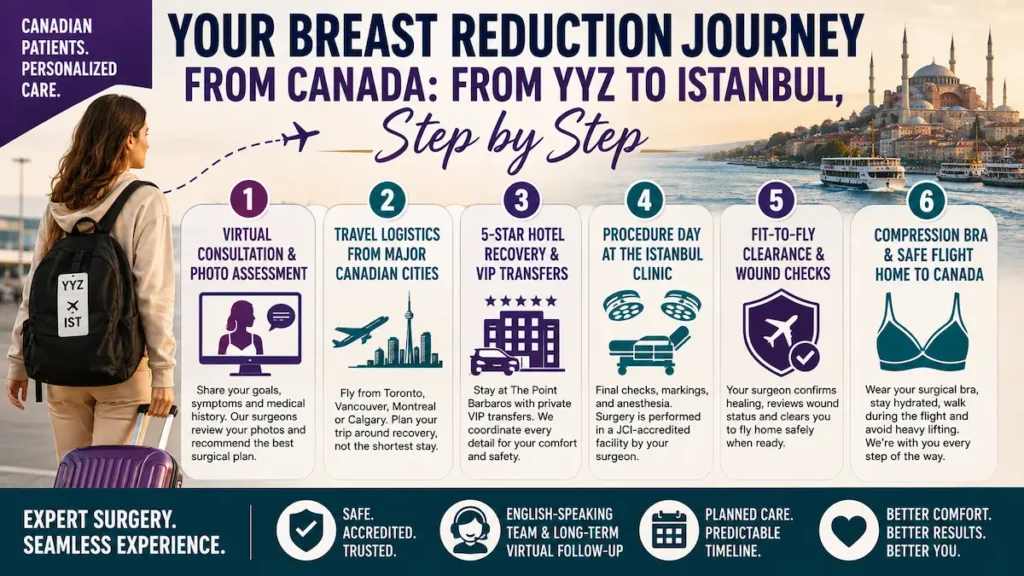
Your Breast Reduction Journey from Canada: From YYZ to Istanbul, Step by Step
Travelling for breast reduction requires planning beyond the operation itself. You need to think about flight timing, hotel recovery, surgical bras, wound care, luggage, and how you will manage the first week after surgery. The right structure reduces stress.
We built our Canadian patient pathway to make the process predictable. You arrange your flight. We coordinate the clinical schedule, airport transfers, hotel stay, pre-operative testing, surgery day logistics, and follow-up while you are in Istanbul.
Virtual Consultation and Photo Assessment
Your process begins with a virtual consultation and photo assessment. You share your goals, symptoms, medical history, current medications, smoking status, pregnancy plans, and breast-size concerns. Clear photos allow our surgeons to estimate technique options before you travel.
This first step also helps determine whether surgery is appropriate. If your case requires in-person Canadian assessment first, additional medical clearance, or weight stabilization before surgery, we will explain that before booking dates. Our patient journey page outlines the broader process.
Travel Logistics From Toronto, Vancouver, Montreal, and Calgary
Most Canadian patients travel through major airports such as Toronto Pearson, Vancouver, Montreal, or Calgary. Flight availability changes by season, so you should confirm current schedules directly with your airline before booking.
For breast reduction, you should plan your trip around recovery rather than the shortest possible stay. You need enough time in Istanbul for consultation, surgery, wound checks, early healing, and fit-to-fly clearance before the long-haul return to Canada.
5-Star Hotel Recovery and VIP Transfers
Our all-inclusive clinical pathway includes 5-star hotel accommodation at The Point Barbaros, private VIP transfers, and coordination between the hotel, clinic, and hospital facility. This reduces the need to navigate Istanbul while you are sore, tired, or wearing a surgical bra.
Private transfers also help after surgery because you should not carry bags, walk long distances unnecessarily, or rely on public transportation while healing. You can review the full logistics structure on our hotels and VIP transfers page.
Procedure Day at the Istanbul Clinic
On procedure day, you complete final checks, markings, consent review, and anesthesia preparation. Your patient host helps you understand the schedule and confirms that your questions have been answered before surgery begins.
After the operation, you recover in a monitored setting. The medical team checks pain, nausea, blood pressure, dressings, and surgical bra placement. You continue to the hotel or overnight recovery pathway only when medically cleared. Our Istanbul clinic page explains the environment Canadian patients arrive into.
Fit-to-Fly Clearance and Compression Bra Logistics
Before returning to Canada, your surgeon checks healing and confirms whether you are fit to fly. This assessment considers swelling, pain control, wound status, mobility, and whether any drains or dressings need further care.
You should fly in your surgical bra unless instructed otherwise. Pack loose front-opening tops, avoid overhead lifting, and ask for help with luggage. During the flight, walk gently, hydrate, and follow your medication schedule. Comfort and circulation matter on a long-haul return.
Frequently Asked Questions (FAQ):
Breast reduction is a practical decision as much as an aesthetic one. Canadian patients often ask about provincial coverage, scar appearance, nipple sensation, breastfeeding, time off work, and how follow-up works after returning home. These answers give a starting point for consultation.
Your final recommendation must come from a surgeon after medical review. Online information cannot replace a direct assessment, especially when symptoms, breast size, and provincial coverage questions are involved. For broader patient questions, visit our patient FAQs.
How long does breast reduction surgery take?
Most breast reduction procedures take about 3 to 4 hours, depending on breast size, incision pattern, asymmetry, and whether liposuction or another procedure is combined. Larger reductions may take longer because tissue removal, nipple repositioning, and layered closure require more detailed work.
How much tissue is usually removed?
The amount varies widely. Some patients need a moderate reduction, while others require significant tissue removal to relieve symptoms. During consultation, your surgeon estimates the safe removal range based on breast size, skin quality, nipple position, and your desired final proportion.
Will I be able to breastfeed after breast reduction?
Some patients can breastfeed after reduction, but others cannot produce enough milk. The risk depends on technique, tissue removal volume, and how the nipple-areola complex is preserved. Patients who strongly prioritize future breastfeeding should discuss this before choosing surgery.
Will I lose nipple sensation permanently?
Nipple sensation can change after breast reduction. Many changes improve over months, but some patients have long-term reduced or altered sensation. Larger reductions, major nipple movement, and free nipple graft techniques carry higher sensation risk.
Is breast reduction covered by OHIP, MSP, AHCIP, or RAMQ?
Provincial coverage may apply when breast reduction is considered medically necessary. Criteria vary by province and may include symptom documentation, estimated tissue removal, physician referral, and other health factors. Patients should verify current rules with their family physician and provincial plan before assuming coverage.
How much does breast reduction cost in Toronto or Ontario vs Istanbul?
Toronto and Ontario private pricing varies by surgeon, anesthesia, facility, and aftercare structure. AKM Clinic’s technique-level breast reduction pricing starts at CAD $5,450 for standard reduction techniques and CAD $4,100 for liposuction-only reduction in selected patients.
Does Canadian travel insurance cover elective breast reduction complications abroad?
Many travel insurance policies exclude elective cosmetic surgery and related complications. Patients should read policy wording carefully before booking. As part of our patient safety pathway, AKM Clinic provides complimentary complication insurance for all patients, offering an added layer of support during the surgical journey.
What is the difference between anchor, lollipop, and liposuction breast reduction?
Anchor reduction gives the most reshaping control and is often used for larger reductions. Lollipop reduction uses a shorter scar pattern and suits moderate reductions. Liposuction-assisted reduction removes fat through small entry points but does not significantly lift the breast or remove excess skin.
When can I return to work, driving, and exercise?
Many patients return to desk work in 2 to 3 weeks, depending on healing and pain control. Driving can resume when you are off strong pain medication and can move safely. Strenuous exercise, upper-body workouts, and heavy lifting usually require longer clearance.
How long does the new breast size last?
The tissue removed during breast reduction does not grow back in the same way. Remaining breast tissue can still change with weight gain, pregnancy, breastfeeding, menopause, and ageing. Stable weight helps preserve results.
What will my scars look like after 1 year?
Most breast reduction scars become flatter and lighter by 12 months, but they do not disappear. Scar quality depends on incision tension, genetics, skin tone, aftercare, sun protection, and whether wound healing was smooth. Some scars continue improving into the second year.
Can I combine breast reduction with a tummy tuck or liposuction in one trip?
Yes, selected patients can combine breast reduction with tummy tuck, liposuction, or other body-contouring procedures. Combination surgery requires stricter screening because surgical time, recovery demands, and travel planning become more complex. Safety determines whether we recommend it.
How do I verify a surgeon before travelling to Turkey?
Ask for the surgeon’s name, credentials, hospital facility, procedure role, before-and-after documentation, and follow-up plan. Your consultation should clearly explain who performs the operation, where surgery takes place, and how follow-up works after you return to Canada.
Medical Disclaimer: This page is for educational purposes only and does not replace medical advice, diagnosis, or treatment from a qualified physician. Breast reduction candidacy must be determined through individual medical assessment, including health history, breast anatomy, medications, risk factors, and surgical goals.