
Tummy Tuck Revision: Fixing Dog Ears & Scars
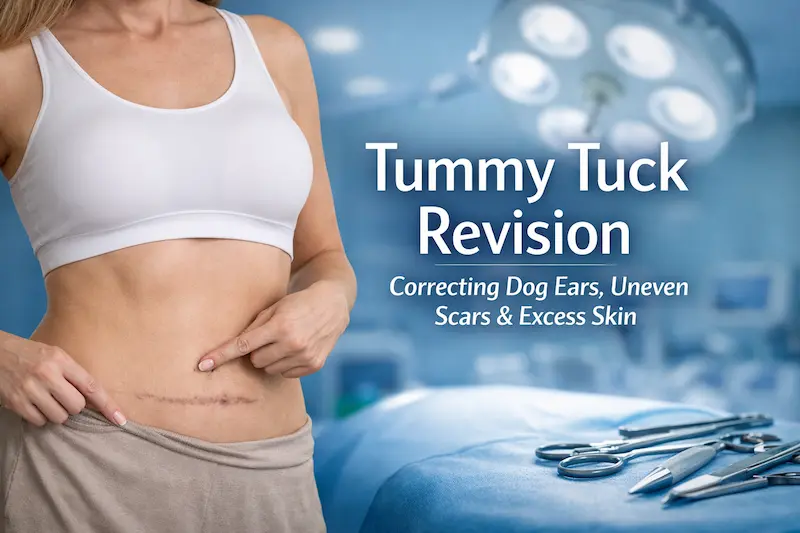
AI Summary
- Tummy tuck revision corrects dog ears, scars, contour irregularities, and excess skin after abdominoplasty.
- Safe candidacy depends on scar maturity, stable weight, non-smoking status, and realistic goals.
- Recovery and aftercare shape scar quality, flight timing, comfort, and confidence for UK patients.
- Turkey can offer value through transparent GBP pricing, revision expertise, and structured support.
AI-generated summary, fact-checked by our medical experts.
Tummy tuck revision is usually not about chasing perfection. It is about correcting a result that feels unfinished, uneven, or difficult to live with day to day. For many women researching abdominoplasty revision, the concern is not only aesthetic. It is also emotional. A visible scar, excess skin after tummy tuck surgery, or small bulges at the ends of the incision can affect confidence, clothing choices, and trust in surgery itself.
In clinical practice, revision tummy tuck procedures range from a minor scar refinement to a more involved secondary tummy tuck. The right plan depends on what went wrong, how well the tissues healed, and whether the original surgery addressed skin excess, muscle separation, and contour harmony properly. This is where careful assessment matters more than quick promises.
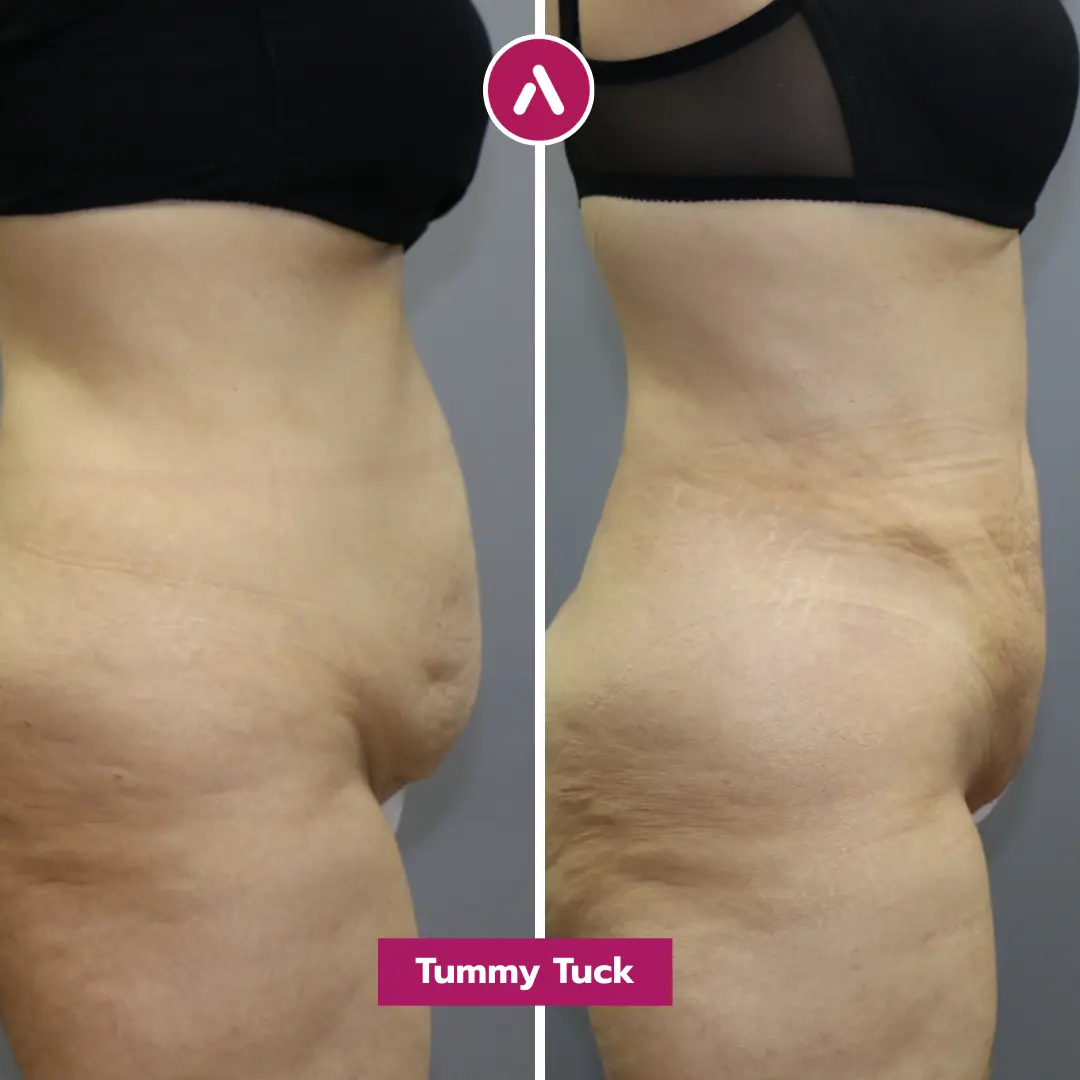
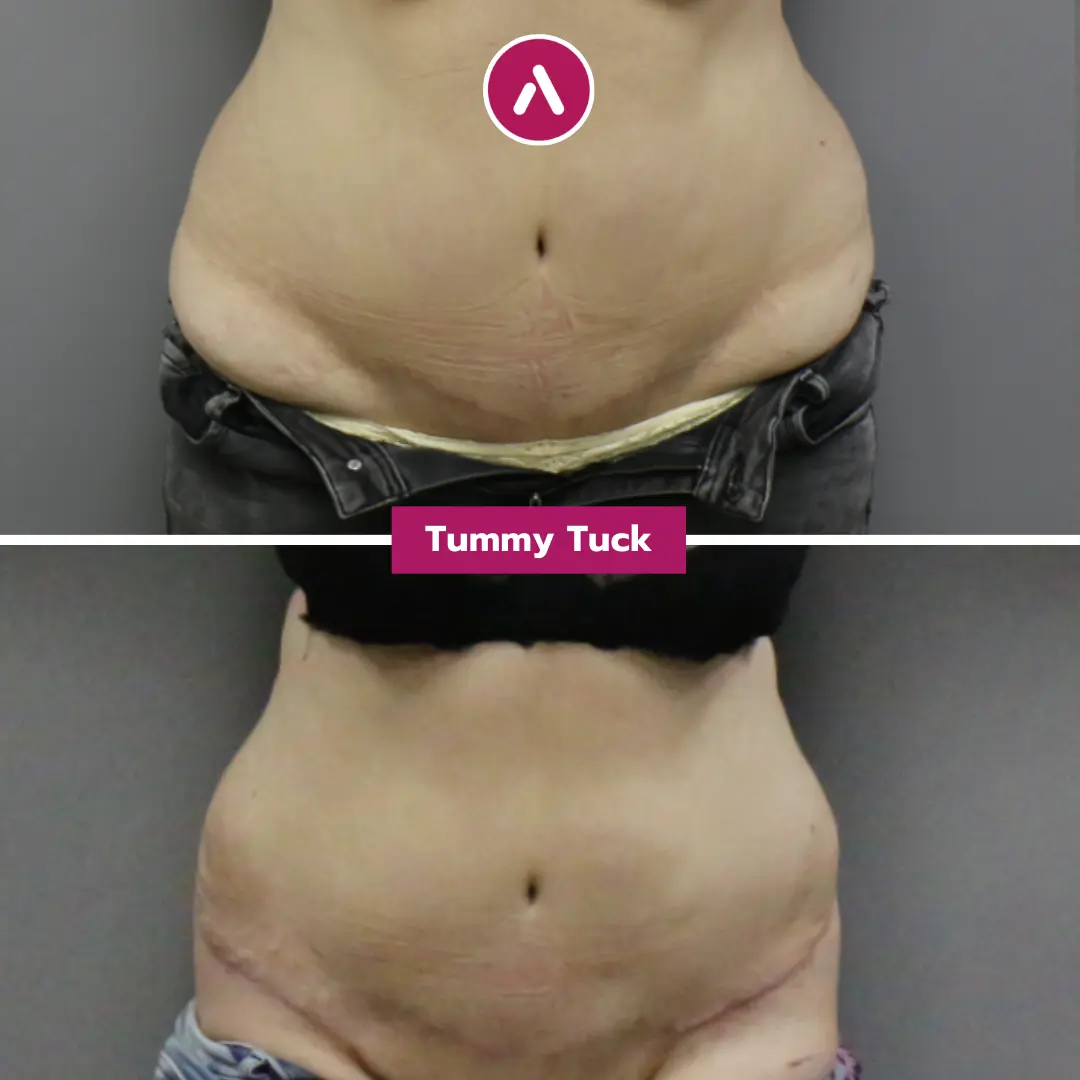
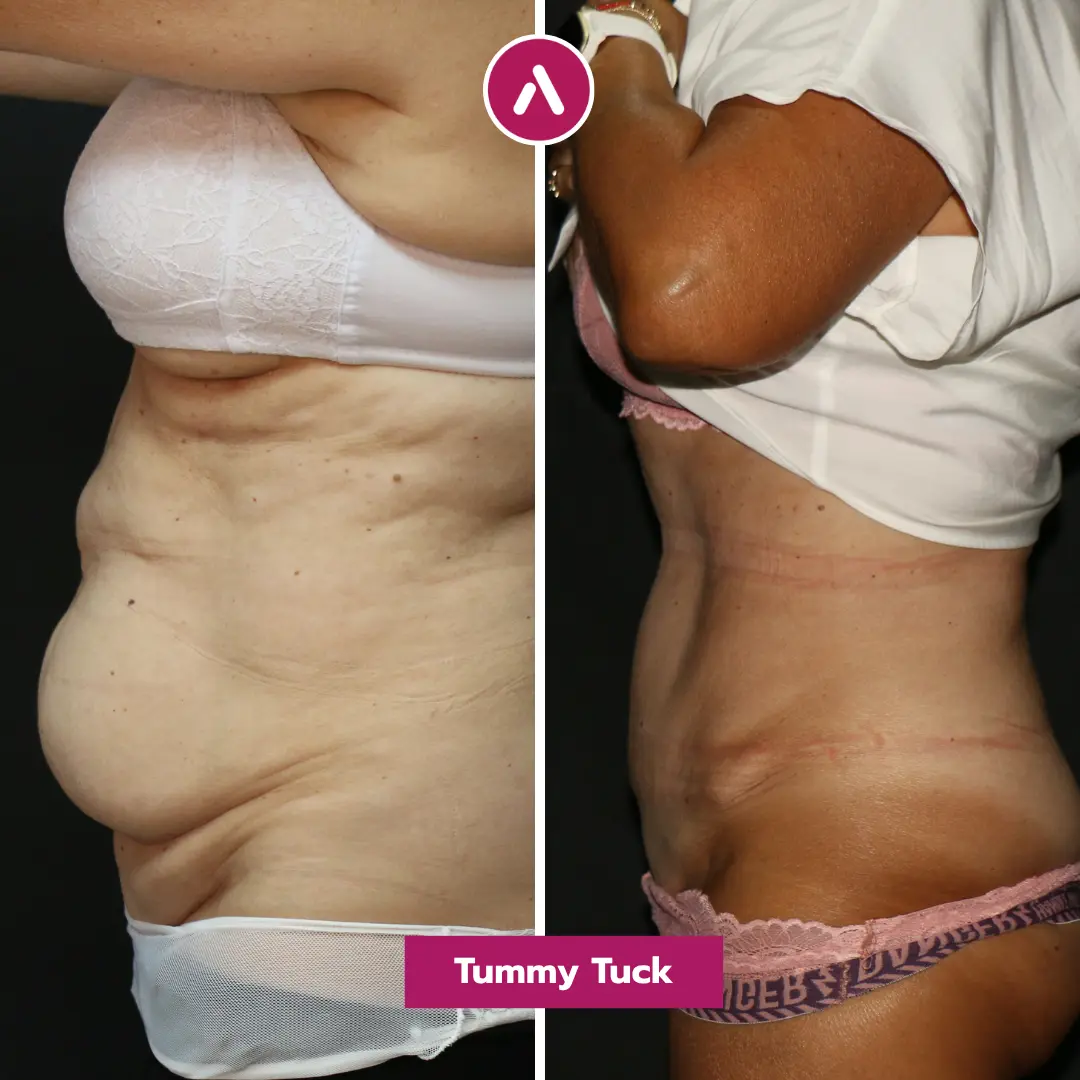
Medical science and scientific research both support a simple principle in revision surgery: tissues must be assessed once healing has matured, inflammation has settled, and the real contour can be judged accurately. In other words, the best tummy tuck correction surgery is based on timing, anatomy, and realistic goals rather than urgency alone.
UK patients often search for terms such as correcting bad tummy tuck results, uneven tummy tuck result, tummy tuck dog ears correction, and tummy tuck scar revision Turkey because they want clear answers before committing to another procedure. In this guide, we explain what can genuinely be improved, when it is safe to revise, and how an expert-led plan can create a smoother, more balanced abdominal result.
A good revision should not create a second “operated” look. It should make the abdomen appear smoother, more balanced, and more natural in fitted clothing, swimwear, and everyday life.
Table of Contents
What Is a Tummy Tuck Revision and When Is It Necessary?
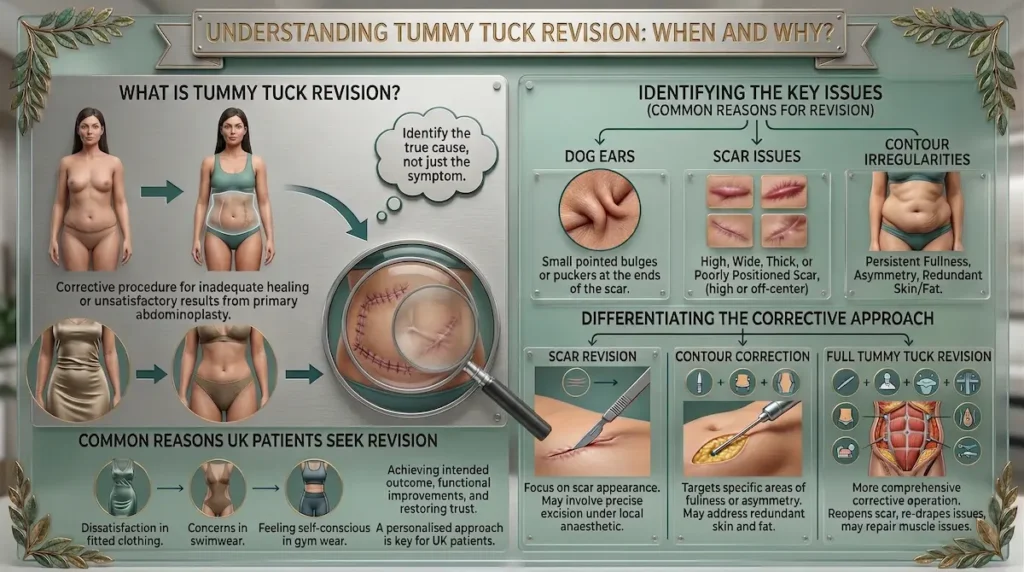
A tummy tuck revision is a corrective procedure performed after a previous abdominoplasty has healed inadequately or delivered a result that is aesthetically or structurally unsatisfactory. Some revisions are small and highly targeted. Others require a broader operative plan. The key is identifying whether the issue is confined to the scar, the contour, the lower abdomen, or the full abdominal wall.
Even when the concern appears minor, careful evaluation is essential because the visible problem may be only one part of a broader surgical outcome. In revision work, success depends on identifying the true cause of the issue rather than treating the most obvious symptom alone. This approach helps patients understand whether they need a small refinement, scar improvement, or a more comprehensive corrective plan.
What surgeons mean by “dog ears” after abdominoplasty
“Dog ears” are small puckers or pointed bulges of tissue that can appear at one or both ends of the tummy tuck scar. They are usually caused by a mismatch between the amount of skin removed and the way the remaining tissue closes under tension. In simple terms, the central area may look flatter, while the ends of the incision gather into raised folds or rounded fullness.
These bulges are one of the most common reasons patients begin researching tummy tuck dog ears correction. In mild cases, they may soften slightly as swelling settles. However, true dog ears rarely disappear completely on their own if there is a structural excess of tissue.
The difference between scar revision, contour correction, and full tummy tuck revision
Not every concern requires a full return to theatre. A scar revision focuses on improving the appearance, width, or position of the scar itself. Contour correction targets fullness, asymmetry, or residual skin and fat around the lower abdomen, flanks, or incision ends. A full abdominoplasty revision or secondary tummy tuck is more extensive and may involve reopening the scar, re-draping tissue, and in selected patients repairing muscle issues that were missed or have recurred.
This distinction matters because the best treatment for an uneven tummy tuck scar repair is not always the same as the best treatment for an uneven tummy tuck result. One patient may need only a precise excision under local anaesthesia. Another may require a wider corrective operation to address skin redundancy, asymmetry, and contour irregularity together.
Common reasons UK patients seek a second procedure after surgery
The most common complaints include dog ears, a scar that sits too high or heals too thickly, persistent lower abdominal fullness, asymmetry between the two sides, and visible excess skin after tummy tuck surgery. Some patients also feel that the original operation was too conservative, while others feel it was too tight in one area and insufficient in another.
For UK patients, the decision to consider tummy tuck correction surgery is often influenced by both function and appearance. They may feel self-conscious in fitted dresses, gym wear, or swimwear, or they may simply feel the result does not match the recovery, cost, and trust they invested the first time.
| Concern | What it commonly looks like | Possible corrective approach |
|---|---|---|
| Dog ears | Small bulges at the ends of the scar | Local excision, scar extension, or selected mini tummy tuck for dog ears |
| Wide or uneven scar | Raised, stretched, asymmetrical, or high-positioned scar | Scar revision with improved closure and tension control |
| Residual fullness | Persistent contour irregularity despite previous surgery | Liposuction, contour correction, or broader revision |
| Residual skin laxity | Loose skin remaining in the lower abdomen or sides | Targeted skin excision or secondary tummy tuck |
Why Dog Ears and Poor Scars Happen After a Tummy Tuck
Dog ears and visible scarring are not always signs of “bad surgery” in a simplistic sense. Healing is influenced by tissue quality, wound tension, patient biology, and post-operative management. That said, surgical planning and execution play a major role. In revision work, understanding why the problem developed is essential before deciding how to correct it.
Excess tissue at the ends of the incision: the most common cause of dog ears
When more skin is tightened centrally than laterally, the remaining tissue at the ends of the incision can bunch rather than lie flat. This is especially common when there is still side-to-side laxity, flank fullness, or a mismatch between the patient’s anatomy and the original incision design. The result is a pucker that may be small but visually frustrating.
Patients searching for abdominoplasty repair Turkey or revision tummy tuck options are often dealing with precisely this problem. A proper revision does not simply “trim the ends”. It assesses whether the dog ear is isolated or part of a wider contour issue involving the hips, pubic area, or lower abdomen.
How skin quality, tension, and healing affect scar appearance
A scar can widen or become uneven when the closure is under too much tension, when the tissue quality is poor, or when healing is affected by factors such as smoking, infection, or early strain on the wound. Some patients also have a stronger biological tendency towards thick or raised scarring. Even when the tummy contour improves, the scar may remain the detail that bothers them most.
This is why tummy tuck scar revision Turkey should never be discussed as a purely cosmetic afterthought. The way the scar behaves reflects both surgical mechanics and healing behaviour. In a well-planned revision, the surgeon considers not only how to remove the old scar, but also how to reduce tension, optimise closure, and improve the final line’s position within underwear or swimwear boundaries.
The role of surgical planning, weight fluctuation, and post-operative care
An uneven tummy tuck result may also stem from factors outside the operating theatre. Weight changes after surgery can alter skin redundancy and abdominal shape. Poor compression garment use, excessive early activity, or delayed wound support can affect how tissues settle. Equally, if the original plan did not fully address side laxity or muscle separation, the abdomen may look only partly corrected from the start.
That is why correcting bad tummy tuck results begins with honest analysis rather than blame. Good revision surgery depends on separating what was caused by healing from what was caused by planning, technique, or expectations that were never realistically discussed.
Are You a Good Candidate for Revision Surgery?
Not every patient who feels disappointed after surgery is ready for immediate correction. A careful surgeon will first decide whether the result is truly stable enough to revise. Timing, skin condition, scar maturity, body weight, smoking status, and future family plans all influence whether surgery should happen now, later, or sometimes not at all.
In many cases, candidacy is determined not only by what the abdomen looks like, but by how predictably the tissues are likely to heal after a second procedure. Before recommending revision, an experienced body contouring surgeon must carefully assess scar maturity and tissue quality, as well as stability, expectations, and recovery readiness. This helps ensure that surgery is timed for the safest and most meaningful improvement.
How long you should wait before revising a tummy tuck result
In most cases, patients should wait until swelling has settled and the tissues have softened before proceeding with a secondary tummy tuck or formal scar correction. That usually means several months rather than several weeks. Early irregularities can look worse during the inflammatory healing phase and may improve naturally with time.
Operating too soon can be counterproductive. Immature tissue is less predictable, more reactive, and harder to shape accurately. If a patient wants a well-planned revision tummy tuck, patience is often part of the treatment strategy.
Signs that a scar is mature enough to assess properly
A maturing scar usually becomes paler, softer, and flatter over time. If the line is still red, firm, itchy, or actively changing, the final appearance may not yet be clear. This matters when deciding whether a patient needs limited scar revision, more extensive tummy tuck correction surgery, or simply more healing time.
An experienced assessment also looks at how the scar sits on the body. A scar that is technically fine but positioned too high may still justify surgery, particularly if it shows above underwear or swimwear. By contrast, a scar that appears slightly uneven in the early months may improve enough to avoid unnecessary intervention.
When BMI, smoking, future pregnancies, and general health matter
Good candidates for abdominoplasty revision are typically close to a stable, maintainable weight, in good overall health, and able to follow recovery instructions closely. Smoking is especially important because it compromises blood supply and increases the risk of poor wound healing, delayed closure, and worse scarring.
Future pregnancies and major weight loss plans also matter. If the abdomen is likely to stretch significantly again, it may be wiser to postpone revision. The best outcome usually comes when the patient’s body is stable and the goals are realistic: better symmetry, smoother contour, and a more discreet scar rather than an impossible promise of perfection.
How Tummy Tuck Revision Surgery Can Fix Dog Ears and Improve Scars
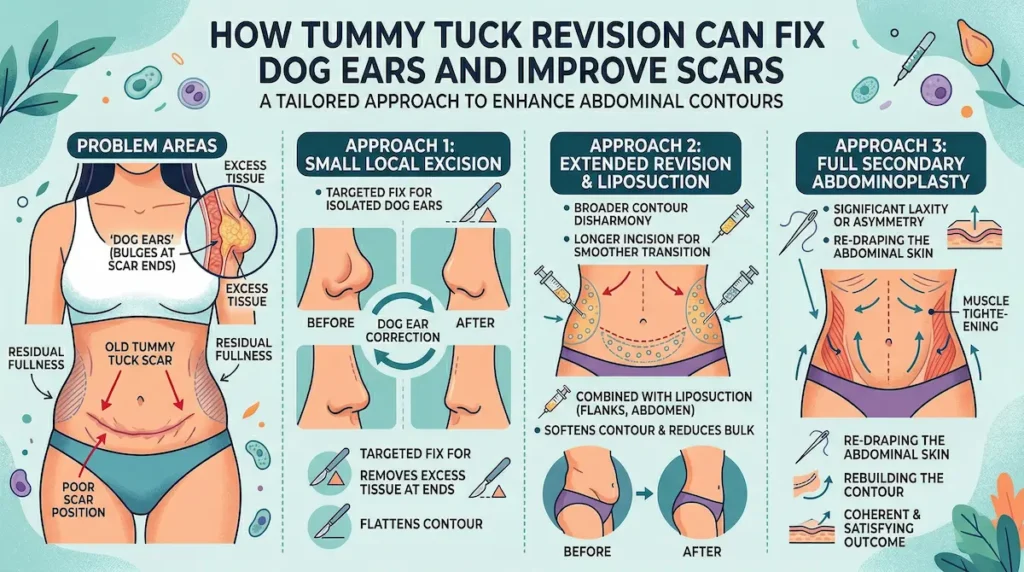
Once healing is complete and the tissues are ready, tummy tuck revision can be tailored very precisely to the problem at hand. Some patients need only a focused correction at the ends of the scar, while others need broader reshaping of the lower abdomen. The aim is not simply to cut away visible flaws, but to create a smoother transition across the entire lower abdominal contour.
Small local excision vs extended revision: choosing the right approach
For isolated dog ears, a small local excision may be enough. This involves removing the excess tissue and refining the scar line so the contour sits flatter. In selected cases, this can be a straightforward tummy tuck dog ears correction rather than a full repeat abdominoplasty.
However, when the bulging extends beyond the incision ends or the scar is poorly positioned, the revision may need to be longer. An extended correction allows the surgeon to smooth the lower abdominal line more evenly and avoid creating a new imbalance. This is why a proper assessment matters: a tiny revision is attractive in theory, but it is not the right answer if the real issue is broader contour disharmony.
When liposuction is added to improve contour and smoothness
Some patients have not only excess skin after tummy tuck surgery, but also residual fullness around the flanks, lower abdomen, or upper pubic region. In these cases, liposuction may be added to refine the result. This is particularly relevant when the scar itself is acceptable but the contour above or beside it still looks heavy or uneven.
In a carefully planned tummy tuck correction surgery, liposuction is not used aggressively for its own sake. It is used to create a more balanced silhouette and to soften transitions, especially where one side looks fuller than the other. For patients researching uneven tummy tuck result or correcting bad tummy tuck results, this combination approach is often more effective than scar excision alone.
When a full secondary abdominoplasty is more appropriate than a minor correction
A secondary tummy tuck may be the better option when the original operation left significant residual laxity, poor scar position, asymmetry across the whole lower abdomen, or unresolved muscle-related concerns. In these situations, a limited fix would only partially improve the result.
This more comprehensive form of abdominoplasty revision may involve re-opening the previous scar, re-draping the skin, removing remaining excess tissue, and rebuilding the contour more thoroughly. It is a bigger undertaking than a local scar tidy-up, but for the right patient it can deliver a far more coherent and satisfying outcome.
| Revision type | Best suited for | Typical goal |
|---|---|---|
| Local dog ear correction | Small bulges at scar ends only | Flatten the ends of the incision |
| Scar revision | Wide, uneven, or high-positioned scar | Create a finer, lower, better-healed scar line |
| Revision with liposuction | Residual fullness or contour imbalance | Smooth the abdominal transition zones |
| Full secondary tummy tuck | Major contour issues or residual laxity | Reshape the abdomen more comprehensively |
Scar Improvement Strategies Beyond Cutting Out the Old Scar
A better scar is not achieved merely by removing the old one. The quality of a revised scar depends on where it is placed, how the tissues are handled, how much tension is present at closure, and how well the healing environment is managed afterwards. This is where revision surgery becomes part technical planning, part healing strategy.
Successful scar improvement depends on subtle planning rather than simple excision alone. The surgeon must consider skin quality, blood supply, scar direction, and how the new closure will behave over time. This more thoughtful approach is what helps transform a merely acceptable scar into one that appears flatter, finer, and better positioned within the natural clothing line.
Better scar placement within the bikini or underwear line
One of the common complaints after abdominoplasty is not just that the scar is visible, but that it sits too high. Even a relatively fine scar can be frustrating if it shows above swimwear or underwear. In appropriate cases, uneven tummy tuck scar repair includes lowering or rebalancing the scar so it sits more discreetly across the lower abdomen.
That can make a meaningful difference for UK patients who want a result that works in everyday life, not only in clinic photographs. A lower, more even scar often improves confidence as much as the contour correction itself.
Reducing tension to help scars heal flatter and finer
Wound tension is one of the biggest drivers of widened or poorly healed scars. If the skin is pulled too tightly during closure, the scar may stretch, become raised, or heal unevenly. Revision surgery aims to redistribute that tension more intelligently so the new scar has a better chance of healing flat and fine.
This is one area where medical science is especially relevant. Scientific research on wound healing consistently supports careful tissue handling, tension control, and optimised blood supply as major factors in better scar outcomes. In practice, that means scar quality is shaped not only by the skin on the surface, but by the deeper closure strategy underneath.
How LLLT scar healing support may help optimise recovery and scar quality
For patients concerned about visible marks, scar support after surgery can be just as important as the operation itself. AKM Clinic offers LLLT scar healing therapy: low-level laser therapy with a 650 nm soft laser, used to support skin healing after surgery. Scar support is particularly relevant in revision cases, where the tissues have already been through one operation, and your surgeon can advise whether LLLT suits your scar. Our guide to how low-level laser therapy works on scars explains the treatment in more detail.
In practical terms, that means tummy tuck scar revision Turkey should be viewed as a process rather than a one-day event. The theatre result matters, but the weeks that follow matter as well. Better scar care, good wound support, and close monitoring all contribute to a more refined final outcome.
Revision scar work is successful when the new scar becomes less noticeable in real life, not just when it looks neater on the day of surgery.
Recovery After Tummy Tuck Revision for UK Patients
Recovery after revision surgery depends on how extensive the correction is. A small local revision for dog ears is naturally lighter than a full revision tummy tuck. Still, even limited procedures require respect for tissue healing. Patients who have already been disappointed once often need a recovery plan that is structured, realistic, and clearly explained from the outset.
What the first 7 to 14 days usually look like after revision surgery
In the first week, some swelling, tightness, and bruising are normal. If the correction is limited, discomfort is usually manageable and mobility returns relatively quickly. A broader abdominoplasty revision may involve more downtime, more careful movement, and a slower return to normal posture.
Most patients are able to walk gently soon after surgery, but they still need to avoid strain, lifting, and twisting. The early aim is to protect the repair, limit swelling, and allow the scar to settle without unnecessary tension.
Managing oedema, compression garments, movement, and sleeping position
Oedema management is especially important after any abdominal revision. Compression garments, gentle mobilisation, careful hydration, and the right sleeping position all help the tissues settle more evenly. UK patients are often very focused on practical recovery details, and rightly so, because these details influence both comfort and scar quality.
Patients are usually advised to sleep in a slightly flexed position in the early phase, avoid sudden stretching, and wear their compression garment exactly as instructed. For those having more substantial correction, disciplined aftercare can be the difference between a merely improved result and a genuinely polished one.
When you can safely fly back to the UK and resume normal daily routines
The timing of return travel depends on the scale of the surgery, how you are healing, and your surgeon’s assessment. A small correction may allow an earlier journey than a full secondary tummy tuck, but no patient should book flights based on guesswork alone. Recovery and travel planning must be personalised.
For British patients, this is where structured post-operative planning becomes crucial. AKM Clinic also offers hyperbaric oxygen therapy (HBOT) as recovery support, as described on our technology and standards page; ask your surgeon whether it is suitable for your revision. Whatever your recovery plan, the aim is to be safely flight-ready before the return to the UK, and your surgeon decides when that point is reached.
| Recovery topic | Limited revision | Full secondary tummy tuck |
|---|---|---|
| Swelling | Mild to moderate | Moderate and longer lasting |
| Mobility | Usually quicker | More gradual |
| Compression garment use | Often required | Usually essential |
| Return flight planning | Case dependent | Requires more cautious timing |
| Return to normal routines | Earlier in many cases | Slower and more structured |
Tummy Tuck Revision Cost in Turkey vs the UK
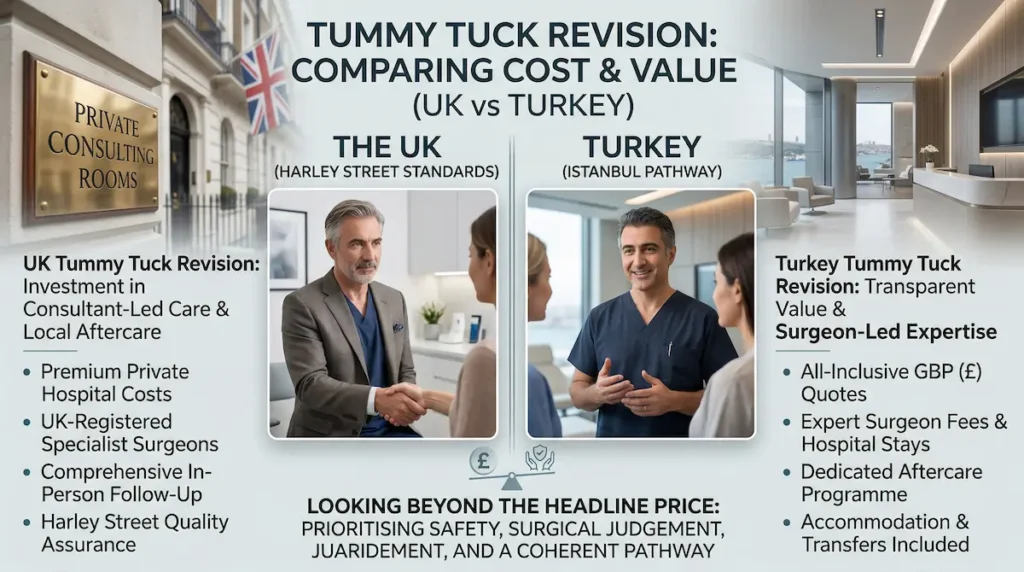
Cost matters in revision surgery, but value matters more. A revision procedure is usually more complex than a primary operation because the surgeon is working with scar tissue, altered anatomy, and tissues that have already been operated on once. For that reason, patients should compare quotes by scope, safety, aftercare, and transparency, not by headline price alone.
In revision pricing, experience often matters as much as the procedure itself. An experienced body contouring surgeon may charge more to revise a tummy tuck safely and precisely. Patients should therefore look beyond the initial figure and consider what that investment includes in terms of surgical judgement, clinic standards, post-operative care, and the likelihood of achieving a smoother, more balanced long-term result.
Why revision surgery often costs more than primary surgery
A revision tummy tuck or abdominoplasty revision is rarely a simple repeat of the original procedure. The tissues may be less predictable, scar planes can distort normal anatomy, and the surgical plan often needs more finesse than a standard primary abdominoplasty. In some cases, the operation is smaller in area but more demanding in judgement.
This is one reason why tummy tuck correction surgery can sometimes cost more than patients expect. They are not paying for “the same operation again”. They are paying for the expertise required to correct a result that did not heal or settle well the first time.
Harley Street vs Istanbul: what UK patients are really paying for
For many British patients, the real comparison is not simply Turkey versus the UK. It is often Harley Street-level private pricing versus a more accessible international option that still prioritises surgeon-led care, patient safety, and clear planning. That is why the question is not merely “Where is revision surgery cheaper?” but “Where is the overall pathway more coherent, transparent, and supportive?”
In practical terms, patients researching abdominoplasty repair Turkey are often looking for a balance of consultant-led expertise, all-inclusive organisation, and realistic value in GBP (£). The goal should never be “cheap surgery abroad”. It should be a carefully costed solution that feels safe and professionally managed from consultation through to aftercare.
What should be included in an all-inclusive GBP (£) quote
A meaningful quote for tummy tuck scar revision Turkey or secondary tummy tuck should explain exactly what is and is not included. That normally means surgeon’s fees, hospital costs, anaesthesia, accommodation where relevant, transfers where relevant, routine checks, and the structure of aftercare once the patient returns home.
For UK patients, this transparency is particularly important. A lower headline figure loses its value if it excludes essential elements such as follow-up, post-operative support, scar care guidance, or clear travel planning. A proper revision quote should feel like a medical plan, not a sales offer.
| Comparison point | UK private revision pathway | Turkey all-inclusive pathway |
|---|---|---|
| Headline pricing | Often higher, especially in premium London settings | Often more accessible for UK patients |
| Quote structure | May be itemised separately | Often presented as a bundled GBP-focused package |
| Travel and accommodation | Usually arranged independently | Often integrated into the treatment journey |
| Aftercare planning | Varies by clinic | Should be checked carefully before booking |
| Best question to ask | What exactly is covered? | What exactly is covered? |
How to Choose a Safe Revision Clinic as a UK Patient
Revision surgery should always raise the standard of questions, not lower it. Patients who are correcting an unsatisfactory result need evidence of experience, a clear treatment rationale, and a clinic structure that supports them before and after surgery. Choosing well is not about glossy marketing. It is about whether the team can explain the problem, the limitations, and the likely outcome with honesty.
Why revision body contouring requires consultant-led expertise
Correcting an uneven tummy tuck result is not merely a matter of removing a little extra skin. Revision work requires judgement about scars, soft tissue tension, contour transitions, and what can realistically be improved without creating new problems. That is why correcting bad tummy tuck results should be undertaken by a surgeon who is comfortable with secondary work rather than one who treats revision as an occasional add-on.
Consultant-led expertise matters even more when the issue seems “small”. A supposedly minor dog ear may actually reflect a broader asymmetry, poor scar design, or unresolved laxity. A surgeon who looks beyond the obvious will usually plan a better correction.
Which surgeon qualifications and hospital standards matter most
UK patients are understandably alert to standards when considering treatment abroad. They want to know who is operating, what credentials support that decision, and whether the clinical environment follows rigorous protocols. In any revision setting, those questions are entirely appropriate.
At AKM Clinic, the broader care framework is built around British-patient expectations: international hygiene protocols, CQC-equivalent medical guidelines, and a zero-compromise approach within sterile operating theatres. This kind of system matters because good revision surgery depends not only on the surgeon’s hands, but also on the standards of the environment in which the procedure is performed.
Questions to ask during your online consultation before booking abroad
A proper consultation for uneven tummy tuck scar repair or mini tummy tuck for dog ears should answer several practical points clearly. Is the issue a local correction or a full revision? Will liposuction be needed? Can the scar be lowered? How long should you stay in Istanbul? When is it safe to fly? What support is available after you return to the UK?
Patients should also ask what the surgeon believes cannot be improved. That answer is often as revealing as what can be done. In revision surgery, trust is built when the plan feels medically grounded and not over-promised.
The safest revision plan is usually the one that explains both the possibilities and the limitations with equal honesty.
Why Aftercare Matters More in Revision Cases
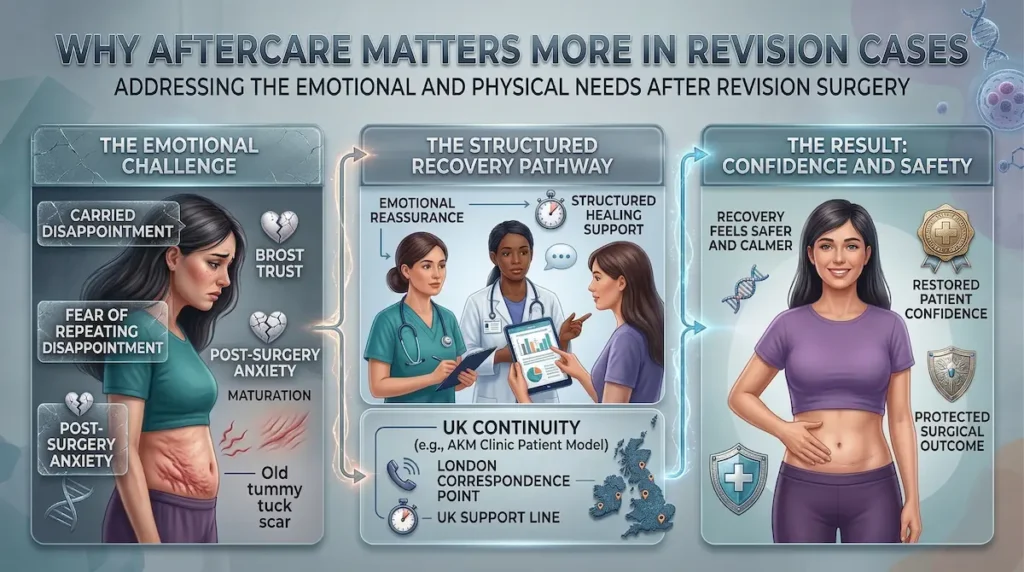
Aftercare is important after any operation, but it becomes even more significant in revision surgery. Patients coming for a second procedure are often carrying more than a physical concern. They may also be carrying disappointment, anxiety, or fear of repeating the same experience. Good aftercare helps protect both the surgical result and the patient’s confidence during recovery.
For many patients, reassurance after surgery is just as important as the technical correction itself. An experienced tummy tuck revision team must recognise the added anxiety that often comes with a second operation. Clear follow-up, prompt answers, and structured healing support can make recovery feel safer, calmer, and far more manageable from start to finish.
The emotional side of corrective surgery after a disappointing result
A patient seeking revision tummy tuck surgery is often more cautious than someone having their first operation. They may inspect every detail, worry about every asymmetry, and fear that another scar problem is developing even when healing is normal. This is not unreasonable. It is the psychology of someone who has already lost trust once.
That is why supportive communication matters. The most effective corrective care pathway is not only technically strong. It is also calm, responsive, and clear about what normal healing looks like week by week.
Why UK patients need structured follow-up after returning home
For British patients, aftercare cannot end at airport departure. Once they return home, questions often arise about swelling, scar maturation, compression garments, posture, and daily activity. In revision cases especially, these questions need timely answers because uncertainty can quickly increase stress.
This is why structured follow-up after surgery matters. UK patients often feel more secure when they know there is a defined communication route after surgery, rather than being left to interpret healing changes alone.
How AKM Clinic’s recovery approach supports reassurance, monitoring, and communication
AKM Clinic’s UK-focused patient pathway is built around continuity as well as surgery. After you return home, the Istanbul team continues to follow your recovery online, and your patient coordinator remains your direct point of contact, which helps reduce the feeling of distance. That kind of accessibility can be especially reassuring after revision surgery, when patients are naturally more vigilant about healing.
Patient experience summaries also highlight how valuable this support can feel in real life. One AKM facelift patient who flew home to Germany described the reassurance of being able to call the clinic again and again whenever a worry came up during her recovery. Although every procedure is different, the principle is highly relevant for abdominoplasty revision: aftercare is not an optional extra. It is part of the treatment itself.
For many UK patients, peace of mind after revision surgery comes from knowing they are still being followed, still being answered, and still being cared for once they are back home.
Frequently Asked Questions (FAQ): Tummy Tuck Revision
These are the questions UK patients most often ask when considering tummy tuck revision, tummy tuck scar revision Turkey, or a more comprehensive secondary tummy tuck. The answers should always be individualised during consultation, but the guidance below provides a useful starting point.
Can dog ears go away on their own after a tummy tuck?
How long should I wait before having a tummy tuck revision?
Is tummy tuck revision more painful than the first operation?
Will a revision remove my old scar completely?
Can dog ears be fixed under local anaesthesia?
How much does tummy tuck revision cost in Turkey for UK patients?
When is it safe to fly home after tummy tuck revision surgery?
If you would like to explore related options beyond this topic, you can also learn more about Scar Revision Surgery Turkey, Tummy Tuck Scar Treatment, Mini vs Full Tummy Tuck, and Diastasis Recti Repair Surgery. We also provide guidance on Mummy Makeover Recovery with Children, How to Prepare for Cosmetic Surgery, and Questions to Ask a Plastic Surgeon before booking. For patients comparing expertise and planning their journey, our resources on Specialist Plastic Surgeon Turkey, Tummy Tuck Cost in Turkey, and Online Plastic Surgery Consultation may also be helpful when considering the safest, most suitable next step for your body goals.
Medical Disclaimer: This page is provided for general educational purposes only and does not replace a face-to-face medical consultation, diagnosis, or personalised treatment plan. All surgery carries risks and outcomes vary between individuals. Suitability for revision tummy tuck surgery, procedure selection, and anaesthesia choice can only be determined after a full clinical assessment by a qualified surgeon. Always follow your clinician’s instructions and seek urgent medical attention if you develop concerning symptoms during recovery.
Related Treatments




Ready to Begin Your Own Transformation Journey?
Join the 2,000+ patients who have trusted Dr Akif Mehmetoğlu and the AKM Clinic team. Your journey to a more confident, naturally restored you begins with a simple, no-obligation conversation. Contact us today from the UK for your free virtual consultation.
#1: Get Your Free Personalised Quote
Start with a free, no-obligation online consultation. Share your photos, and our surgical team will provide a fully personalised treatment plan and a transparent, all-inclusive price package. There are no hidden fees.
#2: Secure Your Date & VIP Booking
Once you are ready, our dedicated patient coordinators will help you secure your procedure date. We will handle all your bookings, including your 5-star hotel accommodation and private VIP airport transfers.
#3: Arrive in Istanbul & Meet Your Surgeon
Arrive at Istanbul Airport (IST) and be greeted by your private driver. Settle into your hotel and prepare for your in-person consultation, where you will meet your specialist surgeon to finalise the details for your "natural, subtle, and restored" new look.