
Tummy Tuck Scar Treatment: How to Fade Your Scar
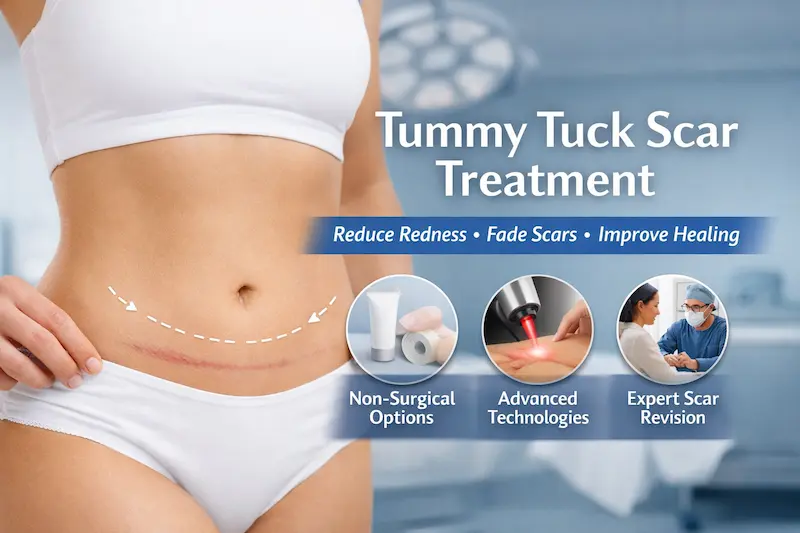
AI Summary
- Tummy tuck scar treatment works best with realistic timelines, proper aftercare, and patient-specific healing assessment.
- Low bikini line scar planning supports discreet healing and may improve old Caesarean scar placement.
- Non-surgical scar care may include silicone, massage, laser, and LLLT for smoother scar maturation.
- Consultant-led revision helps when scars remain wide, raised, high, or uneven despite home care.
AI-generated summary, fact-checked by our medical experts.
For many women, the biggest worry after abdominoplasty is not only the flatter abdominal contour, but how visible the scar may be in everyday life. That is why tummy tuck scar treatment is such an important part of the overall conversation before and after surgery. In reality, a well-planned scar should sit low, heal in stages, and become less noticeable with time, but it still requires realistic expectations, proper aftercare, and a consultant-led strategy.
Whether you are researching abdominoplasty scar treatment, wondering how to fade a tummy tuck scar, or asking if a tummy tuck over a C-section scar can improve both shape and scar placement, the key point is this: the goal is not “no scar”, but a low bikini line tummy tuck scar that matures as discreetly as possible. Medically, scar behaviour depends on several factors, including surgical technique, wound tension, skin biology, lifestyle, and the quality of scar care after tummy tuck.
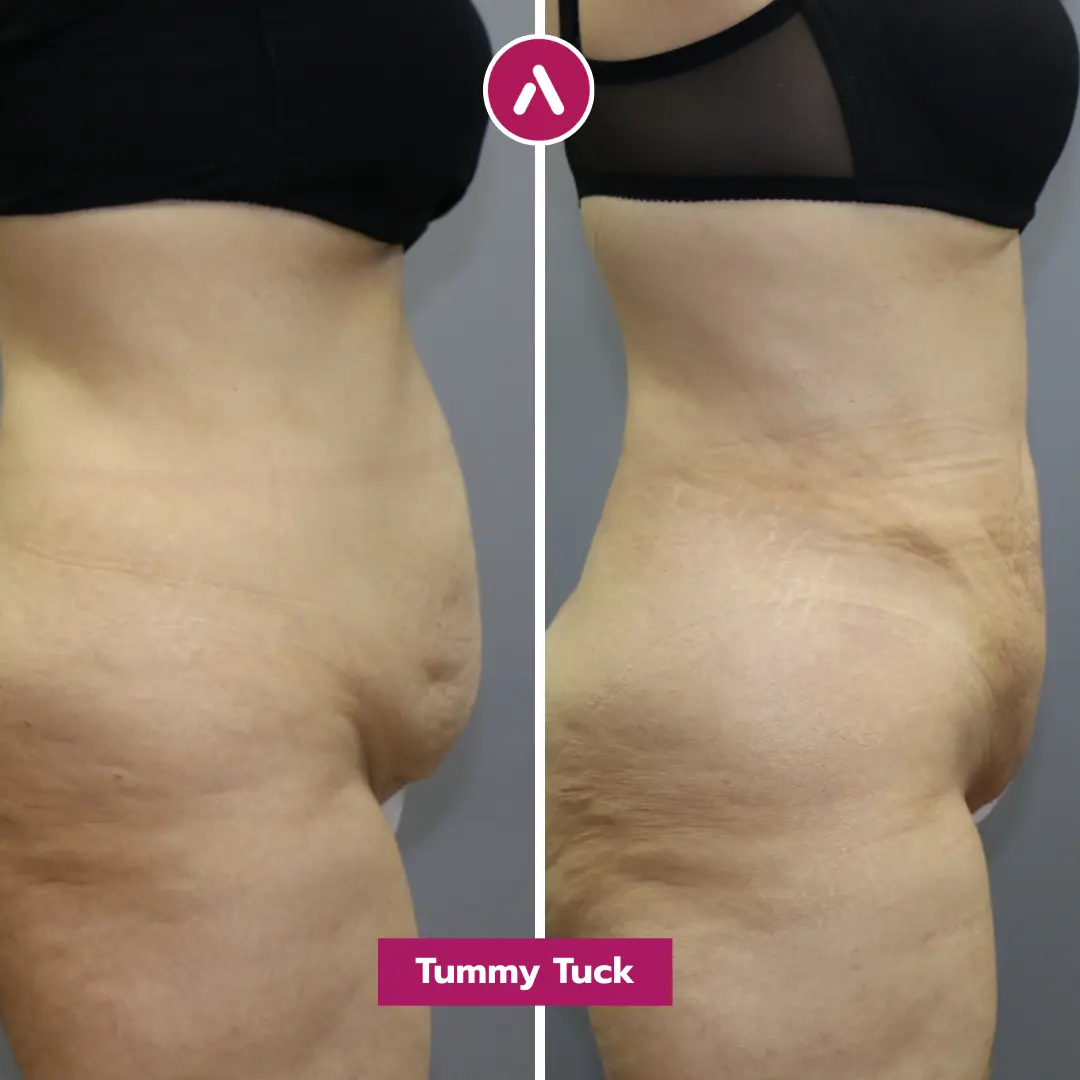
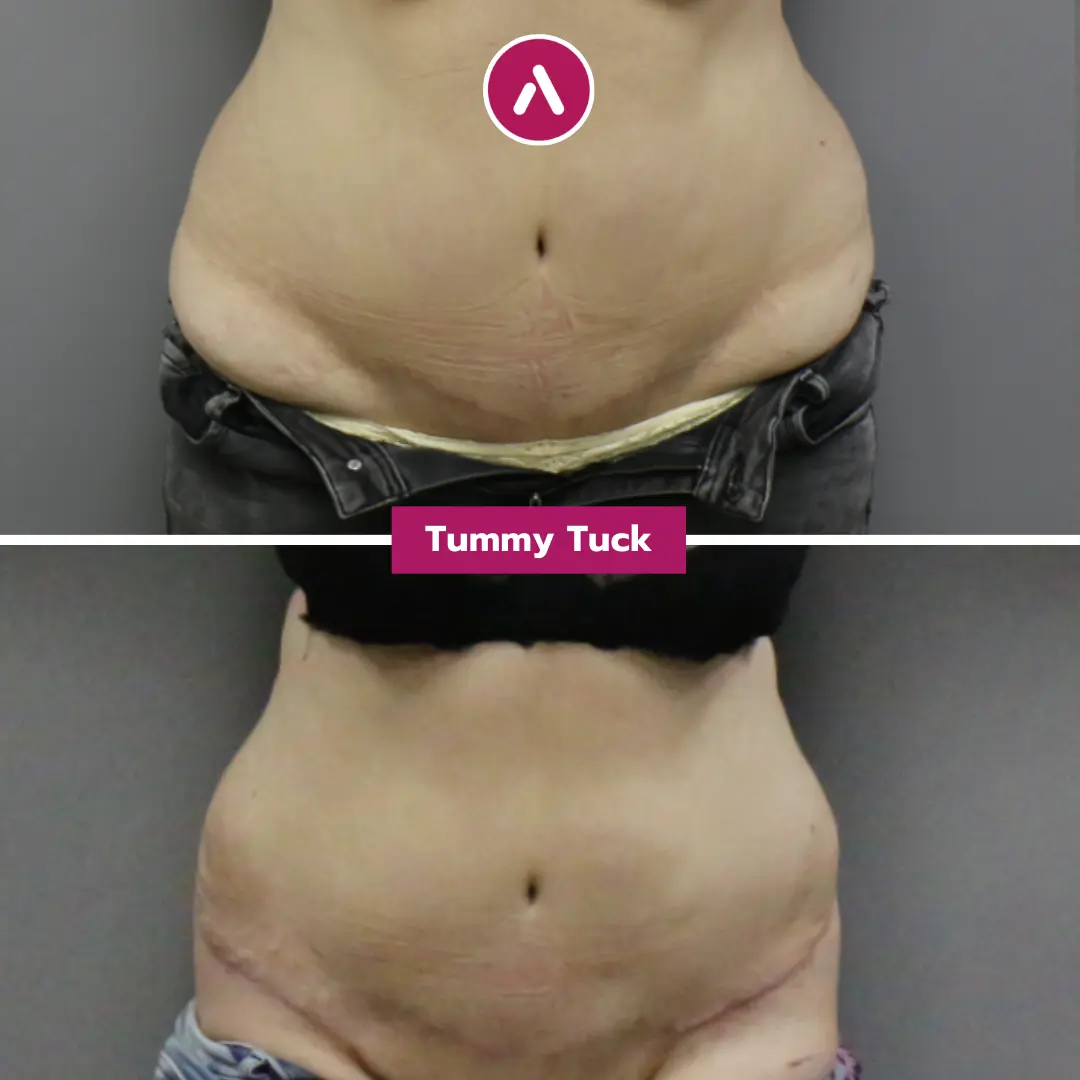
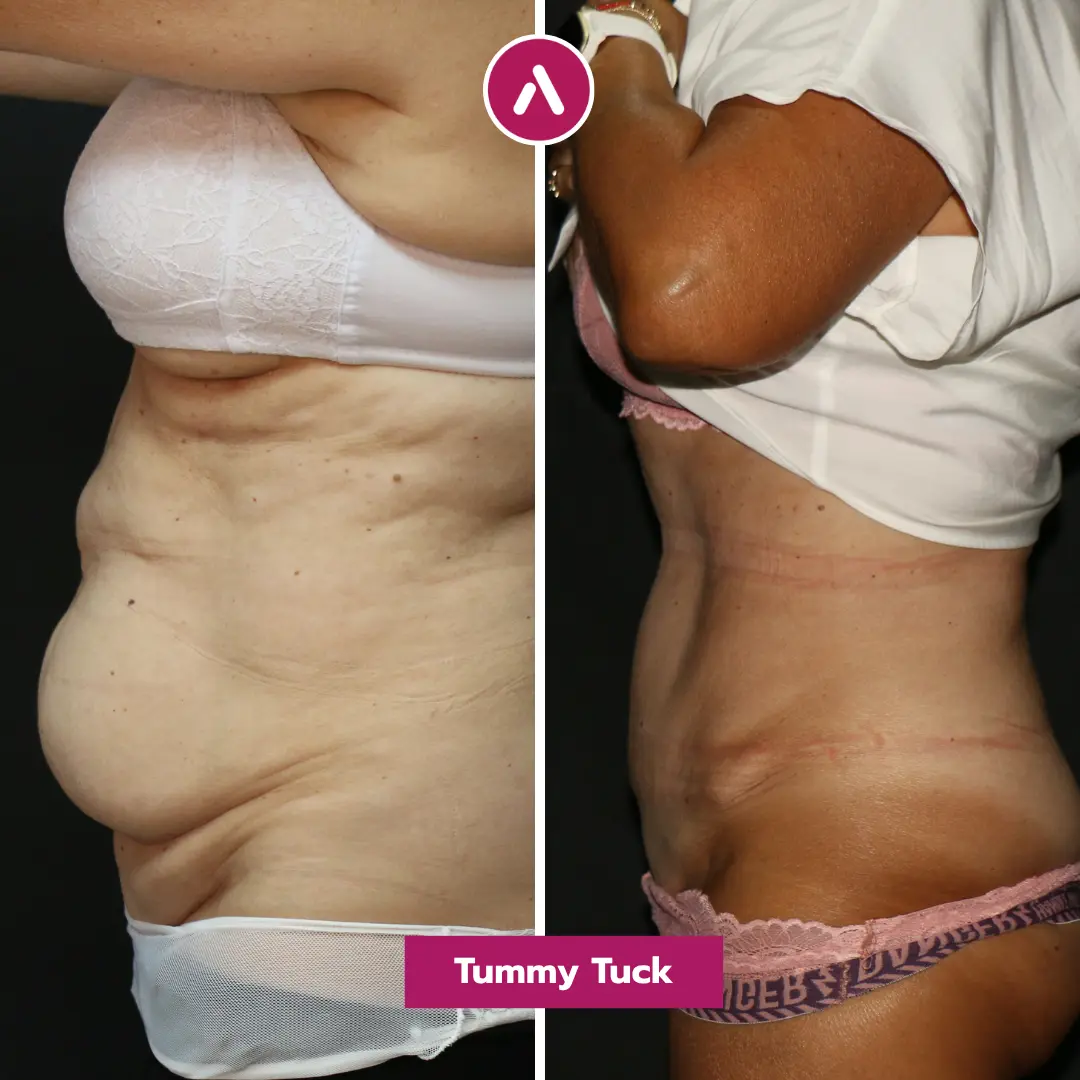
This guide explains what normal tummy tuck scar healing looks like, what influences the final result, and when non-surgical support may be enough versus when tummy tuck scar revision becomes the better option. It also addresses common UK patient concerns, including C-section pouch and scar removal, scar colour changes, firmness, itching, and the full tummy tuck scar recovery journey.
Table of Contents
What Does a Normal Tummy Tuck Scar Look Like?
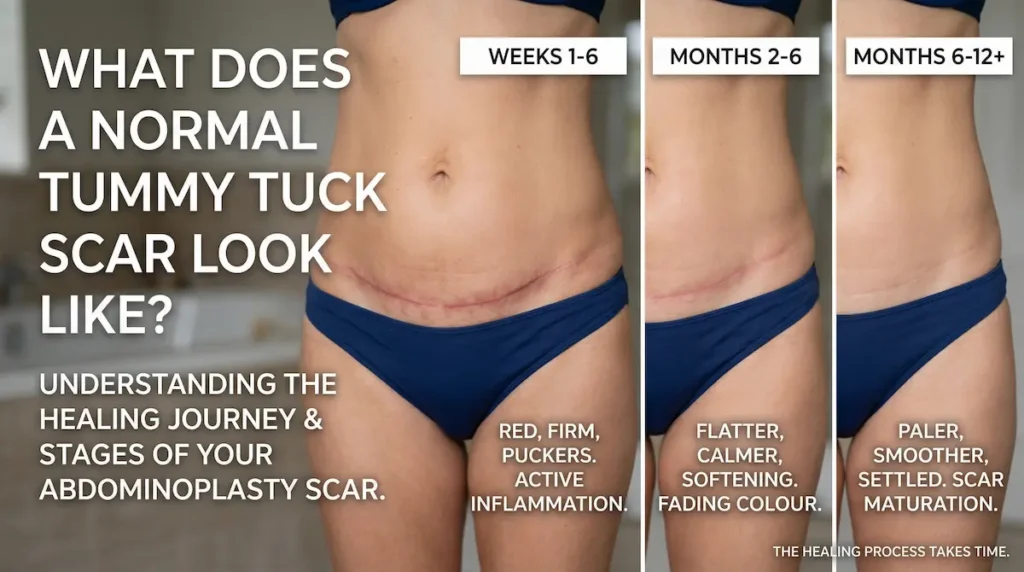
Before discussing treatments, it helps to understand what a normal scar actually looks like. Many patients become anxious because they judge the scar far too early. In the first weeks and months, it is completely normal for the incision line to appear redder, firmer, or more obvious than expected. A scar that looks prominent at six weeks may look very different at six months. Understanding the normal tummy tuck scar healing stages helps you avoid unnecessary panic and make better decisions about aftercare.
It is also worth remembering that scar appearance can vary slightly depending on the surgical technique used and how much skin was removed. For example, in a tube tummy tuck (a drainless abdominoplasty), tissue handling and wound management may influence how tight, flat, or visible the scar looks in the early phase. Even so, the same principle applies: a scar should be judged over time, not too soon after surgery.
Why a Low Bikini-Line Scar Is Usually Planned
In a standard tummy tuck, the scar is usually designed to sit low across the lower abdomen so it can be hidden beneath underwear, swimwear, or most bikini bottoms. This is why patients often search for terms such as low bikini line tummy tuck scar or discreet tummy tuck scar. The exact length and curvature depend on how much excess skin must be removed, whether muscle repair is needed, and whether there is existing asymmetry or an old Caesarean section scar.
A well-positioned scar is not a cosmetic accident; it is part of the surgical plan from the beginning. During pre-operative marking, your surgeon should think not only about skin removal, but also about where the final line will sit once swelling settles and the tissues relax. If the scar is placed too high, even excellent healing may still leave a result that is difficult to hide. If it is placed thoughtfully, the scar may still exist, but it tends to feel far easier to live with in everyday clothing.
For women who have had previous lower abdominal surgery, including a C-section, scar placement becomes even more important. In some cases, a tummy tuck over a C-section scar allows the previous scar to be incorporated into the new incision so that the final scar sits in a cleaner, lower, and often more flattering position.
How a Tummy Tuck Scar Changes from Red to Pale Over Time
One of the most reassuring things for patients to know is that scar appearance changes slowly, not overnight. Early on, the line often looks pink, red, or slightly darker than the surrounding skin. Later, it usually becomes flatter and paler. This gradual transition is a core part of normal tummy tuck scar healing. The scar you see at one month is not the scar you should expect at nine or twelve months.
In broad terms, the body first closes and strengthens the wound, then gradually remodels the collagen within the scar. That remodelling phase can take many months. Both clinical experience and scientific research support the idea that scar maturation is a long process, which is why experienced surgeons advise patience before judging the final appearance. Rushing into aggressive treatments too early can sometimes irritate tissue that is still settling.
Colour also changes over time. Some scars begin quite red and then fade. Others become temporarily darker before lightening. In patients prone to pigmentation changes, sun exposure can make the line appear more obvious for longer, which is why sun protection matters so much in the first year.
What Is Normal in the First Few Months: Firmness, Itching and Colour Changes
Patients are often surprised that a healing scar can feel hard, slightly raised, itchy, or numb in places. In many cases, this is normal. A scar may feel thick before it softens. Itching is common during healing, and temporary numbness around the lower abdomen can also occur as small nerves recover. Mild unevenness along the line does not always mean something has gone wrong.
What usually matters more is the overall pattern. A line that is gradually settling, softening, and becoming less inflamed is generally following a normal course. On the other hand, increasing redness, worsening pain, significant heat, fluid leakage, or a scar that becomes increasingly raised may need review. Patients should be careful not to confuse normal healing signs with true complications.
This is where realistic education becomes important. Many people searching for how to fade a tummy tuck scar are actually looking at a scar that is still in its early, active phase. At that point, the best step is often not panic, but structured follow-up and appropriate scar care after tummy tuck.
| Healing stage | What the scar may look like | What is usually normal |
|---|---|---|
| Weeks 1-6 | Red or pink, slightly firm, sometimes puckered | Early inflammation, tightness, mild itching, visible line |
| Months 2-6 | Still noticeable but usually flatter and calmer | Gradual softening, improving colour, less tenderness |
| Months 6-12 | Paler, smoother, more settled | Scar maturation continues and the final look becomes clearer |
These stages vary from one patient to another, but they help explain why the full tummy tuck scar recovery process cannot be judged too early. A scar needs time, protection, and consistent care before its final appearance can be assessed properly.
What Affects How Well a Tummy Tuck Scar Fades?
Not every scar heals in exactly the same way, even when the operation is performed correctly. Some patients heal with a very fine line, while others are more prone to redness, thickness, or pigmentation. If you want to understand how to fade a tummy tuck scar, it is essential to look beyond creams alone. The final result depends on what happens in theatre, what happens in the weeks after surgery, and how your own skin responds biologically over time.
It is also important to remember that scar behaviour is influenced by the type of abdominal procedure performed and the extent of tissue tightening required. The way fluid is managed and the tissues are closed, for instance, may affect early swelling, tension, and overall scar appearance. This is why two patients can follow good aftercare and still experience slightly different scar fading patterns.
Surgical Technique, Tension Control and Incision Placement
The first stage of effective abdominoplasty scar treatment actually begins during the operation itself. Scar quality is influenced by how gently tissue is handled, how well bleeding is controlled, how the wound is closed, and how much tension sits across the incision. A scar placed under excessive tension is more likely to widen or heal less neatly than one that is closed with careful support across multiple layers.
Incision placement matters just as much. A scar may technically heal well, but if it sits too high or follows an awkward line, patients may still find it difficult to hide. This is why the idea of a discreet tummy tuck scar starts with planning, not with post-operative products. A well-designed low scar, combined with thoughtful closure, gives the best possible foundation for later scar fading.
Previous abdominal scars can also change the plan. In women asking about a tummy tuck over a C-section scar, the surgeon may be able to remove or incorporate the older scar into the new line. When done appropriately, this can improve both contour and scar position, particularly in patients interested in C-section pouch and scar removal after pregnancy.
Skin Type, Smoking, Sun Exposure and General Healing
Your skin biology plays a major role in scar behaviour. Some people naturally heal with faint, flat lines, while others are more prone to prolonged redness, post-inflammatory pigmentation, or raised scars. This does not automatically mean surgery was poorly performed; it often reflects how the body builds and remodels collagen.
Smoking is one of the clearest negative factors. Nicotine reduces blood flow to healing tissues and may impair wound quality, which in turn can affect the final appearance of the scar. Poor nutrition, uncontrolled health conditions, and inconsistent rest can also slow normal tissue repair. Even something as simple as repeated friction from clothing or ignoring your garment instructions may irritate a still-maturing incision.
Sun exposure is another major issue. Fresh scars can darken more easily than normal skin, particularly during the first several months. If a healing line is repeatedly exposed to ultraviolet light, the scar may remain more visible for longer. For UK patients travelling home after surgery, this still matters during holidays abroad or when wearing lower-rise clothing in sunny weather.
Why Early Aftercare Matters More Than Most Patients Realise
When patients think about scar improvement, they often jump straight to advanced treatments such as laser treatment for a tummy tuck scar. While laser may be appropriate in selected cases later on, the early phase is often more important than people realise. Good scar care after tummy tuck usually begins with protecting the incision, following garment advice properly, avoiding unnecessary strain, and starting topical scar support only when the wound is fully ready.
Silicone-based products are commonly used once the incision has healed sufficiently on the surface, because they help create a stable environment for scar maturation. Gentle scar massage may also be advised later, depending on how the wound is settling. However, timing matters. Starting too soon, or using harsh products on an incompletely healed incision, may do more harm than good.
Early aftercare also includes monitoring for small problems before they become larger ones. A wound that stays irritated, repeatedly rubs, or develops prolonged inflammation is less likely to mature into a fine line. This is one reason why structured follow-up matters so much in the overall tummy tuck scar recovery process. The best results usually come from a combination of sound surgery, patient compliance, and early intervention when healing is not following the expected pattern.
Put simply, the question is not only what cream should I use? but also how well was the scar planned, how carefully am I healing, and am I getting the right guidance at the right time? That broader view is what leads to smarter, safer, and more effective scar management.
Non-Surgical Tummy Tuck Scar Treatment Options
Not every scar concern requires surgery. In many patients, the best tummy tuck scar treatment is a structured non-surgical plan introduced at the right stage of healing. The aim is usually to help the scar mature more smoothly, reduce persistent redness, improve texture, and support a flatter, paler final line. For patients researching abdominoplasty scar treatment, it is important to understand that non-surgical options work best when chosen according to the scar’s age, behaviour, and appearance rather than used randomly.
In practical terms, the right treatment depends on whether the scar is still early and active, thick and raised, widened, darkened by pigmentation, or simply taking longer than expected to settle. This is why experienced clinicians do not treat all scars in the same way. The goal is not to “erase” the line, but to improve quality, reduce visibility, and support more favourable tummy tuck scar healing over time.
Another important point is that non-surgical planning should always take the original procedure into account. Details such as tissue handling, fluid management, and closure technique may influence how the scar settles in the weeks that follow. This is why effective scar treatment is never fully generic; it should be matched to both the scar’s current appearance and the surgical method used.
Silicone Sheets, Silicone Gel and Scar Massage
For many patients, first-line scar care after tummy tuck begins with silicone-based products. Silicone sheets and silicone gel are commonly recommended once the incision is fully closed and surface healing is stable. They help maintain hydration at the scar surface and can support a softer, flatter scar as it matures. In uncomplicated cases, this may be one of the simplest and most effective starting points for patients asking how to fade a tummy tuck scar.
Scar massage may also become useful later, particularly when the line feels firm, tethered, or slightly lumpy. However, technique and timing matter. Massage should not be started on an incompletely healed incision, and aggressive rubbing is not better. Gentle, consistent work is usually more helpful than over-treating the area. This is one reason why clear aftercare advice matters so much in the early months of tummy tuck scar recovery.
Topical treatment alone will not solve every scar issue, but it often forms the foundation of a sensible plan. When the scar is basically healthy and simply needs time plus support, silicone and massage may be enough to guide better maturation without moving to more advanced treatments too quickly.
When Laser, Microneedling or Steroid-Based Treatments May Be Considered
Some scars need more than home care. If the line remains persistently red, raised, thick, or texturally irregular, your clinician may discuss options such as laser treatment for a tummy tuck scar, microneedling, or steroid-based injections. These are not one-size-fits-all solutions; each has a role depending on the type of scar being treated.
Laser-based treatment is often considered when redness remains prominent or when the scar needs help blending more evenly with surrounding skin. Microneedling may be discussed later for texture irregularities in selected cases. Steroid-based treatments are more commonly reserved for scars that are becoming hypertrophic or unusually raised. The key point is that the treatment should match the scar pattern rather than follow a trend.
In clinical practice, these approaches are most useful when introduced at the correct point in the healing timeline. Using them too early can irritate tissue that is still actively repairing itself, while using them too late may delay progress unnecessarily. A consultant-led review helps identify the right window.
How LLLT Scar Healing Therapy Supports Smoother Scar Maturation
For patients who want a more advanced recovery strategy, low-level laser technology may offer an additional layer of support. At AKM Clinic, LLLT scar healing therapy is used as part of a broader healing-focused approach. The purpose is to support tissue recovery, encourage a smoother healing response, and help minimise scar visibility as the line matures.
In simple terms, this type of light-based support is designed to stimulate cellular activity involved in repair. Scar quality is closely linked to how collagen is laid down and remodelled over time. Treatments that support balanced healing may therefore be useful in patients who want to optimise recovery rather than wait passively for months without guidance.
LLLT is not a magic shortcut, and it does not mean a scar becomes invisible. What it can do, in appropriate cases, is support the environment in which healing takes place. For UK patients especially, this can be reassuring because it shows that scar management is being considered as part of the total aftercare plan, not as an afterthought once they have already returned home.
| Non-surgical option | Best suited for | Main aim |
|---|---|---|
| Silicone gel or sheets | Early to mid-stage scar maturation | Support hydration, flattening and smoother healing |
| Scar massage | Firm or slightly tethered scars once healed | Improve softness and mobility |
| Laser-based treatment | Persistent redness or visible scar quality issues | Improve colour and blend |
| Microneedling | Selected texture irregularities | Refine surface quality |
| Steroid-based treatment | Raised or hypertrophic scars | Reduce thickness and overactive scarring |
| LLLT support | Patients seeking enhanced healing support | Promote smoother scar maturation |
Can a Caesarean Scar Be Improved During a Tummy Tuck?
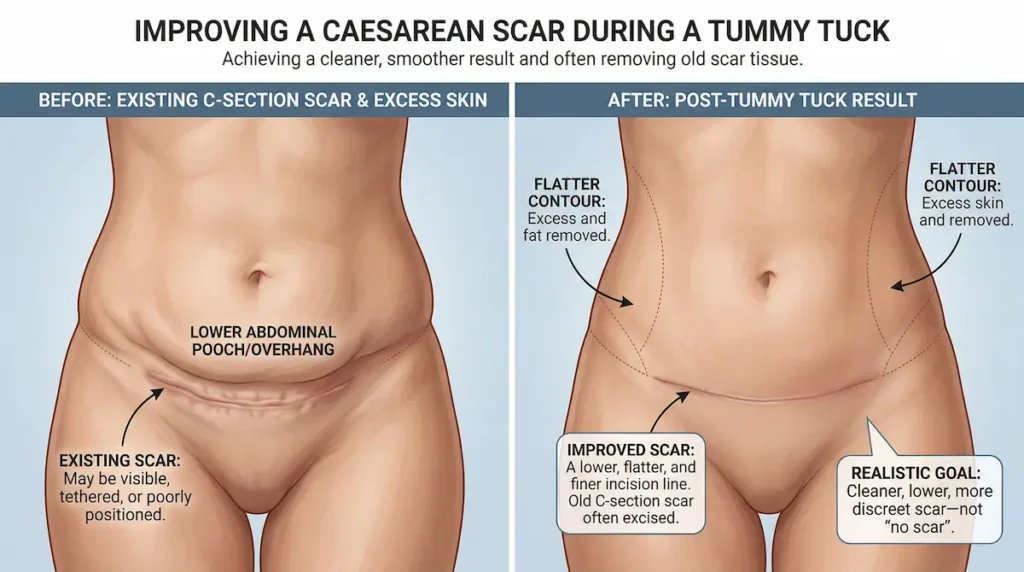
This is one of the most common questions from women who have had children. Many patients are not only concerned about the shape of the lower abdomen, but also about an old C-section line, tethering, or a persistent lower abdominal bulge. In those cases, a tummy tuck may offer more than contour improvement. It may also help address the position and quality of the old scar. For patients researching a tummy tuck over a C-section scar or C-section pouch and scar removal, the answer is often yes, but only after proper assessment.
What matters most is understanding what can realistically be improved. A tummy tuck may allow the old Caesarean scar to be removed, replaced, lowered, or incorporated into a better-planned line. However, this depends on scar position, skin excess, tissue quality, and whether the existing scar sits within the skin that will be excised. The aim is often a cleaner, lower, more balanced final result rather than the complete disappearance of all evidence of previous surgery.
It is also worth noting that surgical planning can influence how effectively an old scar is improved. The approach to lower abdominal tissue management and closure may help create a smoother contour while allowing the final scar to sit in a more favourable position. For many mothers, the goal is not perfection, but a lower, neater, and more balanced result that feels easier to live with day to day.
Combining a C-Section Scar with the Abdominoplasty Incision
In many women, the previous Caesarean scar lies in the same general lower abdominal region as the future tummy tuck incision. This means that the surgeon may be able to design the new operation so the old scar is included within the excised tissue or incorporated into the final closure. That is why a tummy tuck over a C-section scar comes up so often in patient research.
When this is possible, the benefit is not merely aesthetic. A single lower, smoother, better-planned scar may feel easier to conceal and psychologically easier to accept than a poorly positioned or uneven old line. It can also help create a more harmonious lower abdominal contour when scar tethering has been contributing to a visible fold or step.
That said, not every Caesarean scar can be treated in exactly the same way. Some are already low and heal well, while others are thick, indented, asymmetrical, or sitting above a lower abdominal “shelf”. The exact surgical plan must be tailored to the individual rather than assumed from online photos alone.
When Old Scar Tissue Can Be Excised Rather Than Simply Covered
One of the biggest misconceptions is that tummy tuck surgery merely “covers” a C-section scar. In many suitable patients, the better description is that some or all of the old scar tissue can actually be removed as part of the skin excision. This is particularly relevant for women researching C-section pouch and scar removal, especially when the old scar is associated with a lower abdominal overhang or a visible contour break.
If the old scar sits within the skin that will be removed, excision may allow a fresh closure in a more controlled position. That does not mean the patient ends up with no scar at all; it means the old scar may be exchanged for a new scar that is often lower, cleaner, and more aesthetically planned. For many women, that is a meaningful upgrade in both appearance and confidence.
In other cases, complete excision of the old scar may not be possible, but the area can still be improved. The final answer depends on how much redundant skin is present, how high the original scar sits, and whether there are additional issues such as muscle separation, laxity, or previous wound healing problems.
Realistic Expectations: Fading, Flattening and Better Placement — Not “No Scar”
Perhaps the most important part of this discussion is expectation management. Patients who feel frustrated by an old Caesarean scar sometimes hope a tummy tuck will leave the abdomen completely scar-free. Ethical surgical counselling should never promise that. What a tummy tuck can often offer is a more refined scar, better placement, flatter contour, and improvement in the lower abdominal shape that made the previous scar look more obvious.
A realistic scar goal is not invisibility, but improvement: lower placement, smoother healing, less tethering, and a scar that becomes easier to hide as it matures.
This is especially relevant for women who are comparing a visible old scar with the possibility of a low bikini line tummy tuck scar. A well-planned abdominoplasty scar may still be longer, but if it sits lower, heals better, and improves the abdominal contour at the same time, many patients feel it is a worthwhile trade.
For that reason, patients should think in terms of overall improvement rather than a single-line comparison. Contour, symmetry, skin excess, and scar position all interact. When the abdomen looks flatter and the scar is more discreetly placed, the total aesthetic result often feels far more balanced than before surgery.
When Is Scar Revision Better Than Creams or At-Home Treatments?
Most scars improve with time and sensible aftercare, but not all scars settle as hoped. Some remain too wide, too raised, too indented, or too awkwardly positioned to respond fully to creams and home measures alone. This is when the conversation shifts from routine scar support to tummy tuck scar revision. The challenge is knowing when patience is still appropriate and when a more active corrective plan will produce a better outcome.
It is also important to consider how the original operation was performed before deciding on revision. Closure technique, tissue tension, and early healing patterns, for example, may influence whether a scar continues to improve naturally or has reached a point where further progress is limited. This is why revision decisions should be based on careful assessment, not frustration alone.
Scar revision is not simply about making a scar shorter or prettier. In some cases, it is about correcting tension problems, contour irregularities, asymmetry, dog ears, or tethering that affects how the whole lower abdomen looks. In other words, revision may be functional as well as cosmetic. The best candidates are usually those whose scars have matured enough to be judged properly and whose concerns are unlikely to improve much further with conservative care alone.
Widened Scars, Raised Scars and Uneven Healing
A scar that becomes obviously widened may indicate that tension, healing quality, or tissue support was not ideal during recovery. A scar that is thick or raised may reflect a more active scarring response. Uneven healing can also leave areas that are flatter in some sections and more visible in others. These are common reasons patients begin to ask whether home care is enough.
At this stage, conservative measures may still have a role, particularly if the scar is still maturing. However, once the line has had adequate time and remains clearly suboptimal, tummy tuck scar revision may offer a more meaningful improvement than repeatedly changing creams. The decision depends on how stable the scar is, how long it has been since surgery, and whether the issue is mainly colour, thickness, width, or shape.
Importantly, revision should be based on the scar’s actual problem. A red scar and a wide scar are not the same issue. A raised scar and a badly positioned scar are not the same issue either. Good revision planning starts with accurate diagnosis, not guesswork.
Dog Ears, Asymmetry and Poorly Positioned Incisions
Some of the most frustrating post-tummy tuck concerns are not about the scar line itself, but what happens at the ends or around it. “Dog ears” are small puckers or bulges that can remain at the outer edges of the incision. Asymmetry may make one side sit higher or heal differently from the other. In some patients, the scar may simply be too high to qualify as the discreet tummy tuck scar they expected.
These problems are often less responsive to topical care because the issue is structural rather than purely superficial. No gel can reposition a scar that sits too high, and no massage can fully correct a persistent dog ear caused by excess tissue. In such cases, revision may be the more rational option, particularly when the scar has already matured and the concern is clearly unlikely to resolve on its own.
For UK patients, this is a particularly important distinction. Many people spend months trying home treatment because they hope to avoid another procedure, when in fact the real issue may be incision design, contour imbalance, or residual excess tissue. A careful review can prevent wasted time and unrealistic expectations.
Why Consultant-Led Revision Planning Matters After Previous Surgery
Revision work should never be treated casually. Tissue that has already been operated on may contain scar tissue, altered blood supply, and less predictable healing behaviour than untouched skin. That is why consultant-led planning matters so much when discussing tummy tuck scar revision. A proper assessment should look not only at the scar, but also at the surrounding contour, tissue quality, old operative history, and the patient’s healing pattern.
This matters even more when the patient has had multiple lower abdominal procedures, including Caesarean delivery, previous abdominoplasty, liposuction, or wound healing issues. Revision in these cases is about judgement as much as technique. The goal is not to repeat surgery for the sake of it, but to intervene only when the likely benefit outweighs the additional recovery.
From a patient’s perspective, one of the most valuable parts of a consultant-led review is clarity. You should be told honestly whether your scar is still evolving, whether a non-surgical option is worth trying first, or whether surgery is the only realistic route to meaningful improvement. That kind of honesty is central to safe aesthetic care.
| Concern | May improve with conservative care? | May need revision? |
|---|---|---|
| Red but otherwise flat scar | Often yes | Usually not initially |
| Firm early scar | Often yes, with time and support | Usually not early on |
| Wide mature scar | Limited improvement | Often worth discussing |
| Raised mature scar | Sometimes partly | Depends on scar type |
| Dog ears | Rarely fully | Often yes |
| Scar positioned too high | No | Often the main solution |
| Persistent asymmetry | Sometimes slightly | Often worth assessing |
Tummy Tuck Scar Healing Timeline: Month by Month
One of the most helpful ways to reduce scar anxiety is to understand the timeline properly. Many patients start searching for tummy tuck scar treatment very early, often while the scar is still behaving exactly as a fresh surgical scar is expected to behave. In reality, tummy tuck scar healing is a staged process. The scar changes in colour, texture, firmness, and visibility over many months, not just a few weeks. Knowing the normal tummy tuck scar healing stages makes it easier to judge progress sensibly and avoid overtreating a scar that still needs time.
Weeks 1–6: Early Healing, Dressings and Compression Garments
In the first few weeks, the priority is wound protection rather than appearance. The incision is still in its early healing phase, so the scar may look red, slightly swollen, and more obvious than patients expected. Mild itching, tightness, and firmness are common at this stage. This early phase of tummy tuck scar recovery is not the time to panic about final scar quality.
Dressings, hygiene, and correct use of the compression garment matter greatly during this period. Too much friction, moisture, strain, or premature use of unsuitable creams may irritate the wound. Patients should also be careful with movement, especially in the first days and weeks, because tension across the incision can affect how the scar settles later.
At this stage, the best scar care after tummy tuck is usually simple, structured, and protective. The goal is to support uncomplicated closure first. Appearance comes later.
Months 2–6: Scar Flattening, Reduced Redness and Colour Changes
From around the second month onwards, the scar often begins to settle more visibly. Redness may slowly reduce, the line may soften, and the scar may become flatter, although it is still usually noticeable. This is often the stage when patients begin silicone gel, silicone sheets, or scar massage, depending on how the incision has healed and what their clinician advises.
This middle stage is also when some patients start to ask whether laser treatment for a tummy tuck scar might help. In selected cases, that can be worth discussing, especially if redness remains prominent or the scar is maturing unevenly. However, the scar is still actively remodelling during these months, so any intervention should be chosen carefully.
For patients wondering how to fade a tummy tuck scar, this is usually the phase in which consistency matters most. Regular aftercare, patience, and protection from sun exposure often make more difference than repeatedly changing products.
Months 6–12: Final Scar Maturation and When to Judge the Result Properly
Between six and twelve months, the scar usually reaches a more mature appearance. It often becomes paler, flatter, and less inflamed. In many patients, this is the first point at which the final direction of healing becomes clear. That is why ethical surgeons advise patients not to judge the result too early unless there is a specific concern that needs review sooner.
If the scar is still too red, too wide, too raised, or badly positioned at this point, more focused treatment may be discussed. This might include non-surgical options or, in selected mature cases, tummy tuck scar revision. Timing matters because a scar that is still improving naturally should not be revised unnecessarily.
For most patients, the key message is reassuring: a scar that looks quite obvious in the first months can still improve substantially with time. The full story of abdominoplasty scar treatment is almost always measured in months rather than days.
| Time period | Typical scar appearance | What patients should focus on |
|---|---|---|
| Weeks 1-6 | Red, firm, slightly swollen, very visible | Protection, dressings, garment use, gentle healing |
| Months 2-6 | Flatter, calmer, still pink or red | Consistency with aftercare and scar support |
| Months 6-12 | Paler, softer, more mature | Assess final direction and decide if extra treatment is needed |
How AKM Clinic Supports Better Scar Outcomes for UK Patients
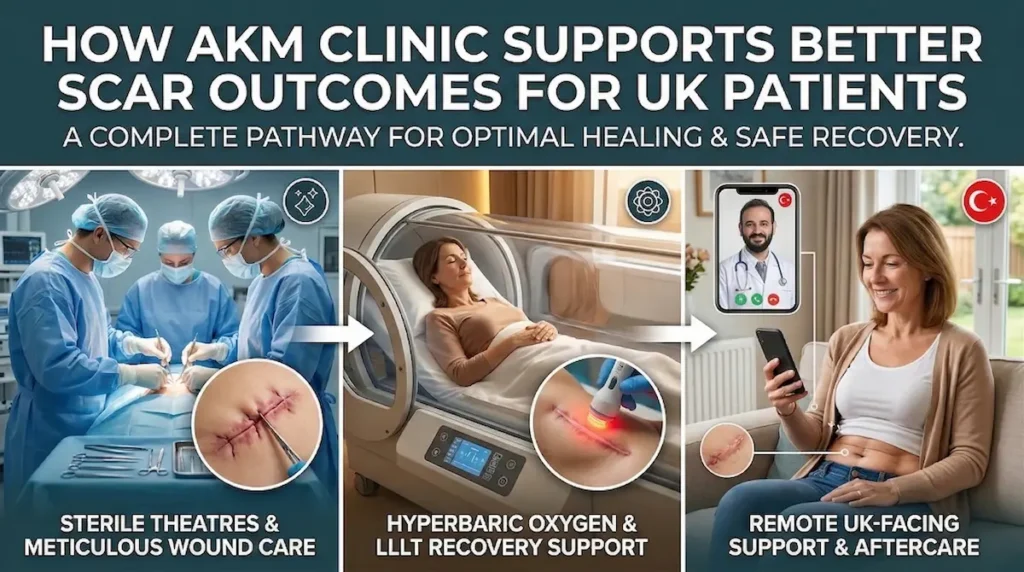
Scar quality is not determined by one cream or one appointment. It is shaped by the whole treatment pathway: surgical planning, tissue handling, sterile conditions, recovery support, and what happens after the patient returns home. For UK patients especially, this matters because one of the greatest fears about surgery abroad is not only the operation itself, but what happens afterwards. A scar tends to heal better when the entire process is organised around safe recovery rather than rushed discharge.
It is also worth noting that procedure-specific planning can shape healing expectations from the outset. Careful wound management, tissue handling, and a structured recovery pathway may help support smoother scar maturation over time. For UK patients, this is particularly reassuring, as better scar outcomes are rarely the result of one product alone, but of consistent care before, during, and after surgery.
British-Standard Hygiene, Sterile Operating Theatres and Structured Aftercare
Good scar outcomes start with fundamentals. Meticulous hygiene, careful wound closure, and a structured recovery pathway all contribute to better healing conditions. A scar may never be completely invisible, but it is far more likely to mature well when surgery is performed in a properly controlled environment and followed by organised aftercare rather than improvised advice.
For British patients, this point matters psychologically as much as medically. Many are not simply searching for lower prices; they want reassurance that standards, cleanliness, and follow-up are taken seriously. When a clinic treats scar quality as part of the full care pathway, patients feel safer and better supported throughout tummy tuck scar recovery.
That is also why patients should ask not only about the operation, but about theatre standards, wound monitoring, and what support exists once they are back in the UK. Scar care is a process, not an afterthought.
HBOT and LLLT as Part of a Recovery-Focused Scar Strategy
Advanced recovery support can make a meaningful difference to how patients experience the early healing period. At AKM Clinic, Hyperbaric Oxygen Therapy and low-level laser support are positioned as part of a recovery-focused strategy rather than cosmetic extras. The goal is to support tissue repair, reduce recovery stress, and help the scar mature under better conditions.
HBOT is used to help reduce post-operative oedema and support lymphatic drainage, which may improve comfort and help recovery feel smoother overall. LLLT is used to support wound healing and scar maturation, particularly for patients who are worried about visible marks after body contouring surgery. In practical terms, these technologies fit the needs of UK patients who want to become “flight-ready” safely and return home with a clear aftercare structure in place.
In a scar-focused pathway, the value of these technologies is not that they promise perfection. Their value lies in supporting a calmer, more controlled healing environment, which is exactly what patients want when searching for a more discreet tummy tuck scar.
UK Support Line, London Correspondence Support and Remote Follow-Up After Returning Home
For many British patients, reassurance does not end when they leave Istanbul. One of the strongest trust signals in international care is knowing there is still a communication pathway once they are back home. This is especially important for patients monitoring a healing scar, because even normal changes can create anxiety if there is no reliable route for follow-up.
Remote follow-up, direct messaging, and a UK-facing support structure can make the recovery period feel much less isolating. Instead of wondering whether redness, firmness, or delayed fading is normal, patients can share updates and receive guidance within an organised system. That continuity matters when discussing scar care after tummy tuck because good advice is often about timing and observation, not just product recommendations.
UK patient reassurance matters: one patient story from the clinic describes recovery as comfortable enough to require minimal paracetamol, while another highlighted the value of ongoing contact through the UK support route after returning home.
For an expert patient, this kind of continuity can be just as persuasive as the operation itself. Real support after surgery often shapes whether the overall journey feels safe, professional, and worth recommending to other patients in the UK.
Choosing a Safe Clinic for Tummy Tuck Scar Treatment
When patients search for tummy tuck scar treatment, they are often already feeling vulnerable. Some are worried because their scar is still early and unfamiliar. Others are genuinely unhappy with a mature scar, high incision, widening, or dog ears. In both situations, choosing the right clinic matters more than choosing the most dramatic promise. Ethical scar treatment starts with honest assessment, realistic expectations, and a clear explanation of what can and cannot be improved.
Why No Ethical Surgeon Should Promise “Scarless” Surgery
Any clinic promising “scarless” tummy tuck surgery should immediately raise concern. A tummy tuck, by definition, removes skin and tightens tissue through an incision. That means a scar is unavoidable. The real question is not whether there will be a scar, but whether it can be planned well, supported properly, and improved if necessary.
Patients looking for a low bikini line tummy tuck scar or a more discreet tummy tuck scar should be wary of marketing that sounds too absolute. Honest surgeons speak in terms of improvement, concealment, and scar maturation. They do not pretend that major body contouring surgery leaves no trace.
That honesty is actually a good sign. It shows the clinic respects the patient enough to discuss reality, not fantasy. In scar management, realism is part of safety.
What UK Patients Should Ask About Scar Placement, Revision Policy and Healed Photos
Patients in the UK often research deeply before committing to treatment, and rightly so. A proper consultation should include a discussion about scar position, expected length, the possibility of widening, and what the clinic would do if healing is not ideal. These questions are especially important for women considering a tummy tuck over a C-section scar or seeking C-section pouch and scar removal.
Healed photographs matter more than fresh post-operative images. A scar can look deceptively neat on the operating table, yet mature differently over time. Patients should therefore ask to see results at sensible follow-up stages, not just immediately after surgery. They should also ask whether the clinic has a clear approach to tummy tuck scar revision if a mature scar remains poor.
- Where will my final scar sit in underwear or swimwear?
- Can my existing Caesarean scar be removed or incorporated?
- What scar support do you recommend after surgery?
- At what point would you consider laser or revision?
- Can I see healed results, not just early after photos?
These are not difficult questions. They are sensible questions, and a good clinic should welcome them.
Trust Signals That Matter: Natural Results, Aftercare and Surgeon Credentials
For UK patients, trust is rarely built by price alone. It is built by a combination of transparent communication, consultant-led care, realistic scar counselling, and visible aftercare structures. Patients want to know who is performing the operation, how the recovery plan works, and whether help remains available once they are back in Britain.
Natural-looking outcomes matter in body surgery just as much as in facial aesthetics. In scar terms, “natural” means a result that looks well planned rather than obviously surgical, with sensible placement and mature healing. Aftercare matters because even a good operation can be undermined by poor follow-up. Credentials matter because revision decisions and scar judgement require experience, not guesswork.
| Green flag | Why it matters |
|---|---|
| Realistic discussion of scarring | Shows honesty and proper consent |
| Healed before-and-after examples | Helps patients judge mature scar quality |
| Clear aftercare pathway | Supports safer healing and better reassurance |
| Consultant-led review for revision cases | Important when previous healing has been poor |
| Thoughtful scar placement planning | Essential for a low, concealable result |
In other words, the safest clinic is usually not the one with the boldest claim, but the one with the clearest plan, the most transparent communication, and the most credible support before and after surgery.
Frequently Asked Questions (FAQ): Tummy Tuck Scar Treatment
Below are some of the most common questions patients ask when researching tummy tuck scar treatment, abdominoplasty scar treatment, and the full tummy tuck scar healing process. The answers should always be tailored to the individual, but these general principles are useful for setting expectations.
Can tummy tuck scars disappear completely?
When should I start scar treatment after a tummy tuck?
Is it normal for a tummy tuck scar to stay red for several months?
Can laser treatment improve a tummy tuck scar?
Can a Caesarean scar be removed during a tummy tuck?
When should I consider tummy tuck scar revision surgery?
How long does it take before a tummy tuck scar reaches its final appearance?
If you would like to explore related topics beyond scar care, you can also read about scar revision surgery in Turkey, tummy tuck revision, mini vs full tummy tuck, diastasis recti repair surgery, mummy makeover recovery with children, questions to ask a plastic surgeon, online plastic surgery consultations and our all-inclusive tummy tuck package. These guides can help you understand your options more clearly, compare procedures, and plan a safer, more informed treatment journey that matches your goals, lifestyle, and recovery expectations.
Medical Disclaimer: This page is provided for general educational purposes only and does not replace a face-to-face medical consultation, diagnosis, or personalised treatment plan. All surgery carries risks and outcomes vary between individuals. Suitability for tummy tuck surgery, procedure selection, and anaesthesia choice can only be determined after a full clinical assessment by a qualified surgeon. Always follow your clinician’s instructions and seek urgent medical attention if you develop concerning symptoms during recovery.
Related Treatments



Ready to Begin Your Own Transformation Journey?
Join the 2,000+ patients who have trusted Dr Akif Mehmetoğlu and the AKM Clinic team. Your journey to a more confident, naturally restored you begins with a simple, no-obligation conversation. Contact us today from the UK for your free virtual consultation.
#1: Get Your Free Personalised Quote
Start with a free, no-obligation online consultation. Share your photos, and our surgical team will provide a fully personalised treatment plan and a transparent, all-inclusive price package. There are no hidden fees.
#2: Secure Your Date & VIP Booking
Once you are ready, our dedicated patient coordinators will help you secure your procedure date. We will handle all your bookings, including your 5-star hotel accommodation and private VIP airport transfers.
#3: Arrive in Istanbul & Meet Your Surgeon
Arrive at Istanbul Airport (IST) and be greeted by your private driver. Settle into your hotel and prepare for your in-person consultation, where you will meet your specialist surgeon to finalise the details for your "natural, subtle, and restored" new look.