
Diastasis Recti Repair Surgery: Medical & Cosmetic
AI Summary
- Diastasis recti repair surgery restores core support and improves abdominal contour after pregnancy or weight loss.
- Medical and cosmetic benefits include better posture, reduced bulging, and a flatter, more supported midsection.
- Tummy tuck with muscle repair may be ideal when separated muscles and loose abdominal skin coexist.
- Safe UK patient planning depends on transparent pricing, structured aftercare, and consultant-led assessment in Turkey.
AI-generated summary, fact-checked by our medical experts.
Diastasis recti repair surgery is the term many UK patients search for when they want to understand why the abdomen still looks rounded, weak or unsupported long after pregnancy or major weight change. For some women, the issue is mainly aesthetic. For others, it is functional as well, affecting how the core feels during daily movement, exercise and recovery after childbirth.
From the perspective of medical science, diastasis recti is not simply “stubborn belly fat” or a lack of fitness. It describes a separation between the left and right sides of the rectus abdominis muscles, usually caused by stretching of the connective tissue in the midline of the abdomen. This is why many patients who eat well, exercise consistently and return to a stable weight still feel that their abdomen does not look or behave as it once did.
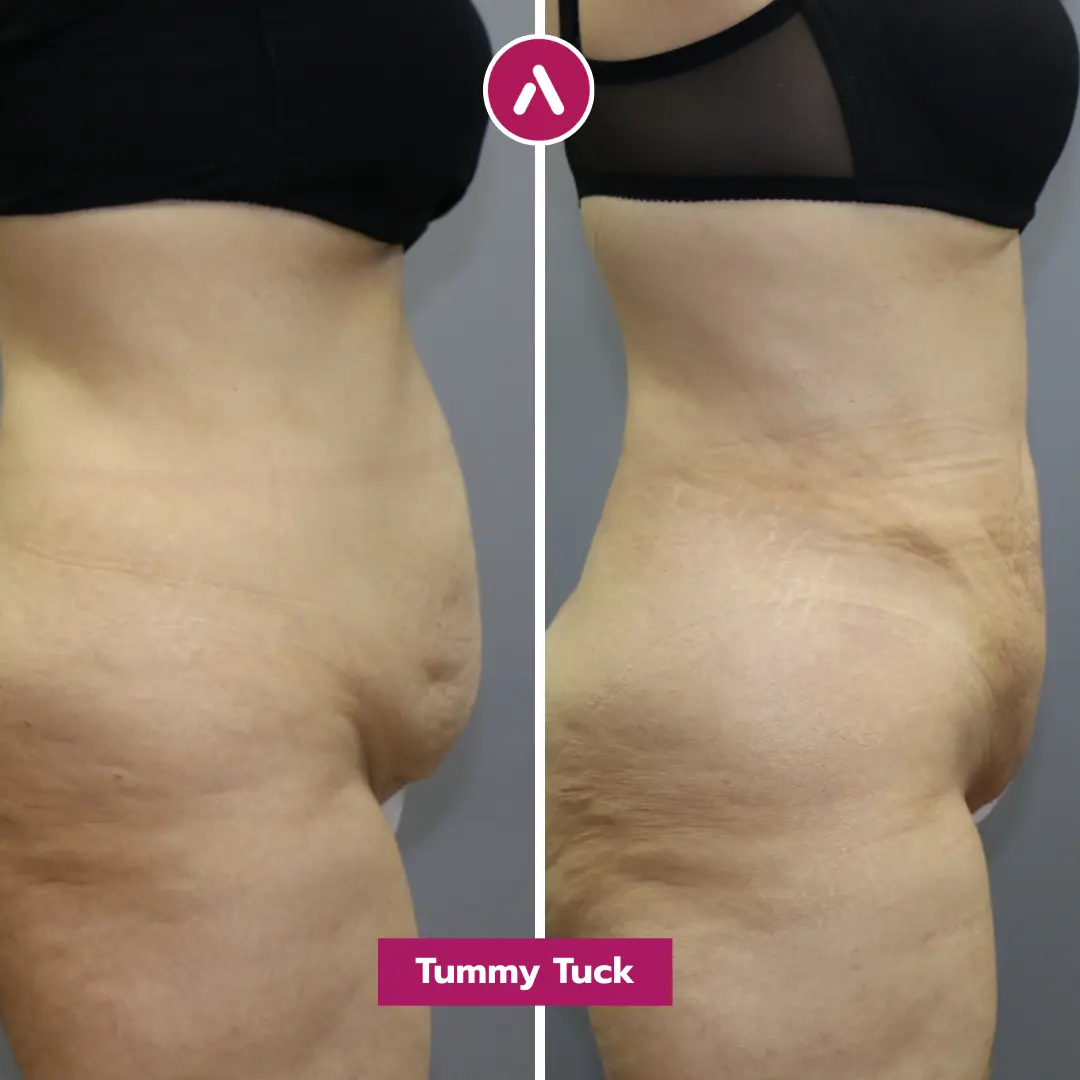
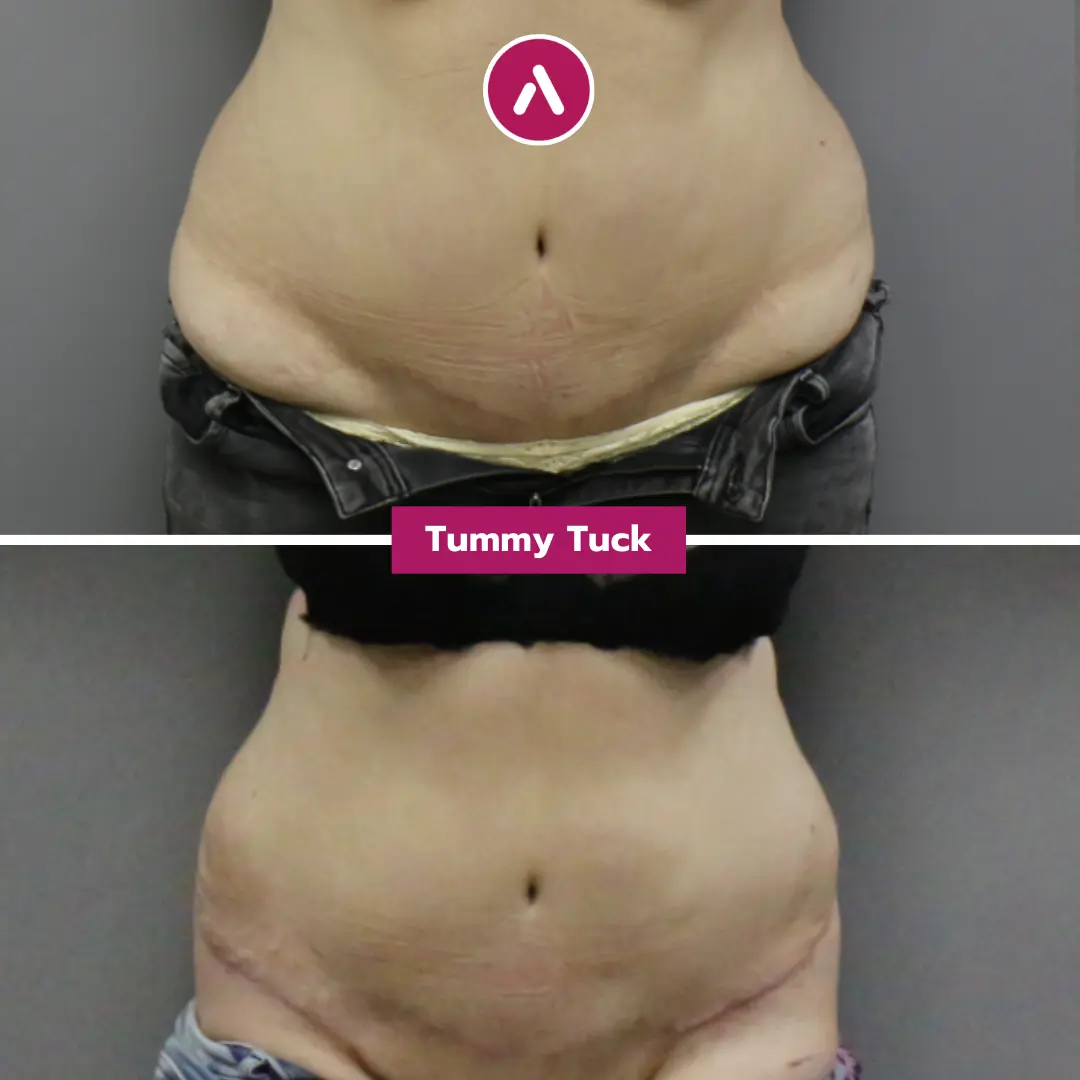
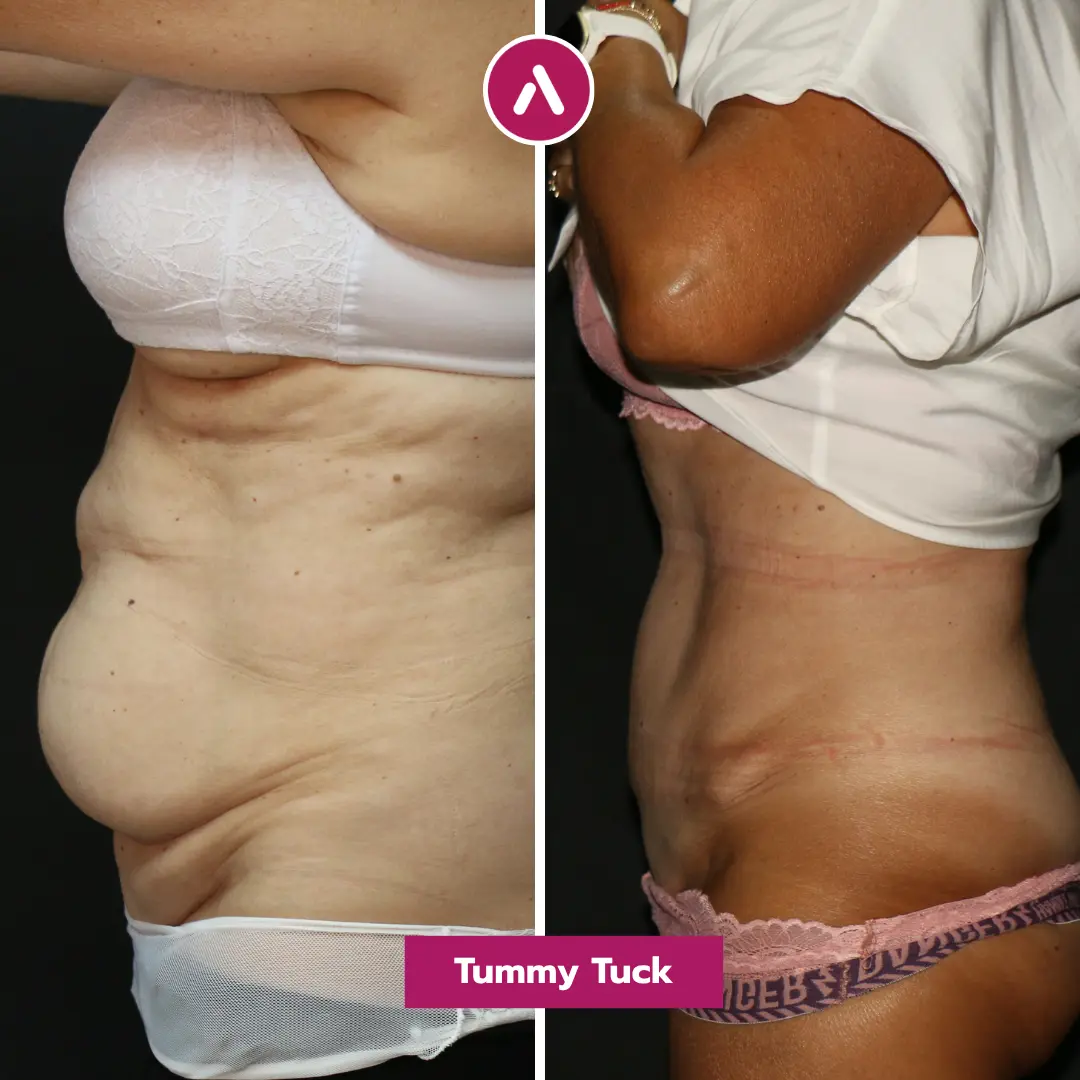
In real clinical practice, this concern often sits in the space between medicine and aesthetics. A patient may describe a persistent bulge, poor core control, difficulty engaging the lower abdomen, or a silhouette that still resembles pregnancy months or even years later. Others search for terms such as rectus diastasis repair, abdominal muscle separation surgery, separated stomach muscles repair or how to fix split stomach muscles, because they sense that the problem lies deeper than the skin.
Key point: Diastasis recti is often both a structural and a visual concern. A good surgical plan starts by identifying whether the problem lies in the muscles, the skin, or both.
That distinction matters. Some patients need muscle repair only. Others may also have loose skin, a persistent lower abdominal fold, stretched tissues after pregnancy, or changes around a previous Caesarean scar. Understanding the difference is the first step towards choosing the right treatment rather than chasing the wrong solution.
| Area of concern | What the patient may notice | Why it matters |
|---|---|---|
| Muscle separation | A central bulge, weakness when sitting up, difficulty engaging the core | May affect abdominal support and shape |
| Loose skin | Creasing, wrinkling, excess skin in the lower abdomen | Mainly affects contour and skin quality |
| Combined change | Bulging plus loose skin after pregnancy or weight loss | Often requires a broader surgical plan |
Table of Contents

What Is Diastasis Recti and Why Is It More Than a Cosmetic Concern?
Diastasis recti is commonly described as a widening of the tissue between the abdominal muscles, but that short definition does not capture why it matters to patients. In daily life, it can present as a persistent fullness through the midsection, reduced abdominal support, or a body shape that feels disconnected from the effort a patient is putting into diet, Pilates, walking or strength training. This is why the condition is often discussed as both a medical and cosmetic issue rather than a purely aesthetic one.
For many post-pregnancy patients, the real frustration is not simply how the abdomen looks, but how it feels during normal movement, exercise and daily routines. This is why treatment planning must go beyond surface appearance alone. In some cases, especially when loose skin and muscle separation exist together, a tummy tuck with muscle repair, such as the drainless tube tummy tuck, may be discussed as part of a broader approach to restoring both abdominal support and body contour.
How Abdominal Muscle Separation Happens After Pregnancy or Weight Loss
During pregnancy, the abdominal wall expands to accommodate the growing uterus. As this happens, the connective tissue in the midline, known as the linea alba, stretches under pressure. In many women, that tissue gradually tightens again after childbirth. In others, especially after more than one pregnancy, a large baby, twins, or substantial stretching of the abdominal wall, the gap remains wider than normal.
Major weight fluctuations can also contribute. When the abdomen has been under prolonged tension, the tissues may not return to their previous level of support even after weight stabilises. This is one reason post-pregnancy abdominal muscle repair becomes an important conversation for patients who feel their core has changed permanently.
Importantly, the problem is not that the muscles have “torn apart” in a dramatic sense. Rather, the tissue joining them has thinned and widened, reducing its ability to hold the abdominal wall firmly. For that reason, patients often use non-medical phrases such as split stomach muscles or separated stomach muscles, whilst surgeons usually refer to rectus diastasis repair when discussing treatment.
Diastasis Recti vs Loose Skin: Understanding the Difference
One of the most common areas of confusion is the difference between diastasis recti and loose skin. They may appear together, but they are not the same issue. Loose skin is a surface problem. It affects the outer drape and tone of the abdomen. Diastasis recti is a deeper support problem, involving the central abdominal wall.
A patient may have clear muscle separation with very little excess skin, particularly if she is naturally slim. Another may have good muscle tone but significant skin redundancy after pregnancy or weight loss. Many have both. This is why a proper surgical assessment matters so much: the treatment must match the anatomy.
In practical terms, abdominal muscle separation surgery addresses the structural gap. It does not automatically remove stretched skin, improve every stretch mark, or reshape the entire abdominal surface on its own. When patients expect a flatter abdomen from muscle repair alone, but the main problem is actually skin excess, disappointment can follow. Good planning prevents that mismatch.
Why a “Mummy Tummy” Can Persist Even With Exercise and Diet
Many UK patients are understandably frustrated by the persistence of a so-called “mummy tummy” despite genuine effort. They may return to exercise, improve their nutrition, and lose pregnancy weight, yet still feel a dome-like bulge or softness through the lower abdomen. This does not mean they have failed. It often means the issue is structural rather than behavioural.
Exercise can improve muscular control, posture and overall strength, and for mild cases that may be enough. However, once the connective tissue has been significantly stretched, training alone may not fully restore the original tension of the abdominal wall. That is why some women continue to research how to fix split stomach muscles even after months of responsible rehabilitation.
In more advanced cases, the gap is wider, the contour change is more visible, and the feeling of weakness is harder to ignore. This is where the discussion may move towards severe diastasis recti surgery, particularly when the patient’s concern is not vanity but a lasting sense that her abdomen no longer feels stable, responsive or normal.
The Medical Side of Diastasis Recti Repair
The phrase “medical and cosmetic” matters because it reflects how patients actually experience this condition. They do not separate function and appearance neatly in everyday life. A woman may feel physically weak when lifting a child, yet also feel unhappy with the shape of her abdomen in clothing. The medical side of diastasis recti repair is therefore not an abstract idea; it relates directly to support, control and comfort in the body.
This is also why surgical planning should be based on more than appearance alone. When the abdominal wall has lost support after pregnancy, the goal is often to restore structure as well as contour in a balanced way. In selected cases, a tummy tuck may be considered alongside muscle repair, particularly when the patient has both functional weakness and stretched lower abdominal tissues that cannot be improved through exercise alone.
How Muscle Separation Can Affect Core Stability and Posture
The abdominal wall works as part of a wider support system involving the core, pelvis, lower back and breathing mechanics. When the central connective tissue is weakened, the muscles may not transmit tension as effectively as before. Patients often describe this not as pain, but as a sensation of reduced firmness or poor control through the midsection.
That reduced support may influence posture, especially when standing for long periods, carrying children, or trying to return to exercise. Some women notice they “push out” through the abdomen more easily, or that they struggle to create the same sense of internal support they once had. For these patients, the conversation around surgery is not simply about looking slimmer. It is about restoring a more functional abdominal wall.
This is also why diastasis recti is sometimes discussed alongside the broader concept of abdominal wall restoration rather than cosmetic contouring alone. In the right candidate, repair can bring the muscles back into a more supportive relationship, helping the core feel more connected and controlled.
Why Some Patients Notice Weakness, Bulging, or Reduced Abdominal Support
The symptoms of diastasis recti vary from patient to patient. Some are subtle; others are obvious. What matters is that the pattern often reflects a loss of central support rather than simple fat distribution.
- A visible midline bulge, especially when getting out of bed or leaning backwards
- A soft, unsupported feeling in the abdomen
- Difficulty engaging the lower core during exercise
- A sense that the abdomen still appears “pregnant” after childbirth
- Reduced confidence in fitted clothing or swimwear
Not every patient will have every symptom, and not every abdominal bulge is caused by diastasis recti. That is why a surgical consultation should focus on anatomy, tissue quality, lifestyle, pregnancy history and examination findings, not on assumptions. A patient who feels weak may have only mild separation. Another who feels cosmetically distressed may have a significant anatomical gap.
Understanding that pattern is essential before discussing surgery, because the right procedure depends on what is actually driving the problem.
When Functional Repair Becomes Part of a Wider Abdominal Wall Plan
For some patients, isolated muscle repair may be appropriate. For others, functional restoration forms just one part of a broader treatment plan. If the abdomen also has loose skin, lower abdominal heaviness, or marked stretching after pregnancy, repairing the muscles alone may not produce the overall improvement the patient hopes to see.
This is where terminology becomes important. Patients may search for rectus diastasis repair thinking only about the muscles, but clinically they may be better suited to a more comprehensive procedure. In other cases, the opposite is true: the patient believes she needs a full abdominoplasty, yet the primary problem is actually the muscle separation itself.
Later in this guide, we will look at when tummy tuck with muscle repair becomes the better option, and when isolated repair may be enough. We will also cover how surgeons assess whether a patient needs contour improvement, structural repair, or both.
The Cosmetic Benefits of Repairing Diastasis Recti
Although diastasis recti has an important functional side, it would be unrealistic to pretend that appearance does not matter. For many women, the emotional impact begins with the mirror, with clothing fit, and with the feeling that their abdomen no longer reflects how healthy or active they are. Cosmetic improvement is therefore not a superficial concern; it is often closely tied to confidence, body comfort and the sense of feeling “like yourself” again after pregnancy or weight change.
From an aesthetic perspective, the aim is not to create an artificial or overly tight result. The goal is to restore a smoother abdominal contour, improve the relationship between the waist and lower abdomen, and correct the persistent central bulge that makes the torso look rounded even at a stable weight. In the right patient, repairing the deeper support structure can change the shape of the abdomen in a way that diet and exercise alone cannot achieve.
Creating a Flatter, Smoother Abdominal Profile
When the abdominal muscles are separated, the front of the abdomen may project forwards even when the patient has relatively little body fat. This is why some women say, “I look pregnant by the end of the day,” or feel that fitted dresses and tailored trousers reveal a persistent lower abdominal curve they cannot explain.
Repairing the separation can help restore a flatter profile by improving the internal support of the abdominal wall. Instead of the midline pushing forwards, the abdomen often appears firmer, more contained and more balanced. This can make a meaningful difference in side profile photographs, fitted knitwear, occasion wear and swimwear.
That said, surgeons must always distinguish between realistic improvement and unrealistic expectation. Muscle repair can improve abdominal projection, but the final visual result still depends on skin quality, remaining fat distribution, tissue elasticity and the patient’s starting anatomy. Good aesthetic surgery is about proportion, not perfection.
Improving Waist Definition Without an “Overdone” Result
One of the subtler benefits of repair is that it can improve the transition between the waist and the front of the abdomen. When the core is more supported centrally, the waistline may look better defined, even without aggressive contouring. This matters to UK patients who generally prefer a natural, proportionate outcome rather than a dramatic “operated” appearance.
In practical terms, a successful result should look harmonious rather than obvious. Clothes should sit better. The abdomen should appear smoother and more stable. The patient should not look as though the torso has been unnaturally tightened or sculpted beyond what suits her body frame.
This is particularly important for women seeking correction after pregnancy. The aim of post-pregnancy abdominal muscle repair is usually restoration, not transformation. Most patients are not asking for an unrealistically flat abdomen at any cost. They are asking for their body shape to make more sense again.
Why Muscle Repair Alone Does Not Always Remove Loose Skin
This is the point many patients need explained clearly. Muscle repair can improve projection and support, but it does not directly remove excess skin. If the lower abdomen has stretched skin, laxity after pregnancy, or a fold that hangs over a previous Caesarean scar, a more comprehensive plan may be needed.
That does not mean muscle repair has failed. It simply means it addresses one part of the problem. A patient can have excellent structural correction and still feel bothered by surface looseness if the skin itself has changed significantly.
For this reason, cosmetic planning should never be based on photographs alone or on social media promises. It should be based on anatomy. Some patients do very well with isolated muscle correction. Others need a broader procedure to match their goals. Clear explanation before surgery is what protects the patient from disappointment afterwards.
| Cosmetic concern | Will muscle repair help? | What may still need addressing? |
|---|---|---|
| Central abdominal bulge | Often yes | Depends on severity and tissue quality |
| Poor abdominal support in fitted clothing | Often yes | May also require skin tightening if laxity is significant |
| Loose lower abdominal skin | Not fully | Skin excision may be required |
| Stretching around a C-section scar | Partly | Scar and skin management may be needed as well |
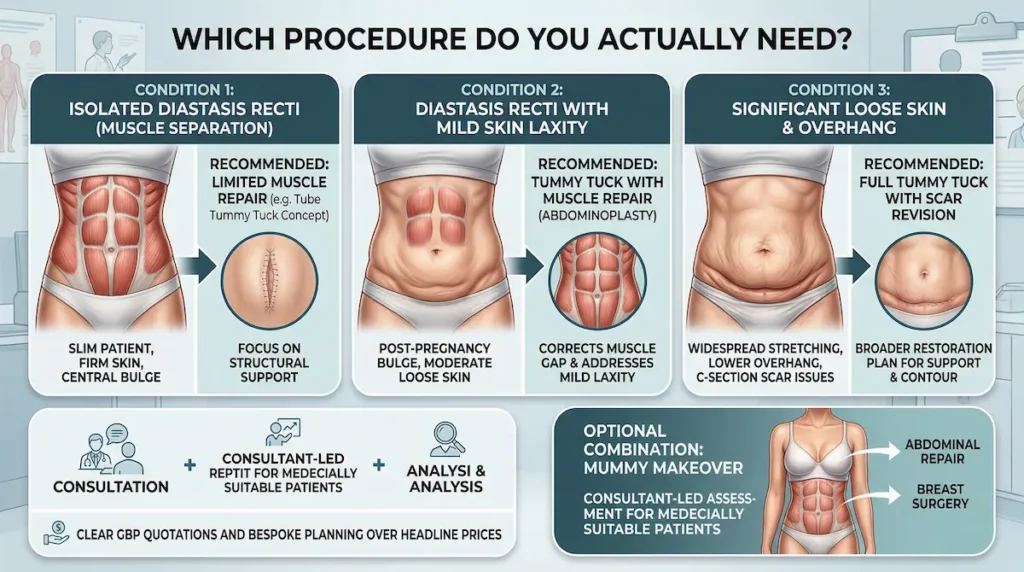
Which Procedure Do You Actually Need?
Choosing the correct procedure is one of the most important parts of good surgical planning. Many patients arrive believing they need one operation, when in fact their anatomy points to another. Some assume they need a full tummy tuck because the abdomen looks rounded. Others focus only on the muscles and do not realise that stretched skin is playing a major role in the final appearance.
This is precisely why a proper consultation matters. A rounded abdomen does not automatically mean every patient needs the same operation, because muscle separation, loose skin and tissue laxity can appear in different combinations. In some cases, a tummy tuck with muscle repair may be the more appropriate option, especially when the aim is to address both abdominal contour and deeper structural support in a single, carefully planned procedure.
The right answer depends on what is causing the problem: the muscle separation, the skin envelope, residual soft tissue fullness, or a combination of all three. This is why consultant-led assessment matters more than internet terminology. A precise diagnosis helps the surgeon recommend a proportionate solution rather than a one-size-fits-all package.
Isolated Diastasis Recti Repair vs Full Tummy Tuck
In simple terms, isolated repair focuses on bringing the separated abdominal muscles back into a more supportive position. A full abdominoplasty, by contrast, addresses both the underlying structure and the overlying skin. In many post-pregnancy cases, the operation people describe casually as a “tummy tuck” is actually a tummy tuck with muscle repair, because both elements need to be corrected together.
Patients who are slim, weight-stable and mainly troubled by a central bulge may sometimes be considered for a more limited structural repair. However, if there is visible skin redundancy, lower abdominal overhang, or widespread stretching, isolated muscle correction may not deliver the cosmetic result the patient expects.
This is also where severity matters. In more advanced anatomical cases, where the gap is broader and the contour change more marked, surgeons may discuss severe diastasis recti surgery as part of a wider abdominal wall restoration plan. That does not necessarily mean the case is dangerous, but it does mean the repair must be tailored carefully to the patient’s tissues and goals.
When Loose Skin, Stretching, or C-Section Changes Also Need Addressing
Pregnancy changes the abdomen in layers. The muscles may separate, the skin may stretch, the umbilical area may distort, and a previous Caesarean scar may affect the lower abdominal contour. Treating only one layer when several are involved can leave the result incomplete.
For example, a woman may search for separated stomach muscles repair because she feels the core is weak, but her real distress may also come from loose lower abdominal skin she sees every day when dressing. Another may feel that even after weight loss, the tissue around the scar line folds or creases in a way exercise cannot improve.
When these issues are present, the surgical plan may need to include skin redraping, scar revision or contour improvement as well as deeper repair. That is why a proper examination is essential. The best surgery is not the most aggressive operation; it is the one that addresses the actual combination of problems.
Clinical principle: The best abdominal result comes from matching the operation to the anatomy. Muscle repair treats support. Skin excision treats laxity. Many post-pregnancy patients need both.
When It May Be Combined With Breast Surgery as Part of a Mummy Makeover
For some women, abdominal repair is only one part of the post-pregnancy picture. The breasts may also have changed in volume, position or symmetry after breastfeeding and weight fluctuation. In these circumstances, the conversation may expand beyond isolated abdominal surgery towards a more comprehensive Mummy Makeover plan.
This does not mean every patient should combine procedures. Combined surgery must always be assessed on safety, operative time, recovery capacity and the patient’s home responsibilities. A mother with small children, limited support at home, or a very specific functional goal may be better served by staging treatment rather than doing everything at once.
However, when the patient is medically suitable and the goals are aligned, combining abdominal repair with breast surgery can create a more balanced overall result. The key is that the treatment plan should be bespoke, not driven by marketing language. The surgeon’s role is to explain what is possible, what is sensible, and what recovery will realistically involve.
Procedure choice also affects budgeting. Patients frequently search for diastasis recti repair cost Turkey, but the final investment depends on whether the operation involves isolated muscle correction, a full tummy tuck with skin excision, or a broader combined approach. Clear GBP quotations and transparent planning matter far more than headline prices alone.
| Procedure option | Best suited to | Main aim |
|---|---|---|
| Isolated muscle repair | Patients with structural separation and limited skin excess | Restore abdominal support |
| Tummy tuck with muscle repair | Patients with separation plus loose or stretched skin | Improve support and contour together |
| Mummy Makeover combination | Selected post-pregnancy patients with abdominal and breast concerns | Comprehensive post-pregnancy restoration |
Who Is a Good Candidate for Diastasis Recti Repair Surgery?
Not everyone with a post-pregnancy abdominal change needs surgery, and not everyone who wants surgery is an ideal candidate at the same moment in life. Good candidacy depends on anatomy, health, recovery expectations, future family plans and the patient’s real reason for seeking treatment. The strongest candidates are usually those who understand the difference between functional support and cosmetic contour, and who want a sensible, evidence-based solution rather than an instant fix.
Scientific research and long-standing surgical experience both support the importance of patient selection. A carefully chosen procedure in the right patient tends to produce better outcomes, smoother recovery and greater long-term satisfaction than an operation performed too early, for the wrong reason, or with unrealistic expectations.
Post-Pregnancy Patients Seeking Both Functional and Aesthetic Improvement
Many ideal candidates are women whose bodies changed after pregnancy and did not return in the way they expected, despite appropriate rehabilitation, stable weight and time. They often describe a combination of concerns: visible abdominal bulging, poor core engagement, lower abdominal looseness and frustration with the mismatch between effort and results.
These women are often not looking for dramatic body contouring. Instead, they want a solution that feels proportionate, medically sound and compatible with everyday life. In this group, post-pregnancy abdominal muscle repair may be discussed when the abdominal wall no longer functions or appears as it did before pregnancy.
The best candidates are also emotionally ready. They understand that surgery is not a substitute for recovery after childbirth, and not a punishment for a changing body. It is a treatment choice for a specific anatomical problem that has not improved sufficiently by other means.
Weight-Stable Patients After Significant Weight Loss
Pregnancy is not the only reason for abdominal wall change. Some patients present after major weight loss, particularly when the abdomen has been stretched for a long period and the tissues have lost elasticity. In these cases, the muscle support may be compromised and the skin may also be redundant.
Weight stability is important because the surgeon needs to see the abdomen in its more settled state before planning repair. Large swings in weight after surgery can affect both the contour result and the tension of the tissues. In general, the patient should be close to a maintainable weight and following habits she can realistically continue after the procedure.
For this group, candidacy depends not only on the presence of separation but on the whole abdominal picture: skin quality, tissue thickness, general fitness, scar history and how much contour improvement is being sought.
Why Future Pregnancy Plans Matter Before Surgery
This is one of the most important counselling points for younger patients. A future pregnancy can stretch the abdominal wall again, which may compromise the durability of the repair and alter the final cosmetic result. For that reason, surgeons usually prefer to perform definitive correction when the patient feels her family is complete.
That does not mean surgery is impossible before then, but it does mean the patient needs honest information. If further pregnancy is likely in the near future, waiting may be the more sensible choice. This protects the investment in surgery and reduces the chance that the patient will need revision later.
In other words, the right timing is part of good treatment. Surgery should fit the patient’s life plan as well as her anatomy. For many women, the best outcomes come when healing, childcare arrangements, work commitments and family planning have all been thought through carefully in advance.
For this reason, timing is not just a practical detail but part of the treatment strategy itself. A patient considering abdominal repair should think not only about her current anatomy, but also about whether her body is likely to go through another major change in the near future. In selected cases, a tummy tuck with muscle repair may offer an effective solution, but even the best-planned procedure benefits from being performed at the right stage of life.
Recovery Timeline and Aftercare for UK Patients
Recovery after diastasis recti repair is not identical for every patient. The timeline depends on whether the operation involves isolated muscle repair or a broader tummy tuck with muscle repair, as well as the patient’s tissue quality, general health and home support. What matters most is not rushing. A good result depends on protecting the repair during the early healing phase whilst allowing the body to recover in a controlled and realistic way.
For UK patients travelling to Istanbul, aftercare planning should begin before surgery, not after it. That includes understanding how long you are likely to stay locally, when you may be reviewed before flying home, what support is available once you return to the UK, and how swelling, scar care and lifting restrictions will be monitored. Thoughtful aftercare is one of the clearest differences between consultant-led surgery and a package sold on price alone.
The First Days After Surgery: Walking, Rest, and Compression Garments
In the first few days, patients usually feel tightness across the abdomen, reduced ease of movement, and a natural protective posture when standing or walking. This does not mean something is wrong. It simply reflects the fact that the abdominal wall has been repaired and needs time to settle. Gentle walking is usually encouraged early, because it supports circulation and reduces the risks associated with prolonged immobility, but activity should remain light and controlled.
Compression garments are commonly used to support the tissues and help the abdomen settle more comfortably. They are not a substitute for healing, but they can make the early recovery period feel more secure. Patients should also expect to prioritise rest, hydration, regular short walks and careful position changes when getting in and out of bed.
During this stage, practical planning matters just as much as the operation itself. Help with luggage, childcare, meal preparation and household tasks can make the first one to two weeks significantly easier. UK patients with small children should prepare in advance for reduced lifting capacity, because protecting the repair is far more important than trying to “bounce back” too quickly.
Managing Oedema, Tightness, and Scar Maturation Week by Week
Oedema after abdominal surgery is normal, and the abdomen rarely looks “final” in the early weeks. Patients often feel disappointed if they expect an immediate flat result, when in reality the tissues are still inflamed and adapting. Tightness, temporary firmness and uneven swelling can all occur during normal recovery.
Most patients begin by noticing recovery in stages rather than all at once. The first improvement is often in comfort and mobility. The second is a gradual reduction in swelling. The final stage is refinement, where the scar softens, the contour settles and the abdomen begins to feel more natural during everyday movement.
| Recovery stage | What is commonly felt | Main priority |
|---|---|---|
| Days 1-7 | Tightness, fatigue, swelling, careful walking | Protect the repair and maintain gentle mobility |
| Weeks 2-4 | Improving movement, ongoing oedema, scar sensitivity | Gradual routine recovery without overexertion |
| Weeks 4-8 | Less swelling, better posture, more natural movement | Follow surgeon guidance on increasing activity |
| Later healing | Scar maturation and contour refinement | Patience, scar care and long-term support of the result |
Scar maturation is especially important to explain honestly. Even a well-placed scar is still a scar, and it usually changes over months rather than days. Early redness, firmness or sensitivity do not predict a poor long-term result. They are part of the normal healing journey. What matters is good surgical technique, appropriate aftercare, and realistic expectations about how the body heals over time.
How HBOT and LLLT May Support a Faster, Smoother Recovery
For patients who are particularly concerned about oedema, downtime and scar quality, recovery support technologies can make a meaningful difference. At AKM Clinic, this is where the conversation moves beyond routine aftercare and into applied medical science.
Hyperbaric Oxygen Therapy (HBOT) is used as part of a rapid recovery strategy to help reduce post-operative oedema and support lymphatic drainage. In practical terms, this may help patients feel more comfortable sooner and may shorten the period during which the abdomen feels heavily swollen or socially restrictive.
Low-Level Laser Therapy (LLLT), including 650 nm soft laser support, is used to stimulate fibroblast activity and support smoother scar healing. For patients undergoing abdominal contouring or post-pregnancy repair, this matters because scar quality is not just about where the incision is placed, but also about how the tissue heals afterwards.
These technologies do not replace careful surgery or disciplined recovery, but they can support a more efficient healing environment. For UK patients planning a return flight, any strategy that helps recovery feel more controlled and “flight-ready” can add genuine value, especially when time away from family or work is limited.
One AKM Clinic patient journey highlighted that the greatest reassurance came after returning home: having access to a direct WhatsApp UK number, a UK support line and a London correspondence point made the recovery period feel supported rather than isolated.
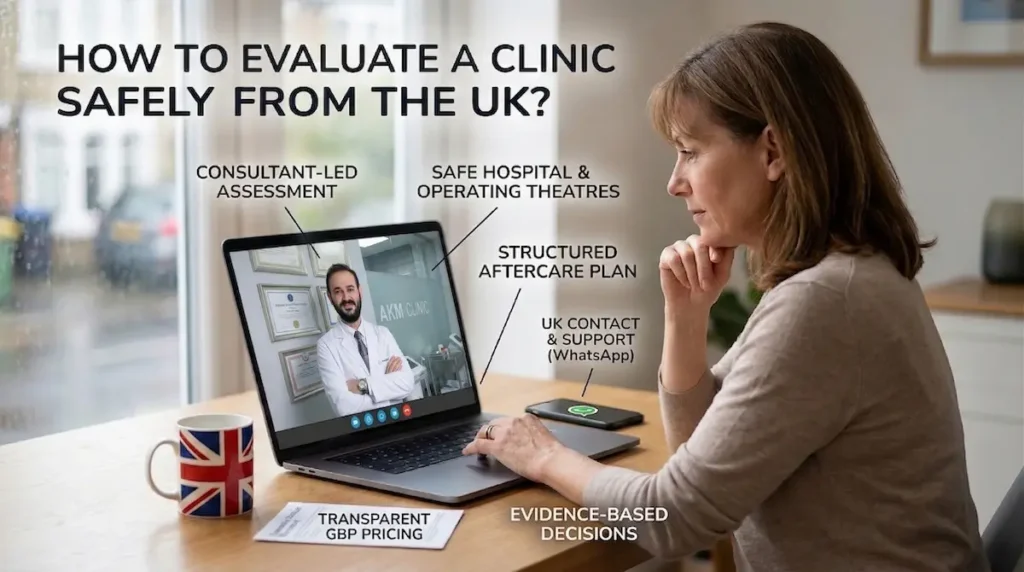
How to Evaluate a Clinic Safely From the UK
For British patients, safety concerns often begin long before the consultation. Media stories about poor outcomes abroad have made many people understandably cautious, especially when the operation involves both functional repair and visible cosmetic change. That caution is healthy. Choosing a clinic should never begin with the cheapest price. It should begin with evidence, transparency and a clear understanding of who is responsible for your care before, during and after surgery.
For UK patients, this becomes even more important when considering procedures such as a tummy tuck with muscle repair, where both functional repair and cosmetic refinement may be involved. A trustworthy clinic should be able to explain not only the technical plan, but also the standards of surgical safety, aftercare structure and who will remain responsible once you return home. Clear communication and consultant-led planning are often stronger signs of quality than price alone.
If you are comparing providers, focus on whether the clinic can explain your anatomy clearly, outline the difference between muscle repair and skin excision, discuss realistic recovery, and provide structured aftercare once you are back in the UK. A private cosmetic clinic in Istanbul with British standards should be able to communicate all of this without vague promises or sales pressure.
What to Ask About Surgical Planning, Hospital Safety, and Sterile Theatres
A strong consultation should leave you better informed, not merely reassured. The clinic should be able to explain what type of repair you need, why it is being recommended, whether loose skin is also part of the problem, and what the recovery restrictions will mean in everyday life.
- Who will perform the full procedure, and will the named surgeon be responsible throughout?
- Is the plan isolated repair, tummy tuck with muscle repair, or a combined post-pregnancy procedure?
- Where will the operation take place, and what safety protocols are used in the operating theatres?
- What is the expected stay in Istanbul before it is considered safe to travel?
- How will post-operative concerns be handled once I am back in the UK?
These are not difficult questions. They are essential ones. A credible clinic should welcome them and answer them clearly in English, with no attempt to rush the patient into a decision.
Why Aftercare, UK Contact Access, and Clear Communication Matter
For UK patients, the operation is only one part of the journey. The real test of a clinic often begins after discharge, when swelling fluctuates, questions arise and the patient is no longer physically in Turkey. This is why aftercare systems matter so much.
Clear written instructions, scheduled follow-up, rapid answers to recovery questions, and the ability to reach the team without barriers are not optional extras. They are part of safe international care. A direct WhatsApp UK number, a UK support line and a UK-based patient contact point can provide significant psychological reassurance during the vulnerable early weeks of healing.
This is also where transparent communication protects the patient. If you are researching diastasis recti repair cost Turkey, look beyond the headline number. Ask what is included, what the review structure looks like, whether recovery support technologies are part of the plan, and how concerns are handled after your return flight. A cheaper quote with weak aftercare is not necessarily better value.
Consultant-Led Planning vs Cheap Package Marketing
There is a major difference between a surgical recommendation and a marketing package. Consultant-led planning begins with diagnosis: what exactly is wrong, what will correct it, and what will recovery realistically involve? Cheap package marketing begins with a price and works backwards.
That distinction matters even more in abdominal surgery, because patients often describe the problem in non-medical terms. A woman may say she wants to fix split stomach muscles, but the clinic must determine whether she needs true rectus diastasis repair, skin removal, scar revision, or a more comprehensive procedure. A generic package cannot make that decision safely.
British patients tend to research deeply before proceeding, and rightly so. The best clinics respect that mindset. They provide all-inclusive GBP pricing transparently, communicate in a calm and evidence-based way, and focus on suitability rather than urgency. In short, they behave like medical professionals, not travel agents.
Frequently Asked Questions (FAQ): Diastasis Recti Repair Surgery
These are some of the most common questions UK patients ask when researching diastasis recti repair surgery. The answers below are general and should always be confirmed during a personal consultation, because anatomy, procedure type and recovery capacity vary from patient to patient.
Can diastasis recti come back after surgery?
Is diastasis recti repair considered medical, cosmetic, or both?
Will I need a tummy tuck as well as muscle repair?
How painful is recovery after diastasis recti repair?
When can I stand upright comfortably again?
When can I lift my children after surgery?
When is it usually safe to fly back to the UK?
If you would like to explore related topics beyond diastasis recti repair, you can also learn more about Mini vs Full Tummy Tuck, Mummy Makeover Recovery with Children, Breast Lift with Implants, and Tummy Tuck Scar Treatment. We also provide guidance on Tummy Tuck All-Inclusive Package, Surgery Companion Turkey, Questions to Ask Plastic Surgeon, and Online Plastic Surgery Consultation, helping UK patients compare options, plan recovery, and make informed decisions with greater confidence.
Medical Disclaimer: This page is provided for general educational purposes only and does not replace a face-to-face medical consultation, diagnosis, or personalised treatment plan. All surgery carries risks and outcomes vary between individuals. Suitability for diastasis recti repair surgery, procedure selection, and anaesthesia choice can only be determined after a full clinical assessment by a qualified surgeon. Always follow your clinician’s instructions and seek urgent medical attention if you develop concerning symptoms during recovery.
Related Treatments




Ready to Begin Your Own Transformation Journey?
Join the 2,000+ patients who have trusted Dr Akif Mehmetoğlu and the AKM Clinic team. Your journey to a more confident, naturally restored you begins with a simple, no-obligation conversation. Contact us today from the UK for your free virtual consultation.
#1: Get Your Free Personalised Quote
Start with a free, no-obligation online consultation. Share your photos, and our surgical team will provide a fully personalised treatment plan and a transparent, all-inclusive price package. There are no hidden fees.
#2: Secure Your Date & VIP Booking
Once you are ready, our dedicated patient coordinators will help you secure your procedure date. We will handle all your bookings, including your 5-star hotel accommodation and private VIP airport transfers.
#3: Arrive in Istanbul & Meet Your Surgeon
Arrive at Istanbul Airport (IST) and be greeted by your private driver. Settle into your hotel and prepare for your in-person consultation, where you will meet your specialist surgeon to finalise the details for your "natural, subtle, and restored" new look.