



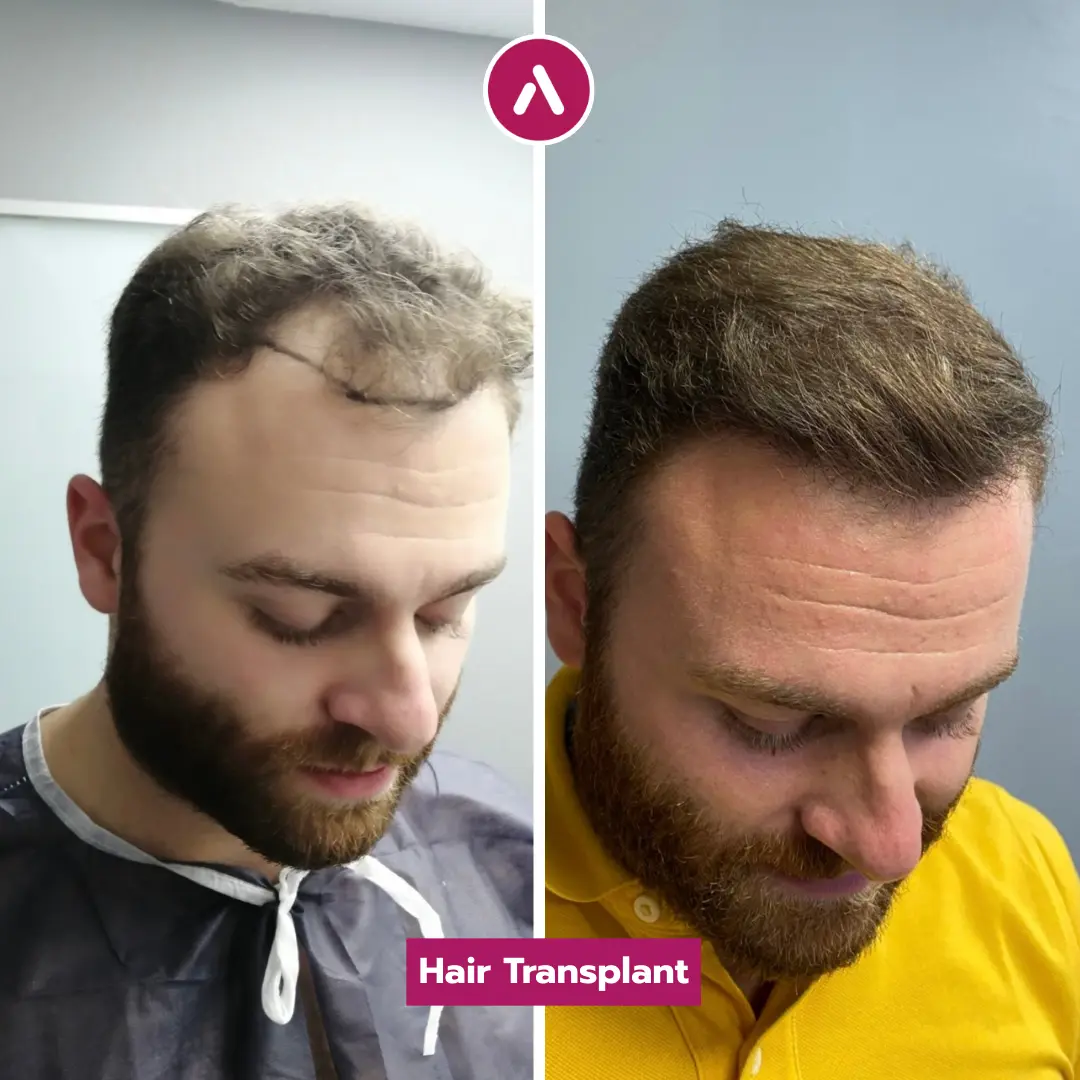
Considering a FUE Hair Transplant? This guide explains how follicular unit extraction works, what affects graft survival, and how we plan natural hairlines with donor ethics, so you can judge quality beyond marketing claims.
You’ll also see a clear Turkey vs UK cost comparison, what an all-inclusive package typically includes, and a day-by-day recovery timeline for UK travellers. Read on to check suitability, understand technique options, and request a personalised graft estimate.
Table of Contents
What is FUE Hair Transplant?
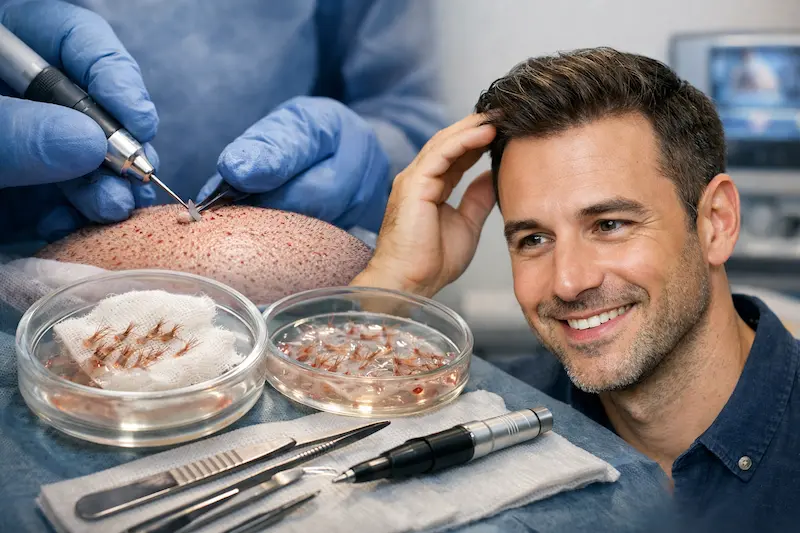
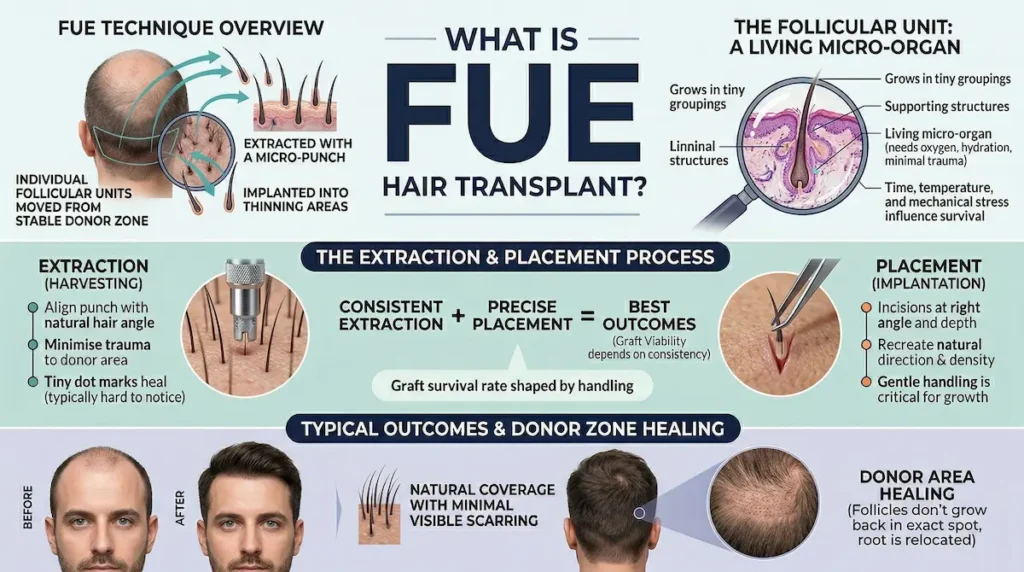
A FUE Hair Transplant moves individual follicular units from a stable donor zone to thinning areas. Each graft is extracted with a micro-punch and implanted at the right angle and depth. The goal is natural coverage with minimal visible scarring. Growth depends on gentle handling.
Position Zero Definition (40–50 words)
FUE is a surgical hair restoration technique where follicles are removed one by one from the back or sides of the scalp and placed into areas of hair loss. It aims to recreate natural direction and density without a linear scar. The quality of graft handling shapes the outcome.
The biology of follicular units (why graft handling matters)
Hair does not grow as single strands in isolation. It grows in tiny groupings called follicular units, each with its own supporting structures.
- Follicular unit extraction (FUE) method focuses on moving these intact units, not “loose” hairs.
- Each graft is a living micro-organ. It needs oxygen, hydration, and minimal trauma.
- Time, temperature, and mechanical stress all influence how well the graft tolerates transfer.
This is why technique matters. A good plan protects both sides of the equation: the recipient area that needs coverage, and the donor area that must remain healthy and natural-looking.
Why “extraction + placement” is a survival equation (graft survival rate perspective)
Patients often focus on graft numbers. Our Specialists focus on graft viability.
- Graft survival rate is shaped by how follicles are harvested, stored, and implanted.
- Extraction trauma can occur if the punch is not aligned with the hair’s natural angle under the skin.
- Implantation trauma can occur if incisions are too tight, too shallow, or placed at the wrong direction.
A practical way to think about it is simple: even a perfect extraction can be undermined by poor placement. Likewise, excellent placement cannot rescue damaged grafts. The best outcomes come from consistency across the full chain of steps.
One common question is donor area regrowth. The follicles we remove do not “grow back” in the exact same spots, because the root has been relocated. The donor usually heals as tiny dot marks that are typically hard to notice once surrounding hair grows through.
What Are The Benefits Of An FUE Approach?
FUE is popular because it can deliver natural-looking restoration with a discreet donor footprint. It also allows us to tailor the plan to your pattern of hair loss, hair calibre, and long-term goals. Still, it is not a shortcut. The benefit comes from precision, planning, and conservative donor management.
Natural-looking hairline design (density vs realism)
A convincing result is not about packing the front as tightly as possible. It is about making the hairline look believable up close.
- We build the hairline with irregular micro-variations, just like native growth.
- Angle and direction are matched to your facial structure and existing hair pattern.
- Density is distributed strategically, so the outcome looks natural in different lighting.
Our goal is simple: a result that looks like you, just less affected by hair loss.
Minimal linear scarring (how the donor area typically looks)
Unlike FUT (strip surgery), FUE does not create a single long incision across the back of the scalp. That matters if you prefer shorter hairstyles.
- The donor area heals with small dot marks rather than a line.
- When extraction is planned properly, the donor can remain evenly dense.
- A careful approach reduces the risk of an over-harvested, “moth-eaten” look.
That said, FUE is not “scar-free”. It is more accurate to say the scarring pattern is typically more discreet and easier to camouflage with surrounding hair.
Flexibility for different patterns of hair loss (early vs advanced)
FUE planning changes depending on what you are treating. Early-stage thinning needs a different strategy than advanced recession or crown loss.
- Early-stage loss: focus on reinforcing the hairline and framing the face while preserving donor supply for the future.
- Advanced loss: prioritise a natural hairline and mid-scalp coverage, with realistic expectations for the crown.
- Diffuse thinning: careful assessment is needed to avoid placing grafts into unstable areas.
For UK patients who need minimal downtime, technique options like unshaven approaches may also be relevant later in the guide. The core benefit remains the same: a tailored plan that respects donor limitations and long-term stability.
Am I a Suitable Candidate For an FUE Hair Transplant?
Suitability is not just about hair loss. It is about the quality of your donor supply, the stability of your shedding, and how realistic your goals are. We assess these points first, then decide whether surgery makes sense now or later. If anything raises a safety flag, we pause and investigate rather than pushing ahead.
Donor area quality and limitations (safe donor zone)
Your donor area is the long-term “bank” for transplanted hair. We look at density, hair calibre, and how evenly follicles are distributed across the back and sides of the scalp. We also assess the contrast between your hair and scalp, because that affects perceived fullness.
- Donor density: more available follicles usually means more coverage options.
- Hair calibre and curl: thicker or wavier hair can create stronger visual coverage.
- Donor management: the aim is to avoid over-harvesting and keep the donor looking natural.
If the donor is limited, we plan conservatively. A smaller, well-designed restoration can look better than an aggressive plan that thins the donor.
Hair loss stability, age, and expectations
Hair loss often progresses. That matters, because today’s “perfect” plan can look unbalanced if native hair continues to thin behind the transplanted zone. We check your pattern, family history, and the speed of change over the last 12–24 months.
- Early-stage loss: we often prioritise a natural hairline and future-proofing.
- Advanced loss: we discuss realistic density and how to allocate grafts for the most natural frame.
- Crown work: it can be graft-hungry; some patients do better with staged planning.
Expectation is the quiet deal-breaker. If your goal is “nobody can ever tell”, we plan for subtlety and natural direction rather than an artificial wall of density.
Contraindications & “who should wait” (medical red flags, unrealistic goals)
Some issues are not permanent “no’s”. They are “not yet”. If there is an active medical problem, we would rather stabilise it first and protect your outcome.
- Active scalp problems: infections, severe dermatitis, or unexplained inflammation.
- Uncontrolled medical conditions: for example, poorly controlled diabetes or blood pressure.
- Bleeding and clotting risks: including certain medications that need GP-led planning.
- Scarring alopecia: some forms require specialist diagnosis before any surgery is considered.
- Unrealistic expectations: expecting teenage density across a large area in one session.
We also discuss lifestyle factors such as smoking and alcohol intake, because they can affect healing and graft take. If your medical history is complex, we may request additional tests before confirming a surgery date.
Next step: If you want a clear answer on suitability, we can review photos and your history in a virtual consultation, then outline a safe plan and a realistic graft range.
FUE Hair Transplant Surgical Techniques Explained
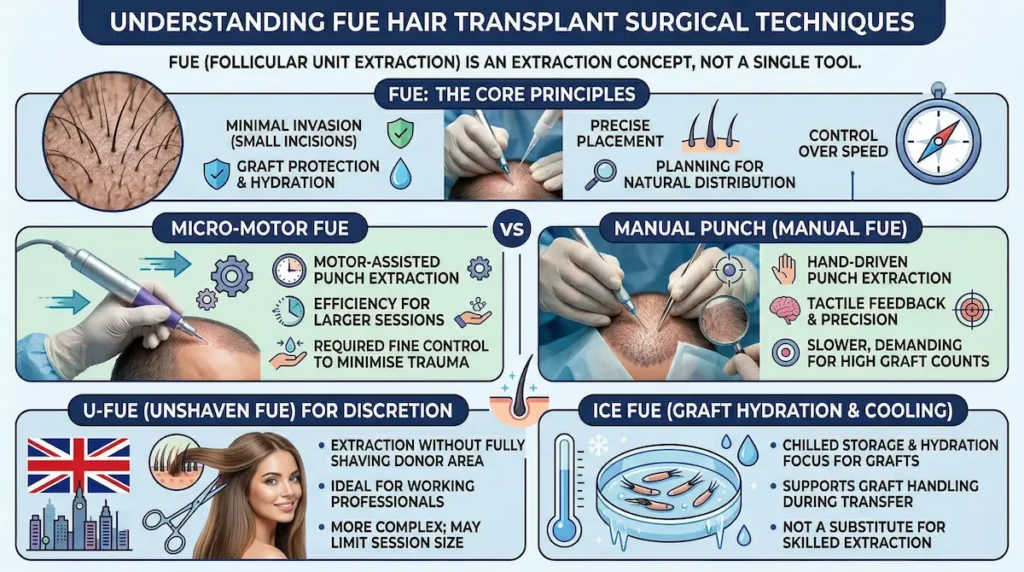
“FUE” describes the extraction concept, not one single tool. There are several variations that change how grafts are harvested, how visible shaving is, and how grafts are protected during transfer. Some terms are used inconsistently online, so we define them clearly and keep the focus on controllable variables. The fundamentals stay the same: careful extraction, graft protection, and precise placement.
| Technique / term | What it usually means | Potential advantage | Common trade-off |
|---|---|---|---|
| Micro-motor FUE | Motor-assisted punch extraction | Efficiency for larger sessions | Requires fine control to minimise trauma |
| Manual punch | Hand-driven punch extraction | Tactile feedback and controlled movement | Slower; can be demanding for high graft counts |
| Manual FUE | FUE performed using manual tools (no motor) | Precision in selected donor types | Time-intensive in extensive cases |
| Percutaneous FUE | Term often used for direct skin-level punch extraction | Emphasises minimal incision footprint | Meaning varies; always ask for definition |
| U-FUE (Unshaven FUE) | Extraction without fully shaving the donor area | Discretion for working professionals | More complex; may limit speed and session size |
| Ice FUE | Chilled storage and hydration focus for grafts | Supports graft handling during transfer | Not a substitute for skilled extraction and placement |
Micro-motor FUE vs manual punch (precision vs trauma)
Both approaches aim to remove follicular units with minimal injury. The difference is how the punch is driven. A motorised system can speed up extraction, which can be useful when a case requires a higher graft number.
- Precision comes from alignment: the punch must follow the hair’s sub-skin angle, not just the visible shaft.
- Trauma risk comes from force: too much torque, depth, or speed can increase graft stress.
- Planning still matters most: spacing extractions across the donor reduces the risk of visible thinning.
In practice, the best method is the one that matches your donor characteristics and the team’s control over each movement. Speed is helpful. Control is non-negotiable.
Manual FUE
Manual FUE is FUE performed with hand-driven instruments rather than a motor. It is often discussed in the context of control and tactile feedback. For some donor types, that feedback can help fine-tune how the punch enters and tracks the follicle.
- Where it can shine: selective work, refinement, and cases where careful pacing helps.
- Where it can struggle: very large sessions, where fatigue and time become practical limits.
Manual does not automatically mean “better”. It means a different way to control the same biological goal: intact grafts.
Percutaneous FUE (what it means clinically)
“Percutaneous” is sometimes used to describe a direct punch-through-the-skin extraction approach. In reality, most FUE is percutaneous by nature, because grafts are harvested through small circular incisions. The key is not the label. It is the discipline behind it.
- Ask what they mean: does the clinic use the term for a specific punch type, depth control, or technique?
- Focus on outcomes: low transection, healthy grafts, and an even donor appearance.
If a term is vague, we bring it back to measurable principles: donor safety and graft viability.
U-FUE (Unshaven FUE) for working professionals (UK intent)
Some patients cannot disappear for a week with a shaved head. Unshaven approaches keep more length in the donor and recipient area, so early signs are easier to camouflage. It can be a sensible option for UK patients who need discretion around work, public-facing roles, or travel schedules.
- Best for: smaller to moderate sessions, hairline refinement, or targeted reinforcement.
- Trade-offs: it can take longer and may reduce how many grafts can be extracted efficiently.
The practical question is simple: do you need maximum graft numbers, or maximum discretion? We plan around the priority that fits your life.
Ice FUE / graft hydration & temperature logic (risk-reduction framing)
Grafts are living tissue. Once extracted, they rely on proper hydration and careful handling until implantation. “Ice FUE” usually refers to chilled holding solutions and temperature-aware graft storage, intended to reduce metabolic demand while grafts are out of the body.
- Hydration: prevents drying, which can damage follicles quickly.
- Temperature control: can support graft stability during longer sessions.
- Handling still leads: rough extraction or crushing force cannot be fixed by cooling.
Think of it as a supportive protocol, not a headline feature. The safest results come from a calm, methodical chain from extraction to placement.
FUE vs DHI: what is the real difference?
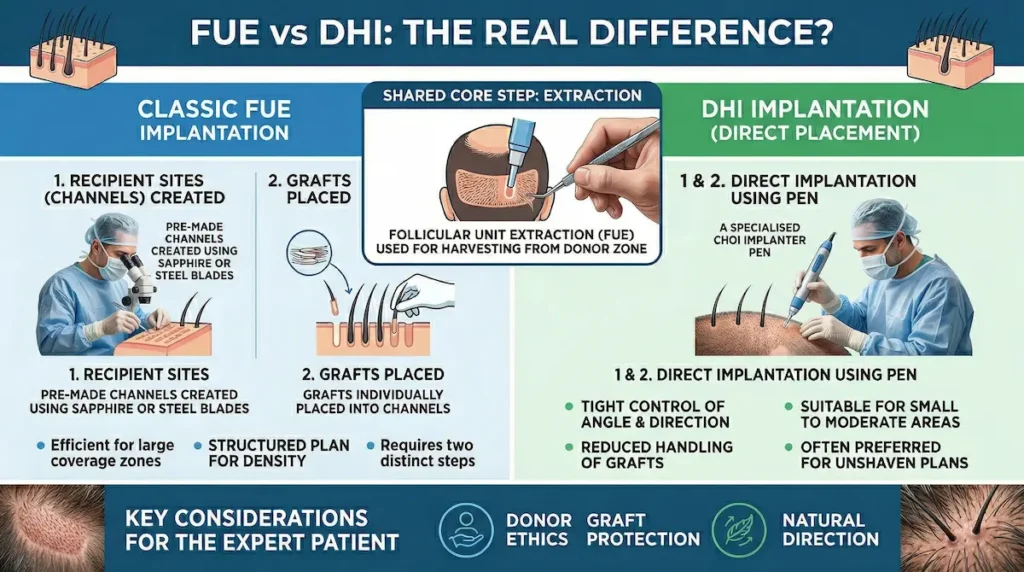
Online, “FUE” and “DHI” are often presented as competing procedures. In reality, they share a core step: grafts must be harvested from a donor zone and transferred to an area of thinning. The practical difference is usually how implantation is performed, and how the team controls angle, depth, and spacing. For the Expert Patient, the question is not “Which is newer?” It is “Which is better suited to my scalp, my hair type, and my long-term plan?”
Extraction is similar; implantation philosophy differs
In most cases, both approaches use follicular unit extraction for harvesting. That means individual grafts are removed one by one with a small punch. The divergence starts at implantation.
- DHI hair transplant typically uses an implanter pen to place grafts directly.
- Classic implantation uses pre-made recipient sites (channels), then places grafts into them.
- Both routes can work. Control and consistency matter more than the label.
We plan implantation around natural direction first. Always. Density comes second.
Who tends to prefer DHI (cases where it can be logical)
DHI is often discussed for its implantation tool and the idea of “direct placement”. That can be appealing for small-to-moderate areas where precision is the priority.
- Hairline refinement: when we need tight control of angle and micro-irregularity.
- Targeted reinforcement: strengthening specific zones without building a large field of new channels.
- Some unshaven plans: when discretion is important and the case scope is suitable.
DHI is not automatically “denser” or “better growth”. A tool cannot replace careful graft handling and calm pacing.
When classic FUE implantation is the better match
There are scenarios where channel creation followed by implantation is a cleaner solution. It can be efficient, structured, and predictable in larger sessions.
- Larger coverage zones: especially when we need broad, even distribution.
- Complex direction work: such as blending mid-scalp flow into existing hair patterns.
- Case planning: when we want to map density gradients before placing a single graft.
Technique is a framework. The outcome depends on how thoughtfully we apply it to your anatomy.
If you are comparing options, focus on three variables: donor ethics, graft protection, and natural direction. Those decide the result.
What is Sapphire FUE and when does it matter?
Sapphire FUE is one of the most misunderstood terms in hair restoration. It does not change the fact that follicles are harvested as individual grafts. It usually refers to the material used to create recipient sites: sapphire blades instead of standard steel. For some patients, this can support a more controlled incision profile. For others, it adds little. We choose it when it fits the surgical goal, not because it sounds more advanced.
Sapphire blades vs standard steel (incision quality logic)
Recipient sites are tiny openings that guide how grafts sit in the scalp. Their shape, size, and spacing influence how natural the hair looks once it grows.
- Sapphire FUE method typically uses sapphire-tipped blades for site creation.
- These blades can allow very fine, consistent slit sizes in selected cases.
- Steel blades remain a strong option when the plan requires a different incision geometry.
The key point is simple: the blade is one variable inside a bigger system. Planning still leads.
Tissue trauma, slit creation, and healing considerations
When incisions are well-controlled, the scalp tends to settle more smoothly. Less unnecessary trauma can mean a calmer early healing phase. That matters for comfort, redness, and how quickly the recipient area looks socially “presentable”.
- We keep incision depth consistent to reduce avoidable stress on surrounding tissue.
- We match slit size to graft calibre rather than forcing follicles into tight spaces.
- We avoid over-packing when it would compromise blood supply in the early phase.
No blade can compensate for rushed work. Precision takes time.
Matching technique to hair calibre and density goals
Not every scalp behaves the same way. Hair calibre, curl pattern, and scalp laxity change how dense a result can look. They also influence whether finer site creation is genuinely helpful.
- Fine hair: can benefit from careful density distribution rather than aggressive packing.
- Thicker hair: may achieve stronger visual coverage with fewer grafts in the right pattern.
- Micro Sapphire FUE can be considered when we want tightly controlled, small recipient sites for refined zones.
If you are deciding between standard site creation and sapphire options, we can explain which one suits your goals after reviewing your donor supply and recipient area.
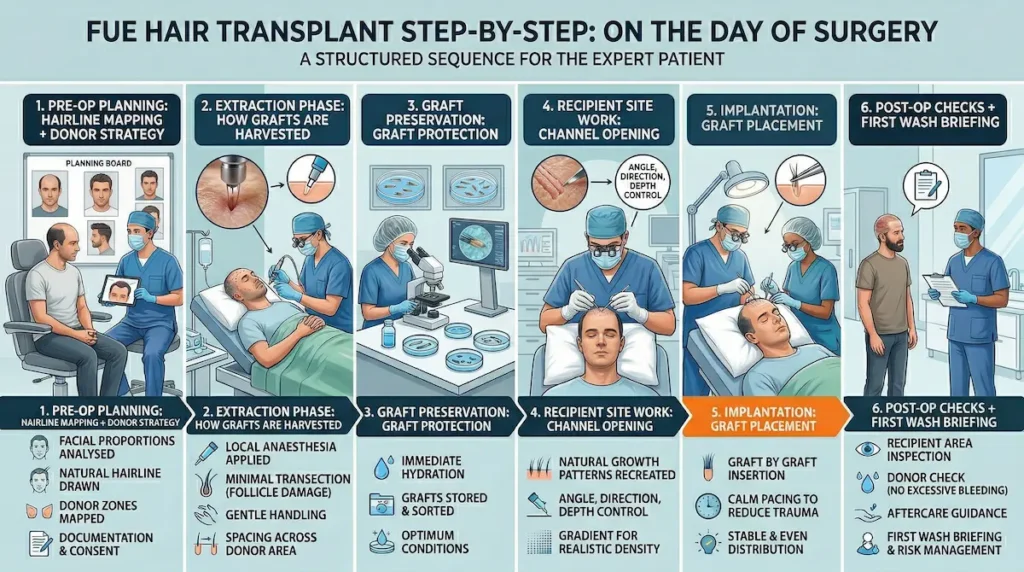
FUE Hair Transplant Step-by-Step: what happens on the day of surgery?
For an Expert Patient, clarity reduces anxiety. A well-run FUE hair transplant day follows a structured sequence: planning, anaesthesia, extraction, graft protection, recipient site work, implantation, and post-op checks. The details matter because each step can influence comfort, healing, and the quality of graft handling.
Pre-op planning: hairline mapping + donor strategy
Before anything begins, the team confirms the surgical plan and aligns it with your facial proportions, existing hair, and long-term hair loss pattern. This is where “natural-looking” is designed, not guessed.
- Hairline mapping: the outline is drawn to suit your face shape and age-appropriate proportions, with subtle irregularity for realism.
- Density distribution: grafts are allocated so the front frames the face naturally, with gradients that prevent a harsh “wall” effect.
- Donor strategy: extraction zones are planned to keep the donor looking even and to avoid over-harvesting.
This is also the point where photos may be taken for medical documentation and consent is re-confirmed. If you have questions about graft ranges, crown priorities, or future sessions, this is the right time to raise them.
Extraction phase: how grafts are harvested and protected
Extraction is the first half of the survival equation. Follicular units are removed one by one using a micro-punch (manual or motor-assisted, depending on the plan). What matters is not speed—it is control.
- Alignment: the punch must follow the follicle’s natural angle beneath the skin to minimise transection (follicle damage).
- Spacing: extractions are distributed across the donor to maintain a uniform appearance once healed.
- Gentle handling: grafts are kept hydrated and protected from drying throughout the process.
From a patient perspective, you will typically feel pressure and movement rather than sharp pain once anaesthesia has taken effect. If any area becomes uncomfortable, additional local anaesthetic can be applied.
Channel opening + implantation: angle, direction, distribution
After grafts are harvested, attention shifts to the recipient area. The goal is to recreate natural growth patterns, not just fill space.
- Angle and direction: recipient sites are created to mirror how hair naturally exits the scalp (this is especially important at the hairline and temples).
- Depth control: grafts should sit securely without unnecessary trauma to surrounding tissue.
- Distribution: density is placed in a planned gradient to avoid an artificial look and to optimise visual coverage.
Implantation is then performed carefully, graft by graft. This is where calm pacing helps: reducing crush injury, keeping grafts hydrated, and maintaining consistent orientation.
Immediate post-op checks and first wash briefing
At the end of surgery, the team checks both the donor and recipient areas and explains the first critical aftercare steps. This is not just “instructions”. It is risk management.
- Recipient inspection: confirming graft placement looks stable and evenly distributed.
- Donor check: ensuring the donor looks uniform and that there is no excessive bleeding or irritation.
- First wash guidance: how to cleanse without rubbing or dislodging early scabs.
You will also be advised on sleeping position, swelling management, and what is normal in the first 48–72 hours. If you are travelling back to the UK soon after, your team should clarify how to protect the grafts during transfers and flights.
Anaesthesia & Comfort: what should a UK patient expect?
Most FUE procedures are performed under local anaesthesia. The aim is to keep you comfortable while you remain awake. Comfort is not a luxury detail—it affects how smoothly the day runs and how consistently the team can work.
Local anaesthesia basics (what you feel, what you don’t)
Local anaesthetic numbs the scalp so the procedure can be performed without significant pain. Patients typically describe two phases:
- During injections: brief stinging or pressure as the anaesthetic is introduced.
- During the procedure: pressure, vibration, and movement sensations rather than sharp pain.
If you feel discomfort at any point, you should say so immediately. Needing a top-up is common and does not mean anything is “wrong”—it simply means the team is keeping anaesthesia effective across a large area of scalp.
Managing anxiety (measured, evidence-based reassurance)
Feeling nervous is normal—especially if you have never had a procedure in a clinical theatre environment. The most helpful approach is practical, not dramatic.
- Set expectations: you may be in theatre for several hours, with planned breaks.
- Communicate clearly: tell the team if you are prone to fainting, panic, or needle anxiety.
- Avoid self-medicating: do not take extra medications unless your clinician has approved them.
If you have a medical history that includes anxiety treatment, or you are taking prescription medicines, it is important to share this in advance so your plan is safe and coordinated.
Why comfort protocols matter for a long procedure
Comfort supports precision. A patient who is positioned well, hydrated, and able to take short breaks is more likely to tolerate the day smoothly—which helps maintain a consistent surgical rhythm.
- Positioning: careful head and neck support reduces stiffness during longer sessions.
- Breaks: planned pauses allow you to stretch and reset without rushing the surgical work.
- Environment: stable temperature and calm communication help reduce stress responses.
In short: anaesthesia makes surgery possible, but comfort protocols make it sustainable—especially when the goal is meticulous graft handling from start to finish.
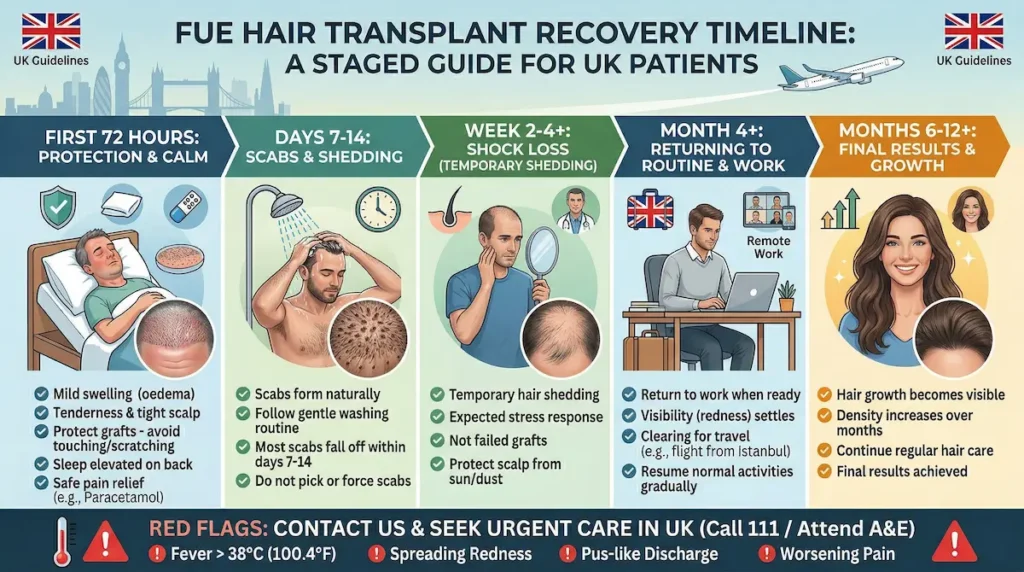
FUE Hair Transplant Recovery Timeline: what happens day by day?
Recovery after a FUE Hair Transplant is usually predictable, but not identical for everyone. Your scalp will look “busy” at first. That is normal. Our goal is to protect grafts in the fragile early window, then guide you back to normal routines in a sensible, staged way. We keep the plan practical, not dramatic.
Important: always follow the aftercare instructions we give you on the day, even if a friend’s timeline looked different. Social media timelines often skip the boring parts. Those boring parts are where graft survival is protected.
First 72 hours: swelling, donor sensations, sleeping position
The first three days are about protection and calm. Expect some tightness, mild tenderness, and a “sunburn” feeling on the scalp. Some patients also notice mild oedema (swelling), especially around the forehead. It tends to settle with good positioning and hydration.
- Sleeping: we advise sleeping on your back with your head elevated to reduce swelling and protect grafts.
- Touching: no rubbing, scratching, or picking. Even light friction can irritate graft sites.
- Comfort: we guide you on safe pain relief (UK patients often ask about Paracetamol) and what to avoid.
If swelling tracks down towards the eyelids, it can look alarming. It is usually a gravity issue, not a graft problem. If swelling is severe or one-sided, tell us.
Scabs: when they form and when they typically fall off
Scabs are part of normal healing. They form as tiny protective caps over each graft site. The goal is to keep them clean and let them shed naturally.
- First appearance: scabs usually form in the first few days.
- Shedding phase: with correct washing, FUE scabs falling off commonly happens across days 7–14.
- What not to do: do not peel scabs early. Forced removal can inflame the skin and risk dislodging weak, early graft anchoring.
We teach you a wash routine that is gentle but effective. Clean does not mean aggressive. If scabs feel unusually thick, or you see increasing redness, contact us so we can adjust your aftercare.
Shock loss: what it is, what it is not
Some patients experience temporary shedding after surgery. It can happen in the recipient area, and sometimes around the donor. It is unsettling. It is also usually temporary.
- What it is: a stress response that pushes some hairs into a shedding phase.
- What it is not: it is not the same as “failed grafts” in most cases.
- What helps: protecting the scalp, managing inflammation, and sticking to your aftercare plan.
We discuss Shock loss hair transplant FUE openly because it is common enough to deserve a real explanation. The key point is timing: early shedding does not predict your 6–12 month result.
Return to work and “flight-ready” considerations (UK travel intent)
UK patients usually want two things: discretion and a reliable schedule. Return to desk-based work can be quick for many people, but visibility (redness, scabs, shaved areas) is often the limiting factor. If you chose Unshaven techniques, early camouflage can be easier.
- Work: many patients return to office or remote work within days, depending on swelling and how public-facing their role is.
- Flying: we clear you for travel after your final check in Istanbul, and we tell you how to protect grafts during transfers.
- Red flags: if you develop fever of 38°C (100.4°F) or higher, spreading redness, pus-like discharge, or worsening pain, contact us and seek urgent care. In the UK, that may mean calling 111 or attending A&E.
We will not push a “one-size-fits-all” return date. We will give you a realistic window based on your scalp response and graft count.
Our Recovery Support Protocol: HBOT & LLLT (risk reduction lens)
Aftercare is not an afterthought. It is part of the treatment. We built our recovery approach to reduce risk, protect the graft environment, and make your downtime more manageable. This is especially relevant for UK patients travelling home soon after surgery. Support needs to continue after the flight.
When clinically appropriate, we integrate advanced recovery technologies as part of our “Rapid Recovery & Safety Protocol”. These technologies are not magic. They are tools. Used well, they support the biology you cannot rush.
HBOT: oxygenation logic, inflammation and infection defence
Hyperbaric Oxygen Therapy (HBOT) is built around a simple idea: oxygen supports healing. In a pressurised environment, oxygen delivery to tissue can be improved. We use it to support calmer recovery where it makes clinical sense.
- Inflammation control: supporting the body’s natural drainage processes can reduce swelling and discomfort.
- Scar-quality support: oxygenation can assist collagen-producing cells involved in repair.
- Infection defence: a well-supported healing environment helps the immune response do its job.
We position HBOT as a safety-minded support layer. It complements surgical technique and good hygiene. It does not replace them.
LLLT: microcirculation + follicle stimulation post-transplant
Low-Level Laser Therapy (LLLT) is a “soft laser” approach designed to stimulate cellular activity without heat damage. In practical terms, we use it to support the scalp’s recovery environment after surgery. For hair restoration, it is relevant because the graft bed benefits from calm tissue and healthy microcirculation.
- Microcirculation: improved local blood flow supports oxygen and nutrient delivery.
- Cellular energy: stimulating ATP production supports repair processes at a cellular level.
- Follicle support: it may help encourage follicles from a dormant state into an active growth phase, depending on the individual.
We keep expectations realistic. LLLT is supportive. Your core result still depends on donor quality, graft handling, and correct placement.
How we structure aftercare so patients don’t feel “abandoned”
“What happens when I’m back in the UK?” is a fair question. We plan your aftercare as a continuum, not a handover. That means clear written instructions, direct access to our team, and scheduled check-ins.
- In Istanbul: we monitor you closely after surgery and confirm you are safe to fly after a final in-person check.
- Remote support: we remain available via WhatsApp for questions and photo updates when you are home.
- Long-term follow-up: we schedule virtual reviews at set milestones (1, 3, 6, and 12 months) to track progress and guide next steps.
This structure matters. It reduces uncertainty. It also helps us spot small issues early, before they become bigger problems.
Combined Procedures with FUE Hair Transplant
Some patients ask whether they can combine a FUE Hair Transplant with other treatments in the same trip. The priority is always safety: we only consider combined plans when your medical assessment is suitable, procedure time is controlled, and aftercare remains simple.
Hair restoration add-ons
An eyebrow transplant or beard transplant can sometimes be planned alongside scalp work because the aftercare principles are similar (gentle washing, graft protection, no rubbing). We still treat each area as its own donor–recipient plan, with conservative graft allocation and realistic density goals.
Facial or body procedures
If you are also considering rhinoplasty, facelift, or liposuction, we usually recommend staging rather than combining. These operations can increase swelling, require different wound-care routines, and may extend anaesthesia time—factors that can complicate early graft protection.
How we decide
- Your health profile and medication plan
- Total procedure duration and comfort management
- A recovery timeline that supports work, travel, and predictable healing
If you want the fastest, safest route, we’ll map a staged plan with transparent costs.</p
Safety & Risks: Is FUE Hair Transplant Dangerous?
Any surgical procedure carries risk. FUE is generally considered low-risk when it is planned properly and performed in controlled, sterile conditions. Still, “low-risk” does not mean “no-risk”. We prefer to be clear about what can happen and how we reduce the odds of it happening.
Most complications are preventable. They usually come from rushed work, weak aftercare, or unrealistic graft planning. Our approach is simple: risk is managed step-by-step, not promised away.
Infection risk: how it happens, how it’s prevented
Infection after FUE is uncommon, but it is one of the risks patients worry about most. It typically starts when bacteria enter healing graft sites or the donor area. Picking scabs, touching the scalp with unclean hands, or returning too quickly to sweaty environments can increase risk.
- Clean theatre standards: we work in sterile operating theatres with controlled protocols.
- Structured aftercare: we explain exactly how to wash, when to wash, and what to avoid.
- Medication plan: where clinically appropriate, we provide a tailored post-op medication schedule and clear usage guidance.
If you notice spreading redness, increasing warmth, worsening pain, or discharge, we want to see photos immediately. If you are back in the UK and you feel systemically unwell (fever, chills), seek urgent assessment via 111 or A&E.
Overharvesting and donor thinning (the avoidable complication)
Overharvesting is not “bad luck”. It is a planning error. The donor area has limits, and we treat it like a finite resource that must still look natural after healing.
- Safe donor zone mapping: we extract within stable areas to protect long-term cosmetic balance.
- Even distribution: we spread extractions to avoid patchy thinning or a “moth-eaten” look.
- Case-appropriate graft counts: we avoid chasing numbers when the donor cannot support them safely.
Our rule is conservative donor ethics: a natural donor today matters as much as a natural hairline tomorrow.
If a clinic promises extreme graft counts to everyone, treat that as a red flag. A responsible plan changes with your donor quality, hair calibre, and future hair loss risk.
Poor growth / low yield: controllable variables vs biology
Not every graft grows at the same speed. A small amount of variation is normal. When growth is disappointing, the cause is usually a mix of controllable variables and individual biology.
- Controllable: gentle extraction, minimal out-of-body time, hydration, correct placement angle and depth.
- Partly controllable: smoking, unmanaged scalp inflammation, early trauma to grafts, poor sleep and hydration.
- Biology: hair calibre, ongoing native hair loss, and individual healing response.
We focus on what we can control. That is why we treat graft handling like a chain: if one link breaks, the outcome can soften. Your role matters too. Aftercare is part of the procedure.
Trypophobia concern: what the donor area really looks like (fear management)
Some patients feel uneasy about the idea of “holes” in the scalp. That concern is valid, and it is usually driven by alarming images online. In reality, FUE extraction sites are very small and they form tiny scabs that settle gradually.
- Early phase: small dots and mild redness are expected in the first days.
- Scab phase: scabs typically lift with correct washing over 7–14 days.
- After settling: the donor usually blends well once surrounding hair grows through.
If you have strong trypophobia, tell us early. We will talk through what you will see day-by-day, and how we keep the donor looking tidy during healing.
Is FUE Hair Transplant Safe in Turkey for UK patients?
This is a sensible question. Safety is not about geography; it is about standards, systems, and accountability. UK patients often compare Istanbul care to what they expect from reputable private clinics at home. We welcome that comparison.
What matters is how the clinic operates: sterile theatres, qualified clinicians, clear consent, and structured follow-up. The second factor is communication. If a team cannot explain the plan in a medically coherent way, that is a risk signal.
Standards & sterility: what “British standards” means in practice
When patients say “British standards”, they usually mean predictable hygiene, professional governance, and a calm clinical environment. We translate that into practical checkpoints, not vague reassurance.
- Sterile theatre discipline: controlled clinical environments and consistent protocols.
- Transparent planning: clear graft-range reasoning rather than sales-led promises.
- Documented aftercare: written guidance plus direct access for questions once you are home.
If you are comparing a private cosmetic clinic Istanbul British standards claim, ask to see the process behind it. Real safety is systematic.
Credentials: how to think about “GMC alternatives” and European boards
UK patients often search for GMC registered surgeon alternatives when travelling. The right mindset is to look for internationally recognised training pathways and board-level credentials, then match that with a track record in the procedure itself.
- Board-level signals: European Board certification and recognised international professional affiliations.
- Procedure focus: consistent work in hair restoration, not occasional sessions.
- Team structure: a coordinated clinical team reduces operational risk during long cases.
We keep the discussion evidence-led. You should know who is responsible for the surgical plan, who performs the critical steps, and how quality is checked.
Continuity of care: post-op care in Turkey for British citizens (1-year follow-up framing)
For travelling patients, continuity is a safety feature. A good surgery is not enough if you feel unsupported once you return to the UK. We organise follow-up as a 12-month structure, with planned milestones and rapid access if something looks unusual.
- Digital check-ins: routine reviews at 1, 3, 6, and 12 months with photo guidance.
- WhatsApp access: direct support for practical questions during the scab and shedding phases.
- Travel logic: we plan around flight-ready recovery protocols so your return feels controlled, not rushed.
For UK patients, the safest journey is the one with structure: clear pre-op planning, calm surgery, and visible follow-up once you are home.
If you want to sanity-check your suitability, we can review your photos remotely and give a conservative graft range with an honest donor assessment. No pressure. Just clarity.
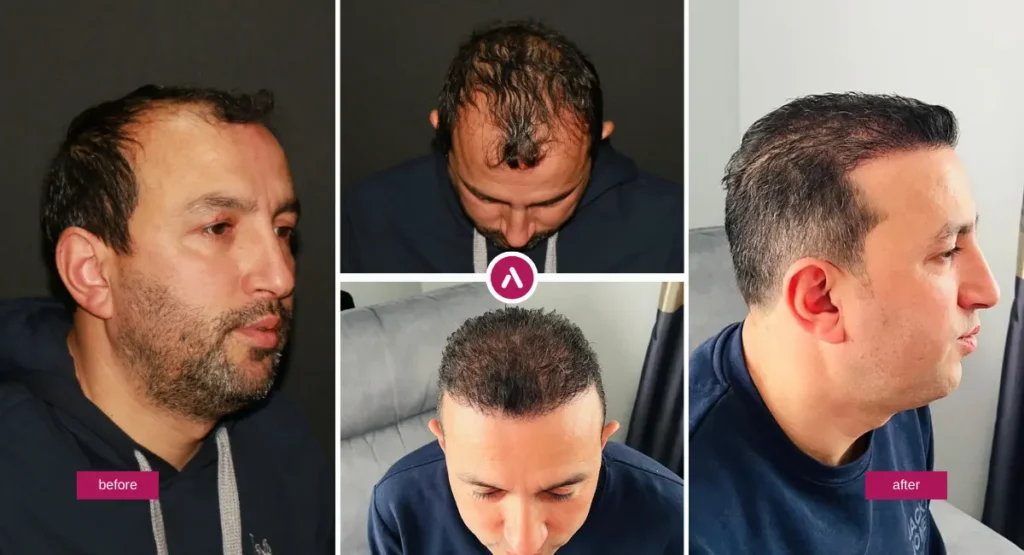
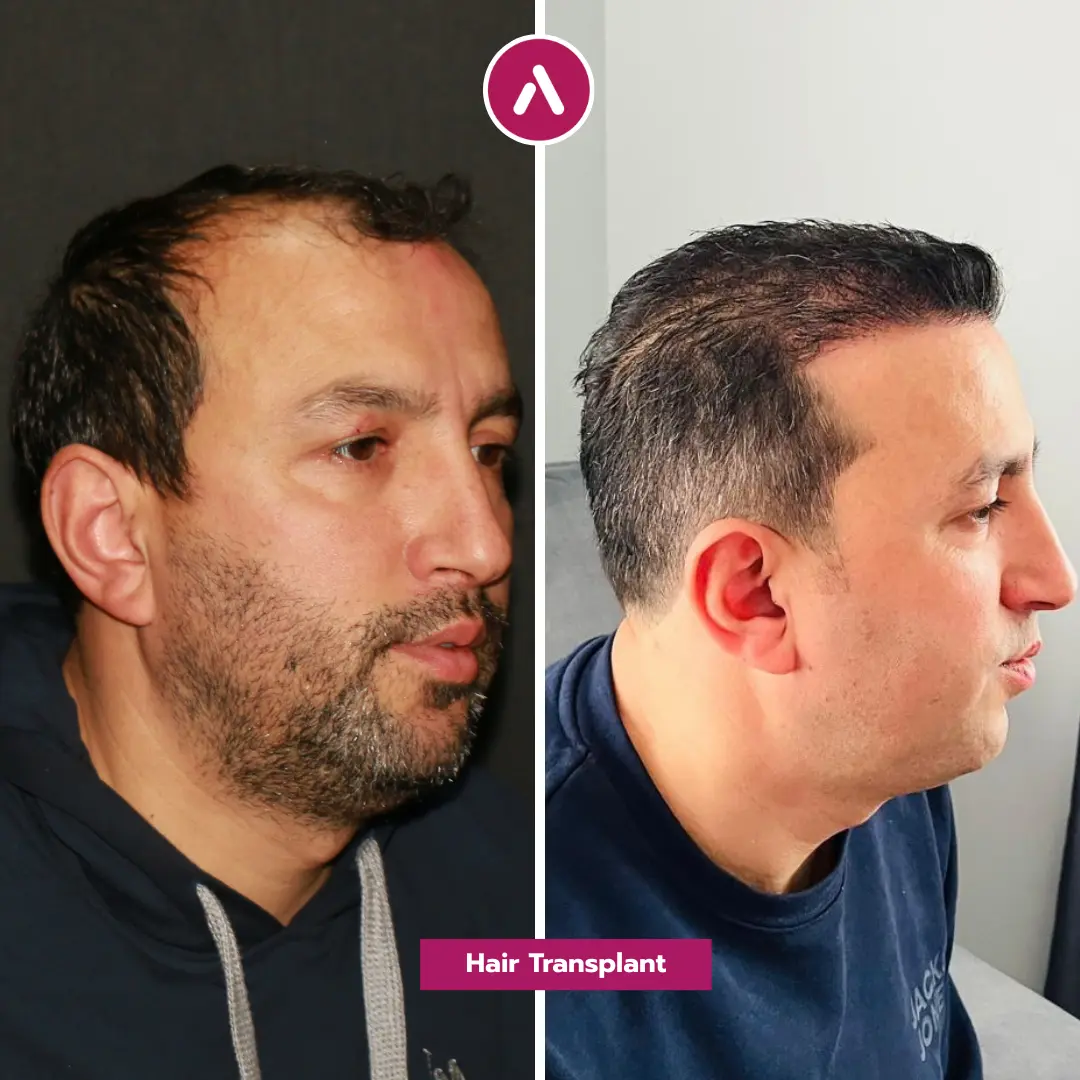
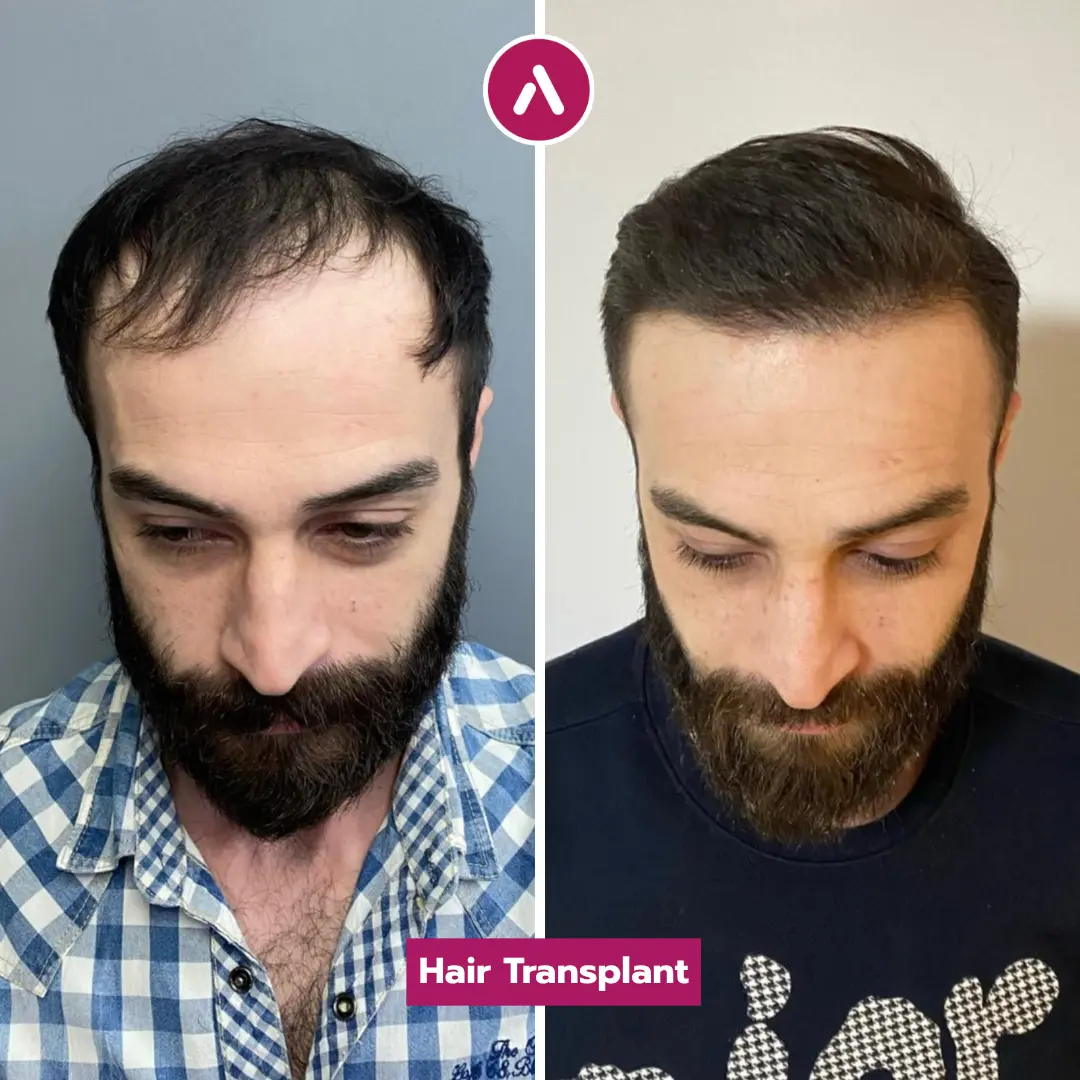
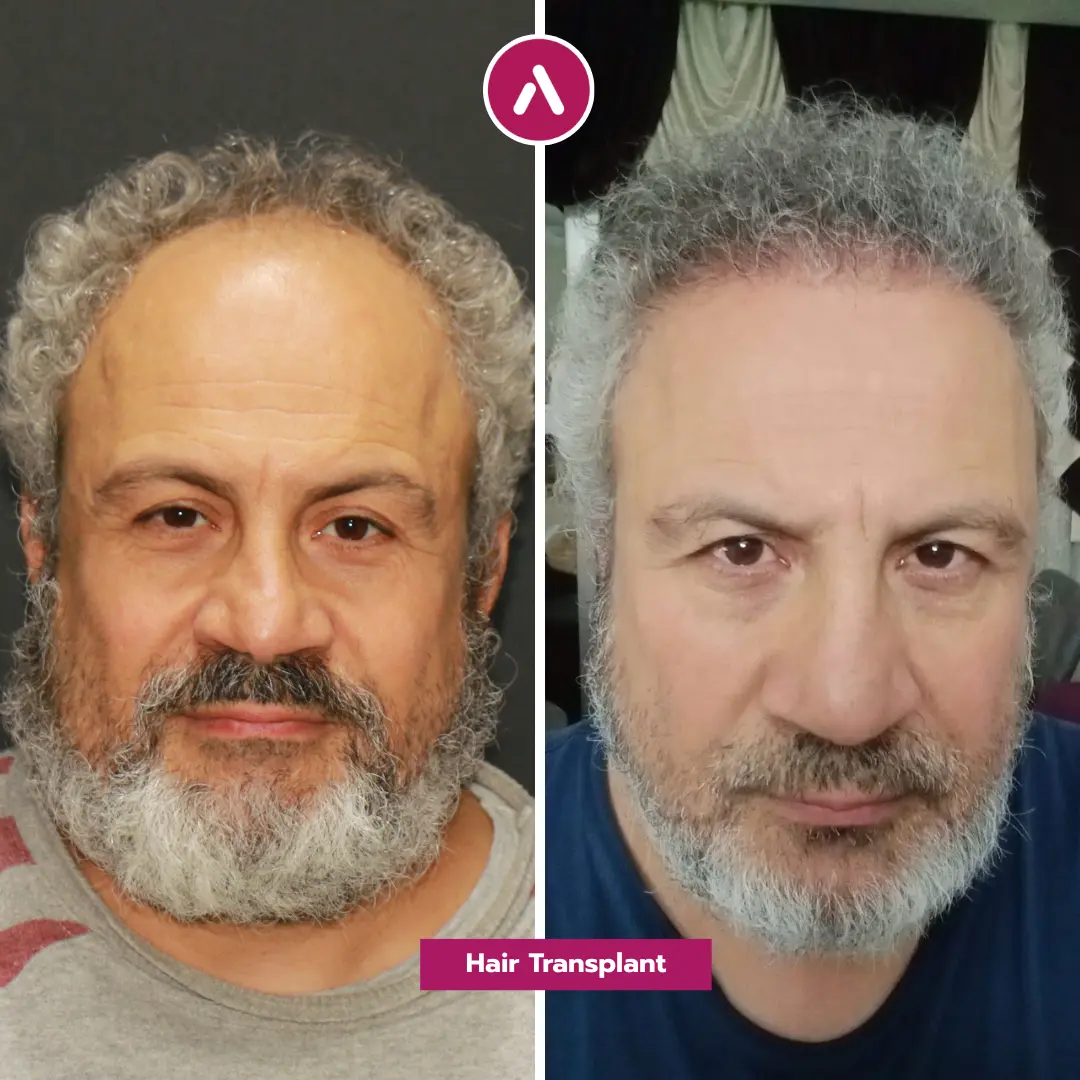
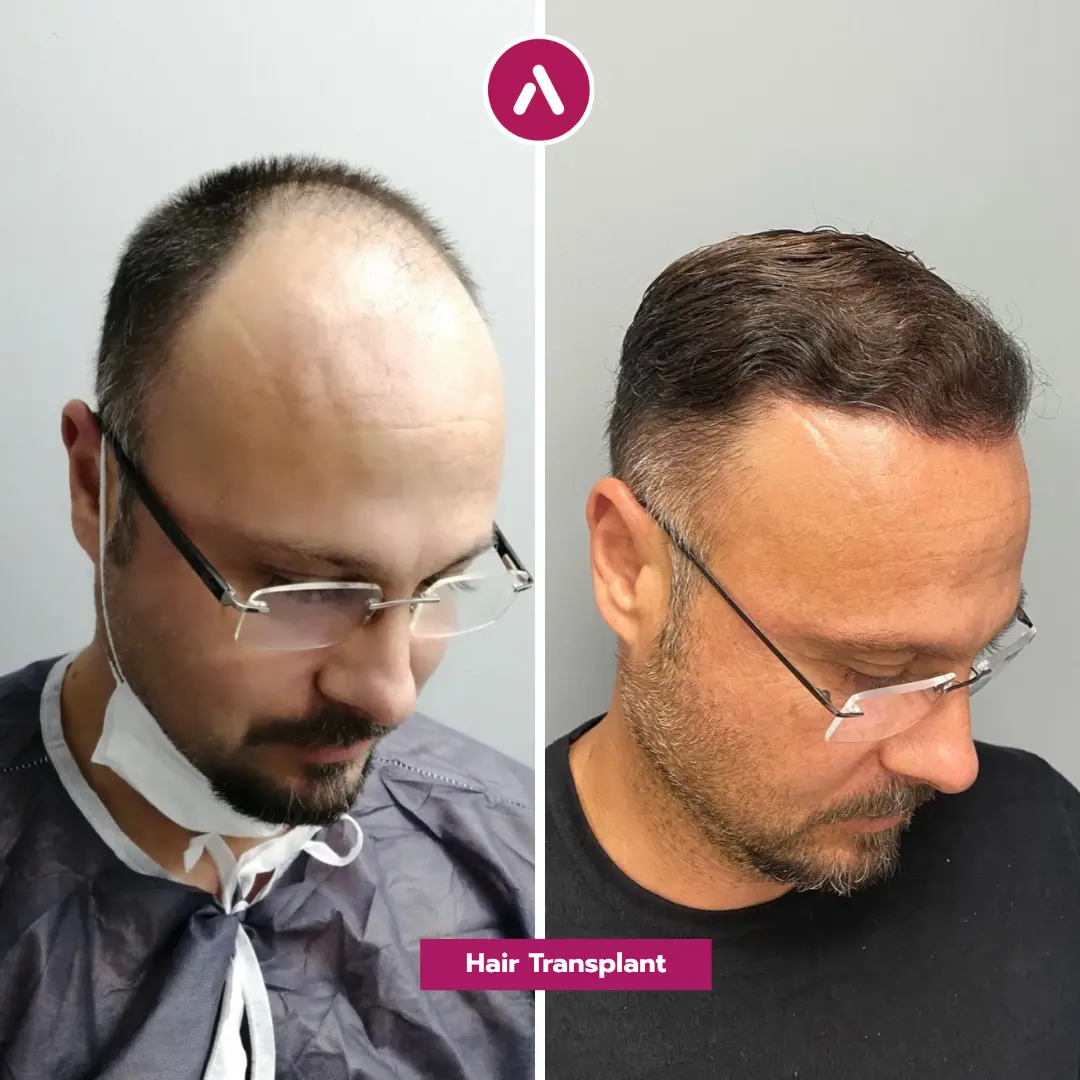
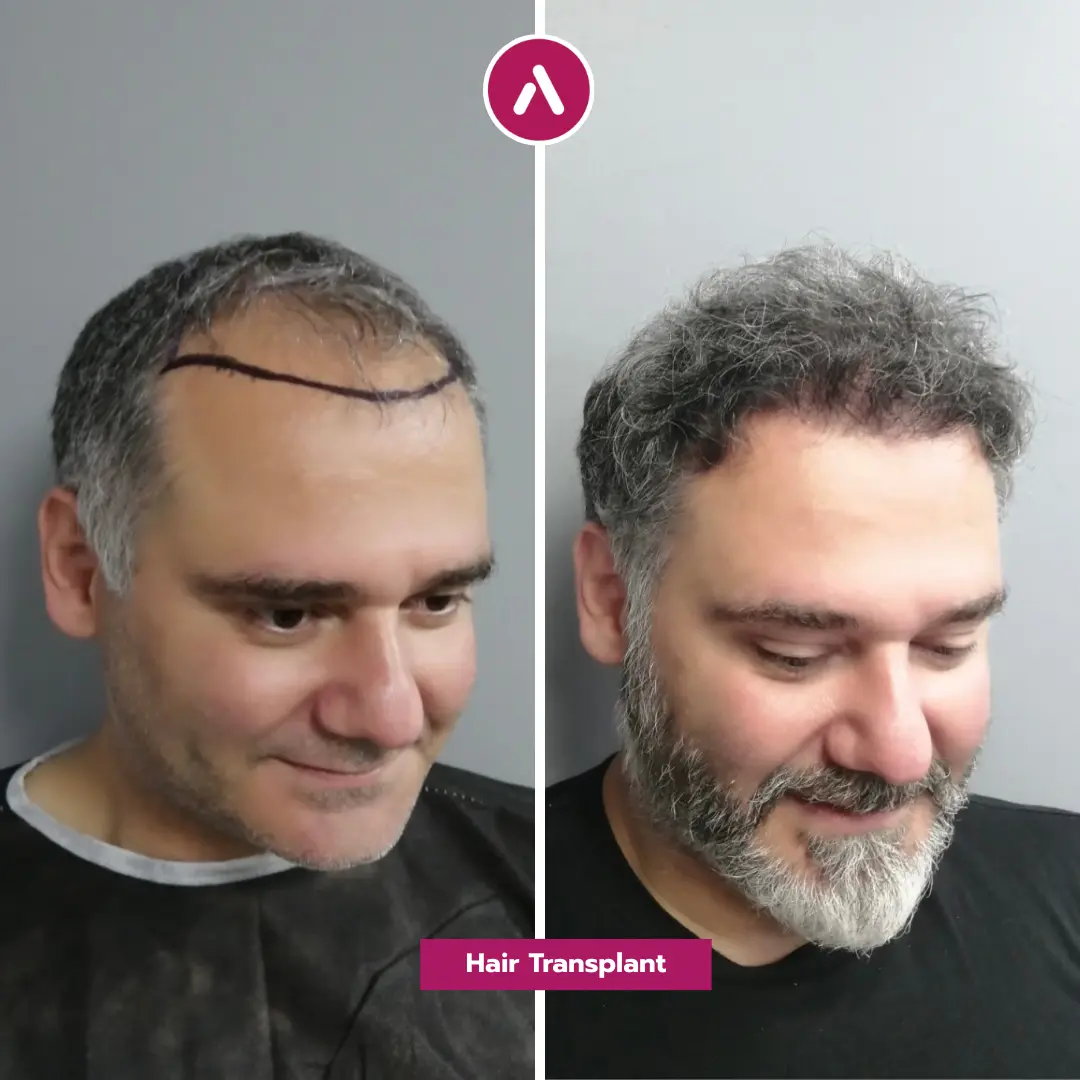
FUE Hair Transplant Before and After: Realistic Expectations
Hair restoration is predictable, but it is not instant. The first few weeks can feel underwhelming because the scalp is healing and the follicles are settling. That phase is normal. We set expectations around biology, not optimism.
Your final look depends on three things: donor quality, careful graft handling, and how your native hair behaves over time. We plan with the long view. It keeps results believable at 12 months and beyond.
When growth starts (and why early weeks can look worse)
Most patients notice that the transplanted hairs shed in the early phase. It can look like you have “lost” the result. You have not. Shedding is often part of the normal cycle as follicles reset.
- Days 1–14: scabs settle and lift with correct washing. Redness can linger, especially in fair skin.
- Weeks 2–8: shedding is common. The follicles remain under the skin and begin their new growth cycle.
- Months 3–4: early growth often starts. It can be fine and uneven at first.
We keep you focused on the right metric: trend, not day-to-day appearance. That mindset helps.
Month-by-month expectations (3 / 6 / 12 months)
Hair growth is staged. It builds slowly, then accelerates, then matures. We track progress with photo check-ins so you can see the change clearly.
- Month 3: early sprouts. Coverage is usually patchy. Texture can feel different.
- Month 6: visible improvement. The hairline reads more naturally in normal lighting.
- Month 9: density and calibre often improve. Styling becomes easier.
- Month 12: the result typically reaches maturity. Some patients continue to see refinement beyond this point.
Our philosophy is “Rejuvenation, Not Alteration.” We aim for a natural frame that suits you, not a drastic change that draws attention.
If you are using medical therapy alongside surgery, we align timing and expectations so the plan stays coherent. One programme. One strategy.
Density, crown limitations, and “natural look” philosophy
Not every area behaves the same way. The hairline is a design challenge. The crown is a maths problem. We explain that difference early, so you are not surprised later.
- Hairline: we prioritise direction, angle, and micro-irregularity. Natural-looking beats “perfectly straight”.
- Mid-scalp: structured distribution creates the strongest visual coverage for the grafts used.
- Crown: it can require a high graft demand because of the swirl pattern. Some patients do better with a staged approach.
We also plan for future hair loss. A good result should still make sense if native hair thins over time.
Cost / Fees: FUE Hair Transplant Cost 2026 Turkey vs UK
UK patients usually compare two very different pricing models. Many UK clinics charge a price per graft, which can be logical for smaller cases and clear for budgeting. In Istanbul, the more common model is all-inclusive packages, which bundle surgery and logistics into one predictable plan.
We keep the discussion practical. Cost should reflect clinical standards, planning time, and safety systems. It should also be easy to understand. If the quote feels vague or conditional, that is a problem.
Price model differences: “price per graft” vs “all-inclusive”
These models are not just “different ways to pay”. They change how patients experience the process.
- UK model: often per graft, sometimes tiered by graft bands (for example, small vs large sessions).
- Istanbul model: typically packaged to include transfers, accommodation options, medication, and follow-up.
- Expert Patient lens: the right comparison is total value and predictability, not headline numbers.
If you are comparing options, ask what happens if the graft plan changes after in-person assessment. Clarity matters.
What’s typically included vs not included
Hidden extras create distrust. We avoid that. We explain what is covered and what is not, in plain terms, before you commit.
- Common inclusions: clinic transfers, hotel coordination options, post-op medication, first wash guidance, and structured follow-up.
- Common exclusions: flights, extended hotel nights, and optional add-ons that are not medically required.
- Aftercare: we provide clear instructions and remote support once you are back in the UK.
This is where packaged care can be useful. It reduces friction. It also reduces surprises.
Value anchors for the “Expert Patient” (quality + safety + predictability)
High-value care is not about chasing the lowest figure. It is about spending intelligently on the variables that protect outcome quality. That is where experienced planning and disciplined execution matter.
- Safety systems: sterile theatres, structured aftercare, and continuity of communication after you return home.
- Donor ethics: conservative harvesting that preserves your long-term options.
- Technique matching: choosing the right approach for your donor and goals, not forcing a one-size plan.
A rational quote is one you can audit: what you get, why you get it, and who is responsible for each step.
If you want a personalised estimate, we can assess your photos and goals first, then provide a conservative graft range and a clear, itemised plan. No pressure. Just a structured answer.
| Comparison factor | UK (typical private clinics) | Istanbul (AKM-style pathway) | Decision driver |
|---|---|---|---|
| Cost model | Per graft or graft bands | Packages with predictable inclusions | Budget clarity and transparency |
| Service depth | Procedure-focused, limited logistics | End-to-end coordination + follow-up | Lower friction for travellers |
| Technology & aftercare | Varies by clinic | Structured recovery support protocols | Risk reduction and confidence |
| Session scope | Often smaller sessions | Can be planned for higher graft ranges where appropriate | Coverage goals vs donor limits |
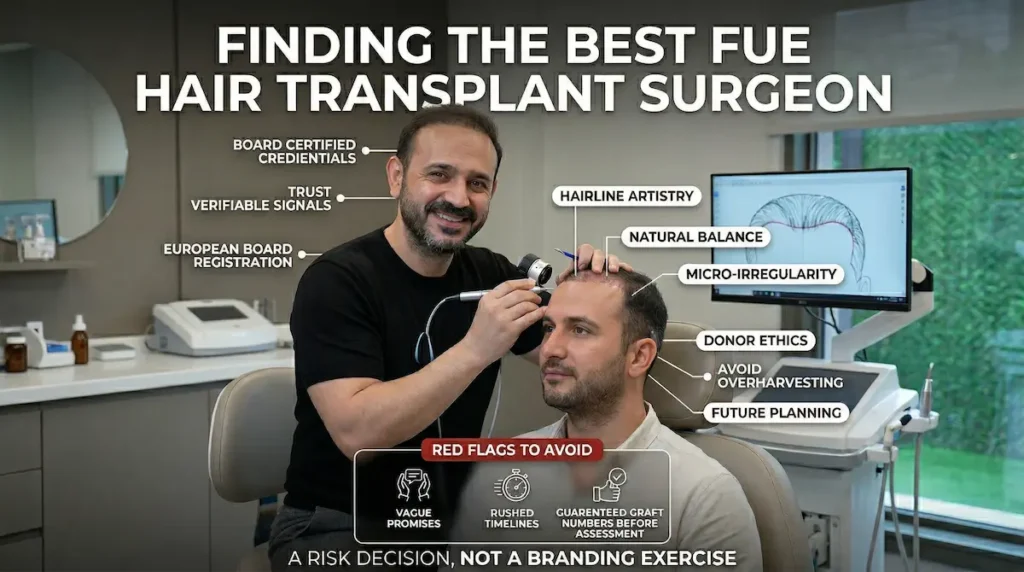
Finding the Best FUE Hair Transplant Surgeon
Choosing a provider for hair restoration is not a branding exercise. It is a risk decision. You are trusting someone with your donor supply, your hairline, and your long-term options. We encourage UK patients to evaluate clinics the way they would assess any medical service: credentials, process, transparency, and accountability.
Board certification and case experience (how to evaluate)
Titles alone are not enough. The question is whether the team has recognised training, consistent experience in hair restoration, and a repeatable clinical process. We advise focusing on verifiable signals rather than marketing labels.
- European Board Certified Surgeons or Specialists registered with international medical boards are stronger trust signals than vague “expert” claims.
- Ask who designs the plan and who performs the critical steps. Clarity matters.
- Look for consistency across cases: hairline direction, density gradients, and donor preservation.
If you are comparing UK private clinics and Istanbul options, keep your standards consistent. The same questions apply in both places.
Hairline artistry + donor ethics (two non-negotiables)
A natural result is built on two foundations: a believable hairline and a donor area that still looks healthy once healed. One without the other is short-term thinking. We plan around what looks natural at 12 months and what still looks natural years later.
- Hairline artistry: micro-irregularity, correct angle, and a soft density gradient matter more than a perfectly straight line.
- Donor ethics: we avoid overharvesting and keep extraction distribution even to protect the donor’s appearance.
- Future planning: we consider likely progression of hair loss so your result stays coherent over time.
Our priority is long-term natural balance. A hairline should look like it belongs to you, and a donor should still look like your own hair.
Red flags: “too many graft promises”, “one-size-fits-all plans”
Most poor outcomes share the same early warning signs. They are not subtle. If you spot them, pause and reassess.
- Guaranteed graft numbers offered before an in-person assessment.
- Rushed timelines with no discussion of donor limitations, shock loss, or staged planning.
- Vague accountability about who is responsible for the surgery and post-op support.
- Sales-first language that avoids medical detail and focuses only on “before/after” hype.
A careful clinic will sometimes tell you to wait. That restraint is often a sign of safety.
Your Medical Journey: what to expect as a UK traveller
For UK patients, the journey is part of the treatment. A good surgical plan can be undermined by chaotic logistics, poor communication, or unclear aftercare once you are home. We run the process as a structured programme, with the goal of removing friction and keeping you focused on preparation and recovery. It should feel organised, calm, and medically led.
Remote consultation + photo triage (what we need)
Your first step is usually a remote review. It helps us assess suitability, estimate a sensible graft range, and identify any medical questions before you book flights.
- Photos: hairline, temples, mid-scalp, crown, and donor area in good lighting.
- History: how long hair loss has progressed, family pattern, and any previous treatments.
- Health basics: medications, relevant medical conditions, smoking status, and allergies.
We use this stage to set realistic expectations early. No vague promises. Just a clear plan.
Flights, transfers, hotel, clinic schedule (smooth itinerary)
Once you secure a date, we coordinate the practical details so your time in Istanbul runs smoothly. UK patients often prefer predictable timing and minimal uncertainty, especially if they are balancing work and family schedules.
- Arrival: we organise private transfers from the airport to your hotel.
- Clinic day: an in-person review confirms the plan, followed by your procedure in a sterile operating theatre.
- Post-op in Istanbul: we monitor you closely, guide your first wash, and clear you to fly after a final check.
We keep the itinerary simple. You should not be problem-solving logistics while you are recovering.
WhatsApp support, contact points, and post-return check-ins
After you return to the UK, questions are normal. Scabs, redness, shedding, and shock loss can look dramatic even when healing is on track. We stay reachable, and we keep follow-up structured so you are not left guessing.
- Direct support: our team remains available via WhatsApp for questions and photo updates.
- Planned reviews: we schedule check-ins at 1, 3, 6, and 12 months to track progress and guide aftercare.
- Escalation clarity: if something looks unusual, we tell you what to do next. If you need urgent assessment in the UK, we will advise accordingly.
Travelling for treatment should not mean travelling without support. We stay involved after you land back home.
For most patients, this structure is the difference between feeling anxious and feeling in control.
FUE Hair Transplant Frequently Asked Questions (FAQ):
UK patients tend to ask the same questions before committing to surgery. Sensible ones. We answer them in plain terms, without overpromising. Your exact plan depends on donor quality, hair loss pattern, and what looks natural on your face.
If you want personal clarity, we can review your photos and medical history remotely, then confirm your graft range once you are assessed in person.
How many grafts do I need (1500 / 3000 / 5000)?
Around 1500 grafts: often suits early recession or targeted hairline refinement.
Around 3000 grafts: commonly used for a larger hairline + mid-scalp plan where donor allows.
Up to 5000 grafts: may be considered in broader cases, but only if donor capacity and safe extraction distribution support it.
We prefer conservative ranges. A natural result with a healthy donor is the goal. Always.
Will my donor area regrow?
- With correct spacing and conservative planning, the donor usually blends well once surrounding hair grows through.
- Overharvesting is avoidable. We treat donor supply as finite and plan accordingly.
- Short hairstyles may show dot scarring more than longer styles, so we factor that into your plan.
If you are concerned about donor visibility, we can discuss extraction patterns and whether an unshaven approach makes sense for your case.
How long until I can wear a hat or go to the gym?
Hats: we usually advise avoiding tight hats early on. If you must wear one, it should be loose, clean, and non-rubbing.
Gym: heavy exercise and sweating are typically paused initially to reduce swelling and infection risk.
Swimming and saunas: usually avoided early because heat, chlorine, and bacteria can irritate healing sites.
If you have a fixed work schedule, tell us. We can plan around your commitments and give a realistic return-to-routine window.
Is Sapphire FUE worth it?
It can be useful when we want very precise site sizing and spacing.
It does not replace good graft handling, donor ethics, or correct direction.
The “right” choice depends on your hair calibre, scalp characteristics, and the area being treated.
We recommend it only when it adds practical value to your plan, not as an automatic upg
FUE hair transplant Istanbul reviews: what should I look for?
Specificity: do people describe planning, cleanliness, and aftercare, not just “good service”?
Consistency: do results look natural across different hair types and degrees of hair loss?
Continuity: do patients mention support once they returned to the UK?
We also recommend comparing how clinics respond to concerns. Calm, structured communication is a strong safety signal.
Medical Disclaimer: This page is for general information only and does not replace a consultation with a qualified clinician. Results vary between individuals. Any surgical procedure carries risk and requires a personalised assessment, including your medical history, medications, and scalp condition. If you have sudden symptoms, severe pain, fever, or signs of infection, seek urgent medical advice. In the UK, you can contact NHS 111 for guidance, or attend A&E in an emergency.