




Canadian men dealing with enlarged chest tissue often face the same first question: is this true gynecomastia, or is it chest fat that may improve with weight loss? The answer matters. True gynecomastia usually involves firm glandular tissue beneath the nipple and often requires surgical removal, while pseudogynecomastia is mostly fat. This guide explains how diagnosis works, which treatment options are realistic, and why many Canadian men compare private care in Toronto, Montreal, Vancouver, or Calgary with a surgeon-led programme in Istanbul.
Table of Contents
What Is Gynecomastia? Male Breast Reduction Explained
Gynecomastia surgery, or male breast reduction, removes excess glandular tissue and/or fat from the male chest to flatten enlarged breast contour. It combines glandular excision for true gynecomastia with liposuction for fat or mixed cases, usually through small periareolar and axillary incisions.
Gynecomastia is not simply “being out of shape.” It is a medical condition where male breast tissue enlarges because of gland growth, fat accumulation, hormonal changes, medication effects, or a combination of these factors. For many men, the condition creates a rounded or puffy chest that does not respond predictably to gym training. That is why diagnosis matters before choosing treatment.
At AKM Clinic, we evaluate the chest as a three-part structure: gland, fat, and skin. Each part behaves differently. Glandular tissue often feels firm or rubbery under the nipple, fat feels softer and more diffuse, and loose skin may appear after major weight loss or long-standing gynecomastia. A tailored surgical plan begins by identifying which of these elements is present.
Gynecomastia Meaning: Medical Definition and Male Chest Anatomy
Medically, gynecomastia refers to enlargement of male breast gland tissue. This tissue sits behind the nipple-areola complex and may become more prominent during puberty, after weight gain, after steroid use, or because of hormonal imbalance. Some men have tenderness, nipple puffiness, or asymmetry. Others have no pain at all, but the chest contour still feels out of proportion to the rest of the body.
How Gynecomastia Surgery Works
Gynecomastia surgery removes the tissue that is creating the rounded contour. If the issue is dense gland, our surgeons use direct excision through a discreet incision near the areola. If excess fat is present, we add liposuction or VASER-assisted contouring to blend the chest into the upper abdomen and sides. Most cases require both steps, because many men have mixed gynecomastia.
Male Breast Reduction vs Female Breast Reduction
Male breast reduction and female breast reduction are different operations. Female breast reduction reshapes a breast mound while preserving a natural breast contour. Male breast reduction aims to create a flatter, more angular chest with a masculine pectoral outline. The incision planning, tissue removal pattern, and aesthetic endpoint are different, even though both procedures remove excess tissue.
Brief History: From Pure Excision to VASER-Assisted Contouring
Older gynecomastia operations focused mainly on cutting out the gland. That helped nipple puffiness, but it could leave uneven edges or a crater-like depression if too much tissue was removed. Modern male chest surgery is more precise. We combine conservative gland removal with liposuction or VASER-assisted sculpting so the chest looks flatter, smoother, and more athletic without appearing hollow.
Benefits of Gynecomastia Surgery
The main benefit of gynecomastia surgery is a flatter, more proportional male chest. For many Canadian men, the goal is not dramatic change. It is the ability to wear a T-shirt without thinking about nipple puffiness, train at the gym without hiding under layers, or feel comfortable at a pool or beach.
The procedure can also improve the physical discomfort caused by enlarged breast tissue. Some men describe tenderness during exercise, rubbing under fitted clothing, or sensitivity around the nipple area. Surgery can address those symptoms when they come from excess glandular tissue.
Results are strongest when the surgical plan matches the diagnosis. True gynecomastia needs gland removal. Pseudogynecomastia may need fat reduction. Mixed cases usually need both. That is why we do not treat every male chest the same way.
Physical Symptom Relief
Some men with gynecomastia experience soreness, pressure, or nipple tenderness, especially during workouts or contact sports. Removing excess glandular tissue can reduce that irritation. It may also improve chafing caused by a rounded chest rubbing against compression shirts or athletic clothing. Symptom relief is not guaranteed in every case, but it is a common reason men seek assessment.
Sport, Gym, and Outdoor Activity Restoration
Gynecomastia can change how men move through daily life. Many avoid swimming, team sports, fitted gym tops, or changing rooms. After surgery, the chest is flatter and easier to compress during early recovery, then gradually settles into a more natural contour. Most patients return to light activity within a few weeks, while chest training waits until healing is stable.
Confidence and Body Image Restoration
Many patients describe gynecomastia as a private problem that affects public confidence. They may stand with rounded shoulders, avoid photos, or wear dark oversized clothing even in summer. Surgery can help restore a sense of control over the body. The best outcome is not an exaggerated chest. It is a contour that feels normal, balanced, and easier to live with.
Clothing Fit Improvement
A flatter chest changes how clothing sits. Dress shirts close more smoothly, T-shirts no longer pull across the nipple area, and athletic tops fit closer to the torso without drawing attention to the chest. For men in professional settings across Toronto, Vancouver, Calgary, or Montreal, this can be one of the most practical day-to-day benefits.
Long-Term Recurrence Prevention
When dense glandular tissue is removed properly, true gynecomastia is less likely to return. Recurrence can still happen if the underlying trigger remains active, such as anabolic steroid use, major weight gain, or certain medications. During consultation, we review possible causes so the surgical result is protected long-term. A stable weight and healthy hormone profile matter.
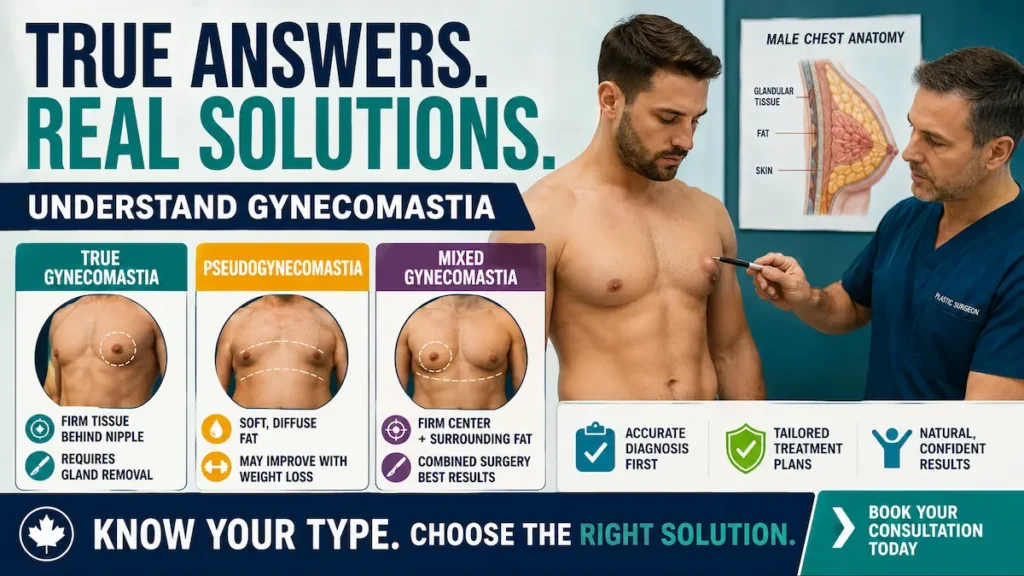
True Gynecomastia vs Pseudogynecomastia: A Diagnostic Framework for Canadian Men
Before any Canadian patient compares surgeons, pricing, or travel logistics, the first question is diagnostic: is the chest enlargement caused by gland, fat, skin, or a combination? This distinction changes everything. True gynecomastia usually requires glandular excision because the tissue does not reliably disappear with exercise. Pseudogynecomastia may improve with weight loss or liposuction-focused contouring.
This is why our consultation process does not begin with a package recommendation. It begins with tissue assessment. We look at firmness, distribution, nipple puffiness, skin laxity, weight history, medication exposure, steroid history, and how long the chest fullness has persisted.
For many men from Toronto, Montreal, Vancouver, Calgary, or Ottawa, this diagnostic step is the first time the problem feels clearly explained. The goal is not to push every patient toward surgery. The goal is to identify which tissue is actually creating the contour.
The Self-Diagnostic Question: Glandular Tissue or Fat?
A useful starting question is simple: does the fullness sit directly behind the nipple, or is it spread across the whole chest? Firm fullness behind the areola suggests true gynecomastia. Soft, diffuse fullness across the chest and sides suggests pseudogynecomastia. Many men have both.
Body weight alone does not answer the question. Lean men can have true gynecomastia. Higher-BMI men can have pseudogynecomastia. Athletic men who used anabolic steroids may have firm gland despite low body fat. Post-weight-loss patients may have residual fat plus loose skin.
We treat this as a diagnostic map, not a label. The surgical plan changes based on the answer.
The Gynecomastia Pinch Test: Step-by-Step Self-Assessment
The gynecomastia pinch test is not a replacement for medical examination, but it can help you understand what you may be feeling. Stand in front of a mirror. Place your thumb and index finger around the areola. Gently pinch inward toward the tissue directly behind the nipple.
If you feel a firm, rubbery, disc-like mound, that pattern often suggests glandular gynecomastia. If the tissue feels soft and evenly spread, fat may be the main driver. If you feel a firm central disc surrounded by soft tissue, the case may be mixed.
Self-assessment note: Pain, nipple discharge, a hard irregular lump, or sudden one-sided enlargement should be assessed by a Canadian family physician or specialist before cosmetic planning. Do not self-diagnose those symptoms.
True Gynecomastia Identification
True gynecomastia usually feels firm, rubbery, and centred behind the nipple-areola complex. It may create a puffy nipple even when the rest of the chest is lean. Some men report tenderness. Others only notice shape.
This tissue is glandular. Diet and chest exercises may reduce surrounding fat, but they do not reliably remove the gland itself. That is why men with true gynecomastia often say they became leaner everywhere except the nipple area.
For these cases, our usual surgical solution is direct glandular excision through a small periareolar incision. If surrounding fat is also present, we blend the contour with liposuction or VASER-assisted sculpting.
Pseudogynecomastia Identification
Pseudogynecomastia is chest enlargement caused mainly by fat rather than gland. The tissue usually feels soft, spread out, and less concentrated directly behind the nipple. It often appears with broader weight gain across the abdomen, flanks, and upper chest.
For some men, weight loss and resistance training improve pseudogynecomastia significantly. For others, fat remains in the chest despite a stable weight. In those cases, liposuction-focused contouring may be appropriate, especially when the skin still has good elasticity.
This is where over-treatment can become a problem. Removing gland when the issue is mostly fat does not create the best chest shape. The contour must match the tissue type.
Mixed Gynecomastia
Mixed gynecomastia is common. It includes a central glandular component behind the nipple plus surrounding fat across the chest. This pattern is often seen in men who gained weight after puberty, men after major weight loss, and men who have both hormonal and lifestyle-related factors.
In mixed cases, gland excision alone may leave a bulky chest. Liposuction alone may leave puffy nipples. That is why a combined approach is often the most balanced solution.
At AKM Clinic, we commonly combine glandular excision with liposuction or VASER-assisted contouring. This allows our surgeons to flatten the nipple area while smoothing the chest perimeter into the upper abdomen and lateral chest.
| Type | Main Tissue | Pinch Test Feel | Surgical Need | Non-Surgical Resolution | Our Approach |
|---|---|---|---|---|---|
| True Gynecomastia | Glandular tissue | Firm, rubbery disc behind the areola | Usually requires glandular excision | Limited once persistent | Periareolar gland removal, with contour blending if needed |
| Pseudogynecomastia | Fat | Soft, diffuse fullness | Not always surgical | Possible with weight loss if fat-driven | Weight stability first; liposuction or VASER if resistant fat remains |
| Mixed Gynecomastia | Gland + fat | Firm central disc with soft surrounding fullness | Often benefits from combined surgery | Partial improvement possible, but gland often remains | Glandular excision plus liposuction or VASER-assisted contouring |
Simon Scale Staging Framework
The Simon scale helps classify gynecomastia severity. It looks at breast enlargement and skin excess. This matters because small, firm glandular cases do not require the same plan as severe gynecomastia with skin redundancy.
Grade I usually means minor enlargement without extra skin. Grade IIa means moderate enlargement without skin excess. Grade IIb includes moderate enlargement with some skin excess. Grade III is marked enlargement with visible skin redundancy. Some surgical outlines describe Grade IV for severe redundancy beyond standard Grade III patterns.
Staging guides incision planning, liposuction extent, and whether skin excision may be needed.
| Stage | Chest Appearance | Skin Excess | Typical Tissue Pattern | Likely Surgical Strategy |
|---|---|---|---|---|
| Grade I | Minor enlargement, often puffy nipple | No | Small glandular disc | Targeted glandular excision; limited contouring if needed |
| Grade IIa | Moderate enlargement | No | Gland, fat, or mixed tissue | Excision plus liposuction for contour blending |
| Grade IIb | Moderate enlargement with early droop | Mild | Mixed tissue, often post-weight change | Combined excision and liposuction; skin retraction assessment |
| Grade III | Marked enlargement, breast-like contour | Clear | Gland, fat, and skin laxity | Combined removal with possible skin excision |
| Grade IV | Severe enlargement with significant redundancy | Significant | Complex gland, fat, and skin excess | Advanced contouring and skin reduction strategy |
“The first surgical decision is not incision placement. It is diagnosis. If we do not separate gland, fat, and skin correctly, we cannot create a natural male chest contour.”
Causes of Gynecomastia
Gynecomastia can come from several pathways. Puberty is one of the most common. Many adolescent cases improve over time, but persistent gland can remain into adulthood. Hormonal imbalance can also contribute, especially when estrogen-androgen balance shifts. For a general endocrine overview of gynecomastia, the Endocrine Society’s patient resource on gynecomastia explains the testosterone-estrogen imbalance that can contribute to male breast tissue enlargement.
Medication-induced gynecomastia is another category. Some drugs can influence breast tissue growth. Anabolic steroid use can trigger glandular development, particularly after cycles that alter hormonal balance. Some men never identify a clear cause; this is called idiopathic gynecomastia.
Weight-related chest fullness may be fat-driven, gland-driven, or mixed. That is why history matters.
| Cause Category | Typical Pattern | What to Check Before Surgery | Surgical Relevance |
|---|---|---|---|
| Puberty persistent | Started in adolescence, remained into adulthood | Duration and stability | Often surgical if persistent for years |
| Hormonal | May be bilateral or asymmetric | Endocrine review when clinically indicated | Underlying cause should be stable before surgery |
| Medication-induced | Develops after medication exposure | Medication list with physician review | Trigger should be addressed first where possible |
| Steroid-related | Often firm gland behind areola | Hormonal stability after cessation | Surgery may be effective once hormones stabilize |
| Idiopathic | No clear trigger | Medical history and physical exam | Surgical plan based on tissue type |
| Weight-related | Diffuse chest fullness, often with abdominal fat | Weight stability and skin elasticity | May need liposuction or combined approach |
Does Gynecomastia Go Away on Its Own?
Puberty-related gynecomastia can improve naturally, especially within the first 6 to 18 months. That is why adolescent cases require careful timing. Surgery is usually considered only when enlargement persists, causes distress, or remains stable after puberty.
Adult true gynecomastia is less likely to disappear on its own once glandular tissue has matured. Weight loss may improve the surrounding fat, but the firm gland often remains. Steroid-related gynecomastia may soften after hormonal stabilization, but persistent gland usually does not fully reverse.
The honest answer is therefore conditional. Some cases improve. Persistent glandular cases usually do not.
When to Stop DIY and See a Surgeon
You should consider a surgical assessment if chest fullness has remained stable for more than 12 months, feels firm behind the nipple, persists despite weight loss, or creates significant distress in clothing, sports, or professional life. A consultation is also appropriate when one side is noticeably different from the other.
Men with sudden enlargement, pain, nipple discharge, or a hard irregular mass should first see a Canadian family physician. Cosmetic surgery planning should not replace medical screening. Safety comes first.
If the concern is long-standing and stable, a surgeon-led assessment can clarify whether glandular excision, liposuction, VASER-assisted contouring, or no surgery is the right next step.
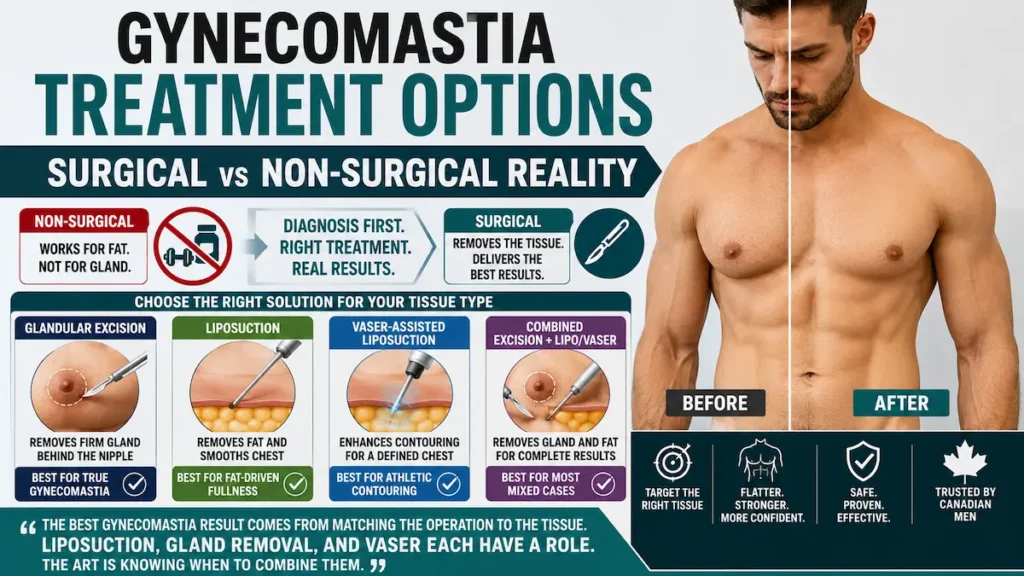
Gynecomastia Treatment Options: Surgical vs Non-Surgical Reality
Gynecomastia treatment should match the tissue type. This is where many men lose time. They try chest workouts, fat-loss plans, supplements, compression shirts, or posture fixes without knowing whether the problem is glandular tissue, fat, or mixed tissue.
Non-surgical improvement is possible in selected cases, especially when the chest enlargement is mostly fat or very recent puberty-related swelling. Mature glandular tissue is different. Once firm gland has persisted behind the nipple, surgery is usually the only predictable way to remove it.
Our approach is direct: we explain what can improve without surgery and what cannot. That honesty protects patients from over-promising, under-treating, and repeating years of ineffective solutions.
The Treatment Decision Framework
The best treatment depends on three clinical questions. First, is the tissue gland, fat, skin, or mixed? Second, how severe is the chest enlargement on the Simon scale? Third, is the condition stable, or is an active cause still present?
A small glandular disc may need targeted excision. A soft fat-driven chest may respond to weight loss or liposuction. A mixed case often needs both gland removal and contour blending. Severe cases with loose skin require a broader skin-management plan.
This is why the same operation is not right for every man. A bodybuilder with steroid-related firm gland needs a different protocol than a post-weight-loss patient with fat and skin laxity.
Gynecomastia Treatment Without Surgery
Non-surgical treatment can help when the cause is early, reversible, or fat-driven. Weight loss may improve pseudogynecomastia. Medication review may help when a prescription is contributing to breast tissue growth. Hormonal assessment may be useful when symptoms suggest endocrine imbalance.
Adolescent gynecomastia often deserves observation before surgery, because many puberty-related cases improve over time. The key word is “often,” not “always.” Persistent gland that remains into adulthood behaves differently.
What non-surgical treatment cannot reliably do is dissolve mature glandular tissue. Creams, chest exercises, and fat-burning supplements do not remove a firm gland behind the nipple.
How to Get Rid of Gynecomastia
To get rid of gynecomastia properly, the treatment has to remove the tissue creating the contour. If the issue is gland, that means surgical excision. If the issue is fat, it may mean weight loss, liposuction, or VASER-assisted contouring. If both are present, both need to be treated.
Chest workouts can strengthen the pectoral muscle, but they sit underneath the gland and fat. Exercise may improve posture and definition, yet it can also make nipple puffiness look more obvious if gland remains on top of a developed pectoral muscle.
The most predictable result comes from diagnosis-first planning. Once we know the tissue type, the solution becomes clearer.
Glandular Excision Technique
Glandular excision removes dense breast tissue through a discreet incision, usually placed along the lower edge of the areola. This location helps the scar blend into the colour transition between areolar skin and chest skin.
During excision, the surgeon removes the firm gland while preserving a thin layer beneath the nipple. This is important. Removing too much tissue can create a crater deformity, while leaving too much can cause persistent puffiness.
Our goal is a flat, natural chest contour, not a hollow one. Conservative, controlled excision is safer than aggressive removal.
Liposuction-Assisted Gynecomastia Surgery
Liposuction treats the fatty component of gynecomastia. Small access points allow the surgeon to remove fat and blend the chest into surrounding areas. This is especially useful for men with fullness across the lower chest, lateral chest, or upper abdomen.
Liposuction alone works best when the tissue is mainly fat and the skin has enough elasticity to retract. It is less effective for firm gland. If dense tissue remains behind the nipple, liposuction may flatten the sides but leave the central puffiness unchanged.
For that reason, we often use liposuction as a contouring tool rather than a standalone answer.
VASER High-Def Liposuction for Gynecomastia
VASER uses ultrasound energy to loosen fat before removal. In male chest contouring, this can help refine the border between the pectoral muscle, lower chest, and upper abdomen. It is especially useful when the goal is a more athletic contour.
VASER does not replace glandular excision. It supports contouring around the gland. For mixed gynecomastia, VASER can reduce surrounding fat while direct excision removes the firm tissue behind the nipple.
This combined logic is important for Canadian men comparing standard liposuction quotes with more complete male chest contouring plans. The technique should match the tissue.
Combined Glandular Excision and Liposuction
The combined approach is the most common solution for mixed gynecomastia. It treats both the central gland and surrounding fat. This helps avoid two common problems: a flat nipple area with bulky sides, or smooth sides with persistent puffy nipples.
The sequence usually starts with liposuction or VASER-assisted fat reduction. After the chest has been blended, the surgeon removes the gland through the periareolar incision. The chest is then reassessed for symmetry, contour, and skin behaviour.
For many men, this combined method creates the most natural masculine result.
| Technique | Best For | What It Removes | Scar Pattern | Strength | Limitation |
|---|---|---|---|---|---|
| Glandular Excision | True gynecomastia with firm tissue behind the nipple | Dense glandular tissue | Small periareolar incision | Directly treats puffy nipple and firm gland | Does not fully contour surrounding fat by itself |
| Liposuction | Pseudogynecomastia or soft fatty fullness | Fat | Small access points, often lateral or axillary | Smooths broad chest fullness | Cannot reliably remove dense gland |
| VASER-Assisted Liposuction | Mixed cases needing more defined male contour | Fat, with improved contour control | Small access points | Supports athletic chest shaping | Still requires excision if firm gland is present |
| Combined Excision + Lipo/VASER | Most mixed gynecomastia cases | Gland and fat | Periareolar incision plus liposuction access points | Most complete contour correction | Requires careful balance to avoid over- or under-resection |
Severe Gynecomastia and Skin Excess
Severe gynecomastia is different from mild nipple puffiness. It may include visible breast-like projection, drooping skin, enlarged areolas, and poor skin elasticity. This pattern is more common after major weight loss, long-standing gynecomastia, or Grade III to Grade IV cases.
In these cases, removing gland and fat may not be enough. The skin may not retract fully. Some patients need skin excision, areola reduction, or a staged approach to protect the final contour.
We discuss this carefully during consultation. A flatter chest is the goal, but scar placement and skin quality must be considered honestly.
Awake Gynecomastia Surgery Variant
Some smaller gynecomastia cases may be suitable for surgery under local anesthesia with sedation. This is not the right option for every patient. It works best when tissue volume is limited, anxiety is controlled, and the surgical plan does not require extensive contouring.
For larger mixed cases, general anesthesia may still be safer and more comfortable. The awake option is valuable, but it should not be forced into cases that need broader surgical access.
Canadian patients interested in avoiding general anesthesia can review our dedicated awake gynecomastia page, where we explain candidacy, comfort, recovery, and limitations in detail.
“The best gynecomastia result comes from matching the operation to the tissue. Liposuction, gland removal, and VASER each have a role. The art is knowing when to combine them.”
Are You a Candidate for Gynecomastia Surgery?
Gynecomastia surgery is appropriate when chest enlargement is stable, tissue type is clearly identified, and non-surgical options are unlikely to create the desired contour. Candidacy is not based on embarrassment alone. It depends on anatomy, health status, skin quality, weight stability, and whether the underlying cause has been addressed.
For Canadian patients, we also consider travel-readiness. A patient flying from Toronto, Vancouver, Montreal, Calgary, Edmonton, or Ottawa needs enough cardiovascular fitness to handle surgery, early walking, compression wear, and the return flight home. This is why we review medical history carefully before confirming surgery dates.
The best candidates understand that surgery reshapes the chest; it does not replace weight management, hormone evaluation when needed, or long-term lifestyle stability. The result depends on both surgical planning and what happens after recovery.
Ideal Candidate Profile
An ideal candidate has persistent chest enlargement that has remained stable for at least several months, especially if it includes firm tissue behind the nipple. He is close to a stable weight, does not smoke, and has realistic expectations about scars, swelling, and recovery. He wants a flatter, more masculine chest contour without an over-sculpted or artificial look.
Good candidates also understand the difference between improvement and perfection. The chest may become flatter and more proportional, but no ethical surgeon can promise total symmetry or a completely scar-free result. We aim for a natural contour that works with the patient’s frame.
Adolescent Candidacy
Teenage gynecomastia often improves naturally as hormones stabilize. For that reason, surgery is usually delayed unless the tissue has persisted, causes significant distress, or remains clearly glandular after observation. A family physician or pediatric specialist should be involved when the patient is still in adolescence.
For younger patients travelling from Canada, parental involvement, maturity, and psychological readiness matter. Surgery should never be rushed because of short-term embarrassment. The chest must be stable enough to justify intervention.
Adult Onset Candidacy
Adult-onset gynecomastia needs a more careful history. Sudden chest enlargement can be linked to medication changes, anabolic steroid use, hormone shifts, weight gain, or medical conditions. A Canadian family physician may need to review blood work or medications before cosmetic planning.
If the tissue has been stable and medical causes are controlled, surgery can be considered. Adult men often benefit from combined gland excision and liposuction because the tissue pattern is frequently mixed.
Athletic and Bodybuilder Candidacy
Athletic men can still have gynecomastia. In fact, a lean body can make puffy nipples or firm gland more visible. Bodybuilders may develop glandular tissue after anabolic steroid use or hormonal fluctuation. In these cases, chest training usually does not solve the problem.
We assess whether the gland is stable and whether steroid use has stopped. Surgery performed while the trigger is ongoing has a higher chance of recurrence. Honest disclosure is essential. It helps protect your result.
Weight Stability Requirement
Weight stability is one of the strongest predictors of a durable result. If the chest is mainly fat-driven, additional weight loss may improve the contour before surgery. If the patient is still losing weight quickly, we may recommend waiting until the body stabilizes.
Large weight changes after surgery can alter the chest again. Fat can return, skin can loosen, and the result may become less defined. A stable weight before surgery creates a more predictable surgical plan.
Disqualifying Conditions
Some conditions can delay or prevent surgery. These include uncontrolled diabetes, active infection, untreated bleeding disorders, severe heart or lung disease, heavy smoking, unstable hormone problems, or unrealistic expectations. Sudden unilateral enlargement, nipple discharge, or an irregular hard lump also needs medical assessment before aesthetic surgery.
If a concern appears during consultation, we may ask for clearance from your Canadian family physician or specialist. This is not a formality. It is part of safe cross-border surgical planning.
“A good candidate is not simply someone who wants a flatter chest. He is someone whose tissue pattern, health status, and expectations all point toward a safe and predictable operation.”
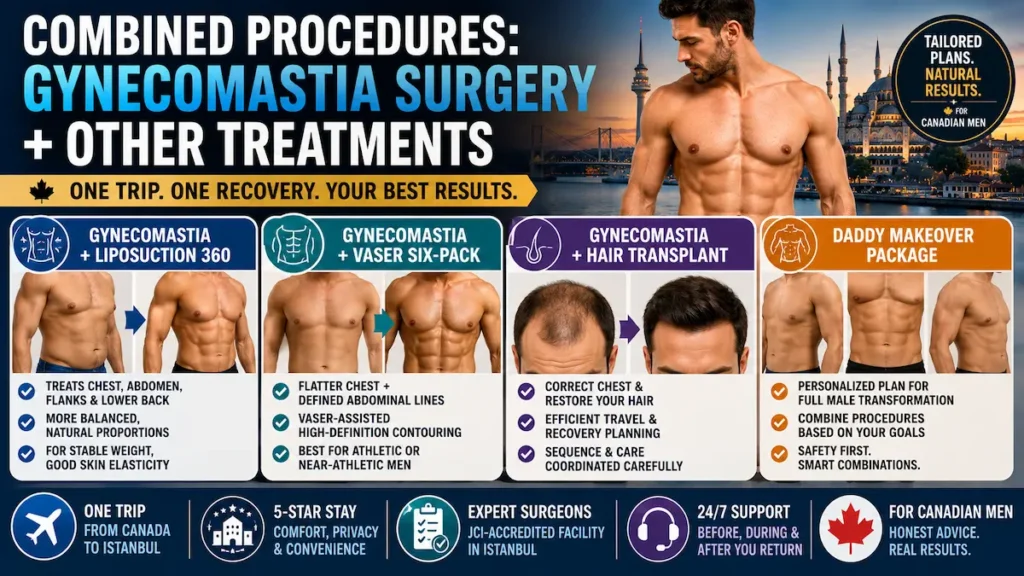
Combined Procedures: Gynecomastia Surgery + Other Treatments
Some Canadian men choose gynecomastia surgery as a standalone procedure. Others use it as part of a broader male body contouring plan. The right choice depends on anatomy, recovery capacity, anesthesia safety, and how much surgical time can be combined responsibly.
Combining procedures can be efficient because it means one anesthesia event, one recovery period, and one trip from Canada to Istanbul. It also requires careful limits. More surgery is not automatically better. The combination must be medically appropriate.
During consultation, we assess whether the chest concern is isolated or part of a broader pattern involving abdominal fat, flank fullness, poor core definition, or hair restoration goals. The plan should match the whole body without overloading recovery.
Gynecomastia + Liposuction 360
Gynecomastia often appears alongside abdominal or flank fat. In those cases, treating the chest alone can create imbalance: the chest becomes flatter, but the torso still looks soft through the midsection. Liposuction 360 can address the abdomen, waist, flanks, and lower back in the same overall body-contouring strategy.
This combination works best for men with stable weight, good skin elasticity, and realistic expectations. It is not a substitute for weight loss. It is a contouring strategy for resistant fat zones after weight has stabilized.
Patients considering this combination can review our liposuction in Turkey guide for the broader body-contouring framework.
Gynecomastia + VASER High-Def Six-Pack Surgery
For athletic men, the chest is only one part of the visual goal. They may want a flatter chest, sharper pectoral border, and more defined abdominal lines. VASER-assisted contouring can support that plan when fat distribution, skin quality, and muscle structure are suitable.
Six-pack surgery is more selective than standard liposuction. It works best when the patient is already close to an athletic body-fat range. If the goal is definition, not weight reduction, the combination can be powerful.
For a dedicated treatment pathway, patients can review our six-pack surgery in Turkey page and the gynecomastia + six-pack surgery package.
Gynecomastia + Hair Transplant
Gynecomastia surgery and hair transplant can sometimes be planned during the same Istanbul trip, but the sequence must be chosen carefully. Hair restoration uses local anesthesia and has its own sleeping, washing, and graft-protection rules. Chest surgery requires compression, mobility, and upper-body protection.
This combination is best for patients with moderate chest correction and a straightforward hair restoration plan. It may not be ideal for severe gynecomastia, major VASER contouring, or complex revision work.
Patients interested in this route can compare options in our hair transplant in Turkey guide and review the DHI hair transplant + gynecomastia package.
Daddy Makeover Package
A daddy makeover is a broader male transformation plan. It may include gynecomastia surgery, abdominal liposuction, flank contouring, six-pack definition, or other procedures depending on the patient’s body and goals. The phrase is casual, but the planning is clinical.
We do not treat the daddy makeover as a fixed menu. A man with glandular gynecomastia and low body fat needs a different plan than a man after weight loss with chest fullness, abdominal fat, and loose skin. The safest plan is tailored, not excessive.
Patients considering a broader male contouring strategy can review our daddy makeover in Turkey page for procedure combinations and candidacy guidance.
| Combination | Best Candidate | Main Benefit | Recovery Consideration |
|---|---|---|---|
| Gynecomastia + Liposuction 360 | Chest fullness plus waist, flank, or abdominal fat | More balanced torso contour | More swelling and longer compression planning |
| Gynecomastia + VASER Six-Pack | Athletic or near-athletic men seeking sharper definition | Chest and core definition in one plan | Requires disciplined activity restriction |
| Gynecomastia + Hair Transplant | Men wanting chest correction and hair restoration in one trip | Efficient travel planning | Sleeping and washing instructions must be coordinated |
| Daddy Makeover | Men seeking multi-area correction after aging, weight change, or lifestyle changes | Tailored male body-contouring strategy | Procedure limits must be set for safety |
Anesthesia for Gynecomastia Surgery: General and Awake-Pair Options
Gynecomastia surgery can be performed under different anesthesia models depending on severity, tissue type, surgical extent, and patient comfort. Most combined glandular excision and liposuction cases are performed under general anesthesia because the surgeon needs full control, the patient needs comfort, and the procedure may involve multiple access points.
Smaller cases may be suitable for local anesthesia with sedation. This is especially true when the gland is limited and the liposuction component is modest. The choice should never be based on marketing preference alone. It should match the operation.
At AKM Clinic, anesthesia planning is part of the pre-operative assessment. We review your health history, prior anesthesia experiences, medication use, smoking status, and travel timeline before recommending the safest route.
General Anesthesia Standard for Combined Cases
General anesthesia is commonly recommended for mixed gynecomastia because it allows the surgeon to combine liposuction, VASER-assisted contouring, and glandular excision without patient movement or discomfort. This is helpful when both sides require careful symmetry work.
For Canadian patients, general anesthesia also allows efficient single-session correction. The procedure usually takes one to two hours, depending on severity, whether VASER is used, and whether skin management is required.
Local Anesthesia and Sedation for Smaller Cases
Local anesthesia with sedation may be appropriate for mild gynecomastia, limited gland removal, or small-volume fat correction. The chest is numbed, and sedation helps the patient remain calm and comfortable. This approach may reduce post-anesthesia grogginess for selected patients.
It is not the right choice for every case. Extensive liposuction, severe gland, loose skin, or high anxiety may make general anesthesia safer and more controlled.
Awake Gynecomastia Surgery Variant
Some patients specifically ask about avoiding general anesthesia. We address that request through our dedicated awake gynecomastia pathway, where the focus is local anesthesia, comfort control, same-day mobility, and narrower candidacy. This page only introduces the option because the awake version has its own selection rules.
For the full anesthesia-specific explanation, patients can review our dedicated awake gynecomastia surgery in Turkey page. That sibling page explains who is eligible and when the standard approach remains preferable.
Pre-Operative Anesthesia Assessment
Before surgery, our team reviews medication use, allergies, previous anesthesia reactions, smoking, alcohol intake, and relevant medical conditions. Patients with heart, lung, clotting, or endocrine concerns may need documentation from their Canadian physician.
This assessment also guides travel timing. Patients should arrive with enough time for pre-operative tests, consultation, and recovery planning before returning to Canada.
Comfort and Monitoring During Surgery
During surgery, monitoring includes vital signs, oxygenation, heart rhythm, and anesthesia depth. The goal is patient comfort, stable physiology, and a controlled surgical field. After the operation, the medical team observes the patient before transfer back to the hotel or recovery setting.
For international patients, this matters. A smooth early recovery supports walking, hydration, compression use, and safer fit-to-fly assessment.
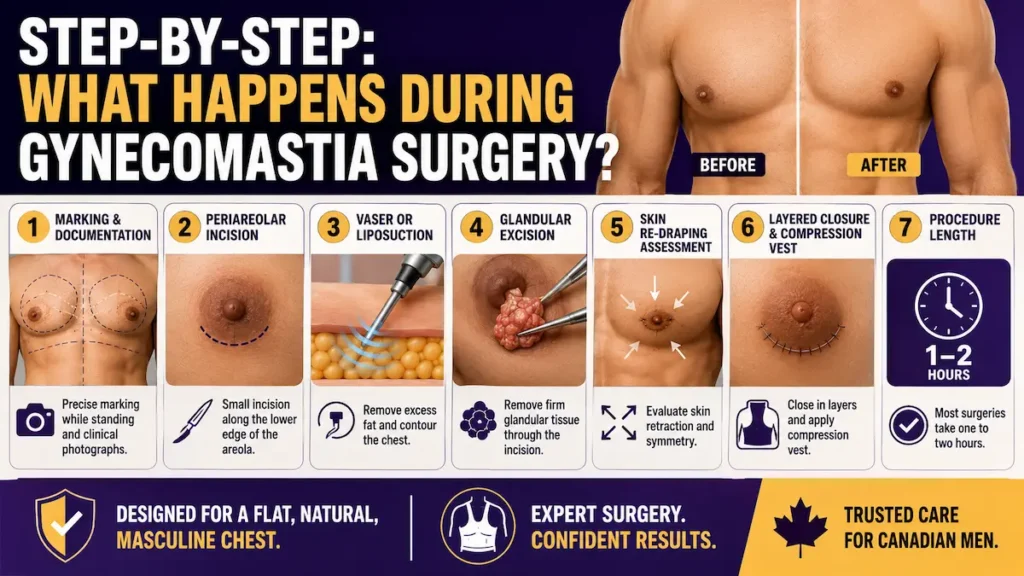
Step-by-Step: What Happens During Gynecomastia Surgery?
Gynecomastia surgery follows a structured sequence. The exact steps vary based on whether the patient has glandular tissue, fat, skin excess, or a mixed pattern. Still, most operations include marking, anesthesia, contouring, gland removal, closure, and compression.
We explain the sequence before surgery because informed patients recover with less anxiety. You should know where incisions are placed, why liposuction may come before excision, how symmetry is assessed, and why the compression vest is essential.
The goal is controlled correction. Removing tissue is only one part of the operation. The surgeon must also protect the nipple contour, avoid hollowing, blend the chest edges, and support healing after surgery.
Pre-Operative Marking and Photographic Documentation
Before surgery, the surgeon marks the chest while the patient is standing. These markings identify gland location, fatty areas, nipple position, asymmetry, and planned access points. Standing assessment is important because gravity changes the contour compared with lying down.
Clinical photographs are taken for surgical planning and follow-up comparison. They also help document asymmetry that existed before surgery, which is common in gynecomastia patients.
Periareolar Incision Planning
For glandular excision, the most common incision sits along the lower border of the areola. This placement hides the scar within the natural colour transition around the nipple. Through this incision, the surgeon can remove firm glandular tissue while preserving a safe layer beneath the nipple.
The incision is kept as small as the tissue allows. Larger or severe cases may require additional planning, especially when skin excess is present.
VASER or Liposuction Phase
If fat is part of the problem, liposuction often comes first. Small access points allow the surgeon to reduce fatty fullness across the chest and blend the contour into the sides. VASER may be used when more precise fat emulsification and athletic definition are needed.
This step helps reveal the gland more clearly and prevents a sharp transition between the treated nipple area and the surrounding chest.
Glandular Excision Phase
After contouring, the surgeon removes glandular tissue through the periareolar incision. The goal is balance. Too little removal leaves persistent puffiness. Too much removal can create a depressed or cratered nipple area.
Our surgeons remove the dense tissue conservatively and reassess both sides repeatedly. This is one of the most important steps in male chest surgery.
Skin Re-Draping Assessment
Once gland and fat are treated, the surgeon evaluates how the skin sits over the new contour. In mild and moderate cases, skin often retracts gradually with compression and healing. In severe cases, loose skin may require additional excision or staged management.
This assessment helps avoid unrealistic promises. Skin quality matters, especially after major weight loss.
Layered Closure and Compression Vest
The incisions are closed in layers to reduce tension on the skin. Small dressings are applied, and the patient is placed into a compression vest. Compression helps limit swelling, supports skin retraction, and protects the new contour during early healing.
The vest is not optional. It is a key part of the result.
Procedure Length
Most gynecomastia operations take about one to two hours. Mild gland-only cases may be shorter. Severe mixed cases with VASER, skin concerns, or revision work may take longer. The surgical plan is confirmed after examination, not based only on photos.
After surgery, patients move into monitored recovery. Before leaving the clinical setting, we review pain control, walking, vest use, sleeping position, and early warning signs.
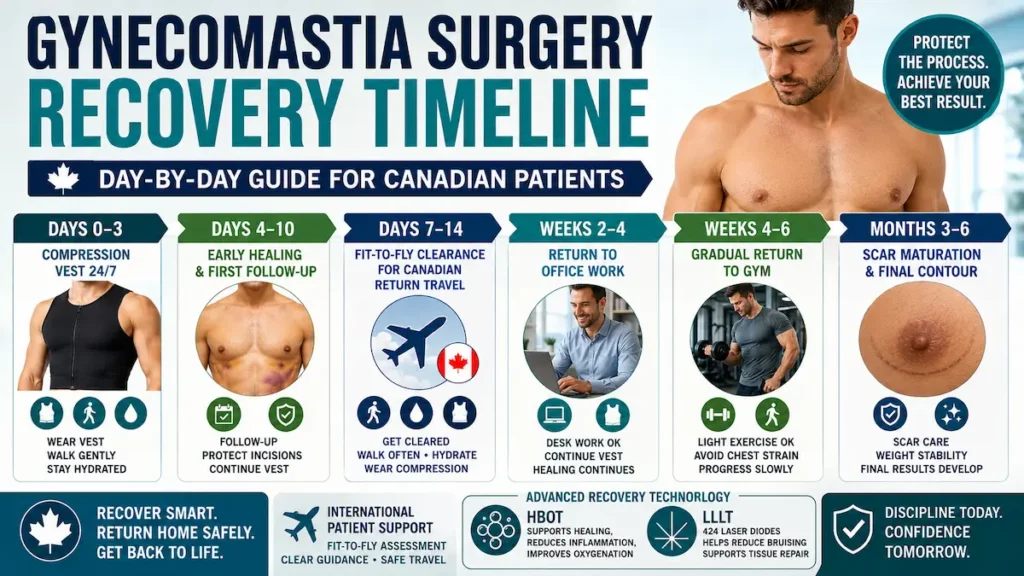
Gynecomastia Surgery Recovery: Day-by-Day Timeline for Canadian Patients
Gynecomastia surgery recovery is usually manageable, but it requires discipline. The first priorities are compression, walking, hydration, incision care, and avoiding early chest strain. Most Canadian patients can return to desk-based work within one to two weeks, depending on the extent of gland removal, liposuction, VASER contouring, and swelling.
Recovery is not only about pain. It is about protecting the contour while the skin re-drapes over the flatter chest. The compression vest helps control swelling and supports the new shape while the tissues settle.
For patients travelling from Canada, we also plan recovery around the return flight. A long-haul trip from Istanbul to Toronto, Montreal, Vancouver, Calgary, or Ottawa requires fit-to-fly clearance, early mobility, and clear post-operative instructions.
Days 0–3: Compression Vest 24/7
The first three days are the acute recovery phase. Swelling, tightness, bruising, and mild to moderate soreness are expected. The chest may feel firm or numb. This is normal. Patients wear the compression vest continuously unless instructed otherwise.
Walking starts early. Short, slow walks reduce stiffness and support circulation. Heavy lifting, arm stretching, chest workouts, and sleeping on the stomach are avoided. Most patients sleep on their back with the upper body slightly elevated.
Medication instructions are reviewed before discharge. Patients should not add supplements, anti-inflammatory medication, or blood-thinning products without medical approval.
Days 4–10: First Follow-Up and Early Shape Changes
During the first week, swelling may shift downward or outward. Bruising can darken before it fades. The chest may look uneven from side to side. This does not mean the result is final. Early asymmetry is common because each side heals at a slightly different pace.
If drains are used, they are usually assessed during early follow-up. Many mild to moderate cases do not require drains, but this depends on tissue volume, liposuction extent, and surgeon preference.
Patients continue wearing the vest and avoid sudden arm movements. Shower timing, dressing care, and incision protection are confirmed by the clinical team.
Our HBOT and LLLT Recovery Protocol
We use recovery technology to support tissue healing and reduce unnecessary downtime. Hyperbaric Oxygen Therapy, or HBOT, increases oxygen availability in healing tissues, which may help reduce inflammation and support tissue repair after surgery. This matters for international patients preparing for a long return flight.
Low-Level Laser Therapy, or LLLT, uses 424 medical-grade semiconductor laser diodes at 650 nm to stimulate cellular ATP production. In practical terms, LLLT supports cellular repair, bruising reduction, and incision maturation. Patients can learn more about these tools on our technology and recovery standards page.
These technologies do not replace surgical skill or compression. They support recovery. Patients still need to follow vest use, activity restriction, hydration, and walking instructions carefully.
Day 7–14: Fit-to-Fly Clearance for Canadian Return Travel
Many Canadian patients are assessed for return travel between day 7 and day 14, depending on the extent of surgery. Fit-to-fly clearance depends on swelling, pain control, mobility, incision status, and whether any drain or complication concern remains.
During the flight home, patients should walk periodically, hydrate well, avoid alcohol, and wear compression as instructed. Cabin pressure does not usually harm the surgical site, but prolonged sitting can increase stiffness and circulation risk.
Patients flying to Vancouver or Western Canada may have a longer itinerary than those flying to Toronto or Montreal. Travel timing should reflect the route, layovers, and personal recovery speed.
Week 2–4: Return to Office Work
Many patients return to remote or desk-based work during this period. Some return earlier if the operation was limited. Jobs involving lifting, physical labour, driving long distances, or repeated arm movement may require more time.
The chest usually still feels tight. Numbness or tingling may continue around the nipple or incision areas. The vest remains part of recovery, though wear schedule may change based on surgeon guidance.
Socially, the chest is often easier to conceal under normal clothing by week two. Bruising may still be visible without a shirt.
Week 4–6: Return to Gym, Chest Training Delay
Light lower-body exercise and walking usually return before chest training. Upper-body workouts, push-ups, bench press, dips, and heavy lifting wait longer because they place tension across the healing chest.
Most patients can gradually resume gym activity between weeks four and six, but chest-specific training often restarts more cautiously. Rushing this stage can increase swelling, soreness, or scar tension.
Athletic patients should treat this phase as controlled re-entry, not a test of strength. The result needs healing time.
Month 3–6: Scar Maturation and Final Contour
By month three, the chest contour is usually much clearer. Swelling continues to refine, firmness softens, and the skin adapts to the flatter shape. The areola may look more settled as the underlying tissue relaxes.
Scars mature gradually. Periareolar scars often blend well because they sit along the areola border, but redness or firmness can persist for months. Sun protection matters. Scar products may be recommended when the incisions are fully closed.
Final contour can take six months or longer, especially after VASER, larger fat removal, revision surgery, or severe gynecomastia. Patience is part of the outcome.
| Recovery Stage | What You May Notice | What You Should Do | What to Avoid |
|---|---|---|---|
| Days 0–3 | Swelling, tightness, bruising, soreness | Wear compression, walk gently, hydrate | Chest strain, heavy lifting, smoking, alcohol |
| Days 4–10 | Bruising changes colour, swelling shifts, early asymmetry | Attend follow-up, protect incisions, continue vest | Judging the final result too early |
| Days 7–14 | Improved mobility, reduced soreness | Complete fit-to-fly assessment before returning to Canada | Long sitting without walking during travel |
| Weeks 2–4 | Chest still firm, numbness possible | Return to desk work if cleared | Manual labour and upper-body strain |
| Weeks 4–6 | More stable contour, less swelling | Gradually resume activity with clearance | Heavy chest training too soon |
| Months 3–6 | Scar fading, contour refinement | Continue scar care and weight stability | Expecting final definition at week two |
Safety and Risks of Gynecomastia Surgery
Gynecomastia surgery is generally well tolerated when it is planned around the correct diagnosis and performed in an accredited surgical setting. Still, it is surgery. Canadian patients should understand the normal side effects, the uncommon complications, and the avoidable risks that come from poor technique or under-qualified clinics.
The main safety issue is not only “removing tissue.” It is removing the right amount of the right tissue. Over-resection can create a hollow chest. Under-resection can leave persistent puffiness. Poor contour blending can make the chest look uneven, especially in athletic men with low body fat.
Our risk-reduction approach starts before the operating room. We assess tissue type, Simon stage, skin quality, medication use, steroid history, smoking status, and medical fitness before confirming a surgical plan. The American Society of Plastic Surgeons’ gynecomastia surgery resource also identifies male breast reduction as surgical correction of overdeveloped or enlarged male breasts.
Common Side Effects
Bruising, swelling, tightness, tenderness, and temporary numbness are common after gynecomastia surgery. The chest may feel firm during the early healing phase. Some patients notice one side swelling more than the other, especially after liposuction or VASER-assisted contouring.
These changes usually improve gradually over weeks. The compression vest helps control swelling and supports the skin as it adapts to the flatter contour. Early unevenness is not the final result.
Patients should expect the chest to look “in progress” during the first month. Final contour takes longer.
Hematoma, Seroma, and Infection
A hematoma is a collection of blood under the skin. A seroma is a collection of fluid. Both can happen after chest surgery, especially when larger tissue volumes are removed or when patients return to heavy activity too soon.
Infection is uncommon but possible. Warning signs include increasing redness, fever, worsening pain, unusual discharge, or one-sided swelling that suddenly changes. Canadian patients returning home receive written guidance so they know when to contact our team and when to seek local assessment.
We reduce these risks through sterile protocols, careful hemostasis, compression, early follow-up, and clear activity restrictions.
Over-Resection and Crater Deformity
Crater deformity occurs when too much tissue is removed beneath the nipple, leaving a depressed or hollow appearance. This is one of the most feared aesthetic complications in gynecomastia surgery. It usually comes from aggressive gland removal without preserving a thin support layer under the nipple-areola complex.
Our surgeons use controlled excision. The goal is to remove enough gland to flatten puffiness while preserving enough tissue to maintain a natural chest surface.
This balance is especially critical in lean men, where small contour irregularities are more visible.
Under-Resection and Residual Puffiness
Under-resection is the opposite problem. Too little gland is removed, and the nipple area remains puffy after swelling resolves. This may happen when surgery relies only on liposuction despite the presence of firm glandular tissue.
Residual puffiness can also come from swelling, scar tissue, or early healing firmness. Timing matters. A chest that looks puffy at week three may improve by month three. A stable firm disc after full healing may suggest residual gland.
This is why our planning separates gland, fat, and skin from the beginning.
Scar Reality: Periareolar and Liposuction Access Points
Gynecomastia scars are usually small, but they are not invisible on day one. Gland removal often uses a periareolar incision along the lower edge of the areola. Liposuction or VASER access points are usually placed in discreet side-chest or axillary locations.
Early scars may look red, firm, or slightly raised. Over months, they usually soften and fade. Scar quality depends on incision tension, skin type, sun exposure, genetics, smoking, and aftercare.
We use LLLT as part of our recovery protocol to support incision maturation, but good scar care remains a shared responsibility.
Revision Gynecomastia Surgery
Revision surgery may be needed when a previous operation left residual gland, contour dents, scar tethering, asymmetry, or loose skin. Revision cases are more complex than first-time surgery because scar tissue changes the anatomy.
Some revisions require additional gland removal. Others need fat grafting to correct hollowing, or careful liposuction to smooth irregular transitions. Severe skin excess may require a different incision pattern.
Patients seeking revision should share all previous operative details, photos, and recovery history during consultation.
How We Reduce Risk at AKM Clinic
Our safety protocol combines diagnostic planning, accredited surgical infrastructure, and structured aftercare. Procedures are performed in a JCI-accredited facility, with pre-operative testing, sterile surgical pathways, monitored anesthesia, and documented post-operative instructions.
We also maintain long-term virtual follow-up for international patients. Canadian patients are not left to interpret swelling, vest use, scar changes, or fitness return alone after flying home.
For deeper guidance on international surgical safety, patients can read our plastic surgery safety in Turkey guide and our ghost surgery prevention checklist.
“The safest gynecomastia result is not the most aggressive tissue removal. It is the most accurate tissue removal, supported by contour blending and disciplined recovery.”
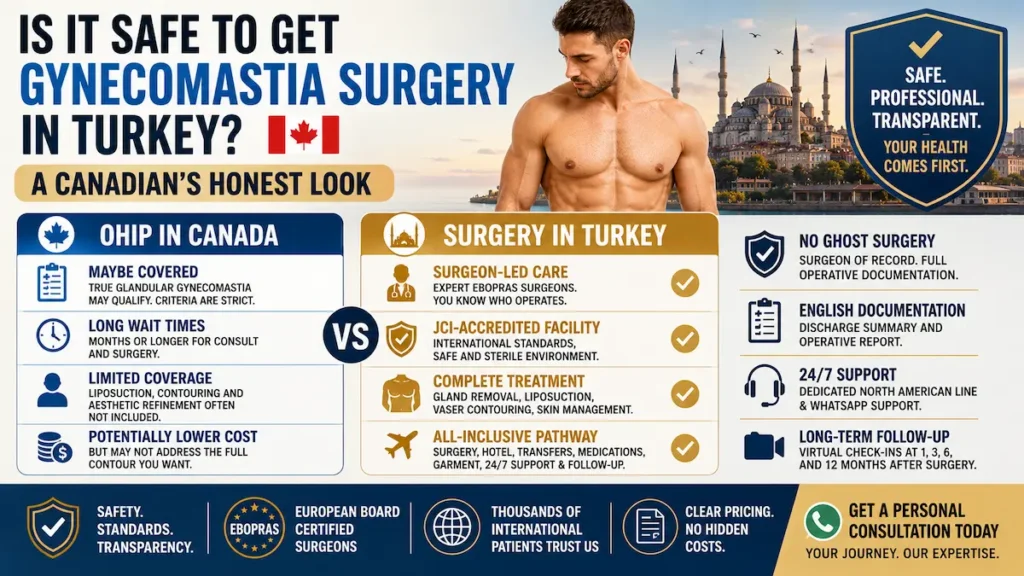
Is It Safe to Get Gynecomastia Surgery in Turkey? A Canadian’s Honest Look
Many Canadian men considering surgery in Turkey have two parallel concerns. The first is medical safety: Who performs the operation, where is it performed, and what happens if there is a problem after returning home? The second is financial logic: If OHIP or another provincial plan might cover gynecomastia, why travel at all?
Both questions deserve straight answers. Turkey has excellent surgical centres and poor-quality high-volume operators. The difference is verification. Canadian patients should confirm surgeon identity, facility accreditation, anesthesia protocol, aftercare access, and whether the clinic has a clear surgeon-of-record policy.
At AKM Clinic, we position gynecomastia surgery as a surgeon-led clinical procedure, not a transactional travel product. That distinction matters.
OHIP Coverage Reality
In Ontario, OHIP may cover some gynecomastia-related procedures when there is documented medical necessity. This usually applies to true glandular gynecomastia, significant symptoms, and cases that meet provincial criteria. It does not mean every man with chest fullness qualifies.
Coverage can be more limited when the issue is pseudogynecomastia, mixed chest fullness, athletic contouring, or cosmetic refinement. Liposuction for contour blending is often treated differently from gland removal, which means a “covered” operation may not include the sculpting needed for the best aesthetic outcome.
Patients should ask their Canadian physician what is covered in their province before assuming the surgery is fully funded. Ontario patients can review the OHIP Schedule of Benefits and fees for the official provincial provider framework.
OHIP Qualification Criteria
Typical qualification depends on documentation. A patient may need physician assessment, symptom history, physical findings, and sometimes specialist referral. The tissue must be medically relevant, not only cosmetically unwanted.
This creates a gap for many men. They may have real distress and visible chest fullness, but still not meet provincial thresholds. Others qualify medically but wait months or longer to move through referral, consultation, and scheduling.
For those patients, private surgery becomes the practical path. The question then becomes whether to stay in Canada or compare international surgical options.
Why Most Canadian Candidates Do Not Qualify
Many gynecomastia candidates do not fit the narrow coverage pathway. Their concern may be mixed gland and fat, mild to moderate puffiness, steroid-related gland, or cosmetic contouring after weight loss. These cases can be very real for the patient, but still fall outside public coverage.
Even when a glandular component is present, coverage may not include VASER contouring, lateral chest blending, or athletic definition. Those refinements can be essential for a natural male chest shape.
This is why some men receive a technically adequate but aesthetically incomplete plan in a public pathway. The priorities are different.
OHIP Wait Time Reality
Canadian public health care is designed for medical necessity, not speed for elective contouring. Even when a patient qualifies, wait time can be significant. Specialist referral, consultation, approval, and surgery scheduling may extend the process well beyond what many men expect.
Private clinics in Toronto, Vancouver, Calgary, or Montreal reduce the wait, but the cost rises quickly. Fees may be separated into surgeon, anesthesia, facility, garment, and follow-up charges.
Our Istanbul pathway appeals to Canadian men who want private surgical timing, combined gland-and-contour treatment, and clear package inclusions.
Provincial Coverage Beyond Ontario
Coverage rules vary by province. British Columbia’s MSP, Alberta’s AHCIP, Quebec’s RAMQ, Manitoba Health, and other provincial systems may treat gynecomastia differently depending on medical necessity, documentation, and whether the procedure is considered reconstructive or cosmetic.
Patients should not assume OHIP rules apply across Canada. They should check their provincial plan and ask whether liposuction, contouring, or skin management is included if surgery is approved.
For many patients, the gap is not only approval. It is whether the approved procedure matches the aesthetic problem.
The Turkey Path: Surgeon-Led Diagnostic and Combined Treatment
The advantage of a surgeon-led private pathway is diagnostic completeness. We assess whether the chest needs glandular excision, liposuction, VASER-assisted contouring, areola adjustment, skin management, or a combination.
This allows the plan to match the anatomy rather than a narrow billing category. It is especially useful for mixed gynecomastia, athletic patients, and men after weight loss.
Our all-inclusive clinical pathway also includes pre-operative tests, surgery, anesthesia and hospital fees, hotel stay, VIP transfers, medications, support garments, 24/7 coordinator support, and long-term virtual follow-up.
Ghost Surgery in Turkey Gynecomastia Procedures
Ghost surgery means the advertised surgeon is not the person who actually performs key parts of the operation. Canadian patients are rightly concerned about this. It has been discussed in international surgery warnings and patient forums.
To reduce this risk anywhere, patients should ask direct questions before booking:
- Who is my surgeon of record?
- Who performs the incision and glandular excision?
- Who performs liposuction or VASER contouring?
- Where will the procedure be performed?
- Will I receive written operative documentation in English?
At AKM Clinic, surgeon-led planning and documentation are part of the care pathway. Patients know who is responsible for their procedure.
JCI-Aligned Standards, EBOPRAS Surgeons, and Documentation
Canadian patients are used to RCPSC-certified specialists, provincial college oversight, and regulated surgical facilities. In Turkey, the equivalent verification framework is different, so it must be translated clearly.
Our surgical environment includes JCI-accredited hospital infrastructure, Turkish Ministry of Health authorization, European Board-Certified surgical expertise, sterile operating protocols, monitored anesthesia, and English-language documentation for follow-up. These markers help Canadian patients compare standards more logically.
Patients should also verify external signs of accountability, including patient reviews, before-and-after documentation, and direct communication with a coordinator. Our North American support line and 24/7 WhatsApp support help bridge the time-zone gap after patients return to Canada.
| Canadian Concern | What It Means | What to Verify | Our Response |
|---|---|---|---|
| OHIP coverage | Some true gynecomastia cases may qualify, but contouring is often limited | Provincial criteria, wait time, and whether liposuction is included | We offer a private diagnostic pathway for gland, fat, and mixed cases |
| Surgeon identity | Patients fear technician-led or ghost surgery models | Named surgeon, operative responsibility, written records | We use surgeon-led planning and documented care |
| Facility safety | International surgical standards vary | Hospital accreditation, sterilization, anesthesia monitoring | Procedures are performed in a JCI-accredited facility |
| Follow-up after Canada return | Patients worry about being abandoned after travel | Virtual check-ins, English discharge notes, support access | We provide long-term virtual follow-up at 1, 3, 6, and 12 months |
| Travel insurance | Elective cosmetic complications may be excluded | Policy wording before travel | We discuss this honestly and provide medical documentation for continuity |
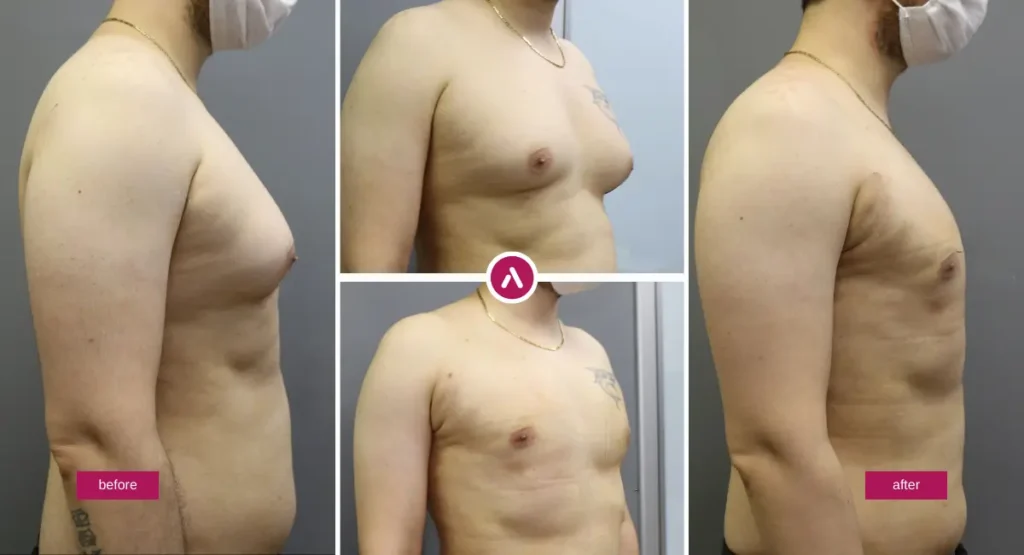
Gynecomastia Surgery Before and After: Realistic Expectations and Results
Gynecomastia surgery can create a flatter, more masculine chest contour, but the result develops gradually. Early swelling can hide definition. Bruising may make the chest look uneven. Firmness beneath the nipple can persist while scar tissue remodels. None of these early changes should be judged as the final outcome.
The best results look natural for the patient’s frame. A lean athletic patient may want sharper pectoral definition. A broader patient may need a flatter, smoother contour that matches his torso. The goal is balance, not an exaggerated or overly carved chest.
We set expectations before surgery because gynecomastia patients often arrive after years of frustration. Many have tried training, dieting, compression shirts, or avoiding fitted clothing. Surgery can be a strong corrective step, but it still follows biological healing rules.
Gynecomastia Surgery Before and After
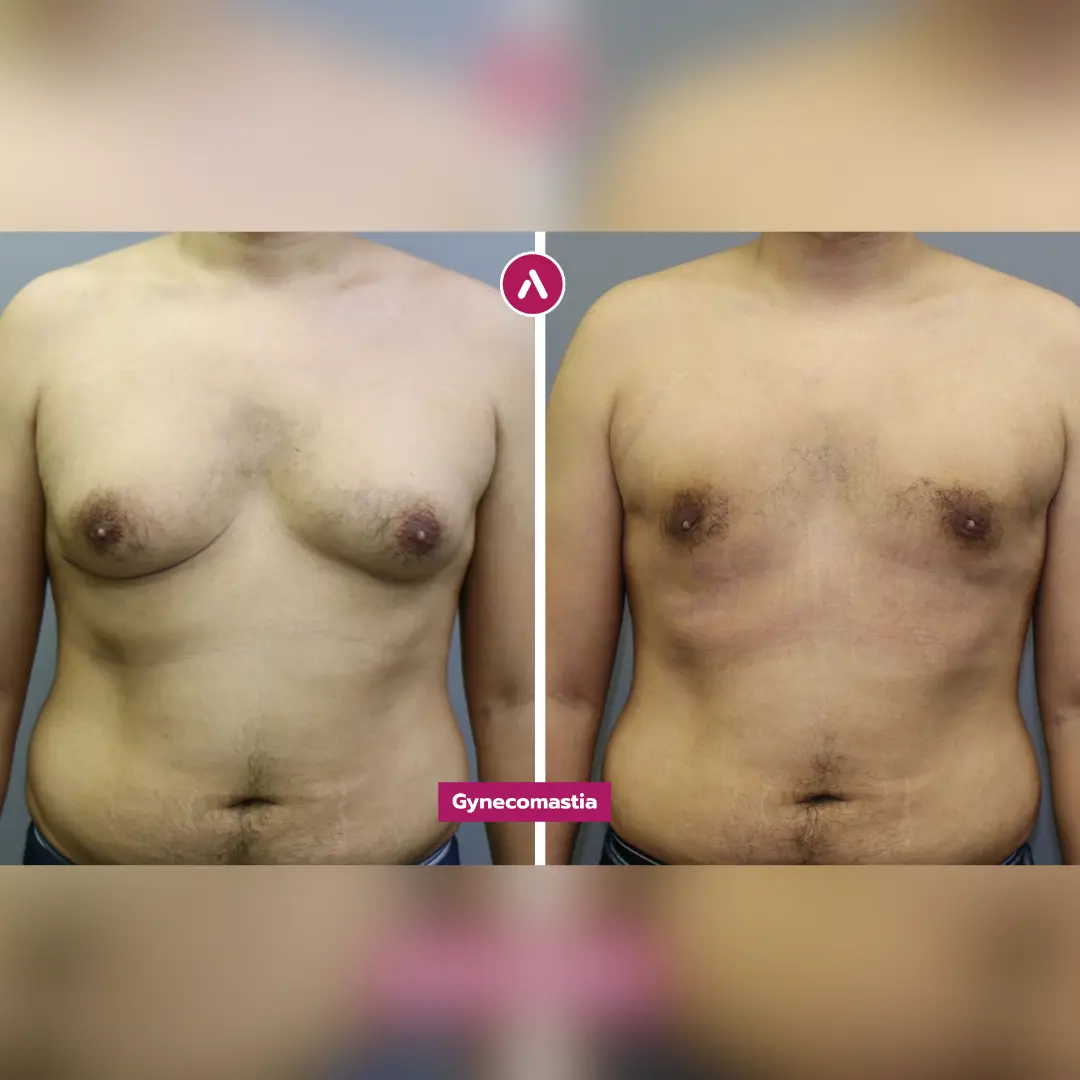
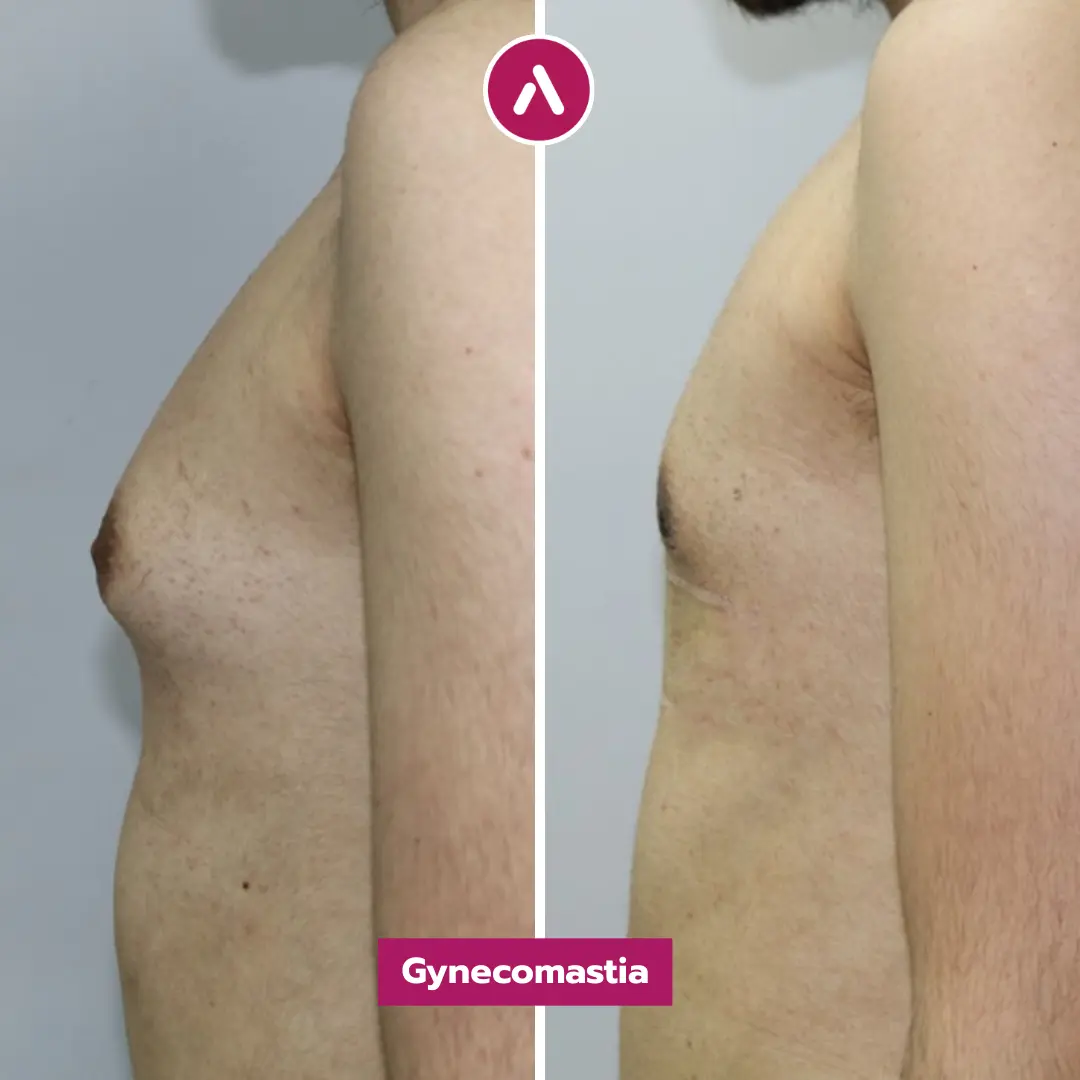
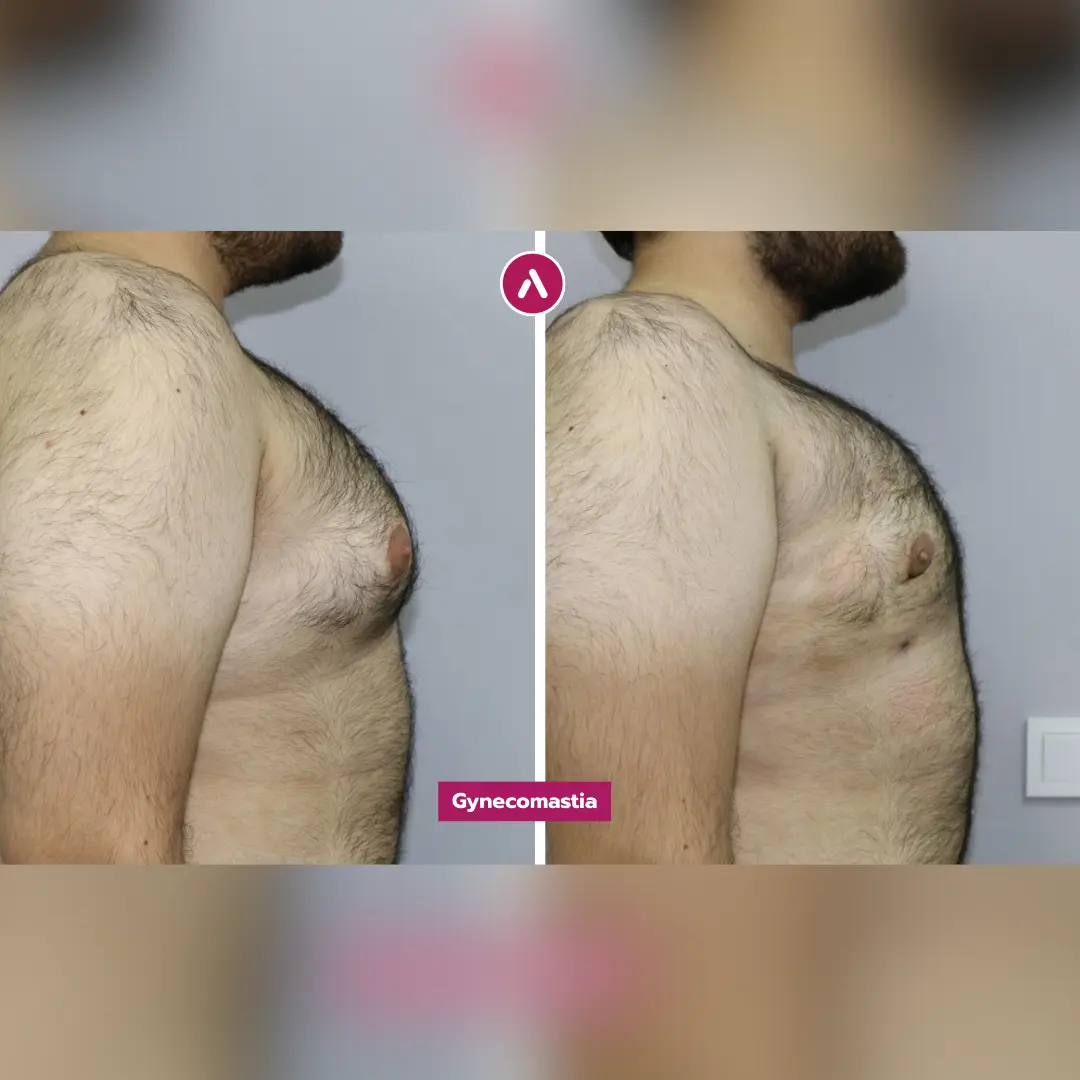
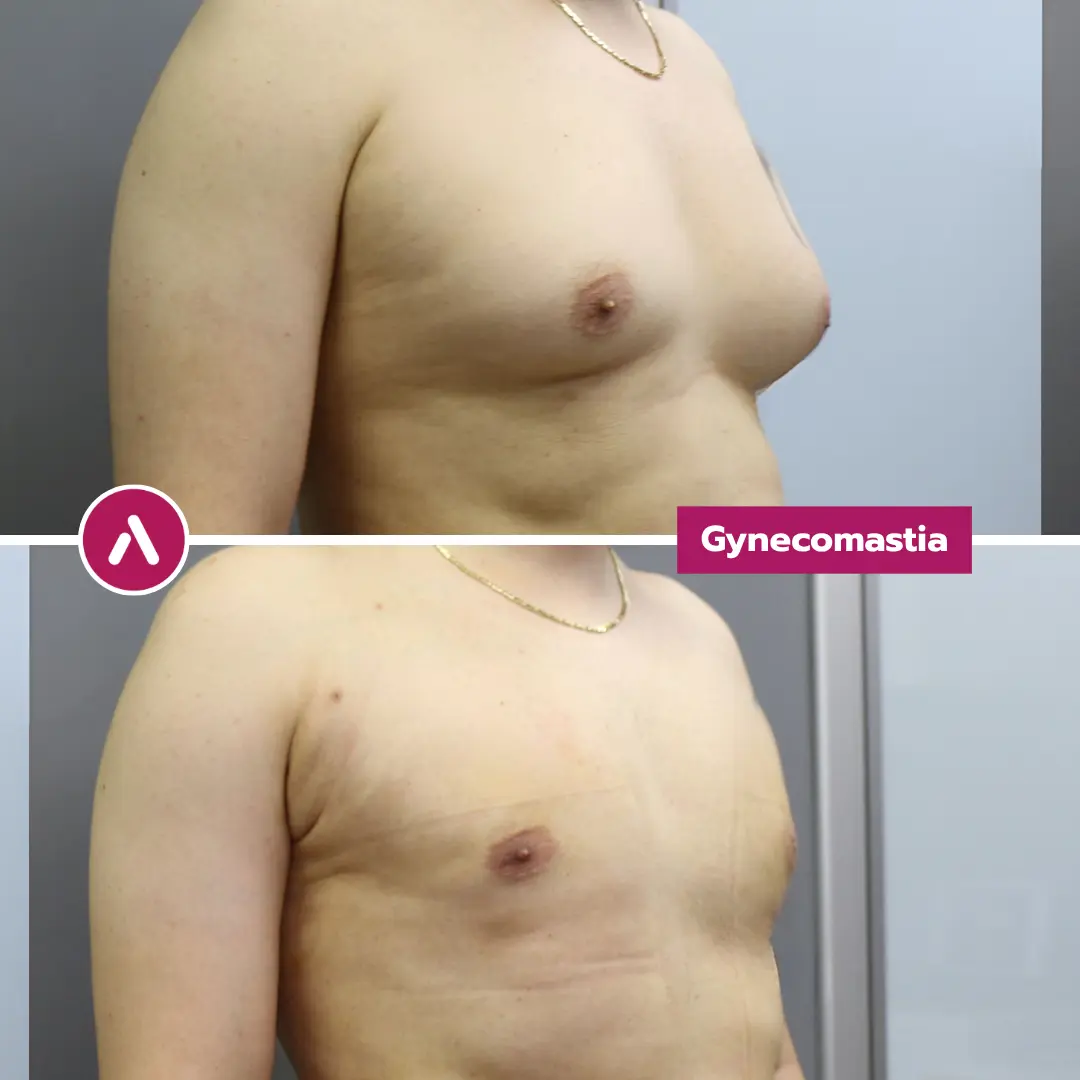
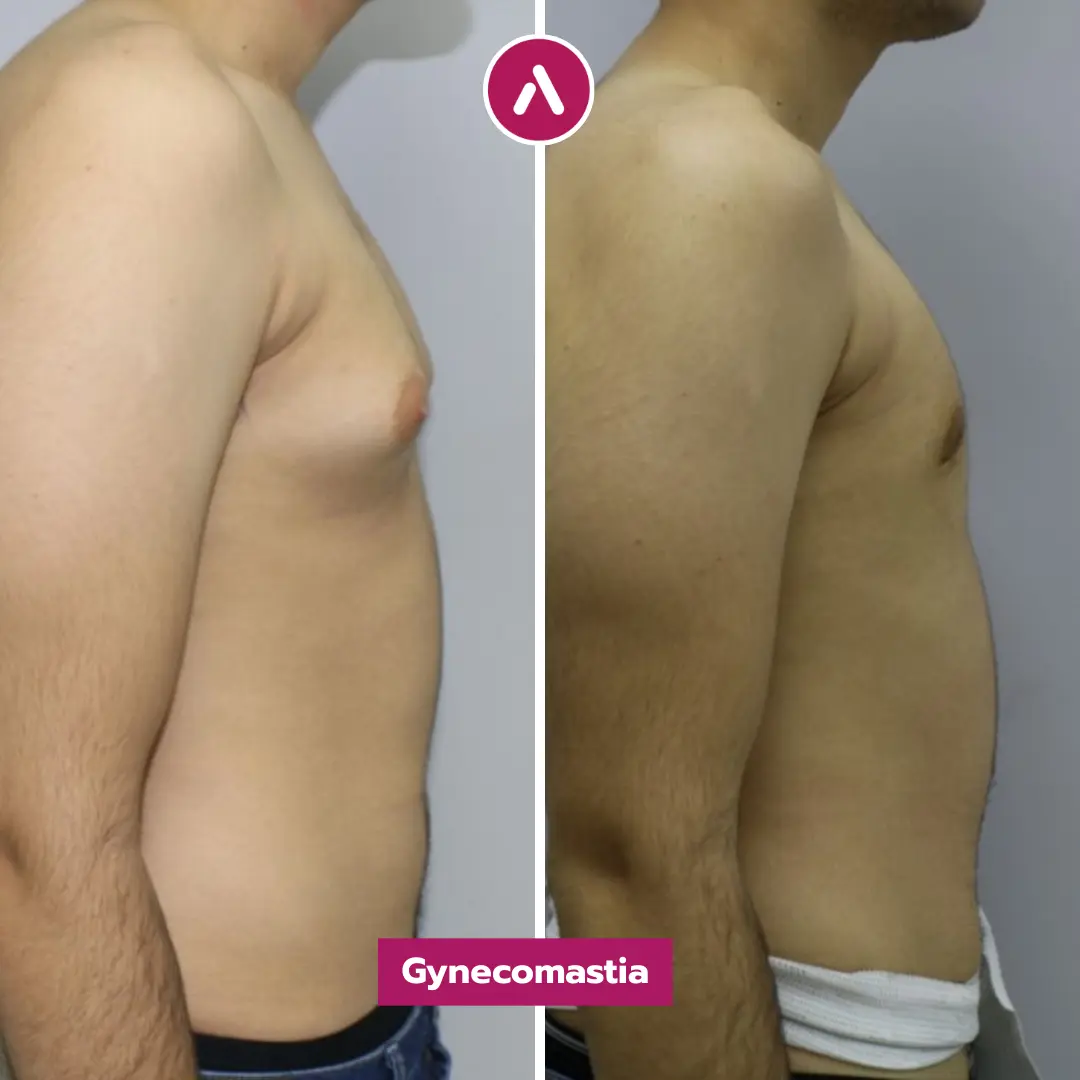
Before-and-after photos should be interpreted carefully. A strong result is not just a smaller chest. Look for a natural nipple position, smooth lower-chest transition, symmetrical contour, and no visible hollowing beneath the areola.
Good photos should show multiple angles: front, oblique, and side. This matters because gynecomastia can look acceptable from the front but still project from the side. Side-view correction is often where gland removal makes the biggest visual difference.
Patients can review our gynecomastia before and after gallery to understand realistic contour changes across different body types and severity levels.
Symptom Resolution Reality
If the patient had tenderness, rubbing, or sensitivity related to glandular tissue, symptoms may improve after removal. If discomfort came from posture, muscle strain, or unrelated medical causes, surgery may not solve every sensation.
This is why symptom history matters. We ask whether pain is central behind the nipple, activity-related, one-sided, medication-linked, or associated with sudden changes. That context helps separate gynecomastia-related discomfort from other chest concerns.
Surgery can improve a tissue-based problem. It should not be used to ignore unexplained pain, discharge, or a hard irregular lump that needs medical evaluation.
Athletic and Body Confidence Timeline
Most men notice an immediate difference in chest flatness once the early dressings are removed, but the athletic contour takes longer. Swelling can blur the pectoral border during the first several weeks. The compression vest helps, but time is still required.
By three months, many patients feel more comfortable in fitted clothing. By six months, the chest usually looks more settled. Gym confidence often returns in stages: first walking, then light training, then upper-body activity, and eventually chest exercises when cleared.
Confidence improves most sustainably when the result matches the patient’s natural body type. A natural male chest still has normal tissue and movement.
Long-Term Stability
When glandular tissue is removed properly, recurrence is less likely. That does not mean recurrence is impossible. Major weight gain can add fat to the chest. Anabolic steroid use can trigger new gland stimulation. Some medications or hormonal changes can also affect the result.
Long-term stability depends on three habits: maintaining weight, avoiding unsupervised hormone manipulation, and addressing medication or endocrine causes with a physician when relevant.
For most stable adult patients, the chest contour remains significantly improved long-term after gland removal and contour blending.
Scar Maturation Timeline
Periareolar scars usually start pink or red, then gradually fade. In darker skin types, pigment changes can be more visible during early healing. Some scars feel firm for several months before softening.
The first year matters. Sun exposure, smoking, poor nutrition, and early tension can worsen scar appearance. LLLT, silicone-based scar care, and patient compliance can support better maturation once the incisions are fully closed.
Patients should expect scars to improve over months, not days. A small scar that is visible at week three may be far less noticeable at month twelve.
| Timeline | Chest Appearance | Scar Behaviour | Patient Expectation |
|---|---|---|---|
| Week 1 | Swollen, bruised, tight | Fresh, red or pink | Too early to judge contour |
| Week 3 | Flatter, but still firm | May feel raised or sensitive | Compression remains important |
| Month 3 | Contour becoming clearer | Redness slowly fading | Most clothing confidence improves |
| Month 6 | More natural chest movement | Scars softer and lighter | Gym confidence usually stronger |
| Month 12 | Final or near-final contour | Mature scar appearance | Long-term result can be assessed |
Before and After Gallery
Before-and-after images should support decision-making, not create unrealistic pressure. The best comparison is a patient with similar skin quality, body fat level, gland severity, and areola size. A Grade I case will not heal or look like a Grade III case.
During consultation, we review your photos and explain which examples are most relevant to your anatomy. This keeps expectations grounded. It also helps patients understand whether they need glandular excision, liposuction, VASER-assisted contouring, or skin management.
Our Natural-First approach applies to male chest surgery as well. We want the result to look like your chest, not a generic template.
Gynecomastia Surgery Cost 2026: Turkey vs Canada
Canadian patients researching gynecomastia surgery cost often compare three paths: public coverage, private Canadian clinics, and international private care. Public coverage may be available only for selected true gynecomastia cases that meet provincial medical-necessity criteria. It may not include VASER, liposuction contour blending, or athletic chest definition.
Private gynecomastia surgery in Toronto, Vancouver, Montreal, or Calgary commonly reaches CAD $12,000–$14,000 once surgeon, anesthesia, facility, garment, and follow-up fees are included. Costs rise for severe cases, revision surgery, or combined liposuction. Initial quotes may not include every line item.
At AKM Clinic, gynecomastia surgery is priced according to tissue type and technique. Our all-inclusive gynecomastia surgery package is listed at CAD $5,050 with a 3-night hotel stay. Technique-level pricing includes liposuction-only gynecomastia at CAD $4,100, excision gynecomastia at CAD $5,050, combined lipo and excision at CAD $5,450, and skin-excision gynecomastia at CAD $5,750.
For a more detailed Canadian cost comparison, including Toronto and Montreal private-clinic fee structures, see our gynecomastia surgery cost guide for Canadian patients.
Our all-inclusive clinical pathway includes surgery, anesthesia and hospital fees, pre-operative tests, 5-star hotel accommodation, VIP transfers, post-operative medications, support garments, coordinator support, and long-term virtual follow-up.
| Location / Option | Typical Cost Range | What Is Usually Included | Important Limitation |
|---|---|---|---|
| OHIP / Provincial Coverage | May be covered if medically necessary | Selected glandular gynecomastia cases | Cosmetic contouring, liposuction, and VASER definition may not be included |
| Toronto Private Clinic | CAD $12,000–$14,000+ | Often surgeon fee, with other line items billed separately | Total invoice may increase after anesthesia and facility fees |
| Vancouver / Calgary Private Clinic | Often comparable to Toronto private pricing | Private surgical pathway | Availability and technique range vary by clinic |
| AKM Clinic Istanbul | CAD $4,100–$5,750 technique range | Surgery, hospital, anesthesia, hotel, transfers, medications, garment, follow-up | International flights are not included |
| AKM All-Inclusive Gynecomastia Package | CAD $5,050 | 3-night hotel stay plus clinical and logistical pathway | Final plan depends on tissue type and surgeon assessment |
How to Find the Best Gynecomastia Surgeon in Turkey: A Canadian Patient’s Checklist
Many Canadian men begin their research by searching for the best gynecomastia surgeon in Toronto, Montreal, Vancouver, or Calgary. That is a reasonable starting point. Local research helps patients understand private pricing, consultation style, and what Canadian surgeons typically include.
The next step is comparison. When evaluating Turkey, the question should not be “Which clinic is cheapest?” It should be: who performs the diagnostic assessment, who removes the gland, who performs liposuction or VASER contouring, and how is aftercare handled after the patient returns to Canada?
Gynecomastia surgery requires male chest-specific judgement. A surgeon must distinguish gland, fat, and skin; understand athletic contouring; avoid crater deformity; and document a clear follow-up pathway for international patients. Our About AKM Clinic page explains our broader Natural-First clinical philosophy and international patient model.
EBOPRAS Certification and RCPSC Equivalency
Canadian patients are familiar with the RCPSC framework: specialist training, formal credentialing, and professional accountability. In Turkey, the credential language is different. European Board certification, EBOPRAS-style training pathways, international society involvement, and Turkish Ministry of Health authorization help patients compare standards more logically.
This is not a word-for-word equivalency. It is a verification framework. Patients should ask what boards, fellowships, hospital privileges, and continuing education the surgeon holds. The Royal College of Physicians and Surgeons of Canada’s specialist certification framework is the benchmark many Canadian patients recognize.
For a deeper credential framework, patients can review our plastic surgeon board certification guide for Canadian patients. The Canadian Society of Plastic Surgeons’ guidance on choosing a surgeon is also a useful Canadian professional reference point and patient safety expectations.
| Credential Framework | What It Signals | Canadian Comparison Point |
|---|---|---|
| EBOPRAS / European Board pathway | Structured specialist training and board-level surgical assessment | Comparable verification logic to RCPSC specialist credential review |
| RCPSC | Canadian specialist certification framework | Benchmark Canadian patients recognize |
| ABPS / international plastic surgery boards | Additional board-style credential reference for plastic surgery training | Useful comparison for North American patients evaluating surgeons abroad |
Male Body Contouring Sub-Specialization
Gynecomastia surgery sits within male body contouring. That matters. The male chest is not treated like a small breast reduction. The goal is a flatter pectoral contour, a natural areola position, and smooth transition into the upper abdomen and lateral chest.
A qualified surgeon should be comfortable treating Grade I nipple puffiness, mixed gynecomastia, post-weight-loss skin laxity, athletic contouring, and revision cases. Ask how often they perform male chest procedures, not just body contouring in general.
Volume is not the only marker of skill, but experience with multiple severity levels matters.
Diagnostic Capability Verification
The surgeon should perform or directly supervise the diagnostic assessment. Technician-triaged planning is a red flag. A proper assessment identifies true gynecomastia, pseudogynecomastia, mixed tissue, Simon stage, skin quality, and possible causes.
During your virtual consultation, ask these questions:
- Do I appear to have gland, fat, skin laxity, or a mixed pattern?
- Which Simon grade best matches my chest?
- Will I need glandular excision, liposuction, VASER, or skin management?
- How will you avoid crater deformity beneath the nipple?
- What happens if swelling looks uneven after I return to Canada?
A strong consultation gives specific answers. Vague reassurance is not enough.
Technique Range: Glandular Excision and VASER Lipo Capability
The best gynecomastia surgeon for a mixed case must be able to perform both glandular excision and fat contouring. If a clinic only offers liposuction, true gland may remain. If a surgeon only excises gland without blending surrounding fat, the chest can look flat in the centre but bulky at the edges.
Technique range matters most for Canadian men who are athletic, post-weight-loss, or dealing with long-standing Grade II or Grade III gynecomastia. These patients often need more than one maneuver.
For patients with a significant fat-contouring component, our VASER High-Def Liposuction in Turkey page explains ultrasound-assisted contouring in more detail.
Real Patient Reviews and Multi-Severity Before/After Documentation
Before-and-after photos should include more than the easiest Grade I cases. Look for mild, moderate, severe, mixed, athletic, and post-weight-loss examples. Ask whether the photos show front, side, and oblique views. Side views reveal projection correction more clearly than front views alone.
Reviews also matter. Canadian patients should look for comments about communication, coordinator support, surgical explanation, pain control, follow-up, and honesty about healing. A clinic that only shows final glamour-style images is not providing enough clinical context.
Our professional plastic surgery reviews page gives patients a broader view of how international patients describe our care pathway.
Aftercare Continuity from Istanbul to Canada
Aftercare is one of the biggest concerns for Canadian patients travelling abroad. Gynecomastia recovery includes compression vest use, swelling interpretation, gym timing, scar management, and monitoring for fluid collection. These questions do not end when the patient boards the flight home.
We provide long-term virtual follow-up at 1, 3, 6, and 12 months, with 24/7 coordinator support for urgent questions. Patients receive written guidance and can share photos as healing progresses.
This continuity is especially important for men who return to busy work schedules in Toronto, Vancouver, Calgary, Montreal, or Ottawa. You should not have to guess whether swelling is normal.
| Checklist Item | Why It Matters | Question to Ask | Red Flag |
|---|---|---|---|
| Credential verification | Confirms training and accountability | What board certification and hospital privileges do you hold? | No clear credential explanation |
| Male chest specialization | Gynecomastia requires masculine contour judgement | How many gynecomastia cases do you treat yearly? | Only general body contouring examples shown |
| Diagnostic assessment | Treatment changes based on gland, fat, and skin | Is my case true, pseudo, or mixed gynecomastia? | Package quote given without tissue explanation |
| Technique range | Mixed cases often need excision plus contouring | Do you offer glandular excision and VASER/liposuction? | Liposuction-only plan for firm gland |
| Aftercare continuity | Healing continues after return to Canada | How do I contact the team after flying home? | No structured virtual follow-up |
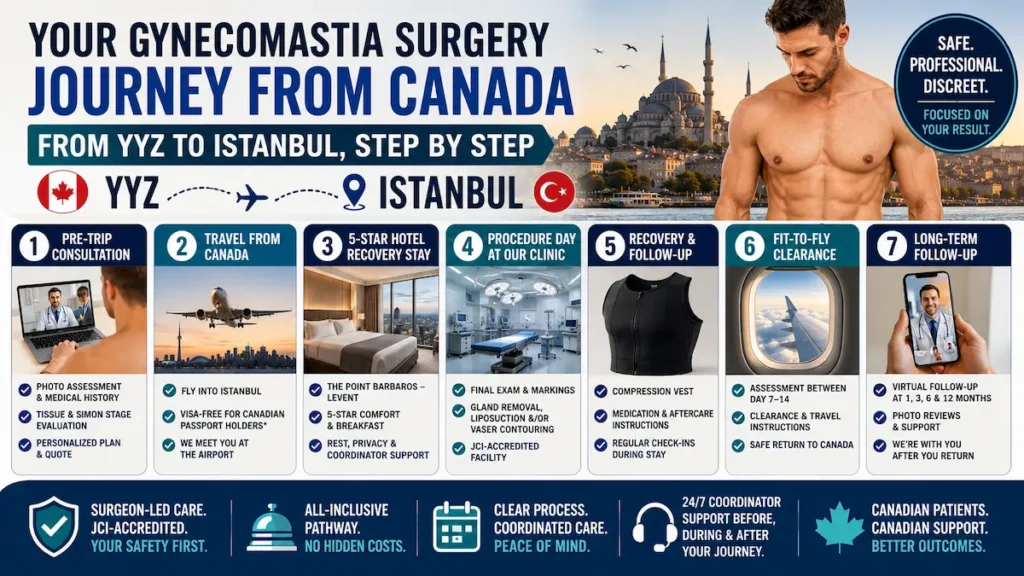
Your Gynecomastia Surgery Journey from Canada: From YYZ to Istanbul, Step by Step
Planning surgery abroad should feel structured, not improvised. Canadian patients travelling for gynecomastia surgery need a clear pathway: virtual assessment, travel planning, arrival support, in-person examination, surgery, recovery, fit-to-fly clearance, and long-term follow-up.
Our process is designed around that sequence. You book your international flight; we coordinate the clinical and local logistics, including hotel accommodation, VIP transfers, pre-operative tests, procedure scheduling, post-operative medications, compression vest support, and virtual follow-up after you return home. Our patient journey page explains this broader Canada-to-Istanbul pathway in more detail.
The goal is to reduce stress at each step. Less logistical friction means more attention on recovery.
Pre-Trip Consultation
The process begins with photo assessment and medical history review. We ask for clear front, side, and oblique chest photos in good lighting. We also ask about weight history, puberty onset, steroid use, medications, tenderness, previous surgery, and whether the chest changes with weight loss.
During planning, we discuss likely tissue type and Simon stage. Photo assessment cannot replace physical examination, but it helps us estimate whether the case appears glandular, fat-driven, mixed, or severe with skin laxity.
Canadian patients may also be asked to speak with their family physician if there are endocrine concerns, sudden changes, medication questions, or symptoms that need local medical review before travel.
Travel Logistics from Canada
Most Canadian patients fly into Istanbul Airport. Toronto and Montreal often have the simplest routing, while Vancouver, Calgary, Edmonton, Ottawa, and Halifax may require one connection depending on current airline schedules. Patients should always check current routes before booking.
Canadian passport holders can typically enter Türkiye visa-free for short stays, but passport validity rules and airline requirements should be checked before travel. We recommend arriving with enough time for rest, consultation, testing, and final surgical planning.
Once you arrive, our driver meets you and transfers you to the hotel. You do not need to navigate Istanbul traffic immediately after a long flight.
5-Star Hotel Recovery Stay in Levent
Recovery takes place near the clinic in Istanbul’s Levent district. Our hotel pathway is designed for privacy, comfort, and practical post-operative needs. The Point Barbaros is used for 5-star accommodation, including breakfast and proximity to the clinic.
For gynecomastia patients, the hotel phase is usually straightforward. You need rest, compression, short walks, hydration, and easy communication with the coordinator. Most men do not need extensive assistance, but they do need clear instructions.
Patient hosts such as Hande, Emine, and Khadija help coordinate the experience, answer logistical questions, and bridge communication between the patient and the medical team.
Procedure Day at Our Istanbul Clinic
On procedure day, you complete final checks, markings, consent review, and anesthesia preparation. The surgeon confirms the plan in person: glandular excision, liposuction, VASER-assisted contouring, skin strategy, incision placement, and expected recovery instructions.
The procedure is performed in a JCI-accredited surgical facility. Patients who want to understand the clinical environment before booking can review our Istanbul clinic overview. After surgery, the team places dressings and a compression vest. You are monitored before transfer back to the hotel or recovery area according to your clinical status.
Before discharge, we review pain medication, walking, sleeping position, vest use, shower timing, warning signs, and follow-up schedule.
Fit-to-Fly Clearance and Return Travel
Fit-to-fly clearance depends on swelling, pain control, mobility, incision status, and whether any drain or fluid concern remains. Many patients are assessed between day 7 and day 14, depending on surgical extent and travel distance.
During the return flight to Canada, patients should wear compression as instructed, walk periodically, hydrate, and avoid alcohol. Aisle seats can help with movement. Compression socks may be recommended for some patients based on risk profile.
After returning home, patients continue virtual follow-up. Photos can be reviewed at healing milestones, and questions about swelling, scar care, compression, and gym return can be handled remotely.
Male Breast Reduction Frequently Asked Questions (FAQ):
Canadian patients often arrive with practical questions that are not answered by standard clinic pages. They want to know whether the tissue is gland or fat, whether OHIP might cover the procedure, how long recovery takes, and what happens after they fly home.
The answers below are general education, not a diagnosis. Your final plan depends on tissue type, medical history, physical examination, and surgeon assessment.
How long does gynecomastia surgery take?
Most gynecomastia operations take about one to two hours. Mild gland-only cases may be shorter. Mixed cases with liposuction, VASER-assisted contouring, or skin management may take longer. Revision surgery can also require more time because scar tissue changes the surgical plane.
How do I know if I have gynecomastia or just chest fat?
Firm, rubbery tissue behind the nipple suggests true gynecomastia. Soft, diffuse fullness across the chest suggests pseudogynecomastia. Many men have a mixed pattern. The pinch test can help you understand the pattern, but it does not replace a surgeon’s assessment.
Can gynecomastia go away without surgery?
Some puberty-related or fat-driven cases may improve without surgery. Persistent adult glandular gynecomastia usually does not resolve with exercise, creams, or supplements. Mature gland often requires surgical removal.
When can I return to the gym after surgery?
Walking starts early, but upper-body training waits. Many patients gradually return to light activity after a few weeks, while chest exercises, push-ups, bench press, and heavy lifting usually wait until the surgeon clears them. Rushing gym return can increase swelling and scar tension.
Is gynecomastia surgery covered by OHIP, MSP, AHCIP, or RAMQ?
Some provincial plans may cover selected medically necessary cases, usually when true glandular gynecomastia is documented and criteria are met. Cosmetic contouring, VASER definition, liposuction blending, or mild mixed cases may not be covered. Patients should check their provincial plan before assuming eligibility.
How much does gynecomastia surgery cost in Toronto vs Istanbul?
Private gynecomastia surgery in Toronto commonly reaches CAD $8,000–$14,000+ after surgeon, anesthesia, facility, garment, and follow-up fees. At AKM Clinic, technique-level gynecomastia pricing ranges from CAD $4,100 to CAD $5,750, with the all-inclusive gynecomastia package listed at CAD $5,050.
Does Canadian travel insurance cover complications from elective gynecomastia surgery abroad?
Many travel insurance policies exclude elective cosmetic surgery and related complications. Patients should read policy wording carefully before booking. As part of our patient safety pathway, AKM Clinic provides complimentary complication insurance for all patients, offering an added layer of support during the surgical journey. We also provide English-language medical documentation and post-operative instructions; however, final travel insurance coverage decisions remain with the insurer.
Will gynecomastia come back after surgery?
Recurrence is less likely when mature glandular tissue is removed properly and the underlying trigger is controlled. It can still happen after major weight gain, anabolic steroid use, medication effects, or hormonal changes. Long-term stability depends on both surgery and lifestyle factors.
Can steroid-induced gynecomastia be reversed without surgery?
Early hormone-related swelling may improve after the trigger is controlled, but mature gland often remains. Men with steroid-related gynecomastia should be honest during consultation. Surgery is more predictable when hormonal use has stopped and the chest tissue has stabilized.
How long does the new chest contour last?
For stable adult patients, the flatter contour can be long-lasting. Gland removal is durable, but fat can return with weight gain. Skin can also change with age or major body-weight shifts. Maintaining weight and avoiding hormone disruption help protect the result.
Will I have visible scars after gynecomastia surgery?
Scars are expected but usually discreet. Glandular excision often uses a small incision along the lower areola border. Liposuction access points are small and placed strategically. Scars may look pink or firm early, then soften and fade over several months.
Can I combine gynecomastia with hair transplant or liposuction in one trip?
Yes, selected patients can combine gynecomastia surgery with hair transplant, liposuction 360, VASER contouring, or six-pack surgery. The plan must respect anesthesia time, recovery demands, and travel safety. Not every combination is appropriate for every patient.
Do I need to bring someone with me from Canada?
Many Canadian patients travel alone for gynecomastia surgery. Our coordinator and patient-host team supports airport transfer, hotel logistics, clinic visits, and post-operative communication. A companion can be helpful, but it is not mandatory for every case.
How do I arrange follow-up after returning to Canada?
We provide long-term virtual follow-up at 1, 3, 6, and 12 months. Patients can send photos, ask questions about swelling or scar changes, and receive guidance on compression and activity. If an urgent medical concern arises, patients should also seek local care in Canada.
Medical Disclaimer: This page is for educational purposes only and does not replace medical advice, diagnosis, or treatment from a qualified physician. Gynecomastia can sometimes be linked to hormonal conditions, medication effects, breast masses, or other medical issues that require local assessment.