
Surgery Companion in Turkey: Rules & Benefits

AI Summary
- A surgery companion in Turkey helps UK patients travel, recover, and return home with greater comfort and confidence.
- Practical recovery support reduces stress, helps daily tasks, and improves the first post-operative days abroad.
- Safety and aftercare matter most; companion support works best alongside clear medical guidance and recovery protocols.
- Companion costs can add value by improving logistics, emotional reassurance, and overall recovery quality.
AI-generated summary, fact-checked by our medical experts.
If you are researching surgery companion arrangements in Turkey before travelling from the UK, you are already focusing on one of the most important parts of a safe and comfortable medical journey. For many British patients, choosing Istanbul is not only about cost. It is about finding high-quality consultant-led care, avoiding long waiting times, and making sure recovery feels properly supported from the moment you leave home to the moment you return.
A companion can make that journey feel significantly easier. Whether you are travelling to Turkey for surgery with a friend, a partner, or a close relative, the right person beside you can reduce stress, help with simple daily tasks, and make the early stages of recovery more manageable. This matters especially after cosmetic procedures, when you may be tired, mildly sore, or less inclined to organise practical details on your own.
It is also important to approach the trip with the right mindset. Even when clinics in Turkey advertise surgery and holiday packages, a surgical journey should never be treated like an ordinary city break. From the perspective of medical science, the first phase of recovery is a time for rest, hydration, gentle mobilisation, and observation rather than unnecessary activity. A well-planned companion arrangement supports that goal and helps keep decisions calm, sensible, and recovery-focused.
For couples planning a medical trip to Turkey together, or patients comparing Turkey cosmetic surgery packages for two, it is worth looking carefully at the details. A good plan should clarify room type, transfer arrangements, meal expectations, and how much practical help your companion can realistically provide. Clear planning is what turns a stressful overseas procedure into a structured and reassuring experience.
Table of Contents

Why Bringing a Surgery Companion from the UK Can Make Your Journey Easier
A carefully chosen companion often improves the overall experience before, during, and after surgery. A sensible Turkey surgery companion plan is not about drama or dependency; it is about reducing avoidable stress. For British patients who may already feel anxious about surgery abroad, having a trusted person nearby can make the entire journey feel more familiar, more stable, and more emotionally manageable.
Emotional reassurance before surgery and during recovery
Even confident patients can feel unsettled before an operation. You are away from home, sleeping in a hotel or recovery setting, thinking about the procedure ahead, and preparing for the first few days afterwards. In that situation, a familiar face can be genuinely grounding. A companion can help you stay calm, listen properly during appointments, and avoid the spiral of overthinking that sometimes happens the night before surgery.
This emotional reassurance can continue after the procedure as well. During early recovery, patients are often not in severe distress, but they may feel tired, puffy, slightly foggy, or simply vulnerable. Having someone nearby to reassure you, help you settle, and keep the mood steady can make the entire experience feel less clinical and far less isolating.
“Knowing there was a UK-based patient contact point gave me immense psychological comfort.”
– An AKM Clinic patient reflecting on the value of feeling supported throughout the journey
Practical help with mobility, medication, and daily tasks
One of the most underestimated benefits of a companion is practical support. After surgery, even straightforward tasks can feel unnecessarily tiring. Carrying luggage, sorting chargers, opening bottles of water, organising toiletries, collecting prescribed items, or simply adjusting pillows can become irritating when you are trying to rest properly. A companion reduces that physical and mental burden.
They can also help with routine structure. For example, they may remind you of your aftercare timings, encourage short gentle walks when advised, help you stay hydrated, and make sure you do not overdo things because you suddenly feel “fine”. That kind of recovery assistance is particularly valuable after plastic surgery abroad, where being in a hotel rather than your own home can make everyday tasks feel less convenient.
Just as importantly, a good companion helps you conserve energy. The less unnecessary effort you spend on small logistics, the more energy you can direct towards proper healing.
Why British patients often feel more confident travelling with a trusted companion
Many UK patients are careful researchers. They want to know who will look after them, what the recovery period will actually feel like, and what happens if they feel emotional or uncomfortable after the procedure. Bringing a companion answers several of those concerns at once. It adds continuity between home and abroad, and it often makes the idea of surgery in Istanbul feel more realistic rather than intimidating.
This is particularly true for patients who are already balancing multiple worries: fear of flying after surgery, concern about being alone in a hotel room, or anxiety shaped by negative media coverage about treatment overseas. A trusted companion does not replace clinical care, but they do make the environment feel safer and more personal. For many British patients, that emotional comfort is every bit as important as the surgeon’s credentials or the treatment plan itself.
In simple terms, travelling with the right person can help turn a complicated-looking journey into one that feels structured, supported, and much easier to manage.
Who Can Be Your Surgery Companion and What Rules Usually Apply?
Not every companion is automatically the right companion. When patients search for terms such as cosmetic surgery companion package Turkey or hospital companion policy Turkey, they are usually trying to understand two things: who should come with them, and what that person will actually be allowed to do. The answer depends on the procedure, the clinic pathway, the hospital setting, and the accommodation arrangement. Policies are not always identical, so it is wise to clarify the details before you travel.
Partner, family member, or close friend: who is most suitable?
In most cases, the best companion is the person who remains calm under pressure, listens carefully, and is genuinely dependable. A romantic partner can be an excellent choice because there is already trust, emotional closeness, and shared decision-making. This is one reason why medical trips to Turkey with a partner are increasingly common for UK patients.
A family member may also be ideal, especially if they are naturally organised and protective without becoming overwhelmed. A close friend can be equally helpful when there is strong trust and good communication. This is often the most practical route for patients who are specifically travelling to Turkey for surgery with a friend and want both emotional support and light-hearted companionship during recovery.
What matters most is not the label of the relationship, but the person’s temperament. A companion should be patient, discreet, responsible, and willing to prioritise your comfort over their own sightseeing plans.
Age, health, and travel readiness considerations for companions
Your companion should also be physically and practically capable of managing the trip. They do not need medical training, but they should be well enough to travel, able to walk through airports, comfortable following instructions, and happy to help with ordinary tasks. If they have significant health problems of their own, the arrangement may become harder rather than easier.
It is also helpful if your companion is comfortable with travel logistics. They should be able to manage passports, phone access, local transport timings, and communication with the clinic if needed. A companion who becomes flustered easily, sleeps through alarms, or dislikes hospital environments may not be the best choice, even if they are emotionally close to you.
Think of your companion as part reassurance, part organiser, and part practical helper. The most useful person is rarely the most glamorous choice; it is the one who will actually make recovery smoother.
Clinic, hotel, and hospital policy points UK patients should clarify in advance
This is where details matter. Some patients assume their companion can be with them at all times, remain in the same room throughout the stay, or attend every stage of the journey. In reality, access can vary. Hospital rules, clinical protocols, room availability, and accommodation type may all affect what is possible. That is why asking about the hospital’s companion policy in advance is so important.
If you are comparing a cosmetic surgery package with a companion, ask whether the companion’s airport transfers, breakfast, hotel stay, and room upgrades are included. If you are considering a twin room arrangement, confirm whether that refers to the hotel, the hospital stay, or both. Some clinics may offer a hotel twin room but not shared post-operative hospital accommodation. Others may structure the journey so the companion stays with you in the hotel, while clinical recovery remains under medical supervision.
The same applies to broader Turkey cosmetic surgery packages for two. The phrase sounds straightforward, but what it includes can vary considerably. One package may include only hotel sharing and transport, while another may include meals, companion transfers, and upgraded room arrangements. Asking these questions early helps you avoid confusion later.
| Companion option | Best suited to | Points to think about |
|---|---|---|
| Partner | Patients who want emotional closeness and shared travel planning | Often ideal for couples, but confirm room arrangements and whether both of you are comfortable prioritising recovery over holiday activities |
| Family member | Patients who prefer a protective, dependable support figure | Can be highly reassuring, though some relatives may become anxious and unintentionally increase stress |
| Close friend | Patients seeking practical help and a familiar, relaxed presence | A good option when travelling to Turkey for surgery with a friend, provided they take recovery instructions seriously |
What a Surgery Companion Can and Cannot Do During Your Stay in Turkey
A companion is there to support your recovery, not to act as part of the medical team. That distinction matters. In practical terms, the best recovery assistance after plastic surgery abroad is the kind that reduces effort, keeps you comfortable, and helps you follow the care plan sensibly. Put simply, your body heals best when it is allowed to rest, stay hydrated, mobilise gently when appropriate, and avoid avoidable stress. A good companion helps protect those conditions.
Support before the procedure: paperwork, check-ins, and settling in
Before surgery, a companion can be extremely useful. They can help you get through airport movement more smoothly, manage bags, keep your documents in order, and make sure you arrive at transfers, hotel check-in, and clinic appointments without unnecessary stress. On the day before the procedure, they can help create a calm routine rather than a frantic one.
This may include helping you organise comfortable clothing, keeping chargers and essentials together, reminding you not to buy or eat anything outside your pre-operative instructions, and making sure the room is set up for comfort afterwards. A calm companion can also help you absorb practical information more clearly, especially when nerves make concentration harder.
Immediate post-operative help: walking, meals, and comfort
Once surgery is completed, the companion’s role becomes more practical. They may help you settle back into your room, make sure water is within easy reach, help prepare simple meals or snacks if permitted, and remind you to follow the recovery plan given by the clinical team. They may also help you move around gently and safely, rather than letting you overestimate your energy levels.
This is where companion support becomes genuinely valuable. Patients often do not need dramatic assistance; they need steady, low-level help with ordinary tasks. Getting in and out of bed carefully, arranging pillows, keeping the room tidy, and reducing needless trips up and down can all make a difference to comfort in the first few days.
In practice, the essentials of companion planning are often simple but important: good organisation, patience, clear communication, and willingness to put your recovery first.
- Keep passports, booking details, and clinic contact numbers together.
- Pack chargers, headphones, and a power bank.
- Bring loose clothing, button-front tops if appropriate, and slip-on shoes.
- Keep water, approved snacks, and basic toiletries easy to reach.
- Store prescribed aftercare items exactly as advised by the clinic.
Understanding the limits: when medical care must be left to the clinical team
A companion should never be expected to replace trained postoperative care. They are not there to interpret symptoms, alter medication instructions, judge whether healing is normal, or decide when you are fit to fly. Those responsibilities belong to the surgeon and the clinical team. The safest role for a companion is supportive, observant, and practical.
For example, a companion can notice if you seem unusually uncomfortable or if something does not feel right, but they should report concerns promptly rather than try to solve them independently. They can help you remember instructions, but they should not improvise them. They can encourage rest and gentle movement, but they should not push you into activity because you seem “better”.
This balance is exactly what makes a companion so useful. They do not need to be clinical. They simply need to help you stay comfortable, stay sensible, and stay connected to the team looking after you.
Travel Planning from the UK: Flights, Hotel Stays, and Return Journey Logistics
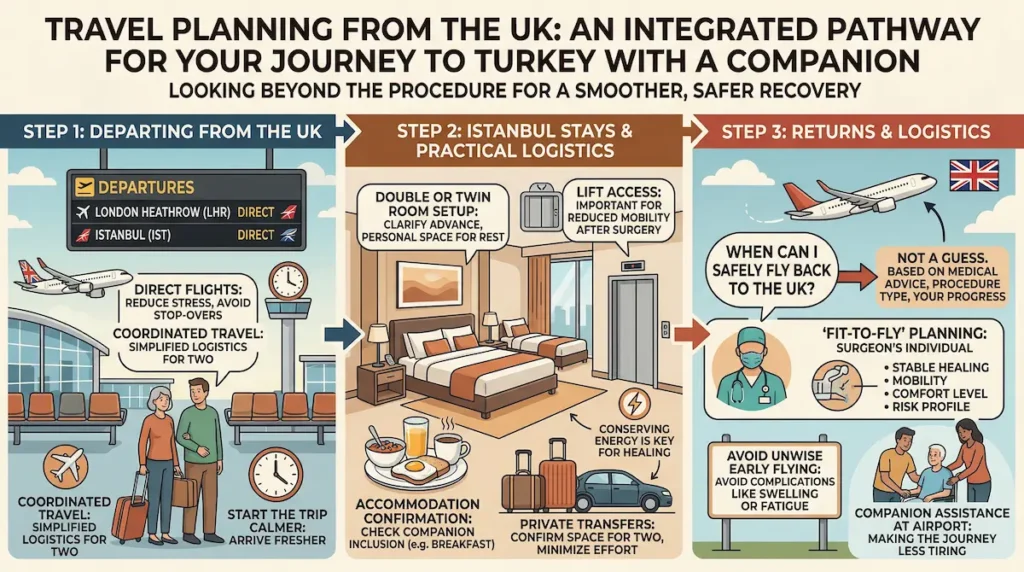
For British patients, the decision to bring a companion is closely tied to travel planning. A good Turkey surgery companion arrangement should make the journey feel easier from the moment you leave the UK, not more complicated. That means looking beyond the procedure itself and thinking carefully about flights, local transport, hotel comfort, and the practicalities of returning home safely after surgery. Patients comparing cosmetic surgery packages with a companion should always look at the full travel pathway rather than the headline price alone.
Direct flights from London and other UK airports to Istanbul
One reason Turkey remains attractive for British patients is convenience. Direct flights from London and many other UK cities to Istanbul make the journey relatively straightforward, especially compared with destinations that require multiple stopovers. For a patient already thinking about surgery, shorter and simpler travel arrangements can reduce stress substantially.
If you are travelling to Turkey for surgery with a friend or partner, direct flights also make coordination easier. You can travel together, keep luggage organised, and arrive on the same schedule as your transfer arrangements. This sounds obvious, but a smooth airport experience matters more than people realise when surgery is scheduled shortly after arrival.
For many British patients, practical comfort begins before they reach the clinic. Avoiding a chaotic route, long airport waits, or separate arrival times can help you start the trip in a calmer frame of mind.
Planning hotel accommodation and local transfers for two people
Accommodation details matter even more when a companion is involved. Patients often search for Turkey cosmetic surgery packages for two because they want to understand whether the companion's stay is properly factored into the plan. That means checking whether the package includes a shared room, whether breakfast is covered for both people, and whether private transfers are arranged with enough space for luggage and post-operative comfort.
If you are considering a twin room for your stay, clarify exactly what that means. In some cases, it refers only to hotel accommodation. In others, it may relate to room layout or whether separate beds are available. This can be especially important if you are travelling with a friend rather than a partner and want enough personal space for proper rest after the operation.
Patients attracted by surgery and holiday packages in Turkey should also be realistic. Although hotels may be comfortable and Istanbul is a beautiful city, the early post-operative period is not a normal holiday. A companion can enjoy the destination in a modest way, but the primary aim of the trip should remain recovery, comfort, and safe return planning.
| Travel detail | Why it matters | What to confirm in advance |
|---|---|---|
| Flights | Reduces stress and avoids unnecessary stopovers | Direct route, baggage allowance, airport assistance if needed |
| Hotel room | Comfort affects rest and recovery quality | Double or twin room, lift access, quiet environment |
| Transfers | Important after surgery when mobility is reduced | Private transfer, waiting time, support for luggage |
| Companion inclusion | Avoids hidden costs and last-minute confusion | Whether the companion is included in accommodation and transport |
Flight home timing, CAA-style concerns, and why “fit-to-fly” advice matters
Many patients ask the same question: when can I safely fly back to the UK? The answer depends on the procedure, your recovery progress, and your surgeon’s instructions. This is not something to guess. It should always be based on proper medical advice rather than convenience or the cheapest return fare.
From a medical science perspective, flying too early may be unwise because swelling, dehydration, reduced movement, and fatigue can complicate the recovery period. That is why thoughtful clinics advise patients according to procedure type and individual condition rather than using a one-size-fits-all answer. A companion can be especially helpful here because they make the airport journey less tiring and more manageable when you are not yet feeling fully yourself.
It is also sensible to think in terms of “fit-to-fly” planning. While patients often mention CAA-style concerns, what matters in practice is whether your own surgeon considers your healing stable enough for travel. This includes your mobility, comfort level, risk profile, and the expected demands of the return journey. Safe timing matters more than rushing home.
Recovery in Turkey with a Companion: What the First Few Days Look Like
The first few days after surgery are usually when a companion is most valuable. This is the stage where a patient may feel tired, mildly uncomfortable, emotionally fragile, or simply less efficient than usual. Proper recovery assistance after plastic surgery abroad is often not dramatic; it is about consistent, sensible help with ordinary things. That is exactly why the right companion can make such a meaningful difference.
The first 24 to 72 hours after surgery: what most patients need
In the early recovery window, most patients need quiet, hydration, light meals if permitted, gentle movement when advised, and a calm environment. They may not be in severe pain, but they can feel puffy, sleepy, slow, or mentally less sharp than normal. Even small decisions can feel tiring at this stage.
This is where the value of practical companion support becomes obvious. A companion can help maintain order in the room, keep important items within reach, encourage sensible pacing, and reduce the temptation to do too much too soon. They can also make sure that rest is prioritised over unnecessary activity, which is one of the most valuable gifts in the immediate post-operative phase.
Put simply, the first 24 to 72 hours are about protecting healing. A well-prepared companion helps create exactly that kind of environment.
How a companion helps reduce stress, overexertion, and poor decision-making
Patients recovering abroad sometimes make the same mistake: once they feel a little better, they assume they are ready to walk too far, sit out too long, or treat the trip like an ordinary short break. In reality, early recovery is not always linear. Feeling better for a few hours does not mean your body is ready for extra strain.
A good companion acts as a steadying influence. They can gently remind you to slow down, help you avoid needless walking, and stop small tasks from turning into tiring mini-projects. This matters because stress and overexertion can leave you feeling worse later in the day, and unnecessary fatigue is not helpful when your body is trying to heal.
There is also an emotional side to this. Patients sometimes feel tearful, flat, or impatient during recovery, even when everything is progressing normally. This does not necessarily mean something is wrong; it simply reflects the reality of surgery and travel. A calm companion can stop those feelings from turning into panic or impulsive decisions.
The benefit of structured aftercare, including UK-friendly communication support
Recovery feels easier when there is a clear structure around it. That structure should come from the clinic, but a companion helps make it practical in day-to-day life. They can help you follow written instructions, remember timings, and keep communication smooth when you are tired and would rather not deal with every detail yourself.
This is particularly reassuring for British patients who value accessibility after they leave the clinic or return home. UK-friendly communication support, such as clear English-speaking coordination and reliable follow-up channels, adds another layer of confidence. A companion does not replace that system, but they do make it easier to use well.
“The journey felt far more manageable because I did not have to organise every little thing on my own while recovering.”
– A typical reflection shared by patients who travel with a trusted companion
Safety, Comfort, and Aftercare: Why Companions Matter for British Patients
For many people in the UK, concerns about surgery abroad are not purely medical. They are emotional, cultural, and logistical as well. Patients may worry about communication, about what happens after discharge, or about being left alone in an unfamiliar setting. A companion helps answer many of those concerns at once. They add reassurance, continuity, and practical calm, which is why medical trips to Turkey with a partner or friend are so common among cautious British patients.
Reducing anxiety about surgery abroad and “botched in Turkey” fears
British media coverage has made some patients understandably cautious about going abroad for surgery. Even people who know these stories do not represent every clinic can still carry anxiety into the planning stage. They may worry about who will look after them, how problems would be handled, or whether they will feel alone once the operation is over.
Having a companion cannot solve every concern, but it can significantly reduce the emotional intensity of those fears. Instead of facing the experience alone, you have someone there to observe, listen, and support you. That matters, especially for patients who are naturally analytical and want a sense of control throughout the process.
In other words, a companion improves not just comfort but perceived safety. For many British patients, that psychological benefit is extremely important.
The value of a UK-based patient contact point and ongoing WhatsApp communication
A strong companion arrangement works best when it sits inside a wider support framework. Patients tend to feel particularly reassured when there is a clear communication route after surgery, including English-speaking coordination and reliable follow-up. This is where a UK-focused support structure can add real value.
If your clinic offers a UK-based patient contact point, that can help reduce the emotional distance patients often fear when travelling overseas for treatment. It means questions feel easier to ask, and support feels more accessible. When this is paired with practical channels such as WhatsApp communication, the overall journey feels more continuous and less fragmented.
A companion benefits from this as well. They are not left guessing what to do if you feel worried or uncomfortable. Instead, they know who to contact and how to raise a concern quickly and clearly.
How modern recovery support such as HBOT and LLLT can make the stay smoother
Companion support is valuable, but clinical recovery support still matters enormously. Modern technologies used in postoperative care can make the early days more comfortable and more manageable. In particular, approaches designed to reduce oedema, support circulation, and encourage better healing can help make the stay smoother for both patient and companion.
This is one area where scientific research and practical experience come together. Patients generally care less about technical language for its own sake and more about what it means in real life: reduced swelling, better comfort, and a recovery pathway that feels more controlled. When a clinic uses evidence-led recovery measures, the companion’s role also becomes easier because the patient is more likely to feel stable and supported.
For the British patient, that combination matters. Emotional support from a trusted person and structured postoperative care from the clinic work best together, not separately.
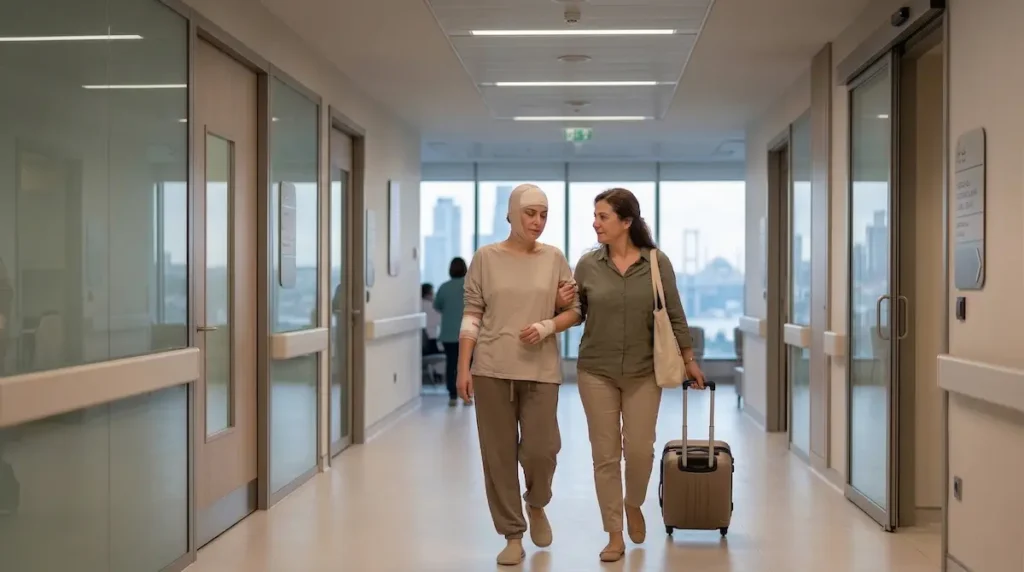
Do You Always Need a Surgery Companion?
Not every patient absolutely requires a companion, but many benefit from having one. The right answer depends on the type of surgery, your confidence level, your general health, your pain tolerance, your experience with travel, and how independent you are likely to feel after the procedure. Patients often assume this is a simple yes-or-no issue, but in reality it is more nuanced. A well-planned Turkey surgery companion decision should be based on common sense rather than pressure.
Procedures where travelling alone may still be manageable
Some patients can travel alone for smaller or less physically demanding procedures, particularly if the clinical pathway is straightforward and they are experienced, calm travellers. If a patient is highly organised, medically fit, and comfortable navigating airports and hotels independently, solo travel may be possible in selected cases.
That said, “manageable” is not always the same as “ideal”. Even when travelling alone is possible, many patients still prefer support because it makes the journey easier, not because they are incapable of coping. This is especially true for first-time patients or anyone who knows they become anxious after medical procedures.
Procedures where a companion is strongly recommended
For more involved procedures, or for combinations of procedures, a companion is often strongly recommended. The same applies when mobility may be limited, fatigue may be greater, or the return journey is likely to feel more demanding. If you are comparing Turkey cosmetic surgery packages for two, it may be because you already sense that support will improve the experience in a meaningful way.
Companions are also particularly useful when the patient is naturally anxious, travelling during a stressful life period, or likely to need extra emotional reassurance. In those circumstances, support is not a luxury. It is part of sensible planning.
Personal factors that matter more than the procedure itself
Sometimes the deciding factor is not the procedure but the patient. Someone having a relatively modest operation may still benefit hugely from bringing a companion if they are nervous, travelling abroad for the first time, or prone to feeling overwhelmed when tired. Another patient may cope very well on their own because they are calm, practical, and already familiar with medical travel.
Ask yourself a few honest questions. Are you likely to manage luggage and logistics calmly after surgery? Will you feel comfortable spending recovery time alone? Do you become anxious when you are tired or sore? Would you feel better if someone you trust were there to listen, observe, and help with ordinary tasks?
If the answer to those questions suggests that support would help, then bringing a companion is probably the wiser choice.
Cost Considerations: Is Bringing a Companion Worth It?
For many UK patients, cost matters, but value matters more. When people compare Turkey surgery companion plans, they are usually not asking whether a companion is the cheapest option. They are asking whether the additional cost improves safety, comfort, and peace of mind enough to justify the spend. In many cases, the answer is yes, particularly for patients having more involved surgery or for anyone who feels uneasy about recovering abroad alone.
Extra flight and hotel costs in GBP
The most obvious cost is the companion’s travel. This usually includes an extra return flight, additional hotel costs, meals, and day-to-day spending. If you are reviewing a cosmetic surgery package with a companion, check whether the quoted price already includes the second person’s room, airport transfers, breakfast, or any room upgrade.
This is where details matter. Some Turkey cosmetic surgery packages for two are genuinely structured for patient-plus-companion travel. Others sound similar but only include partial accommodation support. If a provider mentions a twin room option, make sure you understand whether that refers to the hotel only, the recovery setting, or simply the bed arrangement. Clear pricing in GBP helps British patients compare options properly and avoid unpleasant surprises.
Why support can reduce hidden stress-related problems and practical setbacks
Although bringing a companion adds cost, it can also prevent smaller problems from becoming bigger ones. Patients who travel alone sometimes underestimate how tiring simple tasks can feel after surgery. When that happens, avoidable stress builds quickly: carrying bags, sorting meals, getting to follow-up appointments, or managing airport movement when you still feel swollen or tired.
A companion helps reduce those practical setbacks. They can support sensible pacing, help you stay organised, and create a calmer recovery rhythm. From a real-world point of view, this means fewer small errors, fewer moments of panic, and less temptation to overdo things simply because there is no one there to help. That kind of support is difficult to measure in a spreadsheet, but it often has real value.
Companion costs versus the value of a safer, calmer recovery experience
The real question is not whether a companion costs more, but whether the extra spend improves the overall journey. For many patients, especially those travelling from the UK for the first time, the answer is clear. A calmer recovery, better emotional reassurance, and easier logistics can make the entire medical trip feel more secure and more manageable.
This is particularly true when people are drawn to surgery and holiday packages in Turkey but want to approach the journey sensibly. Surgery should always be planned as surgery first, not as a leisure break with a procedure added on. If a companion helps you keep the trip recovery-focused, organised, and emotionally steady, the extra cost may represent good value rather than unnecessary expense.
| Cost factor | Typical extra expense | Potential value |
|---|---|---|
| Companion flight | One additional return fare from the UK | Shared travel, easier airport support, less stress |
| Accommodation | Shared room or companion supplement | Comfort, reassurance, practical help during recovery |
| Meals and local spending | Modest day-to-day travel costs | Less pressure on the patient to manage everything alone |
| Transfer inclusion | May be included or charged separately | Smoother logistics before and after surgery |

How AKM Clinic Supports UK Patients Travelling with a Companion
A companion is most helpful when the clinic itself is organised around the needs of international patients. British patients usually want more than a procedure and a hotel booking. They want clarity before travel, smooth communication throughout the stay, and confidence that support continues after they return home. That is especially important for patients interested in medical tourism in Turkey with a partner or anyone seeking structured recovery assistance after plastic surgery abroad rather than a basic treatment-only plan.
Clear planning before arrival and transparent communication
One of the most valuable parts of pre-travel planning is clarity. Patients should know what the schedule looks like, where they will stay, how transfers are arranged, and what their companion can realistically expect. This reduces uncertainty before departure and helps both people travel with the right expectations.
For UK patients, communication style matters as much as logistics. Clear English-speaking coordination, transparent pricing, and straightforward explanations all make the journey easier to trust. A well-run plan should not leave the patient or the companion guessing what happens next.
VIP transfers, accommodation coordination, and recovery pathway guidance
International patients usually benefit from a joined-up pathway rather than piecing the journey together themselves. That includes airport transfers, hotel coordination, and guidance on how the first days after surgery should be managed. When these details are planned properly, the companion can focus on supporting the patient rather than constantly troubleshooting travel issues.
This is also where companion planning becomes more practical. A companion is more useful when the basics are already well organised: transport is clear, accommodation is comfortable, and the patient knows how the recovery schedule will unfold. That structure lowers stress for everyone involved.
A British-patient-focused journey with emphasis on comfort, safety, and aftercare
For UK patients, strong aftercare is one of the most important trust signals. Recovery does not end when the operation is over, and British patients often want reassurance that communication remains accessible once they leave the clinic or return home. This is particularly valuable for those who worry about distance after surgery abroad.
Modern postoperative support can also improve the experience. Recovery technologies that aim to reduce oedema, support tissue healing, and make patients more comfortable can help the early phase feel more manageable. In practical terms, that means a smoother stay for the patient and less worry for the companion as well.
When a clinic combines structured communication, comfortable logistics, and evidence-led recovery support, the overall journey feels much more aligned with what cautious British patients actually want: safety, organisation, subtle care, and reliable aftercare rather than empty promises.
Frequently Asked Questions (FAQ): Surgery Companion in Turkey
Below are some of the most common questions British patients ask when planning surgery companion arrangements in Turkey. These answers are intentionally concise so that patients and companions can understand the basics quickly before discussing the final plan with the clinic.
Can my companion stay with me throughout my time in Istanbul?
Does my companion need to attend the consultation or surgery day?
Can I travel back to the UK without a companion after cosmetic surgery?
What should my companion pack for the trip?
Are there procedures where bringing a companion is essential?
Will my companion be able to help if I feel unwell after surgery?
Is bringing a companion worth the additional cost for UK patients?
If you would like to explore related topics beyond surgery companion planning, you can also learn more about How to Prepare for Cosmetic Surgery, Blepharoplasty in Turkey, Mummy Makeover Recovery with Children, Lymphatic Drainage Massage After Lipo, English Speaking Plastic Surgeons in Turkey, Online Plastic Surgery Consultation, and Finance for Plastic Surgery in Turkey. These guides can help you understand recovery, communication, budgeting, and practical travel arrangements in greater detail, so you can plan your treatment journey from the UK with more confidence, clearer expectations, and better overall support.
Medical Disclaimer: This page is provided for general educational purposes only and does not replace a face-to-face medical consultation, diagnosis, or personalised treatment plan. All surgery carries risks and outcomes vary between individuals. Suitability for plastic surgery, procedure selection, and anaesthesia choice can only be determined after a full clinical assessment by a qualified surgeon. Always follow your clinician’s instructions and seek urgent medical attention if you develop concerning symptoms during recovery.
Related Treatments



Ready to Begin Your Own Transformation Journey?
Join the 2,000+ patients who have trusted Dr Akif Mehmetoğlu and the AKM Clinic team. Your journey to a more confident, naturally restored you begins with a simple, no-obligation conversation. Contact us today from the UK for your free virtual consultation.
#1: Get Your Free Personalised Quote
Start with a free, no-obligation online consultation. Share your photos, and our surgical team will provide a fully personalised treatment plan and a transparent, all-inclusive price package. There are no hidden fees.
#2: Secure Your Date & VIP Booking
Once you are ready, our dedicated patient coordinators will help you secure your procedure date. We will handle all your bookings, including your 5-star hotel accommodation and private VIP airport transfers.
#3: Arrive in Istanbul & Meet Your Surgeon
Arrive at Istanbul Airport (IST) and be greeted by your private driver. Settle into your hotel and prepare for your in-person consultation, where you will meet your specialist surgeon to finalise the details for your "natural, subtle, and restored" new look.