
Mummy Makeover Recovery with Children: Practical Tips

AI Summary
- Mummy makeover recovery with children needs structured childcare, realistic expectations, and extra support during the first two weeks.
- No-lifting rules protect healing after tummy tuck or breast uplift, especially with toddlers, prams, and daily routines.
- Week-by-week recovery planning helps British mums manage swelling, travel home safely, and return gradually to family life.
- AKM Clinic supports safer recovery through HBOT, LLLT, and UK follow-up communication for reassurance after surgery.
AI-generated summary, fact-checked by our medical experts.
Mummy makeover recovery with children requires far more planning than recovery in a quiet household. For most British mums, the real concern is not simply pain or swelling, but how to rest properly when a baby still needs feeding, a toddler wants lifting, and older children still need school runs, meals, and bedtime routines. A Mummy Makeover may combine procedures such as a tummy tuck, breast uplift, breast augmentation, or liposuction, which means the early healing period must be handled with structure, patience, and realistic expectations.
This guide is designed for UK patients who want practical, honest advice about recovery after mummy makeover with children. It explains what the first days and weeks may feel like, how to prepare your home before surgery, and how to reduce stress when recovering from a mummy makeover with toddlers or younger children. We will also cover common concerns such as lifting toddler after tummy tuck, holding baby after breast uplift, pushing a pram after tummy tuck, and changing nappies after abdominal surgery.
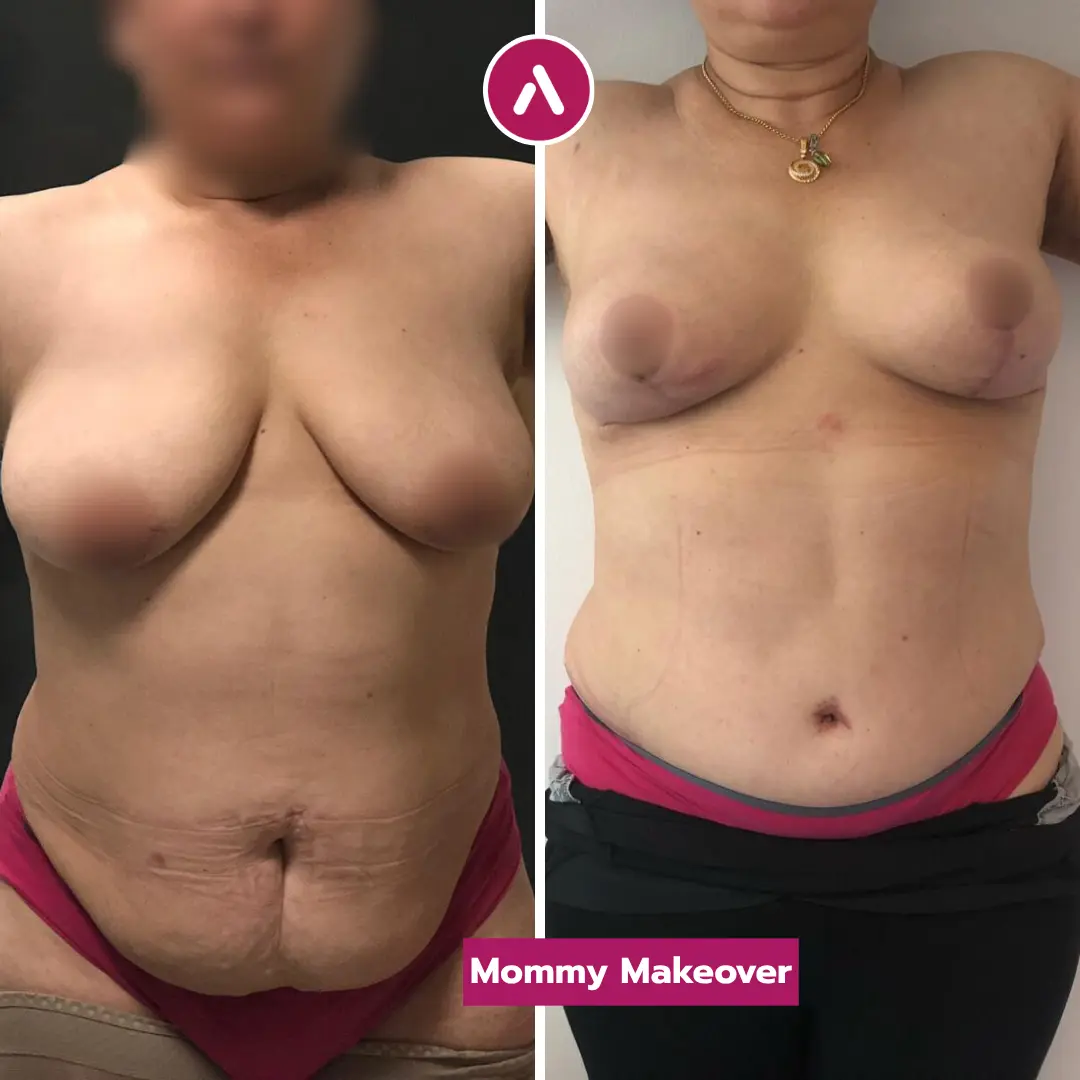
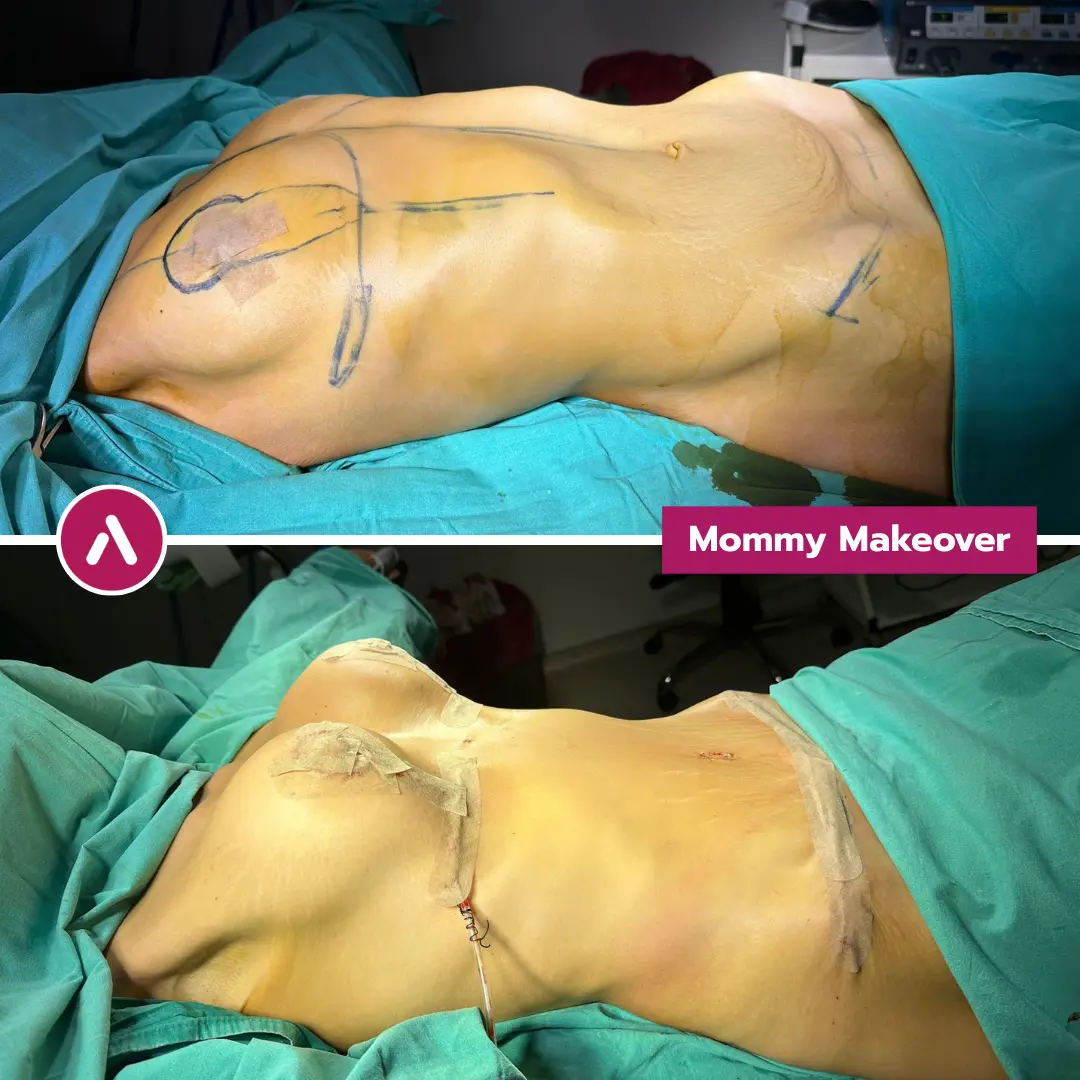
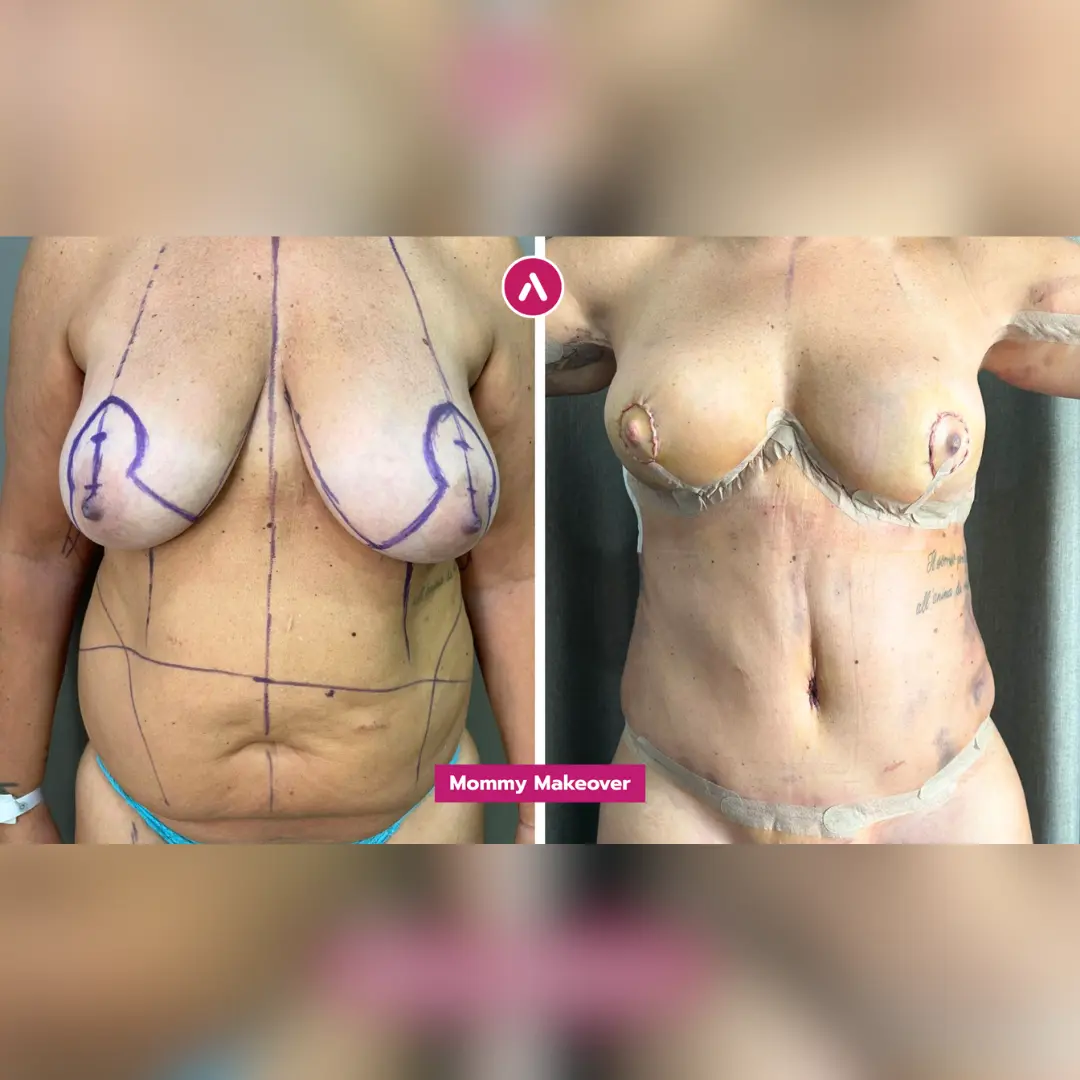
Although every recovery is personal, medical science and clinical aftercare principles are clear on one point: healing is better when strain is reduced early. Good planning does not make you weak or over-cautious; it protects your repair, lowers the chance of complications, and makes the entire experience more manageable for both you and your children. Think of this article as a realistic survival guide, built around common mummy makeover recovery tips, sensible home preparation, and a more confident mummy makeover recovery timeline.
Practical recovery principle: In the first stage of healing, your job is not to “bounce back”. Your job is to protect your body while it does the work that only rest, time, and careful movement can achieve.
Table of Contents

What Recovery Really Looks Like When You Have Young Children
For mothers, recovery is rarely just physical. It is emotional, logistical, and often mentally exhausting because children do not fully understand why you cannot pick them up, run after them, or carry out your usual routine. This is why the first stage of recovery should be approached as a family adjustment period rather than simply a medical one. Setting expectations early can make the difference between a smoother recovery and one filled with preventable setbacks.
For many women, this planning becomes even more important when the procedure includes abdominal repair, particularly with techniques such as a tube tummy tuck. Because this approach is designed to support a smoother early recovery, patients may feel encouraged by the prospect of easier movement, but they still need realistic boundaries at home. In practical terms, even a well-managed recovery requires help with lifting, childcare, and household routines during the first stage.
Why Mummy Makeover recovery feels different for mums with babies, toddlers, or school-age children
The recovery experience depends heavily on the age of your children. A baby may need feeding, carrying, winding, and frequent holding. A toddler may climb onto you unexpectedly, demand to be lifted, or resist changes to their routine. School-age children are more independent, but they still need help with dressing, meals, transport, and reassurance. In practical terms, this means childcare after cosmetic surgery is not optional for most patients; it is part of the treatment plan.
Parents often underestimate how many movements involve abdominal pressure or upper body strain. Leaning into a cot, lifting a child into a highchair, carrying a car seat, pushing a pram uphill, or bending repeatedly for toys can all place tension on healing tissues. If your Mummy Makeover includes a tummy tuck, muscle repair, breast uplift, or breast surgery, even ordinary parenting tasks may feel surprisingly difficult at first.
This is especially important for women recovering from a mummy makeover with toddlers, because toddlers are active, unpredictable, and physically attached to their main caregiver. They do not understand why Mummy cannot lift them today when she did yesterday. Preparing for this emotional reality is just as important as preparing your medication, pillows, or compression garments.
The first 14 days: what you can and cannot do safely
The first two weeks are usually the most structured part of the recovery period. During this time, soreness, tightness, tiredness, bruising, and oedema are common. You may be walking slightly bent at first if abdominal repair is involved, and your energy levels may be lower than expected. Even patients who are coping well often need more support than they imagined.
During the earliest stage, you should generally focus on short walks around the room or home, regular hydration, light meals, medication as prescribed, and careful positioning when getting in and out of bed. What you should not do is equally important: no lifting children, no carrying laundry baskets, no vacuuming, no twisting suddenly, and no forcing yourself through “mum guilt” to resume normal chores too soon.
Questions such as lifting toddler after tummy tuck or holding baby after breast uplift are extremely common because they affect daily life immediately. In most cases, patients need a temporary no-lifting period, particularly in the early days, because the repaired abdomen and chest must not be stressed before healing is established. The safest answer is always to follow your own surgeon’s instructions, but as a practical rule, you should assume that child-lifting will need to be avoided for an initial period and properly planned for in advance.
| Recovery period | What is usually realistic | What should usually be avoided |
|---|---|---|
| Days 1–3 | Resting, short assisted walks, fluids, light meals, prescribed medication | Lifting children, bending repeatedly, housework, school runs |
| Days 4–7 | Gentle movement around the house, sitting out of bed more comfortably, brief self-care | Pushing a pram, changing nappies on the floor, carrying shopping, driving unless cleared |
| Days 8–14 | Gradually increasing mobility, light routines with support, brief time with children while seated | Picking up toddlers, hoisting children into car seats, strenuous chores, overexertion |
Why rest is not a luxury but part of protecting your surgical results
Many mums feel guilty about resting. However, rest after surgery is not indulgent; it is protective. A Mummy Makeover often involves multiple treatment areas, which means your body is handling more inflammation, more tissue repair, and more overall fatigue than after a smaller single procedure. Returning to normal parenting duties too early may increase swelling, discomfort, tension across incisions, and general exhaustion.
This is where clinical recovery principles align with common sense. Healing tissues respond better when blood flow is supported through gentle movement, but they also need protection from repeated stress. In simple terms, light walking is helpful, but lifting, twisting, reaching, rushing, and carrying children too soon can work against your recovery.
Rest also supports mental recovery. When pain is controlled, sleep is better, and the household is calmer, patients tend to feel more confident and less overwhelmed. Some women need only simple pain relief such as paracetamol as recovery progresses, while others need a longer period of support. The point is not to compare yourself with anyone else. The point is to create the conditions for safe, steady improvement.
- One of the most important mummy makeover recovery tips: accept help early instead of waiting until you feel exhausted.
- Another key point: schedule proper rest periods during the day, not just at night.
- Most importantly: remind yourself that protecting your results is part of caring for your children, not time taken away from them.
Discover If a Mummy Makeover Is Right for You
Share your photos and medical history to receive a personalised assessment from our European Board-certified facial surgery team.
How to Prepare Your Home and Childcare Before Surgery
A smoother recovery usually begins before you leave for surgery. The women who cope best are rarely the ones who are strongest or most determined; they are usually the ones who prepare the most carefully. Home organisation, childcare cover, meal planning, sleeping arrangements, and practical access to everyday items all matter. If you prepare properly, the first week can feel calm and manageable rather than chaotic.
For mothers planning ahead, understanding the specific procedure also helps shape a more realistic home set-up. Whichever techniques are used, you should prepare for temporary lifting restrictions, reduced stamina, and the need for structured childcare support.
Creating a realistic childcare plan for the first 2 weeks
For most patients, the biggest mistake is underestimating how much help they will need. It is far better to arrange “too much” support and scale it back than to assume you will manage and then struggle physically. A realistic childcare plan should cover mornings, meals, school logistics, bathing, bedtime, nursery pick-ups, and weekend routines. Do not just plan for the first two or three days; plan properly for the full first fortnight.
If you have a baby or toddler, another adult should ideally be the primary lifter for the early phase. This matters because tasks such as carrying a child upstairs, lifting them into a buggy, or moving them in and out of a cot can place significant pressure on the abdomen and chest. If you are worried about holding baby after breast uplift, discuss positioning in advance and prepare seated alternatives so you can still bond safely without taking weight through your arms and upper chest.
For women concerned about childcare after cosmetic surgery, the most useful approach is to divide help into layers:
- Essential help: lifting children, transport, bathing, bedtime, meals.
- Practical help: laundry, cleaning, shopping, pet care, medication reminders.
- Emotional help: someone to stay calm, keep children settled, and reduce household tension.
If your partner cannot be present throughout, try to arrange a rota involving grandparents, siblings, trusted friends, or paid childcare where appropriate. Temporary help is often what protects long-term healing.
Organising meals, school runs, baths, and bedtime in advance
Children do better when routines remain predictable, and patients recover better when they are not making dozens of decisions each day. For that reason, pre-planning is one of the true mummy makeover recovery must-haves. Prepare freezer meals, school uniforms, snack boxes, medications, and a written household schedule before surgery. Even a simple list on the fridge can reduce stress for everyone involved.
School runs deserve particular attention. If you normally walk, carry bags, or manage younger siblings at the same time, assume that this may not be realistic straight away. Likewise, if you usually manage bath time or bedtime alone, plan for hands-on support. These tasks sound simple until you are newly post-operative and realise how much bending, reaching, and lifting they involve.
Many women also ask about pushing a pram after tummy tuck. In practical terms, pushing a pram is not just about walking; it can involve arm force, core stability, kerbs, uneven pavements, and sudden steering adjustments. In the early stage, it is wiser to assume that someone else should handle pram duty. The same logic applies to changing nappies after abdominal surgery, particularly if the changing set-up requires bending over a low surface or floor mat.
| Task to organise before surgery | Why it matters | Helpful solution |
|---|---|---|
| School and nursery transport | Reduces morning strain and time pressure | Arrange partner, family member, friend, or temporary taxi plan |
| Meals for adults and children | Prevents skipped meals and unnecessary standing in the kitchen | Batch-cook and freeze, or organise simple ready-made meals |
| Nappy changes and feeding stations | Limits repeated bending and reaching | Create waist-height set-ups on each floor where possible |
| Bedtime and bath routine | Evening fatigue is often at its highest | Assign another adult for lifting, bathing, and settling |
Setting up a recovery station at home with medicines, pillows, fluids, and loose clothing
Your environment has a major effect on your comfort. A well-planned recovery station saves steps, reduces frustration, and helps you avoid unnecessary strain. Ideally, this area should be close to a toilet, easy to get in and out of, and stocked with essentials before you return home. Think less in terms of luxury and more in terms of access, convenience, and energy conservation.
Common mummy makeover recovery must-haves include prescribed medication, paracetamol if appropriate within your care plan, water bottles, light snacks, spare dressings if advised, supportive pillows, phone chargers, lip balm, hand cream, and easy entertainment. Clothing should be soft, front-fastening where possible, and loose enough not to rub against healing areas. Trousers and robes are usually more practical than anything tight or complicated to pull on.
If abdominal work is involved, small practical changes matter. Keep frequently used items at waist or chest height, not on the floor. Avoid low sofas that are difficult to rise from. Use extra pillows to support a more comfortable resting position. If you need to care for a baby while seated, make sure someone else can place the baby into your arms so you are not the one lifting. These details may sound minor, but they have a major impact on day-to-day comfort and confidence during the early mummy makeover recovery timeline.
- Keep a water bottle, medication, and charger within easy reach at all times.
- Prepare a seated area where you can spend calm time with your children without physical strain.
- Place nappies, wipes, muslins, and children’s essentials on raised surfaces to reduce bending.
- Choose loose, breathable clothing and footwear that is easy to step into.
Most importantly, set expectations with your children in advance in an age-appropriate way. You do not need to explain every medical detail. A simple message often works best: Mummy will be sore for a little while, she still loves cuddles, but she cannot be jumped on or picked up for a short time. That clarity can make the home atmosphere far calmer for everyone.
Ready to Schedule Your Mummy Makeover?
Our surgical dates fill up quickly due to high international demand. Secure your consultation today to arrange your preferred travel dates.
Lifting Restrictions, Daily Tasks, and Safe Movement After a Mummy Makeover
Once you are home, the biggest challenge is rarely complete rest. It is finding safe ways to live around your children without putting stress on your abdomen, chest, or healing incisions. This stage is where many mothers become frustrated, because they may feel mentally ready to do more before their body is ready. The science of wound healing is not negotiable: tissues need time, reduced tension, and steady progress rather than sudden effort.
When you can hold, lift, or carry your child again
This is one of the most important questions in recovery after mummy makeover with children. The honest answer is that the timing depends on your exact procedure combination, the extent of any muscle repair, your surgeon’s instructions, and how well you are healing. However, most mothers should plan around a temporary no-lifting period in the early stage. If you assume you will not be able to lift your child for a while and prepare accordingly, you are far less likely to panic or overdo it.
For women worried about lifting toddler after tummy tuck, the concern is not only weight. It is the movement itself: bending down, scooping up a moving child, straightening your trunk, and carrying them while they wriggle. All of that places pressure through the abdomen. If your Mummy Makeover included abdominal tightening, this is exactly the kind of strain you want to avoid in the early weeks.
The same applies to holding baby after breast uplift. Holding a baby may sound gentle, but repeated lifting from a cot, car seat, or buggy uses the chest, shoulders, and upper arms more than most mothers realise. A safer option is to sit in a supportive chair while another adult places the baby into your arms. That way, you can still have feeding time, bonding, and cuddles without taking the full load through healing tissues.
- Use seated cuddles rather than standing carries in the early phase.
- Ask another adult to place your baby or toddler beside you instead of onto you from a low level.
- Do not test your limits “just once”; many setbacks happen during one impulsive movement.
How to manage cuddles, nappy changes, and feeding without straining your abdomen
You do not need to disappear from family life during recovery, but you do need to adapt how you participate. Children usually respond well when they are still getting closeness and attention, even if the physical format changes. Story time on the sofa, quiet play beside you, hand-holding, or seated cuddles often work well. A pillow across your lap can act as a gentle protective barrier if a child is likely to lean or climb.
Changing nappies after abdominal surgery is another common challenge. A floor-level changing mat is often a poor choice early on because it requires repeated bending, lowering, and rising. A raised changing surface at waist height is usually much kinder to your abdomen. Keep wipes, nappies, muslins, creams, and spare clothes within easy reach so you are not twisting or stretching awkwardly.
Feeding routines also need thought. If you are bottle-feeding, set up a seated feeding station with pillows, water, and muslins beside you. If you are managing older children’s meals, keep food simple for the first fortnight. This is not the time for elaborate cooking. Many of the best mummy makeover recovery tips are surprisingly ordinary: simplify the day, reduce unnecessary movement, and stop treating every task as urgent.
If you are thinking about pushing a pram after tummy tuck, it is wise to be careful. Even if your early recovery feels comfortable, pushing a buggy can place pressure on the abdomen, especially on uneven pavements, at kerbs, or during sudden stops and turns. In the first stage, it is usually safer to let someone else manage the pram, particularly outdoors.
Safe walking, stairs, getting in and out of bed, and using the toilet comfortably
Gentle movement is important because it supports circulation and reduces the stiffness that can make recovery feel worse. Short, regular walks around your room or home are generally more useful than trying to do too much at once. Walking is part of recovery; rushing is not. Aim for calm, deliberate movement rather than trying to prove how well you are coping.
Stairs should be taken slowly and with a handrail where possible. If your home has multiple floors, try to limit unnecessary trips up and down in the first days. A practical set-up on one main level often helps. Getting in and out of bed can also be awkward, especially after abdominal surgery. Roll onto your side first, then push up with your arms while keeping your core movement controlled rather than sitting straight up sharply.
The same principle applies when sitting down, standing up, or using the toilet. Small adjustments reduce discomfort significantly. Choose supportive chairs rather than low, soft seating. Keep your essentials nearby. Wear clothing that is easy to remove without twisting. These details may seem minor, but they are central to a safer and less stressful mummy makeover recovery timeline.
| Everyday activity | Safer option in early recovery | Why it helps |
|---|---|---|
| Lifting a child from the floor | Ask another adult to lift, then sit for cuddles | Reduces abdominal and chest strain |
| Nappy changes | Use a waist-height changing surface | Limits bending and repeated trunk flexion |
| Pushing a pram | Delegate to another adult for the first stage | Avoids forward pressure and sudden effort |
| Getting out of bed | Roll to the side, then push up | More comfortable after abdominal repair |
A Week-by-Week Mummy Makeover Recovery Timeline for UK Mums
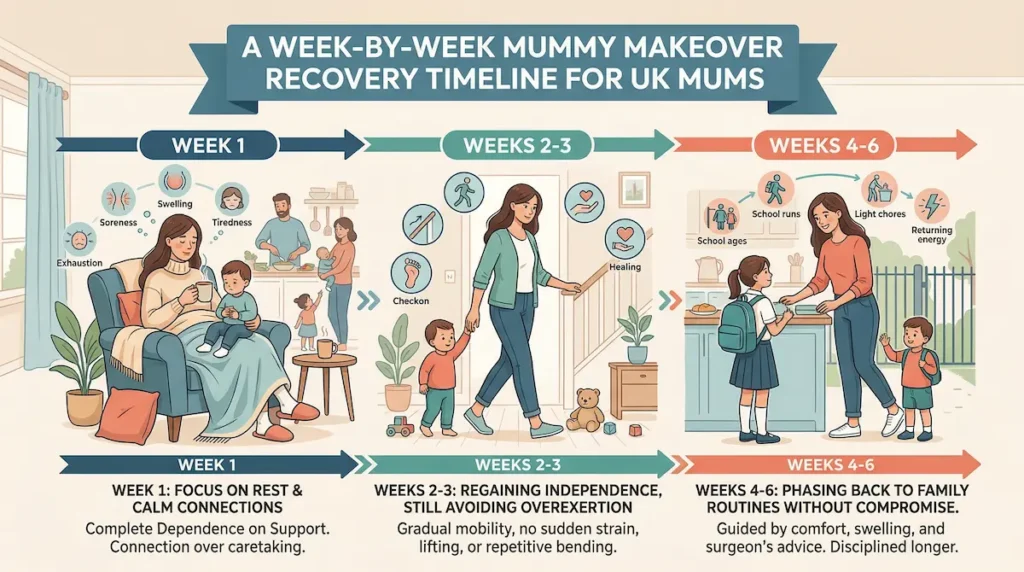
Patients often feel calmer when they can picture recovery in stages. Of course, no two people heal in exactly the same way, and your own surgeon’s advice must always come first. Still, a realistic framework can be very reassuring. Rather than expecting a dramatic “bounce back”, it is wiser to think in terms of gradual milestones: less soreness, easier mobility, more independence, and a slow return to family routines.
Week 1: swelling, soreness, tiredness, and complete dependence on support
The first week is usually about protection and patience. Swelling, tightness, bruising, reduced stamina, and a general feeling of vulnerability are all common. Even simple actions may feel tiring. This is why women recovering from a mummy makeover with toddlers need a dependable support system rather than a vague promise of help.
In this phase, your role should be limited to resting, eating lightly, walking a little, taking medication correctly, and following your aftercare instructions. You may still spend meaningful time with your children, but ideally in calm, seated, well-supported ways. Think connection rather than caretaking. Another adult should manage the physically demanding side of parenting.
Weeks 2–3: regaining independence while still avoiding overexertion
By this stage, many women feel noticeably better and assume they can return to normal faster than they should. This is often the tricky phase because improvement can create overconfidence. You may be moving around more comfortably, standing straighter, and relying less on help, but your internal healing is still ongoing.
This is usually the stage when mothers begin asking again about housework, school runs, or carrying children for “just a second”. Be careful here. Feeling better does not mean fully healed. Continue avoiding sudden strain, heavy lifting, and repetitive bending. Gradual independence is the goal, not premature normality.
Weeks 4–6: returning gradually to normal family routines without compromising healing
During weeks four to six, many mothers begin to feel more like themselves again. Energy may improve, everyday movement often feels easier, and family life becomes more manageable. However, this is still not the stage to ignore restrictions or assume all tissues are ready for full pressure. Good results often come from staying disciplined slightly longer than feels necessary.
By now, many patients can take on more gentle household involvement, spend longer periods upright, and enjoy more normal interaction with their children. But progression should still be guided by comfort, swelling, your surgeon’s advice, and the exact procedures you had. The best long-term outcome usually comes from steady recovery, not heroic effort.
| Stage | Main focus | Typical family strategy |
|---|---|---|
| Week 1 | Protection, pain control, short walks, rest | Full childcare support and no lifting |
| Weeks 2–3 | Gentle independence, controlled activity | Shared childcare with continued lifting restrictions |
| Weeks 4–6 | Gradual return to routine | Progressive involvement without overexertion |
Travelling Solo for Your Mummy Makeover?
You are never alone. Our dedicated 24/7 Patient Hosts and English-speaking team will be by your side from the moment you arrive until your departure. Your comfort and safety are our constant priority.
Travelling Back to the UK and Managing Aftercare with Children at Home
For British patients travelling for surgery, recovery does not end when you leave the clinic. It continues on the journey home and through the first days back in the UK. This is where planning really matters. Travel, luggage, transfers, airport walking, and then returning to a household with children can feel more demanding than patients expect. A smoother experience depends on timing, support, and sensible expectations rather than trying to “manage everything” alone.
Even if your early recovery has gone smoothly, airport queues, sitting for long periods, luggage handling, and arriving home to children can place unexpected demands on the body, so careful planning and extra support remain essential.
When it is usually safe to fly after surgery and why flight timing matters
Your own surgeon’s clearance should always be the deciding factor, because the right timing depends on the combination of procedures, your mobility, and how well you are healing. Flying too soon can be problematic because air travel after surgery may increase discomfort, swelling, and clot-related concerns. In other words, fit-to-fly timing is not a formality; it is part of your recovery plan.
For mothers, this matters even more because a travel day with children can involve far more physical effort than expected. There may be bags to manage, airport queues, toilet stops, comforting an overtired child, and the temptation to lift something when nobody else is quick enough. Plan the journey as though you are still in recovery, because you are.
How UK-based follow-up support reduces anxiety after you return home
One of the greatest fears for British patients is not the operation itself, but the thought of being back home with questions, swelling, or uncertainty. That is why structured aftercare matters so much. Ongoing communication can make the difference between normal post-operative worry and genuine reassurance. When you have children at home, that emotional support is especially valuable because there is very little spare mental capacity for uncertainty.
AKM Clinic’s follow-up approach is designed around that reality. British patients value clear communication, access to a UK support line, and the comfort of a direct WhatsApp UK number when they need guidance after returning home. A London correspondence address or UK based patient contact point can also make the experience feel more secure and easier to navigate, particularly for mothers balancing healing with family life.
Mehtap’s experience highlights this well: once she returned home, the ability to stay in contact through the UK support line and WhatsApp provided ongoing reassurance during recovery. For many patients, that continuity of care matters just as much as the surgery itself.
Planning your first days back in the UK with children, luggage, and household help
Your return home should be treated as part of the recovery pathway, not the end of it. Arrange airport assistance if needed, keep luggage light, and make sure another adult is responsible for children, bags, and any lifting. The goal is to arrive home without turning travel day into a physical setback.
It is also wise to prepare your home before you return. Make sure the fridge is stocked, medication is organised, and childcare cover is still in place for the first days back. Many mothers assume they will feel relieved once home and naturally step back into routine. In reality, the transition can feel tiring. Continue using the same protective habits that helped you earlier: no lifting, no rushing, and no unnecessary strain.
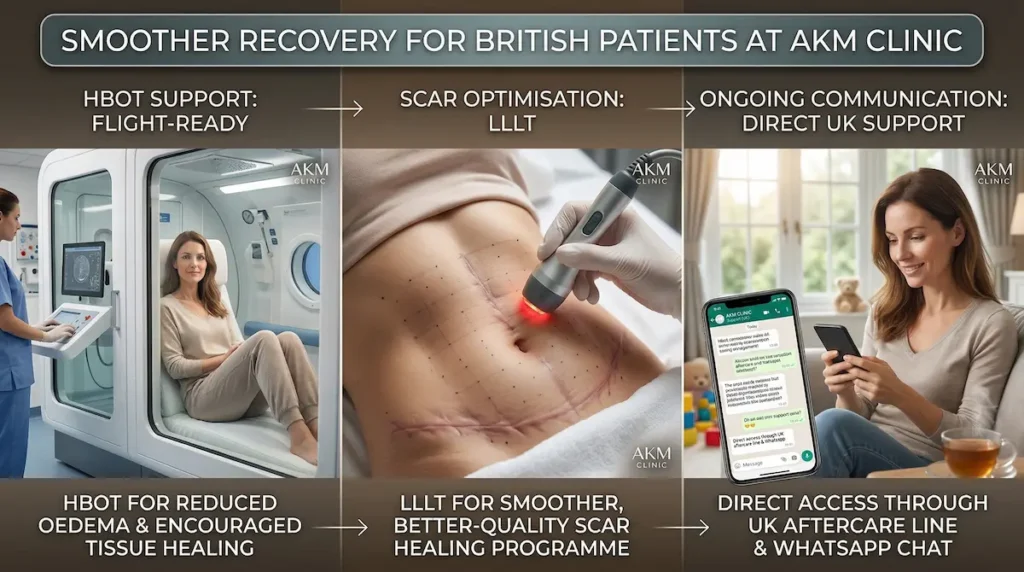
How AKM Clinic Supports a Smoother Recovery for British Patients
For UK patients, recovery is not only about what happens in theatre. It is about how well the entire process is structured around healing, travel, communication, and aftercare. A well-designed recovery pathway should lower anxiety, support comfort, and make it easier to return home feeling stable rather than overwhelmed. This is particularly important in Mummy Makeover cases, where the patient may be returning to a household that still demands emotional attention even when physical effort must be limited.
British patients often value not only the surgical result but also how manageable recovery feels once they return to family life. That is why the procedure should be combined with structured aftercare, clear communication, and practical support that helps mothers recover more confidently at home.
HBOT support for reducing oedema and helping you feel “flight-ready” sooner
One of AKM Clinic’s practical recovery advantages is the use of HBOT, or Hyperbaric Oxygen Therapy, as part of selected aftercare support. In simple terms, this approach is used to support tissue recovery, help reduce oedema, and encourage a more comfortable healing process. For patients who are travelling back to the UK, that matters because less swelling and a calmer recovery often make the whole journey feel more manageable.
While no technology replaces proper rest and careful behaviour, supportive treatments can help make the early phase more tolerable. For mothers, feeling less tight, less swollen, and more mobile can have a real effect on confidence. It does not mean returning to normal parenting instantly; it means giving your body better conditions for steady healing.
LLLT support for scar healing and a more comfortable post-operative period
AKM Clinic also uses LLLT, or low-level laser therapy, to support scar quality and tissue recovery. This is especially relevant in body procedures where scar placement and long-term healing matter to patient confidence. The aim is not to promise “invisible” scars, because no ethical clinic should do that, but to support smoother, better-quality healing in line with good aftercare practice.
For mothers, this is often reassuring because scars are one of the biggest worries during recovery after mummy makeover with children. It can be emotionally difficult to care for a family while also adapting to dressings, swelling, and the look of early healing. Supportive scar therapy helps patients feel that the process is being actively managed, not simply left to chance.
Ongoing communication through the UK support line, WhatsApp, and patient contact points
Another major benefit for British patients is communication that does not stop once they fly home. Questions may arise about swelling, comfort, activity levels, garments, sleeping position, or the normal ups and downs of healing. Fast access to guidance matters. It helps patients avoid unnecessary worry and, just as importantly, unnecessary mistakes.
That continuity is often what mothers remember most. They do not just want surgery; they want to know that if something feels uncertain while managing children at home, they are not dealing with it alone. For many UK patients, that level of contact is part of what makes an international recovery feel structured, safe, and realistic.
Sarah from the UK described her recovery as comfortable and noted that she needed minimal paracetamol as healing progressed. Experiences differ from patient to patient, but her story reflects what many British patients value most: subtle results, calm recovery, and support that continues beyond the operation itself.
Frequently Asked Questions (FAQ): Mummy Makeover Recovery with Children
These are the questions UK mothers ask most often when planning a Mummy Makeover around family life. The answers should always be tailored to your exact procedure and recovery progress, but the guidance below offers a realistic starting point.
How long before I can pick up my child after a Mummy Makeover?
Can I recover safely if I have a toddler at home?
When can I do the school run again?
How much help will I need during the first week?
When is it safe to travel back to the UK after surgery?
What should I do if my children accidentally bump my tummy or chest?
How can I explain my surgery and recovery needs to young children?
If you would like to explore related topics in more detail, you may also find useful information on Breast Lift with Implants, Diastasis Recti Repair Surgery, Mini vs Full Tummy Tuck, Lymphatic Drainage Massage After Lipo, Surgery Companion Turkey, Plastic Surgery Packages Turkey, How to Prepare for Cosmetic Surgery, and Questions to Ask Plastic Surgeon. These guides can help you better understand your treatment options, recovery planning, support needs, and the most important points to consider before making a confident decision.
Have Specific Questions About Mummy Makeover?
Speak directly with our dedicated patient coordinators regarding Mummy Makeover. Receive instant guidance and personalised support.
Medical Disclaimer: This page is provided for general educational purposes only and does not replace a face-to-face medical consultation, diagnosis, or personalised treatment plan. All surgery carries risks and outcomes vary between individuals. Suitability for a mummy makeover surgery, procedure selection, and anaesthesia choice can only be determined after a full clinical assessment by a qualified surgeon. Always follow your clinician’s instructions and seek urgent medical attention if you develop concerning symptoms during recovery.
Related Treatments

Awake Abdominal Etching in Turkey
UK guide to awake abdominal etching in Istanbul: HD sculpting, tumescent local anaesthesia, twilight sedation, recovery phases, HBOT/LLLT and GBP costs.

Awake Mummy Makeover in Turkey
UK-focused guide to an awake mummy makeover using tumescent local anaesthesia with optional conscious sedation. Explore tummy tuck, liposuction and breast options, recovery timelines and costs in GBP.

Awake Tummy Tuck in Turkey
UK guide to Awake Tummy Tuck under twilight sedation at AKM Clinic, Istanbul—techniques, combinations, recovery timeline, risks, aftercare and GBP planning.

Breast Lift with Implants in Turkey
Breast Lift With Implants: Augmentation mastopexy in Istanbul for UK patients. European Board Certified surgeons, all-inclusive package.
Ready to Begin Your Own Transformation Journey?
Join the 2,000+ patients who have trusted Dr Akif Mehmetoğlu and the AKM Clinic team. Your journey to a more confident, naturally restored you begins with a simple, no-obligation conversation. Contact us today from the UK for your free virtual consultation.
#1: Get Your Free Personalised Quote
Start with a free, no-obligation online consultation. Share your photos, and our surgical team will provide a fully personalised treatment plan and a transparent, all-inclusive price package. There are no hidden fees.
#2: Secure Your Date & VIP Booking
Once you are ready, our dedicated patient coordinators will help you secure your procedure date. We will handle all your bookings, including your 5-star hotel accommodation and private VIP airport transfers.
#3: Arrive in Istanbul & Meet Your Surgeon
Arrive at Istanbul Airport (IST) and be greeted by your private driver. Settle into your hotel and prepare for your in-person consultation, where you will meet your specialist surgeon to finalise the details for your "natural, subtle, and restored" new look.