
Calf Liposuction: Slimming and Reshaping the Lower Legs
AI Summary
- Calf liposuction suits fat-based calves, not muscular or swelling-driven lower-leg fullness.
- Careful assessment protects safety by checking skin elasticity, anatomy and realistic contour goals.
- Recovery requires patience, compression, gentle walking and leg elevation while swelling settles in stages.
- Pricing decisions should follow suitability, surgeon expertise and aftercare, not low-cost offers alone.
AI-generated summary, fact-checked by our medical experts.
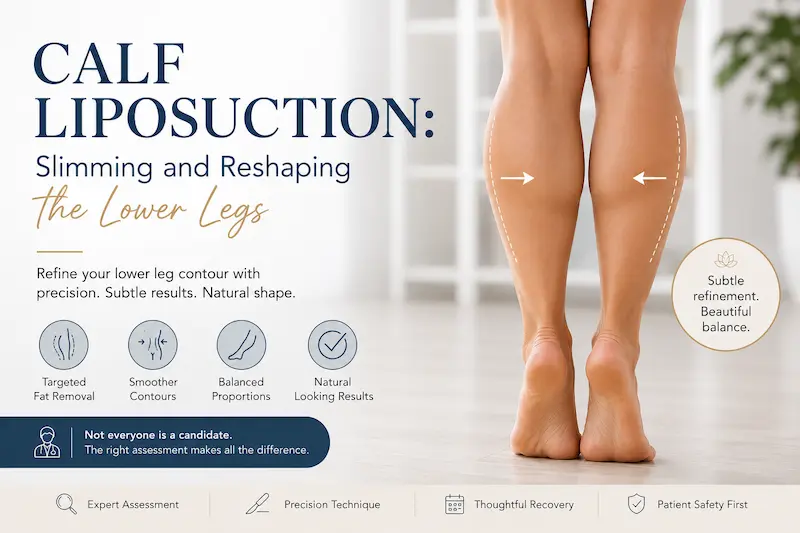
Calf liposuction can slim the lower legs when the fullness is caused by fat, not muscle. The key is honest assessment: many calves look broad because of gastrocnemius muscle shape, genetics, or ankle-to-knee proportions, which liposuction cannot reduce. In the right candidate, conservative lower-leg liposuction can refine contour, but the result is usually subtle rather than dramatic.
At AKM Clinic, lower-leg contouring is approached as a precision procedure, not a quick fat-removal treatment. Before considering the calves, your surgeon should assess the whole line from knee to ankle, skin quality, swelling tendency, and whether the bulk is pinchable fat or firm muscle. For a wider context, see a full overview of liposuction before focusing on this specific area.
This guide is written for UK patients comparing calf reshaping abroad with the same caution they would apply to a Harley Street consultation. It explains who is suitable, who is not, why the lower leg is a delicate zone, and what a realistic calf liposuction result can actually look like.
Table of Contents
Can You Liposuction Your Calves?
Yes, calves can be treated with liposuction, but only in a narrow set of cases. The calf is not like the abdomen or flanks, where a thicker fat layer may be present. In the lower leg, contour is created by a mix of muscle, bone structure, fluid tendency, skin tightness and a much thinner fat layer.
That is why the first question is not “Can fat be removed?” It is “What is making the calf look full?” If the answer is muscle, liposuction will not make the calf smaller. If the answer is a soft, pinchable fat layer around the inner calf, outer calf, or lower leg transition, liposuction may be helpful.
What “calf fat” really means
When patients talk about calf fat, they often mean one of three things. The first is true subcutaneous fat: the soft layer under the skin that can be gently pinched. The second is muscle bulk, especially in people with athletic calves or naturally prominent gastrocnemius muscles. The third is lower-leg heaviness caused by swelling, fluid retention, or overall leg proportion.
Liposuction only treats the first category. It removes selected areas of subcutaneous fat using a thin cannula. It does not shrink muscle. It does not change bone width. It does not correct lymphatic swelling. This distinction matters because treating the wrong cause can lead to disappointment, contour unevenness, or a result that looks barely different.
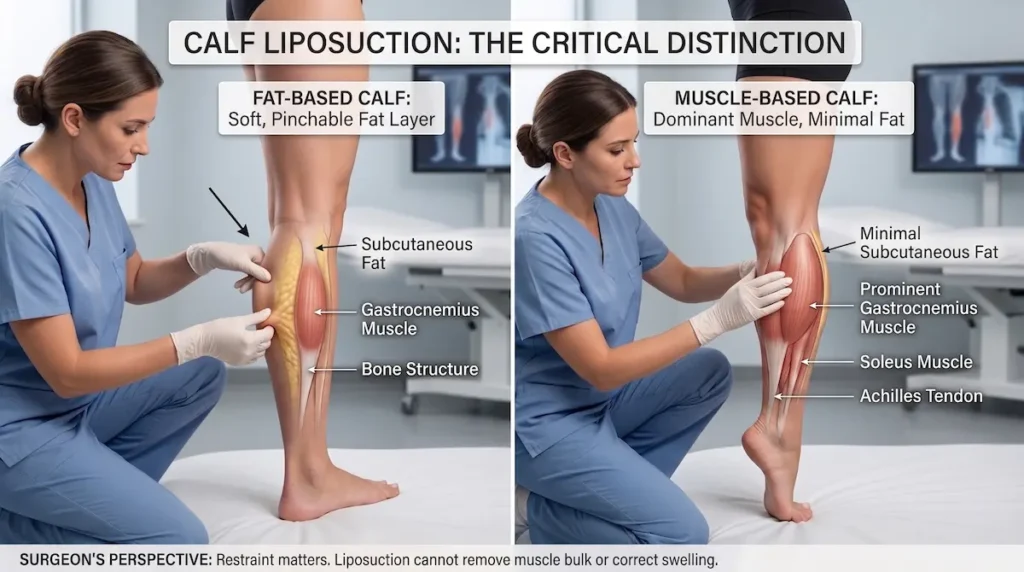
Muscle vs fat: the critical distinction
A fat-based calf usually feels soft when pinched. It may look fuller around the inner calf, lower calf, or transition towards the ankle. The shape may change slightly when you stand on tiptoe, but the fullness is still partly pinchable.
A muscle-based calf feels firm. It becomes more prominent when you flex, stand on tiptoe, climb stairs, or contract the calf. Athletic calves, dancer’s calves and genetically rounded calves are usually driven by muscle shape. In these cases, calf liposuction is not the right solution because there is not enough removable fat to create a meaningful reduction.
Surgeon’s perspective: “The calf is one of the areas where restraint matters most. If most of the volume is muscle, removing fat will not slim the leg — it may only make the surface less smooth. A good assessment is often more important than the procedure itself.”
What liposuction can and cannot reshape
Calf liposuction can soften a heavy lower-leg line when the issue is localised fat. It may improve the transition between the calf and ankle, reduce a puffy-looking inner calf, or make the leg appear more proportionate from the knee down.
It cannot create a long, narrow calf if your natural muscle shape is round. It cannot create a “model leg” silhouette from a muscular build. It also cannot tighten loose skin. If skin elasticity is poor, removing even a small amount of fat may make the surface look looser rather than slimmer.
This is why many patients considering calf and ankle liposuction need a whole-lower-leg assessment. The calf rarely exists as an isolated shape. The knee, calf and ankle all affect how the leg reads visually.
Am I a Suitable Candidate for a Liposuction?
Answer a few brief questions about your concerns, health, and goals to discover which treatment options may suit you best.
Are You a Good Candidate?
A good candidate for calf liposuction has realistic goals, a stable weight, good skin elasticity and a clearly pinchable fat layer in the lower leg. The goal is refinement, not a complete change in body type. If you want your calves to look slimmer in fitted trousers, boots or dresses, the result may be worthwhile — but only when the anatomy supports it.
For UK patients travelling for surgery, this stage should be handled carefully during consultation. A responsible surgical team should ask for standing photos, flexed calf photos, front and back views, and sometimes video to understand how the calf changes in motion. A flat, cropped photo is rarely enough.
Fat-based calves vs muscle-based calves
Fat-based calves tend to have a softer, less defined outline. The fullness may sit below the knee, along the inner calf, or near the calf-ankle transition. The lower leg may look heavy even when the patient is not especially muscular.
Muscle-based calves have a more defined, firm curve. They may look strongest from the back or side, especially when the calf is flexed. Patients with this pattern often say, “My calves have always been big, even when I was slim.” That history is a clue that the issue may be structural or muscular rather than fat-based.
| Calf Type | Common Signs | Is Calf Liposuction Suitable? | Realistic Outcome |
|---|---|---|---|
| Fat-based calf | Soft, pinchable fullness; less definition; heaviness around inner or lower calf | Often suitable, if skin elasticity is good | Subtle slimming and smoother lower-leg contour |
| Muscle-based calf | Firm bulk; prominent curve when flexed; athletic or genetic calf shape | Usually not suitable | Liposuction is unlikely to create meaningful slimming |
| Mixed fat and muscle | Some pinchable fat over a naturally strong calf | Possibly suitable with conservative expectations | Refinement, not major calf reduction |
| Fluid or swelling tendency | Legs feel heavier by evening; puffiness changes through the day | Requires medical assessment first | Liposuction may not address the true cause |
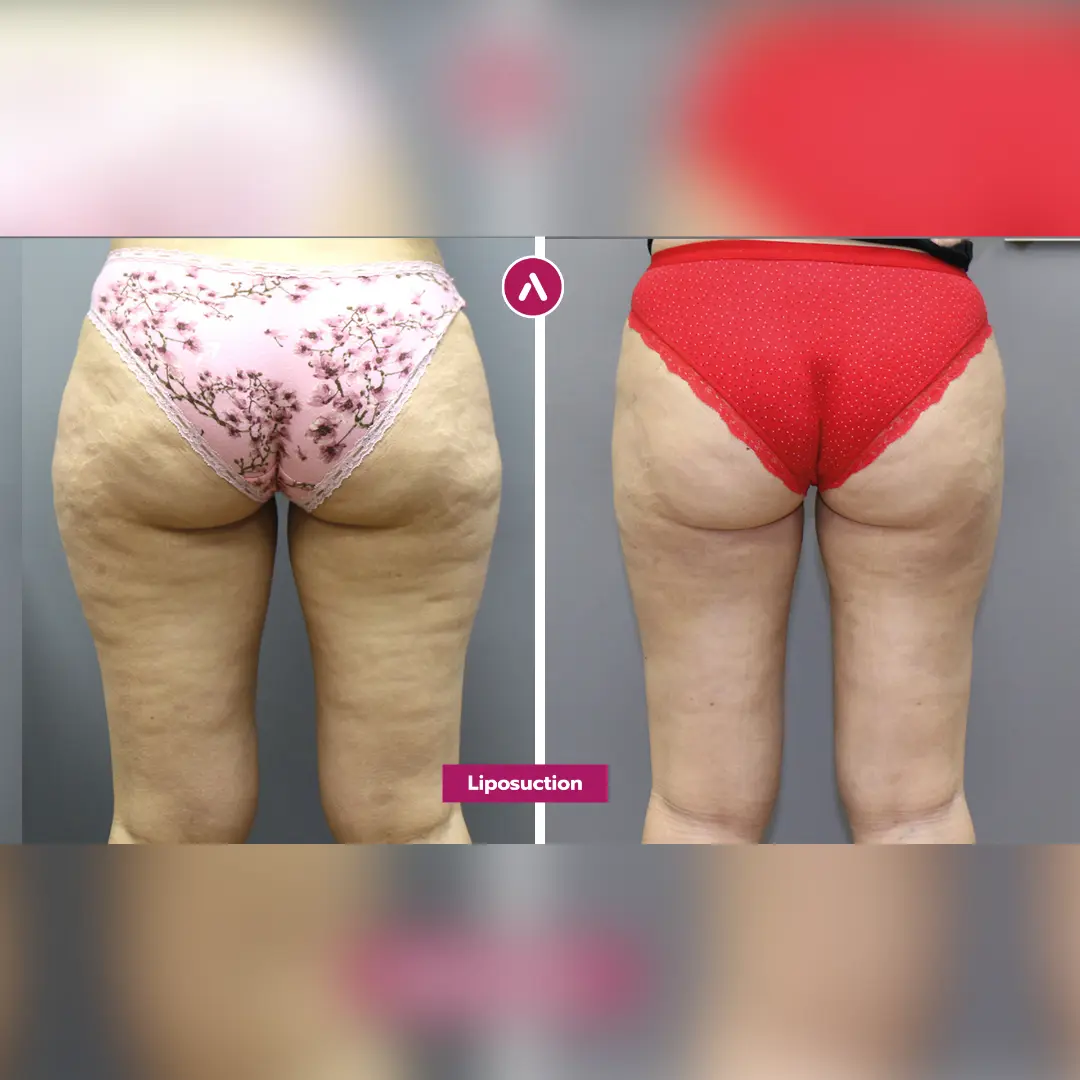
The pinch test: useful, but not a diagnosis
A simple pinch test can help you understand whether there is a soft fat layer. Gently pinch the calf while relaxed. If the tissue feels soft and mobile, there may be fat that liposuction can reduce. If the calf feels firm and the shape comes mainly from deeper bulk, that suggests muscle.
Still, the pinch test is not a substitute for surgical assessment. Skin thickness, swelling, asymmetry and the exact fat distribution all matter. A surgeon also needs to judge whether enough fat can be removed safely without creating grooves, waviness, or an over-treated look.
Why athletic calves do not shrink with liposuction
Athletic calves are often shaped by developed muscle fibres. Running, cycling, dancing, hill walking, weight training and genetics can all contribute. If the calf becomes more prominent when you rise onto your toes, the main driver is likely muscle.
In that situation, liposuction cannot “debulk” the calf. Removing a thin fat layer from over a strong muscle may even reveal the muscular outline more sharply. For some patients that is acceptable; for others, it is the opposite of what they wanted. This is why expectation-setting is essential before committing to surgery.
When skin quality changes the plan
Good skin elasticity allows the skin to contract smoothly after a small fat reduction. Poor elasticity does not. If the skin already looks loose, crepey or stretched, removing fat from the calf can make laxity more visible.
This is less common in the calf than in the arms or abdomen, but it still matters. Patients after major weight loss, older patients, or those with naturally thin skin need a more cautious plan. In some cases, the safest recommendation is not to operate.
Why the Lower Leg Is a Delicate Area
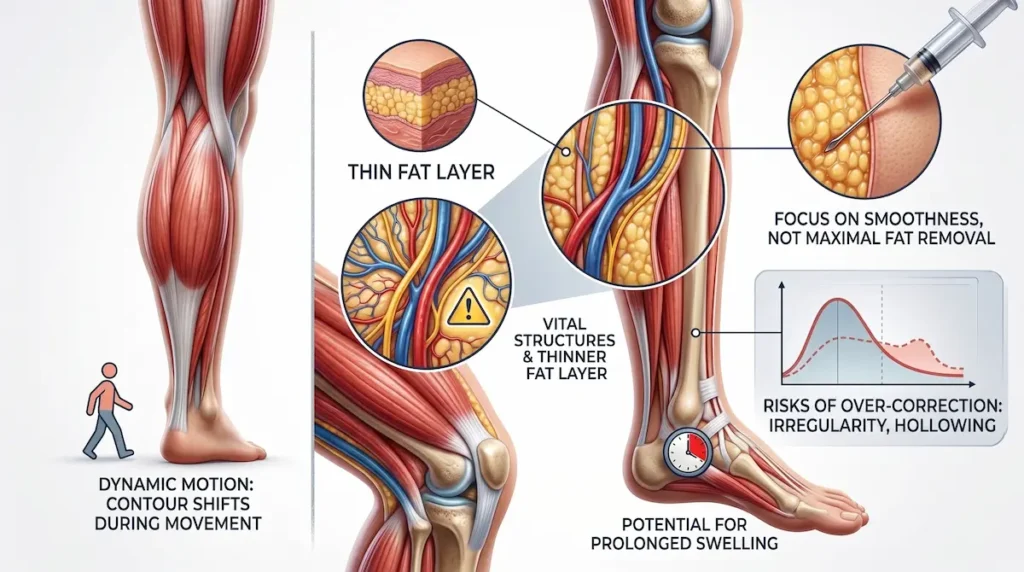
Lower-leg liposuction needs more caution than many larger body areas. The calf has a thinner fat layer, tighter skin, and important vessels and nerves nearby. The aim is not to remove as much fat as possible. It is to remove a small, carefully judged amount while keeping the leg smooth, balanced and natural-looking.
This is also why surgeon experience matters. A calf that is over-treated can look irregular, hollowed, asymmetric or less elegant in motion. In lower leg contouring, “less but precise” is often safer than aggressive fat removal.
The fat layer is thinner than patients expect
In the abdomen, waist or thighs, there may be a broader fat layer to contour. In the calf, the removable fat layer is usually much thinner. That leaves less room for error. Even a small overcorrection can show as a dent, groove or uneven surface.
The calf also changes shape as you walk, flex and stand. A contour that looks acceptable while lying down may look different in motion. A careful surgeon therefore evaluates the calf from several angles, not just in one relaxed position.
Vessels, nerves and swelling make the area more sensitive
The lower leg has a tighter soft-tissue envelope and a greater tendency to prolonged swelling than some other areas. Bruising and puffiness can take time to settle, especially around the calf and ankle transition. This does not mean recovery is abnormal, but it does mean the final contour should not be judged too early.
Because important anatomical structures run through the leg, technique must be conservative. Small cannulas, measured passes and controlled fat removal are important. Clinical literature on lower-leg contouring describes the calves and ankles as areas where careful patient selection and delicate technique are central to avoiding contour problems; see why lower-leg liposuction requires careful assessment.
Why conservative technique matters
In calf liposuction, the goal is usually a smoother vertical line rather than a dramatic size reduction. This may mean treating the inner calf, lower calf, ankle transition, or selected contour bulges while leaving enough fat to preserve a natural surface.
Over-aggressive liposuction can cause more problems than it solves. If too much fat is removed, the skin may appear stuck down, uneven, or aged. The result can also look unnatural beside the knee or ankle if those areas are not considered together.
For patients concerned about visible marks, it helps to understand the small scars liposuction leaves. Calf incisions are usually tiny cannula entry points, but placement still matters because the lower leg is exposed in skirts, shorts and swimwear.
UK safety perspective: do not treat this like a simple beauty procedure
UK patients are often rightly cautious about cosmetic surgery abroad. For a delicate area like the calf, that caution is useful. A proper consultation should explain what can be improved, what cannot, the limits of your anatomy, the likely recovery, and what aftercare is available once you return home.
You should also be clear about who performs the surgery and what credentials they hold. At AKM Clinic, patients are treated by European Board-Certified surgeons. This is a European qualification, not UK GMC registration, and the surgery is performed in Istanbul.
Lower-leg incisions are small, but healing quality still depends on skin type, tension, aftercare and surgical planning. For a broader body-contouring comparison, it may help to read how arm lift incisions heal, while remembering that calf liposuction uses much smaller access points than an arm lift.
Dreaming of a Natural-Looking Liposuction?
Our philosophy is “Restoration, Not Alteration.” Discover how our surgeons achieve subtle, naturally restored results that honour your unique beauty.
What Realistic Results Look Like
Realistic calf liposuction results are usually measured in refinement, not transformation. The lower leg may look lighter, smoother and better proportioned, but it should still look like your own leg. If your goal is a completely different calf shape, liposuction is unlikely to deliver that safely.
The best results often come from treating the calf as part of a lower-leg silhouette. The knee, calf and ankle work together visually. A small improvement in one area can look more noticeable when the overall line becomes more balanced.
Subtle slimming, not dramatic reshaping
Calf liposuction may reduce heaviness around the inner calf or create a cleaner taper towards the ankle. It may help the leg look less bulky in fitted boots or trousers. It may also make the lower leg appear more balanced beside the thigh.
What it should not do is hollow the calf or erase natural curves. A completely straight lower leg can look unnatural. For many patients, the better aim is a softer contour and improved proportion rather than the smallest possible circumference.
How the knee and ankle affect the calf result
The calf rarely looks heavy in isolation. A fuller inner knee can make the calf look shorter or bulkier. A thicker ankle transition can make the entire lower leg look less tapered. That is why calf contouring is often assessed alongside contouring the knees and ankle slimming for balanced legs.
This does not mean every patient needs multiple areas treated. It means the surgeon should understand the visual chain. Treating only the calf when the ankle is the main concern, or treating only the ankle when the calf is muscle-based, can miss the real issue.
What you may notice in clothing
Patients often judge calf liposuction results in everyday situations: tall boots fitting more comfortably, trousers falling more smoothly, or the lower leg looking less heavy in dresses and skirts. These are realistic goals when the anatomy is right.
However, circumference change may be modest. This is normal. A few millimetres of contour improvement in a visible lower-leg line can be meaningful, but it is not the same as reducing a large fat pocket from the abdomen or waist.
When the final result starts to show
Early swelling can hide the result. In the first weeks, the lower leg may feel tight, puffy or uneven. This is especially common around the ankle and calf transition, where fluid can linger.
A visible improvement often develops gradually over several weeks, with more reliable contour judgement after a few months. Final refinement can take longer, particularly if the lower legs are prone to swelling. Patience is important. So is wearing compression exactly as advised.
What a poor candidate might experience
If a patient has mainly muscular calves, the result may be barely visible. If they have poor skin elasticity, the calf may look softer but less firm. If they have swelling or lymphatic issues that were not recognised before surgery, the perceived heaviness may remain.
These outcomes are not solved by taking out more fat. They are prevented by saying no when calf liposuction is not the right procedure. A trustworthy consultation should sometimes end with that answer.
Realistic-result principle: Calf liposuction is most successful when the aim is lower-leg refinement. If the goal is to shrink strong calf muscles or change your natural leg type, surgery is unlikely to meet that expectation.
Recovery & Protecting Your Result
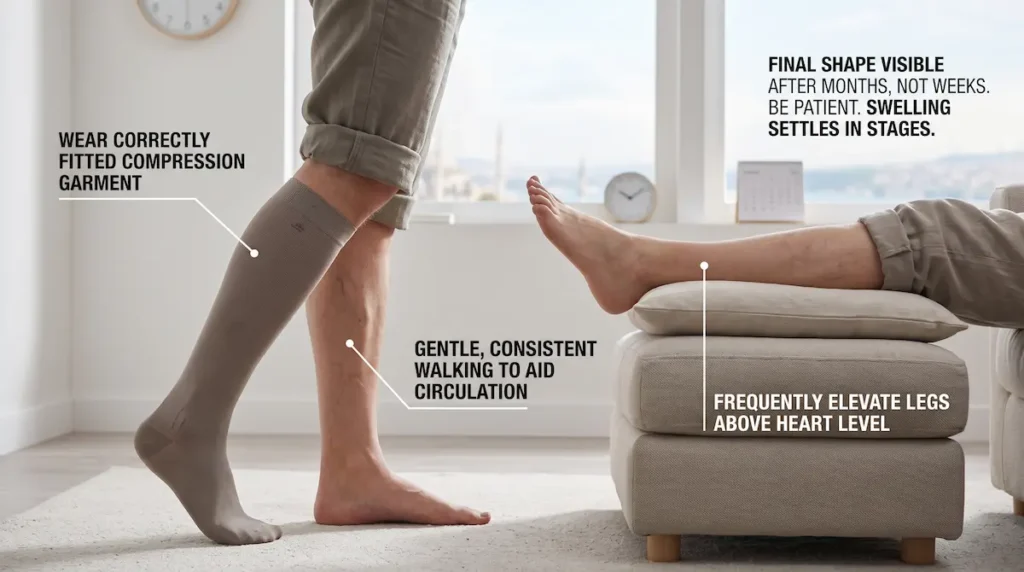
Recovery after calf liposuction is usually manageable, but the lower leg can swell for longer than patients expect. Gravity encourages fluid to settle towards the calf and ankle, so compression, walking, elevation and patience all matter. This is not an area where you should rush the final judgement.
A good recovery plan should also include travel timing. For UK patients flying home after surgery in Istanbul, your surgical team should confirm when you are fit to fly, how to wear compression during travel, how often to walk during the journey, and what symptoms should prompt urgent medical advice.
Compression and swelling in the lower leg
Compression helps reduce swelling and supports the treated tissue as it settles. In calf liposuction, the garment must fit well: too loose and it will not support the contour; too tight and it may cause discomfort or pressure marks. Your team should check the fit before you travel home.
Swelling often improves in stages. The leg may look puffy at first, then uneven, then gradually more defined. It is common for one side to settle slightly faster than the other. That early asymmetry does not automatically mean the final result will be uneven.
Walking, rest and return to activity
Gentle walking is usually encouraged early because it supports circulation and reduces stiffness. Strenuous exercise, calf training, running and long walks should wait until your surgeon clears them. The exact timing depends on the amount treated, your healing response and whether any other areas were treated at the same time.
Standing still for long periods can make swelling worse. So can doing too much too soon. A steady, moderate recovery usually gives the lower leg the best chance to settle smoothly.
When you can judge the final shape
Do not judge calf liposuction in the first few weeks. The lower leg can hold swelling, and the contour may look firm, tight or slightly irregular while tissue is healing. Many patients see visible improvement within weeks, but the more accurate result takes months.
Peer-reviewed descriptions of calf and ankle liposculpture show that lower-leg contouring is a specialised area where technique, candidate selection and follow-up all affect results; see a clinical technique for sculpting the lower legs. The practical lesson is simple: this is a precision treatment, not a high-volume fat-removal procedure.
How to protect the result long-term
Results are best maintained with a stable weight. Liposuction removes selected fat cells from the treated area, but remaining fat cells can still enlarge with weight gain. If the calf fullness was partly due to overall body-fat distribution, lifestyle still affects the long-term contour.
It is also important to keep expectations realistic. Calf liposuction can improve proportion, but it will not stop natural ageing, muscle development, or fluid-related changes. If you train calves heavily after surgery, the muscle can still grow.
Planning the cost of calf liposuction
Cost should be transparent, but it should not be the main decision factor for a delicate area like the lower leg. The more important questions are whether you are anatomically suitable, whether the surgeon is experienced with lower-leg contouring, and what aftercare is available after you return to the UK.
For pricing context, use AKM’s dedicated liposuction pricing in Turkey page rather than relying on estimates inside a clinical article. This keeps the focus here on suitability, safety and realistic results.
Frequently Asked Questions: Calf Liposuction
These answers cover the most common UK patient questions about calf liposuction. They are general educational guidance and cannot replace a personalised surgical assessment.
Does calf liposuction work?
Can liposuction slim muscular calves?
Will calf liposuction leave loose skin?
How long is calf liposuction recovery?
Does calf lipo leave scars?
Are calf liposuction results permanent?
Are calf and ankle liposuction done together?
Is calf liposuction painful?
Who should avoid calf liposuction?
Final Thoughts: Is Calf Liposuction Right for You?
Calf liposuction is not a shortcut to smaller legs. It is a selective contouring procedure for patients whose calf fullness is genuinely fat-based. When the anatomy is right, it can refine the lower-leg silhouette and improve proportion. When the fullness is muscle-based, it is usually the wrong tool.
The safest first step is a detailed consultation that looks at the whole leg, not just the calf. Your surgeon should assess fat thickness, muscle shape, skin quality, ankle proportion, swelling tendency and your goals. The answer may be yes. It may be no. Either answer is valuable if it is honest.
Ask AKM whether your calves are fat- or muscle-based before considering liposuction, and request a personalised lower-leg contour assessment.
Have Specific Questions About Liposuction?
Speak directly with our dedicated patient coordinators regarding Liposuction. Receive instant guidance and personalised support.
Medical disclaimer: This article is for educational purposes only and does not replace medical advice, diagnosis or treatment. Suitability, recovery and results vary between patients. If you have leg swelling, pain, circulation concerns, or symptoms that worry you, speak with a qualified clinician before considering cosmetic surgery.
Related Treatments

Awake Abdominal Etching in Turkey
UK guide to awake abdominal etching in Istanbul: HD sculpting, tumescent local anaesthesia, twilight sedation, recovery phases, HBOT/LLLT and GBP costs.

Awake Mummy Makeover in Turkey
UK-focused guide to an awake mummy makeover using tumescent local anaesthesia with optional conscious sedation. Explore tummy tuck, liposuction and breast options, recovery timelines and costs in GBP.

Awake Tummy Tuck in Turkey
UK guide to Awake Tummy Tuck under twilight sedation at AKM Clinic, Istanbul—techniques, combinations, recovery timeline, risks, aftercare and GBP planning.

Awake High-Definition Liposuction
Awake high-definition liposuction in Istanbul for UK patients: 4D Vaser sculpting with tumescent local anaesthesia + conscious sedation, HBOT/LLLT recovery and GBP fees.
Ready to Begin Your Own Transformation Journey?
Join the 2,000+ patients who have trusted Dr Akif Mehmetoğlu and the AKM Clinic team. Your journey to a more confident, naturally restored you begins with a simple, no-obligation conversation. Contact us today from the UK for your free virtual consultation.
#1: Get Your Free Personalised Quote
Start with a free, no-obligation online consultation. Share your photos, and our surgical team will provide a fully personalised treatment plan and a transparent, all-inclusive price package. There are no hidden fees.
#2: Secure Your Date & VIP Booking
Once you are ready, our dedicated patient coordinators will help you secure your procedure date. We will handle all your bookings, including your 5-star hotel accommodation and private VIP airport transfers.
#3: Arrive in Istanbul & Meet Your Surgeon
Arrive at Istanbul Airport (IST) and be greeted by your private driver. Settle into your hotel and prepare for your in-person consultation, where you will meet your specialist surgeon to finalise the details for your "natural, subtle, and restored" new look.