
Does Liposuction Leave Scars? What the Tiny Incisions Look Like
AI Summary
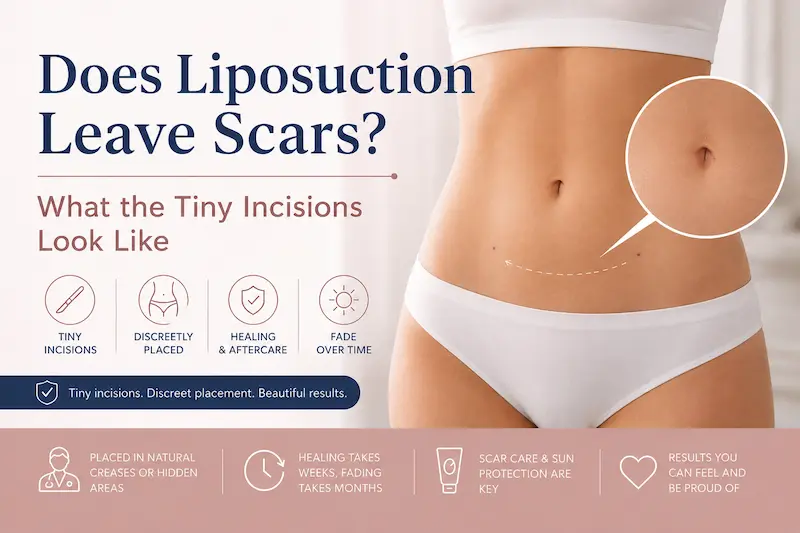
- Does liposuction leave scars? Yes, usually tiny cannula entry marks, not long incision lines.
- Discreet placement matters: surgeons hide entry points in natural creases, shadows and clothing lines.
- Most scars fade over months: redness, pigmentation and firmness usually soften with careful aftercare.
- Scar safety depends on aftercare: silicone, sun protection and prompt review for concerning healing changes.
AI-generated summary, fact-checked by our medical experts.
Yes — but liposuction scars are tiny. If you are asking does liposuction leave scars, the honest answer is that fat is removed through a few small cannula-entry points, not long surgical cuts. These marks usually look like small dots, pale freckles, or faint pin-prick scars once healed.
In a well-planned liposuction procedure, surgeons place these entry points in natural creases, shadowed areas, or positions that are usually covered by underwear or swimwear. The goal is not to pretend there is no incision. The goal is to make each incision as small, calm, and discreet as possible.
For UK patients comparing liposuction abroad with a Harley Street-style consultation, the scar conversation should be specific. Ask where the entry points would sit, how many are likely, how your skin type may heal, and what aftercare is used to reduce irritation, friction and pigmentation.
Table of Contents
Does Liposuction Leave Scars? The Short Answer
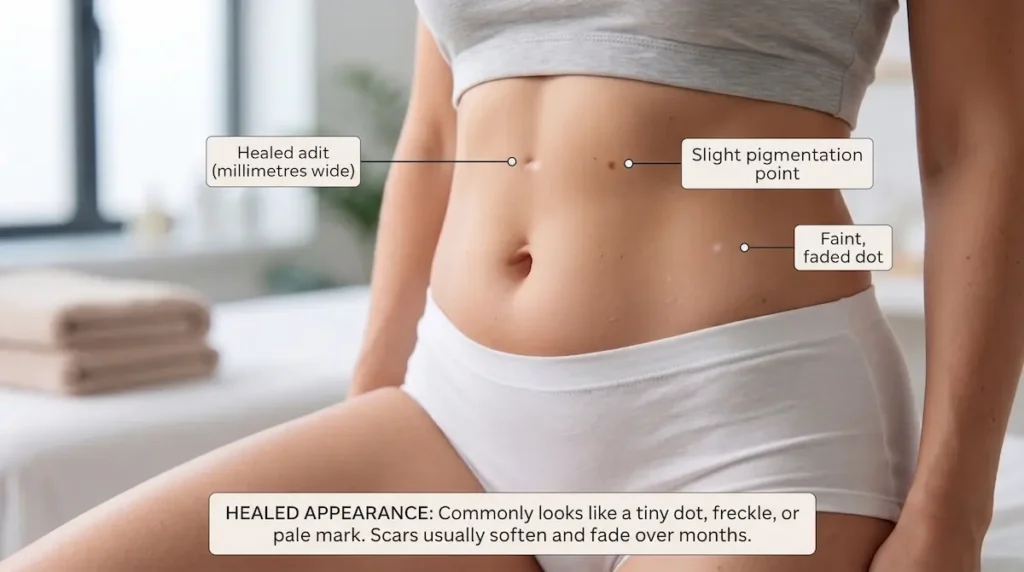
Liposuction does leave scars, but they are very different from the scars people often imagine. The marks come from the tiny openings used to introduce the cannula, the slim tube that removes fat from the treated layer. These openings are usually only a few millimetres wide.
That is why liposuction scars rarely look like a long surgical line. More often, a healed entry point looks like a dot, a small pale mark, or a slightly darker point of pigmentation. Early on, it may look pink, red, or purple before it fades.
Yes, but they are tiny cannula-entry scars
The key word is entry point. Liposuction needs access beneath the skin, so the surgeon creates small openings called adits or port sites. Through these, the cannula passes into the fat layer and moves in controlled strokes to remove fat evenly.
Each entry point heals like a small surgical wound. At first, it may be covered with a dressing, look slightly raised, or feel a little firm. That early appearance is not the final scar.
Most patients notice that the marks soften and flatten over the next few months. Some fade to a pale dot. Others leave a slightly darker point, especially in skin that is more prone to post-inflammatory pigmentation.
Why liposuction scars are small
Liposuction is not performed through a large open incision. The cannula is narrow, and the entry point only needs to be wide enough for controlled access. That keeps the visible mark small compared with procedures that remove loose skin.
This is also why liposuction and skin-excision surgery have very different scar profiles. Liposuction removes fat. It does not cut away a strip of skin, so it does not create a long closure line.
However, “small” does not mean “impossible to see”. A small scar can still show if it becomes irritated, stretched, repeatedly rubbed by the cannula, exposed to sun too early, or heals with excess pigment.
What they usually look like: dot, freckle, faint mark
A healed liposuction scar commonly looks like one of three things: a tiny pale dot, a faint freckle-like mark, or a small area of darker pigmentation. The exact colour depends on your baseline skin tone, the amount of inflammation during healing, and your scar tendency.
In the first few weeks, the marks can look more noticeable than expected. That does not automatically mean poor healing. New scars are often pink or red before they settle.
By several months, the scar usually becomes flatter and less obvious. In some patients, full scar maturation takes closer to 12–18 months, especially if the area is under tension or exposed to friction from clothing.
Dreaming of a Natural-Looking Liposuction?
Our philosophy is “Restoration, Not Alteration.” Discover how our surgeons achieve subtle, naturally restored results that honour your unique beauty.
What the Tiny Incisions Actually Look Like
The easiest way to understand liposuction scars is to picture several small access points rather than a single incision. Their job is practical: they let the surgeon reach the fat from more than one angle so the contour can be smoothed rather than tunnelled from one direction.
This section explains the size, number and early-to-late appearance of those entry points. It also helps set expectations before you start comparing your own healing at two weeks with someone else’s healed result at one year.
Adit or port size: usually a few millimetres
An adit is the small opening made for the cannula. In many liposuction cases, each opening is only a few millimetres long. It may be created with a small blade, then used as the access point for the cannula throughout that treatment zone.
The opening has to be large enough for safe movement, but not larger than needed. Too much tightness around the cannula can create friction. Too much unnecessary opening can leave a more visible mark.
That balance is one reason surgeon experience matters. Scar quality is not only about the size of the incision; it is also about placement, angle, cannula movement, and how much stress the skin edge experiences during the procedure.
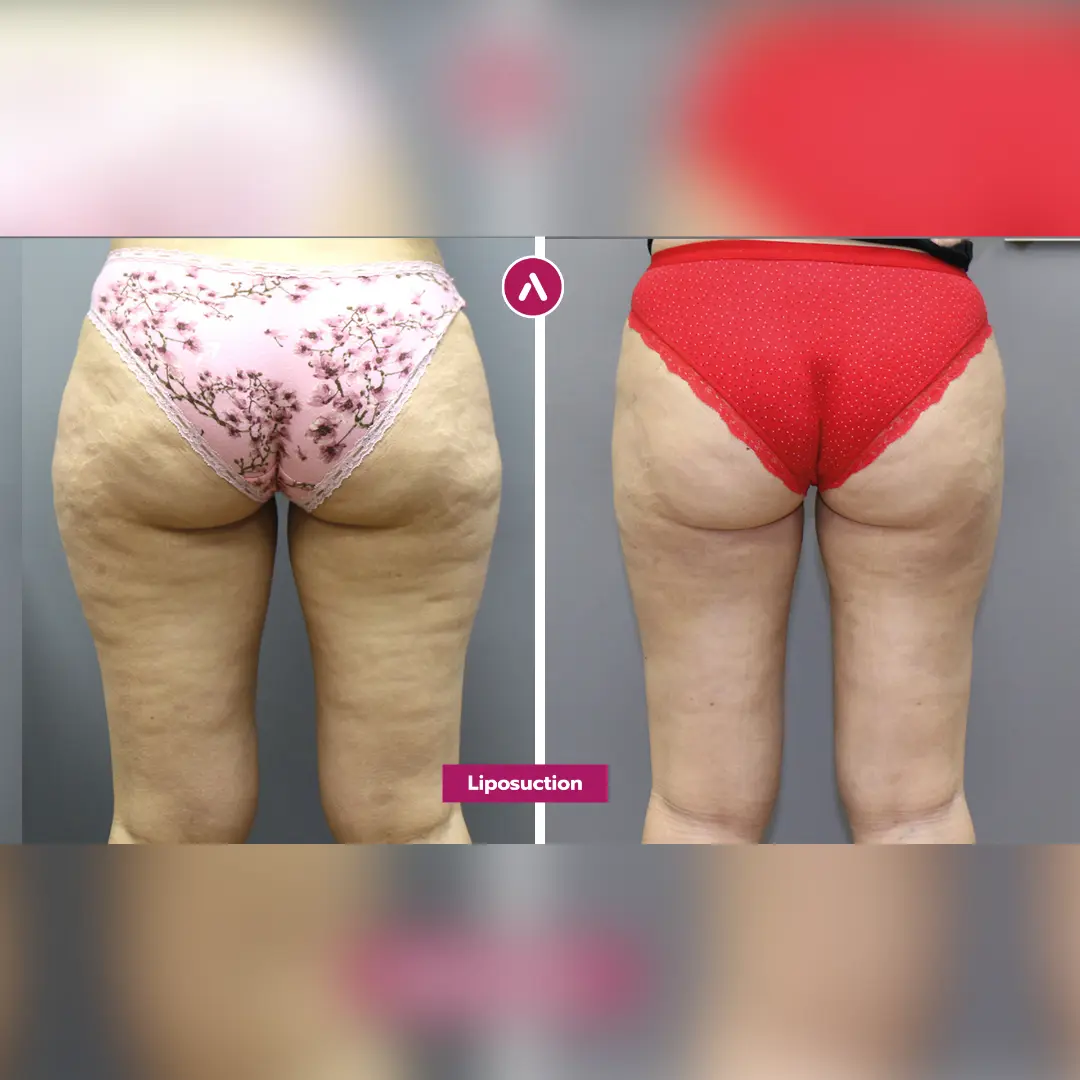
How many entry points are usually needed
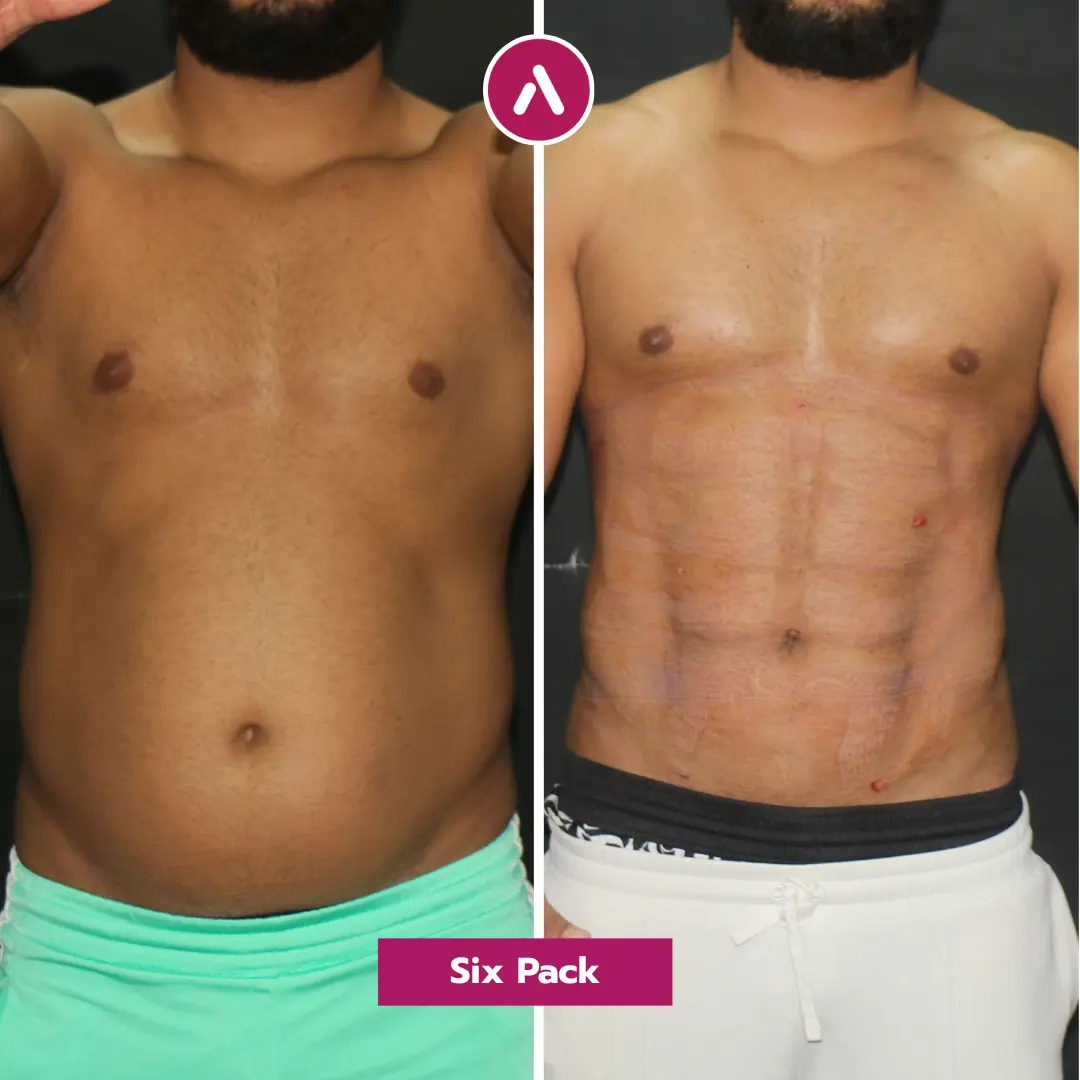
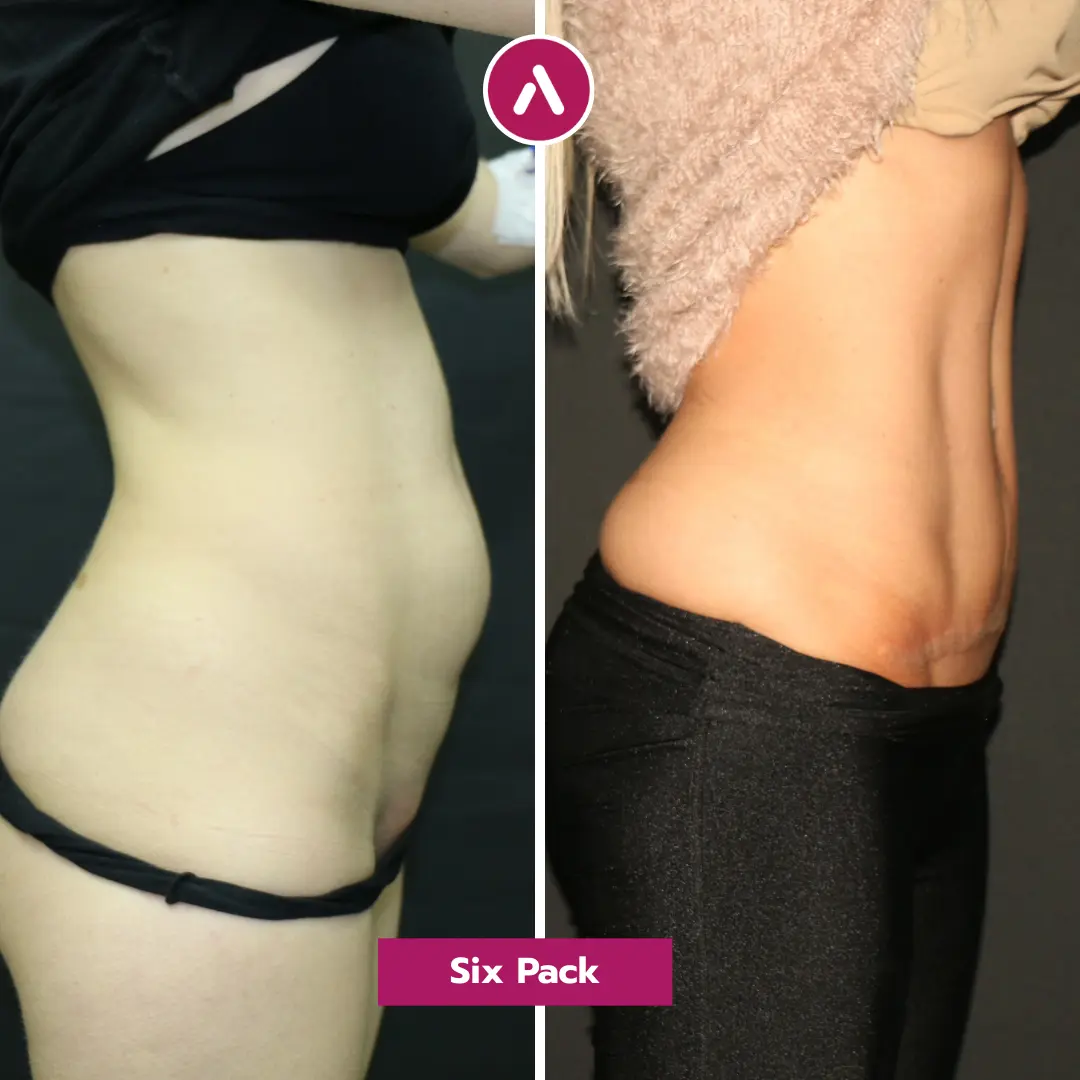
The number of entry points depends on the body area, the fat distribution, and the contour goal. A small zone may need only a few carefully placed openings. A larger or more curved area may need more access points so the surgeon can work evenly.
More entry points do not automatically mean worse scarring. In some cases, using a few well-placed adits is better than forcing all cannula movement through one overworked opening. Overusing a single port can increase friction and irritation.
A careful plan aims for the minimum number of entry points needed to contour the area safely. It should also take future visibility into account: standing, sitting, wearing underwear, wearing swimwear, and moving normally.
Early appearance vs healed appearance
In the first days, the incision sites may look like tiny cuts or dots with mild redness, swelling, or crusting. Some fluid drainage can happen early, depending on the technique and dressing plan. Follow your surgeon’s written aftercare instructions rather than trying to “dry out” the area aggressively.
By the first few weeks, the entry points may look pink, purple, or slightly brown. They may feel firmer than the surrounding skin. This firmness usually reflects normal early scar activity.
A healed liposuction mark is usually much quieter: flatter, softer, and closer to the surrounding skin colour. If a mark becomes increasingly painful, hot, raised, weepy, or red around the edges, it should be reviewed rather than ignored.
Surgeon-led scar planning is about restraint. Small entry points, low-friction cannula movement and discreet placement all matter. The best scar is not just short; it is placed where your body naturally hides it.
Where Surgeons Place the Incisions
Incision placement is one of the biggest reasons liposuction scars can be hard to spot once healed. The surgeon is not only thinking about access to the fat layer; they are also thinking about how the mark will look when you stand, sit, bend, wear underwear, or put on swimwear.
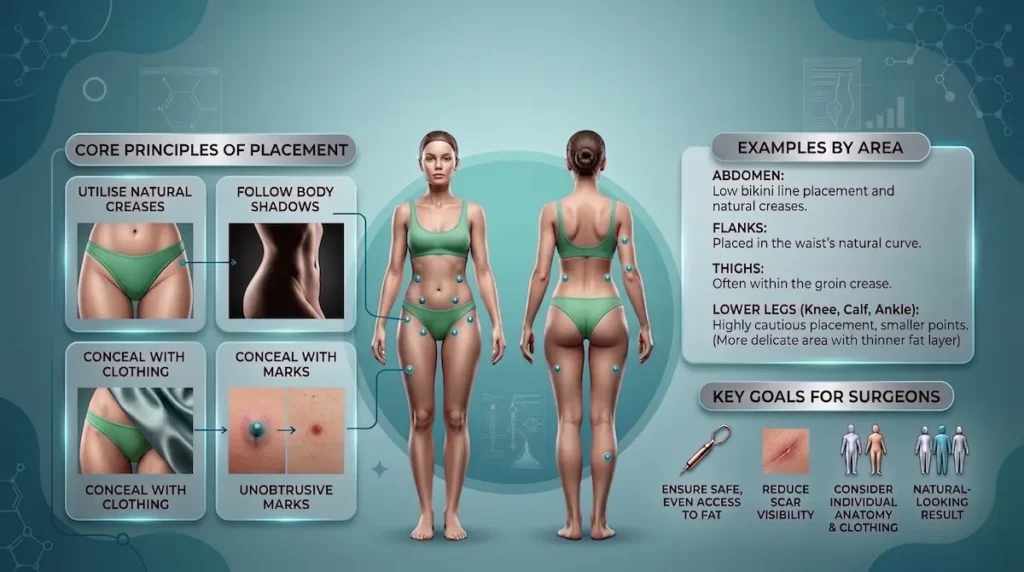
Good placement uses the body’s shadows and creases. A tiny mark hidden in the groin crease, under the buttock fold, near the bikini line, or in a natural skin fold is usually less noticeable than the same mark placed on a flat, exposed surface.
Hidden in natural creases and folds
Surgeons often choose entry points where the body already creates a line or shadow. This may be near the groin crease, under a skin fold, close to the natural curve of the flank, or in a place covered by underwear.
The aim is simple: if a tiny scar does form, it should sit where the eye does not naturally stop. A well-placed adit can look like a small freckle or old injection mark rather than an obvious surgical scar.
This is also why scar planning is individual. A placement that works well for one patient may not suit another patient’s anatomy, clothing preferences, or treatment area.
How clothing or swimwear can cover them
Many patients care less about whether a scar exists under close inspection and more about whether it shows in everyday life. That is a fair question. For most body areas, entry points can be planned so they sit beneath underwear, swimwear, or common clothing lines.
For abdominal liposuction, entry points may be placed low enough to be covered by briefs or bikini bottoms. For flank liposuction, they may sit where the natural waist or lower-back shadow helps conceal them.
There are limits. The surgeon still needs safe, even access to the treated fat. A scar should not be hidden at the expense of poor contouring, overworking a single port, or creating uneven results.
Area examples: abdomen, flank, thigh, knee, calf and ankle
Different body areas require different entry-point logic. A small abdominal mark is not planned in the same way as a lower-leg mark because the skin, fat thickness and visibility are different.
For example, lower-leg work is more delicate because the fat layer is thinner and the area is more exposed. That is why planning around the knees, calves and ankles tends to be especially conservative. You can read more about liposuction of the knee area, calf liposuction incisions and ankle contouring in the related lower-leg guides.
| Body area | Typical entry-point logic | How visible it may be |
|---|---|---|
| Abdomen | Often planned low, near underwear or bikini lines, or in natural lower-abdominal shadows. | Usually discreet once healed, especially if protected from sun exposure. |
| Flanks | Placed to allow even access to the waist and lower-back curve. | Often hidden by underwear, swimwear or the body’s side shadow. |
| Inner thighs | Often placed near groin creases or less exposed inner-thigh positions. | Usually less visible in standing posture, but friction can affect healing. |
| Knees | Planned carefully because the fat layer is thin and the area is visible. | Small scars can be discreet, but placement precision matters. |
| Calves | Used only when calf bulk is fat-based, with conservative access points. | Can be more noticeable than trunk scars because the lower leg is exposed. |
| Ankles | Requires very cautious placement due to thin tissue and limited fat. | Even small marks may be easier to see, so candidate selection is important. |
Experience a Seamless Liposuction Journey
From VIP airport transfers to 5-star hotel accommodation, we manage every detail. Enjoy a premier medical travel experience in Istanbul.
Why Some Lipo Scars Show More
Two patients can have the same procedure and heal with different-looking scars. That does not always mean one surgeon made a bigger incision. Skin biology, inflammation, pigmentation, sun exposure, friction and aftercare all influence how visible a tiny port-site scar becomes.
This is the section to read if you are prone to darker marks after spots, insect bites, piercings or previous surgery. It does not mean you cannot have liposuction. It means scar planning and aftercare should be discussed before the operation.
Skin type and keloid tendency
Some people naturally make thicker or more raised scars. Others develop post-inflammatory hyperpigmentation, where a small wound heals with a darker mark. This can happen even when the incision is tiny.
A history of keloid or hypertrophic scarring is important to share during consultation. A keloid grows beyond the original wound edge, while a hypertrophic scar stays within the wound boundary but becomes raised or firm.
Most liposuction entry points are too small to create dramatic scarring, but risk is never zero. If you have a strong scar tendency, the surgeon may adapt placement, aftercare and follow-up accordingly.
Cannula friction, pigmentation and irritation
Port-site scars can become more visible if the opening is irritated during the procedure. Repeated cannula movement through one small point can create friction at the skin edge, which may increase redness, thickening or pigmentation.
This is why scar quality is partly technical. A surgeon may use several discreet access points instead of repeatedly stressing one opening. The goal is even fat removal with minimal trauma to the skin edge.
After surgery, friction from tight waistbands, rough seams, exercise clothing or early rubbing can also irritate the entry points. During the early healing period, calm skin is better skin.
Sun exposure and aftercare mistakes
Sun exposure can darken new scars. This matters even for small liposuction marks, especially on areas that may be uncovered in summer or on holiday. A scar that would have faded quietly can become more noticeable if it tans or pigments early.
Aftercare also matters. Picking scabs, using harsh products, massaging too early, or applying scar creams before the wound is closed can irritate the area. Scar care should start only when the skin is fully sealed and your surgical team has cleared it.
It also helps to compare scars within the same category. Liposuction port sites are not the same as longer body-contouring incisions. For context on how larger body-surgery incisions behave, see how butt implant incisions scar.
A tiny incision can still deserve careful planning. Scar visibility is shaped by where the port sits, how gently it is used, how your skin heals, and how well the mark is protected while it matures.
How to Help Lipo Scars Heal and Fade
Scar fading is a slow process, even when the scar is tiny. The aim is to keep the entry points calm, protected and free from avoidable irritation while the skin matures. Most patients see the biggest change over the first few months, but subtle colour changes can continue for a year or longer.
This section is about practical scar care, not a promise that every mark disappears. Skin biology varies. A careful surgeon can minimise trauma and place the adits discreetly, but your aftercare and scar tendency still shape the final result.
Silicone, sun protection and scar-care basics
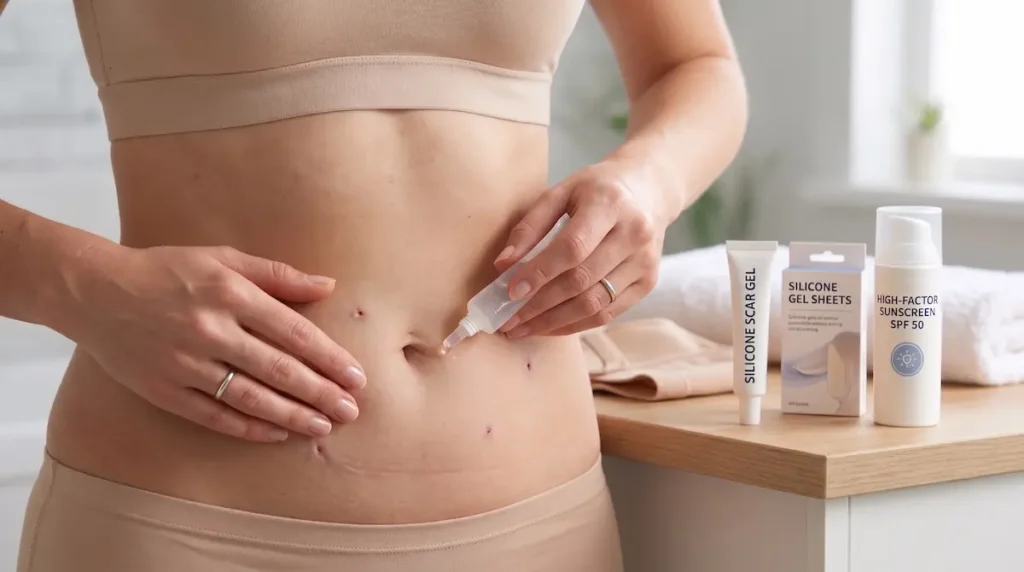
Scar care should begin only once the incision is fully closed and your surgical team has confirmed it is safe. Starting too early can irritate the wound. Once the skin is sealed, silicone gel or silicone sheets may be recommended to help the scar soften and flatten.
Sun protection is just as important. New scars can darken when exposed to UV light, even if they are only a few millimetres wide. Keep healing entry points covered where possible, and use high-factor sun protection once your surgeon says topical products are safe.
Gentle scar massage may be suggested later, but timing matters. Do not massage fresh, scabbed, open, weeping or tender wounds. Scar care should reduce inflammation, not create more of it.
For clinical background on how liposuction access points are made, you can review how liposuction incisions are made. For more detail on possible port-site healing issues, see documented liposuction port-site healing.
Normal vs concerning healing
It is normal for liposuction entry points to look more visible in the early weeks. Mild redness, small scabs, firmness, itchiness and colour change can all happen as the wound closes and the scar begins to mature.
What is not normal is a mark that becomes increasingly hot, painful, swollen, wet, open, or surrounded by spreading redness. Pus, a bad smell, fever, worsening tenderness or a wound that separates should be raised with your surgical team promptly.
If you are travelling for surgery, ask before you fly home what photos to send, how quickly the team reviews concerns, and what would require an in-person medical review in the UK. That is a practical safety question, not a sign that you expect something to go wrong.
When to ask about revision
Most liposuction scars should not be judged too early. A red or brown dot at six weeks may look much softer at six months. Scar revision discussions usually make more sense once the mark has matured, unless there is an active wound-healing problem.
If a port-site scar remains raised, widened, dark or bothersome after the normal maturation period, options may include silicone therapy, steroid treatment for selected raised scars, laser treatment for colour, or a small scar revision. The right option depends on the scar type.
Cost questions are separate from this scar guide. If you are comparing treatment planning and total fees, use the dedicated page on what liposuction costs rather than treating scar care as a pricing article.
UK consultation note: Before booking liposuction, ask the surgeon to mark the likely entry points on your photos or during consultation. For UK patients, it is also sensible to check the surgeon’s credentials and ask who reviews scar or wound concerns after you return home.
Frequently Asked Questions: Does Liposuction Leave Scars?
These are the common scar-related questions patients ask before liposuction. The answers stay focused on incision marks and healing, not general recovery, pricing or body-contouring combinations.
Are liposuction scars permanent?
How big are liposuction scars?
Where are lipo incisions placed?
Do lipo scars fade?
Can you hide liposuction scars?
Does the cannula size affect scarring?
Do lipo scars look worse on darker skin tones?
Can a bad liposuction scar be fixed?
Have Specific Questions About Liposuction?
Speak directly with our dedicated patient coordinators regarding Liposuction. Receive instant guidance and personalised support.
Medical Disclaimer: This article is for general information only and is not medical advice, diagnosis or a substitute for a consultation with a qualified surgeon. Healing varies from person to person. If a liposuction incision becomes increasingly painful, hot, swollen, open, weepy, foul-smelling or surrounded by spreading redness, contact your surgeon or seek medical care promptly.
Related Treatments

Awake Gynaecomastia Surgery in Turkey
UK-focused guide to awake gynaecomastia surgery in Istanbul: local anaesthesia safety, excision vs liposuction, recovery, and £(GBP) cost context.

Awake Abdominal Etching in Turkey
UK guide to awake abdominal etching in Istanbul: HD sculpting, tumescent local anaesthesia, twilight sedation, recovery phases, HBOT/LLLT and GBP costs.

Awake Mummy Makeover in Turkey
UK-focused guide to an awake mummy makeover using tumescent local anaesthesia with optional conscious sedation. Explore tummy tuck, liposuction and breast options, recovery timelines and costs in GBP.

Awake Tummy Tuck in Turkey
UK guide to Awake Tummy Tuck under twilight sedation at AKM Clinic, Istanbul—techniques, combinations, recovery timeline, risks, aftercare and GBP planning.
Ready to Begin Your Own Transformation Journey?
Join the 2,000+ patients who have trusted Dr Akif Mehmetoğlu and the AKM Clinic team. Your journey to a more confident, naturally restored you begins with a simple, no-obligation conversation. Contact us today from the UK for your free virtual consultation.
#1: Get Your Free Personalised Quote
Start with a free, no-obligation online consultation. Share your photos, and our surgical team will provide a fully personalised treatment plan and a transparent, all-inclusive price package. There are no hidden fees.
#2: Secure Your Date & VIP Booking
Once you are ready, our dedicated patient coordinators will help you secure your procedure date. We will handle all your bookings, including your 5-star hotel accommodation and private VIP airport transfers.
#3: Arrive in Istanbul & Meet Your Surgeon
Arrive at Istanbul Airport (IST) and be greeted by your private driver. Settle into your hotel and prepare for your in-person consultation, where you will meet your specialist surgeon to finalise the details for your "natural, subtle, and restored" new look.