


An arm lift scar is one of the first concerns patients raise when considering brachioplasty, especially if they already feel self-conscious about loose upper arm skin. For many women and men, the decision is not simply about removing excess tissue. It is also about whether the resulting scar can be placed discreetly enough to feel comfortable in short sleeves, summer dresses, fitted tops, or gym wear. In other words, patients are often weighing one concern against another: the embarrassment of “bingo wings” versus the anxiety of visible scarring after arm lift surgery.
From a practical and emotional perspective, this is entirely understandable. A well-performed arm lift can improve contour, reduce the heavy “bat wing” appearance, and help clothing sit better on the upper arms. However, no ethical surgeon should present brachioplasty as a scar-free procedure. The honest question is not whether there will be a scar, but whether the arm lift incision can be planned, closed, and supported in a way that makes it far less noticeable over time.
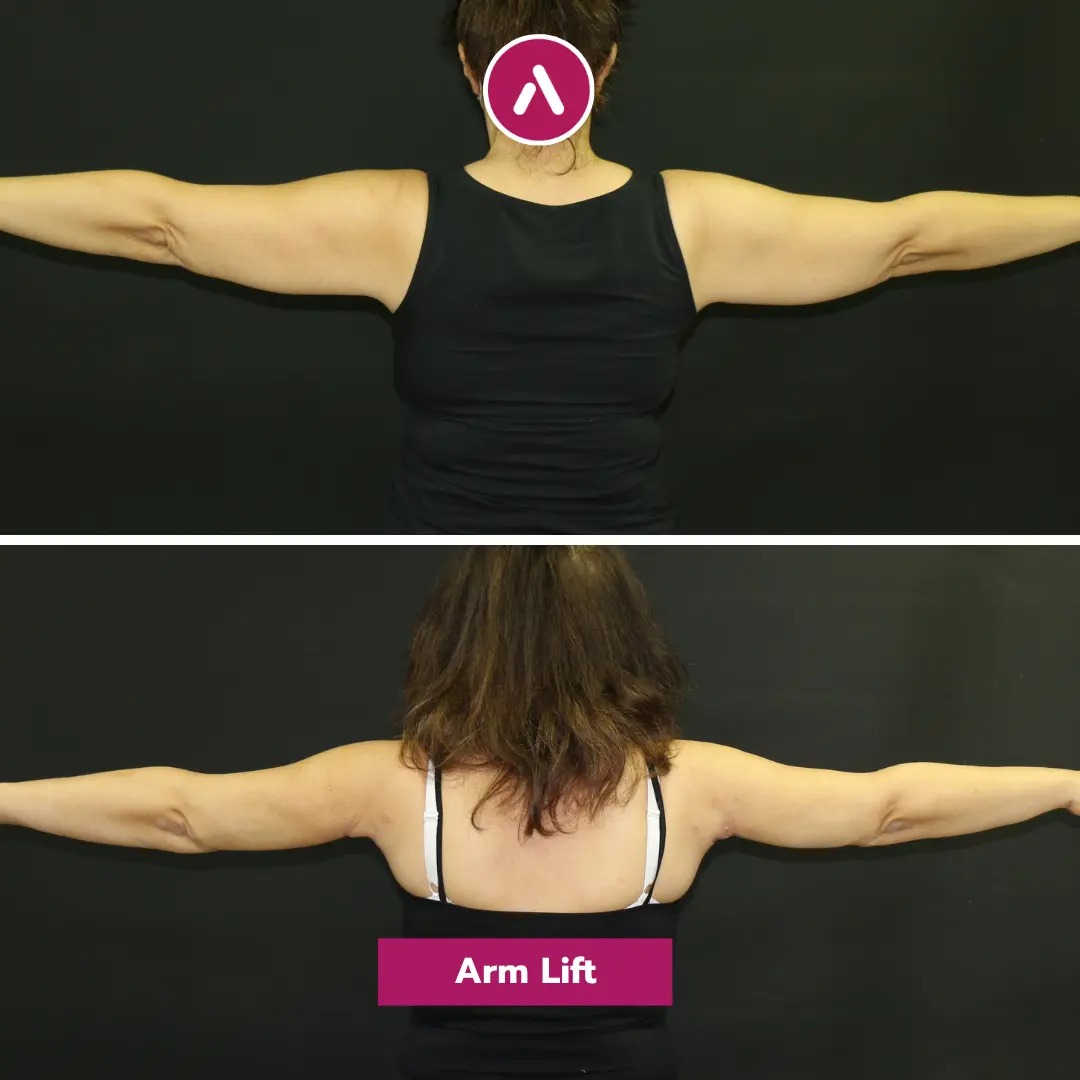
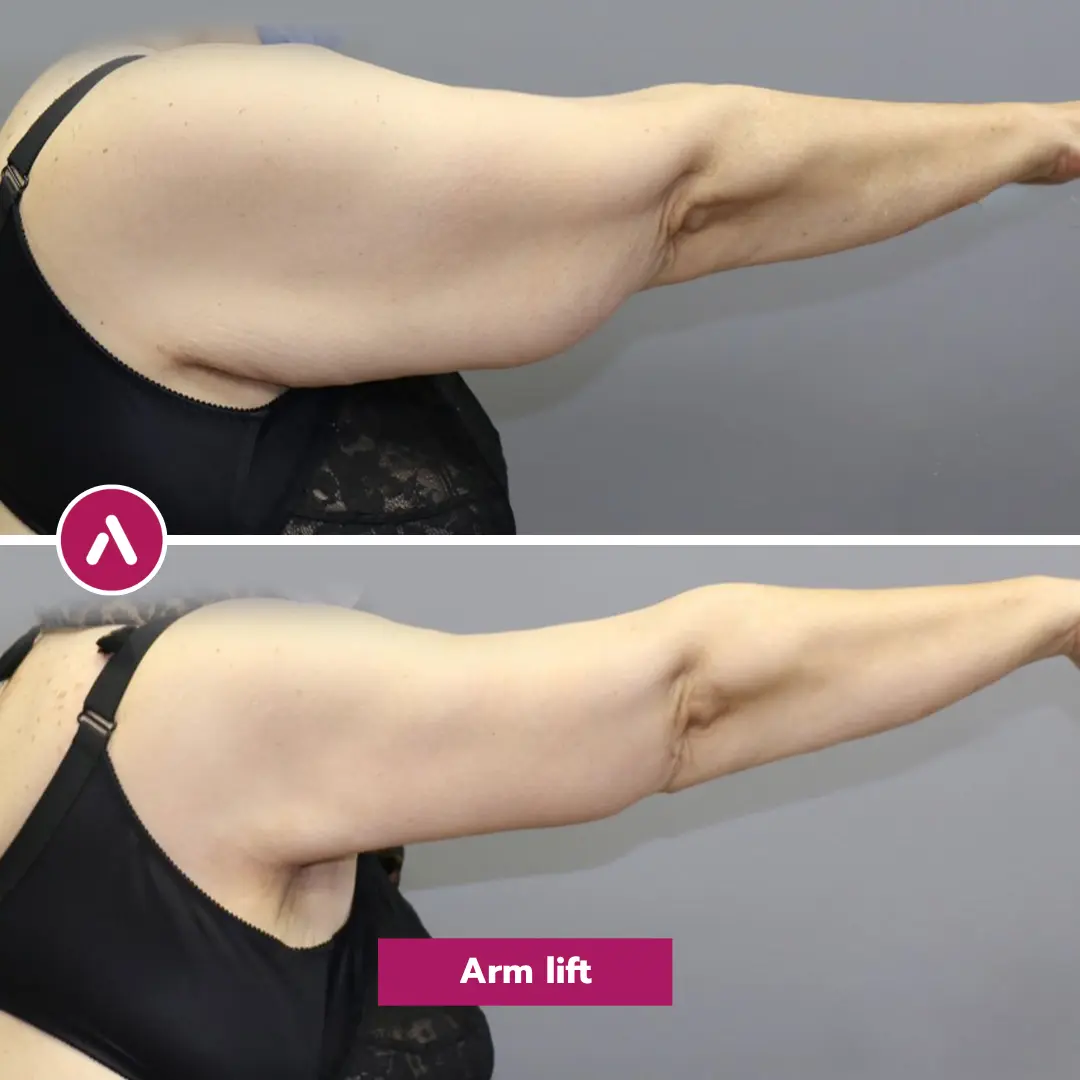
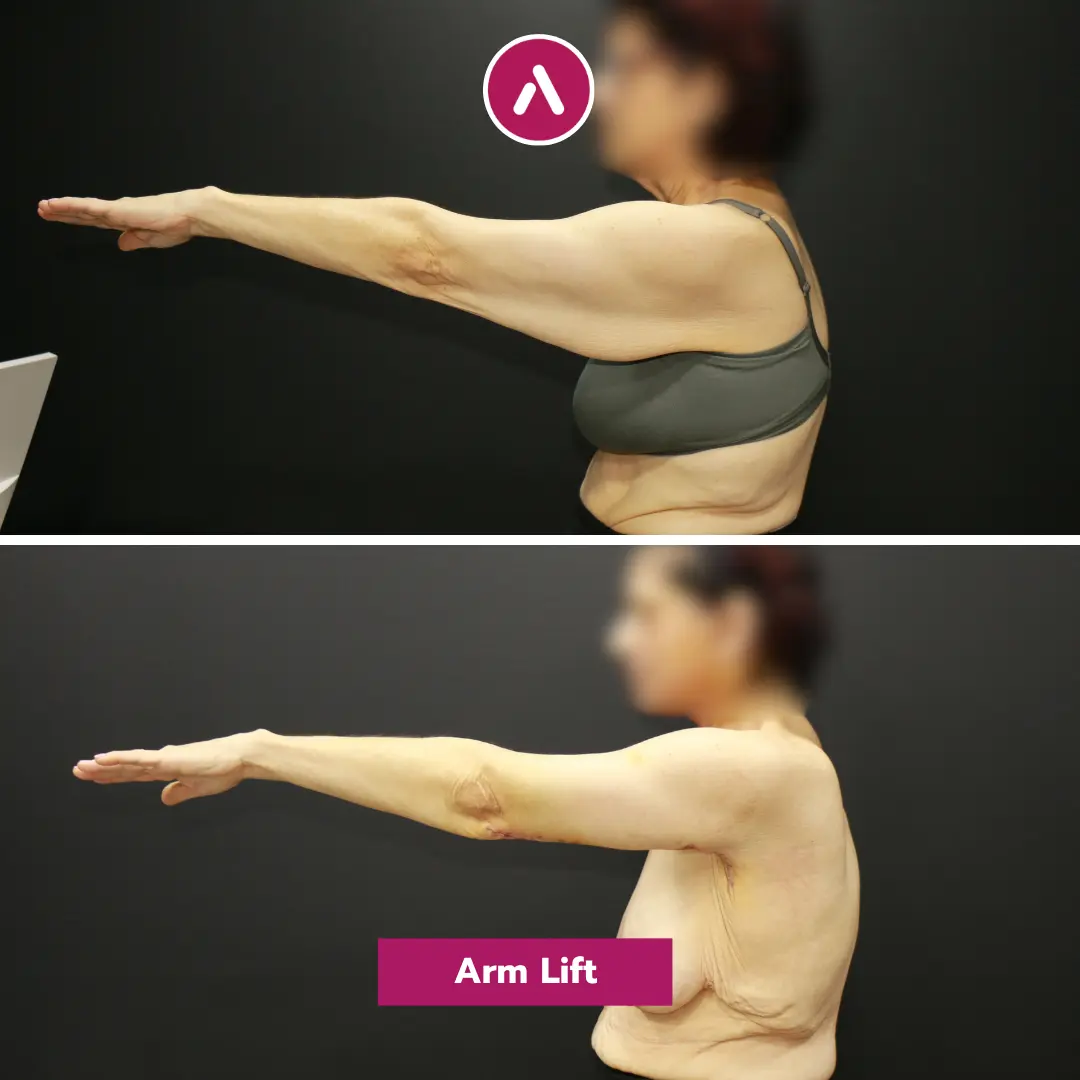
That is where careful surgical judgement matters. In modern brachioplasty, scar placement for arm lift surgery is not random. It is based on anatomy, the amount of loose skin, the degree of arm movement, and how the scar will sit when the arms rest naturally by the sides. This is also where science and patient-centred planning meet: medical science shows that scar quality depends not only on healing biology, but also on incision design, tension management, aftercare, sun protection, and individual skin behaviour.
In this guide, we will explain where a brachioplasty scar is usually placed, whether hiding arm lift scars is realistic, and how patients can approach recovery with a more informed expectation. The goal is not to promise an invisible line. The goal is to understand what makes a scar more discreet, more refined, and easier to live with in everyday life.
Table of Contents
Where Is an Arm Lift Scar Usually Placed?
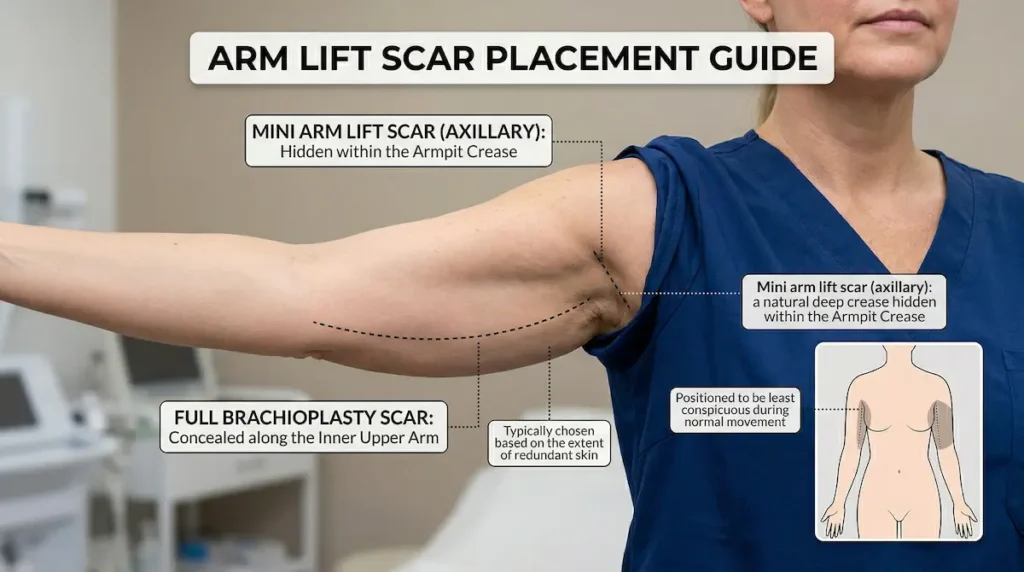
The location of an arm lift scar depends on the extent of loose skin and the type of brachioplasty required. Patients often imagine a scar placed randomly along the arm, but in reality, the incision is usually planned to sit where it will be least obvious in normal daily movement. For most full arm lifts, this means positioning the scar along the inner arm so that it is less visible from the front or side when standing naturally. In smaller procedures, the scar may be limited to the armpit area. Understanding these patterns helps patients separate internet myths from realistic surgical planning.
In some cases, patients who are considering an arm lift are also exploring other contouring procedures, such as vaser liposuction, especially when excess fat and loose skin appear together in the upper arms. While liposuction can help refine volume, it does not remove redundant skin in the way brachioplasty does. This is why scar placement and procedure selection should always be tailored to the patient’s anatomy, skin quality, and overall aesthetic goals.
The Difference Between Mini Arm Lift and Full Brachioplasty Scars
Not every patient needs the same operation. A mini arm lift, sometimes described as an axillary brachioplasty, is generally suitable for people with mild skin laxity close to the armpit. In this approach, the scar is shorter and largely confined to the underarm crease. When patients search for axillary brachioplasty scars or an arm lift scar under armpit, they are usually referring to this smaller, more limited operation.
By contrast, a full brachioplasty is designed for patients with more significant excess skin extending down the upper arm, often after major weight loss or age-related tissue laxity. In these cases, the scar usually runs from the armpit towards the elbow along the most concealed line possible. This longer scar can sound alarming at first, but it often provides the only reliable way to remove enough loose skin to create a genuinely improved arm contour.
The key point is that a longer scar is not automatically a poor result. In many cases, it reflects a more honest and effective correction. A very short incision cannot remove a large amount of loose skin without compromising the shape. This is why surgical planning must match the anatomy, not the hope of having “no scar”.
| Procedure Type | Typical Scar Position | Best Suited For | Visibility Pattern |
|---|---|---|---|
| Mini arm lift | Mainly within the armpit crease | Mild upper arm looseness near the axilla | Often well hidden when arms are down |
| Full brachioplasty | Inner arm, from armpit towards elbow | Moderate to severe excess skin | Less visible from the front, more noticeable with arms raised |
| Extended arm lift | May continue beyond the arm into the chest wall in selected cases | Massive weight loss patients | Greater scar burden, but stronger contour change |
Why the Incision Is Usually Hidden Along the Inner Arm
Patients are often surprised to learn that the most visible-looking area on a diagram is not always the most visible area in real life. The reason surgeons often place the scar along the inner or posteromedial arm is that this area faces inward when the arms rest by the sides. In ordinary social settings, people do not usually inspect the inner upper arm directly. That makes it one of the more discreet zones for a longer scar.
This principle is especially relevant for patients worried about bingo wings surgery scars or a bat wing removal scar. The tissue that hangs tends to sit on the underside of the arm. Removing it effectively often requires the incision to be placed near that same territory. When done thoughtfully, the resulting line can be concealed within the natural shadow of the arm rather than displayed on the outer, more public-facing surface.
Of course, “inner arm” does not mean “completely hidden in every position”. A scar may still be seen when waving, lifting weights, swimming, or reaching overhead. Good surgeons do not deny this. Instead, they aim to choose the position that makes the scar least conspicuous during ordinary, relaxed posture and daily social interaction.
How Arm Position Affects Scar Visibility in Daily Life
One of the most important but least discussed aspects of visible scarring after arm lift is movement. Scar visibility changes depending on whether your arms are down, slightly abducted, raised above the head, or rotated outwards. A scar that is difficult to notice when standing naturally may become more visible during exercise, dance, yoga, or changing clothes.
This is why consultation photographs and pre-operative marking should never be judged in only one static pose. A thoughtful surgeon considers how the arm looks from the front, side, and back, and how the line will behave when the patient moves. In well-planned cases, the scar is placed where it is least intrusive in real life, not merely where it looks shortest on paper.
Patients should also remember that scar maturity changes its impact. A fresh red scar at six weeks behaves very differently from a flatter, paler scar at nine or twelve months. Early anxiety is common, but the long-term appearance is what matters most when evaluating a brachioplasty result.
Can an Arm Lift Scar Really Be Hidden?
This is the question most patients truly want answered, and the answer requires nuance. Yes, an arm lift scar can often be made discreet. No, it cannot honestly be described as invisible. The difference matters. Good surgical technique can improve placement, reduce tension, and support finer healing, but scars are part of the biological repair process. The realistic aim is a scar that does not dominate the arm or draw immediate attention in everyday life.
When people search online for “before and after” photographs, they often see either overly optimistic claims or overly dramatic examples. Neither gives a balanced view. In reality, whether patients feel comfortable with the scar depends on several things: the pre-operative amount of loose skin, the final arm shape, the way clothing sits afterwards, and how the scar matures over the months following surgery. A refined scar on a firmer arm contour is, for many patients, a very worthwhile trade-off.
Surgeon-led perspective: The goal of brachioplasty is not a scar-free arm. It is a better arm contour with a scar placed as discreetly and intelligently as possible.
What the Scar Looks Like When Your Arms Are Resting Naturally
In the most favourable cases, the scar sits in a line that is partially obscured when the patient stands with the arms relaxed. This is the everyday position that matters most socially. Friends, colleagues, or family members are far more likely to see the arm in this neutral posture than with the arm fully raised above the head.
That is why patients who worry about hiding arm lift scars should think about their real lifestyle. Do they mainly want to feel comfortable in a blouse, a cardigan, a fitted T-shirt, or summer occasion wear? Or are they more concerned about gym-based activities and sleeveless sportswear? The answer influences how they feel about scar trade-offs.
It is also important to remember that improving contour changes what others notice first. Before surgery, loose arm skin may move visibly through clothes or create friction and heaviness. After surgery, the eye is often drawn less to the upper arm overall, even though the patient knows a scar is present. In many cases, the improved shape reduces self-consciousness far more than patients initially expect.
How Clothing Choices Help Conceal the Incision Discreetly
Clothing plays a bigger role than many patients realise. Even when a scar is still pink during the early healing period, it may remain hidden in most outfits simply because the inner arm is not directly exposed. Short-sleeved tops, loose blouses, lightweight summer layers, and many occasion outfits naturally conceal much of the scar when the arms are at rest.
Patients who have an arm lift scar under armpit after mini brachioplasty may find that the line is hidden almost completely in many ordinary garments. For a longer brachioplasty scar, the concealment is more partial than absolute, but still often better than feared. In practice, social visibility is usually lower than the anxiety patients imagine before surgery.
This is also one reason why “scar visibility” should not be judged only by close-up mobile phone photos taken with the arm lifted and rotated outwards. Those images can exaggerate concern. A more meaningful question is: what does the arm look like in ordinary daylight, in normal posture, wearing normal clothes, during a typical week?
The Difference Between a “Discreet” Scar and an “Invisible” Scar
The language around scars matters because it shapes expectations. A discreet scar is one that heals into a fine, well-positioned line that does not immediately draw the eye in normal life. An invisible scar suggests that no mark remains at all, which is not medically realistic. Good patients appreciate honest terminology because it supports better decision-making and less disappointment during recovery.
From a scientific research and wound-healing perspective, all scars pass through phases of inflammation, collagen remodelling, and maturation. Their final appearance depends on tension, local blood supply, genetics, pigmentation, smoking status, aftercare, and sun exposure. This is why two patients undergoing similar surgery can heal differently, even when the operation is performed well.
When discussing fading an arm lift scar, the better framework is gradual improvement rather than erasure. Most scars soften, flatten, and lighten over time. The real success of brachioplasty lies in a balanced outcome: improved arm contour, a strategically placed incision, and a mature scar that becomes easier to live with month by month.
What Makes an Arm Lift Scar More or Less Noticeable?
Not all arm lift scars heal in the same way, even when the procedure itself is appropriate and the incision is placed carefully. Patients often assume that scar visibility depends only on the surgeon, but the final appearance is influenced by several factors working together. Skin thickness, elasticity, the amount of tissue removed, wound tension, pigmentation, aftercare, smoking, sun exposure, and even individual genetics all contribute to whether a scar settles into a fine line or remains more obvious for longer. This is why realistic counselling matters so much before brachioplasty.
When discussing visible scarring after arm lift, it is helpful to think in terms of risk factors rather than guarantees. A patient with good skin quality, stable weight, and strong healing behaviour may develop a flatter, paler scar over time. Another patient with thin skin, high wound tension, delayed healing, or a predisposition to hypertrophic scarring may need a more patient and structured recovery process. In other words, scar outcome is never random, but it is never controlled by a single variable either.
Skin Quality, Elasticity, and the Amount of Excess Tissue Removed
The more loose skin that needs to be removed, the more demanding the closure can become. Patients who have experienced significant weight loss often have a larger amount of stretched, poor-quality tissue, which means the arm lift incision may need to be longer and more carefully planned to achieve a smooth contour. In these cases, the benefit can be transformative, but the scar burden may also be greater than in a patient with only mild upper arm laxity.
Skin quality matters because collagen structure and elasticity influence how the wound settles. Firmer skin often supports a cleaner final line, while thinner or more damaged skin may be slower to remodel. This does not mean the outcome will be poor, but it does mean expectations should be aligned with the biology of the tissue rather than social media promises.
This is particularly important for patients researching bingo wings surgery scars or a bat wing removal scar after weight loss. In many of these cases, the pre-operative looseness is so advanced that a meaningful contour improvement is only possible with a longer scar. The key question then becomes not “Can I avoid a scar?” but “Will the scar be acceptable compared with the excess skin I currently live with?”
Surgical Technique, Tension-Free Closure, and Precise Planning
The quality of the closure has a major influence on how the scar behaves over time. Basic wound-healing science shows that scars placed under excessive tension are more likely to widen, thicken, or remain red for longer. For that reason, experienced surgeons focus not only on removing skin, but on designing excision patterns that allow for a balanced, carefully supported closure.
This is where scar placement for arm lift surgery becomes more than a cosmetic detail. A well-planned incision follows a line that is both strategically hidden and mechanically sensible. If the scar sits in an area of constant pull, repeated friction, or awkward rotation, it may become more noticeable as the patient heals and moves. If it is placed with anatomical logic and closed meticulously, the long-term appearance is often more refined.
From a practical point of view, precision matters at every stage: pre-operative marking, tissue handling, layered closure, dressing support, and post-operative review. Patients sometimes underestimate how much these “small” surgical decisions affect the final look of a brachioplasty scar. In reality, they are often what separate a merely acceptable scar from a discreet one.
Genetics, Pigmentation, Smoking, and Healing Behaviour
Even excellent surgery cannot completely override biology. Some patients naturally form flatter, paler scars. Others are more prone to pigmentation, prolonged redness, or thickened scar tissue. This is one reason honest surgeons avoid making blanket promises about exactly how a scar will look at twelve months.
Smoking is another important factor because it can impair circulation and wound healing. Poor circulation does not simply affect comfort in the early days after surgery. It can also influence how neatly the incision matures over time. Similarly, inconsistent aftercare, excessive early movement, and sun exposure on immature scars can make fading an arm lift scar slower and less predictable.
Patients should also understand that scar behaviour is partly behavioural. Following instructions about compression, activity restriction, wound care, and skin protection can make a meaningful difference. Good scar outcomes are rarely the result of surgery alone; they are usually the result of good surgery supported by good healing habits.
How to Improve Arm Lift Scar Healing After Surgery
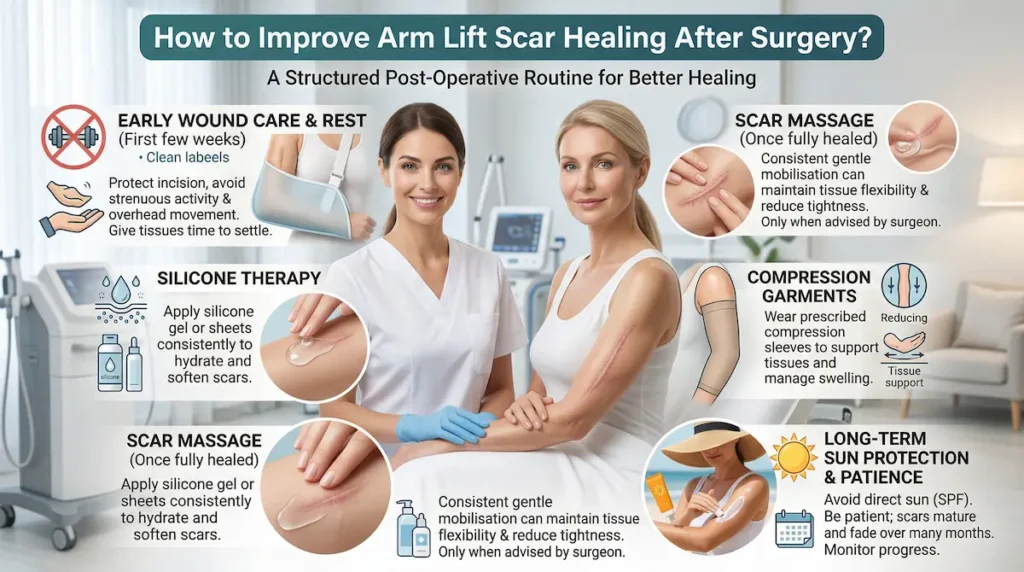
Once brachioplasty is complete, scar care becomes an active process rather than a waiting game. Many patients assume they must simply “leave it alone”, but scar management is more structured than that. The first months are especially important because the scar is going through inflammation, collagen formation, and remodelling. The choices made during this period can influence how flat, pale, and supple the final line becomes.
Scar care and contour improvement are separate issues. Once an incision has been made to remove loose skin, the quality of healing depends heavily on aftercare. This is why a consistent post-operative routine is essential if the goal is a flatter, softer, and less noticeable scar over time.
That said, effective scar care is usually simple rather than dramatic. It does not rely on miracle creams or internet hacks. Instead, it depends on evidence-based basics: careful wound protection, reduced tension, silicone support where appropriate, healthy hydration, no smoking, and sensible avoidance of sun exposure. In short, the best approach is consistency rather than over-treatment.
Why the First Few Weeks Matter Most for Scar Quality
The earliest healing phase sets the foundation for everything that follows. In the first days and weeks, the body is sealing the wound, laying down early collagen, and responding to swelling and inflammation. If the incision is disturbed by unnecessary tension, friction, infection, or repeated overstretching, the risk of a more noticeable scar can increase.
This is why patients are advised to be cautious with lifting, overhead movement, and vigorous exercise in the early period. It is not simply about comfort. It is about giving the arm lift incision the best chance to settle in a controlled way. A scar that is protected early often has a better chance of maturing into a fine, balanced line later.
For patients worried about hiding arm lift scars, the most important principle is patience. A scar that looks pink, shiny, raised, or firm at six weeks is not necessarily a poor long-term scar. It is often simply an immature scar. Judging the result too early is one of the most common sources of unnecessary anxiety.
Silicone Therapy, Scar Massage, and Compression Garments
Once the wound is appropriately healed and your surgeon advises it, silicone-based scar care is often recommended as part of a structured routine. Silicone sheets or silicone gels are widely used because they help support hydration in the scar environment and may encourage a flatter, softer result over time. They are not magical, but they are one of the more sensible tools in practical scar management.
Scar massage may also be introduced later in recovery, once the tissues are ready. The aim is not to “break” the scar, but to help maintain softness and mobility in the healing area. Gentle, consistent massage can sometimes improve how the tissue feels and reduce the sense of tightness some patients notice after brachioplasty.
Compression garments matter as well. In the early phase, they can help support the tissues, reduce swelling, and limit unnecessary stress on the healing incision. For patients with axillary brachioplasty scars or a longer full-arm scar, well-fitted compression may make the recovery period more comfortable and more controlled. The details of wear time should always follow surgeon advice rather than general internet recommendations.
Sun Protection, Activity Restrictions, and Long-Term Scar Care
Sun exposure is one of the easiest ways to make a healing scar more noticeable. Immature scars exposed to ultraviolet light may become darker or remain discoloured for longer, which is especially frustrating for patients trying to achieve a discreet result. For that reason, protecting the scar from direct sun is an important part of long-term care, particularly in the first months.
Activity should also be reintroduced with care. Patients often feel “better” before the tissues are fully settled, which can lead to premature stretching. Returning to the gym, lifting children, or doing repetitive upper-body activity too soon can put avoidable stress on the healing line. A sensible return to normal activity usually supports better scar behaviour than rushing back too early.
Over the longer term, good skincare habits, scar monitoring, and follow-up reviews can all play a role in fading an arm lift scar. If a scar remains unusually thick, red, itchy, or uneven, early review is worthwhile. Sometimes reassurance is all that is needed. In selected cases, additional scar-focused treatment may be considered later if the healing pattern is less favourable than expected.
How AKM Clinic Approaches More Discreet Arm Lift Scars for UK Patients
For British patients considering surgery abroad, the concern is rarely just the scar itself. It is also about whether scar planning, wound care, and follow-up are handled with the same seriousness they would expect from a high-standard private setting in the UK. A discreet scar is not created by marketing language. It is created by careful operative planning, meticulous closure, sterile theatre protocols, and structured aftercare that continues beyond discharge.
At AKM Clinic, this approach is supported by a broader patient-care framework that emphasises sterile operating theatre standards, internationally aligned hygiene protocols, and recovery support designed for international patients returning home to the UK. In practical terms, that means the scar conversation begins before surgery, continues during the wound-healing phase, and does not stop at the airport gate.
Careful Pre-Operative Marking for Better Scar Placement
Good scar outcomes begin before the first incision is made. Pre-operative marking allows the surgeon to assess skin redundancy, arm shape, asymmetry, and how the tissues fall when the patient is standing rather than lying flat. This matters because the ideal scar line is not determined by theory alone. It must reflect how the arm looks and moves in real life.
For patients anxious about an arm lift scar under armpit versus a longer full-arm line, this stage is especially important. A smaller scar may sound attractive, but if it cannot address the degree of loose skin properly, the final contour may disappoint. Careful marking helps align the extent of the procedure with the anatomy, which is a far more reliable path to satisfaction than under-correcting for the sake of a shorter scar.
It also allows for a more honest discussion about what can realistically be concealed. Some patients are ideal candidates for a more limited axillary approach. Others will benefit much more from a full brachioplasty, even if the scar is longer. Clear planning usually leads to better decisions than wishful thinking.
Meticulous Closure Techniques in Sterile Operating Theatre Conditions
Scar quality is shaped not only by where the incision is placed, but by how the tissues are handled and closed. Gentle tissue management, precise layered closure, and attention to wound support can all influence whether a scar heals as a fine line or becomes broader and more conspicuous. These are technical details, but they have very visible consequences later.
AKM Clinic’s care standards emphasise rigorous hygiene and sterile operating theatre conditions aligned with international protocols. While sterility alone does not guarantee an excellent scar, it is part of the foundation for safer healing. Reducing avoidable wound complications is an essential part of reducing scar-related problems.
For UK patients, this matters because trust is built through process as much as through results. When a clinic demonstrates structure, discipline, and consultant-led planning, it becomes easier for patients to feel that their concerns about visible scarring after arm lift are being taken seriously rather than dismissed.
LLLT Scar Healing Support and Structured Aftercare for British Patients
Scar care does not end in theatre. AKM Clinic uses LLLT scar healing therapy, based on a 650 nm soft laser approach designed to support fibroblast activity and encourage smoother healing. In plain terms, this means the clinic integrates scar-focused recovery support rather than treating the incision as an afterthought. For patients worried about long-term scar visibility, that is a meaningful difference.
This is particularly relevant to British patients who want reassurance once they are back home. Recovery confidence often depends on knowing there is a structured communication pathway after surgery. Ongoing remote follow-up with the Istanbul team and direct contact with your patient coordinator can reduce anxiety during the phase when scars are still changing week by week.
In other words, a discreet scar is supported by both careful medical preparation and good logistics. That combination matters. It is easier to stay calm, follow instructions properly, and heal well when patients know they are not navigating recovery alone.
Arm Lift Scar Healing Timeline: What to Expect Week by Week
One of the best ways to reduce post-operative anxiety is to understand the normal timeline of scar maturation. Patients often panic because they expect the scar to look “good” within a few weeks. In reality, brachioplasty scars improve gradually. Redness, firmness, mild lumpiness, and colour change are all common parts of the healing journey. The mature result is usually judged in months, not days.
Thinking in stages can be helpful. In the earliest phase, the wound is closing and swelling is settling. In the middle phase, the scar may look more obvious before it starts to improve. In the later phase, remodelling becomes the main process, and the line usually softens and fades. This is normal scar biology, not a sign that something has gone wrong.
Days 1–14: Swelling, Dressings, and Early Healing
During the first two weeks, the priority is wound protection. The arms may feel tight, swollen, and somewhat restricted. Dressings, compression, and follow-up checks are more important than the visual appearance of the scar at this stage. The incision may look red, uneven, or slightly puckered early on, which is not unusual.
Patients should focus less on appearance and more on calm, uncomplicated healing. Sleeping position, arm movement, hygiene, and not overdoing daily tasks matter far more than inspecting the scar repeatedly. This stage is about protection, not judgement.
Weeks 3–8: Scar Settling, Colour Changes, and Daily Comfort
As the wound gains strength, patients usually start to feel more normal in day-to-day life, but the scar may still look active. This is often the period when people worry most because the line can remain pink, firmer than expected, or a little raised. That does not automatically mean the final scar will be poor.
Where appropriate, this is also the stage when scar care measures such as silicone therapy may begin, based on your surgeon’s advice. Gentle routine and consistency matter more than doing too much. The scar is still immature and should be treated with patience.
Months 3–12: Maturation, Fading, and Final Scar Appearance
From around three months onward, the scar generally starts to soften and mature more noticeably. Colour often becomes less vivid, the texture may flatten, and the line begins to blend more naturally into the surrounding skin. For many patients, this is the stage when they realise the scar is becoming far less dominant than it felt in the early weeks.
By the later part of the first year, the outcome is usually much closer to the long-term result. Some scars continue to refine beyond twelve months, but this timeframe is a reasonable window for judging how successfully the scar has settled. For patients focused on fading an arm lift scar, this is why long-term perspective matters so much.
| Healing Stage | What You May Notice | Main Priority |
|---|---|---|
| Days 1–14 | Swelling, tightness, redness, dressings | Protect the incision and avoid tension |
| Weeks 3–8 | Pink scar, firmness, early remodelling | Follow scar-care advice consistently |
| Months 3–12 | Gradual lightening, softening, flattening | Patience, sun protection, ongoing review |
Is the Scar Worth It for Patients With Loose Upper Arm Skin?
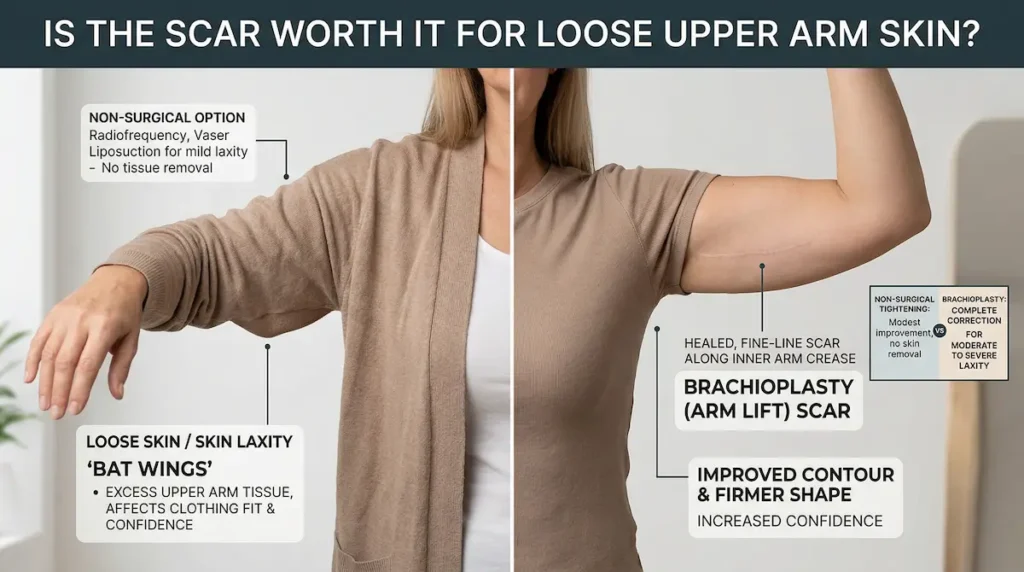
For the right patient, the answer is often yes. This is especially true when loose upper arm skin causes daily frustration, makes fitted clothing uncomfortable, or creates a constant sense of self-consciousness in social situations. The key is not to think about the scar in isolation. It should be judged against the starting point: how much excess skin is present, how much it affects confidence, and whether a better arm contour would meaningfully improve quality of life.
Many patients spend years trying to hide their upper arms in cardigans, long sleeves, or carefully chosen outfits, even in warm weather. In that context, a well-positioned brachioplasty scar may feel far more acceptable than continuing to live with significant skin laxity. The right decision is rarely about perfection. It is about choosing the trade-off that feels more comfortable in real life.
For some patients, the decision may also involve comparing brachioplasty with vaser liposuction, particularly when the upper arms feel both heavy and loose. While Vaser can reduce stubborn fat and improve contour, it cannot remove significant excess skin on its own. That is why patients with marked laxity often find that an arm lift, despite the scar, provides the more complete and satisfying improvement in shape, comfort, and clothing fit.
Why Skin Removal Often Achieves More Than Non-Surgical Tightening
Patients often ask whether radiofrequency, ultrasound, or injectable treatments can tighten the upper arms enough to avoid surgery. For mild laxity, non-surgical options may offer a modest improvement. However, when there is clear excess skin, particularly after weight loss or with age-related tissue descent, these treatments usually cannot remove redundant tissue in a meaningful way.
From a medical science perspective, skin that has stretched beyond a certain point does not reliably contract back to a youthful position on its own. That is why patients with more advanced “bingo wings” often find that creams, energy-based treatments, and exercise improve tone but do not remove the loose skin envelope itself. In such cases, surgery is not the more aggressive option; it is simply the more effective one.
This is where honest consultation matters. A good surgeon will explain when a non-surgical option is reasonable, and when it is more likely to waste time and money. For patients with moderate to severe laxity, brachioplasty often remains the most reliable route to a smoother, lighter-looking upper arm.
Common Reasons UK Patients Choose Brachioplasty After Weight Loss
Upper arm skin laxity can develop for different reasons, but two of the most common are significant weight loss and age-related loss of skin elasticity. After weight reduction, patients may feel proud of the number on the scales yet disappointed by the way the upper arms still hang or fold. Even with continued exercise, the loose tissue often remains.
This is why searches for bingo wings surgery scars or a bat wing removal scar are so common. Patients are not being superficial. They are usually trying to solve a very practical problem that affects clothing, confidence, body image, and sometimes skin irritation. An arm lift addresses the loose skin directly, rather than asking the patient to continue managing around it.
For UK patients in particular, the decision may also be tied to lifestyle. Feeling comfortable in short sleeves on holiday, at the gym, or during summer events can matter a great deal. When the contour improves, many patients feel that the scar is a reasonable exchange for finally being able to stop hiding their arms.
Balancing the Trade-Off Between Better Arm Contour and a Fine-Line Scar
The real question is not whether a scar exists, but whether the final arm feels better than the arm you started with. In many successful cases, patients accept a fine-line scar because the arm looks firmer, smoother, and more proportionate in clothes and in motion. The scar becomes a detail rather than the defining feature.
That said, this trade-off is personal. Some patients are highly scar-averse and would rather tolerate loose skin. Others are much more troubled by the skin laxity than by the idea of a hidden or discreet scar. Neither response is wrong. The best surgical decisions are made when expectations are honest and individual priorities are clear.
When scar placement is thoughtful and healing progresses well, many patients find that the improvement in arm contour outweighs the concern about visible scarring after arm lift. For appropriately selected patients, that is often what makes brachioplasty worth it.
What Should UK Patients Ask Before Booking Arm Lift Surgery Abroad?
For British patients considering brachioplasty overseas, scar placement is only one part of the decision. The wider questions are just as important: who is performing the surgery, how the scar is planned, what support is available after the operation, and how follow-up will work once you are back in the UK. A beautiful marketing gallery is not enough. Patients should look for clarity, structure, and evidence of responsible aftercare.
This is particularly relevant for people who feel nervous about travelling for surgery because of media stories about poor results abroad. The safest way to approach the process is to ask direct, practical questions. Scar quality is influenced by surgical planning, but also by recovery support, communication, and early intervention if healing does not progress as expected.
How to Assess Before-and-After Photos for Scar Placement
Before-and-after galleries should be viewed critically, not emotionally. Look beyond the overall contour and examine where the incision has been placed, how the scar looks in a healed result, and whether the photographs show the arms from more than one angle. A result that looks excellent from the front but is never shown from the side or with the arms slightly raised may not tell the full story.
Patients should also pay attention to consistency. Are the photos taken in similar lighting? Are the arms in a natural position? Is the scar shown only in the early weeks, or are there mature results at several months? These details matter when assessing scar placement for arm lift surgery.
A trustworthy consultation should also explain whether your own anatomy is likely to require an arm lift scar under armpit only, or a longer full-arm scar. The answer should be based on your degree of skin excess, not on sales language.
Why Aftercare, UK Contact Access, and Recovery Planning Matter
Even the best scar plan can be undermined by weak aftercare. Patients should ask exactly how dressing changes, wound monitoring, scar advice, and remote follow-up are handled once they leave the clinic. This is one of the biggest differences between a serious international service and a purely transactional one.
For UK patients, communication matters enormously. Knowing there is an organised post-operative pathway, direct contact access, and support that continues after the flight home can make recovery feel far safer and less isolating. This is especially important in the weeks when the scar is still active and patients naturally have questions about redness, tightness, swelling, or early scar texture.
Practical recovery planning matters too. Ask when you can fly, how long you should stay locally, what signs should prompt review, and whether you will receive written aftercare instructions that are easy to follow once you are back home. These details are not administrative extras. They are part of scar management and surgical safety.
Questions to Ask About Healing Support, Follow-Up, and Scar Revision
A strong consultation should welcome detailed questions rather than brushing them aside. Patients considering brachioplasty abroad should feel comfortable asking direct questions about both routine healing and what happens if scar maturation is slower than expected.
- Where exactly will my incision sit when my arms are resting naturally?
- Am I suitable for a mini arm lift, or do I need a full brachioplasty?
- What scar-care routine do you usually recommend once the wound has healed?
- How will follow-up work after I return to the UK?
- What support is available if I am worried about redness, widening, or delayed healing?
- Do you offer additional scar-focused treatments if the scar remains too visible?
Questions like these help patients move from vague anxiety to informed decision-making. They also make it easier to judge whether a clinic is taking the issue of hiding arm lift scars seriously, or merely minimising it.
Frequently Asked Questions (FAQ): Arm Lift Scar
Below are concise answers to the questions British patients most often ask about arm lift scars, brachioplasty recovery, and scar visibility. These answers are designed to be realistic rather than overly reassuring.
Will my arm lift scar show when I wear short sleeves?
Does a mini arm lift leave a much smaller scar?
How long does it take for an arm lift scar to fade?
Do silicone sheets or scar gels actually work?
Can laser treatments improve an arm lift scar later on?
Is it possible to revise an old or thickened arm lift scar?
How soon can I safely fly back to the UK after arm lift surgery?
If you would like to explore related topics in more detail, you can also learn more about J-Plasma Skin Tightening, Mini vs Full Tummy Tuck, Scar Revision Surgery Turkey, Tummy Tuck Scar Treatment, How to Prepare for Cosmetic Surgery, Surgery Companion Turkey, Questions to Ask Plastic Surgeon and the all-inclusive arm lift package. These guides can help you compare treatment options, understand recovery and scar care, plan your journey with greater confidence, and decide which procedure may be the most suitable for your needs and aesthetic goals.
Medical Disclaimer: This page is provided for general educational purposes only and does not replace a face-to-face medical consultation, diagnosis, or personalised treatment plan. All surgery carries risks and outcomes vary between individuals. Suitability for an arm lift (Brachioplasty) surgery, procedure selection, and anaesthesia choice can only be determined after a full clinical assessment by a qualified surgeon. Always follow your clinician’s instructions and seek urgent medical attention if you develop concerning symptoms during recovery.