
Breast Reduction Size Chart: What Cup Size Can You Expect?
AI Summary
- Breast reduction size chart explains grams-to-cup estimates, but final bra size cannot be guaranteed.
- Safe target sizing balances frame, symptoms, breast density, nipple blood supply and realistic comfort goals.
- Sister sizes matter because band size changes cup volume and post-operative measurements.
- Consultation-led planning helps align expectations, costs and personalised outcomes before surgery.
AI-generated summary, fact-checked by our medical experts.
Answer first: A breast reduction size chart can help you understand the rough relationship between grams removed and cup-size change, but it cannot predict your final bra size exactly. Most surgeons estimate a realistic target range using your starting size, band measurement, breast density, frame, skin quality and nipple blood supply.
If you are thinking, “I want to go from a G to a D,” that is a useful starting point. It gives your surgeon a direction. It does not, however, work like ordering a dress in a fixed size.
Breast reduction is planned around proportion, comfort and safety. The cup letter matters, but it is only one part of the picture. A D cup on a 32 band is not the same volume as a D cup on a 40 band, and two women with the same bra label can need very different surgical plans.
This guide explains how surgeons estimate cup size after breast reduction, how grams of tissue relate to bra sizing, what “sister sizes” mean, and how to talk about your ideal result in consultation without expecting an impossible guarantee.
For the full surgical overview, you can read more about AKM’s breast reduction procedure. This article stays focused on size planning only.
Table of Contents
Why There’s No Exact “Size Chart”?
A size chart feels reassuring because it turns a personal, anatomical decision into numbers. The problem is that breast size is not measured with one universal system. Cup letters change with band size, bra brand, breast shape and how a person prefers their bra to fit. That is why a surgeon can usually promise that your breasts will be smaller, but should not promise an exact final cup letter.
Cup size is not a fixed volume
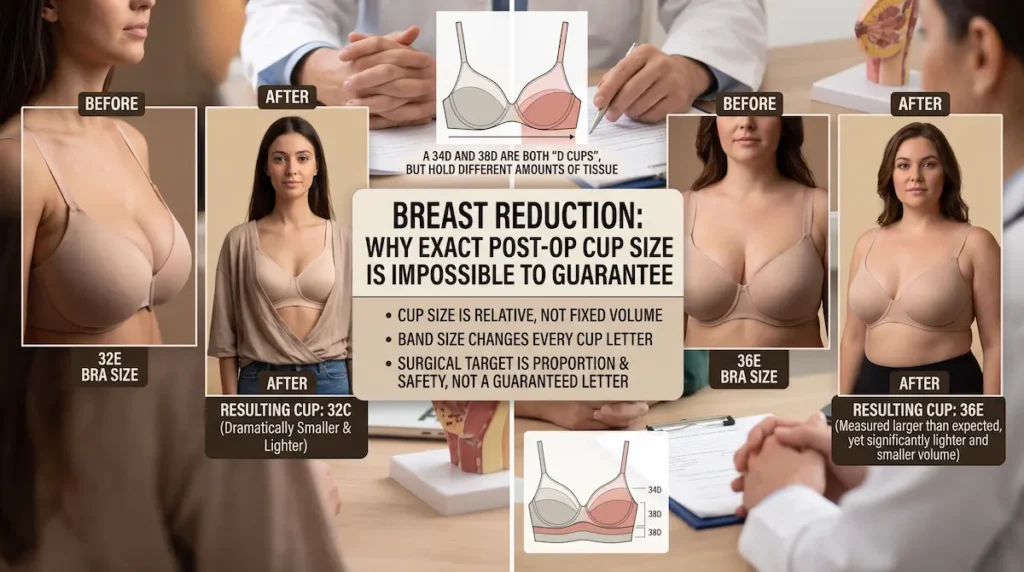
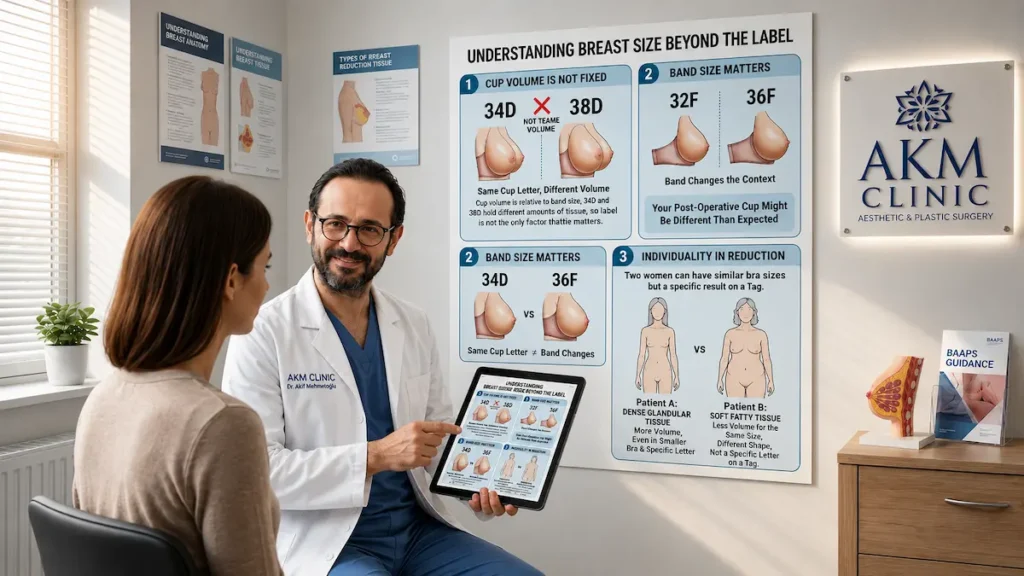
A common misunderstanding is that a cup size equals one fixed amount of breast tissue. It does not. A 34D and a 38D are both called “D cups”, but the 38D has a larger cup volume because the band is wider.
This is why “I want to be a C cup” needs more context. A C cup on which band? In which bra brand? With what level of fullness at the upper pole? These details matter.
UK guidance from BAAPS makes this point clearly: a reduction in breast size can be expected after surgery, but specifying the exact cup size afterwards is not realistic. A responsible consultation should turn your cup-size wish into a safe, proportionate surgical target rather than treating the letter as a guarantee.
Band size changes the meaning of every cup
Cup size is calculated in relation to the difference between your under-bust measurement and the fullest part of the bust. This means the same cup letter changes as the band changes.
For example, a 32F and a 36F are not the same breast volume. The letter is the same, but the cup on the larger band holds more. That is why two patients asking for “three cup sizes smaller” may need very different amounts of tissue removed.
It also explains why your post-operative bra label may surprise you. You might feel dramatically lighter and more proportionate, yet still measure into a larger cup letter than you expected because your band and cup relationship has changed.
Two patients with the same bra size can need different reductions
Even when two women start with the same bra size, their surgical plans may not match. One may have dense glandular tissue. Another may have softer fatty tissue. One may have a narrow chest and heavy projection. Another may have a broader chest with more tissue spread across the side of the breast.
Skin quality also matters. If the skin has stretched after weight change, pregnancy or years of heaviness, the surgeon must think about shape as well as volume. Removing tissue is only part of the plan; reshaping the breast and keeping the nipple-areola complex safely supplied with blood are just as important.
Surgeon-led expectation: A good breast reduction plan does not chase a letter on a bra tag. It aims for a breast size that is smaller, lighter, balanced with your frame and safe for your anatomy.
The Gram-to-Cup Relationship
Grams are the language surgeons use in theatre because breast tissue can be weighed accurately once removed. Cup size is the language patients use because it describes daily life: bras, clothing, exercise and comfort. The useful part of a breast reduction size chart is that it connects those two languages — but only approximately.
The 100–300 g per cup rule of thumb
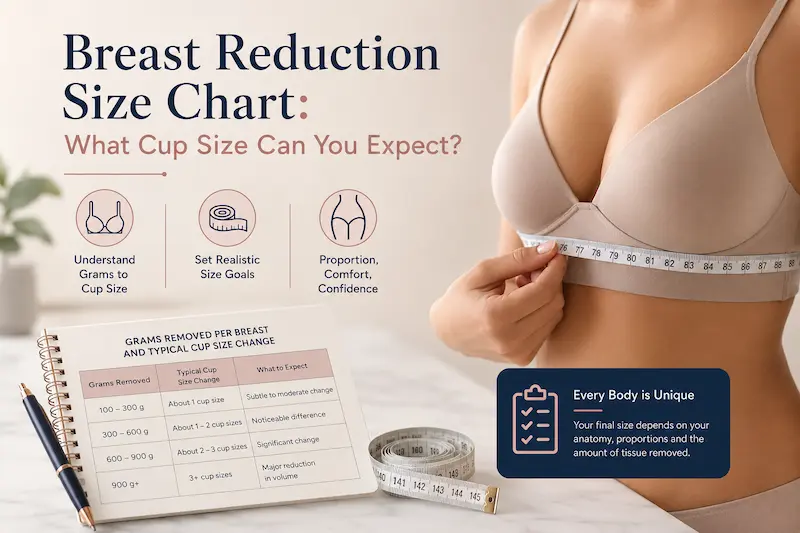
A commonly used estimate is that removing about 100–300 grams of tissue per breast may reduce the breast by roughly one cup size. This range appears in clinical discussion because cup volume varies so much from person to person.
Research on reduction mammaplasty has also shown why cup prediction is difficult. Studies have tried to estimate cup-size change from tissue weight, chest girth and breast measurements, but they still treat the result as a prediction rather than a promise.
| Approximate tissue removed per breast | Typical cup-size change | Important caveat |
|---|---|---|
| 100–300 g | About 1 cup size | May look like less or more depending on band size and breast density |
| 300–600 g | About 1–2 cup sizes | Often a noticeable comfort change, but not a guaranteed bra label |
| 600–900 g | About 2–3 cup sizes | Shape, projection and nipple position become key planning factors |
| 900 g+ | Often 3+ cup sizes | Larger reductions need careful planning around blood supply and long-term shape |
This table is a planning guide, not a guarantee. It is most useful when it helps you ask better questions in consultation: “If you remove this amount, what range would be realistic for my frame?”
Why it is a range, not a promise
The range is wide because breast tissue does not behave like water in a measuring jug. Tissue density varies. Chest width varies. The shape of the breast base varies. The same 400 g reduction can look subtle on one person and dramatic on another.
Bra fitting adds another layer. Some brands run shallow. Some are more projected. Some people wear a tighter band for support; others size up for comfort. After surgery, you may also prefer a different style of bra because your breast shape has changed.
That is why a surgeon should discuss a target range rather than a fixed endpoint. For example, the plan may be “to reduce heaviness and aim for a balanced D/DD range” rather than “you will be exactly a D cup”. The first statement is clinically sensible. The second is overconfident.
How breast density changes the estimate
Dense glandular tissue weighs more for the same visual volume. Softer fatty tissue may occupy more space but weigh less. This means grams removed do not always translate neatly into the cup-size change you imagine.
A patient with dense breasts may have a smaller-looking reduction for the same gram weight because the tissue removed is compact. A patient with softer, bulkier tissue may see a greater visual change from a similar volume adjustment.
This is also why your surgeon’s examination matters. Photos and bra size help, but they cannot replace an assessment of tissue quality, skin stretch, breast footprint, asymmetry and nipple position.
How Surgeons Set Your Target Range?
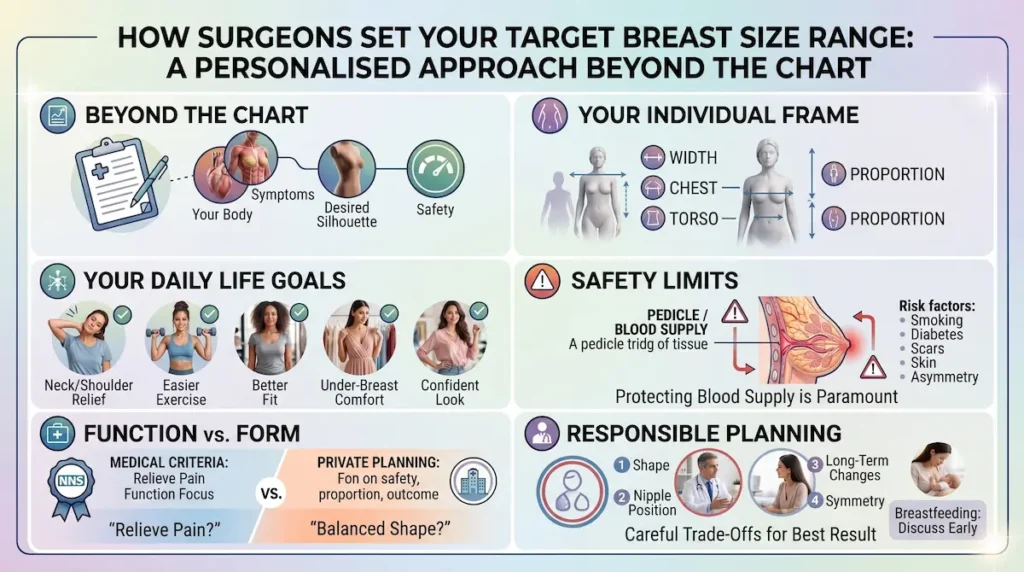
Your target size is not chosen from a chart alone. It is built from your anatomy, your symptoms, your preferred silhouette and what can be achieved safely. A careful surgeon will listen to your cup-size goal, then translate it into a realistic range based on your frame, tissue volume and the limits of blood supply to the nipple-areola complex.
Proportion to your frame and shoulders
The best breast reduction results usually look balanced, not simply “small”. Your surgeon will look at shoulder width, chest width, torso length, waist-to-hip proportion and how much breast tissue sits towards the side of the chest.
For one patient, a D cup may look neat and athletic. For another, the same letter may still feel too full. That is why the consultation should include more than a target bra label.
It helps to describe what you want in daily-life terms. Do you want less neck and shoulder strain? Easier exercise? Better clothing fit? Less under-breast skin irritation? A lighter shape that still feels feminine? These clues often guide planning better than a single cup letter.
Nipple blood supply limits how small you can safely go
During breast reduction, the nipple usually remains attached to a living bridge of tissue called a pedicle. This tissue carries blood supply and sensation. The more tissue removed, the more carefully the surgeon must protect that blood supply.
This is one reason a very small target is not always possible. A patient may ask to go from a very large cup to a small B, but if that would put the nipple blood supply, breast shape or wound healing at risk, the surgeon should explain the safer range.
In larger reductions, the operation is not just about removing weight. It is about moving and reshaping the breast in a way that still heals well. This is also where related factors such as smoking, diabetes, previous scars, skin quality and breast asymmetry become important.
If you are researching risk factors, the size conversation overlaps with the broader topic of what can affect breast reduction healing and satisfaction. This article will not go into complications in detail, but those risks should be part of your consultation.
Medical-necessity thresholds are not the same as aesthetic goals
Some UK patients first encounter breast reduction through the NHS criteria conversation. That discussion often focuses on symptoms, body mass index, functional impact and local commissioning rules. Private surgical planning is different: it still considers safety and symptoms, but it also looks at shape, proportion and the patient’s preferred outcome.
It is useful to separate these two ideas. A medical threshold may ask, “Is enough tissue being removed to treat symptoms?” Your personal aesthetic question may be, “Will the result feel balanced on my body?” Both matter, but they are not identical.
A responsible surgeon will not remove the maximum amount simply because the patient wants the smallest possible result. They will weigh relief, shape, nipple position, symmetry and long-term ageing of the breast.
This is especially important if you may want to breastfeed in the future. Larger reductions and certain techniques can carry different trade-offs, so that concern should be discussed early. For a focused explanation, see our guide to breastfeeding after breast reduction surgery.
UK consultation note: Before travelling for surgery, ask your surgeon to explain your expected size range, not just the grams to be removed. You should also understand how nipple position, blood supply and future life plans may affect the safest result.
Sister Sizes and Reading Your Result
Many patients feel confused after surgery because the mirror, the tape measure and the bra label do not always seem to agree. This is where sister sizing helps. It explains why your breasts may look much smaller, feel lighter and fit clothing better, even if the cup letter is not as small as you expected.
What sister sizing means
Sister sizes are bra sizes with similar cup volume but different band sizes. For example, a 34DD, 36D and 38C may hold similar breast volume, even though the letters look different.
This matters after breast reduction because your band size may change as swelling settles, posture improves and you move into more supportive bras. If your band changes, your cup letter may shift too.
So a patient who hoped for a C cup may be disappointed at first to measure as a D. But if the band is smaller, the breast volume may still be close to the size she had in mind. The label alone does not tell the whole story.
Why your bra label may change between brands
UK bra sizing is not perfectly standardised across every brand. Some cups are deeper. Some bands are firmer. Some full-cup styles fit differently from balconette or sports bras. After breast reduction, these differences often become more noticeable because the breast shape has changed.
Early swelling also makes bra fitting unreliable. In the first few months, the breasts can sit higher, feel firmer and change shape as tissues soften. A post-operative support bra is chosen for healing, not for your final size.
For this reason, many surgeons advise waiting until swelling has settled before investing in expensive new bras. Your final bra wardrobe should come after the breast has softened and dropped into a stable shape.
Measuring after full healing
Your final size is not set in the first week, or even the first month. Swelling can make the breasts look fuller, higher and firmer than they will be later. The lower part of the breast also needs time to settle into its new contour.
Many patients start to get a realistic sense of size by three months, but the final shape can continue refining for six to twelve months. Scars also mature during this time, and the breast envelope softens gradually.
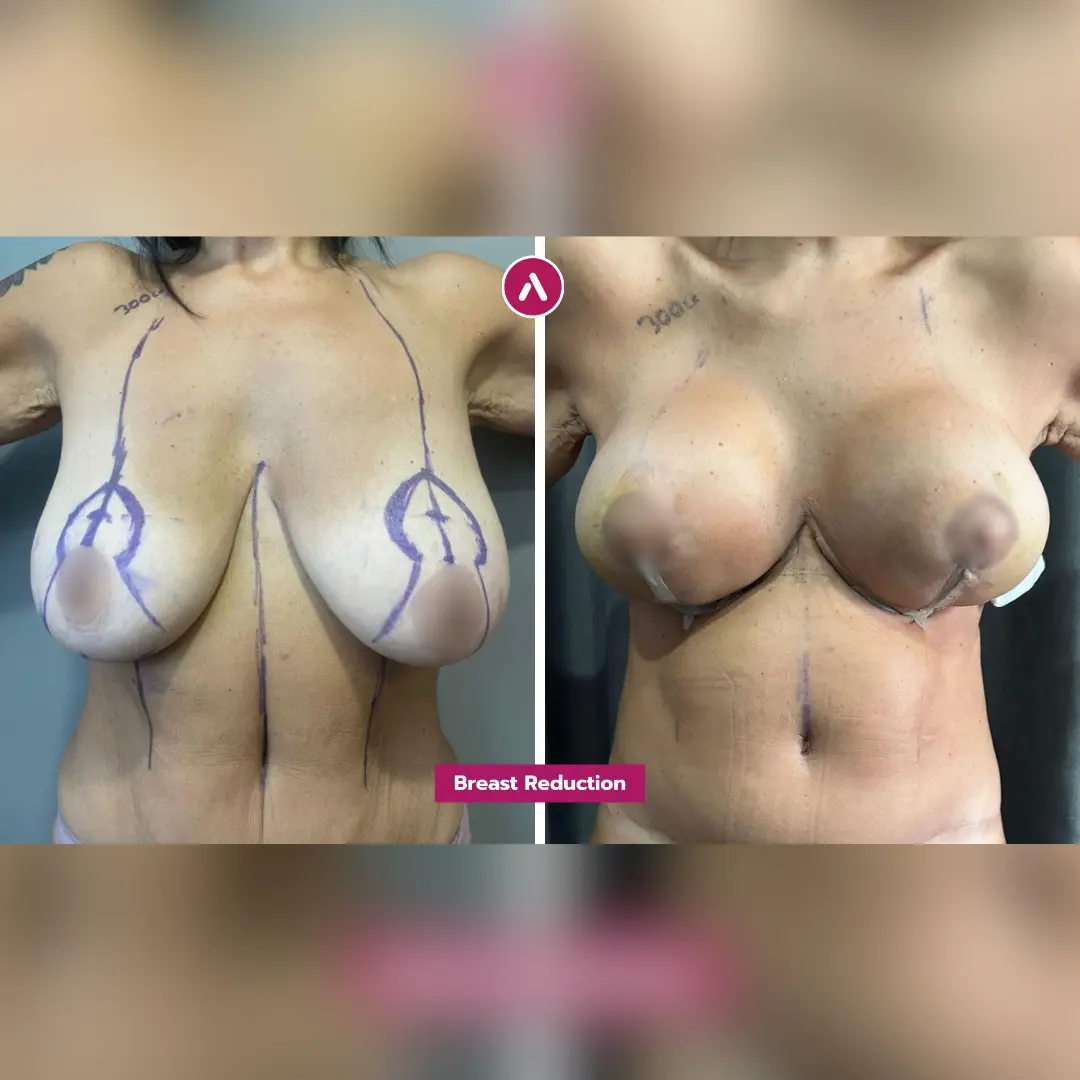
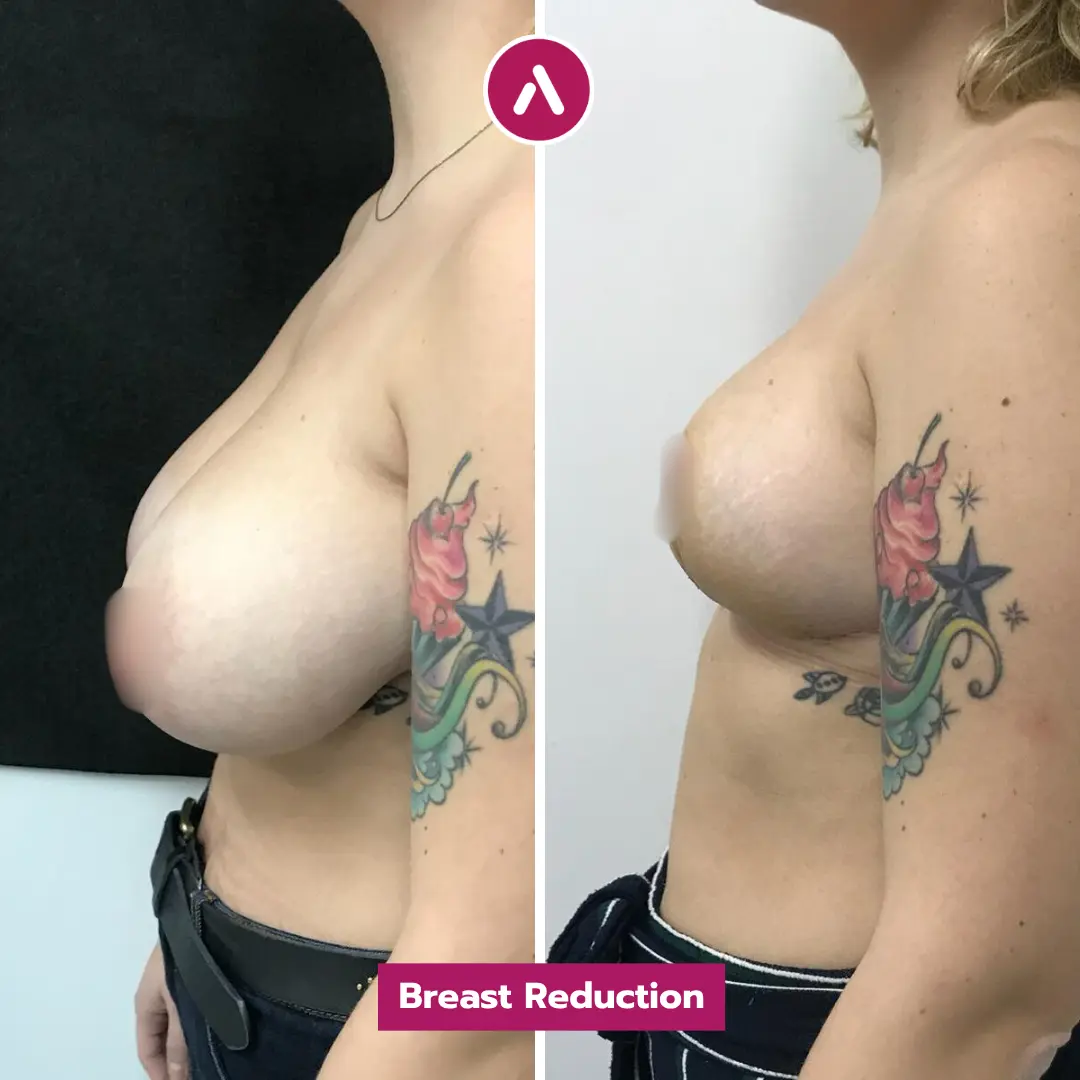
If you want visual context, use before-and-after results carefully. Do not compare yourself to someone with a completely different starting size, body frame or skin quality. A better approach is to look for patients with a similar build and ask your surgeon what is realistically transferable to your anatomy.
For general outcome context, you can review healed breast reduction results, but your own cup-size target should still be confirmed in consultation.
Setting Size Goals in Consultation
The most useful size conversation is specific, visual and realistic. Instead of asking only for a cup letter, explain what you want your breasts to feel like in daily life: lighter, easier to dress, more proportional, less painful, or still curved but not heavy. That gives your surgeon a clearer target than a bra label alone.
Bring reference goals, but keep them anatomical
Reference photos can help, especially when they show body frames similar to yours. They are less useful when they show a completely different chest width, height, weight, breast base or skin quality.
A good consultation should turn your references into questions: What do you like about this result? The upper fullness? The smaller side profile? The way clothes sit? The distance between nipple and breast fold?
It is also helpful to bring the bra sizes you currently wear, including the size that fits best and the size you wish you could wear. Your surgeon can then explain whether that goal is likely, too conservative or too aggressive for your anatomy.
Discuss the trade-off of going very small
Many patients want the smallest result possible because they are tired of heaviness. That is understandable. Still, smaller is not automatically better if it compromises shape, nipple position, healing or long-term balance.
Going very small can sometimes flatten the breast, reduce natural curvature, or place too much tension on the skin closure. In larger reductions, it may also affect the safest way to preserve nipple blood supply.
This does not mean you should accept a result that still feels too large. It means the consultation should define the safest lower limit for your body. That is where an experienced surgical team can be honest: “This is realistic,” “this is possible but carries trade-offs,” or “this would not be safe for your anatomy.”
If your concern is emotional uncertainty rather than size maths, read our guide to setting expectations before breast reduction. That topic deserves its own discussion and should not be reduced to cup size alone.
Use the chart as a question tool, not a promise
The best way to use a breast reduction size chart is to prepare for consultation. It can help you understand why 300 g may be a meaningful reduction for one patient and modest for another. It can also help you ask how your surgeon thinks about grams, cup size, breast shape and safety together.
For a research-based example of cup-size prediction, one published study describes the challenge of estimating final cup size and attempts to connect tissue weight with desired reduction. You can review research on predicting cup size after reduction mammaplasty, but remember that prediction is not the same as certainty.
ASPS patient guidance also explains the common rule of thumb that around 100–300 g of tissue per breast may correspond to roughly one cup size, while still noting that exact cup size cannot be predicted before surgery. That is why the grams-per-cup estimate should be treated as a guide, not a contract.
Cost is another separate decision point. This article does not open a pricing breakdown, but you can review breast reduction costs compared with the UK if you are planning your full treatment budget.
Ready to discuss your target size? Book a free virtual consultation with AKM Clinic to review your current size, preferred range, body proportions and the safest surgical plan for your anatomy.
Frequently Asked Questions: Breast Reduction Size Chart
These questions come up often because cup size feels personal. The honest answer is rarely a single number. Your final result depends on your starting anatomy, the amount removed, the reshaping needed and how your breasts settle during healing.
How much smaller will I go after breast reduction?
How many grams equal one cup size?
Can my surgeon promise a cup size?
What is a sister size?
Will both breasts be exactly the same size?
When is my final size set?
Should I buy new bras straight away?
Medical disclaimer: This article is for general educational purposes only and is not a substitute for personalised medical advice. Breast reduction results, healing, scarring, sensation and final cup size vary from patient to patient. Always consult a qualified surgeon who can assess your anatomy, medical history and goals before making a treatment decision.
Related Treatments



Ready to Begin Your Own Transformation Journey?
Join the 2,000+ patients who have trusted Dr Akif Mehmetoğlu and the AKM Clinic team. Your journey to a more confident, naturally restored you begins with a simple, no-obligation conversation. Contact us today from the UK for your free virtual consultation.
#1: Get Your Free Personalised Quote
Start with a free, no-obligation online consultation. Share your photos, and our surgical team will provide a fully personalised treatment plan and a transparent, all-inclusive price package. There are no hidden fees.
#2: Secure Your Date & VIP Booking
Once you are ready, our dedicated patient coordinators will help you secure your procedure date. We will handle all your bookings, including your 5-star hotel accommodation and private VIP airport transfers.
#3: Arrive in Istanbul & Meet Your Surgeon
Arrive at Istanbul Airport (IST) and be greeted by your private driver. Settle into your hotel and prepare for your in-person consultation, where you will meet your specialist surgeon to finalise the details for your "natural, subtle, and restored" new look.