
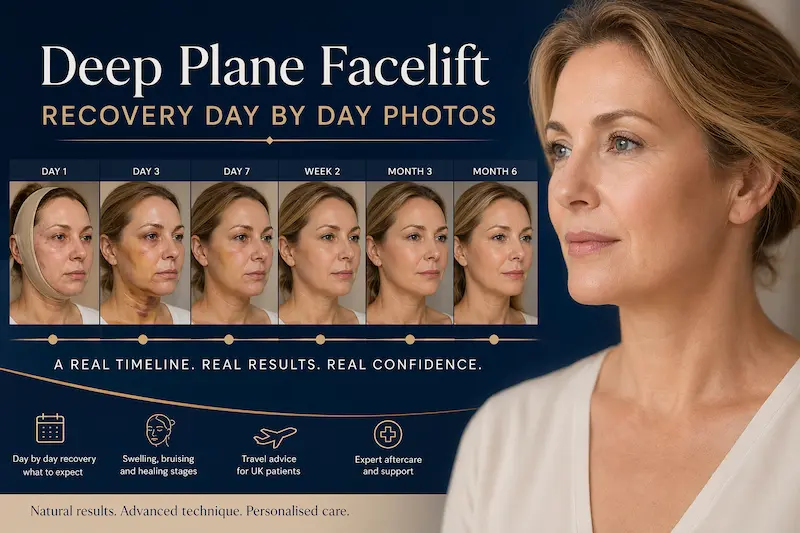
Deep Plane Facelift Recovery Day by Day Photos: A Real Timeline
AI Summary
- Deep plane facelift recovery day by day photos show realistic healing stages, from swelling peaks to refined long-term results.
- Day 2 to Day 4 swelling is usually normal, with bruising worsening briefly before gradual improvement begins.
- Structured aftercare, HBOT, and LLLT support safer healing, reduced oedema, smoother scars, and stronger patient confidence.
- UK patients need clear travel guidance, flight-ready recovery plans, and remote support after returning home.
AI-generated summary, fact-checked by our medical experts.
If you are searching for deep plane facelift recovery day by day photos, what you usually want is not a polished marketing gallery, but a realistic explanation of how healing actually unfolds. In other words, you want to know what your face may look like in the mirror on Day 1, how deep plane facelift swelling day by day tends to change, when bruising begins to fade, and when you can start to feel like yourself again.
This guide has been written for the detail-oriented patient who wants a medically grounded, honest view of day-by-day healing after a deep plane facelift. We will walk through the deep plane facelift recovery timeline, the typical deep plane facelift bruising timeline, the main deep plane facelift healing stages, and the practical deep plane facelift aftercare timeline that matters most in the first days after surgery. We will also explain the wider deep plane facelift healing process in plain English, so you know what is normal, what is temporary, and what deserves a call to your surgeon.
One of the most important points to understand is that deep plane facelift recovery day by day rarely looks linear. Some mornings you may look better, then slightly puffier again by evening. That can feel alarming if you are relying only on isolated photographs online. Good recovery guidance should combine realistic visual expectations with medical science, because swelling, bruising, tightness, numbness, and scar maturation all follow biological patterns rather than cosmetic timelines.
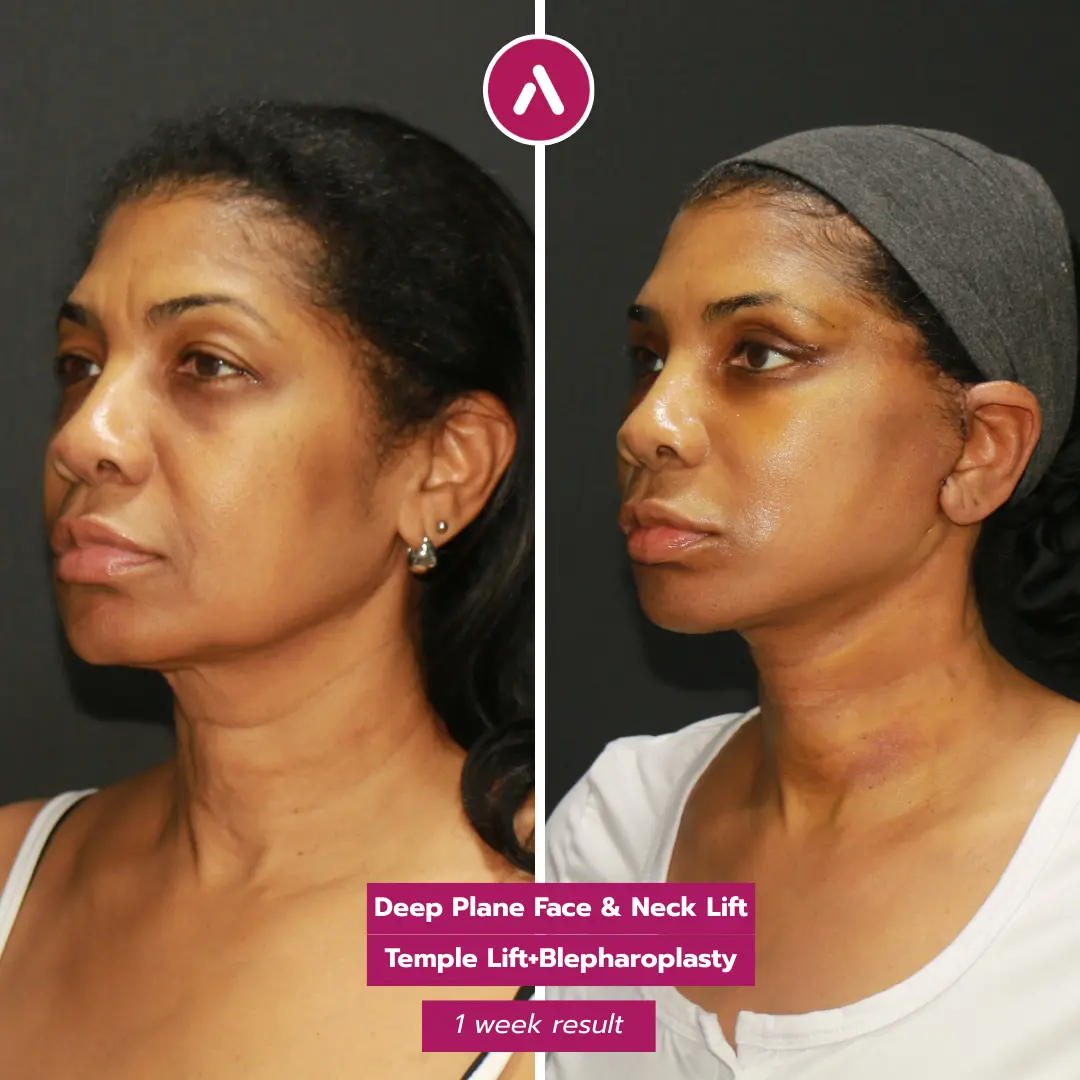
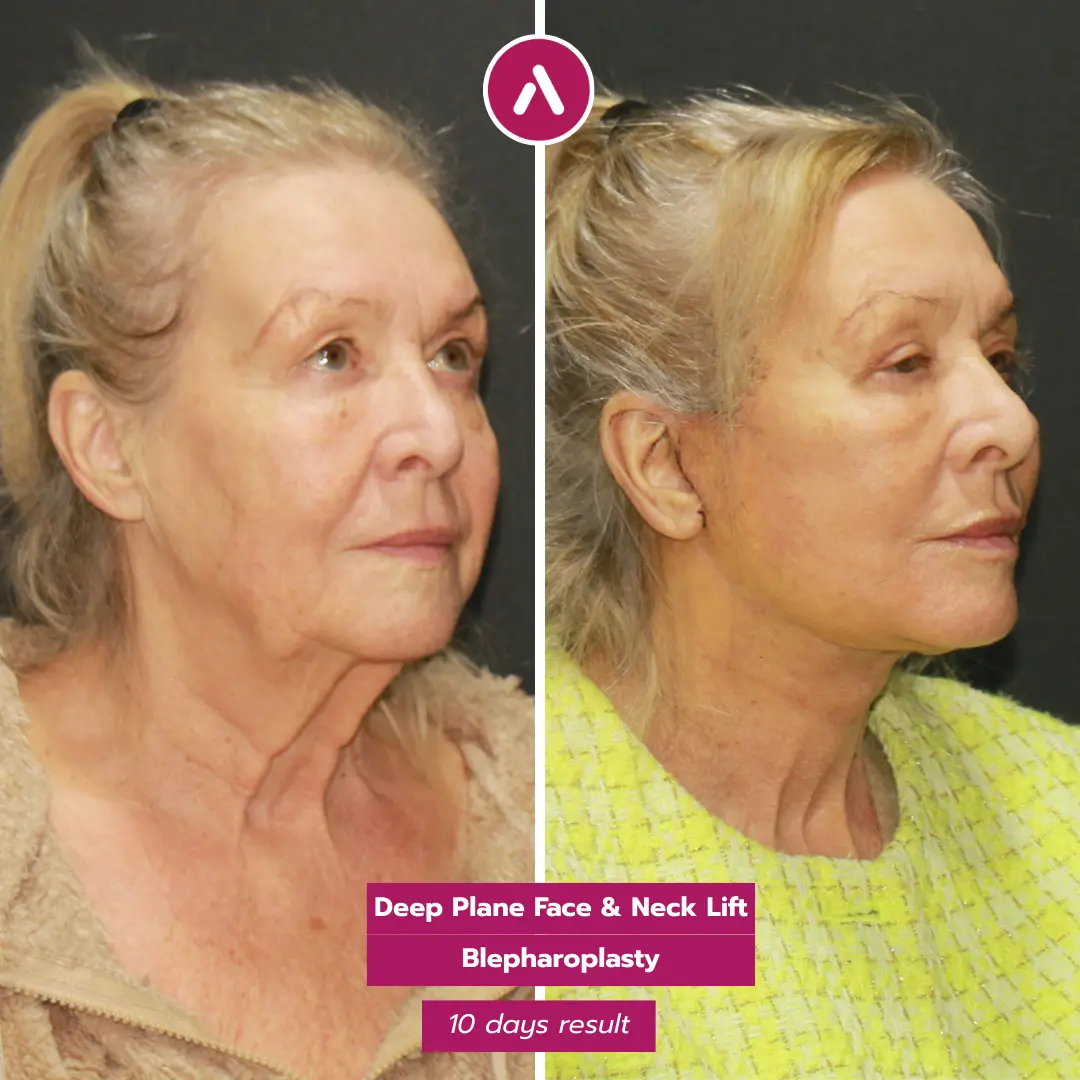
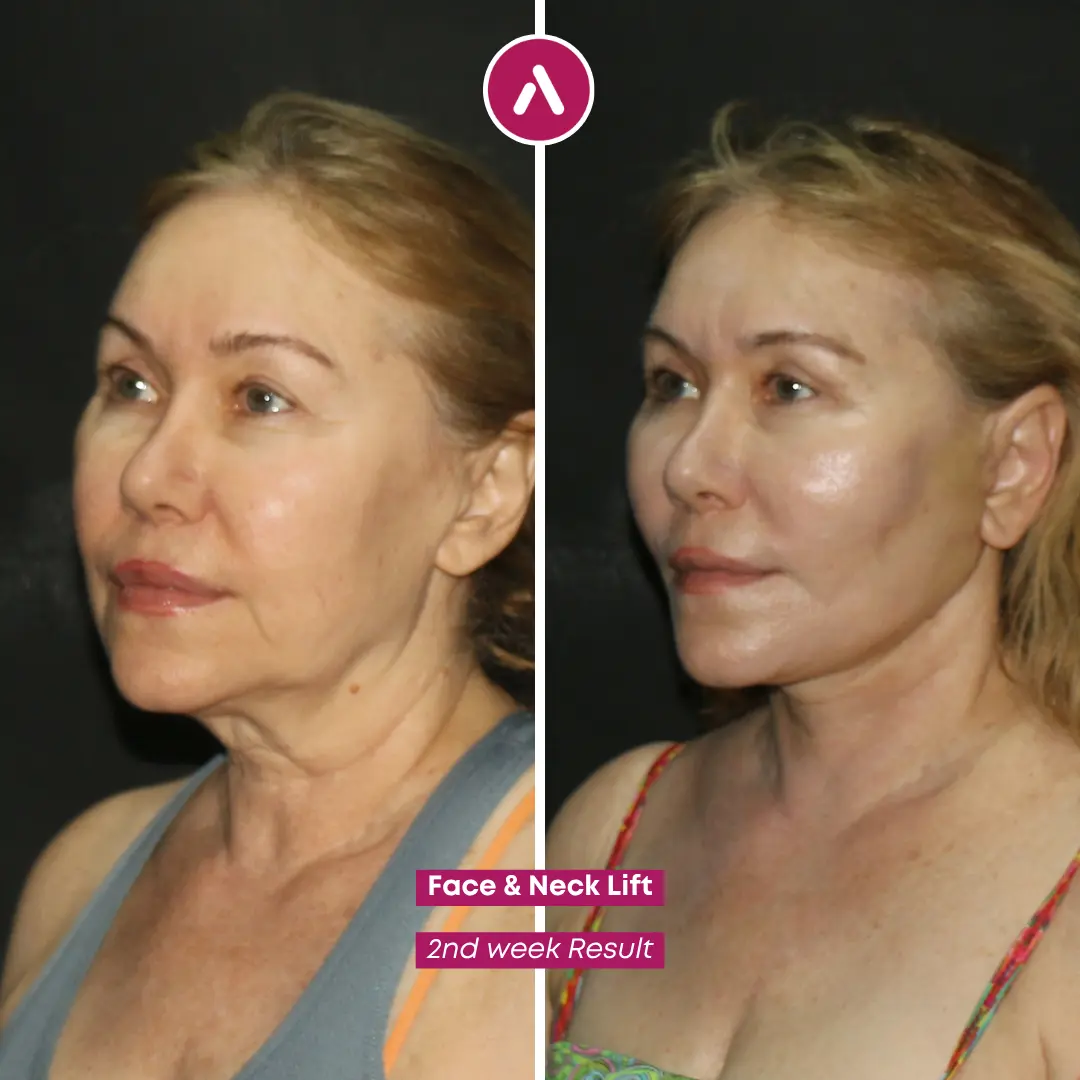
For UK patients in particular, the goal is usually not to look dramatically altered. It is to look fresher, better rested, and more like yourself. That is why a useful recovery guide should focus on realistic facelift before and after healing, not just the polished final result. The early stage may look socially awkward, but that does not mean the outcome will be artificial. In fact, the “messy middle” is often a perfectly normal part of a strong long-term result.
| Recovery stage | What is commonly happening | What most patients notice |
|---|---|---|
| Hours 0–24 | Compression, dressings, early tightness, drowsiness, mild ooze from drain sites | Pressure more than pain, facial heaviness, cautious movement |
| Day 2–4 | Peak oedema and bruising, especially around the cheeks, jawline, and neck | “I look worse before I look better” phase |
| Day 5–7 | Steadier improvement, less puffiness, early confidence returning | Comfortably going out with sunglasses or a scarf |
| Weeks 2–4 | Residual swelling, unevenness, scar softening begins | More socially presentable, but not final result |
| Months 3–12 | Deeper tissue settling, scar maturation, sensation gradually normalising | A naturally refreshed look rather than a “done” appearance |
Table of Contents
What Happens Immediately After Surgery (Hours 0–24)
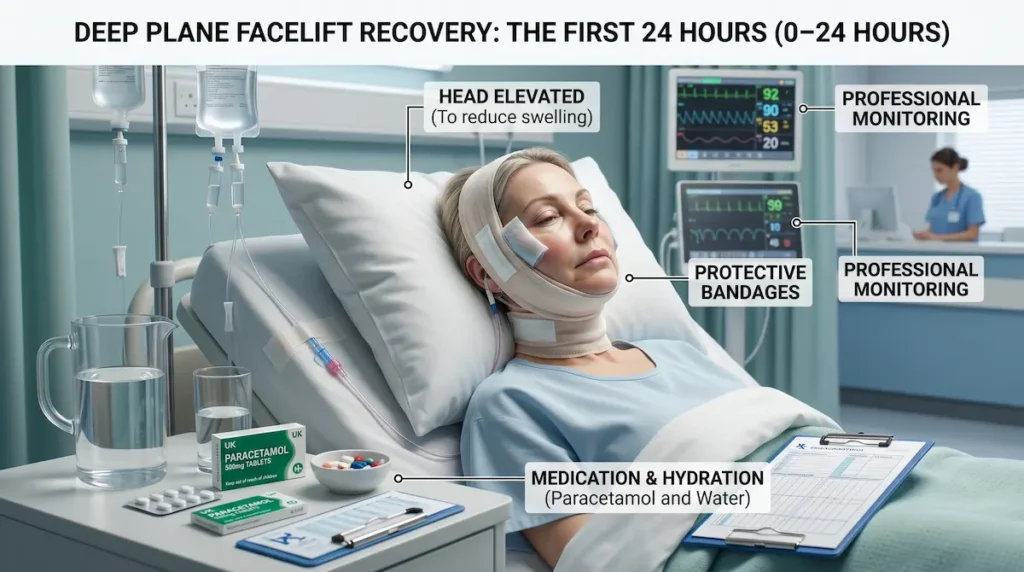
The first 24 hours are less dramatic than many patients expect, but they are also the most structured. This stage of deep plane facelift day by day recovery is focused on protection, monitoring, hydration, and rest. You will not yet be judging your final appearance. Instead, you are protecting freshly repositioned tissues, controlling swelling early, and allowing the body to begin its normal healing cascade in the safest possible way.
What you look and feel like in the first few hours after a deep plane facelift
In the first hours after surgery, most patients feel a combination of facial tightness, heaviness, mild grogginess, and emotional relief that the procedure is over. Your face will usually be wrapped or supported, and your features may look broader or less defined than expected because early swelling begins almost immediately. This does not reflect the final result.
Most people are surprised that the dominant sensation is not severe pain. It is more often described as pressure, stiffness, or the feeling that the skin and deeper tissues are “aware of themselves”. Chewing, smiling widely, or turning the neck quickly may feel awkward. That is expected in the earliest phase of the deep plane facelift healing process.
It is also normal to notice that one side looks slightly more swollen than the other. Human faces are not perfectly symmetrical before surgery, and healing is not perfectly symmetrical afterwards either. Tiny day-to-day fluctuations are common and should not be overinterpreted on the first night.
- Mild blood-tinged drainage on dressings can be normal.
- Tightness along the jawline and in front of or behind the ears is common.
- Your smile may feel restricted at first because the tissues are swollen, not because the result is wrong.
- Numbness around the ears, neck, or lower cheeks may begin early and often improves gradually over time.
Managing drains, dressings, and the first night after surgery
Depending on the surgical plan, small drains may be placed to reduce fluid collection in the first stage of healing. If drains are used, they are temporary and practical rather than alarming. Their purpose is simply to reduce the chance of trapped fluid contributing to extra pressure or swelling. Dressings help protect incision lines and support the tissues while the body settles into the first night.
Patients often feel anxious about seeing tubes, bandaging, or visible puffiness, but this is a normal part of immediate aftercare. In a well-managed post-operative setting, the focus is on keeping everything clean, dry, supported, and calm. That early structure matters because the first 24 hours set the tone for the next several days of the deep plane facelift aftercare timeline.
You should expect to sleep with your head elevated. That is not just a comfort suggestion; it is a simple way to reduce fluid accumulation. Sleeping flat can make the next morning’s swelling more pronounced. A slightly upright position is usually more helpful, especially through the first few nights.
| Hours 0–24 practical checklist | Why it matters |
|---|---|
| Keep dressings clean and undisturbed | Protects incisions and supports early healing |
| Sleep with head elevated | Helps limit fluid build-up and morning puffiness |
| Take medication exactly as advised | Supports comfort and keeps recovery predictable |
| Walk gently indoors | Supports circulation without stressing the face |
| Drink water regularly | Helps recovery and reduces that “dry, heavy” feeling |
Pain relief, paracetamol use, and why most patients describe tightness more than pain
A well-performed deep plane facelift is often less painful than people imagine. The first day is typically dominated by tightness, tenderness, and awareness of the incision lines rather than sharp pain. Many patients manage well with a straightforward medication plan, often including paracetamol, depending on the surgeon’s advice and the specifics of the case.
This distinction matters because it changes how you interpret what you are feeling. Tightness is not necessarily a sign that something is wrong. It usually reflects swelling in the tissues and the fact that the deeper facial structures have been repositioned. Early inflammation is part of healing, not automatically a warning sign; for general background, see the NHS overview of facelift surgery.
“My recovery was painless, requiring minimal paracetamol.”
That type of feedback is reassuring because it matches what many patients report after modern facelift surgery: discomfort is real, but it is often manageable, structured, and shorter-lived than expected. The first night is usually more about getting comfortable enough to rest than about coping with severe pain.
Why local anaesthesia or twilight anaesthesia can make early recovery feel smoother
For some patients, undergoing surgery with local anaesthesia or twilight anaesthesia (conscious sedation) can make the immediate recovery period feel gentler than expected. Without the full physiological impact of general anaesthesia, patients may feel clearer sooner, mobilise earlier, and experience less of the heavy “hangover” feeling that some people fear after surgery.
That does not mean there is no recovery. There absolutely is. But the first phase can feel more controlled and less disorientating. For the patient who values detail and predictability, this can make a meaningful difference to the overall experience of deep plane facelift recovery day by day, especially during the first night and first morning.
For background, see the NHS guide to local anaesthesia. In general, smoother early mobilisation, good hydration, and calmer physiology can all support a steadier transition into the swelling phase that follows. Recovery is never just about the face; it is also about how the whole body tolerates the journey.
The role of immediate monitoring, hydration, and calm rest before your first post-op review
One of the biggest mistakes patients make mentally is believing that they should already be “improving” in the first 24 hours. In reality, this period is about stabilisation. Your job is not to judge the outcome. Your job is to rest, sip fluids, take medication as directed, avoid unnecessary facial movement, and allow your surgical team to monitor the earliest phase of healing.
Hydration matters because the body heals better when it is supported properly. Calm walking indoors matters because it helps circulation. Rest matters because poor sleep increases the sense of facial heaviness and can make swelling feel worse the next morning. All of these details sound small, but together they shape how the next phase of the deep plane facelift recovery timeline unfolds.
The best mindset for the first 24 hours is simple: protected, patient, and observant. Not fearful. Not analytical to the point of panic. Just aware that the visible result is temporarily hidden beneath the normal first layer of post-operative change.
The “Swelling Peak”: Day 2 to Day 4
Days 2 to 4 are often the most psychologically difficult part of the journey because this is when many patients feel they look worse rather than better. That is entirely normal. If you have been comparing online images and searching terms like deep plane facelift swelling day by day or deep plane facelift bruising timeline, this is the stage those searches are really about. It is the moment when healing becomes visible before it becomes flattering.
Why bruising gets worse before it gets better
Bruising often appears more noticeable on Day 2 or Day 3 than it did on the day of surgery. That happens because small amounts of blood that were not obvious at first begin to settle and show through the skin. Gravity, facial movement, and tissue settling can all make the discolouration appear more dramatic before it starts to fade.
This is one reason why a deep plane facelift recovery timeline can feel misleading if you only look at one image from one day. The face may actually be healing well while looking more colourful or more swollen for a short period. In other words, visible improvement and biological improvement do not always happen in the same order.
Colours typically evolve rather than disappear overnight. The skin may move from red-purple to bluish, then to yellow-green as the body clears the pigments. That progression is often a reassuring sign that the bruising is resolving, even if it still looks socially inconvenient.
Which facial areas usually swell most: cheeks, jawline, under-eye region, and neck
During Days 2 to 4, swelling is often most obvious through the mid-face, lower cheeks, jawline, and upper neck. Some patients also notice puffiness extending towards the under-eye area, particularly in the morning. This does not necessarily mean surgery was performed there; facial tissues are connected, and fluid shifts easily in the early healing stage.
The jawline can look less defined than expected at this point, which may feel disappointing if that was the main reason for surgery. This is temporary. A strong jaw and neck result is often hidden by oedema before it becomes visible. That is why deep plane facelift healing stages should always be judged over weeks and months, not over a single long weekend.
Morning swelling is commonly worse than evening swelling because fluid accumulates while you are resting. Gentle walking, upright posture, hydration, and time usually help the face feel lighter as the day goes on.
| Day | What you may see | What it usually means |
|---|---|---|
| Day 2 | Increased puffiness, early bruising, facial tightness | Normal inflammatory response is building |
| Day 3 | Peak swelling for many patients, stronger colour changes | The classic “worse before better” stage |
| Day 4 | Swelling may plateau, bruising more defined | Not final result, but often close to the turning point |
HBOT support for reducing postoperative oedema and helping you feel more mobile sooner
One of the most useful tools during this phase can be HBOT (Hyperbaric Oxygen Therapy), which is used to support tissue oxygenation, reduce postoperative oedema, and encourage a smoother recovery pattern. For patients worried about prolonged swelling or being unfit to travel, this kind of structured support can be especially reassuring.
In practical terms, HBOT is valued because the worst part of Days 2 to 4 is not just appearance. It is the feeling of heaviness, stiffness, and sluggish facial movement. By supporting circulation and tissue recovery, HBOT may help reduce that sense of “fullness” and social downtime. For a UK patient planning a sensible return journey, that matters.
Clinical note: in UK patient case analysis, HBOT was highlighted for helping reduce postoperative oedema and bruising after deep plane facelift surgery.
This is also where science becomes more useful than internet folklore. Good recovery is not about miracle hacks. It is about giving healing tissues the conditions they need: oxygen, rest, hydration, reduced pressure, and time.
Emotional ups and downs during recovery and why this stage can feel misleading
The emotional side of recovery is often underestimated. Patients who felt calm and confident on Day 1 may suddenly feel doubtful on Day 3. That does not mean they regret surgery; it usually means they are in the least flattering visual window of the process. Puffiness, bruising, stiffness, sleep disruption, and the simple shock of seeing your own face look temporarily unfamiliar can all affect mood.
This stage is sometimes called the emotional dip of recovery because you are not yet at the final result, but you are far enough from surgery to start forming opinions. Those opinions are frequently too negative. A face that looks swollen, broad, or slightly uneven at this stage can still go on to settle beautifully.
For that reason, one of the most helpful forms of aftercare is expectation management. A realistic guide to deep plane facelift day by day recovery should reassure you that temporary awkwardness is often part of an elegant final outcome.
Warning signs that are normal versus symptoms that should prompt a message to your surgeon
Most swelling, bruising, tightness, and asymmetry in Days 2 to 4 fall firmly into the “normal but inconvenient” category. Mild numbness, changing bruise colours, and a puffy jawline are all commonly seen during this point in the deep plane facelift aftercare timeline.
However, patients should still know the difference between expected recovery and a concern worth reporting. A sudden increase in pain on one side, rapidly expanding swelling, bright red bleeding that does not settle, fever, or symptoms that feel sharply different from the pattern explained by your surgeon should always be reported promptly. Sensible reassurance is helpful, but so is sensible caution.
- Usually normal: tightness, moderate swelling, bruise colour changes, mild numbness, looking worse on Day 3 than Day 1.
- Worth reporting: sudden severe one-sided swelling, persistent heavy bleeding, fever, or pain that escalates rather than gradually settles.
That balance is important. The goal is neither panic nor passivity. It is informed observation. Patients do best when they understand that recovery has patterns, and that knowing those patterns makes the entire deep plane facelift healing process feel more manageable.
Suture Removal and Feeling Normal: Day 5 to Day 7
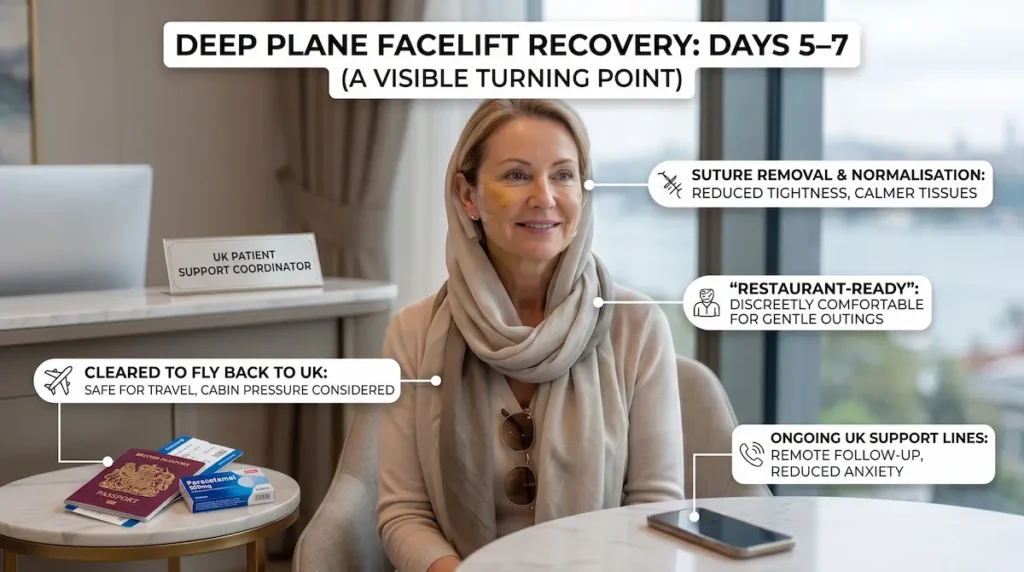
Days 5 to 7 are often the first point at which patients feel they can breathe mentally. You are still in the active phase of deep plane facelift recovery day by day, but the recovery pattern usually begins to feel more predictable. Swelling is still present, bruising may still be visible, and your face is not ready to be judged as a final result. Even so, many people notice that this part of the deep plane facelift recovery timeline feels like a turning point rather than a setback.
What changes after suture removal and why patients often feel a visible turning point
When sutures are removed, patients often feel a practical and emotional shift. It is not that healing suddenly becomes complete, but the face can feel less “medical” and more like it is entering a normalisation phase. Incision lines begin to feel less tight, hygiene becomes easier, and there is often a sense that the hardest part of the first week is behind you.
This stage is important in the broader deep plane facelift healing stages because it marks the transition from immediate post-operative protection to more confident daily recovery. Many patients still have puffiness around the jawline, lower cheeks, and in front of the ears, but the tissues usually begin to look calmer than they did during the Day 2 to Day 4 peak.
It is also common for bruising to look “older” rather than fresher at this point. That can actually be a good sign. The colours may soften into yellow, green, or light brown tones, which often means the body is progressing through the normal deep plane facelift bruising timeline.
- The face often feels less fragile after suture removal.
- Washing around the hairline and ears becomes less intimidating.
- Tightness may still be present, but many patients describe it as more manageable.
- This is improvement, not completion; the result is still in transition.
The “restaurant-ready” test in Istanbul: when you may feel comfortable going out discreetly
One practical question many patients ask is whether they would feel comfortable leaving the hotel for a short outing by Day 5, 6, or 7. The honest answer is that some do, and some do not. Comfort depends on the amount of residual swelling, the intensity of bruising, your hairstyle, your confidence, and whether you mind being seen looking a little “in recovery”.
For many patients, this is the point where they start to pass the informal “restaurant-ready” test. That does not mean glamorous or camera-ready. It means feeling well enough for a gentle meal out, perhaps with sunglasses, a scarf, or hair positioned to soften the visibility of the area around the ears. For the cautious UK patient, this can be a reassuring marker in the deep plane facelift day by day recovery journey.
The goal should not be to prove anything socially. It should be to assess whether you feel physically comfortable, emotionally relaxed, and not overtired. Recovery tends to go better when patients pace themselves rather than rushing to look normal too soon.
| By Day 5–7 | Often realistic | Usually too early for some patients |
|---|---|---|
| Short hotel walk | Yes | No issue if energy is good |
| Quiet restaurant visit | Sometimes | If bruising is still strong or confidence is low |
| Long shopping day | Usually not ideal | May increase fatigue and swelling |
| Social photos | Often premature | The face is still settling |
When are you cleared to fly back to the UK?
This is one of the most important practical questions in the entire deep plane facelift aftercare timeline. Most UK patients want to know not just when they feel able to travel, but when it is sensible and clinically appropriate to do so. Clearance to fly depends on your recovery pattern, swelling control, wound assessment, and your surgeon’s examination rather than a generic online rule.
Many patients are medically reviewed around this stage because the travel decision should be individual. You should not base it purely on how “presentable” you feel. Travel readiness is about safety, circulation, wound stability, comfort, and whether your early healing is proceeding as expected.
For British patients, this stage also links directly to planning around airport logistics, cabin pressure anxiety, and how much support you will have once home. The best approach is to treat your return not as a rushed escape, but as part of the treatment plan itself.
A sensible return-to-UK plan is part of the recovery process, not an afterthought.
Flight-ready recovery protocols, cabin pressure concerns, and practical travel planning
Patients often use search terms such as deep plane facelift recovery timeline when what they really want is a practical answer to this question: “When will I be fit enough to sit on a plane and manage the journey comfortably?” The answer depends on swelling, stamina, incision progress, and your surgeon’s view of how stable your healing looks.
Structured, flight-ready recovery protocols matter because air travel is physically tiring even when everything goes smoothly. You may be sitting upright for long periods, carrying some anxiety, dealing with dry cabin air, and navigating security or boarding while still looking and feeling slightly delicate. The more controlled your early recovery has been, the easier that journey tends to feel.
Practical details can make a noticeable difference. Loose, comfortable clothing, head elevation when possible, hydration, gentle walking before and after the flight, and avoiding unnecessary physical strain all support a calmer return. This is not about superstition; it is about sensible recovery behaviour grounded in medical science.
- Choose comfort over appearance on travel day.
- Keep medication and aftercare items in hand luggage.
- Stay well hydrated and avoid overexertion at the airport.
- Follow your surgeon’s exact flying advice rather than online averages.
How UK support lines and remote follow-up reduce anxiety after you return home
Going home is often emotionally positive, but it can also make patients feel suddenly more vulnerable. In Istanbul, you are physically close to your clinic. Once back in Britain, even perfectly normal swelling can feel more stressful because you are no longer in the same city as your surgeon.
This is why proper aftercare for UK patients should never end at the airport. Ongoing access to a UK support line, a direct WhatsApp number, and a clear pathway for photo updates can significantly reduce anxiety. For many patients, that support is as important psychologically as it is medically.
In the real world, aftercare is not only about complications. It is also about reassurance, pattern recognition, and being told, “Yes, this swelling is still normal,” or, “Please send another photo tomorrow.” A reliable support structure makes the later part of the deep plane facelift healing process feel much more manageable from home.
UK patient feedback consistently shows that strong aftercare communication provides major reassurance once the patient is back home.
The “Ugly Duckling” Phase vs. the Final Result (Weeks 2–4)
Weeks 2 to 4 can be strangely confusing because you often look much better than you did during the first week, yet still not quite like yourself. This is the stage where patients start to analyse every detail: one side of the jawline, a slightly stiff smile, puffiness near the ears, lingering numbness, or the feeling that the face is improving but not fully settled. In terms of deep plane facelift day by day recovery, this is where patience becomes just as important as aftercare.
Why the face can look uneven, puffy, or “not quite you” during this stage
The face may still appear uneven through Weeks 2 to 4 because swelling does not disappear all at once. Some areas resolve faster than others, and one side may continue to look fuller for longer. This is one of the most misunderstood parts of the deep plane facelift healing process: improvement is real, but it is not perfectly symmetrical or perfectly linear.
Patients also often describe a vague sense of looking “not quite me yet”. That feeling is common and usually temporary. The face is no longer in the dramatic post-operative stage, but it has not yet regained its fully natural softness, movement, and settled contour. You may look better to other people than you think, because they see freshness rather than the tiny details you are scrutinising.
This phase can be especially frustrating for the detail-oriented patient because it sits between obvious surgery and obvious success. It helps to remember that the tissues are still remodelling beneath the surface, and surface impressions can lag behind deeper healing.
Residual swelling around the SMAS and deep plane release areas explained simply
In a deep plane facelift, the surgeon works beneath the more superficial layers in order to reposition the descended facial tissues more naturally. Because of that deeper surgical work, some residual fullness may linger longer than patients expect. It is not necessarily visible to everyone else, but you may notice it when washing your face, smiling, or comparing one cheek to the other.
Put simply, the tissues that were released and repositioned need time to settle into their new, stable relationship. This is one reason why deep plane facelift swelling day by day searches can be misleading after the first week. Day-by-day change becomes less dramatic, but week-by-week refinement continues.
The key idea is that deeper surgery often aims for a more natural long-term result, but that does not mean instant perfection. The elegance of the final outcome is often built through a slightly slower, more nuanced settling phase.
| Weeks 2–4 concern | Common explanation | Typical significance |
|---|---|---|
| One cheek looks fuller | Residual asymmetrical swelling | Usually normal |
| Jawline still slightly puffy | Deep tissue settling continues | Expected in many patients |
| Smile feels stiff | Tissue tightness and mild swelling | Common and often temporary |
| Numbness near ears or neck | Nerve recovery and tissue healing | Often gradually improves |
When make-up, light social activity, and video calls usually start to feel comfortable again
By this stage, many patients begin to feel more socially functional. Make-up may help conceal the final traces of bruising, hair styling becomes easier, and light social contact starts to feel less daunting. This is often where the recovery begins to move from “medical” into “manageable”, even though the final result is still developing.
Video calls, short meetings, or a controlled return to normal routine may be realistic for many people during Weeks 2 to 4, depending on the visibility of swelling and how confident you feel. The important thing is to measure readiness by comfort rather than pressure. Just because you technically can do something does not mean you need to do it immediately.
In the context of realistic facelift before and after healing, this stage is often the first time patients can imagine the final outcome properly. The obvious drama of bruising is fading, and the refreshed direction of the face starts to emerge.
LLLT scar healing support and how incisions begin to soften around the ears and hairline
Scar care becomes increasingly relevant during this phase. Although incision lines may still look pink, firm, or slightly raised, they often start to appear less conspicuous as the weeks progress. Around the ears and hairline, the early goal is not invisibility but calm, uncomplicated healing.
LLLT scar healing therapy can be helpful because it is used to support fibroblast activity and encourage smoother scar maturation. For patients who are especially concerned about visible signs of surgery, this can be one of the most reassuring parts of the aftercare strategy. It reflects a scientific research approach to healing rather than a passive “wait and see” mindset.
Scar improvement should always be judged over months, not days. At this stage, good signs include closed incisions, softening tissue, reduced redness over time, and no signs of abnormal tension or delayed healing.
Patients who fear visible scarring often feel reassured once the incision lines begin to soften and integrate more naturally around the ear and hairline.
How subtle facial rejuvenation differs from a pulled or overdone result
By Weeks 2 to 4, many patients begin to see the difference between early tightness and an actually overdone result. In the first days after surgery, temporary stiffness can create the fear that the face will look pulled forever. In most properly executed cases, that fear fades as swelling falls, movement improves, and the contours settle into a softer shape.
The goal for many British patients is not obvious transformation. It is subtle facial rejuvenation: a cleaner jawline, smoother transition from lower eyelid to cheek, reduced jowling, and a more rested version of the same face. That distinction matters because it aligns with what most UK patients actually want from surgery.
In other words, the “ugly duckling” phase is not evidence of a poor result. It is often part of the path towards a natural one. That is why the most useful view of deep plane facelift recovery day by day is not a single dramatic photo, but a realistic sequence showing how healing matures over time.
Long-Term Healing: Month 3, Month 6, and Year 1
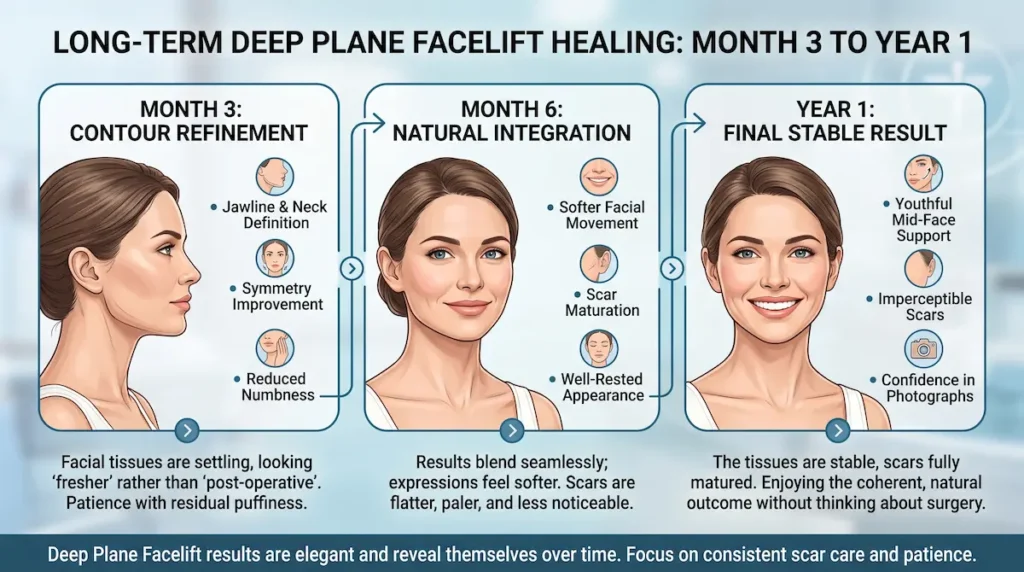
By the time you reach Month 3, recovery usually stops feeling “day by day” and starts feeling “month by month”. This is an important transition in the deep plane facelift recovery timeline. Most of the obvious bruising and a large proportion of the visible swelling are behind you, but subtle tissue settling, scar maturation, and sensory recovery are still continuing beneath the surface. Patients who understand this part of the deep plane facelift healing process tend to feel calmer, because they no longer expect dramatic weekly change and instead learn to look for refinement.
What usually improves by Month 3: contour settling, reduced numbness, and better symmetry
By Month 3, most patients feel significantly more like themselves. The face generally looks fresher rather than “post-operative”, and the jawline, mid-face, and neck begin to show the more elegant contours that were hidden during the earlier deep plane facelift swelling day by day phase. Residual puffiness may still exist, particularly in the morning or in areas where the tissues were more firmly repositioned, but it is usually much less intrusive.
Numbness often starts to improve during this stage as well. Some areas may still feel slightly strange to the touch, especially around the ears, lower cheeks, or upper neck, but the direction of change is usually reassuring. This is one of the reasons why the long-term view matters so much in deep plane facelift recovery day by day discussions: the early days dominate online searches, but the true elegance of the result is often clearer by Month 3.
Symmetry also tends to improve. Small differences between the two sides of the face, which can feel magnified in the mirror during the first few weeks, often soften as swelling continues to resolve. From a medical science perspective, that makes sense because healing tissues rarely settle at exactly the same rate on both sides.
| By Month 3 | Common improvement | Still possible |
|---|---|---|
| Jawline | More defined and cleaner | Mild residual puffiness |
| Cheeks | Better contour and lift | Subtle firmness on palpation |
| Scars | Less obvious in daily life | Pinkness or slight textural change |
| Sensation | Gradual return towards normal | Patchy numbness in some areas |
What changes by Month 6: scar maturation, softness, and more natural facial movement
Month 6 is often where patients stop focusing on “recovery” and start focusing on how naturally the result has integrated into their face. This is a major milestone in the deep plane facelift healing stages. Facial movement usually feels softer, expressions appear more effortless, and the concern about looking tight or “done” often fades substantially.
Scar maturation also becomes more rewarding at this point. Incision lines commonly look flatter, paler, and better blended into the natural contours around the ears and hairline. Patients who were especially worried about visible surgery tend to feel more reassured here, because the signs of healing usually become far less obvious in normal lighting and everyday social situations.
Softness matters just as much as appearance. By Month 6, the face often feels less like it has been surgically altered and more like it simply belongs to you again. That is a key part of realistic facelift before and after healing: not just looking better in photographs, but feeling normal when you smile, wash your face, turn your head, or see yourself unexpectedly in a mirror.
The best deep plane facelift results usually read as “well-rested” and “refreshed”, not “surgically changed”.
What to expect by Year 1: final result, imperceptible healing, and confidence in photographs
At Year 1, most patients are seeing the most complete version of their result. This is the stage where the deep plane facelift recovery timeline reaches its most meaningful endpoint: the tissues have settled, the scars have matured further, and the face typically looks coherent, natural, and stable. In many cases, this is when patients feel fully confident in candid photographs, strong lighting, and normal day-to-day life without thinking about surgery at all.
That does not mean every tiny sensation is identical to pre-surgery life, but by this stage the healing is generally so integrated that it becomes part of your normal appearance rather than something you are managing. This is the strongest argument for patience during the early deep plane facelift bruising timeline and swelling phase. The first two weeks can be visually discouraging, but they do not predict the sophistication of the Year 1 result.
For patients who wanted subtle rejuvenation rather than a dramatic transformation, Year 1 is often when the outcome feels most satisfying. The lower face looks cleaner, the neck looks smoother, the mid-face support appears more youthful, and yet the overall impression is still recognisably you.
Incision scar fading timeline and the role of consistent scar care
Scar healing is gradual and should always be judged over months rather than days. In the early weeks, scars may be pink, firm, slightly raised, or more visible than patients expected. By Month 3 and Month 6, they often begin to soften and fade, while by Year 1 many are significantly less noticeable in ordinary social settings.
This longer timeline is an important part of the deep plane facelift aftercare timeline. Patients who expect scars to disappear quickly often become unnecessarily worried. In reality, scar maturation follows biology, and even excellent scars need time. Careful hygiene, sun protection, following the surgeon’s aftercare advice, and in selected cases supportive technologies such as LLLT all contribute to better long-term integration.
From a scientific research standpoint, scar remodelling is a slow physiological process involving collagen organisation and tissue adaptation. That is why consistency is more useful than impatience. Good scar care rarely produces overnight change, but it does improve the odds of a refined final result.
Return of skin sensation, tissue settling, and why patience matters with deep plane surgery
One of the quieter parts of the deep plane facelift healing process is sensory recovery. Patients often focus on swelling and bruising, but numbness, tingling, occasional tightness, and gradual return of skin sensation can continue for months. This is usually not dramatic, but it is common and worth understanding in advance.
Deep plane surgery works at a deeper anatomical level than older, more superficial lifting techniques. That deeper repositioning is one reason the long-term result can look more natural, but it also means the settling process is more nuanced. The face may appear socially presentable quite early while still healing biologically for a much longer period.
Patience matters because deep plane results are often judged too early. If you evaluate the outcome at Day 7, Week 3, or even Month 2, you are still looking at an unfinished version. A realistic view of deep plane facelift day by day recovery should always make room for that truth: elegant results take time to reveal themselves.
Frequently Asked Questions (FAQ): Deep Plane Facelift Recovery Day by Day Photos
The questions below address the most common concerns patients have when reviewing deep plane facelift recovery day by day photos. The aim is to give concise, practical answers in plain English, while keeping the wider deep plane facelift recovery timeline in perspective.
How painful is deep plane facelift recovery really?
How long does the swelling last after a deep plane facelift?
When can I safely fly back to the UK after surgery?
Will I look obviously “done” during the first two weeks?
When can I wash my hair and shower normally again?
When can I go back to work, meetings, or social events?
How long do scars take to fade around the ears and hairline?
Is numbness normal after a deep plane facelift?
Does HBOT genuinely help reduce downtime after facelift surgery?
What kind of aftercare support do UK patients receive once they are home?
Medical Disclaimer: This page is provided for general educational purposes only and does not replace a face-to-face medical consultation, diagnosis, or personalised treatment plan. All surgery carries risks and outcomes vary between individuals. Suitability for a deep plane facelift surgery, procedure selection, and anaesthesia choice can only be determined after a full clinical assessment by a qualified surgeon. Always follow your clinician’s instructions and seek urgent medical attention if you develop concerning symptoms during recovery.
Related Treatments
Ready to Begin Your Own Transformation Journey?
Join the 2,000+ patients who have trusted Dr Akif Mehmetoğlu and the AKM Clinic team. Your journey to a more confident, naturally restored you begins with a simple, no-obligation conversation. Contact us today from the UK for your free virtual consultation.
#1: Get Your Free Personalised Quote
Start with a free, no-obligation online consultation. Share your photos, and our surgical team will provide a fully personalised treatment plan and a transparent, all-inclusive price package. There are no hidden fees.
#2: Secure Your Date & VIP Booking
Once you are ready, our dedicated patient coordinators will help you secure your procedure date. We will handle all your bookings, including your 5-star hotel accommodation and private VIP airport transfers.
#3: Arrive in Istanbul & Meet Your Surgeon
Arrive at Istanbul Airport (IST) and be greeted by your private driver. Settle into your hotel and prepare for your in-person consultation, where you will meet your specialist surgeon to finalise the details for your "natural, subtle, and restored" new look.