
Breast Implant Revision: Upsizing or Removal
AI Summary
- Breast implant revision helps correct discomfort, asymmetry, rippling, or size changes with personalised surgical planning.
- Upsizing or removal depends on tissue quality, lifestyle goals, and whether a lift improves shape.
- Recovery for UK patients varies by procedure complexity, with structured aftercare and safe travel guidance essential.
- Turkey offers value through transparent GBP pricing, consultant-led care, and careful safety standards for revision cases.
AI-generated summary, fact-checked by our medical experts.
For many women, breast implant revision is not simply about changing size. It is often about restoring comfort, confidence, symmetry, and a sense that the breasts still feel proportionate to the body and aligned with personal goals. Whether the concern is ageing implants, discomfort, capsular contracture, visible rippling, or a wish to move to a more natural look, revision surgery requires thoughtful planning rather than a one-size-fits-all approach.
At AKM Clinic, we see that British patients usually want two things at the same time: natural-looking results and clear clinical reasoning. That is why this guide explains the differences between breast revision surgery, secondary breast augmentation, implant exchange, and explant procedures in straightforward terms. We also address why some women choose upsizing breast implants, while others decide that breast explant surgery in Turkey is the better long-term option.
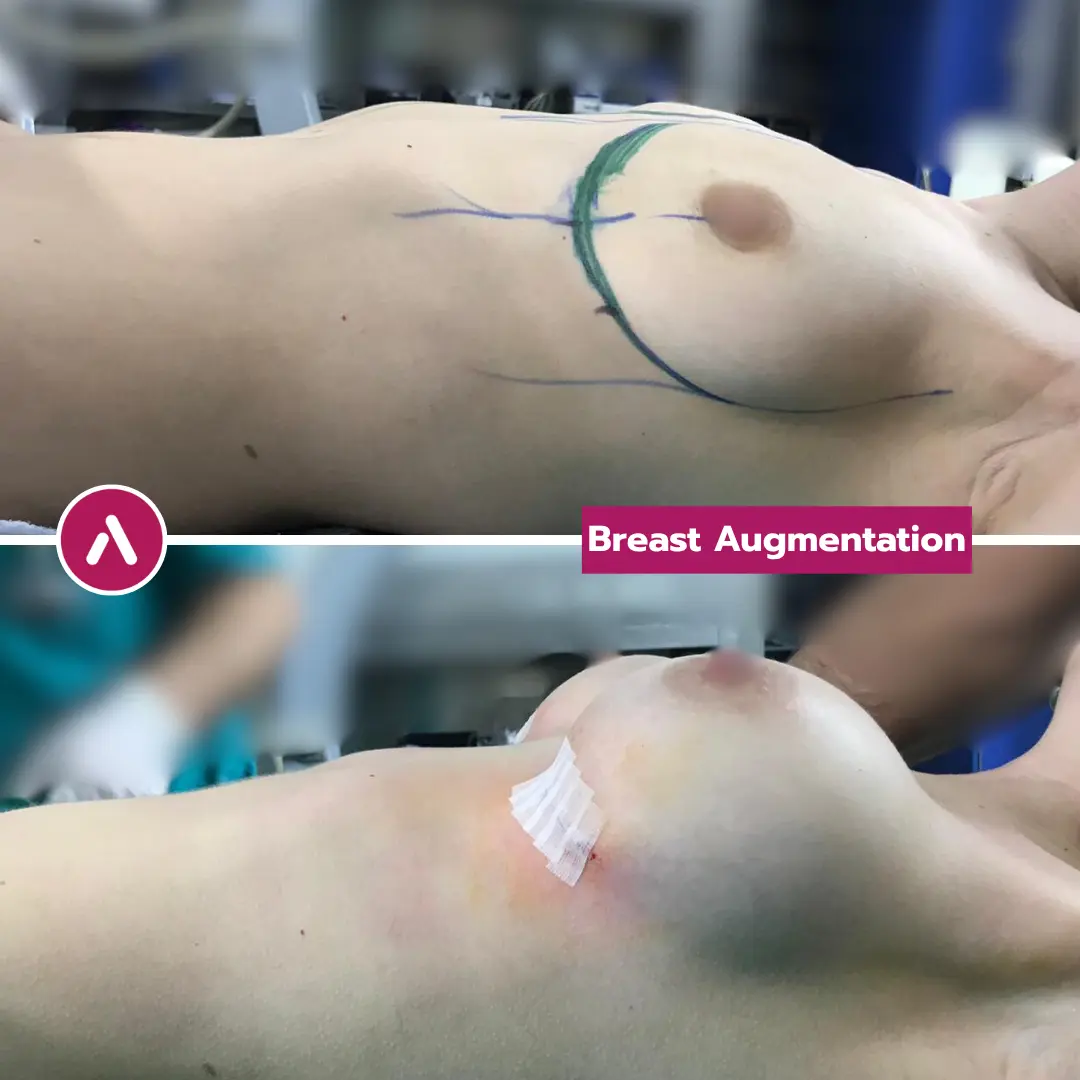
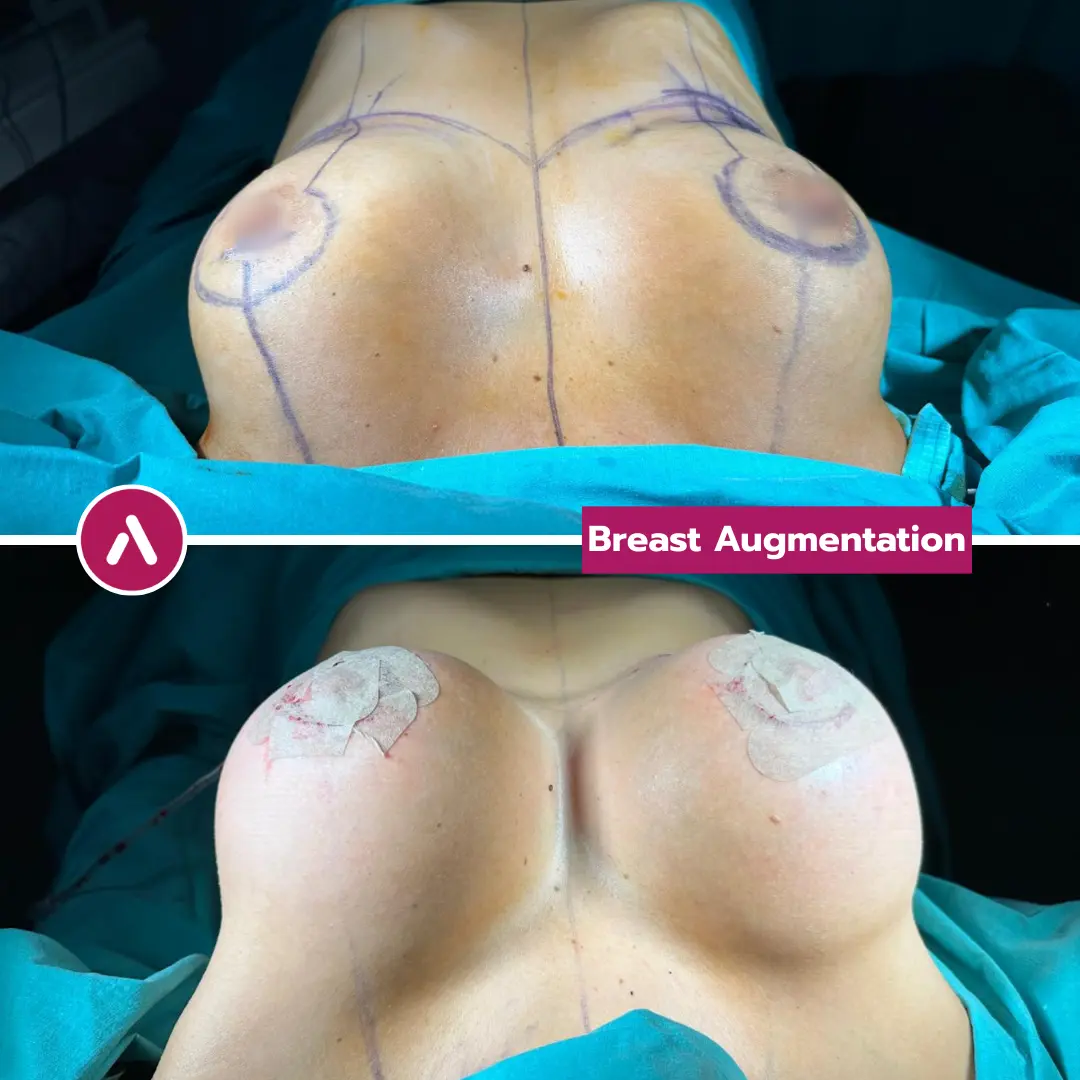
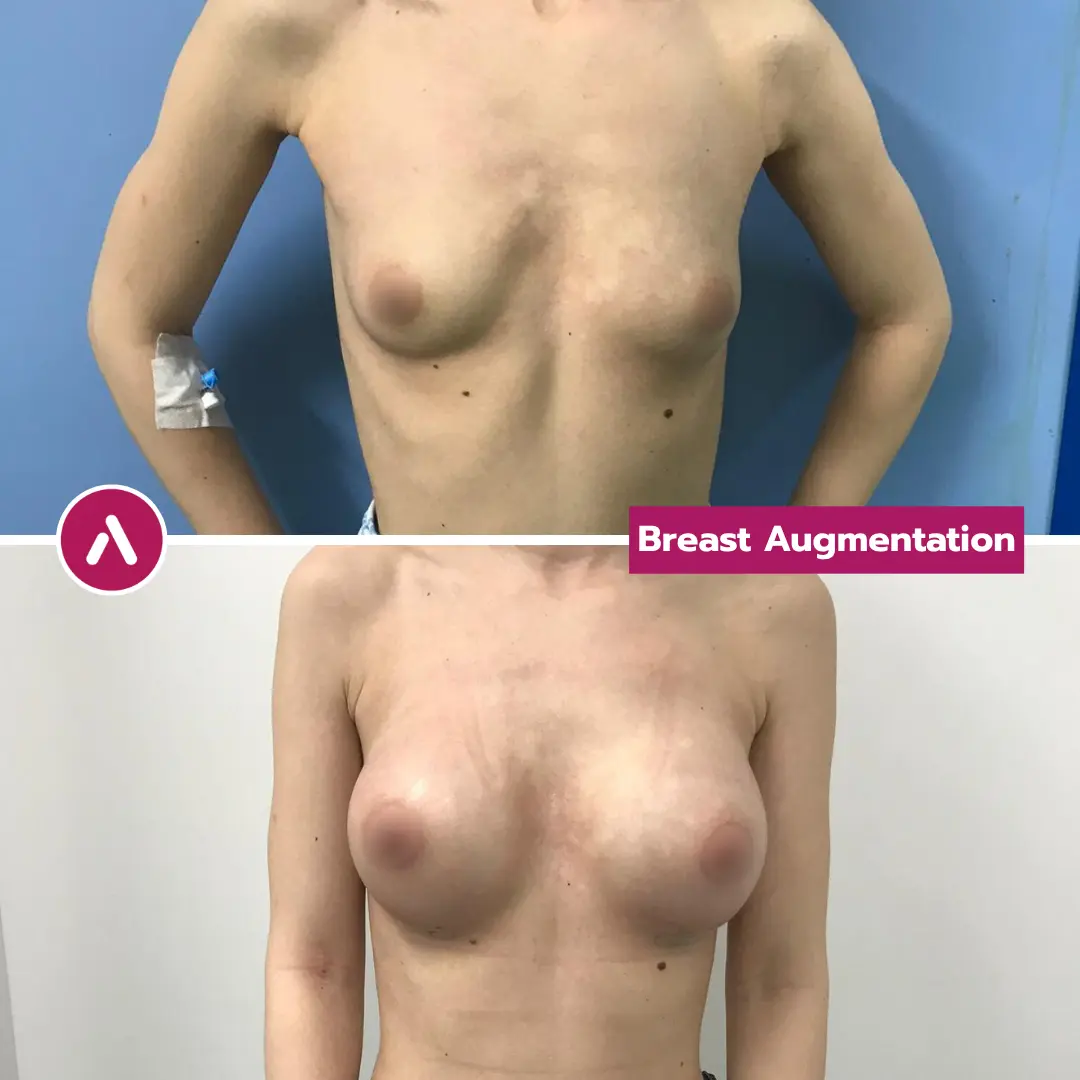
From the perspective of medical science, revision surgery is more nuanced than first-time augmentation because the surgeon must work with existing scar tissue, previous implant pockets, stretched skin, and changing breast anatomy over time. Good outcomes depend on careful assessment, realistic planning, and a consultant-led strategy focused on safe correction rather than simply replacing one implant with another.
Table of Contents

Why Women Consider Breast Implant Revision
Breast implant revision can be requested for cosmetic, functional, or medical reasons. Some women are happy with their original surgery for years before their priorities change. Others begin to notice discomfort, asymmetry, firmness, or an unnatural appearance that makes them consider corrective breast surgery. In many cases, the goal is not a dramatic transformation, but a more balanced and comfortable result that suits the body today rather than the body of ten years ago.
Breast implant revision calls for a surgeon with focused experience in secondary and corrective surgery. The presence of scar tissue, altered implant pockets, and changing breast anatomy means that revision cases often require more careful planning than primary augmentation, with the aim of restoring comfort, proportion, and a natural-looking result.
Common Reasons for Revision After Previous Breast Augmentation
There are several reasons a woman may seek changing breast implants after an earlier augmentation. Sometimes the implants have simply aged and the patient wants reassurance, a shape update, or a more contemporary result. In other situations, the issue is more specific, such as hardening around the implant, implant malposition, visible rippling, or disappointment with the original size.
Common reasons include:
- Capsular contracture revision when scar tissue around the implant becomes tight or firm
- Rippling breast implants correction when implant edges become visible or palpable
- A desire for a different volume through upsizing breast implants or downsizing
- Implant displacement, asymmetry, or bottoming out
- Changes after pregnancy, breastfeeding, or weight fluctuation
- A wish to remove implants completely and return to a lighter, more natural profile
For UK patients, these concerns are rarely superficial. They are often tied to day-to-day comfort, clothing fit, body confidence, and the worry that older implants no longer reflect their lifestyle or aesthetic preferences.
When Size, Shape, or Symmetry No Longer Feels Right
A result that once felt ideal can become less satisfying over time. Breasts may appear lower, wider, emptier at the top, or less even than before. This does not always mean that something has “gone wrong”; sometimes it reflects natural tissue changes, skin laxity, hormonal shifts, or the ageing process.
In these cases, breast implant replacement may be considered if the patient still wants upper pole fullness or improved projection. Alternatively, some women prefer a more understated outcome and choose smaller implants or explant surgery instead. The key question is not merely whether the implants can be changed, but which surgical plan will create a result that looks proportionate on the patient’s frame.
This is especially important for British patients who often prefer a subtle, elegant shape rather than an overly augmented look. A carefully planned implant exchange can improve balance, projection, and symmetry without making the chest appear too round or artificial.
Why Some UK Patients Choose Revision Instead of Living with Discomfort
Many women delay revision for months or even years because they assume discomfort or dissatisfaction is something they should simply tolerate. In reality, persistent tightness, breast firmness, visible distortion, or recurrent self-consciousness are all valid reasons to seek assessment.
For some, revision is about physical relief. For others, it is about emotional relief after living with a result that never felt quite right. This is one reason why breast implant revision in Turkey has become a topic of interest for UK patients comparing quality, surgeon expertise, aftercare, and value in GBP terms. When performed for the right reasons and with the right plan, revision surgery can be both corrective and restorative.
Upsizing vs Removal: Which Option Is Right for You?
One of the most important questions in revision planning is whether to keep implants and change them, or remove them altogether. There is no universally “better” option. The right choice depends on your current anatomy, skin quality, implant history, lifestyle, and personal goals. A well-planned revision should reflect what you want your breasts to look and feel like now, not what you wanted many years ago.
Who May Benefit from Larger Implants
Secondary breast augmentation may be the right path for women who still like the idea of implants but feel that their current volume is no longer proportionate. This can happen after pregnancy, breastfeeding, weight loss, or when the original implants were conservative and no longer provide the desired upper fullness.
Upsizing breast implants may be considered when:
- The breasts have lost fullness in the upper pole
- The patient wants more projection while keeping a natural silhouette
- The current implants feel too small for the chest width or body proportions
- There is asymmetry that may be improved with revised implant selection
However, larger is not always better. A responsible plan must consider tissue support, skin stretch, nipple position, and long-term implant behaviour. The aim should be a proportionate result rather than a short-term increase in size that may create more weight and tissue strain later.
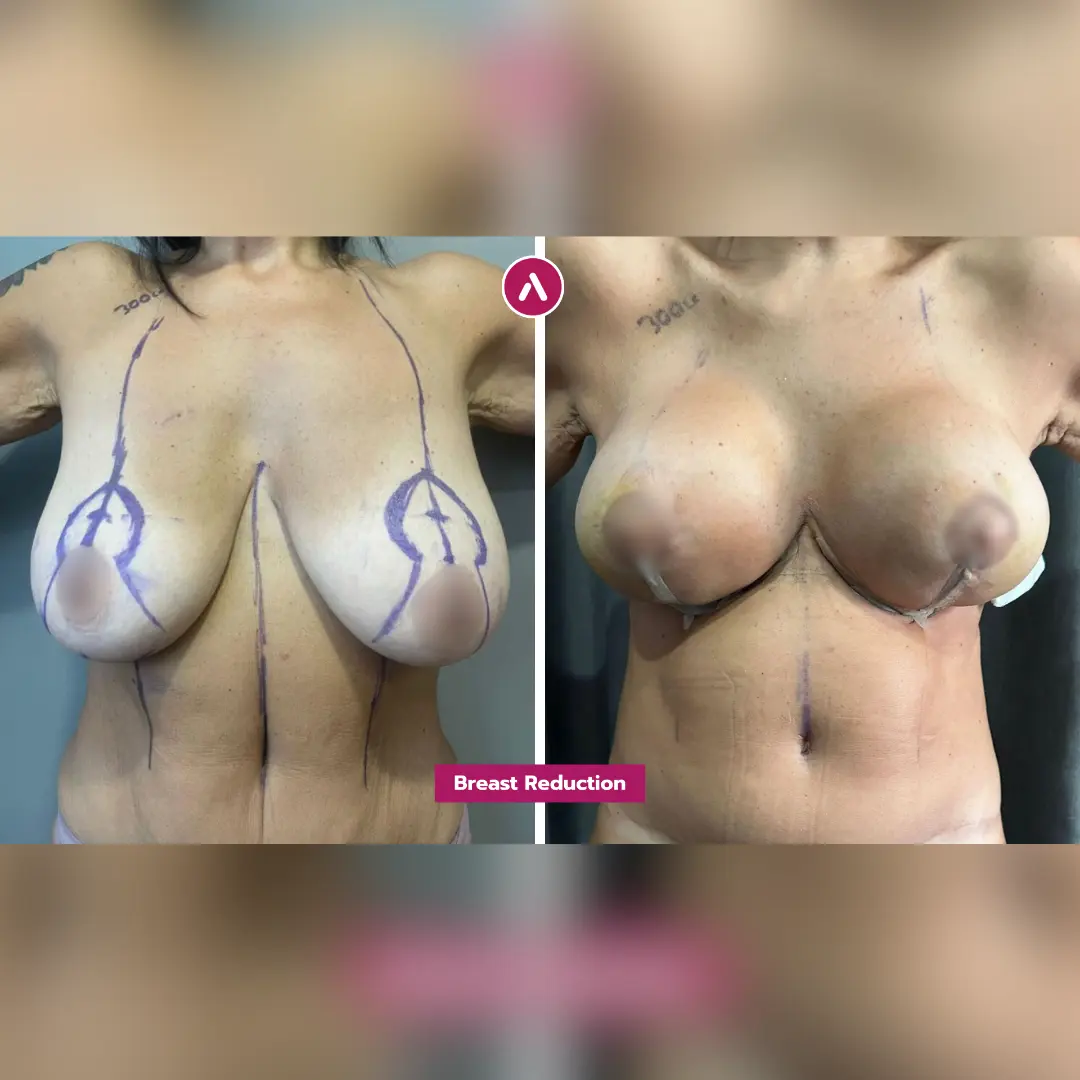
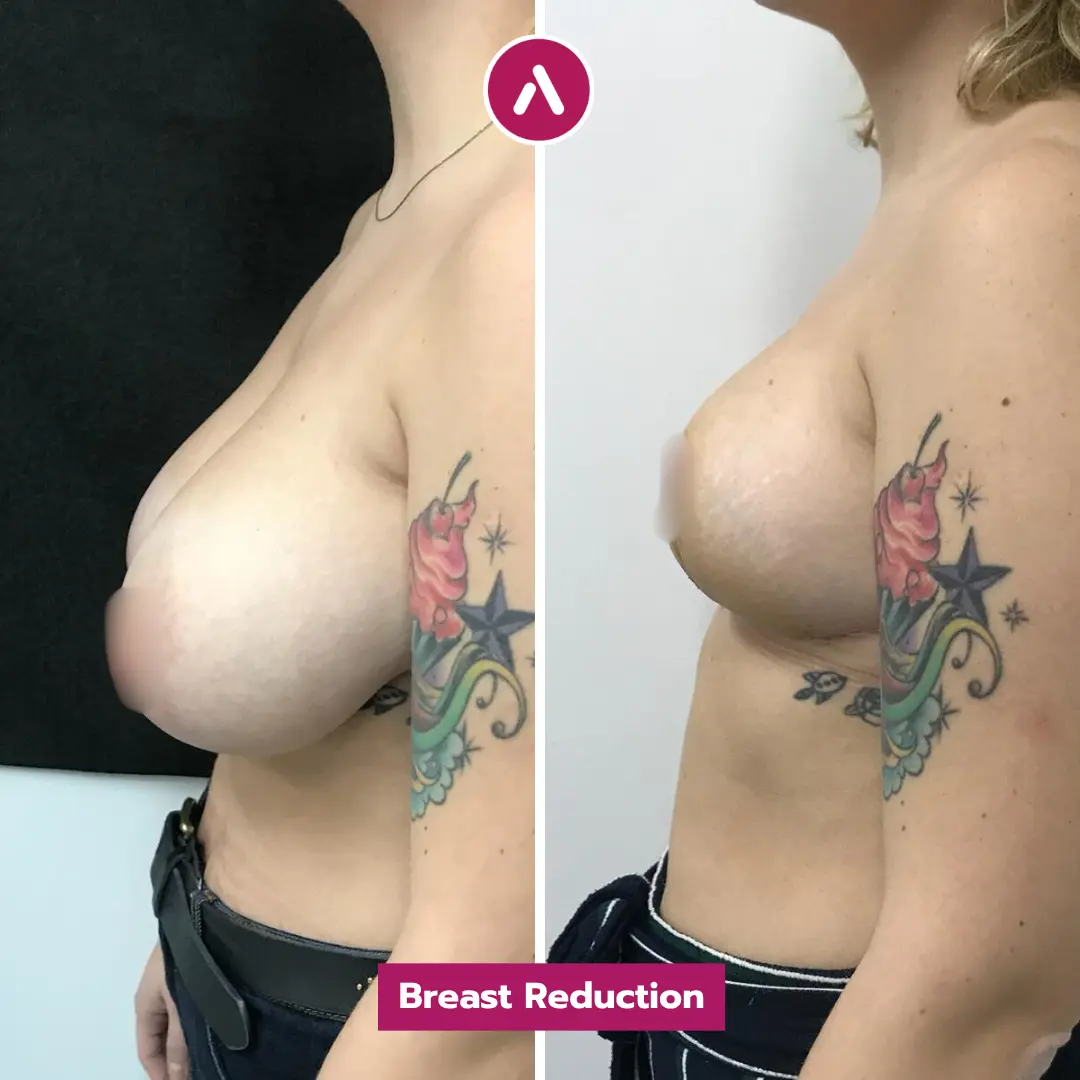
When Implant Removal May Be the Better Long-Term Choice
Some women reach a point where they no longer want implants at all. They may prefer lighter breasts, less maintenance, or a more natural appearance. In these cases, breast explant surgery may be a more suitable option than further implant replacement.
Removal may be especially appropriate when:
- The patient has recurrent capsular contracture
- The implants feel too heavy or uncomfortable
- There is visible rippling or thinning tissue
- The patient wants to avoid ongoing future implant exchanges
- Her aesthetic preference has shifted towards a smaller, softer look
Some patients also ask specifically about en bloc capsulectomy. This term is often discussed online, but it is not automatically required in every case. The most appropriate capsule management technique depends on the condition of the implant, the capsule, the surrounding tissue, and the surgical objective. A good surgeon will explain when a capsulectomy, partial capsule removal, or another approach is clinically justified rather than using dramatic terminology as a sales point.
Can You Combine Explant Surgery with a Breast Lift for a Better Shape?
Yes, in many cases implant removal can be combined with a breast lift if the goal is to improve breast position and shape after the implant is taken out. This is often a very important part of planning, because removal alone may leave loose skin or a deflated appearance, particularly if the implants were large or had been in place for many years.
A lift can help reshape the natural breast envelope, reposition the nipple, and create a more youthful contour without reintroducing an implant. For women who want a lighter chest but still want elegant shape, this can be one of the most satisfying forms of corrective breast surgery.
From a tissue-behaviour perspective, the final shape after explant depends on several factors: original breast volume, implant size, skin elasticity, pregnancy history, and the degree of stretching over time. This is why personalised planning matters so much in breast revision surgery.
Signs It May Be Time to Replace or Remove Your Implants
Not every change means revision is urgently needed, but certain signs should prompt a proper surgical review. Some are aesthetic and develop gradually, while others are more physical and noticeable in daily life. The earlier a problem is assessed, the easier it is to plan the safest and most appropriate solution.
Breast implant concerns benefit from early expert review. Small changes in shape, softness, or position can sometimes point to deeper structural issues, and identifying them early helps create a safer, more precise treatment plan before the problem becomes more complex.
Changes in Breast Shape, Firmness, or Position
If the breasts begin to look uneven, sit lower than before, or feel firmer on one side, it may be time to consider a revision assessment. These changes can happen slowly and may be linked to tissue stretch, implant movement, or scar capsule changes. Even when the implants are intact, the result may no longer look balanced or natural.
Women often describe this stage as a feeling that their breasts “do not sit properly anymore”. That instinct is worth listening to. Revision is not only for obvious complications; it is also for results that have drifted away from what feels comfortable and aesthetically right.
Capsular Contracture, Rippling, and Other Implant-Related Concerns
Two of the most common clinical concerns are capsular contracture revision and rippling breast implants correction. Capsular contracture occurs when scar tissue around the implant tightens and can make the breast feel firm, look distorted, or become uncomfortable. Rippling refers to visible or palpable folds in the implant, which may be more noticeable in thinner patients or in certain implant positions.
Other issues that may lead patients to enquire about breast implant revision include:
- Implant malposition
- Bottoming out
- Lateral displacement
- Double bubble deformity
- Unnatural upper fullness
- Progressive asymmetry
These problems are rarely solved well by guesswork. They require structured analysis of the pocket, implant type, tissue thickness, and scar capsule behaviour before deciding whether implant exchange surgery, explant, or lift-based correction is best.
How Ageing, Weight Changes, and Pregnancy Can Affect Old Implants
Breasts continue to change even when implants remain the same. Ageing can reduce skin elasticity, pregnancy can stretch the breast envelope, and weight changes can alter the relationship between implant volume and natural tissue. A result that once looked balanced may begin to look too full, too low, or too artificial for the body as it changes.
This is why many women start exploring changing breast implants years after being perfectly happy with their original augmentation. In some cases, breast implant replacement offers a good route to restore proportion. In others, implant removal with or without lift may better reflect the patient’s current lifestyle and aesthetic priorities.
| Concern | Possible Revision Direction | Main Goal |
|---|---|---|
| Implants feel too small after body changes | Upsizing / implant exchange | Restore fullness and projection |
| Firmness or distortion | Capsular contracture revision | Improve softness, comfort, and shape |
| Visible rippling | Rippling correction with exchange or pocket adjustment | Create smoother contours |
| Heavy or unwanted implants | Explant with or without lift | Lighter, more natural breasts |
| Breast droop after pregnancy or ageing | Exchange plus lift or explant plus lift | Improve position and shape |

How Breast Implant Revision Surgery Is Planned
Successful breast implant revision begins long before the day of surgery. Unlike first-time augmentation, revision planning must take into account the existing implant pocket, scar tissue, skin quality, breast position, and the changes that have happened over time. Whether the goal is breast implant replacement, implant exchange surgery, or breast explant surgery, the safest approach is always a personalised, consultant-led plan rather than a generic package.
Breast implant revision depends on specialist judgement rather than routine decision-making. Each case involves a careful balance of anatomy, long-term tissue support, implant history, and patient goals, which is why tailored planning is essential for achieving a safe, proportionate, and natural-looking outcome.
What Happens During Your Consultant-Led Assessment
A proper consultation for breast revision surgery should be detailed and clinically structured. The surgeon will usually review your original surgery history, implant size if known, how long the implants have been in place, any symptoms such as firmness or discomfort, and whether your aesthetic goals have changed. The breasts are then examined for symmetry, tissue thickness, skin stretch, implant position, nipple level, and signs of capsule-related problems.
When clinically indicated, imaging may also be discussed to better understand implant condition and surrounding tissue. This is particularly important when the patient is considering changing breast implants after many years or has concerns about distortion, asymmetry, or capsular contracture. A high-quality assessment is not about steering every patient towards more surgery; it is about deciding which option is actually appropriate.
For UK patients, this stage is often where trust is either built or lost. Clear explanations, realistic expectations, and a willingness to explain what is possible — and what is not — matter just as much as technical skill.
Choosing Between Implant Exchange, Explant, or Explant with Lift
There are several routes within corrective breast surgery, and the right one depends on both anatomy and intention. Some women still want volume, projection, and cleavage, but in a more proportionate or updated form. Others want to remove the implants entirely and avoid further maintenance. A third group wants the implants removed but also needs reshaping, which is where a lift can play an important role.
- Implant exchange may be suitable if you still want augmentation but need a different size, profile, pocket correction, or implant type.
- Explant surgery may be the better option if you want lighter breasts, less maintenance, or a more natural result without implants.
- Explant with lift may be recommended if implant removal alone would leave excess skin, nipple descent, or loss of shape.
This is also the stage where terms such as capsular contracture revision and en bloc capsulectomy are often discussed. It is important to approach these terms carefully. An en bloc capsulectomy is not a routine requirement for every revision case. The decision depends on the implant, the capsule, the surrounding tissue, and the clinical reason for surgery. In responsible practice, the surgical method should follow the indication — not online trends or fear-based marketing.
How Surgeons Aim for Natural, Proportionate Results for UK Patients
Many British patients do not want a dramatically augmented result. They want breasts that look balanced in clothing, feel more comfortable, and sit naturally on the chest. That is why planning for secondary breast augmentation or revision should focus on proportion, tissue support, and long-term stability rather than simply choosing a bigger implant.
When upsizing breast implants is being considered, the surgeon must assess whether the breast tissue can support the additional volume safely. Going larger without respecting tissue limits can increase the risk of stretching, visible implant edges, bottoming out, or a result that appears too heavy. Likewise, when moving towards a smaller implant or removal, the surgeon must consider how to preserve feminine shape and avoid an emptied look.
The best revision outcomes usually look less obvious, not more. For UK patients especially, a successful result often means that the breasts look elegant, proportionate, and age-appropriate rather than noticeably “done”.
“Knowing there was a UK based patient contact point and a London correspondence address provided immense psychological comfort.”— Based on a UK patient aftercare testimonial
Breast Implant Revision Recovery: What UK Patients Should Expect
Recovery after breast implant revision depends on what is actually performed. A straightforward implant exchange is often easier than a complex correction involving capsule work, pocket repair, or a breast lift. For that reason, recovery should always be explained according to the real surgical plan rather than a generic estimate copied from first-time augmentation. Good aftercare is especially important for UK patients who want to travel home safely and feel supported once they return.
Recovery also benefits from specialist planning and close follow-up. The extent of swelling, discomfort, mobility restrictions, and travel readiness can vary significantly depending on the complexity of the surgery, which is why personalised aftercare is essential for a safe and reassuring return to normal daily life.
The First Days After Surgery: Discomfort, Swelling, and Support Garments
In the early days after surgery, it is normal to experience tightness, swelling, bruising, and a sense of pressure across the chest. The extent of this varies depending on whether the procedure involved a simple exchange, significant capsule removal, or explant with lift. Most patients are mobile early, but they still need to rest sensibly and avoid unnecessary strain.
Support garments are usually recommended to help control swelling and maintain the new breast position during early healing. Patients are also advised to sleep as directed, avoid sudden upper body movements, and take prescribed medication exactly as instructed. For UK readers, it is worth noting that routine discomfort is often managed with standard post-operative medication such as paracetamol alongside the clinical plan provided by the surgeon.
Where clinically appropriate, advanced recovery support may also be part of the wider patient journey. At AKM Clinic, recovery technologies such as HBOT are used to help manage post-operative oedema, while LLLT is used to support scar quality. Whilst no device replaces meticulous surgery, the principles behind these treatments are aligned with what scientific research and wound-healing medical science suggest about tissue oxygenation, fibroblast activity, and recovery support.
When You Can Return to Daily Life, Work, and Exercise
Most patients can return to light day-to-day activities relatively soon, but revision surgery still requires patience. The body needs time to settle, and the breast shape can continue to refine for weeks and months. If the operation included more complex tissue work, the timeline may be longer than with a simple implant swap.
In practical terms, patients are usually guided through recovery in stages:
- Light walking: encouraged early to support circulation
- Desk-based work: often possible sooner than physically demanding work, depending on comfort and the exact procedure
- Driving and daily independence: resumed only when movement is comfortable and medication allows
- Exercise and lifting: delayed until the surgeon confirms tissues are healing appropriately
This gradual return matters because overdoing activity too early can increase swelling, discomfort, and pressure on healing tissues. Patients who have had rippling breast implants correction, internal pocket repair, or lift-based reshaping should be especially careful not to judge the final result too soon.
Flying Back to the UK and the Importance of Structured Aftercare
For British patients travelling abroad, the question is not simply “When can I fly?” but “When is it clinically sensible for my recovery?” The answer depends on the extent of surgery, how you are healing in the first days, and whether additional procedures such as capsulectomy or a lift were performed. Safe travel planning should always be confirmed by the treating surgeon after assessment, not assumed in advance.
This is where structured aftercare becomes a major trust factor. Patients need clear discharge instructions, easy access to the clinic, and a realistic plan for follow-up after returning home. A strong international patient pathway should include direct communication, remote check-ins, and a UK-accessible support route rather than leaving the patient to manage concerns alone.
For many women, this support is what turns a good surgical result into a reassuring overall experience. That is one reason why patients comparing breast implant revision options in Turkey often look beyond the operation itself and examine whether the clinic offers transparent guidance, reliable follow-up, and genuine continuity of care after the flight home.
| Recovery Stage | What You May Notice | What Matters Most |
|---|---|---|
| First few days | Tightness, swelling, bruising, fatigue | Rest, support garment use, medication, gentle movement |
| Early settling phase | Breasts may sit high or feel firm | Patience and close adherence to instructions |
| Return to routine | Improving comfort and mobility | Avoid rushing exercise or heavy lifting |
| After returning to the UK | Questions about symmetry, swelling, or scar care | Reliable aftercare communication and review |
Breast Implant Revision Cost: UK Private Clinics vs Istanbul
The cost of breast implant revision is one of the main reasons UK patients compare private treatment in London with treatment abroad. However, price alone should never drive the decision. Revision surgery is more complex than first-time augmentation, so the real question is not simply “Where is it cheaper?” but “Where can I receive safe, consultant-led care, clear planning, and transparent value?” For many women, the appeal of breast implant revision in Turkey lies in combining clinical quality, structured aftercare, and more accessible pricing in GBP terms.
Why Revision Surgery Costs More Than First-Time Breast Augmentation
Breast revision surgery usually costs more than primary augmentation because the surgeon is not starting with untouched anatomy. Instead, they may need to manage old scar tissue, revise the implant pocket, correct asymmetry, address stretched skin, or perform a lift at the same time. If the patient also needs capsular contracture revision, rippling breast implants correction, or more complex capsule work, the procedure becomes more technically demanding.
In practical terms, higher revision costs often reflect:
- Longer operating theatre time
- Greater surgical complexity
- The need for more advanced planning and pocket correction
- Additional procedures such as a breast lift or capsulectomy
- Closer aftercare requirements compared with first-time augmentation
This is why patients researching secondary breast augmentation or implant removal should be cautious about unusually low quotes. Revision work requires experience and precision, and those factors matter far more than headline discounts.
Harley Street vs Istanbul: Understanding the GBP Price Difference
For British patients, the biggest contrast is often between high-overhead UK private practice — especially London and Harley Street — and a well-organised Istanbul treatment pathway. The reason for the difference is not necessarily that the surgery itself is “less serious” abroad. In many cases, the gap reflects operating costs, staffing structures, clinic overheads, and the way international packages are organised.
Patients comparing breast implant replacement in Turkey with UK private care are often looking for:
- More transparent package pricing in GBP (£)
- Clear inclusion of accommodation and transfers
- Direct communication before and after surgery
- A consultant-led plan rather than a sales-led process
| Cost Factor | Typical UK Private Clinic Focus | Typical Istanbul All-Inclusive Focus |
|---|---|---|
| Surgeon and clinic overheads | Higher London operating costs | Often more cost-efficient structure |
| Accommodation and transfers | Usually separate | Often built into the package |
| Pre-op and post-op logistics | Patient may organise parts independently | Commonly coordinated as one pathway |
| Quote clarity | May require item-by-item review | Often presented as an all-inclusive figure |
| Overall value consideration | Convenience of staying in the UK | Potentially stronger price-to-service ratio |
The important point is that “better value” is not the same as “cheap”. British patients tend to respond best when the clinic presents Istanbul not as a bargain-basement alternative, but as a route to high-quality treatment with a more sensible overall cost structure than Harley Street.
What Should Be Included in an All-Inclusive Quote
If you are comparing implant exchange surgery or breast explant surgery packages in Turkey, the quote should be specific and easy to understand. A trustworthy clinic should explain exactly what is included and what may be charged separately if your surgery turns out to be more complex than expected.
A well-structured all-inclusive quote should clarify:
- Surgeon fees
- Hospital or operating theatre fees
- Anaesthesia costs
- Pre-operative tests
- Implants, if replacement is planned
- Accommodation and local transfers, if offered
- Post-operative checks and early aftercare
- Whether additional lift surgery or capsule work changes the final price
For UK patients, transparency is a major trust signal. Hidden costs undermine confidence very quickly, especially in revision cases where the patient may already be emotionally cautious because of a disappointing prior result.
How to Choose a Safe Clinic for Breast Implant Revision
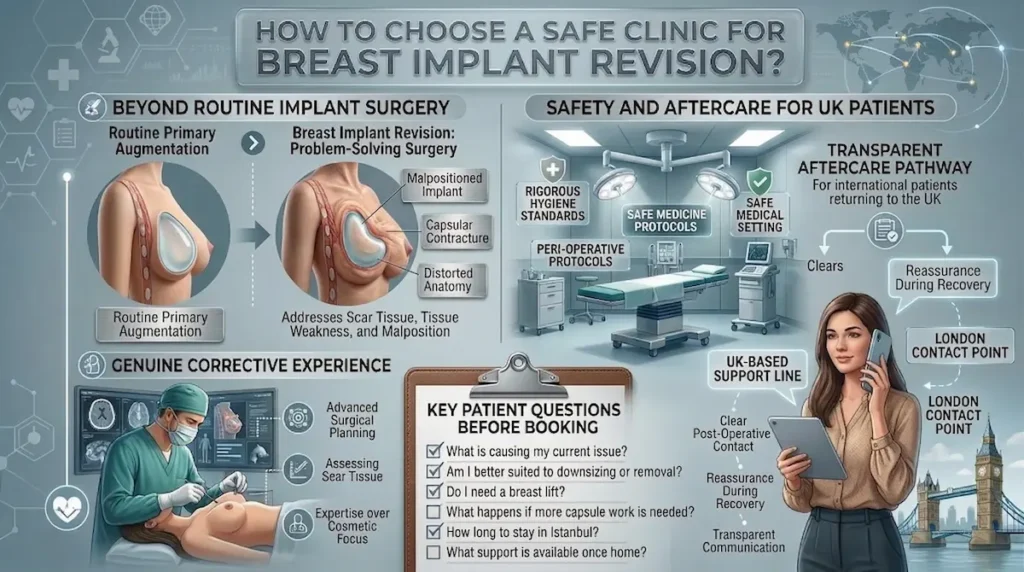
Choosing the right clinic for corrective breast surgery matters more than choosing the lowest quote or the fastest available date. Revision surgery is not routine implant replacement; it is problem-solving surgery. That means patients should assess the clinic’s communication style, the surgeon’s revision mindset, the safety standards of the operating environment, and the quality of aftercare for international patients returning to the UK.
Breast implant revision demands a clinic with genuine corrective experience rather than a routine cosmetic focus. The ability to assess scar tissue, implant-related changes, surgical planning, and long-term aftercare is what separates a safer revision pathway from a rushed or overly commercial approach.
Why Revision Surgery Requires Experience, Not Just Routine Implant Surgery
A surgeon who performs primary breast augmentation is not automatically the right fit for difficult revision work. Revision cases often involve scar tissue, altered anatomy, implant pocket distortion, soft tissue weakness, or a breast shape that no longer responds predictably to standard techniques. A safe surgeon must be able to explain not only what they plan to do, but why that approach is suitable for your particular anatomy.
This is particularly important when the case involves:
- Capsular contracture revision
- Recurrent implant displacement
- Rippling breast implants correction
- Combined explant and lift planning
- Concerns around capsule removal, including discussion of en bloc capsulectomy
Patients should also consider the wider clinical environment. A revision procedure should take place in a properly managed medical setting with rigorous hygiene standards and clear peri-operative protocols. For UK readers, that means looking for an operating-theatre culture that reflects the seriousness you would expect from a reputable private hospital pathway.
Questions UK Patients Should Ask Before Booking Abroad
A good consultation should welcome detailed questions. In fact, a cautious patient often makes a safer patient. When researching breast implant revision in Turkey, it is wise to ask direct questions that reveal how thoughtfully the clinic approaches revision rather than standard sales conversion.
Helpful questions include:
- What exactly is causing my current problem: implant position, capsule, tissue stretch, or a combination?
- Am I better suited to changing breast implants, downsizing, or removal?
- Do I need a lift as part of the correction?
- What happens if more capsule work is needed than expected?
- How long should I stay in Istanbul before flying back to the UK?
- What support is available once I am home?
- What does the quote include, and what could increase the price?
These questions are especially relevant for British patients influenced by negative media stories about surgery abroad. A safe clinic should answer calmly, clearly, and without pressure.
The Value of UK Support Lines, Transparent Communication, and Aftercare
For many UK patients, trust is built through communication as much as through credentials. International surgery feels far less risky when the patient knows there is a clear line of contact before travel, during recovery in Istanbul, and after returning home. This is why practical trust signals matter so much: a UK support line, a UK based patient contact point, and a London correspondence address all help reduce the psychological distance between patient and clinic.
Transparent aftercare is equally important. The patient should know who to contact if swelling changes, if a dressing issue arises, or if they simply need reassurance about normal healing. This level of access matters even more in revision surgery, where patients may already have heightened anxiety because of a previous unsatisfactory experience.
“The lifeline of support after returning home made a real difference. Knowing there was an easy route for contact provided reassurance throughout recovery.”— Adapted from a UK patient aftercare journey
In other words, safe breast implant revision is not only about what happens in theatre. It is also about how securely the patient is guided through the entire journey, from consultation to travel planning to follow-up once back in the UK.
Frequently Asked Questions (FAQ): Breast Implant Revision
These are some of the most common questions British patients ask when comparing breast revision surgery, implant exchange, and explant options. The answers below are intentionally concise and written to support decision-making without unrealistic promises.
How long do breast implants usually last before revision is needed?
Is breast implant revision more difficult than first-time augmentation?
Will my breasts look flat after implant removal?
Do I need a breast lift when removing implants?
Can I go larger and still keep a natural look?
How long should I stay in Istanbul after breast implant revision?
When can I safely fly back to the UK after surgery?
If you would like to explore related topics in more detail, you may also find useful information on Tummy Tuck Revision, Scar Revision Surgery in Turkey, How to Prepare for Cosmetic Surgery, Questions to Ask Plastic Surgeon, Specialist Plastic Surgeon Turkey, Ghost Surgery in Turkey, Online Plastic Surgery Consultation, and Surgery Companion in Turkey. These guides can help you better understand your options, compare procedures, and plan a safer, more informed treatment journey as a UK patient considering surgery in Turkey.
Medical Disclaimer: This page is provided for general educational purposes only and does not replace a face-to-face medical consultation, diagnosis, or personalised treatment plan. All surgery carries risks and outcomes vary between individuals. Suitability for breast implant revision surgery, procedure selection, and anaesthesia choice can only be determined after a full clinical assessment by a qualified surgeon. Always follow your clinician’s instructions and seek urgent medical attention if you develop concerning symptoms during recovery.
Related Treatments



Ready to Begin Your Own Transformation Journey?
Join the 2,000+ patients who have trusted Dr Akif Mehmetoğlu and the AKM Clinic team. Your journey to a more confident, naturally restored you begins with a simple, no-obligation conversation. Contact us today from the UK for your free virtual consultation.
#1: Get Your Free Personalised Quote
Start with a free, no-obligation online consultation. Share your photos, and our surgical team will provide a fully personalised treatment plan and a transparent, all-inclusive price package. There are no hidden fees.
#2: Secure Your Date & VIP Booking
Once you are ready, our dedicated patient coordinators will help you secure your procedure date. We will handle all your bookings, including your 5-star hotel accommodation and private VIP airport transfers.
#3: Arrive in Istanbul & Meet Your Surgeon
Arrive at Istanbul Airport (IST) and be greeted by your private driver. Settle into your hotel and prepare for your in-person consultation, where you will meet your specialist surgeon to finalise the details for your "natural, subtle, and restored" new look.