
Crown Hair Transplant: Why the Vertex Is Harder to Restore
AI Summary
- Crown hair transplant is more complex because vertex whorls need precise angle and swirl design.
- Realistic density planning prioritises social fullness, natural blending and long-term donor preservation.
- Future hair loss matters; careful staging helps avoid unnatural crown patterns as native hair thins.
- Costs vary by graft plan; personalised assessment is safer than judging by graft numbers alone.
AI-generated summary, fact-checked by our medical experts.
A crown hair transplant is harder than a frontal hair transplant because the crown grows in a spiral pattern, covers a wider circular area, and needs careful graft distribution from every angle. The realistic goal is usually natural “social fullness”, not the dense look of a non-balding scalp.
For many men, the crown is the area that bothers them most in photographs, lifts, changing-room mirrors, and overhead lighting. It is also one of the easiest areas to underestimate. A thinning vertex can look small from the front, then appear much larger once the hair is wet, parted by a barber, or viewed from above.
That is why a crown hair transplant needs a different mindset from a hairline transplant. The front frames the face. The crown must recreate a rotating pattern over a curved surface while protecting the donor supply for the future. At AKM Clinic, crown planning is assessed as part of a wider FUE hair transplant in Turkey strategy, not as a stand-alone patch.
This guide explains why the vertex is technically demanding, why it often needs more grafts than patients expect, and why honest density planning matters more than chasing an artificial “carpet” effect.
Table of Contents
Why the Crown Is Harder to Restore
The crown is not difficult because surgeons “cannot” transplant it. It is difficult because the area behaves differently from the frontal scalp. Hair in the vertex changes direction, curves around a whorl, and sits on a rounded surface that catches light from above. Small planning errors show quickly.
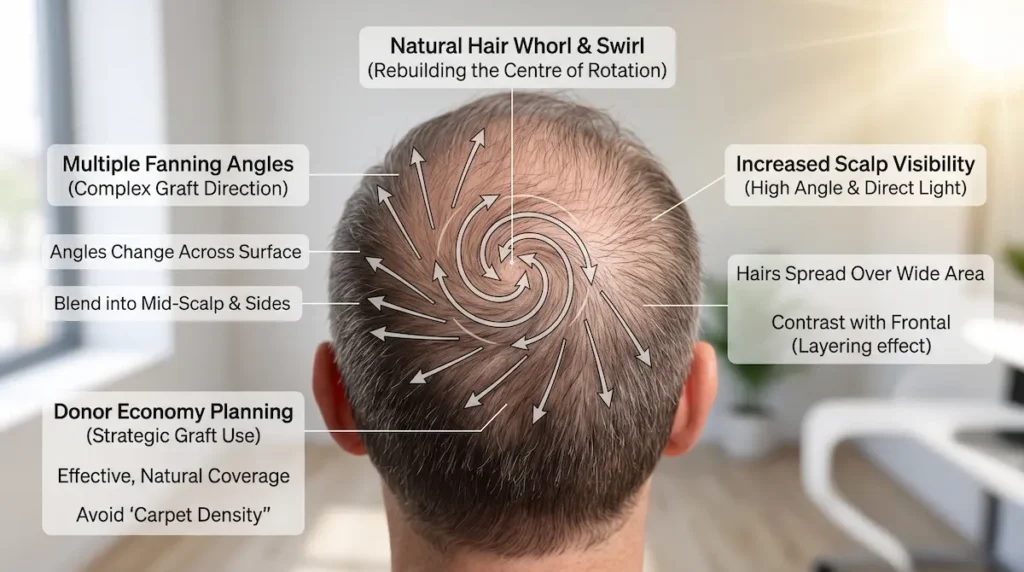
In the hairline, grafts are mostly angled forward and slightly sideways to frame the face. In the crown, grafts need to fan out in several directions at once. That makes every slit angle, density decision, and transition zone more important.
The whorl and swirl growth pattern
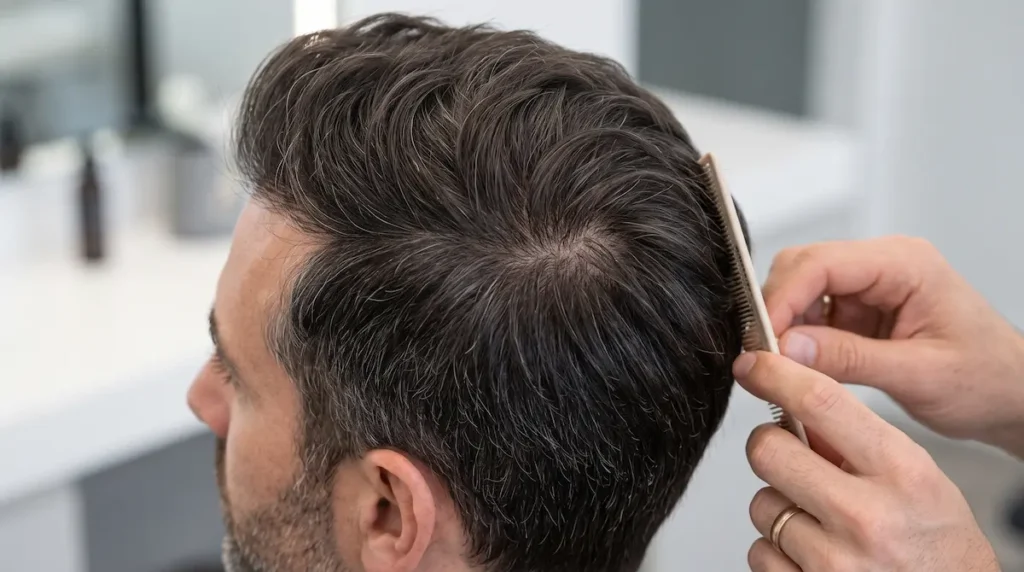
The crown usually has a natural whorl: a spiral where hair rotates clockwise, anticlockwise, or occasionally forms a double swirl. This is not just a cosmetic detail. It is the blueprint for a natural-looking result.
If grafts are placed without respecting that swirl, the crown can look “brushed on”, flat, or obviously transplanted. The result may grow, but the direction can look wrong. A hair loss patient may not notice it in the mirror at first. Someone standing behind him might.
A good crown plan maps the existing whorl before any graft is placed. Even when the crown is mostly bald, the surrounding miniaturised hairs often give clues about the original direction. The surgeon then uses that direction to rebuild the centre of rotation and blend outward.
Why angles are harder than the front
Angle control is the reason crown work separates ordinary graft placement from real hair restoration design. The crown does not have one universal direction. Near the centre, hairs lie flatter and rotate. Moving away from the centre, they start to blend into the mid-scalp and sides.
That means the same crown may require several angle changes across a small surface. A few degrees matter. Too upright, and the grafts can stand out under bright light. Too dense in the wrong direction, and the result can look heavy rather than natural.
AKM planning principle: Crown restoration is a donor-economy procedure. The aim is natural coverage that works in real life, not artificial carpet density that spends too many grafts too early.
Why the crown often shows more scalp
Even after a successful transplant, the crown can show more scalp than the front. This is partly because of geometry. The vertex is viewed from above, where light hits directly and separates the hairs visually. The front, by contrast, is usually viewed face-on, with hairs layered over each other.
The crown also spreads grafts across a wider circular area. The same number of grafts that creates a strong frontal frame may look modest in the vertex. This is why honest pre-operative planning is essential. A realistic crown result can look excellent in conversation, on video calls, and in everyday movement, while still appearing thinner in harsh overhead lighting.
Discover If a Hair Transplant Is Right for You
Share your photos and medical history to receive a personalised assessment from our European Board-certified facial surgery team.
The Graft Density Problem
The crown asks a difficult question: how much of a limited donor supply should be used on an area that is large, circular, and often still changing? The answer is rarely “as many as possible”. More grafts can improve coverage, but overusing the donor area can create bigger problems later.
StatPearls’ NIH/NCBI overview of hair transplantation warns that treating the vertex too aggressively can use donor grafts prematurely and may create an unnatural “doughnut” appearance if surrounding native hair continues to thin. That is why crown planning must look beyond this year’s bald spot and consider the next decade of hair loss.
The crown is a large circular area
The crown can look like a small patch because it sits at the back of the head. In surgical planning, however, it is often a surprisingly large zone. A circular area expands quickly as the thinning widens. A modest increase in diameter can require a much larger number of grafts to create visible coverage.
This is the core graft-density problem. A patient may ask for the crown to look “as dense as the front”, but the vertex usually needs a different visual strategy. The surgeon has to create the impression of coverage while keeping enough donor hair available for the hairline, mid-scalp, and future loss.
Why it needs more grafts for the same visual effect
Hairline grafts benefit from layering. They overlap visually and create a frame around the face. Crown grafts spread outward in a swirl and are seen from above. The viewer is often looking directly down into the spacing between hairs.
That is why a crown can need more grafts to produce the same perceived fullness. A PubMed-indexed review of factors affecting follicular graft growth and survival also reinforces an important point: a hair transplant result is not just about placing more grafts, but about graft quality, handling, survival, and long-term planning. Simply packing the area densely is therefore not always the right answer. If the surrounding native hair is still miniaturising, dense crown grafting today may leave an isolated island of transplanted hair later.
| Planning factor | Frontal hairline | Crown / vertex |
|---|---|---|
| Growth pattern | Mostly forward and layered | Rotating whorl with multiple angle changes |
| Visual priority | Frames the face and defines age perception | Creates top-down coverage and reduces the bald spot |
| Graft demand | Often more efficient per visible change | Often higher because the area is circular and exposed to overhead light |
| Density expectation | Stronger visual impact with strategic placement | Usually planned for social fullness rather than native density |
| Maturation | Usually easier to judge earlier | Can take longer to look settled, especially in the swirl |
The donor supply limit
Every hair transplant is limited by the donor area. The back and sides of the scalp contain the more stable hairs used for FUE, but that supply is not unlimited. Once grafts are extracted, the donor area must still look natural and must remain useful for possible future sessions.
This is where crown restoration becomes a long-term judgement call. Spending too many grafts in the crown can reduce the options for the front or mid-scalp later. It can also increase the chance of visible donor thinning, especially if harvest planning is too aggressive. For a deeper look at donor-zone trade-offs, see our guide to the donor-area scarring to expect.
Donor planning is also why AKM avoids treating the crown as a simple “fill the hole” request. The better question is: how many grafts can create a believable improvement while protecting the donor area for the rest of your hair-loss journey?
Realistic Density Expectations
Crown restoration works best when the goal is defined clearly before surgery. The right target is not usually “make it as dense as it was at 18”. A better target is natural coverage that reduces the bald spot, follows the swirl, and still leaves enough donor hair for future needs.
This is where many crown consultations succeed or fail. If a hair loss patient expects the vertex to look identical to a non-balding crown under a bathroom spotlight, he may feel disappointed even after a technically good result. If he understands social fullness, lighting, hair length, and future loss, the outcome is easier to judge fairly.
“Social fullness” vs non-balding density
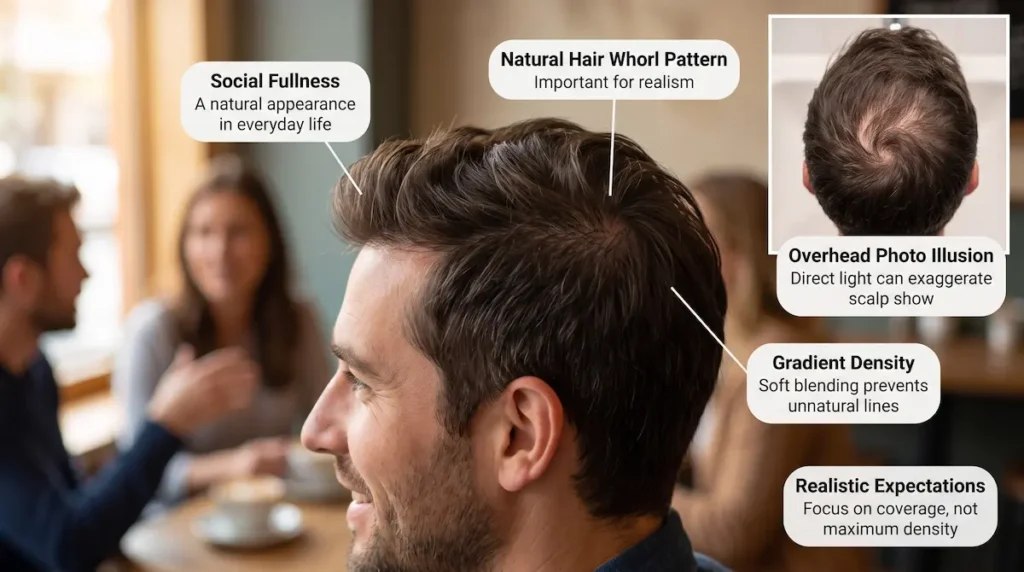
Social fullness means the crown looks naturally covered in normal life: in conversation, on video calls, in photographs taken at eye level, and under ordinary indoor light. It does not mean every square centimetre is restored to teenage density.
The crown rarely needs to be packed to maximum density to look better. In fact, trying to do that can waste grafts and make the design look unnatural. The vertex is more forgiving when the grafts are placed in a soft, irregular, whorl-matched pattern rather than a uniform grid.
A natural crown often uses a gradient. The centre of the whorl may receive careful placement to break up the bald spot, while the outer edge is blended into the existing hair. That transition matters. A dense centre with a weak surrounding zone can look artificial once the native hair continues to thin.
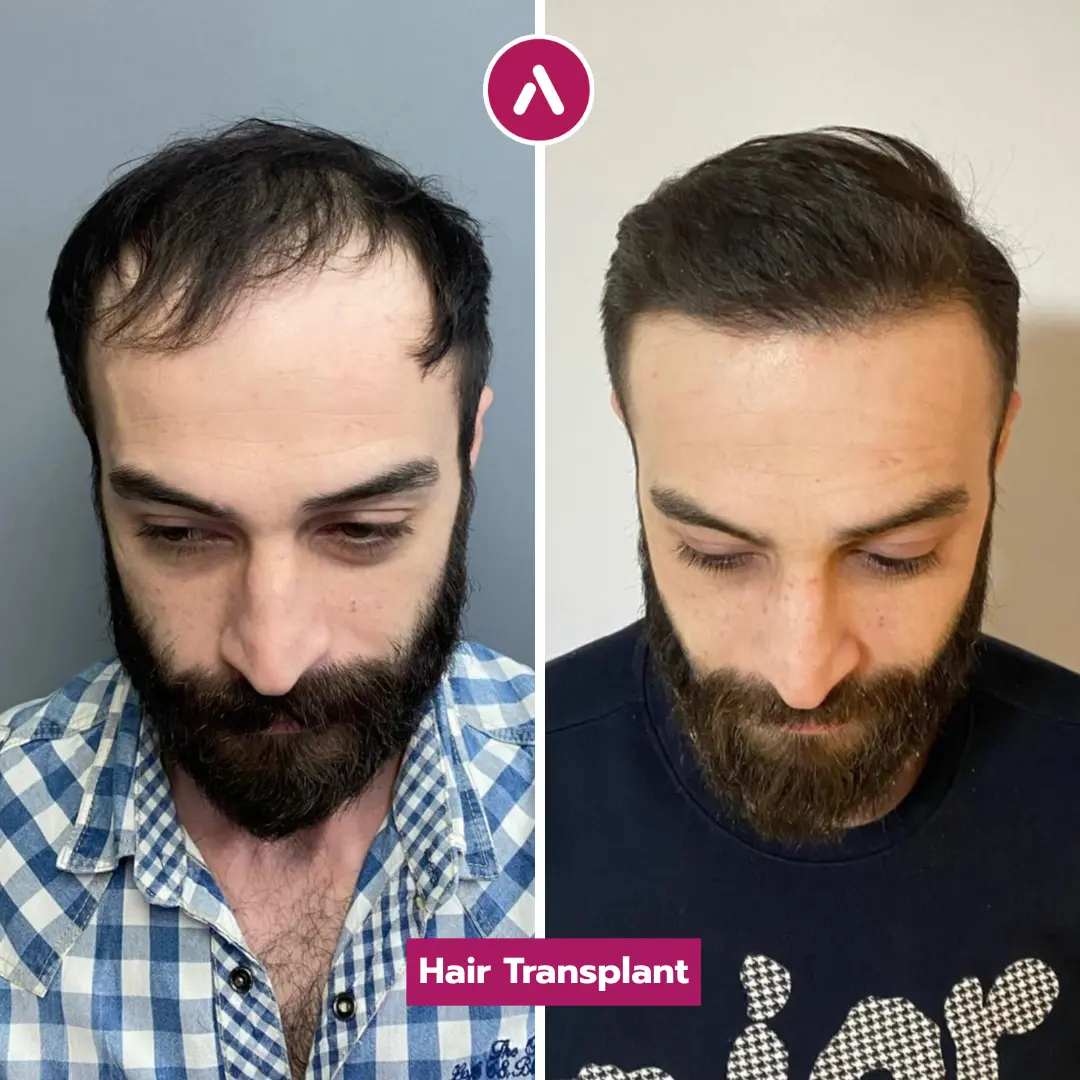
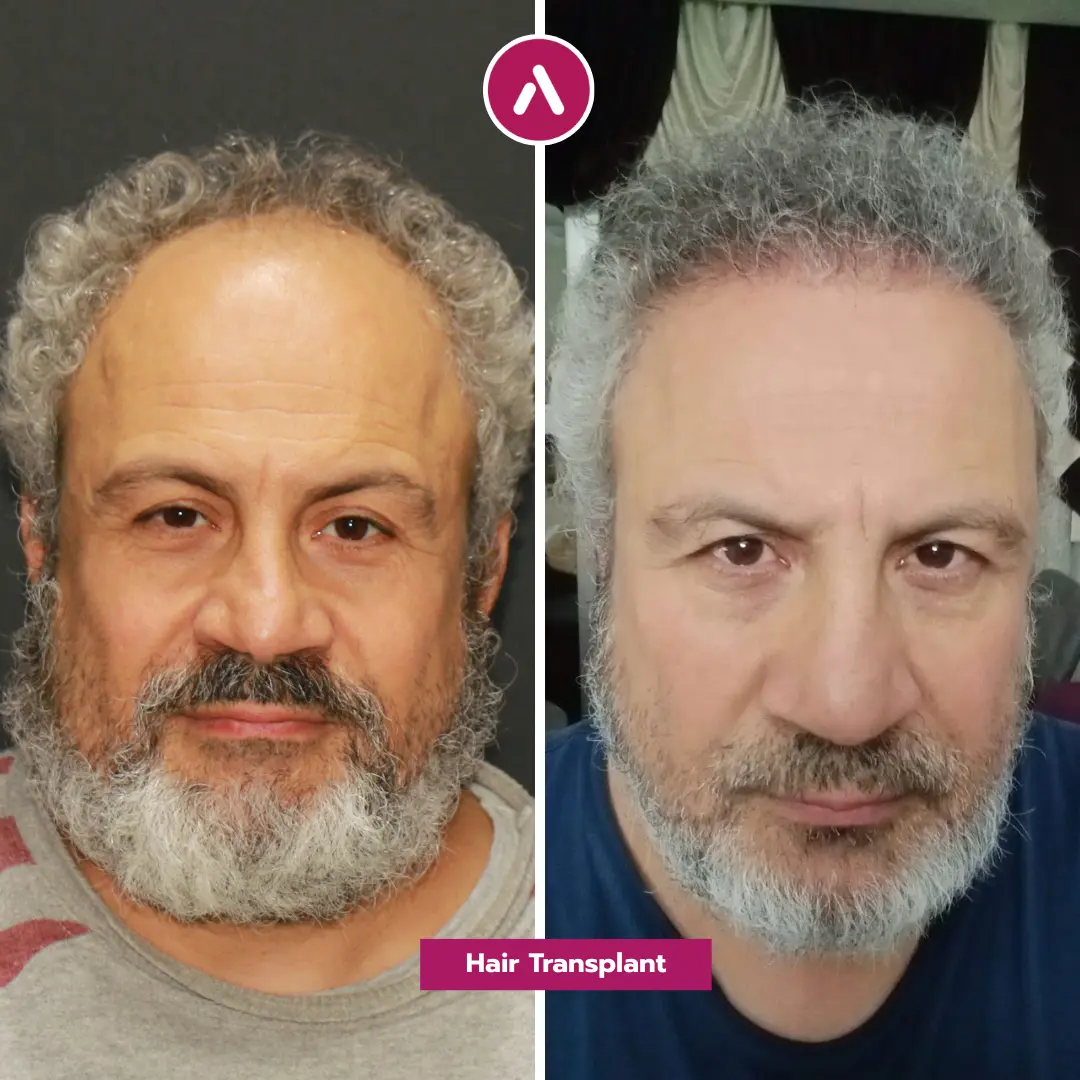
Why overhead photos can look thinner
Overhead photos are the crown’s least flattering test. Direct top-down light separates the hairs, exposes the scalp between grafts, and removes the layering effect that helps the front look fuller. This is why a crown may look strong in real life but thinner in a clinic photo taken from above.
This does not mean the transplant has failed. It means the viewing angle is harsh. Wet hair, short haircuts, flash photography, and bright changing-room lights can all exaggerate scalp show in the vertex.
For the same reason, progress photos should be taken consistently. Same room, same lighting, same hair length, same angle. Comparing a damp post-gym photo to a dry clinic photo tells you very little.
Avoiding an artificial carpet-like crown
The most obvious crown transplants are not always the thinnest. Sometimes they are the ones that look too regular. A crown filled with evenly spaced grafts in the wrong direction can look like a planted lawn rather than a natural whorl.
A skilled plan avoids that by varying density, direction, and distribution. The surgeon uses the existing hair as a guide and accepts that the crown should have a softer finish than the frontal hairline. That softness is not a weakness. It is what makes the result believable.
This is also why patient selection matters. If the donor area is limited, the hair calibre is fine, or hair loss is still moving quickly, a conservative crown may be the safest choice.
Experience a Seamless Hair Transplant Journey
From VIP airport transfers to 5-star hotel accommodation, we manage every detail. Enjoy a premier medical travel experience in Istanbul.
The Native Hair Loss Factor
A crown transplant does not freeze the surrounding hair. Transplanted grafts are taken from the more stable donor area, but the native hairs around them may continue to miniaturise. This is one of the main reasons the crown needs a long-term plan, not just a graft count.
The danger is simple: if a young patient fills the centre of the crown while the surrounding native crown keeps thinning, the transplanted island may remain while the hair around it disappears. That can create an unnatural ring or “doughnut” effect. It is preventable only if future loss is part of the design from the beginning.
Why early crown grafting can create a “doughnut” risk
The “doughnut” risk happens when the transplanted crown survives but the native hair around it keeps falling. The result is not baldness in the centre. It is the opposite: a preserved central patch surrounded by thinning scalp. That pattern can look more unnatural than the original crown loss.
This is especially relevant for younger men with active male-pattern hair loss. If the frontal hairline, mid-scalp, and crown are all changing, using a large number of grafts in the vertex too early can limit what can be done later.
A cautious surgeon will assess the wider Norwood pattern, donor strength, family history, age, and the stability of current hair loss before recommending crown grafting. Sometimes the best answer is to treat the front first. Sometimes it is to stage the crown. Sometimes it is to wait.
Planning around future hair loss
Good crown design builds in room for change. It avoids hard edges, keeps the density believable, and blends into the surrounding miniaturised hairs instead of pretending they will stay forever. The plan should still make sense if the patient loses more hair over the next five to ten years.
This is where conservative graft use protects the future. A moderate crown improvement today may leave enough donor supply for the mid-scalp later. A very dense crown today may win the short-term photo and lose the long-term plan.
Future planning also includes the donor area itself. Overharvesting can create visible thinning at the back and sides, making it harder to wear short hair and harder to perform a second procedure. Crown work must therefore respect both the recipient area and the donor bank.
When to wait or combine with medical treatment
Not every crown should be transplanted immediately. If the crown is thinning but still has a lot of miniaturised native hair, stabilising loss first may give a clearer picture of what surgery should do. This is a medical decision, not a one-size-fits-all rule.
Some patients are advised to use evidence-based hair-loss treatment before committing grafts to the vertex. Others may proceed with a staged transplant if the bald area is established and donor supply is strong. The key is that the crown should not be treated in isolation.
Temporary shedding can also confuse the early recovery period. Native hairs may look weaker for a time after surgery before the area settles. For that reason, it helps to understand shock loss after a hair transplant before judging the crown too early.
If your crown is still changing quickly, the honest consultation question is not “Can you fill it?” It is “Should we fill it now, and how do we protect the rest of my scalp later?”
Getting a Natural Crown Result
A natural crown result depends on restraint as much as graft placement. The surgeon must rebuild the swirl, create enough coverage to reduce the bald spot, and protect the donor area for the future. A crown that looks natural from behind, from above, and in movement is usually the result of careful planning rather than maximum density.
This is also the section where expectations should become specific. How short do you wear your hair? Is your mid-scalp stable? Are you prepared for a staged plan if the crown is large? Do you want the crown treated now, or is the hairline the higher priority? These questions shape the result more than the graft number alone.
Matching the crown whorl direction
The crown whorl is the centrepiece of vertex design. Grafts should not simply be placed into the bald area in neat rows. They need to follow the original rotation of the scalp hair, then gradually blend into the surrounding hair as the direction changes.
When the whorl is respected, the crown looks softer and more believable. The eye does not catch a hard border. The grafts do not fight the native hair. Instead, the result looks like the patient’s own pattern has been strengthened.
This is one reason crown work should be planned with high-resolution photographs and a direct examination of the scalp. Even if the central whorl is thin, the surrounding hair often reveals the direction. The surgeon’s task is to read those clues before creating the recipient sites.
Why staged sessions may be safer
A staged crown plan can be frustrating for patients who want everything fixed at once, but it is often safer. The first session can create coverage and define the whorl. A later session, if needed, can refine density once growth, donor reserve, and further hair loss are clearer.
Staging is especially useful when the crown is large, the donor area is limited, or the patient is still losing native hair. It reduces the risk of spending too many grafts too early. It also gives the surgeon a chance to judge how the first grafts mature before committing more donor hair.
For some men, a discreet approach is also part of the decision. If shaving is a concern, the planning conversation may include whether no-shave FUE options are realistic for the crown. That choice depends on hair length, graft count, and the need for clear visibility during placement.
Why crown maturation can take up to around 18 months
Crown growth can feel slower than frontal growth. The grafts follow a curved surface, the swirl takes time to visually blend, and the area is constantly judged under overhead light. Early months can look patchy before the final texture appears.
Many patients begin to see meaningful growth from months 4 to 6, stronger coverage around months 9 to 12, and further cosmetic maturation beyond that. In the crown, it is reasonable to judge the final blend closer to 12–18 months rather than rushing to conclusions too early.
That longer timeline is not a sign of failure. It is part of how crown restoration settles. The key is to compare progress consistently, keep hair length similar in photographs, and attend follow-up reviews so the surgeon can assess whether the plan is maturing as expected.
If a patient has had poor planning elsewhere, crown correction can be more complex because the donor area may already be depleted. That is why crown planning always belongs within wider donor management: donor hair is finite.
What to ask before choosing crown surgery
Before committing to a crown hair transplant, ask questions that reveal the plan, not just the price. A serious consultation should explain why the crown is being treated now, how many grafts are reasonable, how the whorl will be designed, and how the donor area will be protected.
In the UK, it is sensible to benchmark any surgical advice against recognised standards: confirm who performs the surgical steps, what follow-up is available, and whether the clinic is transparent about limitations. At AKM, surgery is performed in Istanbul, so ask which surgeon leads your plan and which qualifications they hold, rather than assuming UK GMC registration.
Cost also belongs in the consultation, but it should not dominate this article. Crown difficulty is primarily a design and donor-economy issue. For pricing context, use the dedicated FUE hair transplant cost guide rather than trying to judge the crown from graft numbers alone.
Ask AKM how many grafts your crown realistically needs, whether your vertex should be treated now, and how the donor area will be protected for future hair loss.
Frequently Asked Questions: Crown Hair Transplant
These answers focus specifically on the crown and vertex. They do not replace a personalised scalp assessment, because crown planning depends on donor strength, age, hair calibre, whorl direction, and the stability of native hair loss.
Is a crown hair transplant harder than a hairline transplant?
How many grafts does the crown need?
Will the crown look as dense as the front?
Should I fix the crown or hairline first?
Does crown hair grow slower after a transplant?
Can native crown hair keep falling out?
Can a crown transplant look unnatural?
Is crown surgery always worth it?
Have Specific Questions About Hair Transplant?
Speak directly with our dedicated patient coordinators regarding Hair Transplant. Receive instant guidance and personalised support.
Medical Disclaimer: This article is for general educational purposes only and does not constitute medical advice, diagnosis, or a personalised treatment recommendation. Hair transplant planning depends on your donor area, hair-loss pattern, medical history, age, hair calibre, scalp condition, and long-term expectations.
Results vary from patient to patient. A crown hair transplant may improve coverage and visual fullness, but no clinic can guarantee a specific graft survival rate, density level, growth timeline, or final appearance. Only a qualified medical professional can assess whether crown restoration is suitable for you.
If you are considering surgery, consult an experienced hair restoration surgeon for an individual evaluation before making any treatment decision.
Related Treatments

Awake Gynaecomastia Surgery in Turkey
UK-focused guide to awake gynaecomastia surgery in Istanbul: local anaesthesia safety, excision vs liposuction, recovery, and £(GBP) cost context.

Awake Abdominal Etching in Turkey
UK guide to awake abdominal etching in Istanbul: HD sculpting, tumescent local anaesthesia, twilight sedation, recovery phases, HBOT/LLLT and GBP costs.

Awake Neck Lift in Turkey
Awake neck lift in Turkey under local anaesthesia with twilight sedation: deep structural technique, scars, recovery, HBOT/LLLT support. UK patient guide.

Facelift in Turkey
Explore facelift techniques (deep plane, SMAS), scars, recovery timelines and sedation options. UK-focused safety pathway and aftercare at AKM Clinic, Istanbul.
Ready to Begin Your Own Transformation Journey?
Join the 2,000+ patients who have trusted Dr Akif Mehmetoğlu and the AKM Clinic team. Your journey to a more confident, naturally restored you begins with a simple, no-obligation conversation. Contact us today from the UK for your free virtual consultation.
#1: Get Your Free Personalised Quote
Start with a free, no-obligation online consultation. Share your photos, and our surgical team will provide a fully personalised treatment plan and a transparent, all-inclusive price package. There are no hidden fees.
#2: Secure Your Date & VIP Booking
Once you are ready, our dedicated patient coordinators will help you secure your procedure date. We will handle all your bookings, including your 5-star hotel accommodation and private VIP airport transfers.
#3: Arrive in Istanbul & Meet Your Surgeon
Arrive at Istanbul Airport (IST) and be greeted by your private driver. Settle into your hotel and prepare for your in-person consultation, where you will meet your specialist surgeon to finalise the details for your "natural, subtle, and restored" new look.