
Flank Liposuction: Targeting Love Handles for a Smoother Waistline
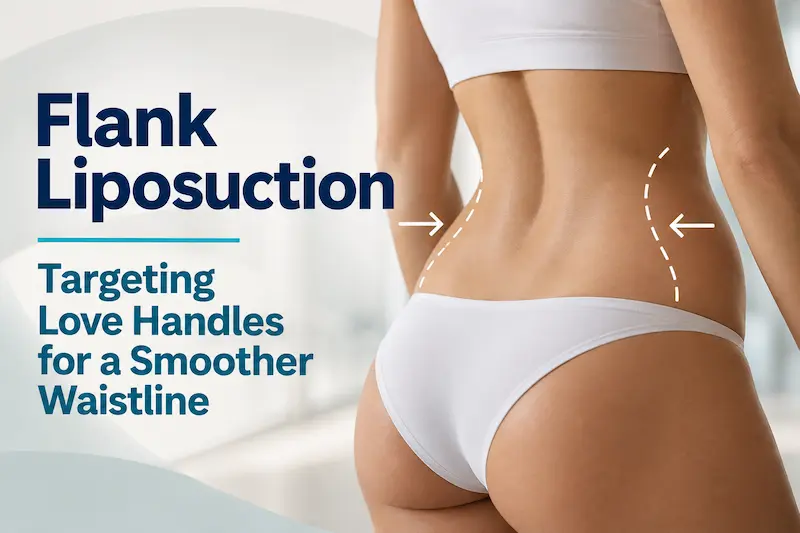
AI Summary
- Flank liposuction targets localised love handles for a smoother, more defined waistline.
- Best candidates have stable weight, elastic skin and pinchable fat above the hips.
- Recovery planning centres on compression, swelling control, light walking and fit-to-fly guidance.
- Safe, realistic results depend on conservative contouring, surgeon-led assessment and transparent pricing in GBP.
AI-generated summary, fact-checked by our medical experts.
Quick answer: Flank liposuction removes stubborn fat pads above the hips, often called love handles, to create a smoother waistline from the front, side and back. It works best for people at a stable weight with localised fat and skin that still contracts well. It is a contouring procedure, not a weight-loss method.
Love handles can be frustrating because they often sit outside the logic of ordinary weight loss. You may lose weight from the face, chest or legs, yet the padding above the hips still softens the outline of your waist. That does not mean you have failed. It usually means this area stores fat in a way that needs a more precise plan.
For UK patients comparing private surgery at home with treatment abroad, the real question is not simply “Can this remove fat?” A better question is: Will flank liposuction alone create the waistline change I want, or do I need a wider contouring plan? That distinction matters.
This guide focuses only on the flank area. You will learn what love handles really are, who tends to benefit, how results look, why male and female fat distribution can differ, and where the limits of flank lipo sit. For a broader overview of zones, anaesthesia and surgical planning, see liposuction zones and techniques at AKM.
Table of Contents
What Flank Liposuction Treats (and What Love Handles Really Are)
Flank liposuction treats the fatty pads that sit above the hip bones and often wrap slightly towards the lower back. This section matters because many people use “waist”, “hips”, “muffin top” and “love handles” as if they mean the same thing. They overlap, but they are not identical.
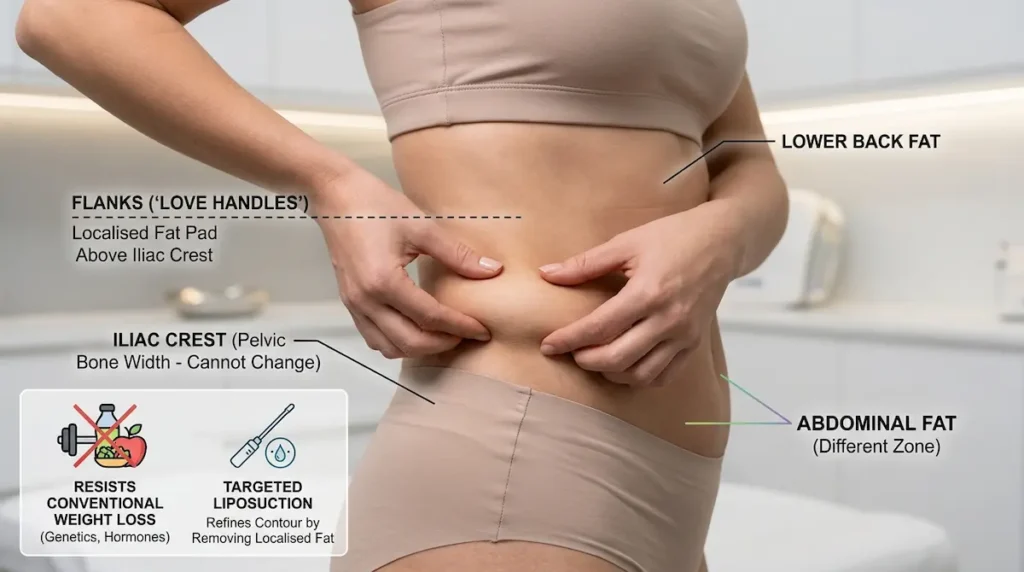
The flank fat pad: where it sits
The flanks are the side areas of the lower torso. In practical terms, they sit above the iliac crest — the upper edge of the pelvis — and below the lower ribs. The fat often feels pinchable. It may bulge over jeans, fitted trousers or underwear, especially when sitting.
This is different from abdominal fat at the front. It is also different from hip width, which is partly bone structure and gluteal shape. Flank fat is a soft-tissue contour issue. That is why the best results come from reshaping, not from trying to make the skeleton look narrower.
In some patients, the flank pad is small and sharply defined. In others, it blends into the lower back or upper outer hip. That blending is one reason a surgeon must assess the body in motion, not just from a front-facing photograph.
Why love handles resist diet and exercise
Love handles can remain even when your general weight is stable and your fitness is good. The area is influenced by genetics, hormones, sex-specific fat distribution and previous weight changes. Exercise strengthens muscle, but it cannot choose which pocket of fat disappears first.
That is where love handle liposuction can be useful. It removes a localised fat pad that has not responded proportionately to lifestyle changes. The aim is not to replace healthy habits. It is to refine a contour that has proved resistant.
There is a limit, though. If the fullness is caused mainly by loose skin, wide hip structure or general weight, liposuction alone may disappoint. A careful consultation should separate fat, skin and frame before any treatment plan is agreed.
Flank vs waist vs hips: what the terms mean
Patients often say they want a “smaller waist”, but the surgeon has to translate that into anatomy. The waist is the narrowest part of the torso. The flanks sit lower and more lateral, just above the hips. The hips include the pelvis and outer thigh curve.
Flank lipo can make the waistline look smoother by reducing the bulge that interrupts the side silhouette. It cannot change pelvic width. It also cannot create the same result as a full trunk procedure if fat extends around the abdomen and back.
There is another nearby but separate zone: the mons pubis. If fullness sits low at the front rather than above the hips, that belongs to another small, stubborn fat zone. Mixing those areas up can lead to the wrong expectation.
Good planning starts with naming the area correctly. The clearer the anatomy, the more realistic the result discussion becomes.
Am I a Suitable Candidate for a Liposuction?
Answer a few brief questions about your concerns, health, and goals to discover which treatment options may suit you best.
Are You a Good Candidate?
The best candidate for flank liposuction has a specific, pinchable fat pad, a stable weight and skin with enough elasticity to contract after the fat is removed. This section helps you decide whether flank-only treatment is likely to match your goal or whether another plan should be discussed.
Localised fat, elastic skin and stable weight
Flank liposuction is most predictable when the problem is localised fat. You should be able to identify the bulge clearly with your fingers. It should not be a general thickening of the whole torso.
Skin quality matters just as much. If the skin snaps back after being pinched, it is more likely to redrape after liposuction. If it hangs, creases deeply or has already lost support after major weight loss, fat removal may reveal more laxity instead of a smoother outline.
Stable weight is also important. Most surgeons prefer patients to be close to a maintainable weight before surgery. StatPearls describes suitable liposuction candidates as people with localised fat deposits, minimal skin laxity and realistic expectations; it also notes contour irregularity as a recognised risk when planning or healing is poor. See candidate criteria for liposuction from StatPearls.
The ASPS candidate guidance also places emphasis on firm, elastic skin, good muscle tone and being within a reasonable range of ideal weight. See who the ASPS says is a good liposuction candidate.
Male vs female fat distribution: love handles vs muffin top
Men often describe the flank area as classic love handles: firm padding above the belt line, sometimes extending into the lower back. In male patients, flank lipo for men may focus on reducing the side bulge without over-narrowing the torso. A natural masculine shape usually keeps some straightness through the waist.
Women may describe a similar area as a muffin top, especially when the fullness spills over fitted clothing. In female patients, the flank can blend into the waist, hip and lower back more gradually. The goal may be a softer inward curve rather than a sharply athletic line.
Neither approach is better. They are simply different body-shape goals. The surgeon should plan the contour around your frame, not around a generic waist measurement.
Who may need a different plan
Flank-only treatment may not be enough if the fullness continues around the whole abdomen, lower back and waist. In that case, a wider contouring approach may be more logical. The difference between lipo 360 vs flank lipo should be discussed carefully, because a 360 plan belongs to a broader treatment category and should not be treated as “just a little extra”.
Loose skin is another reason to pause. If the skin has poor recoil, removing fat can make the area look flatter but not tighter. Patients with this concern should read about when the skin will not tighten after lipo before deciding.
General weight loss is also outside the purpose of this procedure. Liposuction changes shape. It does not treat obesity, visceral fat or metabolic health. A responsible surgical team should say that clearly.
| Assessment point | Good candidate for flank liposuction | Limited candidate | When another approach may be better |
|---|---|---|---|
| Fat pattern | Pinchable love handles above the hips | Fullness spread across the whole torso | Broader waist or trunk contouring discussion |
| Skin quality | Firm skin that springs back after pinching | Mild looseness or stretch marks | Skin-tightening or excisional options may need review |
| Weight | Stable, maintainable weight | Recent weight fluctuation | Weight stabilisation before surgery |
| Goal | Smoother side silhouette and waist definition | Expectation of major weight loss | Non-surgical weight management first |
| Body-shape aim | Natural waistline refinement | Request for an extreme waist-to-hip change | Full-body proportion assessment before treatment |
“The flank is a transition zone. Removing too much fat can create a hollow; removing too little may leave the love handle unchanged. The safest plan is usually conservative, symmetrical contouring that respects the patient’s natural waist and hip frame.”
For UK patients, the consultation should feel measured rather than rushed. Ask what part of your fullness is fat, what part is skin, and what change is realistic from the front, side and back. If that answer is vague, pause before booking.
What the Results Look Like
Flank liposuction usually changes the outline of the waist rather than the number on the scales. This section explains what patients can realistically see in clothing, photographs and day-to-day posture, and where flank-only treatment reaches its limit.
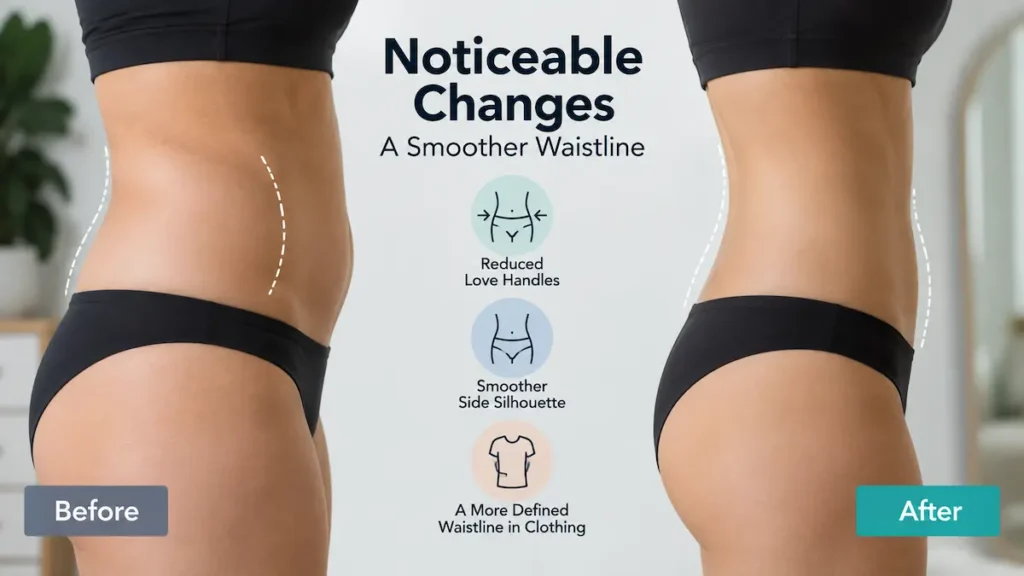
Waist definition and the side silhouette
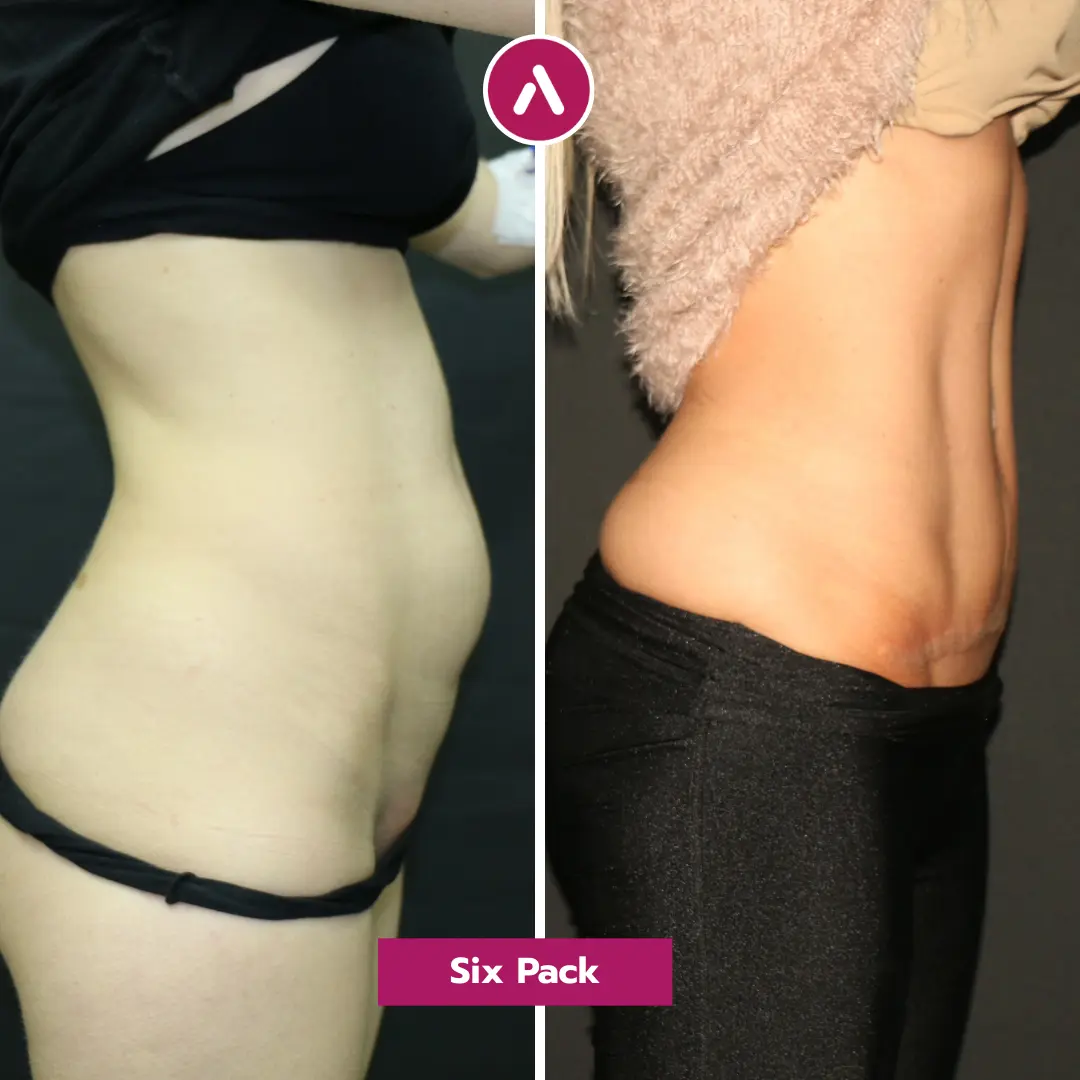
The most noticeable change after flank liposuction is often the side silhouette. The soft bulge above the hips becomes flatter, so the torso looks less square from the back and less padded from the side. In fitted clothing, the waistband may sit more smoothly.
That does not mean every patient gets a dramatic hourglass shape. A natural result depends on the starting frame, rib position, hip width, muscle tone and skin recoil. Liposuction refines the soft-tissue layer; it does not redraw bone structure.
This is why a surgeon should look at the waist from several angles. A front view may show only a small bulge, while a back view reveals the true love-handle pad. The side view can show whether the flank blends into the lower back. Each view changes the plan.
What changes from the front, side and back
From the front, successful love handle liposuction can make the waist look cleaner because the side bulge no longer pushes outward. The belly itself may not change much if the fat is mainly on the flanks. That distinction should be made before surgery.
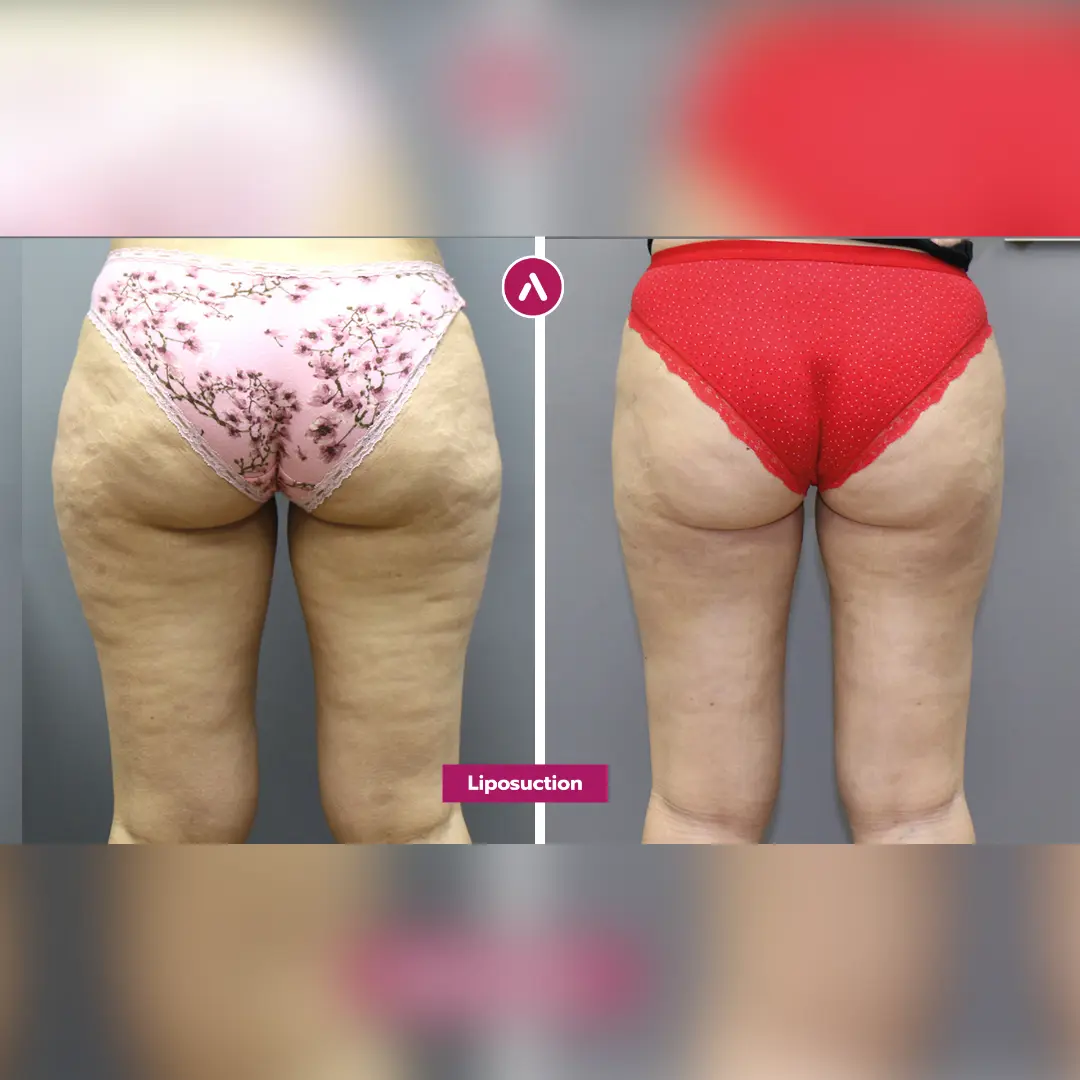
From the side, the lower torso can look less heavy above the hips. From the back, the improvement may be especially visible in the way the waist transitions into the upper buttock. This is often where patients notice a smoother line in trousers, dresses or swimwear.
Small asymmetries are common before surgery. One side may hold more fat or sit slightly higher. Flank lipo can improve symmetry, but it cannot promise mirror-image sides. A careful plan aims for balance, not overcorrection.
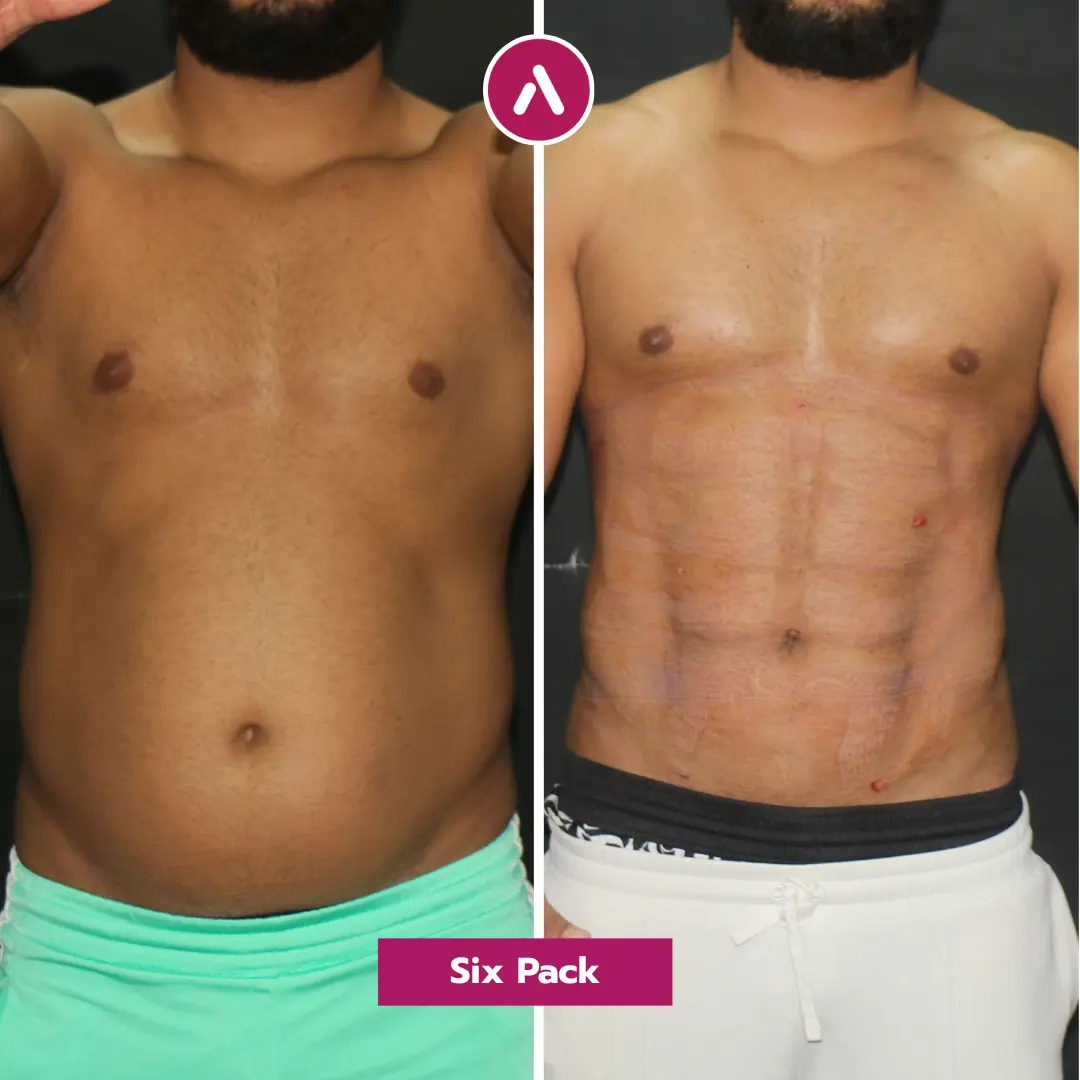
When lipo 360 or HD contouring makes more sense
Flank-only treatment is best when the problem is truly isolated to the side waist. If fat extends across the abdomen, lower back and waist as one continuous ring, a wider plan may be discussed. That is where high-definition VASER contouring for a wider plan becomes a different conversation.
Lipo 360 vs flank lipo is not simply a bigger version of the same operation. A 360 approach treats the torso circumferentially, so planning, swelling, garment use and recovery expectations can differ. It also belongs to a broader body-contouring intention.
High-definition contouring is different again. It is not just about removing love handles; it aims to reveal muscle transitions and athletic shadowing. For many UK patients, that may be more than they want. Subtle contouring can be the better fit.
The safest result often comes from restraint. Over-removing fat from the flanks can leave hollows, sharp ledges or an unnatural waist-to-hip transition. A smoother waistline should still look like your body.
UK planning note: Liposuction is a contouring procedure, not a weight-loss treatment. For UK patients used to NHS-style risk discussions, the key questions are candidacy, skin quality, aftercare and realistic expectations — not simply how much fat can be removed.
Everything You Need to Know About Liposuction
From surgical stages to aftercare, discover how AKM Clinic delivers world-class Liposuction in Istanbul.
How the Flank Zone Is Treated
The flank is treated as a transition area between the abdomen, lower back, waist and hips. This section explains why access points, body positioning and feathering matter so much. A good flank result is rarely about one isolated pocket of suction; it is about blending.
Positioning and access points
During surgery, the patient may be positioned so the surgeon can reach the side waist and lower back safely. The exact position depends on the treatment plan and whether the flank is being treated alone or as part of a broader contouring strategy.
Access points are usually small and placed where they can be hidden as well as possible. Their job is to allow the cannula to reach the fat layer from more than one direction. That helps avoid ridges and uneven transitions.
Planning access is not only a scar issue. It also affects precision. If the surgeon can approach the fat pad from the right angle, the contour can be tapered more evenly into the surrounding tissues.
Feathering into nearby areas for symmetry
Feathering means softening the edge of the treated area so there is no obvious line between suctioned and untouched tissue. In flank liposuction, this is especially important because the flank blends into the waist, lower back and hip.
Imagine reducing only the centre of the love handle and leaving a firm ridge above or below it. The treated zone might be smaller, but the body line could look less natural. Feathering helps prevent that step-off.
This is one reason the consultation should include photographs from the back and oblique angles. A flank that looks small from the front may need subtle blending towards the back. A flank that looks large may still need conservative treatment if the skin is loose.
Why conservative fat removal matters
More removal is not always better. The flank sits next to curved structures, so aggressive suction can create an over-scooped waist. This may look unnatural when standing and even more obvious when bending or sitting.
Conservative removal protects the transition between the ribs, waist and hips. It also leaves enough soft tissue to avoid a hollowed appearance. This matters for both male and female patients, though the target shape may differ.
Patients often ask whether energy-based treatments can tighten the area at the same time. That is a separate discussion. For the flank specifically, it is worth understanding what laser lipo can and cannot do for love handles before assuming it will solve skin laxity.
Another nearby issue is flank laxity after abdominal surgery. If loose tissue remains at the ends of a tummy tuck incision, it can contribute to dog-ear fullness. That is different from isolated love handles, but the zones overlap, which is why the guide on why flank laxity can create dog ears after a tummy tuck is a useful related read.
Surgeon-led consent note: A UK-style consultation should include the limits of treatment, the likely access-point plan, anaesthesia, recovery support and what happens if the skin does not contract as expected. Do not rely on before-and-after images alone.
Recovery and Protecting Your New Waistline
Recovery after flank liposuction is usually more about swelling, compression and patience than bed rest. This section covers what patients typically need to plan for, especially when travelling from the UK to Istanbul and returning home after early review.
Compression garment and swelling
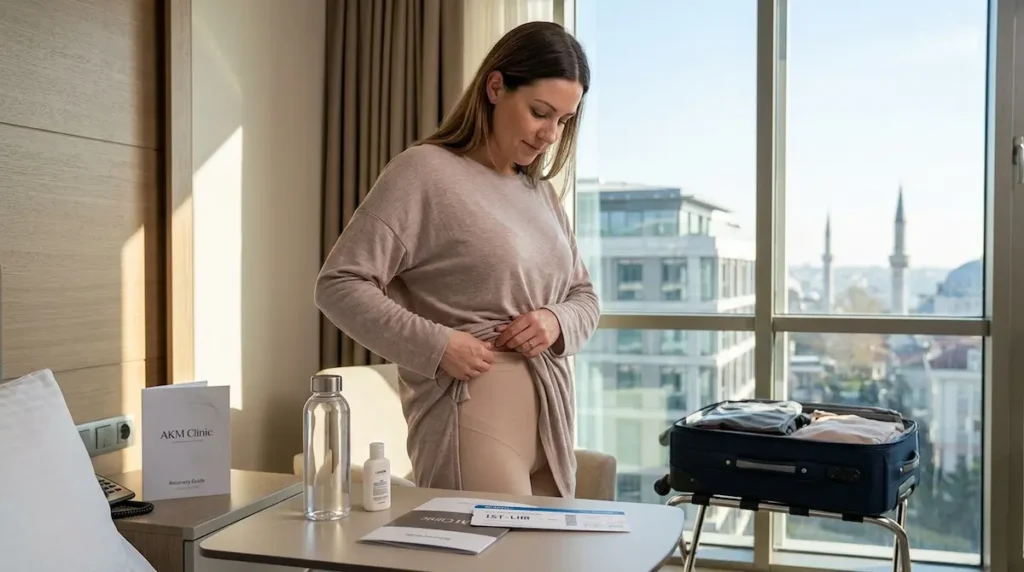
A compression garment helps support the treated area while swelling settles. It does not create the result by itself, but it helps the tissues sit smoothly during early healing. Your surgical team should explain how long to wear it and when it can be removed for washing.
Swelling can make the flanks look uneven at first. One side may feel firmer. The waist may look better in the morning and puffier later in the day. These changes are common during early healing.
The final contour does not appear immediately. Many patients see a visible change within weeks, but refinement continues as swelling reduces and the soft tissues settle. Patience matters.
Returning to activity
Light walking is usually encouraged early, because it supports circulation and reduces stiffness. Strenuous exercise, heavy lifting and intense core work normally wait until the surgeon clears you. The exact timeline depends on the amount treated and your healing pattern.
For UK patients flying home, the plan should include fit-to-fly assessment, wound checks, garment guidance and written aftercare instructions. A flight is not just a travel detail. It is part of the recovery plan.
Most people need to think practically: loose clothing for the return journey, help with luggage, hydration, movement during travel and a quiet first week at home. None of this is glamorous. It helps.
Stable weight, planning and cost link
Flank liposuction removes fat cells from the treated area, but it does not stop future weight gain. If weight increases significantly, remaining fat cells can enlarge and the waistline can soften again. Stable habits protect the result.
Cost should be discussed, but it should not dominate this article. Pricing depends on the treatment plan, anaesthesia, whether other areas are added and aftercare. For our prices in GBP, see the liposuction price list.
At AKM Clinic, the aim is a surgeon-led plan that separates flank-only treatment from broader body contouring. Surgery is planned in Istanbul with a board-certified plastic surgery team and structured follow-up after you return home. Patient reviews of AKM Clinic are publicly visible on Trustpilot; they describe other patients’ experiences and are not a promise of a specific result.
The right question is not “How much can be removed?” It is “How can this area be shaped safely without creating hollows, loose skin or an artificial waistline?” That is the question your consultation should answer.
Ask AKM whether flank liposuction alone is enough for your waistline goals, or whether your anatomy needs a different plan.
Frequently Asked Questions: Flank Liposuction
These answers address the questions UK patients most often ask before choosing flank liposuction. They are designed to clarify expectations, not replace a personal consultation with a qualified surgical team.
Does flank liposuction get rid of love handles?
Is flank lipo the same as lipo 360?
How much fat can be removed from the flanks?
Will my skin sag after flank liposuction?
Is flank liposuction different for men?
How long is recovery after flank lipo?
Can flank liposuction fix a muffin top?
Is waistline liposuction permanent?
Have Specific Questions About Liposuction?
Speak directly with our dedicated patient coordinators regarding Liposuction. Receive instant guidance and personalised support.
Medical Disclaimer: This article is for general patient education only and is not a substitute for medical advice, diagnosis or treatment. Suitability for flank liposuction depends on your anatomy, skin quality, medical history, medication use, smoking status and surgical goals. Results vary between patients. Always discuss your individual case with a qualified medical professional before making a decision.
Related Treatments
Awake Abdominal Etching in Turkey
UK guide to awake abdominal etching in Istanbul: HD sculpting, tumescent local anaesthesia, twilight sedation, recovery phases, HBOT/LLLT and GBP costs.

Awake Mummy Makeover in Turkey
UK-focused guide to an awake mummy makeover using tumescent local anaesthesia with optional conscious sedation. Explore tummy tuck, liposuction and breast options, recovery timelines and costs in GBP.
Awake Tummy Tuck in Turkey
UK guide to Awake Tummy Tuck under twilight sedation at AKM Clinic, Istanbul—techniques, combinations, recovery timeline, risks, aftercare and GBP planning.
Awake High-Definition Liposuction
Awake high-definition liposuction in Istanbul for UK patients: 4D Vaser sculpting with tumescent local anaesthesia + conscious sedation, HBOT/LLLT recovery and GBP fees.
Ready to Begin Your Own Transformation Journey?
Join the 2,000+ patients who have trusted Dr Akif Mehmetoğlu and the AKM Clinic team. Your journey to a more confident, naturally restored you begins with a simple, no-obligation conversation. Contact us today from the UK for your free virtual consultation.
#1: Get Your Free Personalised Quote
Start with a free, no-obligation online consultation. Share your photos, and our surgical team will provide a fully personalised treatment plan and a transparent, all-inclusive price package. There are no hidden fees.
#2: Secure Your Date & VIP Booking
Once you are ready, our dedicated patient coordinators will help you secure your procedure date. We will handle all your bookings, including your 5-star hotel accommodation and private VIP airport transfers.
#3: Arrive in Istanbul & Meet Your Surgeon
Arrive at Istanbul Airport (IST) and be greeted by your private driver. Settle into your hotel and prepare for your in-person consultation, where you will meet your specialist surgeon to finalise the details for your "natural, subtle, and restored" new look.