
Thread Lift in Turkey: Pros, Cons and Cost

AI Summary
- Thread lift Turkey offers subtle, non-surgical facial rejuvenation for mild laxity, not a replacement for facelift surgery.
- Lower upfront cost makes Turkey attractive, but long-term value depends on candidacy, maintenance, and realistic expectations.
- Shorter recovery time appeals to UK patients, though swelling, bruising, and careful aftercare still matter.
- Clinic safety and surgeon-led assessment are essential for natural results, honest advice, and confident UK aftercare planning.
AI-generated summary, fact-checked by our medical experts.
Thread lift Turkey searches have grown because many UK patients want a fresher, more defined face without the commitment, downtime, or price of formal surgery. For the right person, a thread lift in Turkey can offer a subtle improvement to the jawline, cheeks, or brow area using minimally invasive techniques performed under local anaesthetic. For the wrong person, however, it can lead to disappointment, short-lived results, or a lift that never truly addressed the real issue in the first place.
This guide explains what a thread lift can and cannot do, who may benefit most, what to know about thread lift risks and benefits, and how the cost of a thread lift in Turkey compares with the UK private market. We will also look at PDO thread lift options in Turkey, the role of branded systems such as Silhouette Soft thread lift, and the honest answer to the question many patients ask: are thread lifts permanent? From a medical science perspective, the most important point is not whether threads are fashionable, but whether they are the correct treatment for your anatomy, skin quality, and long-term goals.
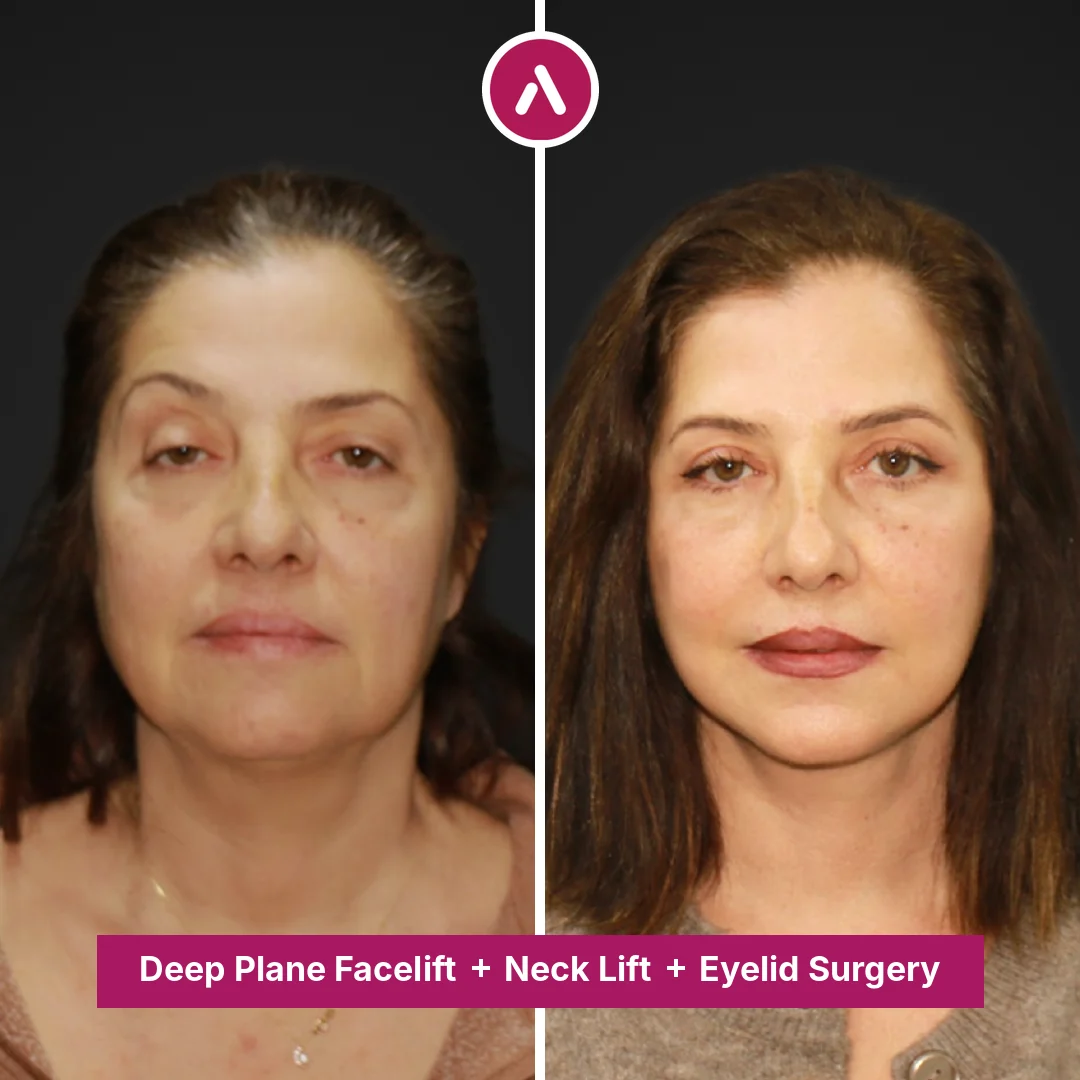
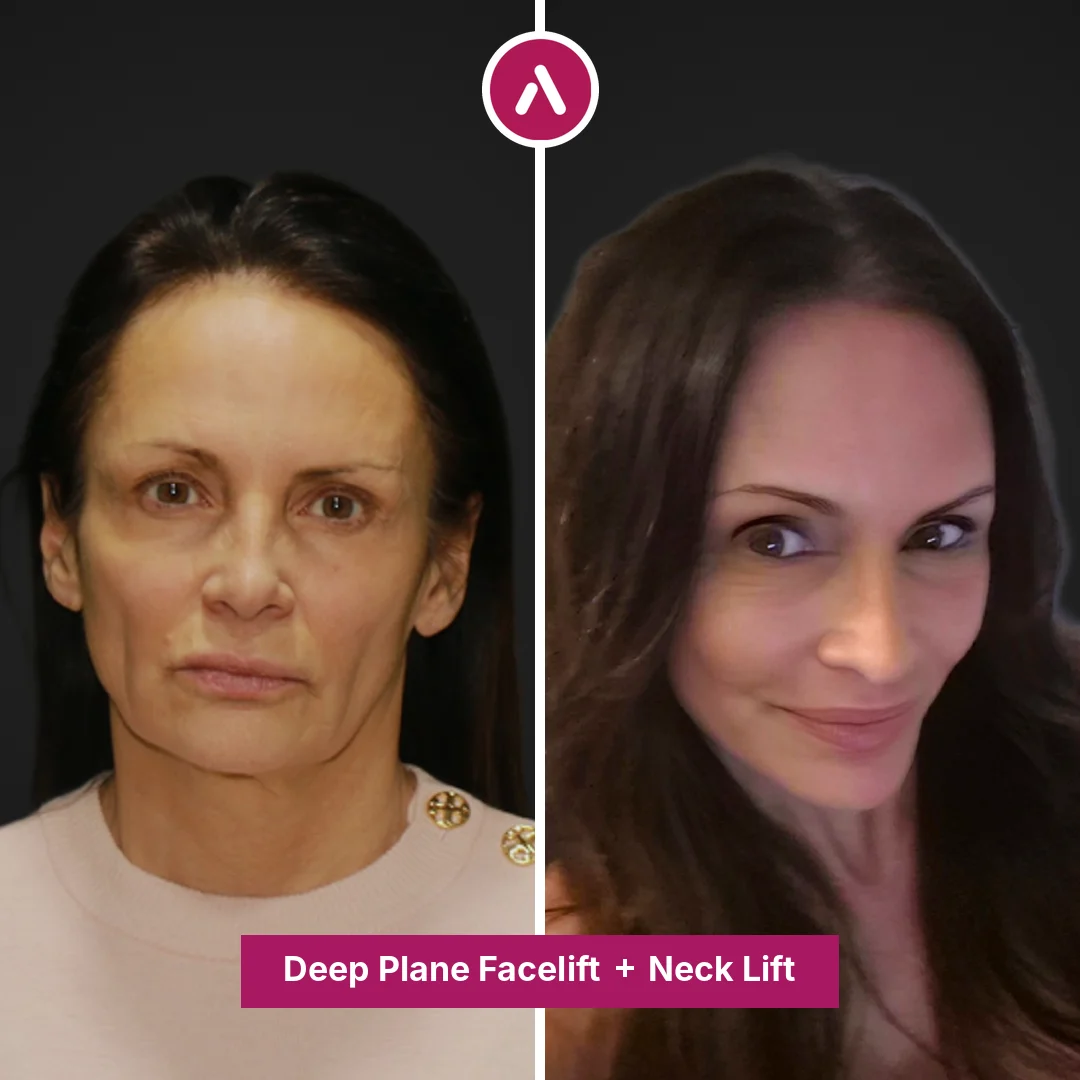
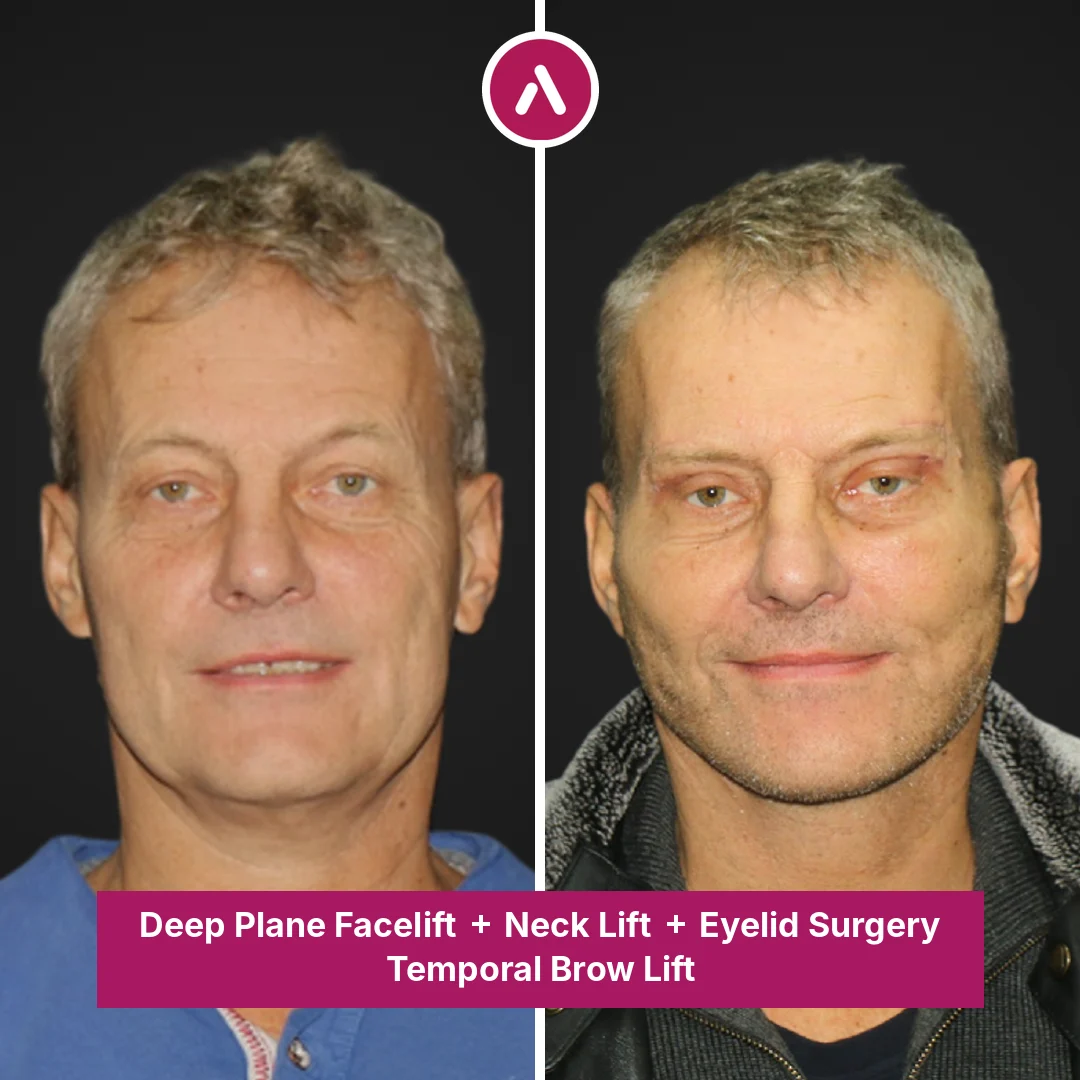
For British patients especially, the attraction is easy to understand. A thread lift often sounds more approachable than surgery, the recovery is usually shorter, and the treatment may feel more aligned with the modern UK preference for discreet, subtle facial rejuvenation rather than an obvious “done” look. That said, a thread lift is not a miracle shortcut and it should never be marketed as a true replacement for a well-planned surgical lift when deeper facial descent is present. That distinction matters enormously when comparing thread lift options in Turkey and the UK, because real value is not just about headline price. It is about suitability, safety, and whether the result will still make sense six months later.
Surgeon-led principle: the best thread lift result is not created by the thread alone, but by honest facial assessment, precise placement, and good judgement about when a patient needs something more than threads.
Table of Contents

What Is a Thread Lift and How Does It Work?
A thread lift is a minimally invasive facial rejuvenation treatment designed to reposition mildly sagging soft tissue and create a modest lifting effect without formal facelift surgery. Tiny dissolvable or suspension-based threads are placed beneath the skin through entry points rather than long incisions. In simple terms, the threads act either as a support structure, a collagen-stimulating scaffold, or both. This is why thread lifts are often described as a halfway point between injectable treatments and surgery. However, good patient education is essential: the lift is usually modest, the effect is temporary, and the treatment works best when facial laxity is still at an early stage.
This is also why a careful consultation matters before choosing threads over other non-surgical options. In some cases, a liquid facelift using fillers and anti-wrinkle injections may be more suitable for restoring volume and softening tired features, particularly when the main issue is hollowing rather than tissue descent. The best treatment plan depends on whether the face needs lifting, volumisation, skin tightening, or a more balanced combination of all three.
What PDO and suspension threads actually do beneath the skin
The most common technique discussed by UK patients is the PDO thread lift. PDO stands for polydioxanone, a material long used in medical sutures. Once placed under the skin, these threads provide a degree of mechanical support while also encouraging a healing response around them. In practical terms, this means a carefully selected patient may see mild lifting at the jawline, cheek, or brow, along with some improvement in skin quality over time as collagen production increases.
Not all threads are identical. Some are smoother and used more for collagen stimulation than lifting, while others include barbs or cones to grip tissue more effectively. That is why the term “thread lift” can be misleading: one clinic may mean subtle skin support, while another may mean a more structured suspension technique. When patients compare treatments, they should ask not just “How many threads?” but “What type of thread, for what purpose, and for which area of the face?”
In clinical practice, threads are not replacing anatomy. They are working with it. If the soft tissue is already heavy, the skin is significantly lax, or there is notable descent in the midface and neck, threads may struggle to produce a convincing result. In those cases, a patient may spend money on an elegant-sounding treatment that never truly achieved the outcome they had in mind.
| Thread approach | Main aim | Often used for | Best suited to |
|---|---|---|---|
| PDO threads | Support plus collagen stimulation | Mild jawline or cheek soft tissue laxity | Patients with early facial descent |
| Barbed suspension threads | Stronger tissue repositioning | Lower face and midface lifting | Patients needing a more visible but still modest lift |
| Silhouette Soft thread lift | Suspension with cone-based anchoring | Selected cheek and lower-face cases | Patients suitable for a structured non-surgical lift |
Lifting sagging tissue vs stimulating collagen: what is realistic?
This is where expectations need to be handled with particular care. The immediate effect of a thread lift comes from repositioning tissue. The delayed effect comes from the body’s healing response around the thread material. In theory, that combination sounds ideal. In reality, the visible lifting element is often less dramatic than patients expect, especially if they have been influenced by marketing photography taken immediately after treatment or by clinics that blur the line between a thread lift and a true facelift.
From the standpoint of science and practical aesthetics, collagen stimulation is helpful but limited. It may improve skin firmness and texture to a degree, but it does not recreate the structural correction achieved by surgical lifting of deeper facial tissues. That is why a thread lift can be useful for selected early ageing changes, yet underwhelming for patients with heavier jowls, neck laxity, or substantial midface descent.
It is also important to answer the permanence question honestly. Are thread lifts permanent? No. They are not permanent. The threads themselves are typically absorbed over time, and while some collagen response remains, the lifting effect does not behave like surgical repositioning. A thread lift may therefore be best viewed as a temporary or medium-term refinement rather than a once-and-for-all correction.
For many UK readers, this is actually helpful rather than disappointing. A person who wants a subtle refresh before an event, prefers a smaller first step, or is not yet ready for surgery may find a thread lift entirely reasonable. Problems arise only when a patient with more advanced ageing is told that threads will deliver a facelift-level result. That is where dissatisfaction begins.
Common treatment areas for UK patients: jawline, cheeks, brows, and neck
In facial aesthetics, certain areas respond better to threads than others. A jawline thread lift is often requested by patients who dislike the earliest signs of jowling or blurring along the lower face. A cheek thread lift is usually considered when mild descent in the midface has softened the transition between the cheek and lower face. Brow or temple threads may create a subtle refreshed effect in selected patients, particularly when the goal is not dramatic reshaping but a small lift that looks natural in everyday life.
The neck is a more cautious area. Patients often hope that threads will sharply redefine the neck-jaw angle, but the result can be limited if there is skin excess, platysmal banding, or heavier tissue under the chin. In such situations, a thread lift may not be the most efficient route to a meaningful change. Good treatment planning means matching the technique to the problem rather than forcing every concern into the same non-surgical solution.
For British patients, the most successful thread lift outcomes usually share the same pattern: the patient is seeking a refined improvement, not a dramatic transformation; the tissues are not too heavy; and the practitioner has assessed the face in motion as well as at rest. That is how the result stays believable, elegant, and in line with the UK preference for a fresher appearance rather than an obviously altered one.
Discover If a Facelift Is Right for You
Share your photos and medical history to receive a personalised assessment from our European Board-certified facial surgery team.
Why UK Patients Consider a Thread Lift in Turkey
British patients rarely look at a thread lift in isolation. They compare it against Harley Street fees, downtime, convenience, naturalness, and whether a non-surgical option is enough for their stage of ageing. That is why the conversation around thread lifts in Turkey vs the UK is about more than geography. It is about whether a patient can access surgeon-led judgement, sensible pricing, and realistic advice rather than glossy promises.
For many people, Turkey enters the picture because they want better value and a more tailored experience, while still expecting clinical standards, clear communication, and honest aftercare planning.
For some UK patients, the comparison is not only between threads and surgery, but also between threads and a liquid facelift. That matters because a face can look older for different reasons, including volume loss, skin laxity, or a combination of both. In the right case, threads may offer light support, while in others, a liquid facelift may be better suited to restoring contour without creating the expectation of a true surgical lift.
The appeal of a subtle, non-surgical refresh instead of an overdone result
One of the strongest themes among UK patients is the wish to look rested rather than obviously altered. In that sense, thread lifts fit neatly into the British preference for subtle enhancement. A patient may not want a full facelift at this stage, may be wary of long scars or a larger procedure, and may simply want to look less tired around the jawline or cheek area. When used appropriately, threads can serve that purpose.
This is particularly relevant for patients who are professionally visible, socially active, or simply uncomfortable with the idea of a dramatic change. A thread lift may offer a softer entry point into facial aesthetics. It can feel more psychologically manageable than surgery and more anatomically meaningful than simply adding filler to a face that is already beginning to descend.
However, “subtle” should never be confused with “effortless”. Good subtle work requires discipline. It means respecting facial proportions, not over-lifting, and recognising when the patient’s concern is caused by volume loss, skin quality, or true tissue descent rather than a problem threads can solve on their own.
Harley Street expectations vs Istanbul value: why this comparison matters
Many UK patients start their research by looking at London clinics and then broaden the search when they realise how widely private pricing can vary. The point is not to frame Istanbul as “cheap”; that language usually signals the wrong mindset in medical aesthetics. The real discussion is about value. A patient comparing a thread lift price in Istanbul with a Harley Street quote is often asking a more thoughtful question: can I receive careful assessment, honest treatment planning, and quality care without paying London overheads for a non-surgical procedure?
That question is fair. Yet the answer should never rely on price alone. A low fee means very little if the candidate selection is poor, the thread choice is inappropriate, or the provider has little understanding of facial ageing. For UK patients, the better benchmark is this: does the clinic communicate clearly, use proper medical standards, assess candidacy honestly, and explain when thread lift vs surgical facelift is the more truthful comparison?
When this standard is applied, Turkey becomes attractive not because patients want to gamble, but because they want rational value. They want the chance to compare quality and expertise more intelligently, especially in a field where some non-surgical treatments are marketed far too casually.
When a thread lift feels more accessible than a full surgical facelift
There are practical reasons why a patient may choose threads first. The procedure is generally performed under local anaesthetic, takes less time than surgery, and usually involves less social downtime. For someone with early laxity and realistic expectations, that can make a thread lift feel like a sensible first step rather than a compromise.
It may also be appealing to patients who are not yet ready for a formal operation, want to see how they feel about a modest lift, or prefer to postpone surgery until ageing changes become more structurally significant. In this context, a thread lift can be a bridge treatment. It may offer improvement now while buying time before a future surgical intervention is considered.
The key point is honesty. A thread lift is often more accessible than surgery, but it is not equivalent to surgery. The moment a patient expects threads to deliver the same depth of correction, longevity, or neck and jawline definition as a proper facelift, the treatment has been mis-sold. The safest and most satisfying journey begins with candid assessment, not with the assumption that less invasive automatically means better value.
- Most suitable mindset: “I want a modest, natural-looking refresh.”
- Less suitable mindset: “I want the result of a facelift without having surgery.”
- Best reason to proceed: mild laxity, targeted concerns, and realistic expectations.
Ready to Schedule Your Facelift?
Our surgical dates fill up quickly due to high international demand. Secure your consultation today to arrange your preferred travel dates.
The Main Pros of a Thread Lift
The advantages of a thread lift are real, but they are often strongest in carefully selected patients rather than in everyone who wants a more defined face. This is why balanced discussion of thread lift risks and benefits matters so much. For a patient with early laxity, good skin quality, and a clear wish for subtle rather than dramatic change, threads can offer a meaningful improvement with less downtime than surgery.
For a patient with heavier tissue descent, however, the same treatment may feel expensive for a result that is too small or too short-lived. In other words, the main benefit of threads is not that they “replace” surgery, but that they can fill an appropriate gap between injectables and formal lifting procedures.
Minimally invasive treatment with local anaesthesia and shorter downtime
One of the most obvious advantages is that a thread lift is minimally invasive. There are no long incisions, no operating theatre stay in the way a formal facelift would require, and the treatment is commonly performed under local anaesthesia. For many UK patients, that alone reduces anxiety. The procedure can feel more approachable, especially for those who are curious about facial rejuvenation but not ready to commit to a larger operation.
Downtime is also usually shorter. While swelling, tenderness, tightness, and mild bruising are common, most patients find the recovery period more manageable than surgical recovery. Social downtime may still be necessary, particularly if the threads were placed in the lower face or midface, but the disruption is generally less dramatic than after a facelift. That makes threads appealing for patients who want improvement without stepping fully into surgical recovery planning.
From a patient-behaviour perspective, this is often what drives interest in thread lift in Turkey. The treatment appears lighter, faster, and easier to fit around work and life. That can be a reasonable motivation, provided the patient also understands that “easier” does not automatically mean “better” if the degree of ageing really calls for structural lifting instead.
Subtle improvement for early facial laxity and mild jowling
When thread lifts work well, they tend to work well in precisely the kind of face that does not yet need major correction. Mild jowling, early softening of the jawline, gentle descent in the cheek, or a subtle loss of definition around the lower face can all respond reasonably in the right hands. A jawline thread lift, for example, may help sharpen a lower face that has begun to blur without severe heaviness. A cheek thread lift may slightly restore a fresher contour in patients whose midface has only started to descend.
This is where a consultant-led facial assessment becomes important. A refined result is rarely about simply pulling tissue upwards. It is about choosing the correct vector, respecting facial symmetry, and preserving an appearance that still looks like the patient. This is one reason many facial aesthetics patients value a clinician with strong skin-focused judgement: a more sophisticated understanding of skin quality, surface detail, and subtle balance often supports results that look refreshed rather than visibly manipulated.
For UK patients in particular, that subtlety is often the point. Many do not want obvious change. They want to look less tired, slightly firmer, and better defined in photographs and in daylight, not as though they have undergone a conspicuous cosmetic intervention. A well-selected thread lift can serve that purpose, but only within modest limits.
In some patients, the better comparison is not between a thread lift and surgery, but between a thread lift and a liquid facelift. If the face looks tired mainly because of volume loss rather than tissue descent, injectable treatment may sometimes create a softer, more harmonious refresh. This is why careful assessment matters: the most natural result often comes from choosing the right technique for the real cause of ageing, rather than assuming every concern needs lifting.
Lower upfront cost than surgery for the right candidate
The lower entry cost is another reason patients compare threads with surgery. In straightforward terms, a thread lift usually costs less upfront than a formal facelift. For a patient who only needs a mild correction, that can be sensible value. Spending more on surgery too early is not always wise if the concern is small and the patient would be satisfied with a shorter-term, lighter intervention.
That said, upfront affordability should not be confused with best long-term value in every case. If someone undergoes repeated thread treatments because the original problem was really too advanced for threads, the combined spend may begin to approach a surgical solution without delivering the same depth or longevity. That is why a proper discussion of value should always include maintenance, not just the initial fee.
Still, for the correct candidate, lower initial cost is a genuine advantage. The patient may receive a subtle lift, limited downtime, and a more accessible first step into facial rejuvenation. The key phrase there is for the correct candidate. When candidacy is poor, even a lower price can become poor value.
| Potential advantage | What it means in practice | When it is most relevant |
|---|---|---|
| Minimally invasive | No formal facelift incisions and generally lighter recovery | Patients wanting a smaller first step |
| Shorter downtime | Often easier to fit around work and social commitments | Busy professionals and event-based timing |
| Subtle lift | Can refine early jowling or mild cheek descent | Patients with early facial laxity |
| Lower upfront cost | Less expensive initially than surgical lifting | Patients suitable for a modest correction |
The Main Cons and Limitations of a Thread Lift
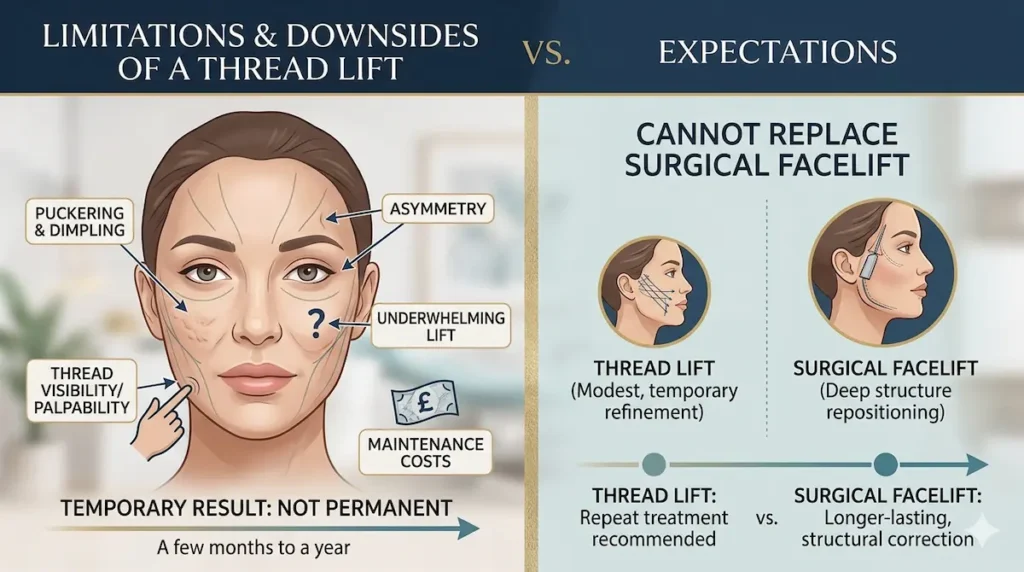
No honest article about thread lift risks and benefits is complete without a serious look at the downsides. The problem is not that thread lifts are inherently bad treatments. The problem is that they are sometimes marketed as though they can solve more than they truly can. Their limitations are not minor details; they are central to whether a patient will feel pleased or underwhelmed. Many disappointments happen not because the treatment was performed badly, but because the treatment was the wrong choice for the anatomy in front of the practitioner.
Why a thread lift cannot replace a surgical facelift
This is the most important limitation. A thread lift cannot do what a well-planned surgical facelift does. Threads work at a more limited level of tissue support and cannot reproduce the deeper structural repositioning achieved during surgery. If the midface has clearly descended, the jowls are significant, or the neck has visible laxity, threads are unlikely to provide the degree of improvement many patients imagine when they search thread lift vs surgical facelift.
A surgical facelift is not merely about “tightening skin”. Proper facelift surgery addresses deeper support structures and can reshape the facial contour in a more durable and anatomically meaningful way. Threads, by contrast, are best seen as temporary support for milder concerns. When this difference is ignored, patients often end up comparing two treatments that are not truly comparable in power.
In practical terms, a patient choosing between thread lift vs surgical facelift should ask a very simple question: do I want a modest soft improvement, or do I want a genuine structural reset? If the answer is the second one, threads may only delay the inevitable while adding extra cost and frustration.
It is also worth noting that neither threads nor surgery are the only options in facial rejuvenation. For patients with mild ageing changes driven more by volume loss than true tissue descent, a liquid facelift may sometimes be discussed as an alternative or complementary treatment. However, it should not be confused with lifting deeper structures. The key is to match the treatment to the anatomy, so the result looks natural, proportionate, and genuinely worth the investment.
Temporary results and the cost of repeat maintenance
Another major limitation is longevity. The question are thread lifts permanent comes up for good reason, and the answer remains no. The effect is temporary. Some patients may enjoy a visible improvement for a moderate period, while others feel the lifting element softens sooner than expected. Tissue weight, skin quality, facial movement, age, lifestyle, and the type of thread all influence how the result settles.
This does not mean threads are pointless. It means they should be approached as a maintenance-based treatment rather than a one-time correction. Some patients are comfortable with that. Others realise that the need for repeat treatment changes the financial picture significantly. A thread lift that seemed very appealing on day one may look less attractive when repeat appointments are factored into the long-term budget.
This is where scientific research and real-world patient counselling align. Temporary devices can provide useful aesthetic benefit, but patients must understand the expected lifecycle of the treatment. Transparent planning is part of good medicine. A patient who is told the truth about maintenance can make an informed choice. A patient who thinks they are buying a lasting facelift alternative is far more likely to feel let down.
Possible downsides: puckering, asymmetry, thread visibility, and underwhelming lift
Even when appropriately selected, thread lifts are not free of drawbacks. The most commonly discussed issues include temporary puckering or dimpling of the skin, asymmetry during healing, tenderness, swelling, bruising, and a sensation of tightness or pulling. In thinner-skinned patients, thread visibility or palpability can occasionally become a concern. In other cases, the placement may settle unevenly and require adjustment.
There is also the risk of a result that is simply too small to justify the treatment. This is perhaps the most under-discussed downside. Not every thread lift complication is dramatic. Sometimes the problem is subtler: the patient followed instructions, healed normally, and still feels the face looks only marginally different. That kind of under-correction can be emotionally frustrating because the treatment was not disastrous, merely insufficient.
Good judgement reduces these risks, but it cannot erase them entirely. That is why practitioner skill matters so much in facial aesthetics. The best outcomes come not from enthusiastic selling, but from disciplined restraint: selecting appropriate patients, avoiding overpromising, and declining to perform threads when the anatomy would be better served by another option.
Important principle: a thread lift should be chosen because it is the right treatment, not because it is the easiest treatment to say yes to.
Am I a Suitable Candidate for a Facelift?
Answer a few brief questions about your concerns, health, and goals to discover which treatment options may suit you best.
Who Is a Good Candidate for a Thread Lift?
Candidate selection is where most of the success or failure is decided. A thread lift can be worthwhile, elegant, and genuinely helpful in the correct face. It can also be an expensive detour in the wrong one. The best candidates are not necessarily the people who want the biggest change. They are usually the patients whose anatomy matches the strengths of the treatment: mild to moderate laxity, relatively good skin tone, and realistic expectations about subtle rather than transformative improvement.
In some cases, patients who seem broadly suitable for threads may also be assessed for a liquid facelift, particularly if facial ageing is being driven by volume loss as much as mild laxity. This comparison can be helpful because not every tired or softened face needs a lifting procedure. The most suitable candidate is usually someone whose anatomy, skin quality, and aesthetic goals clearly match the strengths and limits of the treatment being considered.
Best candidates: younger patients or those with mild to moderate sagging
In general, the ideal thread lift candidate is someone with early signs of facial descent rather than advanced ageing. This may include mild jowling, soft blurring of the jawline, modest cheek descent, or a slight drop in the brow or lower face. Often, these patients are younger than classic facelift candidates, but biological age matters more than the number on paper. A fit patient with lighter tissues and good skin quality may respond better than an older patient with pronounced heaviness and laxity.
These are also the patients most likely to appreciate what threads actually do well. They are not chasing dramatic correction. They want refinement. They may be considering a jawline thread lift to improve definition before the jowls become significant, or a cheek thread lift to refresh mild midface descent without looking “done”. In such cases, a modest intervention can be completely appropriate.
Psychology matters too. Good candidates tend to be comfortable with improvement rather than perfection. They understand that subtle enhancement is a valid aesthetic goal and that a treatment does not have to be dramatic to be worthwhile.
When skin quality, facial volume loss, or heavier tissue limit results
Threads do not work in a vacuum. Skin quality, tissue weight, facial shape, and volume loss all affect the result. If the face has significant heaviness, marked jowling, poor elasticity, or a great deal of lower-face descent, the mechanical support created by threads may not be enough to produce a convincing or durable lift. Likewise, if the real issue is volume depletion rather than tissue descent, threads may fail to address what the patient actually notices in the mirror.
This is why high-level facial assessment matters. A patient may describe their concern as “sagging”, but the more precise issue may be skin laxity, deep structural descent, hollowing, or a combination of all three. Treating every complaint with threads oversimplifies ageing. In facial aesthetics, subtle natural outcomes depend on reading the problem correctly before choosing the tool.
A clinician with a strong surface-and-structure perspective may be better placed to see where threads will harmonise with the skin and where they will merely add tension without elegance. For UK patients who want believable results, that distinction is crucial.
Who should consider another option instead of threads
Some patients are better served by another treatment from the outset. This may include those with advanced facial ageing, pronounced neck laxity, very heavy lower-face tissues, unrealistic expectations, or a clear wish for a more dramatic and longer-lasting correction. In such cases, the more truthful conversation is often about thread lift vs surgical facelift, not because surgery is always superior in every scenario, but because it may be more appropriate for the problem being treated.
Likewise, patients who want permanence should pause. Since thread lifts are not permanent, anyone specifically seeking a once-only long-term solution may be better exploring a surgical route or a broader rejuvenation plan rather than relying on repeated thread sessions.
Finally, patients who are highly risk-averse about asymmetry, visible irregularity during healing, or limited-value outcomes should think carefully before proceeding. A treatment can be minimally invasive and still be the wrong choice for a particular face. The most ethical aesthetic plan is the one that respects anatomy, budget, and long-term satisfaction all at once.
- Usually a good candidate: mild laxity, good skin quality, realistic expectations, preference for subtle change.
- Proceed with caution: mixed concerns involving volume loss, heavier tissues, or borderline facelift-level ageing.
- Often better suited to another option: significant jowling, neck laxity, or a wish for stronger and longer-lasting correction.
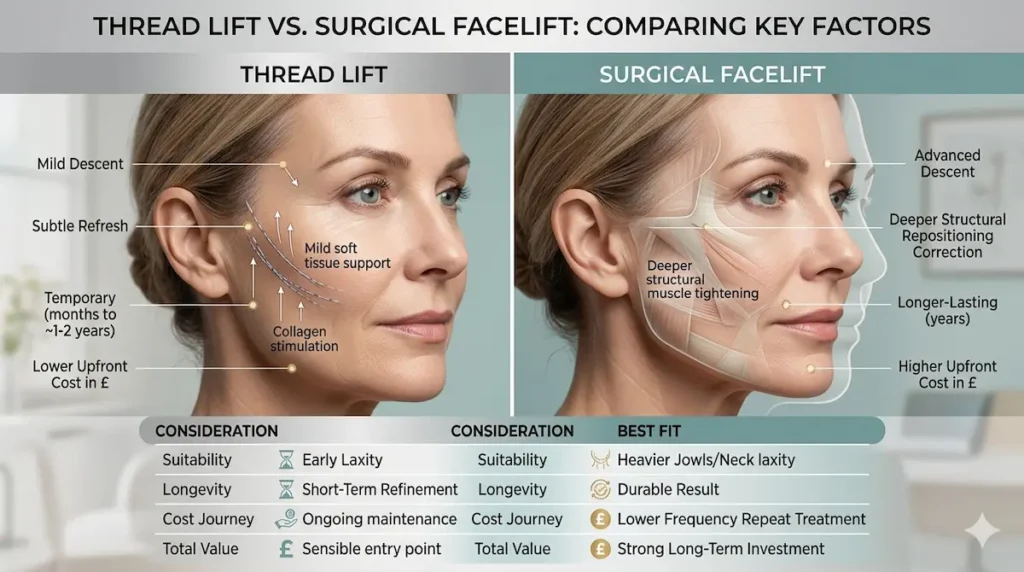
Thread Lift vs Surgical Facelift: Which Option Delivers Better Value?
When patients weigh up thread lift vs surgical facelift, the most useful comparison is not simply price, but suitability, longevity, and the quality of the result over time. For background on the surgical option, see the BAPRAS patient guide to face and brow lifts. In facial aesthetics, true value comes from choosing the treatment that best matches the degree of ageing rather than the one with the lowest initial fee.
For some patients with early laxity, a thread lift may offer sensible short-term value, while others may be better served by a liquid facelift if volume loss is the main concern. Where deeper facial descent is present, however, surgical facelift treatment often represents the more meaningful long-term investment.
Depth of correction: skin-level support vs true structural lifting
The most important difference is the depth of correction. A thread lift creates a limited mechanical lift and some collagen-related support, but it does not reposition deeper facial structures in the same way that a surgical facelift can. This is why threads may work well for early laxity but struggle to produce a meaningful transformation in patients with heavier jowls, midface descent, or neck laxity.
A surgical facelift, by contrast, is designed to address more significant facial descent through deeper tissue handling and more powerful structural repositioning. That does not mean every patient needs surgery. It means the two treatments belong to different categories of intervention. Patients who understand that distinction usually make better decisions, because they stop expecting a minimally invasive treatment to behave like a formal operation.
In practice, the best value often comes from choosing the treatment that fits the anatomy at the current stage of ageing. A patient with mild lower-face softening may do very well with threads. A patient with obvious jowling and a dropping neck contour may spend less overall frustration, time, and money by discussing surgery honestly from the outset rather than repeating lighter treatments that never fully address the issue.
Longevity, maintenance, and total long-term spend in GBP
From a medical science and budgeting perspective, longevity matters just as much as the initial fee. A thread lift generally has a lower upfront cost than surgery, which is why it often feels more accessible. However, because the result is temporary, some patients return for repeat treatment or additional non-surgical procedures to maintain a similar look. Over time, that can change the financial equation considerably.
A surgical facelift usually involves a larger initial investment, but it is designed for a more durable structural result. For a patient who truly needs that level of correction, the long-term value may actually be stronger despite the higher starting cost. This is especially relevant for British patients comparing thread lift options in Turkey and the UK, because the temptation is to compare only the first invoice rather than the full treatment journey.
The sensible way to think about this in GBP is not “threads are cheaper, therefore better value” or “surgery is more expensive, therefore only for severe cases”. Instead, the question should be: what will I spend, and what result will I realistically maintain, over the next few years? That is a far more intelligent way to judge value than headline pricing alone.
| Factor | Thread lift | Surgical facelift |
|---|---|---|
| Invasiveness | Minimally invasive | Formal surgical procedure |
| Best for | Mild to moderate early laxity | More advanced facial descent |
| Lift strength | Modest | More powerful structural correction |
| Longevity | Temporary | Longer-lasting |
| Maintenance pattern | May require repeat treatment | Usually lower treatment frequency over time |
| Upfront cost | Lower | Higher |
| Long-term value | Best when the concern is mild and expectations are modest | Best when the face needs deeper correction |
Why expert facial assessment matters for natural-looking outcomes
The most natural results usually come from the right diagnosis rather than the most fashionable treatment. A patient may assume they need lift, when the real issue is facial volume loss or skin quality. Another may believe they are a good thread candidate, when their tissues have already reached the stage where surgery would create a more coherent and subtle result. This is why expert assessment matters so much in facial rejuvenation.
For UK patients who want refinement rather than an “overdone” appearance, the quality of the consultation is often more important than the treatment menu. A clinician with strong facial judgement should be able to explain why a jawline thread lift or cheek thread lift may work well in one face and look insufficient in another. This is also where skin expertise can be helpful in facial aesthetics: greater attention to skin behaviour, contour, and subtle balance can support results that look refreshed rather than artificial.
In other words, the better the assessment, the more likely the treatment plan will respect both anatomy and taste. For British patients, that often means favouring elegant, believable outcomes over aggressive correction. Whether the answer is threads, surgery, or a different combination altogether, value begins with honest judgement.
Why Pay More for Facelift?
Achieve the same high-standard, clinical excellence you expect in the UK or US, but without the premium price tag. Quality meets exceptional value at AKM Clinic.
How Much Does a Thread Lift Cost in Turkey?
The cost discussion matters because it is one of the main reasons patients search for the cost of a thread lift in Turkey or a thread lift price in Istanbul in the first place. Yet there is no single universal fee that applies to every patient. The price depends on the type of thread used, the number of threads required, the area being treated, the expertise of the practitioner, and whether the quote includes aftercare or only the treatment itself. That is why a vague low number is not automatically a good deal. In facial aesthetics, the more useful question is not simply “How much?” but “What exactly am I paying for, and how appropriate is the plan for my face?”
What affects the price: thread type, number of threads, and treatment area
The first major cost variable is the type of thread. A PDO thread lift plan may be priced differently from treatment using a branded suspension system such as Silhouette Soft thread lift. This is because thread materials, anchoring design, and intended treatment effect are not identical. Some threads are used more for support and collagen stimulation, while others are chosen for a more defined suspension effect.
The number of threads matters too, but patients should be careful not to treat thread count as a measure of quality by itself. More threads do not automatically mean a better outcome. The correct number depends on the treatment area, skin thickness, tissue weight, and the specific aesthetic goal. A clinic that talks only about quantity without explaining the rationale may be oversimplifying the treatment.
Area also plays a role. A small targeted treatment may be priced differently from a broader lower-face plan involving the jawline, cheek, and supporting vectors. A jawline thread lift may not carry the same treatment design as a cheek thread lift, and a combined approach will usually require more planning than a single-area adjustment.
What should be included in a transparent quote for UK patients
For UK patients, transparent pricing matters almost as much as the number itself. The safest clinics do not rely on a catchy headline fee with hidden extras added later. Instead, they explain what the quote includes and whether there are any likely additional costs. This is especially important when comparing London prices with treatment abroad, because a patient may assume they are comparing like for like when in fact the packages are very different.
A sensible quote should make clear whether it covers the consultation, practitioner fee, thread materials, any medications, follow-up reviews, and what happens if a minor adjustment is needed after the treatment settles. If a clinic works with international patients, it should also communicate clearly about remote follow-up, support channels, and how aftercare questions are handled once the patient is back in the UK.
For British readers, one of the most reassuring signs is not just a lower quote in Turkey, but a transparent, all-inclusive quote in pounds sterling backed by clear communication. Even if the treatment itself is non-surgical, the principle still applies: a patient should know exactly what is included, who is responsible for follow-up, and whether there is a reliable line of contact if concerns arise after returning home.
| Quote element | Why it matters |
|---|---|
| Consultation fee | Shows whether assessment is included or charged separately |
| Type of thread used | Clarifies whether the plan is PDO-based or uses another system |
| Number of threads | Helps explain the scale of treatment, though not quality by itself |
| Treatment areas | Prevents confusion about what is and is not being treated |
| Medication and aftercare | Avoids hidden extras after the procedure |
| Follow-up policy | Important for patients travelling back to the UK |
| Direct UK contact route | Provides reassurance if questions arise after returning home |
Turkey vs UK private clinic pricing: value, not “cheap” medicine
When patients compare thread lifts in Turkey and the UK, the most mature approach is to think in terms of value rather than bargain hunting. Private treatment in London, especially in prestige districts associated with Harley Street expectations, often reflects higher overheads as well as brand positioning. Turkey may therefore appear more financially accessible, but the smartest patients do not stop at the headline saving. They ask whether the treatment plan is equally thoughtful, whether the practitioner is credible, and whether the aftercare pathway makes sense for an international patient.
That distinction matters because “cheap” medicine is not the goal. The goal is to access a high standard of assessment and treatment without paying unnecessary overheads for a procedure that should still be judged clinically, not cosmetically. For some patients, that may indeed make Turkey attractive. For others, especially if the treatment is borderline unnecessary or the plan is poorly explained, even a lower fee is not good value.
A reasonable thread lift discussion should therefore include both sides of the equation: yes, Turkey may offer more accessible pricing than some UK private clinics, but real value comes from honest indications, skilled placement, proper follow-up, and a result that still looks elegant once the initial swelling has settled.
Value principle: the cheapest quote is not the best quote if it buys the wrong treatment, vague aftercare, or unrealistic promises.
Have Safety Concerns Regarding Surgery Abroad?
Speak directly with our Patient Safety Coordinator regarding anaesthesia options, risk management, and travel safety following Facelift. Your peace of mind is our priority.
Is a Thread Lift in Turkey Safe? How to Choose the Right Clinic
Safety is one of the most important parts of the conversation, particularly for British patients who are naturally cautious about facial treatment abroad. The honest answer is that a thread lift in Turkey can be safe, but safety depends far more on who assesses and performs the treatment, how carefully the patient is selected, and what follow-up arrangements are in place than on geography alone. A good clinic will not hide behind marketing language. It will explain candidacy honestly, use appropriate hygiene protocols, and offer a clear support pathway for patients travelling back to the UK.
For many patients, safety also depends on whether the clinic can clearly explain why threads are the right choice over other non-surgical options, such as a liquid facelift. A trustworthy provider should assess facial anatomy carefully, discuss realistic outcomes, and avoid recommending threads simply because they are marketable. In well-run clinics, good judgement, transparent communication, and structured aftercare are just as important as the procedure itself when treating international patients.
Why practitioner skill matters more than the low advertised price
Thread lifts may look simple online, but facial tissue behaves differently from patient to patient. Placement depth, vector choice, tissue weight, skin thickness, and symmetry all affect the result. That is why practitioner skill matters so much. In the wrong hands, a thread lift can lead to puckering, asymmetry, visible irregularity, or a result that fails to look balanced. In the right hands, it can be subtle, clean, and appropriate.
For UK patients, this is where professional background becomes highly relevant. Rather than focusing only on the lowest available quote, patients should look at whether the clinician has facial expertise, whether the consultation feels evidence-led, and whether the provider can explain where threads end and surgery begins. In facial aesthetics, the ability to say “You are not the right candidate” is often a stronger sign of professionalism than the ability to sell another treatment.
When the goal is a refined, natural result, judgement is everything. This is also why many patients value skin expertise in facial work: a practitioner who understands skin, surface detail, and subtle contour often brings a more disciplined eye to lower-face and midface rejuvenation. The best result is not the most dramatic one, but the one that looks believable.
Questions UK patients should ask before booking
Asking the right questions helps filter out weak providers quickly. A good clinic should welcome detailed questions rather than rushing the patient towards a deposit. This is especially important when researching thread lift in Turkey, because the patient is not only choosing a treatment but also choosing how secure and supported they will feel once they return home.
- Who will perform my consultation and who will perform the treatment?
- Am I genuinely a good candidate for threads, or would another treatment suit my anatomy better?
- Which type of thread will be used, and why?
- How many threads are planned, and what areas will be treated?
- What level of lift is realistic in my case?
- What are the expected risks, side effects, and recovery milestones?
- How will follow-up work once I am back in the UK?
- Is there a direct WhatsApp UK number, UK support line, or London correspondence contact point if I need help?
Questions like these are not a sign of mistrust. They are a sign of an informed patient. The best clinics understand that British patients often research thoroughly and want to feel they are making a rational decision, not an impulsive one.
Red flags to avoid when researching facial aesthetics abroad
There are several warning signs that should make a patient pause. One is a provider who treats threads as though they are suitable for nearly everyone. Another is a clinic that guarantees dramatic results, permanent results, or “facelift outcomes without surgery” regardless of facial anatomy. These promises are usually a sign that expectation management is weak or deliberately misleading.
Other red flags include vague pricing, no clear follow-up pathway, pressure to book quickly, poor-quality before-and-after imagery, and uncertainty about who will actually carry out the treatment. In broader cosmetic travel, patients are already alert to concerns such as poor continuity of care or “ghost surgery” culture. Even in a non-surgical setting, the same principle applies: the patient should know exactly who is responsible for the treatment and how concerns will be handled afterwards.
Finally, international patients should pay attention to trust signals that make practical sense for UK-based follow-up. A clinic that communicates clearly, offers organised aftercare, and provides accessible contact routes for British patients creates a safer experience than one that disappears after payment. Good care does not end when the treatment is over. It continues through recovery, review, and honest availability if the patient has questions once back in the UK.
- Red flag: “This will give you the same result as a facelift.”
- Red flag: “The result is permanent.”
- Red flag: unclear pricing or missing aftercare details.
- Red flag: no clear answer about who performs the procedure.
- Red flag: pressure selling instead of proper facial assessment.

Recovery, Aftercare, and Flying Back to the UK
Recovery is one of the main reasons patients choose a thread lift over surgery, but “minimal downtime” does not mean “no aftercare”. A thread lift still requires careful healing, sensible movement, and realistic expectations in the first days and weeks. For UK patients travelling home after treatment, the most reassuring approach is a structured recovery plan: clear instructions, honest timelines, and an accessible contact route if questions arise after returning home. Good aftercare is not a luxury in facial aesthetics; it is part of the treatment itself.
What to expect in the first 24 hours, first week, and first month
In the first 24 hours, it is common to experience tightness, tenderness, swelling, and some bruising. The face may feel slightly uneven or “pulled” at first, which can be unsettling if the patient was expecting an instantly polished result. In most cases, this early phase is part of normal settling rather than a sign that something has gone wrong. Gentle rest, careful facial movement, and following the clinic’s aftercare instructions are usually more important than trying to judge the result too quickly.
During the first week, swelling and bruising generally begin to settle, although the face may still look socially presentable at different speeds depending on skin type, treatment area, and how many threads were placed. Some patients feel comfortable returning to light daily routines quite quickly, while others prefer to allow more time before social events or video calls. Mild discomfort is often manageable with simple pain relief such as paracetamol, if advised by the treating clinician.
By the first month, the treatment usually looks more settled and the patient has a better sense of the genuine outcome. This is the point at which early tightness has eased, minor irregularities have usually softened, and the face begins to look more natural in motion. The most important message here is patience: thread lifts should be judged after settling, not in the mirror on the first evening.
| Recovery stage | What is common | What patients should focus on |
|---|---|---|
| First 24 hours | Tightness, swelling, tenderness, early bruising | Rest, avoid pressure on the face, follow instructions carefully |
| First week | Settling bruising, mild asymmetry, sensitivity | Protect the result, reduce facial strain, keep expectations realistic |
| First month | More natural settling and clearer final shape | Assess the result more fairly once healing has progressed |
Sleeping position, facial movement, exercise, and social downtime
After a thread lift, small practical details make a real difference. Patients are usually advised to sleep on their back with the head slightly elevated for the early recovery period, rather than sleeping face-down or pressing one side of the face into a pillow. This helps reduce unnecessary pressure and may support more even settling in the treated areas.
Facial movement should also be treated with respect. Excessive chewing, forceful laughing, very wide mouth opening, aggressive skincare, facial massage, and pressure-heavy beauty treatments are usually best avoided in the early phase. The aim is not to freeze normal life, but to avoid disturbing the tissues while they are still settling around the threads.
Exercise and social timing should be approached sensibly rather than competitively. Light daily activity may be manageable relatively soon, but strenuous exercise, heavy lifting, and anything that increases facial pressure or swelling too early may be unhelpful. Patients planning treatment before an event should always allow a buffer. Even a well-performed thread lift can leave temporary bruising or swelling that takes longer than hoped to settle.
- Sleep: back sleeping with the head slightly elevated is usually the safer choice early on.
- Movement: avoid unnecessary pulling, rubbing, massage, or exaggerated facial strain.
- Exercise: return gradually rather than rushing back to intense workouts.
- Social plans: allow extra time in case bruising or swelling lingers longer than expected.
When it is usually sensible to fly home and resume normal life
For UK patients, this is one of the most practical concerns. Because a thread lift is less invasive than formal facelift surgery, flying home is often possible sooner than after a major operation. Even so, the wisest approach is not to turn travel timing into a race. It is usually sensible to allow enough time for an early review, basic settling, and reassurance that the immediate post-treatment phase is progressing as expected before returning to the UK.
In real terms, many patients prefer to build in a short recovery window rather than travelling home immediately after treatment. This gives space for swelling to declare itself, for any early concerns to be checked in person, and for the patient to travel with more confidence rather than anxiety. The right timing depends on how extensive the treatment was, how the face is settling, and what the treating clinician advises.
Once back in the UK, aftercare should still feel accessible. This is where organised international support matters: a clinic should offer a direct communication pathway, ideally including a WhatsApp route or UK-friendly contact method, so that the patient does not feel abandoned once the flight home is over. Good recovery is not only about the first 48 hours. It is also about having sensible support if a question arises on day five or day ten.
UK patient reassurance: the best international aftercare plan is one that still feels reachable after you land back in Britain, not one that ends at the airport.
Frequently Asked Questions (FAQ): Thread Lift Turkey
These are the most common questions UK patients ask when comparing a thread lift with other facial rejuvenation options. The answers should stay practical, honest, and grounded in real expectation management rather than marketing language.
How long does a thread lift last?
Is a thread lift painful?
Is a thread lift better than fillers?
Can a thread lift replace a facelift?
How much does a thread lift cost in Turkey?
When can I fly back to the UK after a thread lift?
What are the most common risks of a thread lift?
If you would like to explore related options beyond thread lifting, you can also learn more about buccal fat removal in Turkey, neck liposuction, Morpheus8 skin tightening after surgery, and lip lift surgery. For a more informed and confident decision, we also recommend reviewing our checklist of questions to ask a plastic surgeon, understanding how an online plastic surgery consultation works, comparing our all-inclusive surgery packages, and reading how to prepare for cosmetic surgery before planning your treatment journey.
Have Specific Questions About Facelift?
Speak directly with our dedicated patient coordinators regarding Facelift. Receive instant guidance and personalised support.
Medical Disclaimer: This page is provided for general educational purposes only and does not replace a face-to-face medical consultation, diagnosis, or personalised treatment plan. All surgery carries risks and outcomes vary between individuals. Suitability for facelift surgery, procedure selection, and anaesthesia choice can only be determined after a full clinical assessment by a qualified surgeon. Always follow your clinician’s instructions and seek urgent medical attention if you develop concerning symptoms during recovery.
Related Treatments

Awake Neck Lift in Turkey
Awake neck lift in Turkey under local anaesthesia with twilight sedation: deep structural technique, scars, recovery, HBOT/LLLT support. UK patient guide.
Awake Mini Facelift in Turkey
Discover the awake mini facelift under local anaesthesia in Istanbul. Learn SMAS vs MACS vs deep plane options, recovery timeline, scars, risks, and UK-to-Turkey planning in GBP.

Facelift in Turkey
Explore facelift techniques (deep plane, SMAS), scars, recovery timelines and sedation options. UK-focused safety pathway and aftercare at AKM Clinic, Istanbul.
Mid Face Lift in Turkey
Mid Face Lift in Istanbul with an anatomy-led, natural approach. Endoscopic/temporal/subciliary options, plus HBOT & LLLT recovery support. Best Prices!
Ready to Begin Your Own Transformation Journey?
Join the 2,000+ patients who have trusted Dr Akif Mehmetoğlu and the AKM Clinic team. Your journey to a more confident, naturally restored you begins with a simple, no-obligation conversation. Contact us today from the UK for your free virtual consultation.
#1: Get Your Free Personalised Quote
Start with a free, no-obligation online consultation. Share your photos, and our surgical team will provide a fully personalised treatment plan and a transparent, all-inclusive price package. There are no hidden fees.
#2: Secure Your Date & VIP Booking
Once you are ready, our dedicated patient coordinators will help you secure your procedure date. We will handle all your bookings, including your 5-star hotel accommodation and private VIP airport transfers.
#3: Arrive in Istanbul & Meet Your Surgeon
Arrive at Istanbul Airport (IST) and be greeted by your private driver. Settle into your hotel and prepare for your in-person consultation, where you will meet your specialist surgeon to finalise the details for your "natural, subtle, and restored" new look.