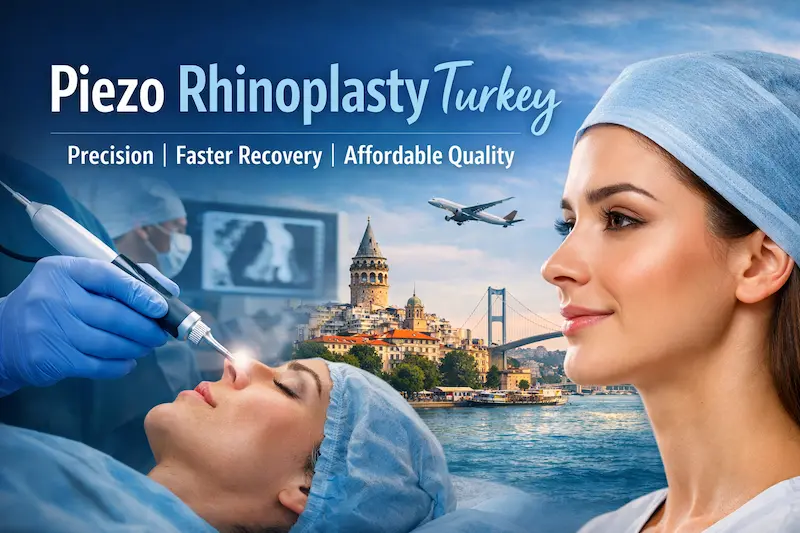
For many British patients, piezo rhinoplasty Turkey is appealing for one simple reason: it sounds more precise, less traumatic and easier to recover from than older bone-breaking methods. When people search for piezo rhinoplasty in Turkey, Turkey piezo rhinoplasty or ultrasonic rhinoplasty Turkey, they are usually not looking for marketing claims. They want clear, honest answers about technique, swelling, bruising, travel timing and whether the result will still look natural on a real face.
In straightforward terms, Piezo rhinoplasty is a modern approach to nasal bone reshaping that uses ultrasonic energy rather than relying purely on traditional manual instruments to fracture or rasp bone. That matters because the bones of the nose sit next to delicate soft tissues, fine blood vessels and the under-eye area. From a medical science perspective, the attraction of Piezo technology is not that it performs miracles, but that it allows bone work to be carried out with a higher degree of control in carefully selected cases.
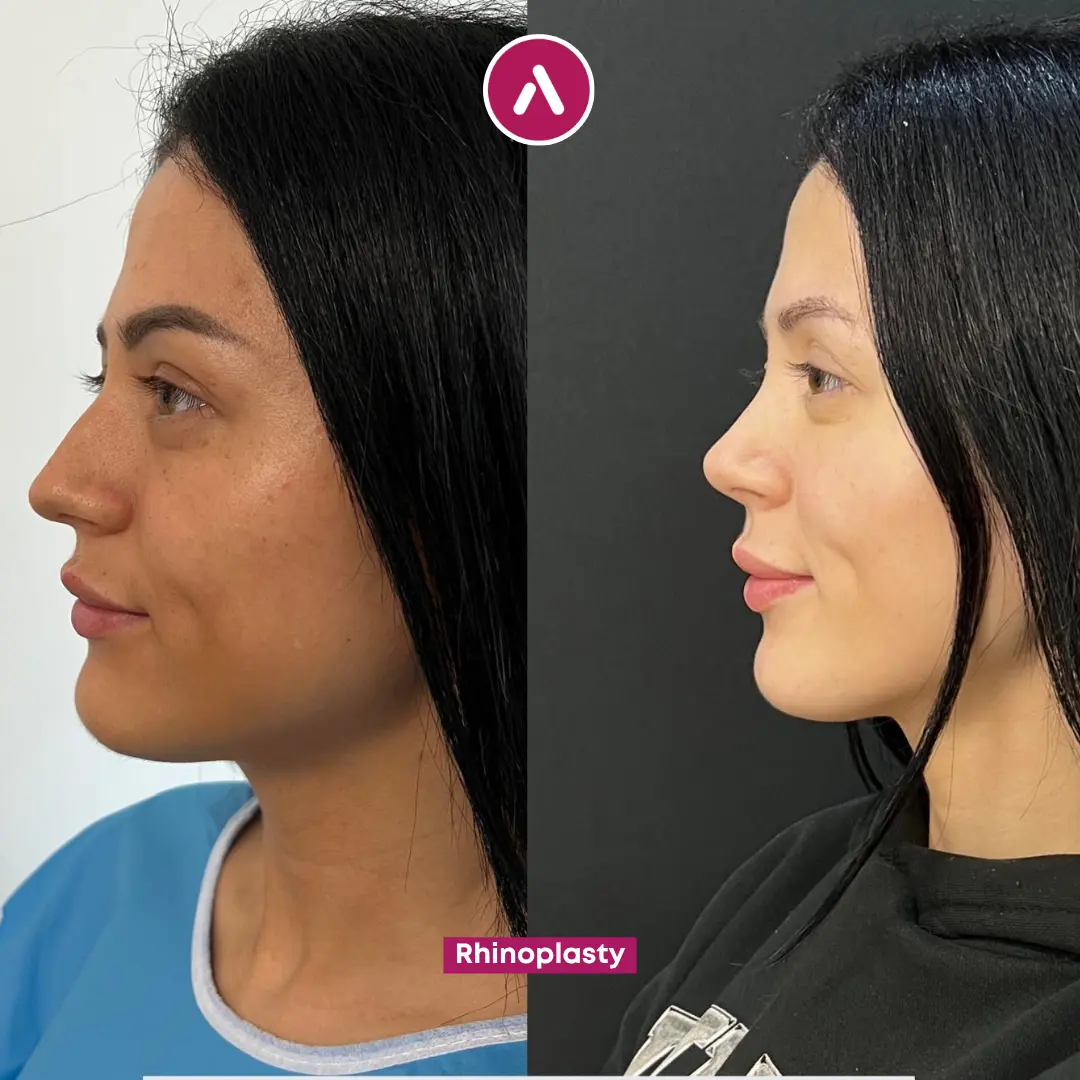
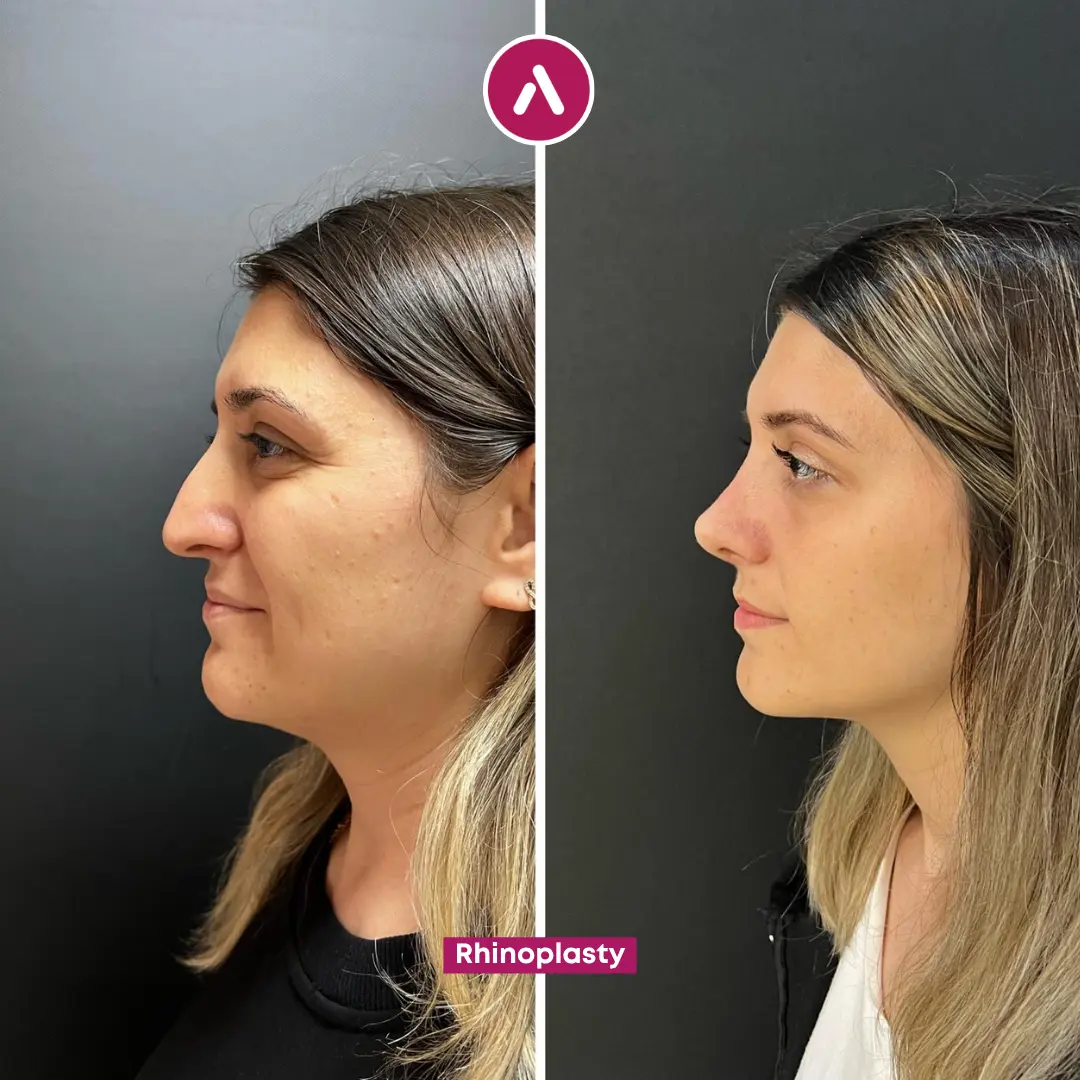
This is why ultrasonic nose reshaping Turkey has become such a popular phrase among UK patients comparing clinics in London, Harley Street and Istanbul. The appeal is not only aesthetic. It is also practical. A lower-trauma approach may support a gentler early recovery, which is especially important for patients who need a realistic piezo rhinoplasty recovery timeline before flying back to the UK. That said, honest surgical advice still matters: Piezo is a valuable tool, not a substitute for judgement, anatomy knowledge or surgical experience.
It is also worth addressing a common online phrase early: bruise-free rhinoplasty Turkey. This wording appears often in search behaviour, but no ethical surgeon should promise zero bruising or zero swelling. Every nose, every skin type and every healing response is different. A more accurate way to frame Piezo is this: it may help reduce unnecessary trauma during the bone phase of surgery, which can contribute to less bruising and less oedema for suitable patients.
- What Piezo rhinoplasty actually is and how it differs from traditional techniques
- Why British patients are drawn to it, especially when they want subtle results and a smoother travel plan
- Where the benefits are real and where expectations need to remain realistic
Table of Contents
What Is Piezo Rhinoplasty and How Does It Differ from Traditional Nose Reshaping?
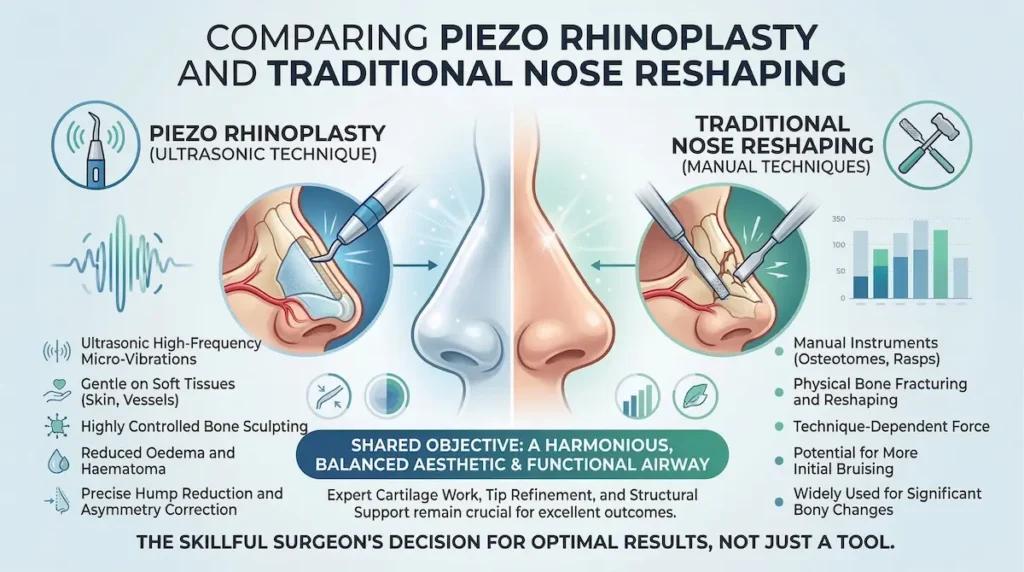
Piezo rhinoplasty is best understood as a bone-reshaping technique within modern rhinoplasty, rather than as an entirely separate operation. In a standard rhinoplasty, a surgeon may need to reduce a hump, narrow wide nasal bones or correct asymmetry. In a piezo nose job Turkey approach, that bony work is performed with an ultrasonic device, often referred to as a piezotome, which allows the surgeon to sculpt bone with a very controlled action. The cartilage work, tip reshaping and internal structural support still depend on classic rhinoplasty skill and careful surgical planning.
Piezo rhinoplasty is best described as an advanced bone-contouring method used within modern rhinoplasty, rather than a completely different procedure on its own. During rhinoplasty, the surgeon may need to smooth a dorsal hump, narrow broad nasal bones or improve asymmetry, and in a piezo nose job Turkey approach this stage is carried out with an ultrasonic instrument known as a piezotome, allowing for highly controlled bone reshaping. While this can be especially valuable in carefully planned cases, including some ethnic rhinoplasty Turkey procedures, the final outcome still depends on expert cartilage work, tip refinement and sound structural support.
What “ultrasonic precision” actually means in nasal bone surgery
The phrase “ultrasonic precision” sounds technical, but the principle is quite easy to understand. A Piezo device uses high-frequency micro-vibrations to act on hard tissue such as bone. In practical surgical terms, this allows the surgeon to shape and refine the nasal bones with more measured movements than those used in some older osteotomy techniques. That is one reason why piezotome rhinoplasty Turkey has become a topic of interest among well-informed UK patients.
In the right hands, the advantage is not simply that the instrument is modern. The real advantage is that it can allow for more refined, more deliberate bone contouring. This can be particularly useful in patients with a prominent dorsal hump, broad bony vault or visible asymmetry across the bridge. The more controlled the bony stage is, the easier it can be to create cleaner lines and a smoother transition from the bridge to the tip.
However, it is important to stay medically honest. Piezo is not automatically better for every single nose, and it does not replace the need for surgical judgement. A beautiful result still depends on facial proportions, skin quality, airway considerations, internal support and whether the surgeon respects the patient’s existing identity rather than chasing an artificial trend.
Piezo instruments vs traditional bone-breaking techniques
Traditional rhinoplasty techniques can achieve excellent results, and many outstanding surgeons still use them successfully. The difference is that Piezo changes how the bone is approached. Instead of relying more heavily on manual fracturing instruments, the surgeon can use ultrasonic energy to shape bone with increased finesse. For many patients searching for ultrasonic rhinoplasty Turkey, this is the central point of interest.
| Feature | Piezo Rhinoplasty | Traditional Bone Work |
|---|---|---|
| How bone is reshaped | Ultrasonic instrument targets bone with controlled micro-vibrations | Manual instruments such as rasps and osteotomes are commonly used |
| Soft tissue handling | Designed to be gentler around surrounding soft tissues during bone work | Can involve more mechanical force depending on the technique used |
| Precision in hump reduction | Often allows very measured contouring of the bony dorsum | Effective, but may be less refined in certain complex bony adjustments |
| Early bruising and oedema | May be reduced in suitable patients | Can be more noticeable in some cases |
| Best use | Bony hump reduction, narrowing and asymmetry correction | Still widely used and valid in experienced hands |
| What it does not replace | Tip reshaping, cartilage support and overall aesthetic judgement | Same principle applies |
For a British reader, the key message is this: the comparison should never be reduced to “old equals bad, new equals good”. The better question is whether the surgeon is selecting the right tool for your anatomy and using it in a way that protects both appearance and function. That is the difference between a thoughtful surgical plan and a trend-led sales pitch.
Why controlled bone work matters for a more refined result
The nose sits in the middle of the face, which means even small irregularities can catch the eye. A fraction too much taken from the bridge, a bony edge left slightly uneven or an over-narrowed upper vault can change the character of the whole result. This is where controlled bone work becomes especially valuable. The goal is not merely to make the nose smaller. The goal is to make it look balanced, harmonious and believable.
That point matters enormously for British patients, who often ask not for a dramatic “done” look, but for a nose that suits their face and does not announce surgery. A carefully planned ultrasonic nose reshaping Turkey procedure can help the surgeon pursue that softer aesthetic because the bony framework is being shaped in a more deliberate way. In other words, precision at the bridge can support subtlety in the final appearance.
It also matters functionally. A well-executed rhinoplasty is not only about the external line. It must also respect the internal anatomy that supports breathing and long-term structural stability. This is why the best surgical outcomes come from specialists who understand both form and function, not from clinics that treat rhinoplasty as a one-size-fits-all cosmetic package.
Why British Patients Are Interested in Piezo Rhinoplasty
British patients do not usually choose rhinoplasty on impulse. They tend to compare surgeons, research recovery in detail and think carefully about value, safety and subtlety before booking a consultation. That is exactly why interest in piezo rhinoplasty in Turkey has grown. It speaks to several UK priorities at once: more controlled technology, potentially gentler recovery, a natural-looking result and the possibility of accessing consultant-led treatment in Istanbul at a cost that is often more accessible than private care in London.
For many patients, the appeal also lies in customisation. A modern approach is not only about reducing trauma during bone work, but about tailoring the operation to the individual face, skin quality and aesthetic goals. This is especially relevant in ethnic rhinoplasty Turkey, where preserving identity and respecting natural facial character are just as important as achieving balance, refinement and long-term structural support.
The appeal of less trauma, less bruising and less oedema
For many UK patients, the first attraction is simple: they want a technique that appears kinder to the tissues around the nose. Search phrases such as reduced downtime nose job Turkey and piezo rhinoplasty recovery timeline reflect a practical concern rather than vanity. Patients want to know when they will look socially presentable, when they can travel comfortably and how much visible bruising they should realistically expect.
Here, Piezo technology can be appealing because the bone stage may be performed with less collateral trauma than older methods in appropriate cases. That does not mean recovery becomes effortless or instant. You can still expect swelling, temporary congestion and a healing process that continues long after the cast comes off. But for the right patient, the early period may be more manageable, which is especially relevant if the plan involves a return flight to the UK after surgery.
It is also important to reframe the popular keyword bruise-free rhinoplasty Turkey in a medically responsible way. “Bruise-free” is not a guarantee and should not be marketed as one. A better and more truthful message is that Piezo may support less bruising and less oedema compared with more forceful bony manipulation, depending on anatomy, surgical technique and individual healing response.
Why “subtle”, natural-looking change matters more than dramatic alteration
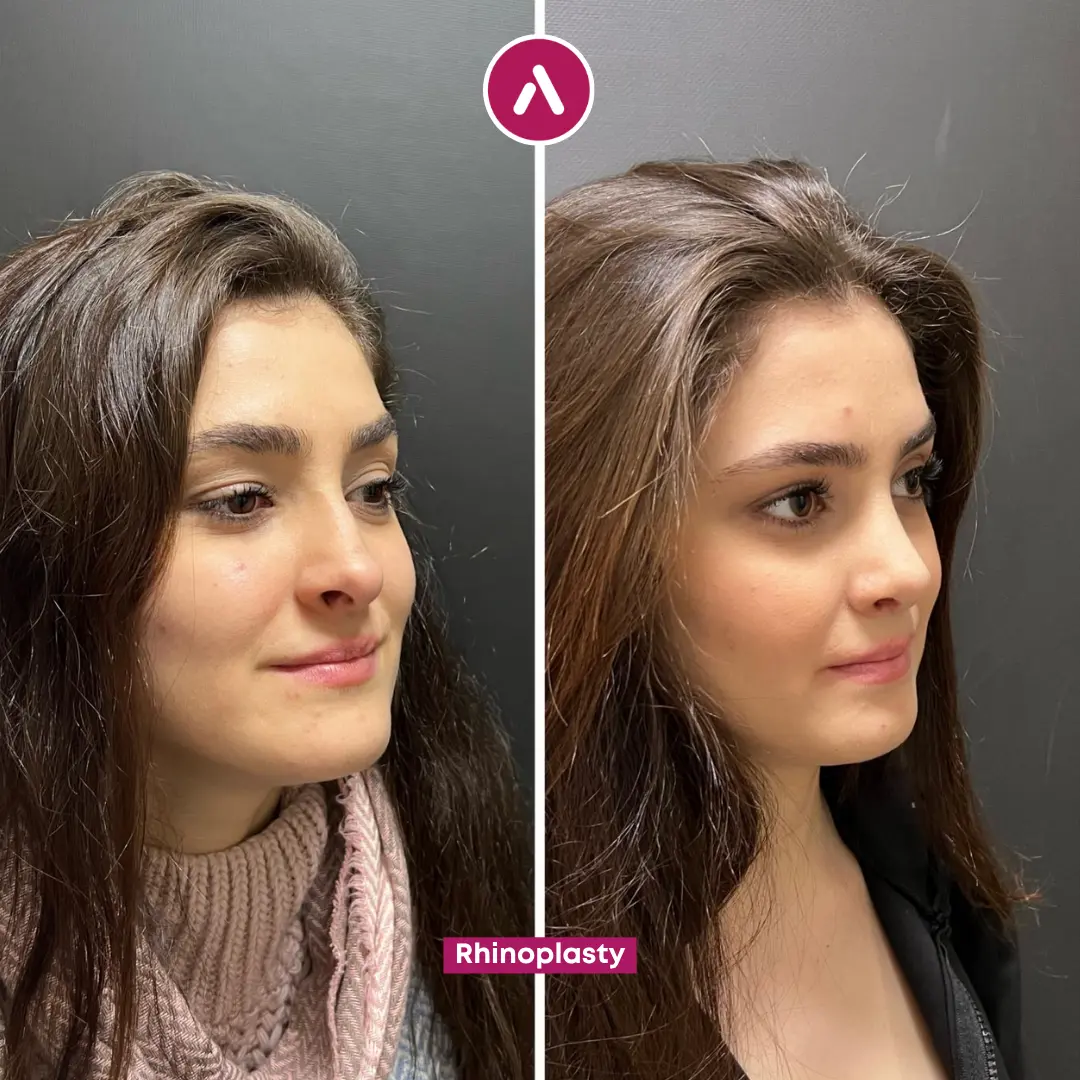
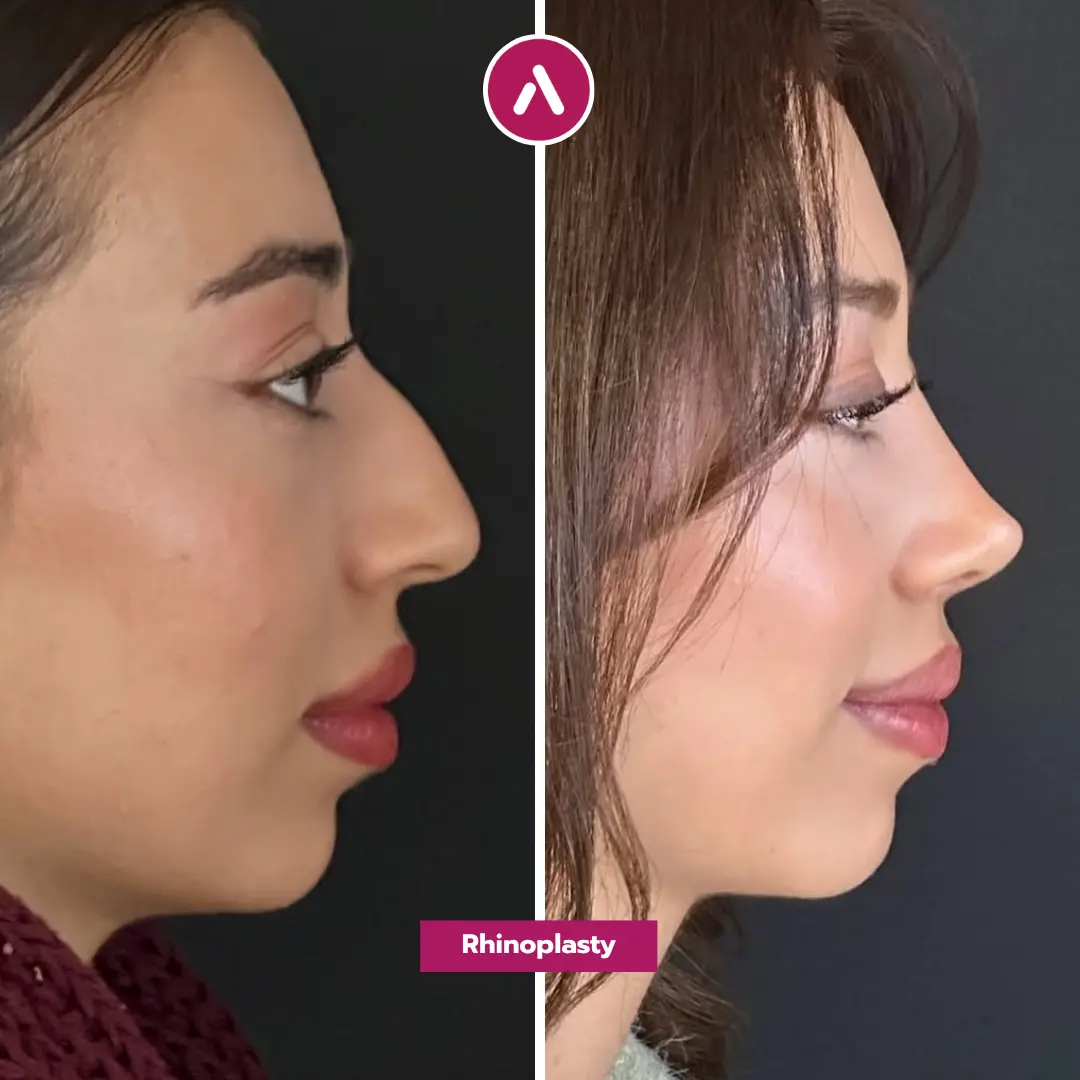
The typical British aesthetic preference is not usually “make me unrecognisable”. It is much closer to “make me look fresher, straighter or more balanced, but still like myself”. That mindset shapes why Turkey piezo rhinoplasty is attractive to the UK market. The technology sounds advanced, but the deeper reason for its appeal is that it suggests finesse rather than aggression.
When a patient wants to refine a hump, improve asymmetry or soften a profile without creating an over-operated look, the promise of more controlled bone reshaping feels aligned with that goal. A refined result is rarely about one dramatic manoeuvre. It comes from a series of measured decisions: how much to reduce, where to preserve support, how to maintain airflow and how to keep the nose in proportion with the patient’s forehead, lips, chin and ethnicity.
That is also why honest clinics avoid promising a fashionable template nose. The best outcomes are bespoke. A well-performed piezo nose job Turkey should not make every patient look the same. It should respect identity, preserve facial character and avoid the tell-tale signs of over-reduction that many British patients specifically want to avoid.
How Piezo fits the expectations of the UK “expert patient”
The UK patient profile is often highly research-driven. Many people want to understand surgeon qualifications, hygiene protocols, recovery support and what happens after they return home. In that context, interest in best piezo rhinoplasty surgeon Turkey is not just about finding a catchy name online. It is about finding a surgeon whose credentials and philosophy stand up to scrutiny.
For rhinoplasty, that standard of scrutiny matters. British patients often look for a surgeon who combines aesthetic judgement with functional understanding of the nose. For the UK reader, this matters because it frames rhinoplasty not as a beauty trend, but as a facial procedure that should be planned with anatomical discipline, technical precision and respect for breathing function.
Just as importantly, the treatment journey matters as much as the operation itself. A private cosmetic clinic in Istanbul with British standards, sterile operating theatre protocols, clear communication and structured post-operative support will always feel more credible to a UK patient than a price-led offer with vague aftercare. That is one reason why many British patients do not simply compare piezo rhinoplasty cost UK vs Turkey; they compare overall value, trust and support.
One UK patient, Sarah, described her AKM Clinic recovery as painless with minimal need for paracetamol and said that, when comparing London and Istanbul, she would confidently choose Turkey over the UK again.
That kind of feedback matters because British patients often trust the lived experience of other UK patients. They want to know whether communication was smooth, whether expectations were realistic and whether support continued after the flight home. In other words, the appeal of Turkey piezo rhinoplasty package options is not only convenience. It is the reassurance that logistics, follow-up and recovery planning have been thought through properly.
The Main Clinical Benefits of Piezo Rhinoplasty
The main reason piezo rhinoplasty Turkey attracts so much attention is that it offers a more controlled way of reshaping nasal bone in suitable patients. This does not mean every case becomes easy, nor does it mean every patient will heal in exactly the same way. What it does mean is that the surgeon can often work with more precision during the bony stage of the operation, and that may translate into a neater surgical process, a more refined contour and a gentler early recovery for some patients. For British readers comparing ultrasonic rhinoplasty Turkey with more conventional approaches, the value lies in precision, tissue respect and realistic recovery planning rather than exaggerated promises.
More precise hump reduction and bone reshaping
One of the key benefits of Piezo technology is the precision it offers when refining a dorsal hump or reshaping wide nasal bones. Although these changes can also be achieved with traditional rhinoplasty techniques, Piezo allows the surgeon to work on the bony framework in a more targeted and controlled way. This can be especially valuable for patients seeking subtle refinement rather than a dramatic change, and it may also be beneficial in carefully planned ethnic rhinoplasty Turkey procedures, where preserving natural facial identity is just as important as improving balance and contour.
This matters aesthetically because rhinoplasty is a game of millimetres. A tiny irregularity along the bridge can cast shadows, affect symmetry in photographs or create a profile that looks slightly “operated on”. By shaping bone with a more deliberate technique, the surgeon can pursue smoother lines and a more elegant bridge transition. For patients searching ultrasonic nose reshaping Turkey, that is usually the hidden meaning behind the keyword: they want refinement, not a template nose.
There is also an important philosophical point here. Precision should not be confused with aggressiveness. The best results often come from conservative, anatomy-led reshaping rather than from over-reduction. British patients, in particular, tend to prefer a result that looks harmonious in real life, not just in edited before-and-after images. Piezo supports that more restrained approach because it helps the surgeon stay deliberate during the bony phase of surgery.
Better protection of surrounding soft tissue during osteotomies
Another reason why Turkey piezo rhinoplasty has become so widely discussed is its reputation for being kinder to the tissues around the nose. In simple terms, the nasal bones do not exist in isolation. Around them sit delicate soft tissue layers, tiny blood vessels and the under-eye region where bruising can become visible. A technique that allows for targeted bone work may reduce unnecessary collateral trauma compared with more forceful manoeuvres in selected cases.
That does not mean surgeons should market Piezo as magical or “trauma-free”. Ethical patient education matters. There will still be swelling, internal healing and some disruption to normal tissue simply because rhinoplasty is still surgery. Yet from the standpoint of scientific research and practical surgical experience, the attraction of selective ultrasonic bone work is easy to understand: when less unnecessary force is transferred to surrounding structures, the early aftermath may be gentler for some patients.
This is exactly why phrases like bruise-free rhinoplasty Turkey appear so often online. The phrase is catchy, but it is medically imprecise. A more responsible explanation is that Piezo may help reduce bruising and discolouration for suitable candidates, but it cannot ethically promise zero bruising or zero oedema. Individual healing, skin thickness, the extent of correction and whether other structural work is needed all influence the visible recovery pattern.
A potentially smoother early recovery period for patients flying home to the UK
For the UK market, the benefit conversation does not end in the operating theatre. It continues into the travel phase. A patient from London, Manchester or Birmingham will reasonably want to know whether a more precise operation can support a more comfortable journey back home. This is why search behaviour often includes terms such as reduced downtime nose job Turkey and piezo rhinoplasty recovery timeline. The goal is not simply to look better; it is to recover with fewer practical disruptions.
When early swelling and bruising are more manageable, the patient may feel more confident during hotel recovery, post-operative checks and the return flight to the UK. Comfort still depends on many variables, including how extensive the surgery was, whether septal correction was also performed and how carefully the patient follows instructions regarding rest, hydration and aftercare. But in principle, a lower-trauma bone technique fits very naturally with the priorities of the British “expert patient” who plans every detail of the journey.
At AKM Clinic, this wider recovery picture is supported by a structured care model rather than by the operation alone. The clinic’s stated emphasis on British-standard hygiene, sterile operating theatres and adjunctive recovery support helps place piezo rhinoplasty in Turkey within a more complete patient journey, which is ultimately what most discerning UK patients are really evaluating.
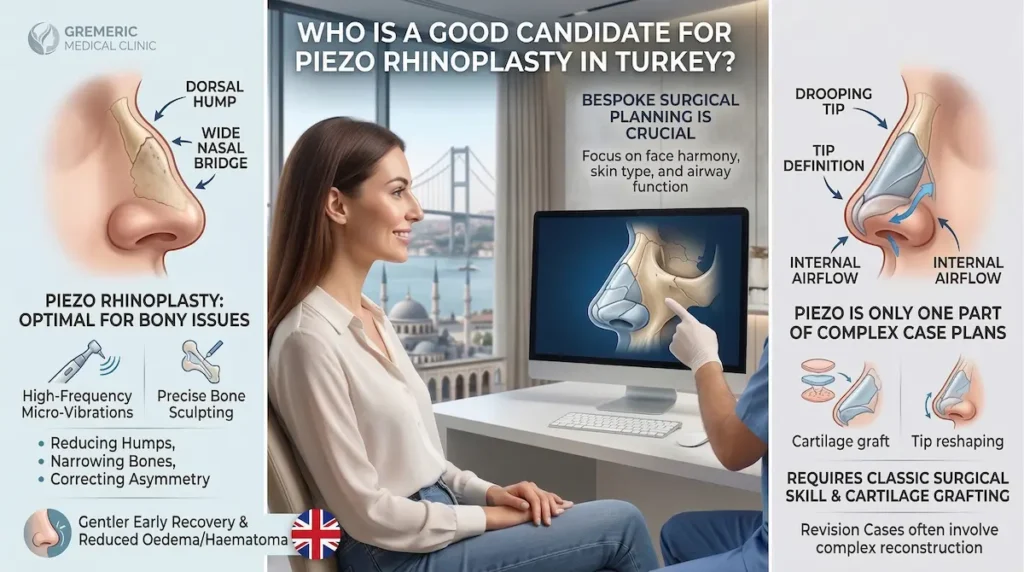
Who Is a Good Candidate for Piezo Rhinoplasty in Turkey?
Not every patient needs Piezo, and not every rhinoplasty concern is primarily about bone. This is one of the most important things to understand before booking a consultation. Piezo is most useful when the bony framework of the nose genuinely needs precise reshaping. If the main issue lies in the tip, cartilage strength, septum or internal airflow, then the operation may still include Piezo as one part of the plan, but it will not be the whole story. A good consultation should therefore focus less on trendy device names and more on your anatomy, your priorities and whether a piezo nose job Turkey approach is actually the right fit for your case.
Patients with a dorsal hump, asymmetry or wide nasal bones
Patients who often benefit most from Piezo are those with a visible bony hump, broad nasal bones or bridge asymmetry that becomes obvious from the front or side view. In these cases, the ability to contour bone more precisely can be especially useful. If the goal is to soften a prominent profile or narrow a broad upper third without creating a harsh or artificial finish, Piezo may be a strong option.
For some patients, the decision is not only about reducing a hump or straightening the bridge, but also about preserving harmony with their wider facial features. This is where ethnic rhinoplasty Turkey becomes especially relevant, as the aim is not to erase identity but to refine the nose in a way that respects natural proportions, skin thickness and long-term structural balance.
This is one reason ultrasonic nose reshaping Turkey appeals to British patients who want a softer, more polished bridge while keeping their overall look familiar. Rather than asking for a complete transformation, they are often asking for refinement: a straighter line, less prominence in profile and better facial balance when viewed from multiple angles. That kind of objective fits well with a technique designed for controlled bony adjustment.
It is also relevant in patients who are highly aware of social downtime. Someone with a public-facing profession or limited annual leave may be especially interested in whether a more selective bone technique can support a gentler early recovery. That does not make them superficial; it simply means they are balancing aesthetic goals with work, travel and real-life obligations.
Primary rhinoplasty candidates vs revision rhinoplasty patients
Piezo can be highly useful in primary rhinoplasty, especially where the main objective is bridge refinement, narrowing or correction of mild to moderate asymmetry. In a first-time operation, the tissue planes are usually more predictable, and the surgeon can plan the bony work in a relatively straightforward way if the anatomy is suitable. For this reason, many people searching piezo rhinoplasty in Turkey are first-time patients who want a more modern approach from the outset.
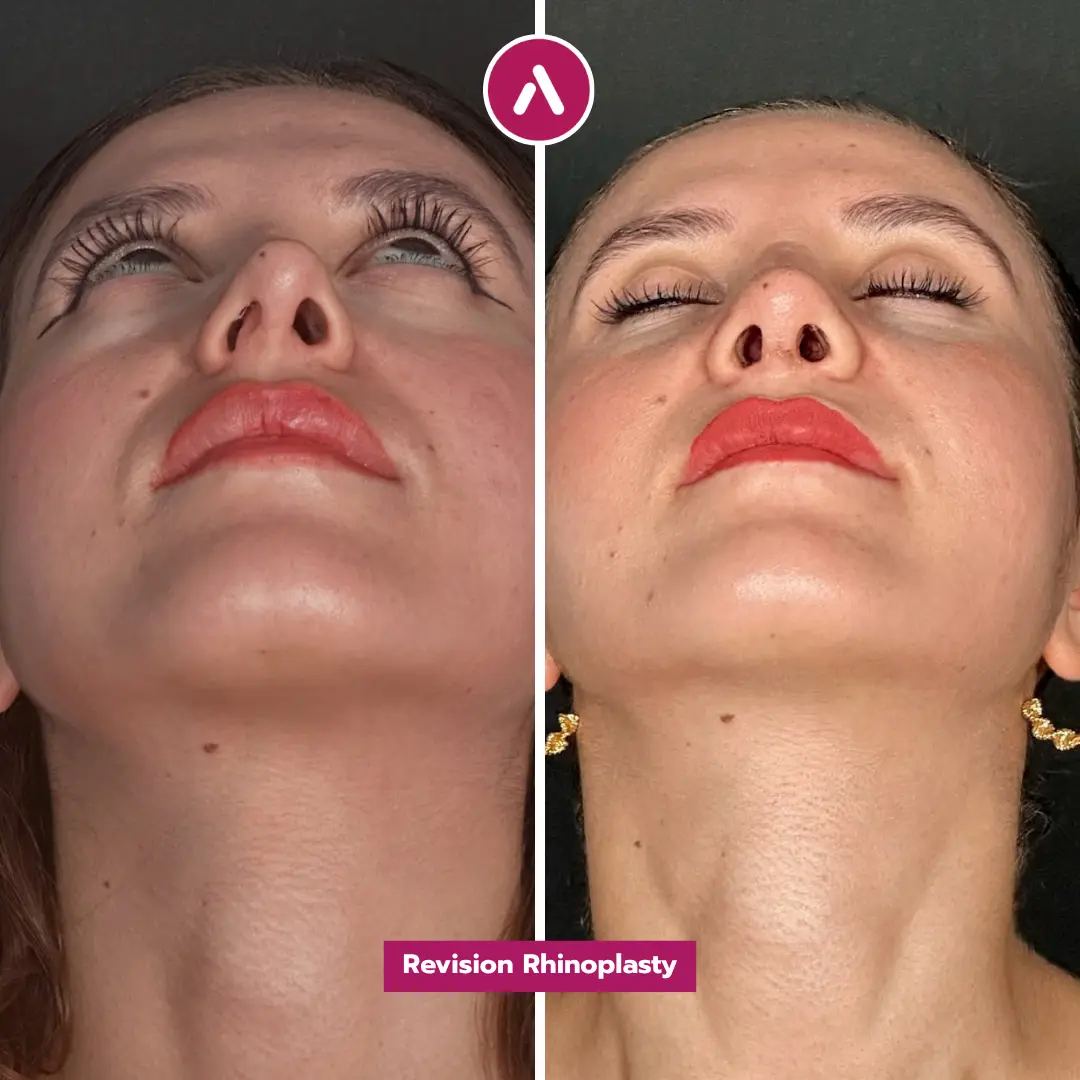
Revision rhinoplasty is more complex. Previous surgery may have changed the anatomy, weakened support structures or created scar tissue that alters how the nose responds. In such cases, Piezo can still be valuable, particularly for careful bony adjustments, but it is only one component of a much more demanding reconstructive strategy. Cartilage grafting, internal support and breathing assessment may become even more important than the bone technique itself.
That is why surgeon selection matters so much more than the device. A patient looking up best piezo rhinoplasty surgeon Turkey should not judge quality by technology alone. The real question is whether the surgeon can explain, in a personalised way, where Piezo will help, where it will not and what additional structural work may be required to achieve both an aesthetic and functional result.
When cartilage work, septal correction or tip refinement matter just as much as Piezo
Many noses are not “bone-only” cases. A patient may have a hump and a drooping tip, a deviation and weak cartilage, or breathing concerns alongside cosmetic concerns. In those situations, Piezo may assist with the bridge, but the final outcome still depends heavily on cartilage shaping, tip definition and internal support. This is where a specialist rhinoplasty mindset becomes far more important than any single device.
For UK patients, this is a good point to remember when comparing Turkey piezo rhinoplasty package offers online. A package may sound attractive, but the true value lies in whether the operation is bespoke. If your surgeon treats all noses as though they require the same sequence, that is a warning sign. The best treatment plans adapt to the patient rather than forcing the patient into a fixed template.
Recovery Timeline After Piezo Rhinoplasty for UK Patients
Recovery is often the deciding factor for British patients considering surgery abroad. The question is rarely just “How long until I heal?” It is usually much more specific: when will I be fit to walk around comfortably, when can I be seen socially, and when can I fly home with confidence? That is why the piezo rhinoplasty recovery timeline matters so much in UK-focused content. A realistic timeline helps patients organise work leave, accommodation, airport transfers and support at home without falling into either false reassurance or unnecessary anxiety.
What to expect in the first 48 hours, first week and first month
The first 48 hours are usually the phase of peak swelling, pressure and general post-operative tiredness. Even with a more precise piezo rhinoplasty Turkey approach, you should still expect congestion, tenderness and a feeling of fullness around the nose and under-eye area. Some patients have very little bruising; others still bruise visibly. That variation is normal. The key aim during this stage is rest, head elevation, gentle hydration and following your medication plan carefully.
During the first week, most patients start to feel more comfortable, although the nose will still be swollen and somewhat stiff. If an external splint has been used, this is often the period when patients begin to feel psychologically better because the earliest recovery milestones are in sight. Social confidence often improves after the first postoperative review, but it is important to remember that “looking presentable” and “being fully healed” are not the same thing.
By the first month, much of the obvious bruising has usually settled, and the nose generally begins to look more socially normal, although residual swelling remains very common, especially in the tip. Final refinement takes much longer. Thin-skinned patients may see bridge definition sooner, while thicker-skinned noses may need more patience. This is why any clinic promising an instant final result is oversimplifying rhinoplasty recovery.
| Recovery Phase | What Patients Commonly Notice | Practical UK Travel Consideration |
|---|---|---|
| First 48 hours | Swelling, congestion, pressure, mild to moderate bruising | Focus on rest, hotel recovery and local monitoring rather than travel |
| Days 3-7 | Discomfort usually eases; bruising and oedema begin to settle | Useful period for follow-up checks before any return journey |
| Week 2 | Patients often feel much more socially comfortable | Many feel more confident travelling, depending on surgeon advice |
| Weeks 3-4 | Most obvious signs improve, but internal healing continues | Suitable for returning to routine life, with sensible caution |
| Months 3-12 | Progressive refinement, especially in the tip | Important phase for digital follow-up and photo reviews |
Flying back to the UK: timing, comfort and practical planning
One of the biggest concerns for expert patients is the flight home. The answer should always be individualised, because flight timing depends on the extent of surgery, your general health, your examination findings and your surgeon’s instructions. In general, patients should not think about flying purely in terms of “How quickly can I leave?” but rather “When will I be comfortable, medically stable and properly reviewed?”
For a patient comparing reduced downtime nose job Turkey options, it is worth remembering that comfort matters almost as much as safety. A return journey through Istanbul Airport, plus the pressure changes and fatigue of air travel, can feel quite different when your nose is still blocked and your sleep has been disrupted. That is why a responsible clinic will discuss not only surgery dates, but also how long you should remain in Istanbul for post-operative checks and when a return flight is realistically sensible.
The appeal of Turkey for UK patients is that the logistics can still be very manageable. Direct flights London to Istanbul are widely available, and that accessibility makes it easier to plan a well-structured treatment journey. The right approach is not to rush recovery for the sake of speed, but to organise the trip intelligently so that surgical review, hotel recovery and the flight home all fit together in a medically sensible sequence.
How HBOT-supported recovery and structured aftercare can support a smoother return journey
Technique is only one part of recovery. Post-operative support can make a real difference to how confident and comfortable patients feel after surgery. At AKM Clinic, the wider recovery framework includes HBOT and LLLT as part of its stated technology and patient-care standards. Hyperbaric Oxygen Therapy is described by the clinic as a core strategy to reduce post-operative oedema and support lymphatic drainage, while LLLT is used to support tissue healing and scar quality.
For the British patient, the value of this kind of structured support is practical as well as clinical. A more organised recovery process may help patients feel more “flight-ready” before returning to the UK, especially when combined with clear instructions, responsive communication and planned digital follow-up. This aligns strongly with what UK patients typically look for: not only a technically good operation, but also reassurance that aftercare continues once they are no longer physically in Istanbul.
That continuity of care matters. Patients considering piezo rhinoplasty cost UK vs Turkey should think beyond the procedure itself and assess the whole pathway: the consultation, the surgical plan, the recovery support, the communication standards and the post-op access to the team after arriving home. In that broader sense, value is not simply about paying less than Harley Street. It is about receiving a well-organised, consultant-led journey that respects both aesthetics and patient psychology.
Safety, Trust and Surgeon Selection: What to Check Before Booking
For many British patients, the decision to book surgery abroad is not primarily about price. It is about trust. A patient may be very interested in piezo rhinoplasty Turkey, but still hesitate because of concerns about safety, aftercare and whether the surgeon’s credentials truly stand up to scrutiny. That caution is sensible. Rhinoplasty is a technically demanding procedure that affects both appearance and function, so the right question is never simply “Does this clinic offer Piezo?” It is “Who is performing my surgery, where will it take place, and what support will I have before and after I return to the UK?”
For many patients, that trust becomes even more important when the surgical plan must balance aesthetic refinement with respect for individual facial identity. This is particularly true in ethnic rhinoplasty Turkey, where the aim should never be to create a generic result, but to achieve improvement in a way that preserves natural character, structural support and long-term harmony.
Consultant-led care, European board-equivalent credentials and UK-style trust signals
When British patients search for the best piezo rhinoplasty surgeon Turkey, they are often looking for more than impressive social media images. They want proof of specialist training, a clear consultant-led model and reassurance that the operation is not being delegated. In rhinoplasty, this matters enormously because the procedure demands precision, restraint and a sound understanding of nasal function as well as facial aesthetics.
UK-style trust signals also matter beyond the surgeon’s CV. British patients commonly look for clear communication, realistic online consultations, all-inclusive pricing explained transparently in GBP and visible signs that the clinic understands the concerns of overseas patients. That includes a structured patient pathway, responsive medical coordination and confidence that the team is used to caring for British patients from consultation through to return travel.
Why sterile operating theatres and British-standard protocols matter
Technology only matters when it is used inside a safe clinical framework. A clinic may advertise ultrasonic rhinoplasty Turkey, but the more important issue is whether that treatment is being delivered in a properly controlled environment with rigorous hygiene protocols. British patients, especially those influenced by negative media stories about surgery abroad, tend to look closely at how seriously a clinic takes safety behind the scenes.
That is why details such as sterile operating theatres, disciplined infection-control standards and a zero-compromise attitude to hygiene are not minor points. They are central trust markers. At AKM Clinic, the stated framework emphasises WHO-aligned sterile field protocols and a private cosmetic clinic in Istanbul with British standards. For a UK reader, that matters because it moves the conversation away from “cheap treatment abroad” and towards a more serious clinical standard of care.
It also affects the overall patient experience. A well-run operating theatre, careful peri-operative monitoring and clear recovery instructions do not only reduce anxiety; they create the conditions for smoother healing and more confident aftercare. In other words, the safety culture of the clinic is part of the result, not a separate issue from it.
Questions UK patients should ask during an online consultation
An online consultation is not merely a booking formality. It is one of the best opportunities to assess whether a clinic is transparent, medically thoughtful and genuinely prepared to personalise your surgery. Anyone considering piezo rhinoplasty in Turkey should use the consultation to test the depth of the surgeon’s planning, not just the warmth of the sales process.
- Am I actually a good candidate for Piezo rhinoplasty, or is another approach more suitable for my anatomy?
- Will the same consultant surgeon who plans my surgery perform the operation personally?
- Is my concern mainly bony, or will I also need septal work, cartilage grafting or tip refinement?
- What should I realistically expect in terms of bruising, oedema and my piezo rhinoplasty recovery timeline?
- How long should I remain in Istanbul before flying back to the UK?
- What post-operative support will I have once I am home, and how quickly can I contact the team if I am worried?
- Are your package quotations transparent in GBP, and what is included or excluded?
If a clinic cannot answer those questions clearly, that matters. Good rhinoplasty care is not built on vague reassurance. It is built on precise explanations, realistic expectations and evidence that the team has already thought through your medical journey from first consultation to long-term follow-up.
Piezo Rhinoplasty Turkey vs UK: Value, Access and Patient Experience
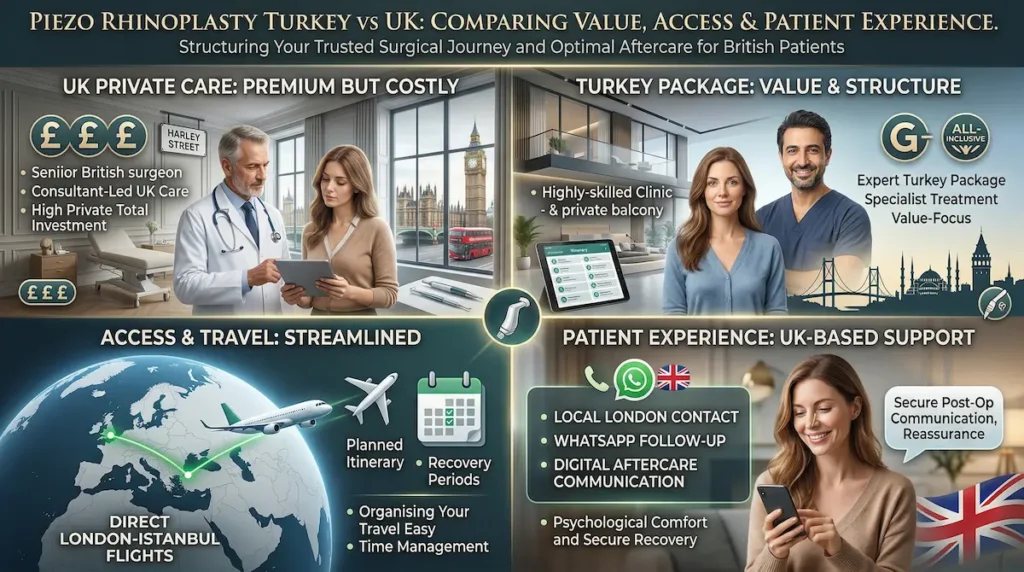
British patients comparing piezo rhinoplasty cost UK vs Turkey are rarely comparing numbers alone. They are weighing cost against access, travel ease, consultant expertise and the quality of support before and after surgery. In the UK, particularly in London and Harley Street, private rhinoplasty can be perceived as premium and highly regulated, but it may also feel financially out of reach for many people. Turkey appeals because it offers a different combination of factors: specialist treatment, shorter access times, structured packages and a medical-travel pathway that is often designed with international patients in mind.
Harley Street expectations vs Istanbul value without compromising standards
The UK patient does not want “cheap”. The UK patient wants value. That distinction matters. For many people, the attraction of Turkey piezo rhinoplasty is the possibility of accessing a consultant-led surgical journey that feels premium, while avoiding the very high private-clinic costs associated with central London. The comparison, therefore, is not “budget versus luxury”; it is “Harley Street expectations with more accessible overall investment”.
| Comparison Point | Typical UK Private Clinic Experience | Typical Turkey Piezo Rhinoplasty Package Experience |
|---|---|---|
| Pricing format | Often itemised across surgeon, theatre and hospital costs | More commonly presented as an all-inclusive quotation in GBP |
| Access speed | Consultations and surgery dates may be more limited | Often easier to plan around work leave and travel windows |
| Travel and accommodation | Usually arranged separately by the patient | Frequently built into the package structure |
| Perceived value | High quality, but often at a much higher total outlay | Strong value proposition when consultant-led care and aftercare are clearly defined |
| Aftercare coordination | Local access is convenient, but private care remains costly | Requires strong digital follow-up and UK-facing communication systems |
The key point is that value should never be reduced to the headline fee. A credible Turkey piezo rhinoplasty package should be judged by the full picture: surgeon experience, operating theatre standards, accommodation logistics, airport transfers, aftercare access and whether the clinic communicates transparently. The best choice is the one that makes medical sense and feels psychologically secure, not simply the one with the lowest quote.
Direct flights London to Istanbul and planning a streamlined surgical trip
Accessibility is one of Turkey’s practical strengths for UK patients. With direct flights from London and other major British cities to Istanbul, the journey is manageable enough to fit around annual leave, family obligations and recovery planning. This matters especially for patients who are drawn to reduced downtime nose job Turkey searches because they are trying to minimise disruption rather than turn surgery into a prolonged trip abroad.
A well-planned medical journey should feel structured from the beginning. That means arranging consultation timing, surgery day, hotel recovery, post-operative reviews and the return flight in a sequence that respects healing rather than rushing it. The best clinics do not encourage patients to leave too early simply to make the package look convenient. Instead, they build the itinerary around when the patient is comfortable, reviewed and medically fit to travel.
For many UK patients, that balance of accessibility and structure is one of the strongest reasons to choose Istanbul. It offers an international city with strong flight links and a medical-tourism infrastructure that can feel easier to navigate than trying to coordinate every detail independently.
Why a UK-based patient contact point and post-op communication matter
One of the biggest emotional concerns for British patients is what happens after they get home. The operation may go well, but patients still want reassurance that they will not feel isolated once they are back in the UK. This is one reason aftercare and communication matter so much in the decision-making process. A clinic offering piezo rhinoplasty Turkey should be able to explain how questions, swelling concerns and recovery updates will be managed once the patient is no longer in Istanbul.
From a patient-experience perspective, UK-facing support tools can be extremely reassuring. A UK support line, direct WhatsApp access and a London correspondence address do not replace the need for good surgery, but they do reduce the feeling of distance. They show that the clinic understands the psychology of overseas care and has created a bridge back to the patient’s home environment.
“Knowing there was a UK based patient contact point and a London correspondence address provided immense psychological comfort.”
That type of reassurance can be decisive for the cautious British patient. When people compare piezo rhinoplasty cost UK vs Turkey, they are not only comparing the operating fee. They are comparing how supported they expect to feel. Strong aftercare communication often becomes one of the clearest signs that a clinic understands British patient expectations at a genuinely professional level.
Frequently Asked Questions (FAQ): Piezo Rhinoplasty Turkey
Patients considering piezo rhinoplasty Turkey often ask practical, highly specific questions rather than broad cosmetic ones. That is especially true in the UK market, where people tend to research technique, healing and travel timing in detail before making any decision. The answers below are intentionally concise and realistic.
Is Piezo rhinoplasty less painful than traditional rhinoplasty?
It can feel gentler for some patients, particularly during the early recovery period, because the bone stage may involve less unnecessary trauma. However, it is still surgery, so congestion, pressure, swelling and tenderness should still be expected.
Does Piezo rhinoplasty mean there will be no bruising at all?
No. The phrase bruise-free rhinoplasty Turkey is a popular search term, but it should not be taken as a guarantee. Piezo may help reduce bruising in suitable cases, yet individual healing responses vary and some bruising can still occur.
Is Piezo only useful for hump removal?
No. It is particularly useful for dorsal hump reduction and reshaping the bony bridge, but it may also help with narrowing wide nasal bones or correcting certain forms of asymmetry. It is not, however, a replacement for cartilage work or tip refinement when those are the main issues.
Can Piezo rhinoplasty be used in revision surgery?
Yes, in selected revision cases it can be helpful for careful bony adjustment. That said, revision rhinoplasty is usually more complex than primary surgery, and the overall result often depends just as much on cartilage grafting, support and scar-related factors as on the Piezo device itself.
How long should I stay in Istanbul after surgery?
The exact stay depends on your operation, your recovery and your surgeon’s review findings. In general, patients should plan enough time for initial healing, post-operative checks and comfortable travel rather than trying to leave as quickly as possible.
When can I safely fly back to the UK after Piezo rhinoplasty?
This must be decided individually by your surgeon. In practical terms, most patients should think about flying only after they have been assessed, are stable and feel comfortable enough for the journey. The safest plan is always one built around clinical advice rather than convenience alone.
Will Piezo automatically give me a more natural-looking nose?
No. Piezo is a precision tool, not a guarantee of beauty. A natural-looking result depends on the surgeon’s judgement, your anatomy, your skin type, the structural plan and whether the operation is designed to suit your face rather than follow a trend.
If you would like to explore related topics beyond this guide, you can also learn more about Thick Skin Rhinoplasty, Tip Plasty Turkey, Septorhinoplasty Turkey, Rhinoplasty Cost Turkey and Revision Rhinoplasty Cost, as well as how to choose a Specialist Plastic Surgeon Turkey, what to expect from an Online Plastic Surgery Consultation, and how to avoid Ghost Surgery in Turkey.
Medical Disclaimer: This page is provided for general educational purposes only and does not replace a face-to-face medical consultation, diagnosis, or personalised treatment plan. All surgery carries risks and outcomes vary between individuals. Suitability for a rhinoplasty (nose job) surgery, procedure selection, and anaesthesia choice can only be determined after a full clinical assessment by a qualified surgeon. Always follow your clinician’s instructions and seek urgent medical attention if you develop concerning symptoms during recovery.