
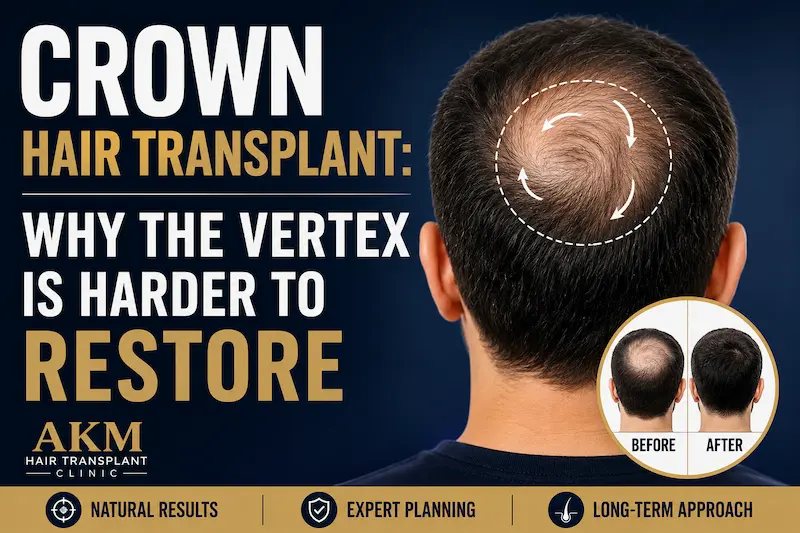
Crown Hair Transplant: Why the Vertex Is Harder to Restore
AI Summary
- Crown hair transplant is harder because vertex whorls require precise graft angle planning.
- Realistic density aims for social fullness, not teenage-level coverage under harsh overhead light.
- Donor protection preserves grafts for future hairline, midscalp, or staged crown needs.
- Recovery expectations should allow crown maturation up to around 18 months.
Summary generated by AI, fact-checked by our medical experts
Quick answer: A crown hair transplant is harder than restoring the frontal hairline because the vertex has a spiral growth pattern, a larger visible surface, and less forgiving light exposure. In a well-planned FUE hair transplant strategy, the goal is usually natural-looking coverage and “social fullness,” not the density of a non-balding scalp.
The crown is the area most men stare at in top-down photos, bathroom mirrors, security cameras, and harsh office lighting. It can look thin even when the rest of the transplant looks strong. That does not mean the surgery failed. It means the crown behaves differently.
Unlike the front hairline, where hairs can be angled forward to create a visual frame, crown hairs rotate around a central whorl. They change direction across a small area. They also sit on a curved surface that catches light from above. For a hair loss patient, that creates the big question: “Can I restore the crown without wasting donor grafts I may need later?”
This guide explains why the vertex is technically demanding, why it often needs more grafts than patients expect, and how a surgeon-led plan protects the donor area while still creating a crown that looks natural in real life.
Table of Contents
Why the Crown Is Harder to Restore
The crown looks simple from the outside: it is a bald or thinning circle at the back of the scalp. Surgically, it is one of the most complex zones in hair restoration. The difficulty comes from three things working together: the spiral whorl, the angle changes, and the way light exposes scalp through the hair.
That is why a good crown plan starts with design, not just graft count. More grafts can help, but only if they are placed in the right direction, density, and pattern. A poorly designed crown can look pluggy, flat, or artificial even when many grafts survive.
The whorl/swirl growth pattern
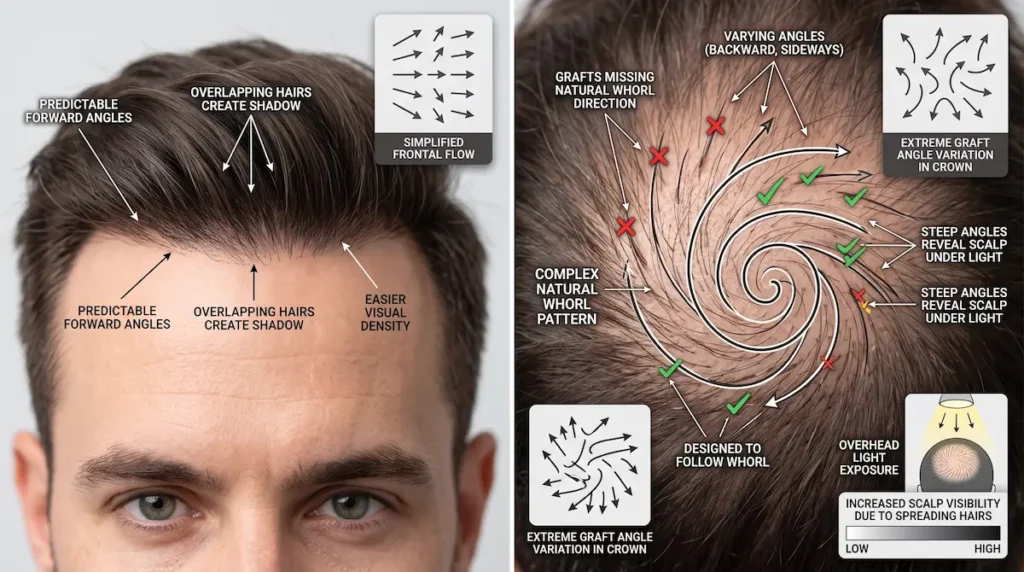
The crown is not a straight-line area. Natural hair in the vertex usually grows in a circular or spiral pattern called the whorl. Some men have one clear whorl. Others have a double whorl, an off-center swirl, or a broken pattern caused by progressive hair loss.
To recreate that pattern, the surgeon has to place follicles so they rotate gradually around the central point. The direction changes by tiny degrees across the crown. If the grafts are all placed in one simple direction, the result can look like a flat patch of transplanted hair rather than a natural crown.
This is where artistry meets anatomy. The surgeon has to decide where the whorl center belongs, how far the swirl should extend, and how the transplanted hairs should blend into the native hair around it. A crown that looks natural at six inches away often depends on those small decisions.
Why graft angles are harder in the vertex
Hairline grafts are demanding, but their direction is more predictable. Most frontal hairs angle forward and slightly downward. Crown grafts do not behave that way. Around the vertex, hairs may angle backward, sideways, diagonally, or nearly flat against the scalp depending on their position within the whorl.
That angle matters. If the grafts are placed too upright, they can stand up under light and reveal more scalp. If they are placed against the natural swirl, the crown can look uneven when the hair grows out. If they are packed without respecting direction, the result may look dense in photos but unnatural in motion.
Clinical hair transplantation guidance emphasizes that successful results depend on candidate selection, donor quality, and realistic planning. It also notes that the donor area is a primary limiting factor, regardless of technique, which is especially relevant when planning a graft-hungry crown.
Why the crown shows more scalp than the front
The crown is exposed to overhead light. That sounds minor, but it changes the visual result. Even a healthy, non-balding crown can show some scalp under bright light because the hairs spread in multiple directions from the whorl.
The front hairline has a visual advantage: hairs overlap forward, creating a shadow and a frame. The crown does the opposite. It opens outward. The same number of grafts that creates impressive coverage in the frontal third may look lighter when used in the vertex.
This is why crown results should not be judged only by bathroom lighting or top-down flash photos. Real-life density is judged by how the crown looks during conversation, walking, sitting, and normal social distance. That is the practical goal: not a carpet of hair, but a crown that no longer reads as a bald spot.
Board-certified team insight: In crown restoration, the goal is not to erase every glimpse of scalp. The goal is to rebuild the whorl, reduce the bald contrast, and create enough visual coverage that the crown looks natural in real life.
Discover If a Hair Transplant Is Right for You
Share your photos and medical history to receive a personalized assessment from our European board-certified facial surgery team.
The Graft Density Problem
The crown is often called a “graft sink” because it can absorb a large number of follicles without looking dramatically dense. This is not because the grafts are weaker in the crown. It is because the area is wide, curved, and visually unforgiving.
For many men, the crown is also not the only area that needs restoration. The hairline may be receding. The midscalp may be thinning. Native hair around the vertex may still be miniaturizing. A smart plan has to balance today’s crown coverage with tomorrow’s donor needs.
The crown is a large visual area
Patients often underestimate the crown because the thinning looks like a circle. In reality, that circle can cover a broad surface area. A small-looking bald spot can become much larger once the surrounding miniaturized hair is examined under magnification.
This matters because transplant planning is not based only on the shiny bald area. It also considers weak native hair around the crown. If those hairs are likely to continue thinning, placing grafts only into the obvious bald center may create a temporary improvement but leave a ring of thinning around it later.
That is one reason younger men need especially conservative planning. If crown loss is still active, restoring only the vertex too aggressively can use donor grafts early and leave fewer options for the frontal scalp later. StatPearls specifically cautions that grafting only the scalp vertex can prematurely use donor grafts and may risk a “doughnut” appearance with future hair loss.
Why the same look needs more grafts than the front
The frontal hairline creates impact because it changes the face. A modest number of grafts, placed strategically, can make a man look less bald from the front. The crown does not frame the face. It is judged from above and behind, where the scalp is more exposed to light.
That means the crown often needs more grafts for a subtler visual improvement. The aim is usually to break up the bald spot, rebuild the swirl, and reduce scalp contrast. That can be very worthwhile, but it should be understood correctly.
A crown hair transplant should not be planned as if every square centimeter must match teenage density. That approach can overuse the donor supply. It can also create a dense island in the vertex while the surrounding native hair continues to thin.
| Area | Growth Pattern | Graft Need | Density Expectation | Maturation Time |
|---|---|---|---|---|
| Frontal hairline | Mostly forward and downward | Often more visually efficient | Can create strong framing with strategic density | Usually visible improvement from 6–12 months |
| Midscalp | More linear and transitional | Moderate to high, depending on thinning | Designed to connect front and crown naturally | Often improves steadily through 12 months |
| Crown / vertex | Spiral whorl with changing angles | Often high for the visible change achieved | Best judged as social fullness, not native density | Can continue maturing toward 12–18 months |
Why donor supply must be protected
Your donor hair is limited. It is not an endless reserve. In FUE, grafts are taken from the safer donor zone and redistributed to thinning areas. Once a graft is moved, it cannot be used somewhere else later.
This is why donor economy is central to crown planning. A surgeon has to ask: Should the crown be treated now? Should the hairline come first? Should the crown be filled lightly and revisited later? Should medical therapy be used to stabilize native hair before surgery?
The answer depends on age, Norwood pattern, donor density, hair caliber, contrast between hair and skin color, and the speed of ongoing loss. Hair shaft thickness can make a major difference: thicker hair provides more visual coverage per graft, while fine hair may require more grafts to create the same impression.
Donor protection also means avoiding overharvesting. If too many grafts are removed from one zone, the back and sides of the scalp can look thin or patchy. For a deeper look at donor visibility and extraction marks, see what donor-area scarring to expect.
Realistic Density Expectations
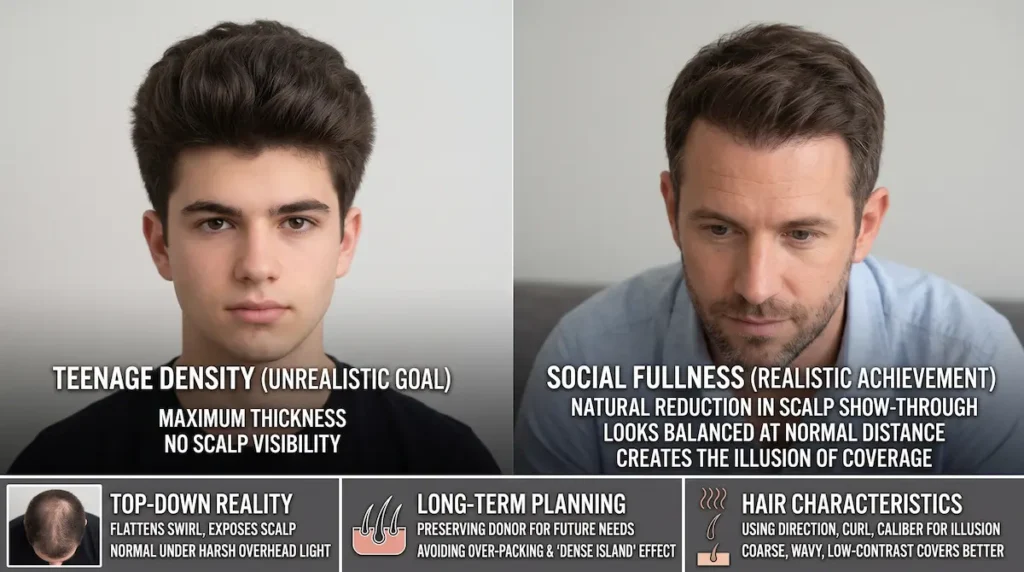
The crown can improve dramatically after a well-planned transplant, but it should be judged by the right standard. The realistic target is not teenage density. It is a natural reduction in scalp show-through, especially at normal social distance.
This distinction matters because unrealistic density goals can push the surgical plan in the wrong direction. If every available graft is used to chase a dense crown, the donor area may be compromised, and future hairline or midscalp needs may be harder to treat.
“Social fullness” vs full native density
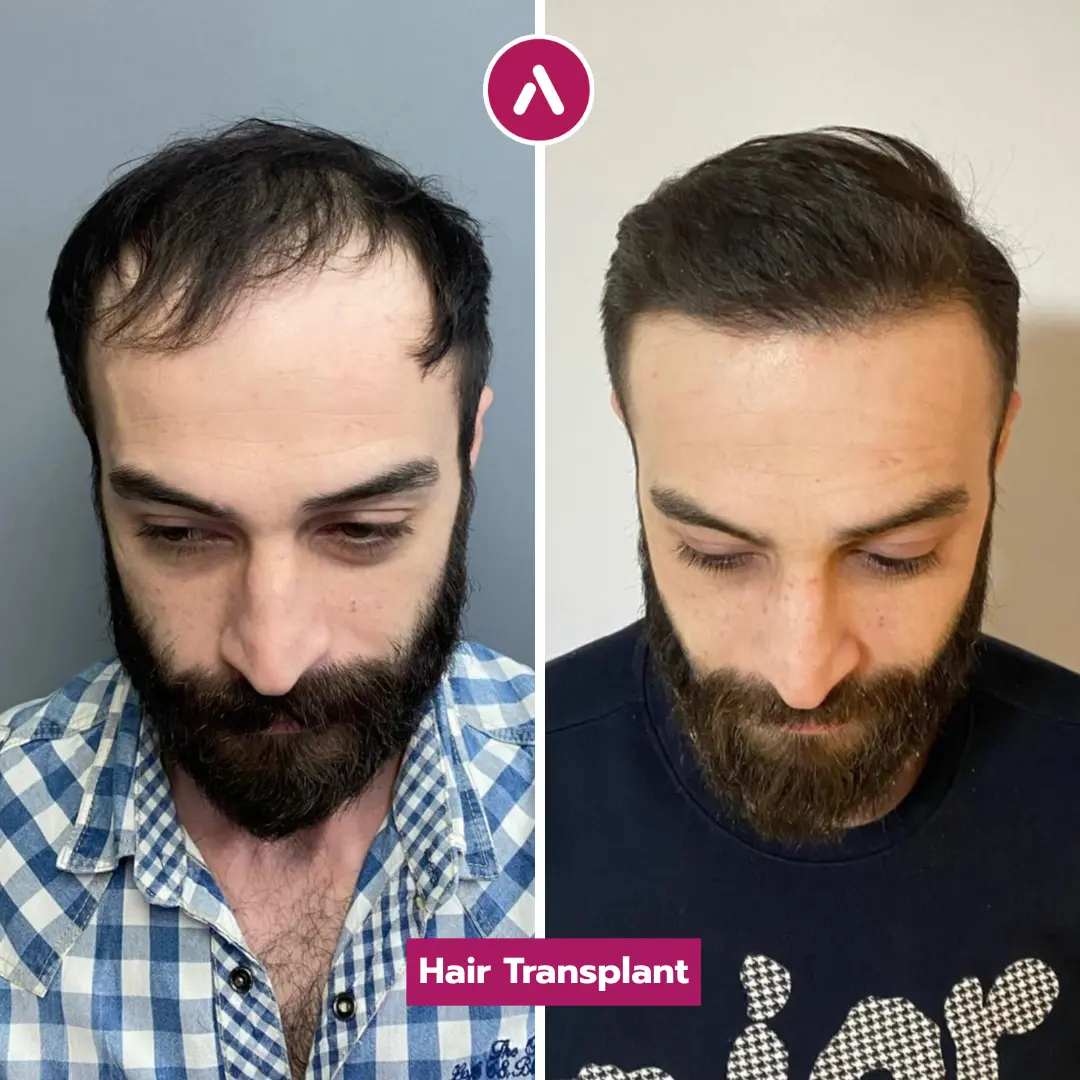
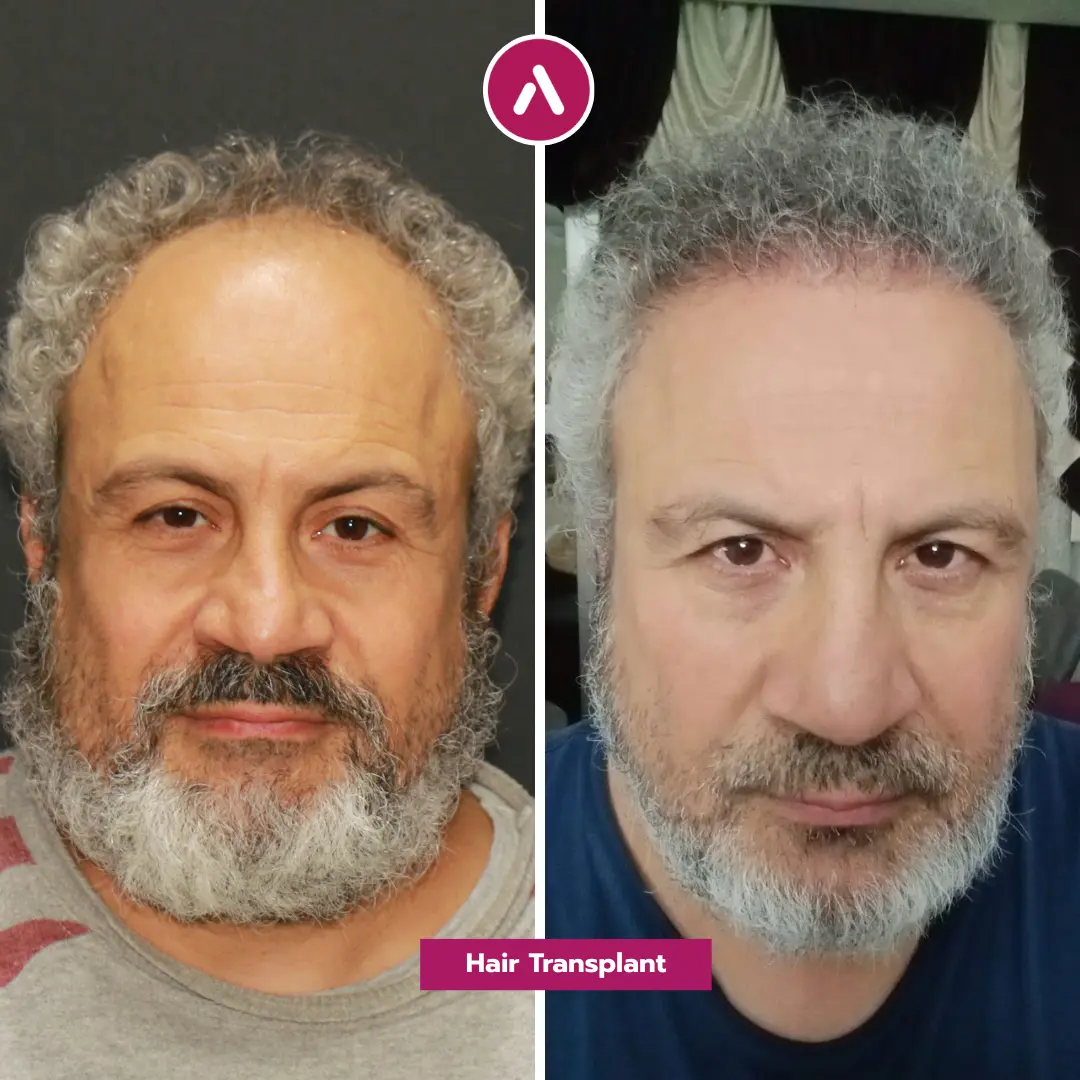
Social fullness means the crown no longer draws attention as a bald spot in normal life. It looks balanced from across a room, at dinner, in casual photos, and under regular daylight. Some scalp may still show under harsh overhead light, wet hair, or a top-down flash.
That is normal. Even naturally dense crowns can show scalp because the whorl spreads hair outward. A transplanted crown has to create the illusion of coverage with a limited number of grafts. The illusion can be excellent, but it is still an illusion of density.
Good planning uses hair direction, curl, caliber, and contrast to create that effect. Coarse, wavy, low-contrast hair usually covers better than fine, straight, dark hair on light skin. Two men may receive the same graft number and still have different visual density because their hair characteristics are different.
Why top-down photos can look thinner
Top-down photos are brutal for crown results. They flatten the swirl, expose the scalp between the angles, and exaggerate contrast. A crown that looks natural in conversation can look thinner in a bathroom mirror selfie taken under a ceiling light.
That is why follow-up photos should be standardized. Same lighting. Same hair length. Same angle. Dry hair, unless the goal is to assess wet-hair transparency. Without consistency, patients often think the crown is not growing when the real issue is lighting and angle.
Another common mistake is judging too early. Crown maturation can lag behind the front. It may take longer for the result to soften, layer, and create coverage because the hairs must grow long enough to overlap around the whorl.
Avoiding an over-packed, artificial crown
The instinct is understandable: “If the crown is hard to cover, just pack more grafts.” Sometimes higher density is appropriate. But aggressive packing in the vertex has limits.
The crown contains changing angles, existing miniaturized hairs, and a blood supply that must support the new grafts. Recipient-site planning, graft handling, and tissue trauma all influence how well grafts survive and grow. A peer-reviewed review of graft survival notes that patient health, hair characteristics, and operative technique all affect growth outcomes.
Over-packing can also create an unnatural visual problem. If the crown center becomes too dense while the surrounding native hair thins, the patient may develop a dense island inside a thinner halo. That is exactly what long-term planning tries to avoid.
A conservative crown does not mean a weak result. It means density is distributed with the future in mind. The surgeon rebuilds the swirl, softens the bald contrast, and keeps enough donor supply available for later stages if hair loss progresses.
Experience a Stress-Free Hair Transplant Journey
From VIP airport transfers to 5-star hotel accommodations, we handle every detail. Enjoy a seamless medical travel experience in Istanbul.
The Native Hair Loss Factor
The hardest part of crown planning is not always the bald spot you see today. It is the hair around it. Native crown hair may still be miniaturizing, and if that process continues, a transplant can look worse over time unless the plan accounts for future loss.
This is why a crown hair transplant should never be designed as a one-day fix for a moving target. The surgeon must evaluate donor capacity, miniaturization, age, family history, medication tolerance, and the likely Norwood pattern.
Why transplanting the crown too early can create a “doughnut” pattern
A “doughnut” pattern happens when grafts are placed into the center of the vertex, but the surrounding native hair continues to fall out. The transplanted center may keep growing while the ring around it thins, leaving a circular island effect.
This risk is most relevant in younger men or men with unstable loss. StatPearls notes that hair transplantation performed too early can deplete donor supply and compromise long-term results, and specifically cautions that grafting only the scalp vertex may prematurely use donor grafts and risk a doughnut appearance with future loss.
That does not mean the crown should never be treated in younger patients. It means the threshold should be higher. If the hairline is also receding, the surgeon may prioritize the frontal third first because it frames the face and usually gives more visual impact per graft.
Planning for future loss
Future loss planning starts with mapping miniaturization. Under magnification, the surgeon can see whether the hair around the crown is strong terminal hair or weak miniaturized hair. That difference changes the plan.
If surrounding hair is stable, the crown may be restored more directly. If it is actively thinning, the plan may be staged. A first session may soften the crown while preserving donor supply, with a second session considered only after the pattern declares itself.
This is also where shock loss of native hair becomes important. Existing weak hairs can shed after surgery. Many return, but not all miniaturized hairs behave predictably. A patient who understands this before surgery is less likely to panic during early recovery.
Long-term planning also includes the question of permanence. Transplanted hairs are usually taken from the donor region that is more resistant to androgen-driven loss, but the native hair around them can continue to thin. That is why a lasting crown plan has to account for the native hair, not only the grafts.
When medication or waiting may be smarter
For some men, the smartest crown plan is not immediate surgery. It may be stabilization first. The American Academy of Dermatology explains that male pattern hair loss tends to develop slowly over years, and that treatment can reduce further loss, with the best results often seen when men start treatment soon after noticing hair loss.
In the U.S., common medical options for male pattern hair loss include FDA-approved medications such as topical minoxidil and prescription finasteride. These are medical decisions, not casual add-ons. A dermatologist or qualified physician should review suitability, side effects, and long-term use before any medication is started.
Waiting can also be strategic. If the crown loss is early and the hairline is actively changing, delaying crown grafting may protect the donor supply. If the crown is stable, visible, and psychologically bothersome, surgery may make sense sooner.
The right answer is individual. A good consultation does not simply ask, “How many grafts can we place?” It asks, “Where will your hair loss be in five to ten years, and how do we protect your options?”
Getting a Natural Crown Result
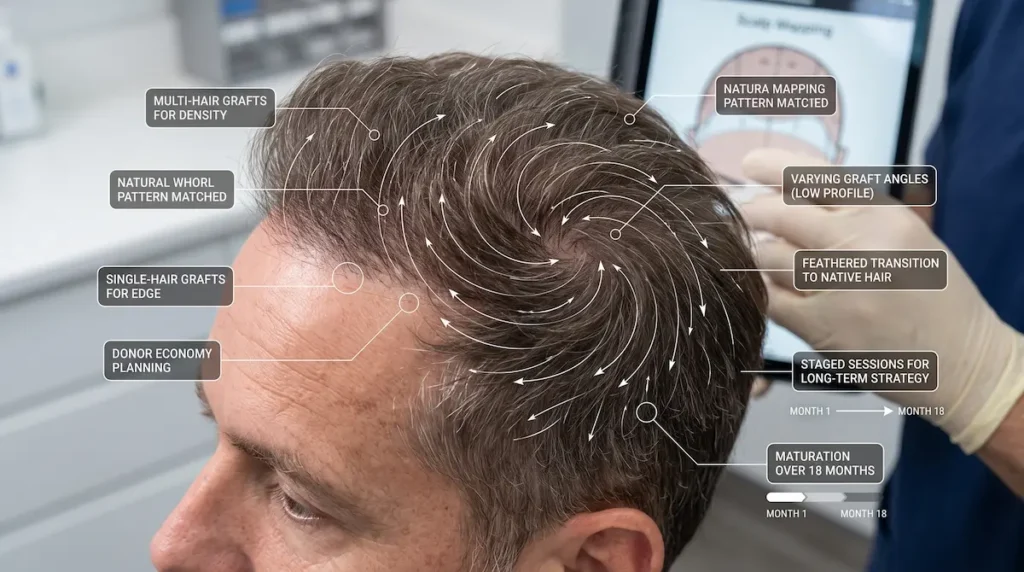
A natural crown result is built in layers. The surgeon has to match the whorl direction, place grafts at low and changing angles, protect the donor supply, and decide whether the crown should be restored in one session or staged over time.
This final planning step is where experience matters. A crown can look technically “filled” but still appear artificial if the swirl is wrong. It can also look natural with moderate density if the pattern, angles, and donor strategy are right.
Matching the whorl direction and angle
The crown whorl is the fingerprint of the vertex. It is not just a circle. It has a center, direction, rotation, and transition zone. The transplanted grafts need to follow that pattern instead of fighting it.
In practical terms, this means the surgeon places single and multi-hair grafts according to the natural rotation. The central whorl may need finer, softer placement, while the surrounding crown can use grafts that create more coverage. The goal is movement, not a flat patch.
Good crown design also avoids a harsh border. The transplanted area should feather into the existing hair. If the edge is too sharp, the crown may look obvious as surrounding native hair changes over time.
Staged sessions and donor economy
Some crowns can be restored in one carefully planned session. Others are better handled in stages. Staging is not a failure. It is often a donor-protection strategy.
A first session may rebuild the whorl and reduce the bald contrast. Then the patient waits for growth, maturation, and a clearer view of future hair loss. If more density is needed later, a second session can be planned with better information.
This is especially important for men who also have frontal recession. If the hairline and crown both need work, the surgeon may recommend prioritizing the front first. The front frames the face and often gives more visual return per graft. The crown can follow once the donor budget is clearer.
Technique choice also depends on the patient’s lifestyle and hair length. For some men, no-shave transplant options may reduce the visibility of the procedure during early recovery. That is a separate planning question, not the main factor that determines crown density.
Why crown maturation can take up to around 18 months
Crown results often mature more slowly than the frontal hairline. Early growth may look uneven. The whorl may seem thin before the hairs gain length, diameter, and layering.
Many patients see meaningful change around 8 to 12 months, but crown texture and coverage can continue improving beyond that. Some men need up to around 18 months to judge the final visual effect, especially if the crown was large or the hair is fine.
During this stage, patience is part of the treatment plan. Rechecking too early can lead to unnecessary worry. Planning another session too soon can also risk using donor grafts before the first result has fully declared itself.
That donor discipline matters across all hair restoration work. Poor planning in one area can affect another, for example when one session overharvests the donor area and leaves too few grafts for later needs.
Cost should also be handled carefully. Crown restoration is not priced only by the visible bald spot; graft count, donor quality, and the full treatment plan matter. Because this guide is focused on crown difficulty rather than pricing, review what an FUE transplant costs on the dedicated cost page instead of relying on a generic graft estimate.
AKM planning note: Crown restoration is most successful when the graft plan respects the whorl, protects the donor area, and leaves room for future hair loss. A dense-looking result today should not create a donor problem tomorrow.
At AKM Clinic, crown planning is assessed as part of a full scalp strategy: donor supply, hairline priority, crown diameter, hair caliber, native miniaturization, and long-term loss pattern. Supportive technologies such as Low-Level Laser Therapy may also be discussed when appropriate, but the core decision remains surgical planning and realistic graft allocation.
Ask AKM how many grafts your crown realistically needs, whether the crown should be treated first, and how your donor supply can be protected for the long term.
Frequently Asked Questions: Crown Hair Transplant
These questions cover the decisions most men ask before committing to crown restoration: difficulty, graft numbers, density, timing, growth speed, and future native hair loss.
Is a crown hair transplant harder?
How many grafts does the crown need?
Will the crown look as dense as the front?
Should I fix the crown or hairline first?
Does crown hair grow slower?
Can native crown hair keep falling out?
Have Specific Questions About Hair Transplant?
Chat directly with our dedicated patient coordinators regarding Hair Transplant. Get instant answers and personalized support.
Medical Disclaimer: This article is for educational purposes only and is not medical advice. Hair transplant suitability, graft estimates, medication decisions, and surgical timing vary from person to person. Always consult a qualified physician or hair restoration surgeon for an individualized diagnosis and treatment plan.
Related Treatments
Awake Gynecomastia Surgery in Turkey
Awake gynecomastia guide: local anesthesia vs general, technique options, recovery timeline, risks, and cost/value insights for expert patients.
Awake Abdominal Etching in Turkey
Learn what awake abdominal etching is, who it’s for, recovery timeline, risks, and USA vs Turkey value—plus how to choose a qualified surgeon.

Awake Neck Lift in Turkey
Learn what an awake neck lift is, who qualifies, recovery day-by-day, risks, and when chin lipo helps. A surgeon-level guide for expert patients.

Facelift in Turkey
Evidence-based facelift guide: deep plane vs SMAS, anesthesia options, day-by-day recovery, scars, risks, longevity, and US vs Turkey cost/value.
Ready to Start Your Own Transformation Journey?
Join the 2,000+ patients who trusted Dr. Akif Mehmetoğlu and the AKM Clinic team. Your journey to a more confident, revitalized you begins with a simple, no-obligation conversation. Contact us today from the USA for your free virtual consultation.
#1: Get Your Free Personalised Quote
Start with a free, no-obligation online consultation. Share your photos, and our surgical team will provide a fully personalised treatment plan and a transparent, all-inclusive price package. No hidden fees.
#2: Secure Your Date & VIP Booking
Once you're ready, our dedicated patient coordinators will help you secure your procedure date. We'll handle all your bookings, including your 5-star hotel and private VIP airport transfers.
#3: Arrive in Istanbul & Meet Your Surgeon
Arrive at Istanbul Airport (IST) and be greeted by your private driver. Settle into your hotel and prepare for your in-person consultation, where you'll meet your specialist surgeon to finalise the details for your "natural, subtle, and revitalized" new look.