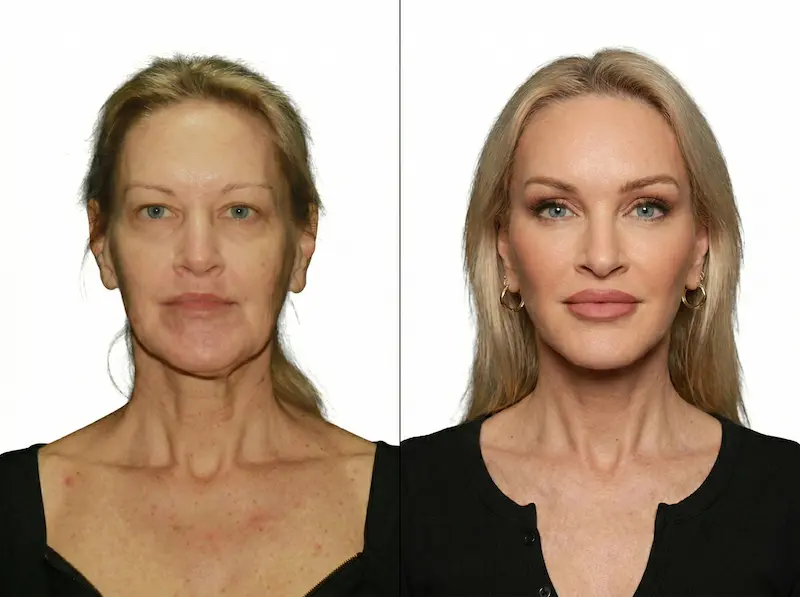
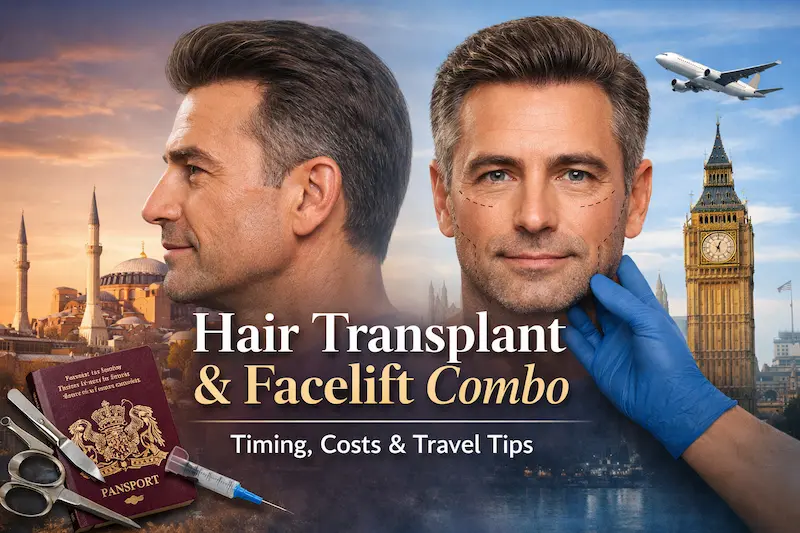
For many British patients, a hair transplant and facelift combo sounds appealing because it can address two visible concerns in one carefully planned journey: a receding hairline and facial ageing. However, the real question is not whether combining procedures sounds efficient on paper. The real question is whether a hair transplant with facelift is appropriate for your anatomy, recovery capacity, travel schedule, and long-term aesthetic goals.
This is why the discussion around a combined facelift and hair transplant should always begin with safety and timing, not price alone. Patients researching hair transplant and facelift Turkey or even combined hair and facelift cost UK vs Turkey often start with value, but good outcomes depend first on clinical judgement. In modern medical science, the safest combined procedure is not the one that saves the most days on your calendar; it is the one that respects blood supply, tissue healing, operative time, and realistic recovery planning.
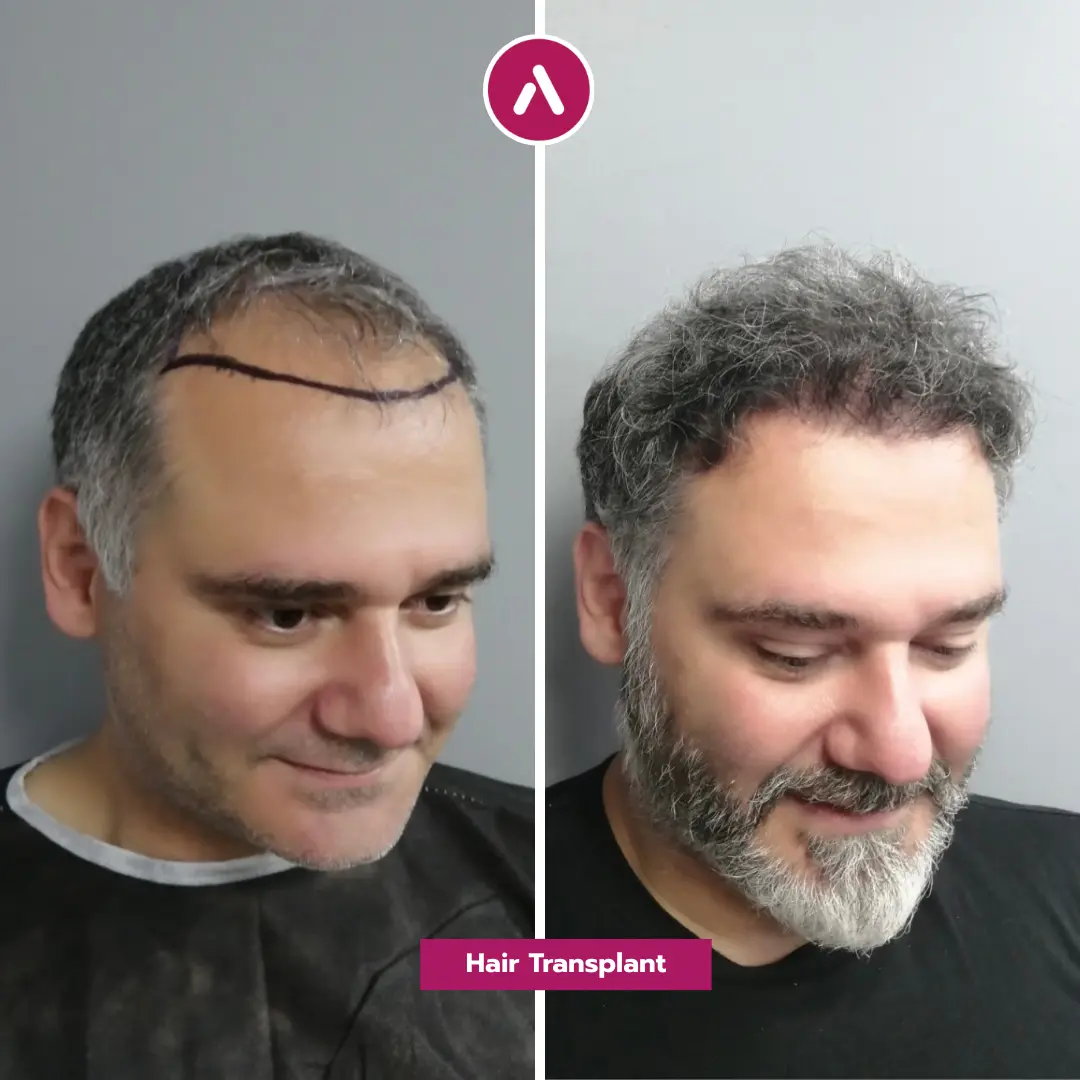
For UK readers in particular, there is another layer to consider: when you are travelling back to London, Manchester, Birmingham, or elsewhere after surgery, you also need a plan that fits your return flight, your work commitments, and your tolerance for visible swelling. That is why this guide looks closely at the safety of combined hair transplant and facelift, who may be suitable, and when a staged plan is often the wiser route.
Table of Contents
Can You Safely Combine a Hair Transplant and Facelift?
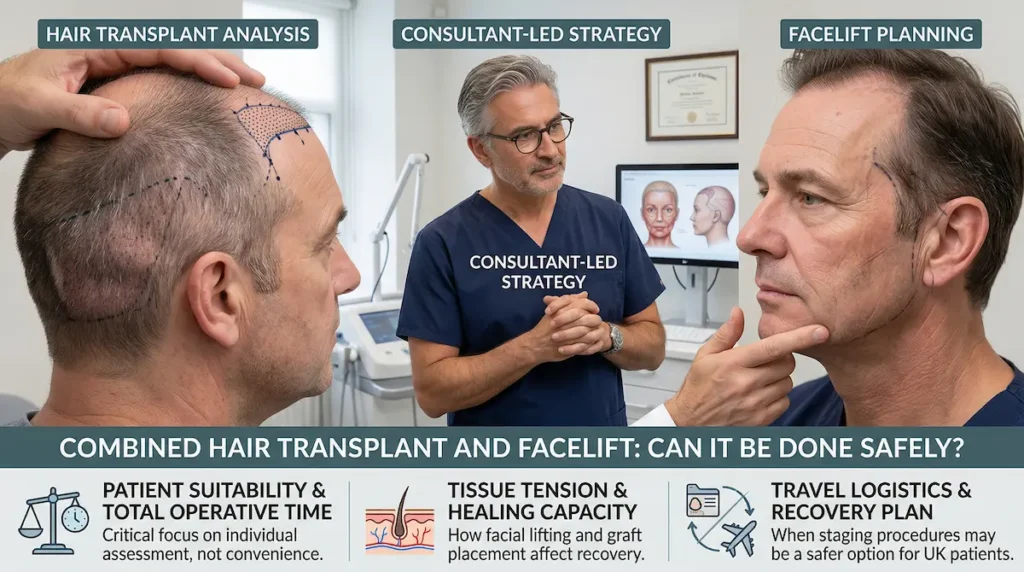
Yes, in selected patients, a facelift and hair transplant same time approach can be safe. But it is only safe when the plan is built around patient suitability rather than convenience. The phrase combined plastic surgery Turkey should never mean “more surgery in less time at any cost”. It should mean a disciplined, consultant-led strategy in which each step has been assessed for healing, comfort, and overall risk control.
Why patient selection matters more than the idea of “doing everything at once”
Not every patient who wants a subtle facelift and natural hairline combo is automatically a good candidate for both procedures in one sitting. Some people have excellent skin quality, good scalp laxity, strong general health, and realistic expectations. Others may have smoking history, poor healing habits, significant thinning across the donor area, or more advanced facial ageing that requires a longer and more technically involved facelift.
In practical terms, suitability depends on whether both procedures can be performed without creating unnecessary physiological stress. A patient with mild hairline recession and moderate lower-face laxity may be far more suitable than someone requesting a very large graft session plus an extensive facial lift in the same treatment window. The safest plan is the one that matches the body’s capacity to recover, rather than the patient’s wish to “get everything done” in one go.
For some men, this decision sits within a wider rejuvenation plan rather than as an isolated procedure. In that context, the principles behind daddy makeover Turkey are relevant, because the goal is not to combine treatments for convenience alone, but to select the right combination for the right patient. When procedures are planned with restraint and clinical logic, the result is usually safer, more balanced, and far more natural-looking.
How operative time, tissue tension, and healing capacity influence safety
When surgeons assess the safety of combined hair transplant and facelift, they are not looking at one issue only. They are thinking about several variables at once: total treatment duration, anaesthesia plan, swelling potential, scalp circulation, incision design, and how much postoperative care will be required in the first few days.
- Operative time: Longer procedures can increase fatigue and make recovery feel heavier, particularly for travelling patients.
- Tissue tension: A facelift changes how facial and temporal tissues sit, so graft placement and incision planning must not work against each other.
- Healing capacity: Patients differ in how they bruise, swell, and form scar tissue. That matters when combining facial surgery with dense graft placement.
- Travel logistics: UK patients also need a recovery pace that makes discharge checks and return flights sensible, rather than rushed.
This is exactly where science and clinical judgement overlap. In other words, scientific research may support principles of wound healing and peri-operative risk reduction, but the day-to-day safety decision still comes down to detailed individual assessment.
When a staged plan is safer than a same-trip combined approach
There are many cases in which surgeons may advise staging. This does not mean you are a poor candidate overall. It simply means the balance of benefit and burden is better when the procedures are separated by time.
A staged approach may be safer when a patient needs a large number of grafts, has more advanced facial laxity, has existing medical issues that slow recovery, or is anxious about flying home while coping with both scalp sensitivity and facial oedema. For these patients, spacing out treatment can improve comfort, allow more precise monitoring, and reduce the feeling that recovery has become “too much at once”.
So, can you combine them? Sometimes yes. Should you always? Absolutely not. The best answer is often not the most aggressive answer; it is the one that minimises cumulative stress while still achieving a coherent aesthetic result.
Who Is the Best Candidate for a Hair Transplant and Facelift Combo?
The best candidate for hairline restoration with facelift is usually someone who has two concerns happening at the same time: visible facial ageing and a receding or weakened hairline that makes the face look older than it feels. This combination is particularly relevant for male patients who want to look fresher without appearing altered, over-pulled, or artificially youthful.
The ideal UK patient profile: hairline recession plus visible facial ageing
The most suitable patient is often in good general health, has realistic expectations, and wants refinement rather than reinvention. In aesthetic terms, that usually means a patient looking for a refreshed lower face, cleaner jawline, and better-framed forehead without sacrificing a masculine identity.
For British patients, this often translates into a preference for discretion. Many do not want colleagues to ask what they have “had done”. They want to look less tired, less hollow, and less receded around the hairline, while still looking like themselves. A properly planned subtle facelift and natural hairline combo is appealing precisely because it can address both ageing signals in a harmonious way.
When mild laxity or early hair loss may not justify combining procedures
Not everyone benefits from a combination plan. If facial laxity is still minimal, or if the hairline change is so early that medical treatment or a small standalone transplant would be more appropriate, combining procedures may be unnecessary. The same applies when a patient’s expectations are being driven more by impatience than by anatomy.
A combination should create a meaningful strategic advantage. If the facelift need is borderline, or the transplant requirement is modest, separate treatment may be cleaner, easier, and more proportionate. Sometimes the most elegant surgical decision is restraint.
Medical and lifestyle factors that may change timing, including smoking and recovery expectations
Timing is often influenced by factors patients underestimate. Smoking, poor sleep, uncontrolled medical issues, stress, heavy alcohol intake, and unrealistic pressure to “be back to normal” too quickly can all change whether a combined plan is sensible. These issues matter because they affect circulation, tissue recovery, swelling, and how well postoperative instructions are followed.
For UK patients planning a return to work soon after treatment, recovery expectations matter just as much as medical suitability. Someone who can work remotely and take a proper recovery window may be a stronger candidate than someone who needs to be in face-to-face meetings immediately after returning home.
| Candidate Factor | Better for Combined Approach | Better for Staged Approach |
|---|---|---|
| Hair loss pattern | Moderate recession with realistic graft goals | Very large graft session required |
| Facial ageing | Clear but manageable ageing changes | Extensive lift likely to require a longer recovery burden |
| General health | Stable health and good healing profile | Conditions or habits that may slow healing |
| Work and travel schedule | Flexible diary and realistic downtime | Immediate return to work or rushed flying plans |
| Aesthetic goal | Natural refinement in one balanced plan | Multiple aggressive changes in a single trip |
Combining Hair Transplants with Facial Plastic Surgery
Combining hair restoration with facial surgery is not just about booking two procedures together. It is about designing one coherent aesthetic plan. A hair transplant changes the frame of the face, while a facelift changes the structure beneath that frame. When both are done well, the result can look balanced and age-appropriate. When they are planned poorly, they can compete with one another.
For many male patients, this wider planning approach overlaps with the thinking behind daddy makeover Turkey, where the aim is to create overall harmony rather than treat each concern in isolation. The key is to ensure that hair restoration and facial rejuvenation support the same aesthetic direction, so the final result looks proportionate, natural, and appropriately masculine rather than overcorrected or visually inconsistent.
Preserving a masculine hairline while avoiding an overdone facial result
For male patients especially, the aim is not simply to look younger. It is to look stronger, fresher, and well-rested without losing masculine character. That means the surgeon must avoid two common mistakes: placing the hairline too low or too rounded, and creating a facelift result that looks tight, windswept, or feminised.
This is why a hair transplant with facelift should be approached as a facial harmony issue, not a checklist of separate treatments. A masculine hairline must still fit the forehead, temples, and age of the patient. Likewise, facial rejuvenation should restore support and contour rather than create an unnatural “done” look.
“Rejuvenation, Not Alteration” is the right mindset for combination planning: restore structure, refine the frame, and preserve identity.
Planning graft placement around facelift incision strategy
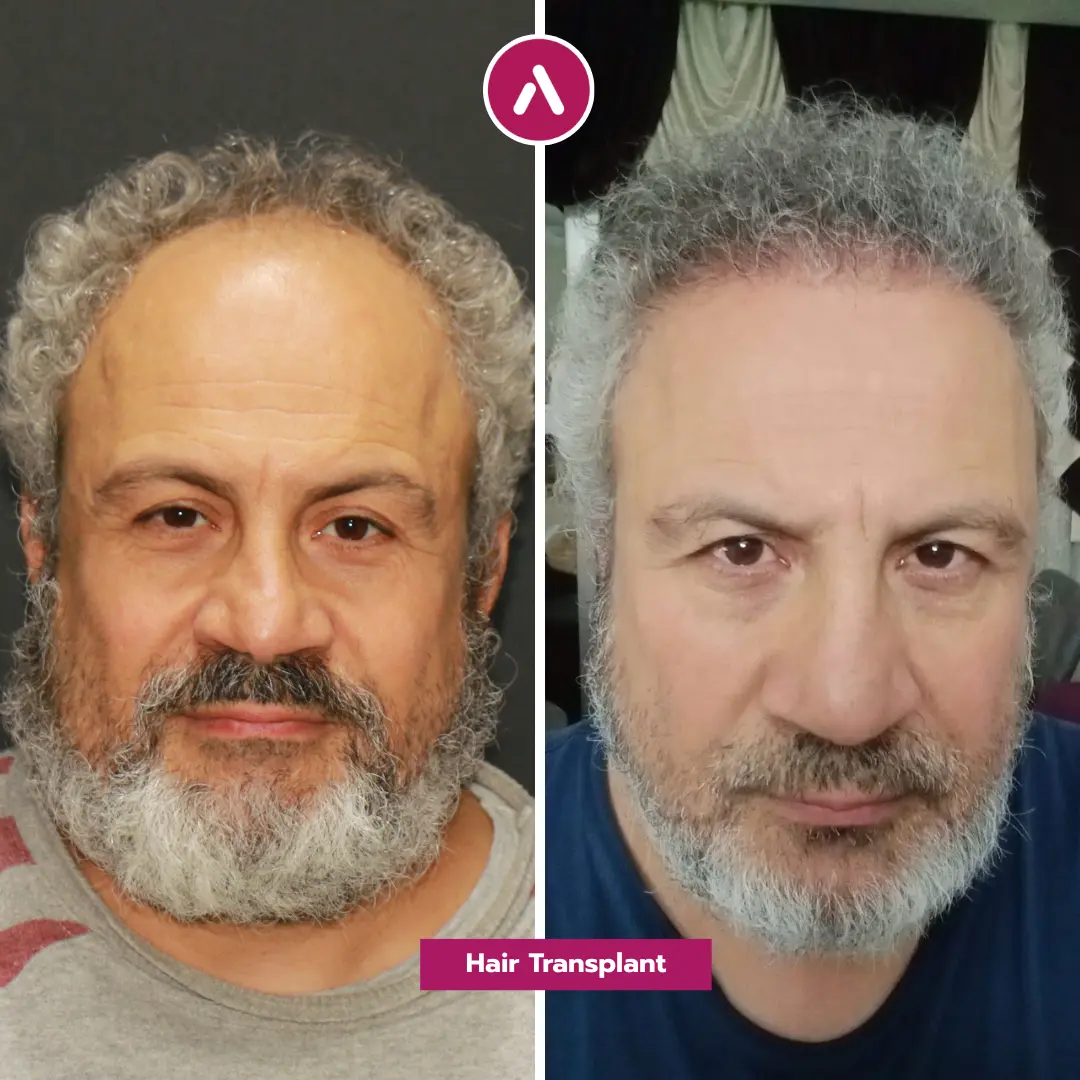
One of the most important technical questions in hairline restoration with facelift is how graft placement relates to incision design, particularly around the temples and sideburn region. This area needs thoughtful planning because the facelift changes tissue position, while the transplant must respect blood supply, density goals, and future scar concealment.
That does not mean the two procedures cannot be compatible. It means they must be mapped together from the beginning. In suitable patients, a carefully designed plan can improve facial framing while keeping the result refined and believable. In unsuitable patients, however, forcing both procedures together may compromise either graft distribution or facelift elegance.
Rigorous clinical safety protocols for multiple procedures
Anyone searching for minimisation of risks multiple surgeries Turkey is really searching for evidence of systems, not slogans. Safety in a combined plan depends on what happens before, during, and after the procedure: pre-operative assessment, consultant-led planning, sterile operating theatre standards, sensible anaesthesia choices, and structured aftercare.
For a British patient, that also means thinking beyond the day of surgery. A safe plan should consider expected oedema, wound checks, hydration, mobilisation, medication guidance, and the patient’s readiness to fly home. This is where high-standard peri-operative care becomes especially relevant. It is also why discussions around combined plastic surgery Turkey should always include practical recovery support rather than focusing only on package convenience.
In the right setting, supportive technologies may also play a role in recovery planning. For example, when clinics use recovery-focused protocols such as HBOT to help manage postoperative oedema, and LLLT to support scar quality, the objective is not to promise “instant healing”. The objective is to support a smoother and more controlled recovery pathway for appropriately selected patients.
That is the true foundation of safety: not marketing a combo, but building a plan in which surgical design, recovery science, and realistic timing all work together.
What Is the Best Timing: Same Day, Same Trip, or Staged Surgery?
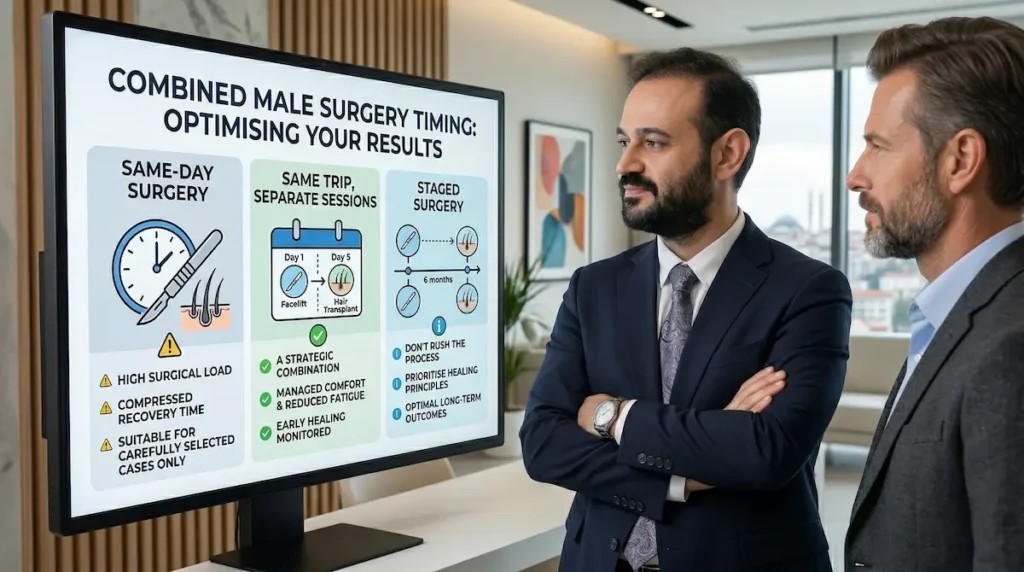
Timing is where many patients either protect a good result or create unnecessary stress. A combined facelift and hair transplant can sound efficient, but the best schedule depends on operative load, healing priorities, and how much visible downtime you can realistically manage before returning to the UK. In other words, the right answer is not always “same day”; sometimes it is “same trip, separate sessions”, and sometimes it is “stage the procedures properly and do not rush”.
Same-day surgery vs two-step scheduling during the same Istanbul stay
A facelift and hair transplant same time approach may be suitable in carefully selected cases, particularly when the facelift plan is not excessively extensive and the graft requirement is moderate. However, same-day surgery is not automatically the most elegant plan simply because it reduces the number of treatment dates.
For some patients, the better compromise is to have both procedures in the same Istanbul journey but not necessarily in the same operative session. This can allow the team to manage comfort, reduce cumulative fatigue, and monitor the early healing response more clearly. The phrase hair transplant with facelift should therefore be understood as a strategic combination, not a rigid one-day formula.
Why scalp healing and facial swelling affect the order of treatment
The scalp and the face heal differently, and that matters. A hair transplant involves the scalp’s blood supply, graft survival, crusting, and a period in which the recipient area must be protected carefully. A facelift, by contrast, involves tissue repositioning, swelling, pressure management, and attention to incision lines around the temporal and peri-auricular regions.
Because of this, timing is partly about respecting competing recovery demands. If both procedures are placed too aggressively into one compressed schedule, the patient may feel that each recovery is making the other more awkward. This is where scientific research on healing principles is useful in theory, but real-world planning still requires surgeon judgement on tissue handling, comfort, and travel-readiness.
How surgeons decide whether to perform the facelift or hair transplant first
There is no one-size-fits-all order. The surgeon will consider hairline design, temporal recession, facelift incision placement, scalp laxity, expected swelling, and how important it is to protect graft positioning during the early postoperative phase. In some cases, facial lifting strategy drives the sequence; in others, hairline restoration priorities shape the plan.
The most important point for UK patients is this: the order should be decided by anatomy and recovery science, not by the assumption that “everything should be done in one go”. When timing is correct, the two procedures can complement each other. When timing is wrong, even a technically good plan can feel harder than it needed to be.
Recovery Timeline for the UK City Professional
Recovery matters just as much as the procedure itself, particularly for British patients who need to think about meetings, social visibility, return flights, and a sensible re-entry into normal life. A patient researching the safety of combined hair transplant and facelift is often really asking a practical question: “How difficult will the first week actually be?”
What to expect in the first 72 hours: dressings, oedema, rest, and mobilisation
The early phase is usually about protection, rest, hydration, gentle mobilisation, and careful review by the surgical team. Facial tightness, mild asymmetry, scalp sensitivity, and postoperative oedema can all be expected in different degrees depending on the treatment intensity and your personal healing pattern.
For most patients, this is not the phase to judge the final aesthetic result. It is the phase to follow instructions properly, protect grafts, avoid unnecessary pressure on the face and scalp, and let the body settle. In a well-managed recovery programme, the emphasis is on calm, not on forcing a quick return to normality.
When HBOT and LLLT may support a faster, more flight-ready recovery
This is where recovery technology becomes particularly relevant for the UK market. At AKM Clinic, HBOT is positioned as a key strategy for reducing postoperative oedema and supporting lymphatic drainage, while LLLT is used to stimulate fibroblast activity and support smoother scar quality.
That does not mean recovery becomes effortless, and it certainly should not be sold as a shortcut. What it does mean is that, in the right candidate, supportive protocols may contribute to a more controlled recovery pathway and help patients progress towards a more flight-ready stage with greater confidence. For British patients balancing surgery with a return journey, that is a meaningful difference.
Typical milestones before returning to work, meetings, and social settings in the UK
Every patient heals at a different pace, so no ethical clinic should promise an identical timeline for everyone. What can be said honestly is that most patients think about recovery in three separate ways: when they feel comfortable, when they look socially presentable, and when they are medically ready to travel.
Those milestones are not always the same day. You may feel well enough to answer emails before you feel ready for an in-person meeting, and you may be safe to fly only after a proper in-person check confirms that swelling, dressings, graft protection, and general recovery are progressing appropriately. For the UK city professional, building in breathing space is always wiser than assuming the best-case scenario.
| Recovery Consideration | Hair Transplant Focus | Facelift Focus | Combined Planning Priority |
|---|---|---|---|
| First few days | Protect grafts and recipient area | Manage oedema and incision care | Avoid pressure, rest well, attend reviews |
| Social visibility | Scalp crusting and sensitivity | Bruising and swelling | Plan downtime honestly |
| Work return | Depends on role and camera exposure | Depends on how visible swelling is | Remote work is easier than in-person meetings |
| Travel home | Head protection matters | Surgeon review matters | Only travel when formally cleared |
How Long Should UK Patients Stay in Istanbul?
This is one of the most important questions in the entire decision-making process. Patients comparing hair transplant and facelift Turkey options often focus on the operation itself, but the real success of the trip depends heavily on how long you stay for consultation, procedure planning, postoperative reviews, and final fitness-to-fly checks.
For many British men, the length of stay in Istanbul is also shaped by whether this trip forms part of a broader rejuvenation journey, similar to the planning involved in daddy makeover Turkey. In these cases, travel dates should never be arranged around convenience alone. A well-timed stay allows proper assessment, safe recovery monitoring, and a smoother return to the UK without unnecessary pressure or rushed postoperative decisions.
Recommended length of stay for consultation, surgery, reviews, and discharge
The exact stay varies according to the complexity of your facelift, the number of grafts, how you heal, and whether your treatment plan is same-day or staged within the same trip. For that reason, the safest answer is always personalised rather than fixed.
What matters is not choosing the shortest stay possible. What matters is allowing enough time for proper assessment, treatment, observation, early healing support, and a final review before discharge. Patients who try to compress everything into the minimum possible window often create more stress than convenience.
Direct flights London to Istanbul and how travel planning affects scheduling
Travel convenience is one reason this treatment journey appeals to UK patients. AKM’s own UK-facing materials emphasise the practicality of direct flights London to Istanbul and the importance of explaining when patients can safely board a return flight.
That convenience, however, should support careful planning rather than encourage a rushed itinerary. It is much better to build your trip around clinical review points than to book the earliest possible return seat and hope for the best. Good scheduling gives the surgical team room to respond to how you are healing.
Why final in-person checks matter before boarding your return flight
Before returning to the UK, patients need more than reassurance. They need a proper review. That review may include wound assessment, swelling evaluation, medication guidance, travel advice, and confirmation that there are no immediate issues that require closer observation.
This is especially important in a combined plastic surgery Turkey context, where the body is recovering from more than one intervention at once. A final in-person check is not a formality. It is one of the key steps in minimising avoidable travel stress and making sure that home recovery begins on the right footing.
What Makes This Safer for British Patients Abroad?
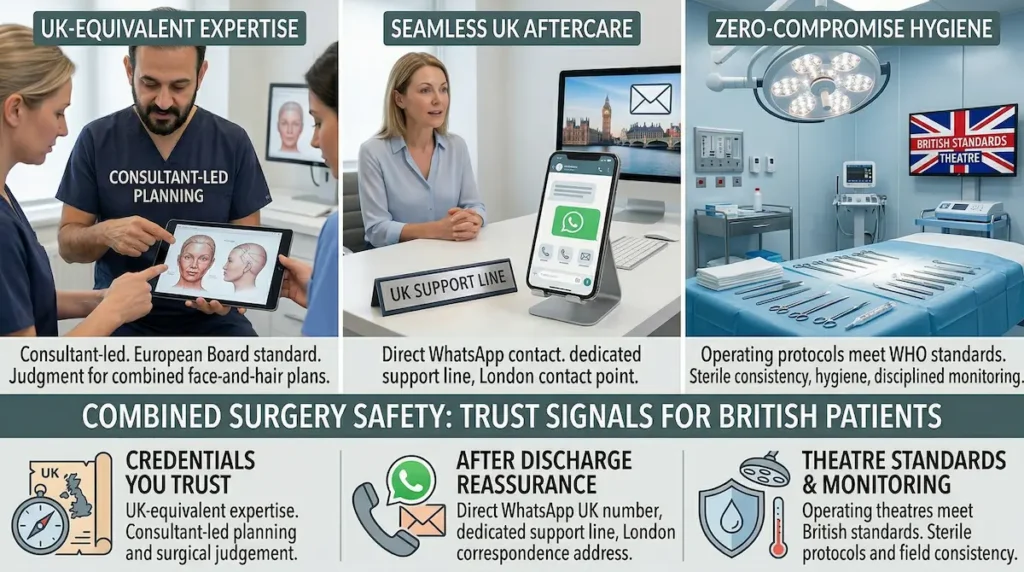
British patients are right to ask hard questions before booking surgery abroad. Safety is not created by marketing language. It is created by surgical expertise, transparent systems, careful screening, reliable aftercare, and clear lines of communication once the patient returns home. For anyone researching the minimisation of risks multiple surgeries Turkey, those are the signals that matter most.
UK board-certified equivalent surgeons and consultant-led planning
AKM Clinic’s UK adaptation materials position the clinic around consultant-led care, natural-looking outcomes, and surgeon credentials that make sense to British patients seeking a GMC-registered surgeon alternative. The clinic also highlights UK board-certified equivalent expertise and European Board-level standards as part of that trust framework.
For patients considering a combined face-and-hair plan, that matters because combination surgery requires judgement, not just technical ability. It is not enough to know how to perform each procedure separately. The surgeon must know when combining them is smart, when it is borderline, and when it is better to separate them.
Operating theatre standards, sterile protocols, and recovery monitoring
AKM’s technology and standards document describes a private cosmetic clinic in Istanbul with British standards, a zero-compromise approach to hygiene, and operating theatre protocols aligned with WHO standards for a sterile field.
For a UK patient, this is not simply reassuring language. It addresses a real fear: that surgery abroad may feel less controlled than surgery at home. In truth, the safer experience is the one in which protocols are clear, patient monitoring is disciplined, and the environment is built around consistency rather than speed alone.
UK support line, WhatsApp contact, and London correspondence reassurance after discharge
Aftercare is one of the biggest concerns for British patients, and rightly so. The UK-facing trust signals used by AKM specifically emphasise a UK support line, a direct WhatsApp UK number, a London correspondence address, and a UK-based patient contact point for reassurance after returning home.
That reassurance also appears in patient experience material. One testimonial notes that Mehtap relied on the direct WhatsApp UK number and UK support line after returning home, while the presence of a London correspondence address provided psychological comfort during recovery.
Patient perspective: Sarah from the UK described her recovery as painless and said she needed minimal paracetamol. When comparing facelift London vs Istanbul quality, she stated that she would confidently choose Turkey again for subtle facial rejuvenation.
Cost Comparison: UK Private Clinics vs. All-Inclusive Turkey Packages
The keyword combined hair and facelift cost UK vs Turkey is important because price is part of the decision, but it should never be the only part. The fairest comparison is not “cheap abroad” versus “expensive in London”. The fair comparison is what the patient receives for the investment: surgical planning, consultant access, aftercare structure, recovery support, and whether the quote is transparent from the beginning.
For many male patients, value is also assessed within a broader treatment strategy, much like the planning involved in daddy makeover Turkey. In that setting, cost should be judged not only by the headline figure, but by the quality of surgical coordination, the standard of aftercare, and the overall coherence of the patient journey. A lower price has limited meaning if it comes with compromises in safety, support, or long-term aesthetic balance.
Why Harley Street facelift costs and separate hair restoration fees add up quickly
In the UK private market, especially in London and Harley Street-linked settings, patients may face separate consultant fees, theatre fees, anaesthetist fees, postoperative costs, and hair restoration charges that are priced independently. That fragmentation can make a coordinated treatment journey feel financially and logistically heavy, particularly if both concerns need addressing within a similar time frame.
This is one reason why British patients begin researching hair transplant and facelift Turkey. It is not necessarily because they want “the cheapest option”; often it is because they want a more coherent pathway in which value, planning, and timing sit together more sensibly.
What patients expect from transparent all-inclusive cosmetic surgery GBP pricing
AKM’s UK content repeatedly highlights the importance of all-inclusive cosmetic surgery GBP pricing, with an emphasis on clarity rather than hidden extras.
For UK patients, that transparency matters almost as much as the number itself. They want to know what is included, what aftercare support looks like, who they contact after discharge, and whether recovery support technologies form part of the treatment journey or are billed as unexpected add-ons.
Why value is not just price: surgeon expertise, recovery tech, and aftercare access
The best-value option is the one that reduces compromise, not simply the headline number. A cheaper quote is not better if it lacks consultant-led planning, careful safety screening, or accessible aftercare. By contrast, a well-structured programme that includes a suitable surgical plan, monitored recovery, and communication support can represent stronger value even before aesthetic outcomes are considered.
This is especially true for a subtle facelift and natural hairline combo, where the result depends on balance, restraint, and proper sequencing. In that kind of case, value comes from judgement and consistency. Price matters, but so do safety systems, patient access, and the quality of the final look.
| Comparison Point | Typical UK Private Route | Coordinated Turkey Route |
|---|---|---|
| Pricing structure | Often split across multiple invoices | Often presented as one clearer package quote |
| Hair + facelift planning | May require separate provider coordination | Can be planned as one combined treatment journey |
| Recovery support | Varies by clinic and package | May include structured recovery-focused add-ons |
| Travel factor | No international travel required | Requires proper itinerary and flight clearance |
| Patient priority | Convenience of staying local | Value, coordinated care, and timing efficiency |
Frequently Asked Questions (FAQ): Hair Transplant and Facelift Combo
Below are the questions most commonly asked by UK patients considering a hair transplant and facelift combo. The answers are intentionally concise and practical.
Is it safe to have a hair transplant and facelift during the same trip?
It can be safe in selected patients, but only when the plan matches your health profile, graft requirement, facelift complexity, and recovery capacity.
Is it better to have the hair transplant before or after the facelift?
There is no universal rule. The correct order depends on hairline design, incision planning, tissue tension, and how the surgeon wants to protect both the facelift result and graft survival.
Can facelift incisions affect transplanted graft survival?
They can influence planning around the temples and sideburn region, which is why both procedures must be mapped together from the start rather than treated as unrelated operations.
How many nights should I stay in Istanbul for both procedures?
There is no ethical one-size-fits-all number. Your stay should be long enough for consultation, treatment, postoperative reviews, and final confirmation that you are fit to travel.
When can I safely fly back to the UK?
You should only fly once your surgeon has reviewed you in person and confirmed that your recovery, swelling, graft protection, and general condition make travel appropriate.
Will the result still look natural and masculine?
That is the goal of a properly planned combination. The aim is a refreshed face and a believable hairline, not an over-pulled facelift or an artificially juvenile hairline.
What happens if I need advice after I return home?
A strong international care model should include structured follow-up and accessible communication channels, including UK-friendly contact options after discharge
If you would like to explore related options beyond the topic discussed above, you can also learn more about Male Facelift Techniques, Beard Transplant Turkey, Facelift Recovery with Stem Cells, Surgery Companion Turkey, How to Prepare for Cosmetic Surgery, Plastic Surgery Packages Turkey, Specialist Plastic Surgeon Turkey, and Best Deep Plane Facelift Clinic in Turkey to compare treatment approaches, recovery planning, travel support, surgeon credentials, and package options before making a well-informed decision.
Medical Disclaimer: This page is provided for general educational purposes only and does not replace a face-to-face medical consultation, diagnosis, or personalised treatment plan. All surgery carries risks and outcomes vary between individuals. Suitability for a hair transplant and facelift combo surgery, procedure selection, and anaesthesia choice can only be determined after a full clinical assessment by a qualified surgeon. Always follow your clinician’s instructions and seek urgent medical attention if you develop concerning symptoms during recovery.