For many British patients, finding the best deep plane facelift surgeon in Turkey is not really about chasing a bargain. It is about finding a surgeon-led clinic that can deliver subtle, elegant rejuvenation with the kind of planning, transparency, and aftercare they would expect from a premium private clinic at home. In other words, the search is not just for a lower fee. It is for clinical judgement, technical refinement, and the confidence that your face is in genuinely expert hands.
That is why terms such as best deep plane facelift surgeon Turkey, Turkey best deep plane facelift surgeon, and best surgeon for deep plane facelift in Turkey have become so commercially important among British patients. People are comparing not only surgeons, but also philosophies of care. They want natural results, not a stretched or windswept appearance. They want a proper consultant-led process, not a sales funnel. And they want proof that a clinic understands the expectations of UK patients who are often comparing facelift London vs Istanbul quality before making any decision.
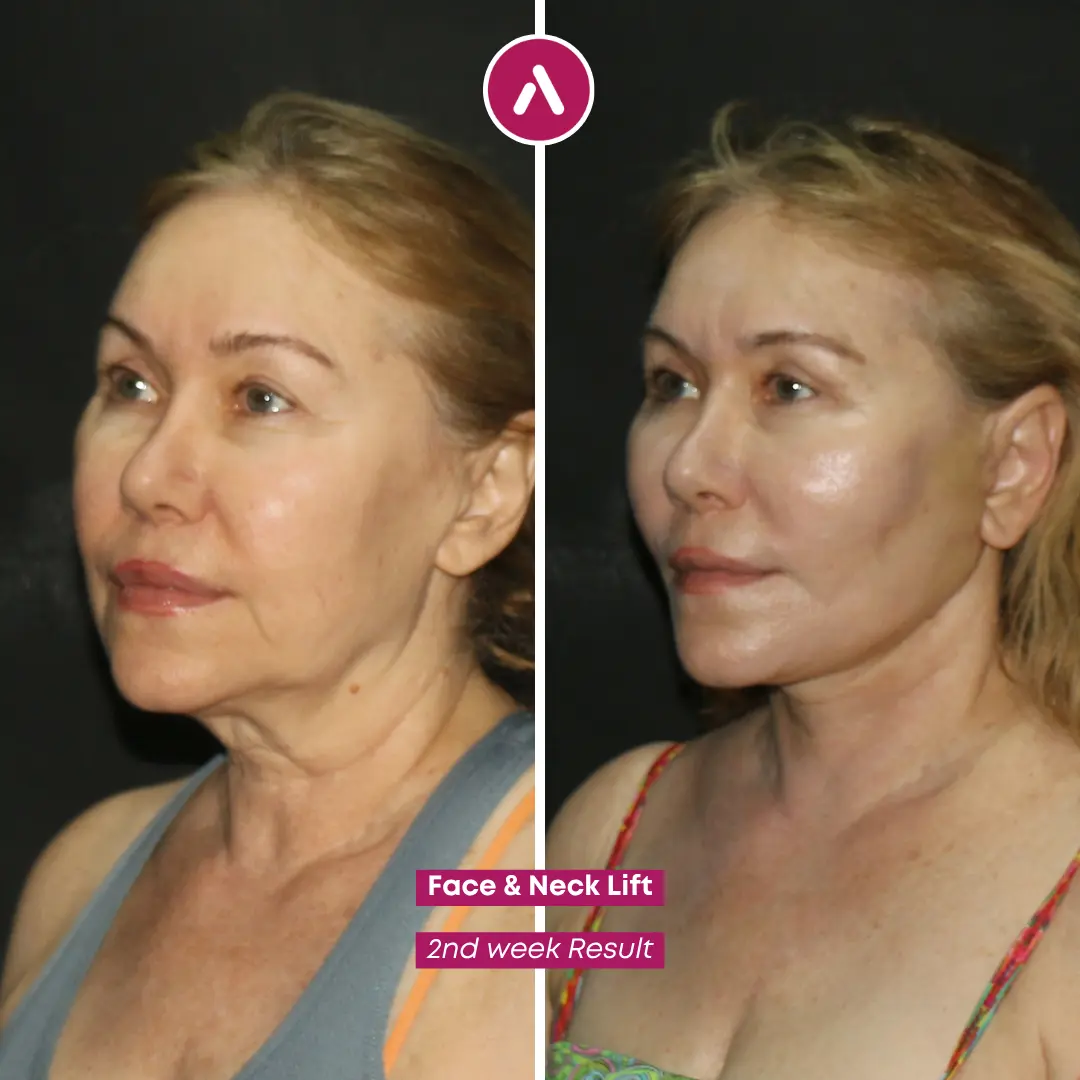
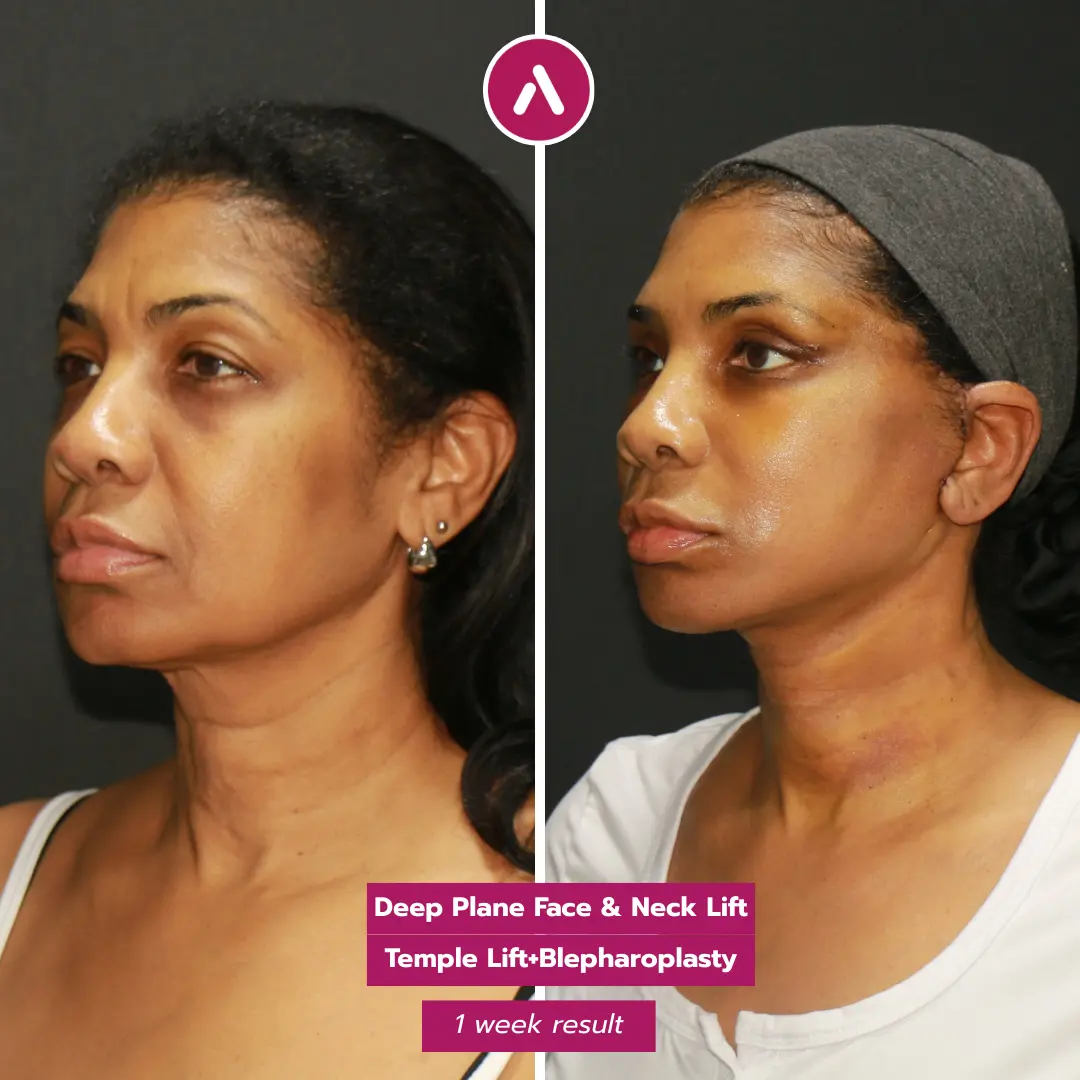
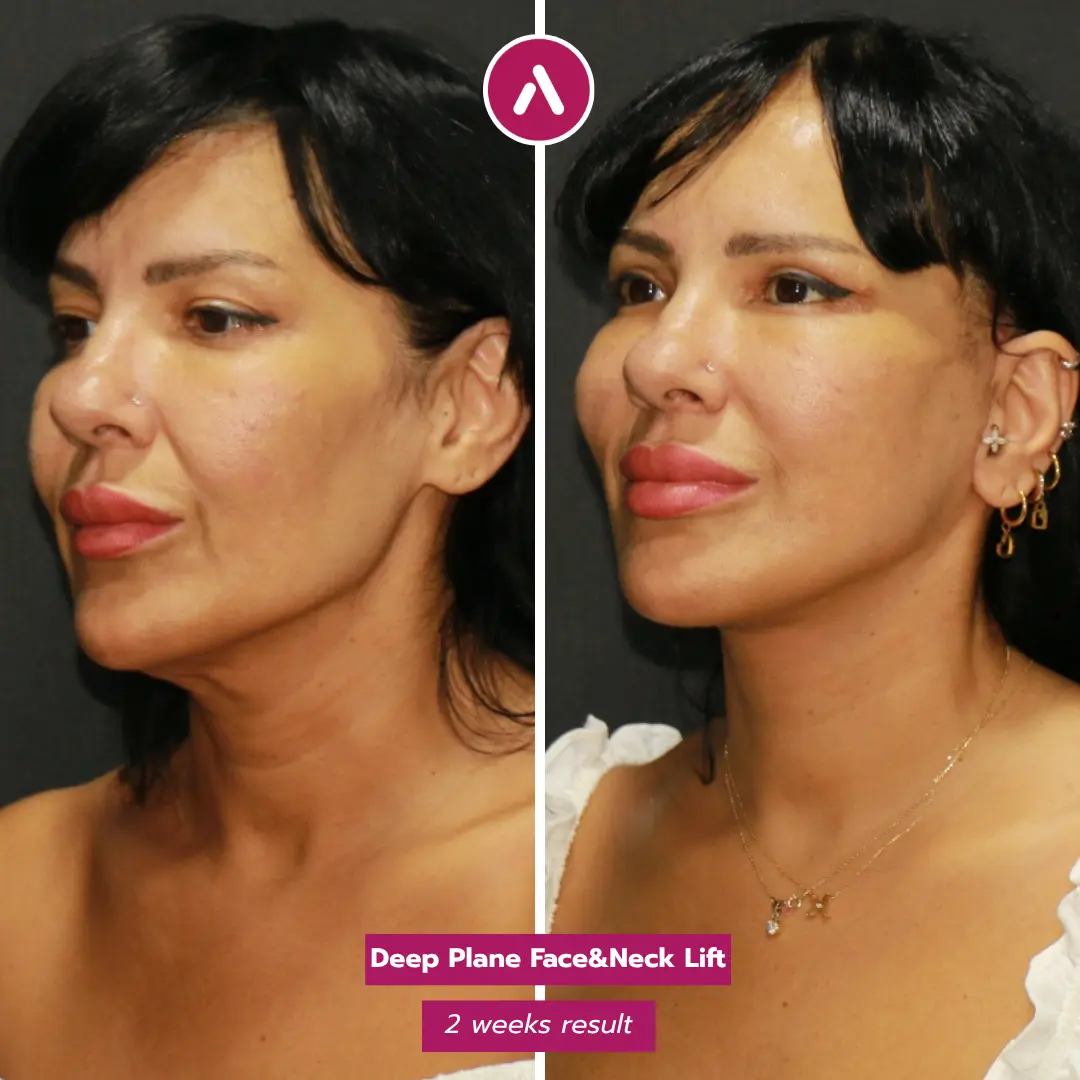
For this audience, the real benchmark is not “cheap abroad”. It is whether the surgeon can provide a Harley Street quality facelift in Istanbul while maintaining honest communication, medically grounded planning, and recovery protocols that make the journey back to the UK feel realistic and safe. That is also why phrases such as UK board-certified equivalent surgeons and GMC registered surgeon alternatives matter so much in this discussion. British patients are not simply asking who is popular online; they are asking who is verifiably qualified, who performs the operation personally, and who has the judgement to create results that still look like them.
At AKM Clinic, that conversation centres on surgeon expertise, facial anatomy, and the principles of medical science. Rather than treating a facelift as a superficial tightening exercise, the modern deep plane approach is based on restoring structure, releasing retaining ligaments, and repositioning deeper tissue in a more anatomically respectful way. For the right patient, this can mean a softer jawline, improved midface support, and a more natural neck transition without the over-pulled look that British patients often fear.
“The goal is not to make somebody look operated on. It is to help them look rested, fresher, and naturally renewed.”
This guide explains what really separates a merely advertised facelift from one performed by the best facelift surgeon Turkey for UK patients: deeper anatomical knowledge, specialist consistency, transparent credentials, and a treatment philosophy built around rejuvenation rather than alteration.
Table of Contents
Why the “Deep Plane” Technique Requires Elite Surgical Skill
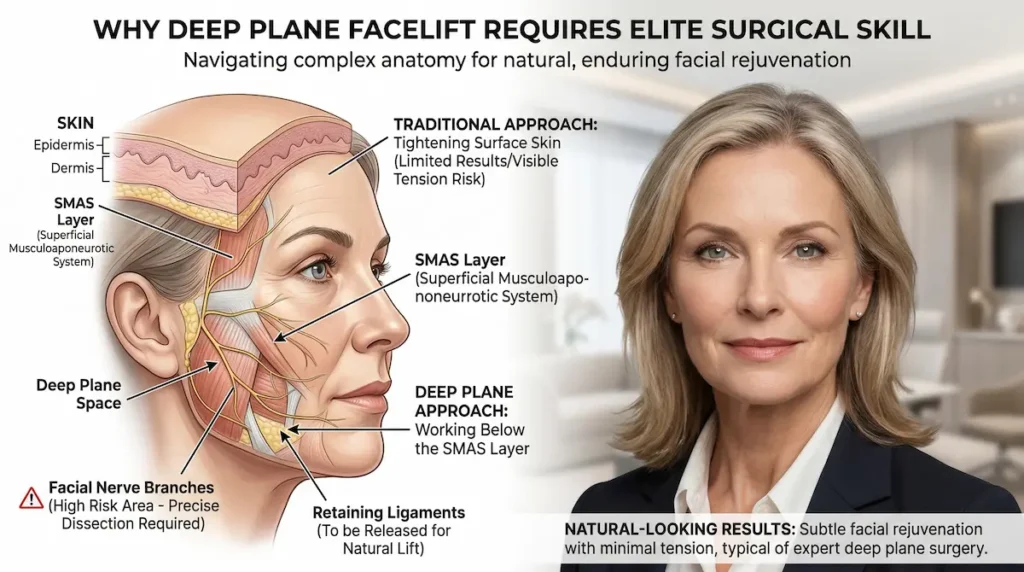
A deep plane facelift is often described casually online, but in practice it is one of the most technically demanding facial rejuvenation procedures in aesthetic surgery. That is because the surgeon is not just trimming skin or pulling the surface tighter. A true deep plane procedure works in a deeper anatomical layer, where judgement, restraint, and surgical finesse matter enormously. For British patients comparing providers, this is the first major point to understand: not every facelift surgeon is a deep plane specialist, and not every clinic advertising the technique performs it to the same standard.
Working Below the SMAS Layer: Clinical Risks and Rewards
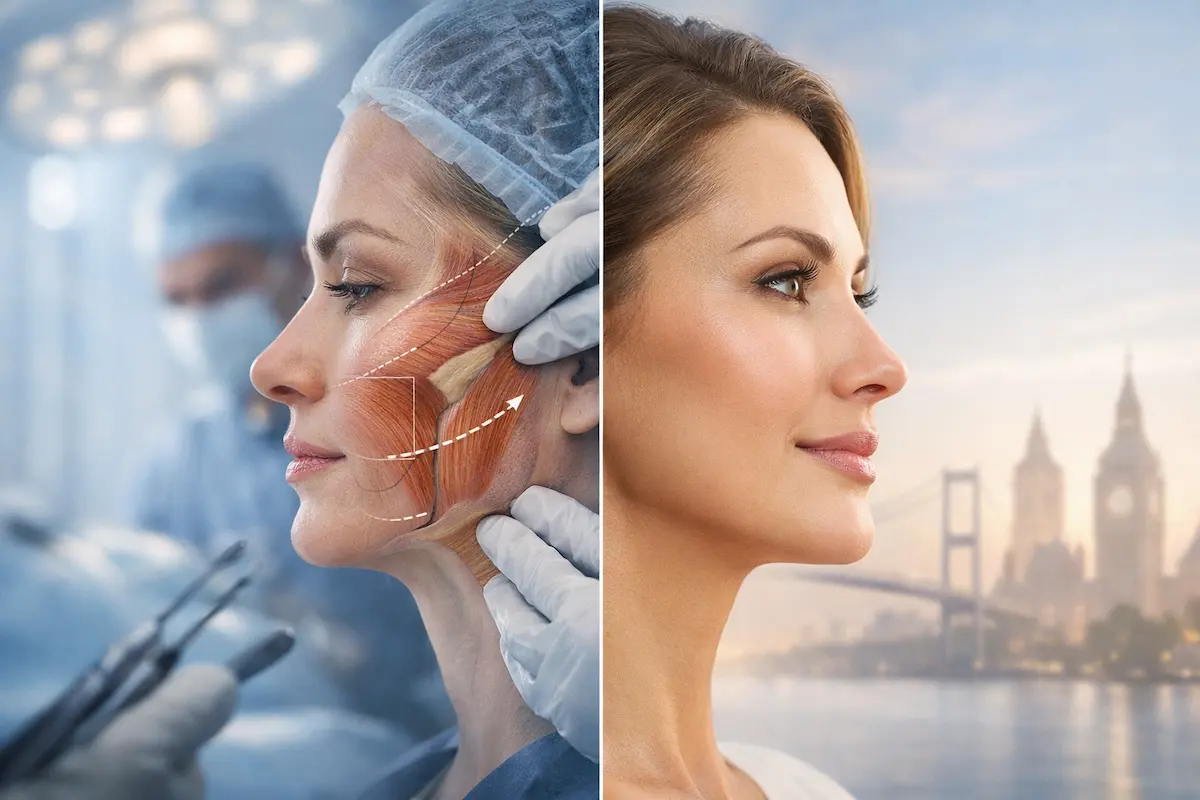
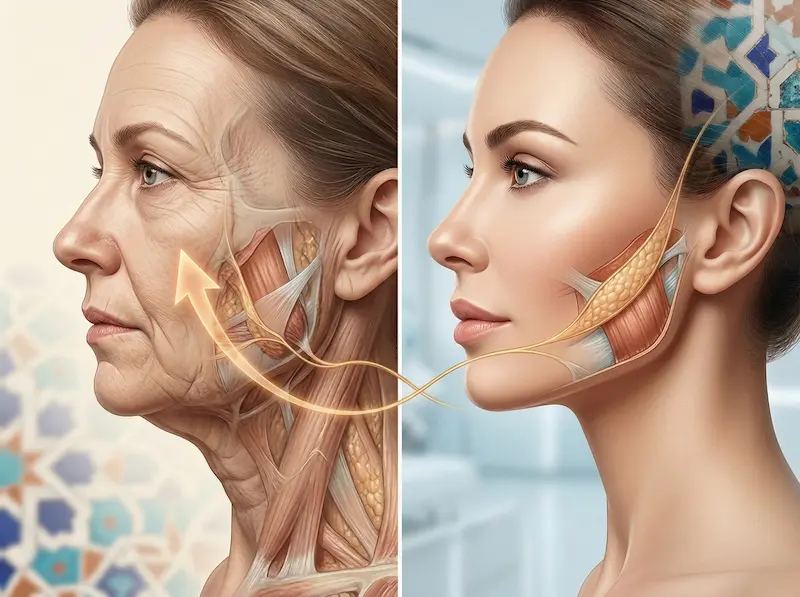
The key distinction of the deep plane facelift is that it moves beyond surface-level tightening and addresses the deeper support structures of the face. By working below the SMAS layer and releasing the retaining ligaments, a skilled surgeon can reposition descended cheek tissue more naturally. This is one reason the procedure is so highly regarded in facial aesthetics: it can improve the midface, jawline, and upper neck in a way that looks less artificial than older, tension-based methods.
The reward of this approach is not simply “more lift”. The reward is better quality lift. The face can be restored vertically and anatomically, rather than being dragged sideways. From a clinical science perspective, that matters because faces age in multiple tissue planes. The best results usually come from respecting that anatomy rather than forcing the skin to do all the work.
However, the same depth that makes the operation powerful is also what makes it unforgiving. Important facial structures, delicate tissue planes, and nerve-adjacent anatomy demand advanced knowledge and discipline. This is why a deep plane facelift should never be viewed as an entry-level procedure.
| Approach | Main Focus | Potential Aesthetic Outcome | Technical Demand |
|---|---|---|---|
| Skin-only lift | Surface tightening | Shorter-term tightening, greater risk of visible tension | Lower |
| Traditional SMAS lift | Supportive tissue tightening | Good lower-face improvement in suitable patients | Moderate to high |
| Deep plane facelift | Ligament release and deep tissue repositioning | More natural midface, jawline, and neck rejuvenation | Very high |
Why Inexperienced Surgeons Avoid the Deep Plane Approach
There is a reason many surgeons prefer more limited facelift techniques. The deep plane method requires greater anatomical confidence, more refined dissection, and a far better understanding of how to balance lift, volume, and facial identity. A less experienced surgeon may avoid it because the margin for error is smaller and the learning curve is steeper.
For patients, that matters enormously. A clinic may use the term “deep plane” in marketing, yet still rely on conservative or hybrid methods that do not deliver the same structural change. This is why the question is not simply whether a surgeon offers facelifts, but whether they truly specialise in advanced facial rejuvenation and perform this level of surgery regularly.
British patients are often particularly cautious here, and rightly so. The media narrative around overseas cosmetic surgery has made many people wary of vague claims and package-led promises. If a clinic cannot explain its technique clearly, show consistent results, and describe how the consultant surgeon manages the deeper anatomy, that should be treated as a warning sign rather than a minor detail.
Why the Best Surgeons Focus on Repositioning, Not Just Tightening
The face does not age simply because skin becomes loose. Ageing also involves descent of deeper tissue, loss of structural support, and changes in the relationship between the cheeks, jawline, and neck. That is why the best surgeons do not chase tightness. They focus on repositioning. This is a more sophisticated and more natural philosophy, and it aligns closely with what UK patients usually want: to look fresher, not altered.
When deep structures are elevated correctly, the result can look softer and more believable. The cheek appears restored rather than overfilled. The jawline appears cleaner without obvious pulling. The neck blends more naturally into the lower face. These are the hallmarks of high-level facial surgery and one reason the deep plane approach remains so attractive to discerning patients researching the best deep plane facelift surgeon Turkey.
At AKM Clinic, this surgeon-led philosophy is particularly relevant because British patients are often seeking refinement rather than drama. The aim is not to erase every line. The aim is to restore harmony and support while preserving character.
How Deep Plane Surgery Helps Avoid the “Pulled” or “Windswept” Look
One of the greatest fears among British facelift patients is looking “done”. They do not want a face that appears stretched, shiny, or visibly operated on. They want colleagues and friends to say they look well, not ask which procedure they had. A properly performed deep plane facelift is especially valued because it can reduce the risk of that over-pulled appearance when compared with techniques that rely too heavily on skin tension.
Because the lift comes from deeper repositioning, the surface can often be closed with less strain. That matters aesthetically. It can help preserve natural facial expression, avoid distortion around the mouth or sideburn area, and create a more convincing transition between rejuvenated areas and untreated features. In simple terms, it allows the face to look fresher without looking forced.
This is also where surgeon selection becomes everything. Even the best technique can produce an unnatural result in the wrong hands. That is why the phrase best surgeon for deep plane facelift in Turkey should always be interpreted through the lens of anatomy, restraint, and artistic judgement, not social media popularity alone.
Why UK Patients Prefer Subtle Facial Rejuvenation Over Dramatic Change
The British aesthetic preference is usually clear: understated improvement. Most UK patients are not looking for an obviously transformed appearance. They are looking for a more rested version of themselves, one that still fits their age, identity, and professional life. This preference shapes the entire consultation process, from planning to incision design to the final vector of lift.
That is why the most persuasive promise is not “extreme youthfulness”. It is subtle facial rejuvenation. For many patients, especially those comparing Harley Street with Istanbul, the real question is whether the surgeon understands restraint. Can they rejuvenate the face without making it look over-corrected? Can they improve the neck and jawline while preserving softness and expression?
In the UK market, this subtlety is one of the strongest indicators of quality. A surgeon who understands British expectations is far more likely to plan a result that feels elegant and socially believable. In that sense, technical skill and cultural understanding go hand in hand.
Critical Qualifications to Verify Before Booking from the UK
Once a patient understands why deep plane surgery is so demanding, the next question becomes far more practical: how do you verify whether a surgeon is genuinely qualified? This is where many British patients become understandably cautious. They are not just choosing a clinic abroad; they are trying to translate familiar UK trust markers into an international setting. That means looking beyond polished websites and focusing instead on credentials, specialist focus, surgeon-led care, and verifiable standards.
Understanding GMC Equivalents, EBOPRAS, and ISAPS
British patients often begin with the language they already know. They look for GMC registration, consultant status, and recognisable standards of specialist training. When researching treatment abroad, that instinct remains sensible, but it needs to be translated properly. The right question is not whether a Turkish clinic can copy the GMC system word for word. The right question is which qualifications, fellowships, and board-level credentials indicate an equivalent commitment to training, ethics, and recognised standards.
This is where terms such as UK board-certified equivalent surgeons and GMC registered surgeon alternatives become especially relevant. They reflect a British patient’s need for a familiar framework of trust. Rather than accepting generic claims like “internationally trained”, patients should look for formal European board credentials, respected society memberships, and a clearly documented area of special interest in facial surgery.
At AKM Clinic, this matters because the clinic positions itself around surgeon expertise rather than agency-style sales language. Dr Akif Mehmetoğlu is presented as a UK board-certified equivalent surgeon with a strong focus on subtle facial rejuvenation and deep plane facelift work that strongly appeal to British patients looking for credible alternatives to familiar UK regulatory markers.
- Look for: named surgeon credentials, European board references, recognised professional affiliations, and a visible facial surgery focus.
- Be cautious of: vague phrases such as “world-class”, “celebrity surgeon”, or “international expert” without supporting detail.
- Best practice: ask who will actually perform the operation and who is responsible for clinical decisions before, during, and after surgery.
The Importance of High Case Volumes and Specialist Focus
Qualifications matter, but they are only part of the picture. The best deep plane facelift results usually come from repetition, consistency, and specialist focus. Facial rejuvenation is not a procedure that benefits from occasional practice. It benefits from surgeons who work on the face regularly, understand nuance, and recognise the small anatomical differences that separate a merely acceptable result from an exceptional one.
Case volume matters because it sharpens judgement. Surgeons who perform advanced facial procedures frequently tend to develop better pattern recognition, more refined tissue handling, and stronger decision-making in the operating theatre. They are often better at assessing skin quality, facial descent, neck anatomy, and when to combine or avoid additional procedures.
For British patients, this is especially relevant when comparing facelift London vs Istanbul quality. A London postcode alone does not guarantee greater specialist depth. Nor does a Turkish address imply lower standards. The better comparison is whether the surgeon has a consistent, specialist facelift practice and whether their results repeatedly show natural rejuvenation rather than tension-based change.
| Verification Point | Why It Matters for UK Patients | What to Ask |
|---|---|---|
| Facial surgery focus | Suggests specialist refinement rather than general cosmetic marketing | “How much of your work is facial rejuvenation?” |
| Deep plane experience | Indicates genuine familiarity with advanced anatomy | “How often do you personally perform deep plane facelifts?” |
| Consistent results | Shows reproducibility, not one-off success | “May I see several patients with concerns similar to mine?” |
| Recovery planning | Demonstrates realistic aftercare and safe travel thinking | “What is your protocol for oedema, scar care, and return flights?” |
Why Consultant-Led Care Matters More Than Agency Promises
One of the biggest differences between a high-trust clinic and a low-trust sales model is whether the care pathway is genuinely surgeon-led. British patients are often highly sensitive to this issue, especially if they have seen reports about ghost surgery, unclear staffing, or package brokers acting as the main point of contact. A well-designed sales process may feel reassuring at first, but it cannot replace direct clinical accountability.
Consultant-led care means the surgeon is not simply appearing on the day of surgery. It means they are involved in assessment, candidacy decisions, treatment planning, and outcome responsibility. It also means that difficult conversations are handled medically, not commercially. If a patient is not suitable for a deep plane facelift, a consultant-led clinic should say so clearly.
This point is central for anyone searching terms like best facelift surgeon Turkey for UK patients. The most persuasive clinic is not the one with the slickest package presentation. It is the one where the consultant surgeon’s judgement is visible throughout the patient journey.
How to Verify Whether a Surgeon Truly Specialises in Facial Rejuvenation
Patients often assume that any plastic surgeon offering facelifts must be equally qualified to perform a deep plane procedure. In reality, specialisation matters. Facial rejuvenation requires a different type of aesthetic judgement from body contouring, breast surgery, or general cosmetic practice. The surgeon must understand not only anatomy, but also the way a face communicates age, fatigue, harmony, and identity.
There are several practical ways to verify this. First, study whether the surgeon’s public case examples repeatedly include facelift, neck lift, eyelid surgery, or other facial procedures. Secondly, assess whether their language focuses on natural rejuvenation, not exaggerated transformation. Thirdly, look for evidence that the clinic understands the preferences of British patients, including subtle outcomes, minimal visible scarring, and realistic aftercare.
At AKM Clinic, this is part of the brand positioning itself: surgeon-led facial rejuvenation for UK patients seeking natural results. Dr Akif Mehmetoğlu’s emphasis on subtle outcomes and deep plane work supports a message that is much stronger than generic “medical tourism” promotion.
What British Patients Should Look for Beyond “Board-Certified” Marketing Claims
The phrase “board-certified” can be useful, but it can also be misleading when it is used without context. British patients should not stop at the label. They should ask what board, what scope of practice, what type of specialisation, and how relevant that background is to facial rejuvenation. A good surgeon should be able to answer these questions comfortably and specifically.
In practical terms, British patients should also assess how the clinic handles aftercare, communication, and recovery support. This is one area where modern facial clinics in Istanbul can compare strongly with private UK practice. For example, structured aftercare, direct patient communication, and recovery support technologies such as HBOT and LLLT may play a meaningful role in the overall experience. These features do not replace surgical skill, but they do show that the clinic understands the full patient journey, not only the operation itself.
Ultimately, the right choice comes from combining several forms of evidence: credentials, case consistency, communication quality, recovery planning, and the surgeon’s aesthetic philosophy. That is how British patients move from marketing claims to informed judgement.
Evaluating Before & After Portfolios Like a Professional
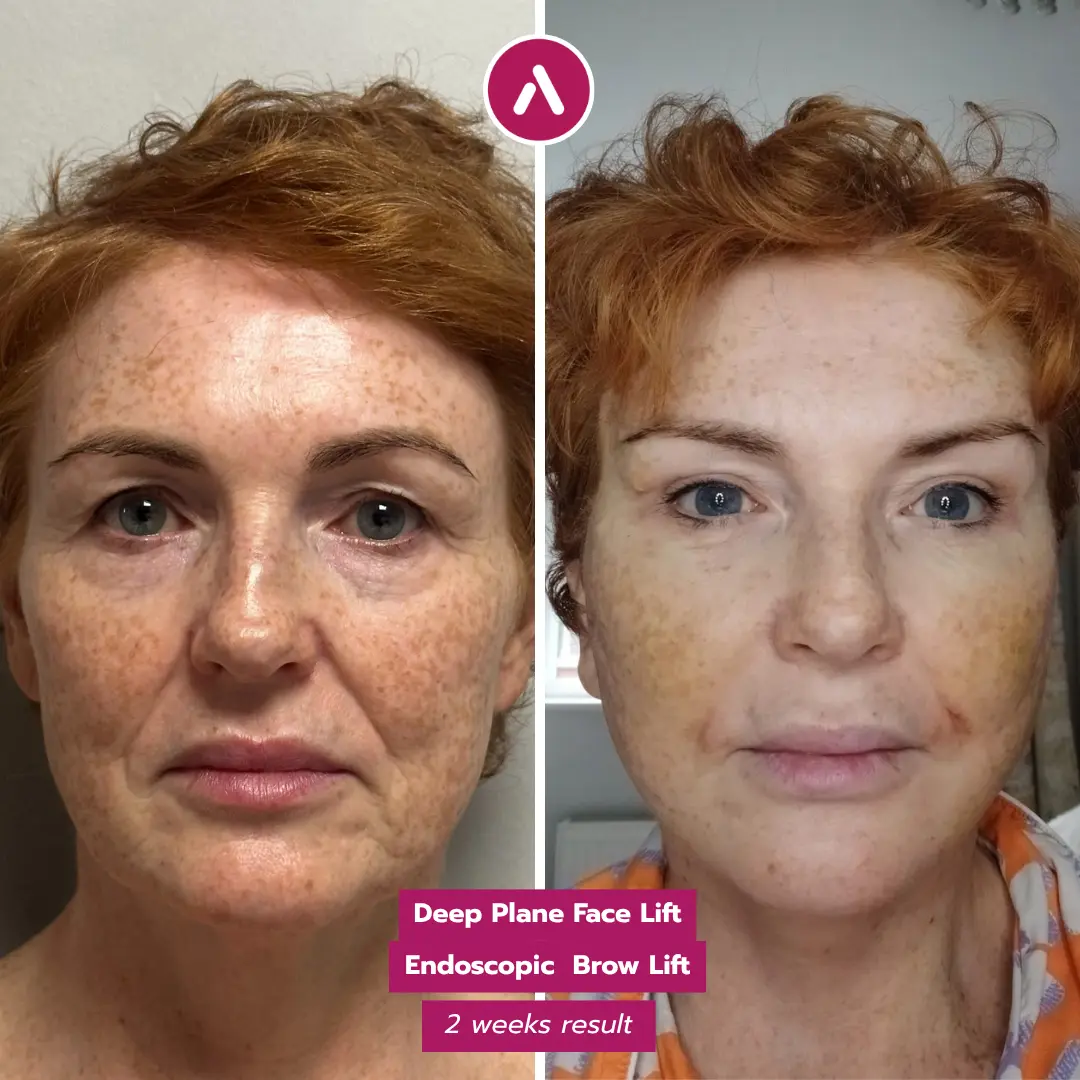
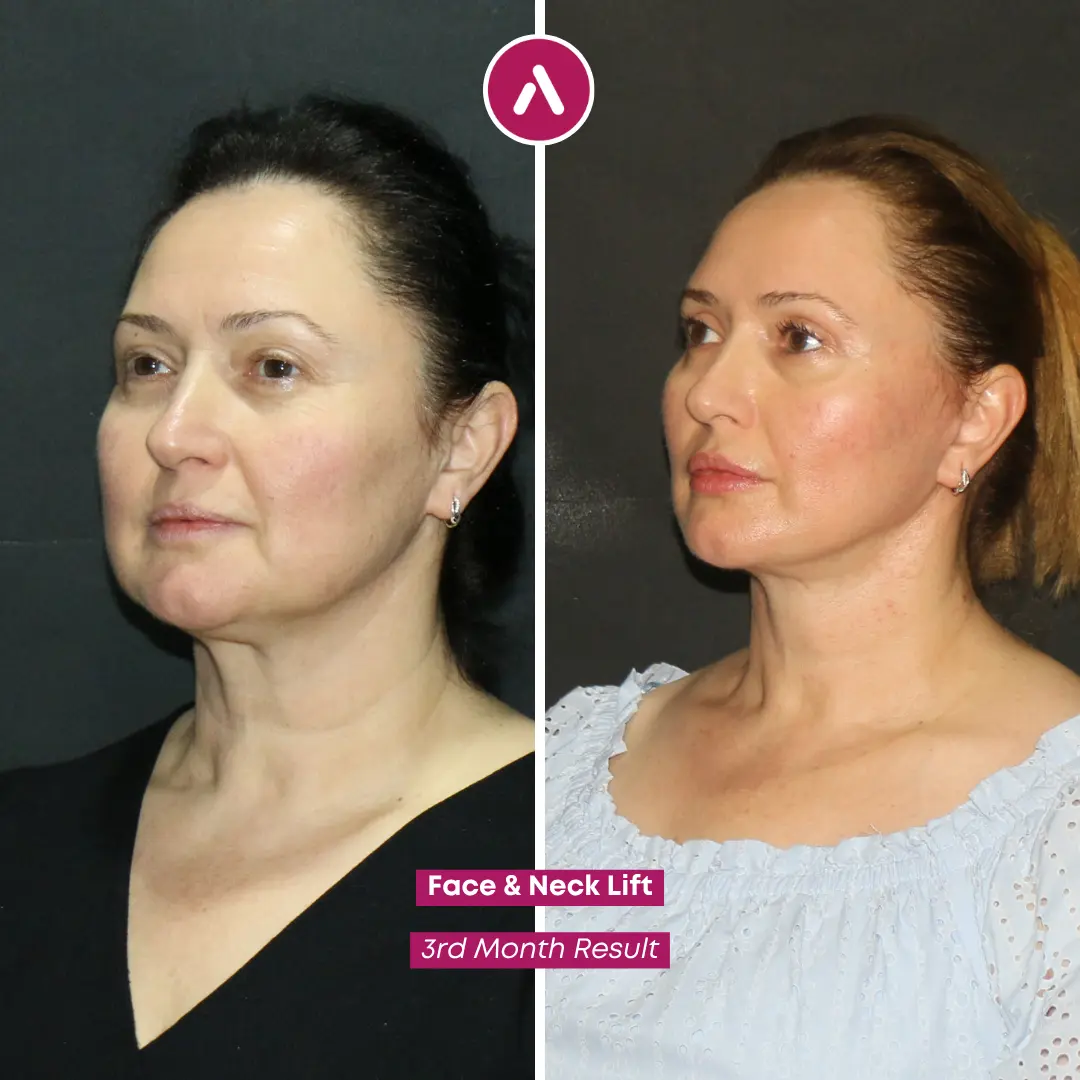
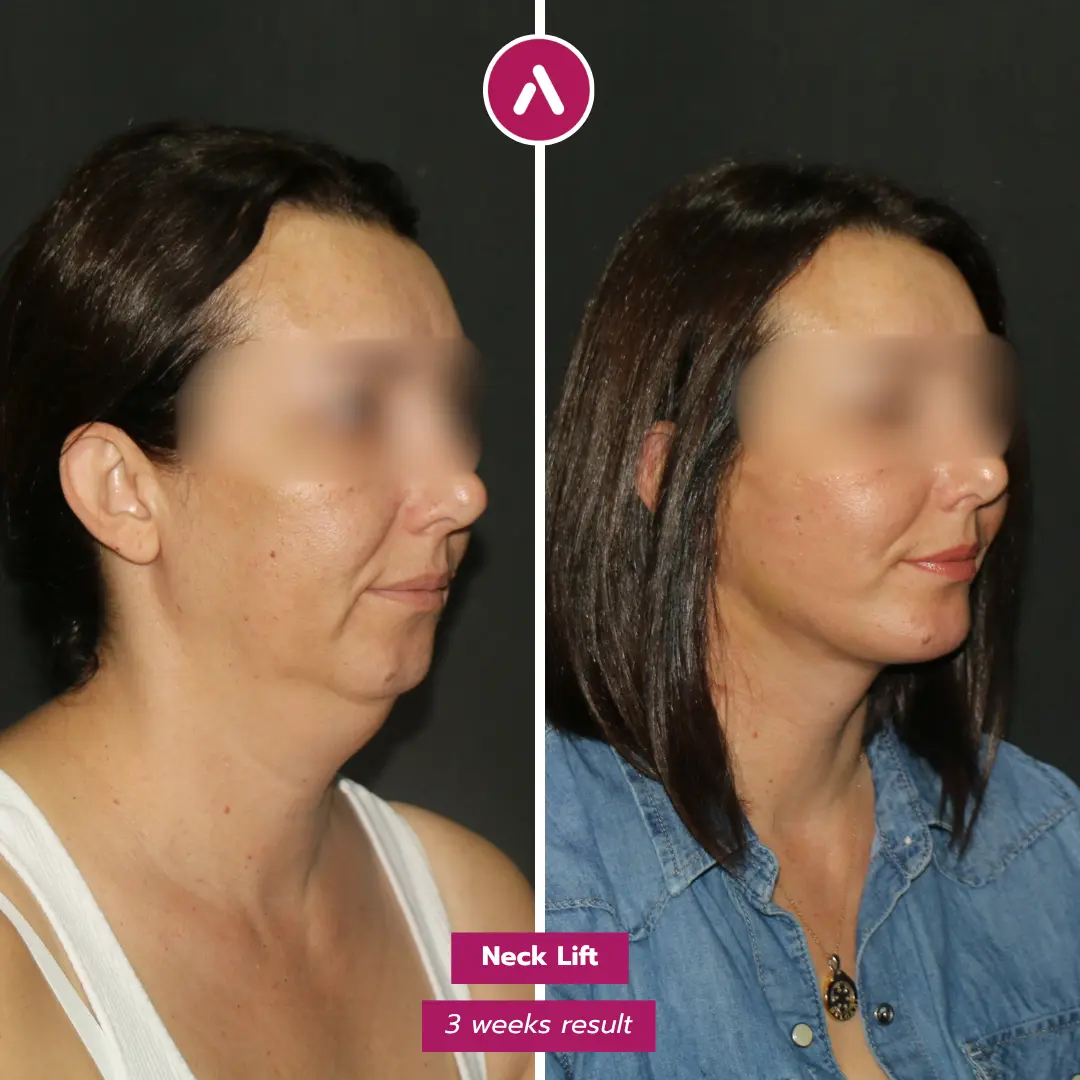
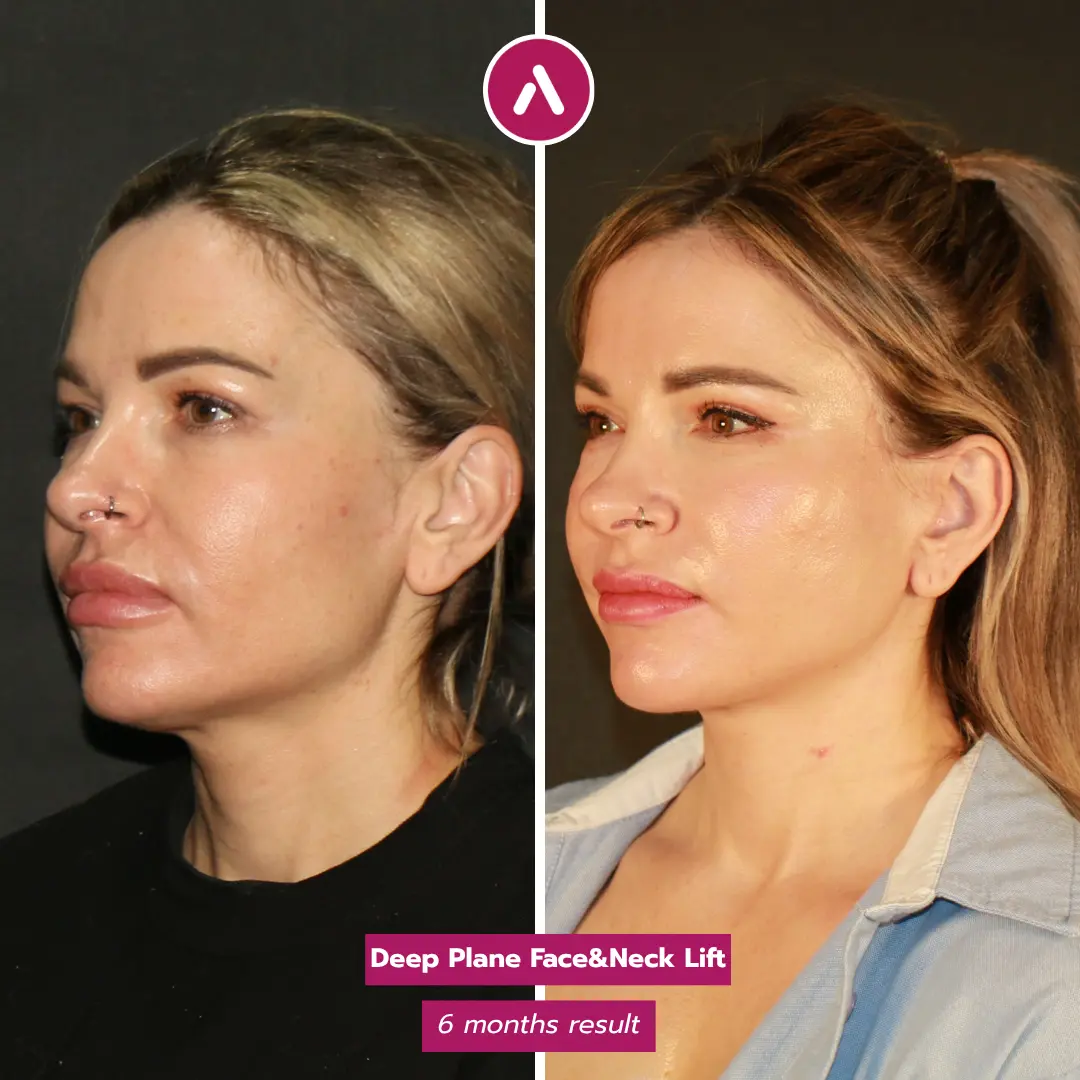
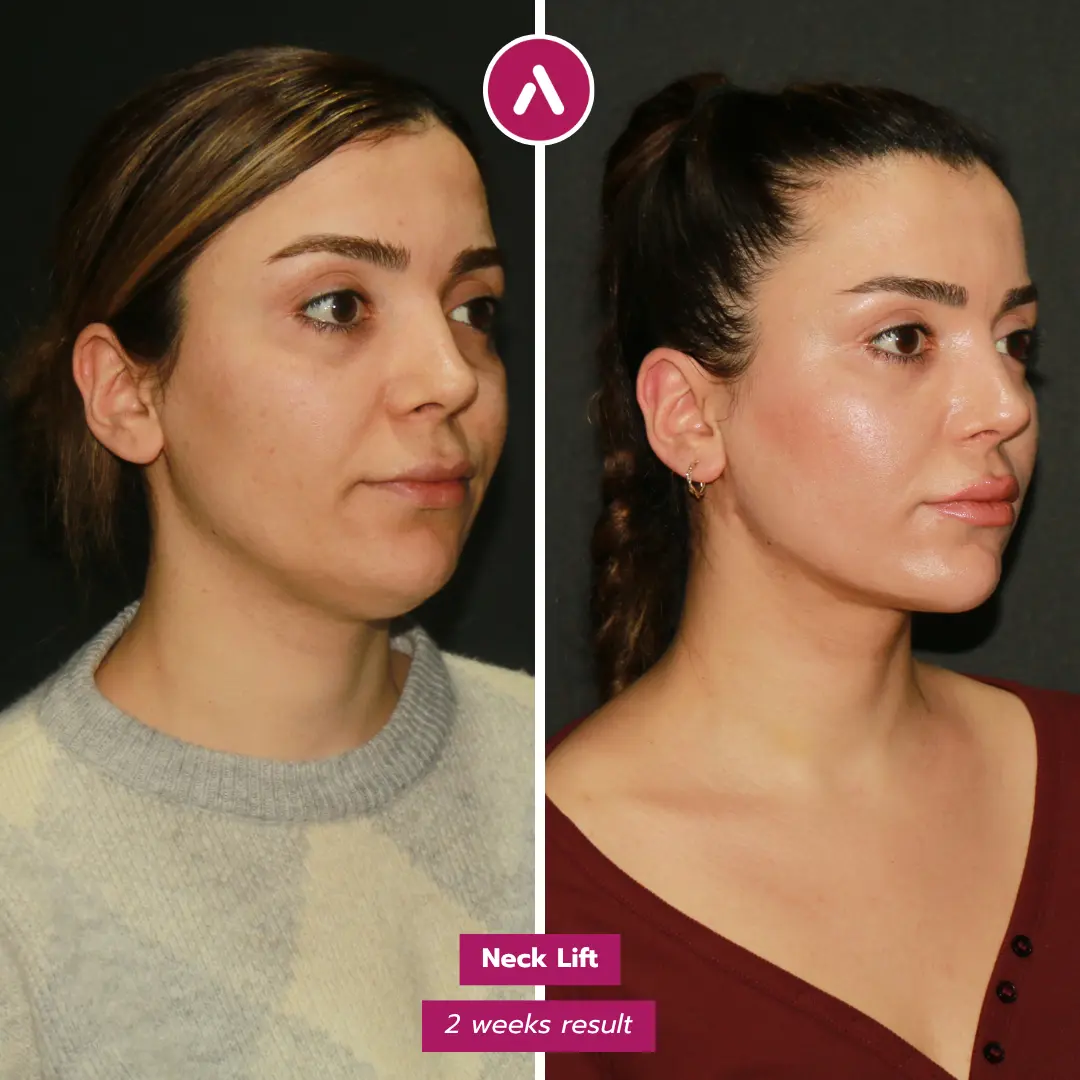
For many British patients, the before-and-after gallery is where marketing ends and judgement begins. A beautiful website can create confidence, but only a carefully assessed portfolio can show whether a surgeon genuinely delivers consistent, anatomically elegant outcomes. If you are searching for the best deep plane facelift surgeon Turkey, you should not look at photos like a casual browser. You should assess them the way an informed patient would: critically, methodically, and with a clear understanding of what a natural result really looks like.
This matters because the difference between a mediocre facelift and an excellent one is often subtle. The face may look “tighter” in both. Yet only the better result looks harmonious, believable, and free from tension. In aesthetic surgery, this is where clinical science and artistry meet. A refined deep plane facelift should restore facial support and contour without leaving obvious clues that surgery has taken place. For UK patients, especially those comparing facelift London vs Istanbul quality, portfolio evaluation is one of the strongest tools for separating true expertise from attractive advertising.
Consistency, Clinic Lighting, and Scar Visibility
The first thing to examine is consistency. One excellent result proves very little. A strong surgeon should be able to show multiple patients with different ages, skin qualities, and anatomical patterns who all look refreshed rather than over-corrected. If every good result appears to come from a single angle, heavy make-up, or unusually flattering lighting, caution is warranted.
Lighting is not a minor detail. Inconsistent lighting can hide bruising, blur shadow lines, and make skin texture appear smoother than it really is. A professionally trustworthy portfolio should show controlled, comparable photography. Ideally, the patient is photographed in similar positions, with similar expression, and with similar light exposure before and after surgery. Otherwise, you are not comparing surgery; you are comparing photography.
Scar visibility should also be judged realistically. An excellent facelift does not mean there are no incisions. It means the incisions are planned intelligently, heal cleanly, and become difficult to notice over time. UK patients who value discretion should look closely at the hairline, around the ear, and along natural creases. A surgeon who combines refined technique with thoughtful aftercare support, including technologies such as LLLT scar support, is more likely to prioritise how the result looks when fully healed rather than just in the early post-operative period.
| What to Check | Strong Sign | Warning Sign |
|---|---|---|
| Lighting | Same lighting and angles before and after | Dramatically different shadows or flattering edits |
| Expression | Neutral, comparable facial posture | Smiling in one image and tense in the other |
| Scars | Well-concealed and progressively less visible | Hairline distortion or obvious tension around the ear |
| Consistency | Natural results across several patients | Only one or two standout examples |
Long-Term Healed Results vs. Immediate “On-Table” Photos
Many patients are impressed by immediate post-operative images, but these are often the least useful photographs in the entire decision-making process. On-table images can look dramatic because tissue has just been lifted, swelling has not yet evolved, and the patient is not yet moving naturally. They may demonstrate that surgery took place, but they do not prove that the result will heal beautifully.
Healed results are far more meaningful. A strong facelift portfolio should include outcomes at several months rather than only the first day or week. Once oedema has settled and the tissues have relaxed into their final position, the truth becomes much clearer. The face should look structurally supported, but soft. The neck should look cleaner, but not unnaturally sharp. The patient should appear more rested, not visibly “done”.
This is particularly important for British patients because the common UK preference is not dramatic transformation. It is credible rejuvenation. A 45-year-old patient who wanted to look “refreshed”, not pulled, and then shows a natural result at six months is far more persuasive than a dramatic theatre photo taken minutes after closure. In practical terms, healed photographs are where you see whether the surgeon actually understood tissue repositioning, not merely tension.
Signs of a Natural Result in the Midface, Jawline, and Neck
Natural-looking deep plane surgery is not about one isolated feature. It is about how the whole lower and midface work together. A good result usually shows restoration in the cheeks, a smoother transition into the jawline, and a cleaner neckline without the appearance of being stretched. The best surgeons understand that the face must remain recognisable. They do not try to erase age entirely; they rebalance it.
In the midface, look for support rather than puffiness. The cheek should appear lifted and better positioned, not swollen or overfilled. In the jawline, the contour should look clearer, but still soft enough to remain believable. In the neck, there should be improved definition without an abrupt, unnatural angle. These are small visual cues, but they matter enormously when identifying the best surgeon for deep plane facelift in Turkey.
One of the most reassuring signs is continuity. The transition between the face and neck should feel seamless. This is often what separates a sophisticated deep plane result from a more superficial lift. When the surgeon works with facial structure rather than against it, the eye does not stop at one “operated” zone. Everything looks calmer, smoother, and more coherent.
How to Spot Overcorrection, Overfilled Features, and Unnatural Tension
British patients are usually highly alert to anything that looks excessive, and this instinct is wise. Overcorrection can show itself in several ways: the outer corners of the eyes may look unnaturally pulled, the mouth may appear strained, the cheeks may look too full for the patient’s age, or the skin may seem polished and tight in a way that does not move naturally. These are not signs of “better lifting”. They are signs of poor balance.
Another red flag is when every after photo has the same stylised look regardless of the patient’s starting anatomy. A refined surgeon does not impose one template on every face. They adapt the operation to the patient’s ligament strength, skin quality, neck anatomy, and facial proportions. That is one reason the best facelift surgeon Turkey for UK patients is not simply the most visible online. It is the surgeon whose work still looks individual from patient to patient.
When assessing a portfolio, ask yourself one practical question: if I met this person in real life, would I assume they had surgery? If the answer is yes in case after case, the aesthetic philosophy may not align with the British preference for subtlety. The strongest portfolios do not impress because they look extreme. They impress because they look believable.
What UK Patients Mean by a “Harley Street Quality” Result
When British patients speak about a Harley Street quality facelift in Istanbul, they are not only referring to price or prestige. They usually mean a combination of natural outcomes, consultant-led planning, professional aftercare, and visual discretion. In other words, a result that appears polished but never theatrical. This standard is emotional as much as aesthetic. The patient wants to feel safe, understood, and treated with a level of seriousness equal to what they would expect in London.
That is also why personal patient stories carry so much weight. For example, one UK patient, Sarah, compared her experience directly against treatment in Britain and felt that, when considering facelift London vs Istanbul quality, she would choose Turkey again. Her motivation was not to look dramatically different. It was to access subtle facial rejuvenation without the disproportionate cost associated with premium London clinics.
“After comparing London and Istanbul quality, I would choose Turkey again.”Sarah from the UK
For a British audience, that kind of endorsement matters because it reflects what they are actually seeking: elegant results, clear communication, and value without compromising standards. In this context, “Harley Street quality” means restraint, refinement, and confidence in the surgeon’s judgement.
Red Flags: How to Avoid “Ghost Surgery” in Turkey
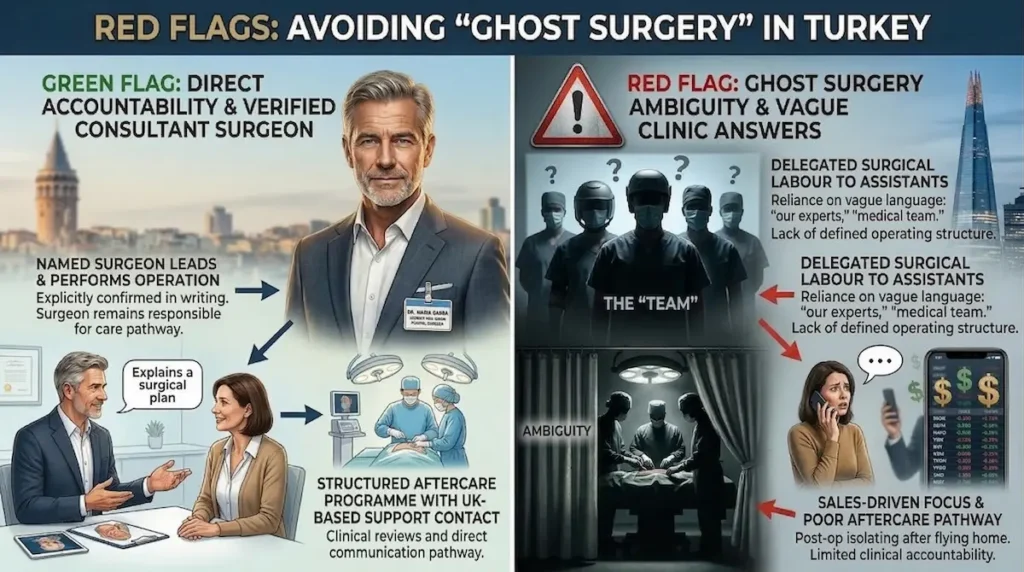
No matter how attractive a clinic’s gallery or package may look, none of it matters if the patient cannot clearly establish who is actually performing the operation. This is the point where many cautious British patients pause, and rightly so. Fear of “ghost surgery” is one of the biggest trust barriers in cross-border cosmetic treatment. A polished consultation is not enough. You must know which consultant surgeon is responsible, who will be present in the operating theatre, and how accountability is maintained from start to finish.
This issue is especially important for readers searching terms such as GMC registered surgeon alternatives and UK board-certified equivalent surgeons. The concern is not only credentials on paper. It is whether those credentials belong to the person who will genuinely operate on you. In a consultant-led clinic, there is no ambiguity. In a weak or sales-heavy model, ambiguity is often exactly the problem.
Ensuring Your Consultant Surgeon Performs the Entire Procedure
The most important question is also the simplest: who will perform the operation? A trustworthy clinic should answer this directly and comfortably. If you are consulting with a named surgeon, you should expect that same surgeon to lead the procedure, make the surgical decisions, and remain responsible for your care pathway.
For British patients, this is more than a preference. It is a basic safety standard. Deep plane facelift surgery is too technical, too anatomy-dependent, and too individual to be treated like a delegated production-line procedure. The surgeon’s judgement is central at every stage, from tissue release to vector control to skin redraping. If the named consultant is not actually performing those critical steps, the entire promise of expertise becomes questionable.
This is why the safest clinics do not hide behind vague team language. They identify the lead surgeon clearly. They explain their role clearly. And they make it clear that the operation is not being handed off once the patient is anaesthetised.
Why Vague Clinic Answers About the Operating Team Are a Warning Sign
If you ask who will be in theatre and receive an answer such as “our medical team”, “our experts”, or “the surgeon and assistants”, that should not reassure you. It should prompt more questions. Vague language often signals that the clinic is more comfortable selling the package than clarifying responsibility.
A serious clinic understands why this matters to UK patients. It should be able to explain the operating theatre structure in ordinary language: who the consultant surgeon is, who supports them, what the anaesthesia team does, and who follows the patient afterwards. There should be no embarrassment about discussing this. In fact, clarity here is one of the clearest markers of trust.
Remember that a deep plane facelift is not interchangeable labour. The surgical outcome depends on the judgement of the named specialist. If the clinic becomes evasive when asked to define that responsibility, the patient should treat this as a genuine red flag rather than a mere communication issue.
How to Confirm Who Will Be Present in the Operating Theatre
The safest approach is to ask precise questions in writing as well as in consultation. Ask for the name of the lead surgeon, ask whether that surgeon performs the full deep plane facelift personally, and ask who else will be present in the operating theatre. This does not make you difficult. It makes you informed.
You should also ask who will handle your follow-up, who reviews your recovery photographs, and who is authorised to make clinical decisions if you contact the clinic after surgery. A trustworthy provider will not be irritated by this level of detail. On the contrary, consultant-led clinics usually appreciate patients who take safety seriously.
For British patients who are wary of overseas treatment, direct accountability is often what converts concern into confidence. When the clinic can name the surgeon, name the support structure, and explain the aftercare pathway, the whole process feels more like premium private medicine and less like medical tourism theatre.
| Question | Reassuring Answer | Concerning Answer |
|---|---|---|
| Who performs my facelift? | A named consultant surgeon | “Our team handles it” |
| Who is in theatre? | Named surgeon, anaesthesia team, theatre staff | “You do not need to worry about that” |
| Who manages aftercare? | Surgeon-led review with clinical follow-up | Sales co-ordinator only |
| Can you confirm this in writing? | Yes, clearly and promptly | Deflection or delay |
Why Cheap Package Deals Can Increase Safety Concerns
Price matters, but price alone should never be the main reason for choosing a facelift provider. Deep plane surgery is a high-skill operation, and extreme discounts can sometimes indicate pressure to fill theatre lists quickly rather than maintain careful case selection and consultant time. British patients are often right to be sceptical of deals that look dramatically below market logic.
This does not mean Turkey cannot offer strong value. It often can. In fact, the appeal of Istanbul is that patients may access a Harley Street quality facelift in Istanbul with more favourable overall pricing than they would see in London. But “better value” is not the same as “suspiciously cheap”. The difference lies in whether the clinic explains what is included, who provides the care, and how aftercare is supported once the patient returns home.
Transparent all-inclusive pricing in GBP can be reassuring. What is not reassuring is a price so low that it seems to leave no room for genuine consultant-led surgery, rigorous theatre standards, recovery support, and proper follow-up. When the offer looks too simple for a complex operation, it usually is.
Questions That Reveal Whether a Clinic Offers Genuine Aftercare or Just Sales Support
One of the clearest ways to distinguish a serious clinic from a sales-led one is to examine what happens after the surgery. Real aftercare is structured, medically informed, and available beyond the moment the invoice is paid. British patients often worry about what happens once they fly home, and that concern is entirely justified. A clinic that understands UK expectations should answer this proactively.
Ask whether the patient has access to a UK support line, whether there is a London correspondence address or UK-based patient contact point, and whether clinical follow-up continues digitally after returning home. These details may sound logistical, but psychologically they are powerful. They tell the patient that the relationship does not end at the airport.
Patient experience reflects this clearly. For one UK-facing aftercare story, the reassurance of being able to remain in contact through a direct WhatsApp line and UK support pathway made a significant difference once the patient returned home. That kind of support reduces isolation and helps the clinic feel accessible rather than distant.
For many British patients, aftercare is not a bonus feature. It is part of the safety decision.
At the highest level, the best clinics combine consultant-led surgery with recovery infrastructure. That may include direct communication, structured remote review, recovery technologies such as HBOT for oedema management, LLLT support for scar quality, and a clear plan for when the patient is ready to travel. This is where scientific research, surgical judgement, and patient logistics come together in a way that genuinely matters.
Why Istanbul is a Premier Global Hub for Facial Plastic Surgery
For a British patient, choosing Istanbul is rarely about geography alone. It is about access to a very specific combination of factors: highly specialised surgeons, consultant-led care, modern operating theatres, recovery-focused technology, and a cost structure that often feels more rational than premium private treatment in London. This is why the debate around facelift London vs Istanbul quality has become so important. Patients are no longer asking whether treatment abroad is possible. They are asking whether it can match the standards, discretion, and aesthetic restraint they would expect from a top-tier UK clinic.
In the case of facial rejuvenation, Istanbul has become especially attractive because the city combines international patient infrastructure with a strong concentration of aesthetic expertise. For the right clinic, this means British patients can access a Harley Street quality facelift in Istanbul without accepting the impersonality of an agency-led pathway. Instead, they can look for surgeon-led treatment, transparent planning, and a recovery programme designed around the realities of returning to the UK.
Harley Street Quality Facelift in Istanbul: Value Without Compromising Standards
When British patients use the phrase Harley Street quality facelift in Istanbul, they are not speaking only about prestige. They are referring to a whole standard of care: refined surgical judgement, discreet outcomes, consultant accountability, and a clinic environment that feels structured rather than improvised. In a strong Istanbul setting, value does not come from cutting corners. It comes from a different cost environment around the surgery.
This distinction matters because the UK market is highly sceptical. Patients influenced by stories of poor outcomes abroad want reassurance that the clinic is not merely affordable, but serious. They want consultant involvement, sterile operating theatres, and a result that aligns with British aesthetic taste. In practice, that means a soft, natural lift, not a dramatic or visibly operated look.
At AKM Clinic, that argument rests on surgeon leadership and clinical positioning rather than discount messaging. The clinic frames itself as a private cosmetic clinic in Istanbul with British standards, supported by facial specialists and a philosophy of subtle facial rejuvenation rather than exaggerated change.
How All-Inclusive GBP Pricing Changes the Decision for UK Patients
For many British patients, uncertainty around cost is nearly as stressful as the surgery itself. Private treatment in London may involve separate consultation fees, hospital charges, anaesthesia costs, follow-up costs, and additional expenses that are not obvious at the start. This is one reason all-inclusive cosmetic surgery GBP pricing has become such a powerful trust signal in Turkey.
Transparent GBP-based planning allows the patient to compare options more realistically. Instead of trying to decode multiple invoices in different currencies, they can review the total financial picture from the outset. Psychologically, this is important. It shifts the conversation away from “cheap abroad” and towards controlled, premium-value decision-making.
That does not mean the cheapest quote is the best one. In fact, the opposite is often true. The better question is whether the quote is transparent, medically coherent, and consistent with genuine consultant-led surgery. For British patients evaluating the best facelift surgeon Turkey for UK patients, clarity is often more persuasive than a dramatic discount.
| Decision Factor | Typical London Concern | What UK Patients Often Seek in Istanbul |
|---|---|---|
| Fee structure | Separate clinical and facility costs | Clear all-inclusive GBP planning |
| Outcome preference | Fear of paying more without greater subtlety | Natural rejuvenation with consultant-led planning |
| Recovery | Limited integrated recovery support | HBOT, LLLT, and flight-aware aftercare |
| Access | Long decision process and high financial barrier | Faster pathway with transparent communication |
The Advantage of Private Cosmetic Clinics in Istanbul with British Standards
The most compelling clinics in Istanbul do not try to imitate mass-market medical tourism. They position themselves around standards, structure, and predictability. For a British audience, that means clean communication, consultant-led planning, and medical protocols that feel familiar in principle even when delivered abroad.
That is why phrases such as UK board-certified equivalent surgeons and GMC registered surgeon alternatives matter so much in this market. They help the patient translate trust across borders. The goal is not to pretend Turkey uses the same regulatory labels as the UK. The goal is to show that recognised European training, specialist focus, and formal board-level credentials can create a meaningful equivalent standard of reassurance.
Direct Flights, Short Travel Times, and Easier Planning from London
Practical logistics matter more than many clinics admit. Even an excellent surgeon may feel inaccessible if the travel plan seems exhausting or medically unrealistic. One reason Istanbul remains highly attractive for UK patients is that the journey can be planned with relative simplicity, especially from London and other major British airports.
Direct flights reduce mental friction. They make it easier to imagine the full pathway, from consultation to surgery to recovery to the journey home. This matters particularly for cautious patients who want control at every stage. The easier the route, the easier it is to focus on the meaningful questions: surgeon expertise, recovery planning, and aftercare support.
For clinics that genuinely understand the British market, logistics are part of the clinical conversation. The patient is not simply travelling to a city. They are moving through a treatment programme that must work in real life. The strongest providers acknowledge that and plan accordingly.
Why Many British Patients Choose Turkey to Skip Long Waiting Periods
Although cosmetic surgery in the UK is private, many British patients still experience extended decision timelines, multiple fee stages, and a high-friction pathway before treatment feels truly achievable. In wider healthcare culture, long waiting periods are already a familiar frustration. That is why the message to skip NHS waiting list cosmetic surgery resonates even in aesthetic decision-making: patients want prompt access, not endless delay.
What makes Istanbul appealing is not speed for its own sake. It is structured access. British patients want to move forward once they have done their research. They do not want to feel rushed, but they also do not want a prolonged process that adds cost and uncertainty without improving the quality of the outcome.
This is where Istanbul competes strongly. For the patient who has already decided that facial rejuvenation is the right step, a well-organised clinic can turn intent into a realistic plan. That is a major reason so many searches for the best deep plane facelift surgeon Turkey now come from British patients who are looking beyond location and focusing on access, quality, and trust.
Essential Questions You Must Ask During Your Consultation
Even the most polished clinic should be judged by the quality of the questions it can answer. For a British patient, a strong consultation is not a performance. It is a test of clarity, accountability, and clinical maturity. The right surgeon will not be unsettled by detailed questions. On the contrary, consultant-led clinics usually welcome them because informed patients make safer and more realistic decisions.
If you are trying to identify the best surgeon for deep plane facelift in Turkey, the goal is not to ask dozens of dramatic questions. It is to ask a small number of precise ones that reveal whether the clinic truly understands anatomy, recovery, and British expectations. The answers should feel calm, specific, and medically grounded. If they sound vague, overly sales-led, or designed to rush you, that is useful information too.
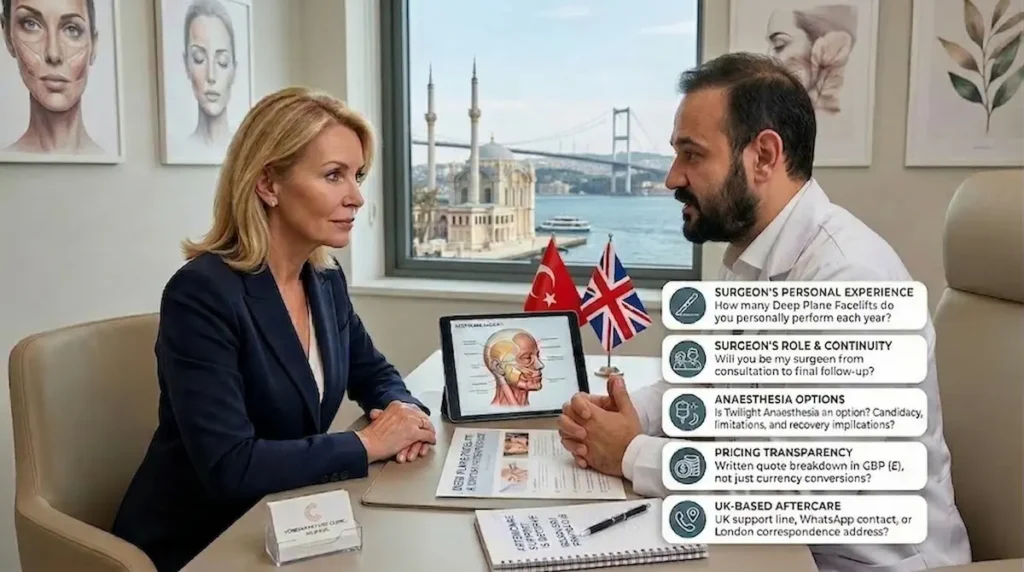
How Many Deep Plane Facelifts Do You Personally Perform Each Year?
This question is not about catching the surgeon out. It is about establishing whether deep plane work is a genuine area of specialisation or simply one of many procedures offered on a website. A surgeon who performs advanced facial rejuvenation regularly is more likely to have the consistency, tissue judgement, and anatomical confidence that this operation demands.
The key word here is personally. British patients should not settle for answers about the clinic as a whole. They should ask how many deep plane facelifts the named surgeon performs personally. Specialist depth matters far more than broad cosmetic branding.
Will You Be My Surgeon from Consultation to Final Follow-Up?
This is one of the clearest ways to identify whether a clinic is truly consultant-led. The patient needs to know whether the surgeon they are speaking with will also be the one making operative decisions and reviewing recovery afterwards. If the answer becomes vague, the patient should pause.
A deep plane facelift is not a treatment that can be safely reduced to interchangeable team members. The entire logic of choosing an expert surgeon depends on continuity. For British patients worried about ghost surgery or fragmented communication, this question is essential.
What Type of Anaesthesia Will Be Used, and Is Awake Deep Plane Facelift an Option?
Many British patients are increasingly interested in alternatives to general anaesthesia, especially if they are cautious by nature or have had difficult previous experiences. That is why the concept of a deep plane facelift performed with Twilight anaesthesia cosmetic surgery has become so compelling.
The important point is not whether every patient should choose it, but whether the clinic can explain the option properly. If awake or twilight-based treatment is offered, the surgeon should be able to discuss candidacy, comfort, limitations, and recovery implications in plain language. This is where medical science matters more than marketing language.
What Is Included in the Quote, and Will I Receive a Clear GBP Breakdown?
British patients should always ask for a written breakdown in GBP. A transparent answer should show what is included in the planned treatment pathway and whether there are likely to be any meaningful extra costs. The goal is not to negotiate line by line; it is to understand the real investment clearly from the beginning.
This question often reveals a clinic’s culture. A consultant-led and well-organised clinic is usually comfortable giving structured, transparent financial information. A vague or evasive answer can indicate that the price is being used more as a hook than as a serious treatment plan.
What Happens After I Return to the UK If I Have Questions or Concerns?
For many British patients, this is the emotional centre of the whole consultation. Surgery abroad may feel manageable while they are in Istanbul, but what matters just as much is how supported they will feel once they are back home. The best answer should include named aftercare pathways, response methods, and a clear explanation of how concerns are handled after travel.
This is where practical UK-facing trust signals become extremely important. Access to a UK support line, a direct WhatsApp UK number, a UK based patient contact point, or a London correspondence address for patients can make the difference between feeling abandoned and feeling properly supported. For cautious patients, these details are not minor extras. They are part of the safety decision.
Strong aftercare does not begin when there is a problem. It begins before the patient ever boards the flight home.
What Recovery Protocols Do You Use to Reduce Oedema, Bruising, and Scar Visibility?
A sophisticated facelift clinic should have more to say than “rest and wait”. Recovery quality affects confidence, return to social life, and how quickly the result begins to look refined. For that reason, British patients should ask what active recovery support is used and why.
At a higher standard of care, the answer may include HBOT for oedema control and lymphatic support, plus LLLT to encourage smoother healing and less visible scarring. These technologies do not replace excellent surgery, but they can strengthen the overall programme by aligning recovery with scientific thinking rather than wishful reassurance.
| Recovery Concern | What a Strong Clinic Should Explain |
|---|---|
| Oedema and bruising | How swelling is monitored and supported during the early phase |
| Scar quality | Incision strategy, wound care, and whether LLLT is used |
| Return travel | How the clinic assesses readiness to fly |
| Daily recovery | When washing, walking, sleeping, and normal routines can resume |
Do You Offer UK Support Line, WhatsApp Contact, or a London Correspondence Address?
This final question may sound administrative, but it is often one of the most reassuring. A clinic that understands British psychology knows that local touchpoints matter. They help the patient feel that communication remains open after travel, and that there is a familiar route for updates, documents, and practical concerns.
In trust terms, this can be decisive. The patient is no longer dealing with a distant clinic in purely abstract terms. They are dealing with a structured organisation that has thought carefully about continuity for British patients. In a market where trust is everything, that can significantly strengthen confidence.
For anyone comparing clinics and searching for the best facelift surgeon Turkey for UK patients, the quality of these answers often says more than the homepage ever will. The best consultation does not simply reassure you. It gives you concrete reasons to trust the process.
Frequently Asked Questions (FAQ): Best Deep Plane Facelift Surgeon in Turkey
Choosing the best deep plane facelift surgeon in Turkey involves more than comparing prices or social media profiles. British patients usually want clear answers about credentials, safety, recovery, natural results, and what happens once they return home. These frequently asked questions address the concerns most commonly raised by UK patients considering facial rejuvenation in Istanbul.
Who is the best candidate for a deep plane facelift?
The best candidate is usually someone with visible facial descent in the cheeks, jawline, and neck who wants natural rejuvenation rather than an artificial or over-tight result. Suitability depends on anatomy, skin quality, medical history, and the surgeon’s assessment.
How do I choose the best deep plane facelift surgeon in Turkey?
Look for a surgeon with a strong facial rejuvenation focus, consistent before-and-after results, clear credentials, consultant-led care, and transparent aftercare. For UK patients, it is also wise to look for UK board-certified equivalent surgeons and credible GMC registered surgeon alternatives.
Is a deep plane facelift better than a SMAS facelift?
Not always for every patient, but for the right candidate, a deep plane facelift can produce a more natural and structurally refined result because it repositions deeper facial tissues rather than relying mainly on surface tension. The best technique depends on facial anatomy and surgical goals.
How much does a deep plane facelift in Turkey cost compared with the UK?
In many cases, treatment in Istanbul is significantly more cost-effective than premium private clinics in London, especially when the plan includes accommodation, transfers, and aftercare. The key point is not simply lower cost, but better value through transparent GBP planning and surgeon-led care.
Can a deep plane facelift be performed without general anaesthesia?
In selected cases, yes. Some clinics may offer a deep plane facelift using twilight or awake-style anaesthesia protocols, depending on the patient and the surgeon’s approach. This should always be discussed in detail during consultation.
How long should I stay in Istanbul after surgery?
Most patients should plan to remain in Istanbul long enough for early monitoring, dressing checks, and surgeon review before flying home. The exact stay depends on the procedure, the recovery pace, and the clinic’s travel protocol.
When is it safe to fly back to the UK after a facelift?
This varies from patient to patient. A responsible clinic will decide based on swelling, healing progress, comfort, and overall recovery status. British patients should avoid fixed assumptions and follow the surgeon’s advice on when they are genuinely flight-ready.
How do I know if a clinic is avoiding ghost surgery?
Ask directly who will perform your operation, who will be present in the operating theatre, and whether the named consultant surgeon will handle your treatment from planning through follow-up. A trustworthy clinic should answer clearly and in writing if needed.
What kind of aftercare should British patients expect after returning home?
Strong aftercare should include direct communication, structured follow-up, recovery guidance, and a clear pathway for concerns after travel. For UK patients, features such as a WhatsApp contact route, UK support line, or London correspondence point can be especially reassuring.
How long do deep plane facelift results usually last?
Results are long-lasting, but no facelift stops the natural ageing process. In general, a well-performed deep plane facelift can provide durable improvement for many years, especially when supported by good skin care, healthy habits, and realistic expectations.
If you would like to explore related topics beyond the subject covered in this guide, you may also request information about the Best Deep Plane Facelift Clinic in Turkey, how to choose a Specialist Plastic Surgeon Turkey, how to avoid Ghost Surgery in Turkey, the most important Questions to Ask Plastic Surgeon, and what the Facelift Revision Rate may indicate about surgical planning, technique, and long-term patient satisfaction.
Medical Disclaimer: This page is provided for general educational purposes only and does not replace a face-to-face medical consultation, diagnosis, or personalised treatment plan. All surgery carries risks and outcomes vary between individuals. Suitability for a facelift surgery, procedure selection, and anaesthesia choice can only be determined after a full clinical assessment by a qualified surgeon. Always follow your clinician’s instructions and seek urgent medical attention if you develop concerning symptoms during recovery.