
Healing or Necrosis? Warning Signs to Watch After a Breast Lift
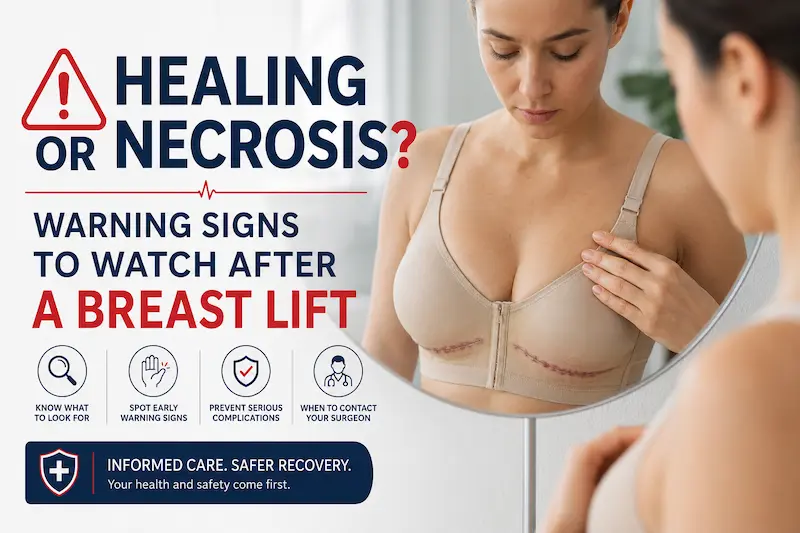
AI Summary
- Breast lift necrosis is uncommon but serious; worsening dark tissue needs prompt surgeon review.
- Normal healing improves as bruising fades, swelling decreases, and scars gradually settle.
- Warning signs include black tissue, spreading redness, odor, drainage, increasing pain, or wound opening.
- Early contact protects safety; send clear photos and follow your surgeon’s post-op instructions.
Summary generated by AI, fact-checked by our medical experts
Breast lift necrosis is uncommon, but it is serious. Normal healing usually improves day by day: bruising fades, swelling softens, and tenderness settles. Necrosis is different. It may show as skin or nipple tissue turning dark blue, purple-black, gray, or black, especially when the area looks worse instead of better. If that happens, contact your surgeon promptly.
After a breast lift, it is normal to study every change in the mirror. A little bruising can look alarming. Swelling can make the breasts feel tight. The nipple or areola may feel numb, extra sensitive, or slightly different from one side to the other.
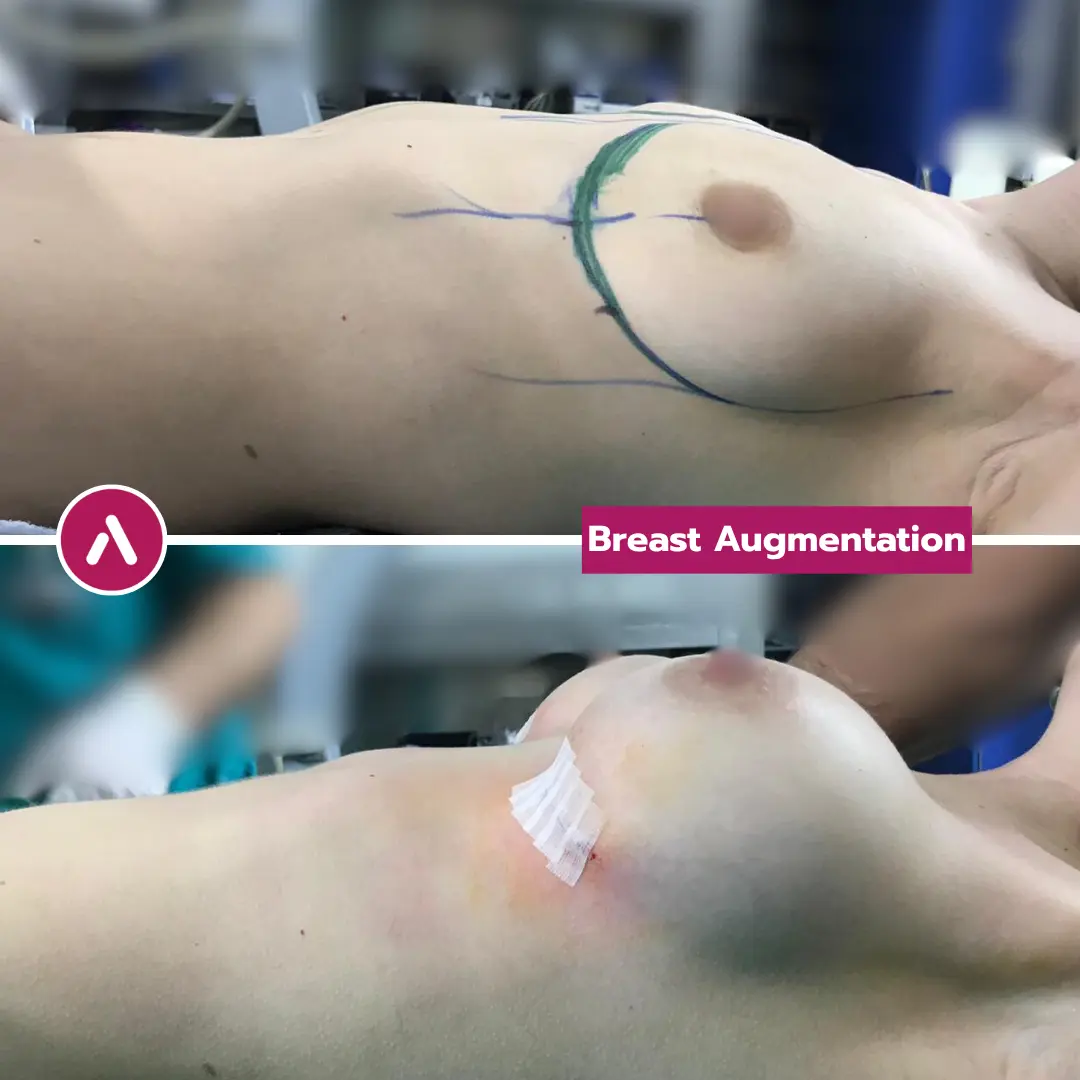
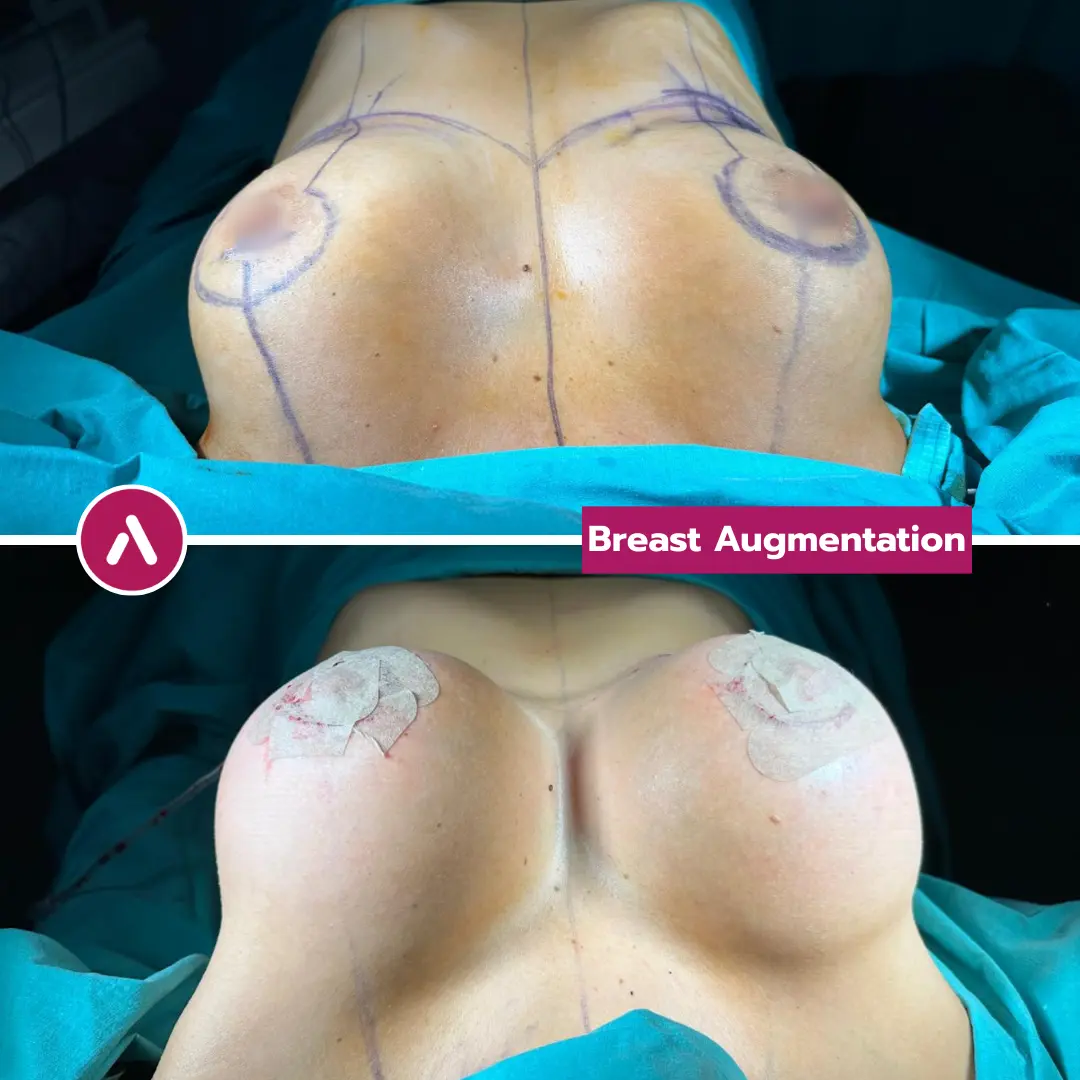
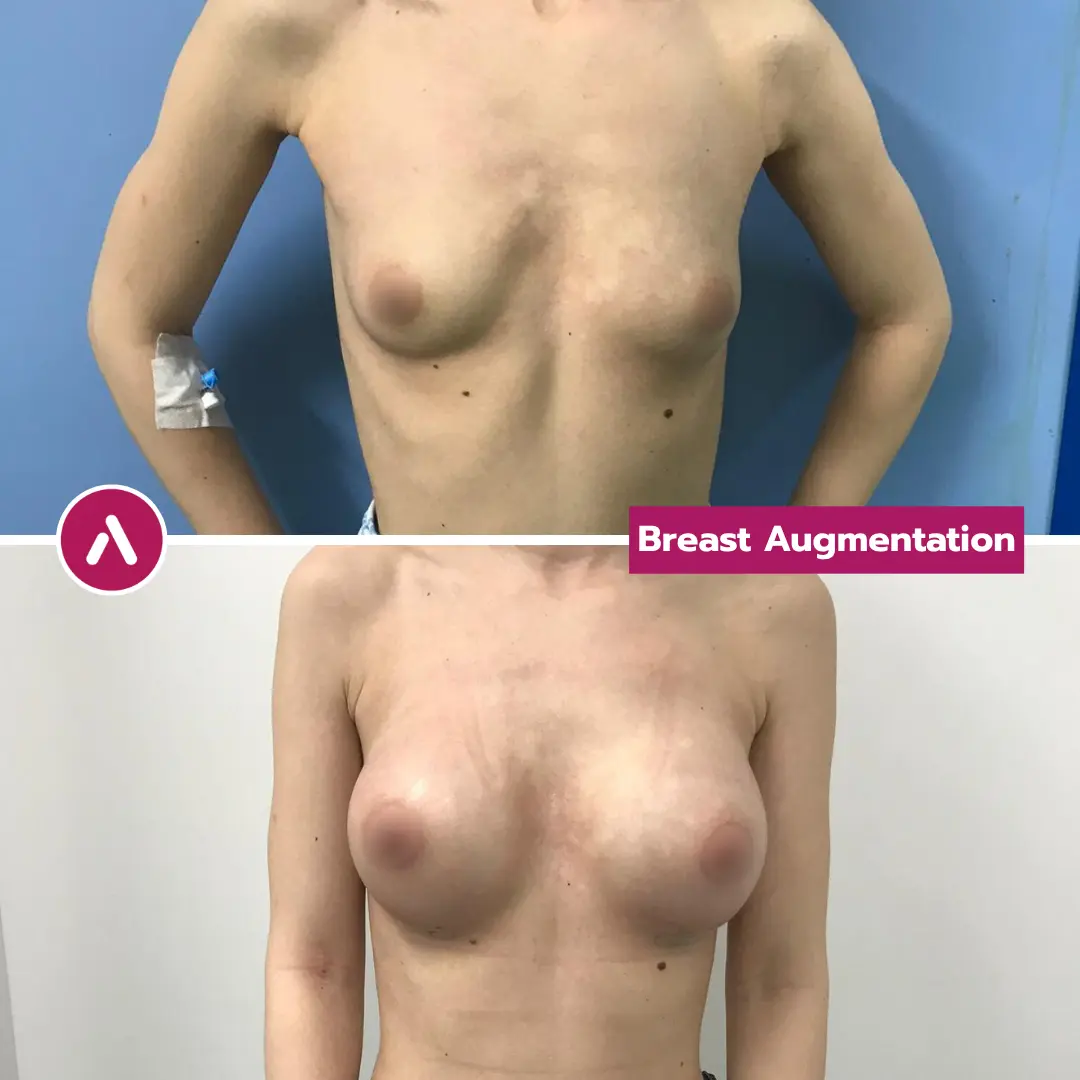
But there is a line between expected healing and a warning sign. This guide explains that line clearly. It is written for patients who want a straight answer: what looks normal, what may point to tissue necrosis, and when it is time to call the surgical team without delay.
At AKM Clinic, breast lift planning is performed by a board-certified plastic surgery team using a safety-first approach to incision planning, tissue handling, and post-op follow-up. You can learn more about how a breast lift is performed before comparing normal healing with warning signs.
Do not panic, but do not wait. A bruise that is fading is usually part of healing. Tissue that is getting darker, colder, more painful, foul-smelling, or open needs prompt review by your surgeon.
Table of Contents
Necrosis vs Normal Healing After a Breast Lift
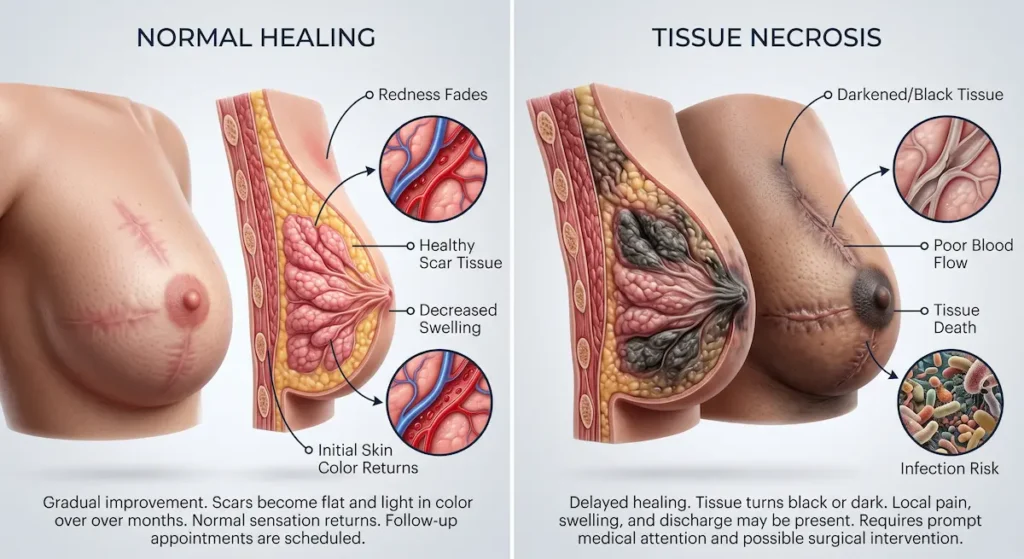
This section explains the basic difference between healthy post-surgical healing and tissue necrosis. The key point is not just the color you see on one day. It is the direction of change: normal healing gradually settles, while necrosis or compromised blood flow often worsens.
What necrosis means after breast lift surgery
Necrosis means that tissue has lost enough blood supply that it begins to die. After a breast lift, this can involve a small area of skin along an incision, part of the areola, or in rare cases the nipple-areola complex.
The nipple-areola complex is often shortened to NAC in medical literature. During a mastopexy, the nipple and areola are lifted to a higher position while remaining attached to living tissue that carries blood supply. The goal is to reshape the breast while preserving that circulation.
When blood flow is reduced, the tissue may first look dusky, bluish, or unusually pale. If perfusion does not recover, the area can darken further. That is why early recognition matters.
Peer-reviewed plastic surgery literature describes NAC ischemia after reduction mammaplasty or mastopexy as a complication that requires careful recognition and management. In plain English: when the blood supply looks threatened, the surgical team needs to know early, not after several days of guessing.
Why the nipple and areola can be more vulnerable
A breast lift changes the skin envelope and repositions breast tissue. The nipple and areola are moved upward, but they must stay connected to a reliable blood supply. That blood supply travels through a tissue bridge called a pedicle.
If there is too much tension, swelling, pressure, or vascular compromise, the nipple-areola complex can become stressed. Most patients never experience necrosis. Still, the reason surgeons watch the NAC closely after surgery is simple: it is a small, highly visible, highly sensitive area that depends on preserved circulation.
This risk is one reason breast lift planning is not only about shape. It is also about tissue safety. A responsible surgeon plans the lift, incision pattern, and amount of repositioning with blood flow in mind.
Why “rare” does not mean “ignore it”
Necrosis after a breast lift is not common. Most patients heal with expected bruising, swelling, and scar changes. But rare complications can still matter because timing affects the response.
If a patient waits too long to report a concerning color change, the window for simple early interventions may narrow. If the surgical team sees the issue early, they can assess whether the problem is bruising, venous congestion, pressure, wound tension, infection, or true tissue compromise.
That does not mean every dark mark is necrosis. It means worsening changes should be checked by the people who know your operation, your anatomy, and your healing plan.
What Normal Healing Looks Like
This section gives a baseline for normal breast lift healing, so the warning signs are easier to recognize. Normal healing is not perfectly pretty in the first days. Bruising, swelling, tightness, scabbing, and uneven color can all occur. The reassuring pattern is gradual improvement.
Expected bruising, swelling, and redness
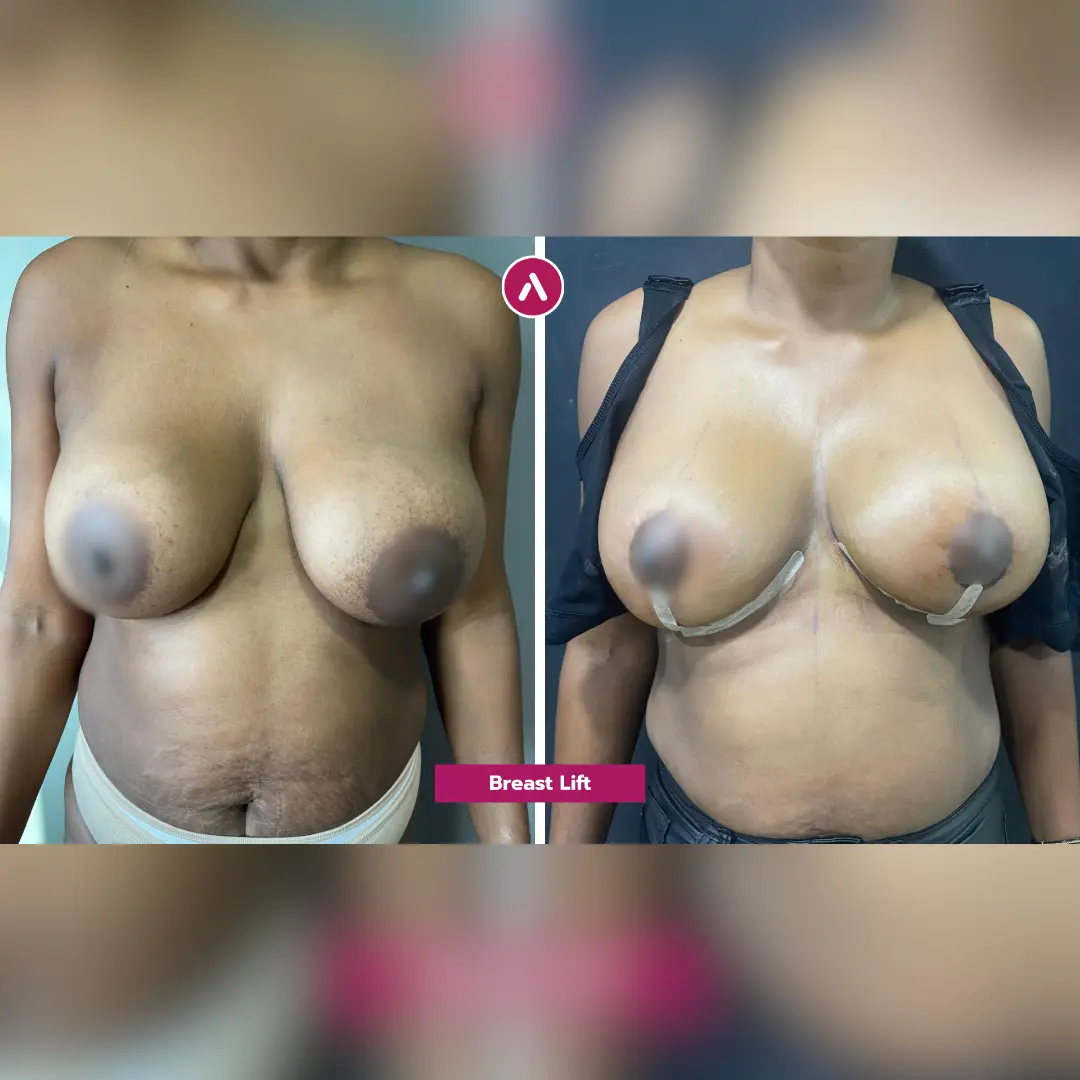
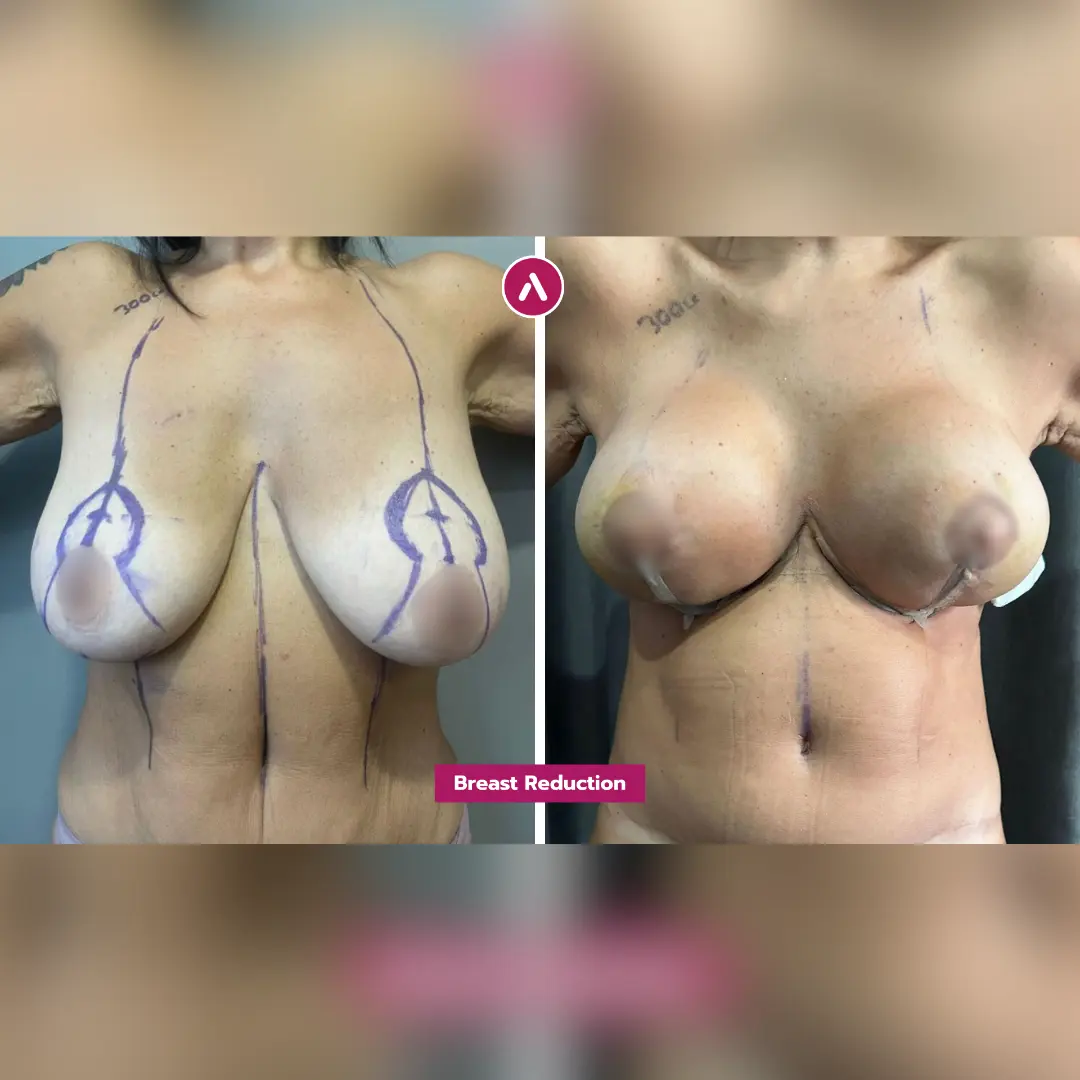
In the first week, the breasts may look swollen, firm, and bruised. Bruising can be purple, red, yellow, green, or brown as it changes. The lower breast, incision lines, and areas around the areola may look more dramatic than expected.
Swelling can also make the breasts look uneven. One side may sit slightly higher or feel tighter. This does not automatically mean something is wrong. Early healing is often asymmetrical because each side has its own swelling, tissue tension, and bruising pattern.
Mild redness directly around an incision can also be normal, especially early on. The more reassuring sign is that redness stays limited, does not spread outward, and gradually calms.
Normal changes in nipple color and sensation
The nipple and areola may not look or feel exactly normal right away. Some patients notice temporary numbness. Others feel tingling, burning, or hypersensitivity as nerves recover.
Color can also vary. The areola may look slightly darker, lighter, or more swollen than usual in the first stage of healing. Mild bruising around the areola can happen, especially when incisions are placed around it.
The important question is whether the color is stabilizing and improving. A bruise that becomes lighter over time is usually part of healing. A nipple or patch of skin that becomes progressively darker, cooler, black, leathery, or painful deserves urgent attention.
The “better day by day” rule
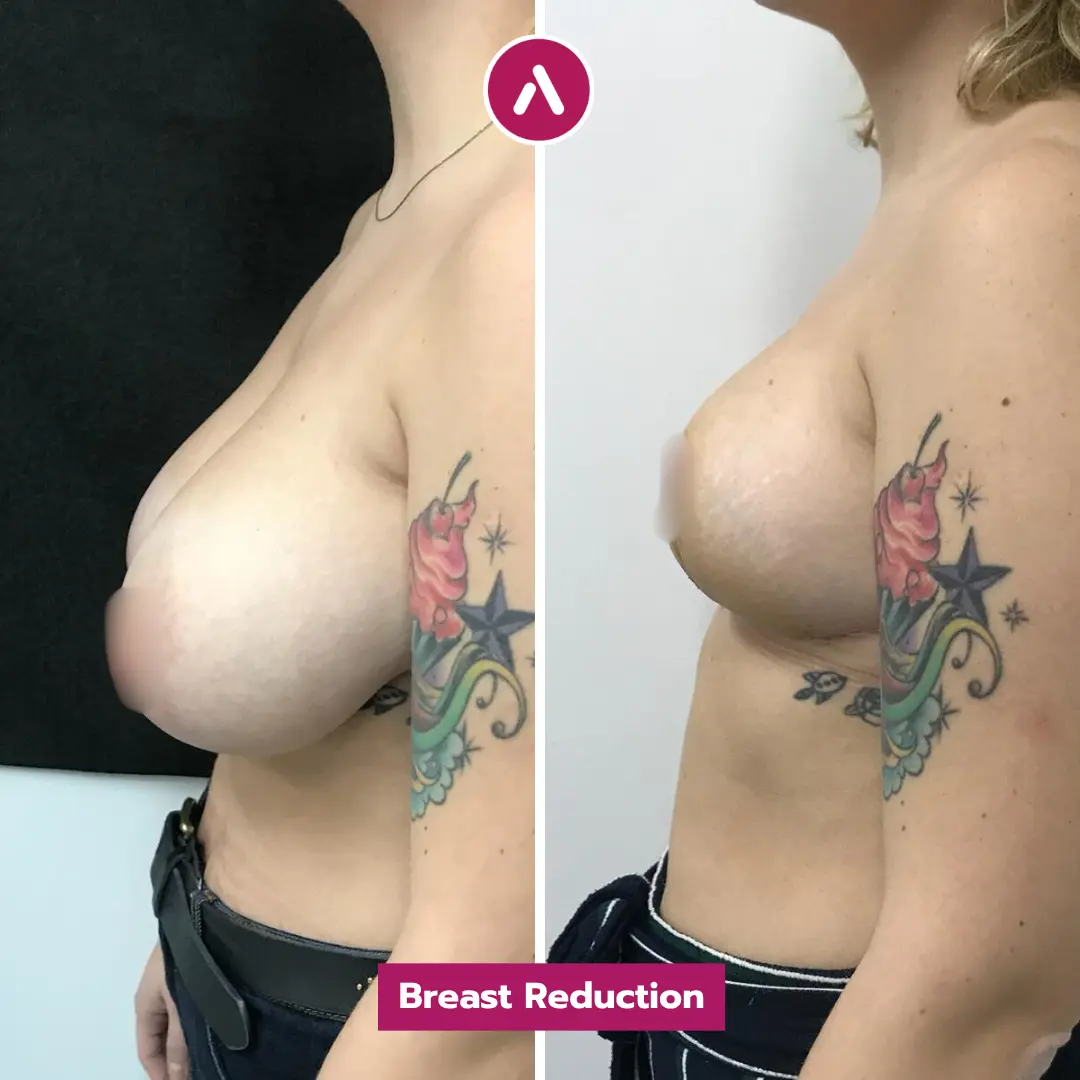
Normal healing is not perfectly linear, but the overall trend should be positive. Pain should become easier to control. Swelling should slowly soften. Bruises should start changing color and fading. Incisions should look cleaner and more sealed with time.
This is where many patients get confused. A breast lift can look rough before it looks refined. Scars, swelling, and bruising may peak before they settle. For a deeper look at expected scar maturation, read the normal breast lift healing timeline.
A warning sign is different from an ugly-but-normal healing day. Warning signs usually move in the wrong direction: darker color, spreading redness, worsening pain, increasing drainage, odor, fever, or tissue that begins to break down.
| Healing Feature | Usually Normal | More Concerning | What to Do |
|---|---|---|---|
| Color | Bruising that changes from purple to yellow, green, or brown | Skin or nipple turning dark blue, gray, purple-black, or black | Send photos to your surgeon and ask for prompt review |
| Trend | Looks slowly better over several days | Looks darker, wider, or worse each day | Do not wait for your next routine check-in |
| Sensation | Temporary numbness, tingling, or mild sensitivity | Increasing severe pain, cold tissue, or sudden major change | Contact your surgical team urgently |
| Incision | Light scabbing, mild tightness, limited redness | Opening wound, foul odor, cloudy drainage, spreading redness | Call your surgeon; seek urgent care if systemic symptoms appear |
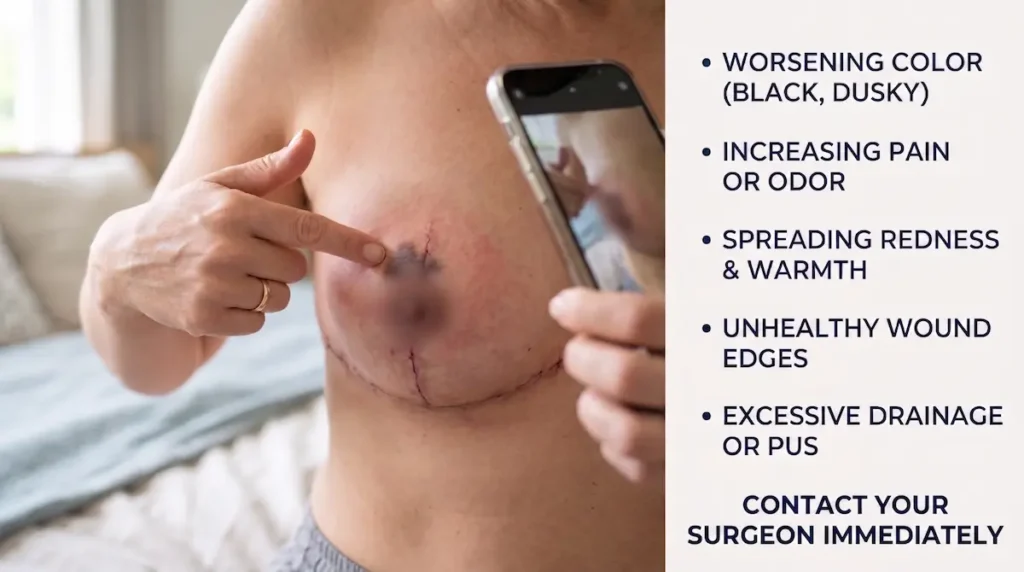
Warning Signs to Watch For
This section is the practical checklist: the changes that are more concerning than routine bruising or swelling. One sign alone does not always prove necrosis, but a worsening pattern should be treated seriously. The safest move is to contact your surgeon early and send clear photos rather than trying to diagnose it yourself.
Skin or nipple turning dark, blue, gray, or black
Bruising can be purple. That is why color alone can be confusing. The warning sign is tissue that becomes progressively darker, especially if it turns dusky blue, gray, purple-black, or black and does not start to lighten.
A bruise usually changes color as it breaks down. It may move from purple to green, yellow, or brown. Necrotic tissue tends to look more fixed, darker, and less alive. It may also look dry, leathery, or sharply different from the surrounding skin.
The nipple and areola deserve special attention after a breast lift. If the nipple looks increasingly dark, cold, or dusky compared with the other side, do not assume it is “just bruising.” Ask your surgical team to review it promptly.
Worsening instead of improving
Trend matters. A breast that looked bruised yesterday but looks calmer today is usually moving in the right direction. A patch that is darker today, larger tomorrow, and more painful the next day is not following the normal healing pattern.
This is one of the clearest ways to separate expected healing from a possible problem. Normal healing can be uneven, but it should not keep moving downhill. Worsening color, worsening pain, worsening odor, or a widening wound all deserve a call.
If you are unsure, take photos in the same lighting once or twice a day and send them to your surgeon. Do not rely on online image comparisons. Your surgeon knows your incision pattern, your lift design, and your risk factors.
Odor, spreading redness, drainage, or an open wound
Necrosis and infection are not the same thing, but they can overlap. Tissue that is not healing well may be more vulnerable to bacterial growth. A foul smell, cloudy or pus-like drainage, spreading redness, fever, or increasing warmth around the incision should be reported quickly.
A small amount of clear or blood-tinged drainage can happen early after surgery. That is different from thick discharge, a bad odor, or drainage that appears with increasing pain and redness.
Open wounds also need review. A tiny superficial separation may heal with wound care, but an opening that exposes deeper tissue, expands, or develops dark edges should not be managed casually at home.
Pain that changes character
Some soreness is expected after breast lift surgery. Tightness, pressure, and tenderness are common in the early recovery period. The more concerning pattern is pain that suddenly becomes sharper, more intense, or localized to an area that also looks darker or unhealthy.
Severe pain is not always present with necrosis. Some compromised tissue may feel numb. That is why pain is only one clue. Color, temperature, odor, drainage, wound opening, and trend over time all matter together.
When in doubt, describe exactly what changed: when it started, whether it is spreading, whether the area feels warmer or colder, and whether the nipple sensation changed suddenly. Specific details help your surgical team triage you faster.
| Sign | More Like Normal Healing | More Like a Warning Sign | Action |
|---|---|---|---|
| Bruising | Changing colors and slowly fading | Becoming darker, blacker, or more sharply defined | Send photos and ask your surgeon to review |
| Nipple color | Mild temporary change that stabilizes | Dusky, blue, gray, or black color that worsens | Contact your surgeon promptly |
| Redness | Limited redness close to the incision | Spreading redness, warmth, fever, or increasing pain | Call your surgeon; seek urgent care if systemic symptoms appear |
| Drainage | Small amount of clear or blood-tinged fluid early on | Cloudy drainage, pus, foul odor, or worsening wound opening | Needs medical review |
| Wound edge | Light scabbing and gradual sealing | Black edge, widening separation, exposed deeper tissue | Do not manage it alone; contact the surgical team |
Why Necrosis Happens and Who’s at Higher Risk
This section explains why necrosis can happen after a breast lift and which patients need extra caution. The goal is not to blame the patient or create fear. It is to show why blood supply, surgical planning, and post-op behavior all matter.
Reduced blood supply and tissue tension
Breast tissue heals when it receives enough oxygen-rich blood. During a lift, the surgeon removes extra skin, reshapes the breast, and repositions the nipple-areola complex while protecting its blood supply.
If tissue is under too much tension, blood flow can be reduced. If swelling is severe, pressure can rise. If the nipple-areola complex is moved a long distance, the circulation may be more vulnerable. These are the kinds of factors surgeons think about before and during the operation.
This is why a larger lift is not just a bigger cosmetic change. It can also be a more demanding blood-supply problem. A careful plan balances lift, shape, incision placement, and tissue safety.
Smoking and nicotine exposure
Nicotine is one of the most important preventable risk factors. It narrows blood vessels and reduces oxygen delivery to healing tissue. That includes cigarettes, vaping, nicotine gum, nicotine patches, and other nicotine products unless your surgeon specifically advises otherwise.
Patients sometimes underestimate this. “I only vape” or “I only had one cigarette” can still matter when skin and nipple blood supply are healing after surgery. Be honest with your surgeon about nicotine use before and after the procedure.
If you are planning a breast lift, nicotine avoidance is not a lifestyle suggestion. It is a wound-healing safety measure.
Diabetes, vascular disease, and healing history
Conditions that affect circulation can increase healing risk. Diabetes, vascular disease, clotting disorders, and a history of poor wound healing may all change the risk profile.
This does not automatically mean surgery is impossible. It means your surgeon needs accurate medical information and may adjust the plan, timing, or aftercare. Pre-op screening matters because complications are easier to prevent than rescue.
Patients with a history of keloids, hypertrophic scarring, wound separation, or delayed healing should also discuss that history clearly. It may not be necrosis-specific, but it helps the team plan safer follow-up.
Large lifts and major weight loss
A breast lift after major weight loss can be more complex because the skin envelope is often stretched, thinner, and less elastic. The nipple may need to be moved farther, and the tissue may have less natural support.
That does not mean patients after weight loss are poor candidates. Many are excellent candidates when the plan is realistic. But the blood-supply and tension questions become more important, especially with severe sagging.
If your breasts changed significantly after weight loss, our guide to breast lifts after major weight loss explains why planning may differ from a smaller lift.
Implants, no implants, and tissue pressure
Breast lift necrosis is about blood supply, not simply whether implants are used. However, adding volume can increase pressure on healing tissues in some patients, especially if the skin envelope is tight or the lift is significant.
For some patients, a staged approach or a breast lift without implants may be discussed when tissue safety, natural shape, or long-term support is the priority.
The right choice depends on anatomy. A patient with mild sagging, good tissue quality, and modest goals is not the same as a patient with severe ptosis, thin skin, nicotine exposure, or a major weight-loss history.
Technique and follow-up matter
Technique affects risk. So does follow-up. A board-certified plastic surgery team should evaluate blood supply during surgery, choose a lift pattern appropriate to the patient, and give clear post-op instructions.
After surgery, the patient’s role is to follow activity limits, avoid nicotine, wear garments as instructed, avoid pressure on the breasts, and report concerning changes early. Good aftercare is part of the procedure, not an optional extra.
AKM Clinic’s breast surgery pathway is built around planning, hospital-based surgical care, and long-term virtual follow-up. For anxious patients, that matters: if something looks wrong, you should know who is reviewing it and what the next step is.
A threatened nipple or skin flap is time-sensitive. Early changes may be reversible or manageable, but the team can only act early if the patient reports the change early. The safest rule is simple: if it is getting darker, opening, smelling, spreading, or hurting more, ask for review.
Breast surgery decisions also involve expectation-setting. Understanding risk honestly before surgery can reduce panic afterward and improve decision quality. For a broader decision-making frame, read about managing expectations around breast surgery.
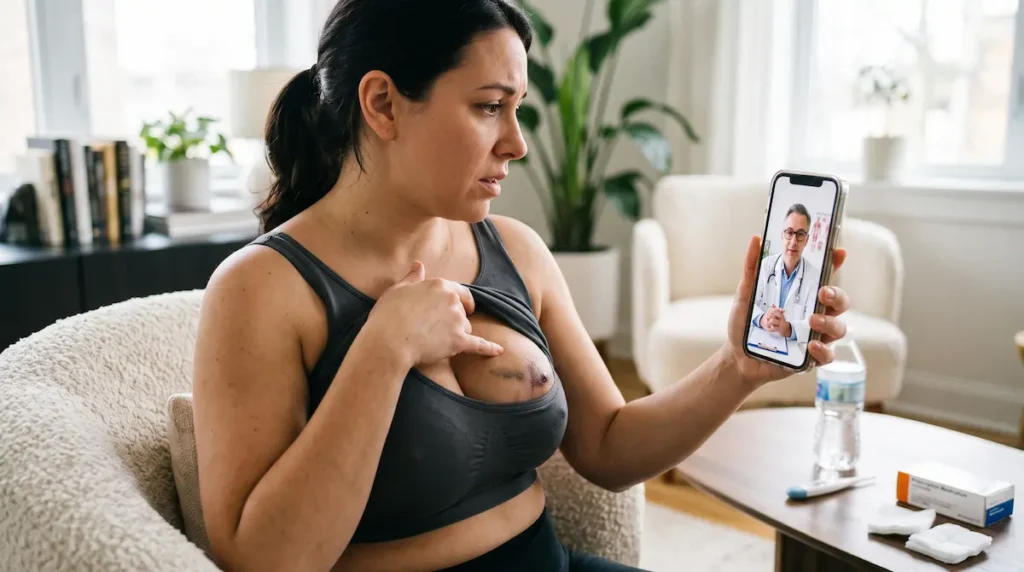
When and How to Contact Your Surgeon
This section explains what to do if you see a possible warning sign. The safest response is not to self-treat, wait for the next scheduled appointment, or compare your photos to strangers online. If a breast lift healing change looks worse instead of better, contact your surgical team directly.
Call early if the tissue is getting darker
If the nipple, areola, or skin edge is turning darker, bluer, grayer, or blacker, contact your surgeon promptly. Do the same if the area looks cold, leathery, dry, open, foul-smelling, or more painful than before.
Early contact does not mean you are overreacting. It means the team can decide whether the change is normal bruising, venous congestion, wound tension, infection, or possible necrosis. Those are not the same problem, and they are not managed the same way.
Send clear photos in good lighting. Include one close-up and one wider photo showing both breasts for comparison. Tell the team when the change started, whether it is spreading, and whether you have fever, drainage, odor, or increasing pain.
What your surgeon may check
Your surgeon may ask about color, capillary refill, nipple sensation, warmth, pain, drainage, incision tension, and whether the area is improving or worsening. In some cases, they may want to examine you in person or direct you to urgent local care.
The management depends on what is happening. Sometimes the issue is pressure, swelling, or a superficial wound problem. Sometimes the tissue needs close observation. Sometimes medication, dressing changes, suture adjustment, or debridement may be considered by the treating surgeon.
Do not apply random creams, heat, hydrogen peroxide, alcohol, or unapproved dressings unless your surgeon tells you to. Well-meant home care can irritate tissue and make assessment harder.
Why early review can change the outcome
Medical literature on nipple-areola complex ischemia after breast lift or reduction surgery emphasizes early recognition and active management. The reason is straightforward: blood-flow problems are time-sensitive.
You can read more about how nipple ischemia after a breast lift is managed in the surgical literature. Clinical reports also discuss compromised nipple perfusion after mastopexy, including venous congestion and related risk factors; see clinical data on compromised nipple perfusion.
For patients, the practical takeaway is simple. You do not need to diagnose necrosis. You need to report warning signs early enough for the surgical team to diagnose and guide the next step.
What not to do while waiting for advice
Do not smoke or vape. Do not place pressure on the breast. Do not massage a dark or painful area unless instructed. Do not try to remove scabs or dark tissue. Do not cover a foul-smelling wound with heavy ointment and hope it settles.
Keep the area clean and dry according to your discharge instructions. Wear your surgical bra or support garment exactly as directed. Avoid strenuous activity, heavy lifting, or sleeping positions that compress the breast.
If you have fever, spreading redness, severe pain, heavy drainage, shortness of breath, chest pain, or you cannot reach your surgical team, seek urgent medical care. A blog article should never replace emergency assessment.
Planning support before you travel
International patients should ask before surgery: Who reviews my photos? How fast can I reach the post-op team? What should I do if I notice a dark nipple or wound opening after flying home? How are urgent concerns coordinated?
Those questions are part of safe planning. They matter as much as hotel, flight, and recovery schedule details. A breast lift is not only an operation; it is a follow-up process.
Cost questions also come up during planning, but this article is focused on warning signs and healing safety. If you are comparing the financial side separately, review the cost of a breast lift without using price as a substitute for surgical risk assessment.
Frequently Asked Questions: Breast Lift Necrosis
This section answers the most common questions patients ask when they are worried about breast lift necrosis. These answers are educational, not a diagnosis. If your own healing looks concerning, your surgeon’s assessment matters more than any general description.
What are the warning signs of necrosis after a breast lift?
Normal bruising usually changes color and fades. Possible necrosis tends to look progressively darker, more fixed, or less healthy. The direction of change is often the biggest clue.
What does necrosis look like after a breast lift?
Not every dark area is necrosis. Bruising can look dramatic. But if the area is getting darker, spreading, smelling bad, draining cloudy fluid, or opening, contact your surgeon promptly.
Is dark skin after a breast lift normal?
Dark skin is more concerning when it becomes black, gray, leathery, cold, painful, foul-smelling, or worse day by day. A stable bruise and a worsening ischemic area are not the same thing.
Can nipple necrosis be reversed?
This is why early review matters. Patients should not wait until the tissue is clearly black or open before reporting a concerning change.
How soon does necrosis appear after a breast lift?
Because timing is variable, patients should keep watching the trend. A change that appears after the first week can still matter if it is worsening or associated with odor, drainage, fever, or wound opening.
When should I call my surgeon?
Do not wait for a routine appointment if you suspect necrosis. It is better to send photos early and be reassured than to delay a time-sensitive problem.
Final Safety Note
This final section is the medical safety boundary. Breast lift healing concerns should be assessed by a qualified clinician who can examine the tissue, understand the surgical plan, and decide whether a change is normal or urgent.
Medical disclaimer: This article is for educational purposes only. It is not medical advice, diagnosis, or treatment. If you notice darkening skin or nipple tissue, worsening pain, foul odor, cloudy drainage, fever, spreading redness, an opening wound, or any symptom that concerns you after a breast lift, contact your surgeon immediately or seek urgent medical care.
AKM Clinic’s approach is built around careful planning, hospital-based surgery, and structured follow-up. If you are considering breast lift surgery and want to understand how nipple blood supply, incision planning, and post-op support are handled, request a free virtual consultation and ask the team to review your anatomy, risk factors, and recovery plan.
Related Treatments



Ready to Start Your Own Transformation Journey?
Join the 2,000+ patients who trusted Dr. Akif Mehmetoğlu and the AKM Clinic team. Your journey to a more confident, revitalized you begins with a simple, no-obligation conversation. Contact us today from the USA for your free virtual consultation.
#1: Get Your Free Personalised Quote
Start with a free, no-obligation online consultation. Share your photos, and our surgical team will provide a fully personalised treatment plan and a transparent, all-inclusive price package. No hidden fees.
#2: Secure Your Date & VIP Booking
Once you're ready, our dedicated patient coordinators will help you secure your procedure date. We'll handle all your bookings, including your 5-star hotel and private VIP airport transfers.
#3: Arrive in Istanbul & Meet Your Surgeon
Arrive at Istanbul Airport (IST) and be greeted by your private driver. Settle into your hotel and prepare for your in-person consultation, where you'll meet your specialist surgeon to finalise the details for your "natural, subtle, and revitalized" new look.