

Thick Skin Rhinoplasty: Managing Swelling & Definition
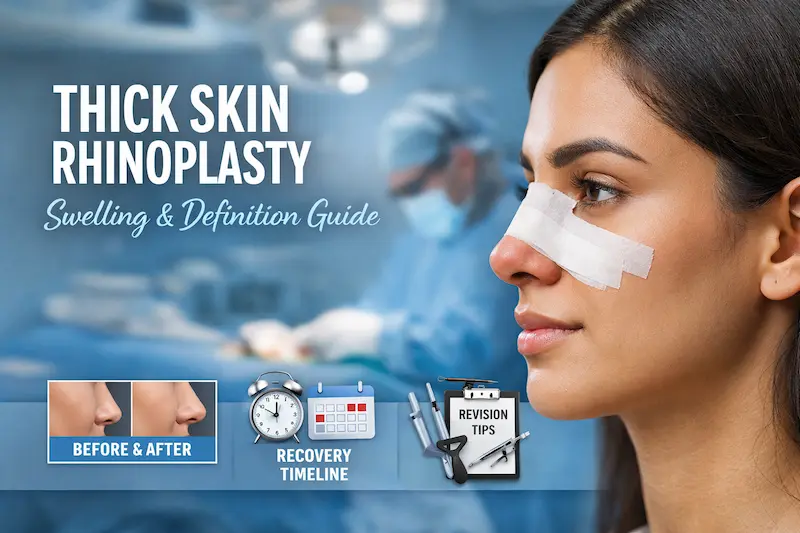
- Thick skin rhinoplasty needs structural support to achieve natural tip definition and stable long-term results.
- Swelling lasts longer in thick-skinned noses, so final definition appears gradually over several months.
- Cartilage grafting and expert planning improve definition, protect projection, and reduce disappointment from over-reductive surgery.
- Turkey offers value with aftercare, helping UK patients balance safety, recovery support, and consultant-led expertise.
AI-generated summary, fact-checked by our medical experts.
Thick skin rhinoplasty is one of the most misunderstood areas of nose reshaping. Many patients assume that if a surgeon makes the nose smaller, the tip will automatically look sharper. In reality, rhinoplasty for thick skin noses is less about aggressive reduction and more about creating the right internal support so that the skin can redrape well over time. For British patients researching natural results, this distinction matters enormously.
From a medical science perspective, thick nasal skin behaves differently during healing. It can hold more fluid, keep the tip looking rounded for longer, and delay the moment when definition becomes visible. That is why the results of thick skin rhinoplasty must be judged patiently and in stages, not in the first few weeks. The early appearance is often dominated by oedema rather than the final surgical outcome.
This is also why patients who worry about “not seeing enough change” too early can become unnecessarily anxious. In well-planned structural rhinoplasty for thick skin, the goal is usually not a tiny, pinched, overly sculpted nose. The goal is stronger shape, better support, and a refined result that still looks believable on your face. For many UK patients, that subtle approach is far more desirable than an obviously “done” result.
Consultant insight: In thick-skinned noses, definition comes from structure, restraint, and healing time — not from removing as much tissue as possible.
Table of Contents
What Makes Thick Skin Rhinoplasty More Technically Demanding?
Thick skin rhinoplasty is more technically demanding because the surgeon is working with a soft tissue envelope that can hide fine detail, especially in the tip. In a thin-skinned patient, even small refinements may show relatively quickly. In a thick-skinned patient, the skin can blur those refinements in the early stages, which means the operation must be planned with long-term visibility in mind rather than immediate sharpness. This is one reason expert patients often look specifically for a consultant who understands structure, proportion, and realistic healing behaviour.
For many patients, this is particularly relevant when considering ethnic rhinoplasty Turkey, where the goal is not to erase identity but to refine the nose whilst respecting natural facial harmony. In thick-skinned cases, that often means balancing definition with preservation, so the final result looks elegant, proportionate, and true to the patient’s features rather than overly reduced or surgically obvious.
What surgeons mean by “thick skin” in rhinoplasty
When surgeons refer to “thick skin”, they are usually describing the soft tissue envelope covering the nasal framework. This does not simply mean the skin is tougher to touch. It means the layer over the cartilage may be denser, heavier, and more prone to retaining fluid after surgery. Clinically, that matters because the outer skin has to shrink and settle over the new internal shape.
Patients often focus only on the bridge, but thick skin is particularly relevant at the nasal tip. The tip is where refinement is most easily hidden by persistent fullness. So when people search for information about achieving tip definition in thick skin, what they are really asking is whether the skin will eventually reveal the structure underneath. In many cases, yes — but only when the operation is designed properly and healing is given enough time.
Why thick skin can mask fine tip refinement in the early months
One of the central frustrations in thick skin rhinoplasty recovery is that the tip can look broader, firmer, or less refined than expected in the first weeks and months. This does not necessarily mean the surgery has failed. It often means the skin and soft tissue have not yet contracted enough to show the underlying framework clearly.
The science is straightforward: thicker soft tissue can hold onto post-operative fluid for longer, and that fluid reduces visible contour. As a result, the bridge may begin to look improved before the tip does. This uneven recovery pattern is normal and is one of the main reasons patients should avoid judging their final result too early.
The relationship between skin thickness, cartilage strength, and long-term definition
In thick-skinned noses, definition rarely comes from reduction alone. It comes from support. If the surgeon weakens the tip too much or removes too much cartilage, the skin may have nothing strong enough underneath to create a clean outline. That is why experienced surgeons often favour reinforcement rather than over-resection.
This is also where cartilage grafting in a thick skin nose can become important. Grafts can act as structural support, helping the tip maintain projection, resist collapse, and create more stable long-term definition. Put simply, a stronger framework gives thicker skin a better shape to sit on. That is why the best results of thick skin rhinoplasty are usually the result of thoughtful structure, not simply making the nose smaller.
- Thin skin reveals detail quickly, but can expose even minor irregularities.
- Thick skin hides irregularities better, but also hides refinement for longer.
- Strong cartilage support is often the difference between a soft, undefined tip and a stable, natural-looking result.
Why Swelling (Oedema) Lasts Longer in Thick-Skinned Noses
For most patients, the most difficult part is not the operation itself but the waiting. Managing oedema in thick skin rhinoplasty is such an important subject because swelling does not disappear in a straight line. It settles gradually, and in thick-skinned patients it usually settles more slowly at the tip than anywhere else. This makes thick skin rhinoplasty healing time feel longer, even when the surgery has gone well.
Why the nasal tip usually stays swollen the longest
The nasal tip has relatively delicate circulation and a naturally thicker soft tissue layer than other parts of the nose. After surgery, this area tends to retain fluid for longer. That is why patients may notice that the bridge looks slimmer whilst the tip still looks rounded, puffy, or less defined.
In other words, the tip is often the last place to “declare itself”. This is especially true after more involved surgery where reshaping, support work, or grafting has been necessary. For patients researching prolonged swelling after a thick skin nose job, this is often the explanation: the recovery is slower, but not necessarily abnormal.
The difference between normal post-operative oedema and a problem that needs review
Normal post-operative oedema tends to improve gradually, even if the changes are slow. The nose may feel stiff, the tip may look fuller in the morning, and the appearance may fluctuate slightly from week to week. These patterns are common during early healing.
What deserves professional review is swelling that becomes increasingly asymmetrical, is associated with worsening pain, sudden redness, unusual discharge, fever, or a clear deterioration rather than slow improvement. Thick skin does not mean every form of swelling is “just normal”. It means normal healing can be slower and more deceptive. Patients should still have clear follow-up guidance and know when to contact their clinic.
A realistic timeline: when UK patients usually begin to see better definition
There is no single universal timetable, but there are realistic patterns. Most patients see obvious early swelling reduce in the first few weeks. However, fine tip definition often takes much longer to emerge. In thick-skinned cases, refinement is often judged over many months, not days.
This is why setting expectations is essential. Patients searching for thick skin rhinoplasty recovery information are often trying to answer one question: “When will I actually look like myself, but better?” The honest answer is that you will usually look socially presentable well before you look final. That difference matters. Social recovery and final definition are not the same thing.
| Healing stage | What patients commonly notice | What it usually means |
|---|---|---|
| First 1-2 weeks | Significant puffiness, tip fullness, general stiffness | Early inflammatory swelling is expected |
| Weeks 3-6 | Bridge often looks better before the tip does | Oedema is reducing, but deeper tip swelling remains |
| Months 2-6 | Gradual improvement in contour and tip shape | The skin is slowly settling over the new framework |
| Months 6-12+ | Better visible refinement, especially in profile and tip light reflection | Later-stage definition becomes more reliable |
For thick-skinned patients, patience is not a vague cliché; it is part of the treatment logic. Good surgery creates the conditions for refinement, but time is what reveals it. That is why the question is not simply whether swelling occurs, but whether the nose was designed intelligently enough to look refined once that swelling has fully settled.
Surgical Techniques That Improve Definition in Thick Skin
To achieve a refined result in thick-skinned patients, the operation must be designed around structure rather than simple reduction. This is one of the key principles of structural rhinoplasty for thick skin. A nose may look smaller on the operating table, but if the internal support is too weak, the tip can heal poorly, lose projection, or remain broad once the skin settles. For that reason, the most reliable surgical plans focus on support, proportion, and long-term stability rather than dramatic short-term change.
In many cases, this approach is also highly relevant for patients researching ethnic rhinoplasty Turkey, where preserving character is just as important as improving shape. Thick skin often requires a more individualised plan, because refinement must be achieved without compromising support or creating an over-operated appearance. The most successful outcomes tend to respect both facial identity and healing biology, producing definition that looks natural rather than forced.
Why simple reduction often fails in thick-skinned patients
Patients are often surprised to learn that taking more away does not necessarily create more definition. In fact, in a thick-skinned nose, excessive reduction can make the final result look softer and less precise. If the cartilage framework is weakened too much, the skin may drape over it without enough support, leaving a rounded or indistinct appearance.
This is why overly aggressive surgery can be especially disappointing in thick-skinned cases. Rather than producing elegance, it may produce collapse, poor light reflection, or a tip that still looks heavy despite significant internal change. For patients researching results of thick skin rhinoplasty, this is one of the most important truths to understand: a better result often comes from smarter support, not more removal.
Structural cartilage support and grafting for a sharper, stable result
When surgeons discuss cartilage grafting in a thick skin nose, they are usually referring to methods used to reinforce the nasal tip, improve projection, and create a framework that the skin can settle over more effectively. This can be particularly important in patients whose natural tip cartilages are weak, soft, or poorly defined.
In practical terms, grafting allows the surgeon to build shape from within. Instead of relying on the skin to shrink dramatically — which may not happen predictably — the surgeon creates a cleaner internal structure that can support better contour. This is one of the most important routes to achieving tip definition in thick skin, especially when the patient wants a natural result rather than an obviously sculpted nose.
- Support grafts can help maintain projection and prevent tip collapse.
- Refinement grafts can improve contour and create cleaner transitions.
- Structural planning is particularly valuable when the skin is heavy and the native cartilage is weak.
When ultrasonic bone work can help reduce trauma and support a smoother recovery
In selected cases, ultrasonic bone reshaping may be useful when the bony part of the nose requires refinement. While thick skin mainly affects the soft tissue envelope and tip behaviour, the bridge still matters. If osteotomies are needed, a more controlled and less traumatic approach may help reduce unnecessary swelling and bruising in the early phase of recovery.
This is why some patients also research related topics such as piezo-assisted rhinoplasty. The principle is not that technology replaces judgement. It is that careful technique may support a smoother early course, which is especially valuable in patients already concerned about managing oedema in thick skin rhinoplasty. Less trauma does not eliminate swelling, but it may reduce avoidable swelling.
| Surgical philosophy | What it aims to do | Why it matters in thick skin |
|---|---|---|
| Simple reduction | Make the nose smaller | May leave the tip under-supported and less defined |
| Structural rhinoplasty | Strengthen and reshape the framework | Gives thicker skin a better contour to redrape over |
| Cartilage grafting | Add support where needed | Improves stability, projection, and long-term definition |
| Controlled ultrasonic bone work | Refine bone with precision | May reduce unnecessary trauma in suitable cases |
How to Manage Swelling Properly After Thick Skin Rhinoplasty
Even the best operation can be made to look disappointing during the early weeks if recovery is not managed properly. Thick skin rhinoplasty recovery is not only about waiting; it is also about following instructions consistently. Thick skin tends to retain fluid more stubbornly, so the patient’s role after surgery is genuinely important. Good healing habits will not replace good surgery, but they can support better comfort, less anxiety, and a smoother recovery pathway.
Taping, splints, head elevation, and why consistency matters
Many patients ask whether taping really makes a difference. In the early period, it can be useful because it supports the soft tissue and may help limit fluid accumulation in selected areas, especially around the tip. Likewise, wearing the splint as directed and sleeping with the head elevated can help reduce dependent swelling.
The key is consistency rather than extremes. Taping too aggressively, removing dressings without guidance, or constantly checking the nose in different lighting can create unnecessary stress. For patients worried about prolonged swelling after a thick skin nose job, the more helpful approach is calm routine: follow the post-operative plan, attend review appointments, and assess progress over weeks rather than hours.
Activity restrictions, travel planning, and protecting the nose during recovery
For British patients travelling for surgery, recovery planning matters almost as much as the operation itself. In the early phase, the goals are straightforward: avoid pressure on the nose, avoid accidental knocks, limit strenuous activity, and follow your consultant’s guidance about flying, luggage, and return-to-work timing. A socially presentable appearance often returns before the deeper swelling has fully settled, so patients should not confuse “fit to travel” with “fully healed”.
This is especially relevant when discussing thick skin rhinoplasty healing time. Healing has layers. You may be comfortable and outwardly well before the internal tissues have finished settling. That is why realistic planning is better than optimism alone. A careful patient usually protects their result better than an impatient one.
How AKM Clinic’s recovery-focused approach helps reduce social downtime
For the UK “expert patient”, reassurance often comes from understanding how a clinic thinks about aftercare. A recovery-focused programme matters because swelling, bruising, and the fear of delayed healing are among the biggest concerns in this audience. In broader facial recovery protocols, AKM Clinic highlights technologies such as HBOT and LLLT because the goal is to support tissue recovery, reduce post-operative oedema, and shorten social downtime where clinically appropriate.
That recovery philosophy is valuable in rhinoplasty conversations as well, because it reflects a larger principle: good surgery should be matched by good healing support. Patients are not only buying an operation; they are investing in a safe, organised recovery pathway. In real-world terms, that means clear aftercare instructions, responsive follow-up, and a plan that respects the fact that many British patients want to return home feeling supported rather than abandoned.
Practical point: In thick-skinned noses, recovery often improves most when patients stop looking for daily perfection and start following a structured healing routine.
| Recovery measure | Why it matters | Common mistake |
|---|---|---|
| Taping as advised | May help support soft tissue settling | Stopping too early without guidance |
| Head elevation | Helps reduce morning puffiness | Sleeping flat in the first phase |
| Protecting the nose | Reduces risk of accidental trauma | Returning to crowded activities too soon |
| Attending follow-up | Allows swelling and healing to be reviewed properly | Judging the result in isolation |
When Will I Actually See Definition? Setting Realistic Expectations
One of the most common emotional challenges after surgery is the gap between what the patient expected to see and what healing actually allows them to see. In thick-skinned noses, this gap is often wider. The result can improve steadily whilst still looking under-defined in the mirror for a period of time. That is why setting realistic expectations is not pessimism; it is good pre-operative counselling and good post-operative psychology.
For patients considering ethnic rhinoplasty Turkey, this stage often requires even more patience, because preserving cultural and facial identity can involve subtle refinement rather than dramatic change. That means the final outcome may reveal itself gradually, especially in thicker skin. Understanding this timeline helps patients judge progress more fairly and reduces the risk of mistaking normal healing for an unsatisfactory result.
Early result vs final result: what changes between month 1 and month 12
At around the early stage of recovery, patients often notice that the bridge seems improved but the tip still looks rounder than expected. Over the following months, the tissues gradually soften, fluid reduces, and the outline becomes easier to read. The final reveal is not one dramatic moment. It is a sequence of small improvements.
This is central to understanding thick skin rhinoplasty healing time. The nose you see at one month is not the nose you will see at six months, and the nose you see at six months may still not represent the fully matured tip. The skin, soft tissue, scar maturation, and deep settling process all continue beyond the earliest visible changes.
Why “subtle” refinement is often the correct goal for thick skin
For many UK patients, subtlety is not a compromise; it is the ideal result. A thick-skinned nose may never look knife-sharp in the way an edited social media image suggests, and it should not need to. The best outcomes usually look balanced, natural, and harmonious with the rest of the face. They improve the profile without creating an artificial identity shift.
There is also a scientific reason for this restraint. Scientific research and clinical experience consistently support the idea that tissues heal best when surgical change respects anatomy rather than fights it. In thick skin, that means aiming for elegant definition rather than extreme narrowing. Patients who understand this tend to be much happier with the final result because they are judging refinement, not fantasy.
Common reasons patients think the surgery “hasn’t worked” too early
There are several predictable reasons why patients become discouraged during recovery. The first is comparing themselves to thin-skinned before-and-after photographs online. The second is assuming that swelling should disappear evenly. The third is expecting the tip to reveal itself at the same speed as the bridge. None of these assumptions is reliable in thick-skinned healing.
Another common issue is confusing persistent oedema with a poor structural result. Of course, not every result is perfect and some patients do need further assessment. But in many cases, the concern is timing rather than failure. This is why patients researching results of thick skin rhinoplasty should focus on long-term healed outcomes, not early photographs taken when the skin is still carrying fluid.
- Month 1 thinking: “It still looks swollen, so nothing changed.”
- Better interpretation: the shape may already be improved, but the thick soft tissue is still hiding detail.
- Month 6 thinking: “Now I can see more contour.”
- Better interpretation: the structural result is becoming visible as oedema continues to settle.
Choosing the Right Consultant for Thick Skin Rhinoplasty
Choosing the right consultant matters in every rhinoplasty case, but it matters even more when the patient has thick skin and wants visible yet natural-looking refinement. In these cases, the difference between a good and a disappointing result often lies in planning, restraint, and structural judgement. Patients researching rhinoplasty for thick skin noses should not only ask whether a surgeon can make the nose smaller; they should ask whether the surgeon understands how thick skin heals, how cartilage behaves under load, and how long-term definition is actually achieved.
Why thick skin requires a structural, not purely reductive, philosophy
Thick skin is rarely forgiving of simplistic surgery. A purely reductive approach may remove support without creating the framework needed for elegant healing. That is why structural rhinoplasty for thick skin is often the more dependable philosophy. The aim is to preserve or rebuild support where needed so the soft tissue envelope can settle onto a stronger shape.
This matters particularly at the nasal tip. Patients often focus on “looking smaller”, but the more important question is whether the tip will look cleaner, better supported, and more proportionate once the oedema subsides. In thick-skinned cases, stability is often more valuable than dramatic change. The best consultants understand that a believable, refined result is usually built, not simply cut away.
What UK patients should look for in qualifications and facial plastic expertise
British patients tend to be highly research-driven, especially when they are worried about botched surgery abroad or poor aftercare. For that reason, credentials should never be treated as a superficial detail. Patients should look for a consultant whose training clearly relates to nasal anatomy, facial balance, and functional as well as aesthetic planning.
It is also sensible to ask practical questions. Does the consultant regularly treat thick-skinned patients? Do they discuss realistic healing timelines rather than promising instant sharpness? Do they explain when cartilage grafting in a thick skin nose may be beneficial? Do they show healed results rather than only early photographs? These are often better quality markers than marketing language alone.
- Look for: a structural treatment philosophy, clear communication, and realistic expectation-setting.
- Ask about: grafting, tip support, swelling timelines, and how healing is monitored after you return to the UK.
- Be cautious of: promises of an ultra-slim tip in a very short timeframe.
For a patient reading about achieving tip definition in thick skin, level of specialisation matters because thick-skinned rhinoplasty is not a generic operation. It requires measured decisions about support, proportion, and healing. A consultant with recognised facial plastic and otolaryngology credentials can offer more confidence that the plan is being built around anatomy and long-term outcome rather than trend-driven aesthetics.
Key takeaway: In thick-skinned rhinoplasty, the safest pair of hands is usually the consultant who speaks most clearly about structure, healing time, and realistic limits — not the one who promises the sharpest result the fastest.
Thick Skin Rhinoplasty in Turkey vs the UK: What British Patients Want to Know
British patients comparing Turkey with the UK are usually not looking for a bargain alone. They are looking for value, safety, communication, and results that do not look overdone. That is especially true for patients considering thick skin rhinoplasty recovery, because they know that aftercare and expectation-setting are just as important as the operation itself. The decision is rarely “cheap versus expensive”; it is usually “who offers the most confidence, expertise, and support for the journey as a whole?”
This is also why many UK patients exploring ethnic rhinoplasty Turkey look beyond price alone and focus on whether the clinic can deliver culturally respectful, natural-looking results with proper aftercare. In thick-skinned cases especially, reassurance often comes from clear communication, realistic timelines, and a consultant-led plan that supports both healing and long-term definition after returning home to the UK.
Harley Street expectations vs Istanbul value: quality, planning, and transparency
Many UK patients compare their options against the Harley Street benchmark. That is understandable. Harley Street represents private medical prestige, consultant-led care, and a high expectation of professionalism. However, many patients also find that London pricing can be difficult to justify, particularly when they want careful planning and a natural result rather than a fashionable one.
In Istanbul, the appeal is often that patients can seek consultant-led treatment with a strong value proposition, particularly when pricing is presented transparently and the care pathway is organised clearly. For those researching results of thick skin rhinoplasty, the more useful comparison is not simply the fee. It is whether the clinic explains healing honestly, supports you properly, and offers a standard of care that feels structured rather than transactional.
| What UK patients compare | Typical UK private concern | What they often look for in Istanbul |
|---|---|---|
| Consultant expertise | Is the surgeon truly specialised? | European Board-level credentials and focused facial experience |
| Value | Harley Street fees can be high | Transparent planning and stronger value in GBP terms |
| Aftercare | What happens once I go home? | Clear follow-up, remote support, and accessible communication |
| Results style | Fear of looking too “done” | Natural, subtle refinement suited to the face |
Why British patients prioritise natural-looking definition over an “overdone” nose
Most British patients do not want a nose that announces surgery. They want a nose that sits more harmoniously on the face, photographs better, and feels proportionate without becoming the only thing people notice. This is particularly relevant in thick-skinned cases, where trying to force excessive narrowness can lead to disappointment or an unnatural look.
That is why natural-looking definition is usually the correct goal. A well-performed operation should improve contour, balance, and tip support without erasing facial identity. In many cases, the best results of thick skin rhinoplasty are the ones friends notice only as “you look fresher” or “your face looks more balanced”, rather than “you have clearly had a nose job”.
Aftercare, remote follow-up, and the reassurance of UK-oriented patient support
When British patients travel for surgery, they often worry less about the flight out than the return home. Who will they contact if swelling fluctuates? What happens if they need reassurance? How do they know whether prolonged swelling after a thick skin nose job is normal or whether they should ask for review? These questions are entirely reasonable, and good clinics should answer them before surgery, not after.
UK-oriented support can make a substantial psychological difference. Patients generally feel more secure when communication is responsive, follow-up is structured, and they are not left to interpret every stage of healing alone. For thick-skinned patients in particular, that support matters because managing oedema in thick skin rhinoplasty often involves reassurance, staged review, and the confidence to let the nose settle properly over time.
A thoughtful aftercare pathway should include written guidance, access to the medical team, and clear instructions about what is normal during thick skin rhinoplasty healing time and what is not. For UK patients, the ideal experience is not just a successful operation in Istanbul, but a recovery process that still feels supported once they are back home.
Frequently Asked Questions (FAQ): Thick Skin Rhinoplasty
Below are some of the most common questions from patients researching rhinoplasty for thick skin noses. The answers are intentionally concise, but each one reflects the same principle: thick skin can still achieve refinement, provided the surgery is planned structurally and the healing process is judged with patience.
Can thick skin still achieve a defined nasal tip?
Yes, but usually through support rather than aggressive reduction. In many cases, achieving tip definition in thick skin depends on creating a stronger internal framework and allowing enough time for oedema to settle.
Does thick skin mean I will stay swollen for longer than other patients?
Often, yes. Thick skin tends to retain fluid for longer, especially at the tip. That does not automatically mean there is a problem; it usually means the visible refinement takes longer to appear.
Is thick skin rhinoplasty more likely to need revision surgery?
Not necessarily, but it does require careful planning. Revision risk tends to rise when the first operation was too reductive, under-supported, or judged too early before healing was complete.
How long should I tape my nose after surgery?
This varies by consultant and by case. Some patients are advised to tape for a short early period, whilst others may benefit from a longer routine, especially when tip oedema is persistent. Always follow your own post-operative instructions.
When is it safe to fly back to the UK after rhinoplasty?
The timing depends on your recovery, examination findings, and your consultant’s guidance. Many patients are fit to travel before the nose is fully healed, but travel readiness and final healing are not the same thing.
Will my result look natural or too sculpted?
The right goal in thick-skinned rhinoplasty is usually natural refinement, not an excessively sharp or artificial shape. A balanced result generally ages and heals better than an over-corrected one.
How do I know whether I need standard rhinoplasty or septorhinoplasty instead?
If you also have breathing issues, blockage, or a deviated septum, septorhinoplasty may be more appropriate. A proper consultation should assess both appearance and function before recommending the most suitable operation.
If you would like to explore related options beyond this topic, you can also learn more about Piezo Rhinoplasty Turkey, Tip Plasty Turkey, Septorhinoplasty Turkey, Specialist Plastic Surgeon Turkey, Questions to Ask Plastic Surgeon, Ghost Surgery in Turkey, Online Plastic Surgery Consultation, Surgery Companion Turkey, and How to Prepare for Cosmetic Surgery. These guides can help you compare procedures, understand safety standards, prepare for your consultation, and plan your recovery with greater confidence before travelling from the UK to Istanbul.
Medical Disclaimer: This page is provided for general educational purposes only and does not replace a face-to-face medical consultation, diagnosis, or personalised treatment plan. All surgery carries risks and outcomes vary between individuals. Suitability for a rhinoplasty (nose job) surgery, procedure selection, and anaesthesia choice can only be determined after a full clinical assessment by a qualified surgeon. Always follow your clinician’s instructions and seek urgent medical attention if you develop concerning symptoms during recovery.



Related Treatments






Ready to Begin Your Own Transformation Journey?
Join the 2,000+ patients who have trusted Dr Akif Mehmetoğlu and the AKM Clinic team. Your journey to a more confident, naturally restored you begins with a simple, no-obligation conversation. Contact us today from the UK for your free virtual consultation.
#1: Get Your Free Personalised Quote
Start with a free, no-obligation online consultation. Share your photos, and our surgical team will provide a fully personalised treatment plan and a transparent, all-inclusive price package. There are no hidden fees.
#2: Secure Your Date & VIP Booking
Once you are ready, our dedicated patient coordinators will help you secure your procedure date. We will handle all your bookings, including your 5-star hotel accommodation and private VIP airport transfers.
#3: Arrive in Istanbul & Meet Your Surgeon
Arrive at Istanbul Airport (IST) and be greeted by your private driver. Settle into your hotel and prepare for your in-person consultation, where you will meet your specialist surgeon to finalise the details for your "natural, subtle, and restored" new look.
