
Quick answer: Cauliflower ear surgery corrects a hardened ear deformity caused by repeated trauma, usually after an untreated auricular haematoma damages the cartilage. The procedure removes overgrown fibrocartilage and reshapes the ear contour. It is more complex than standard cosmetic otoplasty because the surgeon is repairing distorted cartilage, not simply pinning back prominent ears.
Cauliflower ear surgery is usually considered when the ear has already become firm, lumpy, folded, or thickened after contact-sport trauma. For UK patients who wrestle, box, play rugby, train in MMA, or practise Brazilian jiu-jitsu, the key distinction is timing: a fresh, swollen ear after a blow is an urgent medical issue; an old “wrestler’s ear” is a reconstructive problem.
At AKM Clinic, ear-shape concerns are assessed under the wider framework of AKM’s ear surgery approach, but cauliflower ear needs its own conversation. This is not the same as ordinary prominent-ear correction. The anatomy is different. The risk of recurrence is different. The expectation-setting has to be more honest.
This guide explains what cauliflower ear actually is, why early treatment matters, how surgical correction works, and how recovery differs from standard otoplasty. It is written for patients who want clear medical detail without being oversold a perfect reset.
Table of Contents
What Cauliflower Ear Actually Is?
Cauliflower ear is a deformity of the outer ear caused by trauma to the cartilage-bearing part of the ear. It often starts as an auricular haematoma: a pocket of blood collecting between the cartilage and the tissue layer that normally nourishes it. When that blood collection is not treated quickly, the cartilage can lose support, heal irregularly, and become thick, folded, or lumpy.
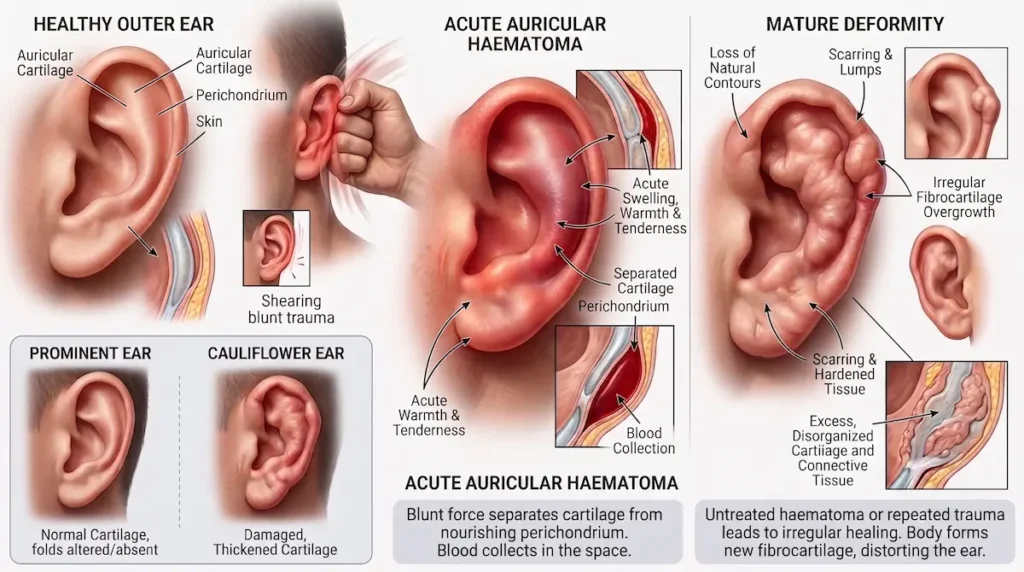
Blunt trauma leads to an auricular haematoma
The outer ear looks soft, but much of its shape comes from a thin, flexible cartilage framework. A direct blow, repeated friction, or a shearing injury can separate the cartilage from its overlying tissue layer. Blood then pools in that space.
In the early phase, the ear may look swollen, warm, tender, or unusually smooth in places where the natural folds used to be. That fresh swelling is not just a bruise. It can be an auricular haematoma, and it should be assessed promptly by a clinician rather than squeezed, pierced, or ignored at home.
Medical reviews describe prompt drainage and pressure dressing as the standard way to prevent the blood from reaccumulating and hardening into a long-term deformity. For athletes, that detail matters because returning to sport before the ear is stable can restart the same injury cycle.
Why fibrocartilage creates the “cauliflower” shape
When an auricular haematoma is left untreated or keeps returning, the ear does not simply “settle back”. The body tries to heal the injured space. Scar-like tissue and new fibrocartilage can form, filling the delicate grooves of the ear with excess bulk.
That overgrowth changes the ear’s architecture. The helix, antihelix, scaphoid fossa, and conchal bowl may lose their clean definition. Instead of a smooth, folded outline, the ear can become rounded, crumpled, thick, and uneven. That is the cauliflower appearance.
Once this tissue has matured, massage, ice, or compression alone cannot reliably restore the original structure. At that point, correction usually means reshaping the ear surgically.
How it differs from naturally prominent ears
Naturally prominent ears usually have a normal cartilage structure that sits too far away from the head or lacks a well-defined antihelical fold. In standard otoplasty, the goal is often to create or refine that fold and bring the ear closer to the scalp.
Cauliflower ear is different. The problem is not simply projection. It is damaged, thickened, and distorted cartilage. One patient may have bulky tissue in the upper ear; another may have a collapsed fold, blocked definition, or asymmetry from repeated trauma.
That is why cauliflower ear correction is planned more like reconstructive reshaping than simple cosmetic pinning. The surgeon must decide what tissue can be safely thinned, what contour can be restored, and what degree of improvement is realistic without damaging the skin envelope.
Why It Happens — And Why Prompt Care Matters?
Cauliflower ear is most strongly linked to sports where the ear is rubbed, compressed, struck, or bent repeatedly. The common thread is not one specific sport; it is repeated trauma to the outer ear followed by delayed or incomplete treatment of the haematoma.
Wrestling, boxing, MMA, BJJ and rugby
Wrestling is the classic setting, which is why cauliflower ear is often called wrestler’s ear. But the same injury pattern can happen in boxing, MMA, Brazilian jiu-jitsu, rugby, and other contact sports where the ear is trapped against another body, mat, glove, shoulder, or headguard.
Some athletes see cauliflower ear as a badge of experience. That is a personal view. Medically, though, it is still a cartilage deformity caused by injury. In more severe cases, the thickened tissue can affect how headphones fit, make protective gear uncomfortable, or narrow the outer ear contours enough to create hygiene and irritation issues.
For a skeptical patient, the honest point is simple: not every mild irregularity needs surgery, but every new swollen ear after trauma deserves proper assessment. Waiting to “see if it goes down” can be the mistake that turns a treatable haematoma into a permanent shape change.
The untreated haematoma cascade
The cascade is predictable. First, trauma separates the cartilage from the tissue layer that supplies it. Then blood collects in the space. If the blood is not removed and the space is not compressed, the collection may return or organise into thicker tissue.
As the cartilage loses its clean relationship with the skin and perichondrium, the ear heals with excess fibrous tissue and irregular cartilage formation. The fine ear folds become rounded and heavy. The longer the process continues, the harder the deformity becomes.
This is also why repeated self-drainage is risky. It may fail to remove the full collection, introduce infection, or leave no proper pressure dressing in place to stop reaccumulation. A swollen ear after trauma is not a DIY problem.
“The best cauliflower ear correction is prevention: drain an acute auricular haematoma properly, compress the space, and protect the ear while it heals. Once the cartilage has hardened into an old deformity, surgery can improve the shape — but it is no longer the same as treating a fresh injury.”
Why early drainage can prevent a fixed deformity
Early treatment aims to remove the blood collection before it damages the cartilage framework. The clinician may use needle aspiration or incision and drainage depending on the size, age, and firmness of the haematoma. After that, a pressure dressing or bolster helps close the space so blood does not simply refill it.
That pressure step is not a minor detail. It is central to preventing recurrence. Without it, the haematoma can come back, and the cycle begins again.
UK patients should also understand the difference between emergency care and elective correction. A newly swollen, painful ear after rugby training belongs in urgent clinical assessment. A long-standing, firm wrestler’s ear belongs in a planned surgical consultation where the goal is contour improvement, symmetry, and recurrence prevention.
For more clinical background, see how cauliflower ear forms and is repaired and a review of cauliflower ear management.
How Cauliflower Ear Surgery Corrects It?
Once cauliflower ear has become firm and established, treatment moves from emergency drainage to planned surgical correction. The aim is to reduce the bulky, hardened tissue and rebuild a clearer ear contour while protecting the thin skin that covers the cartilage. This is delicate work. The ear has little spare soft tissue, so aggressive reshaping can create skin injury, contour dents, or recurrence.
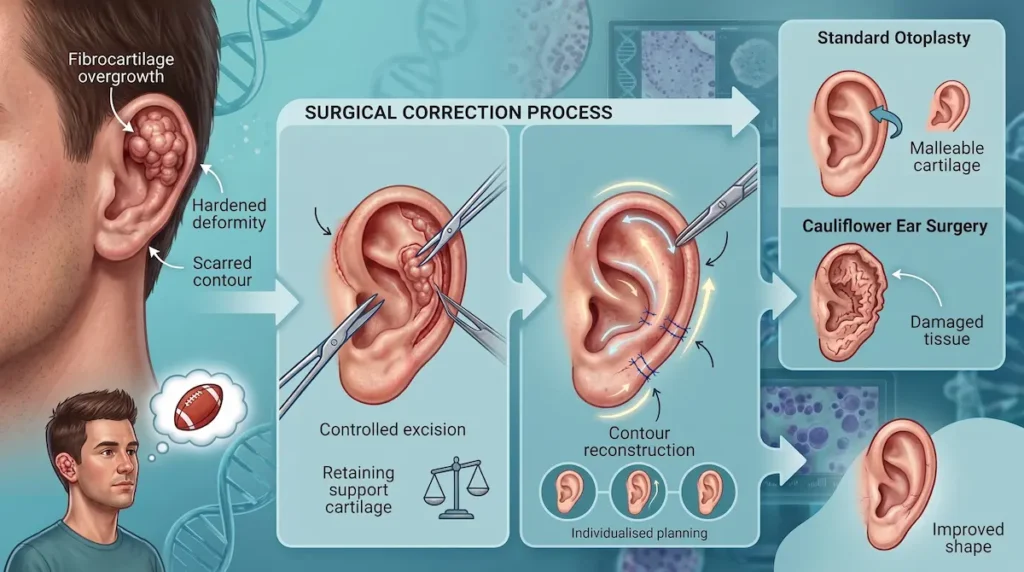
Removing overgrown fibrocartilage
In chronic cauliflower ear, the lumpy shape is often caused by overgrown fibrocartilage and scar-like tissue inside the ear framework. During surgery, the surgeon usually works through a carefully placed incision, often on the back of the ear or within natural creases where possible, to reach the distorted cartilage.
The thickened tissue is then reduced in a controlled way. This is not simple “shaving down”. The surgeon has to judge how much bulk can be removed while preserving support. Remove too little and the ear still looks heavy. Remove too much and the ear can look collapsed or irregular.
This is why cauliflower ear correction should be planned by a team comfortable with reconstructive ear anatomy, not only standard cosmetic ear pinning. The problem is three-dimensional. The surgeon is restoring shape, not just reducing projection.
Reshaping the auricular contour
After excess fibrocartilage is reduced, the ear contour is rebuilt. The surgeon may refine the upper fold, smooth the conchal bowl, release distorted areas, or use sutures to recreate a more natural curve. The exact steps depend on which part of the ear is affected.
A wrestler with thickening across the upper helix may need a different plan from a rugby player with bulky scarring in the concha. Some patients need subtle thinning; others need broader reconstruction. No single template fits every cauliflower ear.
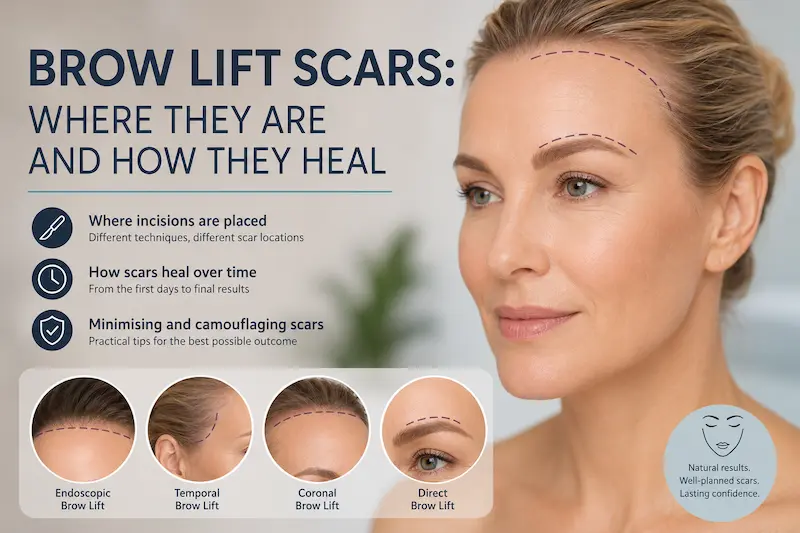
Scars are also considered at this stage. Ear skin is thin, and the incision design matters. Patients who want to understand how scars mature around nearby head-and-neck areas may find it useful to read about how scars around the head can heal, although cauliflower ear surgery follows its own recovery pattern.
Why correction is harder than standard otoplasty
Standard otoplasty usually starts with relatively normal cartilage. The surgeon reshapes, folds, or pins it into a more balanced position. Cauliflower ear surgery starts with damaged cartilage. That changes the operation.
The cartilage may be thick, stiff, fragmented, scarred, or fused to the surrounding tissue. The natural grooves may be partly erased. The skin may also be stretched, thinned, or less mobile after repeated inflammation. These features make the surgery more technically demanding.
That does not mean surgery cannot help. It often can. But the honest target is improvement: a smoother ear, better definition, less bulk, and a shape that looks less traumatised. A completely untouched-looking ear is not always possible, especially after years of repeated injury.
| Feature | Cauliflower Ear Surgery | Prominent-Ear Otoplasty |
|---|---|---|
| Main goal | Correct a trauma-related deformity and reduce hardened bulk | Bring naturally prominent ears closer to the head |
| Anatomy treated | Distorted cartilage, fibrocartilage overgrowth, scarred contours | Usually normal cartilage with underdeveloped folds or excess projection |
| Technical challenge | Higher: the ear structure is damaged and irregular | Usually more predictable when cartilage quality is normal |
| Recovery emphasis | Pressure dressing, contour protection, avoiding recurrence | Headband support, swelling control, protecting the new ear position |
| Recurrence risk | Higher if the patient returns to contact sport too early or sustains new trauma | Lower, though ear position can change if the repair is disrupted |
How It Differs From Prominent-Ear Otoplasty?
Many patients search for cauliflower ear surgery and otoplasty as though they are the same operation. They overlap, but they are not identical. Standard otoplasty changes ear position or fold definition. Cauliflower ear correction treats injury-related deformity. Understanding that difference helps prevent disappointment and helps the surgeon choose the right plan.
Deformity correction versus cosmetic pinning
Prominent-ear otoplasty usually answers a cosmetic concern: “My ears stick out.” The cartilage is often healthy, but the folds or angles are not balanced. The surgical plan may involve sutures, scoring, or cartilage reshaping to set the ear closer to the head.
Cauliflower ear surgery answers a different question: “My ear has changed shape after injury.” The surgeon is not only changing projection. They are correcting deformity caused by haematoma, cartilage disruption, and fibrous overgrowth.
This distinction matters for consent. A patient with prominent ears can often expect a cleaner and more symmetrical change than a patient with years of wrestling trauma. A patient with cauliflower ear may still improve significantly, but the “before” anatomy is less predictable.
Incision and reshaping differences
In standard otoplasty, the incision is commonly hidden behind the ear, and much of the work focuses on fold creation, projection control, and symmetry. In cauliflower ear correction, access may still be discreet, but the surgeon must also reach and reduce thickened internal tissue.
Sometimes the distorted cartilage is approached through the back of the ear. In other cases, the front surface or natural folds may need careful access depending on where the deformity sits. The choice is not made for convenience; it is made for safe exposure and precise contouring.
Patients sometimes ask whether the operation can be done without visible scars. Every incision creates a scar, but ear scars often settle well when placed thoughtfully and protected during healing. The more important question is whether the incision gives the surgeon enough access to correct the deformity safely.
Realistic improvement, not a “perfect reset”
A good result should look calmer, smoother, and more structured. It should reduce the heavy, lumpy, collapsed, or crumpled appearance. It may also make headgear, earbuds, or glasses feel more comfortable if bulk was causing practical problems.
But surgery cannot always recreate the exact ear shape the patient had before injury. The skin may have stretched. The cartilage may have stiffened. The two ears may not have matched perfectly even before the trauma. These details affect the final result.
That is why a responsible consultation should include mirror assessment, close-up photographs, discussion of sport history, and a clear explanation of what can be improved. If a patient also wants to understand the financial side, that belongs on the dedicated ear surgery cost in Turkey page rather than in a deformity-focused article like this one.
For UK patients, this is also where credential checks matter. The NHS advises patients considering cosmetic ear correction to check provider registration and surgeon credentials, including GMC registration and relevant professional bodies in the UK context. For surgery abroad, the equivalent question is whether the surgical team can clearly explain their board certification, theatre standards, complication protocol, and aftercare pathway.
Recovery, Results and Preventing Recurrence
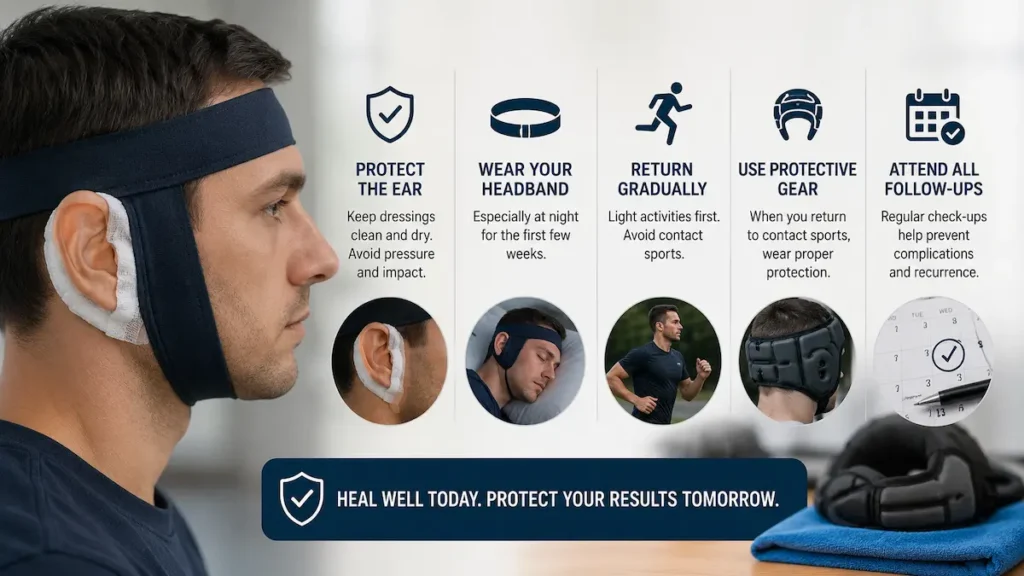
Recovery after cauliflower ear surgery is built around one priority: protecting the reshaped cartilage while it settles. Swelling and tenderness are expected, but pressure control, dressing care and avoiding new trauma are what reduce the chance of the ear filling again or healing into a new irregular shape.
Dressing, pressure and downtime
After surgery, the ear is usually supported with a dressing that applies gentle, even pressure. This helps the skin and cartilage sit back together and reduces the dead space where fluid or blood could collect. The exact dressing style depends on the correction performed, but patients should expect visible support in the first phase of healing.
This is not the stage to “test” the ear. Sleeping on the operated side, wearing tight headphones, returning to grappling, or knocking the ear too early can disrupt the result. Even a well-performed correction needs quiet healing time.
Standard otoplasty patients are often told to wear a support headband after surgery, especially at night. In cauliflower ear correction, the pressure and protection plan can be even more important because the ear has already shown a tendency to form abnormal tissue after trauma. You can read more about why the recovery headband matters in the dedicated recovery guide.
Protective headgear and return to contact sport
For wrestlers, rugby players and combat-sport athletes, the hardest part of recovery is often not pain. It is patience. The ear may feel “good enough” before the internal healing is mature enough to tolerate impact.
Return-to-sport timing should be cleared by the operating surgeon. In general, contact sport is delayed until swelling has settled, the incision has healed, and the ear can tolerate light pressure without pain or fluid build-up. Protective headgear is not optional for many athletes after this kind of correction. It is part of recurrence prevention.
A realistic plan should answer these questions before surgery: When will dressings be removed? When can you wash your hair normally? When can you sleep on the side? When can you restart non-contact training? When is full grappling, sparring or rugby contact allowed? If the answers are vague, ask again.
What the final ear shape can realistically look like
The final result depends on how severe the original deformity was. A mild cauliflower ear may be smoothed enough that only close inspection reveals the old trauma. A severe, long-standing deformity may still look slightly thicker than an untouched ear, but with better contour, less bulk and a more recognisable shape.
Symmetry is also important to discuss honestly. Human ears are rarely identical. After trauma, one side may have lost more definition than the other. The goal is usually a natural-looking improvement, not mathematical matching.
Scar behaviour is another part of the conversation. Ear scars are often discreet, but healing varies. Patients comparing recovery across head-and-neck procedures may find head-and-neck scar healing timelines useful for understanding how swelling, firmness and fading change over months, although the ear has its own anatomy and dressing needs.
What UK patients should confirm before travelling
UK patients are right to be cautious about surgery abroad. A serious consultation should not rely on glossy before-and-after promises. It should explain the diagnosis, whether the deformity is acute or chronic, what type of correction is realistic, how pressure dressing will be handled, and how follow-up works once you are back in the UK.
Ask whether the surgical team has experience with trauma-related ear deformity, not just prominent-ear otoplasty. Ask how they manage recurrence, infection risk and haematoma prevention. Ask what photographs are needed for remote assessment and what would make you a poor candidate.
AKM’s surgical model is based in Istanbul, with procedures performed in a JCI-accredited facility and care delivered by European Board-Certified Surgeons in a GMC-equivalent credential framework. That wording matters. It means equivalent training and board-level standards; it does not claim UK GMC certification. For UK readers, that transparency is part of safe decision-making.
If your ear deformity is established and you want a realistic assessment, you can request a virtual consultation to discuss whether cauliflower ear correction, standard otoplasty, or no surgery is the most sensible option for your anatomy.
Frequently Asked Questions: Cauliflower Ear Surgery
These answers cover the most common questions UK patients ask before considering cauliflower ear correction. They are general information, not a substitute for an examination by a qualified clinician or surgeon.
Can cauliflower ear be fixed with surgery?
Yes, established cauliflower ear can often be improved with surgery. The surgeon removes or reduces overgrown fibrocartilage, reshapes the distorted ear contours and uses dressings or sutures to support the new shape. The result is usually an improvement rather than a perfect return to the original ear.
Is cauliflower ear surgery the same as otoplasty?
It is a form of ear reshaping surgery, but it is not the same as standard prominent-ear otoplasty. Standard otoplasty usually reshapes otherwise healthy cartilage to reduce projection. Cauliflower ear surgery corrects cartilage damaged by trauma, haematoma and scarring, so the planning is more reconstructive.
Does cauliflower ear come back?
It can come back if the ear is injured again or if fluid or blood reaccumulates during early healing. That is why pressure dressings, follow-up checks and protective headgear are so important. Athletes who return to contact sport too soon have a higher recurrence risk.
How long is recovery after cauliflower ear surgery?
Early recovery often centres on dressings, swelling control and avoiding pressure on the ear. Many patients can return to desk-based work relatively quickly, but contact sport takes longer and must be cleared by the surgeon. The final contour continues to settle over weeks to months.
Can early cauliflower ear be treated without surgery?
A fresh auricular haematoma can often be treated with prompt drainage and pressure dressing before a fixed deformity forms. That is not the same as correcting old cauliflower ear. If the ear is newly swollen after trauma, seek urgent medical assessment rather than waiting for it to harden.
Is cauliflower ear surgery painful?
Patients usually feel pressure, swelling and soreness rather than severe pain, but discomfort varies by the extent of correction and the anaesthesia plan. Your surgeon should explain pain control, dressing changes and what symptoms are normal versus worth reporting.
Can I wear headphones after cauliflower ear correction?
Not immediately. Headphones can press on the healing ear and disturb the contour. Your surgeon will advise when it is safe to wear over-ear or in-ear devices again. If headphones were uncomfortable before surgery because of bulk, this may improve once healing is complete.
Should I choose surgery if I still compete in wrestling, rugby or MMA?
Possibly, but the timing must be sensible. If you plan to continue high-impact contact sport, you need a recurrence-prevention plan, protective headgear and clear return-to-training guidance. Some athletes delay correction until a quieter training period or after competition season.
Medical Disclaimer: This article is for general educational purposes only and does not replace medical advice, diagnosis or treatment. Cauliflower ear, auricular haematoma and post-traumatic ear deformity should be assessed by a qualified clinician. Surgical suitability, risks, recovery and results vary from patient to patient.