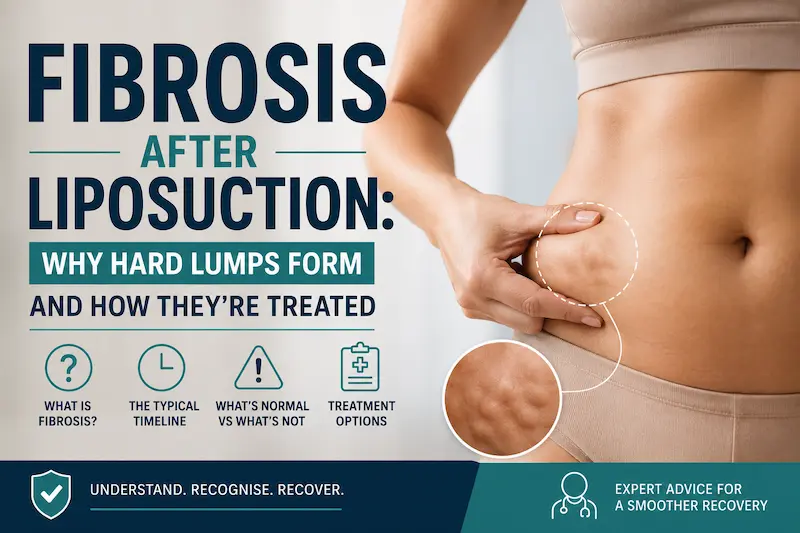
Fibrosis after liposuction is a firm, lumpy or rope-like texture that can appear as the treated fat layer heals. In many patients, it is part of normal collagen remodelling and softens gradually over months. The key is knowing what feels expected, what needs review, and how early aftercare can reduce stubborn firmness.
Feeling hard areas after liposuction can be unsettling, especially if you travelled for surgery and are now trying to judge recovery from home. A smooth result is not created on the operating table alone. It also depends on swelling control, compression, tissue healing and follow-up.
This guide explains why hard lumps form, how the timeline usually unfolds, and when firmness may point to something other than routine healing. For a broader overview of the procedure itself, see AKM’s liposuction approach in Turkey.
Most post-liposuction firmness is not a failed result. It is healing tissue asking for time, structure and the right aftercare. What matters is whether the lumps are gradually softening, staying stable, or becoming painful, hot, red or more uneven.
Table of Contents
What Fibrosis After Liposuction Is?
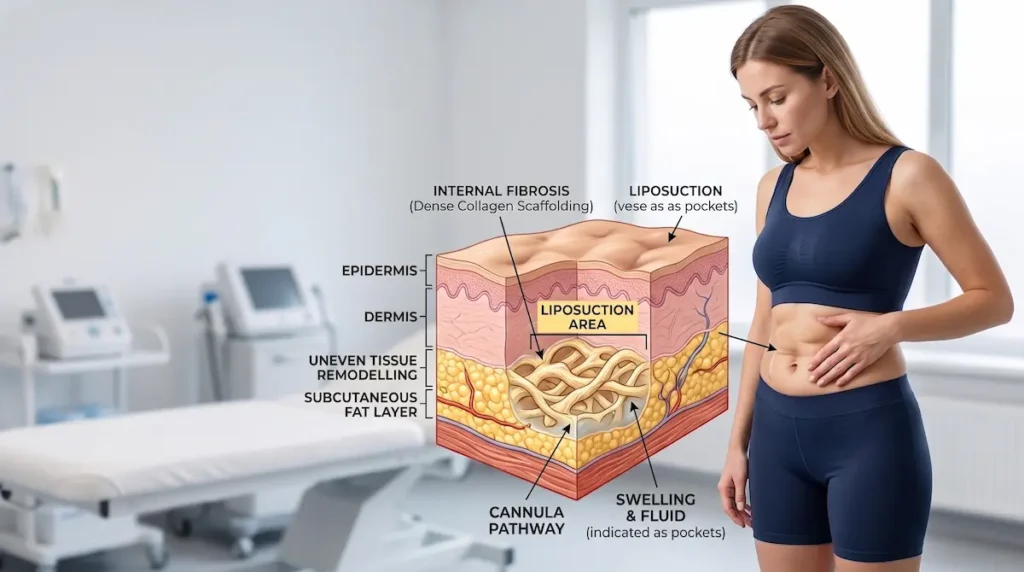
Fibrosis is the body’s repair response inside the layer that has been treated during liposuction. After fat is removed, the remaining tissue has to settle, seal tiny channels, clear fluid and rebuild support. That rebuilding process uses collagen. When collagen is laid down unevenly or becomes temporarily dense, the area can feel hard, thick, ridged or lumpy.
Patients often describe it as “scar tissue under the skin”, although it is not the same as the visible scar at a cannula entry point. It is deeper. It sits in the tissue plane where swelling, healing and contour change are happening at the same time.
Collagen and healing basics
Collagen is not the enemy. Your body uses it to repair tissue after surgery. The problem is that early collagen can feel stiff before it matures. Think of it as internal scaffolding: useful at first, but not meant to stay rigid forever.
During the first weeks, the treated area may feel swollen, numb, tender and uneven. As fluid shifts and collagen firms up, some areas can feel harder than others. This is why a patient may feel soft swelling in one area and a tough lump a few centimetres away.
That unevenness does not automatically mean the final contour is uneven. Early tissue is busy. It rarely feels like the finished result.
Why the treated layer can feel firm
Liposuction creates controlled trauma in the fatty layer. The cannula passes through tissue, fat is removed, and the body responds with inflammation, fluid movement and repair. Firmness can come from several overlapping causes:
- Swelling: fluid trapped in the treated layer can make tissue feel tight or heavy.
- Collagen remodelling: healing tissue can feel thick, ropy or nodular before it softens.
- Compression changes: uneven pressure from garments can make some areas feel firmer than others.
- Reduced movement: lymphatic drainage can slow if the body is not moving enough during recovery.
- Area sensitivity: thinner or more delicate zones may feel irregular sooner because there is less soft tissue covering them.
The NHS notes that recovery after liposuction varies depending on the work done and that patients should discuss return to work, driving and aftercare with their surgeon. That same principle applies to firmness: the expected timeline is individual, not one-size-fits-all. NHS guidance on liposuction recovery.
Fibrosis vs swelling vs loose skin
Fibrosis is often confused with swelling or loose skin. They can overlap, but they are not the same problem.
Swelling feels puffy, tight or fluid-heavy. It can change through the day, often looking worse after standing, travelling or eating salty food. Fibrosis feels more fixed, thick, firm or rope-like. It may not shift much when you press it.
Loose skin is different again. It is a surface laxity issue, not a deep hardening issue. Loose skin folds, creases or hangs; fibrosis feels like firmness under the surface. If your main concern is laxity rather than hard lumps, read how loose skin differs from fibrosis.
A useful way to separate them is to ask: does it feel like fluid, firmness or skin excess? That is not a diagnosis, but it helps you describe the issue clearly during follow-up.
Why Hard Lumps Form?
Hard lumps after liposuction usually form because healing is uneven across the treated layer. Liposuction does not remove fat as a single smooth sheet. It creates tunnels through fatty tissue, then the body collapses, seals and remodels those spaces over time. During that process, some areas can become firm before they soften.
This is also why two patients can have very different healing textures after the same procedure. One person may feel only general tightness. Another may feel small nodules, ridges or bands for several months. Anatomy, technique, aftercare and compression all matter.
Normal collagen remodelling
In the early healing phase, collagen is thicker and less organised. It helps repair the treated tissue but can feel hard under the fingers. Over time, collagen fibres remodel, inflammation reduces and the tissue becomes more flexible.
This is why post-lipo lumps often feel more worrying before they feel better. A lump may become noticeable only after the first swelling starts to settle. That does not always mean a new problem has developed. It may simply mean the surface puffiness has gone down enough for deeper firmness to be felt.
For many patients, the reassuring pattern is gradual softening. The area may still feel uneven, but month by month it becomes less tender, less tight and easier to massage or move.
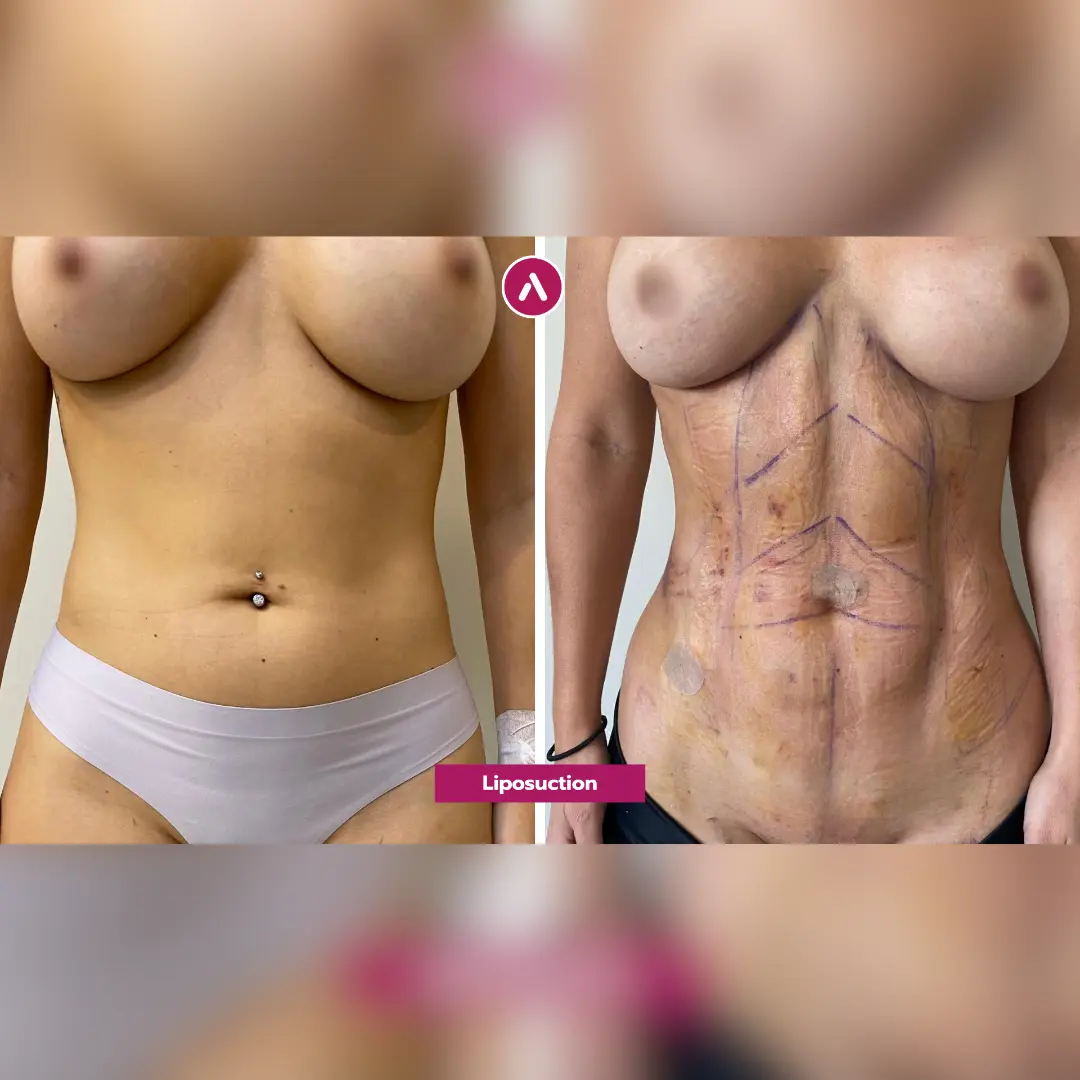
Technique, compression and aftercare factors
Several factors can make fibrosis more likely or more noticeable:
- Large-volume treatment: bigger areas mean more tissue has to heal.
- Dense fat or fibrous zones: some areas naturally resist cannula movement more than others.
- Uneven compression: a garment that rolls, creases or digs in can leave pressure marks and firm bands.
- Delayed aftercare: if swelling is not managed early, tissue can feel tighter for longer.
- Too much activity too soon: overexertion may increase swelling and irritation.
- Too little movement: complete inactivity can slow circulation and lymphatic flow.
Good aftercare does not mean doing more of everything. It means doing the right things at the right time. Compression should support the tissue, not cut into it. Movement should be gentle before it becomes strenuous. Massage should be timed according to your surgeon’s protocol, not started aggressively because the area feels hard.
Why some areas are more prone to firmness
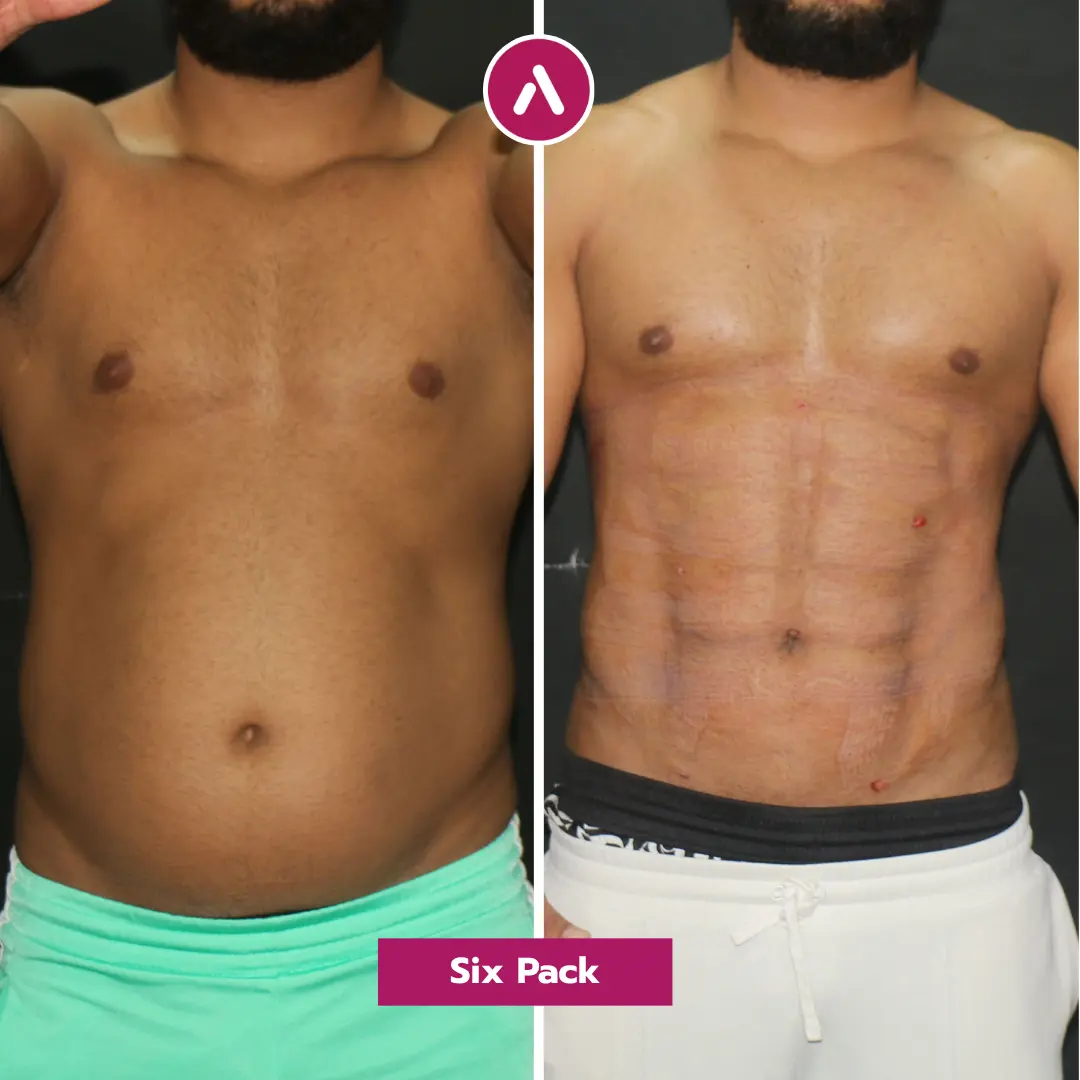
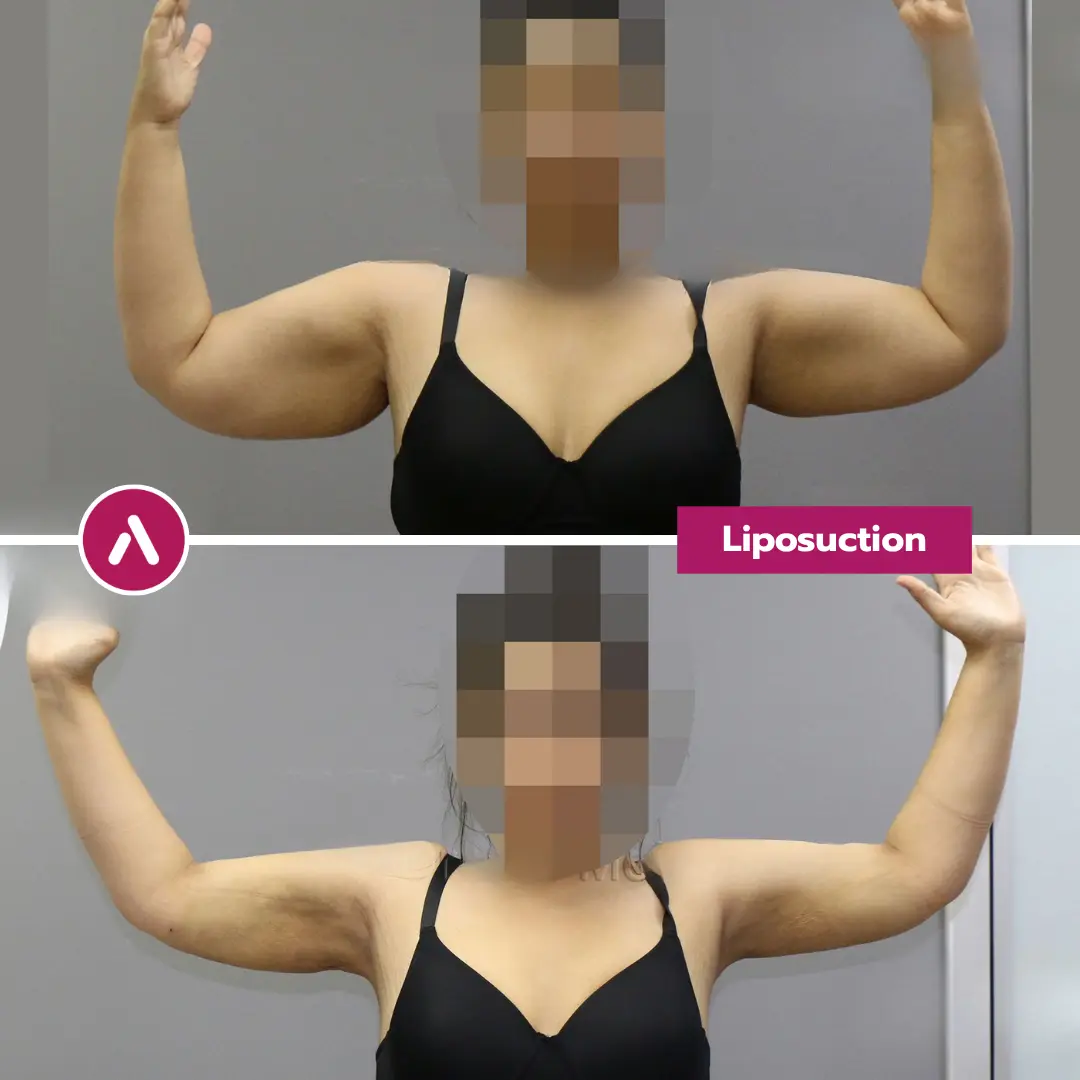
Fibrosis can happen after liposuction in almost any area, but it is often more noticeable in zones where the skin is thin, the tissue is delicate or the contour is highly visible. Arms, lower abdomen, flanks, inner thighs and mons pubis can all feel firm while they settle.
Area-specific anatomy changes what patients notice. On the arms, even small ridges may be easy to feel because the tissue layer is thinner. If you are weighing up that procedure specifically, area-specific liposuction results can help frame expectations.
Delicate areas need even more careful planning. Mons pubis liposuction, for example, is a small zone where swelling and firmness can feel disproportionate because the tissue is sensitive and close to natural creases. For that context, see fibrosis in delicate areas.
The practical takeaway is simple: firmness is not judged only by how it feels today. It is judged by its direction. Is it softening? Is swelling reducing? Is the surface becoming smoother? Those trends matter more than one anxious check in the mirror.
The Typical Timeline
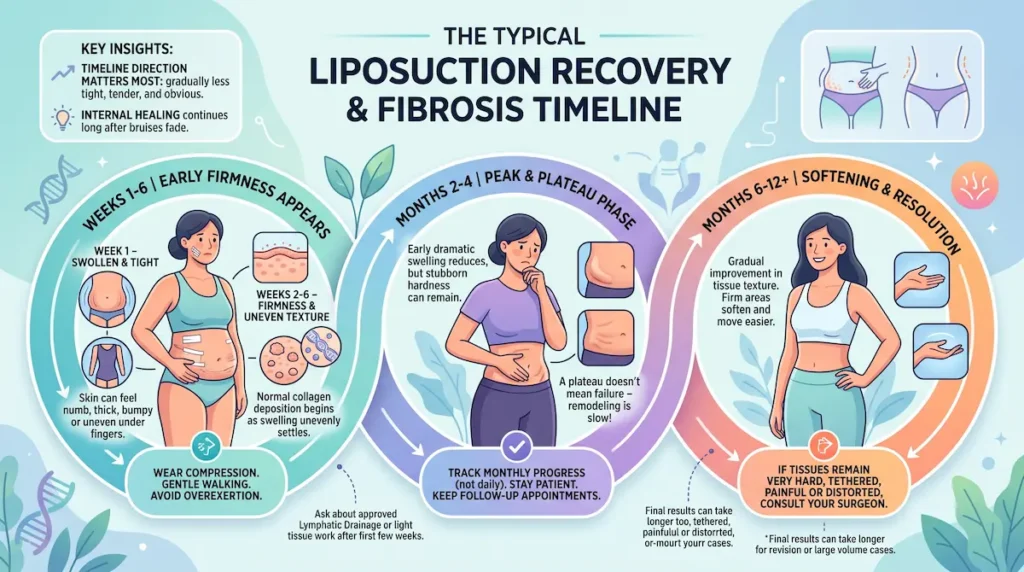
The lipo fibrosis timeline is not perfectly linear. Some people notice firmness early, while others feel smooth swelling first and only discover hard patches once the swelling begins to reduce. A useful timeline looks at direction, not just dates: firmness should gradually become less tight, less tender and less obvious.
UK patients often ask whether they should be “back to normal” after a few weeks. For daily activities, possibly. For tissue texture, not always. Internal healing after liposuction continues long after the bruises fade.
Weeks 1–6 — firmness appears
In the first week, swelling usually dominates the picture. The skin may feel tight, numb or bruised. You may not be able to judge contour clearly because fluid is still moving through the treated area.
Between weeks two and six, firmness can become more noticeable. This is when many patients start searching for hard lumps after liposuction because the treated area no longer feels simply swollen; it feels thick, bumpy or uneven under the fingers.
That can be normal. Early firmness often appears as the body lays down collagen and the swelling begins to settle unevenly. The area may feel worse after a long day on your feet, after travelling, or if the compression garment has creased.
Months 2–4 — peak or plateau
Months two to four can be frustrating. The dramatic early swelling may have improved, but stubborn hard areas can remain. This is often the stage when patients worry that the result is “stuck”.
A plateau does not always mean failure. Collagen remodelling is slow. The tissue can feel firm for several weeks before it starts to loosen again.
What you want to see is gradual change. A lump that is a little softer than last month is different from a lump that is growing, becoming painful or causing a sharp contour dip.
Months 6–12 — softening and resolution
By six months, many patients feel a clear improvement in tissue texture. Firm areas may still exist, but they should usually be less obvious and easier to move under the skin. The final smoothing process can continue towards 12 months.
Some patients need longer, especially after larger-volume treatment, revision liposuction, high-definition contouring or liposuction in naturally fibrous areas. Patience matters here. So does follow-up.
If the tissue is still hard, tethered, painful or visibly distorted at this stage, it is reasonable to ask your surgeon for a structured review rather than guessing from photos or forums.
| Stage | Typical firmness | Usually normal? | Supportive action |
|---|---|---|---|
| Week 1 | Swollen, tight, bruised, tender | Often normal | Wear compression as instructed, walk gently, avoid overexertion |
| Weeks 2–6 | Hard patches, ridges or small lumps may appear | Often normal if improving | Ask when to start approved lymphatic drainage or light tissue work |
| Months 2–4 | Firmness may peak or feel slow to change | Can be normal | Track progress monthly, not daily; keep follow-up appointments |
| Months 6–12 | Gradual softening and smoother contour | Expected trend | Review persistent, painful or worsening areas with your surgeon |
What’s Normal vs Worth Flagging?
Not every lump is fibrosis, and not every firm area is harmless. This section is where a calm, evidence-led approach matters. The goal is not to panic over normal healing, but also not to ignore signs that deserve clinical review.
As a rule, normal healing tends to improve slowly. Concerning changes tend to worsen, spread, become more painful, or come with heat, redness, discharge or a new fluid-like swelling.
Normal firmness and unevenness
Normal post-liposuction firmness often feels dull, thick or rubbery. It may be more noticeable when you stand, stretch, shower or run your hand across the area. It may also feel different from one side of the body to the other.
Unevenness is common early because swelling does not drain evenly. One side may look puffier. One small area may feel firmer. Another may feel numb. That asymmetry can be worrying, but it is not automatically a sign of a poor result.
The more reassuring signs are:
- the firm area is slowly softening;
- tenderness is reducing rather than increasing;
- the skin is not hot, spreading red or leaking fluid;
- the contour is gradually becoming smoother;
- you can function more comfortably week by week.
If that pattern fits, the issue may be routine healing fibrosis rather than a complication. Still, it is worth documenting it with clear photos and mentioning it during follow-up.
Signs to raise with your surgeon
Some symptoms should not be dismissed as “just fibrosis”. Contact your surgical team promptly if a lump is becoming more painful, hot, sharply red, rapidly larger or associated with fever. A new one-sided swelling that feels fluid-filled also needs review.
Other signs worth raising include increasing asymmetry, a hard tethered band that pulls the skin inward, worsening contour dents, skin colour change, or persistent firmness that is not improving by the later months of recovery.
BAAPS lists possible liposuction risks including swelling, seroma, numbness, contour irregularity and skin changes. Those are not mentioned to alarm you, but to make the distinction clear: fibrosis is one possible explanation for lumpiness, not the only one. BAAPS information on liposuction risks
Fibrosis vs seroma or contour irregularity
A seroma is a collection of fluid. It often feels more like a pocket, wave or balloon-like swelling than a dense lump. It may shift slightly under pressure. Fibrosis is usually firmer and more tissue-like.
A contour irregularity is a visible shape issue. It may look like a dent, ridge, hollow or uneven fat removal pattern. Fibrosis can contribute to a temporary irregular contour, but a true contour problem may persist after swelling and firmness settle.
This is why timing matters. At six weeks, a firm uneven area may still be healing. At nine to twelve months, persistent visible irregularity deserves a more detailed discussion.
Bring specific observations to your surgeon rather than general worry. For example: “This right-sided lump has not softened since month three,” or “This area becomes red and warm after light activity.” Clear details make follow-up safer and more useful.
How Fibrosis Is Managed?
Managing fibrosis is not about forcing the tissue flat. It is about helping swelling clear, encouraging the treated layer to soften, and giving collagen time to remodel. The right plan depends on timing: what is helpful at week three may be too light at month six, and what is suitable at month six may be too aggressive in the first fortnight.
This is why aftercare should be personalised. If you are recovering in the UK after surgery abroad, ask for written guidance before you travel home: when to wear compression, when to start manual lymphatic drainage, what firmness is expected, and how to send follow-up photos if something changes.
Manual lymphatic drainage and ultrasound
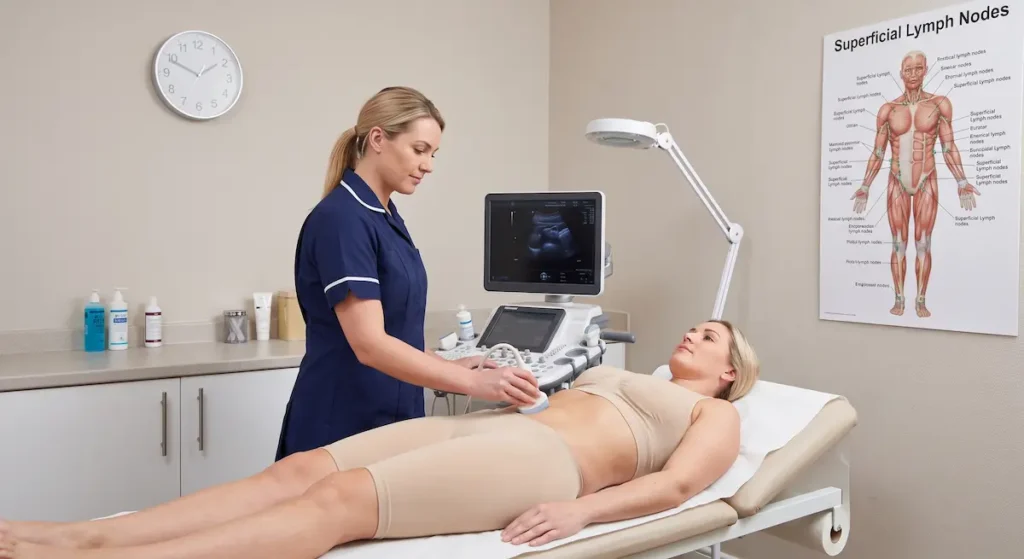
Manual lymphatic drainage, often shortened to MLD, is a gentle massage technique designed to support fluid movement. It is not the same as deep tissue massage. Early after liposuction, forceful massage can irritate healing tissue, increase swelling and make soreness worse.
There is clinical evidence that a programme combining manual lymphatic drainage with therapeutic ultrasound can help reduce swelling, pain and tissue fibrosis after liposuction. The key word is programme: timing, technique and clinical judgement matter. A clinical study on lymphatic drainage and tissue fibrosis
Because this article is focused on fibrosis itself, not massage technique, the detailed aftercare pathway belongs in a separate guide. For that, read lymphatic drainage massage and how it helps.
Compression and time
Compression garments help the treated layer settle. They can reduce dead space, support fluid control and help the skin adapt to the new contour. But compression only works well when it fits properly.
A garment that rolls, digs in, bunches at the waist or leaves sharp lines may create pressure points. Those pressure points can make a firm band feel worse. If your garment is cutting into one area, do not simply tolerate it. Ask your surgical team whether the size, style or foam placement should be adjusted.
Time is also treatment. That can sound unsatisfying when you are anxious, but collagen remodelling is slow biology. You can support it; you cannot rush it safely.
When a clinician may escalate care
If fibrosis remains stubborn after the early healing period, your clinician may recommend a more structured plan. This could include supervised massage, therapeutic ultrasound, radiofrequency-based tissue work, medication in selected cases, or later review for contour correction if the issue is not fibrosis alone.
Escalation does not mean something has gone wrong. It means the tissue needs more than observation. The safest approach is stepwise: diagnose the problem, confirm it is not fluid or infection, then choose the least aggressive option that fits the stage of healing.
If you are comparing total treatment value, aftercare is part of the real cost. Do not judge liposuction by the operation alone. Ask what follow-up, compression advice and remote review are included, and use the liposuction cost guide for UK patients only for pricing details rather than turning this recovery article into a cost breakdown.
At AKM, the consultation focus is not only fat removal. It is also tissue behaviour, skin quality, compression planning and follow-up. The surgical team works in a JCI-accredited setting in Istanbul, with European Board-Certified Surgeons framed as GMC-equivalent for UK patients. That wording matters: it is an equivalence signal, not a claim of GMC registration.
Firmness that is slowly softening is usually a healing pattern. Firmness that is worsening, painful, hot, red, fluid-filled or pulling the skin inward deserves review. The safest recovery plan leaves room for both reassurance and action.
CTA: Book a free virtual consultation to ask AKM how post-lipo fibrosis is prevented, monitored and managed after you return home.
Frequently Asked Questions: Fibrosis After Liposuction
These questions cover the concerns patients most often have once the bruising fades but the tissue still feels uneven. They are written to help you describe what you feel more clearly, not to replace a surgeon’s assessment.
Why do I have hard lumps after lipo?
Hard lumps after liposuction usually come from swelling, collagen remodelling or both. The body is repairing the treated fat layer, and early collagen can feel thick, ropy or nodular before it softens.
If the lumps are gradually improving, they may be part of normal healing. If they are growing, painful, hot, red or associated with fever or fluid, contact your surgeon.
Is fibrosis normal after liposuction?
Mild to moderate firmness can be normal after liposuction, especially in the first few months. Not every firm area is a complication.
Persistent, severe or worsening fibrosis should be reviewed. The question is not only whether fibrosis is present, but whether it is improving on the expected timeline.
How long does fibrosis last?
Many patients notice firmness between weeks two and six, with a peak or plateau around months two to four. Softening often becomes clearer between months six and twelve.
Larger procedures, revision cases and naturally fibrous areas can take longer. If a hard area is not changing by the later months, ask for a structured review.
Will fibrosis go away on its own?
Some fibrosis softens on its own as swelling reduces and collagen matures. However, supportive aftercare can improve the recovery environment.
Compression, gentle movement, hydration, surgeon-approved MLD and follow-up all help the tissue settle. Do not use aggressive massage without clearance.
Can massage help fibrosis after lipo?
Massage can help when it is the right type, at the right time. Manual lymphatic drainage is gentle and aims to support fluid movement. Deep, forceful massage too early can irritate healing tissue.
Ask your surgeon when to start, how often to go, and whether your therapist should avoid any areas.
When should I worry about hard lumps?
Raise concerns promptly if a lump becomes more painful, red, hot, fluid-filled, rapidly larger, or comes with fever, discharge or skin colour change. Also ask for review if firmness causes a visible tether, dent or worsening contour.
Worry less about one bad mirror check and more about the trend. Healing firmness should slowly soften. Concerning firmness tends to worsen or come with other symptoms.
Medical Disclaimer: This article is for general information only and is not a substitute for medical advice, diagnosis or treatment. Liposuction recovery varies by anatomy, surgical technique, aftercare, health history and healing response. Always follow your own surgeon’s instructions and seek urgent medical advice if you develop worsening pain, fever, spreading redness, discharge, skin colour change or sudden swelling.