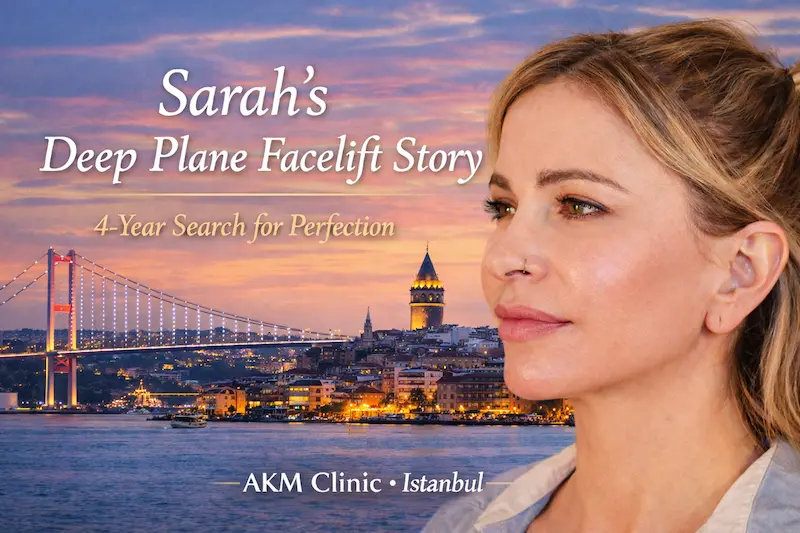
Note: This article shares one patient’s experience and is not a substitute for medical advice. Every face, every healing pattern, and every surgical plan is individual.
If you’ve been searching for a deep plane facelift story that feels genuinely “UK-real” (rather than glossy marketing), Sarah’s journey will sound familiar. She spent years reading, comparing, and quietly worrying about the same things many British patients worry about: looking “pulled”, having poor aftercare once home, and not knowing who to trust when considering surgery abroad.
This is written for the “expert patient” mindset — the person who reads reviews, asks hard questions, and wants a result that looks subtle, not obvious. It also reflects how modern facial rejuvenation is guided by anatomy, judgement, and medical science — not trends.
- Who this is for: People in the UK considering a deep plane facelift, especially those looking for subtle facelift results real patient story content rather than generic claims.
- What you’ll get: A transparent narrative, a practical research checklist, and what mattered most to Sarah when comparing London (including Harley Street-level pricing) to Istanbul.
- Keywords readers often use (and we’ll address): real Turkey facelift experiences, Turkey deep plane facelift reviews, and deep plane facelift Istanbul reviews.
Table of Contents
Introduction — Why Sarah’s Story Will Matter to UK Patients
Sarah is a 45-year-old woman from the United Kingdom who had previously undergone surgery in the UK. Her priority this time wasn’t “more change” — it was natural-looking rejuvenation with a safer-feeling plan, transparent pricing, and support that didn’t disappear once she flew home. She also wanted to avoid the sense that her only choice for premium care was paying Harley Street fees.
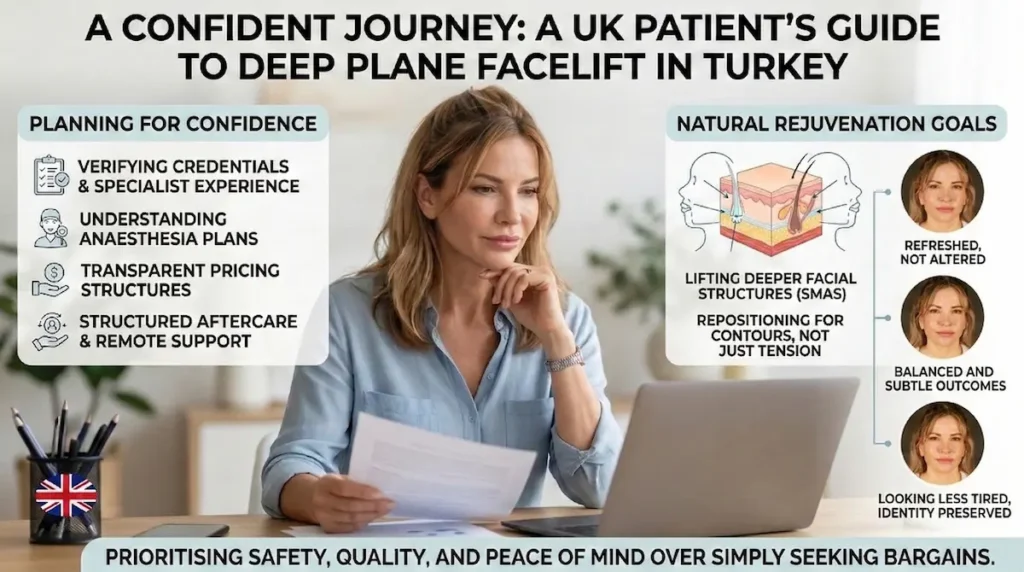
For Sarah, the decision wasn’t really about chasing a “bargain abroad” — it was about reducing risk while keeping control. She treated flying to Turkey for facelift like a medical project: verifying credentials, understanding the anaesthesia plan, and mapping out aftercare milestones before she ever booked flights. That level of preparation helped her feel confident that the journey could be safe, structured, and genuinely aligned with the subtle, natural result she wanted.
Who Sarah is (UK context) and what she wanted to change — without looking “done”
Sarah’s goal was straightforward: look refreshed, not different. Like many British patients, she didn’t want a dramatic, social-media style “after”. She wanted people to say she looked well-rested — not ask what she’d had done.
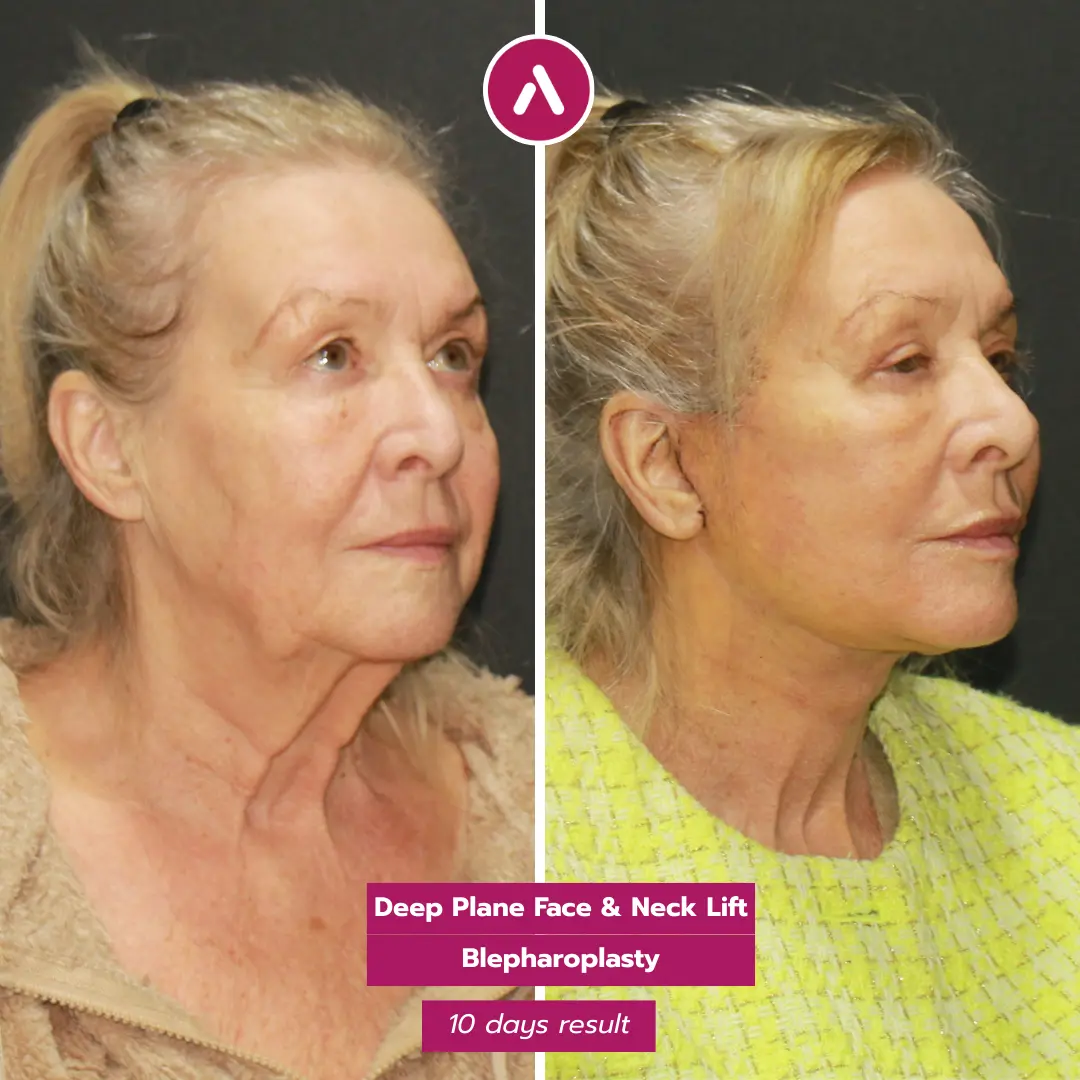
When people search real UK patient deep plane facelift or deep plane facelift before and after stories, they’re usually looking for the same reassurance Sarah wanted:
- That the result can be subtle and still meaningful.
- That swelling and bruising are manageable — and explained honestly.
- That aftercare is structured, not improvised.
What a Deep Plane Facelift means in plain English (not marketing language)
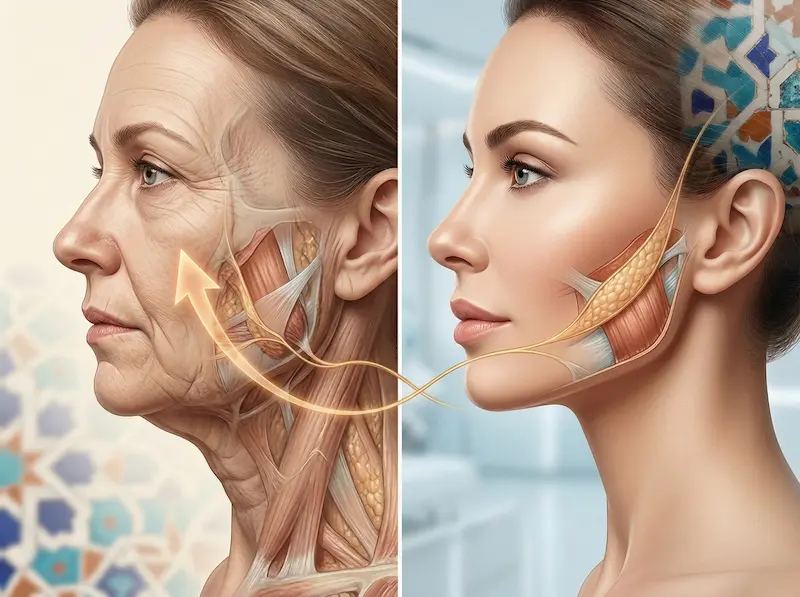
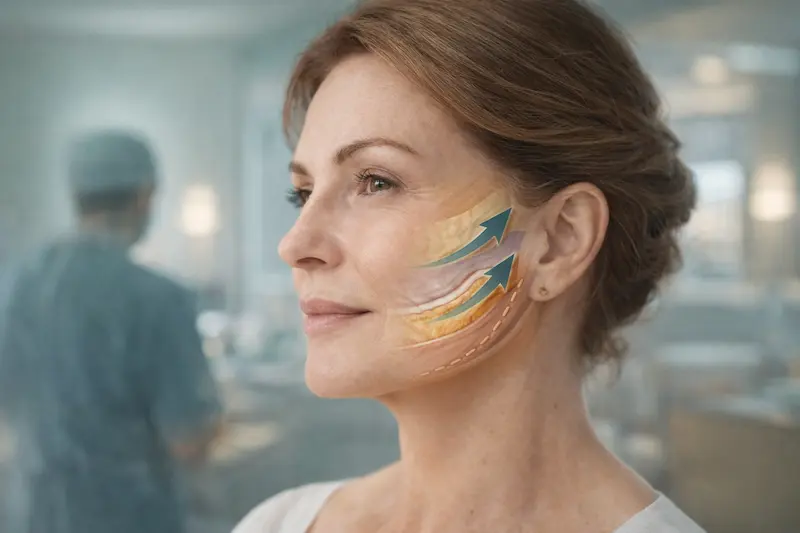
A deep plane facelift is a technique designed to lift and reposition deeper facial tissues (rather than simply tightening skin). In plain English: it aims to restore youthful contours in a way that can look more natural over time, because the lift is supported by deeper structures rather than surface tension.
That’s why so many UK patients specifically look for deep plane facelift in Turkey UK patient reviews — they’re trying to match a technique associated with high-end results to a clinic and a team they can trust.
Defining “perfection” the UK way: refreshed, not altered
Sarah described her “perfection” as a result that preserved identity. Not a new face — her face, but less tired. This is also where careful planning matters: the best outcomes are not “maximum lift”, but balanced rejuvenation with a calm, steady healing process.
Sarah’s mindset: “I didn’t want a dramatic transformation. I wanted the kind of result that looks normal in daylight, in real life — not just in photos.”
Why I Spent 4 Years Researching Before Saying Yes
Sarah’s “four-year search” wasn’t about indecision — it was about due diligence. Many British patients who consider surgery abroad do the same: they read forums, compare techniques, look at long-term outcomes, and search for patterns in reviews. In Sarah’s case, it also meant comparing her past UK experience with what she wanted this time: a more surgeon-led plan, a clearer recovery strategy, and pricing that felt transparent.
The biggest fear: “overdone” results — how I assessed before/after photos
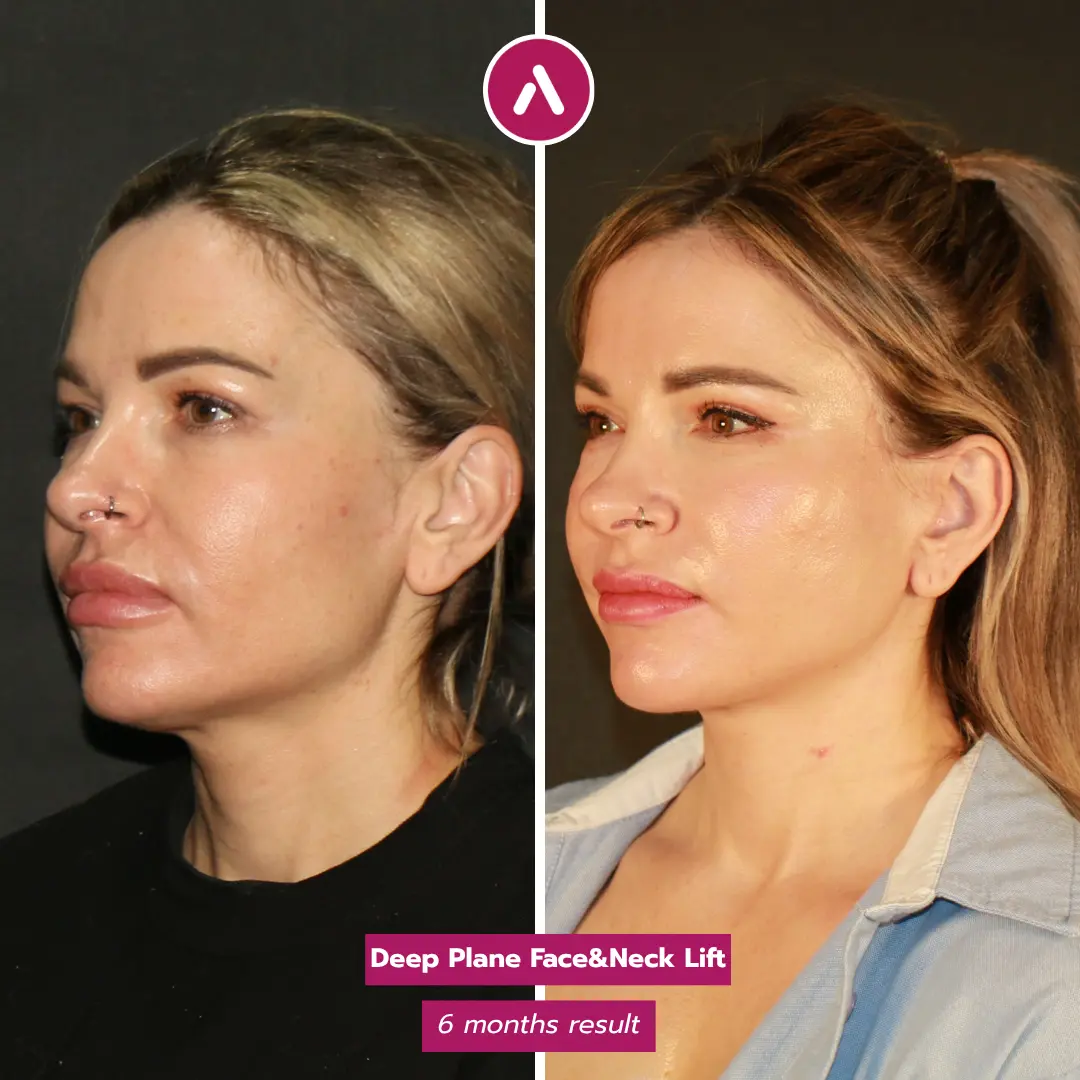
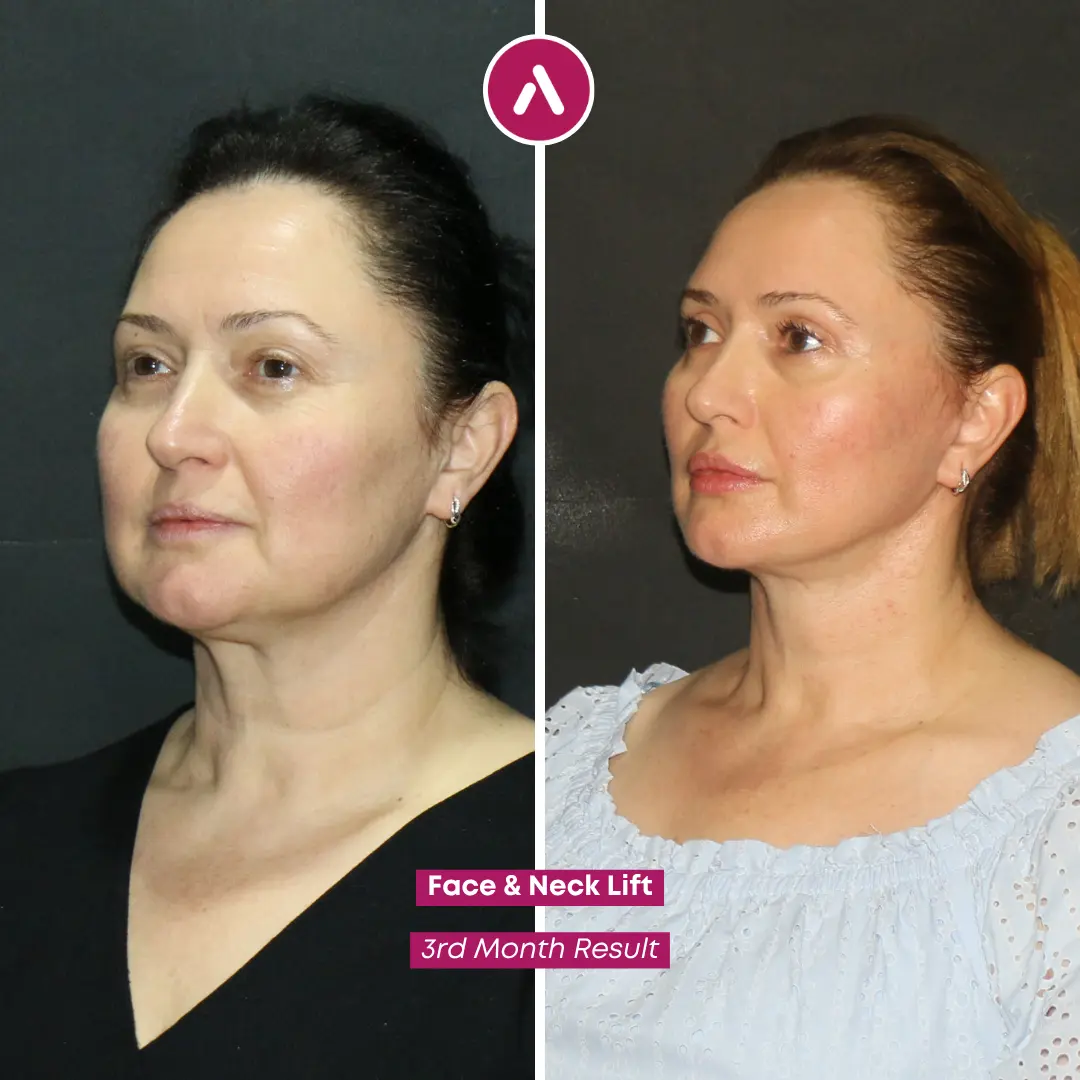
Sarah’s first filter was simple: could she see the person in the “after”? When browsing deep plane facelift before/after stories, she avoided galleries that looked overly tight, shiny, or “windswept”. Instead, she looked for:
- Consistency: Results that look natural across different lighting and angles.
- Neck and jawline harmony: Improvement without an obvious “pulled” direction.
- Longer timelines: Not just week-one photos — but months later, when swelling has settled.
Her takeaway is important for anyone searching Turkey deep plane facelift reviews: the quality of a result isn’t proven by one “perfect” photo. It’s proven by repeatable, realistic outcomes.
UK reality check: Harley Street pricing, access, and what felt missing
Sarah’s motivation included value — but not “cheapness”. She wanted to avoid expensive Harley Street fees while still pursuing a high-standard result. Her comparison wasn’t simply “UK vs Turkey”. It was:
- Is the plan personalised and surgeon-led?
- Is the facility run to strict hygiene and operating theatre standards?
- Is aftercare structured — including support once I’m back in the UK?
Sarah ultimately felt confident that, when comparing facelift London vs Istanbul quality, she would choose Turkey over the UK for this procedure — especially because her recovery experience was described as painless, with minimal need for paracetamol.
My safety due diligence checklist (credentials, facility, anaesthesia plan)
Below is the checklist Sarah used to turn anxiety into clarity. If you’re looking for a British patient facelift story in Istanbul that includes the “how I verified everything” part, this is it.
| What I checked | Why it matters (UK patient logic) | What “good” looked like |
|---|---|---|
| Surgeon credentials & scope of practice | UK patients often look for a “GMC-equivalent” standard of training and accountability. | Clear qualifications, recognised board-equivalent pathways, and surgeon-led consultations. |
| Operating theatre standards | Infection control is non-negotiable — especially when travelling. | Strict, documented hygiene protocols and a “zero-compromise” approach in sterile theatres. |
| Anaesthesia approach | Some patients prefer avoiding general anaesthesia where appropriate. | A clear plan for local anaesthesia with twilight sedation (where clinically suitable), and proper monitoring. |
| Recovery plan (not just “rest and wait”) | British patients want timelines, milestones, and a strategy to reduce swelling and downtime. | A structured programme including technologies used in modern practice, supported by scientific research. |
| Aftercare once I’m back in the UK | Fear of being “on your own” after flying home is one of the biggest barriers. | Clear lines of communication and a defined follow-up process. |
Search-tip: If you’re reading deep plane facelift Istanbul reviews, don’t just count star ratings. Look for details about aftercare, pain control (often paracetamol-led), and how questions were handled after discharge.
Sarah’s practical marker of confidence: “I didn’t want to feel like I was ‘buying a deal’. I wanted a plan, a team, and a safe process.”
The Consultation Process — From the UK to a Clear Surgical Plan
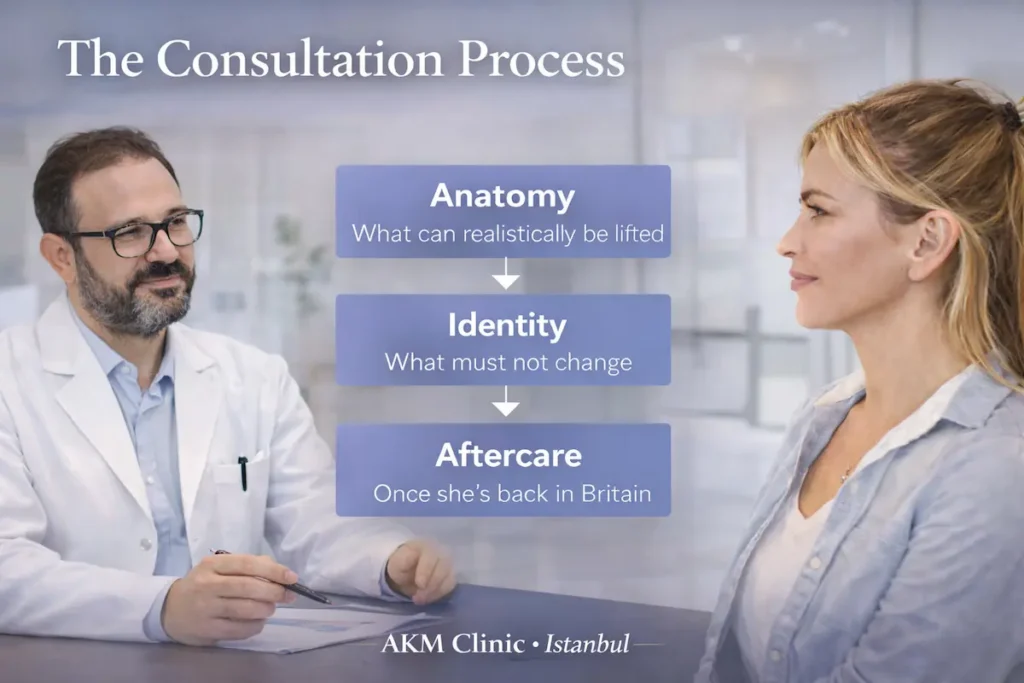
After years of reading Turkey deep plane facelift reviews and saving “before and after” folders, Sarah reached a point many UK patients recognise: she didn’t want more opinions — she wanted a clear plan. What helped her move forward was a surgeon-led consultation process that focused on three things: anatomy (what can realistically be lifted), identity (what must not change), and aftercare (what happens once she’s back in Britain).
For Sarah, that clarity was what turned online research into a real decision. She knew that flying to Turkey for facelift would only feel sensible if every step was mapped in advance: who would examine her, how her specific facial anatomy would be assessed, and what the follow-up looked like once she was back in the UK. Having a documented plan — rather than a generic promise — reassured her that the outcome could be both safe and genuinely subtle.
Remote consultation: sharing photos, medical history, and expectations safely
For UK patients, the first consultation is often remote. That can feel unnerving — especially if you’ve read “botched abroad” headlines. Sarah’s approach was structured: she treated the first contact like an interview. She prepared:
- Clear photos in natural light (front + 45° angles + profile).
- Medical history including prior surgery (Sarah had previous surgery in the UK).
- Non-negotiables: “subtle, not obvious”, and “no pulled look”.
- Questions about safety, anaesthesia options, and how swelling (oedema) is managed.
This is also where many people searching deep plane facelift Istanbul reviews want reassurance: do they give you a real medical conversation, or just a quote?
Surgeon-led planning: midface, jawline, neck, and natural contour priorities
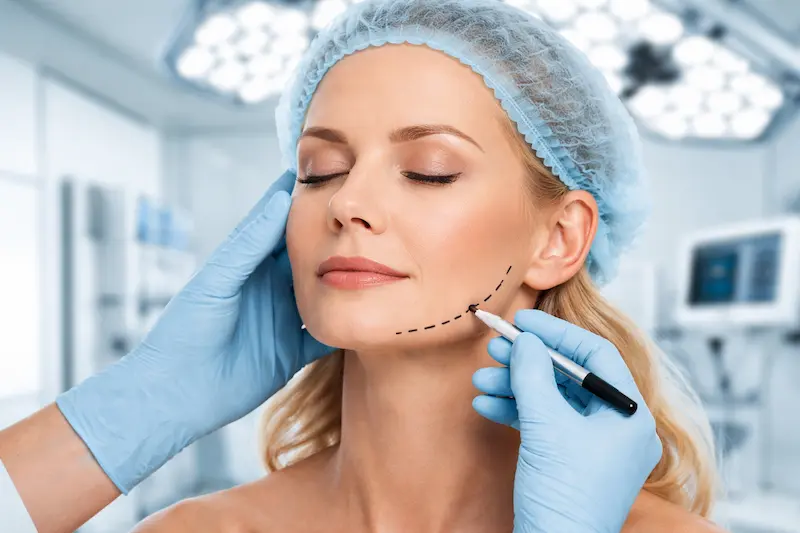
Deep plane techniques are often chosen because they aim to reposition deeper tissues, not simply tighten skin. Planning should therefore sound like a medical discussion, not a sales pitch. Sarah wanted a refreshed midface, a cleaner jawline, and a softer neck transition — but she did not want a different “shape” to her face.
The guiding philosophy she responded to was simple: rejuvenation, not alteration. The “UK standard” is not dramatic change — it’s believable change.
Sarah’s priority: “I wanted to look fresher — not like I’d had a facelift.”
Skin quality and scarring: why a Consultant Dermatosurgeon perspective can matter
British patients often focus on the lift — but the “tell” is frequently skin behaviour: texture, redness, and scar maturation. In modern facial aesthetics, having access to skin-focused expertise (for example, a Consultant Dermatosurgeon perspective) can be valuable when discussing:
- Scar strategy: placement, tension management, and how scars mature over months.
- Skin quality: hydration, barrier health, and realistic expectations for tone and texture.
- Recovery support: how adjunct therapies may reduce visible downtime.
This is where medical science and good clinical judgement overlap — because “natural” isn’t just the lift, it’s how everything settles afterwards.
Surgery Day — Deep Plane Facelift with Local Anaesthesia + Twilight Sedation
Surgery day is where anxiety peaks, especially for patients travelling from the UK. What helped Sarah was understanding the pathway step-by-step: pre-op checks, the operating theatre routine, monitoring, and the immediate post-op plan. In our practice, many patients are interested in approaches that may avoid the physiological stress of general anaesthesia, using local anaesthesia with twilight sedation (conscious sedation) when clinically appropriate.
Why avoiding general anaesthesia can matter (and who it suits)
Not everyone is suitable for the same anaesthetic approach — this is always individualised. However, some UK patients feel more comfortable when the plan includes:
- Local anaesthesia to numb the surgical area.
- Light intravenous sedation (“twilight”) to keep you deeply relaxed.
- Continuous monitoring throughout the procedure.
People often search phrases like real Turkey facelift experiences because they want the “how it felt” details — not just the surgical label.
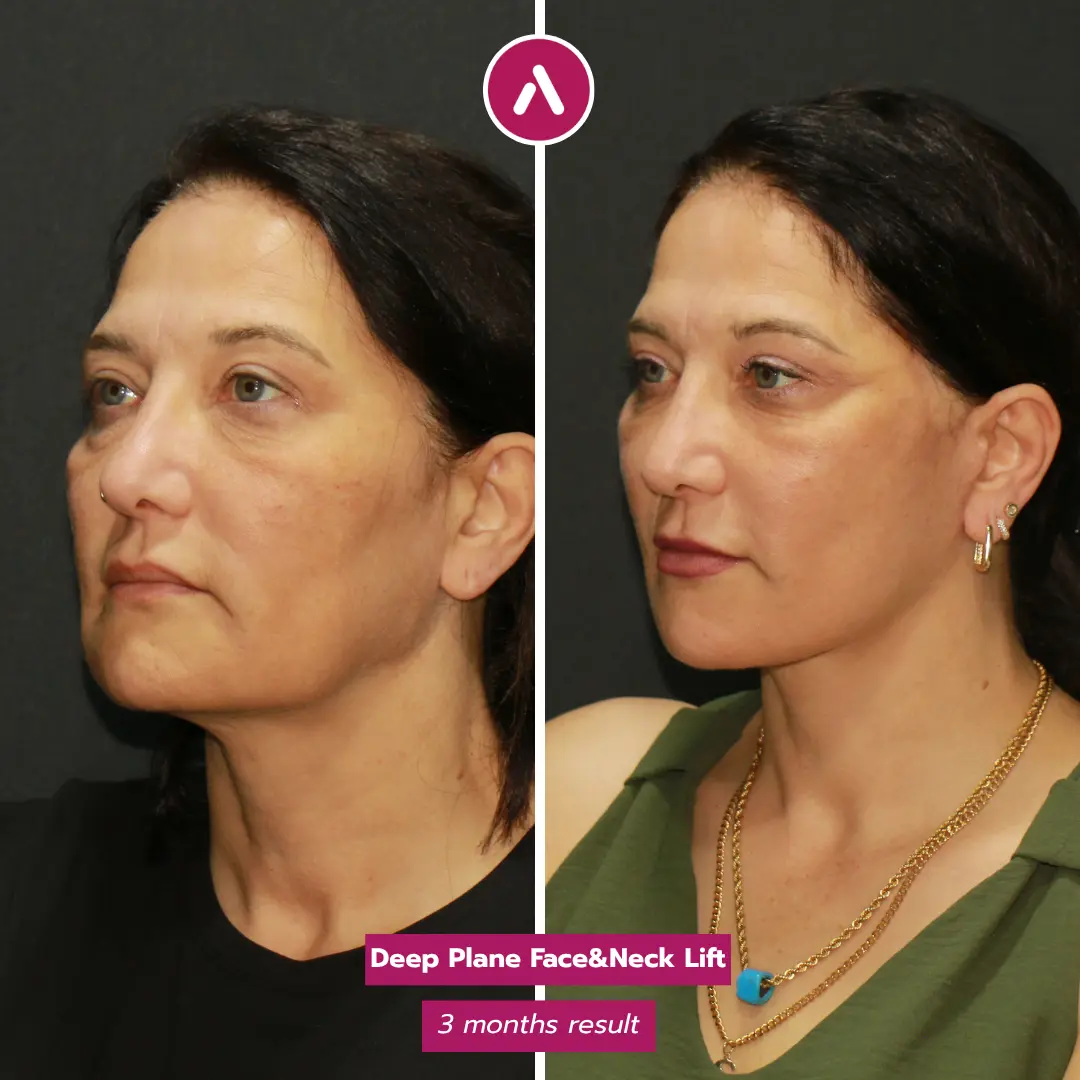
What the operating theatre experience is like (comfort, monitoring, control)
In a well-run pathway, the operating theatre experience is calm and methodical: identity checks, consent confirmation, baseline observations, and then a controlled transition into sedation. The goal is a safe, predictable experience — the opposite of the “rushed abroad” fear many British patients carry.
If you’re reading deep plane facelift in Turkey UK patient reviews, look for comments about how the team communicates on the day, how questions are handled, and whether patients felt monitored and cared for.
Immediate post-op basics: swelling (oedema), bruising, and pain plan (UK language)
After surgery, some swelling (oedema) and bruising are expected. The key difference is whether you’re prepared for it — and whether there is a clear pain and recovery plan. In Sarah’s case, she later described her recovery as painless, requiring minimal paracetamol — and she explicitly compared her experience favourably when weighing facelift London vs Istanbul quality.
Sarah’s reflection: “My recovery was painless — I barely needed paracetamol. And honestly, if I compare London vs Istanbul for quality, I would choose Turkey again.”
Recovery in Istanbul — The Milestones That Made Me “Flight-Ready”
Recovery is the part many UK patients underestimate — not because they’re careless, but because so much online content skips the “in-between”. Sarah cared about one thing as much as the final result: getting through healing in a structured way, with visible progress markers and support that made her feel safe to travel home.
For her, “flight-ready” wasn’t a vague promise — it was a checklist. Sarah wanted to know how swelling (oedema), bruising, and comfort levels would be monitored day by day, and what support would be in place if something felt unexpected. That’s why she viewed flying to Turkey for facelift as a recovery-led decision, not a travel one: the milestones in Istanbul needed to make the journey back to the UK feel calm, planned, and medically sensible.
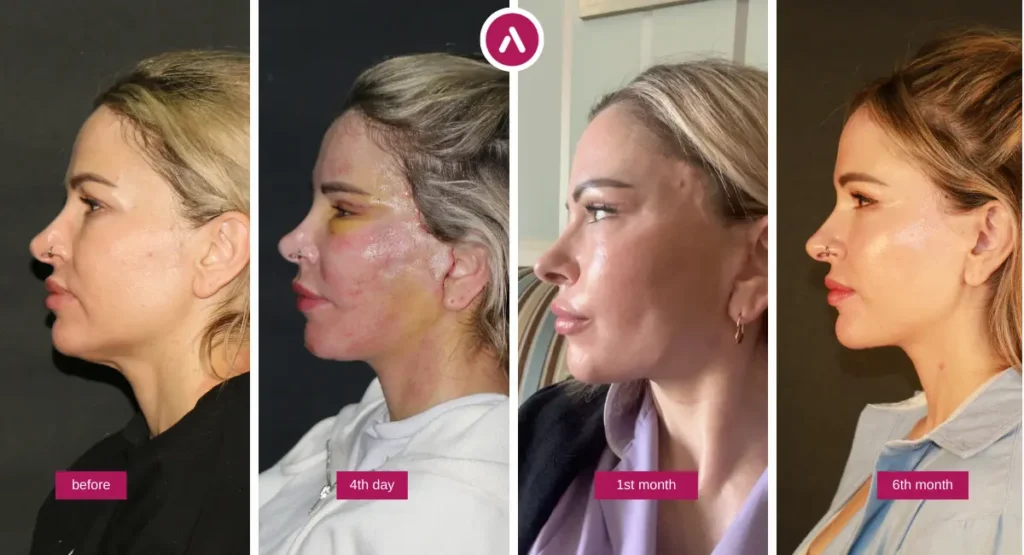
Days 1–3: what swelling/bruising really looks like (honest expectations)
The first few days are usually about rest, hydration, and gentle movement. Most patients experience:
- Peak swelling (oedema) starting early and building over the first 48–72 hours.
- Bruising that can move and change colour over several days (this is normal).
- Tightness rather than “pain” for many patients, with medication plans typically starting with paracetamol where appropriate.
When readers search deep plane facelift before and after stories, the missing chapter is often this phase. A responsible story includes it.
Days 4–7: HBOT-supported recovery and early confidence milestones
Reducing social downtime is a major goal for British patients travelling for surgery. One technology used in advanced recovery pathways is HBOT (Hyperbaric Oxygen Therapy). In plain terms, HBOT aims to support healing by improving oxygen delivery in a controlled environment — and it is commonly discussed in the context of reducing post-operative oedema and bruising.
Patients who read scientific research around wound healing often ask: “What are you doing beyond ‘wait and hope’?” A structured programme is the answer — whether that’s careful monitoring, scar protocols, or recovery technologies.
Days 7–14: LLLT scar support and practical “ready to travel” criteria
Scars are a major concern for UK patients — particularly those who wear their hair up, exercise regularly, or simply want their result to look “undetectable”. LLLT (Low-Level Laser Therapy) is often used in scar-support programmes because it can be applied in a gentle, non-invasive way.
Rather than promising unrealistic “no scars”, the better goal is: well-placed incisions + good scar care + good healing conditions. Practical “flight-ready” criteria typically include stable comfort levels, predictable swelling patterns, and a clear aftercare plan for when you land back in the UK.
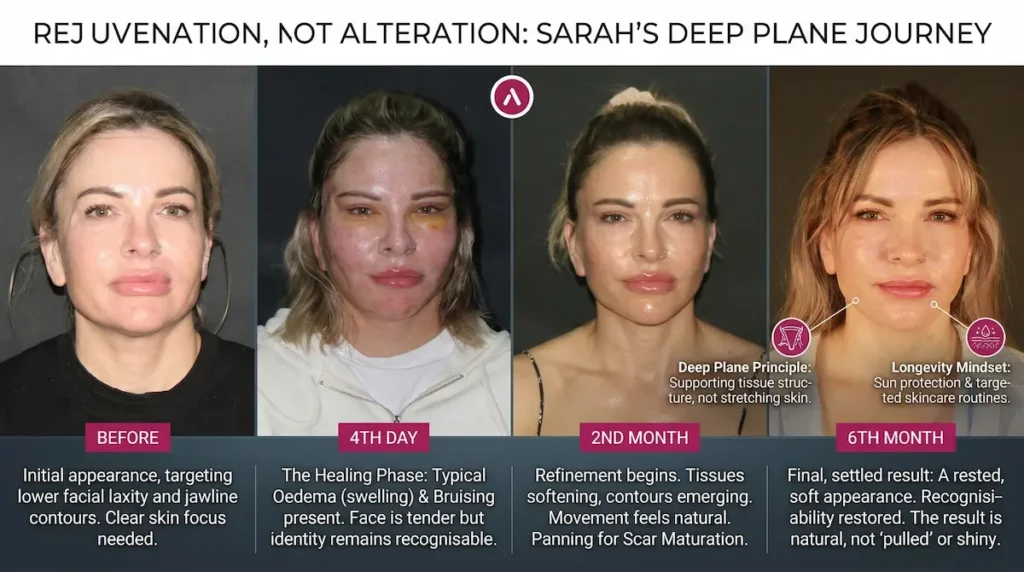
Results — Rejuvenation, Not Alteration (What Changed, What Didn’t)
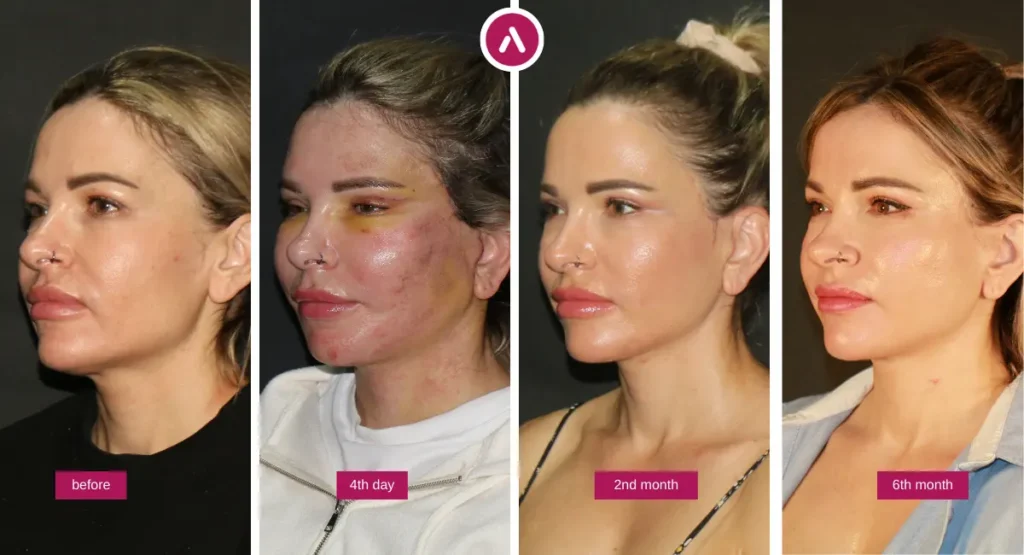
Sarah didn’t judge her result by “day 10 selfies” — she judged it by whether she still looked like herself months later. This is a key point for anyone reading deep plane facelift before and after stories: the most meaningful changes are often the most subtle, and they appear gradually as swelling settles and tissues soften.
Week 2 vs Week 6 vs Month 3: the timeline of “settling”
Deep plane facelift healing is a process. The visible “improvement” often arrives in phases: early tightening, then softening, then refinement. Sarah found it helpful to anchor her expectations to milestones rather than a single “reveal day”.
| Milestone | What you may notice | What UK patients often ask |
|---|---|---|
| Week 2 | Swelling (oedema) typically improving but still present; bruising may linger; tightness around incision lines. | “Can I be seen socially?” “Will it look obvious?” |
| Week 6 | Contours begin to look more “normal”; facial movement feels more natural; redness and firmness reduce. | “Is this my final jawline?” “When do scars fade?” |
| Month 3 | Most patients look far more “settled”; scars continue to mature; skin and soft tissue behave more naturally. | “Will the result last?” “How do I maintain skin quality?” |
Sarah’s key learning was that patience is part of the result — and it’s backed by basic healing science: inflammation reduces, collagen remodels, and scars mature over time.
Keeping identity: how we avoid the “pulled / wind-swept” look
The “windswept” fear is one of the biggest drivers behind searches like real UK patient deep plane facelift and Turkey deep plane facelift reviews. Sarah’s plan was guided by a simple principle: lifting deeper tissues in a way that supports the skin, rather than stretching the skin to create the result.
In practice, patients tend to describe a natural result as:
- Continuity (jawline and neck blend smoothly rather than looking “snatched”).
- Softness (the face looks rested, not tight or shiny).
- Recognisability (friends notice you look well, not “worked on”).
Sarah’s personal “success test”: “If someone thinks I’ve had a good holiday and better sleep, that’s perfect. I never wanted a dramatic look.”
Longevity mindset: maintenance, skin habits, and realistic expectations
Sarah approached her result like an investment in structure — and her maintenance like an investment in skin behaviour. This is where having skin-focused guidance (the kind you’d expect from a Consultant Dermatosurgeon perspective) can support scar maturation and overall skin quality over the long term.
Practical, non-extreme maintenance usually includes:
- Sun protection and barrier-friendly skincare.
- Follow-up scar care as advised (no “miracle” creams; consistency matters).
- Healthy routines that support healing: sleep, hydration, and avoiding smoking.
Aftercare Back in the UK — The Part I Didn’t Want to Gamble On
For British patients, aftercare is often the deal-breaker. Many people can accept travelling for surgery; fewer can accept feeling unsupported once they’ve landed back home. Sarah chose a pathway designed to reduce that uncertainty: clear follow-ups, defined communication channels, and reassurance that support does not end when you leave Istanbul.
UK support line (+44 WhatsApp): what I used it for, and what counts as “urgent”
Sarah valued being able to ask questions without feeling like she was “bothering” anyone. This is especially relevant for those searching deep plane facelift in Turkey UK patient reviews, because the most reassuring reviews usually mention communication, not just the final photo.
Common reasons UK patients use a support line after returning home include:
- Checking whether swelling patterns look typical.
- Scar questions: redness, itchiness, firmness, and how to manage them.
- Medication questions (often paracetamol-led plans, with clear guidance if anything stronger is needed).
Urgent concerns (for any patient, anywhere) include rapidly increasing swelling, severe pain that doesn’t respond to medication, fever, shortness of breath, or signs of infection. In the UK, that may mean contacting your medical team and seeking immediate assessment via appropriate local services if advised.
London correspondence address: documents, follow-ups, and reassurance factor
Sarah described a UK-based contact point as “psychological safety”. It mattered that she wasn’t navigating recovery alone, and that there was a structured way to handle documents and ongoing communication from Britain. For many patients reading real Turkey facelift experiences, this is the missing piece: reassurance that there is a professional system, not just a trip.
Travel safety basics: timing your return flight and reducing DVT risk (practical checklist)
Sarah planned her return based on a “flight-ready” mindset rather than the cheapest ticket. British patients often ask for a checklist they can actually use — especially those searching British patient facelift story in Istanbul content.
- Don’t rush the flight: follow your surgeon’s timing guidance based on your procedure and your healing.
- Keep moving safely: gentle walking during recovery and during travel reduces clotting risk.
- Hydrate and avoid alcohol around travel.
- Plan support: airport assistance if needed, and avoid heavy lifting.
- Know your “red flags” and exactly how to get help if something worries you.
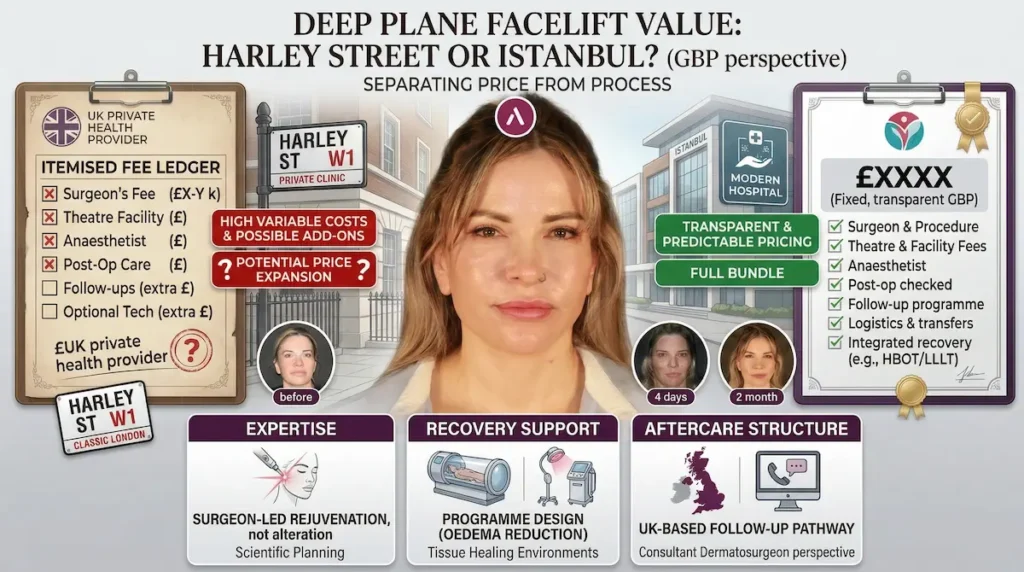
Cost & Value — Harley Street vs Istanbul (Transparent GBP Perspective)
Sarah didn’t want “cheap surgery”. She wanted value: surgeon-led planning, high hygiene standards, and a recovery programme that felt grounded in medical science — while avoiding the financial pressure of Harley Street-level fees.
For Sarah, the value question became clearer once she separated “price” from “process”. If flying to Turkey for facelift was going to make sense, the savings compared with Harley Street needed to come with measurable standards: surgeon-led decision-making, sterile theatre protocols, and a recovery pathway that reduced downtime rather than leaving healing to chance. In other words, Istanbul only felt like the right choice if the overall experience was premium — not just the invoice.
What I was quoted in the UK and what that did not include
UK private facelift pricing varies widely depending on technique, surgeon, and whether neck work is included. Deep plane approaches are typically priced higher than mini lifts. Many UK quotes are also itemised, meaning theatre fees, anaesthetist fees, and follow-ups may be separate line items.
When you read pricing discussions online, you may see deep plane facelift figures commonly quoted in the five-figure range in the UK, particularly in London.
What “all-inclusive in GBP (£)” actually means (how I avoided hidden costs)
Sarah specifically wanted clarity in GBP. She felt more comfortable with a quote that defined what was included, rather than a headline price that expanded later. If you’re comparing deep plane facelift Istanbul reviews, look for whether patients mention transparent, all-inclusive cosmetic surgery GBP pricing and whether logistics were seamless.
| Cost element | Often itemised in UK private care | Often bundled in an all-inclusive medical travel package |
|---|---|---|
| Surgeon + procedure fee | Yes | Yes |
| Operating theatre + facility fees | Sometimes separate | Commonly included |
| Anaesthetist / sedation fees | Sometimes separate | Commonly included (where clinically appropriate) |
| Post-op checks and early follow-ups | Variable | Commonly included |
| Recovery support programme (e.g., HBOT / LLLT where used) | Often separate or not offered | May be part of an integrated recovery pathway |
| Logistics (transfers, accommodation support) | Not included | Often included or organised |
Value beyond price: expertise + recovery technology + aftercare structure
Sarah’s decision was shaped by three “value pillars”:
- Expertise: surgeon-led planning with a philosophy of “rejuvenation, not alteration”.
- Recovery support: an approach designed to reduce oedema and bruising and support scar healing (often discussed in scientific research around wound healing environments and tissue recovery).
- Aftercare: a defined pathway for support once back in the UK.
Sarah’s comparison: “Avoiding Harley Street fees mattered — but only because I felt the standard and the aftercare structure were there. That’s what made it worth it.”
Frequently Asked Questions (FAQ): Deep Plane Facelift Story
These are the questions we hear most often from British patients who are reading real Turkey facelift experiences and trying to decide whether a deep plane facelift abroad can feel as safe and structured as UK private care.
Is a deep plane facelift painful?
Many patients describe tightness and pressure more than sharp pain. Pain control is individualised; in the UK, it’s common to start with paracetamol-based plans where appropriate and escalate only if needed.
How long do I need to stay in Istanbul?
It depends on your procedure scope and healing pattern, but most international patients plan to stay long enough for early post-op checks, swelling management, and safe travel clearance.
When can I fly back to the UK after a facelift?
Timing depends on your individual risk profile and how your recovery is progressing. Your surgeon should guide you based on “flight-ready” criteria rather than a fixed number of days.
Will I look “pulled” or “wind-swept”?
A natural outcome is the goal: refreshed contours without obvious tension on the skin. Reviewing longer-term photos (weeks to months) and discussing technique openly helps set realistic expectations.
What are the main risks and how are they managed?
As with any surgery, risks can include bleeding, infection, delayed healing, and nerve-related issues. A responsible team mitigates risk through thorough assessment, sterile theatre protocols, appropriate monitoring, and structured follow-up.
What does aftercare look like once I’m back in the UK?
Aftercare should include clear communication channels for questions, guidance on scar care, and defined instructions on when to seek local assessment. UK patients often value a UK-based contact point and consistent follow-up.
How do I verify surgeon credentials when booking abroad?
Ask for clear qualifications, training background, and what technique is performed routinely. You should also ask about facility standards, anaesthesia planning, and who is responsible for aftercare once you return to Britain.
If you’d like to go beyond Sarah’s story, you can also explore related guidance on Deep Plane Facelift Before After comparisons, what realistic Facelift Results look like over time, and a step-by-step Deep Plane Facelift Journey including Deep Plane Facelift Recovery milestones. We also cover practical travel questions such as when you can Fly After Facelift, plus evidence-based Pain Management After Facelift expectations. For safety-focused research, you may want to read how to evaluate a Plastic Surgeon Turkey, what Hospital Accreditation Turkey means in practice, and a transparent Deep Plane Facelift Cost breakdown, including a Turkey vs Harley Street Plastic Surgery perspective.
Medical Disclaimer: This page is provided for general educational purposes only and does not replace a face-to-face medical consultation, diagnosis, or personalised treatment plan. All surgery carries risks and outcomes vary between individuals. Suitability for a deep plane facelift surgery, procedure selection, and anaesthesia choice can only be determined after a full clinical assessment by a qualified surgeon. Always follow your clinician’s instructions and seek urgent medical attention if you develop concerning symptoms during recovery.