




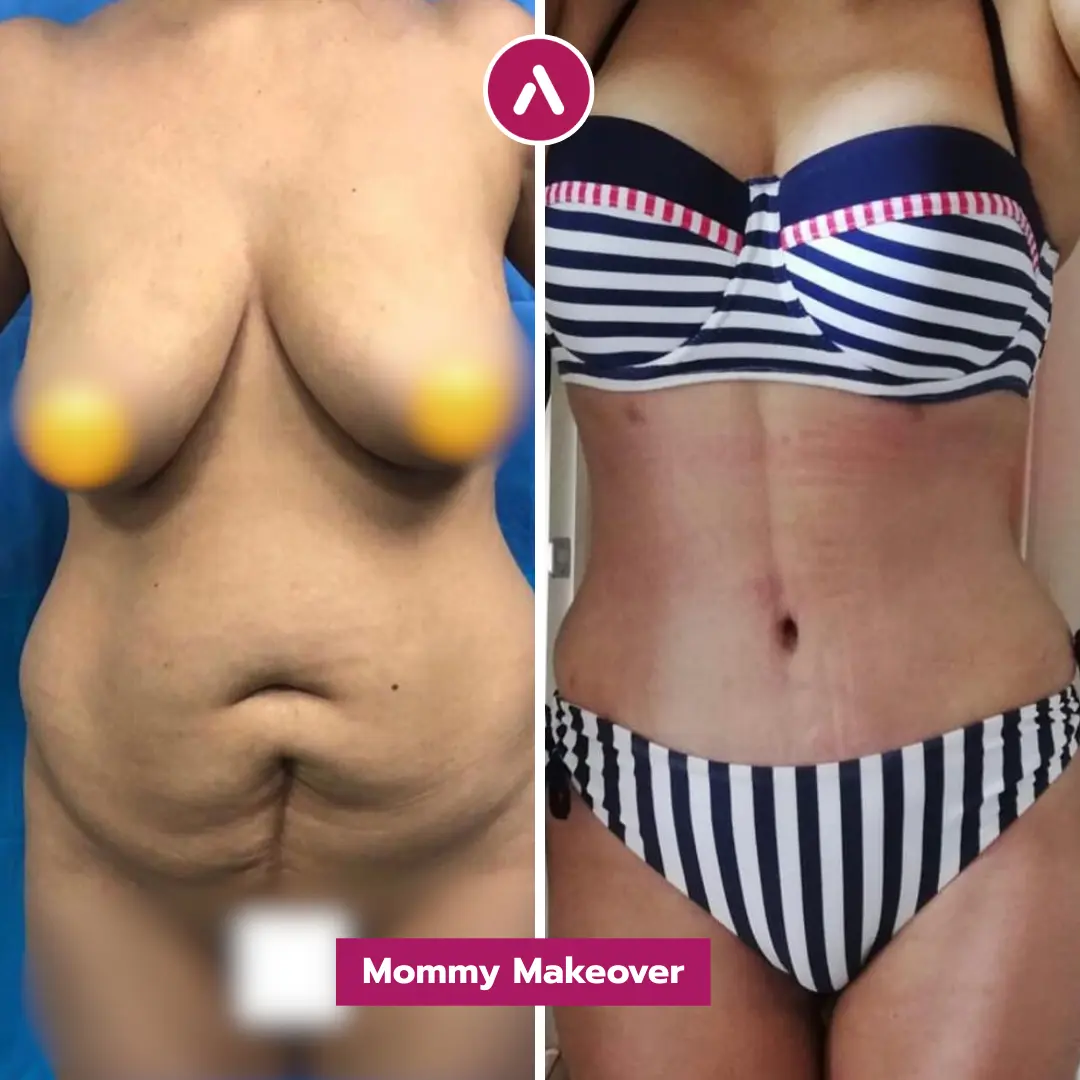
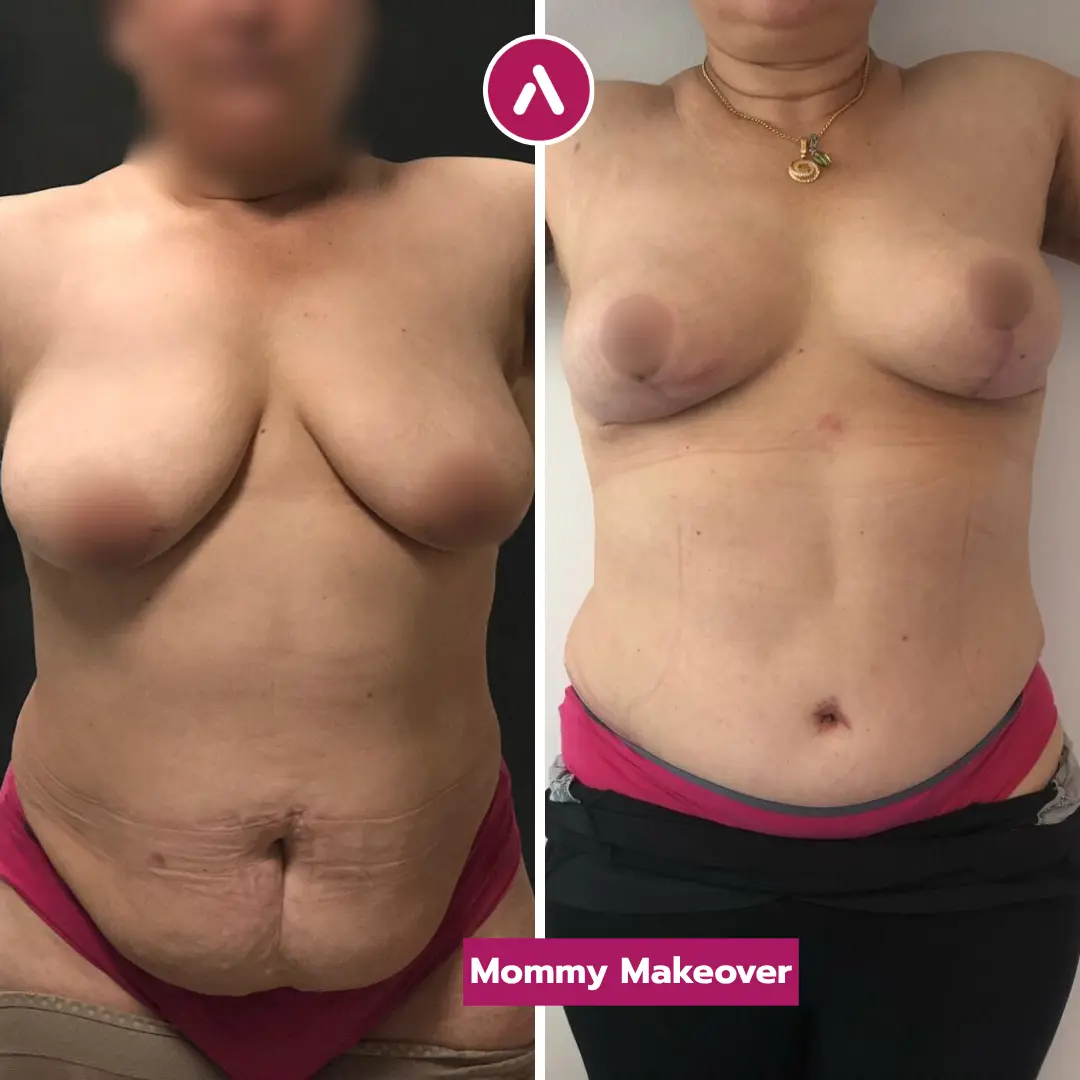
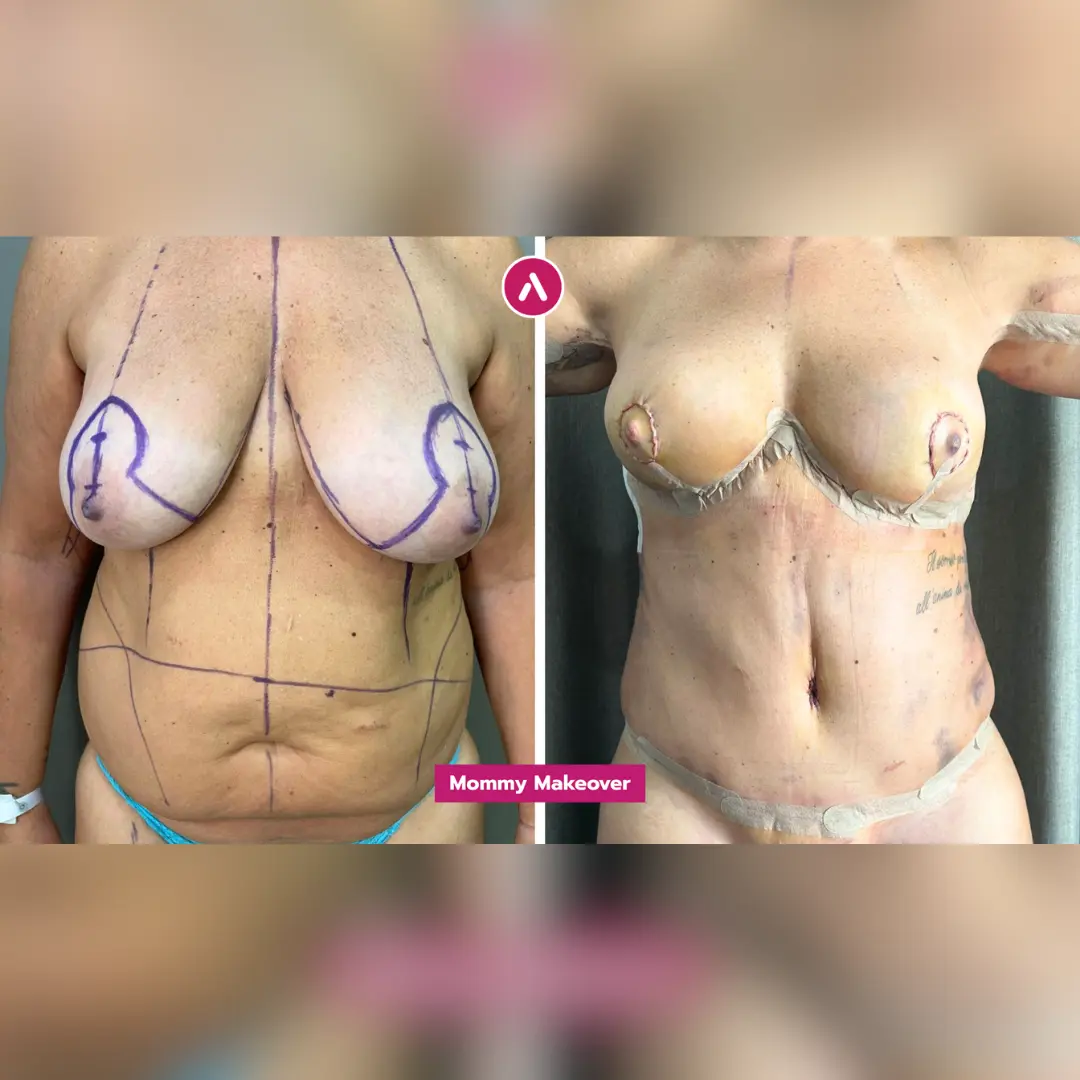
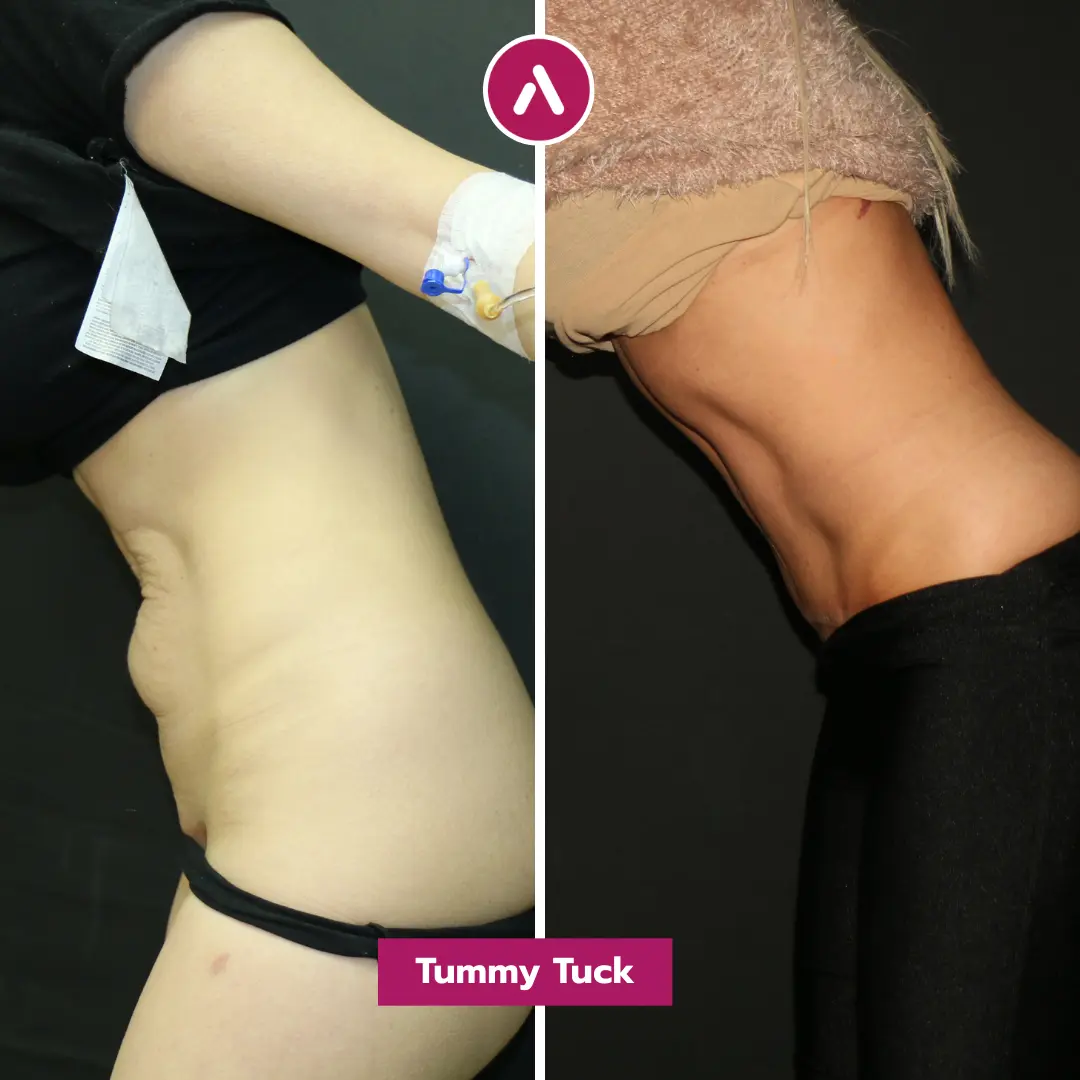
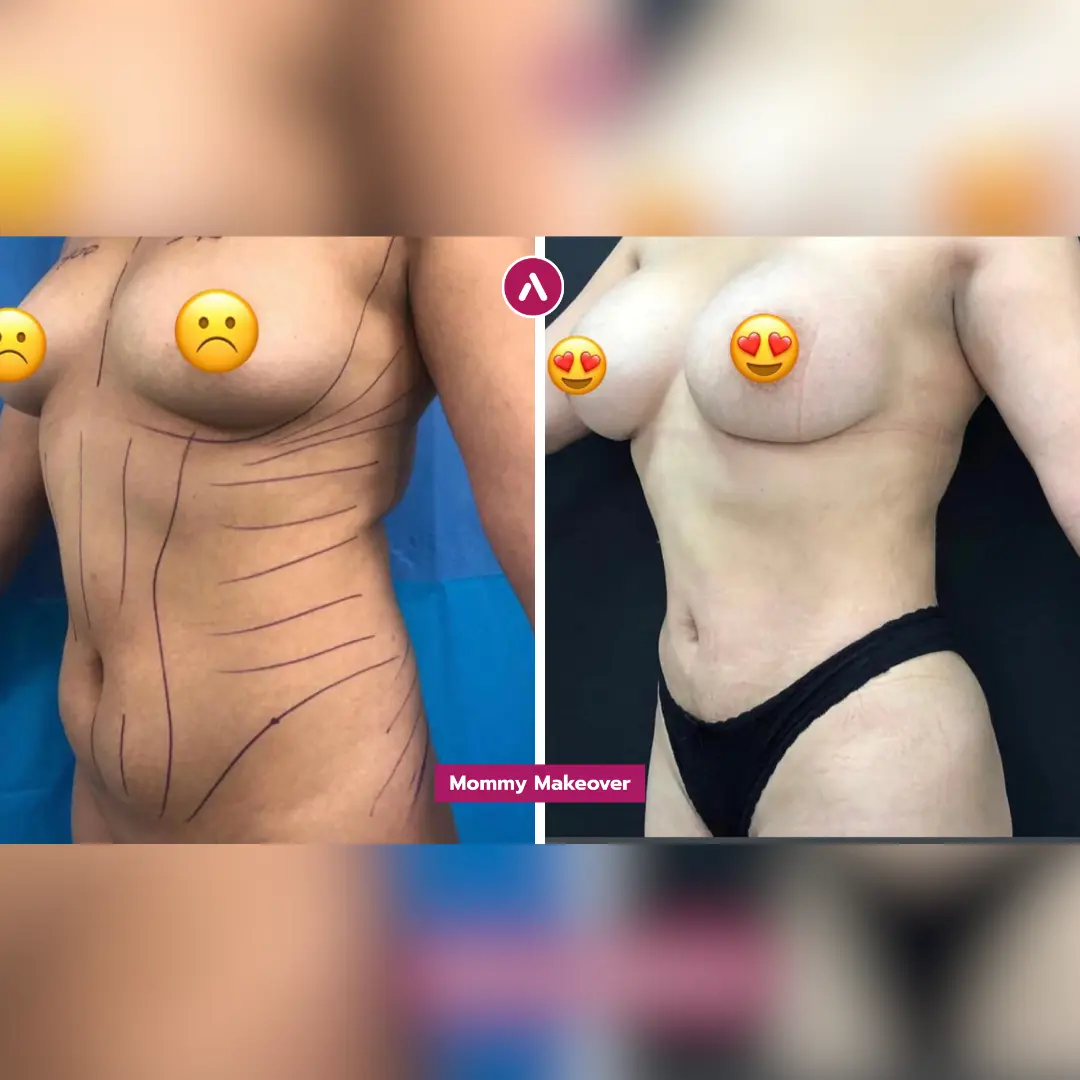
A Mummy Makeover is a personalised combination of abdominal, breast and contouring procedures designed to restore proportion after pregnancy. At AKM Clinic in Istanbul, we plan surgery around your anatomy, safety profile and goals, so results look natural in clothing and movement. It is a pathway, not a package alone.
Your guide covers which procedures may be included, anaesthesia options, recovery milestones, scar care, and risk reduction. We explain how hospital standards, screening, and our HBOT and LLLT Rapid Recovery Protocol support healing for UK patients travelling to Turkey. Book a free consultation to explore your options with next steps.
Table of Contents

What is Mummy Makeover?
A Mummy Makeover is a personalised combination of body-contouring operations designed to address changes after pregnancy and breastfeeding. It typically targets the abdomen, breasts, and stubborn fat deposits. The aim is proportion, not extremes. Treatment is planned to your anatomy. Surgery and recovery are managed as one pathway.
Most women don’t “need” a new body. They want their own shape back, with better balance and fewer day-to-day frustrations. We plan around your priorities, your starting point, and what will look natural on your frame. That means choosing the right procedures, in the right sequence, for the right reasons.
“The goal is rejuvenation, not alteration.”
What pregnancy typically changes (skin laxity, volume shifts, fat distribution)
Pregnancy can alter the body in predictable ways, even with good fitness and stable weight. Skin stretches. Some tissues don’t fully recoil. Fat distribution can shift, especially around the waist and flanks.
- Abdomen: skin laxity, stretched tissue, and a softened waistline
- Breasts: volume loss, drooping, and changes in shape after breastfeeding
- Hips and flanks: stubborn pockets that resist diet and exercise
- Back and bra-line: fullness that can affect clothing fit
These are common patterns, not a diagnosis. The right plan starts with an in-depth assessment of your anatomy and your goals.
What a mummy makeover usually includes (abdomen + breast + contouring)
A mummy makeover is not a fixed “menu”. It’s a tailored combination, built around the areas that have changed most and the results you want to prioritise. Many plans focus on three core pillars: the abdomen, the breasts, and overall contour.
- Abdomen-focused surgery: a tummy tuck (abdominoplasty) to address excess skin and restore a smoother abdominal profile
- Breast surgery: a lift (mastopexy), reduction, augmentation, or a lift with implants, depending on your starting point
- Fat reduction and shaping: liposuction to refine areas such as the waist, flanks, back, or thighs
We keep the objective simple: a more harmonious silhouette that still looks like you. Subtle, well-proportioned changes tend to age best.
Why it’s a “plan”, not a single operation (personalisation logic)
Two patients can ask for a “mummy makeover” and need completely different approaches. Skin quality, scar position from prior surgery, breast shape, and body proportions all influence what’s sensible and safe. That’s why we treat it as a surgical plan, not a one-size package.
- Procedure selection: choose the elements that create the biggest improvement for your anatomy
- Safety-first sequencing: decide what can be combined and what should be staged
- Recovery planning: align your aftercare, time off, and support at home with realistic milestones
Our European Board Certified Surgical team plans with a risk-aware mindset. The best outcomes come from good judgement, not doing “everything” in one day.
Benefits: What can a Mummy Makeover improve?
Most benefits fall into two categories: how your body looks in clothing, and how you feel day to day. For many women, the biggest shift is confidence in normal life—putting on jeans, wearing swimwear, or looking in the mirror without focusing on one “problem area”. A well-planned mummy makeover aims to restore balance between the torso, bust, and waist. The result should read as natural. Quietly improved.
Abdomen benefits (flatness, muscle tightening/repair context)
After pregnancy, the abdominal area can feel “loose” or unsupported. Excess skin can fold, crease, or sit unevenly. Some patients also notice a persistent bulge that doesn’t respond to training alone.
- A smoother abdominal contour and improved waist definition
- Removal of excess lower-abdominal skin when appropriate
- Better fit in clothes, especially around the waistband
- In selected cases, surgical correction of separated abdominal muscles may be considered as part of an abdominoplasty plan
We aim for a firm, natural contour. Not a “pulled” look. Scar placement and tension control matter as much as removal of skin.
Breast benefits (lift/shape/volume options)
Breasts can lose volume, drop, or change shape after pregnancy and breastfeeding. Some women want lift and reshaping only. Others want a fuller upper pole, a reduction in heaviness, or improved symmetry.
- Breast uplift: restores position and shape when the main concern is droop
- Augmentation: can restore volume where it has been lost
- Reduction: may relieve heaviness and improve proportion
- Lift with implants: used when both position and volume need correction
Your plan depends on tissue quality and what looks proportionate to your frame. We talk through what is realistic, and what will still look right years from now.
Body contouring benefits (waist definition, 360 approach)
Liposuction can refine areas that hold fat despite stable weight and regular exercise. In a mummy makeover plan, contouring often focuses on the waist and flanks because they influence the overall silhouette so strongly.
- Improved waist definition and smoother transitions between zones
- Refinement of flanks, back, or bra-line in selected candidates
- A “360” perspective where appropriate, so the result looks balanced from every angle
We keep contouring proportional. The goal is a natural line, not an exaggerated shape that draws attention for the wrong reasons.
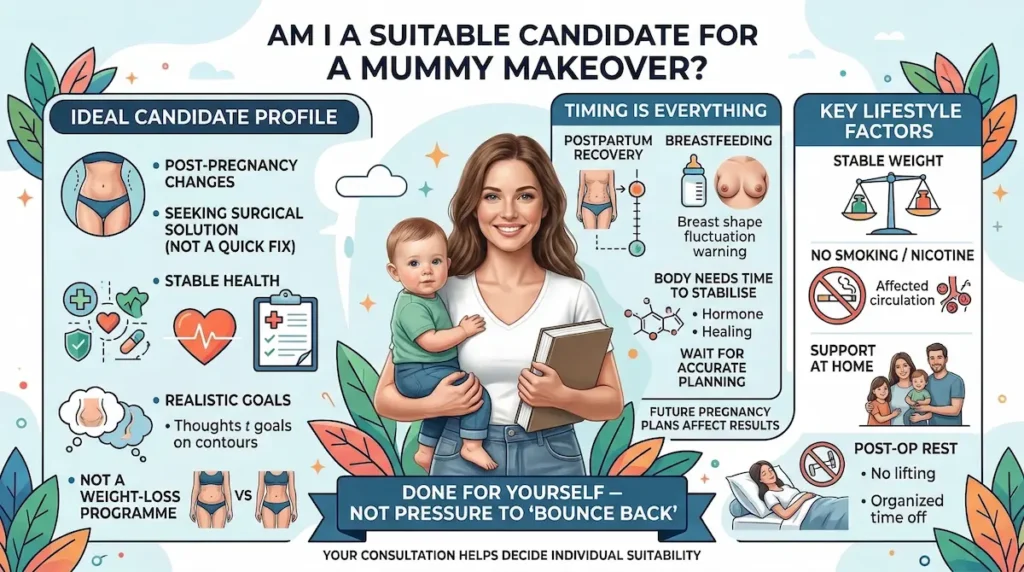
Am I a Suitable Candidate for Mummy Makeover?
A mummy makeover is best suited to people who feel their body has changed after pregnancy and want a surgical solution—rather than chasing quick fixes that don’t match their anatomy. The safest, most satisfying results usually come from the right timing, stable health, and realistic goals.
During your consultation, we assess your medical history, lifestyle, and anatomy to decide which procedures make sense, what can be safely combined, and whether a staged approach would reduce risk.
Timing after childbirth and breastfeeding (planning logic)
Your body needs time to recover from pregnancy and breastfeeding before surgery is considered. Skin quality, breast tissue, and body weight often continue to settle for months. Planning too early can compromise results (and can make your recovery harder than it needs to be).
- Breastfeeding: breast shape and volume can fluctuate; waiting helps us plan more accurately
- Postpartum recovery: the body needs time to stabilise hormonally and physically
- Family planning: a future pregnancy can affect results, especially in the abdomen
If you’re unsure about timing, we’ll guide you towards the safest window based on your individual situation.
Weight stability, future pregnancy plans, lifestyle readiness
A mummy makeover is not a weight-loss programme. It works best when you are at a stable, comfortable weight and your goals are about shape, proportion, and tissue changes (skin laxity, droop, stubborn fat areas).
- Weight stability: stable weight supports longer-lasting contour and more predictable healing
- Smoking and nicotine: nicotine can affect circulation and healing; we advise stopping well before surgery
- Support at home: recovery is easier when you can organise childcare, help with lifting, and time off
- Activity expectations: you’ll need to pause heavy lifting and intense exercise for a period while tissues heal
Most importantly, you should be doing this for yourself—not because you feel pressured to “bounce back”.
When we advise waiting or choosing a staged approach (safety)
Not every patient is best served by combining multiple procedures in one operation. Sometimes it’s safer—and ultimately better for results—to stage surgery into two steps.
- If safety margins would be tighter: complex combinations may benefit from staging
- If your priorities are clear: we can address the most important area first
- If recovery demands are high: a staged plan can reduce the burden on your body
Good surgical planning isn’t about doing more. It’s about doing what’s appropriate, safely, with a clear pathway from operation to recovery.

Which Procedures Are Included in a Mummy Makeover?
A mummy makeover plan is built from a set of procedures that address the abdomen, breasts, and overall body contour. Some patients only need two elements; others may benefit from a broader plan. The right combination depends on anatomy, skin quality, tissue behaviour, and what you want to prioritise.
Below are the most common components we may use when designing your personalised plan.
Abdominoplasty (Tummy Tuck) options and selection criteria
Abdominoplasty focuses on improving the abdominal contour by addressing excess skin and shaping the midsection. There are different approaches depending on how much skin laxity you have, where it sits, and how your waistline is affected.
- Mini tummy tuck: for limited lower-abdominal skin excess, with a smaller scope
- Full tummy tuck: for more significant skin laxity and overall contour improvement
- Extended options: when laxity and fullness extend towards the hips and flanks
We place strong emphasis on scar planning and tension management, aiming for a result that looks natural and sits well in clothing.
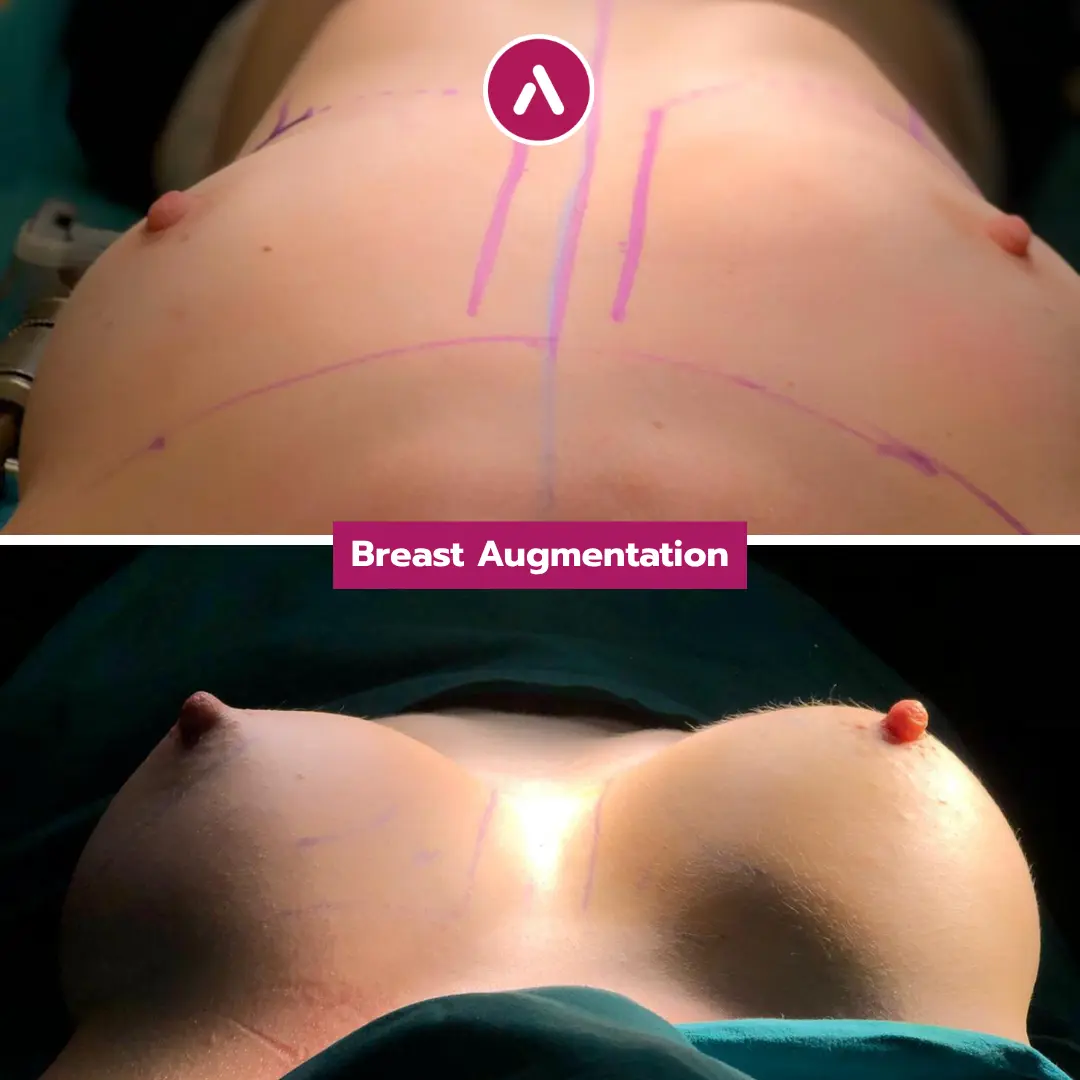
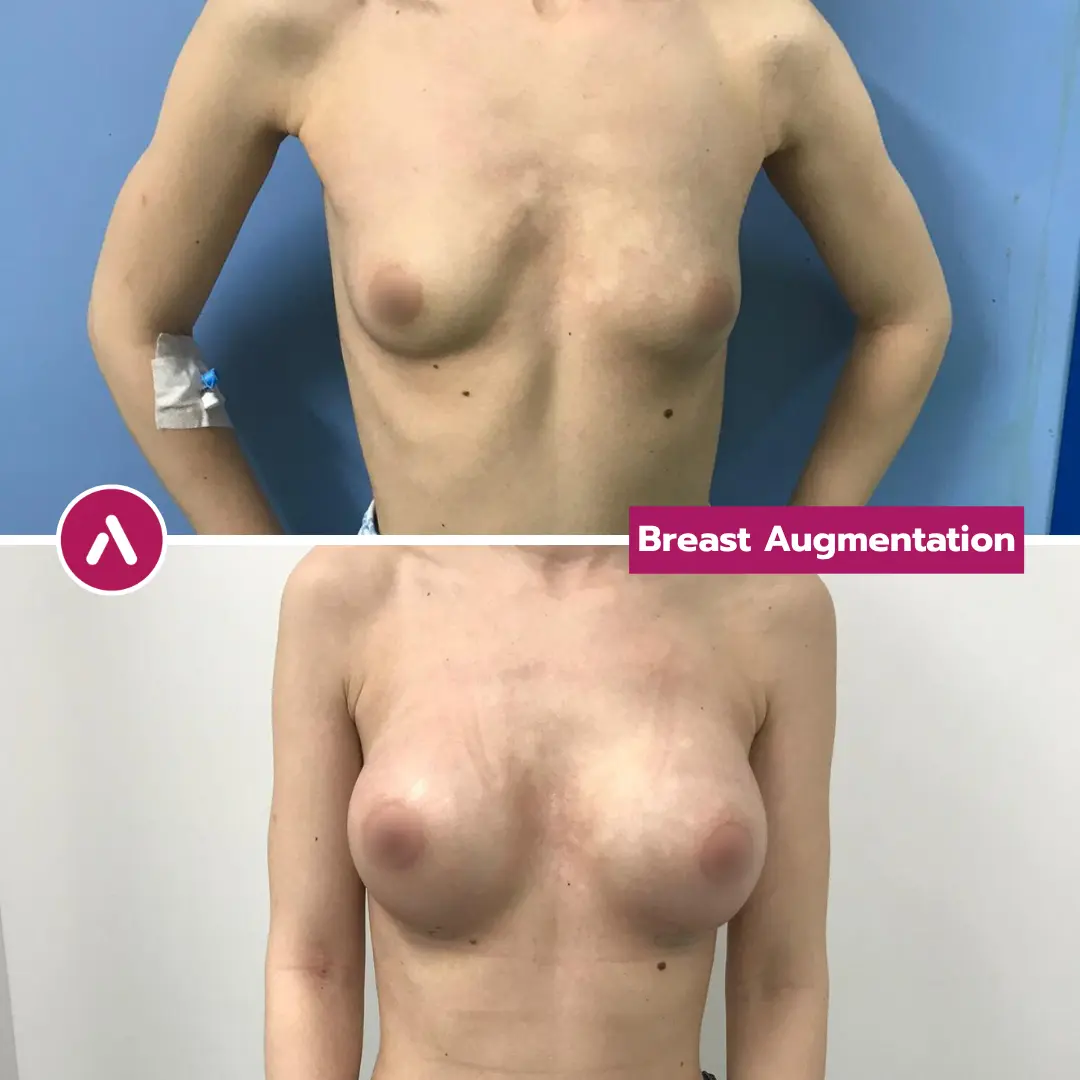
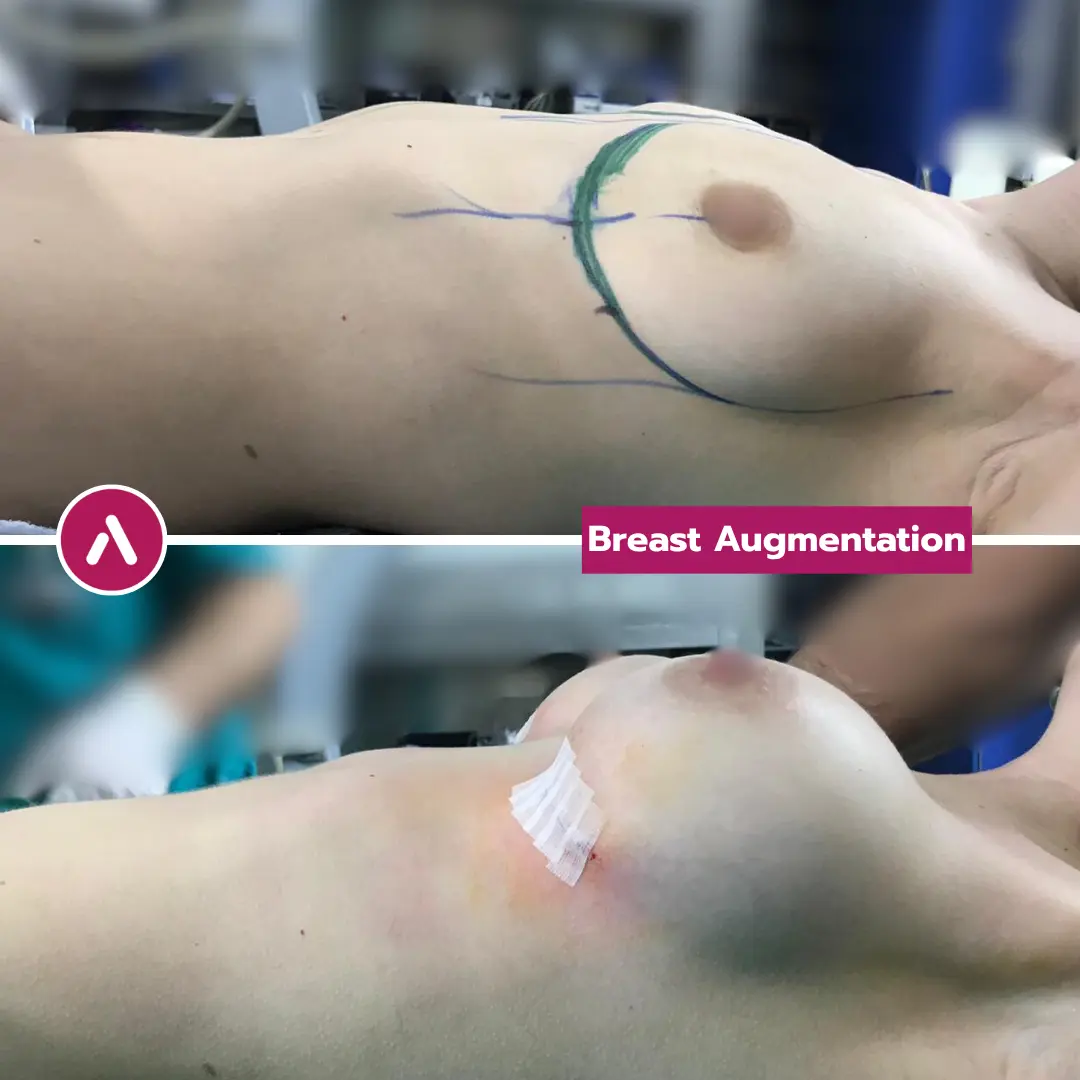
Breast surgery options (Lift, Reduction, Augmentation, Lift with Implants)
Breast changes after pregnancy often involve droop, volume loss, or heaviness. The most suitable option depends on the position of the nipple, skin quality, and the shape you want to achieve.
- Breast uplift (mastopexy): reshapes and elevates the breast when volume is acceptable
- Breast augmentation: restores volume when fullness has been lost
- Breast reduction: reduces heaviness and can improve comfort and proportion
- Lift with implants: for combined concerns—position and volume
Our focus is a proportionate result that complements your frame and remains aesthetically balanced over time.
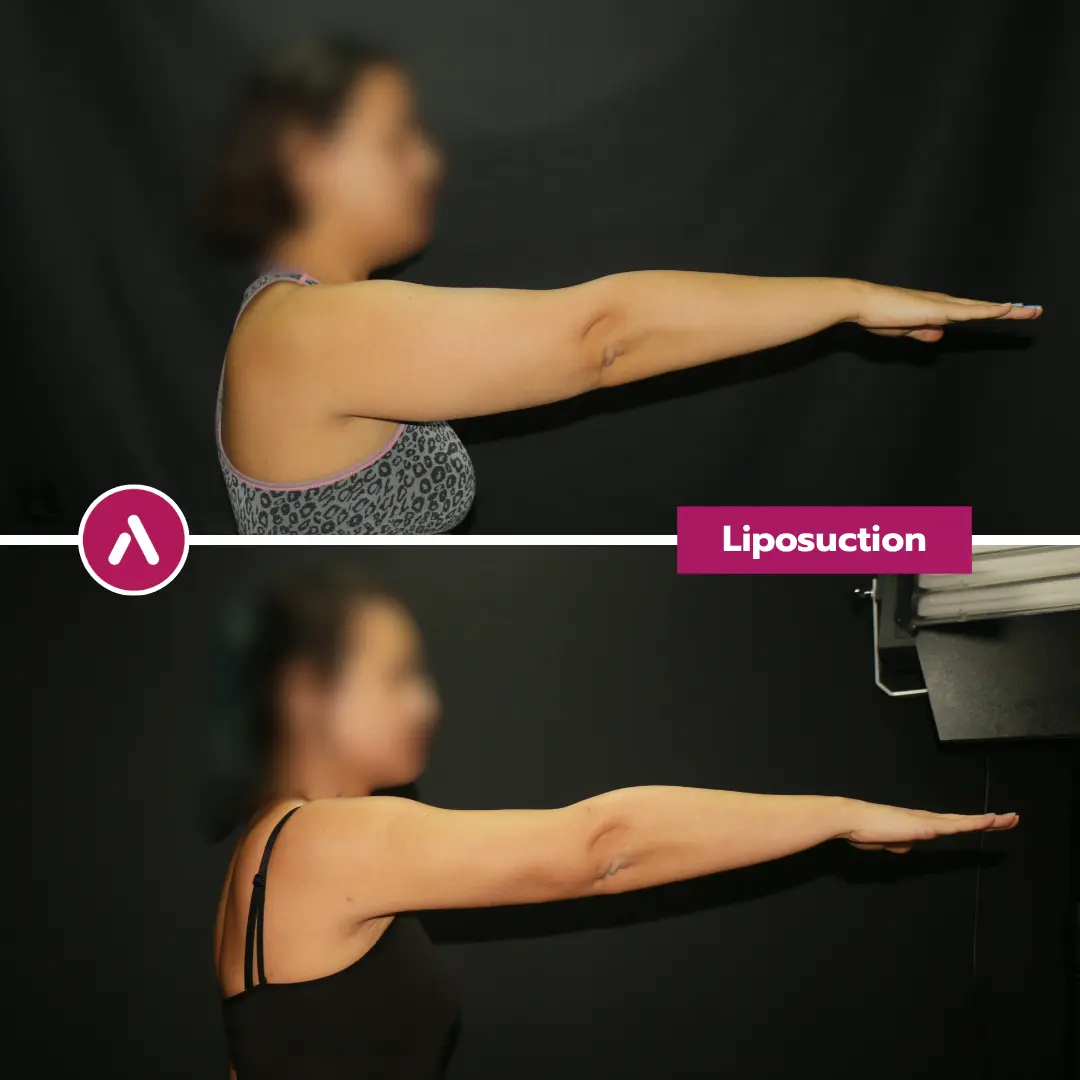
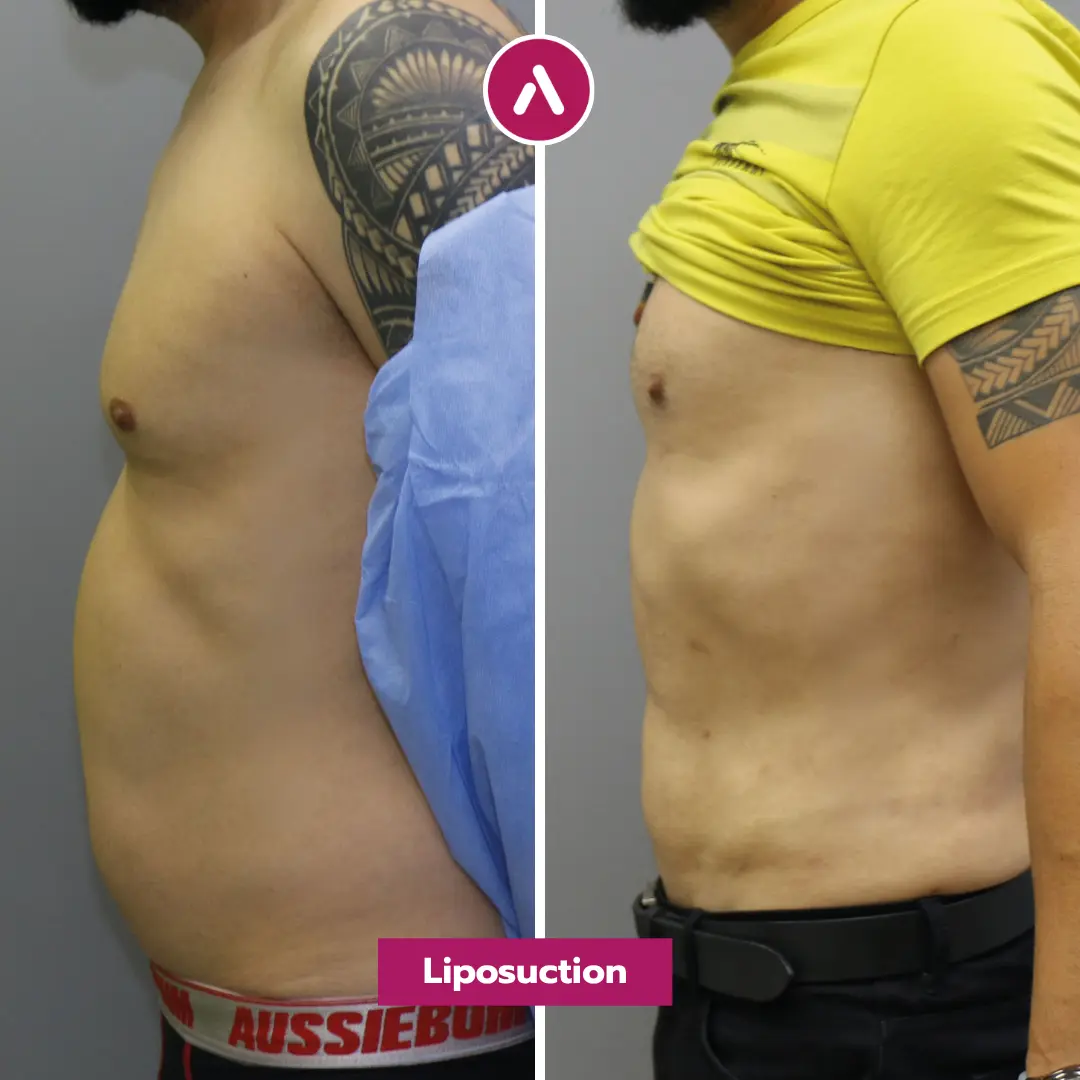
Liposuction and contouring (High-Def Vaser, “Awake Liposuction” context)
Liposuction helps refine areas where fat persists despite stable weight and healthy habits. In mummy makeover planning, contouring is often used to define the waist and improve smooth transitions between body zones.
- Common areas: waist, flanks, back/bra-line, thighs (depending on anatomy)
- Approach: “360” thinking when appropriate, for balanced results from all angles
- Goal: refinement and harmony—not extreme reshaping
In later sections, we explain anaesthesia options (including twilight sedation) and how comfort and monitoring are managed.

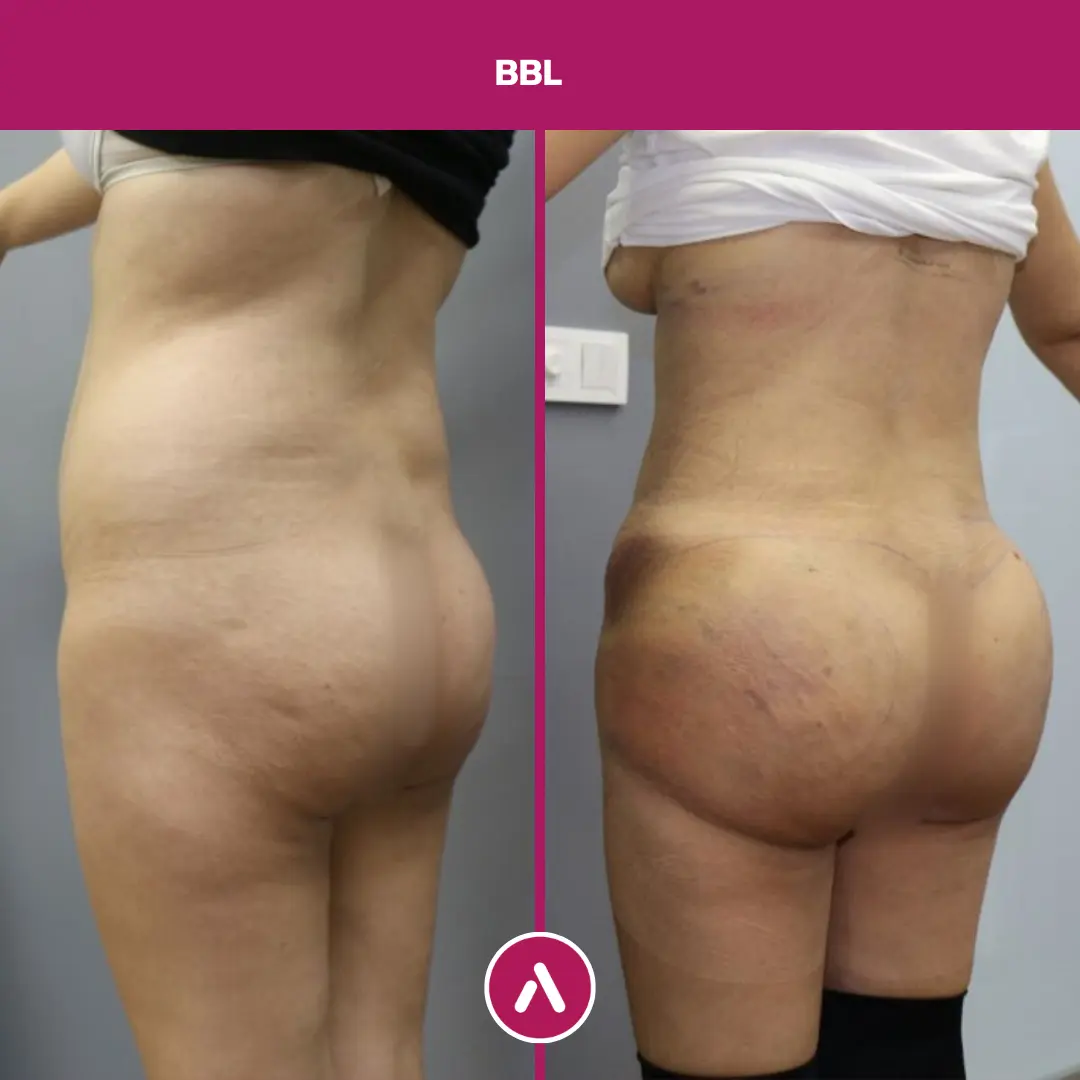
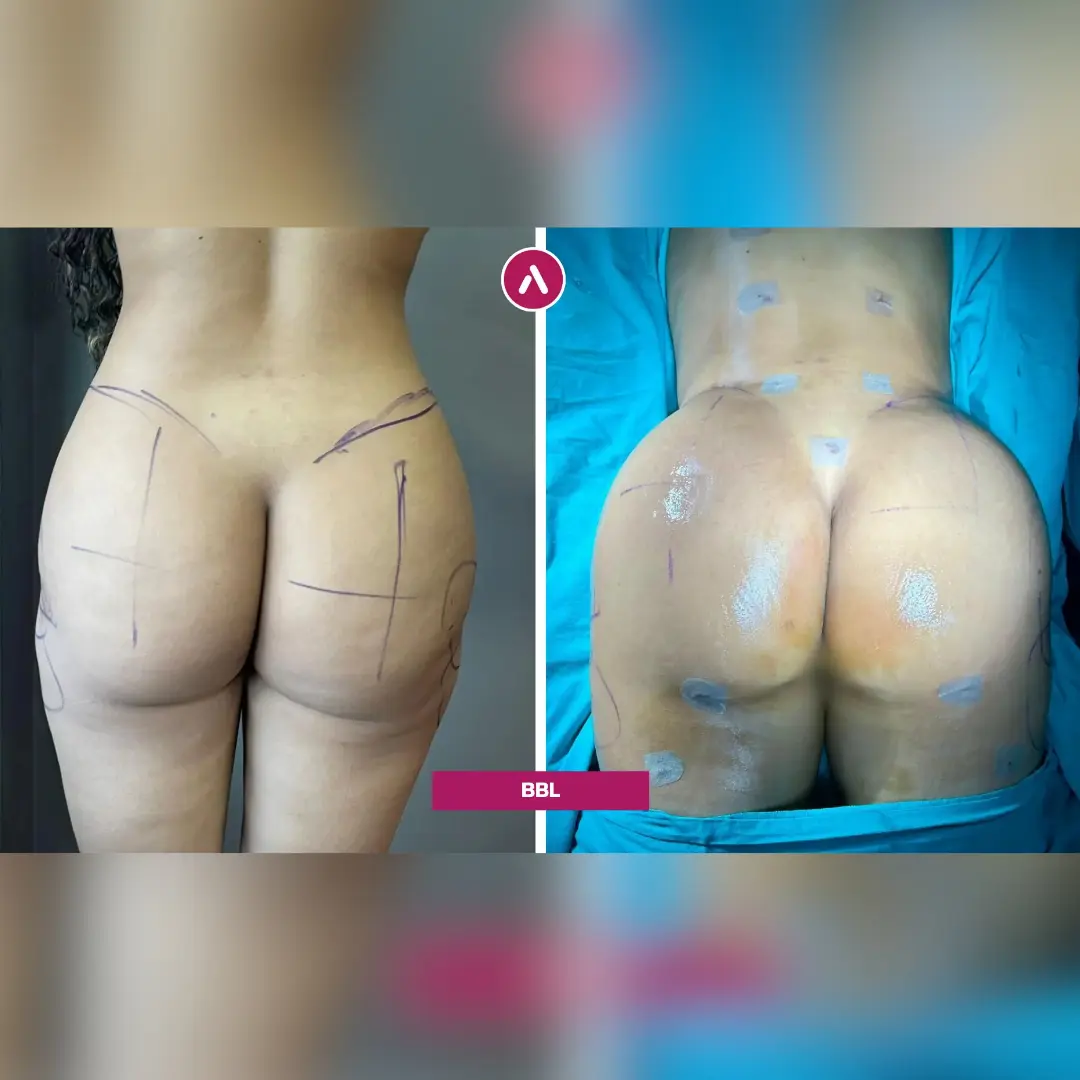
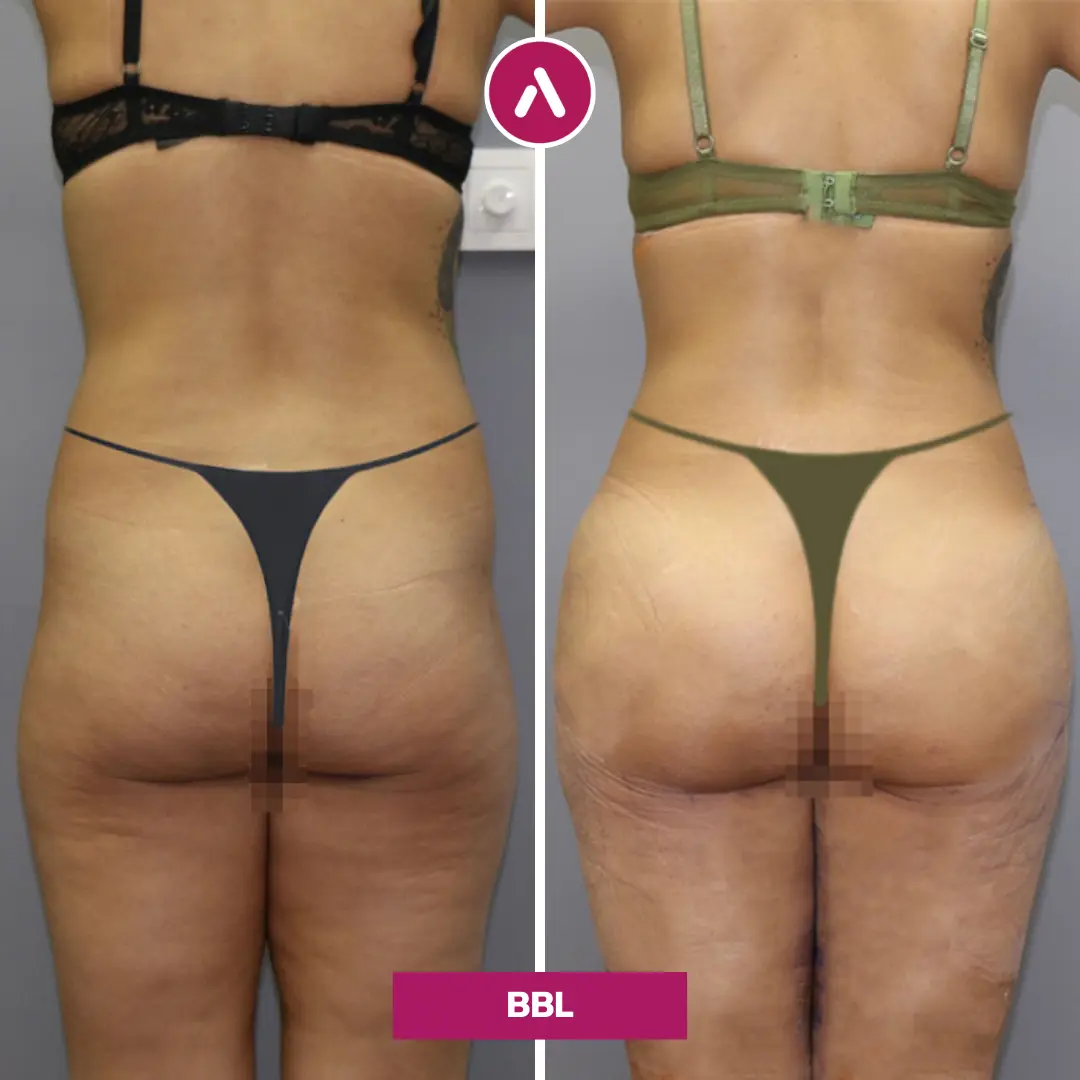
Brazilian Butt Lift (BBL)
A Brazilian Butt Lift (BBL) uses carefully processed fat—usually collected through liposuction—to enhance the shape of the buttocks. For the right candidate, it can improve projection and contour while maintaining a natural look.
- Best for: patients who have donor fat available and want subtle-to-moderate enhancement
- Key principle: proportion—enhancing the buttocks while keeping the waist and hips balanced
- Safety: candidacy and technique selection are critical; we prioritise a risk-aware plan
Thigh Lift
A thigh lift is considered when skin laxity and tissue looseness in the inner or outer thighs cause discomfort, rubbing, or difficulty with clothing fit. It focuses on tightening and recontouring, particularly when weight changes or pregnancy have affected skin quality.
- Concern addressed: loose skin and contour irregularities
- Often combined with: selective liposuction when suitable
- Outcome focus: smoother lines and improved fit in clothing
Labiaplasty and Vaginoplasty
Intimate procedures may be included for selected patients when pregnancy and childbirth have led to changes that affect comfort, confidence, or hygiene. These procedures are always approached with sensitivity, privacy, and clear medical boundaries.
- Labiaplasty: focuses on reshaping the labia where enlargement or asymmetry causes discomfort
- Vaginoplasty: may be considered in specific cases where tightening and functional concerns are discussed
- Planning: suitability is individual and assessed carefully, with realistic expectations
Body Lift
A body lift is a more extensive contouring procedure designed to address circumferential laxity—typically around the abdomen, hips, and lower back. It may be relevant when there is significant skin looseness that cannot be corrected with a standard tummy tuck alone.
- Best for: patients with more widespread skin laxity affecting the front and back
- What it targets: lower torso contour as a continuous unit
- Why planning matters: scar strategy and recovery planning are especially important
Combined procedures with Mummy Makeover: Building your plan safely
One of the reasons a mummy makeover is so powerful is that it treats the body as a whole rather than a collection of separate “problem areas”. However, combining procedures is not about doing the maximum possible in one day. It’s about selecting procedures that complement each other, can be performed within safe limits, and allow for a controlled, predictable recovery.
In your consultation we look at your priorities (what bothers you most), your anatomy (skin quality, tissue behaviour, fat distribution), and your medical profile. From there, we recommend either a single-stage plan (where appropriate) or a staged pathway designed to reduce risk while still delivering meaningful transformation.
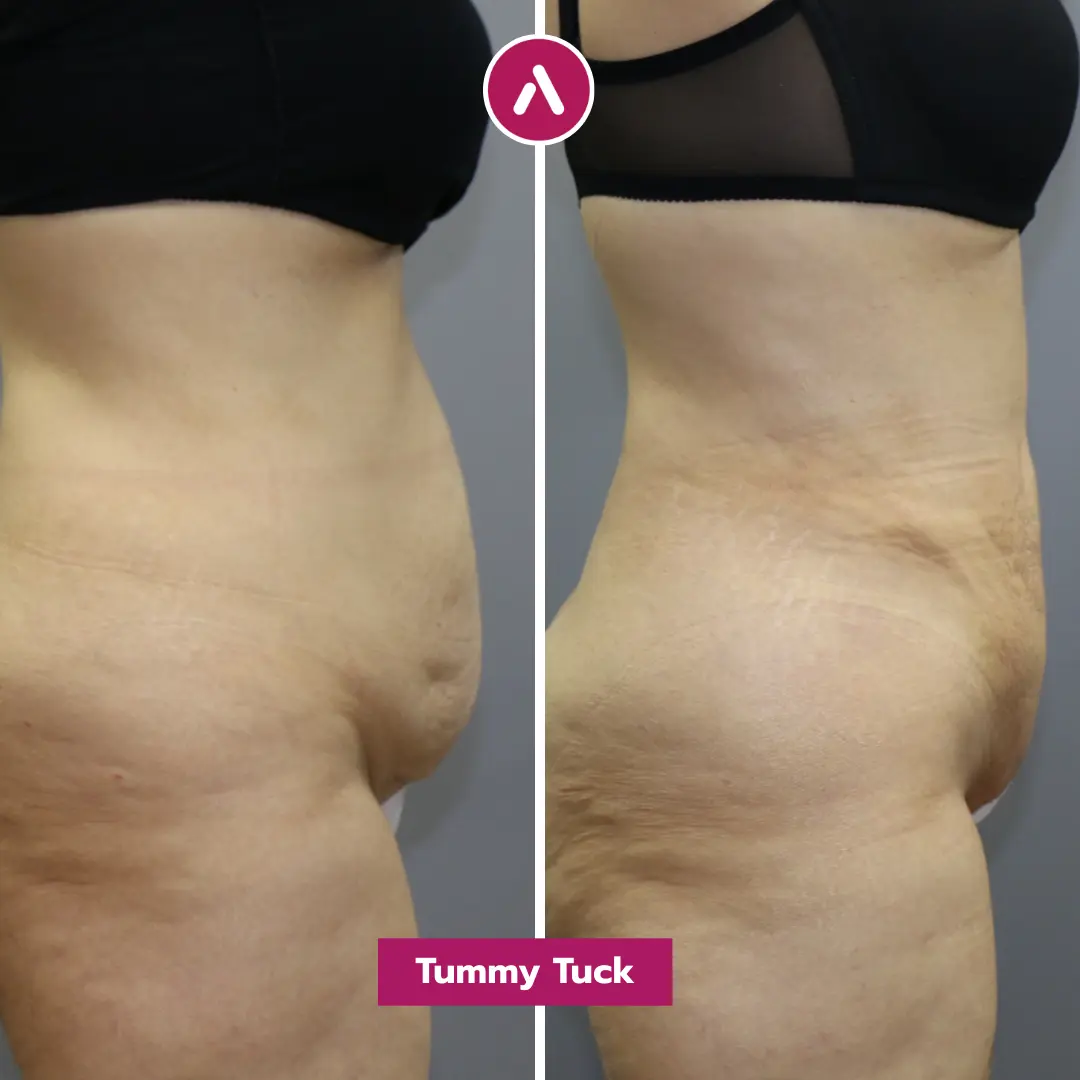
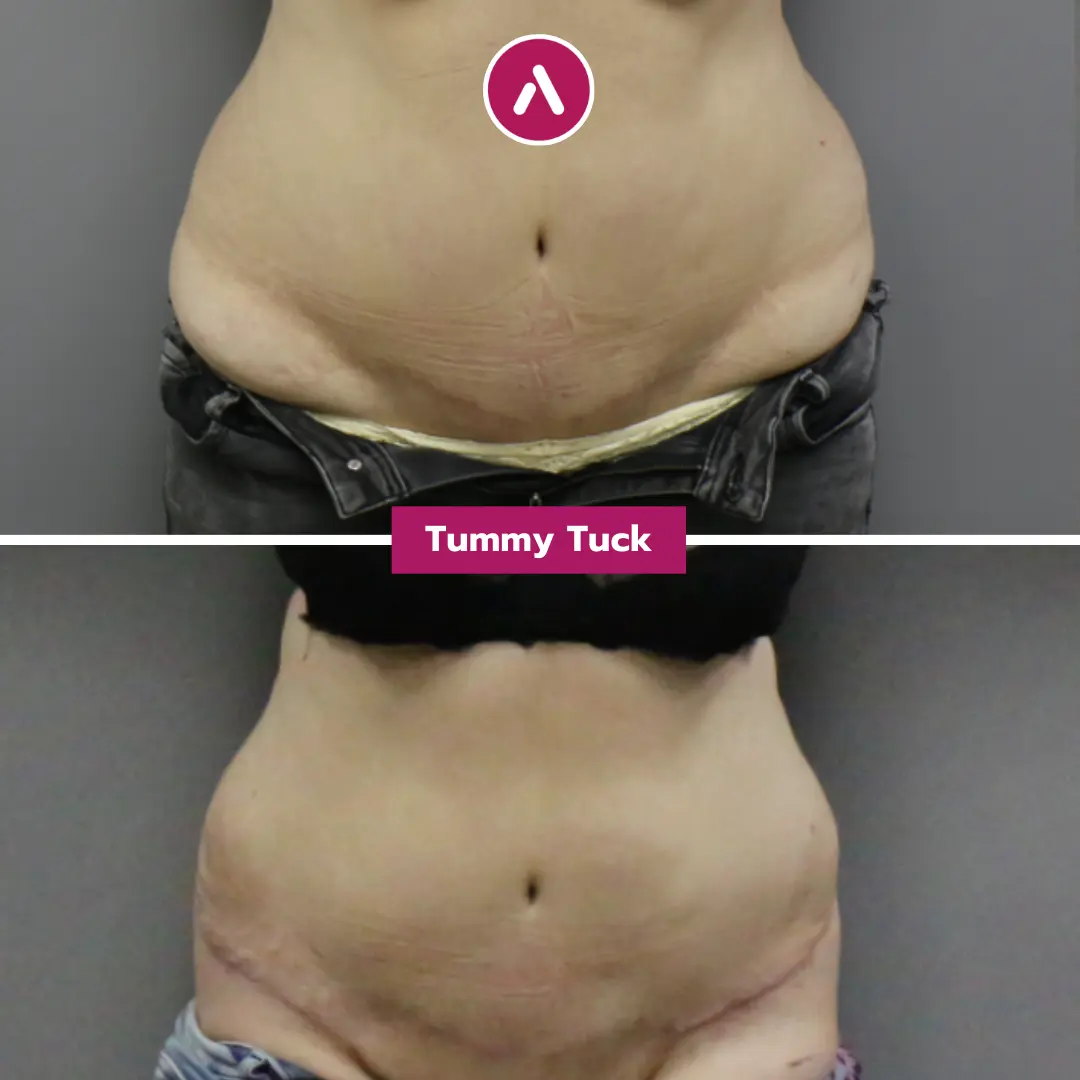
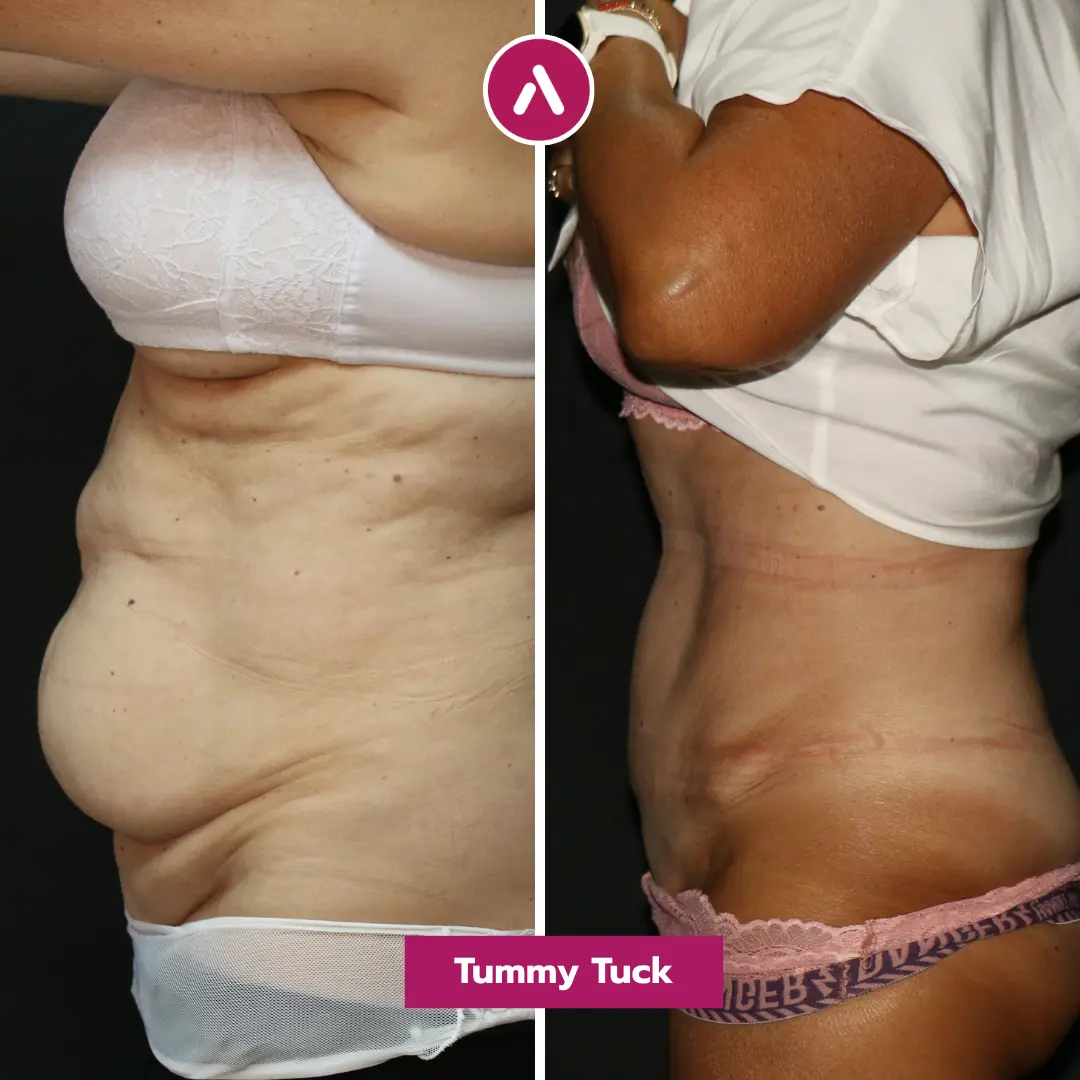
Common combinations (tummy tuck + breast lift + lipo)
Many patients benefit from addressing the abdomen and breasts together, supported by selective contouring to refine the waistline. This is often the most balanced approach because these areas tend to change together during pregnancy and breastfeeding.
- Tummy tuck + breast uplift: reshapes the torso from the lower abdomen to the bust for a more proportionate profile
- Tummy tuck + liposuction: refines the waist and flanks when skin laxity is combined with stubborn fat deposits
- Breast uplift + breast augmentation (with or without abdominal surgery): for patients primarily concerned with upper-body changes
When combining procedures, we plan around symmetry, scar strategy, and the “line” of your silhouette. The aim is a natural-looking result that makes sense from every angle, not a collection of isolated improvements.
Optional add-ons (BBL, Arm/Thigh Lift, J-Plasma Skin Tightening)
Some patients ask whether they can include additional body areas in the same surgical plan. In certain cases, carefully chosen add-ons can enhance the overall outcome—especially when they support the primary goal of proportion and contour.
- BBL (Brazilian Butt Lift): may be considered when there is suitable donor fat and your desired result is proportionate to your frame
- Arm lift (brachioplasty): for loose skin or contour concerns in the upper arms
- Thigh lift: for skin laxity and rubbing/discomfort, often paired with selective liposuction where appropriate
- Body lift: for wider circumferential laxity affecting the lower torso (front and back)
- J-Plasma skin tightening: may be considered in selected cases where skin quality and goals align
Whether an add-on makes sense depends on safety margins, operative planning, and how each procedure affects recovery. We will always prioritise a plan that is sensible for your body rather than “more surgery equals better results”.
Intimate procedures (Labiaplasty, Vaginoplasty) – when they may be considered
Some women explore intimate procedures as part of their post-pregnancy reset, typically due to changes that affect comfort, confidence, clothing fit, or hygiene. These procedures are not “routine add-ons”. They require a careful, respectful assessment and a clear understanding of what surgery can realistically achieve.
- Labiaplasty: may be discussed when enlarged or asymmetric labia cause discomfort, irritation, or self-consciousness
- Vaginoplasty: may be considered in specific cases where tightening or functional concerns are discussed in detail
- Privacy and boundaries: consultation and planning are handled with sensitivity and strict confidentiality
If intimate surgery is part of your goals, we plan it thoughtfully—considering comfort during healing, your lifestyle needs, and the safest way to integrate it into the broader surgical pathway.
Anaesthesia Choices: Why we prefer Awake / Twilight Sedation
Anaesthesia is not a “detail” in a mummy makeover—it’s a core part of safety planning and patient comfort. The best approach depends on your health profile, the combination of procedures, expected duration, and how your body is likely to tolerate surgery and recovery.
In suitable candidates, awake procedures and twilight sedation (conscious sedation) can be considered as alternatives to general anaesthesia for certain components of treatment. Where general anaesthesia is more appropriate, the plan is tailored accordingly. The goal is always the same: a controlled surgical environment, predictable monitoring, and a recovery pathway that feels manageable.
Awake vs Twilight vs General anaesthesia (scope and suitability)
Different anaesthesia options can be used depending on the procedure and the patient:
- Awake procedures (with local anaesthetic): may be suitable for selected treatments where comfort and safety can be maintained without deeper sedation
- Twilight sedation: a monitored, lighter level of sedation where patients are deeply relaxed and comfortable
- General anaesthesia: used when the scope, combination, or surgical requirements make it the safest and most appropriate option
We recommend the method that matches your plan—not the other way around. Some procedures simply require general anaesthesia to be performed safely and precisely.
Who may benefit from avoiding general anaesthesia (anxiety profile)
Some patients feel anxious about the idea of general anaesthesia, while others want the most controlled option for longer combined procedures. When we discuss anaesthesia, we consider:
- Overall health and medical history: any factors that influence anaesthetic risk
- Procedure selection and complexity: what is being performed and how it must be performed
- Comfort and anxiety levels: how you typically respond to medical settings
- Recovery priorities: minimising nausea, grogginess, or specific post-anaesthetic concerns (where relevant)
The most important point: anaesthesia planning is individual. We do not apply a single “standard” approach to every patient.
What you feel on the day (comfort, monitoring, expectations)
Patients often want to know what the day actually feels like. While experiences vary, we plan to keep the process calm, well-explained, and clinically controlled.
- Before surgery: you’ll be assessed and prepared, with clear guidance on what happens next
- During surgery: monitoring is continuous; comfort is actively managed by the clinical team
- After surgery: you’ll be observed during the early recovery phase and given structured aftercare guidance
In the next section, we walk through the surgical day step-by-step—pre-op checks, theatre flow, and how immediate post-op monitoring and discharge planning are typically managed.
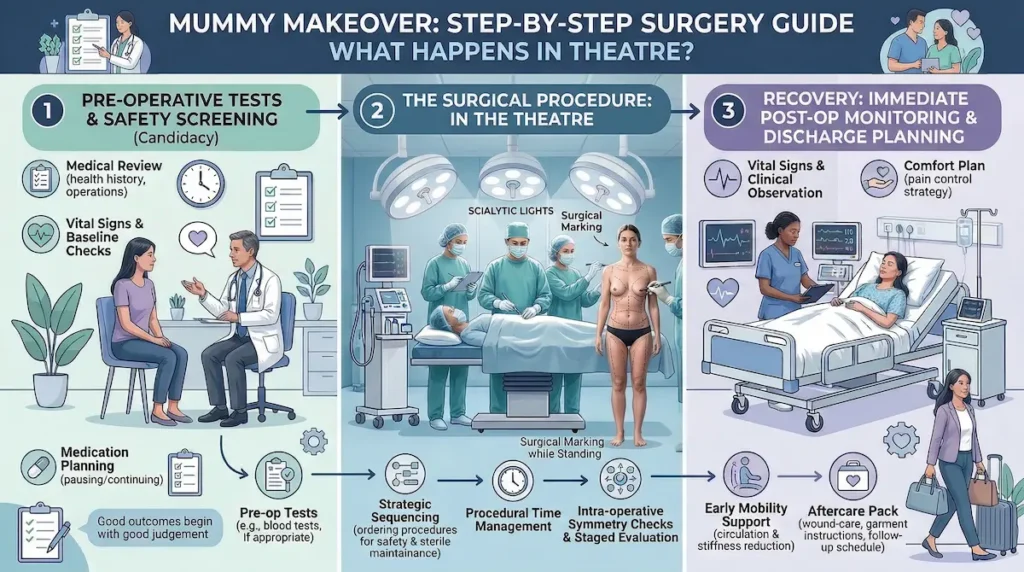
Mummy Makeover Surgery Step-By-Step: What Happens in Theatre?
Understanding the surgical day can reduce anxiety and help you plan practicalities—especially if you are travelling for treatment. While every plan is personalised, the flow below reflects how a typical mummy makeover pathway is organised, from pre-operative checks through to early recovery and discharge planning.
Mummy Makeover Pre-op tests and safety screening (candidacy)
Safety starts before you enter theatre. Your clinical team will review your medical history, medications, allergies, and lifestyle factors that can affect healing. You may also have pre-operative tests to confirm you’re fit for surgery and to identify any risks that require adjustment of your plan.
- Medical review: health history, previous operations, pregnancy history, and any ongoing conditions
- Medication planning: what to pause, what to continue, and what to avoid around surgery
- Baseline checks: vital signs and clinical assessment to confirm readiness for theatre
- Pre-op tests (as appropriate): blood tests and other checks based on your profile and planned procedures
If anything raises concern, the plan is adjusted. In some cases, we may advise delaying surgery until it is safer to proceed. Good outcomes begin with good judgement.
Marking, sequencing (which part first), typical duration ranges
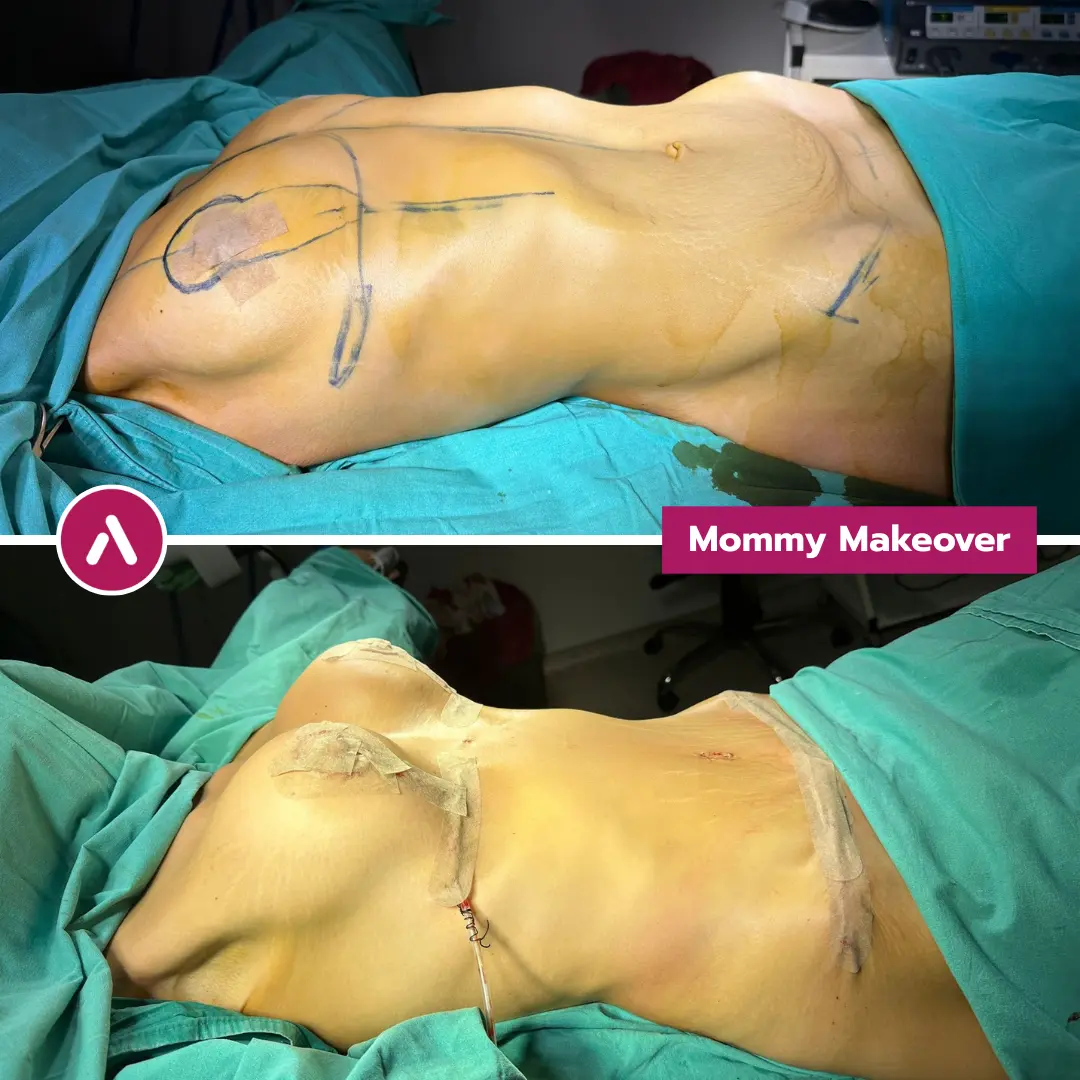
On the day, your surgeon will mark the planned incision lines and key anatomical landmarks. Marking is not “admin”. It is part of precision—helping to guide symmetry, scar placement, and the final contour.
For combined procedures, sequencing matters. The order is planned to protect your safety, maintain sterility, and deliver the best aesthetic result. Your exact surgical time will vary depending on what is included, but we plan carefully to keep within safe operative limits.
- Marking: performed with you standing (where appropriate), so the plan matches gravity and natural body lines
- Sequencing: determined by the procedures selected and what supports safe, controlled progress
- Intra-operative checks: symmetry assessment and staged evaluation throughout the operation
Because mummy makeover plans can vary widely, comparing operative times online is rarely helpful. What matters most is the quality of planning and adherence to safety margins.
Immediate post-op monitoring and discharge planning
After surgery, you’ll be monitored closely while you wake and stabilise. The team will focus on comfort, mobility support, and early recovery milestones. Before discharge, you’ll be given clear instructions so you know exactly what to do (and what not to do).
- Monitoring: vital signs and clinical observation during the early recovery phase
- Comfort plan: pain control strategy and guidance on positioning
- Mobility support: safe movement guidance to help circulation and reduce stiffness
- Aftercare pack: wound-care guidance, garment instructions (if used), and follow-up schedule
You should leave feeling informed—not uncertain. A structured discharge plan is part of a safe surgical pathway, especially for patients travelling from the UK.

Mummy Makeover Recovery Timeline & Aftercare (what to expect week by week)
Recovery is one of the biggest deciding factors for “expert patients”. The truth is simple: a mummy makeover recovery is not instant, and it shouldn’t be. Healing is a phased process, and your body needs time to settle, reduce swelling, and stabilise the new contours.
Your personal timeline depends on your procedure combination, your baseline fitness, and how your tissues respond. The guidance below is a practical overview to help you plan time off, childcare support, and realistic milestones.
First 72 hours (mobility, swelling, pain control)
The first three days are usually the most demanding. Swelling is normal. You may feel tightness, tenderness, and fatigue—particularly if the abdomen and breasts were treated together. The focus is controlled rest, gentle mobilisation, and careful adherence to instructions.
- Movement: short, supported walks are typically encouraged to aid circulation
- Swelling and bruising: expected and often most noticeable early on
- Positioning: you may be advised to rest in a slightly flexed position if abdominal surgery was performed
- Pain control: managed with a structured plan; discomfort should be controlled, not endured
If drains are used (depending on your procedure plan), you’ll be given clear guidance on care and monitoring. Not every patient will require them.
Weeks 1–2 (return to light activity; garments; wound checks)
In the first two weeks, most patients begin to feel more mobile, but that does not mean the internal healing is complete. You may still tire easily, and swelling can fluctuate—often increasing towards the end of the day.
- Light activity: gentle walking and normal daily movement, avoiding strain and heavy lifting
- Wound care: keep incisions clean and dry as instructed; attend scheduled checks
- Garments: if prescribed, compression helps support tissues and manage swelling
- Work and childcare: desk-based tasks may be possible for some patients, but lifting should be avoided
It’s common to feel “better” before you are truly ready to do more. This is where discipline matters. Doing too much too soon can increase swelling and slow recovery.
Weeks 3–6 and beyond (exercise, scar maturation, long-term)
From week three onwards, many patients feel a noticeable improvement in comfort and confidence. However, swelling can persist for longer—especially in the lower abdomen and areas treated with liposuction. Scars also change gradually over months, not weeks.
- Exercise: you may progress gradually, with your surgeon’s guidance; intense training and core strain are typically reintroduced later
- Swelling timeline: tends to reduce steadily, but can fluctuate; final contour takes time to settle
- Scar maturation: scars usually transition through phases and can continue improving for many months
- Long-term habits: stable weight, sensible activity, and good skin care help protect your results
The most reliable mindset is “steady progress”. A mummy makeover is a surgical transformation, but healing is a biological process. When you respect the timeline, results tend to look more natural—and last longer.
Mummy Makeover Scar Management: How we plan for the least visible scars
Scars are a normal part of any surgical procedure, and “scarless surgery” is not realistic. What is realistic is a thoughtful scar strategy: placing incisions where they can be concealed, closing tissues with appropriate tension control, and supporting healing with structured aftercare.
Scar quality varies between individuals. Genetics, skin type, incision location, tension, infection risk, nicotine exposure, and aftercare all influence how a scar matures. That’s why scar planning begins long before the day of surgery.
Incision placement logic (underwear line, breast fold, etc.)
Where possible, we aim to place incisions in natural creases or areas typically covered by underwear or swimwear. The goal is not just “short scars”, but well-positioned scars that heal predictably and sit discreetly.
- Abdomen: tummy tuck incisions are usually planned to sit low, within the underwear line where feasible
- Breasts: incisions depend on the lift/implant plan, and are designed around breast anatomy and symmetry goals
- Body contouring: liposuction entry points are typically small and placed in discreet locations
We also plan for body movement. A scar that looks “fine” on a drawing can behave differently when you sit, twist, or bend. That’s why incision placement and closure technique are planned together.
Early scar care vs late scar care (timeline)
Scar management is a timeline, not a single product. The first phase focuses on wound healing and protecting the incision. Later phases focus on supporting scar maturation and reducing visibility.
- Early phase (first weeks): follow wound-care instructions precisely; keep the area clean and protected, and avoid tension or stretching
- Mid phase (once healed): silicone-based care may be recommended in suitable cases; your team will advise when it is safe to start
- Late phase (months): scars often change colour and texture over time; consistent care, moisturising, and (where advised) gentle scar massage can help
Sun protection is particularly important. UV exposure can darken scars and make them more noticeable, especially in the first year. If you’re travelling, we’ll advise practical ways to keep scars covered and protected.
Technology support: LLLT and healing optimisation
Selected supportive technologies may be used as part of an optimised recovery pathway. One example is Low-Level Laser Therapy (LLLT), which some clinics incorporate to support comfort and tissue recovery during the healing process.
Technology is not a substitute for surgical technique or aftercare discipline, but it may complement a well-structured recovery plan in suitable patients. Your clinical team will advise what is appropriate for your procedure combination and healing profile.
Safety & Risks: Is a Mummy Makeover Dangerous?
Any surgery has risks. A mummy makeover can carry additional considerations because it often involves more than one procedure. The right question is not “Is it dangerous?” but:
- Are you a suitable candidate?
- Is your plan designed within safe limits?
- Are safety protocols and aftercare structured properly?
Below is a clear overview of risks and the practical steps used to reduce them. This is educational information, not a substitute for a personalised medical assessment.
Common risks (bleeding, infection, seroma, DVT/PE, anaesthesia risks)
While most patients recover without major issues, it’s important to understand the possibilities. Risks vary depending on your health profile, the procedures included, and how your body heals.
- Bleeding and haematoma: bleeding under the skin can occur and may require monitoring or intervention
- Infection: can range from mild to more significant, sometimes requiring antibiotics or additional treatment
- Seroma: fluid accumulation can occur after body contouring or abdominoplasty and may require drainage
- Wound healing issues: delayed healing can happen, particularly where tension is higher
- Scarring concerns: thickened or widened scars can occur depending on biology and tension
- DVT/PE: blood clots (deep vein thrombosis) and pulmonary embolism are serious but uncommon risks; prevention strategies are essential
- Anaesthesia-related risks: vary by anaesthetic type and individual health factors
Discussing risk does not mean expecting problems—it means respecting surgery as a medical procedure and making informed decisions.
Risk reduction: screening, monitoring, protocols (vitals, sterilisation)
Good outcomes are built on systems. Risk reduction typically includes careful pre-operative assessment, safe intra-operative management, and structured post-operative guidance.
- Pre-op screening: identifying factors that increase risk (medical conditions, medications, nicotine use, clot risk)
- Procedure planning: selecting combinations that make sense for your body and staying within safe operative limits
- Sterile technique: strict infection control and theatre protocols
- Monitoring: continuous observation of vital signs during surgery and early recovery
- Clot prevention: a prevention plan may include early mobilisation, compression measures, and other strategies as appropriate
- Aftercare structure: clear instructions, scheduled checks, and a pathway for questions and concerns
In short: safety is not a single feature. It’s a chain of decisions and protocols that work together.
If you searched “mummy makeover turkey death” – how to assess real safety
It’s understandable to feel alarmed by negative headlines or forum posts. The safest response is not to ignore your concern, and not to rely on anonymous stories either. Instead, assess safety using objective markers and transparency:
- Clear candidacy rules: reputable providers will say “no” when appropriate
- Structured anaesthesia planning: the method should match your procedure plan and health profile
- Hospital and theatre standards: ask where surgery is performed and what protocols are followed
- Post-op support: understand who monitors you, how follow-ups are organised, and what happens if you need help
- Evidence of process: a reliable team can explain their pathway from consultation to aftercare without vagueness
If you want, bring your concerns into your consultation. A serious surgical team should be willing to address risk directly, without defensiveness, and help you make a confident decision.
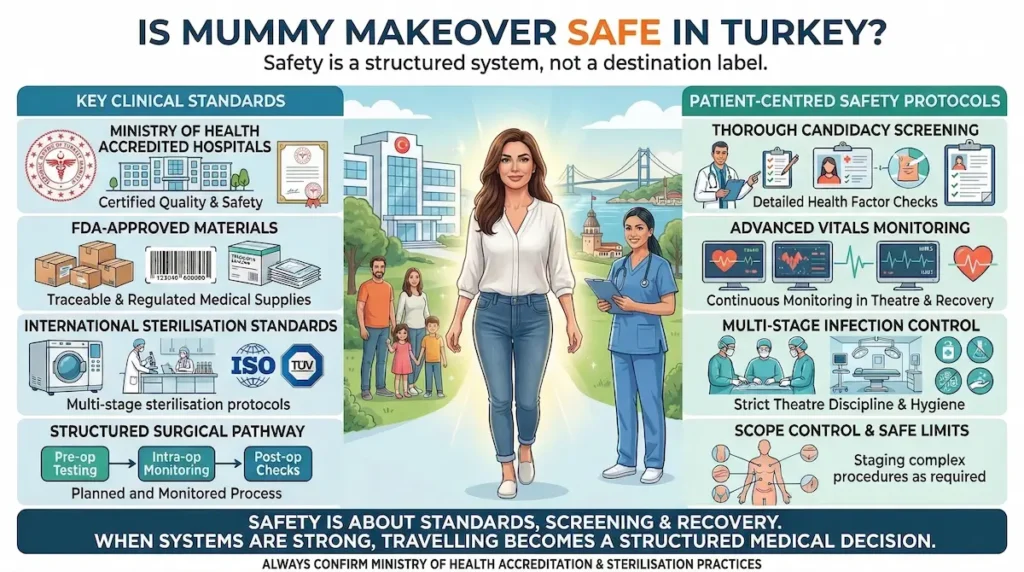
Is Mummy Makeover Safe in Turkey?
For UK patients, the real question isn’t “Turkey” as a label. It’s standards. Safety depends on where surgery is performed, how candidacy is screened, what protocols are in place, and how recovery is supported. When those pieces are strong, travelling for surgery becomes a structured medical decision rather than a leap of faith.
Hospital standards: JCI-accredited hospitals, FDA-approved materials
We perform surgery in JCI-accredited hospitals and use FDA-approved materials within your treatment plan. That matters because a mummy makeover is a multi-step procedure with more than one surgical site. You want theatre standards, sterile processing, and traceable medical supplies that meet the expectations of international patients. It’s not about marketing. It’s about reducing avoidable risk.
- Accredited hospital setting: the operating environment is designed for complex surgery and monitored recovery
- Traceable materials: the same category of regulated medical supplies used in Western markets
- Structured surgical pathway: pre-op testing, intra-op monitoring, and planned post-op checks
International sterilisation standards (ISO/TÜV) + our clinical safety approach
Safety also lives in the “boring” details. Sterilisation standards, monitoring, and screening do most of the heavy lifting. We follow ISO/TÜV sterilisation standards, with strict pre-operative screening and continuous vitals monitoring during procedures. We take a conservative approach to who we operate on, and what we combine in one session.
- Candidacy screening: we check health factors that can increase surgical or anaesthetic risk
- Monitoring: advanced vitals monitoring throughout the procedure and early recovery
- Infection control: multi-stage sterilisation protocols and theatre discipline
- Scope control: we keep your plan within safe operative limits, even if that means staging
If a clinic can’t explain these systems clearly, that’s a signal. A safe provider can walk you through the pathway without vagueness.
Why tech matters: HBOT + LLLT as our “Rapid Recovery & Safety Protocol”
Recovery is not just comfort. It’s risk management. That’s why we integrate a structured post-operative support pathway that can include Hyperbaric Oxygen Therapy (HBOT) and Low-Level Laser Therapy (LLLT) as part of our “Rapid Recovery & Safety Protocol”, when clinically appropriate. HBOT supports tissue oxygenation at a systemic level, while LLLT targets cellular activity to support healing and reduce swelling. Used properly, technology complements technique.
- HBOT: helps saturate tissues with oxygen in a pressurised environment, supporting regeneration and recovery
- LLLT: uses a therapeutic laser wavelength to stimulate cellular repair processes without heat damage
- The point: fewer recovery “surprises”, and a more predictable healing arc

Mummy Makeover Before and After: Realistic Results & Expectations
The best results are the ones that make sense for your body. A mummy makeover can produce a meaningful change, but it won’t rewrite your anatomy or ignore biology. Swelling, scar maturation, and tissue settling take time. Our philosophy stays consistent: rejuvenation, not alteration.
What “natural-looking” means for body contouring
Natural-looking results are about proportion. A flatter abdomen should still match your hips and frame. A lifted breast should suit your torso length and shoulder width. Contouring should look smooth in movement, not just in a single posed photo.
- Proportion first: we plan the torso as a whole, not isolated zones
- Skin behaviour matters: tighter isn’t always better if it increases tension and scar visibility
- Long-term logic: subtle, balanced outcomes tend to age more gracefully
When you see results (swelling resolution timeline)
Most patients see an early improvement, then a “messy middle” where swelling fluctuates. That’s normal. Liposuction areas can feel firm or uneven for a while, and the lower abdomen can hold swelling longer. Your final contour settles gradually as tissues soften and scars mature.
- Early stage: visible change, but swelling is still a major factor
- Middle stage: swelling comes and goes; shape looks better week by week
- Later stage: contour becomes more refined as tissues settle and scars fade
We’ll guide you with clear milestones and follow-ups, including long-term virtual checks, so you’re not left guessing.
Revision risk: how good planning reduces it
No ethical clinic can promise “zero revision”. Bodies heal differently. What we can do is reduce the likelihood of disappointment by planning properly and staying disciplined with safety margins. That means realistic goals, careful procedure selection, and clear aftercare guidance.
- Good selection: choosing the right procedure for your skin quality and anatomy
- Good planning: scar strategy, tension control, and staged surgery when needed
- Good aftercare: following restrictions protects your result while tissues stabilise
If your priority is the most predictable outcome, conservative planning is often the smartest approach.
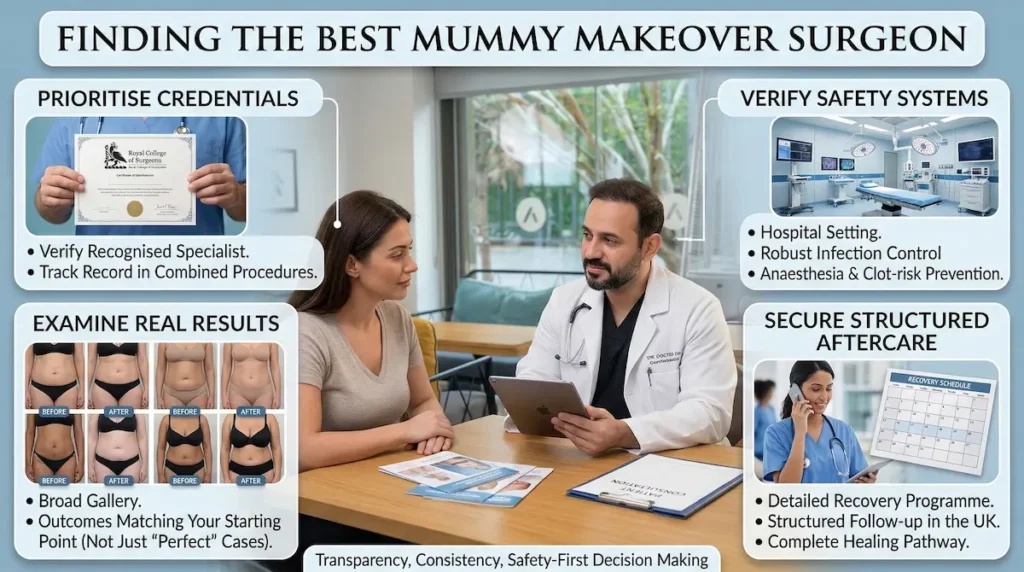
Finding the Best Mummy Makeover Surgeon
Choosing the right surgeon for a Mummy Makeover is less about marketing and more about medical decision-making. Because a Mummy Makeover often combines abdominal surgery, breast surgery, and contouring, you want a surgeon who can explain the plan in a safety-first way, set realistic expectations, and show consistent outcomes across different body types. For UK patients travelling abroad, clarity and structure matter even more: you should understand where surgery is performed, how anaesthesia is managed, and what happens after you fly home.
Prioritise credentials, surgical judgement, and proven results
Look for a surgeon with recognised specialist credentials and a track record in combined body-contouring procedures. In consultation, assess judgement: a reliable surgeon will discuss candidacy, recommend staging when appropriate, and clearly explain scars, recovery milestones, and risks. Ask to see a broad before-and-after gallery, including results that match your starting point (not only the “perfect” cases). The “best” surgeon is the one who can justify every step of your plan—and who will say no when safety margins are tight.
Verify hospital standards and safety systems, not just promises
A Mummy Makeover should be performed in a hospital setting with robust infection control, continuous monitoring, and a clear anaesthesia pathway. Ask what pre-operative screening is required, who provides anaesthesia, and how clot-risk prevention is managed. A trustworthy team can walk you through the day in theatre, immediate post-op monitoring, and discharge planning without vague language.
Choose a clinic with structured aftercare and long-term follow-up
Recovery is part of your result. Confirm who supports you in the first days, how wound checks are organised, and what the follow-up schedule looks like once you return to the UK. If advanced recovery support is offered (such as HBOT or LLLT), it should be positioned as an adjunct to good surgery and disciplined aftercare—not a substitute for either. Ultimately, the best Mummy Makeover surgeon is the one who offers transparency, consistency, and a complete pathway from consultation to long-term healing.
Mummy Makeover Cost 2026: Packages & Value (UK vs Turkey)
Price is part of the decision—but it shouldn’t be the whole decision. A mummy makeover is a high-commitment surgical journey, and the real comparison is value: standards, safety protocols, the operating environment, surgeon experience, aftercare structure, and what is actually included.
Below is a practical way to compare the UK and Turkey without falling into the “cheap vs expensive” trap.
Why prices differ (exchange rate + operational costs; without lowering standards)
Costs can differ between the UK and Turkey for reasons that are not automatically linked to lower quality. Operational expenses, staffing structures, and currency differences all influence pricing. The key is to ensure that any cost advantage is not coming from shortcuts in safety, theatre standards, or aftercare.
- Economic factors: local operating costs and exchange-rate differences
- Service structure: integrated planning and streamlined logistics can reduce overhead
- What should never change: surgical standards, sterile protocols, monitoring, and candidacy screening
If a quote feels “too good”, the right response is to verify standards and inclusions—not to assume you’ve found a bargain.
What’s included in our VIP package vs what isn’t
All Inclusive Packages only make sense when they are transparent. A serious provider should state clearly what is included, what is optional, and what might change based on your personalised plan. As a general principle, our VIP journey focuses on making the process organised and supported for international patients.
- Typically included: coordinated planning, hospital-based surgery, accommodation support, VIP transfers, and structured follow-up
- Plan-dependent elements: the exact procedure combination, length of stay, and specific aftercare needs
- Not automatically included: anything unrelated to your medical pathway, or optional add-ons that aren’t clinically indicated
Your personalised plan should be itemised so you can see what you’re paying for—and why it’s part of your pathway.
How to compare quotes safely (hidden fees checklist)
If you’re comparing clinics, use a checklist that prioritises safety and clarity. The goal is to avoid surprises and to ensure you’re comparing like-for-like.
- Where is surgery performed? Hospital setting, theatre standards, and monitoring protocols
- What is the anaesthesia plan? Who provides it, and how it matches your procedure combination
- What is included in aftercare? Wound checks, garments (if used), medications guidance, and follow-up structure
- What happens if you need support? Clear pathway for questions and concerns during recovery
- Are there “extras”? Transfers, accommodation, tests, garments, and any items that may be billed separately
When you compare surgery responsibly, the decision becomes calmer and
Planning Your Medical Trip: the VIP patient journey in Istanbul
If you’re travelling from the UK, the biggest concern is usually not the flight—it’s the logistics: “Who meets me?”, “Where do I stay?”, “What happens if I need help?”, and “How does follow-up work once I’m home?” A safe medical travel experience should feel structured, not improvised.
Our pathway is designed to reduce friction and uncertainty, so you can focus on recovery rather than admin.
Free virtual consultation and personalised plan
Your journey typically starts with a virtual consultation. This is where we discuss your goals, your medical background, and what’s realistic for your anatomy. From there, we build a personalised plan that outlines which procedures are suitable, what can be safely combined, and the expected recovery pathway.
- Goal-setting: what you want to improve most (abdomen, breasts, waistline, etc.)
- Safety planning: candidacy screening and staged vs combined recommendations
- Clarity: what’s included, what the timeline looks like, and how aftercare is structured
We aim for a plan that feels transparent and sensible—no pressure, no exaggeration, and no vague promises.
5-star hotel + VIP transfers + 24/7 patient host model
Travel logistics should support healing. For that reason, our VIP journey is designed around comfort, privacy, and predictable support—particularly in the first days post-op when you don’t want to be arranging transport or navigating an unfamiliar city.
- Accommodation: a 5-star hotel stay arranged as part of the journey
- VIP transfers: airport, hotel, and hospital transfers organised for you
- Patient host support: a 24/7 point of contact to help coordinate practical needs and communication
This isn’t “luxury for the sake of it”. It’s about reducing stress, improving organisation, and keeping your early recovery as smooth as possible.
Long-term virtual follow-up (1, 3, 6, 12 months)
Aftercare should not stop when you leave Turkey. Healing continues for months, and your questions can change as swelling settles and scars mature. That’s why we provide structured, long-term follow-up with virtual check-ins.
- Planned milestones: follow-ups typically at 1, 3, 6, and 12 months
- Guidance as you heal: recovery milestones, scar-care timing, and gradual return to activity
- Continuity: you’re supported as your result evolves, not left to figure it out alone
For many UK patients, this continuity is what turns medical travel into a confident decision—because you know there is a pathway beyond the flight home.
Mummy Makeover Frequently Asked Questions (FAQ):
Below are the most common questions we hear from UK patients researching a Mummy Makeover. These answers are designed to be clear and practical. Your personalised plan may differ depending on anatomy, medical history, and the procedure combination recommended for you.
What is a mummy makeover?
A Mummy Makeover is a personalised surgical plan that combines procedures to address common post-pregnancy changes—most often in the abdomen, breasts, and overall body contour. Rather than being a fixed set of operations, it’s tailored to your anatomy and goals. Typical components include a tummy tuck (abdominoplasty), breast surgery (uplift, augmentation, reduction, or a lift with implants), and liposuction for contouring. Some patients may also be suitable for additional procedures such as a BBL, thigh lift, body lift, or intimate surgery, depending on individual needs.
How long is the mummy makeover recovery time?
Recovery depends on which procedures are included, your baseline fitness, and how your tissues respond. Most patients find the first 72 hours the most demanding, then gradually improve over the following weeks. Many people can return to light daily activity relatively early, but internal healing continues for much longer.
What about scars and scar healing?
Scars are an inevitable part of surgery, but careful planning can make them far less intrusive. We focus on two things: placement and tension control. Where feasible, incisions are planned to sit low (for abdominal surgery) and in natural contours (for breast surgery), with closure techniques designed to support reliable healing.
Can I combine 360 lipo with a tummy tuck?
In selected patients, yes—liposuction and a tummy tuck can be combined within a mummy makeover plan. However, the best approach depends on your skin quality, the degree of laxity, and how much contouring is required. Combining procedures can deliver a more balanced result, particularly around the waist and flanks, but safety margins and tissue behaviour guide the decision.
Is mummy makeover safe in Turkey?
Safety is not about geography—it’s about standards, screening, and systems. A mummy makeover is a major surgical journey, so safe practice depends on:
Appropriate candidacy screening: reputable teams assess risk and say “no” when necessary
Hospital-based surgery: the operating environment should be designed for complex procedures and monitored recovery
Clear anaesthesia planning: the method should match your procedure combination and health profile
Infection control and monitoring: strict theatre discipline and continuous vitals monitoring
Structured aftercare and follow-up: a clear pathway during early recovery and virtual follow-ups once you return home
How long do Mummy Makeover results last?
Mummy Makeover results can be long-lasting when your weight is stable and you maintain healthy habits. Surgery removes excess skin and reshapes tissues, but your body will still change over time with ageing, lifestyle, and future pregnancies. For UK patients considering a Mummy Makeover in Turkey, we focus on proportion and realistic planning so your outcome stays natural-looking as your body settles.
How long should I stay in Istanbul for a Mummy Makeover?
Length of stay depends on which procedures are included in your Mummy Makeover and how your early recovery progresses. Most patients travelling to Istanbul need enough time for post-op checks and safe mobilisation before flying. Your personalised plan will outline an appropriate schedule, including follow-up appointments and practical guidance so you can return to the UK with confidence.
When can I fly back to the UK after mummy makeover surgery?
Flying after a Mummy Makeover is planned around swelling, mobility, and clot-prevention measures. Your surgeon will advise a safe timeframe based on your procedure combination and recovery, and you’ll receive clear guidance on walking, hydration, and support garments (if prescribed). Safety comes first—especially after combined surgery—so your return flight should be aligned with your clinical checks.
Will I need drains or a compression garment?
Not every Mummy Makeover plan requires drains, but they may be used in selected cases depending on the extent of surgery and tissue behaviour. Compression garments are commonly recommended after liposuction and abdominal procedures to support tissues and manage swelling. Your aftercare instructions will be specific to your operation, with timelines for garments, wound care, and normal daily activity.
Can I have a Mummy Makeover if I’ve had a C-section?
Many patients who choose a Mummy Makeover have had a previous C-section. Suitability depends on your scar position, skin quality, and the amount of tissue laxity. During consultation we assess how prior scars may influence incision planning and healing, and whether a combined or staged approach is safer. The goal is a well-positioned, well-healed result that fits naturally within clothing.
How do HBOT and LLLT fit into recovery and aftercare?
For selected patients, HBOT (Hyperbaric Oxygen Therapy) and LLLT (Low-Level Laser Therapy) may be used as part of a structured recovery pathway. These technologies are designed to support healing and comfort alongside good surgical technique and disciplined aftercare. If clinically appropriate, your team will explain where they fit within your Mummy Makeover in Turkey plan and what to expect during the recovery timeline.
Medical Disclaimer: This page is provided for general educational purposes only and does not replace a face-to-face medical consultation, diagnosis, or personalised treatment plan. All surgery carries risks and outcomes vary between individuals. Suitability for a mummy makeover, procedure selection, and anaesthesia choice can only be determined after a full clinical assessment by a qualified surgeon. Always follow your clinician’s instructions and seek urgent medical attention if you develop concerning symptoms during recovery.