




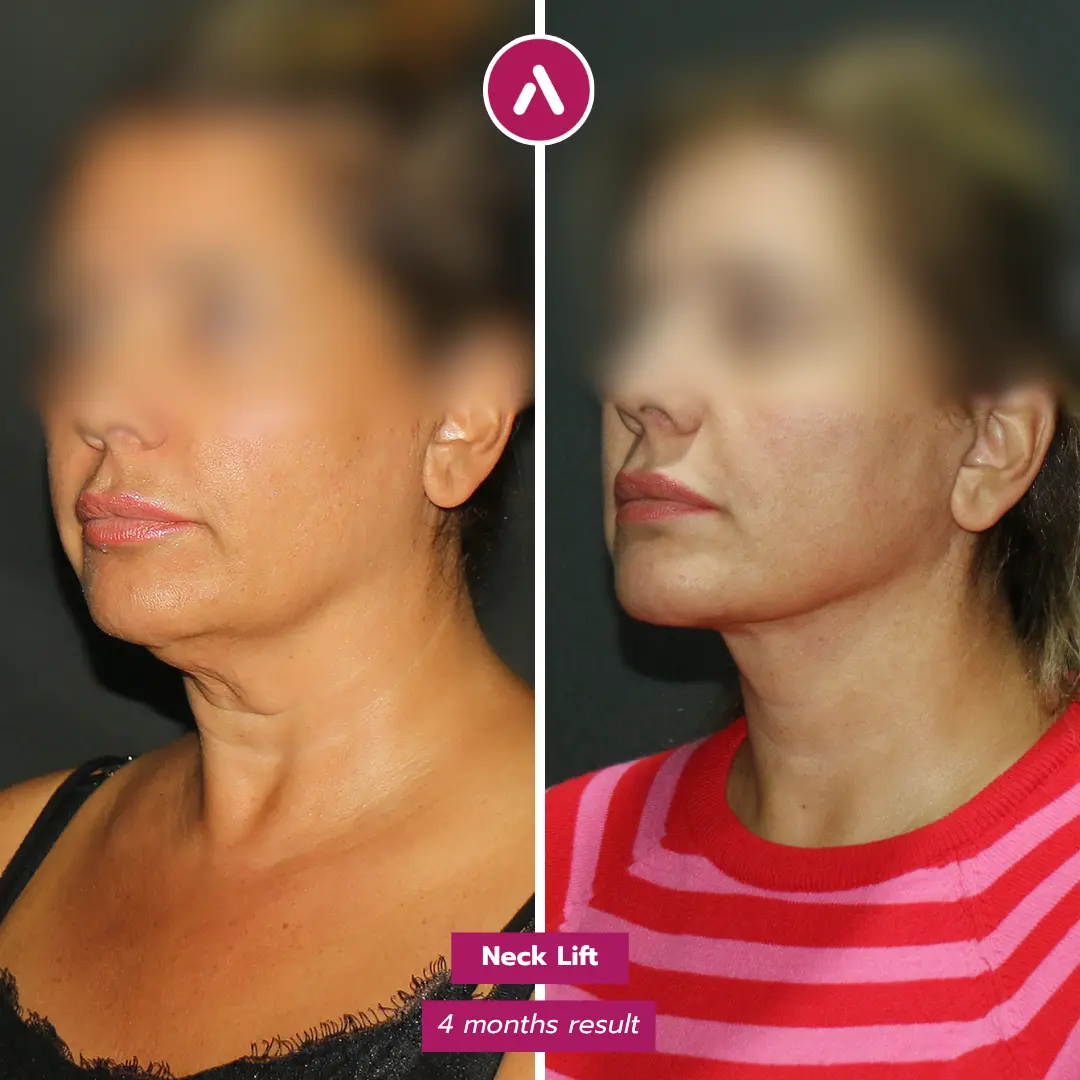
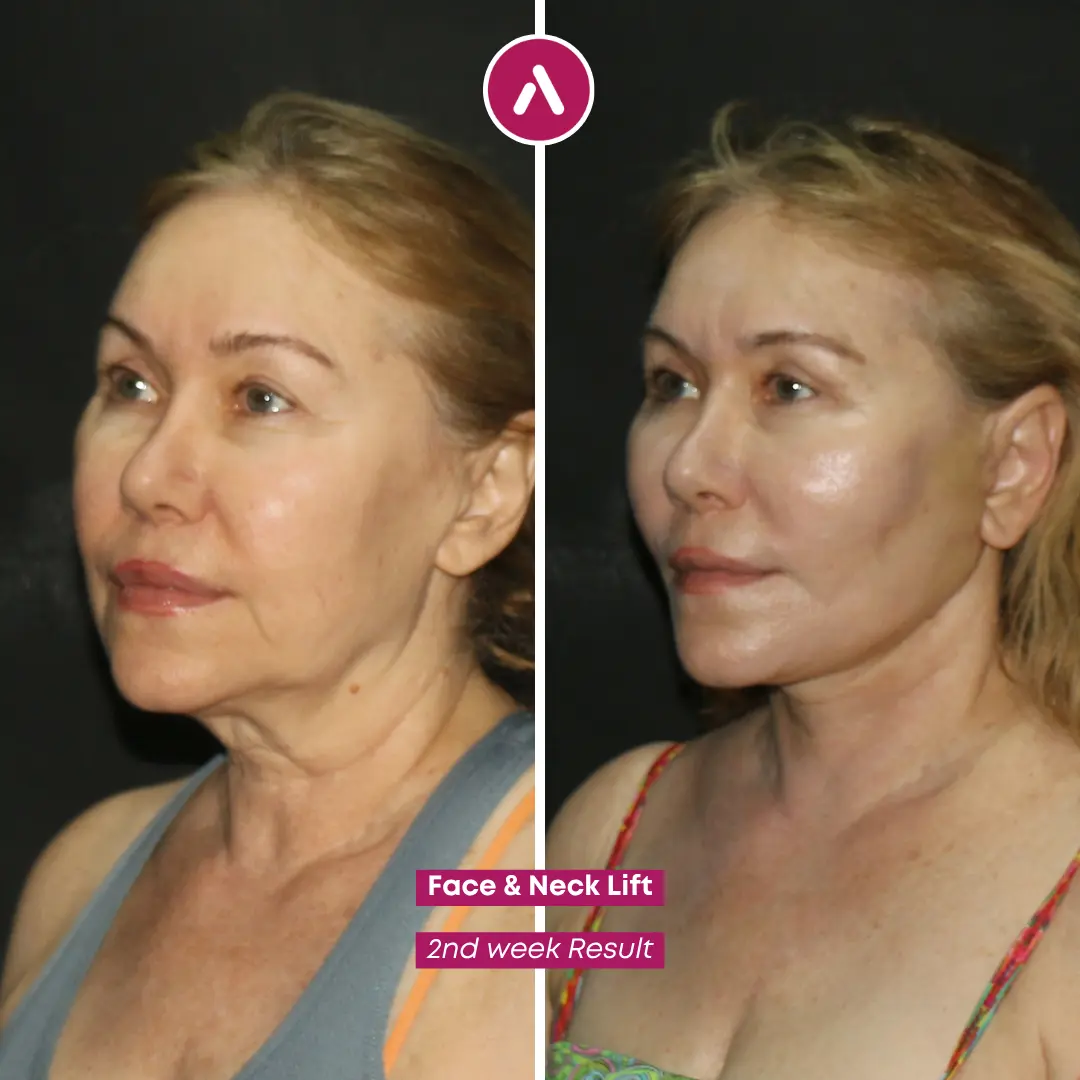
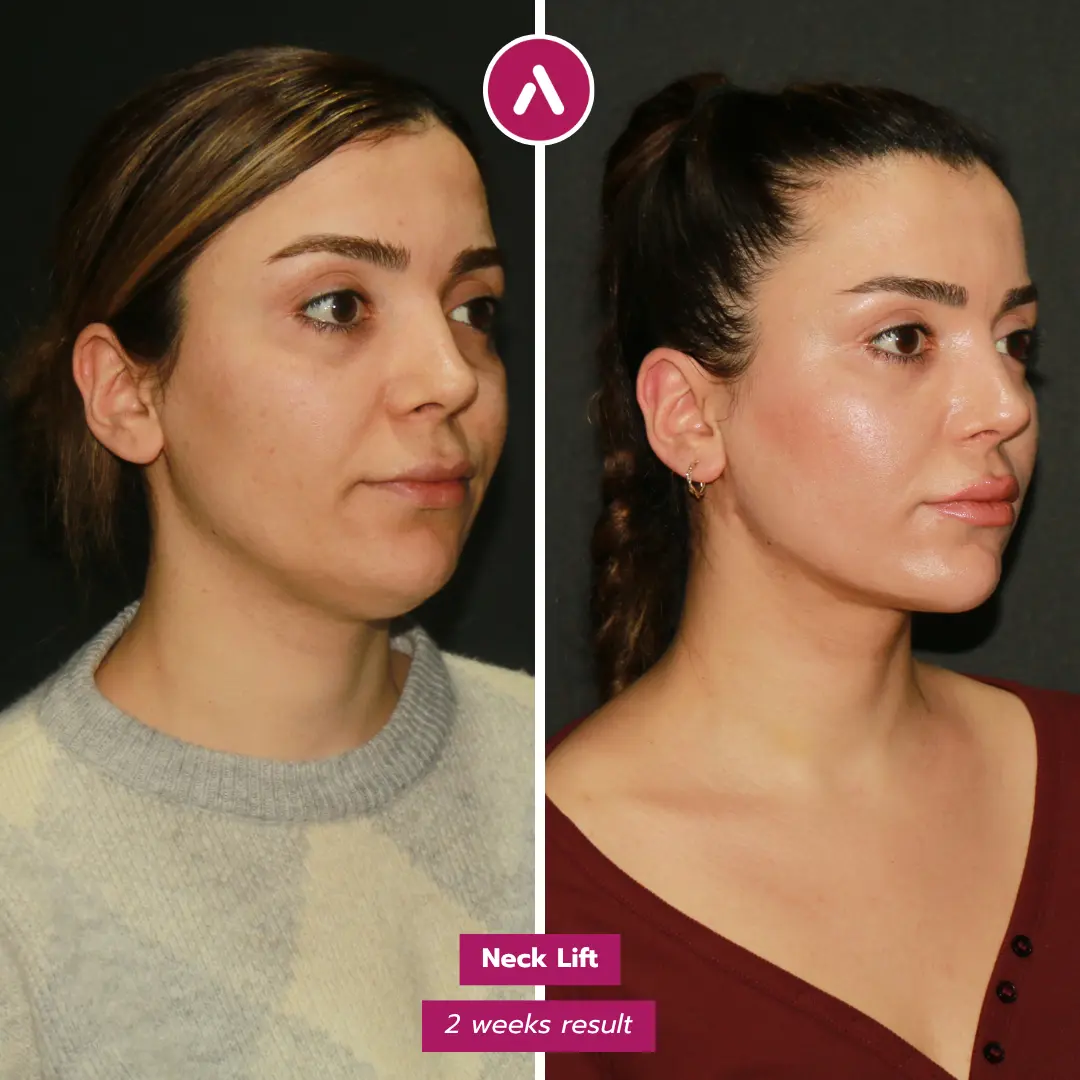
Considering a Neck Lift in Turkey? This definitive guide explains how modern neck rejuvenation restores a cleaner jawline-to-neck transition by tightening the platysma, refining submental fullness, and smoothing loose skin—without changing who you are.
Written for UK patients, you’ll learn the difference between mini, full, isolated, and Deep Plane approaches, what recovery feels like, and how our HBOT + LLLT protocol supports comfort and swelling control. Discover who is suitable and when combined procedures make sense. Use this page to compare options, set realistic expectations, and plan a safe consultation for natural definition in photos, video calls, and everyday life.
Table of Contents
What is a Neck Lift?
Neck Lift is a surgical procedure that refines the jawline-to-neck transition by tightening the platysma muscle, reducing excess fat, and removing loose skin under the chin and along the neck. The goal is a cleaner neck contour that still looks like you.
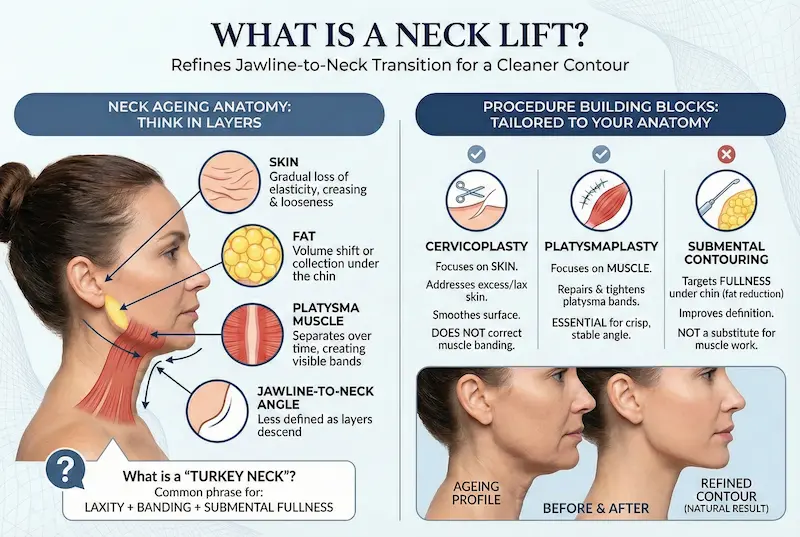
Neck ageing anatomy: skin, fat, platysma, jawline transition
To understand what a neck lift can (and can’t) do, it helps to think in layers. Ageing affects each layer differently, and we plan the surgery based on which layer is driving the change you see.
- Skin: gradual loss of elasticity can create creasing and looseness.
- Fat: volume can shift or collect under the chin (the submental area), softening the jawline.
- Platysma muscle: this thin sheet can separate with time, creating visible vertical bands.
- Jawline-to-neck angle: the “cervicomental angle” can become less defined as layers descend.
When patients in the UK say they want a “sharper jawline” or a “cleaner profile”, they are usually describing this transition zone. That is exactly where a properly planned neck lift focuses.
What is a “turkey neck”? (laxity + banding)
“Turkey neck” is a common, non-medical phrase for a mix of issues rather than a single one. Most often, it includes skin laxity under the chin and along the front of the neck, plus platysmal banding (the muscle bands that can show when you speak or tense the neck).
It can also involve submental fullness. That matters, because “loose skin” and “excess fat” respond to different approaches. A treatment that only targets one layer may leave the other unchanged, which is why technique selection is not one-size-fits-all.
Cervicoplasty vs Platysmaplasty vs Submental contouring (definitions + what each can/can’t fix)
These terms describe the building blocks we combine to create a balanced, natural result. In practice, we tailor the mix to your anatomy and goals.
- Cervicoplasty: focuses on the skin component. It addresses excess or lax skin and helps smooth the surface of the neck. It does not correct muscle banding on its own.
- Platysmaplasty: focuses on the muscle layer. It repairs and tightens the platysma when bands or separation are part of the problem. This is often essential for a crisp, stable neck angle.
- Submental contouring: targets fullness under the chin (often with careful fat reduction). It can improve definition, but it is not a substitute for muscle work when banding is present.
The most important point: we plan for harmony. If we remove fat but leave significant muscle separation, the neck may still look “busy”. If we tighten muscle but ignore redundant skin, the contour may remain soft. A good plan addresses the true driver of your concern.
Benefits of a Neck Lift Surgery
A Neck Lift refines the jawline-to-neck transition by tightening the platysma, smoothing loose skin and reducing submental fullness. The result is a cleaner profile, softer bands and a more rested look—without changing your identity. With a tailored plan, UK patients can expect natural definition and confidence in photos and video calls. Results typically keep improving for weeks.
Jawline definition & cervicomental angle (profile impact)
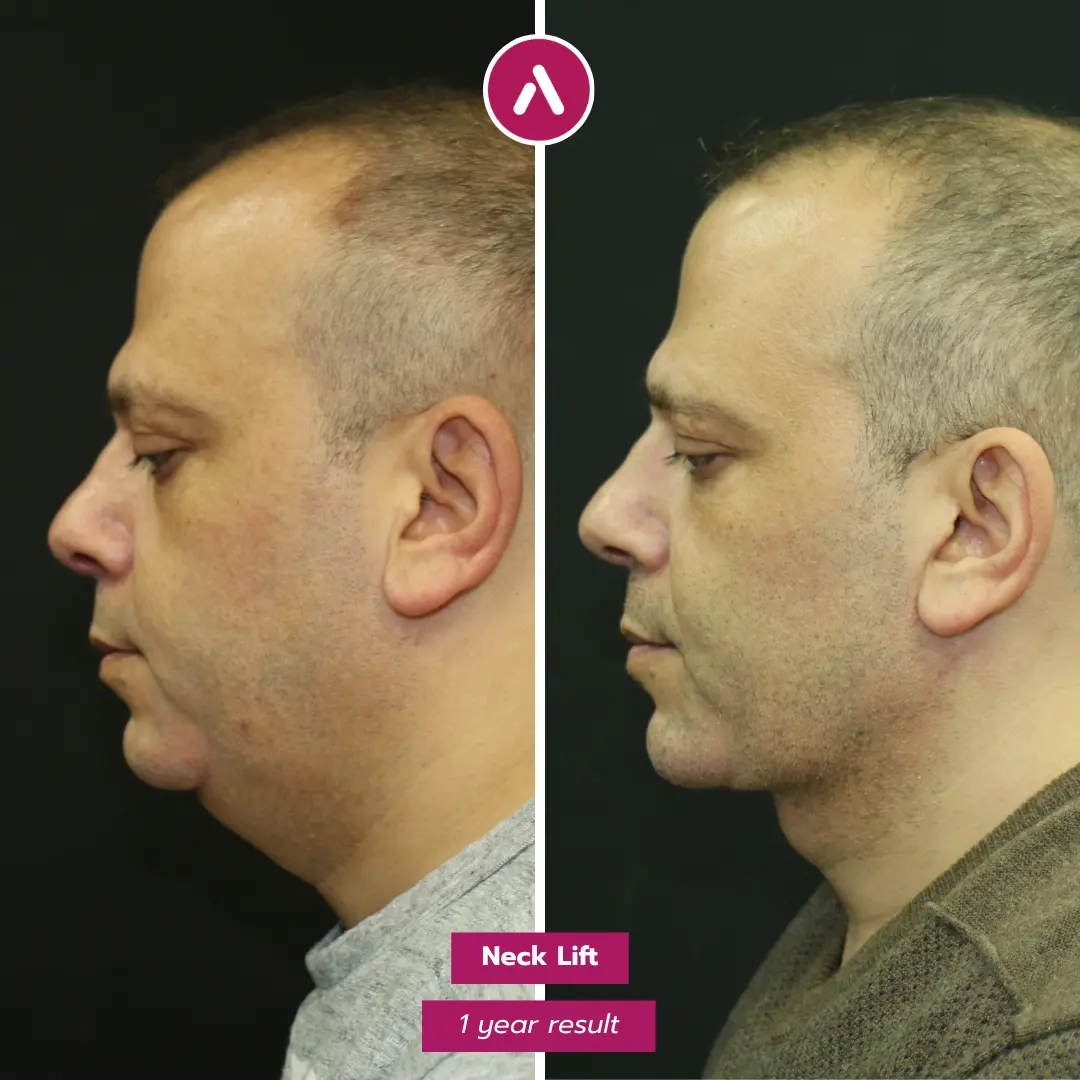
The benefit most people notice first is structural. A neck lift can restore a cleaner jawline and a more defined angle between the chin and neck. This tends to show up in side profile photographs, video calls, and everyday movement—not just posed before-and-after images.
- Sharper jawline outline
- Cleaner under-chin contour
- More balanced lower-face proportions
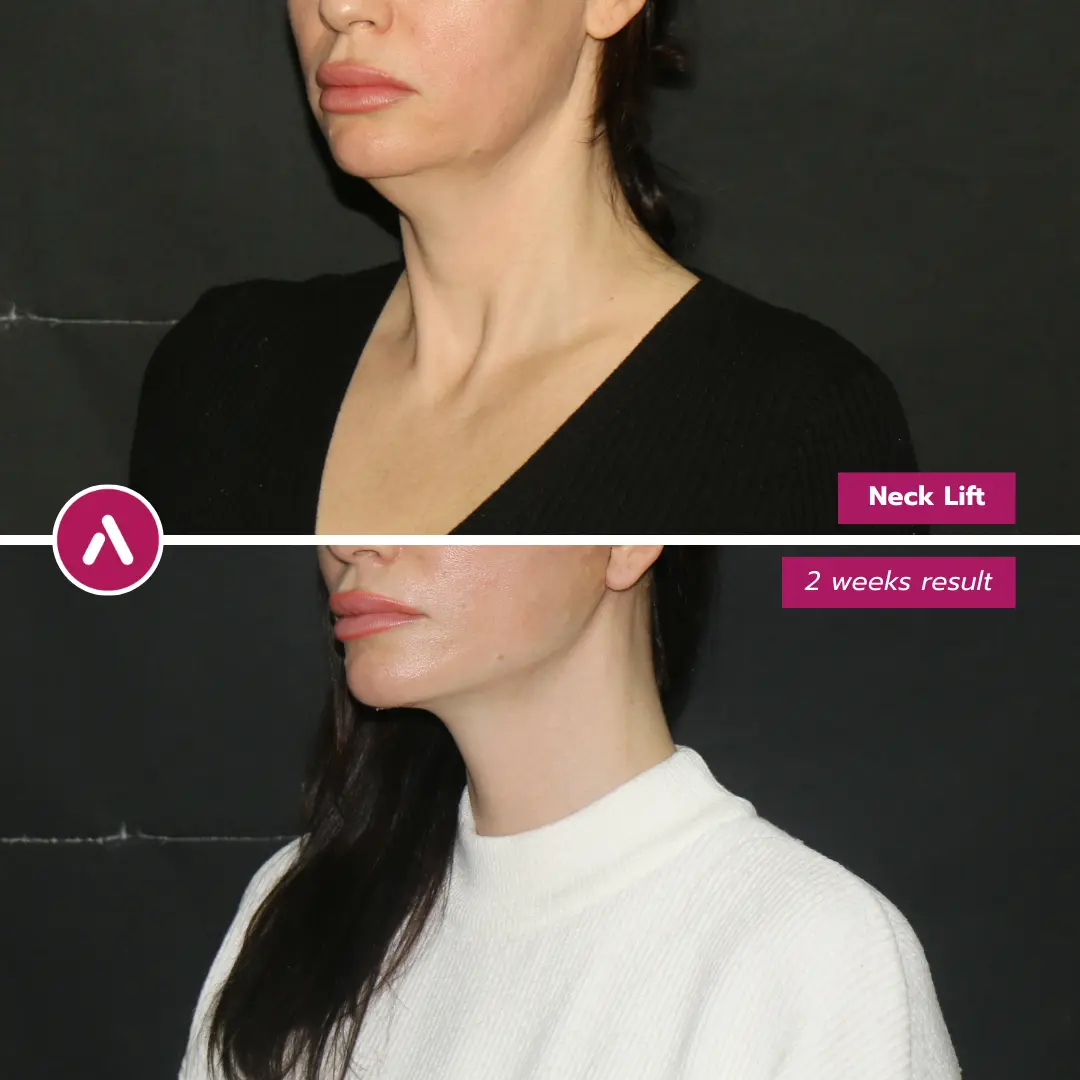
Platysmal banding reduction (softening visible neck bands)
If your main concern is vertical bands, the “benefit” is not simply tighter skin. It is a smoother foundation. When the platysma is repaired and stabilised, the front of the neck can look calmer at rest and less corded in motion.
Not every patient needs the same level of muscle work. Some people have mostly skin laxity. Others have pronounced banding. The key is matching the technique to the anatomy.
“Rejuvenation, Not Alteration” approach for natural-looking outcomes
Many UK patients tell us the same thing: they want to look fresher, not different. A well-executed neck lift is designed to improve definition without creating a tight, “operated” look.
“The goal is rejuvenation, not alteration.”
When planning, we prioritise proportion, tension control, and subtlety. Done properly, the best feedback is often simple: “You look well-rested.”

Am I a Suitable Candidate?
A Neck Lift works best when we match the technique to the exact cause of your concern—skin laxity, submental fullness, platysmal banding, or a combination. In your consultation, we assess your skin quality, muscle tone, fat distribution, and the jawline-to-neck transition to recommend the most reliable plan.
Ideal candidate profile (skin laxity, banding, stable weight)
- Visible skin laxity under the chin or along the front of the neck that doesn’t improve with skincare or non-surgical tightening.
- Platysmal banding (vertical “bands”) that show at rest or when speaking.
- Submental fullness (“double chin”) that blunts the jawline.
- Stable weight with realistic expectations about refinement rather than a completely new neck shape.
Who should delay/avoid surgery (smoking, uncontrolled conditions, bleeding risk etc.)
Safety comes first. A neck lift may need to be delayed (or approached differently) if you have factors that raise complication risk or impair healing, such as:
- Smoking or nicotine use (including vaping) close to surgery
- Uncontrolled medical conditions (for example, poorly controlled blood pressure or diabetes)
- Blood-thinning medication that can’t be safely adjusted under medical guidance
- Active infection or significant skin disease in the surgical area
- Unrealistic expectations (for example, seeking a result that anatomy cannot support)
When non-surgical options make sense (clear limits)
Non-surgical options may be reasonable for early laxity or mild fullness—especially if your primary issue is skin texture rather than true skin excess or muscle separation. The limit is important: once there is substantial loose skin or platysmal banding, surgery is typically the most predictable way to restore a clean cervicomental angle.

Surgical Techniques Explained
“Neck lift” isn’t one single operation. It’s a family of techniques that can be combined to address skin, fat, and muscle. Below is how we think about the main approaches—starting with indications (what it’s best for), then how the technique creates definition in a natural-looking way.
Isolated neck lift vs face & neck lift (indications)
An isolated neck lift focuses on the neck and under-chin contour. It’s often suitable when the midface and cheeks don’t need lifting, but the neck does. A face & neck lift treats the lower face and neck as one aesthetic unit—often ideal when jowling and jawline descent are part of the same ageing pattern.
Mini neck lift vs full neck lift (incision/impact/recovery logic)
A mini neck lift is typically aimed at milder laxity and early contour change. A full neck lift addresses more advanced skin excess and muscle changes and is designed for stronger, longer-lasting definition. The difference is less about “short vs long surgery” and more about how comprehensively we treat the underlying anatomy.
Cervicoplasty
Cervicoplasty refers to the skin component of neck rejuvenation—removing or redraping redundant neck skin to create a smoother, tighter surface. It can significantly improve visible laxity, but on its own it does not correct muscle banding. That is why cervicoplasty is often paired with deeper-layer work when bands or a softened neck angle are present.
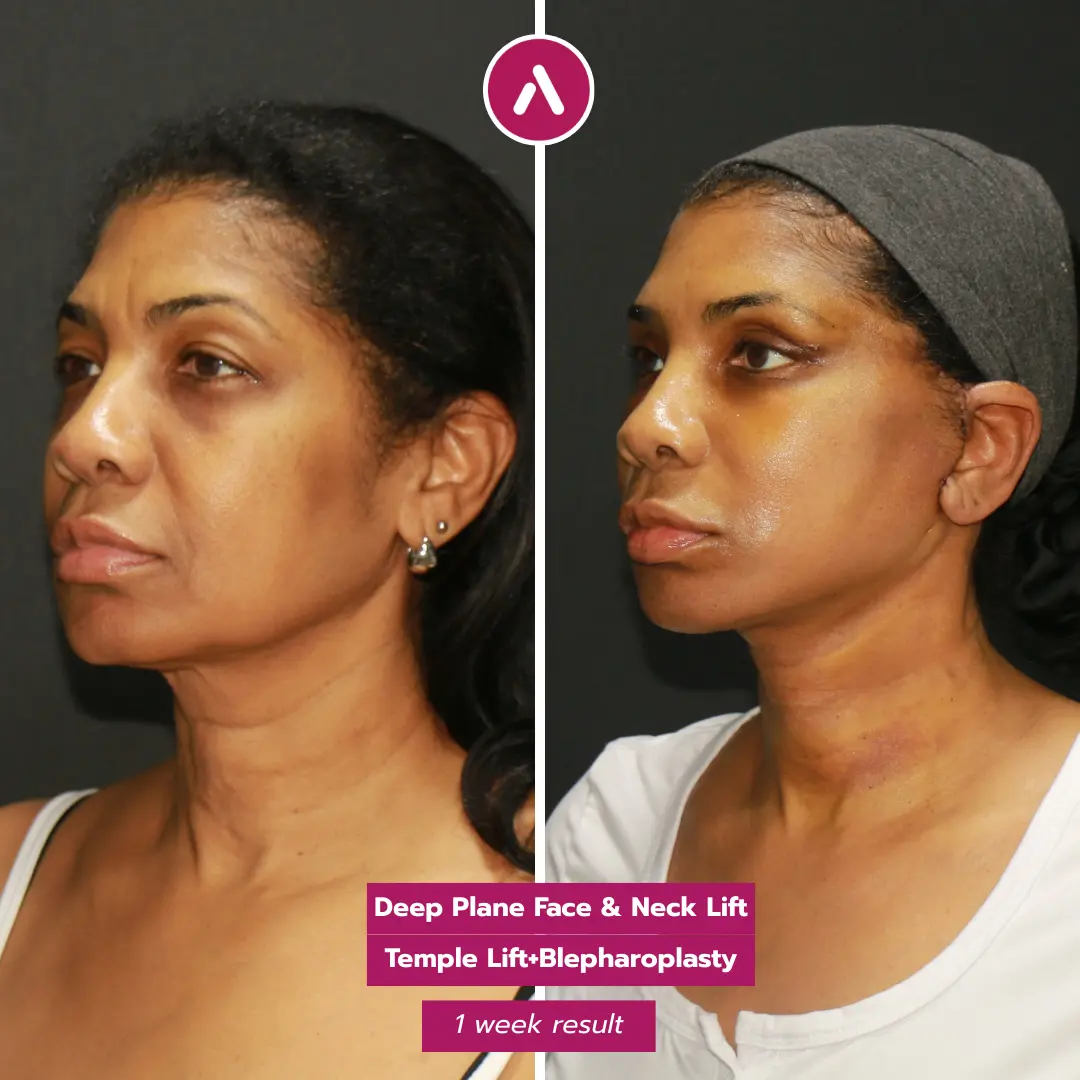
Platysmaplasty (muscle tightening) — when it’s needed (banding-focused)
Platysmaplasty targets the platysma muscle when it has separated or become prominent. If banding is a main concern, muscle repair is frequently the “structural” step that allows the skin to settle calmly over a stable foundation—helping the neck look smoother both at rest and in motion.
Deep Plane Neck Lift Explained
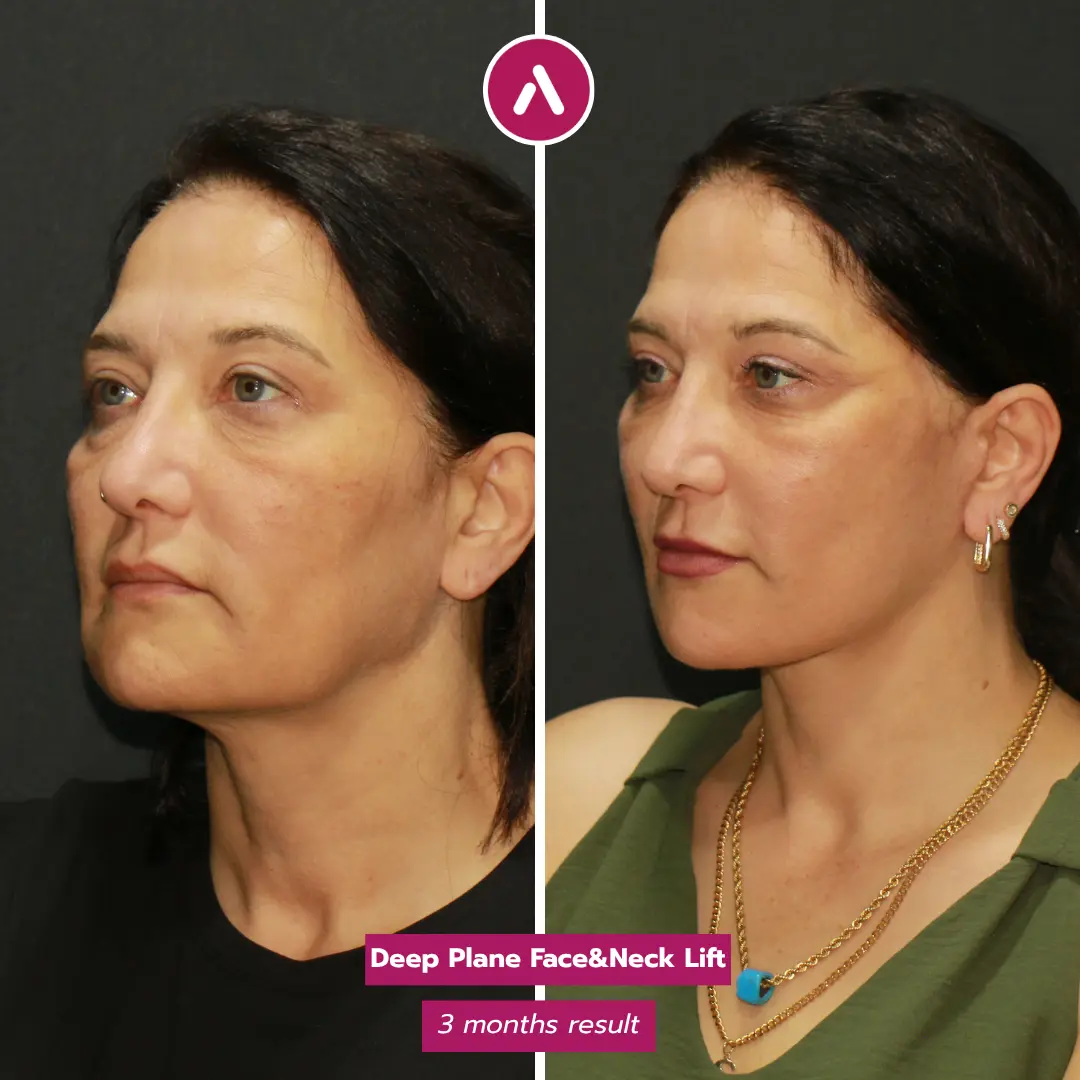
A Deep Plane approach works in a deeper anatomical layer to reposition and support tissues rather than relying on surface skin tension alone. In practical terms, it aims to improve jawline definition and neck contour with a more natural tension distribution—helping reduce the risk of an over-tight, “pulled” appearance when performed appropriately.
Deep Plane face & neck principles (sub-SMAS release, ligament work; reducing “pulled look” risk)
In a Deep Plane face & neck lift, the surgeon addresses the supportive layer beneath the skin (often discussed in relation to SMAS and retaining ligaments). By releasing and repositioning in the correct plane, the lift can look more like a restoration of anatomy rather than a surface stretch—particularly valuable for patients who want definition without a “windswept” look.
Scar strategy & incision logic (incl. Z-plasty as an educational concept)
Incision placement is chosen to balance access, control, and discretion. Scars are typically planned around natural creases and hair-bearing areas where possible. In selected cases, scar-management principles (including educational concepts such as Z-plasty) may be used to optimise the way a scar lies within the skin’s natural tension lines—always with the goal of an unobtrusive finish.
Natural-first philosophy: we prioritise tension control and layered support so that the result looks refined—not “operated”.
Technique Comparison: Mini vs Full vs Isolated vs Face+Neck (Deep Plane)
| Technique | Best for | Primary focus | Typical trade-off |
|---|---|---|---|
| Mini Neck Lift | Milder laxity, early contour softening | Targeted tightening/refinement | Less comprehensive change for advanced anatomy |
| Full Neck Lift | Finalised laxity, more visible skin excess or banding | Skin + deeper-layer work as needed | More recovery investment than a mini approach |
| Isolated Neck Lift | Neck-focused ageing with minimal lower-face descent | Neck contour (submental area + platysma/skin) | Doesn’t address jowls or midface descent |
| Face & Neck Lift (Deep Plane) | Jawline + jowls + neck ageing as a combined pattern | Repositioning in a deeper plane for natural tension distribution | More comprehensive surgery planning and recovery |
Combined Procedures (Synergy): Maximising Your Results
A Neck Lift can be performed as an isolated procedure, but many patients benefit from a thoughtfully planned combination—especially when the neck, jawline, and lower face have aged as a single “unit”. The goal is not to add procedures for the sake of it, but to create harmony across the profile so the result looks natural from every angle.
Neck lift + Deep Plane Facelift / Mini Facelift (jawline continuity)
If you have jowling or a softened jawline in addition to neck laxity, combining a neck lift with a facelift (often a Deep Plane face lift & neck lift when indicated) can deliver a more balanced outcome. This approach treats the lower face and neck together, which may help avoid the mismatch some patients notice when only the neck is corrected but the jawline remains heavy or descended.
- Best for: jawline descent + neck laxity, or jowls that “blend” into the neck.
- Why it helps: creates a continuous line from cheek → jaw → neck, rather than improving one area in isolation.
- Planning note: technique choice depends on your anatomy, not just age.
Chin lipo / submental contouring + neck lift (double chin intent)
For patients whose main concern is fullness under the chin, submental contouring (including carefully planned fat reduction where appropriate) can be paired with a neck lift to refine the cervicomental angle. This combination is most effective when we treat both the shape (fullness) and the support (muscle/skin) together.
- Best for: submental fullness that blunts definition.
- Why it helps: improves the “under-chin shadow” and helps the jawline read cleaner in profile.
- Important limit: fat reduction alone does not correct platysmal banding or significant skin excess.
Brow/Temporal lift + mini facelift + submental work (captures multi-procedure intent)
Some patients don’t just want a sharper neck—they want an overall “rested” look from upper face to jawline. In selected cases, a brow lift or temporal lift may complement lower-face and neck work by restoring balance across the face. This can be particularly relevant when the upper face looks tired while the lower face and neck are being refined.
The key is proportion: a harmonious result often comes from aligning the upper-face expression with the lower-face contour, rather than over-treating one zone.
Buccal fat & neck lift (selected candidates)
Buccal fat reduction can be appropriate for carefully selected patients—typically where fullness in the mid-lower cheek contributes to a heavier lower-face silhouette. Because over-reduction can look ageing, we only consider this when it supports your long-term facial balance.
Anaesthesia: Why We Prefer Awake/Twilight Sedation
One of the most common questions from UK patients is whether a neck lift can be performed without a full general anaesthetic. In many cases, the answer is yes: local anaesthesia with twilight sedation (conscious sedation) can be an excellent option, depending on the plan and your medical profile. The aim is to keep you comfortable while supporting a smooth recovery.
Awake surgery / Local anaesthesia + (when needed) twilight sedation rationale
“Awake” does not mean you are uncomfortable or fully aware of every detail. It means we use local anaesthesia to numb the area, and—when appropriate—add light sedation so you feel calm and relaxed. For suitable patients, this approach can reduce some of the downsides associated with deeper anaesthesia, while still allowing meticulous surgical work.
Comfort-first, safety-led: the anaesthesia plan should be tailored to your procedure, your health, and your anxiety level—never forced into a one-size-fits-all model.
Who is suitable vs who may need general anaesthesia
Local anaesthesia with twilight sedation may be suitable when:
- The surgical plan is focused (for example, an isolated neck lift in appropriate anatomy)
- You are medically stable and pre-operative assessment supports it
- You are comfortable with the idea and can follow simple instructions if needed
General anaesthesia may be recommended when:
- The procedure is more extensive or combined (for example, a comprehensive face & neck plan)
- You have medical factors where deeper airway control is considered safer
- You have significant anxiety that would compromise comfort and stability during surgery
The final decision is made after your assessment, in line with your safety profile and the surgical scope.
Comfort, nausea, recovery and safety perspective
Patients often ask about post-operative comfort and “how they’ll feel” afterwards. While individual experience varies, many people find that a tailored plan with local anaesthesia and appropriate sedation can support a gentler immediate recovery. Regardless of the method, the priority is consistent monitoring, stable pain control, and a clear aftercare plan.
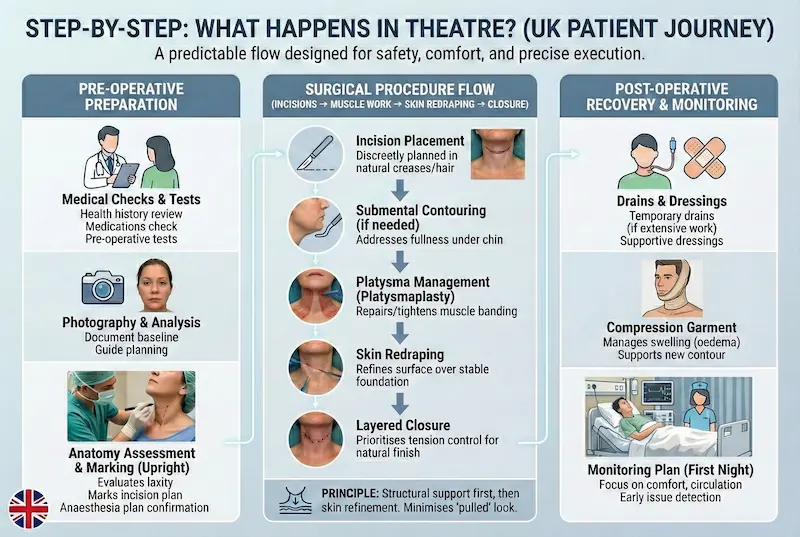
Neck Lift Surgery Step-by-Step: What Happens in Theatre?
Knowing what happens on the day helps reduce uncertainty—especially for UK patients travelling for surgery. While every plan is personalised, the overall flow is predictable and designed around safety, comfort, and precise execution.
Pre-op tests, marking, planning
Before you go into the operating theatre, your team will confirm key details that help keep the experience controlled and safe. This typically includes:
- Medical checks: review of your health history, medications, and any required pre-operative tests.
- Photography and analysis: to document your baseline and guide planning.
- Skin and anatomy assessment: evaluating laxity, submental fullness, and platysmal banding.
- Marking: your surgeon marks the incision plan and contour targets while you are upright, because gravity changes how tissues sit.
- Anaesthesia plan confirmation: local anaesthesia with twilight sedation (when appropriate) vs general anaesthesia, based on your procedure scope and medical profile.
Surgical flow (incisions → muscle work → skin redraping → closure)
Although techniques vary (mini vs full, isolated vs face & neck, and whether Deep Plane work is indicated), most neck lift procedures follow the same anatomical logic:
- Incision placement: planned to provide access while aiming for discretion in natural creases/hair-bearing regions where possible.
- Submental contouring (if needed): addressing fullness under the chin in a controlled way, when it’s part of the problem.
- Platysma management (if needed): repairing/tightening the muscle when banding or separation is present (platysmaplasty).
- Skin redraping: refining the surface so the neck settles smoothly over a stable foundation.
- Layered closure: prioritising tension control to support a natural-looking finish and more predictable healing.
The guiding principle is structural support first (where needed), then skin refinement—not the other way around. This helps minimise the risk of a tight, “pulled” look and supports a more natural contour in motion.
Drains, dressings, first night & monitoring plan
Some patients may have drains placed temporarily to reduce fluid collection during the earliest healing phase—especially when more extensive work is performed. If drains are used, you’ll be shown how they work and when they’re typically removed (often after early post-op review, depending on output and your surgeon’s assessment).
You’ll also have supportive dressings and, in most cases, a compression garment to help manage swelling (oedema) and support the new contour. Monitoring in the first 24 hours focuses on comfort, circulation, and early detection of issues that are best managed promptly.

Neck Lift Recovery & Aftercare: How Long Does Healing Take?
Recovery is a process rather than a single milestone. Most patients notice meaningful improvement early, but the final refinement continues as swelling settles and tissues soften. Your aftercare plan is designed to guide you through each phase with clear priorities.
Swelling (oedema) & bruising timeline (Day 1–3 / Week 1 / Week 2 / Month 1–3)
Every patient heals differently, but the pattern below is a useful guide:
| Phase | What you may notice | Focus of care |
|---|---|---|
| Day 1–3 | Peak swelling (oedema), tightness, bruising; mild asymmetry can be normal | Rest, head elevation, garment compliance, short walks, hydration |
| Week 1 | Bruising begins to fade; swelling starts to reduce but remains noticeable | Incision care, follow-up review, avoid heavy activity |
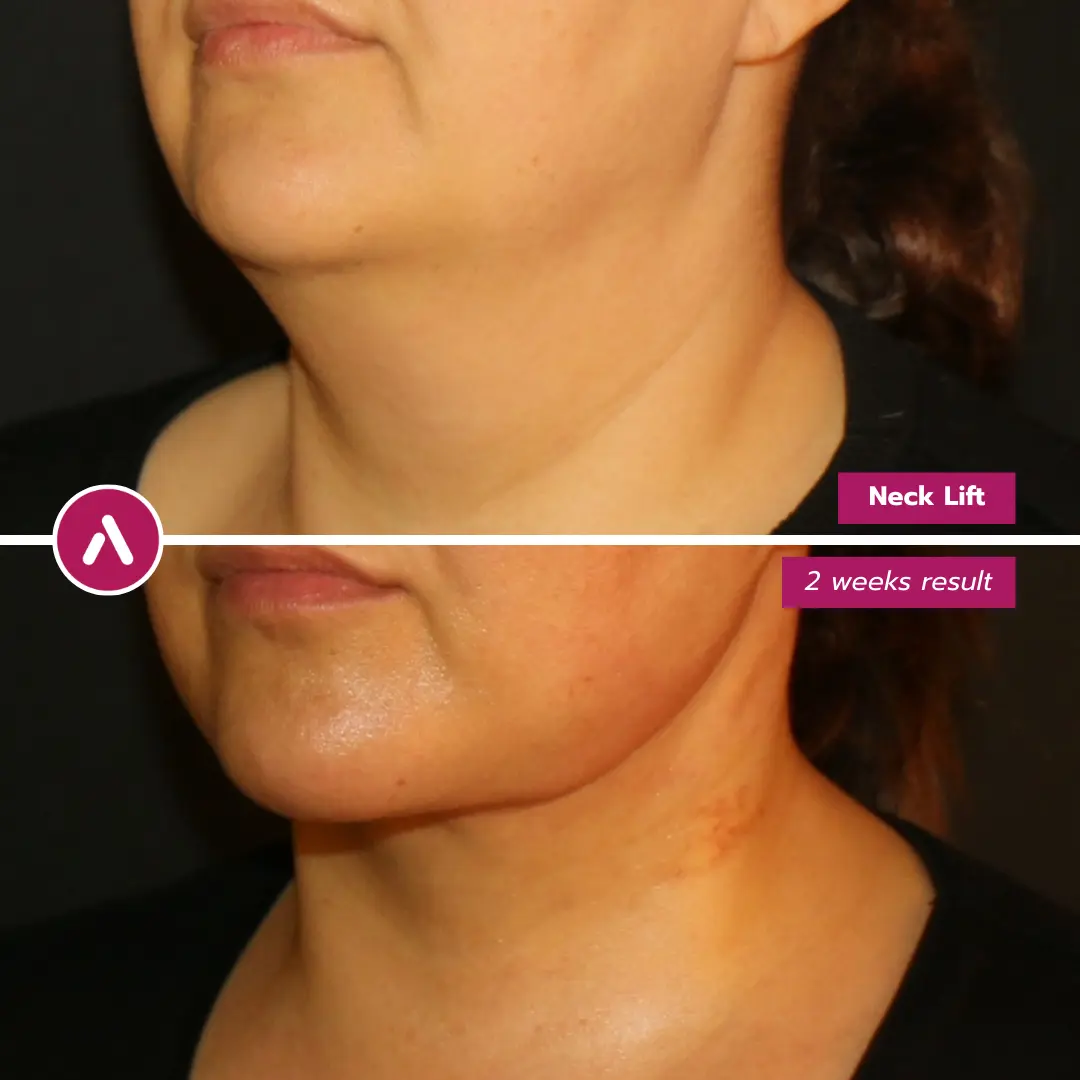
| Week 2 | Many patients look more “socially presentable”; residual swelling remains | Gradual return to routine, ongoing scar/skin care guidance |
| Month 1–3 | Contour continues to refine; tissues soften and settle | Consistency: aftercare, lifestyle stability, sun protection |
It’s normal for the neck to feel firm or “strange” early on—sensation and texture often evolve as nerves and soft tissues recover.
Compression garment & sleeping position / hygiene
Your compression garment supports the contour and helps manage swelling. You’ll be given specific wear instructions based on the technique used. In the early phase, sleeping with the head elevated (and avoiding pressure on the neck) can improve comfort and swelling control.
Hygiene matters for smooth healing. You’ll receive clear instructions on when and how to wash, how to keep incisions clean, and what to avoid until your surgeon confirms it’s safe.
Drainage/drains: when, why, and how they’re managed
If drains are used, the purpose is simple: to reduce early fluid build-up and support a calmer healing environment. Drains are usually short-term and removed once the output decreases to a level your surgeon considers appropriate.
Even without drains, mild fluid shifts are part of normal healing. Your team will advise what is expected and what isn’t.
Pain control (UK terminology)
Most patients describe discomfort as manageable rather than severe. Pain relief is prescribed and tailored to you. Many UK patients are familiar with options such as paracetamol; your care team will tell you exactly what to take (and what to avoid) based on your medical history and procedure plan.
Avoid taking any medication outside the plan you’re given, especially aspirin-containing products, unless your clinician has approved them.
Rapid Recovery & Safety Protocol: HBOT + LLLT
Where clinically appropriate, supportive therapies can be used to optimise recovery comfort. At AKM Clinic, this may include:
- Hyperbaric Oxygen Therapy (HBOT): used in selected cases to support tissue oxygenation and healing dynamics.
- Low-Level Laser Therapy (LLLT): used as an adjunct to support swelling management and comfort in the early recovery phase.
These therapies do not replace meticulous surgery and aftercare, but they can be integrated into a structured recovery plan when suitable.
Safety & Risks: Is a Neck Lift Dangerous?
Every surgical procedure carries risk, and a Neck Lift is no exception. The safest outcomes come from a combination of correct patient selection, a well-matched technique, meticulous surgical planning, and structured aftercare. In your consultation, we discuss risks openly—because informed patients make better decisions.
Common risks: haematoma, infection, nerve changes, scarring
Most patients heal without significant issues, but it’s important to understand what can happen and how we reduce risk.
- Haematoma: a collection of blood under the skin that can increase swelling and pressure.
- Infection: uncommon, but possible after any surgery.
- Changes in sensation: temporary numbness or altered feeling can occur as tissues recover.
- Nerve-related changes: rare, but can affect movement or sensation depending on anatomy and surgical scope.
- Scarring: all surgery leaves scars; our focus is placement, tension control, and scar care guidance.
- Asymmetry and contour irregularities: mild differences can be part of normal healing; persistent issues are assessed systematically.
Risk level is influenced by factors such as smoking/nicotine use, medical conditions, medication (especially blood-thinners), and the extent of surgery (isolated vs combined procedures).
Haematoma management & early warning signs
Haematoma is one of the complications surgeons treat most seriously because early management protects the final result and your comfort. The key is recognising warning signs promptly.
Seek urgent assessment if you notice:
- Rapidly increasing swelling (especially on one side)
- Sudden tightness, pressure, or significant pain that escalates
- New bruising that spreads quickly or looks markedly different from the other side
- Bleeding through dressings or unexpected drainage changes
Early review allows the team to decide whether observation is sufficient or whether intervention is needed. The goal is always timely, decisive care—without delay.
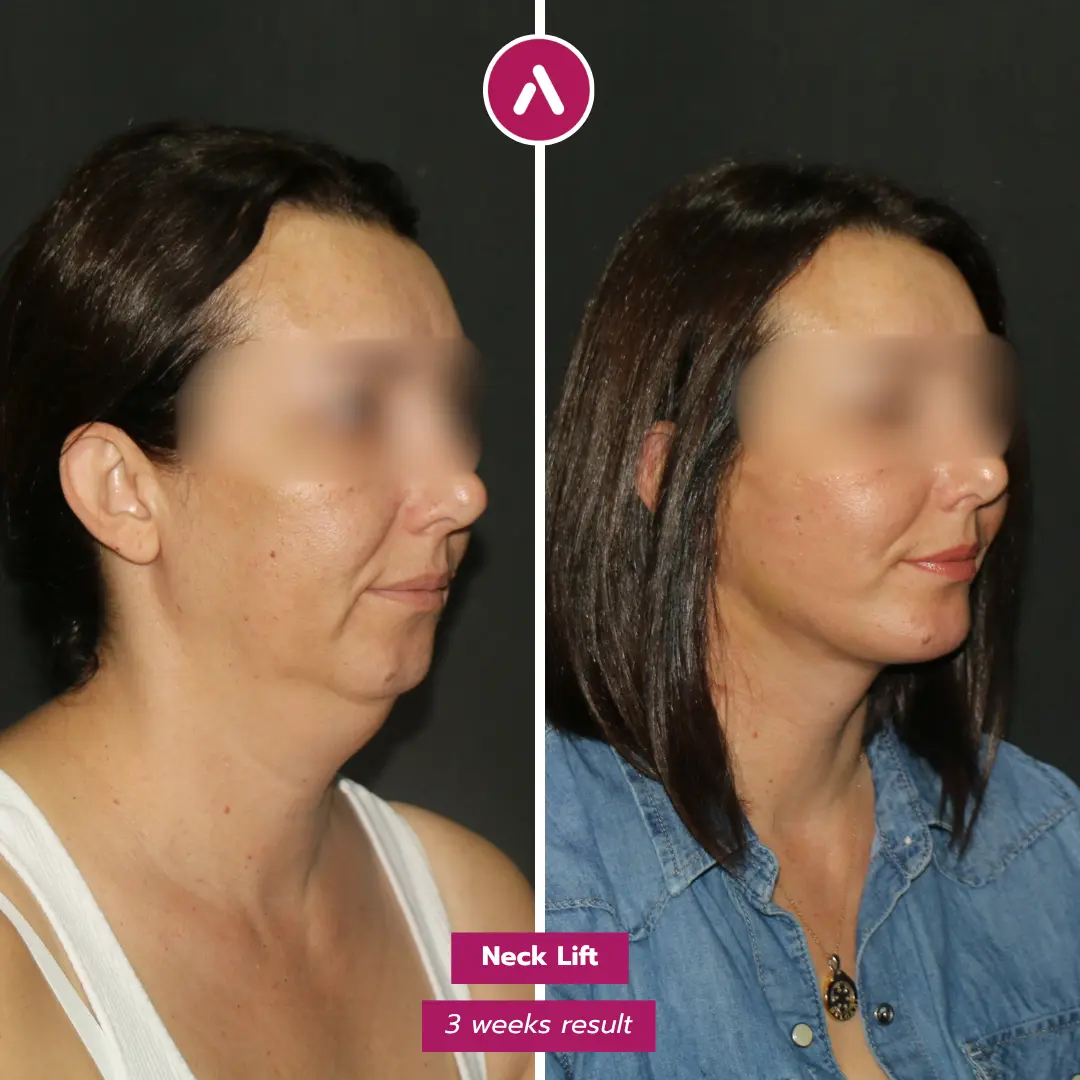
When to seek urgent care (UK framing)
If you are back in the UK and develop symptoms you feel are urgent—such as rapidly worsening swelling, breathing difficulty, fever, or severe pain—seek immediate medical attention via A&E or emergency services. Even when issues turn out to be minor, it’s safer to be assessed than to wait.
Risk mitigation: screening + monitoring + sterile standards
Risk reduction starts before surgery and continues through recovery:
- Pre-operative screening: medical history review, medication planning, and suitability assessment.
- Technique selection: choosing the correct approach (e.g., adding platysmaplasty when banding is a driver) to avoid under-treatment or unnecessary tension.
- Meticulous haemostasis: careful control of bleeding during surgery.
- Structured monitoring: early post-operative checks to catch issues at the stage they are easiest to manage.
- Clear aftercare rules: garment compliance, head elevation, activity restrictions, and incision care.
Is a Neck Lift Safe in Turkey for UK Patients?
UK patients often ask a direct question: “Is it safe to have a neck lift abroad?” The most honest answer is that safety depends on standards and systems—not geography. What matters is the clinical environment, surgeon expertise, anaesthesia planning, and continuity of care from consultation to long-term follow-up.
Standards & environment: screening, monitoring, sterilisation approach
A safe surgical pathway includes consistent processes that don’t change from patient to patient:
- Clear eligibility criteria: operating on suitable candidates and advising delay when risk is elevated.
- Appropriate theatre standards: sterile technique, controlled environment, and reliable equipment.
- Monitoring and early review: especially during the first 24–48 hours when certain complications are best detected early.
- Documented aftercare protocols: so you know exactly what to do (and what not to do) day by day.
In other words, safety is built into the pathway. When you compare options, ask about protocols—not just outcomes.
Surgeon credibility: European Board Certification / equivalency framing
For an “expert patient”, surgeon credibility is not a vague feeling—it’s evidence-based. When assessing a surgeon for neck lifting (especially Deep Plane face & neck work or complex platysmal repair), look for:
- Transparent credentials: board certification (including European Board pathways where applicable), training background, and professional memberships.
- Case relevance: a portfolio that includes neck-focused cases, banding correction, and natural jawline outcomes.
- Technical clarity: a surgeon who can explain why you need cervicoplasty vs platysmaplasty vs combined layers, using your anatomy.
If you’re comparing UK vs Turkey, the best question is not “Who is cheapest?” but “Who can explain my anatomy most clearly—and demonstrate consistent, natural results?”
Continuity of care: 24/7 host + long-term follow-up (1–12 months)
Continuity is where overseas surgery can either feel stressful or fully supported. A safe experience typically includes:
- Clear on-the-ground support: coordination from arrival to discharge, so practical details don’t become medical stress.
- Early post-op reviews: incision checks, garment guidance, and recovery planning before you travel.
- Structured remote follow-up: ongoing check-ins after you return to the UK, because healing continues beyond the first two weeks.
This continuity matters for reassurance and for early troubleshooting if something feels “off” during recovery.
UK travel practicality (measured mention)
From a UK perspective, practicality affects recovery. The main considerations are travel timing, comfort, and having a plan for who to contact if questions arise after you return. Your team should advise when flying is reasonable based on your procedure scope, swelling pattern, and early healing progress—rather than giving a generic timeline.

Neck Lift Before and After: Realistic Expectations & Results
A successful Neck Lift is about refinement, not perfection. The most satisfying results come from aligning the surgical plan with your anatomy and being clear about what changes quickly versus what continues to improve over time.
When you’ll look “presentable” vs when final results settle
Most patients notice an early improvement in neck contour once the initial swelling reduces, but the result continues to evolve for weeks and months. A useful way to think about healing is:
- Early phase (first 1–2 weeks): swelling (oedema), tightness, and bruising are common. Many patients feel more “socially presentable” around week 2, depending on the extent of surgery.
- Refinement phase (weeks 3–6): the contour becomes more consistent and softens in a natural way.
- Settling phase (months 1–3+): residual swelling continues to resolve and the neck-to-jawline transition typically looks more “effortless”.
If you are travelling back to the UK, we plan your aftercare and follow-up around realistic milestones rather than giving a one-size-fits-all timeline.
Longevity: ageing, weight, skin quality, aftercare
A neck lift turns back the clock, but it doesn’t stop time. How long the result stays crisp depends on:
- Skin quality: elasticity and thickness influence how the skin drapes and how it ages.
- Weight stability: significant weight change can alter neck definition.
- Platysma behaviour: if muscle banding is a key driver, correct muscle repair supports a more stable contour.
- Lifestyle and aftercare: sun exposure, smoking/nicotine, and aftercare compliance affect healing and long-term quality.
The aim is a result that remains natural as you continue to age—rather than a “frozen” look that becomes more noticeable over time.
Typical UK patient profiles (no invented identities)
In our experience with UK patients, neck lift goals often fall into a few patterns:
- Profile refinement: patients who look fine face-on but dislike the side profile on video calls or photos.
- Banding-focused: patients whose main concern is visible platysmal bands, especially in motion.
- Submental fullness + laxity: patients who describe a “double chin” alongside loose skin.
- Lower-face and neck as one concern: patients who want jawline definition and neck contour improved together (often best addressed with a combined plan).
Natural-first philosophy
Our benchmark is subtlety: a refined neck contour that suits your facial proportions, without a tight or “operated” appearance.
Cost Analysis: Neck Lift Cost 2026 (Turkey vs UK)
Cost is an important part of decision-making, but it’s most useful when discussed in context: what is included, the technique complexity (mini vs full vs combined face & neck), the safety pathway, and the follow-up plan. In 2026, fees vary widely in both the UK and Turkey based on surgical scope and patient anatomy.
What’s included in our VIP package
When UK patients compare options, the most meaningful comparison is “total journey cost and support” rather than the surgical fee alone. A structured all inclusive package commonly includes elements such as:
- Pre-operative consultation and surgical planning
- Hospital/theatre costs and anaesthesia planning
- Post-operative medications prescribed according to your plan
- Compression garment(s) and aftercare materials
- Airport/hotel/clinic transfers (VIP logistics)
- Scheduled post-op reviews before you travel
- Remote follow-up after you return to the UK
What’s “included” matters because it affects comfort, safety, and how supported you feel during recovery.
Why costs differ (macro factors without quality dilution)
Patients often notice that private surgical fees in major UK cities can be significantly higher than in Istanbul. This is usually driven by broader economic factors—such as operating costs, staffing, facility overheads, and insurance structures—rather than a single “price difference” variable.
The key is to avoid reducing your decision to a number. Instead, compare standards, surgeon expertise, and continuity of care alongside fees.
UK anchors: London/Manchester/Liverpool/Bristol/Leeds comparison framing
Across the UK, private pricing can vary by region and provider (for example, London often sits at a different level to Manchester, Liverpool, Bristol, or Leeds). Those city differences can be useful as a “reference point”, but what ultimately matters is whether the proposed plan matches your anatomy:
- If your concern is mild laxity, you may be offered a “mini” approach in the UK.
- If you have banding, a plan without platysmaplasty may under-treat the problem, regardless of location.
- If jawline descent and neck ageing are linked, a combined approach may be more cost-effective long-term than staging multiple smaller procedures.
Turkey vs UK: fees, inclusions, recovery support, follow-up
| Comparison point | Typical UK private pathway | AKM Clinic pathway in Turkey |
|---|---|---|
| Fee structure | Often itemised: surgeon, theatre, anaesthesia, aftercare can be separate | Often structured around a single, clearer pathway with defined inclusions |
| What’s included | Varies by provider; garments/medications may be separate | Commonly includes garments, prescribed medications, and planned aftercare components |
| Recovery support | Local access, but support level varies widely | Coordinated on-the-ground support during your stay, with a structured plan |
| Follow-up | Usually in-person locally | In-person reviews before travel + remote follow-up after return to the UK |
| Best way to compare | Ask what is included, who monitors you, and what happens if you have concerns | Ask what is included, how aftercare is structured, and how long follow-up continues |
Finding the Best Neck Lift Surgeon
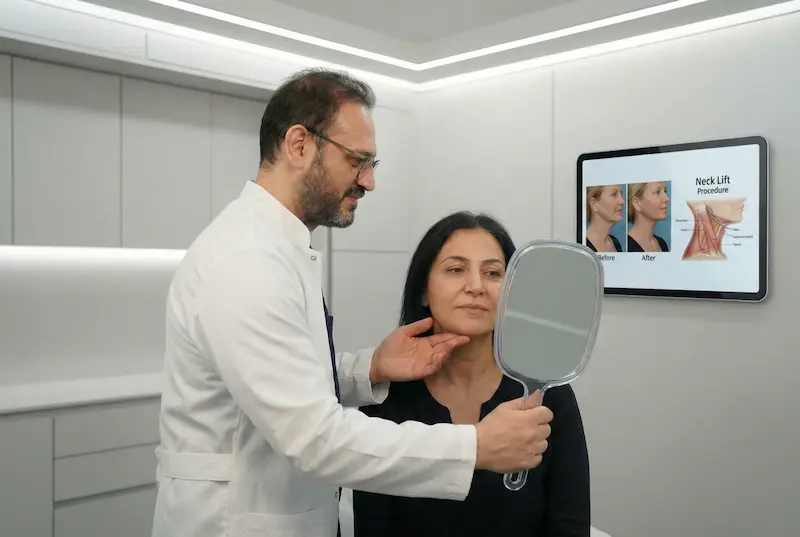
For UK patients considering surgery abroad, choosing the right surgeon is less about marketing and more about evidence: credentials, technique logic, complication readiness, and consistent outcomes. A neck lift is highly anatomical—so the best surgeon is the one who can explain your anatomy clearly and propose a plan that matches it.
Board certification & case volume (what to ask)
Use your consultation to “stress test” the pathway. Helpful questions include:
- Credentials: Are you board certified? What is your formal training pathway and focus area?
- Neck-specific experience: How often do you perform neck lifts, and which techniques do you use most frequently?
- Technique rationale: Do I need cervicoplasty, platysmaplasty, submental contouring, or a combined approach—and why?
- Safety systems: What is your protocol for monitoring, early review, and complication management?
- Scarring plan: Where will scars sit, and how do you manage closure tension to support discreet healing?
- Follow-up: What does follow-up look like after I return to the UK?
Before/after analysis: how to spot “pulled look” risk
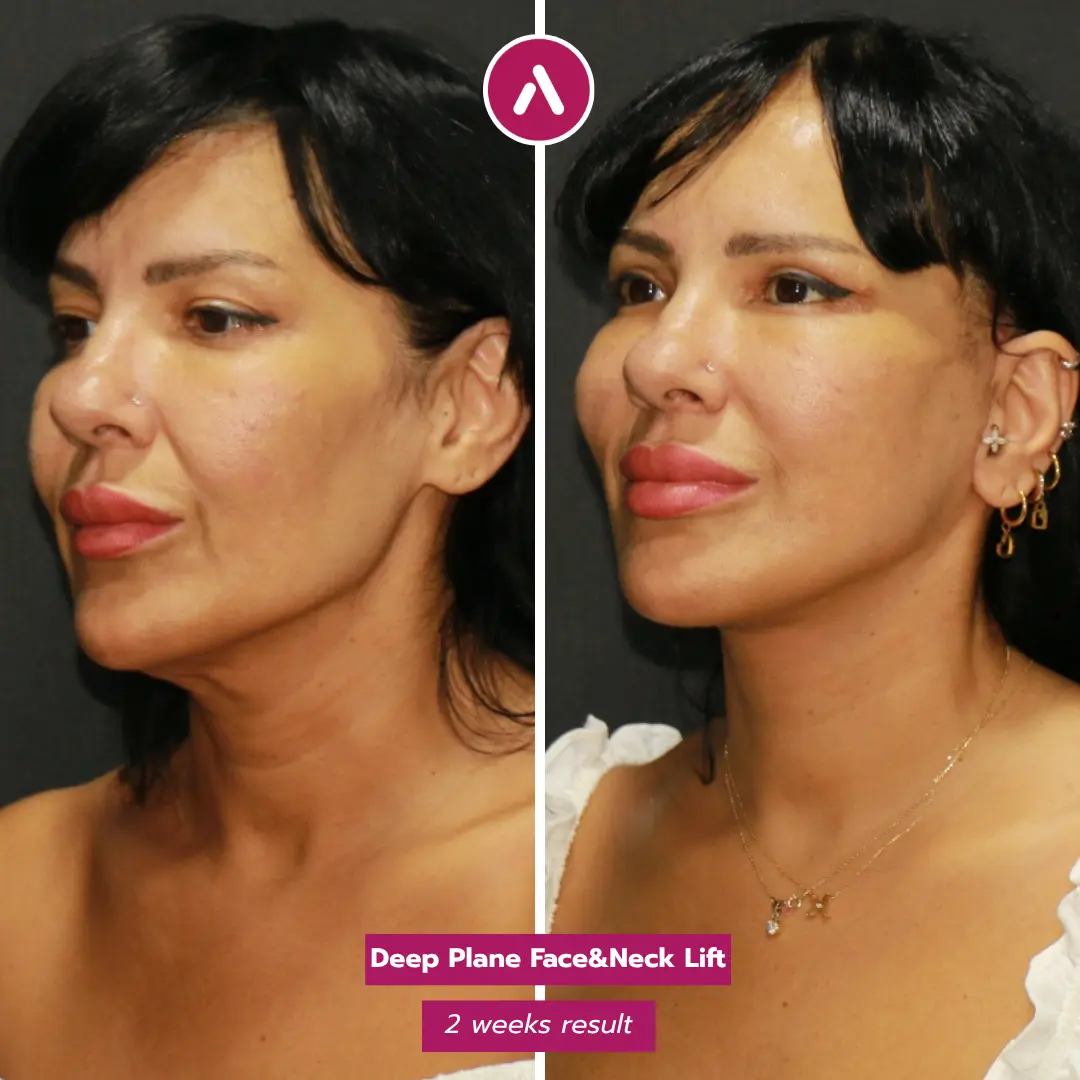
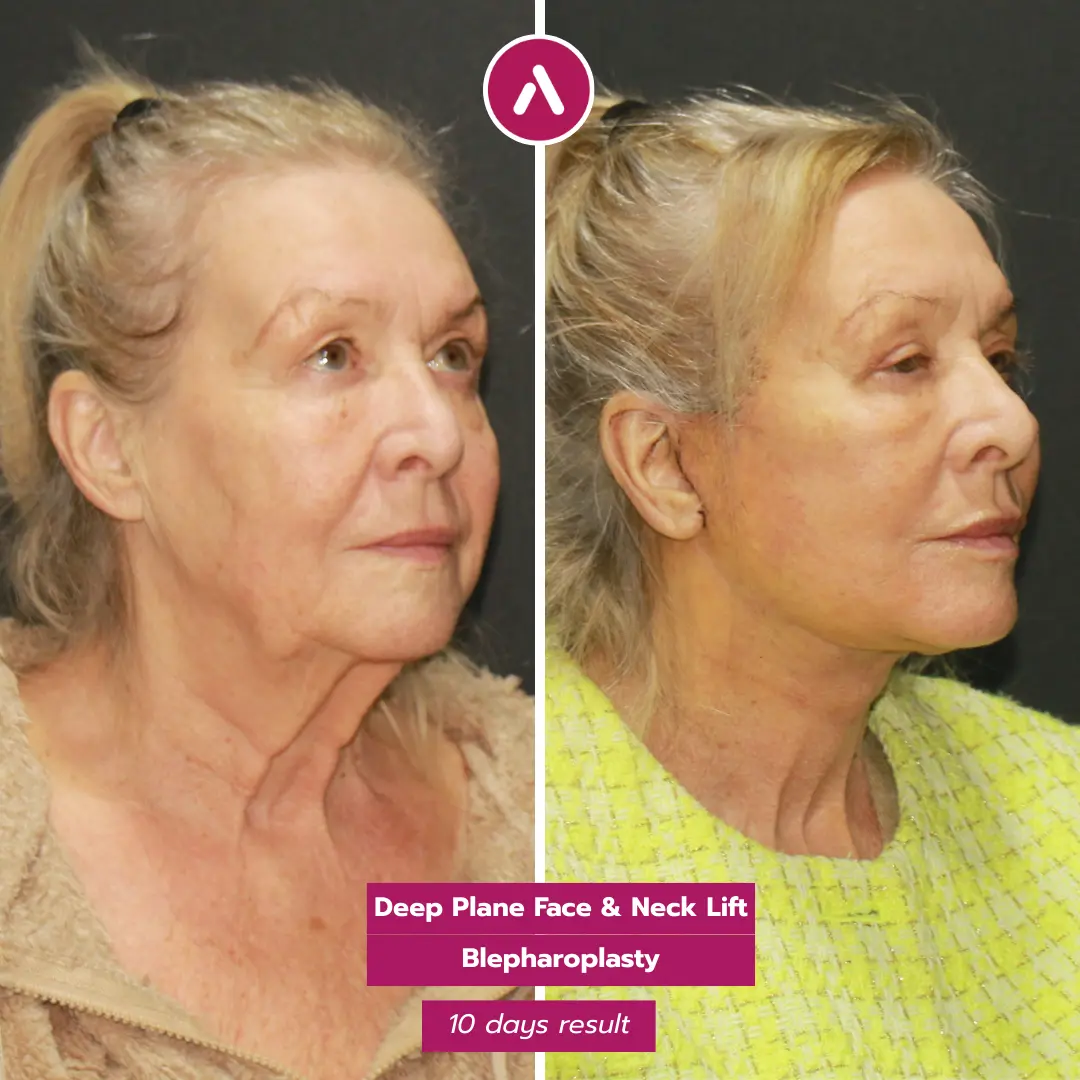
A “pulled” appearance is often linked to surface tension rather than deeper support. When you review before/after images (and ideally videos), look for:
- Natural jawline flow: definition should look structural, not “stretched”.
- Neck in motion: banding and contour should look calm when speaking, not only at rest.
- Scar discretion: placement should respect natural creases and hair-bearing areas where appropriate.
- Consistency: a portfolio that shows repeated, natural outcomes across different anatomies.
Most importantly, ask your surgeon to explain how their chosen technique reduces reliance on skin tension and supports a natural contour as you move.
Revision neck lift / complex cases assessment logic
Revision surgery is a specialist scenario. Previous procedures can create scar tissue, altered anatomy, or uneven tissue behaviour. If you have had prior neck liposuction, facelift/neck lift, or submental work, planning should include:
- Detailed history: what was done before, when, and what changed afterwards.
- Scar and tissue assessment: how skin quality and scar tissue affect predictability.
- Realistic goals: revision often focuses on improvement and balance rather than “perfect symmetry”.
- Contingency planning: a clear plan for what happens if tissues behave unpredictably intra-operatively.
Male neck lift: different aesthetic goals & planning
Male neck lift planning often differs because male skin can be thicker, lower-face proportions differ, and the aesthetic goal is usually a clean, strong contour without feminisation. Planning considerations may include:
- Jawline definition: aiming for a sharper line while preserving masculine proportions.
- Incision planning: taking beard growth patterns into account where relevant.
- Banding strategy: muscle work may be essential when platysmal bands are prominent.
Your Medical Journey: What to Expect
Your medical journey experience should feel structured from first contact to long-term follow-up. For UK patients, good planning reduces travel stress and keeps the focus where it belongs: safety, comfort, and a natural result.
Virtual consultation → personalised plan
We start with a clinical review of your goals and anatomy using a photo-based assessment. This helps determine whether you need an isolated neck lift, a mini vs full approach, muscle repair (platysmaplasty), skin work (cervicoplasty), submental contouring, or a combined face & neck plan.
Arrival, VIP transfers, hotel coordination (practical, not exaggerated)
Travel should not add medical pressure. A coordinated pathway typically includes airport-to-hotel-to-clinic logistics and clear scheduling so you know exactly where you need to be, and when.
In-person consultation → procedure day → discharge plan
Before surgery, you’ll have an in-person assessment to confirm the plan and review aftercare instructions. On the day, your pathway includes:
- Final pre-op review: markings, plan confirmation, and anaesthesia discussion.
- Procedure: performed in a controlled theatre setting with appropriate monitoring.
- Early recovery: focus on comfort, swelling control, and clear rules for activity and garment wear.
- Discharge planning: written instructions and a contact pathway for questions.
Remote follow-up schedule & long-term support
Healing continues after you return to the UK. A structured follow-up plan usually includes scheduled remote check-ins and guidance for incision care, swelling changes, scar maturation, and return to exercise. If something feels unusual, you should know exactly how to reach your team and what to do next.
Neck Lift Surgery Frequently Asked Questions (FAQ):
How long does a neck lift last?
A neck lift can be long-lasting, but longevity depends on skin quality, weight stability, lifestyle factors (especially smoking/nicotine), and whether the plan addressed the main anatomical driver (skin, fat, muscle, or a combination).
Mini neck lift vs full neck lift: what’s the difference?
It’s primarily about how comprehensively the anatomy is treated. A mini approach may suit milder laxity; a full neck lift is designed for more advanced skin excess and/or muscle changes. The best option is determined by anatomy, not age alone.
Will I need drains?
Not always. Drains may be used when the surgical scope suggests a higher risk of early fluid collection. If used, they are typically temporary and removed based on clinical assessment.
When can I fly back to the UK?
Travel timing should be individualised. It depends on the extent of surgery, your early healing progress, swelling pattern, and whether drains were used. Your team should advise you based on your specific pathway rather than a generic timeline.
Is it possible under local anaesthesia/twilight sedation?
In many cases, yes—especially for appropriately selected patients and focused plans. More extensive or combined procedures may be better suited to general anaesthesia. The safest option is the one that fits your procedure scope and medical profile.
How visible are scars?
All surgery leaves scars. Visibility depends on incision placement, closure tension control, your skin biology, and aftercare. We plan scars to be as discreet as possible and provide guidance to support optimal scar maturation.
Male neck lift: is the approach different?
Often, yes. The goal is usually a clean, strong contour without feminisation, and planning may consider thicker skin, beard patterns, and masculine proportions.
Can I combine with chin liposuction or facelift?
Yes—when anatomically appropriate. Combining procedures can improve harmony, particularly when jawline descent and neck ageing occur together. The safest and most natural plan is the most conservative plan that still solves the real driver of your concern.
What is the swelling (oedema) timeline?
Swelling commonly peaks in the first few days, improves through the first two weeks, and continues refining over the following weeks and months. Final “settling” can take several months depending on the technique and your biology.
What are the signs of a haematoma?
Warning signs can include rapidly increasing swelling (often one-sided), escalating tightness/pressure, sudden pain changes, and unexpected bleeding or drainage changes. If you suspect a problem, seek urgent assessment.
How does HBOT/LLLT change recovery?
When clinically appropriate, adjunct therapies such as HBOT and LLLT may support comfort and recovery dynamics. They do not replace correct surgical technique or aftercare, but can be integrated into a structured recovery plan for selected patients.
Medical Disclaimer: This page is for informational purposes only and does not constitute medical advice. A neck lift plan must be personalised after clinical assessment, medical history review, and (where appropriate) pre-operative testing. If you have urgent symptoms, seek immediate medical attention.