
Quick answer: Neck lift scars usually sit in discreet places: a small crease under the chin and, for a full neck lift, behind the ears and into the hairline. Most neck lift scars look red or firm at first, then soften and fade over 6–12 months. Final visibility depends on incision placement, skin quality, tension, aftercare and whether you had a mini or full neck lift.
For many UK patients, the first worry is not the neck lift itself. It is the scar. Where will it sit? Will someone see it when your hair is tied back? What happens if the under-chin scar becomes raised? These are sensible questions, especially when you are comparing a local Harley Street consultation with treatment abroad.
A well-planned neck lift is not about simply “pulling skin tighter”. It is about placing the incision where the eye does not naturally look, reducing tension on the wound, and supporting the deeper neck structures so the skin does not carry the whole result. That is why how a neck lift is performed matters as much as the scar-care routine afterwards.
At AKM Clinic, the surgical philosophy is natural-first: rejuvenation over alteration. The goal is not a pulled, operated-on neck. It is a cleaner jawline and neck contour with scars planned around the folds, shadows and hair-bearing areas that already exist. This guide explains where those scars usually sit, how they heal, and what makes them more or less visible over time.
Table of Contents
Where Neck Lift Scars Actually Sit?
Neck lift scars are designed to be hidden, not absent. Any surgical lift requires an incision, but the location of that incision can make a major difference to how visible the mark becomes once healed. In most cases, scar placement depends on what needs correcting: loose skin, platysma bands, deep neck fullness, or a combination of these.
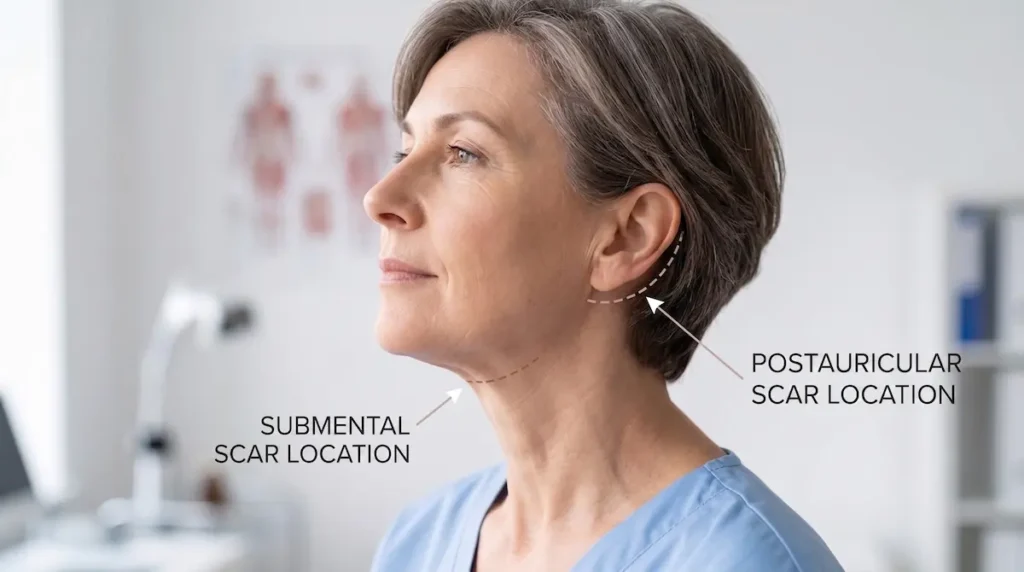
A full neck lift commonly uses two access points: one under the chin and one around or behind the ears. A smaller or mini approach may use fewer incisions, but it also corrects less. The best incision plan is therefore not the shortest one by default; it is the one that gives enough access while keeping the scar in the least noticeable position.
Submental incision: the small scar under the chin
The submental incision sits in the natural crease beneath the chin. It is usually short and placed where the neck naturally folds when you look down. This position helps camouflage the scar because it follows an existing shadow rather than crossing a flat, exposed surface.
This under-chin incision is often used when the surgeon needs to address the central neck. That may include platysma band tightening, deep fat refinement, or improving the angle between the chin and neck. The mark can look pink, slightly raised or firm during early healing. That is normal in the first weeks.
Once it matures, a well-placed submental scar usually becomes a fine line. It may still be visible if someone looks closely from below, but in normal conversation it is often difficult to notice because the chin naturally shields it.
Postauricular incision: behind the ear and into the hairline
The postauricular incision sits behind the ear, often extending into or near the hairline. This is the scar most patients worry about when they wear short hair, tie their hair up, or wear glasses. Planning matters here. A poorly placed incision can sit too far forward, distort the ear crease, or become visible when the hair is lifted.
In a careful full neck lift, the incision is shaped around natural contours: the crease behind the ear, the curve where the ear meets the scalp, and the lower hairline. These areas break up light and shadow, making the healed line harder to see.
The behind-the-ear scar may take longer to settle than the under-chin scar because this area moves, bends and can be affected by hair, glasses or mask straps. Early redness is expected. Thickening, widening or persistent soreness should be discussed with your surgical team.
Why a full neck lift may need both incision sites
A full neck lift often needs both a submental and postauricular incision because the neck ages in more than one direction. Loose skin may need to be redraped from the sides, while central platysma bands or deep fullness may need direct access under the chin. One incision cannot always solve both problems.
This is where scar expectations should be honest. Choosing fewer scars can be reasonable for mild laxity, but it may not correct heavier neck bands or loose skin. Choosing a full lift can mean more incision length, but also better access for a more complete contour change.
The decision is anatomical. It should be made after examining the skin, the platysma muscle, the jawline, the amount of loose tissue and the patient’s hairstyle or scar concerns. For patients comparing options, it is useful to understand the role of the platysma muscle, because muscle tightening can affect both the result and the incision plan.
Surgeon-led principle: A neck lift scar should not be planned as an isolated line on the skin. It should be planned around the anatomy underneath, the amount of correction required, and the places where the face and neck already create natural shadow.
Mini vs Full Neck Lift — The Scar Difference
The difference between a mini and full neck lift is not just the size of the scar. It is the amount of access the surgeon has. A mini neck lift may sound more appealing because it usually involves shorter or fewer incisions, but that smaller footprint comes with a trade-off: it is best for earlier or milder ageing, not advanced skin laxity.
For UK patients, this is an important consultation point. A “short-scar” option can be appropriate, but only if the anatomy suits it. When the neck needs broader redraping or deeper muscle work, reducing incision length too aggressively can compromise the result.
| Approach | Typical scar location | Scar visibility | Correction capacity |
|---|---|---|---|
| Mini neck lift | Often under the chin, behind the ear, or a shorter version of both depending on technique | Usually less incision length, but visibility depends on placement and healing | Best for mild to moderate laxity, early banding or limited contour concerns |
| Full neck lift | Under the chin plus behind the ears and sometimes into the hairline | More scar length, but usually placed in natural creases and hair-bearing areas | Better for loose skin, visible platysma bands, heavier neck laxity and more complete contouring |
| Deep neck or extended correction | Varies by anatomy; may require broader access | Can be discreet when planned well, but should be discussed clearly before surgery | Used when deeper structures, not only surface skin, contribute to neck fullness |
Mini neck lift scars
How a mini neck lift differs is mainly about access and indication. In the right patient, a mini lift can improve early neck laxity with a smaller incision plan. The scar may be limited to the under-chin crease, a shorter behind-the-ear path, or another short-scar pattern depending on the surgeon’s technique.
The advantage is obvious: less incision length. The limitation is just as important. A mini approach may not remove significant loose skin, may not fully correct strong platysma bands, and may not create enough redraping for a patient with heavier tissue laxity.
That does not make it inferior. It makes it specific. For the right neck, a mini lift can be subtle and efficient. For the wrong neck, it can leave the patient disappointed because the scar is smaller but the correction is also smaller.
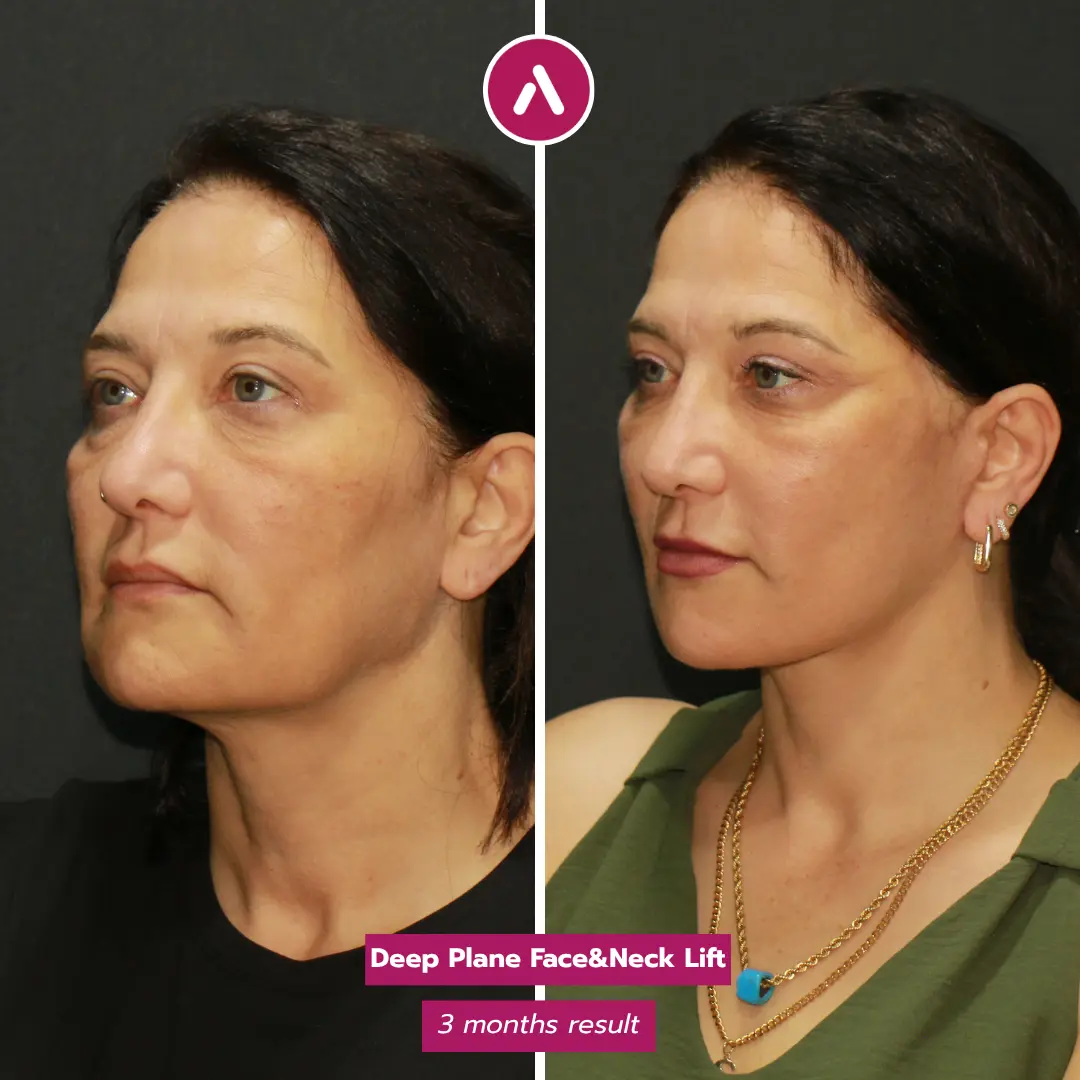
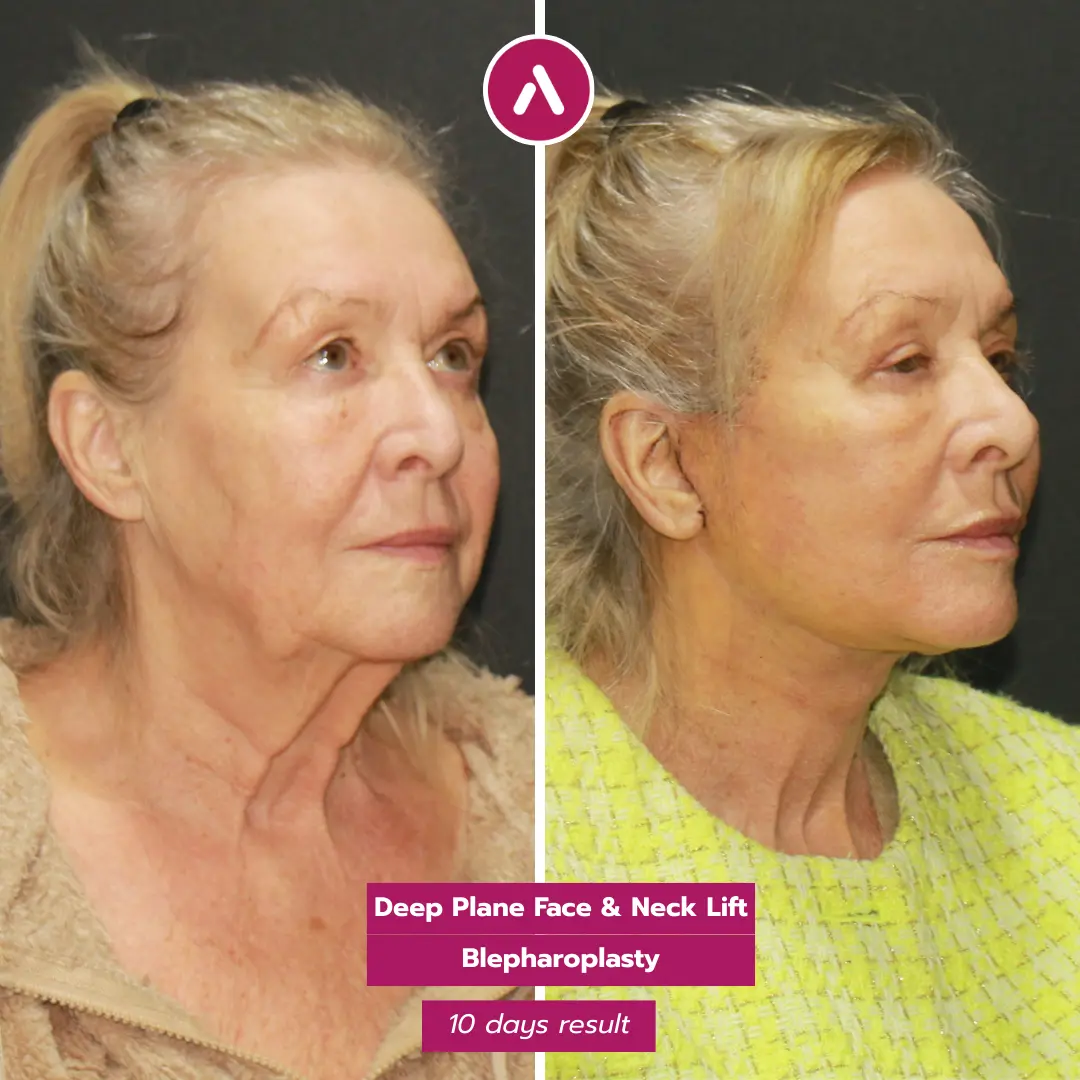
Full neck lift scars
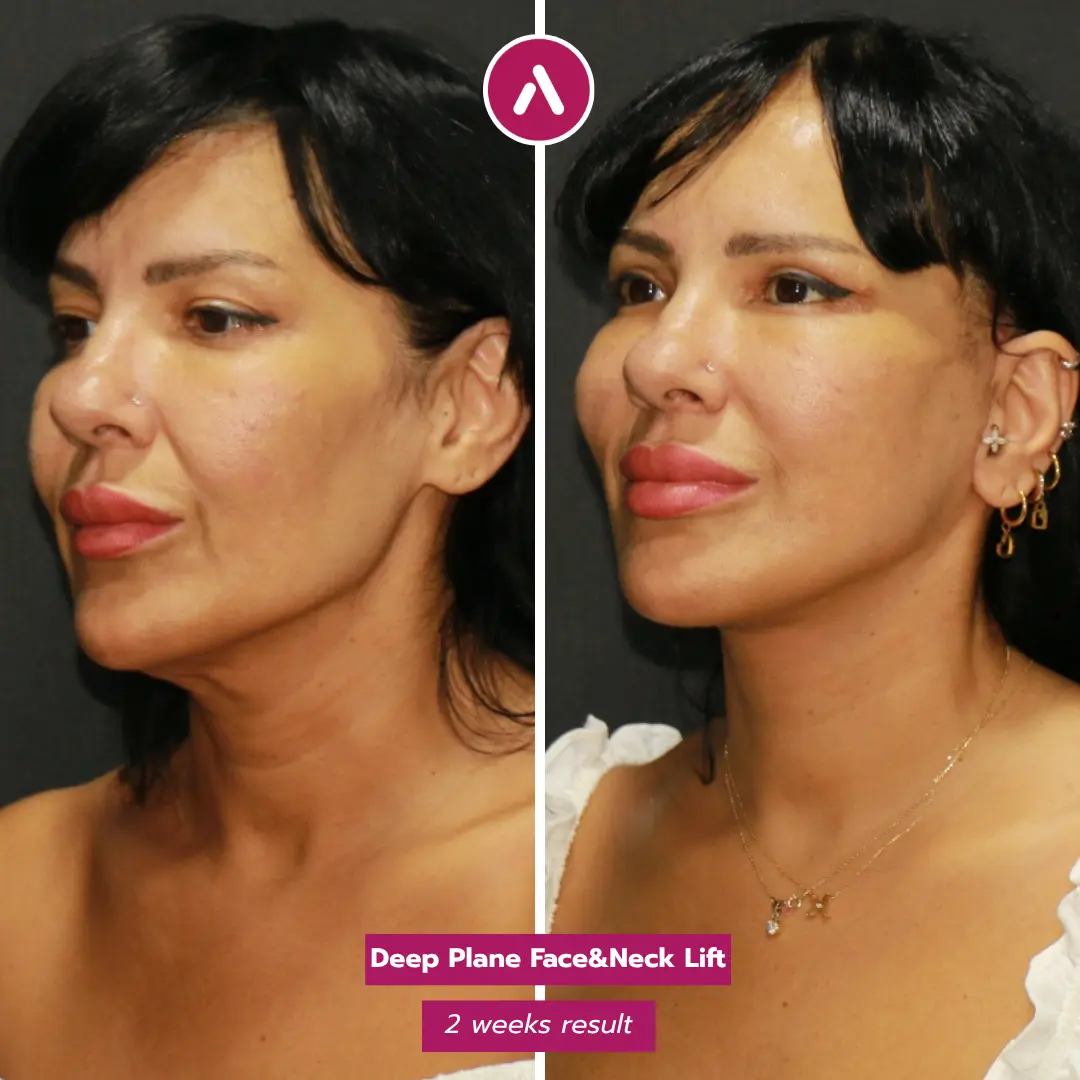
A full neck lift usually involves more incision length because the surgeon needs better access to lift, redrape and support the tissues. The under-chin scar allows central correction. The behind-the-ear scar allows skin to be repositioned more smoothly from the sides.
This is why full neck lift scars may sound more concerning on paper than they look in real life. The incision is longer, but it is not usually placed across the open front of the neck. It is hidden under the chin, around the ear crease and behind the ear where shadows and hair help conceal it.
Early on, patients may notice tightness, redness or small raised areas along the incision. These usually improve gradually. The key is patience. A full neck lift scar should not be judged at two weeks, or even at two months.
The trade-off: fewer scars vs less correction
The scar conversation should be framed as a trade-off, not a sales pitch. A shorter scar may suit a younger patient with mild laxity. A longer, better-placed scar may suit someone with significant loose skin who wants a cleaner neck angle. Neither option is automatically better.
For UK patients travelling abroad, this should be clarified before booking surgery. Ask what incisions are planned, why each one is needed, where each scar will sit, and what follow-up is available if healing is not straightforward. NHS guidance on cosmetic surgery abroad also advises patients to consider aftercare and complication planning before travelling for treatment.
A strong consultation should leave you understanding not only the result being planned, but also the scar pattern required to achieve it. That is the difference between a cosmetic promise and a surgical plan.
The Neck Lift Scar Healing Timeline
Neck lift scar healing is not a straight line from red to invisible. It has phases. In the early weeks, scars can look more noticeable because the body is actively repairing the wound. Later, the same scar usually becomes flatter, paler and softer as collagen reorganises.
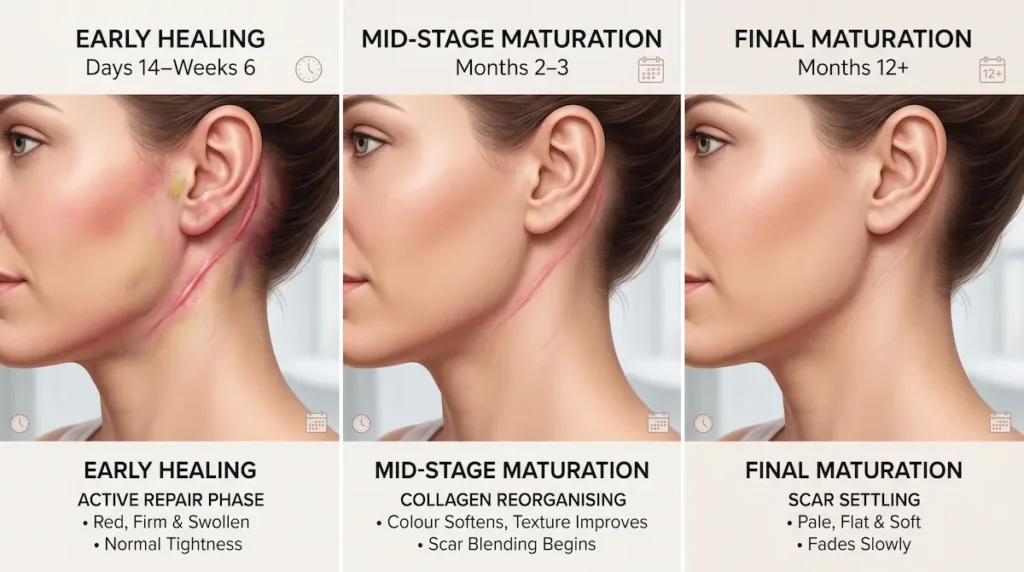
This is why timing matters. A scar that looks pink and firm at three weeks may be healing normally. A scar that is becoming hotter, more painful, swollen, spreading in redness or producing discharge is different and should be reviewed. The goal is to know the usual pattern without ignoring warning signs.
| Healing stage | Typical scar appearance | What is usually normal | Supportive action |
|---|---|---|---|
| Days 1–14 | Pink or red, slightly raised, swollen, tender | Mild tightness, bruising, numbness and firmness around the incision | Follow your surgeon’s dressing, cleaning and activity instructions exactly |
| Weeks 3–6 | May look redder or firmer before it improves | Itching, tightness and a rope-like feel as collagen forms | Avoid sun exposure; do not massage unless the wound is fully closed and your surgeon clears it |
| Months 2–3 | Colour starts to soften; scar may still feel firm under the skin | Gradual flattening and reduced sensitivity | Discuss silicone gel or dressings if appropriate for your skin and incision |
| Months 6–12 | Usually flatter, finer and less pink | Scar maturation, fading and softening | Continue sun protection and attend follow-up if any area remains raised or uncomfortable |
| 12 months+ | Final scar appearance becomes clearer | Some scars continue to fade slowly beyond a year | Ask about scar revision only after maturation, unless there is a clinical concern earlier |
First weeks: redness, firmness and swelling
In the first two weeks, the incision is still new. The scar may look red or pink, and the skin around it can feel firm or swollen. Behind the ear, the area may feel tight because the skin has been redraped and the tissues are still settling.
Bruising and swelling can make the scars look more dramatic than they will later become. This is especially true around the ears, where small folds and shadows can temporarily exaggerate the incision line. Numbness is also common because tiny sensory nerves are disturbed during surgery.
The most important rule in this stage is simple: do not interfere. Avoid pulling, rubbing, over-cleaning or applying scar products before the wound is sealed. Your surgeon’s aftercare plan comes first.
1–3 months: fading and softening
Between one and three months, the scar often enters the “annoying but normal” phase. It may feel firm, tight, slightly raised or itchy. Some patients worry at this stage because the scar is no longer hidden by swelling but is not yet faded.
This is the collagen-building phase. The body is strengthening the incision, and that process can temporarily make the line feel thicker. A raised scar is not automatically a bad scar at this point, but it should be monitored.
Colour usually begins to settle during this period. Redness softens. Firmness reduces. The scar starts to blend better with the surrounding skin, although it is not finished healing.
6–12 months: scar maturation
Most neck lift scars need 6–12 months to mature. Some continue improving beyond that. By this stage, a well-healed under-chin scar usually looks like a fine line in the crease, while the behind-the-ear scar is often hidden by the ear contour and hairline.
Patients with a history of hypertrophic or keloid scarring may need closer monitoring. So may patients with darker skin tones, very fair skin, high sun exposure, smoking history or wound tension. These factors do not mean a poor scar is certain. They simply mean the plan should be more careful.
At 12 months, the scar is usually much easier to judge. If it remains raised, wide, painful or cosmetically troubling, your surgeon can discuss options such as silicone therapy, steroid treatment, laser, camouflage or revision depending on the scar type.
How Visible Are They, Really?
The honest answer is that neck lift scars are usually discreet, but not magically invisible. Visibility depends on the scar location, the technique, the skin’s healing behaviour, hairstyle, sun exposure and how much tension sits on the wound. A good scar is planned. It is not left to chance.
Most people will not inspect the underside of your chin or the crease behind your ear in normal conversation. That is why these sites are useful. The scar is still there, but it sits where everyday viewing angles, shadows and hair help hide it.
Why the under-chin scar is usually hidden
The submental scar benefits from two natural advantages: shadow and direction. It sits under the chin, not across the visible front of the neck. It also follows the crease that already forms when the neck bends.
This means the healed line is often difficult to see unless the chin is lifted and someone looks from below. Even then, a mature scar may appear as a faint line rather than an obvious surgical mark.
It can become more noticeable if the incision is placed too far forward, if the scar thickens, or if the skin is repeatedly stretched during early healing. That is why posture, activity limits and avoiding wound tension matter in the first weeks.
Why behind-the-ear scars are placed discreetly
Behind-the-ear scars rely on anatomy for camouflage. The ear creates a natural fold. Hair softens the outline. The curve behind the ear breaks up the line rather than leaving it exposed on a flat surface.
However, this scar can be more visible in certain situations. Short hair, tightly tied hair, glasses, hearing aids, sun exposure or a low hairline can all affect how much of the scar is seen. These details should be part of the consultation, not an afterthought.
Patients who often wear their hair up should say so before surgery. A surgeon can then plan the incision with hairstyle, hair density and hairline position in mind. The goal is not only to lift the neck, but to leave a scar pattern that fits real life.
What can make scars more noticeable
Several factors can make neck lift scars more visible. Some are biological, such as skin type, pigmentation, previous scar behaviour or a tendency towards raised scars. Others are mechanical, such as wound tension, early overactivity or friction behind the ear.
Sun exposure is another major factor. A healing scar can darken if exposed to UV light too early. NHS scar guidance recommends covering scars in the sun for at least a year and using SPF 30 or more on exposed scars. For a neck lift patient, that usually means being careful with the under-chin area, the lower hairline and any area behind the ears that may catch sunlight.
Scars can also look worse if the neck lift itself is over-tightened. A pulled look can create tension on the incision and may distort the ear crease. This is one reason AKM’s natural-first philosophy avoids a wind-swept or operated-on appearance.
For a broader facial-scar comparison, how scars heal on other facial procedures can be useful, especially because brow lift and neck lift scars both depend heavily on hairline planning and hidden incision placement.
Helping Your Scars Heal Well
Scar healing is partly surgical and partly biological. You cannot control every part of it, but you can reduce avoidable problems. The main priorities are keeping tension low, protecting the scar from sun, following wound-care instructions and asking early if healing does not look right.

This section stays focused on normal scar support. It is not a substitute for your surgeon’s aftercare plan. If the scar is painful, hot, swollen, opening, producing pus or worsening rather than improving, it should be assessed rather than treated at home.
Silicone and sun protection
Silicone gel or silicone dressings are commonly used once the incision has fully closed and the surgeon confirms it is safe. They do not erase scars, but they may help some scars flatten and mature more neatly. NHS guidance also notes that pharmacists can recommend silicone dressings or gels for scars.
Sun protection is just as important. Healing scars are vulnerable to pigment change. The under-chin scar may seem protected, but reflected sunlight and open-neck clothing can still expose it. Behind-the-ear scars can also catch sun if hair is short or tied up.
A practical UK routine is simple: keep scars covered where possible, use high-SPF protection once cleared, and avoid deliberate tanning while scars are maturing. Scar improvement is slow. Consistency helps.
Normal vs concerning healing
Normal healing can include redness, firmness, itching, mild tenderness and temporary numbness. These symptoms should gradually improve. They may fluctuate, but the overall trend should be towards calmer skin and softer tissue.
Concerning signs include spreading redness, increasing warmth, pus, worsening pain, wound opening, sudden swelling or a scar that becomes increasingly raised and tight. These symptoms do not automatically mean something severe is happening, but they deserve prompt review.
If you are worried that your scar is part of a wider surgical problem, it is better to ask early. Signs of a poorly healed neck lift should be considered separately from normal scar maturation, because poor healing, over-tightening and contour irregularities are different issues from a scar that is simply still immature.
When to ask about revision
Scar revision is rarely judged in the first few weeks. Most scars need time to mature before anyone can fairly assess whether revision would help. Asking too early can lead to unnecessary worry; waiting too long when a scar is clearly symptomatic can also be unhelpful.
A good rule is to ask your surgeon if the scar is painful, raised, widening, pulling, itchy beyond the expected period, or emotionally bothering you. Your surgeon may advise more time, silicone, steroid treatment, laser, camouflage or revision depending on what the scar is doing.
If you are still comparing procedures and budgeting, keep the scar conversation separate from price. This article does not open a cost breakdown, but you can review the cost of a neck lift on the dedicated cost page. The scar decision should be based on anatomy, technique and follow-up, not on a shorter incision promise or headline fee.
UK patient checklist before travelling: Ask where each incision will sit, whether you need a mini or full neck lift, who reviews your scars after you return home, what photos you should send during follow-up, and what happens if a scar becomes raised, painful or slow to heal. If comparing with a GMC-registered UK surgeon, use the same questions so you are comparing surgical plans, not just marketing language.
Frequently Asked Questions: Neck Lift Scars
These questions cover the scar concerns patients most often raise before a neck lift. They are not a replacement for a surgical consultation, because scar placement depends on your anatomy, hairstyle, skin quality and whether you need a mini or full correction.
Where are neck lift scars?
Neck lift scars usually sit in two discreet areas: under the chin and behind the ears. The under-chin scar is placed in the submental crease. The behind-the-ear scar follows the natural ear crease and may extend into the hairline, especially in a full neck lift.
A mini neck lift may involve fewer or shorter incisions, depending on the correction needed. A full neck lift often needs both central and side access so the surgeon can tighten deeper support and redrape the skin properly.
Are neck lift scars visible?
They can be visible early on, especially while they are pink, firm or slightly raised. Once healed, neck lift scars are usually difficult to notice because they are placed under the chin, behind the ears and near the hairline.
No surgeon should promise “invisible” scars. A more accurate expectation is that well-planned scars often become discreet fine lines over time. Visibility depends on incision placement, skin type, scar tendency, tension, sun exposure and aftercare.
How long until neck lift scars fade?
Most neck lift scars improve noticeably over 3–6 months and continue maturing for 6–12 months. Some scars keep fading beyond a year. Early redness or firmness does not mean the scar will stay that way.
The final result should be judged after maturation, not during the first few weeks. If a scar remains raised, sore, itchy, wide or darker than expected, ask your surgeon whether scar treatment or revision may be appropriate.
Does a mini neck lift leave less scarring?
Usually, yes. A mini neck lift often uses shorter or fewer incisions than a full neck lift. That is one of its main advantages.
The trade-off is correction power. Mini neck lift scars may be smaller, but the procedure is best suited to mild or early neck laxity. If there is significant loose skin or strong platysma banding, a full neck lift may leave more scar length but provide a more complete correction.
Can neck lift scars be hidden?
Yes, in many cases they can be well camouflaged. The under-chin scar sits in a natural crease, while the behind-the-ear scar is hidden by the ear contour and hairline. Hair length, hair density and how you usually style your hair should be discussed before surgery.
Scar care can also help. Once your incisions are fully closed and your surgeon approves, silicone products, sun protection and careful follow-up may support scar maturation. Do not start scar massage or active scar products until the wound is sealed and you have been cleared to do so.
When should I worry about a neck lift scar?
You should contact your surgeon if the scar becomes increasingly painful, hot, swollen, red, open, leaking fluid or worsening instead of gradually calming down. A scar that is becoming very raised, tight, itchy or thick should also be reviewed.
Some firmness and redness can be normal in the early healing phase. The difference is the direction of travel. A normal scar generally becomes calmer over time. A concerning scar often becomes more painful, inflamed or unstable.
Medical disclaimer: This article is for general educational purposes only and is not medical advice, diagnosis or a substitute for an individual consultation. Healing and scarring vary from person to person. If you have pain, spreading redness, discharge, wound opening, fever, sudden swelling or any concern about a healing scar, contact your surgeon or seek appropriate medical care.