
Male Liposuction Turkey: Etching Six-Pack Abs (A High-Definition Guide for Men)
AI Summary
- Male liposuction turkey can enhance ab definition with precision etching—without “creating” muscle or unrealistic grooves.
- Best candidates are lean with good skin quality; the right plan prevents unnatural, over-etched results.
- Recovery takes months; swelling hides definition early, while structured aftercare supports smoother, safer healing.
- Value beats low price; compare what’s included, safety standards, and follow-up—not just cost alone.
Summary generated by AI, fact-checked by our medical experts
If you're researching male liposuction in Turkey, you're probably not looking for "just less fat." You're looking for *definition*—a sharper midsection, clearer lines, and a result that still looks natural in real life (standing, sitting, bending, and under normal lighting). The candidacy logic, technique options, and recovery rhythm for the broader liposuction conversation belong on a separate page. This article zooms specifically into the male etching subset.
For the full procedure overview before drilling into ab etching specifics: liposuction technique reference.
This is where six-pack etching (sometimes marketed as six pack surgery Turkey) comes in. It’s a body contouring approach designed to enhance the visible anatomy of the abdominal area—without pretending surgery can replace training, nutrition, or genetics.
In this article, we’ll break down what ab etching truly is, who tends to do well, what can go wrong, and how to think about technique and recovery using principles grounded in medical science and practical clinical experience (not hype).
Key takeaway: Ab etching can enhance definition, but it requires the right candidate, careful planning, and disciplined aftercare to avoid an “overdone” or uneven look.
Table of Contents
What “Six-Pack Etching” Really Means (and What It Can’t Do)
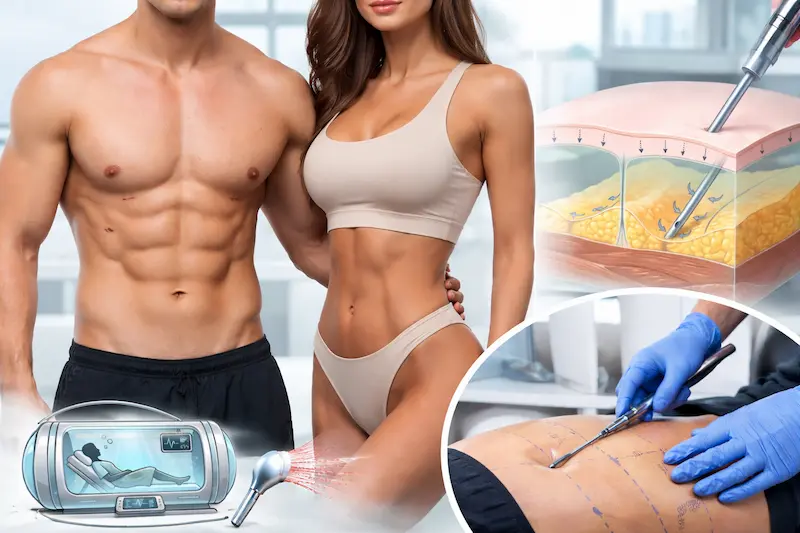
“Etching” is best understood as precision body sculpting. Instead of removing fat evenly, the surgeon strategically contours different layers so that natural shadow lines (like the midline and tendinous intersections) appear more visible. Done well, it can look athletic—done poorly, it can look artificial.
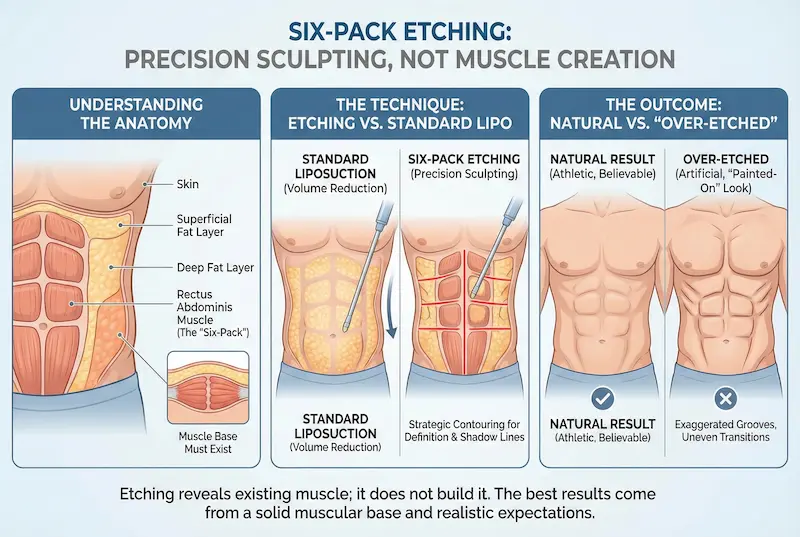
Ab etching vs. standard lipo: what’s different in technique and goals
Standard liposuction focuses on volume reduction—making an area smaller by removing fat more uniformly. Ab etching focuses on definition—creating controlled transitions between slightly fuller and slightly leaner zones to reveal the shape of underlying musculature.
In practice, that often means working with both deeper and more superficial fat layers (depending on your anatomy), and it demands a surgeon who understands how light, skin thickness, and natural abdominal anatomy interact.
"Six-pack etching" and "abdominal etching" are often used interchangeably, but the formal procedure has its own scope, candidacy criteria, and outcome literature distinct from general liposuction. The procedure-specific page covers what's standard, what's optional, and where the boundaries of realistic expectations actually sit—including the candidacy gates that separate good outcomes from disappointing ones.
Full procedure detail: abdominal etching procedure hub.
Etching creates definition—why it doesn’t “build” muscle
This matters for expectations. Etching can highlight what’s already there, but it does not create muscle. If the abdominal wall is weak or there’s minimal muscular structure underneath, the “six-pack” effect can be limited.
The evidence base for abdominal etching has matured into longitudinal data, not just isolated case reports. A May 2025 retrospective in Aesthetic Surgery Journal Open Forum reviewed 345 patients undergoing differential liposuction with abdominal etching across a decade (2014-2024) by a senior author: abdominal etching 10-year retrospective. The series describes technique evolution, candidate selection patterns, and how energy-based or excisional adjuncts integrate with etching depending on skin elasticity and scope.
Important caveat: this is a single senior author's 10-year retrospective—useful for technique evolution and longitudinal pattern recognition, but not a randomized comparison across surgeons or settings. Larger multi-center prospective data remains the harder evidence threshold for definitive claims.
Natural-looking results: the fine line between athletic definition and “over-etched” abs
A natural result should still look believable when you move. “Over-etching” can happen when too much superficial fat is removed or when shadow lines are exaggerated beyond your natural anatomy. That can lead to visible grooves, uneven transitions, or a “etched-on” appearance—especially under harsh lighting or when swelling resolves unevenly.
For patients traveling for Turkey male liposuction, this is one of the most important quality markers to evaluate in before/after photos: look for results that remain smooth and proportional at different angles, not just one posed “after” shot.
Candidate Checklist for Male Ab Etching
If you’re considering male liposuction in Turkey specifically for abdominal definition, candidacy is everything. The procedure is not a shortcut to fitness; it’s a finishing tool for the right body type. The goal is to choose a plan that fits your anatomy—not to force a “template” six-pack onto every patient.
Body fat %, BMI, and muscle foundation: who gets the best definition
Men with a relatively lean starting point and a visible muscle foundation usually see the most convincing definition. If overall body fat is higher, the surgeon may recommend a staged approach (first reduce volume, then refine definition later) rather than aggressive etching that increases irregularity risk.
Skin quality and elasticity: when loose skin changes the plan
Skin quality is a major driver of whether definition will look crisp or blurry. If the skin is thin, significantly stretched, or lacks elasticity, the best plan may include skin-tightening strategies or a different procedure direction—because no amount of precise fat sculpting can fully overcome skin that won’t contract well.
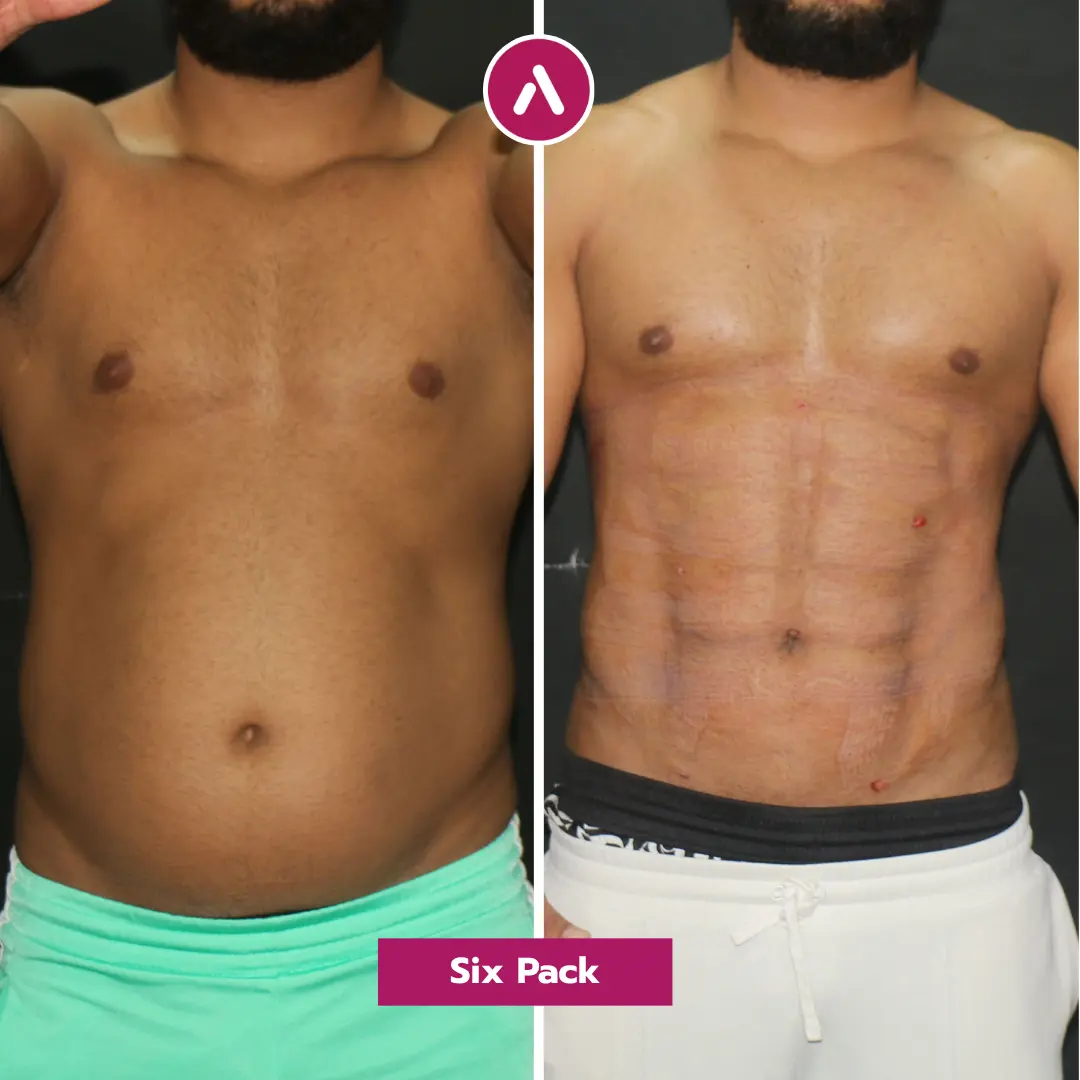
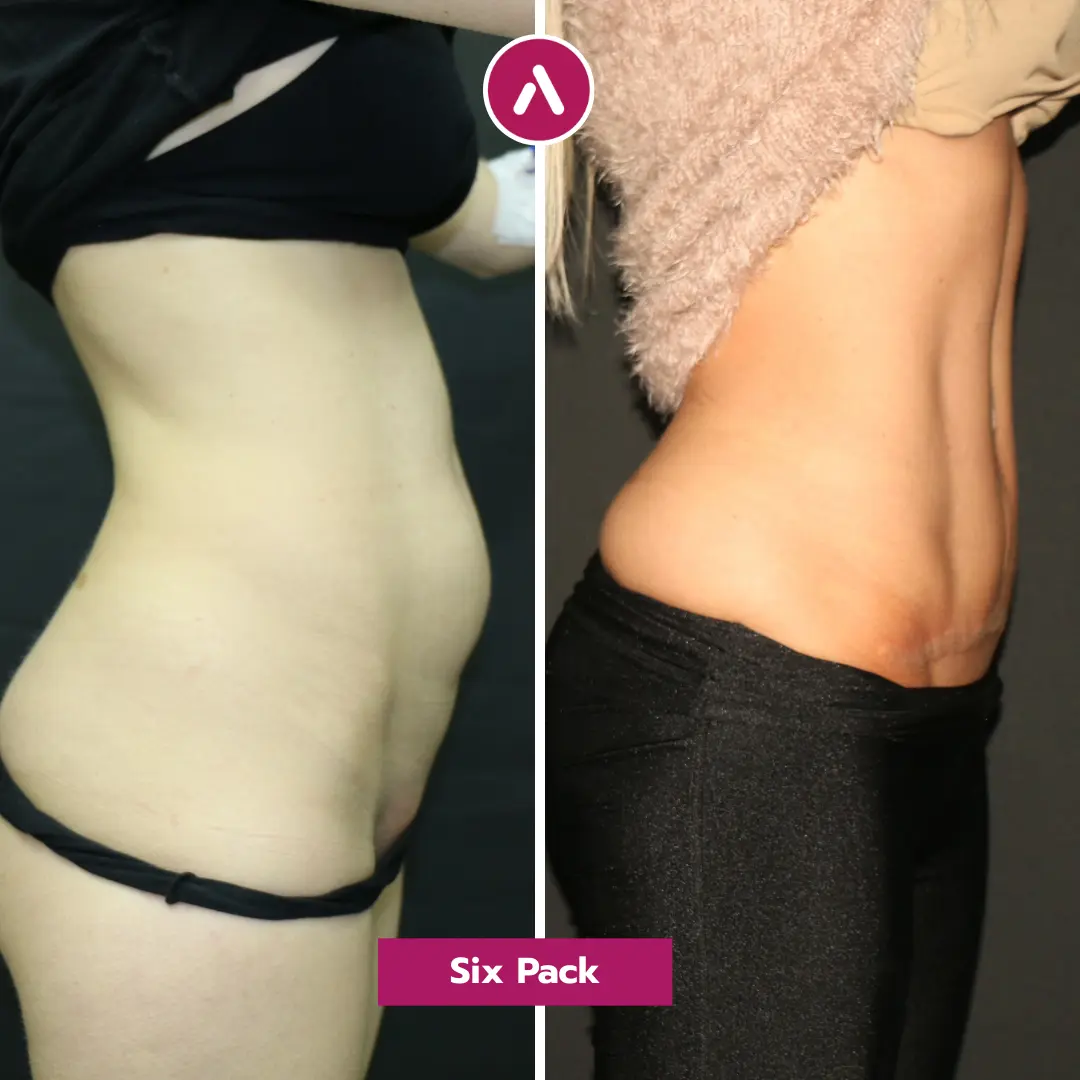
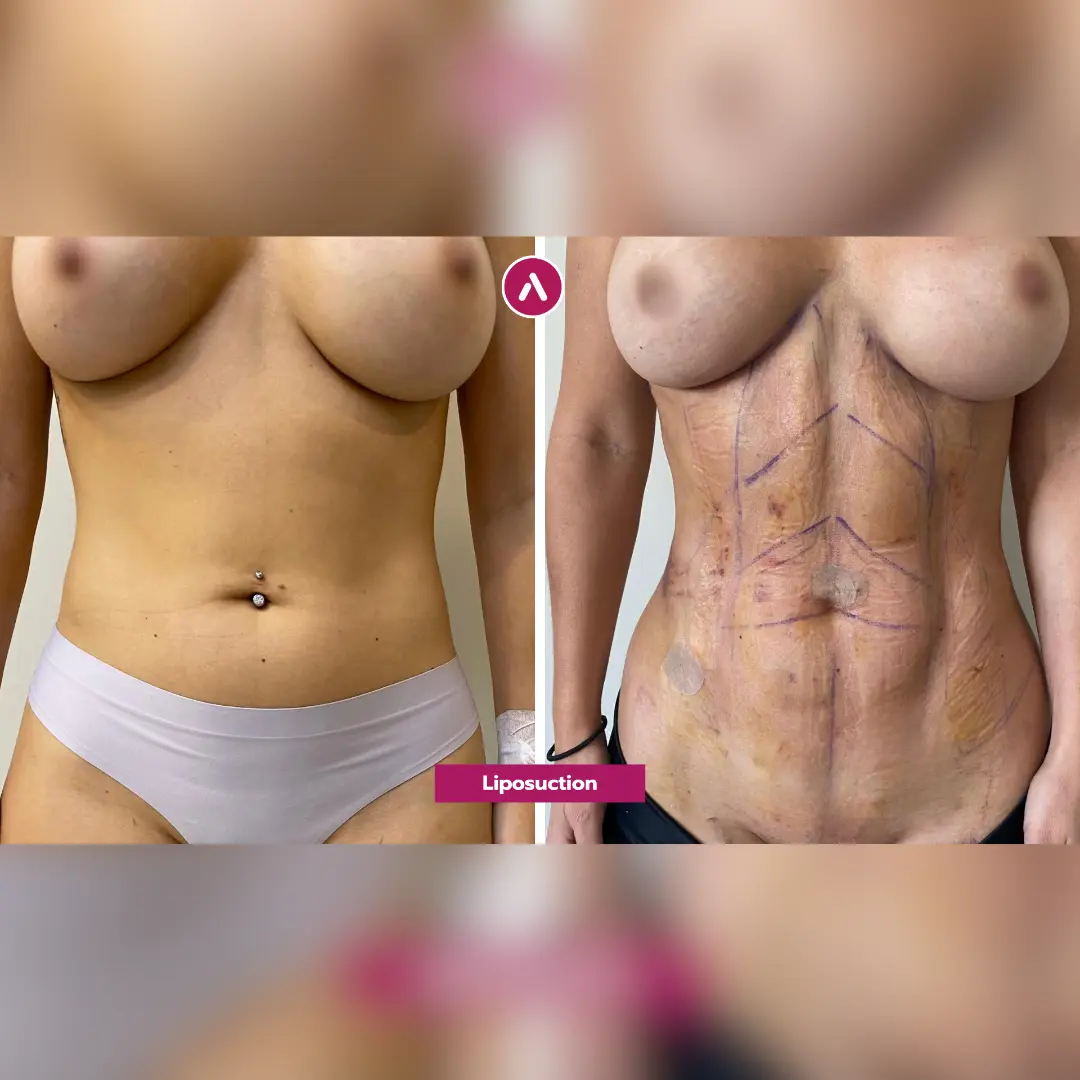
Reading male etching outcomes is a different skill than reading general lipo results. The "good etching" signal isn't a single posed flexed shot—it's a portfolio that holds up across angles, lighting, and movement. What you should be evaluating: how natural the linea alba and oblique transitions look at relaxed posture, whether the lower abdomen avoids the "scooped" appearance, and whether asymmetry is minimal at side profile.
Curated outcomes with multi-angle documentation: male contouring outcome library.
Lifestyle factors (training, diet, smoking): what can sabotage results
For ab etching, aftercare and lifestyle can either protect or undermine the result. Weight fluctuation, inconsistent training, poor nutrition, and smoking can affect swelling, healing quality, and how “sharp” definition appears after recovery.
Clinically, postoperative recovery is also influenced by supportive care protocols. At AKM Clinic, patients may receive recovery-focused therapies such as HBOT (Hyperbaric Oxygen Therapy) and LLLT (Low-Level Laser Therapy) to support tissue healing, swelling management, and overall downtime—especially valuable for international patients who want a more structured recovery experience.
Technique Options: High-Def VASER vs. Traditional Lipo (and When to Add Skin Tightening)
When men search for male liposuction Turkey, they often assume all liposuction is the same. It’s not—especially when the goal is six-pack definition. The technique and energy modality can affect precision, swelling patterns, and the risk of contour irregularities. Understanding the “how” helps you evaluate clinics beyond marketing claims.
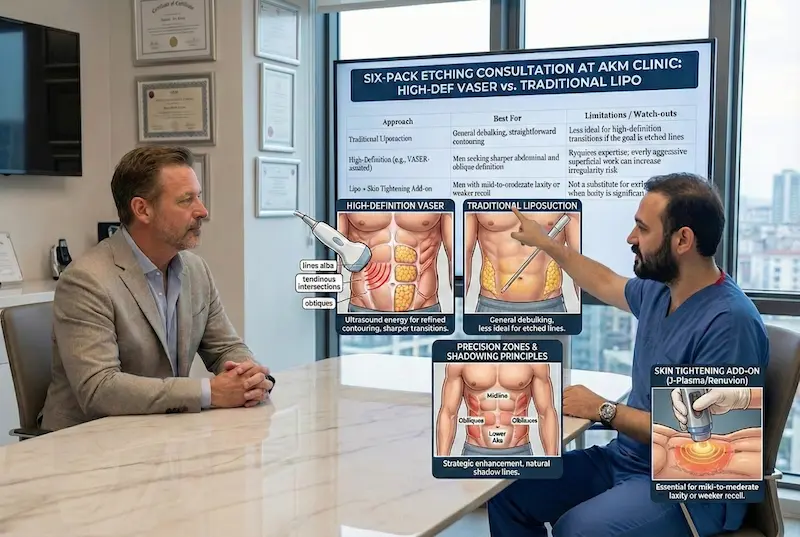
How VASER works for high-definition sculpting (vs. traditional suction)
High-definition approaches typically rely on more controlled fat emulsification and selective sculpting. VASER-assisted methods use ultrasound energy to help disrupt fat before removal, which can allow more refined contouring compared to traditional suction-only techniques—particularly in areas where men want sharper transitions (like upper abs vs. lower abdomen).
From a medical science perspective, the key is not “VASER = better” in every case, but how the surgeon uses the tool. Precision planning, layer selection (deep vs. superficial), and conservative handling of superficial fat are what protect a natural look.
VASER's mechanism deserves its own deep dive—the ultrasound emulsification step is what enables the controlled superficial work that makes etching possible without unacceptable irregularity risk. That mechanism, the candidate selection logic, and how it compares to traditional suction-only approaches belongs in one consolidated reference rather than scattered through this article.
The full VASER procedural breakdown: VASER high-def technique guide.
Precision zones: linea alba, obliques, lower abs, and “shadowing” principles
Six-pack etching is not just “removing fat around the abs.” It’s about strategically enhancing natural anatomic landmarks:
- Linea alba (midline): central definition can be refined, but over-etching can look like a deep groove.
- Tendinous intersections: these create the “segments” of a six-pack; emphasizing them must match your natural anatomy.
- Obliques: many men underestimate the role of oblique contour in a truly athletic torso.
- Lower abdomen: often the hardest area for men; it requires careful balancing to avoid a “scooped” look.
A clinic that understands these “shadowing principles” tends to produce results that still look normal when you sit or twist—an outcome that matters as much as the posed before/after.
When J-Plasma/Renuvion or other tightening becomes essential (not optional)
If the skin doesn’t retract well, definition may look soft or uneven even if fat removal is technically excellent. In men with reduced elasticity, post-weight-loss skin, or early laxity, the plan may include a skin-tightening component—sometimes energy-based tightening, sometimes a different surgical route entirely.
In evidence-based terms, the “best technique” is the one that matches your skin quality + fat distribution + anatomy. A responsible surgeon will say “no” to aggressive etching if it increases the likelihood of irregularities.
Skin tightening adjuncts aren't decoration—they're triage tools. When elasticity is borderline, deciding whether to add energy-based contraction (or step up to excisional surgery) is the difference between a crisp result and one that looks soft despite excellent fat work. Helium plasma technology specifically uses rapid tissue heating for subdermal coagulation, with mechanism and outcome data documented in recent literature.
The full procedure-side breakdown of J-Plasma/Renuvion candidacy and what to expect: helium plasma tightening primer.
| Approach | Best For | Limitations / Watch-outs |
|---|---|---|
| Traditional Liposuction | General debulking, straightforward contouring | Less ideal for high-definition transitions if the goal is etched lines |
| High-Definition (e.g., VASER-assisted) | Men seeking sharper abdominal and oblique definition | Requires expertise; overly aggressive superficial work can increase irregularity risk |
| Lipo + Skin Tightening Add-on | Men with mild-to-moderate laxity or weaker recoil | Not a substitute for excisional surgery when laxity is significant |
The Procedure at AKM Clinic: Step-by-Step (From Marking to Compression)
A safe, natural-looking outcome depends on what happens before fat is removed and what happens after you leave the operating room. For men traveling for male liposuction in Turkey, the step-by-step plan matters because your follow-up window in Istanbul may be short—and the first two weeks are when many preventable issues (seroma, excessive swelling, poor compression habits) begin.
Pre-op planning and markings: why standing mapping matters for men
High-definition outcomes start with detailed pre-op markings done while standing. Gravity changes how the abdomen and flanks sit, and the “six-pack template” must match your natural anatomy. This planning stage helps avoid mismatched symmetry or lines that look unnatural in daily posture.
A serious assessment should also include: skin quality, fat depth, muscle definition, and whether you’d benefit from combined contouring (e.g., abdomen + flanks) rather than isolating the “front” only.
Fat removal and sculpting sequence: deep vs. superficial layers
Ab etching is about controlled contrast. In many cases, surgeons address deeper fat to reduce bulk and then refine with conservative sculpting closer to the skin to create definition. The balance is delicate: too conservative and definition is limited; too aggressive and you risk:
- Contour irregularities or waviness
- “Stuck-down” areas that don’t move naturally
- Asymmetry that becomes more visible as swelling resolves
This is why “six pack surgery Turkey” should be treated as an advanced contouring procedure, not a standard lipo add-on.
Post-op essentials: compression garment protocol and early mobilization
Compression and movement are not optional details—they are part of the medical plan. Proper compression supports swelling control and helps the skin conform to the new contour. Early, gentle mobilization supports circulation and reduces avoidable complications.
AKM Clinic’s recovery-focused approach may include supportive therapies like HBOT and LLLT, used in many settings to assist tissue recovery, comfort, and swelling management—particularly helpful for international patients who want structured postoperative care.
Recovery infrastructure isn't a marketing claim—it's a documented set of protocols, equipment, and standards that determine what's actually delivered after the operating room. The technologies and accreditations that shape AKM's structured aftercare (HBOT, LLLT, hospital-grade monitoring, post-op pathway design) belong in one consolidated reference.
The complete documentation: clinical recovery infrastructure.
Practical rule: The sharper the definition you want, the more disciplined your aftercare must be—especially compression consistency and swelling management.
Recovery & Timeline: When You’ll See the “Final” Six-Pack
With male liposuction Turkey—especially when it includes ab etching—the biggest misunderstanding is timing. Many men expect “instant abs” right after surgery, but swelling, fluid shifts, and tissue firmness can temporarily hide definition. A realistic timeline (and consistent aftercare) is what turns a good procedure into a great-looking, natural result.
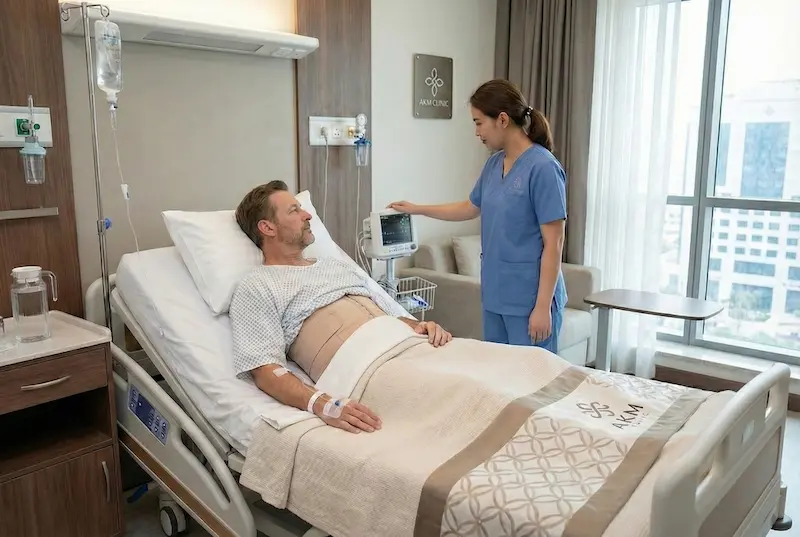
The first 72 hours: swelling, bruising, and movement rules
In the first 2–3 days, it’s normal to feel tightness, soreness, and fatigue. Swelling can be significant, and the abdominal area may look less defined than expected at this stage. Early walking (as advised by your medical team) supports circulation and recovery, while compression helps manage swelling and helps the skin adapt to the new contour.
Important: this early period is also when avoidable issues can begin if compression is inconsistent or if activity is too aggressive too soon.
Week-by-week milestones (2–6 weeks): when definition starts showing
From week 2 onward, you may start seeing early lines and shaping—especially in the upper abdomen. However, swelling often resolves unevenly (for example, lower abdomen can lag behind), and firmness can appear as the tissue heals.
Many clinics incorporate structured aftercare to support comfort and swelling control. At AKM Clinic, supportive recovery options such as LLLT and HBOT may be used as part of a broader postoperative care pathway for selected patients—an approach aligned with modern clinical practice in tissue recovery and patient comfort.
The HBOT mechanism gets summarized as "extra oxygen helps healing"—which is technically true but misses the actual physiology. Pressurized oxygen dissolves directly into plasma, reaching tissues with compromised microcirculation that hemoglobin alone can't fully serve. For post-etching recovery, that matters in zones where compression and bruising temporarily slow perfusion—exactly the areas where prolonged firmness can affect final definition.
The full mechanism, session structure, and realistic outcome expectations: pressurized oxygen recovery science.
Final reveal window (3–6 months+): swelling patterns, fibrosis management, and massage
The most reliable “final” look typically takes months. Swelling continues to improve, tissue softens, and the skin gradually conforms. Some men experience areas of firmness or texture changes during healing (often related to scar tissue remodeling). Your surgeon’s aftercare protocol may include guidance on massage or lymphatic support—used carefully and at the right time—to reduce prolonged firmness and help smooth the contour.
"Massage" gets thrown around in recovery advice as if it's all the same thing. It isn't. Manual lymphatic drainage is a specific technique with specific timing rules—deep tissue work too early can actually worsen swelling and irregularity risk. For ab etching specifically, the timing window matters more than the number of sessions. Starting too aggressively can blur the very definition you're trying to reveal.
The full timing protocol, technique safety rules, and red flags: post-op lymphatic protocol.
From a scientific research and medical science standpoint, this longer timeline makes sense: tissue remodeling and edema resolution occur in phases, and the abdominal area can take time to “settle” into its most natural shape.
| Timepoint | What You May Notice | What Matters Most |
|---|---|---|
| Days 1–3 | Swelling, tightness, bruising; definition often hidden | Compression consistency, gentle walking, hydration, rest |
| Weeks 1–2 | Swelling starts to shift; some early shape appears | Follow-up checks, proper garment fit, avoid overexertion |
| Weeks 3–6 | More visible contour; firmness can occur in spots | Structured aftercare, gradual return to training per surgeon advice |
| Months 3–6+ | Definition improves; tissues soften; final proportions emerge | Stable weight, consistent training, long-term lifestyle habits |
Reality check: If you judge results too early, you risk unnecessary anxiety. Ab etching outcomes often look better with time—once swelling and firmness fully resolve.
Safety, Risks, and How to Avoid Botched Results in Medical Tourism
If you’re comparing Turkey male liposuction providers, safety should be your first filter—before price, before “viral” before/after photos, and before package deals. Six-pack etching is a precision procedure, and most “botched” outcomes come from predictable causes: overly aggressive technique, weak postoperative protocols, or mismatched patient selection.
The real risks: contour irregularities, seroma, asymmetry, and how they happen
All surgeries carry risk, and ab etching has a unique set of concerns because it relies on controlled contrast. Key risks include:
- Contour irregularities / waviness: often linked to overly aggressive superficial fat removal or uneven sculpting.
- Seroma (fluid collection): can occur after liposuction; good technique, compression, and follow-up reduce the risk.
- Asymmetry: mild asymmetry is normal in human bodies, but noticeable asymmetry can happen if markings and layer work aren’t balanced.
- Unnatural “etched” look: created by exaggerated lines that don’t match natural anatomy.
A responsible surgeon will actively design the plan to minimize these risks—sometimes by recommending standard contouring first and postponing etching if it’s not ideal for your body type.
Contour irregularities don't just come from technique—they also emerge from healing biology. Scar tissue formation in the superficial plane (where etching works) can blur definition or create textural unevenness if inflammation isn't well-managed. This is where adjunct technologies have actual mechanistic relevance. Low-Level Laser Therapy uses specific wavelengths to influence cellular activity, with reasonable evidence supporting its role in scar maturation and inflammation modulation.
How LLLT fits into scar quality and post-lipo fibrosis specifically: LLLT scar minimization guide.
Surgeon selection and safety standards: what to verify (credentials, protocols, facility)
When evaluating a clinic for male liposuction in Turkey, focus on verifiable standards:
- Who is performing the procedure: confirm the surgeon’s experience specifically with male high-definition contouring.
- Facility standards: accredited operating environment, anesthesia safety protocols, and emergency readiness.
- Planning process: detailed pre-op assessment (skin quality, fat layers, realistic definition plan).
- Aftercare structure: scheduled follow-ups, garment protocol, and clear guidance for international patients.
In medical tourism, the safest choice is rarely the clinic that promises the most—it’s the clinic that explains limitations clearly and shows a consistent record of natural outcomes.
Aftercare and follow-up: how outcomes are protected after you fly home
Because swelling and tissue remodeling take time, your results are protected by what happens after surgery. Ask how follow-up is handled once you return home: what check-ins exist, how concerns are triaged, and what guidance you’ll have for compression, activity, and long-haul travel timing.
This is also where structured recovery support—such as protocols that may include HBOT and LLLT for selected patients—can be meaningful. It’s not “magic,” but it can support comfort and recovery consistency when paired with proper surgical technique and aftercare.
Cost & Value: Six-Pack Etching in Istanbul vs. New York / Los Angeles / Miami (and vs. Mexico / Thailand)
Cost comparisons get distorted when you're comparing "headline price" instead of "what's actually included." For high-definition contouring specifically, the gap between a transparent all-inclusive quote and a stripped-down lowball figure can be larger than the price difference itself. Surgeon time, anesthesia tier, hospital grade, follow-up scope, recovery support—each line item has its own value calculus.
The transparent line-item breakdown for liposuction specifically: liposuction pricing breakdown.
What drives price differences (OR time, tech, anesthesia, aftercare bundle)
When you compare male liposuction cost Turkey (or male liposuction Turkey cost) against high-cost US cities like New York, Los Angeles, and Miami, you’re often seeing differences in:
- Operating room and facility fees: hospital-grade settings and staffing structure vary by region.
- Anesthesia plan and monitoring: the level of anesthesia support can change total cost and safety profile.
- Surgeon time and complexity: ab etching is typically more time-intensive than standard debulking.
- Technology and technique: high-definition methods may require specialized equipment and expertise.
- Aftercare and follow-up structure: visits, garments, medications, and recovery protocols may be bundled or billed separately.
In other words, comparing “headline price” without knowing what’s included is not an apples-to-apples comparison—especially in medical tourism.
Transparent cost structure: what should be included to avoid “surprise fees”
Whether you’re choosing Turkey, the US, Mexico, or Thailand, a trustworthy quote should clearly state what’s included. Here’s a practical checklist to reduce surprise costs:
| Cost Item | Should It Be Clearly Included? | Why It Matters |
|---|---|---|
| Surgeon fee + procedure scope | Yes | Confirms if it’s standard lipo vs. high-definition etching, and which areas are treated (abdomen only vs. abdomen + flanks/obliques) |
| Anesthesia plan + monitoring | Yes | Affects safety, comfort, and total operating cost |
| Facility / operating room fee | Yes | Major cost driver; also correlates with safety standards and staffing |
| Compression garments | Yes | Not optional—compression is part of the recovery protocol for contour quality |
| Medications + basic supplies | Yes | Reduces post-op friction and prevents last-minute pharmacy surprises |
| Scheduled follow-ups (in-person + remote) | Yes | Critical for international patients; supports early detection of issues like seroma |
| Recovery support options (if offered) | Clearly described | Some clinics include structured recovery therapies (e.g., LLLT/HBOT in selected cases); you should know what is and isn’t part of your plan |
If you’re comparing offers for Turkey male liposuction, ask for the quote in writing with a line-item breakdown. A reputable clinic will not hesitate to explain what is included and what is not.
Value comparison: quality signals that matter more than the lowest quote
Men often compare Istanbul with other medical tourism destinations such as Mexico and Thailand. Those can be valid options for some patients, but the “best value” depends on consistent quality controls—not geography alone. Focus on these value signals:
- Natural-looking portfolio: results that look good in multiple angles and lighting—not just one flexed pose.
- Conservative, anatomy-based planning: an approach that prioritizes realism over exaggerated etching.
- Safety standards: clear facility protocols, anesthesia safety, and structured follow-up—especially important if you’re traveling.
- Aftercare system: detailed recovery guidance, check-ins, and support if swelling or firmness persists.
From a medical science viewpoint, the best outcomes come from consistent execution across every phase: selection, technique, and aftercare. “Cheap and fast” is not a medical strategy—especially for high-definition contouring.
Decision tip: If two quotes are far apart, don’t just ask, “Why is yours cheaper?” Ask, “What exactly is included, and what protocols protect the result once I’m home?”
Frequently Asked Questions (FAQ): Male Liposuction Turkey
Below are the most common, high-stakes questions men ask when considering male liposuction in Turkey—especially when the goal is athletic definition rather than simple fat reduction. These answers are intentionally practical and realistic, so you can plan with clarity.
Is six-pack etching permanent, or can it disappear over time?
When can I return to the gym and ab training safely?
Will the abs look natural when I sit, bend, or gain a little weight?
Can I combine ab etching with gynecomastia correction or 360 lipo?
What if I have loose skin—do I need tightening or a tummy tuck instead?
The full decision framework with skin/fat/muscle criteria: procedure selection decision tree.
How painful is recovery, and what does swelling typically feel like?
Will there be visible scars, and where are the incisions placed?
Medical Disclaimer: This content is for educational purposes only and does not replace medical advice, diagnosis, or treatment. Surgical options, anesthesia choices, risks, costs, and recovery vary by individual. Always consult a qualified, board-certified clinician for personalized guidance. If you have urgent symptoms, seek emergency care.
Related Treatments
Ready to Start Your Own Transformation Journey?
Join the 2,000+ patients who trusted Dr. Akif Mehmetoğlu and the AKM Clinic team. Your journey to a more confident, revitalized you begins with a simple, no-obligation conversation. Contact us today from the USA for your free virtual consultation.
#1: Get Your Free Personalised Quote
Start with a free, no-obligation online consultation. Share your photos, and our surgical team will provide a fully personalised treatment plan and a transparent, all-inclusive price package. No hidden fees.
#2: Secure Your Date & VIP Booking
Once you're ready, our dedicated patient coordinators will help you secure your procedure date. We'll handle all your bookings, including your 5-star hotel and private VIP airport transfers.
#3: Arrive in Istanbul & Meet Your Surgeon
Arrive at Istanbul Airport (IST) and be greeted by your private driver. Settle into your hotel and prepare for your in-person consultation, where you'll meet your specialist surgeon to finalise the details for your "natural, subtle, and revitalized" new look.