If you're recovering from a body-contouring procedure, lymphatic drainage massage is one of the most talked-about aftercare steps—and for good reason. Done correctly and at the right time, it can support comfort, mobility, and the way tissues "settle" as swelling gradually resolves. This guide explains what it is, why it matters, and what you should realistically expect, using a calm, safety-first approach grounded in medical science and post-operative best practices.
For the procedure side of the conversation—candidacy, technique, recovery timeline, what's actually included—our liposuction procedural hub covers it in depth.
Key takeaway: Lymphatic drainage is not “deep tissue” massage. The technique, pressure, and timing are different—and those differences are what make it safer after surgery.
Table of Contents
What Is Lymphatic Drainage Massage (LDM) — and How It Works After Lipo
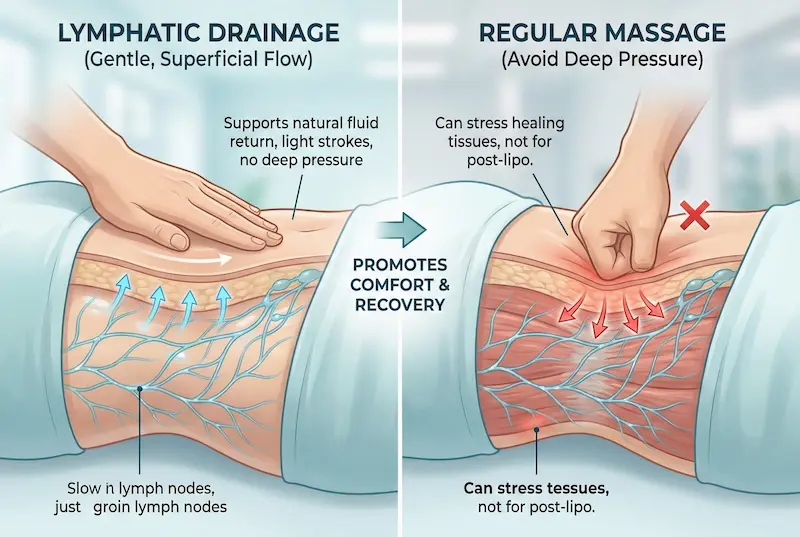
After liposuction, your body goes through a normal inflammatory healing phase: fluid shifts, swelling, bruising, and temporary firmness are common. Lymphatic Drainage Massage (often called manual lymphatic drainage) is a gentle technique designed to encourage movement of lymphatic fluid through superficial lymph pathways. In simple terms, it supports your body’s natural “drainage system” while tissues are recovering—without stressing healing areas.
Your lymphatic system in plain English (why swelling happens)
Your lymphatic system is like a slow-moving cleanup network. It helps return extra fluid from tissues back into circulation and plays a role in immune function. After lipo, small blood and lymph vessels are disrupted, and your body sends fluid and immune signals to heal. That’s why swelling can feel stubborn and why some areas can feel “puffy” or tight for weeks.
What “manual lymphatic drainage” actually does (and what it does not do)
LDM uses light, rhythmic strokes to support superficial fluid movement. It may help reduce the sensation of heaviness and support comfort—especially when paired with surgeon-approved basics like walking, hydration, and compression garments. What it does not do: it does not “melt fat,” it does not replace medical treatment for complications, and it should never be used aggressively to “break up” tissue early on. If someone promises instant contour “fixes,” that’s a red flag.
LDM vs. regular massage: pressure, technique, and safety differences
Traditional spa-style massage often uses deeper pressure and can be uncomfortable even on healthy tissue. Post-lipo tissue is not “healthy tissue yet.” LDM is intentionally gentle. This is why it matters who performs it and how: a provider experienced with post-operative clients should understand incision care, bruising expectations, and how to avoid stressing healing planes.
Where the secondary keywords fit: When people ask how to do lymphatic drainage massage after lipo or search for self lymphatic drainage massage after lipo, the safest answer is: only do self-techniques if your surgeon explicitly clears you, and keep it light, slow, and superficial. We’ll cover safe self-steps and a practical checklist later in this article.
Why Lymphatic Drainage Massage After Lipo Matters for Your Final Result
The goal of aftercare is not to “rush” healing—it’s to support it. In scientific research and clinical recovery protocols, swelling management, early mobility, and consistent follow-up are common themes. LDM can be one supportive tool within that bigger picture. It’s especially relevant for larger treatment areas (like lymphatic drainage massage after lipo 360) where swelling and tightness can feel more widespread.
Benefits of lymphatic massage after liposuction (at a glance)
Is lymphatic massage good after liposuction? For most cleared patients it is a supportive, low-risk comfort measure rather than a contour treatment. Reported benefits of lymphatic massage after liposuction include:
- Swelling and heaviness relief: gentle superficial strokes support movement of trapped lymphatic fluid.
- Better day-to-day comfort and mobility: less tightness often means easier walking and sleeping.
- Bruising resolution support: improved superficial circulation may help discoloration fade more evenly.
- Consistency with aftercare: regular sessions keep compression, hydration and walking habits on track.
- Earlier detection of problems: a trained therapist often notices asymmetry, heat or fluid pockets you should report to your surgeon.
What it does not do: it does not remove fat, replace compression garments, or guarantee a smoother contour.
Swelling control, fluid movement, and comfort in the first weeks
One of the most practical benefits of lymphatic drainage massage after lipo is comfort: many patients describe less “pressure” and improved ease of movement when sessions are appropriately timed and gentle. While swelling will still fluctuate (that’s normal), some people find the day-to-day recovery experience more manageable.
Reducing “lumpiness” and helping tissues settle more evenly (realistic expectations)
Early firmness and unevenness can happen as fluid shifts and tissues heal. LDM may support a smoother recovery experience by encouraging superficial fluid movement and helping you stay consistent with other aftercare habits. But it’s important to set expectations: healing is not linear. A temporary “lumpy” feel does not automatically mean something went wrong, and massage is not a magic eraser for surgical technique or biology.
Tissue settling isn't just about fluid moving. There's a deeper biological story—collagen remodeling, micro-fibrosis at incision sites, and how superficial fibrotic nodules form (or don't) in the first 6 to 12 weeks. This is where adjunct technologies have actual mechanistic relevance. Low-Level Laser Therapy uses specific wavelengths to influence cellular activity, and there's reasonable evidence supporting its role in scar maturation and inflammation modulation.
If you want to understand how LLLT fits into scar quality and fibrosis prevention more specifically: LLLT scar minimization guide.
Supporting mobility and recovery habits that influence outcome (walking, compression, hydration)
Think of LDM as part of a “recovery stack.” Light walking supports circulation, compression helps manage swelling, hydration supports normal fluid balance, and sleep supports tissue repair. When these basics are in place, LDM can fit in as an added support—rather than a standalone solution.
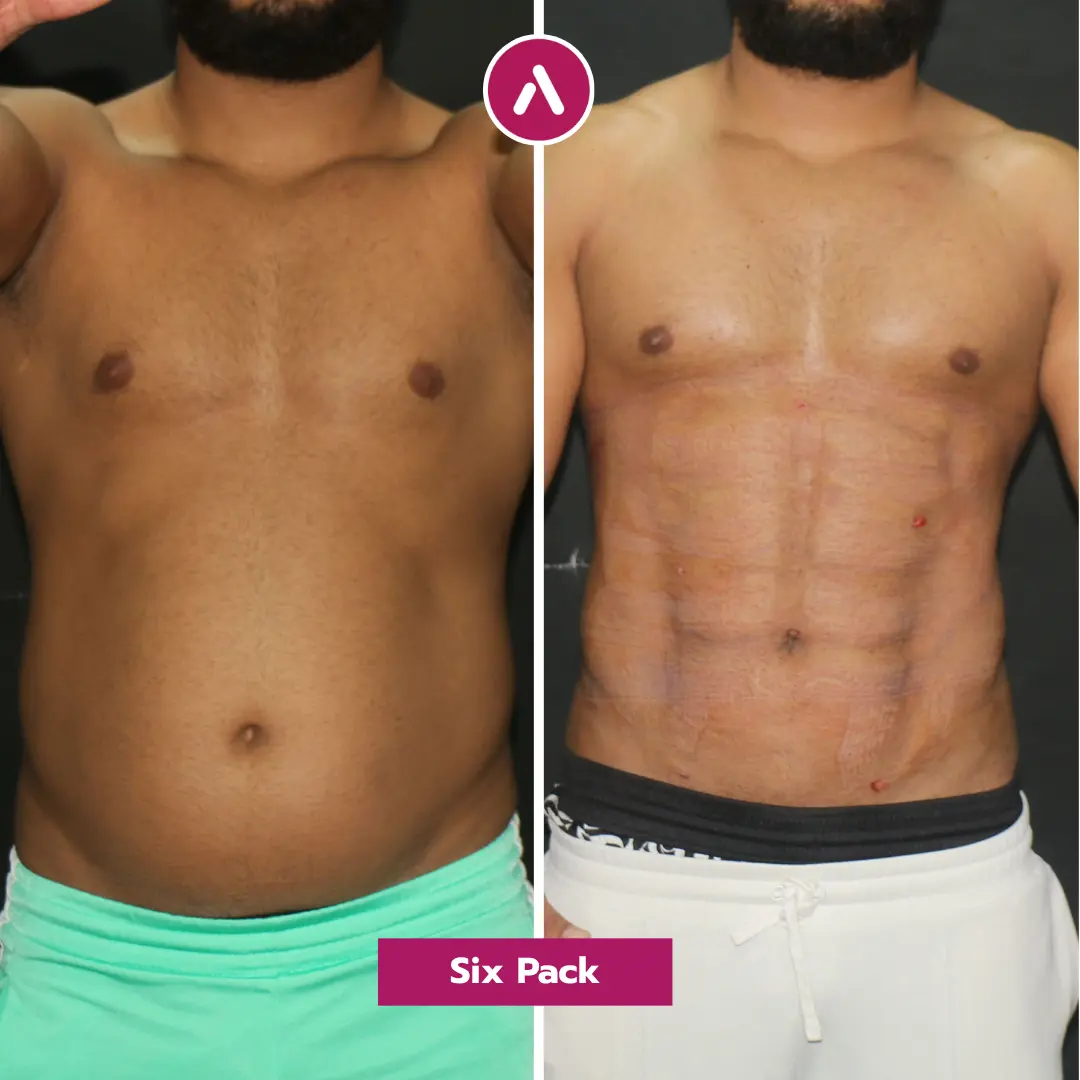
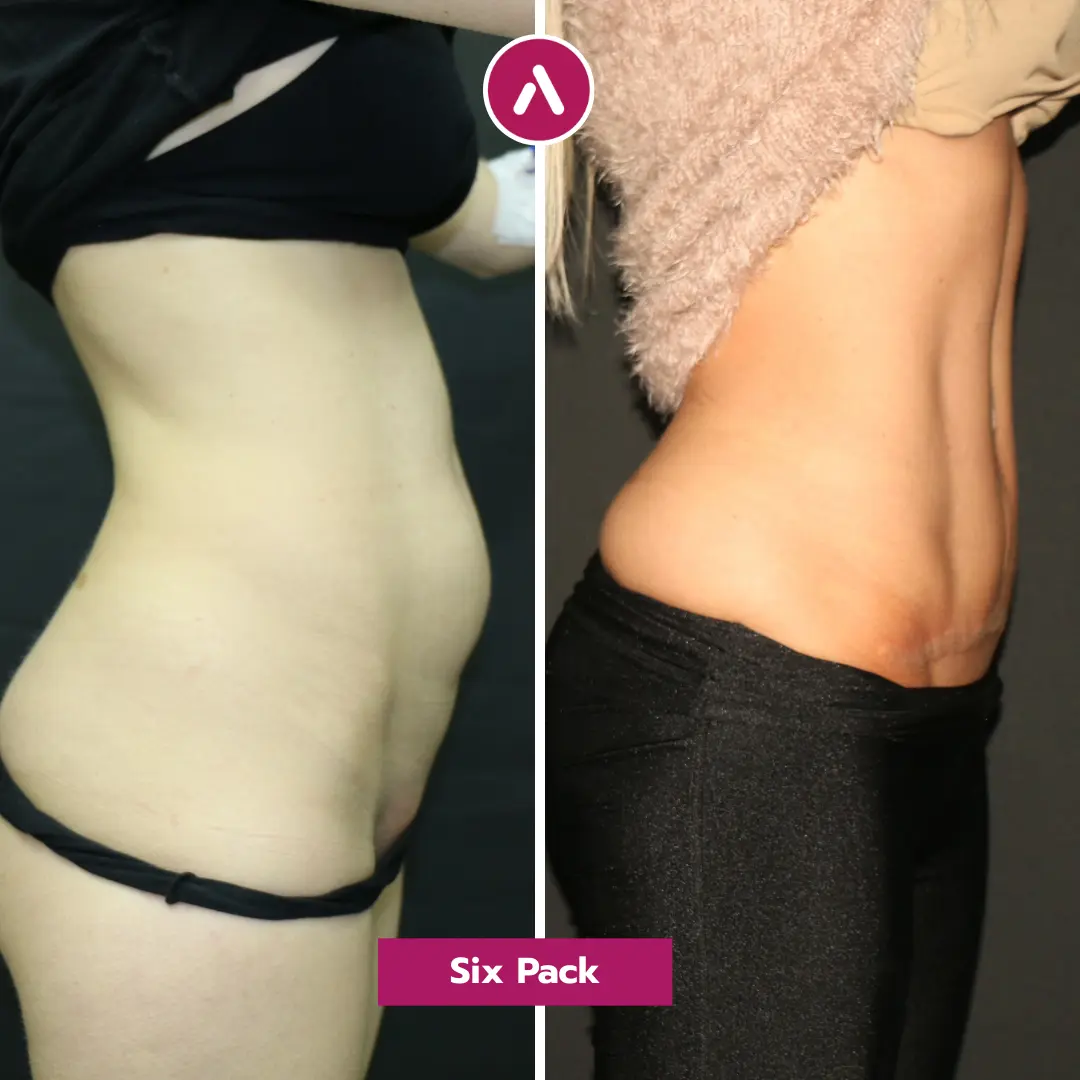
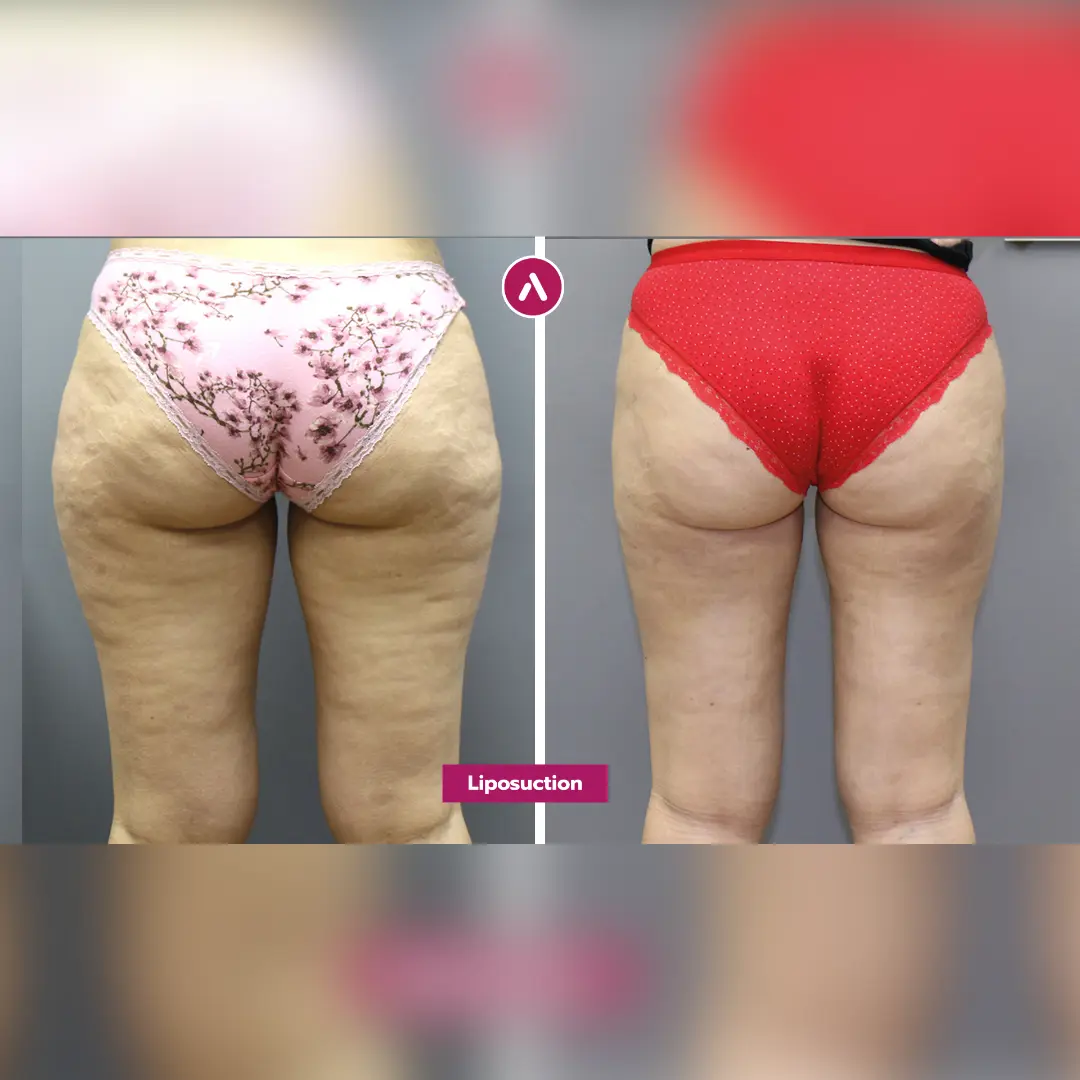
Reading recovery photos is its own skill. The same patient at week 2 vs month 3 often looks like two different cases—because swelling distortion, garment compression, and posture all temporarily distort what the actual contour will be. That's why procedure-specific outcome libraries are more useful than scattered "result" photos: you're seeing the full timeline, not just one frame.
Curated lipo outcomes with timeline annotations: liposuction case gallery.
Special situation note: If you combined procedures—such as lymphatic drainage massage after lipo and bbl—timing and positioning become even more important (because you may have restrictions on sitting/pressure). That’s why surgeon-led clearance and a tailored plan matter.
When to Start Lymphatic Drainage Massage After Lipo (Timing + Frequency)
Short answer: most patients are cleared to start gentle post lipo lymphatic massage within the first 1–2 weeks after surgery, often around days 3–7 for uncomplicated cases, with 2–4 light sessions per week early on and tapering as swelling stabilises. The start date is set by your surgeon based on incision healing, bruising, drains and any warning signs — not by a fixed calendar rule.
Timing is where most patients make mistakes—usually by starting too aggressively or following a generic schedule that ignores their specific procedure, incision status, and surgeon instructions.
The mechanism evidence supporting MLD in cosmetic recovery is reasonably consolidated. A Feb 2023 review in Aesthetic Surgery Journal Open Forum examined manual lymphatic drainage and its proposed role in fluid management after surgery: lymphatic massage cosmetic procedures review. The authors describe MLD as a component of complete decongestive therapy with documented benefit in reducing post-surgical lymphedema development.
Important caveat: this is a review of mechanism and literature, not a single large RCT proving day-by-day efficacy in liposuction recovery specifically. The bigger picture from clinical practice—surgeon clearance first, gentle technique always, individualized timing—remains the operating principle.
The typical start window (and why surgeon clearance matters)
Many patients begin gentle lymphatic drainage within the first 1–2 weeks, but the “right” start date varies. Factors include the extent of liposuction, any drains, how your incisions are healing, your bruising level, and whether there are signs of complications (which must be addressed medically—not massaged away). Clearance matters because early healing tissue can be vulnerable to pressure and shear forces.
A practical schedule by week (Week 1–2, Week 3–6, beyond)
Below is a practical, commonly used framework that you can discuss with your surgeon. It’s not a prescription—think of it as a planning template. Your exact plan should be individualized.
| Recovery Phase | Primary Goal | Typical Session Approach | Frequency (General Guide) | What to Watch For |
|---|---|---|---|---|
| Week 1–2 | Comfort + gentle fluid support | Very light, superficial technique only; avoid incision stress | 2–4 sessions/week (if cleared) | Sharp pain, fever, sudden swelling increase, redness spreading |
| Week 3–6 | Support swelling fluctuations + mobility | Still gentle; may expand coverage as tenderness improves | 1–3 sessions/week | New heat, worsening asymmetry, drainage changes, severe tenderness |
| Week 6+ | Tissue settling + long-term comfort | As directed; some patients taper off | 0–2 sessions/week as needed | Persistent hard areas that worsen, not improve (needs evaluation) |
Signs you’re doing too much too soon (red flags and when to stop)
Stop and contact your surgeon if you notice:
- Severe or sharp pain during massage (gentle LDM should not feel like deep tissue work).
- Fever or chills, or feeling unwell.
- Increasing redness, warmth, or spreading tenderness (possible infection).
- Sudden one-sided swelling, significant new asymmetry, or calf pain (urgent medical rule-outs may be needed).
- Shortness of breath or chest pain (seek emergency care).
Safety-first rule: If a therapist tells you “it has to hurt to work,” that’s not lymphatic drainage. That approach is not appropriate early in post-op recovery.
What to Expect During Sessions (Pain, Bruising, and “Normal vs Not Normal”)
One reason patients feel anxious is uncertainty: “Is this sensation normal?” LDM should feel gentle and supportive—not punishing. You may still have tenderness (especially early), but the technique should work with your healing, not against it. Understanding what’s normal helps you stay calm and recognize the few signs that require medical attention.
What a session feels like: tenderness vs. sharp pain
Most people describe LDM as light pressure with slow, rhythmic strokes. Mild tenderness is normal after lipo, but sharp pain is not the goal. Early sessions may feel sensitive in bruised areas, and some patients feel temporary “stingy” sensations near incision-adjacent swelling—this should be discussed with your provider and surgeon.
Bruising, drainage, and swelling fluctuations: what’s expected
Swelling can fluctuate day-to-day based on activity, sleep, hydration, and compression. It is also possible to feel “puffier” later in the day, especially with more walking. LDM does not instantly eliminate swelling; it supports the recovery process. If you have any unusual drainage, a foul smell, or worsening redness, that is not a massage issue—it is a medical evaluation issue.
It also helps to separate two words patients often mix up: drains are the thin tubes some surgeons place to evacuate fluid in the first days, while drainage refers to the fluid movement your lymphatic system handles once tubes are out. Lymphatic drainage after liposuction supports the second — it is never a substitute for a drain, and it does not empty a fluid pocket. Persistent leakage from an incision, a sloshing feeling, or fluid that returns quickly after a session should be assessed by your surgeon.
Immediate after-session care: hydration, compression, and gentle movement
After sessions, many patients do best with:
- Hydration (consistent water intake unless your doctor has restrictions).
- Compression as prescribed (don’t self-adjust compression rules without guidance).
- Gentle walking to keep circulation and mobility steady.
- Rest and sleep quality—often underestimated, but strongly linked to healing.
How to Do Lymphatic Drainage Massage After Lipo (Self-Options, Safely)
It’s common to ask how to do lymphatic drainage massage after lipo at home—especially if you travel and want continuity after returning. The safest answer: only do self-techniques if your surgeon clears you, and keep it gentle, superficial, and structured. Think “light skin movement,” not “digging.” If you’re unsure, it’s better to do less than to do harm.
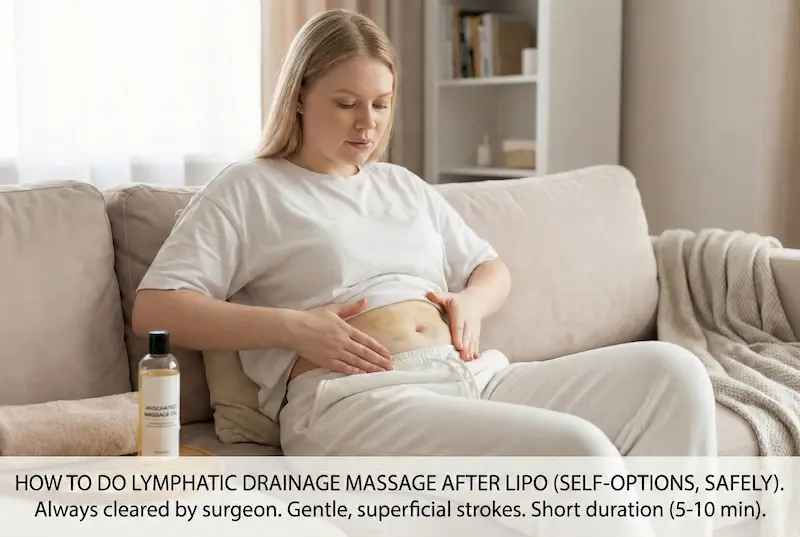
Self lymphatic drainage massage after lipo: a conservative, surgeon-cleared approach
If you are cleared for self lymphatic drainage massage after lipo, this conservative method is often used:
- Wash hands and ensure incision areas are protected as instructed (no rubbing over incisions unless explicitly cleared).
- Start proximally (nearer to lymph node regions) with feather-light strokes to “prepare pathways” (e.g., gentle strokes toward the groin for lower abdomen areas, or toward the armpits for upper torso—only if your provider instructs you on direction for your exact procedure).
- Use slow, light pressure—imagine moving the skin, not pressing into muscle.
- Short duration: 5–10 minutes initially, then reassess how you feel over the next 24 hours.
- Stop immediately if pain spikes, redness worsens, or you feel unwell.
Lymphatic drainage massage on the abdomen after liposuction (step order)
Abdominal lipo is the most common request for self-drainage, and direction matters more than pressure. If your surgeon has cleared you, a conservative abdominal sequence usually looks like this:
- Step 1 – open the pathways: light circular strokes just above the collarbones for about 30 seconds, then the same at the groin creases.
- Step 2 – lower abdomen: feather-light strokes moving down and outward toward the groin nodes, one side at a time.
- Step 3 – upper abdomen and flanks: strokes moving upward and outward toward the armpits, again with skin-level pressure only.
- Step 4 – never cross incisions: work around them, not over them, until fully closed and cleared.
- Step 5 – finish and reassess: 5–10 minutes total, put compression straight back on, and judge the session by how you feel 24 hours later.
Slow, rhythmic and light beats long and firm. If any stroke stings, pinches or leaves marks, you are pressing too hard.
How to massage hard spots after lipo (and what not to do)
Firm, rope-like or lumpy areas in weeks 3–8 are usually fluid plus early fibrous tissue, not a permanent result. Aggressive kneading at this stage tends to increase bruising and swelling rather than smooth anything.
- Wait for clearance: deeper work on hard spots is generally introduced only after your surgeon confirms incisions are closed and healing is normal.
- Warm and soften first: gentle superficial drainage around the area before touching the firm zone itself.
- Use sustained, moderate contact: slow flat-hand pressure held for a few seconds, not fast digging or pinching.
- Short and frequent beats long and hard: a few minutes daily is better tolerated than one aggressive session.
- Keep compression on: unsupported tissue tends to re-swell straight after any hands-on work.
Ripples or wavy areas on the stomach after liposuction can also come from garment folds, uneven swelling or skin quality — which is why they should be assessed by your surgeon before assuming massage is the answer. Hard areas that keep worsening instead of improving always need an in-person evaluation rather than more pressure.
Technique mistakes to avoid (the most common causes of setbacks)
- Deep pressure early on (“breaking up” tissue is not the goal in early healing).
- Massage guns, aggressive rollers, or cupping without surgeon approval.
- Rubbing directly over incisions before full closure and clearance.
- Long sessions that leave you more swollen, more bruised, or exhausted afterward.
Special notes for Lipo 360 and Lipo + BBL
For lymphatic drainage massage after lipo 360, swelling can wrap around the torso, so technique and positioning should be balanced and symmetrical—still gentle, still superficial. For lymphatic drainage massage after lipo and bbl, avoid pressure on the transferred fat area and follow your surgeon’s sitting/sleeping restrictions carefully. Your massage plan should respect those rules and prioritize protection of the BBL result.
Combining a fat-transfer procedure with abdominal lipo changes the rules. The transferred fat needs protected blood supply during graft "take," which is why your sleeping position, sitting restrictions, and any pressure on the buttocks are non-negotiable in the first weeks. Lymphatic drainage in this setup is still gentle and superficial—but the *map* of where you can work changes. You're not just managing edema; you're protecting living tissue that hasn't fully revascularized yet.
The full BBL post-op picture (positioning rules, timeline, why technique choice matters): BBL recovery framework hub.
One question that comes up often in combined-procedure planning: do you actually need lipo, or is loose skin and muscle separation the real issue—meaning a tummy tuck (with or without lipo) is the better fit? This is a diagnostic question, not a "which is better?" preference. The answer changes how aggressive lipo can be, what your scar looks like, and how recovery unfolds.
For the full decision tree (skin quality, fat distribution, muscle separation): lipo-versus-tuck decision walkthrough.
If you are still deciding how your combined procedure will be structured, the recovery load and massage restrictions differ depending on what is performed together. See the scope and aftercare structure of our Lipo 360 and BBL package in Turkey for how sessions, compression and positioning rules are planned around the procedure itself.
Massage after tummy tuck and lipo
When abdominal liposuction is combined with a tummy tuck, the rules tighten further: there is a long incision, often drains, and a repaired muscle layer underneath. Lymphatic drainage after tummy tuck and lipo is typically started later, stays entirely superficial, works around the incision and drain sites, and avoids any traction on the abdominal wall. Positioning is usually slightly flexed rather than fully flat, and sessions should be short until your surgeon confirms the incision is stable.
Reality check: The best benefits of lymphatic drainage massage after lipo come from consistency, correct timing, and gentle technique—not intensity.
Risks, Contraindications, and How to Stay Safe
Lymphatic drainage can be helpful—but only when it’s done with the right technique, at the right time, on the right patient. In clinical practice, the biggest problems usually come from wrong pressure, wrong timing, or ignoring red flags. A safety-first approach is the most “results-focused” approach, because it protects healing tissues and helps prevent setbacks.
Who should avoid or delay LDM (and why)
You should delay lymphatic drainage and speak to your surgeon first if you have any signs of infection, uncontrolled medical conditions, or symptoms that suggest a complication. LDM is not a substitute for medical evaluation. If you have a history of clotting disorders or you’re at elevated risk for blood clots, your surgeon should guide your aftercare plan carefully.
- Possible infection signs: fever, chills, increasing warmth, spreading redness, or worsening tenderness.
- Unusual swelling patterns: sudden one-sided swelling or rapidly increasing firmness.
- Systemic symptoms: feeling significantly unwell, dizziness, fainting.
Unsafe techniques to avoid (especially early on)
Here’s what commonly causes unnecessary bruising and prolonged swelling:
- Deep tissue pressure (“it has to hurt to work” is not lymphatic drainage).
- Aggressive tools (massage guns, hard rollers, unapproved cupping) without surgeon clearance.
- Rubbing over incisions or stressing healing areas before full closure and clearance.
- Over-scheduling sessions so you’re swollen and sore for days afterward.
When symptoms mean “call your surgeon now”
Stop massage and contact your surgical team urgently if you experience:
- Shortness of breath, chest pain, or sudden faintness (seek emergency care).
- High fever or rapidly worsening redness/warmth.
- Severe, sharp pain or a dramatic change in swelling on one side.
- Foul-smelling drainage or worsening wound appearance.
Safety principle: The “best” lymphatic massage is the one that supports healing without creating new trauma. That’s aligned with medical science—gentle, consistent recovery beats aggressive shortcuts.
Expert Patient’s Guide: Planning LDM in Istanbul and After You Fly Home
If you’re traveling for liposuction, planning lymphatic drainage is not just about booking sessions—it’s about building a recovery calendar that fits your flight timing, walking schedule, compression routine, and follow-ups. This is especially true for broader procedures like lymphatic drainage massage after lipo 360 (more surface area, more swelling variability) and combined procedures like lymphatic drainage massage after lipo and bbl (positioning restrictions matter).
Building a real recovery calendar means coordinating five moving parts: your surgery date, post-op clinic check-ins, planned massage sessions, hotel stay length, and your fly-home window. Most international patients underestimate just how much these pieces interact—a poorly timed massage day can throw off a flight, and an aggressive walking day can spike swelling enough that everything else needs rescheduling.
The full step-by-step coordination flow that AKM uses with international patients: Istanbul recovery journey companion.
Building an aftercare calendar around flights and hotel recovery days
A practical travel-friendly approach looks like this:
- Prioritize surgeon check-ins first, then schedule massage around the plan your surgeon sets.
- Avoid “marathon” walking days early; do consistent short walks instead.
- Don’t stack everything on the same day (long outing + massage + poor sleep = more swelling).
- Plan for swelling management on flight day: compression as instructed, hydration, and short walks when safe.
Where you stay matters more than first-time medical travelers expect. Hotel proximity to the clinic affects how easy daily check-ins are. VIP transfer logistics affect how stress-free your travel days feel when you're tired or sore. None of that is "luxury"—it's recovery infrastructure.
For the partnered hotel and transfer details AKM coordinates for international patients: recovery hotel transfer guide.
How to choose a qualified therapist (fast checklist)
When you’re evaluating a provider, focus on clinical habits—not marketing:
- They describe it as gentle and can explain technique and pressure clearly.
- They ask about your procedure details and follow surgeon restrictions (including BBL positioning rules if relevant).
- They respect incision care and do not rush into deep work.
- They communicate well (you should feel comfortable stopping the session if something feels wrong).
Finding post lipo lymphatic massage near you
Searching for post lipo lymphatic massage near me returns a mix of medical spas, physiotherapy clinics and wellness studios — and their training levels differ widely. Prioritise, in this order:
- Physiotherapists or therapists trained in manual lymphatic drainage (Vodder, Leduc or equivalent training) with post-surgical experience.
- Providers willing to contact or read instructions from your surgeon before the first session.
- Clinics that document each session (areas treated, pressure, your response) so your surgeon can review it.
- Anyone who declines aggressive add-ons such as cavitation, deep tissue or vigorous cupping in early recovery.
Booking two or three sessions before committing to a package lets you judge how your swelling responds over 24–48 hours.
Continuing safely at home: what to tell your local provider
Continuity matters. If you continue care after you return home:
- Share your procedure details (areas treated, any drains, current restrictions).
- Share your surgeon’s timing guidance (when massage is allowed, how often, what to avoid).
- Ask for a plan that matches your phase of healing—your needs at week 2 are different from week 6.
If you want to do self-care between sessions, remember: how to do lymphatic drainage massage after lipo safely comes down to surgeon clearance, feather-light pressure, short duration, and stopping at the first sign of increased pain or inflammation.
AKM Clinic Recovery Support: A More Predictable Post-Op Experience
For many international patients, the biggest fear isn’t the surgery—it’s being left alone once they’re back in the hotel or back home. A structured recovery pathway reduces anxiety, improves adherence, and helps you make smarter decisions day by day. The goal is not “perfect comfort” overnight; the goal is a calmer, more predictable healing process with clear guardrails.
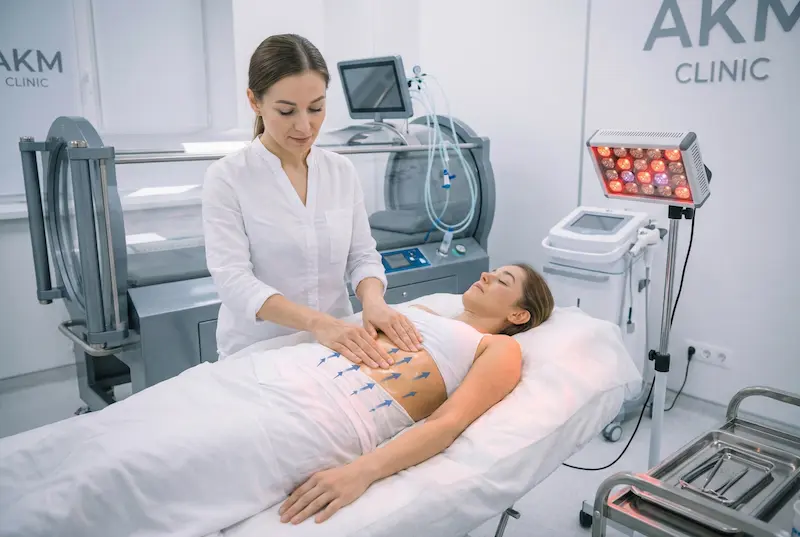
Surgeon-led recovery planning and structured follow-up checkpoints
At AKM Clinic, the patient journey is designed to be organized end-to-end, including planning follow-up touchpoints after you return home. That structure matters for expert patient because it answers the practical questions: “Who do I call if something changes?” and “What happens after I fly back?”
The role of advanced recovery support (HBOT & LLLT) alongside LDM
The two technologies AKM highlights in its official care standards aren't generic add-ons. They're specific tools with specific mechanisms—Hyperbaric Oxygen Therapy (HBOT) for tissue oxygenation, Low-Level Laser Therapy (LLLT) for cellular activity and inflammation reduction. How those tools fit into a structured recovery protocol—what's standard, what's optional, what's documented—belongs in one consolidated reference.
The clinic's complete technology and standards documentation: recovery technology standards reference.
The mechanism part is what most patients underestimate. HBOT isn't "extra oxygen because oxygen is good"—it's a pressurized environment that dissolves oxygen directly into plasma, reaching tissues that compromised microcirculation can't fully serve. For post-lipo recovery, that matters in zones where bruising, swelling, or compression has temporarily slowed perfusion.
The full physiological rationale, session structure, and what realistic outcomes look like: hyperbaric oxygen mechanism guide.
A “recovery stack” that works together: compression + walking + nutrition + sleep + LDM
If you want the benefits of lymphatic drainage massage after lipo to show up in real life, your best strategy is consistency with the fundamentals:
- Compression exactly as prescribed (fit and timing matter).
- Gentle walking in short, consistent blocks (not exhausting bursts).
- Hydration + protein-focused nutrition to support tissue repair.
- Sleep as a “non-negotiable treatment.”
- Lymphatic drainage (professional or surgeon-cleared self-care) that stays gentle and phase-appropriate.
One thing that often gets buried in recovery planning: the lymphatic drainage sessions, the compression garments, the follow-up technology support—these are recovery line items, not procedure costs. Whether they're bundled into your all-inclusive package or charged separately changes the real total of your trip.
Transparent breakdown of what's included (and what isn't) for liposuction patients specifically: liposuction cost framework.
Bottom line: Lymphatic massage is most valuable when it’s part of a surgeon-guided recovery system—especially for travelers who need a clear plan from hotel to home.
Frequently Asked Questions (FAQ): Lymphatic Drainage Massage After Lipo
This FAQ is designed for quick clarity—especially if you’re traveling and want a simple checklist. Remember: surgeon clearance and phase-appropriate technique are what make lymphatic drainage helpful and safe.
What the evidence actually says (and where opinions differ)
Some surgeons routinely recommend manual lymphatic drainage; others argue it is unnecessary when compression and early mobilisation are done properly. Both positions exist in reputable practices, and the current literature explains why:
- Manual lymphatic drainage is well described as part of complete decongestive therapy for lymphoedema, with a plausible mechanism for post-surgical fluid management.
- Evidence specific to liposuction recovery is mostly small studies, reviews and clinical experience rather than large randomised trials proving a fixed session schedule.
- Nothing in the literature supports deep, painful technique in early healing — the reported downsides come from too much pressure, too soon.
Practical takeaway: treat lymphatic drainage as an optional comfort and swelling-management tool inside a surgeon-led plan, not as a requirement for a good result.
When can I start lymphatic drainage massage after lipo?
How many sessions do I need—and how often?
Can lymphatic massage replace compression garments?
Does lymphatic massage prevent seroma or fibrosis?
Is it normal to swell more after a session?
Can I do self-lymphatic drainage massage at home?
When is massage unsafe after liposuction?
What shouldn’t you do after a lymphatic drainage massage?
What happens if you don’t get massages after lipo 360?
Can I have lymphatic massage while drains are still in place?
How much does post lipo lymphatic massage cost?
Lipo as a standalone procedure and lipo as part of a postpartum reconstruction plan are different recovery worlds. The dose of swelling, the positioning rules, the breast involvement, the pace of returning to daily life—all of it shifts when you're combining procedures. Mommy makeover planning is fundamentally about sequencing and proportional thinking, not maximalism.
The full combination logic, candidacy criteria, and travel planning: post-pregnancy procedure framework.
Medical Disclaimer: This page is provided for general educational purposes only and does not replace a face-to-face medical consultation, diagnosis, or personalized treatment plan. All surgery carries risks and outcomes vary between individuals. Suitability for a lymphatic drainage, procedure selection, and anesthesia choice can only be determined after a full clinical assessment by a qualified surgeon. Always follow your clinician’s instructions and seek urgent medical attention if you develop concerning symptoms during recovery.