




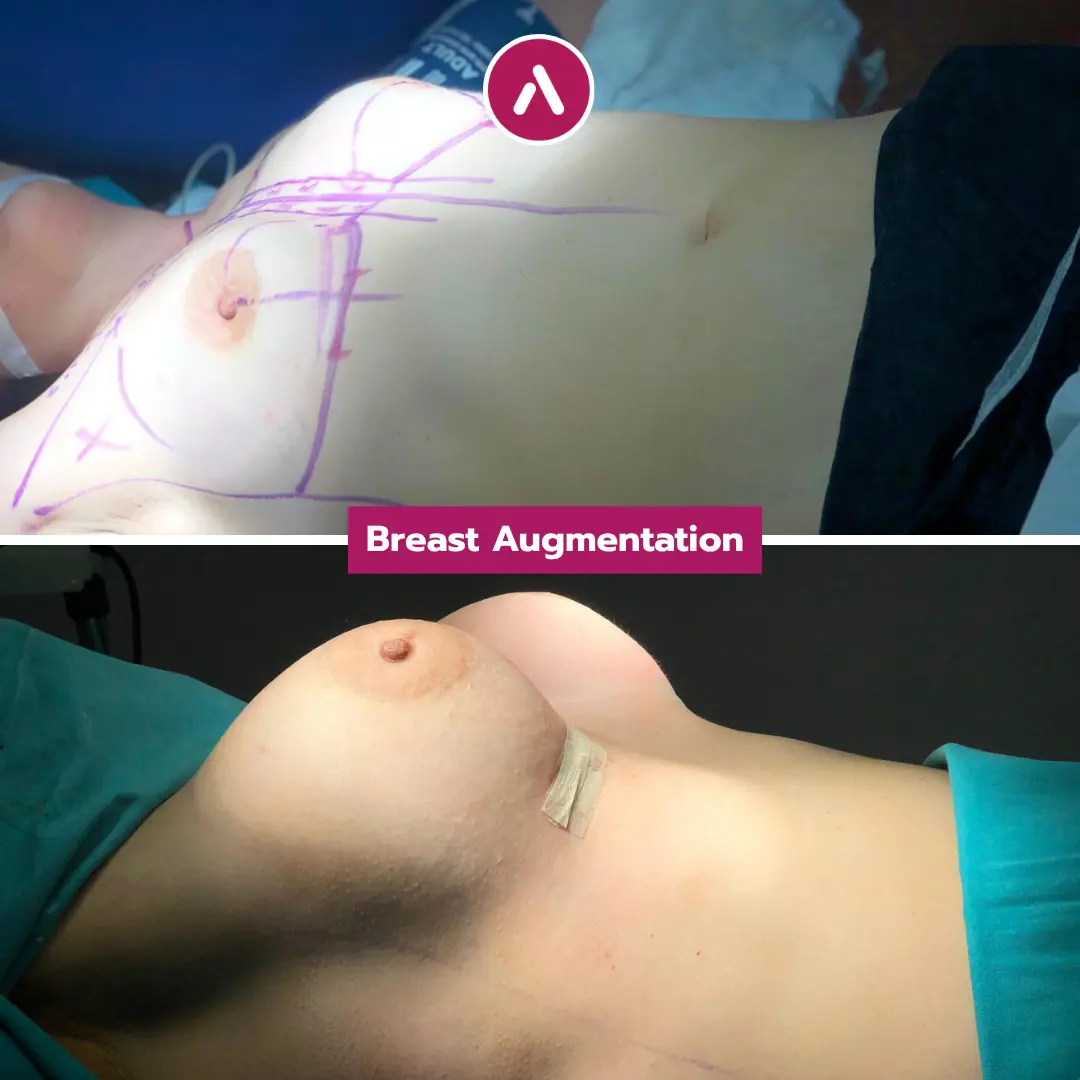
If you are researching breast surgery from the UK, you are likely comparing safety, technique, and long-term maintenance as much as the price tag. Sensible. A good plan is built on anatomy, not marketing. This guide explains the options in plain, clinical terms.
Table of Contents
What is Breast Enlargement?
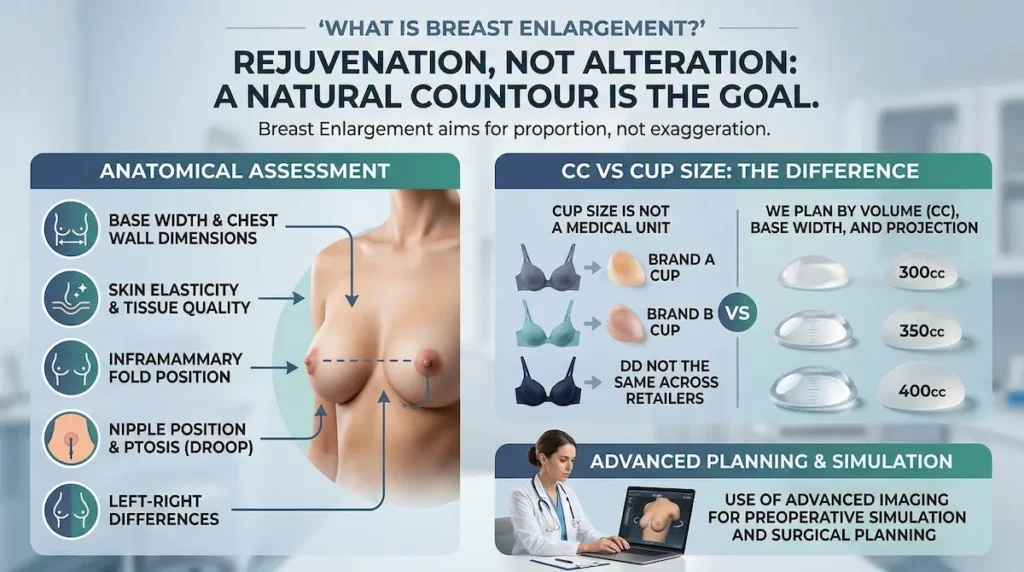
Breast Enlargement is surgery that increases breast volume and improves shape using implants, fat transfer, or both. It aims for proportion, not exaggeration. Your surgeon plans volume in cc and considers your chest width and skin quality. The goal is a natural contour.
In practice, we treat breast enlargement as a design problem with medical constraints. Tissue quality, symmetry, and your lifestyle all matter. Our philosophy stays consistent: “Rejuvenation, Not Alteration.” You should still look like you.
Breast anatomy: what we assess
Before we talk about implant size or fat volume, we assess your baseline anatomy. This is where predictable outcomes begin. We focus on measurements that directly affect shape, cleavage, and scar placement.
- Base width (your breast “footprint”) and chest wall dimensions
- Skin envelope and elasticity (how much stretch your tissue can safely take)
- Inframammary fold position (the natural crease under the breast)
- Nipple position and any degree of ptosis (droop)
- Left–right differences in volume, fold height, and nipple level
For planning accuracy, we also use advanced imaging tools for pre-operative simulation and surgical planning when appropriate. It helps align expectations early. Fewer surprises. Clearer decisions.
Planning volume: cc vs cup size
Implant volume is measured in cc (cubic centimetres). Cup size is not a medical unit. Bra brands vary, band size changes the cup, and “DD” is not the same across retailers.
- We plan by cc, base width, and projection.
- We discuss how your tissues will carry that volume over time.
- We set expectations around cleavage and upper-pole fullness without promising a specific cup.
If you bring reference photos, we use them to clarify shape and proportions, not to “copy” a body. Your anatomy sets the boundaries.
Defining a natural result (Rejuvenation, Not Alteration)
“Natural” is not one look. For some patients it means gentle upper-pole fullness and a subtle lift in profile. For others it means restoring volume lost after pregnancy or weight changes without looking “done”.
- Balanced projection for your frame
- Soft transitions at the décolletage
- Symmetry improvements that still look like your body
When patients ask for natural-looking breast implants, they are usually asking for proportion, not maximum size. We treat that request seriously.
What Are The Benefits Of Breast Enlargement?
Breast enlargement can address more than “size”. It can refine shape, improve proportion, and correct asymmetry. It can also restore volume after pregnancy or weight loss. Results depend on your starting point, technique, and healing.
Our job is to match the method to your anatomy and your goal. Not the other way around. That is how you avoid the over-operated look. It is also how results stay stable.
Proportion and shape (not just volume)
Many patients are not chasing a dramatic change. They want a better silhouette in clothing. They want the breast to sit more harmoniously on the chest.
- Increased upper-pole fullness where appropriate
- Improved projection and contour in profile
- A more balanced waist–hip–bust proportion
In UK search terms, breast enlargement is often used interchangeably with breast augmentation or “breast enhancement”. The core goal is the same: a controlled change with predictable shape.
Correcting asymmetry
Most people have some asymmetry. The question is whether it bothers you in bras, swimwear, or fitted tops. Surgical planning often focuses on levelling fold height, nipple position, and volume differences.
- Mild asymmetry: small volume adjustments can make a visible difference
- More marked asymmetry: tailored sizing or technique may be needed
- Shape asymmetry: contour matters as much as cc
When enlargement is planned as a bilateral procedure, we still treat each side as its own project. Symmetry is engineered, not assumed.
Clothing fit and confidence
Patients often describe the benefit in practical terms. Bras fit more consistently. Necklines sit better. Some feel less “top heavy” because the chest looks proportionate, not compressed.
- More stable bra fit across styles
- Improved balance in fitted clothing
- A shape that feels more aligned with your self-image
We keep expectations grounded. Surgery changes anatomy. It does not solve every body-image concern on its own.
Am I a Good Candidate for a Breast Enlargement?
You may be a good candidate for Breast Enlargement if your goal is to increase volume and improve shape in a way that suits your frame. In consultation, we focus on measurable anatomy rather than “cup size promises”. Base width, tissue thickness, skin quality, and the position of the inframammary fold all influence what is safe, stable, and natural-looking.
Ideal candidates
Most suitable candidates have a stable weight, realistic expectations, and a clear preference for either a predictable volume change (often implants) or a softer, modest enhancement (often fat transfer). You may be well suited if:
- You are generally healthy and your weight has been stable for several months.
- You have specific, realistic goals (for example, restoring volume after pregnancy or weight change).
- Your skin and tissue can support the planned change without being overstretched.
- You can follow recovery guidance, including activity limits and follow-up.
Who should delay or avoid boob job surgery
Some situations are better treated by postponing surgery or choosing a different plan. We may advise delaying if you are pregnant, currently breastfeeding, planning significant weight loss, or if you smoke and are not able to stop before and after surgery (smoking can impair wound healing). Uncontrolled medical conditions, certain medications, or a history that increases surgical risk may also change the recommendation. If your main concern is droop rather than volume, a breast lift (mastopexy) — with or without implants — may be the more direct solution.
What we assess before confirming your plan
We use a structured approach to reduce avoidable risks and align expectations:
- Method selection: implants vs fat transfer vs hybrid, based on tissue and desired change.
- Safety screening: medical history review, anaesthetic assessment, and appropriate pre-op tests.
- Planning details: sizing in cc, symmetry strategy, and scar placement planning.
- Aftercare readiness: recovery milestones, travel considerations, and follow-up access once you return to the UK.
If you are unsure which method fits you, that is normal. A good consultation translates your goals into a plan your anatomy can carry safely—so the result looks intentional, not overdone.
Breast Enlargement Methods
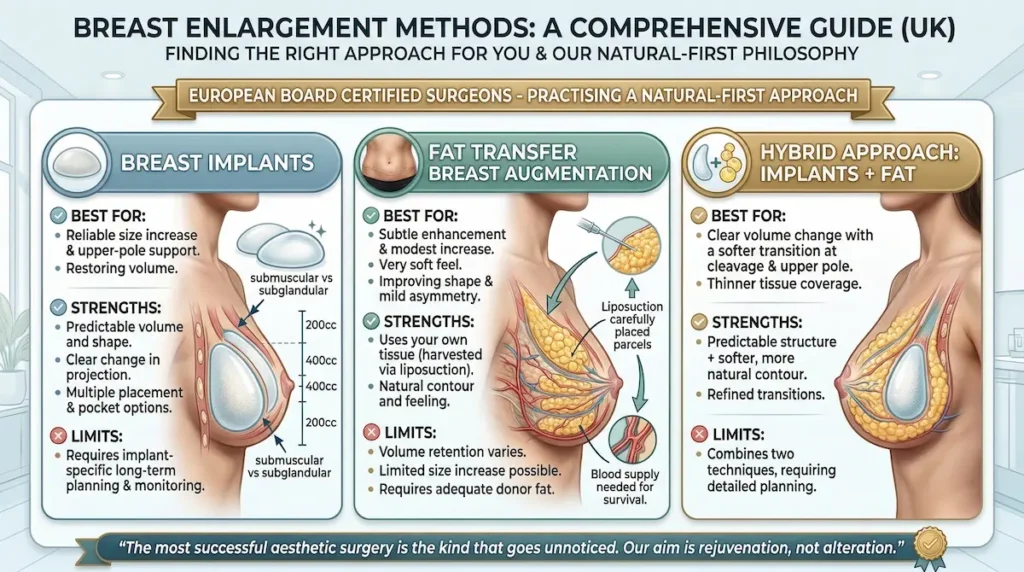
There is no single “best” method for breast enlargement. The right approach depends on your base width, skin quality, existing breast tissue, and how predictable you want the volume change to be. Some patients want a defined increase with clear sizing control. Others want a softer, smaller change using their own tissue.
In consultation, our European Board Certified Surgeons focus on proportion and longevity. The aim is always the same: a result that looks intentional, not obvious. That is the practical meaning of our Natural-First approach.
Breast Implants
Implants remain the most predictable option for volume and shape. You choose a target range in cc, we match it to your chest measurements, and we plan the pocket to support the implant properly. That predictability is why implants are often preferred when you want a clear change in projection.
- Best for patients who want a reliable size increase and upper-pole support.
- Useful for restoring volume after pregnancy, weight change, or natural breast deflation.
- Can be combined with a lift if droop is the primary concern.
Expert patients usually ask about placement and long-term risk. We cover those details in a dedicated section (submuscular vs subglandular, dual plane, and scar planning). Here, the key takeaway is simple: implant choice and pocket choice work together.
Fat Transfer Breast Augmentation
Fat transfer breast augmentation uses your own fat as the “filler”. We harvest fat via liposuction from areas with available stores, process it, and then place it in small, carefully layered parcels to support blood supply. The goal is a gentle increase and improved contour, not an “implant-level” jump in size.
- Best for patients seeking a modest increase with a very soft feel.
- Can improve shape and mild asymmetry while also contouring a donor area.
- Volume retention varies, so we plan conservatively and discuss realistic range.
Because fat cells need blood supply to survive, not every patient is an ideal candidate. Very low body fat, significant skin laxity, or expectations of a large size change usually point us back to implants or a hybrid plan.
Hybrid approach: implants + fat
A hybrid approach combines an implant for structure with fat transfer for refinement. It can be useful when you want a moderate implant size but need softer transitions at the cleavage or upper pole. It also helps when your tissue is thin and you want extra coverage over the implant edge.
| Method | Best for | Strengths | Limits |
|---|---|---|---|
| Implants | Clear volume change | Predictable size and projection | Requires implant-specific long-term planning |
| Fat transfer | Subtle enhancement | Uses your own tissue, very soft feel | Retention variability; limited size increase |
| Hybrid | Natural refinement + structure | Smaller implant with softer contour | Two techniques; planning is more detailed |
“The most successful aesthetic surgery is the kind that goes unnoticed. Our aim is rejuvenation, not alteration.”
Implant Choices Explained (for expert patients)
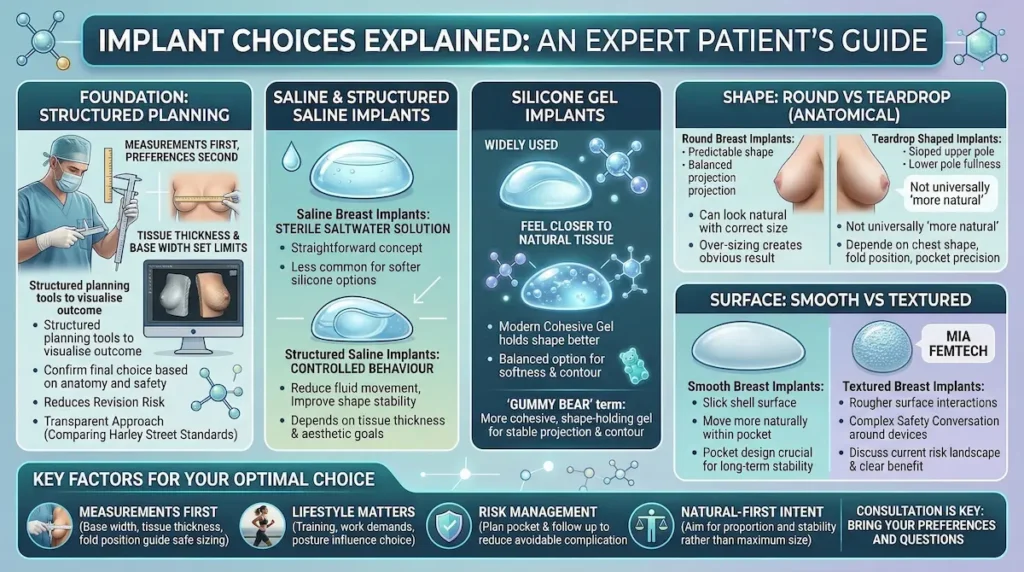
Implant selection is not just “round vs teardrop”. The fill material, shell surface, gel behaviour, and profile all change how the implant sits, moves, and feels over time. Your tissue thickness and base width create hard limits. That is why we plan with measurements first and preferences second.
We use structured planning tools to help you visualise the likely outcome, then confirm the final choice based on anatomy and safety. For UK patients comparing Harley Street standards, this level of transparency matters. It also reduces revision risk.
Saline Breast Implants
Saline breast implants are filled with sterile saltwater solution. They can be a consideration for patients who prefer saline as a fill material and want a straightforward concept. In many modern practices, however, silicone gel options are more commonly chosen for a softer feel.
Structured Saline Implants
Structured saline implants are designed to make saline behave in a more controlled way. The principle is to reduce movement of the fluid and improve shape stability. Whether that trade-off is worthwhile depends on your tissue thickness and aesthetic goals.
Silicone Breast Implants
Silicone breast implants are widely used because the feel is often closer to natural tissue. Modern implants typically use cohesive gel, which holds shape better than older formulations. For many patients, this is the most balanced option for softness and contour.
Gummy bear breast implants
Gummy bear breast implants are a common term for more cohesive, shape-holding silicone gel. They can offer stable projection and predictable contour. The real question is not the nickname; it is how the gel behaviour matches your anatomy.
Form-Stable Implants
Form-stable implants keep their shape more firmly under pressure. This can be useful when you want defined projection or when your tissue needs extra structural support. It can also feel slightly “firmer” in very thin patients, so we consider coverage carefully.
Teardrop Shaped Implants
Teardrop shaped implants (often called anatomical) can be considered when the goal is a sloped upper pole with lower-pole fullness. They are not automatically “more natural” for everyone. Chest shape, fold position, and implant pocket precision decide the outcome.
Round breast implants
Round breast implants can create a balanced, centred projection and are commonly chosen for their predictable shape. With the right size and profile, a round implant can still look natural. Over-sizing is what tends to create an obvious result.
Textured breast implants
Textured breast implants have a rougher surface designed to interact differently with the surrounding tissue. The safety conversation around textured devices is more complex than it used to be. If you are considering textured options, we discuss the current risk landscape and whether there is a clear benefit in your case.
Smooth breast implants
Smooth breast implants have a slick shell surface and are widely used in modern breast augmentation. They tend to move more naturally within the pocket. Pocket design and implant selection still matter, especially for long-term position stability.
Mia Femtech
Mia Femtech appears in online searches as a branded, minimally invasive concept aimed at small-volume enhancement. Candidacy can be narrow, and not every approach suits every anatomy. If this is on your shortlist, we will clarify the realistic benefits and limitations during your consultation.
Choosing the Right Breast Implants for You
- Measurements first: base width, tissue thickness, and fold position guide safe sizing.
- Lifestyle matters: training, work demands, and posture influence implant choice and placement.
- Risk management: we plan the pocket and follow-up strategy to reduce avoidable complications.
- Natural-first intent: we aim for proportion and stability rather than maximum size.
If you want, bring a short list of “must-haves” (cleavage, upper-pole fullness, minimal scarring) and “must-avoid” (overdone look, visible edges). We will translate those preferences into a surgical plan that fits your anatomy.

Implant Placement & Technique (how we plan support and shape)
Implant choice is only half the story. The other half is where we place it and how we design the pocket that supports it. This is the part that influences cleavage behaviour, edge visibility, and how the breast moves when you lift your arms or lie down. Our European Board Certified Surgeons plan placement using your tissue thickness, breast base width, and the position of the inframammary fold. We aim for a stable, natural result that still looks like you.
Expert patients often ask “under the muscle or over the muscle?” It is a sensible question. The honest answer is: it depends. There is no universal best. There is the best choice for your anatomy.
Submuscular vs subglandular placement
Submuscular breast implants sit partially or fully under the pectoral muscle. This can add soft-tissue coverage in patients with thinner breast tissue and may reduce visible rippling in the upper pole. It can also involve a longer settling period as the muscle relaxes and the implant descends into position. We explain what to expect, clearly.
Subglandular breast implants sit above the muscle and beneath the breast tissue. This can mean a simpler pocket and, for the right candidate, a smooth early recovery. The trade-off is reduced coverage in the upper pole for patients with thin tissue. If coverage is limited, we plan more conservatively to avoid a “stuck-on” look.
| Placement | Typical advantages | Typical considerations | Often suited to |
|---|---|---|---|
| Submuscular | More coverage in the upper pole; softer transition in thinner patients | Muscle tightness early on; settling can take longer | Patients with limited soft-tissue thickness |
| Subglandular | Can feel less tight initially; direct shaping in selected cases | Less coverage if tissue is thin; implant edges may be more visible | Patients with good tissue thickness and stable skin quality |
| Dual plane | Balances coverage with shape control; useful in borderline candidates | More nuanced planning; technique sensitive | Patients needing added coverage with a natural lower-pole shape |
“A natural result is engineered. The implant matters, but the pocket matters more.”
Dual plane placement: when it’s considered
Dual plane breast implants combine elements of both approaches. Part of the implant is covered by muscle, while the lower portion sits in a way that supports a natural lower pole. This can be useful when your tissue is not thin enough to mandate full muscle coverage, but not thick enough to make subglandular placement a comfortable choice.
- We consider dual plane when upper-pole coverage is needed but shape demands flexibility.
- It can help with mild glandular ptosis (a “bottomed-out” look in the bra).
- It is technique-sensitive, so planning and execution must match.
We also factor in your lifestyle. Gym training, occupation, and posture can influence how the muscle interacts with an implant. That discussion is part of informed consent, not an afterthought.
Incisions & scar planning (inframammary fold focus)
Most implant procedures use an incision placed in the inframammary fold because it offers direct access and precise pocket control. We plan scar position with standing measurements, not guesswork. The goal is a scar that sits where the fold naturally hides it.
- We map the fold and nipple position pre-operatively to support symmetry.
- We choose incision length based on implant type and safe handling.
- We give a scar-care plan early, because prevention starts immediately.
Scars mature over time. Healing varies. We set expectations in months, not days.
Combined Procedures (synergy): When Breast Enlargement Is Not Enough On Its Own
Breast volume and breast position are different variables. If your primary concern is droop, adding volume alone can be the wrong solution. If your main issue is volume loss with stable nipple position, a lift may be unnecessary. Our job is to choose the most direct route to the outcome you want, with the least surgical “noise”. It is a conservative approach. It protects long-term results.
We also plan these combinations with recovery in mind. Combining procedures can be efficient, but it must be medically appropriate. We are clear about what can be safely done together and what is better staged.
Mastopexy with breast implants (lift + volume)
Mastopexy with implants addresses both shape and position: a lift reshapes the skin envelope and repositions the nipple, while the implant restores volume. This is often chosen after pregnancy, breastfeeding, or significant weight change. It can also be relevant when the breast tissue has “emptied” and the nipple sits lower than desired.
- We plan the lift pattern based on skin quality and degree of ptosis.
- We select implant size to support the new shape, not to stretch it.
- We discuss scar placement openly, including realistic maturation.
“If the issue is position, we correct position. Volume alone cannot lift tissue reliably.”
Mummy makeover combinations (tummy tuck + liposuction + Breast Enlargement)
Many post-pregnancy patients ask whether Breast Enlargement can be combined with body contouring. A mummy makeover often includes breast surgery alongside a tummy tuck (abdominoplasty) and liposuction to address the abdomen, waist, and overall silhouette in one surgical plan.
- Tummy tuck: focuses on abdominal contour and skin laxity after pregnancy or weight change.
- Liposuction: refines areas such as the waist, flanks, or lower back; it may also provide donor fat if fat transfer is planned.
- Breast Enlargement: restores upper-pole volume and shape using implants, fat transfer, or a hybrid approach.
Not every patient should combine procedures. Safety is decided by your health screening, operative time, and recovery capacity. If staging is safer, we recommend a staged plan.
Implant exchange / revision planning
Revision is not rare in breast surgery. Bodies change. Preferences evolve. Sometimes an implant is the right size but the pocket needs refinement. Breast implant revision can include implant exchange, pocket adjustment, or capsular work if needed.
- Common reasons: size change, shape preference, asymmetry, position concerns.
- We review prior operative details when available and plan around scar tissue.
- We prioritise stability and a natural contour over dramatic change.
Removal & lift pathways (downsizing or removal)
Some patients want to downsize or remove implants completely. The decision is personal. The surgical plan depends on how the skin and breast tissue have adapted over time. In some cases, a lift is needed to restore shape after removal. In others, the tissue settles well without extensive reshaping.
- We explain likely breast shape after removal using anatomy-based planning.
- We discuss whether a lift is advisable for contour and nipple position.
- We outline recovery steps and follow-up, including virtual check-ins after you return to the UK.
Can Breast Enlargement be combined with a face lift?
Some patients also ask about combining Breast Enlargement with facial rejuvenation such as a face lift. This is highly individual and often depends on overall operative time, anaesthetic considerations, and recovery logistics. In many cases, it may be safer and more comfortable to stage a face lift separately, even if breast and body contouring are combined.
If you are considering a lift with implants, a revision plan, a mummy makeover (tummy tuck and liposuction), or staged facial surgery, we can review your goals and anatomy in a virtual consultation and outline the safest route forward.
Anaesthesia: Why We Prefer Awake/Twilight (Conscious) Sedation
For many UK patients, the biggest fear is not the incision or the implant. It is the anaesthetic. That concern is sensible, especially if you have had nausea after surgery before, or you simply dislike the idea of being fully unconscious.
Our default philosophy is conservative: use the lightest anaesthetic approach that is medically appropriate for you. In practical terms, that often means twilight sedation (conscious sedation) combined with local anaesthetic, rather than routine general anaesthesia. It is not a one-size programme. Safety decides.
We explain the options clearly in your consultation. We also explain what you will feel, what you will not feel, and how we keep you comfortable. No vague promises. Just facts.
Conscious sedation vs general anaesthesia (UK terminology)
Twilight sedation is a controlled form of conscious sedation. You are deeply relaxed and comfortable. Many patients remember very little of the procedure, if anything at all. You keep your own breathing, and we support you throughout.
General anaesthesia makes you fully unconscious. It can be the right choice for certain patients and certain surgical plans. It can also come with downsides such as grogginess, nausea, and a “hungover” feeling the next day.
- Twilight sedation: calm, monitored, typically less “anaesthetic hangover”.
- General anaesthesia: fully asleep, may be preferable for some complex or lengthy cases.
- Both options: require strict monitoring, pre-op screening, and a safety-first plan.
“We choose the anaesthetic plan the same way we choose the implant: based on anatomy, safety, and predictability.”
Who may still need general anaesthesia
Some patients are not suitable candidates for twilight sedation. That is not a failure. It is responsible medicine. If general anaesthesia is the safer route, we say so.
- Higher surgical complexity or longer operative time.
- Specific medical history that changes sedation safety.
- High anxiety levels where relaxation is unlikely to be sufficient.
- Airway or reflux considerations that warrant a different approach.
We also factor in practical issues. Your travel schedule matters. Your recovery window matters. None of that overrides safety, but it affects how we structure the plan.
Comfort, nausea, and early recovery logic
Patients often ask about nausea, dizziness, and appetite after surgery. These issues can be more common after general anaesthesia. With a lighter approach, many patients feel more “themselves” sooner.
Comfort is not just about medication. It is also about the environment and the team’s workflow. Our theatre process is built to reduce stress, keep things efficient, and avoid unnecessary delays.
- Clear pre-op instructions (including what to eat and drink, and when to stop).
- Monitoring and comfort measures throughout the procedure.
- Practical post-op guidance: hydration, walking, and early rest.
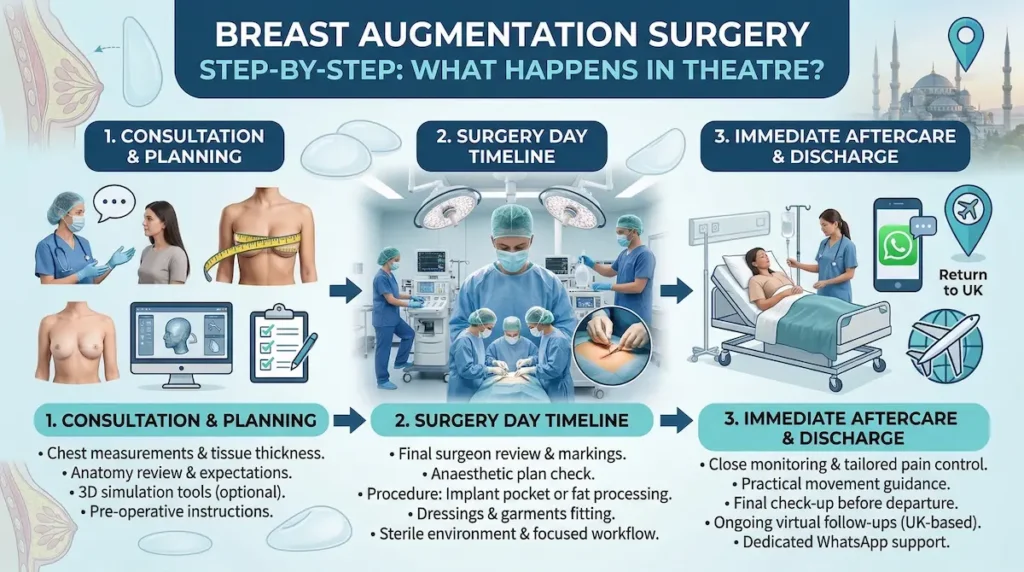
Breast Augmentation Surgery Step-by-Step: What Happens in Theatre?
UK patients doing deep research tend to want one thing: a predictable sequence. What happens first. What happens next. Who is with you. How decisions are confirmed.
We follow a structured pathway. It begins before you arrive in Istanbul and continues after you return home. The aim is clarity. It reduces anxiety and improves decision making.
Below is a practical walkthrough of what a typical surgical journey looks like. Individual details may change based on your method (implants, fat transfer, or hybrid) and your medical screening.
Consultation & planning (including 3D simulation when appropriate)
Planning is where most outcomes are won. We measure your chest, review tissue thickness, and discuss your goal in practical terms. We also align expectations about what is realistic for your body.
- Review of your medical history, medications, and previous surgery (if any).
- Anatomy-based measurements: base width, fold position, and symmetry.
- Implant or method selection based on your tissue and your goal.
- Pre-operative tests and clear instructions for the days before surgery.
When it supports decision making, we use advanced planning tools to visualise likely outcomes. This does not “guarantee” a result. It improves communication and reduces guesswork.
Surgery day timeline (a clear, calm workflow)
On the day, we keep things simple. You arrive, we re-check the plan, and we confirm any final details. Then we move to theatre with a focused team and a sterile, controlled workflow.
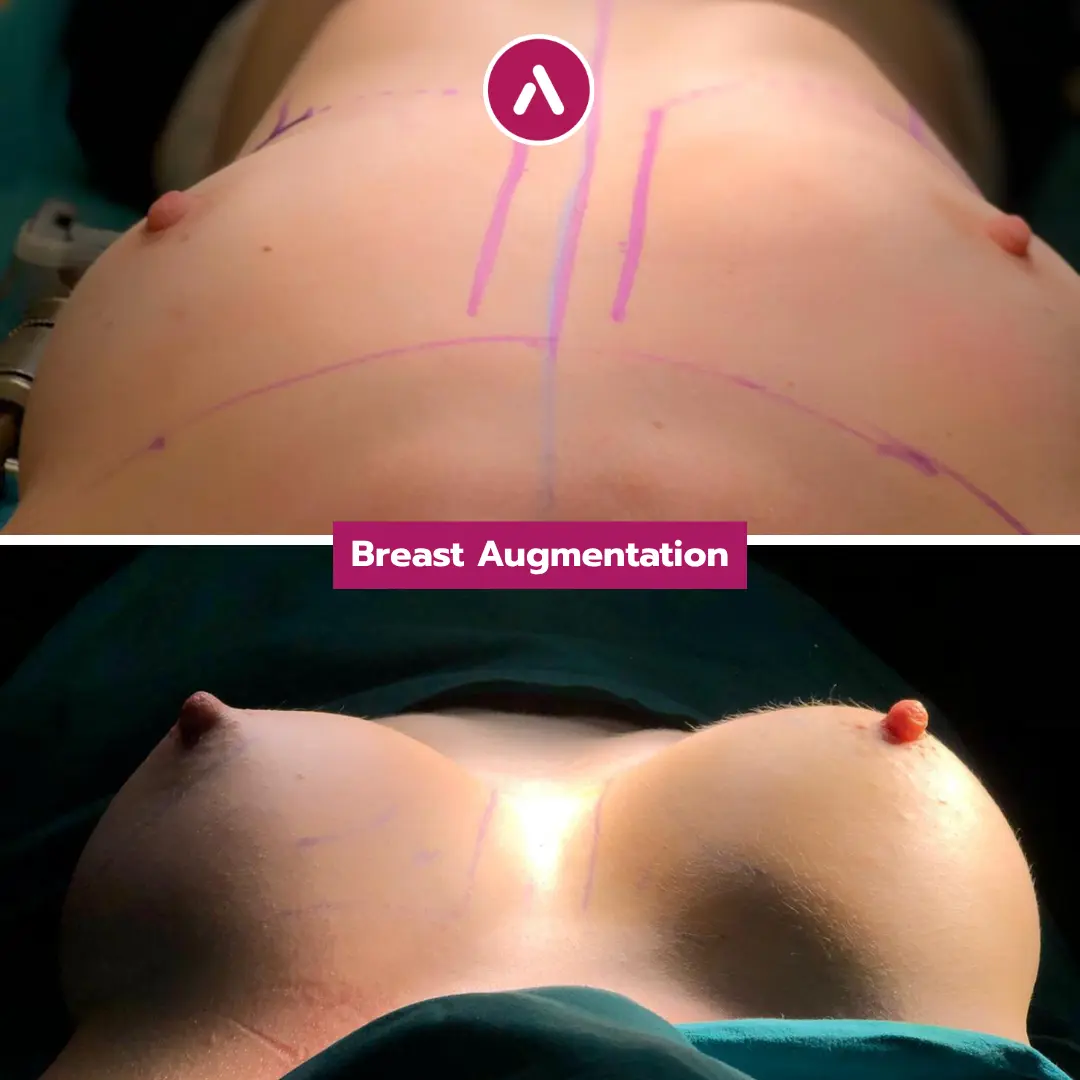
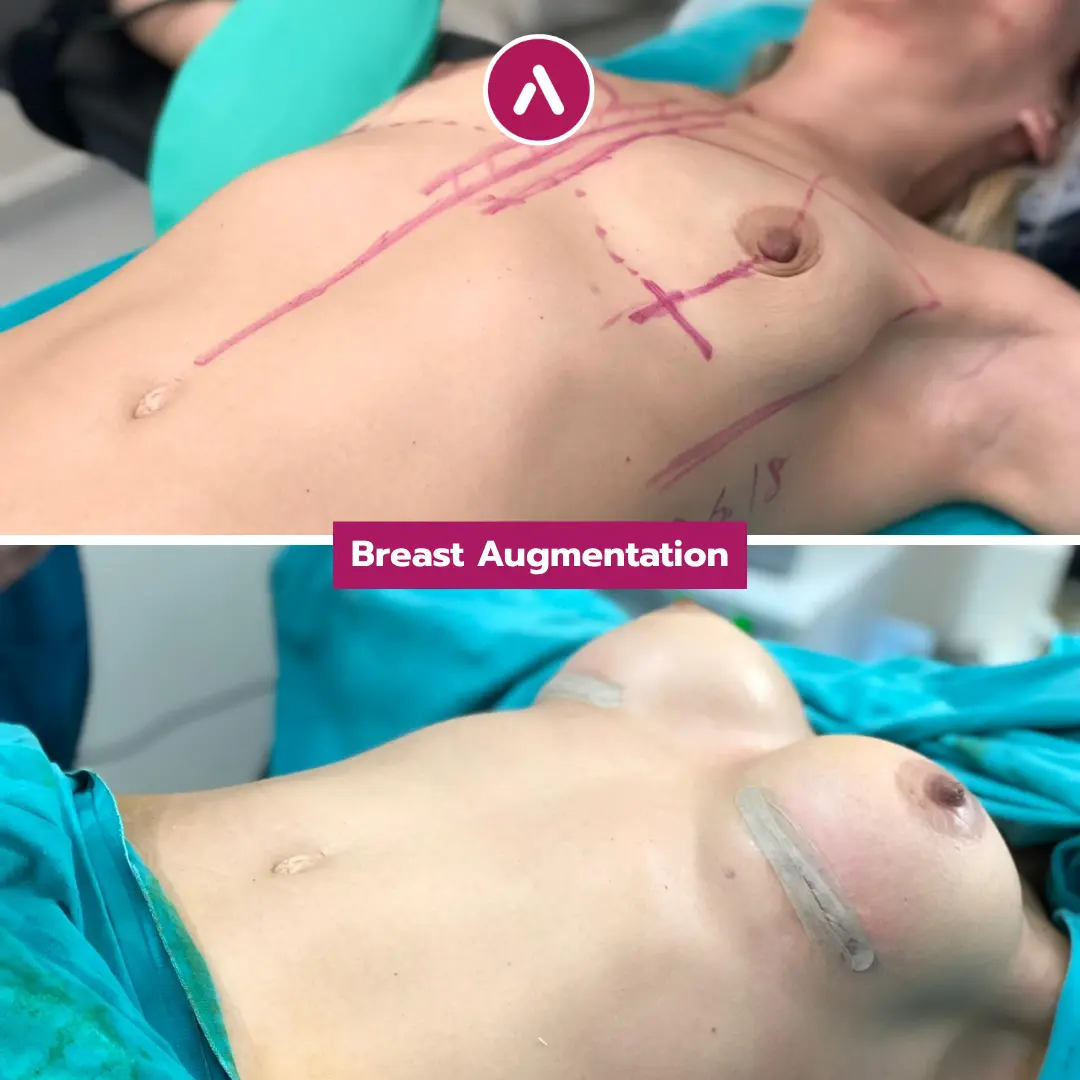
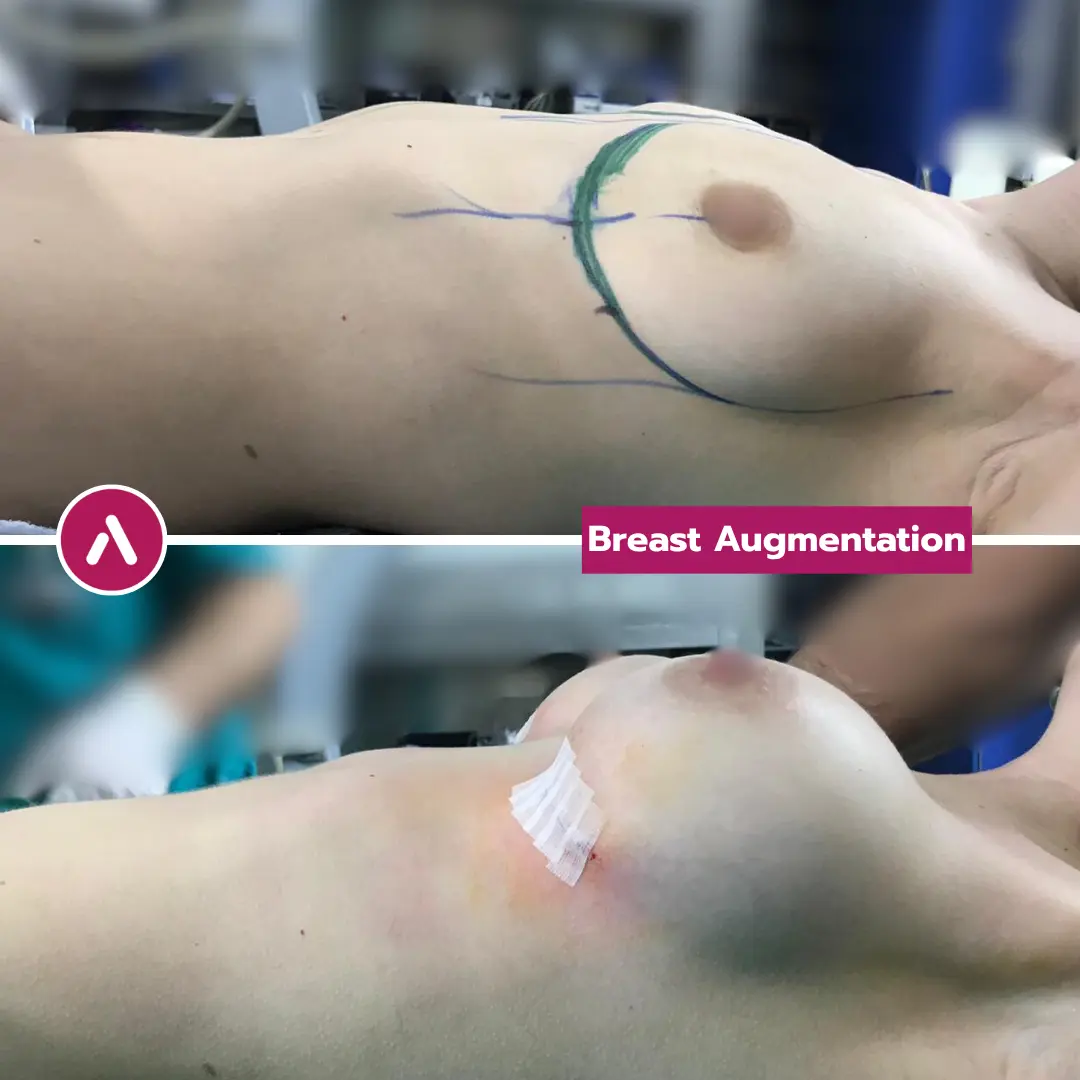
- Final surgeon review: markings, symmetry checks, and method confirmation.
- Anaesthetic plan check: sedation approach and safety monitoring.
- The procedure itself: pocket creation (for implants) or fat processing and placement (for transfer).
- Dressings and garment fitting (where relevant) before you wake fully.
Expert patients often ask about time. It varies. The more important point is what drives it: complexity, combined procedures, and individual anatomy.
Immediate aftercare & discharge planning
After surgery, we monitor you closely. Pain control is tailored, not generic. We also give you a clear plan for the first night and the first week, including what is normal and what is not.
- Observation period and a structured discharge checklist.
- Medication plan and practical advice (including paracetamol-based options when appropriate).
- Clear movement guidance: what to avoid, what to start, and when.
- Direct access to our team via WhatsApp for questions during your stay.
Before you fly home, we schedule a final check-up to confirm your recovery is on track. We then continue with virtual follow-ups to monitor healing after you are back in the UK.
Breast Augmentation Recovery & Aftercare: How long does healing take?
Breast augmentation recovery time varies by method (implants vs fat transfer vs hybrid), your baseline fitness, and how your tissues respond. Most patients feel progressively better week by week, but it is normal for swelling, tightness, and “shape changes” to evolve for several months. We set expectations in stages, not in single dates.
Your aftercare plan is not an optional add-on. It is part of the procedure. We provide structured guidance while you are in Istanbul and continue with remote follow-ups once you are back in the UK. If something feels “off”, you should not have to guess.
First week essentials (pain, swelling, mobility)
The first week is usually about comfort, sleep positioning, and gentle movement. With implants, a tight or pressured feeling across the chest can be common early on. With fat transfer, bruising at donor sites (liposuction areas) often becomes the dominant discomfort.
- Swelling and tightness: expected, especially in the first few days.
- Mobility: light walking is encouraged; heavy lifting is avoided.
- Sleep: on your back with upper body slightly elevated is often advised initially.
- Medication: taken exactly as prescribed; do not “push through” pain.
We also give you a clear “what is normal vs what is not” checklist. If you develop increasing redness, worsening pain, fever, or sudden one-sided swelling, you should contact the team immediately.
Weeks 2–6: “drop and fluff” expectations
Patients often search for breast implants drop and fluff because they notice the breasts look higher and firmer at first. As swelling settles and tissues relax, implants typically sit lower and the contour looks more natural. This is not a single moment; it is a gradual transition.
- Weeks 2–3: swelling starts to reduce; movement becomes easier.
- Weeks 4–6: many patients return to more normal routines (not heavy chest work).
- Shape settling: continues beyond 6 weeks in many cases.
We tailor activity advice to your placement and method. Submuscular/dual plane cases may feel “tighter” longer than subglandular cases. With fat transfer, we focus on protecting the grafted fat while healing progresses.
Follow-up, flight-readiness, and UK-based support
For UK patients, the practical question is often: “When can I fly?” Travel advice depends on your procedure details and how you are doing clinically. We perform a final in-person check before departure and then schedule remote follow-ups after you return home.
- In-person checks in Istanbul before you travel back.
- Remote follow-up for wound monitoring, swelling tracking, and recovery questions.
- Escalation pathway if anything requires in-person assessment in the UK.
If you value structure, ask for your written recovery milestones. A clear plan reduces anxiety and helps you avoid the two extremes: doing too much too early, or becoming overly sedentary.
Safety & Risks: What Expert Patients Should Know
Every surgical procedure carries risk. Responsible clinics do not minimise that reality. Instead, we reduce avoidable risks through screening, sterile technique, careful pocket design, and structured follow-up. We also explain what you can do to support healing.
Below are the risk topics expert patients commonly research online. This is not a complete list, and it does not replace a personalised medical consultation.
Capsular contracture symptoms & response plan
Many patients search for capsular contracture symptoms because it is one of the better-known long-term implant-related concerns. A capsule forms around any implant as part of normal healing. The issue is when that capsule tightens excessively and affects softness, shape, or comfort.
- Possible signs: increasing firmness, shape distortion, discomfort, or a breast that looks progressively “higher”.
- What matters: timeline, severity, and clinical examination.
- Our approach: prevention-focused planning, early assessment if concerns appear, and clear options if treatment is needed.
If you notice a change that seems to worsen over time, do not “wait it out” without guidance. Early assessment is always preferable.
Infection, bleeding, seroma, and sensation changes
Short-term risks can include infection, bleeding, fluid collections (seroma), delayed wound healing, or temporary sensation changes. Most issues are manageable when recognised early. That is why aftercare access matters.
- Infection: may present with redness, heat, increasing pain, or fever.
- Bleeding/haematoma: may present with rapid swelling or increasing tightness on one side.
- Seroma: may present with fluid-like swelling or shifting fullness.
- Sensation: changes can occur and often improve as nerves settle.
We provide a practical escalation plan, including when to message us immediately and when to seek urgent assessment locally.
Rupture or leak concerns & long-term monitoring
Patients also ask about signs of leaking silicone breast implants. Modern implants are designed with durability in mind, but no medical device lasts forever. Monitoring is about sensible long-term care rather than fear.
- What to watch for: changes in shape, firmness, or symmetry that persist.
- When to act: if you notice a sustained change or new discomfort.
- Long-term planning: understand maintenance expectations and keep records of implant details.
The safest approach is informed, calm, and structured: choose a method that matches your anatomy, follow aftercare guidance, and keep follow-ups consistent.
Is Breast Enlargement Safe In Turkey For UK Patients?
“Safe” is not a marketing word. It is a system. For UK patients comparing Harley Street standards with Istanbul options, the question usually comes down to three things: clinical governance, surgeon decision-making, and aftercare access once you are home. We take the same view. We build safety into the pathway, not just the operating theatre.
We start with screening. We continue with sterile theatres, structured checklists, and a measured anaesthetic plan. Then we close the loop with follow-up. If you are the type of patient who reads about capsular contracture risk, implant surface debates, and recovery milestones, you are exactly who our process is designed for.
Standards, sterility, and patient safety protocols
Safety begins before a scalpel touches skin. We run pre-operative checks, confirm your medication plan, and review your medical history with a “risk-first” mindset. In theatre, sterile technique and consistent workflow matter as much as surgeon skill.
- Pre-op screening: health checks, anaesthetic review, and medication guidance.
- Sterile theatre workflow: checklists, time-outs, and controlled implant handling.
- Post-op monitoring: early observation and a clear discharge checklist.
We also reduce avoidable variables. That means we do not chase a “biggest possible” result if your tissue cannot support it. Over-sizing is not brave. It is a predictable route to problems.
Surgeon credentials: what you should look for
When UK patients search for “best breast augmentation surgeon”, the word “best” is subjective. Credentials are not. We encourage you to focus on verifiable markers and a surgeon’s ability to explain trade-offs without defensiveness.
- Board-level credentials: we refer to our surgeons as European Board Certified Surgeons or specialists registered with international medical boards.
- Planning skill: base width, tissue thickness, and inframammary fold control drive outcomes.
- Revision thinking: a good surgeon plans for longevity, not just day-one shape.
“Expert surgery is often quiet. It is careful sizing, precise pocket work, and a plan that still makes sense in five years.”
Aftercare system & escalation plan (when you are back in the UK)
Aftercare is the most common weak point in cross-border surgery. We treat it as a core part of the clinical product. You leave Istanbul with written guidance, a structured follow-up schedule, and a direct line to our team.
- Remote follow-ups: scheduled check-ins to monitor healing milestones.
- Direct access: WhatsApp support for practical questions and early reassurance.
- Escalation pathway: clear instructions for when you need in-person assessment in the UK.
To support recovery, we also run our Rapid Recovery & Safety Protocol for suitable candidates. This includes Hyperbaric Oxygen Therapy (HBOT) to support tissue oxygenation and Low-Level Laser Therapy (LLLT) to support incision and scar healing. It is not a substitute for surgical technique. It is an extra layer of care.
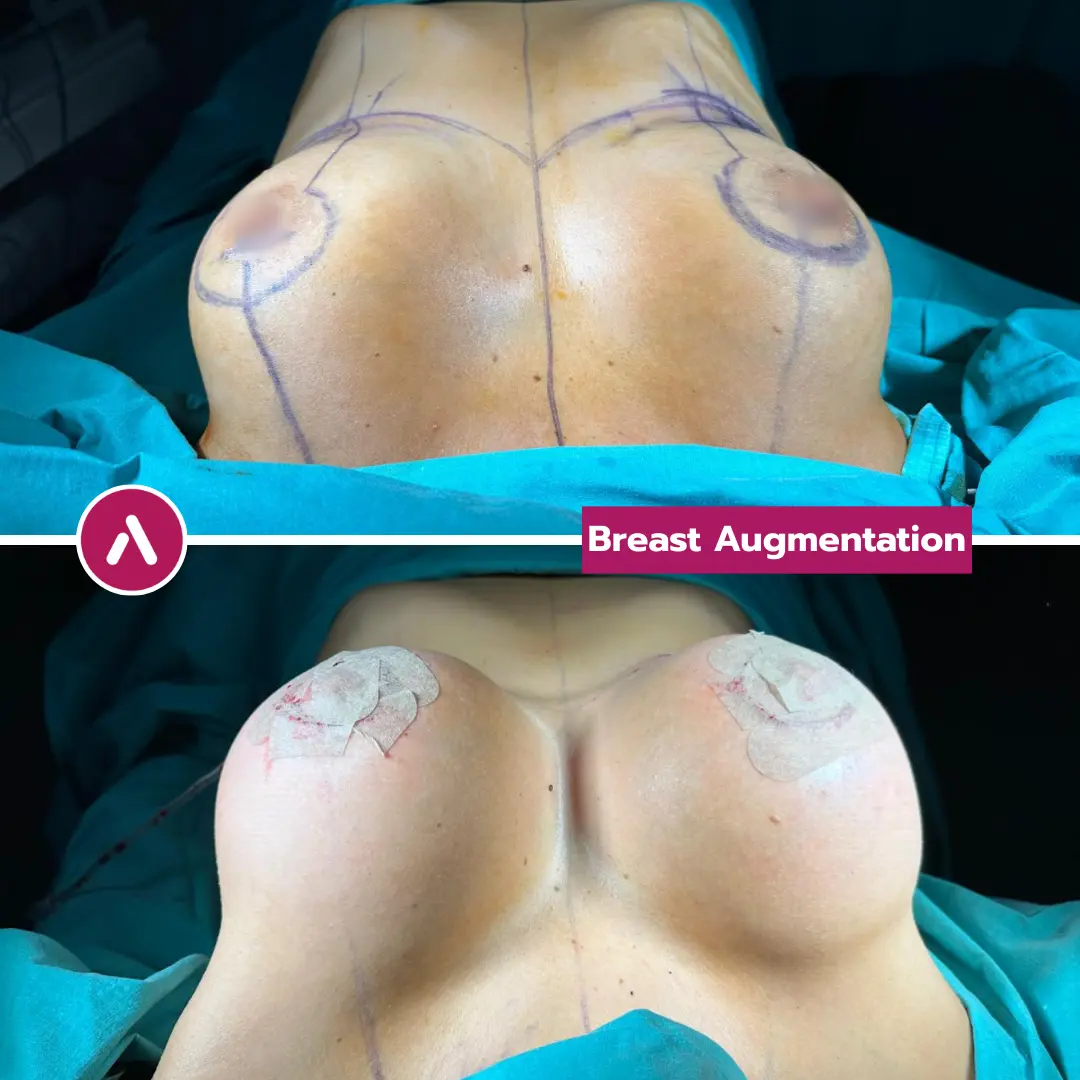
Boob Job Before and After: Realistic Expectations & Results
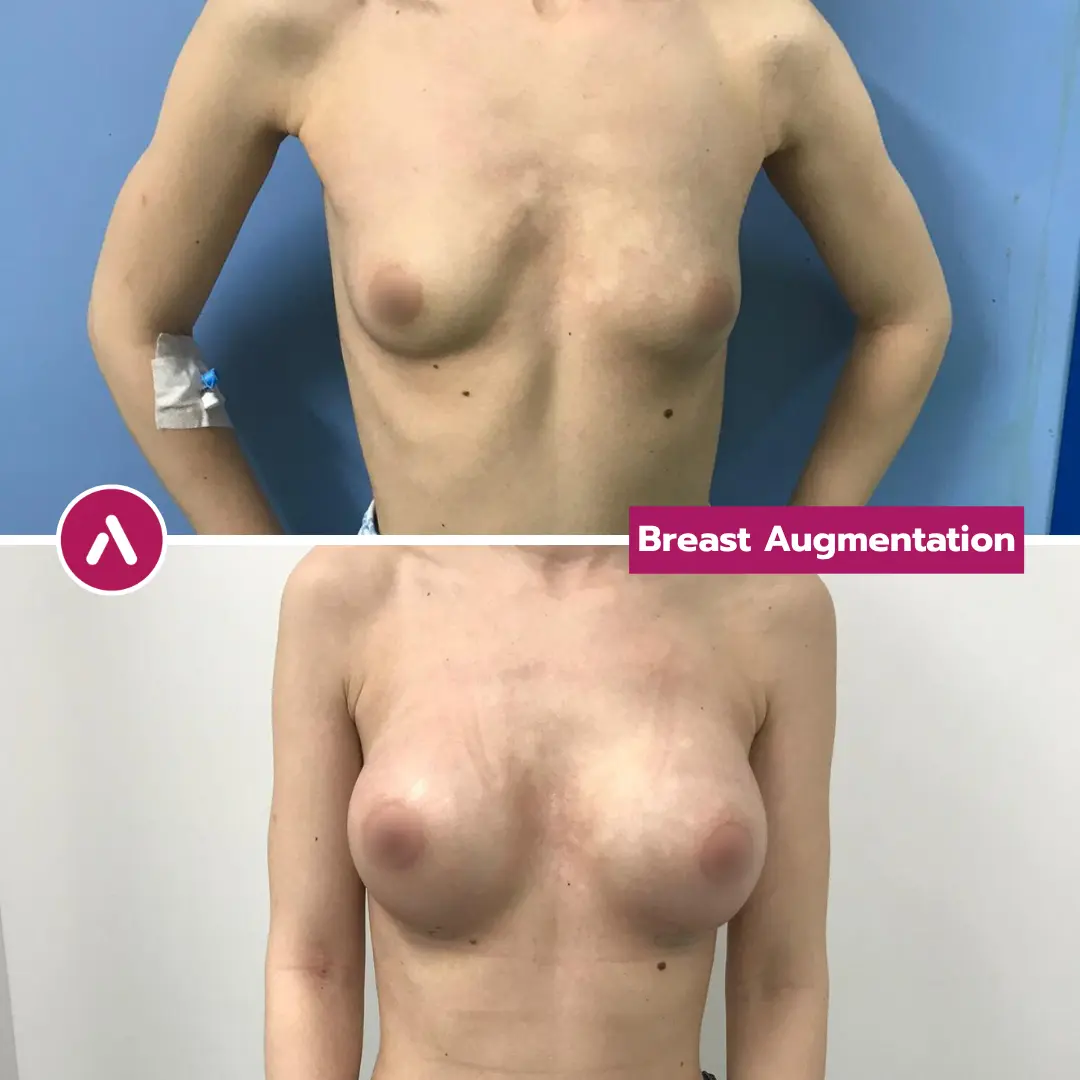
The best results look deliberate, not dramatic. That is why our philosophy is “Rejuvenation, Not Alteration.” For breast enlargement, realistic expectations come from understanding what changes quickly (volume and projection) and what changes slowly (settling, scar maturation, and the final “feel”).
We also keep the conversation grounded in anatomy. You bring preferences. We translate them into a plan your tissues can carry safely. If your goal and your anatomy do not match, we will say so and explain the alternatives.
What “natural-looking” means clinically
Patients often ask for natural-looking breast implants. It sounds simple. It is not. “Natural” is a set of design choices that respect your frame: base width, gentle upper-pole transitions, and proportionate projection.
- Right width: implants that respect your breast footprint reduce edge visibility.
- Balanced projection: enough shape to be noticeable, not enough to look “placed”.
- Soft transitions: achieved through implant choice, pocket design, and tissue coverage.
“A natural result is rarely about a specific cup size. It is about proportion, movement, and how the breast sits on your frame.”
Scars, long-term changes, and maintenance expectations
Scars are a normal part of surgery. They also evolve. Most scars look their “worst” before they look their best. We give a scar-care plan early and advise you on what to avoid while the incision is still fragile.
- Scar maturation: measured in months, not weeks.
- Body changes: pregnancy, weight fluctuation, and ageing can affect shape over time.
- Long-term monitoring: keep your implant details and follow sensible check-ups.
If your goal is long-term stability, we plan conservatively. Stable outcomes are usually built on moderate choices, not extremes.
Typical patient profiles (without the marketing noise)
We do not present breast enlargement as a single “type” of patient. People come with different motivations and different starting anatomy. These are common profiles we see in consultation:
- Volume restoration: patients who lost upper-pole fullness after pregnancy or weight loss.
- Proportion seekers: patients who feel their chest does not match their hips or shoulders.
- Asymmetry-focused: patients whose main goal is balance in bras and swimwear.
Whichever group you fall into, the same rule applies. We plan for your anatomy. We aim for a result that fits your life. That is how breast enlargement stays elegant.
Cost / fees: Breast Enlargement Cost 2026 (Turkey vs UK)
Cost is part of informed consent. It should be transparent, itemised, and easy to compare. UK patients often discover that “headline prices” do not always include the parts that matter most: aftercare, follow-up visits, or revision support. That is where confusion starts.
We prefer a clean model. We quote based on what you actually need, then we show what is included and what is not. No vague ranges. No surprise extras. Just a clear plan.
What drives the fees?
Two patients can both request “a natural look” and still need different surgical plans. Complexity changes the fee. So does the method. A straightforward implant augmentation is not priced the same as a lift-plus-implants or a revision case.
- Method: implants, fat transfer, or a hybrid approach
- Complexity: asymmetry correction, pocket work, or revision planning
- Implant variables: size range, profile, and device type chosen for your anatomy
- Anaesthesia plan: twilight sedation vs general anaesthesia (when clinically required)
- Aftercare intensity: follow-up schedule, garments, and recovery support
Expert patients often ask for a “cup size guarantee”. We do not offer that. We plan by cc, measurements, and tissue limits. It is safer. It is also more honest.
UK vs Turkey: why the difference exists
In the UK, private fees for breast enlargement commonly sit in a multi-thousand-pound range, with London and Harley Street typically at the top end. Cost differences between countries are often driven by macroeconomics, not by a deliberate drop in standards. Exchange rates and national operating costs matter. Staff costs and facility costs matter too.
When you compare value, compare like-for-like. Compare surgeon credentials, the theatre environment, what is included in the fee, and the aftercare pathway once you are home. That is the only fair way to assess breast augmentation surgery cost UK vs Turkey.
| Cost Component | Typical UK private model | Our all-inclusive VIP model (what we standardise) |
|---|---|---|
| Consultation & planning | Often charged separately | Structured virtual planning before travel |
| Procedure & theatre fees | Usually bundled, varies by provider | Included in your transparent quote |
| Pre-operative tests | May be included, may be separate | Included |
| Post-op medications & garments | Can be partially separate | Included |
| Hotel & transfers | Not included | 5-star hotel + VIP airport/clinic transfers included |
| Long-term follow-up | Varies by clinic; may be time-limited | Structured virtual follow-up pathway |
| Flights | Not relevant | Not included (you choose your preferred flight) |
What is included in our VIP package (and what is not)
UK patients do not just want a lower fee. They want lower friction. That is why we built a VIP pathway that removes logistics from the stress list. It also keeps your recovery window calm. Quiet matters after surgery.
- Included: your procedure, anaesthesia and theatre fees, all pre-op tests
- Included: 5-star hotel accommodation, VIP airport and clinic transfers
- Included: post-op medications, garments, and a dedicated patient host via WhatsApp
- Not included: international flights, personal travel insurance, personal expenses
If you want a personalised plan and a clear, all-inclusive quote in GBP, we can map it in a virtual consultation before you commit to travel.
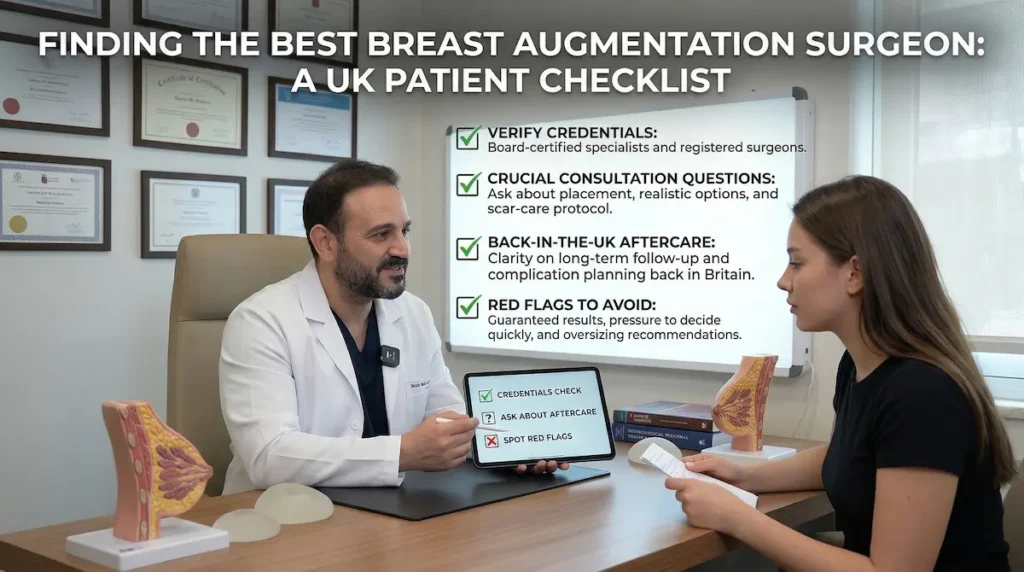
Finding The Best Breast Augmentation Surgeon: a UK Patient Checklist
Most “bad outcomes” start with a poor decision upstream. The wrong implant for the frame. The wrong method for the tissues. A rushed consultation. If you are an expert patient, you already know the key rule: choose the process, not the promise.
We encourage you to approach surgeon selection like a due diligence exercise. Ask for credentials. Ask for complication planning. Ask what happens if you have a concern back in the UK. A confident, ethical team will welcome those questions.
Credentials that matter (beyond marketing)
Titles can be vague. Verification is not. You are looking for training depth, board-level standards, and a surgeon who can explain trade-offs without dodging.
- Board-level credentials: European Board Certified Surgeons or specialists registered with international medical boards
- Procedure focus: consistent experience with breast surgery, not occasional cases
- Planning discipline: measurements, simulation tools when appropriate, and conservative sizing logic
“We earn trust by being specific. If a plan cannot be explained clearly, it is not a plan.”
Questions to ask in consultation (useful, not awkward)
Good questions create good outcomes. Keep them practical. Ask the things that change your long-term result, not just day-one photos.
- What placement do you recommend for my tissue thickness, and why?
- What are my realistic options: implants, fat transfer, or hybrid?
- How do you manage capsular contracture risk and follow-up if I return to the UK?
- What scars should I expect, and what is your scar-care protocol?
- What would make you advise a lift rather than volume alone?
We also suggest reading about related procedures if your concern is position rather than volume. Breast lift (mastopexy) and breast lift with implants are common “better-fit” solutions for the right anatomy.
Red flags (walk away early)
Some warning signs are universal. They are not subtle. If you see them, stop the process and reassess.
- Guaranteed cup sizes or guaranteed “no complications” language
- Pressure to decide quickly, especially before a proper assessment
- Dismissive answers about aftercare once you are back in Britain
- Over-sizing recommendations that ignore your base width and tissue limits
Your goal is not the biggest result. Your goal is the best-fit result. That is how breast enlargement stays natural, stable, and genuinely worth it.
Your Medical Journey: What to expect (arrival to departure)
For UK patients, the best surgical plan can still fall apart if the logistics are chaotic. Recovery is calmer when the pathway is structured: clear timings, predictable check-ups, and support that continues after you fly home. Our VIP journey is designed to reduce friction and protect your recovery window.
Below is a practical overview of how the trip typically works. Individual timing can vary depending on your procedure (implants, fat transfer, hybrid, or combined surgery), your screening results, and your travel preferences.
Travel, hotel, and scheduling logic
We plan your schedule so that key clinical steps are completed before surgery and before your return flight. The aim is to avoid rushed decisions and last-minute changes. Most UK patients appreciate having everything mapped out in advance.
- Before travel: virtual consultation, planning, and a pre-op checklist (medications, smoking guidance, supplements to avoid).
- Arrival: VIP airport transfer to your hotel, then a scheduled clinic visit for in-person assessment and final confirmation.
- Pre-op tests: completed in line with your individual risk profile and anaesthetic plan.
- Post-op checks: timed to confirm early healing milestones before your departure.
We include 5-star hotel accommodation and VIP transfers as part of the standard patient journey, because comfort and reduced stress are not luxuries after surgery. They are practical recovery tools.
Privacy-first clinic experience
Many patients travel for breast enlargement because they want privacy as well as value. We respect that. Your journey is designed to feel discreet, calm, and professional—from consultation through to follow-up. If you prefer minimal visibility and minimal waiting, tell us early so we can shape your schedule accordingly.
- Discreet coordination: scheduled timings to reduce unnecessary waiting.
- Patient host support: a single point of contact for logistics and non-clinical questions.
- Clinical clarity: you receive written guidance for recovery milestones and warning signs.
We do not treat privacy as a branding phrase. We treat it as a patient need.
Timeline checkpoints (pre-op, surgery, follow-up)
Expert patients often want a checklist. Here is the simplified framework:
- Pre-op checkpoint: confirmation of method, implant plan (if relevant), incision strategy, and anaesthetic approach.
- Surgery checkpoint: final markings, time-out safety checks, and a controlled theatre workflow.
- Early post-op checkpoint: monitoring, pain control plan, garment guidance, and mobilisation advice.
- Pre-flight checkpoint: in-person review of wounds, swelling pattern, and travel-readiness guidance.
- UK follow-up checkpoint: remote follow-ups to track healing and answer practical questions.
If you want maximum structure, we can provide a written milestone plan tailored to your procedure. A clear plan reduces anxiety and prevents the most common recovery mistakes.
Breast Enlargement Frequently Asked Questions (FAQ):
How long is breast enlargement recovery time, and when can I return to work?
Recovery depends on the method, the placement (for implants), and the physical demands of your job. Desk-based work is often easier to return to than physically demanding roles. Most patients feel noticeably better week by week, but swelling and settling can continue for months.
How many cc is a cup size?
There is no universal cc-to-cup conversion. Bra sizing varies by brand, and band size changes cup volume. That is why we plan using measurements, base width, tissue limits, and projection—not cup size promises.
We discuss likely visual change using cc ranges and proportional planning.
Reference photos can help define shape goals, not “exact replication”.
We prioritise a stable, natural result over a headline size.
Can I breastfeed after breast implants or fat transfer?
Many patients breastfeed after breast surgery, but no surgeon can guarantee breastfeeding ability. It depends on your anatomy, the surgical approach, and how your body heals. If future breastfeeding is a priority, tell us during consultation so we can plan with that in mind.
Implants: technique and incision choice can matter; individual factors vary.
Fat transfer: uses your own tissue, but outcomes and long-term changes still vary.
Long-term maintenance: pregnancy and weight changes can alter breast shape over time.
When will my breasts look “final” after breast enlargement?
Most patients see a meaningful improvement in shape within the first 4–6 weeks, but “final” settling usually takes longer. Swelling reduces gradually, tissues soften, and implants (if used) typically settle over several months. Scar maturation also continues for many months.
What does “drop and fluff” actually mean?
It describes the normal settling phase after implant surgery. Early on, breasts can look higher and feel firmer due to swelling and muscle tightness (especially with submuscular/dual plane placement). As tissues relax, the implant sits more naturally and the contour looks softer. This happens gradually, not overnight.
Will implants feel obvious or look unnatural on a slim frame?
They can if sizing ignores tissue thickness and base width. For slimmer patients, we prioritise proportional sizing, careful pocket design, and (where suitable) added tissue coverage strategies, including a hybrid plan. The aim is a natural transition at the upper pole and reduced edge visibility.
Can I choose an implant by brand or model (e.g., “gummy bear”)?
You can absolutely discuss preferences, but the final choice should be anatomy-led. “Gummy bear” usually refers to more cohesive gel behaviour rather than a single device. We match device characteristics—width, projection, gel behaviour, and surface—to your measurements and aesthetic goal.
Are textured breast implants still used?
Textured implants are a more complex safety topic than they used to be. If textured options are discussed, we review the current risk landscape, why a textured surface would offer a meaningful benefit for you, and whether a smooth alternative can achieve the same goal more safely.
What is the difference between round and teardrop (anatomical) implants?
Round implants often provide centred projection and can still look natural when correctly sized. Teardrop (anatomical) implants are designed to mimic a slope in the upper pole with fullness in the lower pole, but they are not automatically “more natural” for everyone. Your chest shape and pocket precision drive the outcome.
How do you decide between breast implants, fat transfer, or a hybrid approach?
Implants are typically best for a predictable, clear increase in volume and projection. Fat transfer is usually best for subtle enhancement with a very soft feel, but retention can vary. A hybrid approach can combine structure (implant) with contour refinement (fat) when you want softer transitions or extra coverage.
When can I start exercising again after breast augmentation surgery?
Gentle walking is usually encouraged early, but structured exercise returns in phases. Upper-body and chest-focused training typically needs the longest restriction—especially with submuscular/dual plane placement. Your plan depends on your method, healing progress, and surgeon guidance at follow-up.
When can I start exercising again after breast enlargement surgery?
Gentle walking is usually encouraged early, but structured exercise returns in phases. Upper-body and chest-focused training typically needs the longest restriction—especially with submuscular/dual plane placement. Your plan depends on your method, healing progress, and surgeon guidance at follow-up.
How should I care for scars after breast enlargement?
Scar care starts with protecting the incision while it heals: keep it clean, avoid tension, and follow your dressing and garment guidance. Once the wound is closed and your surgeon approves, a structured scar-care routine may be advised. Expect scars to mature over months rather than weeks.
What happens if I have a concern after I return to the UK?
You will have a structured follow-up pathway with remote check-ins and direct access to our team for guidance. If symptoms suggest you need in-person assessment (for example, increasing redness, fever, sudden one-sided swelling, or worsening pain), we provide a clear escalation plan so you know exactly what to do and when.
Medical Disclaimer: This page is for general information and does not replace a medical consultation. Surgical outcomes and recovery timelines vary between individuals. Any medical decision should be made after a personalised assessment by a qualified clinician.