
Liquid Facelift Turkey: Non-Surgical Alternatives
AI Summary
- A liquid facelift in Turkey offers subtle facial rejuvenation with less downtime than surgery for suitable UK patients.
- Natural-looking results depend on conservative filler planning, facial anatomy expertise, and avoiding the overfilled appearance.
- Liquid facelift vs surgical facelift matters: fillers restore volume, while surgery treats advanced jowls and loose skin.
- Liquid facelift costs in Turkey may compare favourably with Harley Street, but long-term maintenance should be planned honestly.
AI-generated summary, fact-checked by our medical experts.
If you are researching a liquid facelift Turkey option, you are probably looking for a fresher, less tired appearance without the commitment of surgery. For many UK patients, the attraction is clear: a well-planned non-surgical treatment can soften hollowness, improve facial balance, and create a more rested look with less downtime than a traditional operation. However, a liquid facelift is not a magic substitute for every stage of facial ageing, and understanding that distinction is essential before you book treatment in Istanbul.
In simple terms, a liquid facelift uses a strategic combination of dermal fillers and anti-wrinkle injections, in order to restore volume and reduce the appearance of lines. This is why the treatment is often described as a facelift without surgery. It appeals to patients who want subtle improvement rather than a dramatic change, especially those who are not yet ready for an operation or who have only mild to moderate age-related volume loss.
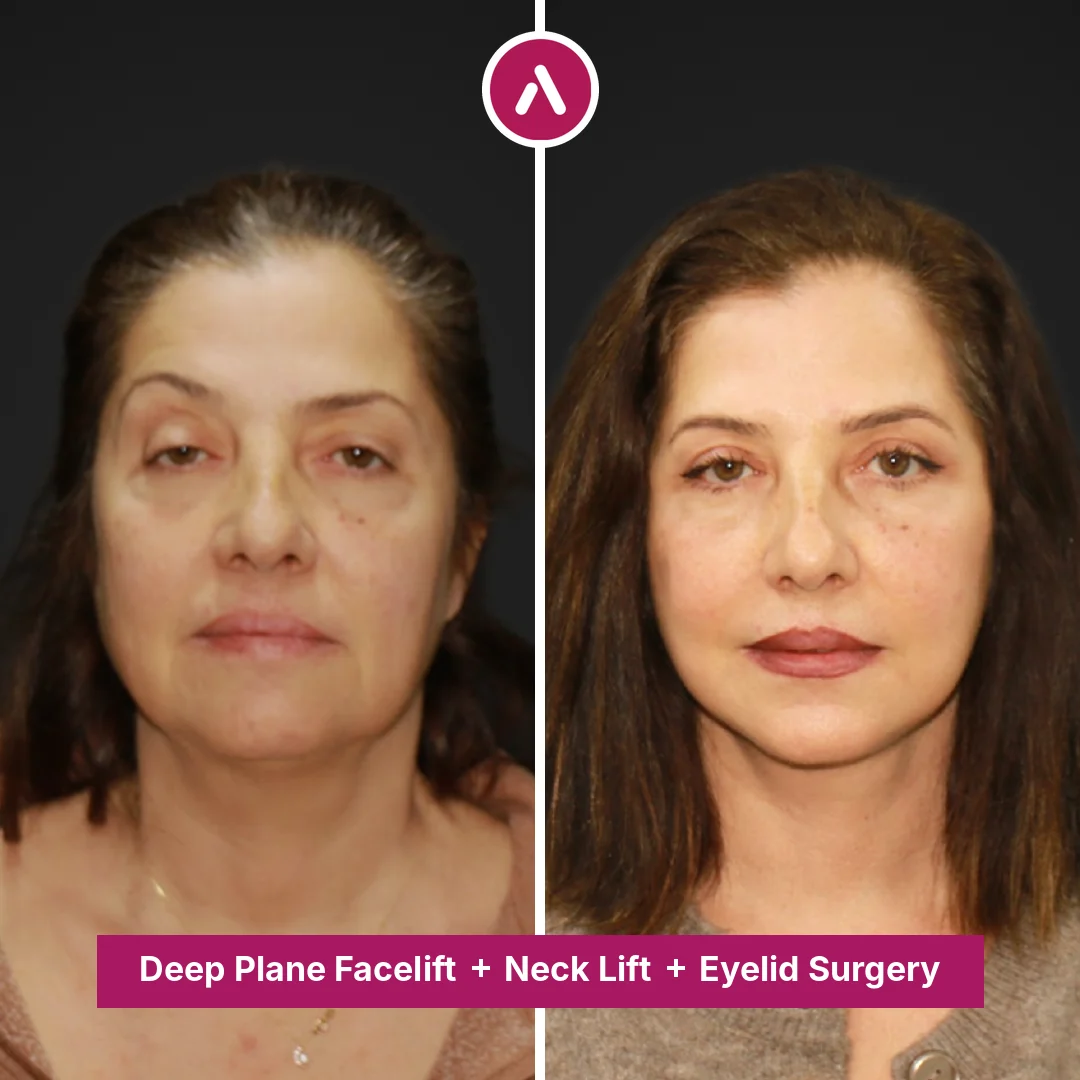
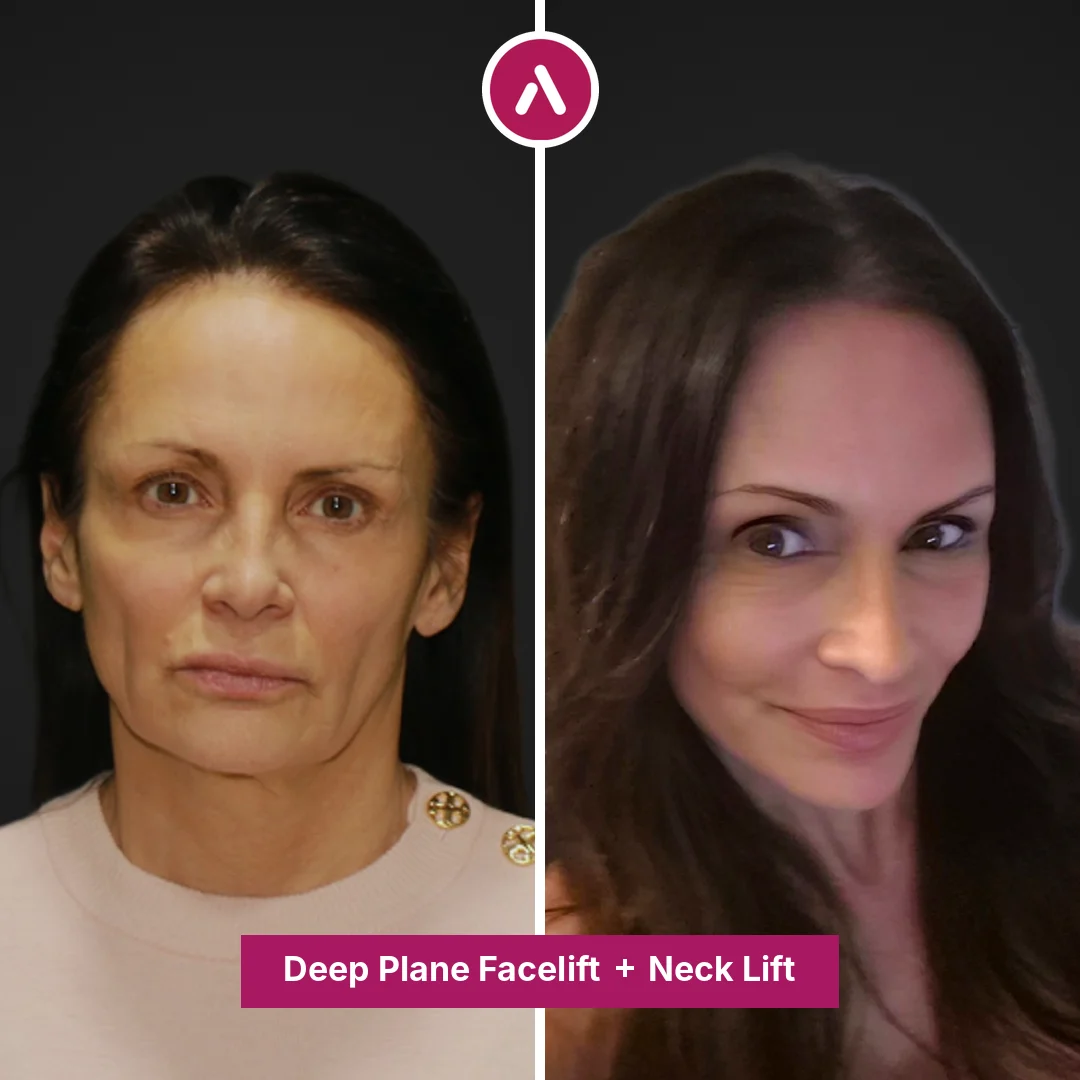
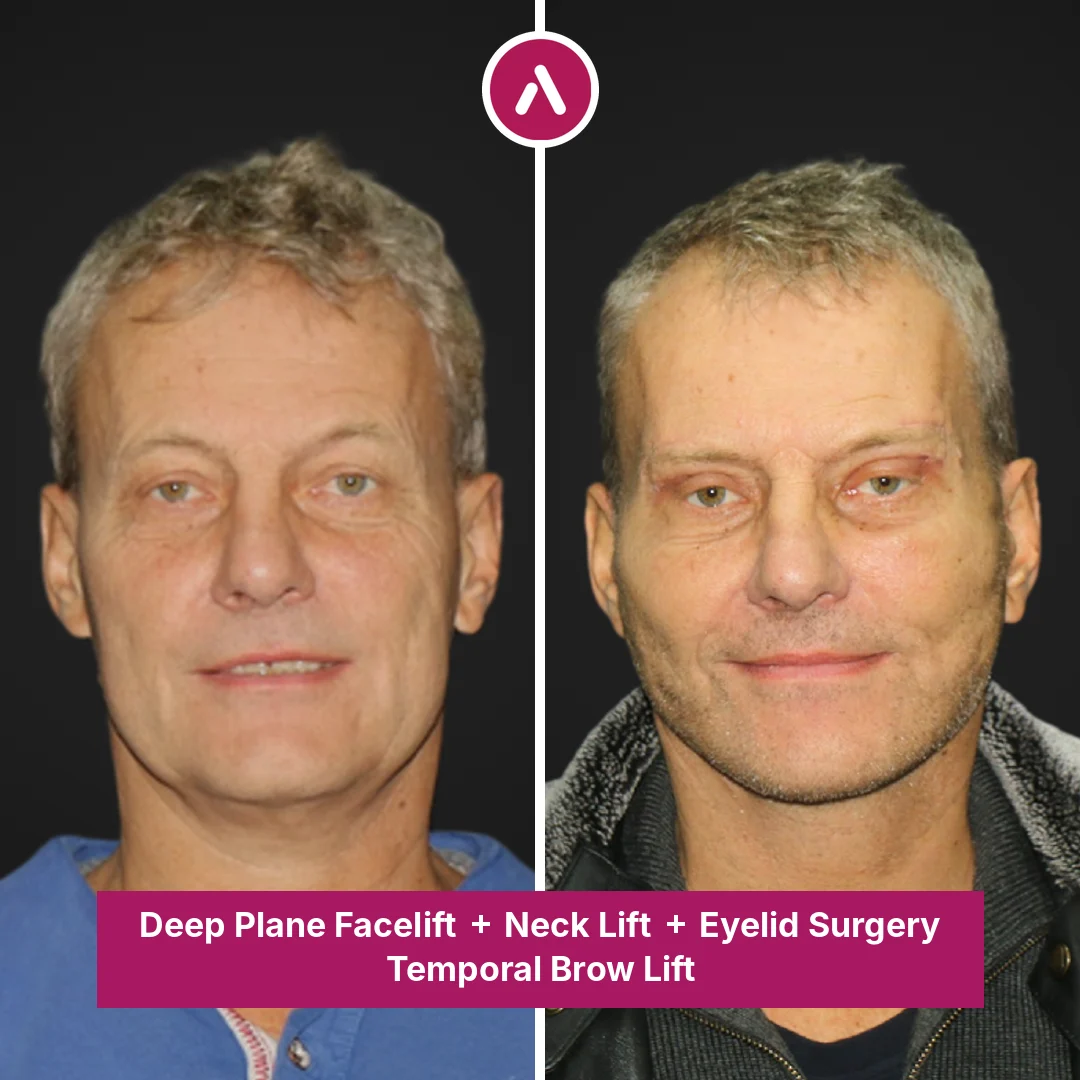
It is also important to be precise with language. Some people search online for liquid facelift surgery Turkey, but a true liquid facelift is not surgery. It is a minimally invasive treatment, not a surgical procedure. Likewise, many people search for a non-invasive facelift Turkey, yet most injectable treatments are technically minimally invasive because they involve needles or cannulas. Good clinics explain these differences clearly rather than relying on marketing language alone.
This guide is written for patients who want evidence-based answers. We will look at liquid facelift vs surgical facelift expectations, facial anatomy, suitable candidates, and when injectables may be worthwhile. We will also touch on the role of science, facial assessment, and why treatment planning should be grounded in anatomy and medical science, not social media trends. Whether you are exploring a liquid facelift in Turkey, comparing a Turkey liquid facelift package with Harley Street pricing, or researching non-surgical face rejuvenation Istanbul clinics, the key is to understand what this treatment can genuinely do for your face.
The best liquid facelift result is not a face that looks “done”; it is a face that looks refreshed, balanced, and still entirely like you.
Table of Contents
What Exactly Is a Liquid Facelift?
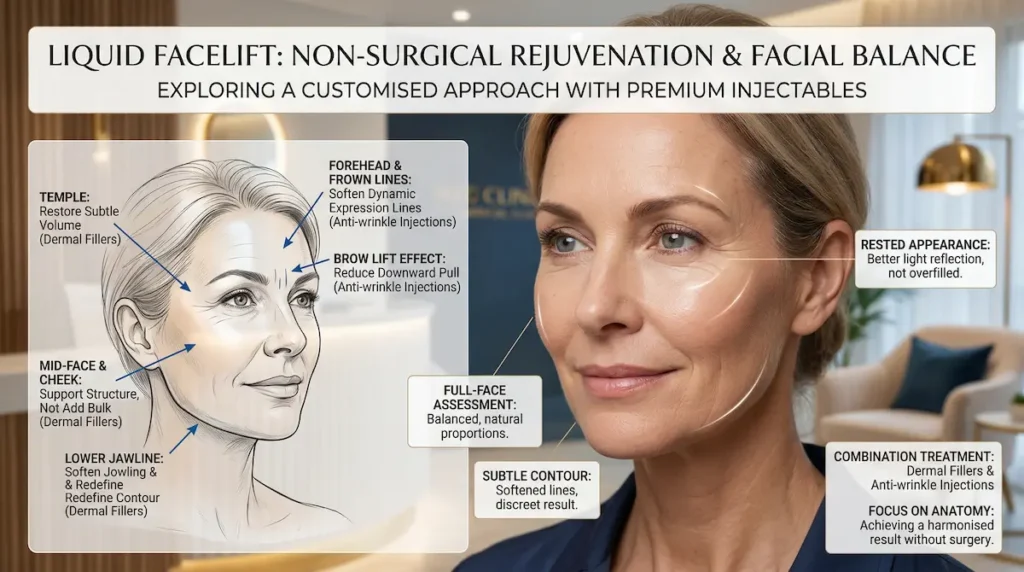
A liquid facelift is a customised injectable treatment designed to restore lost volume, soften lines, and improve facial proportions without surgery. Rather than pulling tissue upward in the way a surgical facelift does, it works by strategically placing volume where the face has become hollow or deflated and by relaxing muscles that contribute to certain dynamic wrinkles. For the right patient, this can create a softer, fresher appearance. For the wrong patient, however, it can add bulk without truly correcting sagging. That is why the consultation matters far more than the label.
How Premium Dermal Fillers and Neurotoxins Work Together
The treatment usually combines two categories of injectables. First, dermal fillers are used to replace volume that has diminished with age. They may be placed in the temples, cheeks, jawline, or other selected areas to support the face and improve contour. Secondly, anti-wrinkle injections may be used to relax specific facial muscles that create repetitive lines or pull certain areas downward. When combined thoughtfully, the effect can be more harmonious than using either treatment alone.
This combination approach is one reason the term 8-point liquid facelift became popular. The idea behind an 8-point liquid facelift is that selected anatomical points of support are treated in a strategic sequence rather than filling one isolated wrinkle at a time. In practice, a good clinician does not rigidly follow a formula. Instead, the face is assessed individually, because no two patients lose volume in exactly the same way.
From a clinical perspective, the success of injectable rejuvenation depends less on the number of syringes and more on anatomical judgement. The injector must understand where volume loss is structural, where muscle activity is contributing to ageing, and where adding product would actually make the face look heavier. This is where scientific research and experience in facial anatomy become far more valuable than trend-based treatment.
| Treatment Component | Main Purpose | Typical Role in a Liquid Facelift |
|---|---|---|
| Dermal fillers | Restore volume and support | Used in areas such as the temples, cheeks, jawline, and sometimes under-eyes |
| Anti-wrinkle injections | Relax targeted muscle activity | Used to soften expression lines and reduce downward facial pull in selected areas |
| Full-face planning | Preserve proportion and natural balance | Prevents over-treatment of one feature while ignoring the rest of the face |
Why a Liquid Facelift Appeals to UK Patients Seeking “Subtle” Rejuvenation
Many UK patients are not searching for a dramatic transformation. They want to look less tired, less drawn, and more refreshed, while still remaining recognisably themselves. A liquid facelift can be appealing because it offers a middle ground between doing nothing and committing to surgery. It may soften early signs of ageing without the recovery period associated with an operating theatre procedure.
This is particularly relevant for patients who dislike the idea of looking overfilled or obviously treated. When planned conservatively, a liquid facelift can improve contour in a way that feels discreet. The goal should not be to erase every line or inflate every hollow. The goal should be facial balance, better light reflection, and a healthier, rested appearance.
There is also a practical appeal. Many patients considering non-surgical face rejuvenation Istanbul options are looking for a shorter visit and a less disruptive recovery. While this does not mean the treatment should be rushed, it does mean the process may fit more easily around work and travel than surgery.
What a Liquid Facelift Can and Cannot Realistically Achieve
A liquid facelift can improve selected signs of ageing, but it cannot replicate the mechanics of surgery. It can replace volume, soften creases, support contour, and in some cases create a modest lifting illusion. What it cannot do is physically reposition deeper facial structures, remove excess skin, or correct advanced jowling and neck laxity in the way a surgical facelift can.
This is where many patients become disappointed. Marketing photographs sometimes make injectable treatment appear capable of replacing surgery altogether. In reality, the most successful cases are usually those involving mild to moderate volume loss, early descent, and reasonably good skin quality. If the main problem is loose skin or heavier lower-face sagging, adding filler may simply make the face look fuller rather than younger.
That is why an honest consultation should sometimes end with a clinician saying, “You are not the right candidate for fillers alone.” Paradoxically, that kind of honesty is often a sign of a safer and more sophisticated practice.
Why “Non-Surgical” Does Not Mean “Risk-Free”
One of the biggest misconceptions around injectables is that non-surgical automatically means simple or low risk. In truth, any injectable treatment requires careful anatomical knowledge, proper product choice, appropriate technique, and a sterile clinical environment. Bruising, swelling, tenderness, asymmetry, migration, and vascular complications are all issues that require skill to avoid and manage.
Patients travelling abroad for treatment should therefore judge a clinic by medical standards, not by Instagram visibility. Ask who performs the injections, what products are used, how emergencies are handled, and whether the plan is based on full-face assessment rather than sales pressure. A proper facial rejuvenation strategy is a medical decision as much as an aesthetic one.
This matters especially when comparing a facelift without surgery approach with surgical options. The lower downtime of a liquid facelift is attractive, but lower downtime should never be confused with trivial treatment. The face contains complex vascular structures, and injectables should be approached with the same seriousness as any other medical aesthetics procedure.
Ready to Schedule Your Facelift?
Our surgical dates fill up quickly due to high international demand. Secure your consultation today to arrange your preferred travel dates.
Key Target Areas: Temples, Cheeks, Jawline, and Under-Eyes
A liquid facelift is not one injection in one place. It is a full-face strategy that targets the areas most responsible for a tired, flattened, or unbalanced appearance. In most cases, the key treatment zones include the temples, cheeks, jawline, and under-eye region. However, these areas should never be filled routinely or in the same quantity for every patient. Good results come from selecting the right zones, in the right sequence, with restraint.
Restoring Temple and Midface Volume Without an Overdone Look
Temple hollowing is often overlooked, yet it can contribute significantly to an aged appearance. When volume is lost in this area, the upper face may begin to look more skeletal, and the transition from forehead to cheek can seem less smooth. Careful restoration of temple volume can make the face appear softer and more supported without calling attention to the treatment itself.
The cheeks are another central area in a liquid facelift. Ageing often causes a gradual loss of midface support, which can make the nasolabial region seem deeper even if the fold itself is not the main problem. In these cases, placing filler directly into the fold is not always the most elegant solution. Supporting the midface first is often anatomically more logical and aesthetically more natural.
The key word here is restraint. Overfilled cheeks can distort the eyes, widen the face unnaturally, and create the rounded “pillow face” look many UK patients wish to avoid. Conservative cheek work should restore structure, not create bulk.
Jawline Definition for Early Sagging and Facial Tiredness
The jawline plays a major role in whether the face looks youthful and well-defined or heavy and fatigued. In selected patients with early loss of contour, filler placed along the jawline can improve definition and create a cleaner transition from face to neck. This can be especially useful when the issue is mild lower-face softening rather than true heavy jowling.
However, jawline filler has limits. If the tissues have already descended significantly, adding product may sharpen part of the contour but cannot physically lift lax deeper structures. This is why some patients who come in asking for more jawline definition may eventually be better served by another treatment, such as neck contouring, thread lifting in carefully selected cases, or surgery.
A careful clinician should also consider sex-specific and face-shape-specific anatomy. A refined female jawline and a stronger male jawline are not planned in the same way, and neither should be treated according to a one-size-fits-all social media template.
Under-Eye Hollowing: When Fillers Help and When They Do Not
The under-eye area is one of the most requested but also one of the most delicate regions in facial aesthetics. When genuine hollowness is present, carefully selected filler may soften the tired look created by shadowing. In the right patient, this can make the face appear brighter and better rested without changing expression.
That said, under-eye treatment is not suitable for everyone. If puffiness, poor skin quality, fluid retention, or significant lower eyelid laxity are the main issues, filler may not be the right answer and can occasionally make matters worse. This is a classic example of why a diagnosis should come before a treatment plan.
Patients who are drawn to a liquid facelift in Turkey because they want to fix tired eyes should therefore be cautious about oversimplified packages. The under-eye area requires precision, conservative technique, and a willingness to say no when filler is not appropriate.
Why Full-Face Assessment Matters More Than Treating One Area in Isolation
One of the common mistakes in injectable aesthetics is to chase one visible problem without analysing the whole face. A patient may focus on a fold, a hollow, or a soft jawline, but the underlying cause may lie elsewhere. Treating the wrong area in isolation can upset balance and lead to an artificial result, even when the product itself is well placed.
For example, a patient who asks for nasolabial fold filler may actually need subtle support in the cheeks. Someone asking for more jawline definition may primarily have chin under-projection or neck fullness. Similarly, a patient requesting under-eye filler may in fact have a midface support problem or skin issue that injectables alone cannot solve. This is why the best results tend to come from structural planning rather than reactive spot treatment.
From both an aesthetic and financial standpoint, this matters greatly. Patients comparing liquid facelift offers in Turkey should look beyond the headline number and ask what the assessment includes. A cheaper treatment that ignores facial proportion may lead to repeated top-ups, suboptimal results, and a more expensive correction journey later.
Liquid vs. Surgical Facelift: Managing Clinical Expectations
This is the point where many patients need the clearest guidance. A liquid facelift vs surgical facelift comparison is not really about deciding which option is “better” in the abstract. It is about understanding which treatment is better for your anatomy, stage of ageing, recovery goals, and long-term plans. For some patients, a well-executed injectable approach is enough to restore freshness. For others, continuing to add filler when the real issue is tissue descent can lead to expense without genuine rejuvenation.
Adding Volume vs. Repositioning Deep Facial Structures
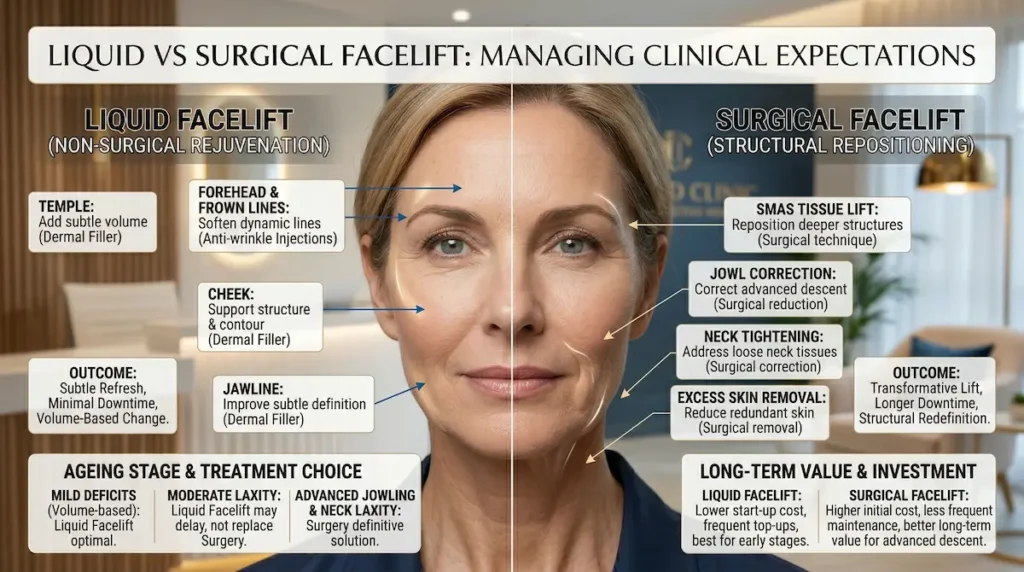
The central difference between a liquid facelift and a surgical facelift lies in what each treatment can physically change. A liquid facelift uses injectables to replace volume, soften transitions, and improve contour. A surgical facelift, by contrast, repositions deeper tissues that have descended over time. These are two very different mechanisms, and they should never be described as interchangeable.
In practical terms, fillers can improve hollow temples, flattening in the cheeks, or a slightly less defined jawline. They may also help a face look brighter and less tired. However, they do not remove surplus skin, tighten loose neck tissues, or restore deeper facial support in the way surgery can. This is why a patient with meaningful jowling may not achieve a convincing lift from injectables alone, even if the immediate post-treatment photographs look promising.
When patients search for liquid facelift surgery Turkey, it often reflects a misunderstanding rather than a true procedure category. A liquid facelift is not surgery. It is a non-surgical approach to facial rejuvenation, and its strength lies in refinement rather than deep structural correction.
| Feature | Liquid Facelift | Surgical Facelift |
|---|---|---|
| Main mechanism | Adds volume and softens selected facial lines | Repositions deeper tissues and addresses laxity |
| Best for | Early volume loss, mild ageing changes, subtle refresh | Moderate to advanced sagging, jowls, and loose neck skin |
| Downtime | Usually shorter | Longer, but often more transformative |
| Skin removal | No | Yes, where clinically appropriate |
| Long-term maintenance | Requires repeat top-ups | Less frequent intervention, though ageing continues |
Which Option Is Better for Mild Ageing, Moderate Laxity, or Advanced Jowling?
Patients with mild volume loss and only early facial descent are often the most suitable for a liquid facelift. In this group, carefully placed filler can restore support without creating heaviness. The improvement tends to be subtle, but for the right face, subtle is exactly the objective.
For moderate laxity, the answer becomes more nuanced. Some patients can still benefit from injectables, particularly if the aim is to improve proportion and delay surgery rather than replace it completely. Others may find that the result of fillers is only partially satisfying because the key problem is tissue descent rather than deflation. In those cases, the patient may look “filled” rather than truly lifted.
When advanced jowling, neck laxity, or marked skin redundancy are present, surgery is often the more anatomically correct option. This is not because injectables have failed, but because the ageing process has reached a stage where structural repositioning is needed. Honest patient selection is therefore more important than promoting any one treatment category.
Why Some UK Patients Start with Tweakments Before Considering Surgery
Many UK patients prefer to begin with conservative, lower-commitment treatments. In British media and patient culture, these smaller interventions are often called tweakments. For someone who is not emotionally or practically ready for an operation, a liquid facelift may feel like a sensible first step. It allows a patient to explore facial rejuvenation in a measured way, often with less downtime and less immediate disruption to work or family life.
This can be especially appealing for patients researching a Turkey liquid facelift option because they want a discreet improvement rather than a dramatic change. They may also be comparing injectable treatment with the very high cost of repeat appointments in central London or Harley Street settings. Starting conservatively can therefore make sense, provided the patient understands that subtle non-surgical treatment and true lifting surgery are not the same endpoint.
The key is to see tweakments as a strategic choice, not as a permanent substitute for surgery in every face. In some patients, they are the correct long-term plan. In others, they are a temporary bridge until the anatomy calls for a more definitive approach.
When a Surgical Facelift Becomes the More Cost-Effective Long-Term Choice
One reason patients become increasingly interested in the liquid facelift vs surgical facelift discussion is cost over time. A non-surgical treatment may appear more affordable at the start, but repeated sessions can accumulate significantly over several years. The more filler a patient needs, and the more frequently maintenance is required, the more important the long-term calculation becomes.
This is particularly relevant for patients comparing UK clinic pricing with Istanbul options. A few carefully planned injectable sessions may represent excellent value for someone with early ageing. Yet if the face needs repeated, high-volume top-ups to compensate for progressive descent, the financial logic changes. At that point, surgery may offer better value not because it is “cheap”, but because it addresses the underlying problem more directly.
In other words, a liquid facelift is often cost-effective when used for the right indication. It becomes less cost-effective when it is repeatedly used to chase a result that only surgery can realistically provide.
A good consultation does not simply ask, “Can we inject this?” It asks, “Is injecting this still the most anatomically sensible and financially honest option for you?”
Why Pay More for Facelift?
Achieve the same high-standard, clinical excellence you expect in the UK or US, but without the premium price tag. Quality meets exceptional value at AKM Clinic.
Longevity and Ongoing Maintenance Investments (Cost vs Value)
Longevity is one of the most important practical questions for UK patients considering treatment abroad. A liquid facelift can produce attractive, natural-looking results, but those results are not permanent. Unlike surgery, injectable rejuvenation depends on products that gradually break down over time, which means maintenance planning should be part of the conversation from the beginning. A realistic discussion about liquid facelift costs in Turkey should therefore include not only the initial appointment, but also how often future treatments may be needed.
How Long Fillers and Neurotoxins Typically Last
There is no universal timeline because duration depends on the product used, the area treated, facial movement, metabolism, and the amount placed. In broad terms, anti-wrinkle injections tend to have a shorter lifespan than dermal fillers, while filler longevity varies according to facial zone and product characteristics. Areas with more movement may break down product more quickly, while deeper structural placement may last longer.
Patients should be cautious of any clinic promising identical longevity for everyone. The face is dynamic, and results change over time. A responsible approach is to describe a range, review the face properly at follow-up, and adjust future treatment according to how the patient’s tissues respond rather than selling a rigid maintenance calendar.
It is also worth noting that longevity is not the same as aesthetic quality. A product may still technically be present while no longer producing the clean, balanced effect the patient wants. Maintenance should therefore be guided by appearance and proportion, not by the calendar alone.
The Real Meaning of “Maintenance” for UK Patients Returning from Istanbul
For a patient travelling from the UK, maintenance means more than simply booking another syringe later on. It means understanding whether top-ups can be spaced sensibly, whether the initial treatment has been done conservatively enough to age well, and whether there is a long-term plan for reassessment. This is especially relevant when researching non-surgical face rejuvenation Istanbul options from abroad.
A thoughtful maintenance strategy should avoid the trap of serial overcorrection. The best faces are not built by adding more product at every visit. They are maintained by reassessing volume loss, tissue quality, and proportion over time. In some patients, the right maintenance is very minimal. In others, the best “maintenance” may actually be moving away from fillers and considering a different treatment pathway.
For UK patients, convenience matters too. Some may choose to have an initial treatment plan in Istanbul and lighter maintenance closer to home. Others may prefer to return periodically if they feel the original injector understands their anatomy and aesthetic goals particularly well. Either way, the plan should be practical, transparent, and medically sensible.
Comparing Repeated Non-Surgical Costs with Harley Street Pricing Patterns
Cost comparisons should be made carefully and honestly. A liquid facelift in Turkey may appear significantly more affordable than equivalent treatment in premium London locations, especially where consultation fees, injector reputation, and per-syringe pricing are high. This is one reason UK patients often look beyond Harley Street when researching facial aesthetics.
However, the cheapest quote is not always the best value. Real value comes from accurate assessment, product quality, conservative treatment planning, and results that remain natural over time. A poorly planned injectable package can lead to migration, imbalance, or the need for correction, which may erase any initial saving. Patients comparing a non-invasive facelift Turkey offer with UK pricing should therefore look at expertise and planning, not just the headline fee.
For this reason, many experienced patients think in terms of value rather than bargain hunting. They are not asking, “Where can I buy the most syringes?” They are asking, “Where can I receive the most anatomically intelligent and restrained treatment for my face?”
When a Liquid Facelift Stops Being Good Value Financially
A liquid facelift stops being good value when repeat filler is being used to compensate for problems it cannot truly solve. This often happens when the face is developing more significant laxity, lower-face heaviness, or neck changes that require lifting rather than filling. At that stage, the patient may be spending more and more to preserve a result that looks less and less convincing.
Another sign is when the amount of product needed increases simply to maintain the same apparent effect. This does not necessarily mean anything has gone wrong; it may simply mean the anatomy has changed and the original treatment category is no longer the best match. Continuing out of habit can be financially inefficient as well as aesthetically unwise.
Ultimately, the best-value treatment is not always the least expensive one at the first visit. It is the one that matches the patient’s anatomy, goals, and ageing pattern most accurately over time. That is why good clinics speak honestly about both the benefits and the limits of injectables.
Avoiding the "Overfilled" or "Pillow Face" Aesthetic
One of the biggest concerns among well-informed patients is not whether fillers can work, but whether they can be used without producing an artificial result. This concern is entirely valid. The fear of looking swollen, wide, puffy, or obviously “done” is one of the main reasons many UK patients approach injectable treatment cautiously. A good liquid facelift should not make the face look larger. It should make the face look fresher, more supported, and more harmonious.
Why Conservative Planning Is Essential for Natural-Looking Results
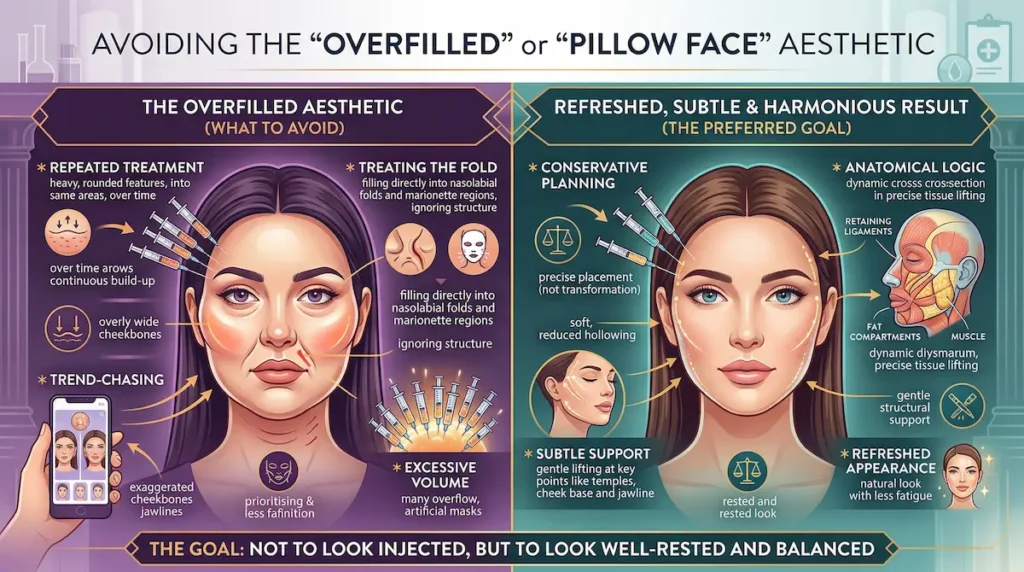
The safest and most elegant injectable outcomes usually come from conservative planning. In facial rejuvenation, more product does not automatically mean a better result. In fact, the opposite is often true. The most attractive outcomes often involve subtle support in carefully selected areas, allowing the face to look rested rather than transformed.
This is particularly important in a liquid facelift in Turkey context, where some patients arrive with the understandable hope of achieving maximum change in a short visit. However, the face does not respond well to aggressive treatment that ignores proportion. If an injector attempts to create surgical-level lifting through volume alone, the likely result is not rejuvenation but heaviness.
Conservative planning is also more compatible with long-term ageing. A face treated with restraint is easier to maintain over time, easier to reassess honestly, and less likely to drift into the overfilled appearance that many patients later regret. In aesthetics, subtlety is not hesitation; it is discipline.
Common Causes of the Overfilled Look in Non-Surgical Aesthetics
The overfilled or “pillow face” look rarely comes from one single mistake. More often, it develops gradually through repeated treatment without sufficient reassessment. Patients may top up the same areas again and again because those areas are familiar, while the underlying pattern of ageing continues to change. Over time, the face can become rounder, heavier, and less defined rather than more youthful.
Another common cause is treating the visible fold rather than the underlying structural problem. For example, repeatedly filling the nasolabial folds, marionette region, or cheeks without evaluating the rest of the face can distort balance. Likewise, chasing an Instagram-inspired cheekbone or jawline trend may produce a result that looks fashionable in a filtered image but unnatural in everyday life.
There is also a technical issue. Product choice, injection depth, and total volume all matter. Even excellent products can give poor results when used in the wrong place or in excessive quantity. This is why the term facelift without surgery should always be understood carefully: it describes an intention to rejuvenate, not a licence to replace structural lifting with endless volume.
Why Facial Anatomy Knowledge Matters More Than the Number of Syringes
Patients sometimes compare injectable treatments by asking how many syringes are included. While this is understandable from a budgeting perspective, it is not how good facial planning works. The number of syringes tells you very little about whether a treatment is appropriate. What matters far more is how the face is assessed, which anatomical changes are being targeted, and whether the injector understands when to treat less rather than more.
This is where medical science matters. The face is not a flat surface that can simply be “filled” until it appears younger. It is a dynamic, layered anatomical structure with retaining ligaments, fat compartments, muscle movement, skin quality changes, and age-related tissue descent. An injector who understands these relationships can often achieve more with less. An injector who does not may create volume without true rejuvenation.
For patients exploring dermal filler options in Turkey, this point is critical. The safest question is not, “How much filler do I get?” but, “What is the anatomical logic behind the plan for my face?”
The UK Preference for Refreshed, Not Obviously “Done”, Results
Many British patients prefer refinement over dramatic visible intervention. They do not want family, colleagues, or friends to ask what they had done. They want to look healthier, less tired, and more like themselves at their best. This cultural preference makes conservative injectable rejuvenation appealing, but it also raises the standard for treatment planning.
A successful Turkey liquid facelift should therefore fit this expectation. It should not aim for exaggerated projection, excessive cheek fullness, or the kind of stretched facial balance that looks attractive only in staged photographs. Instead, it should respect the patient’s original identity and facial character.
The most sophisticated aesthetic outcome is often the least theatrical one. When treatment is done well, people may notice that the face looks well-rested, balanced, or healthier, without being able to identify why. For most discerning patients, that is exactly the point.
The goal is not to look injected. The goal is to look as though the signs of fatigue, hollowing, and stress have been quietly softened.
Am I a Suitable Candidate for a Facelift?
Answer a few brief questions about your concerns, health, and goals to discover which treatment options may suit you best.
Is a Liquid Facelift the Right Procedure for You?
This is the most important question in the entire discussion. A liquid facelift can be an excellent treatment for the right patient, but it is not a universal answer to facial ageing. The right choice depends on the degree of volume loss, the amount of skin laxity, facial shape, skin quality, and what the patient actually means by “lift”. Some patients want subtle refreshment and are ideal for injectables. Others want a sharper jawline, less jowling, and a more durable correction, in which case another treatment may be more appropriate.
The Ideal Candidate: Early Volume Loss, Mild Sagging, and Good Skin Quality
The ideal candidate for a liquid facelift is usually someone with early facial ageing rather than advanced tissue descent. They may have hollowing in the temples, flattening through the cheeks, mild under-eye tiredness, or a slightly less defined jawline, but they still retain reasonably good skin quality and do not have substantial loose skin. In these patients, careful injectable support can create a fresher and more balanced appearance.
These are also often the patients most satisfied with a non-invasive facelift Turkey style treatment, even though the more accurate medical term would be minimally invasive. Their goal is usually refinement, not reinvention. They may want to look less drawn after stress, work pressure, or normal ageing, rather than visibly altered.
In practical terms, the best candidate is someone whose face still has enough structural integrity for volume restoration to make sense. If lifting is mostly an illusion created by replacing support, rather than a battle against significant descent, the result is usually more elegant and more believable.
| Patient Profile | Liquid Facelift Suitability | Why |
|---|---|---|
| Early temple or cheek volume loss | Often suitable | Volume replacement can restore facial support naturally |
| Mild tiredness around the under-eye area | Sometimes suitable | Only if hollowness, not puffiness or laxity, is the main issue |
| Moderate jowling and loose neck skin | Usually limited benefit | Volume cannot replace structural repositioning |
| Advanced lower-face heaviness | Often unsuitable as a sole treatment | Adding filler may create heaviness instead of lift |
When Thread Lift, Morpheus8, Lip Lift, or Neck Liposuction May Be Better Alternatives
Not every patient who wants non-surgical improvement needs a liquid facelift specifically. In some cases, another treatment pathway may be more anatomically sensible. For example, a patient whose main issue is skin quality may benefit more from energy-based skin tightening than from additional volume. A patient bothered by upper lip length rather than lip volume may find that a lip lift addresses the problem more directly than repeated filler.
Similarly, someone with localised fullness beneath the chin may not need volume at all. They may need contouring, such as neck liposuction, if the anatomy is suitable. A patient with mild laxity but limited volume loss may also ask about thread lifting, although expectations should remain realistic there too. The correct treatment is the one that matches the actual problem, not the one with the most recognisable marketing label.
Patients researching non-surgical face rejuvenation Istanbul should therefore avoid package thinking. A good clinic should be prepared to say that anti-wrinkle injections or filler alone may not be the most intelligent answer for your face. That is a sign of judgement, not a lost sale.
When a Consultant-Led Surgical Plan Is More Appropriate Than Fillers
There comes a point when a patient no longer needs more volume; they need a structural solution. If the face has developed meaningful jowling, deeper lower-face heaviness, neck laxity, or excess skin, continued filler treatment may become inefficient and aesthetically counterproductive. In those situations, a consultant-led surgical plan is often more honest and more effective than simply adding product.
This does not mean surgery is “better” for everyone. It means surgery is sometimes the more appropriate treatment category. Some patients first explore a liquid facelift vs surgical facelift comparison because they want to avoid an operation, but once they understand the anatomical difference, they realise that surgery is not an escalation of failure. It is simply a different tool for a different stage of ageing.
For these patients, a responsible clinic should explain where injectables stop and where surgery begins. Good aesthetics depends on matching the treatment to the anatomy rather than pushing one approach beyond its natural limits.
Questions UK Patients Should Ask Before Booking Any Non-Surgical Treatment Abroad
Before booking treatment abroad, patients should ask clear, medically useful questions. Who will perform the injections? What product is being used? Why is that product appropriate for this area of the face? What are the limits of the expected result? What happens if the outcome is underwhelming or if there is a complication? These questions are far more important than whether the treatment sounds glamorous online.
Patients should also ask how the plan was decided. Was there a full-face assessment, or was the recommendation based on a photo and a package menu? Has the practitioner explained whether the main problem is volume loss, skin quality change, muscle activity, or tissue descent? Without that diagnostic thinking, there is a risk of treating the wrong thing in the wrong way.
Finally, ask about maintenance and long-term honesty. A reliable practitioner should be willing to tell you when the answer is no, when the answer is not yet, and when the answer is no longer filler. That kind of clarity is usually what separates a safe aesthetic journey from an expensive cycle of disappointment.
Frequently Asked Questions (FAQ): Liquid Facelift Turkey
Below are some of the most common questions asked by UK patients comparing injectable rejuvenation options in Istanbul with treatment in the UK. The most useful answers are usually the ones that manage expectations clearly rather than promising dramatic change from a simple appointment.
How much does a liquid facelift in Turkey usually cost in GBP (£)?
Is a liquid facelift painful, and is any anaesthetic cream used?
How many syringes are typically needed for a natural result?
How long will swelling, bruising, or tenderness last after treatment?
Can I fly back to the UK soon after a liquid facelift?
At what age does a surgical facelift make more sense than fillers?
Can a liquid facelift fix jowls and loose neck skin?
Have Specific Questions About Facelift?
Speak directly with our dedicated patient coordinators regarding Facelift. Receive instant guidance and personalised support.
Medical Disclaimer: This page is provided for general educational purposes only and does not replace a face-to-face medical consultation, diagnosis, or personalised treatment plan. All surgery carries risks and outcomes vary between individuals. Suitability for facelift surgery, procedure selection, and anaesthesia choice can only be determined after a full clinical assessment by a qualified surgeon. Always follow your clinician’s instructions and seek urgent medical attention if you develop concerning symptoms during recovery.
Related Treatments

Awake Brow Lift in Turkey
UK guide to awake brow lift in Turkey: local anaesthetic + twilight sedation, endoscopic technique, can combine with upper blepharoplasty. Fees in GBP.

Awake Neck Lift in Turkey
Awake neck lift in Turkey under local anaesthesia with twilight sedation: deep structural technique, scars, recovery, HBOT/LLLT support. UK patient guide.
Awake Mini Facelift in Turkey
Discover the awake mini facelift under local anaesthesia in Istanbul. Learn SMAS vs MACS vs deep plane options, recovery timeline, scars, risks, and UK-to-Turkey planning in GBP.

Facelift in Turkey
Explore facelift techniques (deep plane, SMAS), scars, recovery timelines and sedation options. UK-focused safety pathway and aftercare at AKM Clinic, Istanbul.
Ready to Begin Your Own Transformation Journey?
Join the 2,000+ patients who have trusted Dr Akif Mehmetoğlu and the AKM Clinic team. Your journey to a more confident, naturally restored you begins with a simple, no-obligation conversation. Contact us today from the UK for your free virtual consultation.
#1: Get Your Free Personalised Quote
Start with a free, no-obligation online consultation. Share your photos, and our surgical team will provide a fully personalised treatment plan and a transparent, all-inclusive price package. There are no hidden fees.
#2: Secure Your Date & VIP Booking
Once you are ready, our dedicated patient coordinators will help you secure your procedure date. We will handle all your bookings, including your 5-star hotel accommodation and private VIP airport transfers.
#3: Arrive in Istanbul & Meet Your Surgeon
Arrive at Istanbul Airport (IST) and be greeted by your private driver. Settle into your hotel and prepare for your in-person consultation, where you will meet your specialist surgeon to finalise the details for your "natural, subtle, and restored" new look.