
For many patients researching ethnic rhinoplasty Turkey, the goal is not to look like somebody else. It is to look more balanced, more refined, and more confident, while still looking unmistakably like yourself. That distinction matters. The best outcomes in ethnic nose reshaping are not based on copying a narrow Western ideal, but on respecting the proportions, skin quality, cartilage strength, and heritage-linked features that make each face individual.
That is why ethnic rhinoplasty in Turkey should never be approached as a standard reduction procedure. A well-planned operation must preserve identity while improving harmony. In practical terms, this means analysing the bridge, tip, nostril width, projection, skin thickness, and support structures tosgether rather than treating the nose as if it were a simple cosmetic problem. Modern medical science and refined facial analysis both support the same conclusion: durable beauty comes from structure, proportion, and restraint.
Many UK patients begin with searches such as Turkey ethnic rhinoplasty, natural ethnic rhinoplasty Turkey, ethnic nose job Turkey, ethnic rhinoplasty Turkey price, or Turkey ethnic rhinoplasty package. Those are valid questions, especially for patients comparing Harley Street fees with Istanbul options. However, price should come after the more important question: will the surgery preserve your facial identity, or will it erase the very features that make you look like you?
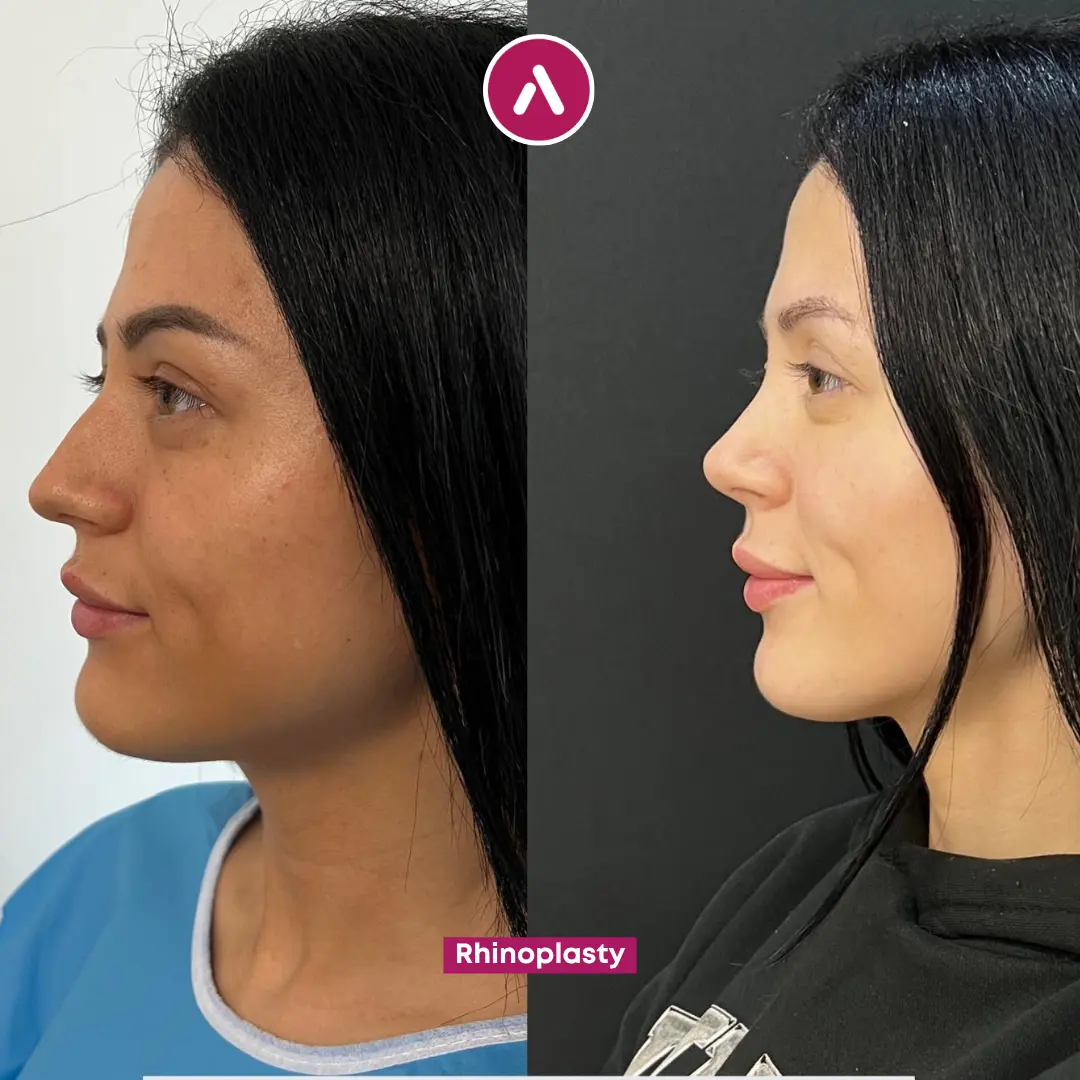
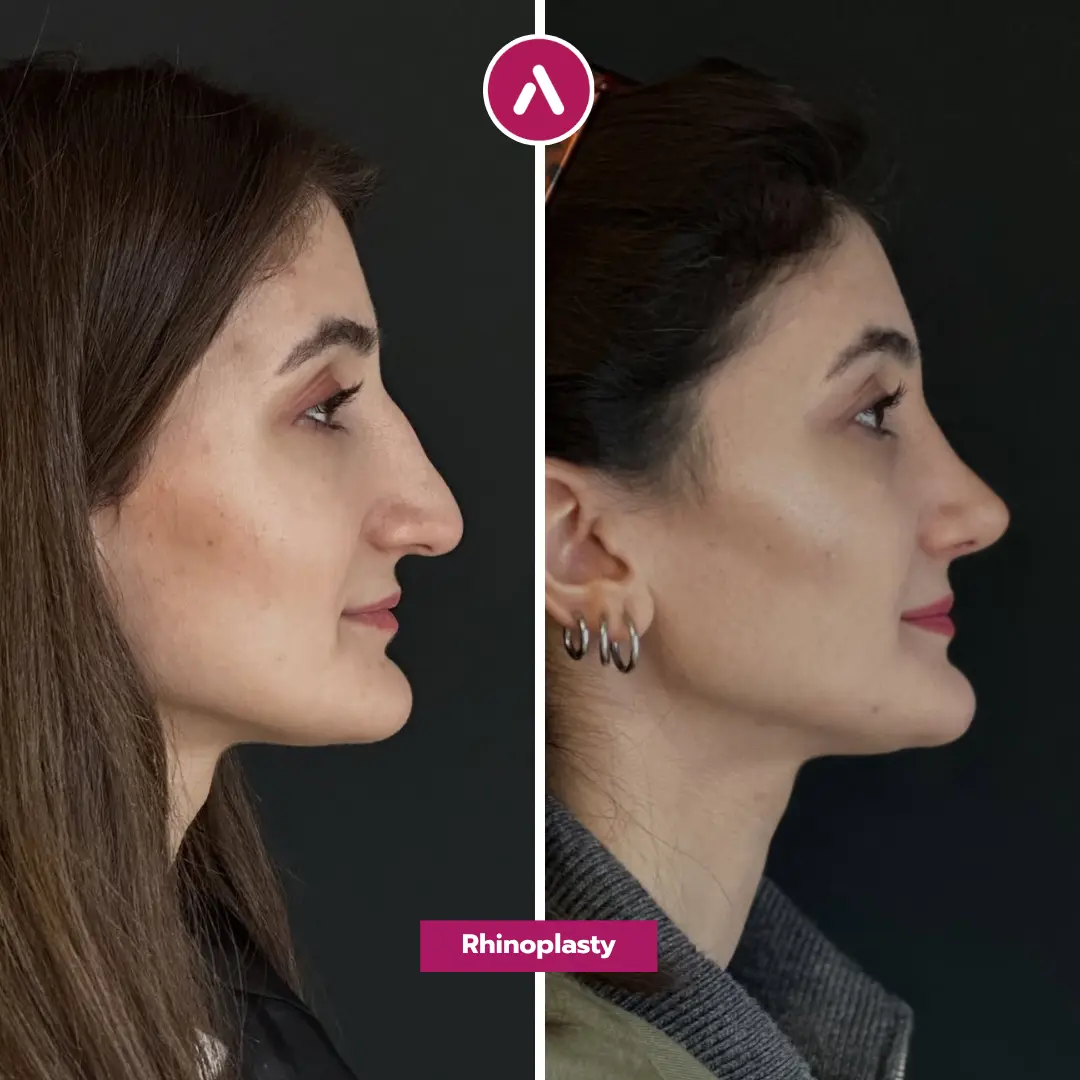
Within the broader field of ethnic aesthetic surgery Turkey offers, rhinoplasty remains one of the most individual procedures because the nose sits at the centre of the face. A small change can make the entire face look more harmonious; the wrong change can make the result look artificial, flattened, or disconnected from the patient’s natural heritage. This is why consultant-led planning, careful anatomical assessment, and realistic expectation-setting matter so much for British patients seeking a subtle result.
UK patient perspective: One reason British patients choose Istanbul is the hope of achieving a natural-looking result without paying premium Harley Street prices for an overdone appearance. That preference for subtle change is highly relevant to preserving ethnic features in rhinoplasty.
In this guide, we will explain why customised ethnic rhinoplasty requires a different philosophy, why thick skin ethnic rhinoplasty can be more technically demanding, and why technologies such as Piezo ultrasonic bone reshaping matter when safety, precision, and recovery are priorities for UK patients.
Table of Contents
Defining Ethnic Rhinoplasty: Rejecting the “One Size Fits All” Approach
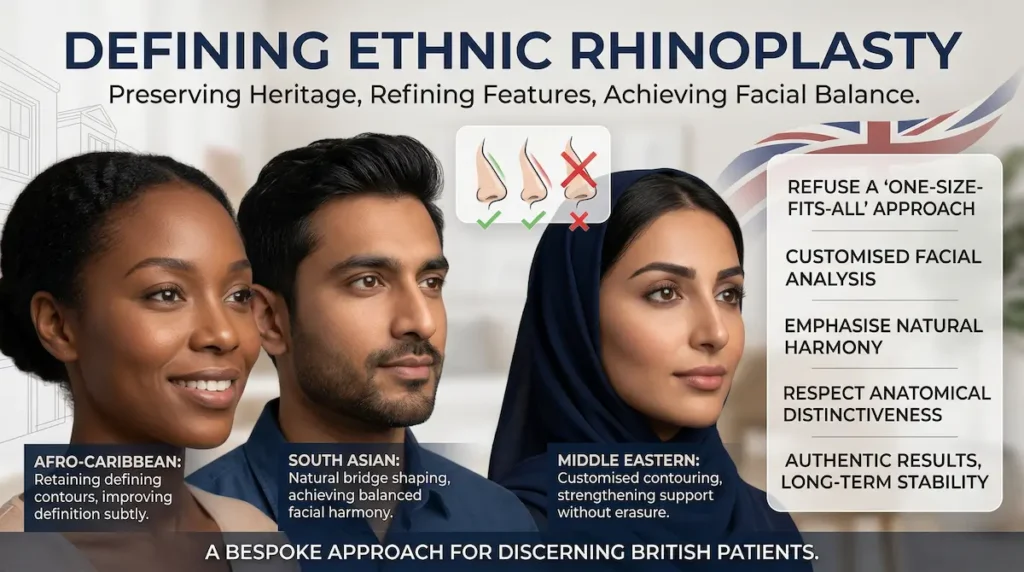
Ethnic rhinoplasty is often misunderstood as simply “rhinoplasty for non-European noses”. That description is too simplistic. In reality, ethnic rhinoplasty is a philosophy of facial surgery that rejects the idea that every patient should be pushed towards the same bridge height, the same tip shape, or the same nostril proportions. The aim is refinement without identity loss. For a British patient of Afro-Caribbean, Asian, Middle Eastern, North African, Mediterranean, or mixed heritage, that distinction is essential.
Why Ethnic Rhinoplasty Is About Refinement, Not Erasure
A successful procedure does not attempt to erase heritage-linked features. It aims to improve proportion while retaining recognisable identity. This is the core principle behind preserving ethnic features rhinoplasty. In many cases, patients are not asking for a dramatic transformation. They want a nose that sits more comfortably within the face, photographs more evenly from different angles, and perhaps looks more refined in profile or better defined at the tip.
This is where problems begin with generic or poorly planned surgery. If the surgeon reduces too aggressively, narrows without support, or over-lifts the tip, the result may look technically altered but emotionally wrong. The patient may feel that their face has been standardised rather than improved. For UK patients especially, the desired aesthetic is usually subtle, elegant, and believable rather than obviously “done”.
- Good ethnic rhinoplasty: improves balance, projection, and definition while retaining facial authenticity.
- Poor ethnic rhinoplasty: over-narrows, weakens support, or creates a generic result unrelated to the patient’s ethnicity and facial structure.
- Best practice: focuses on proportion, support, airway function, and long-term harmony.
Afro-Caribbean, Asian, and Middle Eastern Nasal Structures
Although every face is unique, certain anatomical tendencies appear more often in particular groups. Some patients may present with thicker skin, a lower bridge, softer or weaker lower lateral cartilages, wider nostril base width, or reduced tip projection. Others may have a dorsal hump but still require preservation of ethnic identity rather than excessive straightening or narrowing. This is why a blanket technique does not work.
For example, thicker skin can soften visible definition, meaning the surgeon must think structurally rather than superficially. A lower bridge may require support and shaping rather than simple reduction. A wider alar base may need careful narrowing, but only when it suits the entire face. The operation should not be based on trends, social media filters, or borrowed ideals from unrelated facial types. It should be based on anatomy and judgement.
In well-executed customised ethnic rhinoplasty, every manoeuvre has a purpose. The bridge is not raised simply because a high bridge is fashionable. The tip is not narrowed simply because a sharper tip is trendy. Each change must suit the patient’s skin envelope, cartilage strength, smile dynamics, and broader facial identity.
How UK Patients Define a “Subtle” and Heritage-Respecting Result
British patients usually describe a good outcome in very specific ways. They want to look “refreshed”, “balanced”, “more elegant”, or “less self-conscious”, but they do not want friends and family to think they look like a different person. In ethnic rhinoplasty, that often means preserving character while softening disproportion. The result should look natural in daylight, on video calls, and in profile photographs rather than only in edited clinic pictures.
For this reason, a heritage-respecting result often includes modest rather than dramatic changes. The bridge may be refined rather than radically built. The tip may be supported rather than aggressively carved. The nostrils may be balanced rather than heavily pinched. This preference aligns with both patient psychology and scientific research on structural stability: when support is respected, the nose tends to age and settle more gracefully.
| Approach | Main Goal | Typical Outcome |
|---|---|---|
| One-size-fits-all rhinoplasty | Make every nose follow one template | Higher risk of identity loss, over-reduction, and an artificial look |
| Customised ethnic rhinoplasty | Refine the nose while respecting heritage and structure | More natural facial harmony and a more believable long-term result |
| Consultant-led facial analysis | Match the plan to skin, cartilage, airway, and ethnicity-linked features | Better alignment between patient expectations and surgical design |
The Clinical Challenge of Thick Skin and Weak Cartilage
Once the philosophy of ethnic rhinoplasty is understood, the technical difficulty becomes clearer. Many patients who enquire about a natural result are not difficult because they want too much; they are difficult because their anatomy requires a more intelligent plan. Thick skin and weaker cartilage support are among the most important reasons why ethnic rhinoplasty can be more complex than standard reductive nose surgery.
Why Standard Reduction Techniques Often Fail
Traditional reductive rhinoplasty often focuses on taking away: reducing the hump, trimming cartilage, and narrowing structures. That may work well in selected patients with thin skin and stronger native support, but it can fail badly in ethnic rhinoplasty when the skin is thicker or the support framework is already delicate. If too much support is removed, the skin envelope has nothing strong to drape over.
The result can be disappointing in several ways. The patient may see little visible tip definition despite surgery. The bridge may look too flat. The nostrils may appear distorted during smiling. In some cases, the nose can look narrower yet less elegant because the relationship between the tip, bridge, and alar base has been disrupted. This is why thick skin ethnic rhinoplasty requires more than reduction; it requires strategy.
Structural Grafting for Enduring Support
In many ethnic rhinoplasty cases, the surgeon must build, support, and reinforce rather than simply subtract. Structural grafting can help create tip definition, protect projection, and maintain stability as healing progresses. This is particularly important when the native cartilages are soft or when the skin is thick enough to blunt fine surface detail.
From a medical science perspective, this makes perfect sense. If the outer envelope is heavy, the internal support must be strong enough to hold shape over time. Structural work is therefore not an optional extra for many patients; it is the basis of a result that can remain elegant after swelling settles. Without it, even an initially promising result may lose clarity.
Patients searching for consultant ethnic rhinoplasty Turkey are often trying to separate true specialist planning from clinics that advertise a fixed package but do not discuss support, cartilage behaviour, or long-term shape retention. That distinction matters. Consultant-led surgery should involve explanation of the framework, not just the surface change.
Why Tip Definition Takes Longer in Thick-Skinned Noses
One of the most important pre-operative conversations is about time. Thick skin does not mean a poor result, but it does mean a slower reveal. The tip, especially, may take significantly longer to show its final refinement because the overlying soft tissue can hold oedema for months. Patients who expect a sharply defined tip in the earliest phase may become anxious unnecessarily.
A realistic surgeon explains this early. In thick-skinned patients, the operation creates a better framework first. Visible definition then appears gradually as swelling reduces and the skin adapts to the new support. This is one reason why subtle, natural ethnic rhinoplasty often looks better with patience. A nose that settles slowly but appropriately is preferable to a nose that looks aggressively manipulated from the beginning.
Setting Realistic Expectations for Oedema and Final Definition
Expectation-setting is not a minor detail; it is part of the treatment itself. The early post-operative phase is rarely the time to judge an ethnic rhinoplasty result. Oedema can temporarily make the tip look broader, firmer, or less defined than planned. That does not mean the surgery has failed. It usually means healing is doing exactly what healing does.
For British patients travelling home, this point is particularly important. Recovery must be understood as a process rather than a single reveal moment. Good aftercare, clear photography guidance, regular follow-up, and honest timelines are essential. Patients should know that a natural result often emerges progressively rather than dramatically.
| Clinical Factor | Why It Matters | Surgical Priority |
|---|---|---|
| Thick skin | Softens visible definition and prolongs oedema | Create stronger internal structure and set realistic healing expectations |
| Weak cartilage | Increases risk of poor support or long-term collapse | Use structural support rather than aggressive reduction |
| Wide alar base | Affects frontal balance and facial harmony | Refine only when proportion demands it |
| Patient anxiety about early swelling | Can lead to premature judgement of results | Provide staged follow-up and transparent recovery guidance |
Piezo Ultrasonic Technology in Ethnic Rhinoplasty
Technology does not replace judgement, but the right technology can make a meaningful difference in precision and recovery. For UK patients comparing ethnic rhinoplasty in Turkey options, the question is not only who will operate, but also how the bony work will be performed. This is where Piezo ultrasonic technology becomes relevant. Rather than relying on more forceful traditional instruments for bone reshaping, Piezo uses ultrasonic energy to allow more controlled sculpting.
Precision Bone Reshaping Without Unnecessary Trauma
In ethnic rhinoplasty, millimetres matter. The aim is often not to create a dramatically different nose, but to improve proportion while preserving identity. That level of nuance requires precision. Piezo technology helps the surgeon reshape bone in a controlled way, which can be especially valuable when the goal is refinement rather than major reduction.
This matters because heritage-preserving rhinoplasty is frequently about subtle control. A bridge may need smoothing rather than flattening. Side walls may need narrowing without aggressive fracture patterns. The less collateral trauma created during these steps, the more controlled the overall healing environment can be.
How Piezo Helps Minimise Bruising and Tissue Damage
One reason Piezo has become so relevant in modern nose reshaping is that it can reduce unnecessary trauma to surrounding soft tissues compared with more force-dependent methods. For patients, that often translates into less bruising, less swelling, and a more comfortable early recovery phase. While no technology eliminates swelling completely, reducing tissue trauma is always a sensible surgical objective.
This is one point where practical experience and clinical reasoning overlap. When tissues are handled more gently, the recovery tends to be kinder. In a field where patients are increasingly informed by science and by visible healing timelines on social media, lower-trauma techniques are no longer a luxury; they are part of modern quality standards.
Why Less Trauma Matters for UK Patients Flying Home
For British patients, recovery is not just about comfort at home. It is also about travelling safely and confidently back to the UK. A lower-trauma surgical approach can fit more naturally into that journey because it supports a calmer early healing period. This does not mean patients should rush recovery, but it does mean that every effort to minimise bruising and oedema is relevant to the real-life travel pathway.
At AKM Clinic, technology is best understood as a system rather than a single device. Piezo addresses operative precision, while the wider recovery philosophy may also include structured aftercare and supportive technologies such as HBOT for oedema management and, when relevant, LLLT-based scar support. For UK patients, that broader approach matters because the operation is only one part of the journey back to London, Manchester, Birmingham, or elsewhere in Britain.
Piezo vs Traditional Instruments: What Changes in Recovery?
The key difference is not marketing language; it is control. Traditional tools can still be effective in experienced hands, but Piezo offers a more refined method when the objective is accurate reshaping with less collateral disruption. In ethnic rhinoplasty, where surface definition, skin behaviour, and subtle proportions all matter, that can support a cleaner overall treatment plan.
For the patient, the benefit is not that Piezo magically creates a better nose on its own. The benefit is that it supports a more exact execution of the planned result. In other words, it helps the surgeon be more precise when precision is exactly what the patient needs.
| Technique | Main Advantage | What It May Mean for the Patient |
|---|---|---|
| Piezo ultrasonic bone reshaping | Controlled, precise bone work with less unnecessary trauma | Potentially less bruising, better precision, and a gentler early recovery |
| Traditional bone instruments | Widely used and effective in many settings | Can involve more force-dependent manipulation depending on the case |
| Recovery-focused treatment planning | Links surgical technique with aftercare strategy | More confidence for UK patients planning their return journey |
So, when patients compare natural ethnic rhinoplasty Turkey options, the real issue is not whether the clinic promises a fashionable result. It is whether the clinic understands anatomy, uses a thoughtful structural approach, and chooses technology that supports precision rather than drama. In ethnic rhinoplasty, the best result is usually the one that looks elegant, stable, and entirely believable on your own face.
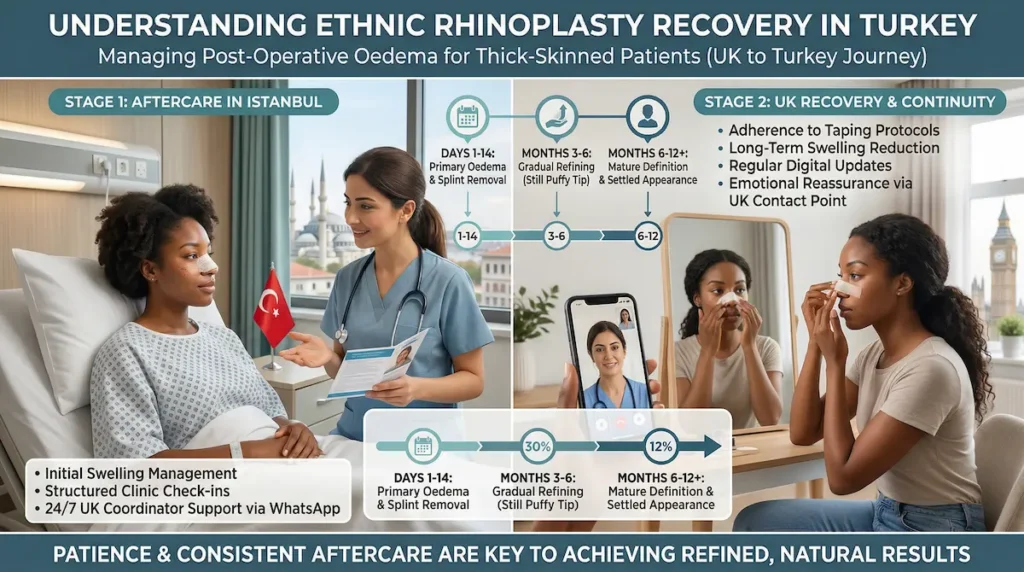
Managing Post-Operative Oedema (Swelling) in Thick-Skinned Patients
Recovery is one of the most important parts of the ethnic rhinoplasty Turkey journey, particularly for patients with thicker skin. Even when the operation is technically excellent, the final shape does not appear all at once. This is because thick skin holds fluid more easily and releases it more slowly, especially around the nasal tip. In other words, swelling is not a side issue in thick skin ethnic rhinoplasty; it is a central part of healing and one of the main reasons patients need realistic expectations from the start.
For British patients travelling from London, Manchester, Birmingham, or elsewhere in the UK, this matters for both emotional reassurance and practical planning. A nose can look broader, firmer, or less defined in the early weeks without there being any problem at all. Good recovery guidance should therefore combine clinical logic, careful follow-up, and a step-by-step explanation of what is normal at each stage.
Why Swelling Lasts Longer After Ethnic Rhinoplasty
In many ethnic noses, the skin envelope is thicker and the soft tissue layer is more substantial. That means the newly shaped framework underneath takes longer to become clearly visible on the surface. The tip, in particular, can remain puffy for months, even when the structural work is sound. Patients sometimes worry that the nose is still “too wide” or “not refined enough”, when in reality the framework is improving gradually beneath healing tissue.
This is one reason preserving ethnic features rhinoplasty requires patience as well as technique. The goal is not to force early sharpness by over-reducing the nose. The goal is to create a stable, proportionate structure and then allow the tissues to settle safely over time. In both clinical practice and wider scientific research on wound healing, lower tissue trauma and better support generally lead to a more controlled recovery pattern.
The First 2 Weeks vs The First 12 Months: A Realistic Timeline
The first two weeks are usually about protection, rest, and early swelling control. During this phase, patients are often focused on practical questions: how visible is the swelling, when can I go out comfortably, and when can I travel back? These are fair concerns, but they should not be confused with the final aesthetic result. The early nose is a healing nose, not a finished one.
From roughly the first month onwards, changes become more gradual. Much of the obvious bruising has usually settled, yet tip definition may still be developing. For thick-skinned patients, it is entirely normal for refinement to continue over many months. By the later healing stages, the nose usually looks softer, more natural, and more integrated with the rest of the face than it did in the first few weeks.
| Healing Stage | What Patients Commonly Notice | What It Usually Means |
|---|---|---|
| Days 1–14 | Visible swelling, firmness, temporary asymmetry | Normal early healing response |
| Weeks 3–8 | Bruising largely settles, shape begins to refine | Early improvement, but not the final result |
| Months 3–6 | Better contour, more natural profile, gradual tip definition | Oedema continuing to reduce |
| Months 6–12 | Further settling, clearer structure in thick-skinned cases | More representative of the mature outcome |
Aftercare, Taping, and Follow-Up for British Patients
Aftercare should never be treated as an afterthought, especially for overseas patients. In ethnic rhinoplasty in Turkey, the operation may take place in Istanbul, but reassurance must continue long after the patient has returned home. This is particularly important when thick skin requires longer-term observation and guidance. Taping, swelling management, sleeping position, photography updates, and ongoing communication all contribute to a calmer recovery experience.
For UK patients, good follow-up also means accessibility. A clinic that provides structured digital check-ins, a responsive medical team, and clear instructions can reduce unnecessary anxiety. Patients feel safer when there is a London correspondence point, a UK support route, or a direct WhatsApp contact rather than the sense of being left alone after flying home. In medical travel, trust is built not only in theatre, but in the months that follow.
Flight-Ready Recovery Protocols and Return-to-UK Planning
Many patients researching Turkey ethnic rhinoplasty package options are also thinking about timing: how long must I stay, when is it sensible to fly, and how obvious will I look at the airport? These are practical rather than superficial concerns, and they deserve direct answers. A sensible clinic plans the procedure around safe review appointments, swelling reduction, and a realistic travel window rather than encouraging rushed departures.
Recovery-focused protocols matter here. In wider AKM Clinic practice, supportive technologies such as HBOT are used to help reduce post-operative oedema and support a smoother early healing period. While no treatment removes the need for time and patience, a lower-trauma surgical method combined with thoughtful aftercare can make the return journey feel far more manageable for British patients. A good Turkey ethnic rhinoplasty package should therefore be judged not only by hotel and transfer arrangements, but by the seriousness of the recovery plan behind it.
Patient-centred recovery insight: For UK patients, confidence after surgery often comes from knowing there is still someone to contact once they are back home. That sense of continuity can be just as valuable as the operation itself.
Before & After: Refining Your Profile Without Erasing Your Ethnicity
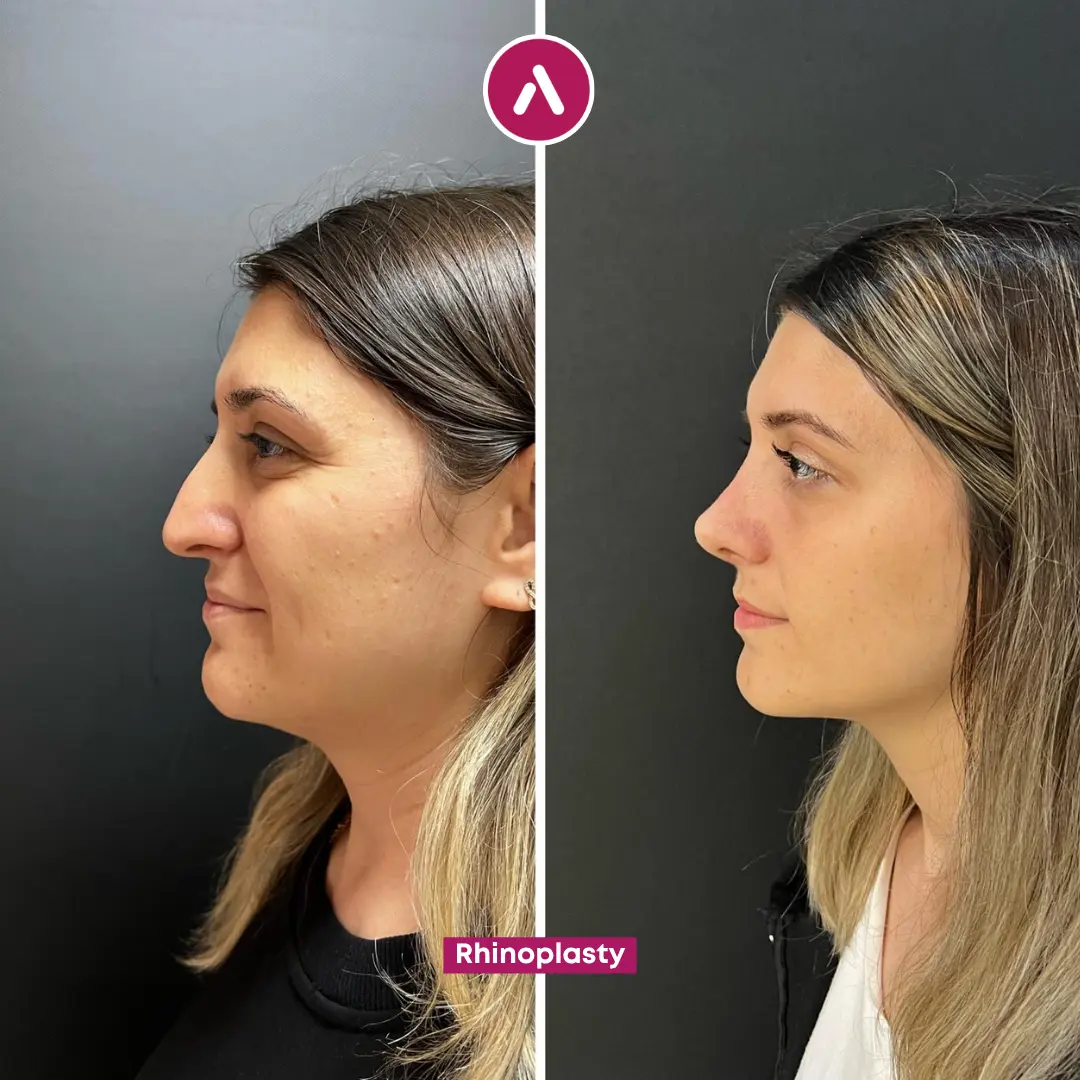
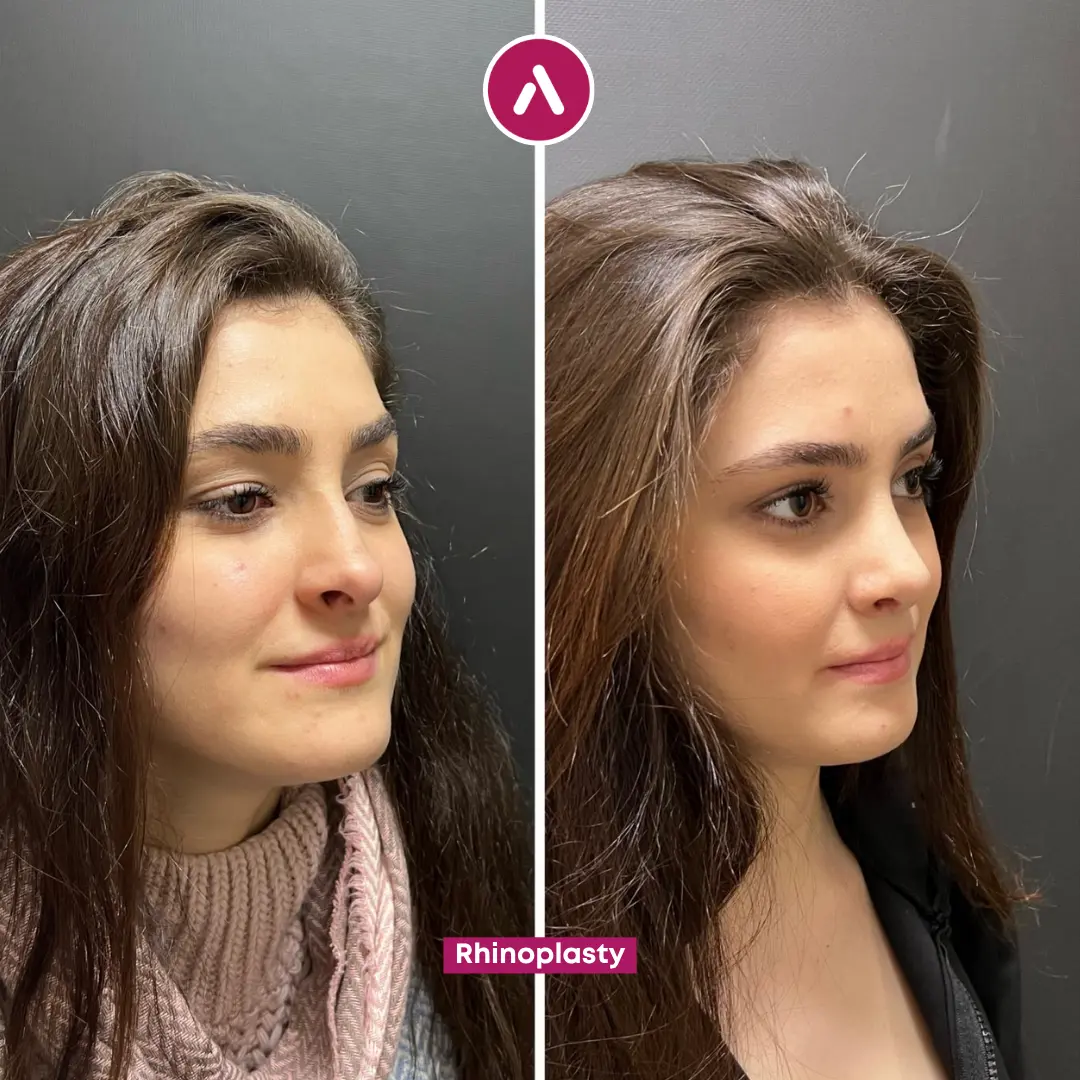
Before-and-after photographs are among the most influential parts of any ethnic nose job Turkey search, but they are also among the most misunderstood. A gallery should not be judged simply by whether the after photo looks “smaller”. In ethnic rhinoplasty, the real question is whether the result looks more harmonious while still belonging naturally to the patient’s face. The best outcomes do not look generic. They look believable, proportionate, and unmistakably personal.
This is why photo assessment matters so much for the informed UK patient. A strong gallery should demonstrate restraint, consistency, and sensitivity to different facial types. The patient should still look like themselves, only more balanced. When a result appears detached from the patient’s heritage or makes every nose look strikingly similar, that is not artistry. It is a warning sign.
What a Successful Before-and-After Gallery Should Actually Show
A meaningful gallery should show more than flattering angles and good lighting. It should show whether the bridge suits the forehead and chin, whether tip projection is balanced, whether nostril refinement looks proportionate, and whether the overall result still feels ethnically coherent. A successful natural ethnic rhinoplasty Turkey case is rarely the one with the most dramatic change. It is usually the one where the face looks quietly improved as a whole.
Patients should look for consistency across multiple cases, not a single standout image. Does the clinic show different skin types, different heritage backgrounds, and different healing patterns? Are the photos taken in similar lighting and head positions? These details matter because they reveal whether the clinic is presenting genuine surgical judgement or simply curating attractive marketing images.
Signs of Over-Reduction vs Signs of Balanced Refinement
Over-reduction is one of the main fears in ethnic rhinoplasty, and rightly so. A nose that is too narrow, too pinched, too rotated, or too flattened can make the face look disconnected from the patient’s own identity. In some cases, it can also create long-term structural problems if support has been sacrificed for an artificially tiny appearance. That is the opposite of customised ethnic rhinoplasty.
Balanced refinement looks different. The bridge may be smoother, but not unnaturally straight. The tip may be more defined, but not skeletal or over-projected. The nostrils may be neater, but not obviously tightened. When a result is well judged, the observer notices overall facial harmony before noticing the surgery itself.
- Possible signs of over-reduction: a pinched tip, excessive nostril narrowing, a flattened bridge, or a result that looks disconnected from the rest of the face.
- Signs of balanced refinement: improved symmetry, cleaner profile lines, better tip support, and a nose that still feels culturally and personally authentic.
- What UK patients usually prefer: a subtle change that reads as elegant rather than obvious.
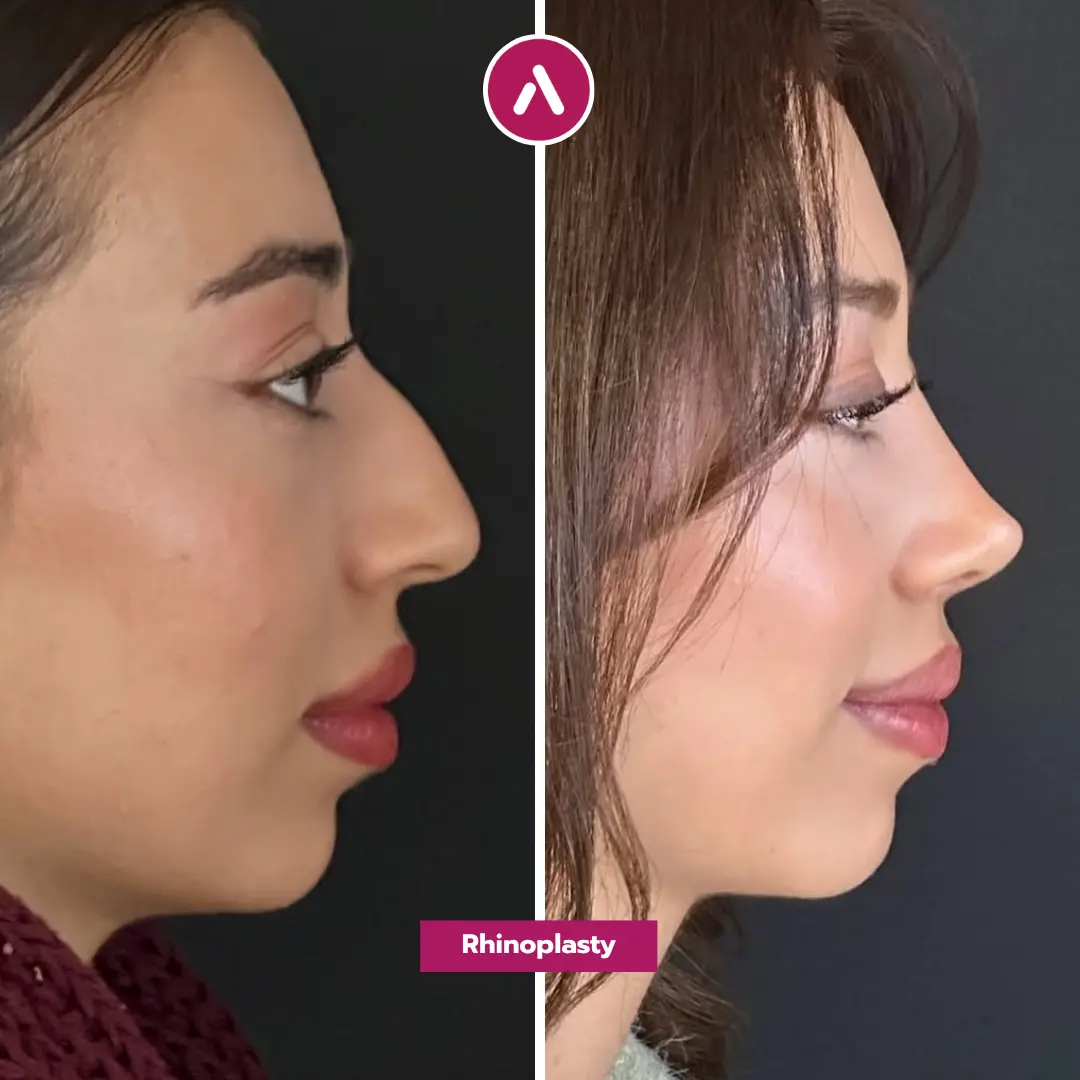
Preserving Identity While Improving Symmetry and Proportion
The phrase preserving ethnic features rhinoplasty is not just a marketing idea. It describes a genuine clinical philosophy. The surgeon is not trying to erase ancestry-linked features, but to refine proportion in a way that still respects them. This may involve improving a drooping tip, reducing asymmetry, softening a hump, or adjusting the alar base, but always with the wider face in mind.
That broader perspective is essential in ethnic aesthetic surgery Turkey and particularly in rhinoplasty, where even small changes can alter the entire balance of the face. A successful result should feel aligned with the patient’s eyes, lips, cheeks, chin, and expressions. It should not look as if one part of the face has been redesigned according to someone else’s template.
How to Read Results Critically as an Expert Patient
British patients are often highly analytical, especially when they are comparing ethnic rhinoplasty Turkey price and expertise side by side. That is a good instinct. But price only becomes meaningful after quality has been assessed properly. The right question is not “Which clinic offers the lowest quote?” but “Which clinic consistently produces natural, structurally sound results in noses similar to mine?”
An expert patient should review healed results where possible, compare front, oblique, and profile views, and pay attention to whether identity has been preserved. It is also wise to ask whether the same consultant performs the surgery personally, how revision cases are handled, and what aftercare looks like once you are back in the UK. In other words, the gallery should begin the evaluation, not end it.
| Photo Review Question | Why It Matters | What to Watch For |
|---|---|---|
| Does the patient still look like themselves? | Identity preservation is central to ethnic rhinoplasty | A natural result rather than a standardised one |
| Is the tip refined but still supported? | Weak support can cause long-term disappointment | Definition without pinching or collapse |
| Are the photos consistent and credible? | Lighting and angles can distort perception | Comparable positioning and realistic presentation |
| Do multiple cases show restraint? | Consistency reveals surgical philosophy | Subtle improvements across different faces and backgrounds |
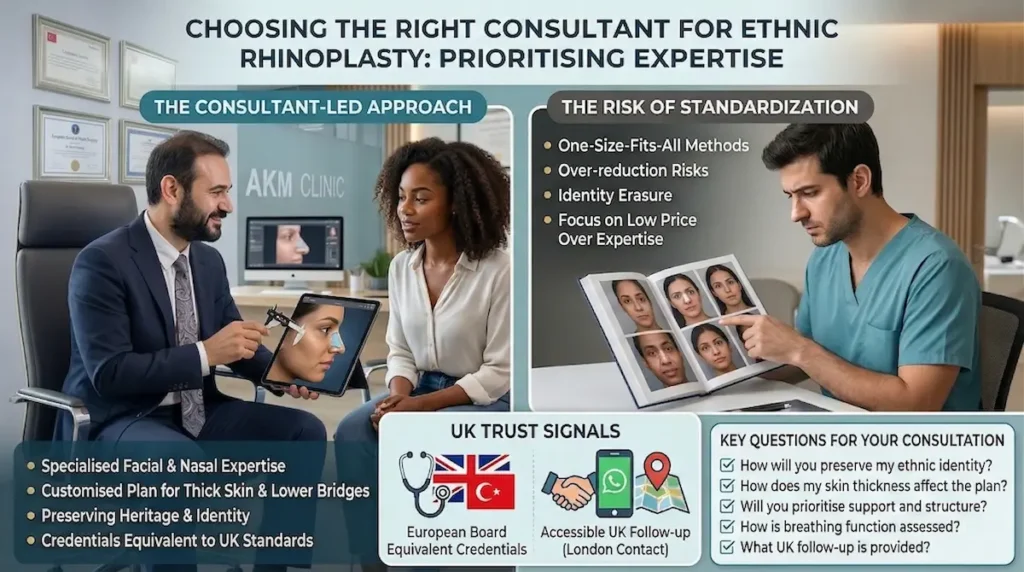
Choosing the Right Consultant for Ethnic Features
Choosing the right surgeon is the most important decision in the entire process. In consultant ethnic rhinoplasty Turkey, experience matters, but so does judgement. Ethnic rhinoplasty is not simply about being technically able to reshape a nose. It is about recognising which features should be refined, which should be preserved, and how skin, cartilage, airway, and heritage all interact. That is why consultant-led planning is so important for UK patients.
For British patients, trust is built through a combination of credentials, communication, and consistency. A clinic may advertise a low ethnic rhinoplasty Turkey price, but if the surgeon does not demonstrate real understanding of ethnic anatomy, the value is poor regardless of the number on the quote. A better approach is to evaluate expertise first, then assess whether the financial structure feels transparent and sensible.
Why Ethnic Anatomy Requires Specific Surgical Judgement
No two noses are identical, but ethnic anatomy often brings patterns that require special attention. Thick skin, lower bridge height, softer cartilage, broader alar base width, and differing tip dynamics can all change the surgical plan significantly. A consultant who approaches every case with the same reductive method is more likely to create a result that looks standardised or unstable over time.
By contrast, strong judgement means knowing when to support rather than remove, when to refine rather than narrow, and when to leave a heritage-linked feature partially intact because it suits the face beautifully. This is the essence of customised ethnic rhinoplasty. It is not about doing more surgery. It is about doing the right surgery.
Questions UK Patients Should Ask During Consultation
A consultation should feel like a structured clinical discussion, not a sales call. Patients should ask how the surgeon would preserve identity, whether structural grafting may be needed, how thick skin affects tip definition, and what realistic recovery milestones look like. It is also sensible to ask how airway function is assessed if there are breathing concerns alongside cosmetic goals.
Other valuable questions include whether the same consultant performs the procedure personally, what the revision philosophy is, and how follow-up will work once the patient returns to Britain. These questions are especially important for patients comparing a private London route with a Turkey ethnic rhinoplasty pathway, because the true difference is often found in planning and aftercare rather than in marketing promises.
- How will you preserve my ethnic identity rather than standardise my nose?
- Do I have thick skin or weak cartilage, and how does that affect the plan?
- Will you prioritise support and structure, not only reduction?
- How is breathing assessed if I also have functional concerns?
- What follow-up support will I have once I return to the UK?
Consultant-Led Care, Credentials, and UK Board-Equivalent Signals
British patients often look for a GMC-style reassurance, which is understandable. In an overseas setting, that reassurance comes through equivalent markers of training, specialist focus, and recognised European credentials. For rhinoplasty patients, this means paying close attention to whether the consultant has relevant facial and nasal expertise rather than only a broad cosmetic practice.
At AKM Clinic’s background speaks directly to patients who want both aesthetic judgement and respect for nasal structure and function. For a British patient seeking a consultant ethnic rhinoplasty Turkey pathway, that combination is a meaningful trust signal.
Why Trust Signals Matter: London Contact Point, WhatsApp, and Ongoing Aftercare
Trust is rarely built by one factor alone. It usually comes from the full picture: clear communication, consultant access, transparent planning, realistic recovery guidance, and visible post-operative support. For UK patients, practical details such as a London correspondence point, a UK-based support route, and direct WhatsApp communication can reduce the psychological distance that often makes overseas surgery feel risky.
This is also where bundled travel quotes need to be interpreted carefully. A Turkey ethnic rhinoplasty package should not be judged only by hotel category or airport transfers. The real value lies in whether the package includes medically meaningful support, transparent planning, and accountable aftercare. That is the difference between a superficial travel offer and a serious treatment journey.
| Evaluation Area | What UK Patients Should Look For | Why It Matters |
|---|---|---|
| Clinical expertise | Consultant with facial and nasal specialisation | Ethnic rhinoplasty requires nuanced judgement |
| Credentials | European Board-level or equivalent trust signals | Reassures patients comparing GMC-style standards |
| Communication | Direct consultation, honest timelines, accessible follow-up | Builds confidence before and after surgery |
| Package value | Transparent inclusions, recovery planning, aftercare support | More important than choosing the lowest quote alone |
Ultimately, the right surgeon for natural ethnic rhinoplasty Turkey is not the one promising the smallest nose or the fastest transformation. It is the consultant who understands your anatomy, respects your heritage, communicates honestly, and plans for a result that will still look balanced, elegant, and truly yours long after the swelling has settled.
Frequently Asked Questions (FAQ): Ethnic Rhinoplasty Turkey
Below are the questions UK patients most often ask when researching ethnic rhinoplasty Turkey. The answers are intentionally concise, practical, and written to help you compare options sensibly. In ethnic rhinoplasty in Turkey, the right decision is rarely based on price alone. It should be based on consultant judgement, structural planning, realistic recovery, and whether your heritage-linked features are being respected rather than standardised.
What is ethnic rhinoplasty?
Ethnic rhinoplasty is a highly individual form of nose reshaping that aims to improve balance and refinement without erasing identity. A good ethnic nose job Turkey plan respects skin thickness, cartilage strength, nostril shape, bridge height, and ancestry-linked facial proportions rather than forcing every patient towards the same template.
Will I still look like myself after ethnic rhinoplasty?
Yes, that should be the goal. The best outcomes in preserving ethnic features rhinoplasty make you look more balanced and more confident while still looking like yourself. If a planned result appears too narrow, too lifted, or too generic for your face, it is worth questioning the approach.
How long does swelling last after ethnic rhinoplasty?
Swelling usually settles in stages. Early swelling improves in the first few weeks, but tip definition can take much longer in thick skin ethnic rhinoplasty. In thicker-skinned patients, refinement may continue for many months, so patience is part of the process.
Is Turkey a safe option for ethnic rhinoplasty for UK patients?
It can be, provided you choose carefully. Safety depends on the consultant, the hospital environment, the anaesthesia team, pre-operative assessment, and the quality of aftercare. A serious Turkey ethnic rhinoplasty pathway should feel medically organised, not simply commercially convenient.
Does thick skin affect the final result?
Yes, but not always negatively. Thick skin can slow visible definition and prolong oedema, especially around the tip, which is why customised ethnic rhinoplasty often relies on stronger structural support. It affects the healing timeline more than the overall value of the procedure when the operation is planned properly.
Can ethnic rhinoplasty also improve breathing?
Yes, in selected cases it can. If you have functional problems such as obstruction, collapse, or a deviated septum, the operation may be combined with functional correction. That is why consultant assessment should consider both appearance and airflow rather than treating them as completely separate issues.
How do I know if a surgeon understands my ethnic features?
Look for case examples involving patients with anatomy similar to yours, and listen carefully to how the consultant speaks about your face. A skilled surgeon will discuss structure, skin, support, and identity preservation. A poor fit usually becomes obvious when the language is generic and every patient is offered the same aesthetic goal.
When can I fly back to the UK after surgery?
This depends on your healing progress and your consultant’s advice. Most patients need a sensible recovery window in Istanbul before travelling. The safest approach is to fly only after your early reviews are complete and you have been medically cleared for the journey back to the UK.
Is Piezo rhinoplasty better for ethnic noses?
Piezo can be very helpful because it supports controlled, precise bone reshaping with less unnecessary trauma to surrounding tissue. In natural ethnic rhinoplasty Turkey, that precision can be valuable when the aim is subtle refinement rather than a dramatic or overdone change. It is an advantage, but not a substitute for surgical judgement.
How much does ethnic rhinoplasty in Turkey cost compared with the UK?
The ethnic rhinoplasty Turkey price is usually influenced by consultant experience, hospital standards, whether structural grafting is needed, and what the Turkey ethnic rhinoplasty package actually includes. Turkey is often more cost-effective than private UK routes, but the right comparison is not the cheapest quote. It is the total value of consultant-led surgery, transparent aftercare, and a result that preserves your heritage rather than compromising it.
Ultimately, the best consultant ethnic rhinoplasty Turkey journey is one built on honest planning, strong structure, thoughtful recovery, and respect for identity. In the wider world of ethnic aesthetic surgery Turkey, rhinoplasty remains one of the most delicate procedures because even small changes can alter the whole face. When it is done well, the outcome does not look manufactured. It looks natural, proportionate, and entirely your own.
Medical Disclaimer: This page is provided for general educational purposes only and does not replace a face-to-face medical consultation, diagnosis, or personalised treatment plan. All surgery carries risks and outcomes vary between individuals. Suitability for a rhinoplasty (nose job) surgery, procedure selection, and anaesthesia choice can only be determined after a full clinical assessment by a qualified surgeon. Always follow your clinician’s instructions and seek urgent medical attention if you develop concerning symptoms during recovery.