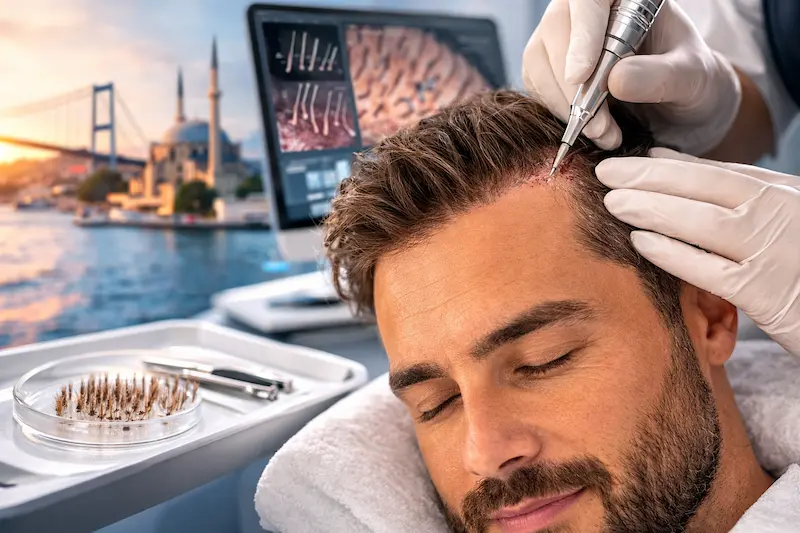

For many British men, beard transplant Turkey is not simply about growing more facial hair. It is about structure, balance, and how the lower face is perceived in everyday life. A stronger beard pattern can make the jaw appear cleaner, the chin look better framed, and the overall face seem more masculine without changing the underlying bone. That is why interest in beard transplant in Turkey and beard restoration Turkey continues to grow among men who want a sharper but still believable result.
In practice, the most successful beard work is rarely the thickest or darkest. It is the most intelligently designed. British patients usually do not want a harsh, theatrical beard that looks obviously transplanted. They want a result that feels consistent with their age, skin tone, hair calibre, and existing facial proportions. This is where aesthetics, planning, and medical science begin to overlap. The beard must suit the man, not dominate his face.
It is also worth saying this early: before comparing beard transplant cost Turkey, beard transplant Turkey price, or searching for the best beard transplant in Turkey, the more important question is whether the design is right for your face. A poor design can look artificial even with a high graft count. A good design can make a modest number of grafts look convincingly masculine. For UK patients comparing Harley Street pricing with Istanbul value, that distinction matters far more than headline numbers alone.
Table of Contents
What Can a Beard Transplant Really Change?
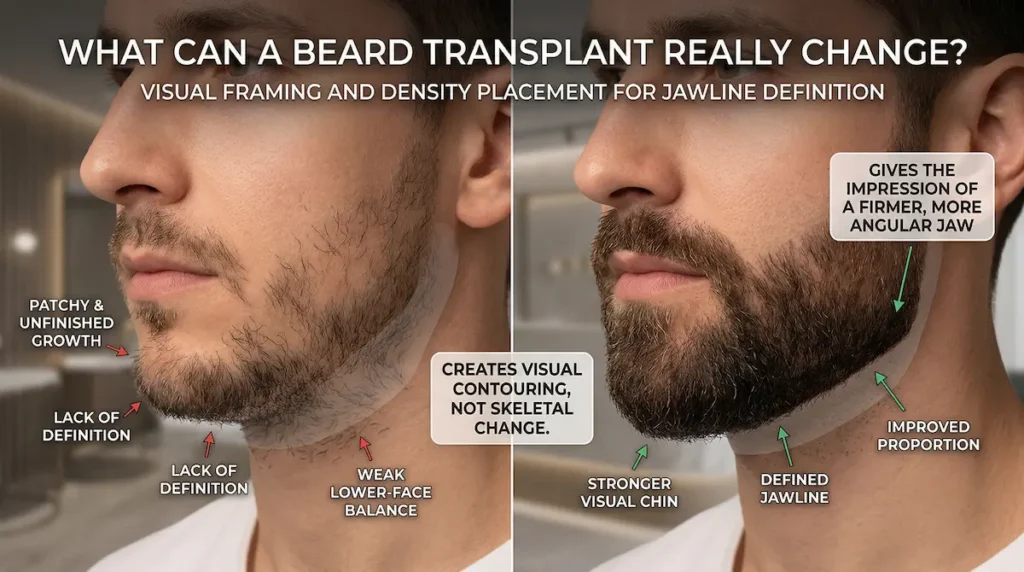
A beard transplant can change how the lower third of the face is visually framed, but it does not alter your actual skeletal anatomy. That distinction is essential. When men search for a beard transplant for jawline definition, they are usually asking whether facial hair can create the appearance of a stronger chin and a more structured jaw. In many cases, the answer is yes. However, the improvement comes from visual contouring, density placement, and border design rather than from any change to the bone itself.
| Area | What a Beard Transplant Can Change | What It Cannot Change | Why This Matters |
|---|---|---|---|
| Jawline | Creates a sharper visual edge through density and outline | Does not widen or reposition the jaw bone | Improves definition without changing facial identity |
| Chin | Adds framing and can make the chin appear stronger | Does not project the chin forwards | Useful for men with weak lower-face balance |
| Cheeks | Can tidy patchy growth and refine the upper beard border | Does not change cheekbone height | Helps the beard look intentional rather than sparse |
| Overall Masculinity | Can enhance facial presence and structure | Does not replace weight loss, orthodontics, or skeletal procedures | Sets realistic expectations from the start |
Why Facial Hair Has Such a Strong Effect on Perceived Jawline Definition
The eye reads contrast, borders, and shadow before it reads anatomy in detail. This is one reason a beard can dramatically alter how a face is perceived. When facial hair is dense along the mandibular line and carefully tapered beneath the chin, it creates a darker lower-face boundary. That darker boundary gives the impression of a firmer, more angular jaw, even in men whose natural jawline is softer.
This is also why patchy growth can have the opposite effect. If the beard is inconsistent along the chin strap, weak at the corners of the jaw, or sparse beneath the lower lip, the eye does not register a clean lower-face frame. Instead, the face can look less structured than it really is. A well-planned beard transplant in Turkey aims to correct those visual interruptions so that the beard reads as continuous, masculine, and proportionate rather than random or unfinished.
From a clinical design perspective, the beard is not just “added hair”. It is facial architecture. The transition from sideburn to cheek, from cheek to jaw, and from jaw to chin all influence how the face is interpreted in profile and in front view. That is why men who think they need more bone projection sometimes discover that what they actually need is more precise beard framing.
Beard Density, Chin Framing, and the Illusion of a Stronger Lower Face
Density is one of the most misunderstood aspects of natural looking beard transplant Turkey planning. Patients often assume that maximum density equals maximum masculinity. In reality, uncontrolled density can make the beard look heavy, flat, or obviously artificial. Strategic density is much more effective. The chin, goatee zone, and jaw corners often carry more visual weight than the mid-cheek, so placing grafts intelligently in those areas can strengthen the lower face without overloading the entire beard.
In some cases, beard density planning also forms part of a broader male aesthetics strategy, particularly for patients considering complementary procedures such as a daddy makeover Turkey journey. When facial hair design is approached alongside wider concerns about profile balance, skin quality, or body contour, the outcome can feel more cohesive. Even so, the beard should still be planned on its own anatomical merits, with density placed where it enhances structure rather than overwhelms the face.
Chin framing is particularly important for men with a narrower chin or less lower-face definition. A denser central chin region, combined with natural transition work around the labiomental crease and along the jaw border, can make the chin appear broader and more grounded. This is one reason beard restoration Turkey is often discussed not only as a hair procedure, but as a facial balance procedure.
In male facial aesthetics, the goal is not to create a “transplanted beard”. The goal is to create a beard pattern that makes the jaw look stronger while still appearing naturally yours.
Equally important is the relationship between the beard and the neck. If beard density extends too low or too uniformly beneath the jaw, the lower face can look heavier rather than sharper. A strong result depends on disciplined border planning, not simply on adding as many grafts as possible. In other words, beard density should support the face, not swallow it.
When a Beard Transplant Improves Balance More Than It Changes Bone Structure
A beard transplant is most effective when the problem is visual balance rather than major skeletal deficiency. Men with mild chin weakness, patchy beard growth, an indistinct jaw border, or asymmetry between the two sides of the face often benefit the most. In these cases, the beard creates a stronger lower-face frame and improves harmony between the nose, lips, chin, and neck.
That does not mean every man seeking a sharper profile is a suitable candidate for beard work alone. If the chin is significantly recessed, or if the submental area is dominated by fullness rather than beard sparsity, the right conversation may involve other options as well. Good consultant-led planning should explain this honestly. A beard transplant for jawline definition works best when it is used to enhance a foundation that is already reasonably balanced, not to disguise every structural issue.
For that reason, the consultation matters as much as the procedure itself. Your surgeon should assess hair calibre, donor quality, facial proportions, skin characteristics, and your likely styling habits. A man who keeps short stubble needs a different design strategy from someone who prefers a fuller beard. Likewise, a patient who wants a subtle corporate look for daily life in London will need a different approach from someone aiming for a denser, more sculpted finish.
How Beard Design Creates a More Masculine Look?
The phrase “beard design” can sound cosmetic, but in expert hands it is fundamentally about proportion. A masculine beard is not created by drawing a hard line across the face and filling every empty area. It is created by understanding facial shape, age, hair direction, and where density will have the strongest structural effect. This is exactly why customised beard design for jawline matters far more than generic templates copied from social media trends.
For British patients, the best result is usually subtle at first glance and impressive on closer inspection. That means a beard that looks believable in daylight, natural in motion, and appropriate both with short stubble and with moderate growth. Good design should support the natural character of the face rather than making the beard the only feature people notice.
Designing the Cheek Line for a Stronger, Cleaner Facial Shape
The cheek line is one of the first things people notice, even if they do not realise it consciously. A low, poorly defined cheek line can make the face appear less crisp, while a very high or unnaturally straight line can look stylised and artificial. The ideal cheek line usually follows the patient’s natural growth pattern, but with improved continuity and cleaner definition.
In beard transplantation, this area must be handled with restraint. Too much density too high on the cheek can feminise the midface or create an over-designed appearance. Too little density can leave the beard looking incomplete. The aim is to create enough presence to support the lower face while keeping the upper beard border soft and believable. This balance is central to any natural looking beard transplant Turkey approach.
It is also where angle and direction become critical. Beard hairs on the cheeks do not emerge like scalp hairs. They sit flatter, change direction frequently, and must match existing native hair if the result is to look authentic at conversational distance. Designing the cheek line well is therefore not just about drawing shape; it is about respecting the natural behaviour of facial hair.
Using Chin and Jawline Grafts to Build a More Structured Profile
When patients search for masculine facial contouring with beard implants, what they are usually describing is strategic graft placement along the chin and jaw. This is the part of the beard that can most effectively change the visual weight of the lower face. By strengthening the beard at the mandibular angles, reinforcing the chin, and connecting weak transition zones, a surgeon can create a profile that appears more composed and more masculine.
This does not require an exaggerated “painted-on” beard. In fact, subtle irregularity is often part of the solution. Real beards are not perfectly uniform. A high-quality result uses this principle intelligently, blending denser anchor points with softer transitions so that the overall effect feels real. That is what separates a tailored result from a generic one.
The chin deserves special attention because it acts as the visual centre of the beard. If the central chin zone is weak, the whole beard can feel unstable. If it is overbuilt, the face can look bottom-heavy. This is why customised beard design for jawline should always be based on the patient’s own front view, three-quarter view, and profile rather than on a standard template. The best beard designs work with facial geometry, not against it.
Avoiding an Artificial or Overly Sharp Beard Shape in Male Aesthetics
One of the biggest mistakes in male facial aesthetics is assuming that sharper always means better. A beard that is too dark, too dense, too symmetrical, or too aggressively lined can draw attention for the wrong reasons. Instead of making the face look stronger, it can make the result look manufactured. For most men, especially professionals who want to look polished rather than performative, this is exactly the wrong outcome.
The real benchmark for the best beard transplant in Turkey is not whether people admire the beard as a procedure. It is whether they simply think your face looks stronger, better balanced, and more self-assured. That usually comes from soft transitions, appropriate density, and a shape that suits your age and features. In other words, the beard should look grown, not installed.
This is also where surgeon judgement matters. Beard transplantation is not only technical placement; it is aesthetic restraint. The most successful cases are often the ones where the observer cannot identify what changed, only that the lower face looks cleaner and more masculine. For UK patients especially, that kind of understated improvement tends to age better and fit more naturally into everyday life.
Who Is a Good Candidate for a Beard Transplant?
Not every man seeking a stronger jawline needs the same type of beard work. A suitable candidate for beard transplant in Turkey is usually someone whose lower-face definition is being reduced by patchy growth, uneven density, poor cheek-to-jaw connection, or visible gaps in the chin and jawline zones. The objective is not merely to add more hair. It is to place the right amount of hair in the right pattern so the beard improves facial balance and still looks naturally grown.
For some men, beard enhancement is also considered within a wider aesthetic plan, particularly when they are already researching a daddy makeover Turkey pathway. In that setting, the beard is not treated as an isolated feature, but as part of the overall balance of the face and profile. Even so, candidacy for beard transplantation should still be assessed carefully on its own, with attention to donor quality, native growth pattern, and realistic expectations.
This is also where expectations need to stay grounded in anatomy. A beard transplant can create visual definition, improve symmetry, and strengthen the outline of the lower face, but it cannot replace major skeletal change. The best candidates are men with realistic goals, sufficient donor hair, and a clear preference for a believable result rather than an aggressively sculpted beard that looks too sharp to be real. In other words, the ideal patient for beard transplant for jawline definition wants improvement, not disguise.
Men With Patchy Growth, Sparse Coverage, or Uneven Beard Density
The most common candidates are men who already grow some facial hair, but not enough of it in the areas that matter most. They may have a strong moustache but a weak chin, decent sideburns but poor jawline connection, or acceptable density on one side of the face with obvious thinness on the other. In these situations, the beard often looks accidental rather than intentional, which can weaken the overall impression of the lower face.
This is where beard restoration Turkey can be particularly effective. Instead of trying to create a completely new identity, the procedure reinforces what is already present. A skilled plan will identify the “anchor zones” that influence facial structure most strongly, especially the chin, jaw corners, and transition from sideburn to beard. Strengthening those zones often creates a larger aesthetic improvement than simply filling every sparse area evenly.
For many UK patients, especially professionals who wear short stubble rather than a long beard, subtle reinforcement is often the better strategy. Light-to-moderate density placed with discipline can create a cleaner, more masculine outline without making the beard look too dark, too square, or too theatrical for everyday life.
Patients With Beard Gaps Caused by Scarring or Genetics
Some men are suitable candidates because the problem is not natural thinness alone, but a specific disruption in beard growth. This may be due to genetics, previous skin injury, acne scarring, burns, or a localised patch that never developed properly. In these cases, the procedure is not only about density but also about camouflage and continuity. The goal is to blend the disrupted area into the rest of the beard so the eye no longer notices a break in the facial frame.
Scar-related beard work needs especially careful judgement. Hair can soften the visibility of a scar, but scar tissue does not always behave like untouched skin. Blood supply, skin texture, and the angle at which grafts can be placed may all differ. This is why patients with scarring benefit from honest assessment rather than sales language. Sometimes the scar can be improved impressively; in other cases, it may be softened rather than fully concealed.
Online searches sometimes use phrases such as masculine facial contouring with beard implants, but that wording can be misleading. A modern beard transplant does not use synthetic implants. It uses your own hair follicles, placed with careful attention to angle, calibre, and pattern so that the result grows, can be trimmed, and behaves like facial hair rather than an inserted material.
When Limited Donor Supply or Hair Characteristics Affect Your Final Plan
Not every patient has donor hair that is ideal for every beard design. Donor limitations matter because beard hair must be convincing at close range, and the texture of facial hair is often different from the texture of scalp hair. A thicker calibre may create stronger visual density, while finer hair may require a more restrained plan. Curl pattern, colour contrast with the skin, and the natural direction of growth all influence what can be achieved safely and naturally.
This is why good candidate selection is not only about whether you have enough donor hair in a numerical sense. It is about whether the donor hair suits the role it will need to play on the face. A patient may technically have enough grafts for a very full beard, yet still look better with a more tailored plan if the hair is fine or straight. Equally, a patient with coarser hair may need fewer grafts to create the same degree of visual strength.
The consultation should therefore answer two questions at once: what result is aesthetically right for your face, and what result is biologically realistic with your donor supply. In the best cases, those two answers overlap neatly. When they do not, an ethical clinic should explain the trade-offs clearly rather than promise an unrealistic density or shape.
How a Beard Transplant Is Performed at a Specialist Clinic?
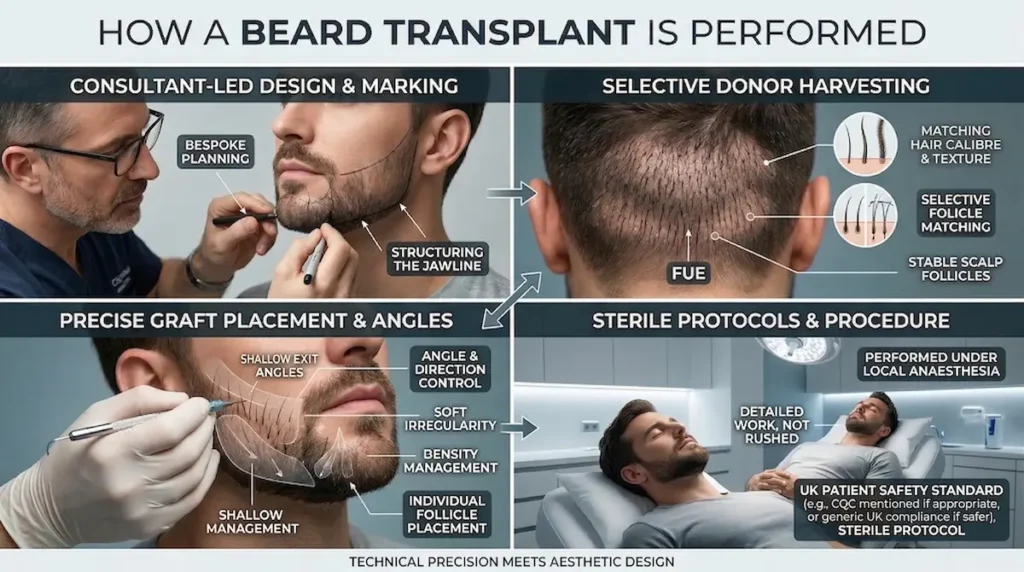
A beard transplant may look simple in photographs, but the procedure itself is highly technical. The challenge is not merely moving follicles from one part of the body to another. The challenge is making those follicles behave convincingly as facial hair. That requires control over graft selection, angle, direction, spacing, and density. It also requires an understanding of how men want to wear their beard in real life: clean stubble, corporate short beard, or fuller growth. Good results depend on planning as much as placement.
For UK patients, consultant-led design matters because the beard sits in the middle of the face and is seen at conversational distance every day. Small technical errors are easier to notice here than on the scalp. That is why the best beard transplant in Turkey should be judged not by marketing language, but by the precision of the design process, the naturalness of the graft placement, and the clinic’s willingness to keep the procedure bespoke rather than formulaic.
Donor Hair Selection and Why Hair Texture Matters
In most modern beard procedures, donor hair is harvested individually, usually from the back or sides of the scalp where follicles are more stable. However, not all scalp hair is equally suitable for facial use. Beard design is particularly sensitive to calibre, curl, and the way the hair catches light. Hair that is too coarse in the wrong area can look harsh. Hair that is too fine may fail to create enough structure where jawline emphasis is needed most.
This is why donor selection should be selective rather than mechanical. A refined plan may reserve softer grafts for transition zones and use stronger-calibre grafts in the chin or jaw where more visual weight is desirable. This kind of matching is one reason a natural looking beard transplant Turkey result depends on judgement, not only on surgical speed.
There is also a science-based reason for caution. Hair behaves differently depending on location, skin thickness, and grooming pattern. A good surgeon should understand not only how the graft survives, but how it will look once it has grown out, been trimmed, and been seen under normal daylight rather than clinic lighting. That is where clinical science and aesthetics genuinely meet.
Graft Placement Angles, Direction, and Density for Natural Results
The most important technical factor in beard transplantation is usually not the graft count alone, but the way each graft exits the skin. Beard hairs lie flatter than scalp hairs and often change direction across the cheek, jaw, and chin. If grafts are placed too upright, too regular, or too densely in the wrong area, the result may survive perfectly well but still look artificial.
A natural beard requires soft irregularity. The cheek should not look ruler-straight unless that shape truly suits the patient. The jawline should be defined, but not stamped on. The chin should feel strong, but not bulky. This is why customised beard design for jawline is so important: the face must remain masculine and structured without becoming severe.
Density planning also differs by region. The central chin and jaw corners often carry more structural importance than the upper cheek, so they may justify more concentration. Yet even then, restraint matters. A beard that is too dense too suddenly can create the “helmet beard” effect, where the face looks boxed in rather than strengthened. Good work blends, transitions, and respects negative space.
Local Anaesthesia, Procedure Time, and What to Expect on the Day
Most patients are relieved to learn that beard transplantation is generally performed under local anaesthesia rather than general anaesthesia. That is important for the UK audience, because many patients actively prefer procedures that avoid the additional stress and recovery burden associated with being fully asleep. On the day itself, the procedure usually involves design marking, donor harvesting, preparation of recipient sites, and then meticulous graft placement according to the agreed beard pattern.
Because the work is detail-heavy, the day can be long even when the procedure is straightforward. It is not a race. The more refined the design, the more important patience becomes. A clinic that rushes the artistic part of the process may still complete the transplant, but the result can feel generic rather than bespoke.
From a safety standpoint, the environment matters as well. A specialist centre should not only focus on aesthetics, but on sterile protocols, controlled technique, and careful post-procedure instructions. For UK patients comparing clinics, that combination of detail and discipline is often a better marker of quality than bold marketing claims about density alone.
Beard Transplant Recovery Timeline for UK Patients
Recovery is one of the main reasons British patients delay treatment, particularly if they need to plan time away from work, organise travel back to the UK, and avoid looking too obviously “post-op” in the first few days. The good news is that beard transplant recovery is usually manageable, but it still requires realistic planning. The first stage is cosmetic healing, when redness, small crusts, and mild swelling settle. The second stage is growth biology, where transplanted follicles shed and then gradually regrow over the following months.
For some men, recovery planning becomes even more important when beard restoration is being considered as part of a broader daddy makeover Turkey journey. In that context, patients are often thinking not only about facial hair growth, but also about how quickly they can return to normal life looking presentable and feeling comfortable. This makes realistic timelines, careful aftercare, and well-structured travel arrangements especially important for a smooth overall experience.
This distinction matters because many patients assume the beard should look better immediately and then keep improving without interruption. In reality, the visible recovery phase and the growth phase are different. Understanding that timeline makes the process feel far less stressful. It also helps patients evaluate beard transplant Turkey price and beard transplant cost Turkey in a more intelligent way, because the real value lies not only in the day of surgery but in the quality of healing support, aftercare communication, and long-term planning.
| Recovery Stage | What You May Notice | What Usually Matters Most |
|---|---|---|
| Days 1–3 | Redness, tiny crusts, mild tightness, occasional swelling | Protecting grafts and following washing instructions carefully |
| Days 4–7 | Scabbing becomes more visible before it starts to settle | Avoiding friction, shaving, and unnecessary touching |
| Week 2 | Most visible healing improves significantly | Social confidence usually starts to return |
| Weeks 3–8 | Some transplanted hairs shed | Remembering this is expected, not failure |
| Months 3–6 | New growth becomes increasingly visible | Early shape and density start to emerge |
| Months 9–12 | Maturation, thickening, and better blending | Most patients assess the true result here |
The First 7 Days: Redness, Scabbing, and Early Healing
The first week is mainly about protecting the grafts while the skin settles. Small crusts around each implanted follicle are normal. Mild redness is also expected, especially in lighter skin tones. Some men experience only limited swelling, while others notice a little tightness or tenderness in the donor area. None of this automatically indicates a problem. It is simply the visible part of the body’s early wound-healing response.
This is also the stage where patience matters most. Over-washing, scratching, rubbing the face with a towel, or trying to tidy the beard too early can interfere with the recovery process. Good post-procedure guidance should explain exactly how to cleanse the area, how to sleep, when to resume normal skincare, and which signs genuinely require review rather than reassurance.
There is a growing interest in the science of recovery support, and for good reason. The early healing phase is when oedema control, skin calmness, and low-friction aftercare make the biggest practical difference to comfort and confidence. A clinic that understands recovery as part of the procedure, not as an afterthought, usually creates a better overall patient experience.
When You Can Fly Back to the UK, Return to Work, and Shave Again
This is often the most practical question for men travelling from Britain. The answer depends on your healing speed, your work environment, and whether you are comfortable being seen with temporary redness or tiny crusts. Many patients can function normally quite quickly, but that is different from looking fully healed. A desk-based worker may feel ready sooner than someone whose job involves public-facing interaction every day.
Flying back to the UK should always follow your clinic’s individual advice, but most patients simply need a sensible, organised plan rather than prolonged downtime. This is one reason travel-conscious patients value a structured aftercare pathway. Good support should cover not only the beard itself, but when you can travel, when normal washing resumes, and when grooming can restart without disturbing the implanted follicles.
Shaving and trimming require restraint. Even if the beard looks uneven in the early period, it is wise not to interfere too soon. The temptation to “tidy things up” before the grafts are properly settled is understandable, but early impatience is one of the easiest ways to complicate a straightforward recovery.
When Final Beard Growth Starts and How Density Improves Over Time
Long-term beard growth follows biology rather than impatience. After the initial healing phase, many transplanted hairs enter a shedding phase before new growth begins. Patients who are not warned about this can become anxious unnecessarily. In reality, temporary shedding is part of the expected cycle. The follicles remain, even if the visible shaft drops out.
Meaningful new growth often becomes easier to assess from around the third month onwards, with further improvement in thickness, blending, and texture over the months that follow. The final result is not just about how many hairs emerge, but how well those hairs mature into the surrounding beard. This is why the most reliable assessment point is usually much later than patients first expect.
For UK patients, the broader aftercare structure can make this period feel far easier. Ongoing communication, remote follow-up, and practical reassurance matter because the real evaluation happens after you have returned home. A well-designed journey should therefore support both stages: the short-term cosmetic recovery in Istanbul and the slower, quieter growth phase back in the UK.
A good beard transplant should look less like “new hair” and more like a beard you were always meant to grow.
At clinic level, this recovery philosophy can be supported by broader therapeutic and aftercare systems rather than by graft placement alone. Advanced recovery protocols such as HBOT for oedema management, LLLT-based support for healing quality, structured follow-up, and accessible UK communication channels can all improve the patient journey even when the visible procedure itself is focused on facial hair.
Beard Transplant Turkey Cost vs UK: Is It Worth It?
For many men comparing options for a beard transplant, the more important question is not simply the beard transplant Turkey price, but what that price actually includes in terms of design, planning, and aftercare. This is a facial aesthetics procedure, not a standard commodity, so choosing the lowest figure is not always the smartest decision. For UK patients, value often comes down to whether Istanbul can provide consultant-led artistry, natural-looking results, and dependable support at a more accessible cost than Harley Street. This is especially relevant for men also exploring a broader daddy makeover Turkey journey.
That is why beard transplant cost Turkey should always be compared in context. A lower fee may look attractive at first glance, but the more meaningful comparison includes surgeon involvement, graft planning, donor management, aftercare access, travel logistics, and how well the clinic understands the aesthetics of the male face. The right investment is not the one with the lowest number attached to it. It is the one most likely to produce a strong, natural, age-appropriate result with support that continues after you return home.
| Comparison Point | UK Private Clinics | Turkey Clinics | Why It Matters |
|---|---|---|---|
| Typical Pricing Model | Often procedure-only or graft-based pricing | Often fixed package pricing | Package structure can make budgeting easier for UK patients |
| Beard Transplant Cost Range | Usually higher, especially in London and Harley Street settings | Usually lower overall, particularly when bundled | The price gap can be meaningful, but design quality still comes first |
| Travel and Hotel | Usually not relevant | Often included in all-inclusive packages | Total cost should be assessed, not surgery fee alone |
| Aftercare Structure | More local by default | Must be clearly organised for return-to-UK support | This is one of the most important quality markers |
| Decision Criterion | Convenience and proximity | Value, expertise, and package efficiency | Worth depends on both result quality and the care pathway |
Typical Harley Street and UK Private Clinic Pricing in GBP (£)
In broad terms, private UK pricing for beard transplantation is often significantly higher than equivalent treatment planning in Turkey, particularly in London. That does not mean UK clinics are poor value. It simply reflects local operating costs, staffing structures, and premium postcodes. For many British patients, the comparison becomes most striking when they realise that a modest beard case in the UK can approach the cost of a more comprehensive, package-based journey in Istanbul.
At the same time, price alone should never define the shortlist. A natural looking beard transplant Turkey result depends on design intelligence, not only affordability. A clinic offering an unusually low figure without clear information about graft planning, surgeon oversight, or aftercare may not be delivering real value at all. In facial hair work, the correction of a poor result can be far more frustrating than paying properly for the right plan from the beginning.
What Is Usually Included in an All-Inclusive Turkey Package
This is where Turkey often becomes more attractive to UK patients. Instead of paying separately for multiple stages of the journey, many international packages combine the procedure, local transfers, accommodation support, medication, and post-operative guidance into a single quote. That model can make beard transplant in Turkey easier to plan financially, especially for patients who prefer clarity in GBP rather than piecing together costs one by one.
However, “all-inclusive” should never be accepted as a vague marketing phrase. Patients should ask exactly what is included, who performs the key parts of the procedure, how many reviews are planned, and what support remains available after the return flight to the UK. A proper package should simplify the journey, not hide essential details inside a convenient headline.
Why Value Is Not Just About Price, but Also Design, Aftercare, and Experience
The safest way to think about value is to ask what problem you are trying to solve. If your priority is beard transplant for jawline definition, then the result must strengthen the lower face in a believable way. If your priority is patch repair, then blending and hair direction matter more than density headlines. If your priority is confidence during recovery, then aftercare access matters just as much as the procedure day itself.
In other words, the best beard transplant in Turkey is not automatically the cheapest or the most expensive. It is the one that combines tailored design, ethical planning, realistic density, and reliable post-operative support. For many UK patients, that is what makes Turkey “worth it”: not bargain hunting, but achieving Harley Street-style thinking with a more accessible overall investment.
How to Choose the Right Beard Transplant Clinic in Turkey?
Choosing a clinic for facial hair work requires more scrutiny than many patients expect. Beard transplantation is sometimes marketed as a simple extension of scalp hair restoration, but the face is less forgiving than the scalp. People view it at close range, in daylight, while speaking, smiling, and moving. That means the right clinic must understand not only graft survival, but masculine aesthetics, facial balance, and how subtle design decisions affect the jawline. For anyone searching for the best beard transplant in Turkey, this is the real standard to apply.
UK patients also tend to approach treatment decisions with a more detailed and cautious mindset, and understandably so. They want clarity on who designs the beard, who performs the graft placement, how aftercare is managed once they are back in Britain, and whether the clinic delivers standards comparable to trusted private care at home. These are exactly the right questions to ask, and they often reveal more about a clinic’s quality than photographs alone. This is particularly true for men who are also considering a broader daddy makeover Turkey treatment plan.
Why Consultant-Led Planning Matters in Male Facial Aesthetics
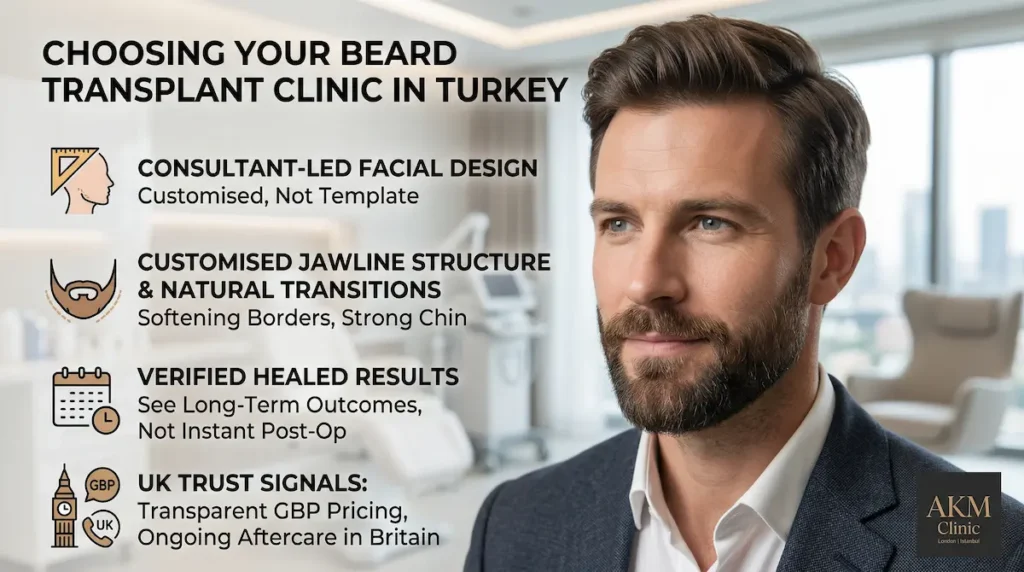
In male facial work, small changes can alter the entire impression of the face. A beard that is too low, too dense, too square, or too sharply edged can make the result look artificial rather than strong. That is why consultant-led planning matters. The beard should be designed as part of the face, not as a separate add-on. Jaw width, chin projection, cheek fullness, neck transition, and how the patient normally grooms all influence the final pattern.
For AKM Clinic’s UK-facing positioning, this consultant-led model is also part of the trust message. British patients are encouraged to look for board-equivalent credentials, European specialist standards, and a clear explanation of who is responsible for the plan. In a field where many clinics compete on volume, individual design judgement remains one of the most valuable differentiators.
What to Look for in Before and After Photos of Beard Work
Before and after galleries are useful, but only if you read them carefully. The first thing to assess is consistency. Do different patients all end up with the same beard shape, or does the design change according to facial structure? A clinic that produces identical cheek lines on every face is showing you a template, not true customisation. For customised beard design for jawline, individuality is the whole point.
You should also look closely at transitions. Are the grafts placed so densely that the beard looks stamped on, or do the borders soften naturally into the skin? Is the chin strong without appearing blocky? Do the jaw corners create structure without making the face look overbuilt? These details matter more than dramatic “instant” photographs taken under flattering lighting.
It is equally wise to ask for healed results rather than just early post-procedure images. Immediate photographs can make any beard look impressive because the implanted area appears full before shedding and maturation begin. A more meaningful portfolio shows how the beard looks once it has grown, blended, and been worn in ordinary life.
UK Trust Signals: Board-Equivalent Credentials, Transparent GBP Pricing, and Ongoing Support
For British patients, trust is never only clinical; it is logistical and psychological as well. The right clinic should communicate clearly in English, provide transparent pricing, explain qualifications in a way that makes sense to a UK audience, and show that support does not disappear once the patient boards the flight home. This is especially important because one of the biggest fears about treatment abroad is not the day of surgery, but what happens afterwards.
One of the strongest reassurance signals for UK patients is knowing that support continues after the flight home, through direct communication channels and a clear point of contact.
That is why practical details matter: a UK support line, a direct WhatsApp route, a London correspondence address, and a documented aftercare pathway all help reduce anxiety. For a patient comparing options, these trust signals can matter just as much as the beard design itself. A clinic may offer a competitive beard transplant Turkey price, but if aftercare feels vague, the saving may not feel worthwhile.
Frequently Asked Questions (FAQ): Beard Transplant Turkey
Patients researching beard transplant Turkey usually reach the same practical questions near the end of the process. The answers below are intentionally concise and written for UK readers who want straight, realistic guidance rather than sales language.
Does a beard transplant actually make your jawline look stronger?
Yes, it can. The effect comes from visual framing, density placement, and border design rather than from changing the bone itself. A well-designed beard can make the lower face appear sharper and more masculine.
How many grafts are usually needed for a beard transplant?
It depends on your goal. Small patch repairs may need only a few hundred grafts, while broader jawline and chin reinforcement can require well over 1,000. Full beard reconstruction needs more.
Will transplanted beard hair look natural up close?
It should do, provided the angles, direction, density, and hair calibre are planned correctly. Naturalness comes from technique and design, not simply from using more grafts.
Is a beard transplant painful?
Most patients describe it as manageable rather than painful. The procedure is usually performed under local anaesthesia, and discomfort afterwards is generally mild and temporary.
How long does recovery take before returning to the UK?
Most men can travel back quite soon with a sensible plan, but visible redness and small crusts often need around a week or a little longer to settle. Your exact timing should follow your surgeon’s advice.
Can a beard transplant cover scars?
Often yes, but results depend on the type of scar, the skin quality, and how well the grafts can be placed in that area. The aim is usually improvement and camouflage rather than a guarantee of complete invisibility.
When can I trim or shave after the procedure?
You should wait until the grafts are secure and your clinic says it is safe. Trimming or shaving too early can interfere with healing, so patience is important during the first stage of recovery.
If you would like to explore related options beyond beard restoration, you can also learn more about Male Facelift Techniques, a Hair Transplant and Facelift Combo, Male Liposuction Turkey, Specialist Plastic Surgeon Turkey guidance, and Questions to Ask Plastic Surgeon before booking. We also provide helpful information on how to avoid Ghost Surgery in Turkey, what to expect from Plastic Surgery Packages Turkey, and whether Neck Liposuction may further improve jawline definition alongside facial hair design.
Medical Disclaimer: This page is provided for general educational purposes only and does not replace a face-to-face medical consultation, diagnosis, or personalised treatment plan. All surgery carries risks and outcomes vary between individuals. Suitability for a beard moustache surgery, procedure selection, and anaesthesia choice can only be determined after a full clinical assessment by a qualified surgeon. Always follow your clinician’s instructions and seek urgent medical attention if you develop concerning symptoms during recovery.