
Arched Nose Surgery (Aquiline Nose Surgery) Turkey: Correcting the Hump
AI Summary
- Arched nose surgery Turkey smooths a dorsal hump while preserving natural facial balance and identity.
- Aquiline nose surgery Turkey uses tailored techniques such as rasping, osteotomy, or Piezo for precise correction.
- Recovery after hump reduction usually means early swelling, improving bruising, and gradual profile refinement over months.
- UK patients choose Istanbul for expert planning, transparent package value, and natural-looking results without an overdone appearance.
AI-generated summary, fact-checked by our medical experts.
For many patients researching arched nose surgery Turkey, the real issue is not simply the nose itself. It is the way the profile changes the balance of the entire face in photographs, video calls, and everyday social situations. A prominent dorsal hump can make the nose appear stronger, heavier, or more angular than the patient feels is in keeping with the rest of their features. For UK patients in particular, the goal is rarely an exaggerated transformation. It is usually a more refined, balanced, and natural-looking profile that still feels recognisably theirs.
In clinical terms, this concern is often described as an aquiline nose or Roman nose, and treatment may involve carefully planned rhinoplasty to reduce the hump while protecting structural support. Whether someone is searching for Turkey arched nose surgery, aquiline nose surgery Turkey, or nose hump removal Turkey, the same core question tends to come up: can the bridge be softened without creating an artificial, over-operated appearance? The answer depends on anatomy, skin thickness, the height of the hump, and whether there are also functional issues such as internal narrowing or breathing difficulty.
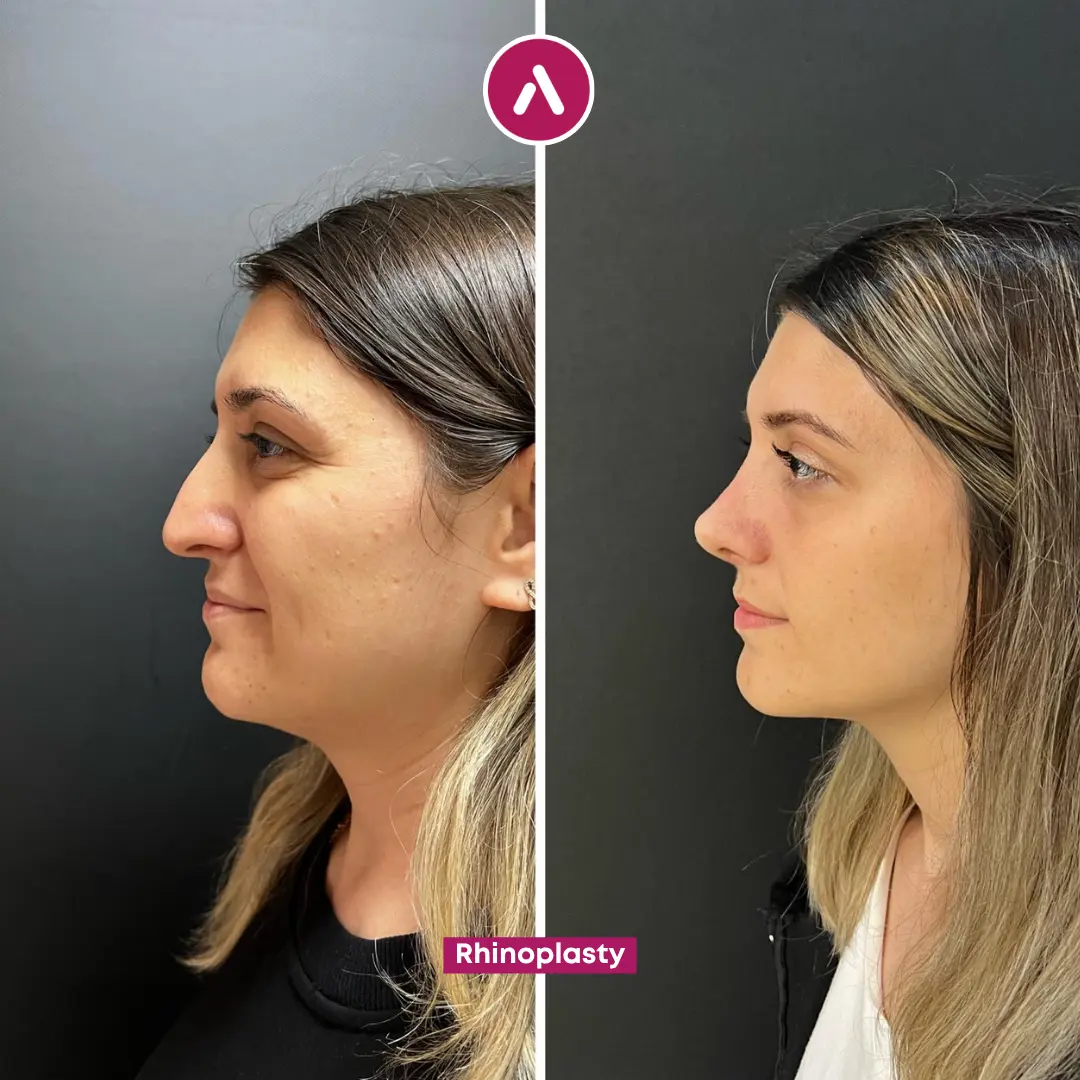
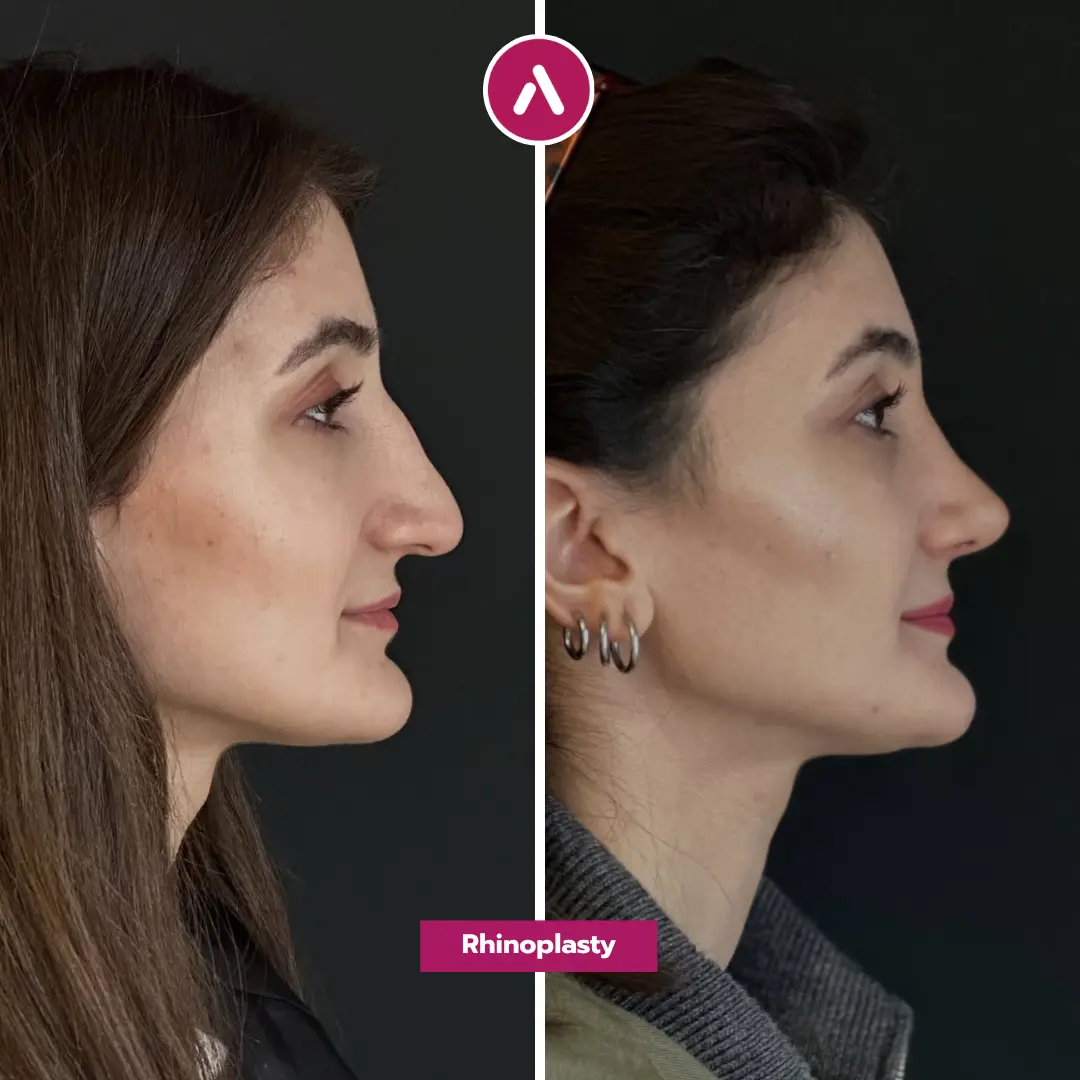
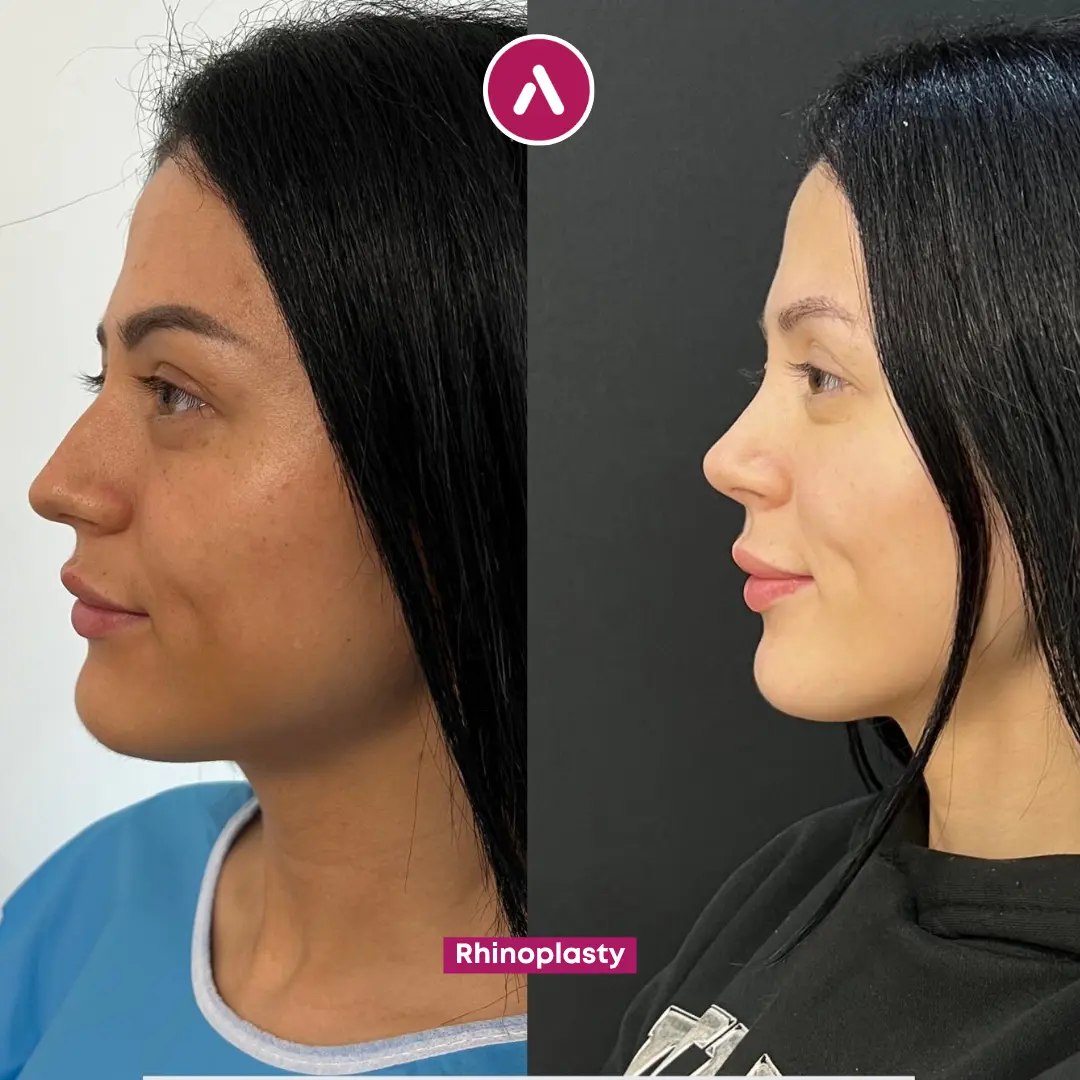
For this reason, a well-planned consultation matters far more than trend-led nose design. The best outcomes in aquiline rhinoplasty Turkey are not about making every nose tiny or dramatically sloped. They are about understanding how the bridge, tip, chin, forehead, and overall facial proportions work together. In some cases, the most elegant result is a straight profile. In others, a very gentle softening of the bridge creates the most harmonious look. The aim is refinement, not identity loss.
Patients considering an aquiline nose job Istanbul are also usually comparing value, surgeon experience, and recovery logistics. That is entirely reasonable. However, before cost and travel are discussed, it helps to understand what an aquiline nose actually is, why it develops, and why some non-surgical options are too limited for a genuinely prominent hump.
Table of Contents
What is an Aquiline (Arched) Nose?
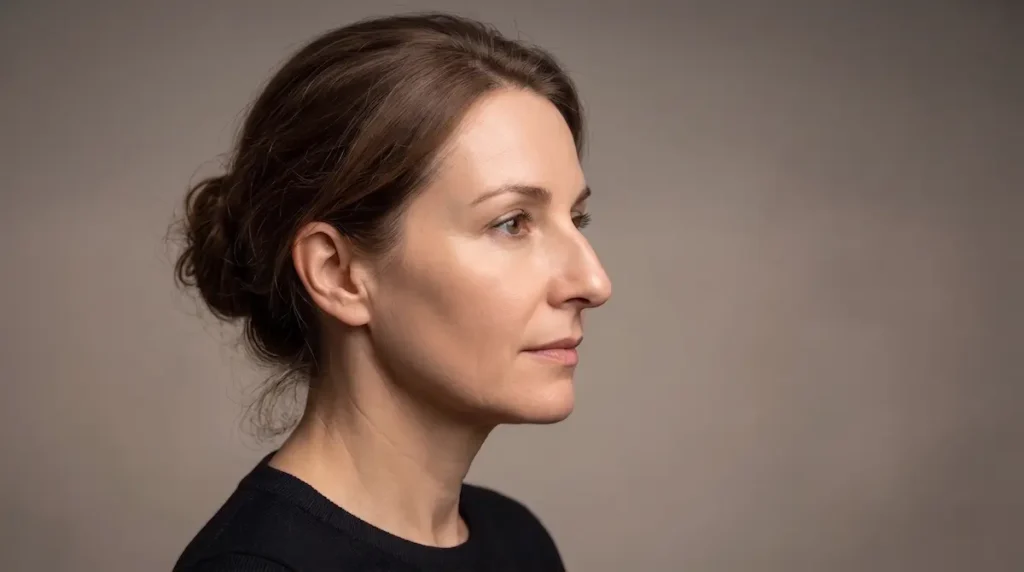
An aquiline nose is a nose shape in which the bridge has a visible curve or projection, often referred to as a dorsal hump. Some patients describe it as an arched, hooked, or Roman nose. In profile, the hump may sit high on the bridge or closer to the middle third of the nose, and its prominence can make the tip appear relatively downturned even when the tip itself is not the primary issue. This is why a careful assessment is essential: what looks like a tip problem in the mirror may actually be a bridge problem, or a combination of both.
The genetics behind the “Roman Nose” or “Dorsal Hump”
In many people, an aquiline or arched nose is simply part of their inherited facial structure. The hump may come from the way the nasal bones and cartilage developed during adolescence, and it can run strongly in families. This is why some patients seeking roman nose correction surgery say they have “always had it”, even if it seemed to become more noticeable with age or weight changes in the face.
Ethnicity and family traits also play a role. A dorsal hump is not automatically a deformity or a flaw; it is one of many natural profile variations. The concern becomes aesthetic when the patient feels that the bridge dominates the face, photographs poorly from the side, or gives a harsher expression than intended. In these cases, the role of surgery is not to erase character, but to refine proportion.
There are also patients whose hump is partly post-traumatic. A childhood knock, sports injury, or previously untreated break may heal in a way that leaves the bridge more irregular or pronounced. In these situations, hump correction may need more than simple filing. It may require a wider structural plan to straighten the nose and restore smooth dorsal lines.
Why dermal fillers (Non-Surgical Rhinoplasty) are often insufficient for prominent humps
Non-surgical rhinoplasty with filler can sometimes camouflage a small irregularity by adding volume above or below it. However, it does not actually remove a hump. That is the key limitation. In a truly prominent aquiline nose, adding filler may make the bridge look straighter from a distance, but it can also make the nose larger overall. For patients who already feel their nose is too dominant, that is often the opposite of what they want.
This is why many searches for dorsal hump removal Turkey or dorsal hump rhinoplasty Turkey reflect a need for actual reduction rather than camouflage. Surgery allows the surgeon to reduce the hump itself, reshape the upper bridge, and rebalance the profile properly. Filler may still have a role in selected cases, but it is rarely the best long-term answer for a marked arched bridge.
Another point to consider is longevity and precision. Fillers are temporary, and repeated treatments can become expensive over time. They also cannot correct internal structural issues or meaningfully narrow a broad bony vault. When the hump is significant, a surgical approach is usually more accurate, more definitive, and more proportionate.
How an arched nose can affect facial balance in profile photographs
Many patients do not focus on their nose from the front nearly as much as they do from the side. In profile images, even a moderate dorsal hump can catch light strongly and draw the eye away from the eyes, lips, and jawline. This is why some people are happy with their appearance face-on but dislike every side photograph. The concern is less about vanity and more about visual balance.
When the bridge projects forward, it can also make the chin look comparatively weaker. A patient may assume they need chin augmentation when in fact the primary imbalance begins at the nose. Proper assessment should always look at the full facial profile rather than the nose in isolation. Good rhinoplasty planning is architectural: it is about harmony between features, not one isolated measurement.
Patients considering hooked nose surgery Turkey often describe this exact problem. They feel their nose is the first thing people see in side profile, even though friends and family may say the difference is subtle. A surgeon-led analysis helps translate that concern into practical decisions about how much reduction is appropriate and where refinement will have the greatest visual effect.
When a dorsal hump is purely aesthetic and when breathing concerns should also be assessed
Not every hump is associated with functional problems. Some patients breathe perfectly well and want only aesthetic refinement. Others, however, have a deviated septum, internal valve narrowing, or previous trauma that affects airflow as well as appearance. This distinction matters because the operation may then need to address both form and function in the same procedure.
A thorough assessment should therefore examine the bridge, septum, tip support, and airway together. It is not unusual for a patient to seek help for an aesthetic hump and then discover that part of the treatment plan should also improve breathing. Equally, some patients think they have a functional problem when the real issue is mainly cosmetic. Both situations are common, which is why a proper examination is essential before committing to surgery.
For UK patients travelling abroad, this is especially important. It is far better to know in advance whether the plan is a straightforward cosmetic hump reduction or a broader rhinoplasty involving airway work, because that affects technique, recovery, and expectations.
Discover If a Rhinoplasty (Nose Job) Is Right for You
Share your photos and medical history to receive a personalised assessment from our European Board-certified facial surgery team.
Why Many UK Patients Seek Correction for an Arched Nose
UK patients typically do not ask for a “designer nose”. More often, they want a profile that looks smoother, lighter, and more balanced without appearing obviously altered. That preference shapes the entire consultation. In practice, many people seeking aquiline nose surgery Turkey are not chasing a fashion trend; they are trying to correct one feature that has bothered them for years while still preserving their identity and facial character.
This is also why the language used in consultation matters. Terms such as “natural”, “balanced”, “subtle”, and “in keeping with your face” often matter more to British patients than dramatic before-and-after promises. A well-executed hump reduction should soften the profile, not create an identikit result. For someone researching Turkey arched nose surgery, confidence usually comes from realistic planning rather than aggressive reshaping.
| Common UK Patient Concern | What It Usually Means in Practice | Surgical Planning Priority |
|---|---|---|
| “I hate my side profile in photos.” | The dorsal hump dominates profile balance. | Smooth and refine the bridge without over-reducing it. |
| “I want it changed, but I still want to look like me.” | The patient wants subtle refinement rather than a trend-led nose. | Protect identity, preserve facial harmony, and avoid an artificial slope. |
| “I do not want a bigger nose from filler.” | Camouflage is not an acceptable long-term solution. | Consider true hump reduction rather than non-surgical masking. |
| “I’m worried about ending up with an obvious surgery look.” | The patient fears over-resection and loss of character. | Use conservative, anatomy-led planning and realistic imaging discussions. |
Feeling self-conscious in side profile and social photographs
One of the most common reasons for pursuing hump reduction is persistent discomfort with side-profile photographs. Patients often say they automatically turn away from one side, avoid video stills, or ask others not to post candid images. This may sound minor, but when it affects confidence for years, it becomes a meaningful quality-of-life issue.
In these cases, surgery is not about perfection. It is about removing a feature that repeatedly distracts the patient from the rest of their face. A smoother bridge can make the whole profile appear calmer and more proportionate, often without the front view changing dramatically. That balance is one of the main reasons interest in nose hump removal Turkey continues to grow among patients who want visible but tasteful refinement.
Wanting refinement rather than an obvious or “overdone” result
Many British patients are highly specific about what they do not want. They do not want a nose that looks pinched, excessively scooped, unstable, or visibly “done”. They are usually more comfortable with language such as “straightened”, “softened”, or “gently refined”. This makes surgical judgement extremely important. Removing too little may leave the patient disappointed, but removing too much can flatten character and create long-term structural problems.
This is where contemporary technique matters. In selected patients, preservation rhinoplasty Turkey may be discussed when the anatomy allows a more structure-conscious approach to hump treatment. The principle is not that one method suits everyone, but that modern rhinoplasty should respect support, airflow, and natural dorsal lines rather than focusing only on reduction.
For some patients, piezo rhinoplasty Turkey is also of interest because of its precision in working with bone. While not every hump reduction requires the same tools, patients increasingly want to understand how technology and technique may influence control, bruising, and recovery. That level of informed questioning is especially common among UK patients.
The appeal of subtle nose reshaping over trend-driven nose designs
Searches such as aquiline rhinoplasty Turkey often reflect a desire for structural improvement rather than a fashionable nose shape. Trend-led aesthetics can look attractive online in curated photographs, but they do not suit every face, and they may age poorly. A nose should match the patient’s facial proportions, ethnicity, skin quality, and long-term goals, not a social media template.
For this reason, subtle nose reshaping is usually the safer and more sophisticated objective. A straight or gently softened bridge often produces a more elegant result than an exaggerated dip. It also reduces the risk of the nose drawing attention for the wrong reasons. Patients who begin by asking for a dramatic change often become more conservative once they understand how strongly the nose affects overall identity.
“The most successful hump reduction is often the one that makes people say you look better, not different.”
Why Harley Street-level expectations often lead patients to compare Turkey and the UK
UK patients who explore private rhinoplasty commonly compare surgeon skill, communication standards, recovery planning, and overall value rather than looking at price alone. They want reassurance that the consultation feels thorough, the plan feels bespoke, and the intended result is clinically sensible. This is why comparisons between the UK and Turkey are so common in rhinoplasty research.
Someone considering an aquiline nose job Istanbul is often not looking for the cheapest route. More often, they are looking for a combination of experienced facial surgery, strong pre-operative planning, and a natural aesthetic approach at a more accessible overall cost than they may find in top-end UK private practice. The decision is usually about value, confidence, and trust, not simply a headline figure.
Surgical Techniques to Remove the Nasal Hump
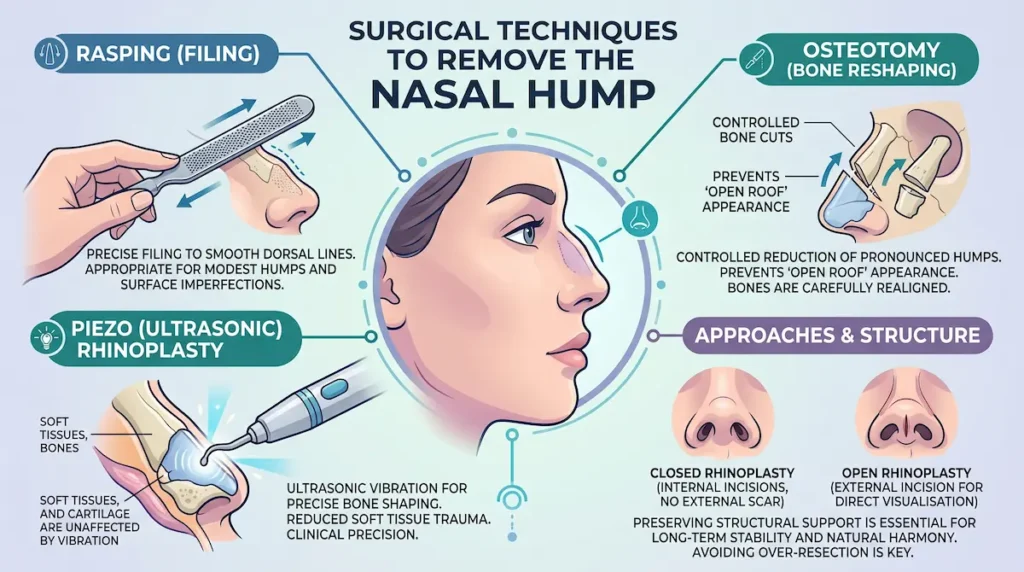
Removing a dorsal hump is not a single, one-size-fits-all manoeuvre. The correct technique depends on how much of the hump is bony, how much is cartilaginous, whether the bridge is deviated, how strong the patient’s support structures are, and whether the aim is a straight profile or a very gently softened one. For patients researching dorsal hump removal Turkey or dorsal hump rhinoplasty Turkey, the most important point is that good surgery is not simply about shaving the bridge down. It is about reducing the hump in a way that preserves stability, smooth dorsal lines, and natural facial harmony.
In practical terms, this means the surgeon must assess the whole nose rather than the hump in isolation. Some patients need only limited reshaping of the bridge. Others require controlled bone work, septal correction, tip refinement, or additional support grafting to keep the result elegant and long-lasting. That is why a proper consultation for aquiline rhinoplasty Turkey should never focus solely on “how much can be removed”, but also on what must be preserved to maintain both appearance and function.
Rasping (Filing) vs. Osteotomy (Breaking): Which approach do you need?
Patients often hear the word “breaking” and understandably feel anxious, but in rhinoplasty it simply refers to carefully controlled osteotomies that allow the nasal bones to be repositioned when needed. In some cases, a small hump can be reduced with rasping alone, especially if the prominence is modest and largely superficial. This involves carefully filing down part of the bridge to create a smoother contour. However, that is not appropriate for every patient.
When the hump is more pronounced, or when reducing it creates an “open roof” at the top of the nasal vault, osteotomies may be required to close and reshape the bony bridge properly. This is particularly relevant in nose hump removal Turkey cases where the patient wants a visible yet natural profile change rather than a partial improvement. A bridge that is reduced without appropriate closure can look too wide, irregular, or unstable.
The choice between rasping and osteotomy is therefore not about which method sounds gentler. It is about which technique will create the smoothest, safest, and most balanced result for that anatomy. A modest hump may need only limited filing. A stronger aquiline bridge may require more complete structural work to look truly refined once healed.
Piezo (Ultrasonic) Rhinoplasty: Clinical precision without unnecessary trauma
Piezo rhinoplasty Turkey has become a widely discussed topic because ultrasonic instruments can allow more controlled work on nasal bone in selected cases. Rather than using traditional manual force in the same way older techniques did, piezo technology uses ultrasonic vibration to cut or shape bone with a high degree of precision. For patients, the appeal is clear: more control, potentially less soft-tissue trauma, and a technique that feels more refined and modern.
That said, piezo is not a magic word and it is not necessary in every rhinoplasty. What matters is how and when it is used. In dorsal hump surgery, piezo may be particularly useful where accurate bony reshaping is needed, especially in patients seeking a clean, elegant bridge line without unnecessary roughness. It can be a strong option in piezo rhinoplasty Turkey when the surgeon judges that bone precision is central to the plan.
Patients should remember that technology does not replace judgement. A beautifully natural result still depends on diagnosis, planning, and surgical restraint. Piezo can be an excellent tool, but the outcome is driven by the surgeon’s understanding of proportion, healing, and long-term stability.
Open vs. closed rhinoplasty for hump correction
Another question patients commonly ask is whether hump correction should be performed through an open or closed approach. In a closed rhinoplasty, all incisions are hidden inside the nostrils, which means there is no external columellar scar. In an open rhinoplasty, a small incision is made across the columella to allow the skin to be lifted for greater visibility of the underlying structures. Each approach has legitimate indications.
For a relatively straightforward hump reduction, especially where the tip needs little change, a closed approach may be entirely appropriate. It can offer efficient access with no external incision and is favoured by some surgeons for selected aquiline nose surgery Turkey cases. However, when the nose is more complex, when tip support needs adjustment, or when there is asymmetry or functional work to be done, an open approach may allow better visualisation and more precise structural refinement.
The real question is not which technique is fashionable, but which one serves the anatomy best. Patients should be cautious of clinics that present one approach as universally superior. Good rhinoplasty is bespoke. The correct route depends on what needs to be changed and what needs to be preserved.
How surgeons smooth the bridge while preserving structural support
One of the greatest risks in hump reduction is over-resection. If too much bridge support is removed, the nose can lose strength and develop problems over time, including collapse, irregular contour, pinching, or breathing issues. This is why modern rhinoplasty places so much emphasis on structure. In a well-planned hooked nose surgery Turkey case, the goal is not merely to flatten the hump, but to create smooth dorsal lines while maintaining support.
This may involve preserving parts of the bridge, adding carefully placed grafts, repositioning bone, or refining cartilage in a controlled way rather than aggressively cutting it away. In some patients, preservation rhinoplasty Turkey principles may be relevant, particularly when the anatomy allows the bridge to be lowered while keeping much of the natural dorsal structure intact. In others, a more traditional structural approach may be more appropriate.
The key message for patients is that elegant results come from respect for anatomy. A nose that looks lovely in the first month but unstable after a year is not a good result. Proper support is what allows the refined profile to remain both attractive and functional in the long term.
Everything You Need to Know About Rhinoplasty (Nose Job)
From surgical stages to aftercare, discover how AKM Clinic delivers world-class Rhinoplasty (Nose Job) in Istanbul.
Achieving a Natural Profile: Straight vs. Gently Sloped Noses
When patients imagine the result of Turkey arched nose surgery, they often picture the hump disappearing and the profile becoming smoother. What they do not always realise is that there are several different ways to achieve that smoother profile. Some noses look best when the bridge is straight from radix to tip. Others suit a very gentle softening that retains character while reducing harshness. The aim should always be a profile that belongs to the patient’s face, rather than a borrowed trend.
This is particularly important for UK patients, who commonly prefer a refined and balanced outcome over an obviously sculpted one. In aquiline nose job Istanbul consultations, the most sophisticated planning usually centres on proportion, restraint, and long-term naturalness. A good result should not make the patient look like somebody else. It should simply remove the visual dominance of the hump and allow the rest of the face to come forward more harmoniously.
Masculine vs. feminine profile design aesthetics
A natural result does not mean the same thing for every patient. In broad terms, masculine and feminine nasal aesthetics often differ in how much dorsal height is preserved, how the tip is rotated, and how strong the final profile line should appear. A masculine profile may suit a straighter bridge with slightly stronger definition. A feminine profile may tolerate a softer transition and a lighter bridge line, but still without looking artificial or excessively scooped.
This is why roman nose correction surgery should never be planned from a template. The surgeon must consider the patient’s bone structure, skin thickness, forehead projection, and chin position as well as their aesthetic preference. The goal is not to feminise or masculinise indiscriminately, but to create a result that fits the individual face.
Patients sometimes arrive with reference images that are attractive in isolation but unsuitable for their anatomy. A responsible consultation should explain not only what is possible, but what will look convincing and stable on that particular face. Personalisation is what separates thoughtful rhinoplasty from generic reshaping.
Managing “Open Roof Deformity” risks with specialist care
When a hump is removed, the upper surface of the nasal bridge can effectively be “opened”, leaving a gap in the bony vault. This is known as an open roof deformity. If not properly addressed, the bridge may heal looking broad, flat, or irregular rather than smooth and elegant. That is one reason why hump reduction is more complex than simply shaving down the highest point.
In high-quality dorsal hump rhinoplasty Turkey, the bridge is reduced as part of a complete architectural plan. That plan may include osteotomies to close the bony vault, careful smoothing of the dorsal lines, and structural measures to maintain both symmetry and support. Without these steps, even a technically “smaller” hump may still leave an unsatisfactory profile.
From the patient’s point of view, the key lesson is that a prominent hump should be treated by a surgeon who regularly plans full-profile rhinoplasty, not just surface reduction. Natural outcomes are built on precise structural thinking, especially when the bridge is a dominant feature.
Why a natural result usually ages better than an aggressively reduced bridge
It is understandable that some patients want a dramatic change after disliking their profile for years. However, aggressive bridge reduction can create a nose that looks fashionable for a moment but less believable over time. Over-reduced bridges may appear pinched, overly scooped, or visibly surgical, particularly as the face matures. By contrast, a well-judged natural correction tends to age more gracefully because it respects the patient’s original anatomy and overall identity.
This is why many of the most successful aquiline surgery Turkey outcomes are those that remove the distraction of the hump while keeping the nose credible within the face. Friends and family may notice that the patient looks fresher, softer, or more balanced, but they may not be able to identify exactly why. That is often the hallmark of refined rhinoplasty.
For UK patients especially, this point matters. The preference is often for a result that looks elegant in everyday life, not one that performs only in filtered images. Surgery should improve harmony, not advertise itself.
Balancing the nose with the chin, forehead, and overall facial proportions
The nose does not sit in isolation. A hump can seem stronger when the chin is relatively recessed, when the forehead has a particular projection, or when the midface lacks balance. This is why the best planning for aquiline rhinoplasty Turkey looks at the full profile rather than the nasal bridge alone. Sometimes a modest hump reduction creates a major improvement because it restores proportion across the face without extreme surgical change.
In consultation, it is useful to discuss the relationship between the bridge, tip, lips, and chin. A surgeon with a facial-harmony mindset will assess how much of the perceived imbalance truly comes from the hump and how much comes from surrounding proportions. That broader view helps prevent overcorrection and supports a more elegant final result.
For patients searching for preservation rhinoplasty Turkey or aquiline nose surgery Turkey, this is one of the most important ideas to understand: the best nose is not the smallest nose. It is the nose that looks right on your face.
Why Pay More for Rhinoplasty (Nose Job)?
Achieve the same high-standard, clinical excellence you expect in the UK or US, but without the premium price tag. Quality meets exceptional value at AKM Clinic.
Aquiline Nose Surgery Turkey vs UK: Cost, Value and What Is Included
For many patients, the decision is not simply whether to have surgery, but where to have it. Someone researching aquiline nose surgery Turkey or Turkey arched nose surgery is often comparing three things at once: surgical quality, financial value, and how supported they will feel before and after treatment. That is why the discussion should go beyond a headline fee. A lower quote means very little if it excludes important essentials, and a higher quote is not automatically evidence of better planning or better results.
UK patients are usually highly attentive to transparency. They want to know what is included, who will perform the surgery, what aftercare looks like, and whether the result is likely to be subtle, balanced, and worth the travel involved. In practice, the strongest value proposition in aquiline nose job Istanbul is often not “cheap surgery”, but clearer package structure, more accessible private pricing than the UK, and a patient journey designed specifically for international travel.
Typical private rhinoplasty costs in the UK vs Istanbul
Private rhinoplasty in the UK, particularly in premium city-centre clinics, is commonly structured around multiple separate fees rather than one neatly bundled figure. The patient may see the surgeon’s fee, theatre costs, anaesthesia, pre-operative tests, garments or supports where relevant, medications, and follow-up arrangements presented separately. This can make initial comparisons difficult, especially when one clinic looks less expensive at first glance but becomes significantly more costly once all elements are added.
By contrast, many patients exploring aquiline rhinoplasty Turkey are drawn to the way international packages are often presented more clearly. The appeal is not merely the base procedure cost, but the fact that transfers, accommodation, early checks, and practical logistics may be organised as part of a single pathway. For a UK patient balancing time away from work, travel planning, and overall spend, that structure can feel easier to evaluate.
It is also important to recognise that lower costs in Istanbul do not automatically reflect lower surgical ambition or lower-quality planning. In many cases, the difference is driven by broader economic and operational factors rather than a simpler or less careful procedure. The sensible comparison is therefore not “UK expensive, Turkey cheap”, but what level of expertise, planning, and support is being offered for the total spend?
| Comparison Point | Typical UK Private Route | Typical Turkey Package Route | Why It Matters |
|---|---|---|---|
| Fee presentation | Often itemised across several categories | Often bundled into one clearer package structure | Makes true like-for-like comparison easier |
| Travel logistics | Usually self-arranged | Often coordinated as part of the treatment journey | Reduces organisational stress for overseas patients |
| Accommodation | Not usually relevant unless travelling within the UK | Frequently included or pre-arranged | Improves budgeting clarity |
| Overall value | Can be excellent, but often at a premium price point | Can offer broader package value for the total spend | Useful for patients comparing outcome plus experience |
What an all-inclusive package may cover for UK patients
When patients search for dorsal hump removal Turkey or nose hump removal Turkey, they are often also looking for simplicity. A well-structured all-inclusive pathway typically aims to reduce the friction involved in travelling for surgery. While package details vary between clinics, patients commonly expect clear information about airport transfers, accommodation, hospital arrangements, pre-operative assessments, medication, and scheduled early follow-up before returning home.
For international patients, that practical organisation can be almost as important as the operation itself. When the itinerary is clear, the patient can focus on preparation and recovery rather than admin. This is especially relevant for British patients who want a polished, medically organised journey rather than a fragmented series of bookings and invoices.
However, “all-inclusive” should never be taken at face value. A trustworthy provider should explain precisely what is and is not covered, how long the patient is expected to remain in Istanbul, what happens if extra reviews are needed, and how remote aftercare is handled once the patient is back in the UK. Those details are what turn a package from a marketing phrase into a genuine source of reassurance.
- Pre-operative consultation and treatment planning
- Hospital or clinic arrangements for the procedure day
- Airport-hotel-clinic transfers
- Hotel accommodation for the agreed stay
- Routine medication and early post-operative checks
- Clear instructions for travelling home and remote follow-up
Why lower costs in Turkey do not automatically mean lower standards
One of the most persistent myths in medical travel is that a lower overall spend must mean inferior care. In reality, price is influenced by many things beyond the operation itself, including local running costs, staffing structures, exchange-rate advantages, and the broader economics of private healthcare. This is why dorsal hump rhinoplasty Turkey may be more financially accessible while still being delivered in a highly structured clinical setting.
What matters more than the headline quote is whether the clinic demonstrates surgical experience, realistic planning, consistent communication, and credible patient support. UK patients are quite right to ask about credentials, facial surgery expertise, aftercare access, and how complications would be handled if concerns arise after returning home. Value should be measured by competence and continuity, not by price alone.
For patients looking at piezo rhinoplasty Turkey or preservation rhinoplasty Turkey, the same principle applies. Modern techniques and technology can be valuable, but only when they are used judiciously by a surgeon with a strong anatomical and aesthetic understanding. A good result comes from clinical judgement first and tools second.
True value in rhinoplasty is not paying the least. It is understanding exactly what you are paying for, who is operating, and how your result will be supported after you return home.
Questions to ask before comparing quotes in GBP (£)
Before choosing between the UK and Turkey, patients should compare quotations line by line rather than relying on first impressions. This is particularly important in hooked nose surgery Turkey research, where one patient may need straightforward hump reduction and another may require more complex structural work. Those are not the same operation, and the quote should reflect that difference honestly.
Asking good questions protects the patient from both under-explained low quotes and over-explained premium quotes that still do not clarify the essentials. The aim is not to interrogate, but to establish whether the clinic communicates with the level of transparency a careful UK patient would reasonably expect.
- Is this a straightforward cosmetic hump reduction, or does the plan include septal or airway work?
- Who will perform the procedure, and what is their specific rhinoplasty experience?
- Are transfers, accommodation, medication, and early follow-up included?
- How many nights should I plan to stay in Istanbul?
- What support is available once I am back in the UK?
- What happens if swelling, asymmetry, or delayed concerns need review later?
- Is the quote fixed in GBP (£), and are there any likely additional charges?
Recovery Timeline for Hump Reduction
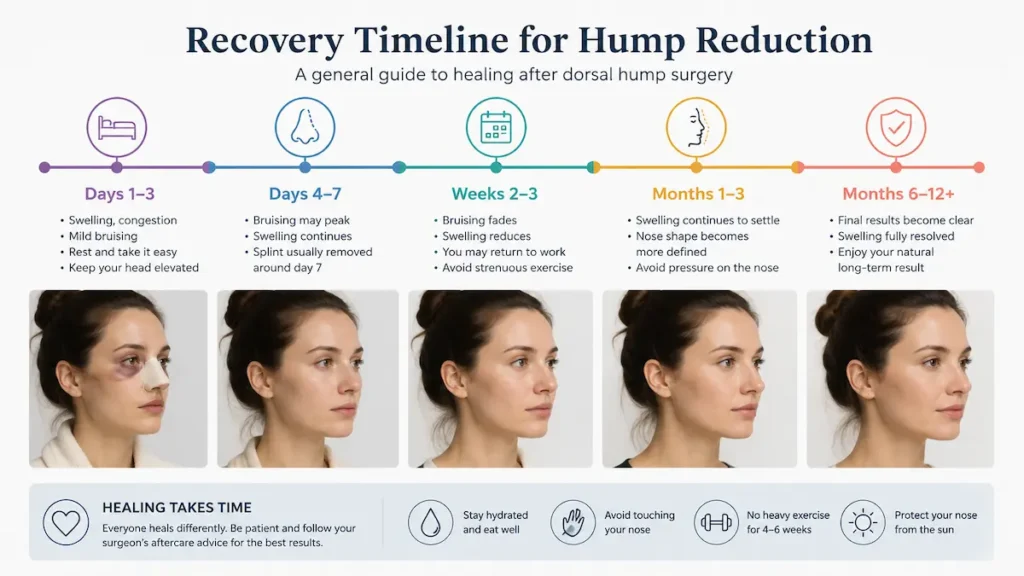
Recovery is one of the first things patients want to understand, especially if they are travelling from the UK. The good news is that hump reduction is usually more manageable than many patients fear, but the healing process still requires patience. A nose can look very presentable long before it is fully settled, and that difference between social recovery and final recovery should be explained clearly from the beginning. Patients researching arched nose surgery Turkey often focus on the operation day, when in reality the more important experience is how the nose evolves over the following weeks and months.
Early swelling, bruising, temporary congestion, and a feeling of tightness are all common. The first visible improvement often comes once the initial dressings or splint are removed, but that is not the final result. The bridge and tip continue to refine gradually, and subtle changes may continue long after the patient has returned home. Good rhinoplasty recovery advice therefore combines realism with reassurance: most patients feel progressively better quite quickly, but the nose reveals its best definition slowly.
| Recovery Stage | What Patients Commonly Notice | What It Usually Means |
|---|---|---|
| First few days | Congestion, swelling, bruising, tenderness | Normal early inflammatory response |
| Around 1 week | Splint review/removal period in many cases | First meaningful look at the new bridge line |
| 2 to 3 weeks | Bruising usually much less obvious | Social recovery improves, but swelling remains |
| 1 to 3 months | Profile becomes cleaner and more refined | Early shape settles, especially across the bridge |
| Several months | Ongoing softening and definition | The result continues to mature gradually |
When does the swelling on the nasal bridge subside?
Bridge swelling often improves faster than patients expect, but not so quickly that it should be judged too early. In the first week, the nose may feel firm and look more swollen than the patient anticipated, especially once the splint comes off and the bridge is seen without its dressing for the first time. This can be emotionally misleading because patients imagine they are seeing the result, when they are actually seeing an early healing stage.
In many aquiline nose surgery Turkey cases, the most obvious bridge swelling starts to settle over the following few weeks, allowing the dorsal hump reduction to become more visible. However, refinement continues well beyond that point. The nose may look broadly improved early on, but not yet polished. That is completely normal.
Patients with thicker skin, more extensive structural work, or combined tip reshaping may find that swelling lingers longer. The important thing is not to evaluate the success of the surgery from the first reveal. A bridge that still looks puffy early on may continue to improve significantly with time.
Wearing glasses post-surgery
Glasses are a practical concern for many patients, particularly those with daily prescription use. In the early phase after hump reduction, pressure on the nasal bridge is often restricted because the bones and soft tissues are still settling. Whether and when glasses can be worn normally depends on the exact technique used, the stability of the bridge, and the surgeon’s aftercare instructions.
Some patients are advised to avoid resting standard spectacles directly on the bridge for a period of time, or to use an alternative method of support while healing progresses. This can be inconvenient, but it is a temporary precaution designed to protect the freshly reshaped area.
Patients planning aquiline nose job Istanbul should raise this point before surgery if glasses are essential to daily life. It is a small detail, but it can affect comfort, work planning, and return-to-routine decisions in the first few weeks.
When bruising is usually at its worst and when it starts to fade
Bruising varies significantly between patients, but where nasal bone work is involved it is common for bruising around the eyes to become more visible before it improves. This is one of the reasons patients are often told not to panic if they look worse on day two or three than they did immediately after surgery. Early bruising is part of the normal evolution of healing, not necessarily a sign that something is wrong.
In dorsal hump removal Turkey cases involving osteotomy or more substantial bridge work, the most noticeable bruising often settles over the first one to two weeks, though faint discolouration can linger a little longer in some people. By the third week, many patients feel far more socially comfortable, even if residual swelling remains.
This distinction matters: bruising and swelling do not disappear at the same speed. A patient may look much better externally while still feeling blocked, puffy, or slightly uneven internally. That does not mean the recovery has stalled. It simply means different tissues heal on different timetables.
When UK patients are typically fit to fly back home
For international patients, one of the most practical questions is when it is reasonable to return home. In most cases, patients are not expected to fly immediately after rhinoplasty. Early review, dressing or splint management, and an initial period of observation are all important, which is why a short stay in Istanbul is typically built into the treatment plan. The exact timeline depends on how the surgery was performed, how the patient is healing, and when the surgeon is satisfied that early recovery is progressing appropriately.
For someone booking Turkey arched nose surgery, this means planning the trip around medical review rather than around the cheapest flight schedule. A well-organised journey leaves enough time for the early post-operative checkpoint, practical comfort, and safe return arrangements. It is always better to stay the required period and travel with confidence than to rush home too soon and feel uncertain later.
Once back in the UK, ongoing healing continues for weeks and months, so remote communication and follow-up instructions remain important. The operation may take place in Istanbul, but the patient experience extends far beyond the flight home.
Dreaming of a Natural-Looking Rhinoplasty (Nose Job)?
Our philosophy is “Restoration, Not Alteration.” Discover how our surgeons achieve subtle, naturally restored results that honour your unique beauty.
What the First Few Months of Healing Really Look Like
The first few months after hump reduction are often the period when expectations need the most careful management. By the time the splint has come off and the initial bruising has improved, many patients understandably assume they are seeing the finished result. In reality, they are usually seeing an early version of it. This is particularly true in arched nose surgery Turkey cases where the bridge has been refined but the internal tissues are still settling. The nose may already look smoother and better balanced, yet it can continue to change in subtle but important ways for many months.
This longer healing process is not a sign that something is wrong. It is simply how rhinoplasty recovery works. Swelling reduces at different speeds in different parts of the nose, and the skin must gradually re-drape over the new framework. Patients researching aquiline nose surgery Turkey or dorsal hump removal Turkey often feel reassured once they understand that “looking better” and “being fully healed” are not the same stage.
Why the nose can look uneven before final refinement appears
One of the most common worries in the first few weeks and months is temporary unevenness. A patient may notice that one side looks a little puffier than the other, that the bridge catches light differently on each side, or that the tip seems to lean slightly in photographs. In most cases, these concerns reflect asymmetrical swelling rather than a problem with the final result.
Healing is rarely perfectly symmetrical. The tissues on one side of the nose may settle a little faster, especially if there has been more internal work on that side or if the patient naturally sleeps more heavily on one side during recovery. This can make the nose appear inconsistent from day to day, which is unsettling if the patient is checking the mirror constantly.
For patients undergoing aquiline rhinoplasty Turkey, this is why early patience matters so much. The shape seen in the first month is not a reliable guide to the polished outcome. A bridge that seems slightly irregular early on may look far smoother once swelling continues to reduce.
How tip swelling and bridge swelling settle at different speeds
Not all swelling behaves the same way. The bridge often begins to look cleaner sooner than the tip, while the tip can remain firmer and less defined for longer. This difference sometimes confuses patients who expected the whole nose to refine at the same pace. Instead, they may feel the hump has clearly improved but the lower part of the nose still looks rounder or heavier than planned.
This is entirely consistent with normal healing. The nasal tip has more delicate soft tissue behaviour and often takes longer to reveal its final contour. Where a patient has had nose hump removal Turkey with additional tip adjustment, the feeling of “the bridge looks done but the rest does not” is especially common.
Understanding this timing helps patients avoid unnecessary alarm. The result is usually revealed in stages: first the obvious hump reduction, then the cleaner dorsal lines, and only later the finer detailing that makes the nose look truly settled and harmonious.
When final profile definition becomes more visible
Most patients notice a meaningful improvement quite early, but the more elegant, refined version of the result emerges slowly. As the swelling reduces, the bridge line appears cleaner, the profile reads more smoothly in photographs, and the transition from forehead to bridge to tip becomes more natural. This gradual sharpening is one of the reasons many patients say the nose looks better month by month rather than all at once.
For someone seeking roman nose correction surgery, this can be encouraging. The first reveal after surgery may confirm that the hump is gone, but the truly sophisticated result often comes later, once the softer tissues have calmed and the profile stops looking post-operative. The best outcomes usually do not announce themselves immediately. They refine quietly over time.
Patients should therefore judge progress in broad phases rather than day by day. It is far more useful to compare monthly photographs than to analyse small mirror changes every morning.
How to protect your result during the long healing phase
Once the first week has passed, patients sometimes feel tempted to treat the nose as “basically healed”. That is understandable, especially if they are back to work, seeing friends, and looking more presentable. However, the healing framework remains vulnerable for longer than the visible bruising lasts. Protecting the nose from accidental knocks, unnecessary pressure, and avoidable irritation is still important.
This is particularly relevant for patients travelling home after Turkey arched nose surgery. Busy airports, lifting luggage carelessly, sleeping awkwardly, returning too quickly to intense exercise, or exposing healing skin to strong sunlight can all complicate an otherwise straightforward recovery. Sensible aftercare is not dramatic; it is simply consistent.
The best long-term results usually come from a combination of good surgery and calm healing. Patients do not need to live in fear of every movement, but they do benefit from respecting the fact that refinement continues well after they begin to feel normal again.
Before and After: Visualising the Profile Transformation
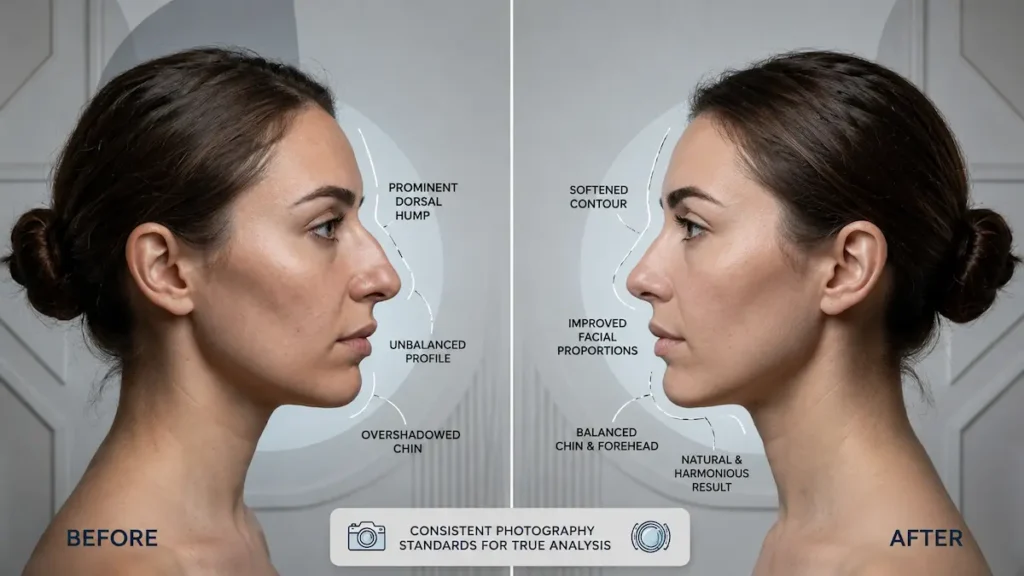
Before-and-after images are often the moment when a patient decides whether a surgeon’s aesthetic style feels right for them. For anyone considering aquiline nose job Istanbul, these photographs should do more than show that a hump has been removed. They should demonstrate judgement: how the bridge has been softened, how the profile now relates to the chin and forehead, and whether the final look appears natural rather than obviously surgical.
Good visual analysis is especially important for patients who want refinement rather than a trend-led result. In hooked nose surgery Turkey or piezo rhinoplasty Turkey research, it is easy to be distracted by dramatic transformations. Yet the most useful examples are often the ones that look believable, balanced, and consistent across multiple views. The question is not simply “Is the hump gone?” but “Does the face now look more harmonious?”
What to look for in genuine before and after photos
Reliable before-and-after photographs should make comparison easy. That usually means similar lighting, similar head position, similar facial expression, and a clear healing stage. If one image is taken in harsh side light and another in flattering diffused light, or if the angle changes significantly, the comparison becomes less useful. A careful patient should want visual honesty, not visual theatre.
In dorsal hump rhinoplasty Turkey, profile consistency matters especially because a small angle difference can make the bridge appear more or less prominent than it truly is. This is why side-profile images, three-quarter views, and front views all have value. They show whether the correction works as part of the whole face rather than only from one carefully chosen angle.
Patients should also pay attention to whether the result looks stable and natural, rather than simply smaller. A refined nose should appear intentional, smooth, and structurally believable. Over-edited images or inconsistent photo standards make it harder to judge that properly.
How profile refinement can soften the entire facial appearance
One of the most striking things about successful hump reduction is that the nose is not the only feature that seems to improve. Once the dorsal hump is reduced, the eyes may appear more open, the lips more balanced, and the chin less overshadowed in profile. The face often looks calmer and more proportionate even though only one area has been operated on.
This is why patients seeking aquiline surgery Turkey are often surprised by how much the change affects their overall appearance without making them look drastically different. The goal is not to create a new identity. It is to remove one structural distraction so that the rest of the face reads more harmoniously.
In profile-heavy concerns, this can have a particularly strong emotional effect. A patient who has spent years avoiding side photographs may find that the improvement feels significant even when the surgery itself has been aesthetically conservative.
The difference between dramatic reduction and elegant correction
A dramatic result is not always a better one. In fact, one of the marks of high-quality rhinoplasty is knowing when to stop. An aggressively lowered bridge may look striking in a single image, but it can also look disconnected from the patient’s natural facial structure. Elegant correction, by contrast, tends to preserve identity while removing the aspect that felt harsh or heavy.
This distinction matters in preservation rhinoplasty Turkey and in more traditional structural approaches alike. Whatever the technique, the result should look coherent on the patient’s face. If the bridge has been reduced so much that the nose looks generic, unstable, or stylistically out of place, the operation may be memorable for the wrong reasons.
Patients often benefit from asking themselves a simple question when viewing outcomes: does this result look like a better version of the same person, or like a different person altogether? For many UK patients, the first answer is the more reassuring one.
Why lighting, angle, and healing stage matter when reviewing results
No before-and-after collection can be interpreted well without context. A nose photographed at six weeks may still carry visible swelling that would not be present at six months. Likewise, a profile photographed from slightly above can look more delicate than one photographed at true eye level. These details matter because rhinoplasty is a three-dimensional operation being judged through two-dimensional images.
For this reason, patients looking at aquiline nose surgery Turkey galleries should pay attention not only to the “after” image itself, but also to when it was taken and how comparable it is to the “before”. The more standardised the photography, the easier it is to understand the real quality of the transformation.
Ultimately, before-and-after photographs are most useful when they support, rather than replace, a thoughtful consultation. They can reveal style, consistency, and judgement, but they should always be interpreted alongside anatomy, healing timelines, and the patient’s own goals.
Experience a Seamless Rhinoplasty (Nose Job) Journey
From VIP airport transfers to 5-star hotel accommodation, we manage every detail. Enjoy a premier medical travel experience in Istanbul.
Choosing the Right Rhinoplasty Surgeon in Turkey as a UK Patient
Choosing where to have rhinoplasty is never only about the destination. It is about who is planning the operation, how carefully your anatomy is assessed, and whether the clinic’s communication style gives you confidence before you travel. For UK patients considering aquiline nose surgery Turkey or aquiline nose job Istanbul, the right surgeon should demonstrate more than technical ability. They should show a clear understanding of facial harmony, realistic expectations, and the difference between a fashionable result and a lasting one.
This is especially important in hump reduction cases. A prominent bridge can be reduced in many ways, but not all of them produce a stable or natural-looking profile. The best surgeon for dorsal hump rhinoplasty Turkey is therefore not simply the one with the most dramatic gallery, but the one whose results look consistent, proportionate, and believable across different faces. UK patients tend to value this measured approach because they are usually looking for refinement rather than an obviously altered appearance.
Why facial ENT and rhinoplasty expertise matters in hump correction
An aquiline or arched nose is not just a cosmetic issue of surface shape. In some patients, the bridge prominence is linked to deeper structural features such as deviation, asymmetry, or internal narrowing. That is why specialised facial ENT and rhinoplasty expertise can be so valuable. A surgeon with strong anatomical understanding is better placed to judge whether the operation should focus purely on appearance or whether breathing and support should also be part of the plan.
For patients researching roman nose correction surgery or hooked nose surgery Turkey, this distinction matters greatly. The aim is not only to remove the hump, but to do so without compromising the stability of the nose. A surgeon who regularly works with functional and aesthetic nasal anatomy is often better equipped to make those decisions with precision.
This level of expertise also supports more individualised planning. Some patients need straightforward hump reduction. Others need septal correction, tip support, or a more conservative structural approach. Good outcomes come from identifying the right operation for the right nose, not from fitting every patient into the same technique.
The importance of European board-level credentials and facial harmony planning
Credentials do not guarantee artistry, but they do tell the patient something important about training, standards, and professional depth. For UK patients who are cautious about travelling abroad for surgery, European board-level qualifications and focused facial surgery experience can provide an additional layer of reassurance. They suggest that the surgeon’s practice is built on structured expertise rather than purely commercial presentation.
However, qualifications should always be considered alongside aesthetic judgement. The most reassuring consultations for aquiline rhinoplasty Turkey are usually those in which the surgeon explains not only what can be changed, but what should be preserved. Facial harmony planning is crucial here. A good surgeon should be able to explain how the bridge, tip, chin, and overall profile interact, and why removing too much can be just as problematic as removing too little.
Patients should therefore look for a balance of credentials, rhinoplasty-specific experience, and a visible commitment to natural proportion. Those three elements together are far more meaningful than marketing language alone.
What UK patients should ask about aftercare before travelling
Aftercare is one of the areas where thoughtful patients often separate strong clinics from merely persuasive ones. Before booking Turkey arched nose surgery, UK patients should ask exactly how early reviews are handled in Istanbul, when they are expected to fly home, what support is available once they return, and how concerns are assessed remotely if swelling or asymmetry causes worry later on.
This is particularly relevant because rhinoplasty healing continues for months. A patient may feel physically well enough to travel, yet still need reassurance, check-ins, or practical guidance after returning to the UK. Good aftercare planning should make the patient feel accompanied rather than abandoned once the flight home is over.
Questions about accommodation, airport transfers, medication, and who to contact in the event of an unexpected concern are also entirely reasonable. The more clearly these details are addressed before travel, the calmer the recovery experience tends to be.
How communication, transparency, and realistic planning build trust
Trust is often built long before the operation itself. It begins with whether the clinic answers questions directly, whether the proposed result sounds measured and believable, and whether the surgeon appears more interested in a good long-term outcome than in making a dramatic promise. This matters in every cosmetic procedure, but especially in nose hump removal Turkey, where a few millimetres can change the entire character of the face.
Transparent communication should include a frank discussion of limitations, expected recovery, likely swelling patterns, and the fact that rhinoplasty is a refinement process rather than an instant reveal. Patients should feel that they are being guided, not sold to. A clinic that communicates well is often a clinic that plans carefully.
For UK patients, trust also tends to grow when the pathway feels organised and culturally familiar: clear written instructions, prompt replies, realistic timelines, and an obvious emphasis on patient safety. Those signals do not replace surgical skill, but they make it much easier to commit with confidence.
Frequently Asked Questions (FAQ): Arched Nose Surgery Turkey
Patients considering arched nose surgery Turkey usually have the same practical questions about terminology, pain, travel, healing, and whether the result will look natural. Below are concise answers to the most common concerns.
Is aquiline nose surgery the same as rhinoplasty?
Can an arched nose be corrected without surgery?
Will hump reduction make my nose look too small?
Is Piezo rhinoplasty better for dorsal hump correction?
How painful is recovery after arched nose surgery?
How long do I need to stay in Istanbul after surgery?
When can I wear glasses again after rhinoplasty?
How long does swelling last after hump reduction?
Can aquiline nose surgery improve breathing as well as appearance?
Why do UK patients choose Turkey for hump correction surgery?
Have Specific Questions About Rhinoplasty (Nose Job)?
Speak directly with our dedicated patient coordinators regarding Rhinoplasty (Nose Job). Receive instant guidance and personalised support.
Medical Disclaimer: This page is provided for general educational purposes only and does not replace a face-to-face medical consultation, diagnosis, or personalised treatment plan. All surgery carries risks and outcomes vary between individuals. Suitability for a Rhinoplasty (Nose Job) surgery, procedure selection, and anaesthesia choice can only be determined after a full clinical assessment by a qualified surgeon. Always follow your clinician’s instructions and seek urgent medical attention if you develop concerning symptoms during recovery.
Related Treatments

Awake Brow Lift in Turkey
UK guide to awake brow lift in Turkey: local anaesthetic + twilight sedation, endoscopic technique, can combine with upper blepharoplasty. Fees in GBP.

Awake Neck Lift in Turkey
Awake neck lift in Turkey under local anaesthesia with twilight sedation: deep structural technique, scars, recovery, HBOT/LLLT support. UK patient guide.

Facelift in Turkey
Explore facelift techniques (deep plane, SMAS), scars, recovery timelines and sedation options. UK-focused safety pathway and aftercare at AKM Clinic, Istanbul.
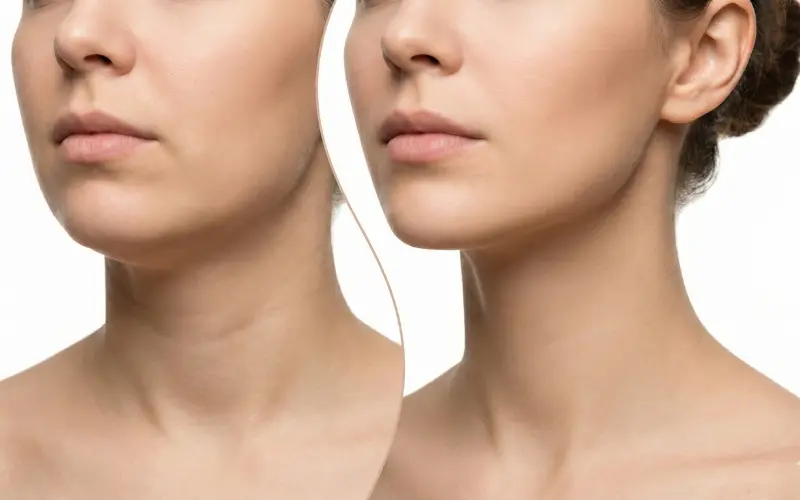
Mini Facelift in Turkey
Learn what a mini facelift (S-lift) is, who it’s for, scars, day-by-day recovery, awake/local anesthesia options, risks, and cost comparisons.
Ready to Begin Your Own Transformation Journey?
Join the 2,000+ patients who have trusted Dr Akif Mehmetoğlu and the AKM Clinic team. Your journey to a more confident, naturally restored you begins with a simple, no-obligation conversation. Contact us today from the UK for your free virtual consultation.
#1: Get Your Free Personalised Quote
Start with a free, no-obligation online consultation. Share your photos, and our surgical team will provide a fully personalised treatment plan and a transparent, all-inclusive price package. There are no hidden fees.
#2: Secure Your Date & VIP Booking
Once you are ready, our dedicated patient coordinators will help you secure your procedure date. We will handle all your bookings, including your 5-star hotel accommodation and private VIP airport transfers.
#3: Arrive in Istanbul & Meet Your Surgeon
Arrive at Istanbul Airport (IST) and be greeted by your private driver. Settle into your hotel and prepare for your in-person consultation, where you will meet your specialist surgeon to finalise the details for your "natural, subtle, and restored" new look.