



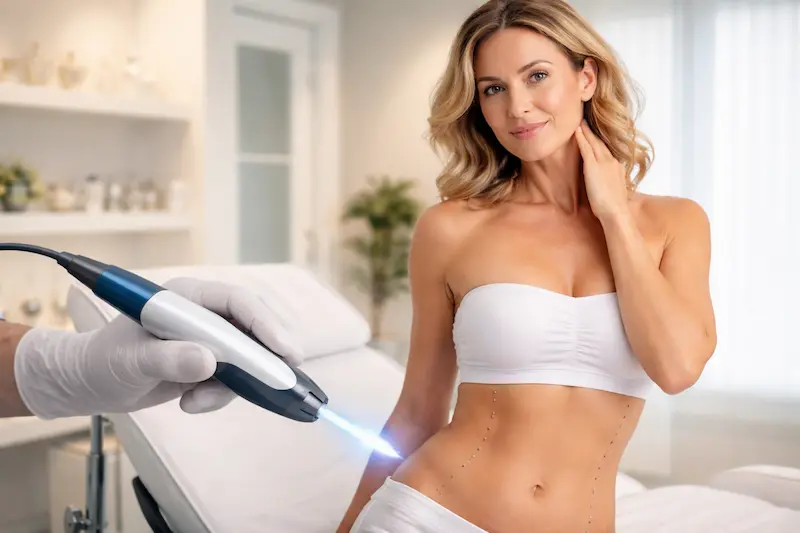
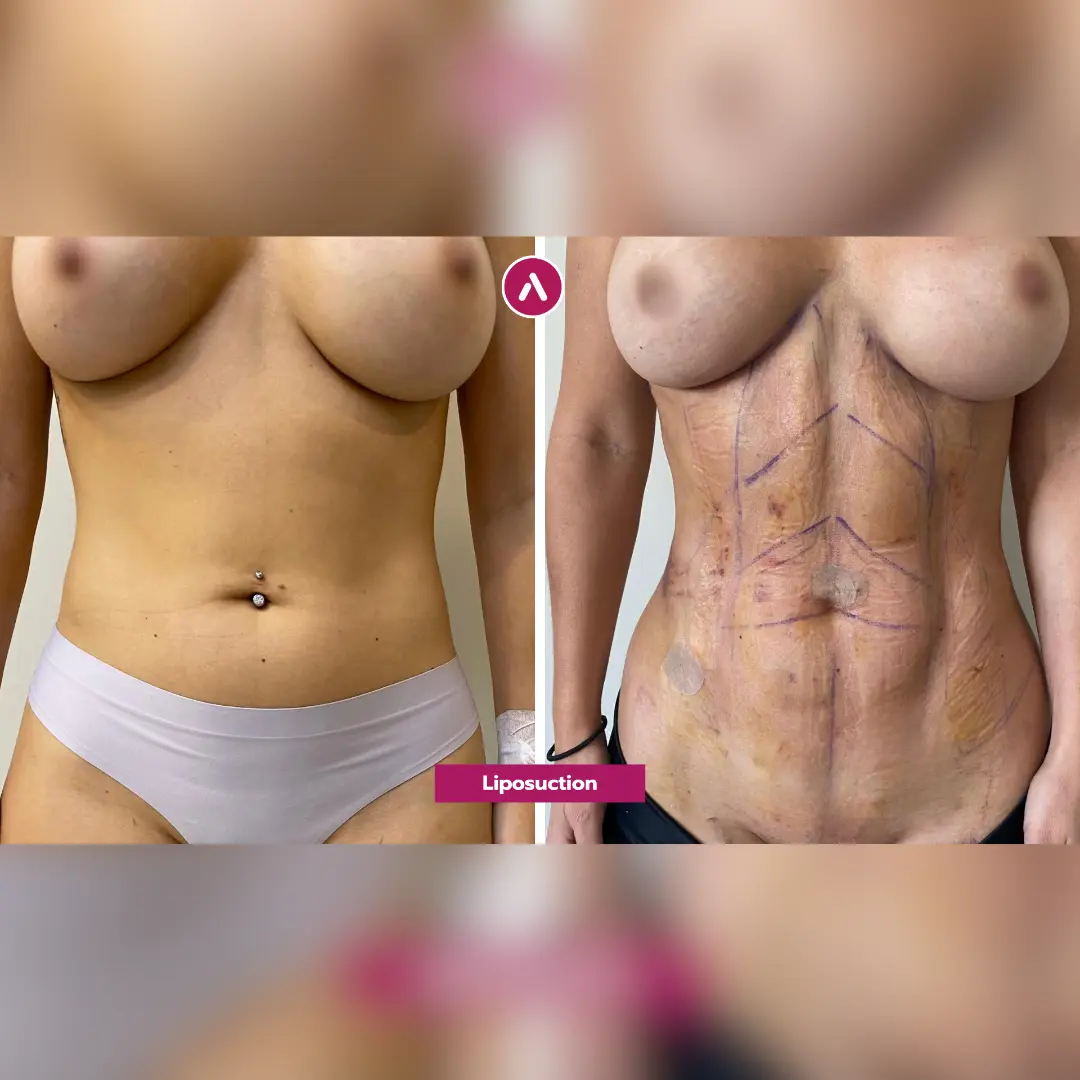
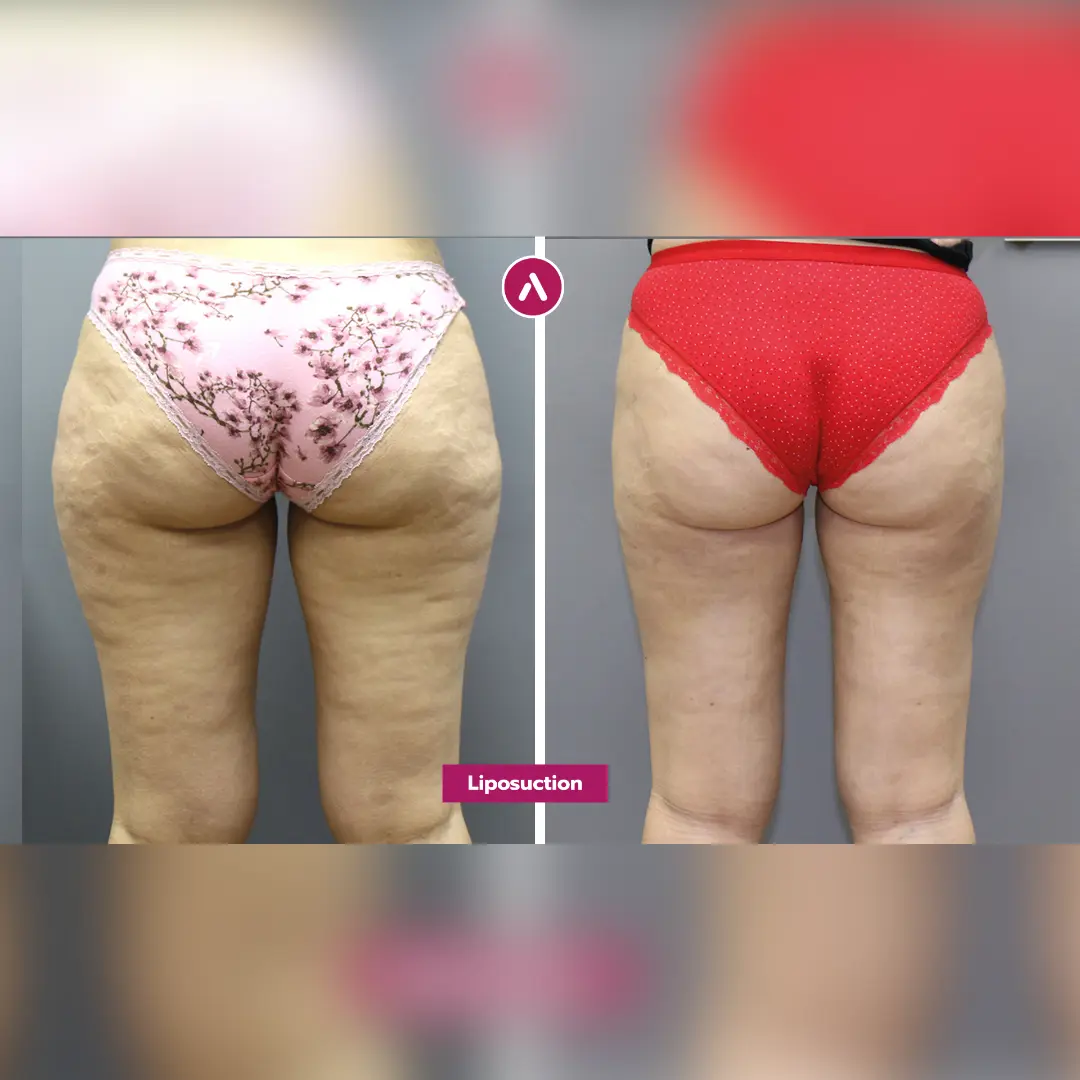
Considering J-Plasma Skin Tightening (Renuvion) to refine loose skin after contouring? This guide explains how helium plasma and RF energy support tissue contraction, where it works best, and when a lift is the smarter choice.
Built for UK readers, we cover candidacy, combined options like Lipo 360 with J-Plasma, anaesthesia choices, recovery timelines, and safety signals to watch for—so you can compare UK vs Istanbul value with confidence and decide your next step.
Table of Contents
What is J Plasma Skin Tightening?
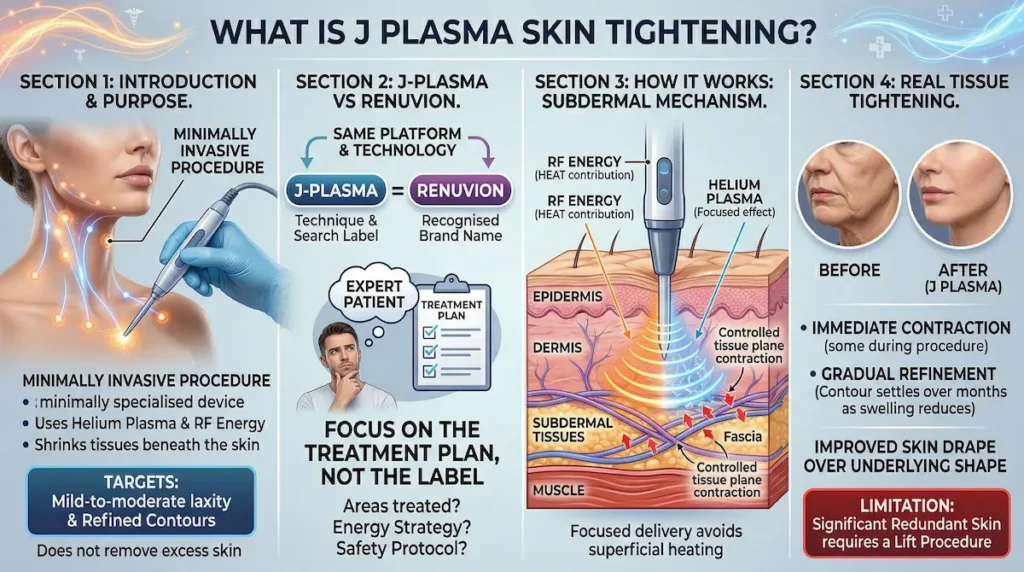
J Plasma Skin Tightening is a minimally invasive procedure that uses helium plasma and radiofrequency (RF) energy to contract tissue beneath the skin. It is typically performed through small entry points. The aim is to reduce mild-to-moderate skin laxity and refine contours. It does not remove excess skin.
In practical terms, this treatment sits between non-surgical tightening and excisional surgery. We use it when the skin needs help “shrinking” to the new shape after body contouring, or when laxity is present but not severe enough to justify a larger scar. The right plan depends on your skin quality, anatomy, and goals.
J-Plasma vs Renuvion: what do the names mean?
Patients often see both terms online and assume they are different procedures. In most contexts, they refer to the same platform and technique. The difference is usually the naming convention used by clinics, forums, or device branding. What matters is how the technology is applied and whether it suits your tissue quality.
- Renuvion is commonly used as the brand name patients recognise.
- “J-Plasma” is widely used as the technique label in aesthetic searches.
- For an “expert patient”, the key question is not the label, but the treatment plan: areas treated, energy strategy, and safety protocol.
How helium plasma and RF energy create tissue contraction
The core concept is controlled energy delivery under the skin. RF energy contributes heat, while helium helps create a plasma field that allows a focused effect. The goal is a predictable contraction response in targeted tissue planes, rather than superficial surface heating.
- Energy is applied beneath the skin through a specialised handpiece.
- Tissue contraction can support smoother contour transitions after shaping work.
- Technique matters: energy should be planned to match skin thickness and area size.
What “tightening” actually means in real tissue
“Tightening” is often used loosely online. Clinically, it usually refers to immediate contraction plus a longer, gradual settling period as tissues adapt. It can improve the way skin drapes over the underlying shape. It is not the same as removing excess skin.
- Immediate effect: tissue contracts during the procedure to some degree.
- Gradual refinement: the contour can continue to settle as swelling reduces.
- Key limitation: if there is significant redundant skin, a lift procedure may be more appropriate.
What Are The Benefits of J-Plasma Skin Tightening?
The appeal of J-Plasma skin tightening is not simply “firmer skin”. For the right candidate, it can help the skin match the new contour after fat reduction or body shaping, improving the overall finish. It can also reduce the gap between “I want improvement” and “I’m ready for a large scar”. Benefits are best understood as contour quality, not a dramatic change of identity.
Our guiding principle is simple: Rejuvenation, not alteration. That means we plan for proportional change and a natural silhouette, rather than chasing an artificial tightness that can look or feel unnatural over time.
Sharper contour where the skin needs to “keep up”
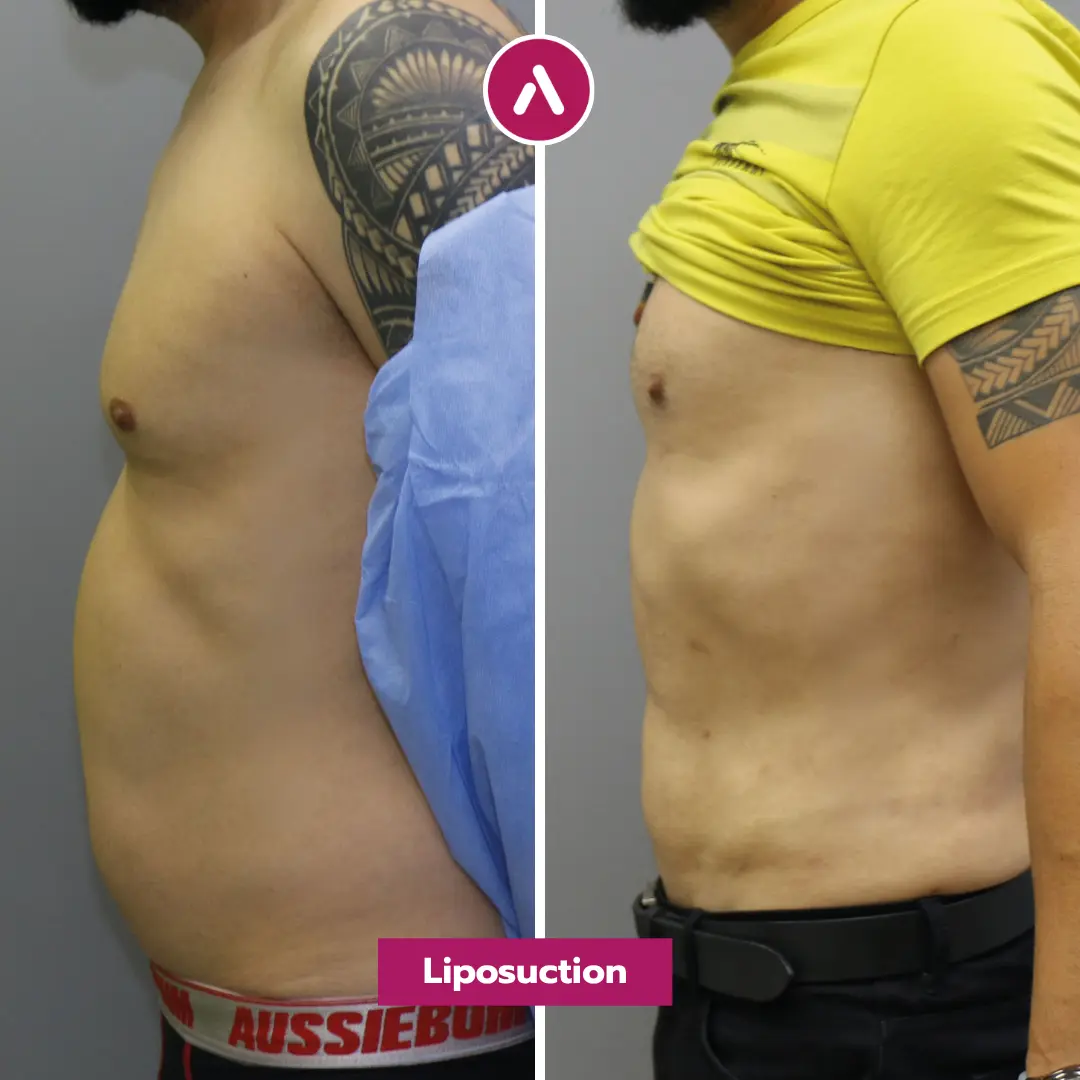
One of the most common challenges after body contouring is skin adaptation. Even when fat is reduced successfully, skin can lag behind, especially in areas where laxity pre-existed. J-Plasma can be used to support a cleaner drape and more consistent transitions between treated zones.
- Helps the skin conform to the underlying contour in selected areas.
- Can reduce the “softness” that sometimes remains after shaping alone.
- Most relevant in mild-to-moderate laxity, where the skin still has some elastic potential.
A logical “middle option” between devices and excisional surgery
Non-surgical tightening devices may suit very mild laxity, but they often rely on multiple sessions and subtle change. Excisional surgery removes skin, but it comes with longer scars and a different recovery profile. J-Plasma can offer a middle route for suitable patients who want a stronger mechanical response than devices, without immediately stepping up to a lift.
- More direct tissue effect than surface-only tightening approaches.
- No promise of “scar-free” results, but typically avoids the long scars of skin removal surgery.
- Best used as part of a plan, not as a one-size-fits-all solution.
Natural-looking refinement (not an “overdone” result)
UK patients often worry about looking “done”. That concern is valid. A good plan should focus on refinement that looks consistent with your frame and proportions, rather than pushing tightness beyond what your tissue can support comfortably.
“We aim for a result that looks unremarkable to others and simply feels more confident to you. If it looks ‘obvious’, it is rarely a good long-term strategy.”
- Better contour continuity, rather than an unnatural, pulled appearance.
- More believable outcomes when paired with realistic expectations and proper candidacy.
- A measured approach that prioritises safety, tissue respect, and proportion.
Am I a Suitable Candidate For J-Plasma Renuvion?
Suitability is not about marketing. It is about tissue behaviour. J-Plasma is most useful when the skin has some remaining elasticity, but needs help contracting after contouring or weight change. If you have significant redundant skin that can be pinched and lifted away from the body, a skin-removal procedure may deliver a more predictable outcome.
Who tends to do well with this approach?
In our experience, the best candidates sit in the “middle ground”. They want a noticeable improvement, but they also want to avoid long scars where possible. They usually have mild-to-moderate laxity, stable weight, and realistic expectations about what tightening can achieve. We look at the quality of the skin, not just the number on the scales.
- People with mild-to-moderate skin laxity after body contouring or pregnancy-related changes.
- Patients who want a refined finish after shaping (for example, after liposuction).
- Those aiming for a natural look, not an over-tight result.
When we may advise against it (or recommend an alternative)
Some situations call for a different plan. If the skin is very thin, very damaged, or clearly excessive, tightening alone can underperform. Safety matters too. During your consultation, we review your medical history, medications, and any factors that could increase risk or slow healing.
- Significant loose skin that is better treated with excisional surgery (for example, a tummy tuck or arm lift).
- Uncontrolled medical conditions that affect healing (your GP may need to support optimisation first).
- Active smoking or nicotine use, which can compromise tissue recovery and final quality.
Which areas respond best? (Stomach, thighs, arms, neck)
UK patients often search by body area. That makes sense. Different regions behave differently because the skin thickness, fat layer, and collagen density vary. During planning, we assess laxity and how the skin “moves” over the underlying tissue, then we match the technique to the anatomy.
- Abdomen / stomach: commonly used to help the skin adapt after shaping, especially in mild laxity.
- Thighs and arms: can benefit when the laxity is moderate and evenly distributed.
- Neck and jawline: suitability depends on whether the issue is skin laxity, deeper banding, or both.
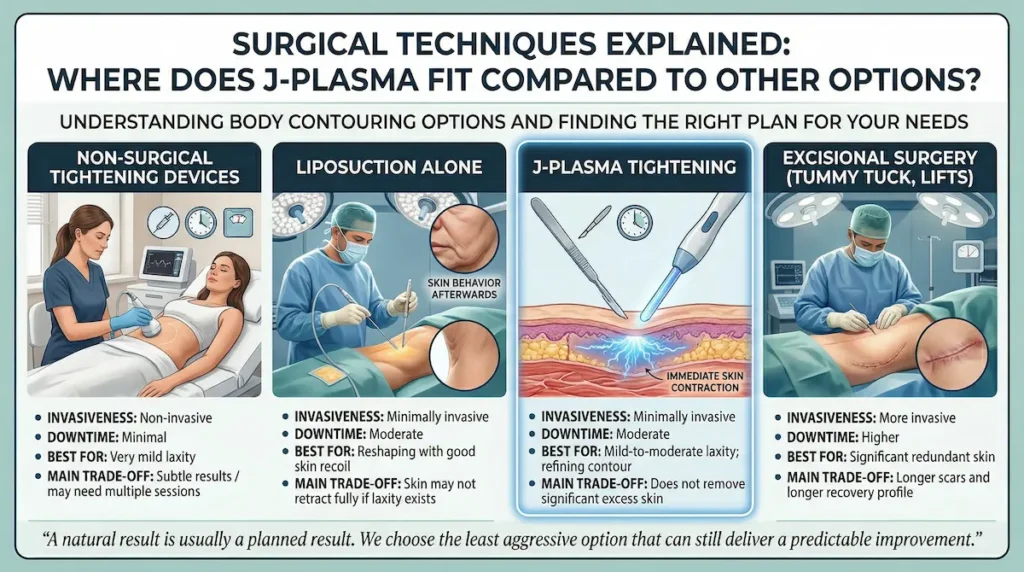
Surgical Techniques Explained: Where Does J-Plasma Fit Compared to Other Options?
Most patients do not need “the most aggressive” option. They need the right one. The key question is whether tightening should be done beneath the skin, on the surface, or through removing skin altogether. We explain the options clearly so you can judge the trade-offs: scarring, downtime, predictability, and how natural the result is likely to look.
J-Plasma vs liposuction alone (and why the finish matters)
Liposuction reshapes. It does not automatically tighten. In patients with good elasticity, skin can retract well after fat reduction. When elasticity is lower, a tightening step can improve how the skin drapes over the new contour, helping avoid a “soft” or uneven finish.
- Liposuction alone can be enough if the skin is strong and recoil is likely.
- Adding tightening can be logical when mild-to-moderate laxity is present pre-op.
- We plan this based on anatomy, not guesswork.
J-Plasma vs excisional surgery (tummy tuck, arm lift, thigh lift)
Excisional surgery removes skin. It is the most direct way to treat significant redundancy. The trade-off is scarring and a different recovery profile. When laxity is moderate, some patients prefer a less invasive route, accepting a more subtle result in exchange for smaller access points and a lighter recovery.
- If excess skin is the main issue, a lift procedure is often the most reliable solution.
- If laxity is mild-to-moderate, tightening may provide a meaningful improvement without long scars.
- Our job is to recommend what is predictable, not what is simply appealing.
J-Plasma vs non-surgical tightening devices
Non-surgical treatments can suit very mild laxity and patients who prefer a gradual approach. They can also require multiple sessions and produce subtle change. J-Plasma is typically considered when a more direct tissue contraction is needed, often as part of a surgical contouring plan. It is not “better” in every case. It is simply different.
| Option | Invasiveness | Downtime | Best for | Main trade-off |
|---|---|---|---|---|
| Non-surgical tightening devices | Non-invasive | Minimal | Very mild laxity | Subtle results / may need multiple sessions |
| Liposuction alone | Minimally invasive | Moderate | Reshaping with good skin recoil | Skin may not retract fully if laxity exists |
| J-Plasma tightening | Minimally invasive | Moderate | Mild-to-moderate laxity; refining contour | Does not remove significant excess skin |
| Excisional surgery (tummy tuck / lifts) | More invasive | Higher | Significant redundant skin | Longer scars and longer recovery profile |
“A natural result is usually a planned result. We choose the least aggressive option that can still deliver a predictable improvement.”
If you want a clinician-led recommendation, we can assess your photos and goals and explain which route is most sensible for your anatomy, including whether tightening should be standalone or combined with contouring.
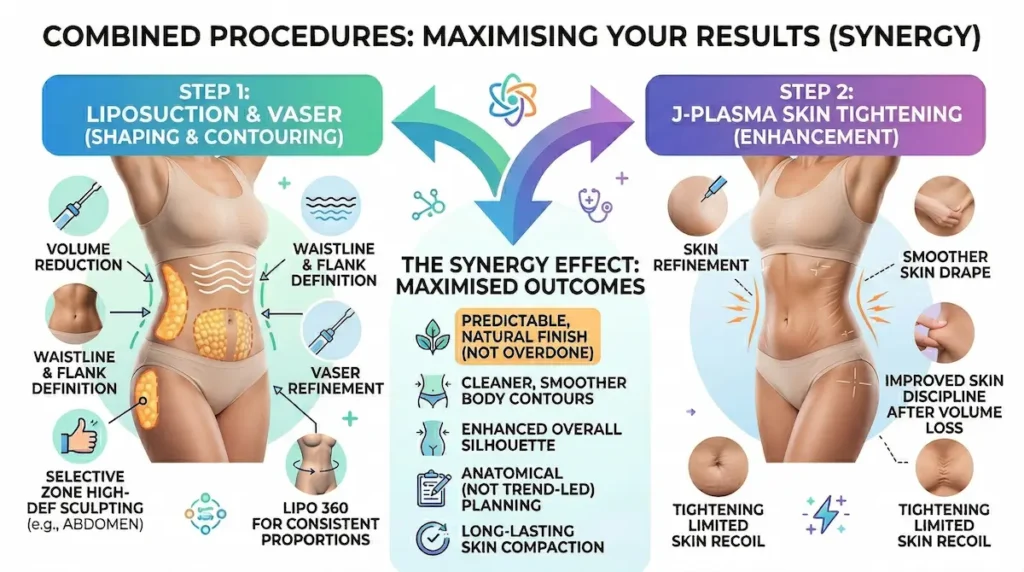
Combined Procedures: maximising your results (synergy)
J-Plasma rarely exists in a vacuum. Most patients consider it because they want a cleaner finish after shaping, not because “tightening” is the only goal. When we plan it properly, synergy is the point: one procedure creates the new contour, and the other helps the skin keep up. That is how you avoid a result that looks good on paper but soft in real life. The best plan is always anatomical, not trend-led.
Lipo 360 with J-Plasma: why this pairing is so common
Lipo 360 with J-Plasma is designed around a simple idea: shaping first, then refinement. Liposuction reduces volume and defines the waistline, flanks, and back. Tightening can then support a smoother drape of the skin over that new silhouette. For UK patients researching “full body contouring”, this combination often feels like the most logical step-up from liposuction alone.
- We use 360° shaping to create consistent proportions from front to back.
- We add tightening when skin recoil is likely to be limited.
- We prioritise an even, natural contour rather than chasing extreme definition.
High-Def VASER liposuction + J-Plasma: definition needs skin discipline
High-Def VASER liposuction aims for sharper definition, particularly in the abdomen, flanks, and chest in suitable candidates. The more definition you want, the more the skin has to behave. That is where a tightening step can make sense, especially in patients with early laxity or post-weight-change skin quality. We choose this combination selectively, because not every body type benefits from “high definition”.
- VASER can support precise fat sculpting in selected zones.
- J-Plasma can help the skin sit more cleanly over those transitions.
- Our focus stays on balance and proportion, not an “overdone” look.
“Synergy is not about doing more. It is about doing what is necessary for a predictable, natural finish.”
Other common combinations and how we decide on staging
You may see long lists of “package” procedures online. We take a more measured approach. Some combinations are sensible on the same day, while others are better staged to protect your recovery and reduce risk. The decision depends on operative time, your medical profile, and how your tissues are likely to respond.
- Common pairings include liposuction with targeted tightening of the abdomen, arms, thighs, or neck.
- For significant loose skin, we may advise a lift procedure instead of relying on tightening alone.
- If you are considering a broader transformation (for example a Mummy Makeover), we map priorities and safety first.
Anaesthesia: why we prefer awake/twilight sedation
Anaesthesia is often the moment where an “expert patient” becomes a cautious patient. That is normal. People do not just worry about pain; they worry about nausea, grogginess, and the risks they associate with general anaesthesia. We take that concern seriously and build the plan around your safety profile and comfort. For many suitable patients, local anaesthesia with sedation can be a sensible, controlled approach.
Understanding your options: local anaesthesia, sedation, and general anaesthesia
There is no single “right” anaesthetic for every case. The correct choice depends on the extent of treatment, your anxiety level, your medical history, and the likely duration in theatre. We talk you through the options in plain terms, then confirm the plan with clinical checks. Nothing is rushed.
- Local anaesthesia: numbs the treatment area, often using a tumescent technique.
- Twilight sedation: helps you stay calm and comfortable while still breathing independently.
- General anaesthesia: may be appropriate for longer or more complex combined procedures.
Why “awake” or twilight sedation can be a safety-led choice
Many patients simply want to avoid general anaesthesia where it is not strictly necessary. That preference can be reasonable, particularly for people who have had difficult experiences in the past or feel anxious about “being put to sleep”. We use awake or twilight approaches when they match the procedure plan and your clinical profile. If we believe general anaesthesia is safer for your case, we will say so directly.
- Clearer recovery in the early hours can feel reassuring for many patients.
- It may reduce certain post-anaesthetic side effects for suitable individuals.
- Pre-operative screening and a tailored plan are non-negotiable.
“Comfort matters, but safety leads. The best anaesthetic plan is the one that keeps risk low and recovery steady.”
What it feels like, and how we manage comfort afterwards
Patients often ask the same question: “Will I feel anything?” During treatment, you should feel pressure and movement, not sharp pain. Afterwards, tightness and soreness are common, particularly in the first few days. We guide you through a simple, realistic pain-control routine and tell you when to contact us.
- Most patients do well with a structured plan using paracetamol and clinician-advised medication.
- Swelling and bruising can occur; your body needs time to settle.
- If you are worried after you return to the UK, we stay available and advise you when to contact your GP or attend A&E.
If you want a clinician-led recommendation: we can review your photos, medical history, and goals, then explain which anaesthesia plan suits your procedure pathway.
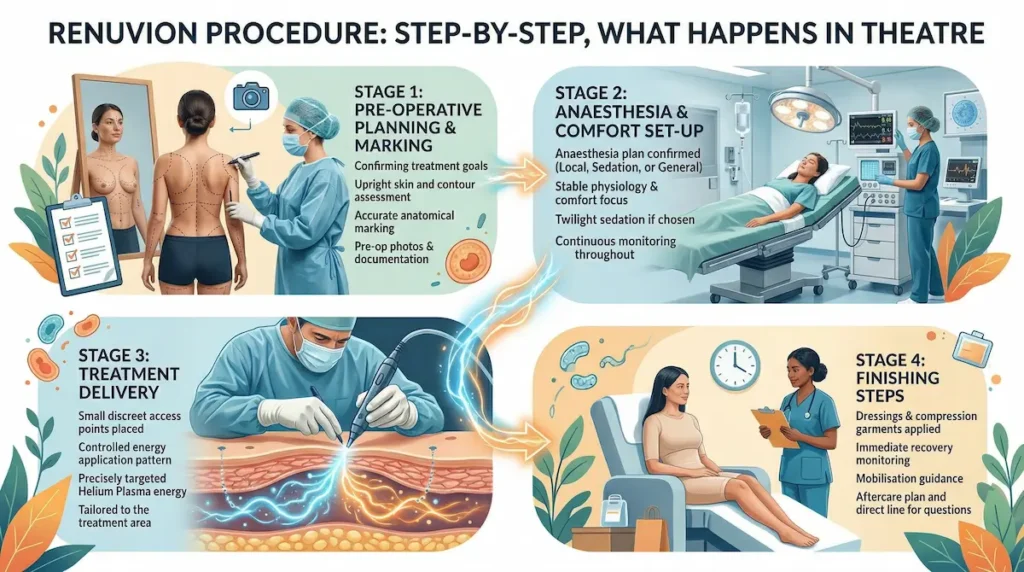
J-Plasma Skin Tightening Step-by-step: What happens in theatre?
Knowing the sequence reduces anxiety and helps you judge whether a clinic’s process sounds structured and safe. While the exact steps vary depending on whether J-Plasma is performed alone or combined with contouring, the fundamentals remain the same: clear marking, controlled anaesthesia, precise energy delivery, and calm post-operative monitoring.
1) Pre-operative planning and marking
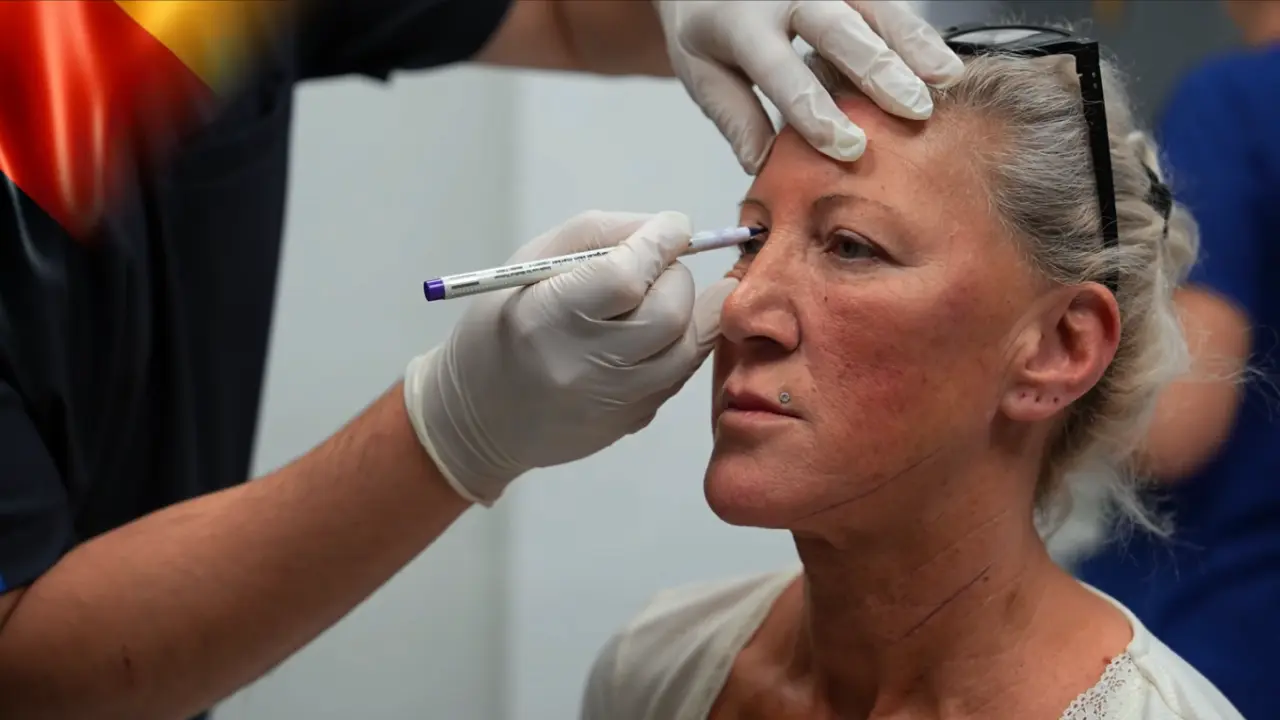
On the day of surgery, your surgeon will confirm the treatment areas, examine skin quality again, and mark the anatomy while you are standing (where relevant). This is important because tissue behaviour changes when you lie down. If J-Plasma is combined with liposuction, the plan focuses on contour first, then tightening where the skin needs support.
- Confirming your goals and the agreed surgical plan.
- Skin and contour assessment in the upright position.
- Pre-op checks and photographs (where appropriate) for documentation and planning.
2) Anaesthesia and comfort set-up
Your anaesthesia plan is confirmed based on the procedure length, combined steps, and your medical profile. Many patients are suitable for local anaesthesia with sedation, but some cases are safer under general anaesthesia. The aim is the same in both: stable physiology, comfort, and predictable recovery.
- Local anaesthesia (often with a tumescent technique) to numb the area.
- Twilight sedation when needed to reduce anxiety and improve comfort.
- Continuous monitoring throughout the procedure.
“A calm theatre is a safer theatre. Good technique is not just what happens under the skin, but how consistently the process is controlled.”
3) Treatment delivery: access points and controlled energy application
J-Plasma is delivered beneath the skin through small access points. The handpiece is guided through the targeted tissue planes and energy is applied in a controlled pattern. The strategy is tailored to the area: abdomen and flanks behave differently from arms, thighs, or the neck. When tightening follows liposuction, the goal is a smoother drape and cleaner contour transitions.
- Small entry points are placed in discreet positions where possible.
- Energy is applied beneath the skin using a planned pattern rather than guesswork.
- Technique is matched to tissue thickness and the size of the treatment zone.
4) Finishing steps: dressings, garments, and recovery monitoring
After treatment, we apply dressings and, where indicated, a compression garment to support swelling control and comfort. You then move into monitored recovery. Before discharge, we make sure you are stable, comfortable, and understand your aftercare plan.
- Dressings and compression garments (if appropriate for your procedure plan).
- Immediate recovery monitoring and mobilisation guidance.
- Clear written instructions and a direct line for post-op questions.
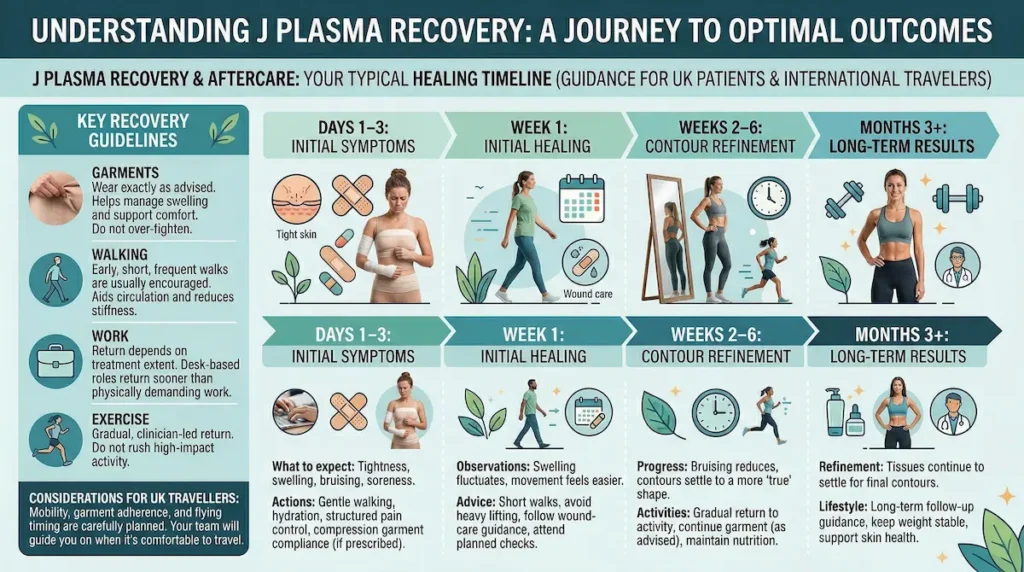
J Plasma Recovery & Aftercare: how long does healing take?
Recovery is a process, not a single day. Most patients notice early swelling and tightness, followed by gradual settling. If you are travelling from the UK, we also plan around practical concerns such as mobility, garment compliance, and when you can fly comfortably. Your exact timeline depends on the areas treated, whether liposuction was included, and your individual healing response.
Typical recovery timeline (what most patients can expect)
| Timeframe | What you may notice | What we typically advise |
|---|---|---|
| Days 1–3 | Tightness, swelling, bruising, soreness | Gentle walking, hydration, structured pain control, garment compliance (if prescribed) |
| Week 1 | Swelling fluctuates; movement feels easier | Short walks, avoid heavy lifting, follow wound-care guidance, attend planned checks |
| Weeks 2–6 | Bruising reduces; contour begins to look more “true” | Gradual return to activity, continue garment as advised, maintain stable nutrition |
| Months 3+ | Refinement continues as tissues settle | Long-term follow-up guidance; keep weight stable; support skin health |
Compression garments, activity, and day-to-day rules
Aftercare is where good surgery becomes a good outcome. Compression garments (when prescribed) help manage swelling and support comfort. Light activity reduces stiffness and supports circulation. The key is consistency, not intensity.
- Garments: wear exactly as advised; over-tightening can be counterproductive.
- Walking: short, frequent walks are usually encouraged early.
- Work: desk-based roles often return sooner than physically demanding work; your plan depends on the extent of treatment.
- Exercise: structured return should be clinician-led; do not rush high-impact activity.
Strategic add-ons: HBOT and LLLT (optimising recovery)
Some patients search specifically for “recovery time” because they have work, family, or travel constraints. Where clinically appropriate, we may recommend supportive protocols designed to optimise tissue recovery. These are not “shortcuts”, and they do not replace proper aftercare. They are adjuncts used to support healing and comfort in a structured way.
- HBOT (Hyperbaric Oxygen Therapy): may be used as part of a recovery-focused protocol to support tissue oxygenation in selected cases.
- LLLT (Low Level Laser Therapy): may be used to support swelling management and comfort as tissues settle.
- Important: suitability depends on your medical history and the procedure plan.
“A smoother recovery is rarely accidental. It is usually the result of planning, consistent aftercare, and the right support where clinically appropriate.”
Flying back to the UK: planning for comfort and safety
If you are travelling, we plan aftercare around safe mobilisation and practical comfort. Timing depends on the extent of your procedure and how you are recovering. Before you fly, you should be able to move comfortably, manage swelling, and understand the warning signs that require medical advice.
- We provide travel-aware guidance based on your procedure and progress.
- We advise on movement, hydration, and garment use during travel where relevant.
- If you have concerns after you return home, we remain available and will advise you when to contact your GP or attend A&E.
Safety & Risks: Is J-Plasma Dangerous?
Any procedure that delivers energy beneath the skin must be approached with respect. J-Plasma is not “dangerous” by default, but it is not trivial either. Safety depends on correct patient selection, appropriate technique, controlled energy use, sterile operating conditions, and structured aftercare. A responsible clinic will explain both the benefits and the limitations without promising a perfect outcome.
Common, expected effects (not usually complications)
Many post-operative changes are part of normal healing. They can feel worrying if you were not prepared for them, which is why we explain what is expected and what is not.
- Swelling and bruising in the treated area(s), often fluctuating over the first 2–3 weeks.
- Tightness, firmness, or tenderness as tissues settle.
- Temporary numbness or altered sensation in some zones, improving gradually for most patients.
Potential risks and side effects (what we actively try to prevent)
No clinic can honestly say there is “no risk”. What matters is how risks are reduced and how quickly concerns are addressed. Depending on the area treated and whether liposuction is combined, risks may include:
- Thermal injury (for example burns) if energy is misapplied or tissue response is not respected.
- Seroma (fluid collection) which may require monitoring or drainage.
- Infection (rare when protocols are followed, but possible in any procedure).
- Contour irregularities (lumps, waviness, or asymmetry), particularly where skin quality is limited.
- Prolonged swelling or delayed healing, influenced by individual factors and aftercare adherence.
“Safety is not a claim. It is a system: selection, technique, monitoring, and aftercare — repeated consistently.”
How we reduce risk: the practical safety framework
Risk reduction is mostly unglamorous, which is exactly the point. It is a sequence of checks and standards that should feel almost boring because they are consistent.
- Patient selection: we assess laxity, skin quality, and medical factors that influence healing.
- Clear planning: targeted areas and energy strategy are planned rather than improvised.
- Controlled theatre protocols: sterile technique, appropriate monitoring, and a calm operating environment.
- Aftercare structure: compression guidance (when indicated), activity instructions, and direct access to advice.
When to seek urgent help (especially after returning to the UK)
Most people recover uneventfully, but you should never ignore symptoms that could indicate infection, a fluid collection, or another complication. If you feel unwell or symptoms are escalating rather than settling, you should seek medical advice.
- Fever, chills, or feeling systemically unwell.
- Rapidly increasing redness, warmth, severe pain, or foul-smelling drainage.
- Sudden swelling that is worsening, or a tense fluid-like pocket.
- Breathing difficulty, chest pain, or fainting (seek emergency care immediately).
If you are in the UK and you are concerned, we will advise you when to contact your GP and when to attend A&E. If symptoms feel urgent, do not wait for messages — seek immediate medical help.
Is J-Plasma Safe In Turkey for UK Patients?
This question is less about geography and more about standards. The safest pathway is the one with clear surgical governance: an experienced surgeon, an appropriate facility, transparent consent, and structured follow-up. UK patients should judge a clinic by how it handles risk, not by how confidently it markets results.
What to look for: surgeon credentials and clinical governance
When patients search “best J-Plasma surgeon” or “Turkey reviews”, they are usually trying to confirm competence and consistency. You should expect a clinic to explain who is responsible for your care and how decisions are made.
- Clear surgeon accountability: who plans the procedure and who performs it.
- Credentials and scope: training background, case volume, and which procedures the surgeon routinely performs.
- Informed consent: benefits, risks, alternatives, and realistic outcomes explained in a way you can understand.
Why “procedure-first” matters more than “location-first”
Many UK searches start with a city name (London, Manchester, Leeds) and then shift to comparing value and protocols. We take a procedure-first approach: what is the right method for your anatomy, and what support makes recovery safer and steadier. Cost comparisons only make sense after the clinical plan is correct.
- We focus on suitability: tightening vs skin removal vs non-surgical options.
- We plan combinations carefully (for example, Lipo 360 with J-Plasma) to avoid unnecessary complexity.
- We build an aftercare pathway that remains active once you return to the UK.
Post-operative follow-up for international patients (what “good” looks like)
For travelling patients, follow-up is not optional. It should be designed, scheduled, and easy to access. You should know exactly how to reach the team, what check-ins are planned, and what happens if you have a concern weeks later.
- Structured check-ins: early post-op review plus remote follow-up after you return home.
- Clear escalation rules: what is normal vs what needs urgent review.
- Practical documentation: written aftercare, medication guidance, and travel-aware instructions.
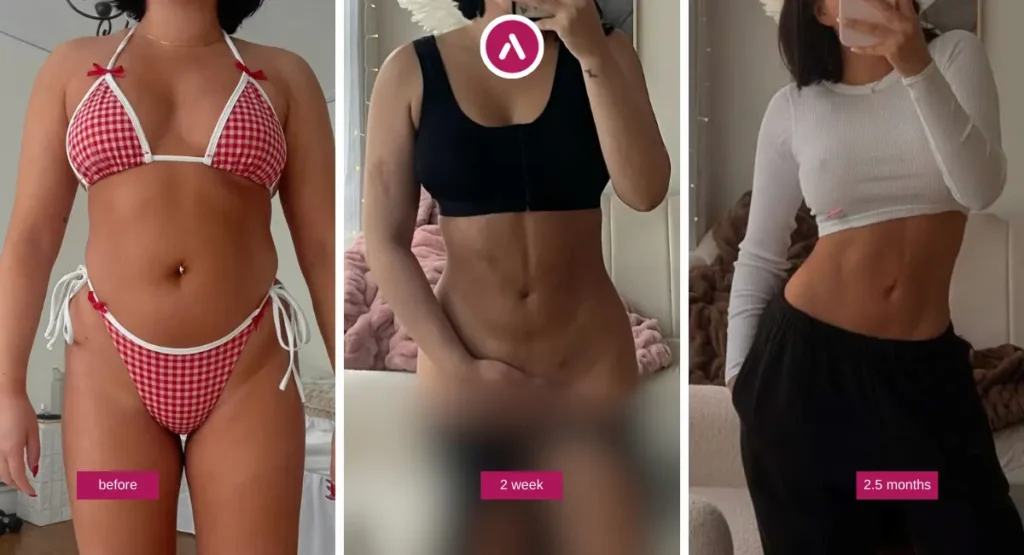
Renuvion Before and After: Realistic expectations & results
J-Plasma can deliver a meaningful improvement in contour quality for the right candidate, but it is not a magic eraser for significant loose skin. The most satisfying outcomes usually come from two things: correct selection (mild-to-moderate laxity) and a plan that respects your tissue limits. If you approach this as refinement rather than reinvention, you are far more likely to be pleased with the result.
When do results appear — and when do they peak?
It is normal to want an immediate “before and after”. However, early swelling can temporarily distort shape, especially when tightening is combined with liposuction. Most people see an early change, followed by a settling phase, then gradual refinement.
- Early phase (first 1–2 weeks): swelling, tightness, bruising, and firmness are common; the contour can look uneven day-to-day.
- Settling phase (weeks 2–6): swelling reduces and your silhouette usually looks more consistent.
- Refinement phase (months 3+): the result typically looks more “final” as tissues soften and the contour stabilises.
“If you judge the result too early, you may judge the swelling, not the surgery.”
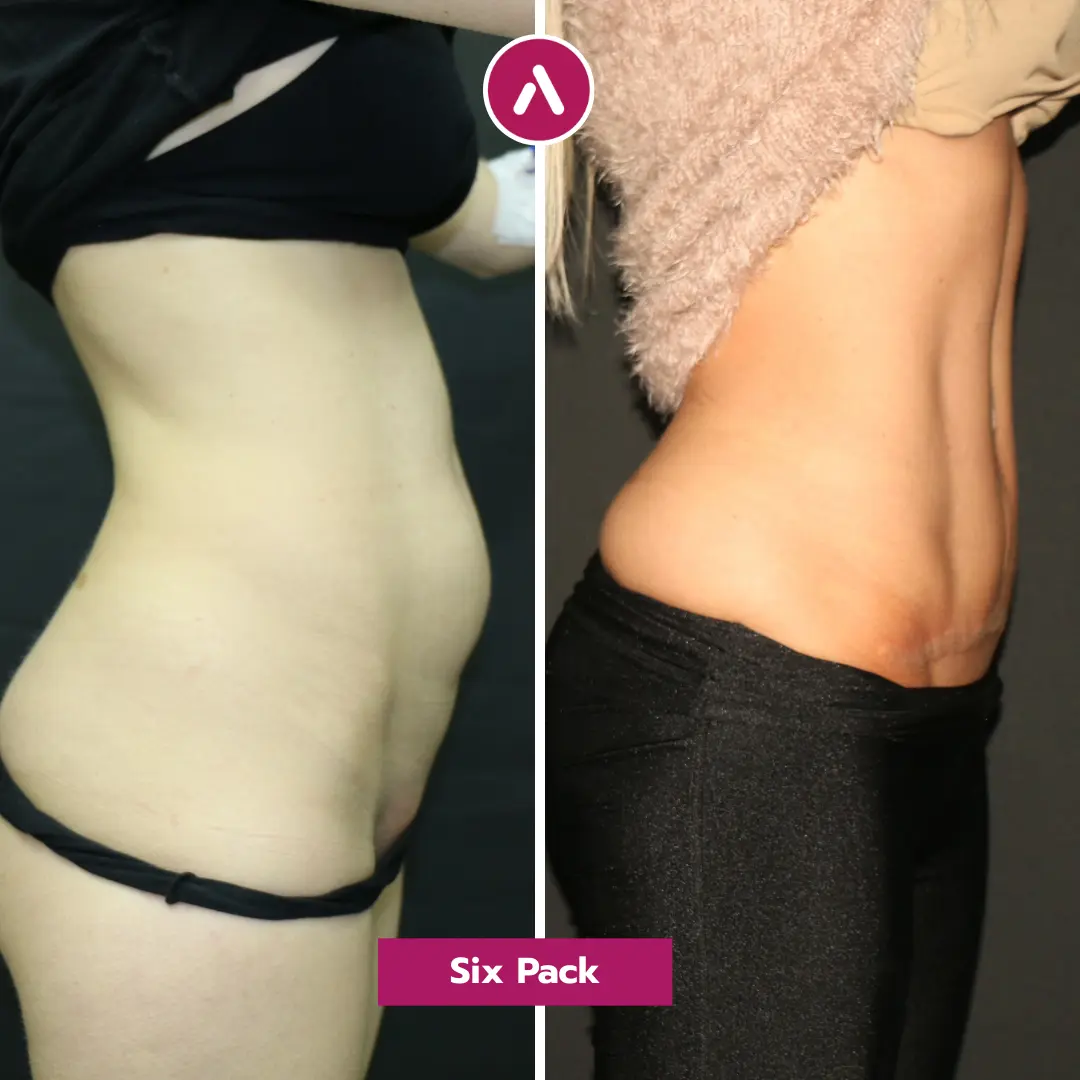
What influences your result more than “technology”
Search results often make it sound as if the device alone creates the outcome. In reality, results are shaped by your skin quality and how well your tissues respond to controlled energy. Your lifestyle and aftercare also matter more than most people expect.
- Skin quality and elasticity: better elasticity generally means better recoil and a smoother drape.
- Degree of laxity: mild-to-moderate laxity is typically where tightening performs best.
- Weight stability: significant weight changes after treatment can reduce longevity and consistency.
- Aftercare adherence: garment compliance (if prescribed), early mobility, and pacing your return to activity.
How to interpret “before and after” properly (expert-patient approach)
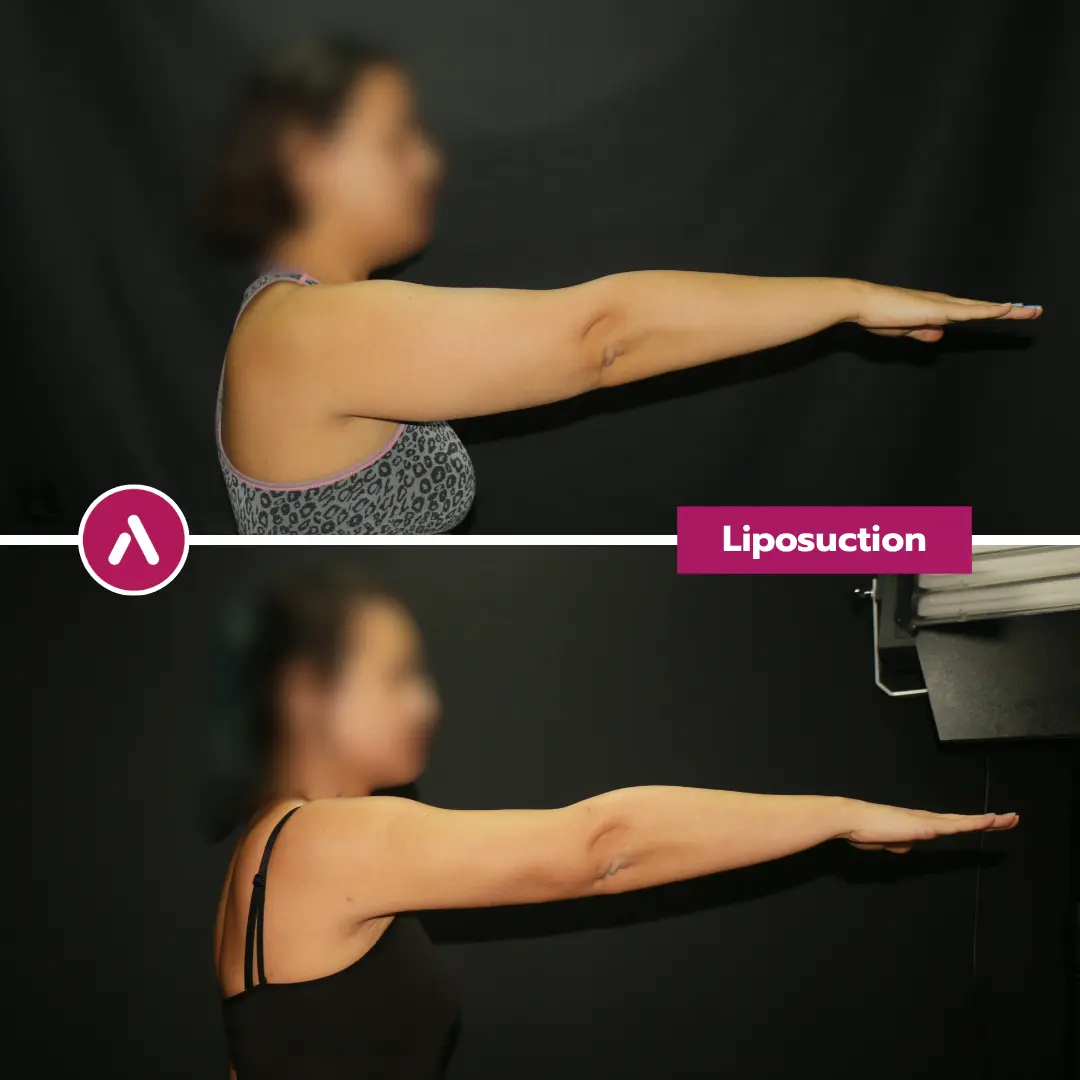
Photos can be helpful, but they can also be misleading if you do not know what you are looking at. When you review images, focus on consistency and contour transitions rather than dramatic lighting differences.
- Look for similar angles, lighting, and posture before and after.
- Assess contour continuity (smooth transitions) rather than only “tightness”.
- Ask what was combined: tightening alone vs liposuction + tightening vs excisional surgery.
“A good result is usually a consistent result — across multiple cases, not one perfect photo.”
Is it permanent?
No aesthetic procedure can stop time, and “permanent” is not a clinically honest promise. What we aim for is durable improvement. Your tissues will continue to age, but you can protect your outcome by maintaining stable weight, staying active, and supporting skin health. If you want the most predictable correction for significant excess skin, a lift procedure is often the more definitive option.
Cost Analysis: J Plasma Cost 2026 (Turkey vs UK value)
When UK patients search “J-Plasma cost” or “Renuvion price”, they often want a number. In practice, responsible pricing comes from a defined clinical plan. The fee depends on the areas treated, whether liposuction is included, the anaesthesia approach, and the level of follow-up and recovery support. A quote that ignores these variables is rarely reliable.
What determines the fee?
- Number of areas treated (and their size): abdomen and flanks differ from arms, thighs, or neck.
- Standalone vs combined procedures: for example, Lipo 360 with J-Plasma is a different pathway to tightening alone.
- Anaesthesia plan: local anaesthesia with sedation vs general anaesthesia (where clinically indicated).
- Facility and safety standards: theatre time, monitoring, and post-op care structure.
- Aftercare and recovery support: scheduled reviews, remote follow-up, and adjunct recovery protocols where appropriate.
Why “cheapest” is not a strategy (and what value actually means)
For an expert patient, “value” is not a discount. Value is a predictable outcome with a safe pathway: correct selection, correct technique, and proper follow-up. Comparing fees only makes sense when you compare what is included and what your care pathway looks like from consultation to long-term check-ins.
“A good quote should explain what you are paying for — not just what you are paying.”
| Comparison factor | Typical UK pathway (city clinics) | Istanbul pathway (procedure-first model) |
|---|---|---|
| How treatment is packaged | Often priced as a single procedure or per-area | Commonly planned as an integrated contour pathway (e.g., shaping + tightening where indicated) |
| Combined procedures | May require separate bookings or staged planning | Often structured as a cohesive plan (e.g., VASER contouring + J-Plasma refinement) |
| Anaesthesia options | Varies by provider and case complexity | Local anaesthesia with sedation may be considered for suitable patients; general anaesthesia used when clinically safer |
| Recovery support | Standard post-op care and follow-up appointments | Option to include structured recovery protocols (e.g., HBOT / LLLT) where clinically appropriate |
| Follow-up structure for UK patients | Local follow-up is straightforward; international follow-up is not relevant | Travel-aware aftercare with planned remote check-ins once you return to the UK |
| How to judge “value” | Compare surgeon experience, governance, and included care | Compare the full pathway: suitability, technique plan, included aftercare, and ongoing support |
What you should ask before accepting a quote
- Is the plan standalone or combined (and why)?
- Which areas are included, and how is the treatment strategy decided?
- What anaesthesia approach is recommended for my case?
- What aftercare is included, and what happens once I’m back in the UK?
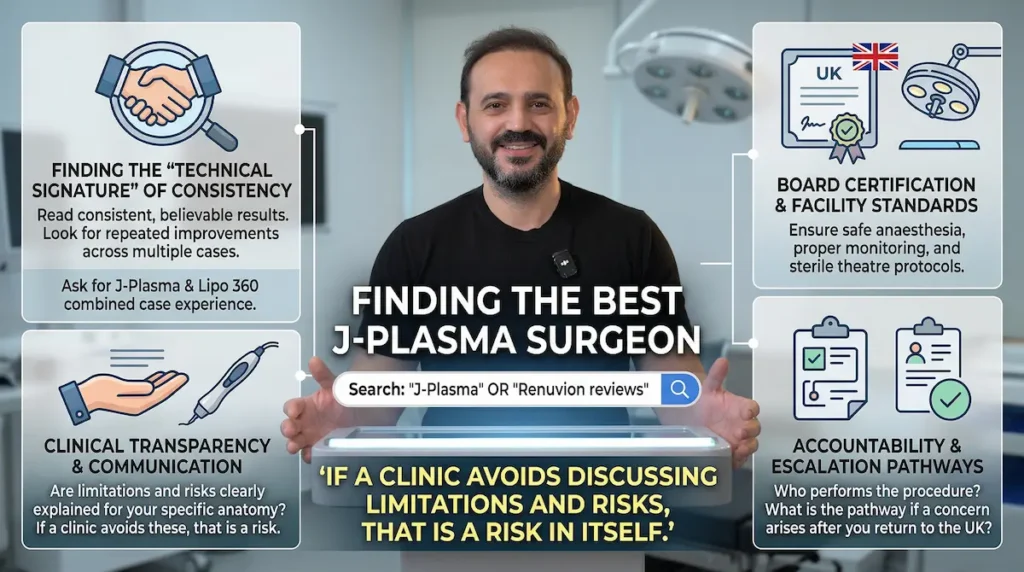
Finding the Best J-Plasma Surgeon
When patients search “best J-Plasma surgeon” or “Renuvion reviews”, they are usually trying to answer one question: “Can I trust this person with my body?” The most reliable indicators are not slogans or influencer clips. They are credentials, case consistency, and how clearly the team explains risk, alternatives, and recovery.
What matters most: safety, consistency, and accountability
- Who is responsible for your plan? You should know who assesses you, who performs the procedure, and who manages follow-up.
- Clinical transparency: a surgeon should explain what J-Plasma can achieve for your anatomy — and when it is not the right tool.
- Governance and facility standards: safe anaesthesia, proper monitoring, sterile theatre protocols, and structured aftercare.
“If a clinic avoids discussing limitations and risks, that is a risk in itself.”
Board certification, case volume, and complication readiness
Experienced surgeons do not just know how to create results — they know how to prevent problems and manage them if they occur. Ask direct questions and expect direct answers.
- What is the surgeon’s scope of practice and typical case mix?
- How often do they perform tightening combined with contouring (e.g., Lipo 360 with J-Plasma)?
- What is the escalation pathway if you develop a concern after you return to the UK?
How to “read” before-and-after photos like an expert patient
Do not look for one dramatic transformation. Look for repeated, believable improvements across different bodies. The aim is to see a surgeon’s “technical signature” — consistent contour transitions, proportional outcomes, and realistic timelines.
- Insist on consistent lighting and angles to reduce visual tricks.
- Ask what procedures were combined (tightening alone vs liposuction + tightening vs excisional surgery).
- Look for smooth transitions rather than simply “tightness”.
Your Medical Journey in Istanbul: what to expect (arrival to departure)
If you are travelling from the UK, the most important part of the journey is not the airport transfer — it is the structure of your care pathway. A good pathway feels predictable: clear timeline, clear instructions, and a team that remains reachable once you are home.
Step 1: remote assessment and a clear treatment plan
We typically begin with an online review of your goals, medical background, and photos. From there, we explain whether J-Plasma is appropriate, whether it should be combined, and what a realistic outcome looks like for your anatomy.
- Photo review focused on laxity, skin quality, and target areas.
- Recommendation: tightening vs liposuction alone vs skin-removal surgery where indicated.
- Discussion of anaesthesia options based on your procedure pathway.
Step 2: arrival, pre-op checks, and theatre day
Once you arrive, the focus shifts to safety and confirmation. Your plan should be re-checked in person, not simply repeated. Pre-op checks, marking, and a calm theatre process are all part of clinical governance.
- In-person examination and confirmation of the surgical plan.
- Pre-operative screening and safety checks.
- Procedure day with monitored recovery and a structured discharge plan.
Step 3: early recovery and travel-aware support
Early recovery is where many travelling patients want clarity: garments, walking, sleep position, showering, and what “normal” looks like. We provide guidance designed for international patients, including what to watch for once you return to the UK.
- Clear aftercare instructions and practical daily rules.
- Planned review(s) before travel, depending on your procedure extent.
- Travel-aware advice on mobility, hydration, and comfort.
Step 4: remote follow-up after you return to the UK
Follow-up should continue after you fly home. You should have a clear pathway for check-ins and an escalation plan for concerns. If you need UK-based review, we advise you when to contact your GP and when to attend A&E.
- Scheduled remote check-ins as your contour settles.
- Support for questions about swelling, firmness, sensation changes, or asymmetry as tissues settle.
- Clear escalation guidance for symptoms that are not normal.
“A good international pathway does not end at the airport. It stays active while your result stabilises.”
J Plasma Skin Tightening Frequently Asked Questions (FAQ):
Does J-Plasma hurt?
During the procedure, you should feel pressure and movement rather than sharp pain, especially with local anaesthesia and (when needed) twilight sedation. Afterwards, tightness and soreness are common for several days. We provide a structured comfort plan and guidance on what is normal.
How long is Renuvion (J-Plasma) recovery time?
Most people can return to light daily activity quickly, but swelling and firmness can take weeks to settle. If J-Plasma is combined with liposuction, downtime is usually longer than tightening alone. Refinement commonly continues for several months.
When can I fly after J-Plasma?
This depends on what was treated and whether liposuction or other procedures were combined. The goal is to travel when you can mobilise comfortably and your early recovery is stable. We provide travel-aware guidance and clear warning signs to monitor after your return to the UK.
When do “before and after” results look most accurate?
Early photos can be distorted by swelling. Many patients find the result looks more reliable after the settling phase (weeks) and more refined over the following months as tissues stabilise.
Is J-Plasma permanent?
It is best described as durable improvement rather than “permanent”. Your tissues continue to age. Stable weight, healthy lifestyle habits, and good aftercare help protect your result.
Can J-Plasma replace a tummy tuck or arm lift?
Not reliably when there is significant excess skin. Tightening does not remove redundant skin. If loose skin is pronounced, excisional surgery is often the more predictable option.
Medical disclaimer: This page is for general information only and does not replace a face-to-face medical consultation. Every procedure carries risks and results vary between individuals. Your suitability, treatment plan, and recovery timeline should be confirmed by a qualified clinician after a full assessment.