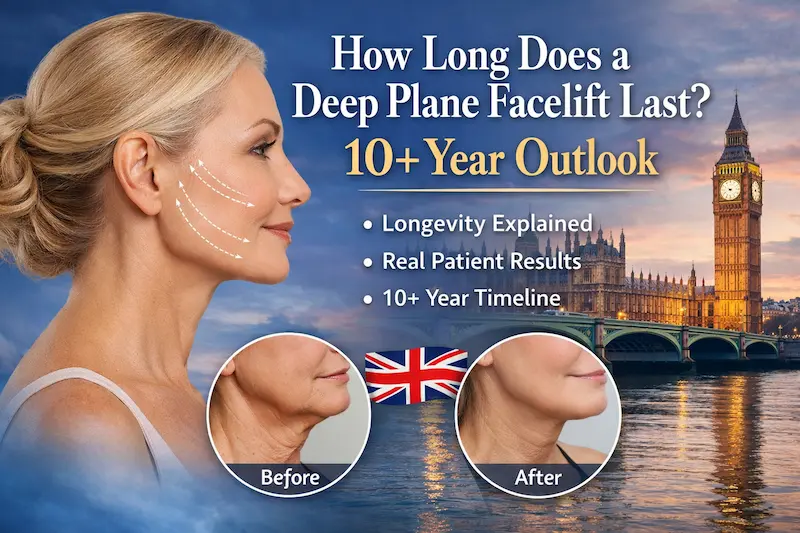
How long does deep plane facelift last — and what does a “10+ year outlook” actually mean in real life? For many discerning UK patients, this isn’t just curiosity. It’s a value question: if I’m choosing surgery, will the result still look natural, credible, and worth it a decade from now?
In this guide, we’ll set expectations using clear, surgeon-led reasoning grounded in medical science and what we see clinically over time. You’ll also find the key factors that influence deep plane facelift longevity, how to interpret the longevity of deep plane facelift results, and what “lasting” looks like year-by-year—without marketing exaggeration.
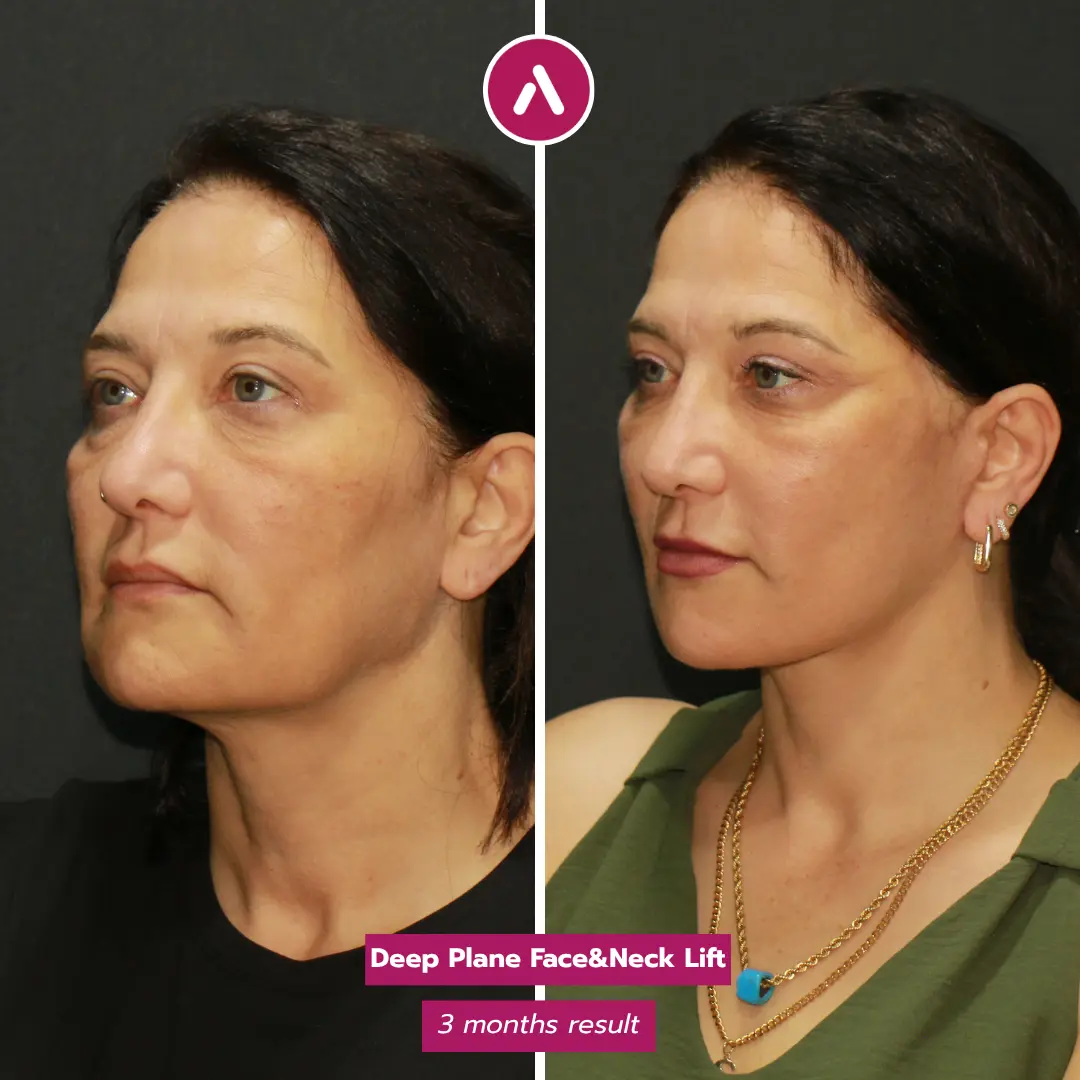
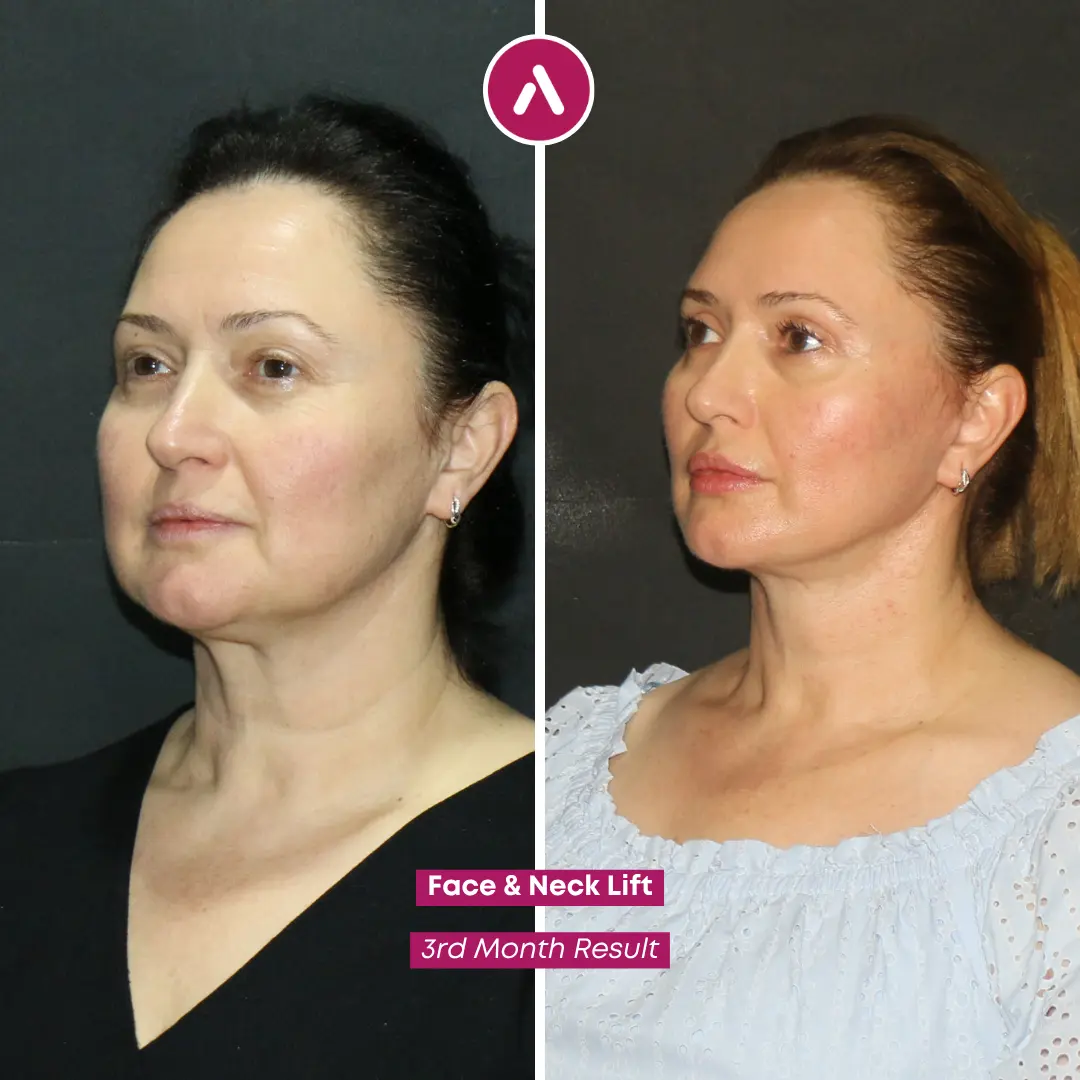
Throughout the article, we’ll use UK English (anaesthesia, oedema, etc.) and focus on what matters to the UK “expert patient”: safety signals, realistic timelines, and the long-term value of deep plane facelift versus alternatives.
Table of Contents
What “Lasting Results” Actually Means in a Deep Plane Facelift
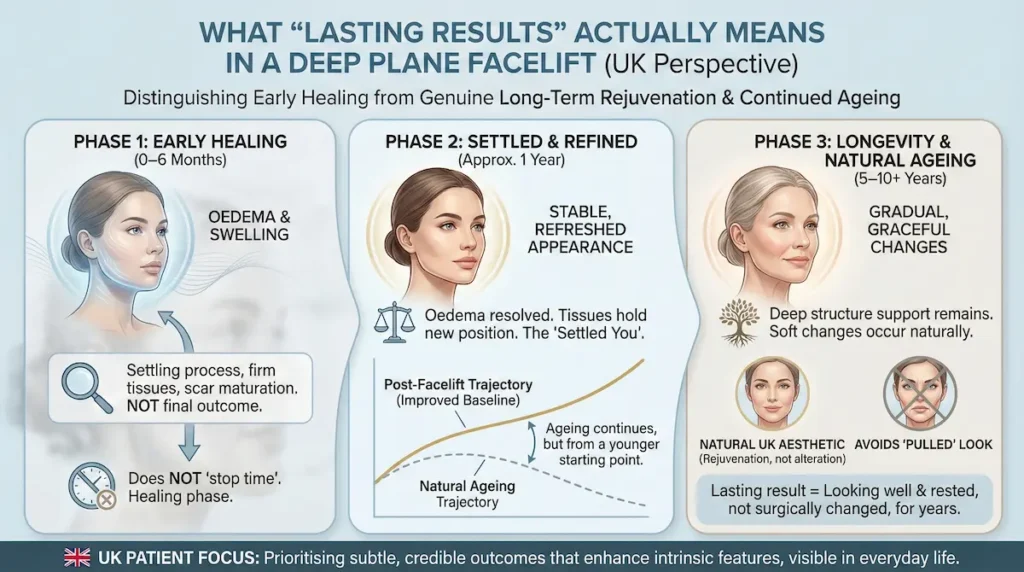
When patients ask about deep plane facelift results duration, they’re often mixing together three different things: (1) how long swelling takes to settle, (2) how long the repositioned tissues hold their new position, and (3) how ageing continues after surgery. A deep plane facelift doesn’t “stop time”; it repositions deeper facial structures so you look refreshed and more youthful, then you continue ageing from that improved baseline. That’s why the best way to understand long-term facelift results is to separate early healing from genuine longevity.
The difference between “swelling settling” and true long-term outcome (oedema vs results)
In the first weeks after surgery, bruising and oedema can make the face look tighter, fuller, or slightly uneven. This early phase can trick people into believing they’re seeing the final result immediately. In reality, the “final you” is often closer to what emerges as oedema resolves and tissues soften. So, if you’re judging deep plane facelift longevity at 3–6 weeks, you’re judging the healing process—not the outcome.
- Early phase: swelling, firmness, numbness, and scar maturation.
- Settled phase: more natural movement, softer contours, and stabilised shape.
- Longevity phase: how well lifted tissues maintain position over years.
What typically changes after year 1 vs after year 5
By around a year, most patients have a stable, refined appearance and scars have matured substantially. After that, the question becomes: how does the face age from here? The answer differs from person to person. Many patients describe that they still look “like themselves—just fresher” years later, which is precisely the goal for UK patients seeking subtlety.
- After year 1: stability and refinement; the lift has “settled in”.
- Years 1–5: typically the most stable-looking period for many patients.
- Years 5–10+: gradual ageing returns; you may notice soft changes but usually from a more youthful starting point.
What a “natural” result looks like for UK patients (rejuvenation, not alteration)
A natural deep plane facelift should not look “pulled” or over-tight. It should restore midface support, improve jawline definition, and soften neck laxity in a way that looks credible in everyday life—close-up, in daylight, and on video calls. The strongest marker of good long-term facelift results is that you look well, rested, and younger—without looking surgically altered.
Why Deep Plane Often Holds Up Better Than a Traditional SMAS Facelift
To understand deep plane facelift how long does it last, you need to understand why deep plane can last well in suitable candidates. While different facelift techniques exist, deep plane approaches are widely discussed for their potential to reposition deeper facial tissues more effectively in selected patients. In simple terms: when the lift is achieved by repositioning supportive layers rather than relying mainly on skin tension, the result can look more natural—and may be more resilient over time. This is one reason people searching how long does a deep plane facelift last often find deep plane associated with longer-lasting outcomes.
What the deep plane layer allows surgeons to reposition (not just tighten skin)
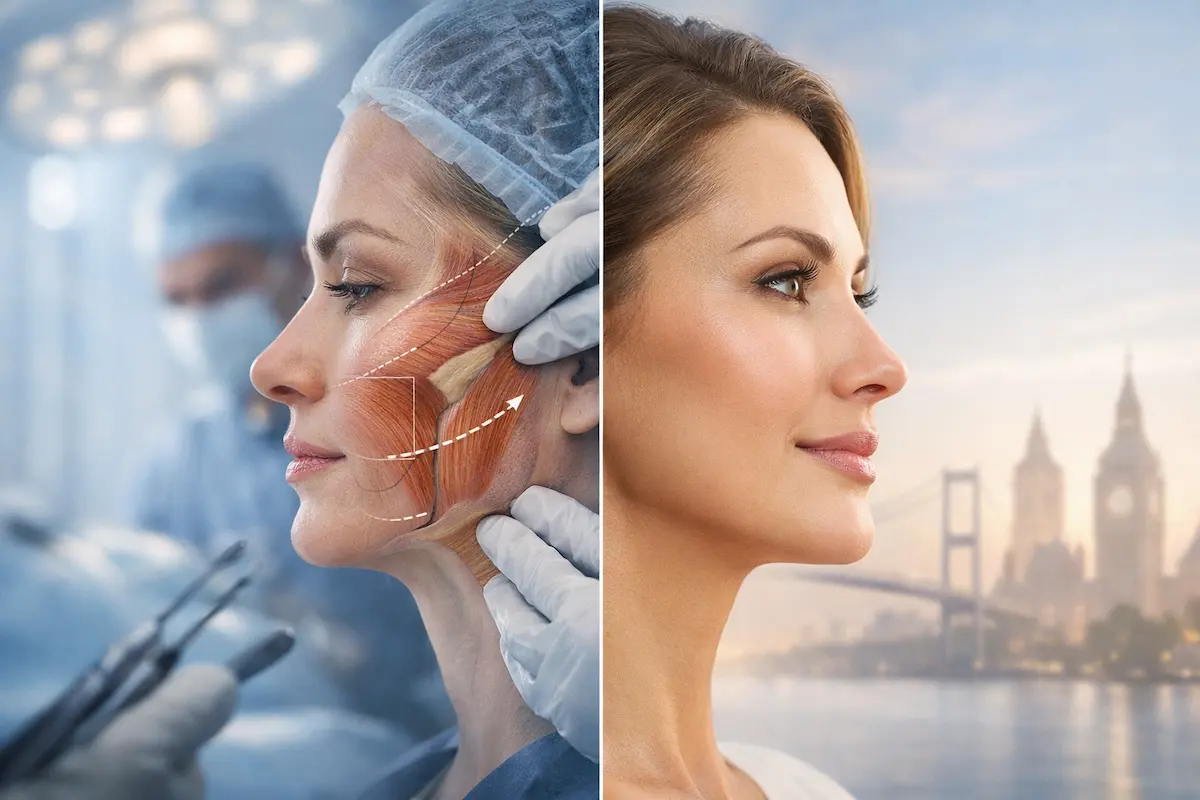
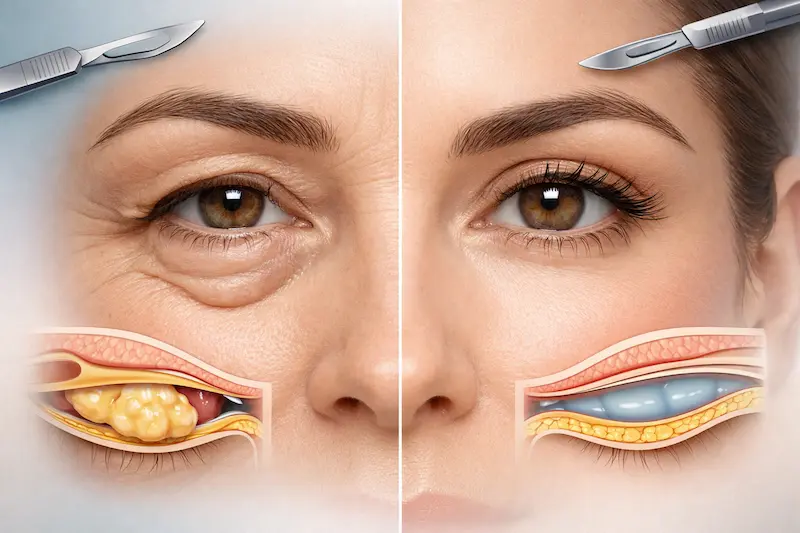
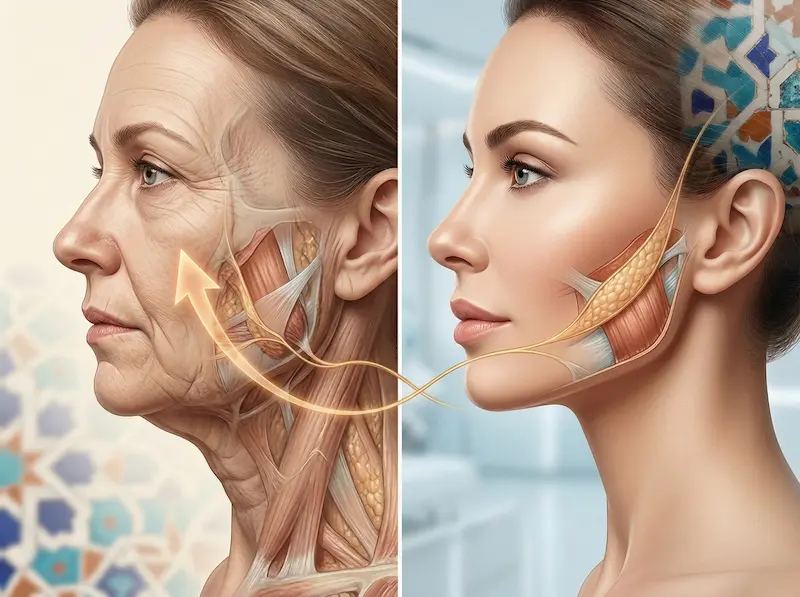
Ageing affects deeper structures (fat pads, retaining ligaments, and the support of the midface) as well as skin quality. The deep plane concept focuses on mobilising and repositioning tissues in a way that can restore more youthful facial architecture. The key point for longevity: when deeper tissues are properly repositioned and supported, the skin can drape more naturally—rather than being the main “holding” structure.
How tension distribution affects long-term relapse risk
One practical reason deep plane outcomes can age well is tension management. Excess skin tension can lead to tell-tale signs (a “pulled” look) and, in some cases, can be less stable aesthetically as tissues relax. A well-executed deep plane lift aims to distribute forces more through supportive layers, which can support a more natural look as years pass. This directly ties into longevity of deep plane facelift results—not as a guarantee, but as a mechanism that can improve durability in appropriate candidates.
Deep Plane vs SMAS: what longevity claims usually get wrong (marketing vs reality)
Online comparisons often oversimplify: “Technique A lasts longer than Technique B.” In reality, the durability of results depends on your anatomy, tissue quality, the surgical plan, and post-operative care. Scientific research and clinical experience consistently point to the same truth: patient selection and execution matter as much as the label of the technique. So, when evaluating deep plane facelift results duration, look beyond slogans. Ask what layer is being lifted, how the neck and midface are addressed, and what the aftercare plan is—especially if you’re travelling from the UK.
The 10+ Year Outlook: A Realistic Timeline (Year-by-Year)
If you’re searching how long does a deep plane facelift last, you deserve a timeline that’s realistic rather than aspirational. Most patients don’t experience a straight line of “perfect” from day one; they move through phases: settling, stabilising, and then gradual ageing from a younger baseline. This section frames deep plane facelift longevity in a way that matches what patients typically notice over time (and what they often worry about unnecessarily).
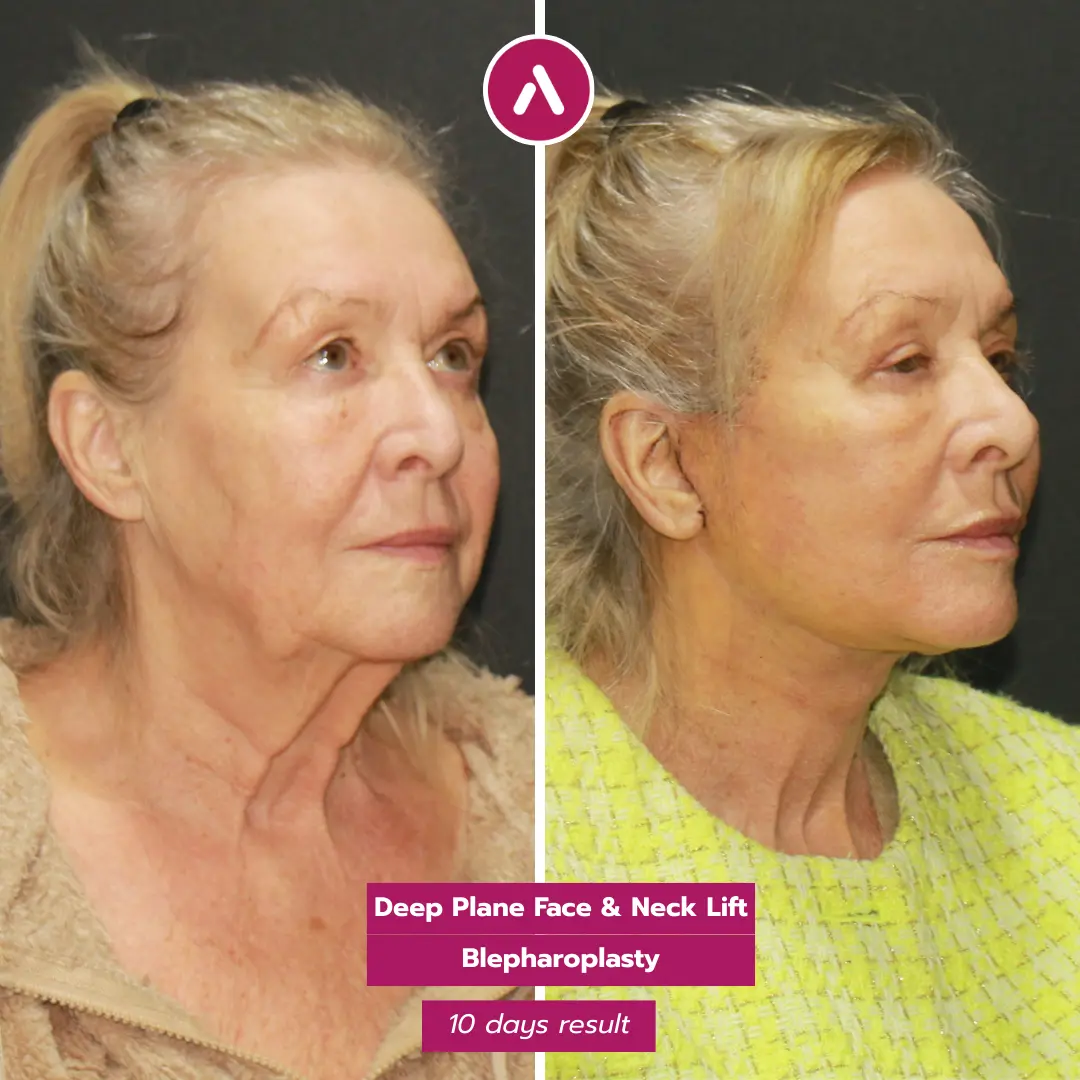
Months 0–12: settling phase, scar maturation, and when you see “the final you”
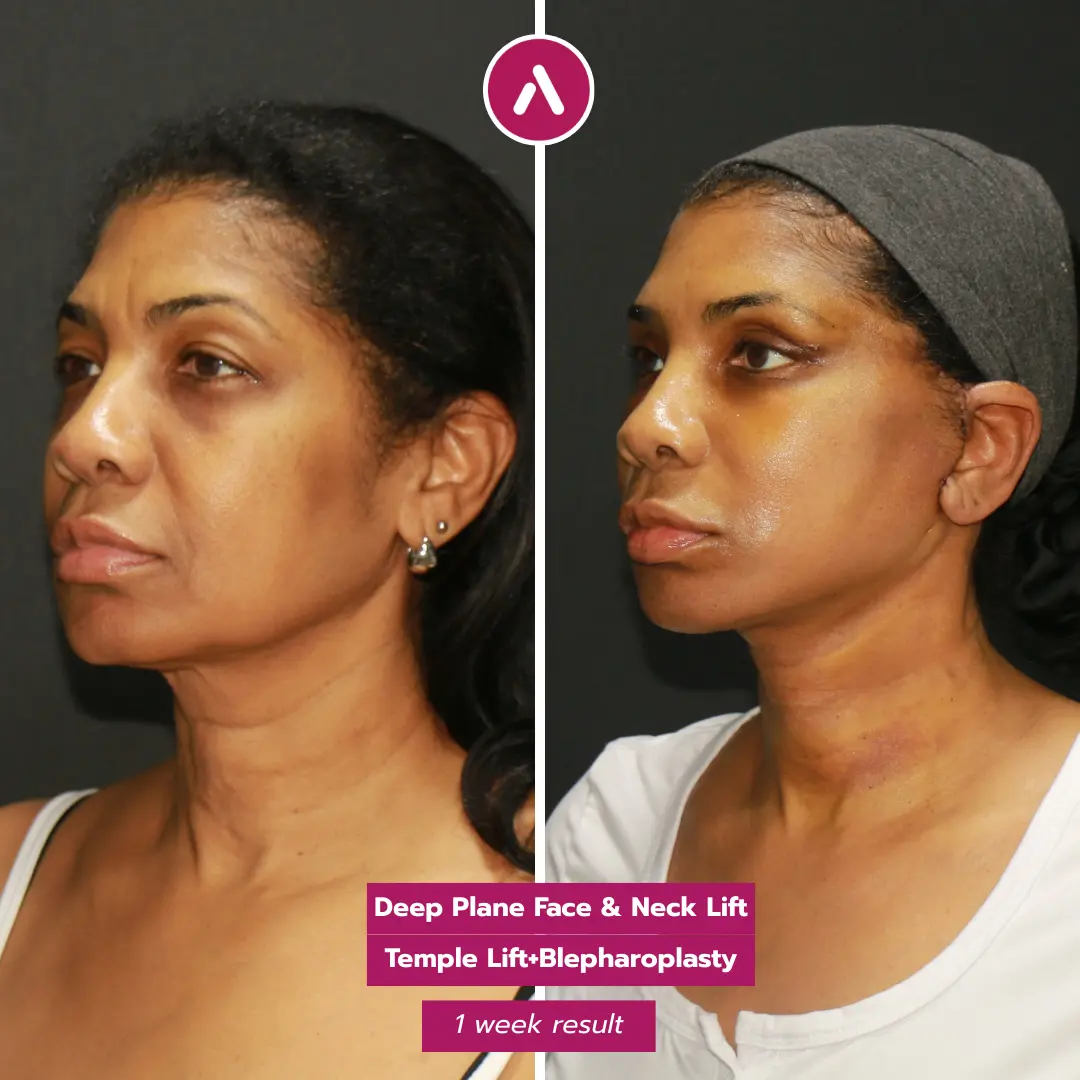
The first year is not only recovery—it’s refinement. Bruising improves first, then oedema reduces, then firmness softens and scars mature. Many patients feel “socially presentable” earlier, but the face can continue to evolve subtly for months as tissues settle. It’s also why asking deep plane facelift how long does it last at 6–8 weeks can be misleading: you’re still in the settling phase.
- Weeks 1–2: bruising/oedema peak then begins to improve.
- Weeks 3–8: swelling reduces; contours start to look more “you”.
- Months 3–6: softer movement; more natural facial animation.
- Months 6–12: scar maturation and final refinement become clearer.
Years 1–5: stable years—what patients typically notice (and what they don’t)
For many suitable candidates, years 1–5 represent the most stable-looking period. Patients often report that they still look refreshed without “maintenance chasing”. This is where the longevity of deep plane facelift results becomes meaningful: the lift looks like part of your face rather than something done to it.
- Jawline and midface tend to remain noticeably improved compared to pre-op baseline.
- Photographs often show the strongest “difference” in this window.
- Small changes may occur, but usually not enough to feel like the result has “gone”.
Years 5–10+: gradual ageing returns—how to interpret “still looks better”
At 5–10+ years, you continue to age—because everyone does. The key is that you’re ageing from a better starting point. A helpful way to interpret long-term value is: “I still look better than I would have looked without surgery.” That’s often the real meaning behind 10+ year discussions about deep plane facelift results duration and long-term facelift results.
A quick comparison: deep plane longevity vs non-surgical options (why they’re not equivalent)
Non-surgical treatments can improve skin quality and restore small amounts of volume, but they generally cannot reproduce the structural repositioning achieved with a deep plane facelift. This matters when you’re evaluating the long-term value of deep plane facelift: comparing a decade-long surgical baseline shift to repeat short-interval treatments is not a like-for-like comparison.
| Approach | What it can realistically do | Typical “duration” concept | Best for |
|---|---|---|---|
| Deep plane facelift | Repositions deeper tissues; improves midface/jawline/neck architecture | Often discussed in multi-year terms (including 10+ year outlook in selected patients) | Structural ageing, laxity, long-term baseline improvement |
| Injectables | Volume restoration/contouring; softening lines | Months to ~1–2 years depending on product/area | Early ageing changes or adjunct maintenance |
| Energy-based skin treatments | Skin quality improvements; limited tightening | Often requires repeat courses | Texture/quality issues, mild laxity |
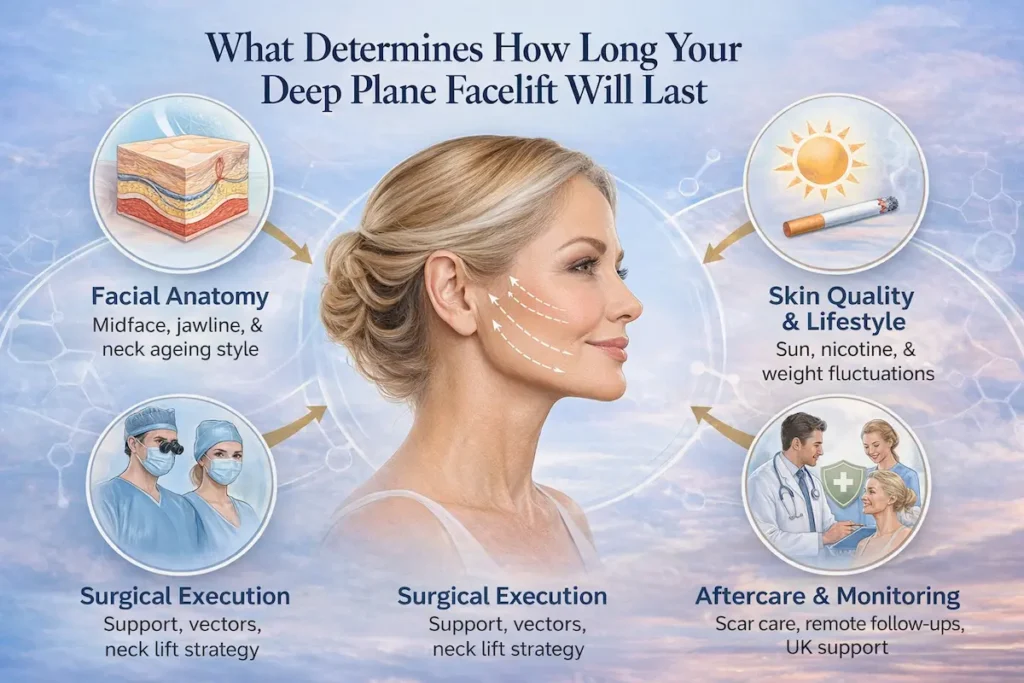
What Determines How Long Your Deep Plane Facelift Will Last
The question how long does a deep plane facelift last has no single universal number, because longevity is driven by patient factors and surgical planning. In both clinical practice and broader scientific research, the themes are consistent: anatomy, skin quality, lifestyle exposures, and the quality of surgical execution all shape deep plane facelift longevity. This section helps you predict your likely outcome more accurately than generic promises.
Ageing style and facial anatomy (midface, jawline, neck)
Some patients mainly age through volume descent in the midface; others show heavier neck laxity or a more pronounced jowl pattern. The deeper your structural descent, the more meaningful surgical repositioning can be—but it also means the plan must be tailored. A deep plane approach can be particularly relevant where midface support and jawline definition are key goals, but the “best” plan is always individual.
Skin quality, sun exposure, nicotine, and weight fluctuations
Skin quality heavily influences deep plane facelift results duration in the visible sense. While deep plane lifting can reposition deeper tissues, skin still contributes to the surface finish. Sun exposure accelerates collagen breakdown; nicotine reduces microcirculation; and large weight fluctuations can repeatedly stretch and deflate facial soft tissue. If you want stronger long-term facelift results, these factors matter as much as the technique name.
- Sun: daily SPF and avoidance of intense sun exposure protect collagen.
- Nicotine: increases risk and can compromise healing quality.
- Weight: stability supports consistent facial contours over years.
Surgical planning: technique choices that impact longevity (vector, midface support, neck strategy)
Longevity is not only about “lifting more”; it’s about lifting in the right direction with the right support. Vector choices (the direction of repositioning), midface support strategy, and how the neck is addressed all influence the stability and naturalness of the result. This is where “deep plane” is not a magic word—it’s a framework that still requires precise execution to deliver durable, subtle outcomes.
Aftercare and follow-up: how ongoing monitoring protects long-term outcomes (UK support mindset)
Aftercare isn’t just comfort—it can influence final quality through scar care, oedema management, and early identification of issues. UK patients often worry about travelling home and losing continuity of care. A structured follow-up plan (remote check-ins, clear escalation pathways, and an organised recovery protocol) can protect confidence and satisfaction, and support the perception of longevity of deep plane facelift results by ensuring the early healing phase is optimised.
Practical UK note: The first 6–12 weeks are about healing quality. Protecting that phase (sleep, nutrition, scar care, oedema control, avoiding nicotine) is one of the most controllable ways to support the long-term result.
Maintenance After Surgery: How to Extend Results Without Looking “Overdone”
Many UK patients want longevity but fear the “worked-on” look. The good news is that maintenance can be conservative, evidence-based, and subtle—more about protecting skin quality and facial balance than chasing change. Done properly, this supports deep plane facelift longevity and reinforces the long-term value of deep plane facelift without drifting into an artificial aesthetic.
Skincare and sun strategy (simple, evidence-based maintenance)
The most underestimated maintenance step is consistent sun protection. A straightforward routine—gentle cleansing, moisturising, vitamin A derivative (as tolerated), and daily SPF—can support long-term skin quality. Think of it as preserving the “surface finish” of your surgical result.
Injectables and energy devices: where they help and where they don’t
In the right hands, small, carefully placed injectables can complement a facelift by supporting balance rather than creating volume overload. Energy-based treatments can help skin texture and quality, but they do not replace structural repositioning. Used appropriately, these can extend the perceived deep plane facelift results duration by keeping skin quality aligned with the new contours.
Lifestyle levers: sleep, stress, weight stability, and long-term collagen support
Sleep quality, stress management, and weight stability often correlate with how “fresh” the face appears years after surgery. These aren’t clichés—they’re practical levers. Weight cycling in particular can erode the stability of facial contours. If your goal is stronger long-term facelift results, stable habits matter.
“Subtle refresh” approach aligned with UK aesthetic preferences
For UK patients, the best long-term strategy is usually “subtle refresh”: small interventions only when needed, spaced out appropriately, and always prioritising natural facial movement. This is often the difference between looking younger and looking done—and it’s central to the long-term satisfaction behind searches like how long does a deep plane facelift last.
Recovery Quality Matters: Why Faster, Cleaner Healing Can Improve the Long Game
When people discuss deep plane facelift longevity, they often focus only on surgical technique. Yet the first weeks of healing can influence how confident you feel about the outcome—and how “natural” it looks as it settles. In practical terms, better oedema control and scar support can reduce the “social downtime” window, improve early symmetry, and help you judge your final result more calmly. That matters for UK patients who want a credible, understated look and need a predictable return-to-normal schedule.
Why early bruising/oedema control influences patient satisfaction and confidence
Early swelling can distort contour and create temporary unevenness. When oedema settles smoothly, patients typically feel reassured earlier—and are less likely to misinterpret normal healing as “the result not lasting”. This psychological aspect is often overlooked in online discussions about longevity of deep plane facelift results, but it is very real: a calmer early recovery supports better decision-making about maintenance and avoids premature “I think it’s dropped” panic.
HBOT and post-op oedema management (social downtime reduction)
At AKM Clinic, Hyperbaric Oxygen Therapy (HBOT) is positioned as a core strategy to reduce post-operative oedema and support lymphatic drainage—aiming to cut down social downtime for patients travelling back to the UK. This can be particularly helpful for patients who want to be “flight-ready” with confidence rather than simply “medically able” to fly.
LLLT for scar support and incision quality (visibility and texture over time)
Scar quality is a major component of long-term satisfaction, especially for UK patients who are detail-oriented and expect discreet incision lines. AKM Clinic describes using Low-Level Laser Therapy (LLLT) (a 650 nm soft laser) to stimulate fibroblast activity, with the goal of stronger, smoother skin and minimised scar visibility. When scar care is structured, it supports the overall perception of deep plane facelift results duration because the “tell-tale signs” of surgery are reduced.
Flight-ready recovery protocols for UK return planning (what patients care about most)
For British patients, recovery is not just healing—it’s logistics: when can I return to work, be seen in public, and travel comfortably? AKM Clinic’s UK-focused pathway emphasises “flight-ready recovery protocols” and continuous support, which helps reduce anxiety around travelling home and feeling “unsupported” once back in the UK.
UK patient reality check: If your plan involves returning to the UK quickly, your recovery strategy becomes part of your long-term value calculation—not an afterthought.
When Results Fade Sooner: Early Relapse vs Normal Ageing
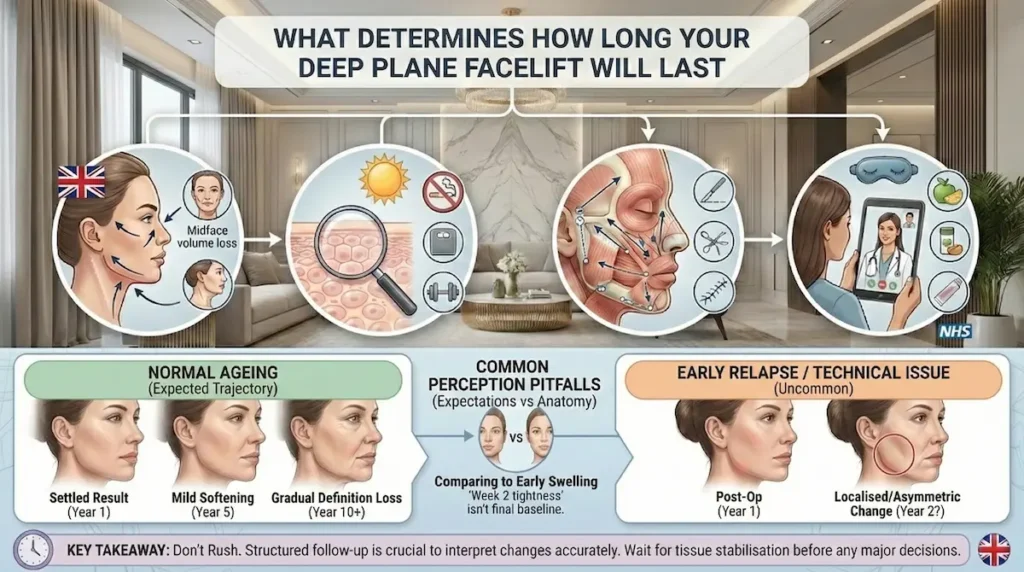
If you are evaluating how long does a deep plane facelift last, it helps to know what “normal” looks like so you don’t mistake healthy ageing for a failed result. True early relapse is uncommon when patient selection and execution are appropriate; more often, patients are noticing that they continue to age (which is expected), or they are comparing themselves to the peak “tightness” of early healing.
How to tell “normal ageing” from a technical issue
Normal ageing tends to be slow and general: mild softening, subtle changes in skin quality, and gradual loss of definition over years. Technical issues often show up earlier and may feel more localised or asymmetric. If you are unsure, structured follow-up matters—particularly for UK patients who fear being “left alone” after travelling.
Common reasons patients feel results didn’t last (expectations vs anatomy)
- Comparing to early swelling: the “week 2 tightness” isn’t the final baseline.
- Weight changes: significant loss/gain can alter facial volume and contour.
- Skin quality mismatch: deep tissues may be repositioned, but sun damage and collagen loss still show on the surface.
- Unrealistic target: expecting a facelift to permanently stop ageing rather than reset it.
What can be corrected non-surgically vs when revision might be considered
Minor changes over time can often be addressed with conservative, UK-appropriate “tweakments” that preserve natural movement—skin quality treatments, modest volume support where genuinely needed, and scar optimisation. Revision discussions are usually reserved for clearly defined issues or significant recurrent laxity, and should be approached cautiously, with a full assessment rather than a rushed decision.
Timing: why rushing into revision is rarely wise
Because healing and scar maturation continue for months, most surgeons prefer to wait until tissues have stabilised unless there is a clear medical concern. In other words, don’t let anxiety rewrite your outcome story too early. A structured follow-up plan is the safest way to interpret changes accurately.
Choosing for Longevity: What UK Patients Should Verify Before Booking
For UK patients, the biggest risk is not “Turkey vs UK” as a concept—it’s choosing the wrong provider. If your goal is long-term facelift results and the long-term value of deep plane facelift, you should verify credentials, standards, and aftercare infrastructure with the same seriousness you would apply to a Harley Street consultation.
Credentials and the “UK board-certified equivalent” expectation (Harley Street benchmark)
AKM Clinic profiles its two lead surgeonsand positions them for the UK market using “UK board-certified equivalent” language. One of them is described as strongly focused on subtle facial rejuvenation (addressing the British fear of looking “overdone”), and other is presented with European Board-linked credentials, which many UK patients view as a credible alternative framework when comparing international standards.
Safety standards: operating theatre protocols and quality signals
Beyond surgeon credentials, ask about sterile operating theatre protocols, infection control frameworks, and how complications are handled. AKM Clinic’s technology and standards document frames the clinic as operating with “zero-compromise” hygiene in operating theatres, aligned with international/WHO-linked expectations. For the UK expert patient, this is the kind of detail that helps bridge the mental gap between “abroad” and “private care standards”.
Aftercare structure: UK contact point mindset (support line, continuity of care)
Aftercare is one of the top UK objections: “What happens when I’m back home?” AKM’s UK signals explicitly address this with the idea of a UK support line, a direct WhatsApp UK number (+44), and a London correspondence address to reduce the fear of being unreachable post-op. This matters because perceived support is part of perceived longevity—patients feel safer, ask questions earlier, and avoid mistakes that can complicate healing.
Value framing: “Harley Street quality” vs price—how to compare fairly
Value Seeker Victoria doesn’t want “cheap”; she wants credible value. The fairest comparison is not just the headline price—it’s the full package: surgeon expertise, theatre standards, recovery technologies, and structured aftercare. AKM positions itself with “all-inclusive cosmetic surgery GBP” transparency to reduce hidden-cost anxiety and improve decision confidence for UK patients.
| What to verify | What to look for | Why it affects longevity |
|---|---|---|
| Surgeon profile | Named lead surgeon, relevant focus (subtle rejuvenation), credible certification pathways | Execution quality drives long-term stability and naturalness |
| Operating theatre standards | Sterile theatre protocols, clear safety frameworks | Protects healing quality and lowers complication risk |
| Aftercare & UK support | Remote follow-ups, UK support line/WhatsApp pathway, clear escalation steps | Optimises early healing and reduces avoidable setbacks |
| Recovery optimisation | Oedema/scar support (e.g., HBOT/LLLT) where appropriate | Improves the early “settling” phase and scar outcomes |
Frequently Asked Questions (FAQ): How Long Does Deep Plane Facelift Last
Below are direct answers to the most searched questions around deep plane facelift longevity, deep plane facelift how long does it last, and the longevity of deep plane facelift results. These are written for UK patients who want clarity without hype.
How many years does a deep plane facelift typically last?
Many patients discuss deep plane results in multi-year terms, often with a “10+ year outlook” in suitable candidates. The most honest interpretation is: you continue ageing, but from a more youthful baseline—so you often still look better years later than you would have without surgery.
Does a deep plane facelift last longer than SMAS?
It can, particularly when deeper tissues are repositioned with good support and minimal skin tension. However, longevity is not just the technique label—your anatomy, skin quality, lifestyle, and the surgical plan influence duration.
Can you get a deep plane facelift without general anaesthesia?
Some clinics perform complex facelift techniques using local anaesthesia with light IV sedation (often described as “twilight anaesthesia” or "conscious sedation") for selected patients. Suitability depends on your health profile and the planned surgical scope.
At what age is it “worth it” if I want a 10+ year result?
There isn’t a single “correct” age. It depends on the pattern of ageing, skin quality, and what you want to improve. The right time is often when laxity and structural descent are meaningful enough that non-surgical treatments no longer give a satisfying, natural result.
What shortens facelift longevity the most (weight change, smoking, sun)?
Large weight fluctuations, nicotine exposure, and high sun exposure are some of the biggest controllable factors. They affect skin quality, healing, and long-term collagen support—key elements of long-term facelift results.
Will I need fillers again—and if so, when?
Some patients choose small, conservative treatments years later to support balance or skin quality, but many do not feel the need for frequent injectables in the early years after surgery. Maintenance should remain subtle and proportionate.
How soon can I safely fly back to the UK after a facelift?
Flight timing depends on your individual recovery, swelling, and medical clearance from your surgical team. If you are travelling, choose a provider with explicit flight-ready recovery planning and a structured follow-up pathway once you are back in the UK.
If you’d like to explore related topics alongside longevity, you can also read our guides on Deep Plane Facelift Cost, SMAS vs Deep Plane Facelift, and view a Deep Plane Facelift Before After gallery to understand what “natural” results look like in real patients. For a practical, step-by-step perspective, see the Deep Plane Facelift Journey (from travel planning to recovery milestones), and for reassurance around decision-making, our Deep Plane Facelift Story patient experiences can help you compare expectations with lived outcomes.
Medical Disclaimer: This page is provided for general educational purposes only and does not replace a face-to-face medical consultation, diagnosis, or personalised treatment plan. All surgery carries risks and outcomes vary between individuals. Suitability for a deep plane facelift, procedure selection, and anaesthesia choice can only be determined after a full clinical assessment by a qualified surgeon. Always follow your clinician’s instructions and seek urgent medical attention if you develop concerning symptoms during recovery.