



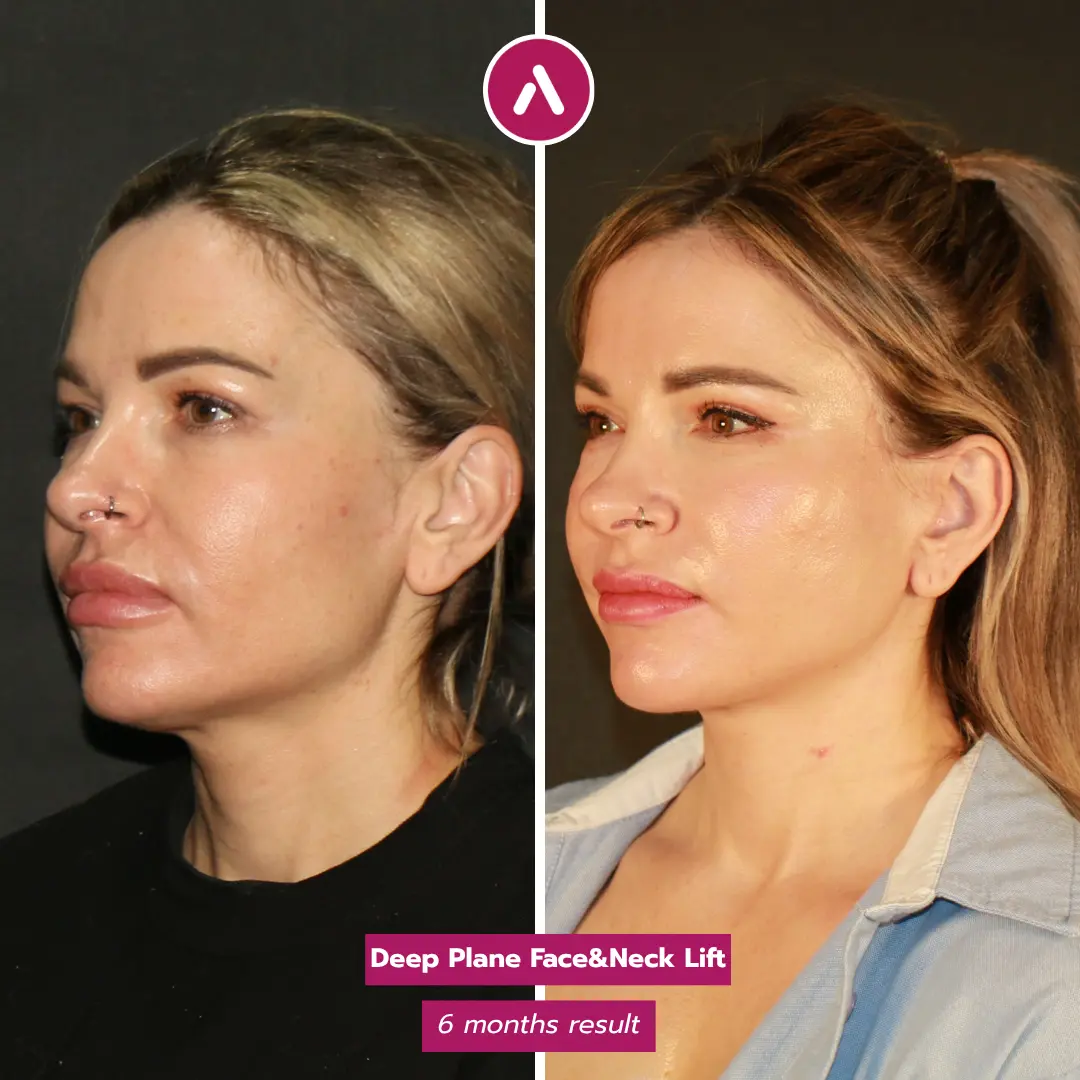
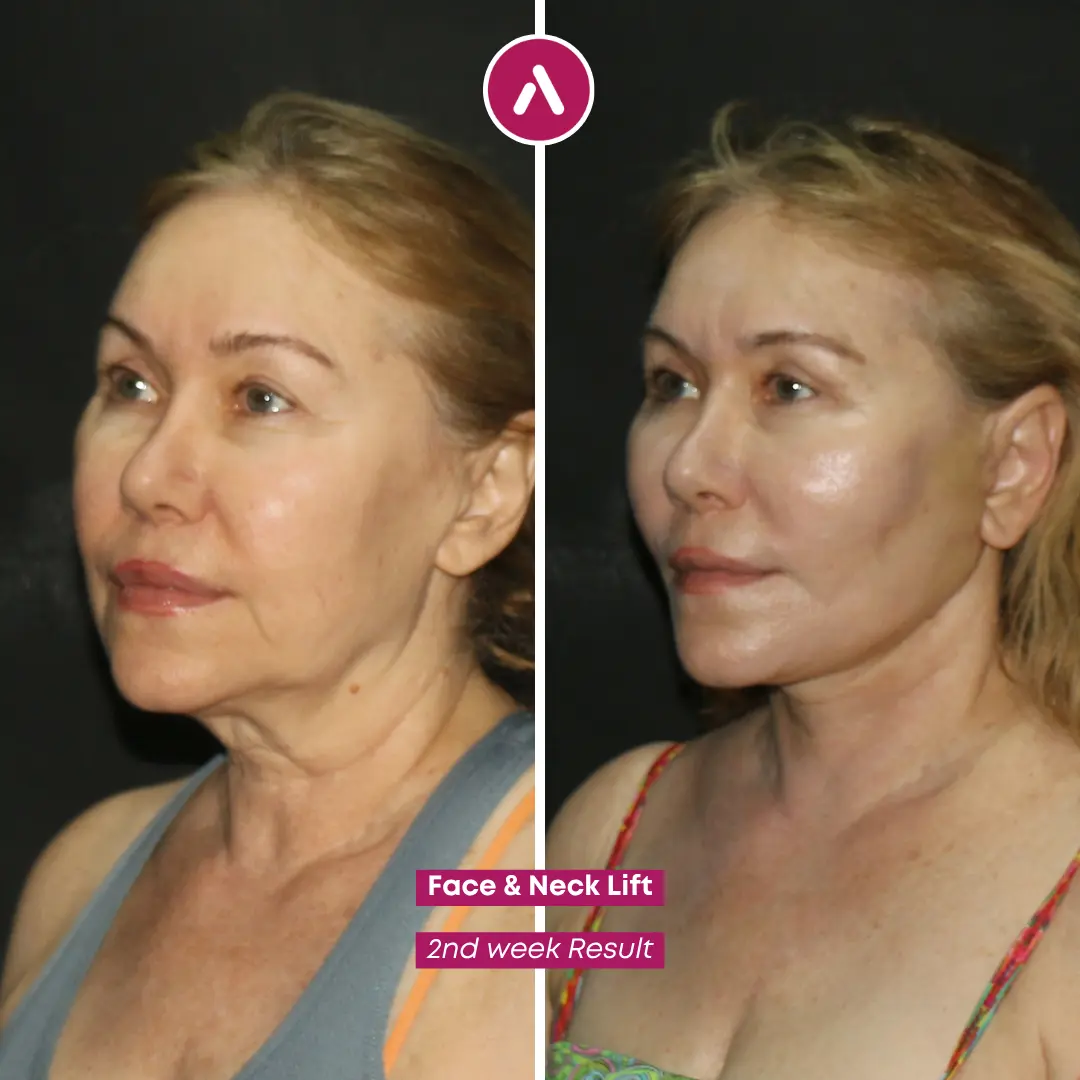
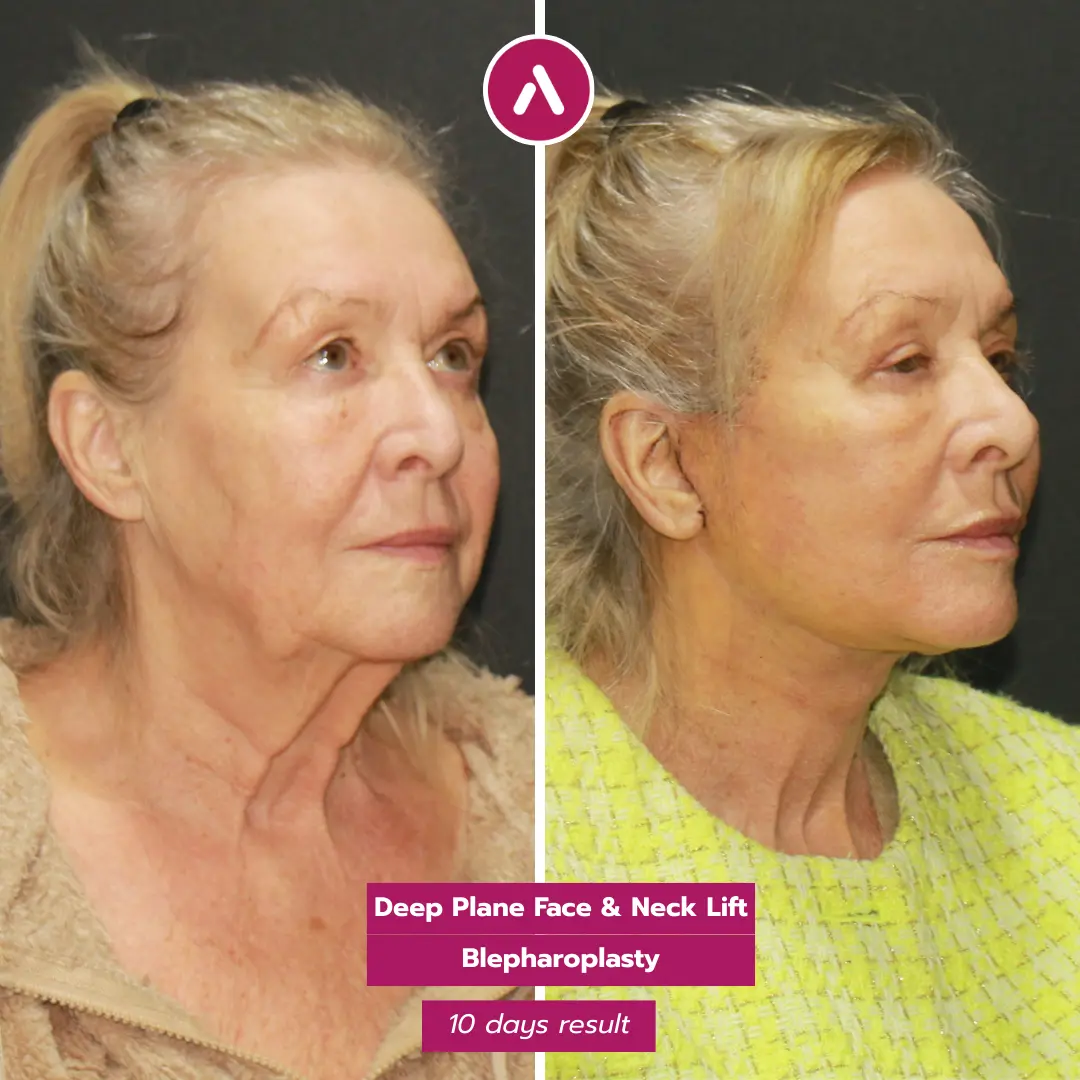
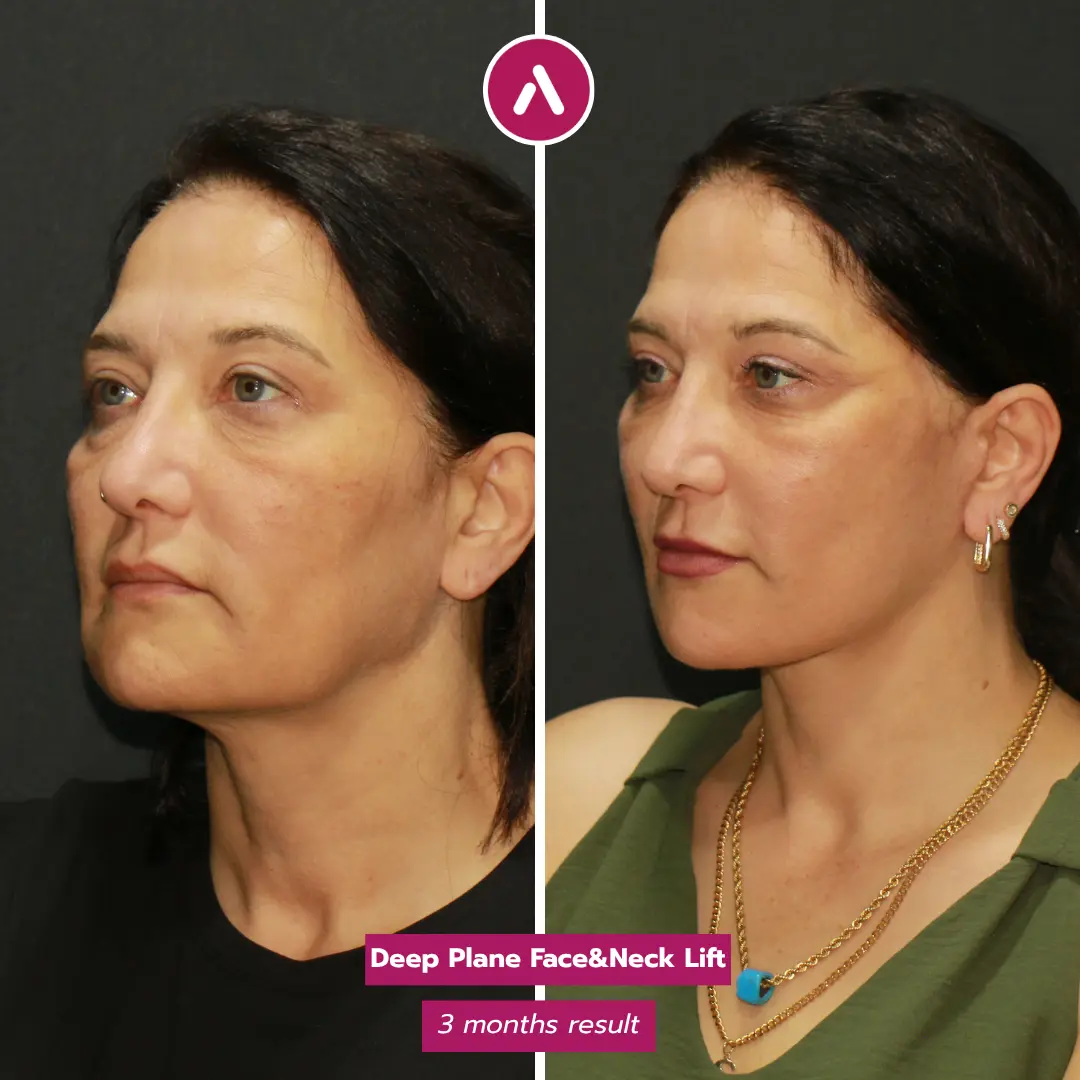
If you’re researching an awake mini facelift, you’re probably not looking for a “cheap deal” — you’re looking for a safer, more controlled way to refresh the lower face without the physiological load and longer downtime that can come with general anaesthesia. Many UK patients want procedure-first clarity: what the technique actually does, how it compares with SMAS, MACS or deep plane approaches, what recovery looks like day by day, and how to judge results beyond filtered “before and after” images. This guide is written for that expert-patient mindset — focusing on anatomy, method and safety first, with Istanbul introduced only as the practical setting for a clinically-led pathway.
Table of Contents
What Is an Awake Mini Facelift?
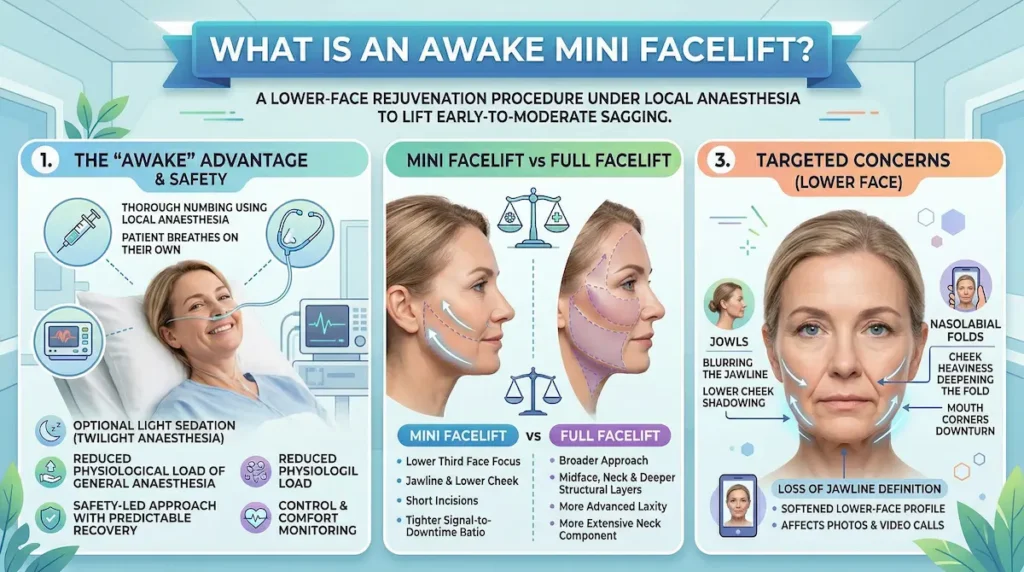
An awake mini facelift is a lower-face rejuvenation procedure performed under local anaesthesia, often with optional light sedation, to lift early-to-moderate sagging around the jawline and mouth. We focus on structural support rather than simply pulling skin, aiming for a refreshed, natural look with controlled downtime.
UK patients usually arrive having read widely and compared techniques, not just locations. That is sensible. A mini facelift sits in the middle ground: more effective than non-surgical “quick fixes”, but less extensive than a full facelift. In our practice, “awake” is not a gimmick. It is a safety-led approach that can reduce the physiological load of general anaesthesia and keep the recovery experience more predictable.
Mini facelift vs full facelift — what’s the difference?
A mini facelift targets the lower third of the face. Think jawline softening, early jowls, and heaviness around the corners of the mouth. A full facelift is broader and often involves more extensive work across the midface, neck, and deeper structural layers.
- Mini facelift: typically focuses on the lower face (jawline and lower cheek), with shorter incisions and a tighter “signal-to-downtime” ratio for the right candidate.
- Full facelift: usually addresses more advanced laxity, deeper descent, and often a more comprehensive neck component.
- What matters most is not the label. It is the plan: which anatomical layers need support to look well-rested rather than “done”.
What does “awake” actually mean? (local anaesthesia / twilight sedation)
“Awake” means we numb the relevant areas thoroughly using local anaesthesia, and you continue breathing on your own. Some patients choose a calming sedative approach commonly described as twilight anaesthesia cosmetic surgery—you are relaxed and comfortable, but not placed under a full general anaesthetic.
This “wide awake” philosophy is designed around control. We can tailor the anaesthesia to you, monitor comfort closely, and avoid the deeper systemic effects that some patients wish to sidestep. For expert patients who specifically search for a deep plane facelift without general anaesthesia, the key point is this: the anaesthesia choice and the surgical technique are separate decisions, and we discuss them distinctly.
Which concerns does it target? (jowls, nasolabial folds, jawline definition)
Most people do not wake up wanting a new face. They want to stop looking tired. The early signs tend to cluster around the lower face:
- Mini facelift for jowls that blur the jawline and create shadowing along the lower cheek.
- Mini facelift for nasolabial folds when heaviness in the cheek begins to deepen the fold (often alongside mouth-corner downturn).
- Loss of clean jawline definition and a “softened” lower-face profile in photos and video calls.
Our guiding principle is simple: rejuvenation, not alteration. We aim for you to look like you have slept well, not like you have had surgery.
What Concerns Can an Awake Mini Facelift Improve?
Patients often describe the same frustration in different ways: “I look cross”, “I look worn”, or “My face has dropped.” These are not vague complaints. They usually reflect specific anatomical changes—tissue descent, ligament laxity, and a shift in the balance between the cheek and jawline. A mini facelift is designed to correct that lower-face drift in a measured way, producing subtle facial rejuvenation Turkey patients often seek when they want an elegant change rather than a dramatic transformation.
Awake Mini facelift for jowls and early jawline sagging
Jowls form when tissues along the jawline lose support and settle below the mandibular border. This creates a break in the clean line from chin to angle of the jaw. In suitable candidates, a mini facelift repositions and supports these tissues so the jawline reads sharper again.
- Best suited to early-to-moderate jowling where skin quality is still reasonable.
- Often ideal for patients who want improvement without the footprint of a full facelift.
- We plan the lift vector to avoid the “pulled” look many UK patients rightly dislike.
Awake Mini facelift for nasolabial folds and mouth-corner heaviness
Nasolabial folds are influenced by skin quality, volume, and midface descent. A mini facelift can reduce the heaviness contributing to the fold, particularly when the lower cheek is starting to drift. It may also soften marionette-line shadowing near the mouth corners.
It is important to be precise. A mini facelift does not “erase” folds like a filter. It rebalances the lower face so the fold looks less harsh in real life, not just in a single photo.
The “tired look” — the anatomical reasons behind lower-face ageing
The tired look is often structural. As ligaments loosen and soft tissue descends, the face loses the crisp transitions that signal youth: cheek-to-jaw definition, light reflection across the lower cheek, and a clean mandibular border. The goal is not tightness. It is harmony.
For UK patients comparing London clinics with Istanbul options, the decision should still start with the anatomy and the method. When technique leads, location becomes a practical detail—especially when your priority is safety, comfort, and a carefully managed recovery.
Key Benefits of the Awake Mini Facelift
The main advantage of an awake mini facelift is not “doing less surgery” — it’s doing the right surgery with a safer-feeling anaesthetic strategy for the patient who wants control, clarity, and a more predictable early recovery. For many UK patients, the decision is heavily influenced by anaesthesia preference, downtime constraints, and the desire for natural results rather than a dramatic change.
Avoiding general anaesthesia: safety, control, and a smoother recovery experience
Many people search specifically for mini facelift under local anaesthesia because they want to avoid general anaesthesia where possible. With a wide-awake approach, you remain breathing independently, and we can adjust comfort in real time. Some patients opt for conscious sedation (often described as twilight sleep) to reduce anxiety while still avoiding a full general anaesthetic.
- Local anaesthesia can support a calmer early recovery for suitable patients, particularly those who dislike “anaesthetic hangover” symptoms.
- It allows a more measured, step-by-step experience — important for the research-driven UK “expert patient”.
- It is not a universal fit: candidacy and comfort are assessed individually to keep safety the priority.
Natural-looking rejuvenation (refresh, not “change”)
The best mini facelift results look like a well-rested version of you — not a new identity. This is especially relevant for UK patients who are cautious about looking “overdone”. A mini facelift can restore lower-face harmony by lifting and supporting tissues that have descended, rather than simply tightening skin.
When people search for subtle facial rejuvenation Turkey, what they often mean is: “I want to look better in daylight, at work, and on video calls — without announcing surgery.” That is exactly the benchmark we use when planning an awake mini facelift.
Downtime and return to work: realistic expectations for UK patients
Downtime varies, but the “mini” in mini facelift is often reflected in the recovery curve — particularly for swelling and bruising distribution. Many UK patients plan around a limited window away from work and family commitments. This is why search terms like awake mini facelift recovery timeline, 1 week awake mini facelift recovery pictures day by day, and awake mini facelift scars after 2 weeks are so common: they’re not curiosity, they’re logistics.
- First week: swelling and tightness are expected; social downtime planning should be conservative.
- Two weeks: many patients feel more “public-facing”, though minor swelling can still be present.
- Longer term: refinement continues for weeks to months as tissues settle and scars mature.
Am I a Good Candidate for an Awake Mini Facelift?
The right candidate is not defined by a number on a passport — it’s defined by anatomy, skin quality, and expectations. The awake mini facelift is best suited to early-to-moderate lower-face laxity where repositioning and support can deliver a meaningful change without the scope of a full facelift.
In your 30s (early maintenance) vs 50s–60s (structural correction)
We commonly see two different motivations:
- 30s–early 40s: early maintenance — the jawline is softening, jowls are beginning, and the goal is prevention of “drop”, not a dramatic reversal. Searches like mini facelift at 40 before and after often reflect this group.
- Late 40s–60s: structural correction — jowls, mouth-corner heaviness, and lower-cheek descent are more established, and the mini facelift becomes a strategic lift-and-support procedure.
Both groups can be suitable — but the plan differs. The earlier group often needs precision and subtlety; the latter group needs a clearer structural strategy and honest discussion about whether the neck should be addressed as well.
Skin quality, elasticity, and expectation-setting
Skin quality matters because it influences how smoothly the tissues redrape after lifting. If elasticity is poor, the procedure can still work, but the plan may need to include additional structural support and a more conservative promise on “texture”.
Expectation-setting is the difference between satisfaction and frustration. A mini facelift can improve jowls and jawline definition significantly for the right anatomy — but it is not designed to eliminate every crease or replace the effect of weight loss, skincare, or volume restoration where indicated.
When a mini facelift may not be enough (advanced laxity / neck dominance)
Sometimes the neck is the dominant ageing feature. If there is significant platysmal banding, heavy submental laxity, or more advanced lower-face descent, a mini facelift alone may under-deliver. In these cases, we may discuss:
- Mini facelift + neck lift (when neck contour is a key priority)
- A broader facelift plan where needed for balance and longevity
- Whether a deeper-layer approach (e.g., SMAS mini facelift considerations) better matches the anatomical problem
The goal is not to “sell you more surgery”. It is to avoid the common mistake of choosing a smaller operation for a bigger problem — which usually leads to disappointment, not elegance.
“One-Stitch” and “Two-Stitch” Mini Facelift — What Do These Terms Mean?
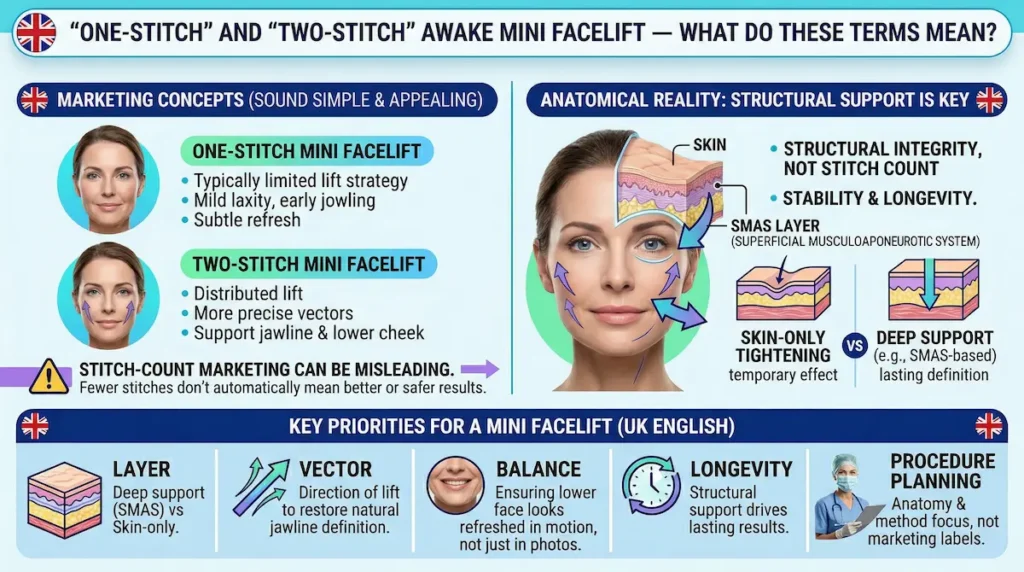
Terms like one stitch mini facelift and 2 stitch mini facelift appear frequently in UK searches because they sound simple, minimal, and appealing. But stitch-count marketing can be misleading if it implies that fewer stitches automatically means a better or safer result. In reality, the quality of a mini facelift is determined by which layer is supported, the lift vector, and the surgeon’s plan — not by a catchy label.
One stitch mini facelift: when it may be discussed
A “one-stitch” concept is typically used to describe a very limited lift strategy in selected patients with mild laxity. It may be discussed when:
- The primary concern is early jowling with relatively good skin elasticity.
- The goal is a subtle refresh rather than major reshaping.
- The patient understands that the improvement can be modest and may not address all lower-face ageing patterns.
For an expert patient, the more useful question is: what exactly is being lifted and anchored, and what does that achieve anatomically?
Two stitch mini facelift: vectors, lift distribution, and typical limits
A two stitch mini facelift term often suggests that the lift is distributed across two fixation points. This can be discussed when a surgeon wants to:
- Control the direction (vector) of lift more precisely.
- Support both the jawline region and lower cheek more evenly.
- Reduce reliance on skin tension by placing support where it matters structurally.
That said, “two stitches” still does not define the technique. The deeper question remains: is the support placed in the SMAS layer, or is this essentially a skin-only tightening with limited longevity?
Why stitch count matters less than layer, vector, and planning
If you only remember one thing from this section, make it this: the longevity and natural look of a mini facelift are driven by structural support, not by how minimal the description sounds. A well-planned awake mini facelift prioritises:
- Layer: whether the lift is skin-only or involves deeper support (e.g., SMAS-based strategy).
- Vector: the direction of lift to restore jawline definition without a swept-back look.
- Balance: ensuring the lower face looks refreshed in motion, not just in a single “after” photograph.
This is also where the “procedure first” mindset protects UK patients: it keeps the focus on anatomy and method, not the marketing phrase.
SMAS vs MACS vs Deep Plane — Which Technique Fits a Mini Facelift?
UK patients often search for technical terms like SMAS mini facelift, MACS lift vs SMAS mini facelift, and deep plane mini facelift because they want to understand what they are paying for: short-term tightening or structural repositioning. These techniques describe different ways of supporting facial tissues. The right choice depends on the pattern of ageing, tissue quality, and how much correction is needed.
SMAS mini facelift: core principles and common indications
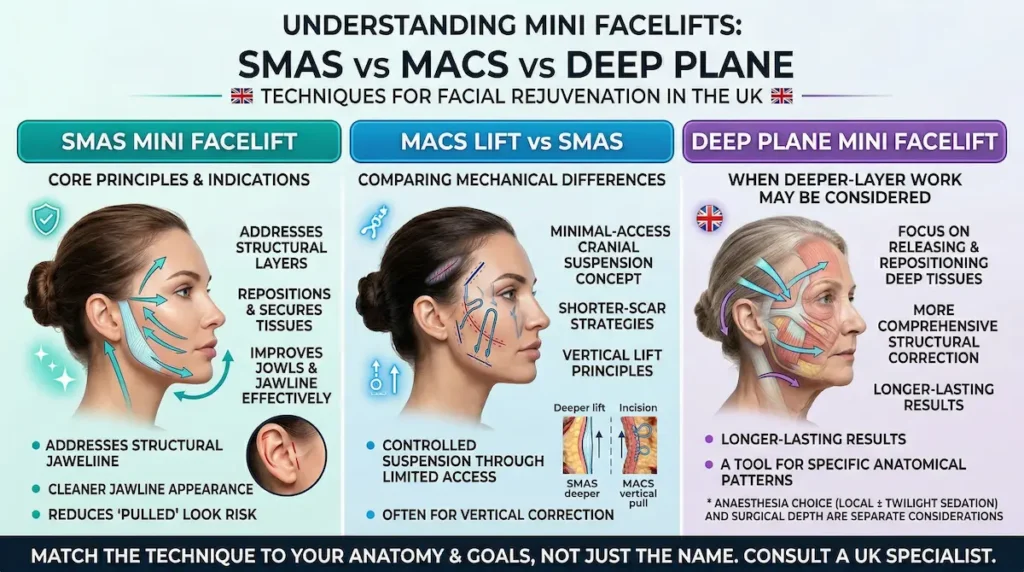
The SMAS (superficial musculoaponeurotic system) is a structural layer that contributes to facial support. A SMAS mini facelift approach aims to reposition and secure tissues at a deeper level than skin-only tightening. In suitable candidates, this can:
- Improve mini facelift for jowls more effectively by addressing support rather than just surface tension.
- Help the jawline look cleaner and more stable as swelling settles.
- Reduce the risk of a “pulled” appearance because the skin is not forced to do all the work.
For many expert patients, SMAS-based planning is part of what separates a surgical facelift from “tightening” procedures that may not age as well.
MACS lift vs SMAS mini facelift: how the mechanics differ
MACS facelift (often discussed as a minimal-access cranial suspension concept) is commonly associated with shorter-scar strategies and vertical lift principles in selected patients. When UK patients type MACS lift vs SMAS mini facelift, they are usually trying to answer: “Which one is more natural? Which one lasts longer? Which one is safer?”
- In broad terms, MACS-style strategies emphasise controlled suspension through limited access, often aiming for a more vertical correction.
- SMAS-based strategies focus on how the deeper layer is handled and secured to support the result.
- Both can be discussed within a mini facelift framework — but the best approach is individualised to your anatomy and priorities.
The practical takeaway: don’t choose a technique name first. Choose the problem first (jowls, jawline, lower cheek descent), then match the technique to it.
Deep plane mini facelift: when deeper-layer work may be considered
The phrase deep plane mini facelift is often used by research-driven patients aiming for longer-lasting structural correction. Deeper-plane concepts focus on releasing and repositioning tissues more comprehensively. In the mini facelift context, “deep plane” is not automatically better — it is a tool that may be considered when the anatomical pattern suggests it could deliver a more coherent correction.
If you’re searching for a deep plane facelift without general anaesthesia, it is important to understand that anaesthesia choice (local anaesthesia ± twilight sedation) and surgical depth are separate considerations. The safest plan is the one that fits your medical profile, your comfort needs, and your anatomical requirements — with clear boundaries on what a mini facelift can and cannot achieve.
Combination Procedures With Awake Mini Facelift
A well-planned awake mini facelift can transform the lower face, but facial ageing rarely happens in a single zone. In many UK patients, the best outcome comes from treating the dominant driver of ageing while keeping the overall face balanced. That is why combination planning is discussed early: not to add complexity, but to avoid a situation where the jawline looks improved while the neck or eyes still “give the game away”.
Awake Mini facelift + neck lift (for neck contour needs)
Sometimes the neck is the real issue, even if the patient initially asks for a mini facelift. If there is visible laxity under the chin, early platysmal banding, or a “blunted” cervicomental angle, combining a mini facelift with a neck-focused correction can create a much more coherent result.
- Best for patients where jawline definition cannot be fully restored without addressing the neck.
- Often improves the side profile and the “under-chin shadow” that photographs badly.
- Can reduce the need for aggressive tension on the face by sharing the correction across regions.
Awake Mini facelift + blepharoplasty / temporal lift (balancing upper and lower face)
UK patients often report: “My lower face has dropped, but my eyes look tired too.” If the upper eyelids feel heavy or the eye area looks hollowed and fatigued, a mini facelift alone may not deliver the overall refresh you’re hoping for. In selected cases, combining with eyelid surgery (blepharoplasty) or a subtle temporal lift can balance the face so the rejuvenation reads natural.
The key point is proportion: when multiple areas age together, a conservative multi-area plan can look more believable than a strong correction in one area.
Submental contour support (selected cases)
If fullness under the chin (submental fat) or mild contour irregularity contributes to a soft jawline, selected supportive measures may be discussed. This is especially relevant for patients searching for mini facelift for jowls who also dislike the “blur” beneath the jaw in side-profile photos.
We keep this decision anatomy-led. The aim is not an over-sculpted look; it is a clean, natural transition from face to neck.
Anaesthesia Choices — Why Awake / Why Twilight?
For many UK patients, anaesthesia is the deciding factor. Searches like mini facelift under local anaesthesia and questions comparing sedation options reflect a simple priority: “I want to feel safe, and I want my recovery to be manageable.” The awake mini facelift is built around that preference — with a clear framework for comfort, monitoring, and recovery planning.
Local anaesthesia and the “wide awake” approach: comfort with control
With local anaesthesia, the surgical area is numbed thoroughly, and you continue breathing independently. Comfort is continuously monitored and adjusted. In practice, “wide awake” does not mean “white-knuckled”. It means controlled, measured, and tailored to the individual — particularly useful for patients who wish to avoid the deeper systemic effects associated with general anaesthesia.
- Suitable for many healthy patients who prioritise a controlled recovery experience.
- Often aligns with the UK preference for minimising anaesthetic exposure where clinically appropriate.
- Works best when planning, communication, and patient reassurance are part of the protocol.
Conscious sedation / twilight sleep: who may benefit
Some patients feel calmer with light sedation alongside local anaesthesia. This is commonly referred to as conscious sedation or twilight sleep. You remain responsive, but significantly more relaxed, and many patients remember little of the procedure.
It may be considered for:
- Patients with higher procedural anxiety who still want to avoid full general anaesthesia.
- Those who want a more “dream-like” experience while maintaining independent breathing.
- Selected cases where comfort needs are best met with a modest sedation layer.
As with all anaesthesia decisions, suitability depends on medical history and a structured pre-operative assessment.
Local anaesthesia (UK) vs anesthesia (US): terminology note for search intent alignment
You may notice both spellings online. In UK English, it is anaesthesia; in US English, it is anesthesia. Patients searching internationally often encounter both, especially when comparing “local anaesthesia” options across clinics. In this guide we use UK spelling, while still recognising the US variant is a common search term.
Step-by-Step — What Happens on the Day of Surgery?
Clarity reduces anxiety. A large proportion of UK patients searching for an awake mini facelift want to know exactly what to expect on the day — not just the outcome. While every plan is individualised, the workflow is usually structured and predictable.
Pre-op assessment and surgical planning (photographic analysis)
Planning starts before surgery day. We assess:
- Your lower-face ageing pattern (jowls, lower cheek descent, jawline softness).
- Skin quality and elasticity (important for redraping and scar behaviour).
- Whether a technique cluster (e.g., SMAS mini facelift or MACS facelift considerations) is appropriate for your anatomy.
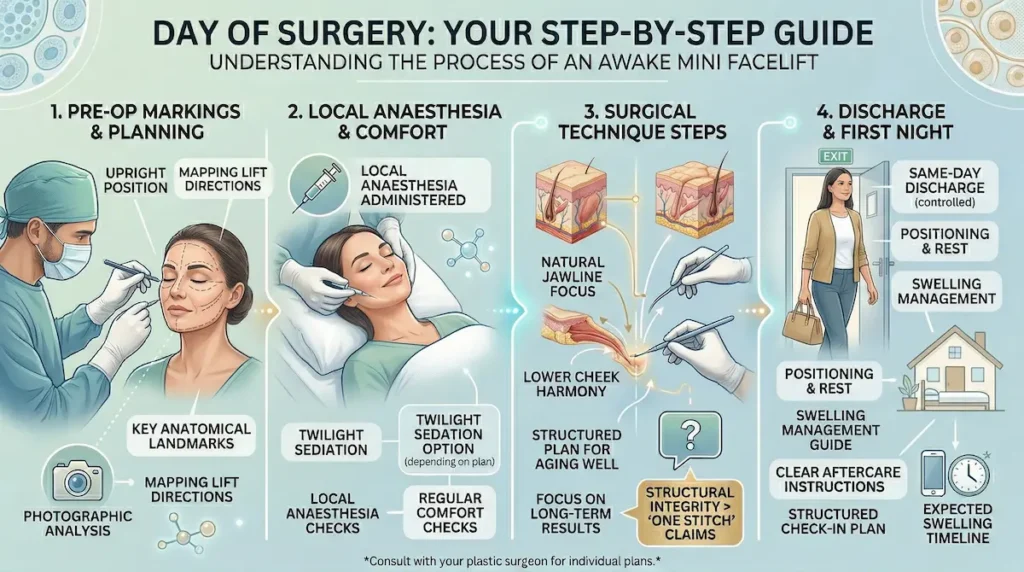
Photographic analysis helps map lift vectors and establish a realistic “after” target that stays natural.
On-the-day flow: marking, local anaesthesia, technique steps
On the day, the process typically includes:
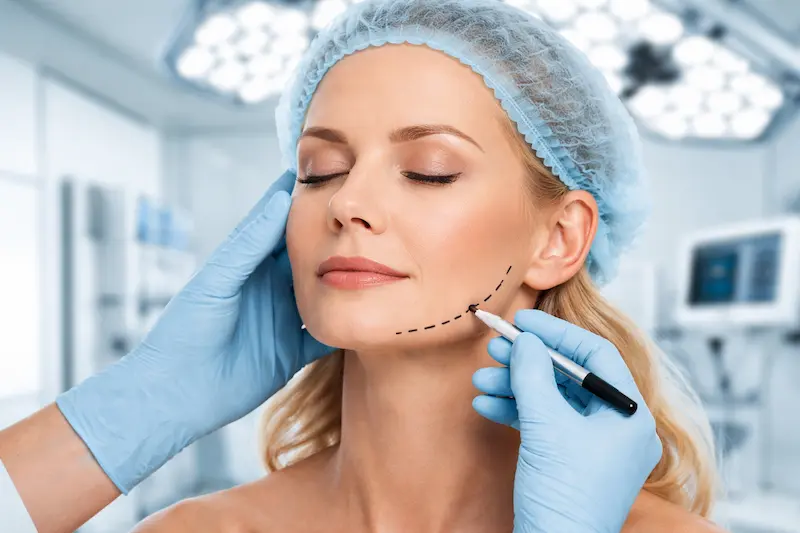
- Marking in the upright position to map the lift direction and key anatomical landmarks.
- Local anaesthesia administration with comfort checks throughout (with or without twilight sedation depending on the plan).
- Technique execution based on the chosen strategy (layer, vector, and fixation method), always prioritising a natural jawline and lower-cheek harmony.
For patients who have read about one stitch mini facelift or 2 stitch mini facelift, this is where you should focus: what is the structural plan, and how is it designed to age well?
Discharge and the first night: what “same-day” really means
Many awake protocols are designed for a controlled same-day discharge, but “same-day” does not mean “no aftercare”. The first night is about rest, swelling management, and clear instructions. You should expect:
- Guidance on positioning, cold compress strategy (if appropriate), and activity limits.
- A structured check-in plan so concerns are addressed early.
- Clear boundaries on what is normal (tightness, swelling) and what is not (rapid expansion swelling, severe unilateral pain, fever).
This is also why recovery searches are so common — a patient who understands Day 2–Day 4 swelling is typically calmer and better prepared.
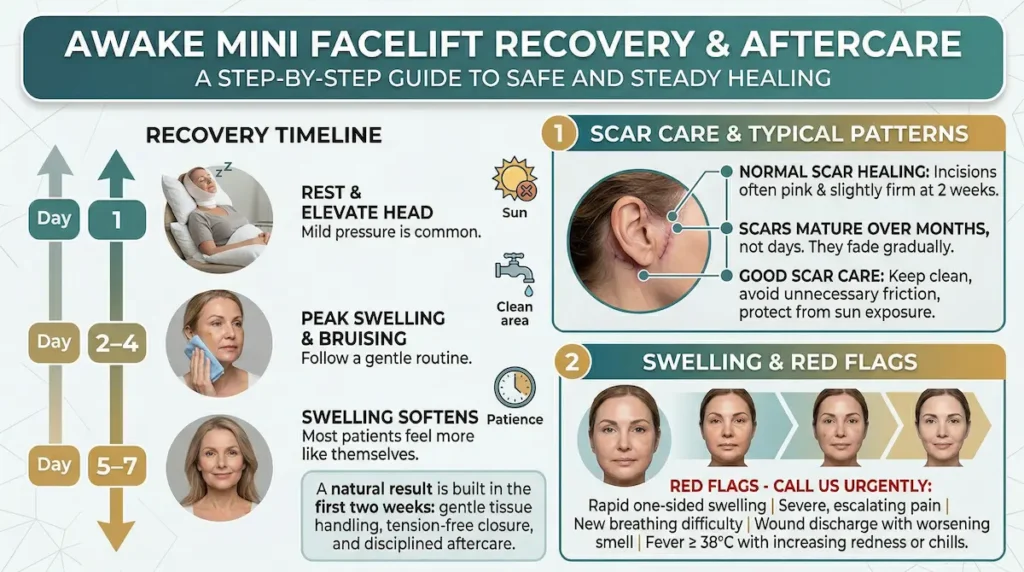
Awake Mini Facelift Recovery & Aftercare
Recovery after a mini facelift is usually straightforward, but it is not “instant”. Swelling shifts over days, bruising changes colour, and tissues need time to settle into their new position. Our job is to make the pathway predictable, with clear guidance and structured follow-up — especially for UK patients planning travel and a return to normal life.
If you have been searching for an awake mini facelift recovery timeline, you are asking the right question. The aim is not perfection on Day 7. The aim is a safe, steady reduction in swelling, comfortable wound healing, and scars that mature quietly over time.
“A natural result is built in the first two weeks: gentle tissue handling, tension-free closure, and disciplined aftercare. That is where the ‘operated’ look is either prevented — or invited.”
Mini facelift recovery timeline: Day 1–Day 7 (a day-by-day framework)
Every patient heals differently, but there are reliable patterns. This overview is designed to match the real-world queries we hear from UK patients, including “1 week mini facelift recovery pictures day by day”.
- Day 1: Tightness and mild pressure are common. Rest, head elevation, and gentle movement matter.
- Day 2–Day 4: Swelling often peaks. Bruising may become more visible before it improves.
- Day 5–Day 7: Swelling begins to soften. Many patients feel more “like themselves”, even though the face is still settling.
Practical rule: plan your first week as a recovery week. Do not schedule important meetings or social events expecting to look “camera-ready”.
Mini facelift scars after 2 weeks: what’s normal, what’s not
At around two weeks, incisions typically look pink and slightly firm. That is normal healing. Scars mature gradually over months, not days.
- Early scars can look more noticeable before they fade. That is expected.
- Good scar care is boring but effective: keep the area clean, avoid unnecessary friction, and protect from strong sun exposure.
- If you are concerned about scar quality, we can discuss targeted support, including our technology-led aftercare options.
Swelling after a mini facelift: typical patterns and clear red flags
Swelling is part of healing. It is usually symmetrical, gradually improving, and more pronounced in the first week. It can also fluctuate during the day, especially if you are active.
- Expected: tightness, mild asymmetry, bruising, numbness, and swelling that slowly reduces.
- Call us urgently: rapidly increasing one-sided swelling, severe pain that escalates, new breathing difficulty, or wound discharge with a worsening smell.
- Fever guidance: a temperature of 38°C (100.4°F) or higher, especially with increasing redness or chills, should be discussed promptly.
For UK patients travelling, we keep the instructions simple, written, and easy to follow. Clarity lowers stress.
Recovery Optimisation: Where HBOT and LLLT Fit
Many clinics talk about “fast recovery”. We prefer a more practical approach: reduce swelling, support tissue healing, and help scars mature well. This is where our recovery technologies come in. We integrate Hyperbaric Oxygen Therapy (HBOT) and Low-Level Laser Therapy (LLLT) into a structured plan when it is clinically appropriate, particularly for patients who want to shorten visible downtime.
These technologies are not presented as magic. They are tools. Used correctly, they support the biology of healing — which is exactly what expert patients are looking for.
“We don’t chase speed for its own sake. We optimise tissue oxygenation and cellular repair so your recovery is calmer, your swelling settles sooner, and your scars behave.”
Rapid recovery facelift with HBOT: why oxygenation matters
Rapid recovery facelift with HBOT is a search phrase we see from UK patients who need minimal social downtime. HBOT supports healing by increasing oxygen delivery to tissues at a systemic level. In simple terms: better oxygen availability helps the body repair.
- HBOT can support reduction of inflammation and bruising in selected patients.
- It is often used as part of a wider “accelerated track” for patients who want a more predictable return to public-facing life.
- We explain the plan clearly: what the sessions involve, what they aim to do, and what they do not promise.
LLLT scar healing therapy: supporting calmer, cleaner scar maturation
LLLT scar healing therapy Turkey is often searched by patients worried about visible scars. LLLT is used to support cellular repair by boosting ATP production (cellular energy) and stimulating collagen activity. In practical terms, it can help the skin settle more smoothly during the early healing phase.
- LLLT supports targeted cellular recovery at the incision sites and surrounding tissues.
- It complements HBOT by working at a “micro-level” once tissue oxygenation is supported.
- We use it as an adjunct — not a substitute for good surgery and good aftercare.
Flight-ready recovery protocols and UK-based aftercare: what continuity looks like
Travel adds a layer of planning. UK patients understandably ask when they can fly and how support works once they are home. Our focus is continuity and sensible pacing, guided by your recovery progress rather than arbitrary dates.
- Flight-ready recovery protocols are built around swelling control, hydration, mobility, and clear warning signs.
- Post-op care in Turkey for British citizens should not end at the airport. We structure follow-up so you know exactly how to reach us and what to send if you have questions.
- When patients refer to a walk-in walk-out facelift Turkey experience, the important point is this: you may not stay overnight in hospital, but you are still supported with a planned aftercare pathway.
Our principle is simple: the result should look natural, and the recovery should feel managed — not improvised.
Risks, Safety, and Risk-Reduction
Any surgical procedure carries risk — and a responsible awake mini facelift pathway is defined as much by what we prevent as by what we improve. UK patients often search for technique names and recovery images, but safety is the real differentiator: careful patient selection, a method that respects anatomy (not skin tension), and a structured follow-up plan that catches issues early.
Common risks: bleeding, infection, asymmetry, nerve irritation
The most discussed risks after a mini facelift are usually the most practical ones:
- Bleeding / haematoma: uncommon, but time-sensitive — typically presents as rapidly increasing swelling (often one-sided) and increasing pain.
- Infection: usually low risk when protocols are followed, but can present with escalating redness, warmth, discharge, or fever.
- Asymmetry: mild asymmetry can be part of normal healing early on; persistent asymmetry may require review.
- Nerve irritation: temporary altered sensation (numbness/tingling) is common; true nerve injury is rare, but must be discussed transparently.
It is also normal to have some tightness, firmness, and minor uneven swelling as tissues settle. Early healing is not a “final result”.
Reducing risk: patient selection + technique + structured follow-up
Risk reduction is a system, not a slogan. In a mini facelift under local anaesthesia pathway, safety is supported by:
- Patient selection: medical history, medications (including blood thinners), smoking status, and realistic expectations.
- Technique: prioritising structural support (e.g., SMAS mini facelift principles when appropriate) rather than skin-only tension that can look unnatural and heal less predictably.
- Haemostasis and tissue handling: careful control of bleeding and gentle tissue work reduce bruising and swelling burden.
- Aftercare: clear instructions, planned checks, and rapid access if something feels “off”.
This is also where “expert patient” behaviour helps: patients who understand Day 3 swelling and Day 10 scar redness tend to recover more calmly and follow instructions more consistently.
When to contact the clinic urgently (clear warning signs)
Whether you are in Istanbul or back in the UK, you should contact the clinic urgently if you experience:
- Rapidly increasing one-sided swelling, or swelling that feels tense and expands quickly
- Sudden, escalating pain that is not controlled by the advised measures
- Breathing difficulty, chest pain, or fainting
- Fever (38°C/100.4°F or higher) with worsening redness, heat, or discharge
- Wound discharge that becomes thicker, foul-smelling, or increasingly bloody
Safety is not only about the operating theatre. It is about response speed and clarity afterwards.
Is It Safe to Have a Awake Mini Facelift in Turkey?
Many UK patients feel a genuine tension: they want the best technique and a safer-feeling anaesthetic approach, but they also want reassurance that standards abroad match what they expect at home. This is exactly why our positioning is procedure first, location second. You should choose a clinic based on method, safety systems, and continuity of care — and then decide where that pathway is delivered.
Private clinic standards: theatre safety, hygiene, and protocols
When people search for a private cosmetic clinic Istanbul British standards, they are looking for tangible proof — not marketing. Practical indicators include:
- Clear pre-operative screening and documented consent processes
- Defined infection-control protocols and theatre workflows
- A named aftercare pathway, not an “if you need us, message us” approach
- Transparent explanation of what is included, who is on your team, and how follow-up is structured
Professionalism is measurable in systems: how a clinic prepares, operates, and follows up.
Surgeon credibility signals: how UK patients can validate expertise
High-intent searches like best mini facelift surgeon Turkey are usually a proxy for: “How do I verify skill and reliability?” Useful validation signals include:
- Technique fluency: the ability to explain MACS lift vs SMAS mini facelift differences in plain, accurate terms
- Case selection honesty: advising when a mini facelift is not enough (especially neck-dominant ageing)
- Realistic outcome framing: natural results, not “perfect” promises
- Aftercare seriousness: recovery planning and access, particularly for UK return travel
In other words, choose the clinician who prioritises anatomy and safety over sales language.
Post-op care for British citizens: remote follow-up and continuity
Post-op care in Turkey for British citizens should be defined in advance. The UK–Turkey corridor only works well when continuity is built into the plan:
- Scheduled check-ins and clear instructions for what to monitor at home
- Guidance on swelling management, scar care, and activity progression
- A direct line for urgent questions with fast response expectations
- Photo-based monitoring for scars and swelling patterns where appropriate
This is how travelling for a procedure stays safe: the journey is planned, not improvised.
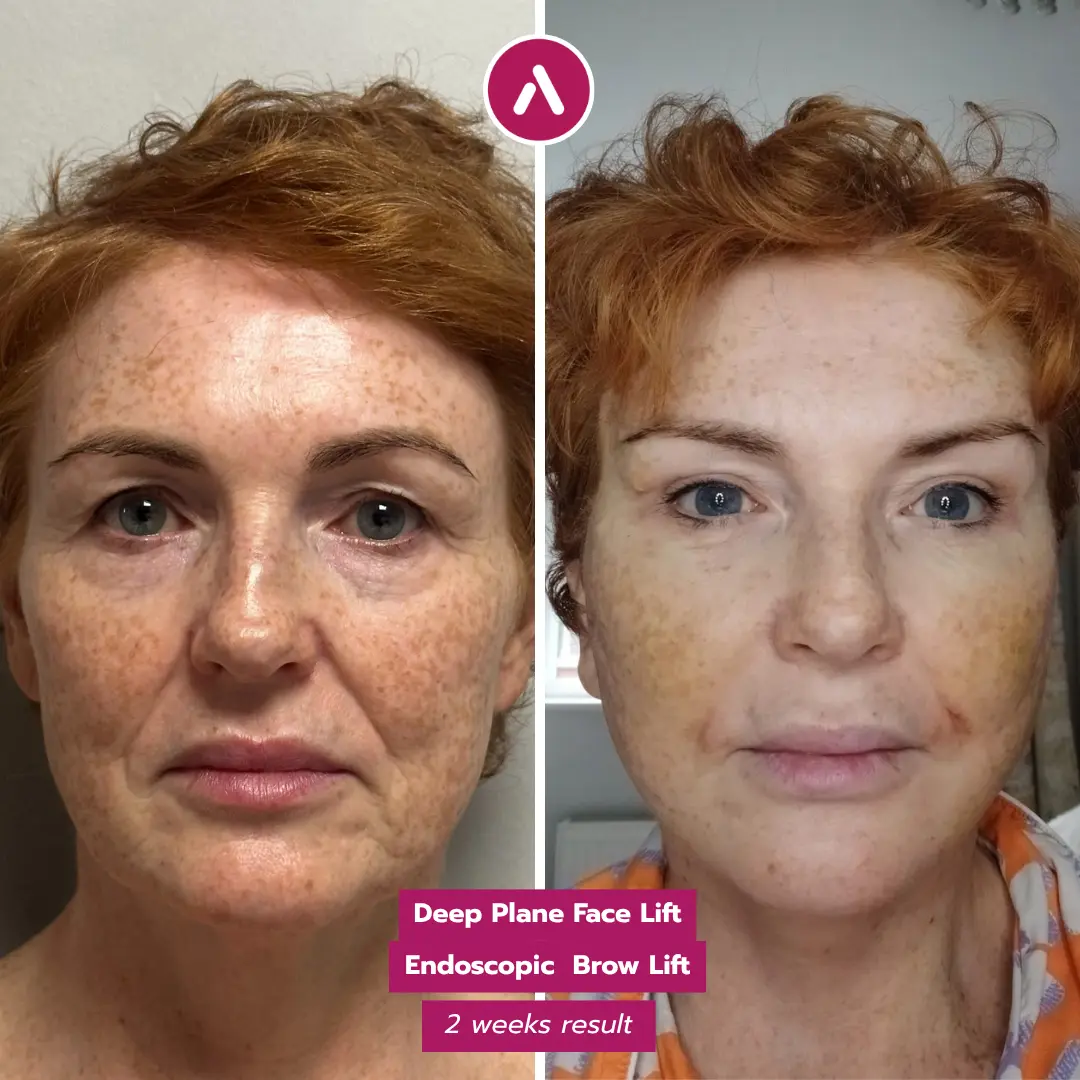
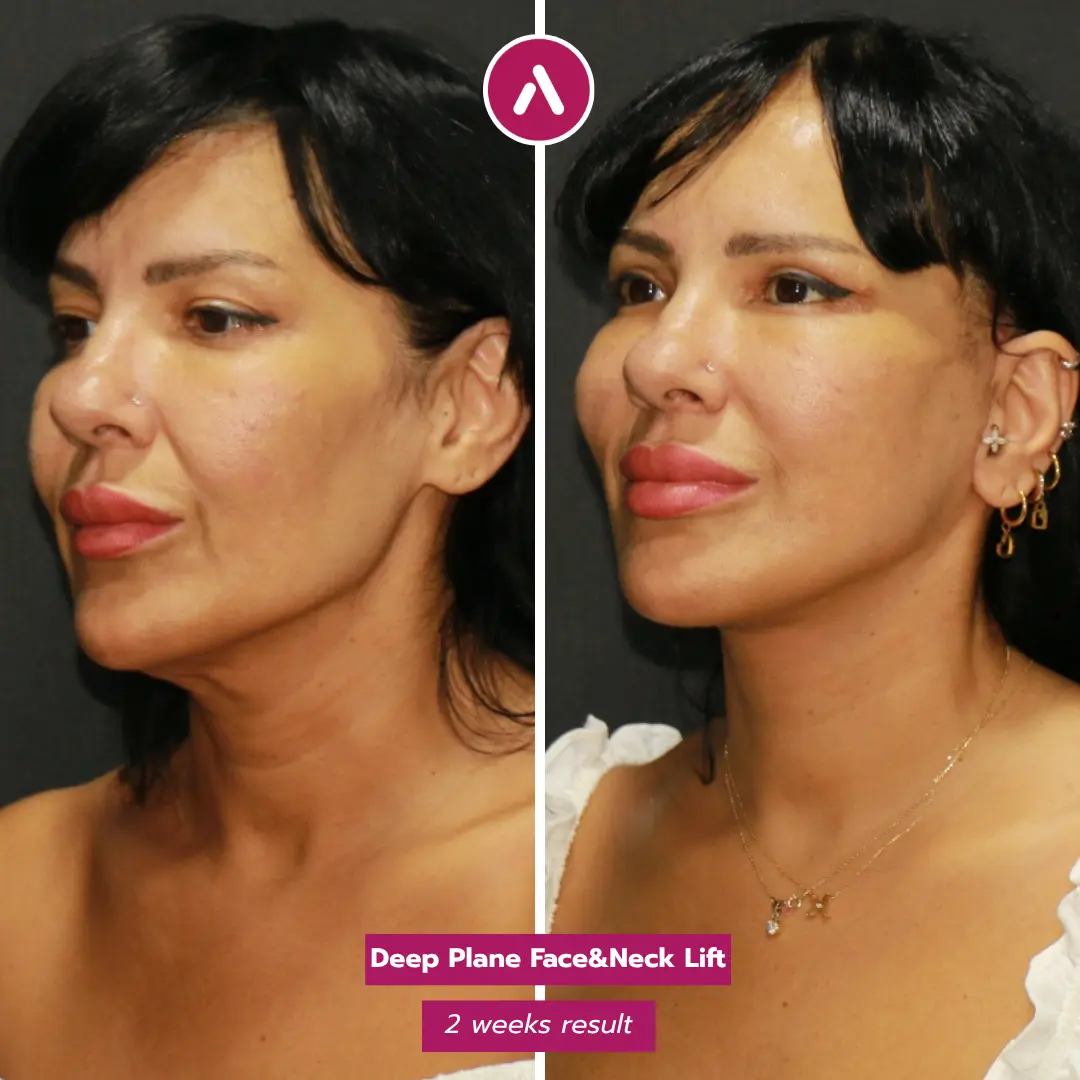
Awake Mini Facelift Before and After
UK patients often ask two very direct questions: “Will it look natural?” and “How long will it last?” The honest answer is: longevity depends on anatomy, technique, and lifestyle — but a well-designed awake mini facelift can deliver a meaningful improvement that holds well when the structural problem is treated correctly.
How long does a mini facelift last?
The search phrase how long does a mini facelift last? is common because mini procedures are sometimes portrayed as “temporary”. In reality, results can be long-lasting, but they are not permanent — ageing continues. Factors that influence longevity include:
- Your starting anatomy (degree of laxity, skin quality, tissue heaviness)
- Whether deeper support is addressed (e.g., SMAS-based planning when appropriate)
- Lifestyle factors (smoking, major weight fluctuation, sun exposure)
- Aftercare discipline during the early healing phase
A mini facelift should not be sold as a shortcut. It should be offered when it is the right-sized solution.
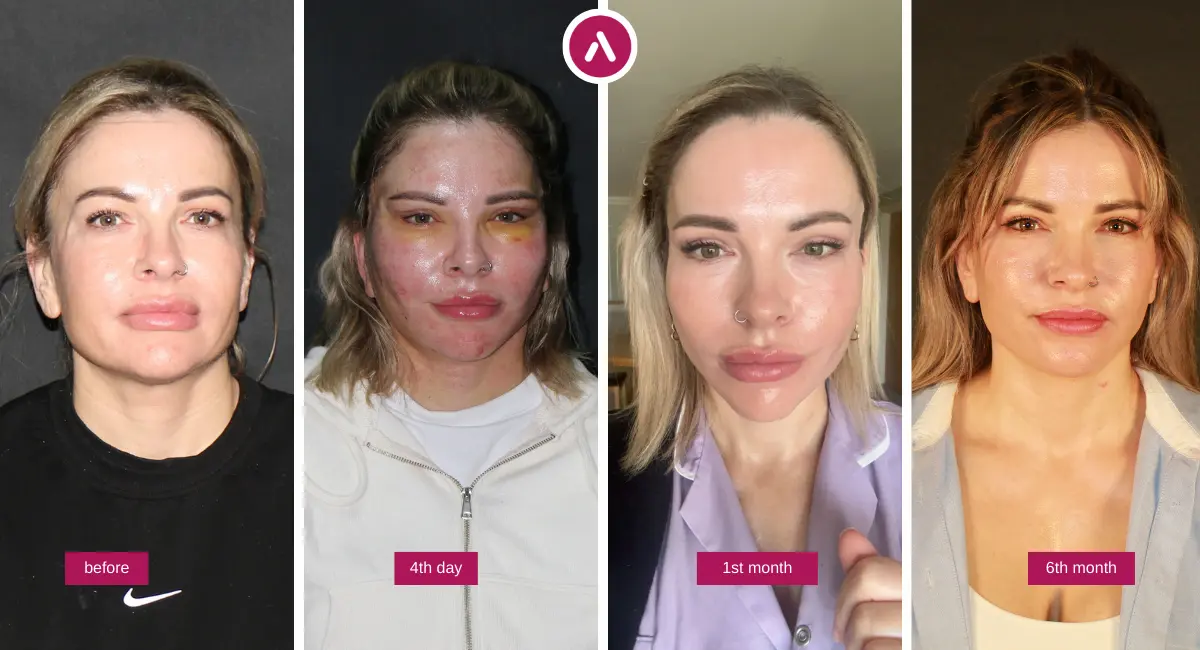
Mini facelift at 40: realistic “before and after” expectations
Searches like mini facelift at 40 before and after often reflect a desire for subtle correction — a cleaner jawline, less heaviness around the mouth, and a fresher look without looking “done”. At this stage, improvements can be elegant because tissues are often more responsive, and the correction can be more conservative.
The best “before and after” is the one that still looks like you — just less tired.
Avoiding an “overdone” result: principles of natural outcomes
Natural results are not accidental. They come from:
- Correct lift vector (avoiding an overly lateral, swept-back look)
- Structural support rather than skin tension alone
- Respect for facial proportions — especially around the mouth corners and jawline
- Conservative refinement: allowing swelling to settle before judging symmetry
This is why technical clarity matters more than hype around “one stitch” claims.
Awake Mini Facelift Cost 2026 UK vs Turkey
UK patients often compare mini facelift London cost with the mini facelift Istanbul price, but price is only meaningful when you understand what the pathway includes. The goal is not to chase the lowest number. The goal is to understand value: technique, safety systems, aftercare, and recovery optimisation.
Mini facelift cost UK vs Turkey: how to interpret price responsibly
When you compare cost of mini facelift UK vs Turkey, make sure you are comparing like-for-like. Ask:
- Is the procedure performed under local anaesthesia or general anaesthesia — and what does that mean for your recovery preference?
- Which technique layer is being addressed (skin-only vs structural support)?
- What aftercare is included, and how is follow-up handled once you are back in the UK?
- Are recovery optimisation options (HBOT/LLLT) part of a defined plan or an “add-on”?
This approach helps neutralise the “Turkey stigma” by focusing on clinical method and continuity, not bargain framing.
Mini facelift London / Manchester / Scotland: what’s driving the difference
Location-based UK searches (London, Manchester, Edinburgh/Glasgow) often reflect overhead and local market pricing — not necessarily a superior method. The smarter comparison is:
- Technique depth and plan clarity (SMAS, MACS, deep plane concepts where relevant)
- Anaesthesia strategy (many UK patients specifically want a mini facelift under local anaesthesia)
- Structured aftercare and access
That’s how you avoid paying more for a less-defined technique.
All-inclusive pricing in GBP: what’s typically included vs excluded
For UK patients, pricing should be transparent in GBP. “All-inclusive” should be defined, not implied. Typically, you should clarify:
- What is included in the surgical fee (theatre, team, anaesthesia plan)
- Accommodation and transfers (if offered) and the precise scope
- Follow-up schedule and how remote check-ins work after returning to the UK
- What is excluded (medications, optional recovery technologies, extra nights if required)
Transparency is part of safety: it prevents rushed decisions and hidden-stress recovery planning.
FAQs: Awake Mini Facelift (10 Most Asked Questions)
What is an awake mini facelift?
An awake mini facelift is a lower-face lift performed under local anaesthesia (often with optional twilight sedation) to improve early-to-moderate jowls and jawline softness.
Mini facelift vs full facelift: which do I need?
A mini facelift targets the lower face (jowls/jawline). A full facelift is broader and more suitable for advanced laxity and significant neck ageing.
Is a mini facelift under local anaesthesia safe?
For suitable patients, a mini facelift under local anaesthesia can be a safe option. Suitability depends on your medical history, medications, and comfort/anxiety levels.
Do you offer twilight sleep (conscious sedation)?
Yes, conscious sedation (often called twilight sleep) may be used alongside local anaesthesia for comfort, if clinically appropriate.
What does a mini facelift improve most?
It most reliably improves mini facelift for jowls, jawline definition, and lower-cheek heaviness. It may soften nasolabial folds but won’t “erase” them completely.
How long does a mini facelift last?
It can be long-lasting, but ageing continues. Longevity depends on anatomy, technique (e.g., SMAS mini facelift planning where indicated), and lifestyle factors like smoking and weight changes.
What is the recovery timeline — will I look okay in 1 week?
Swelling often peaks around Days 2–4. At 1 week, many patients still have visible swelling; plan conservatively. Around 2 weeks, most feel more “public-facing”, though mild swelling can remain.
Are scars visible after 2 weeks?
Mini facelift scars after 2 weeks are usually pink and slightly firm — that’s normal. Scars typically soften and fade over months with proper aftercare and sun protection.
What are “one stitch” and “two stitch” mini facelift techniques?
One stitch mini facelift / 2 stitch mini facelift are marketing-style terms. What matters more is the lift layer (skin vs structural support), the vector, and your anatomy-based plan.
What should I check before booking in Turkey/Istanbul?
Look for clear technique explanations (e.g., MACS lift vs SMAS mini facelift), consistent before/after documentation, transparent GBP pricing, and a structured aftercare plan for your return to the UK.
Medical Disclaimer: This page is provided for general educational purposes only and does not replace a face-to-face medical consultation, diagnosis, or personalised treatment plan. All surgery carries risks and outcomes vary between individuals. Suitability for a awake mini facelift, procedure selection, and anaesthesia choice can only be determined after a full clinical assessment by a qualified surgeon. Always follow your clinician’s instructions and seek urgent medical attention if you develop concerning symptoms during recovery.