



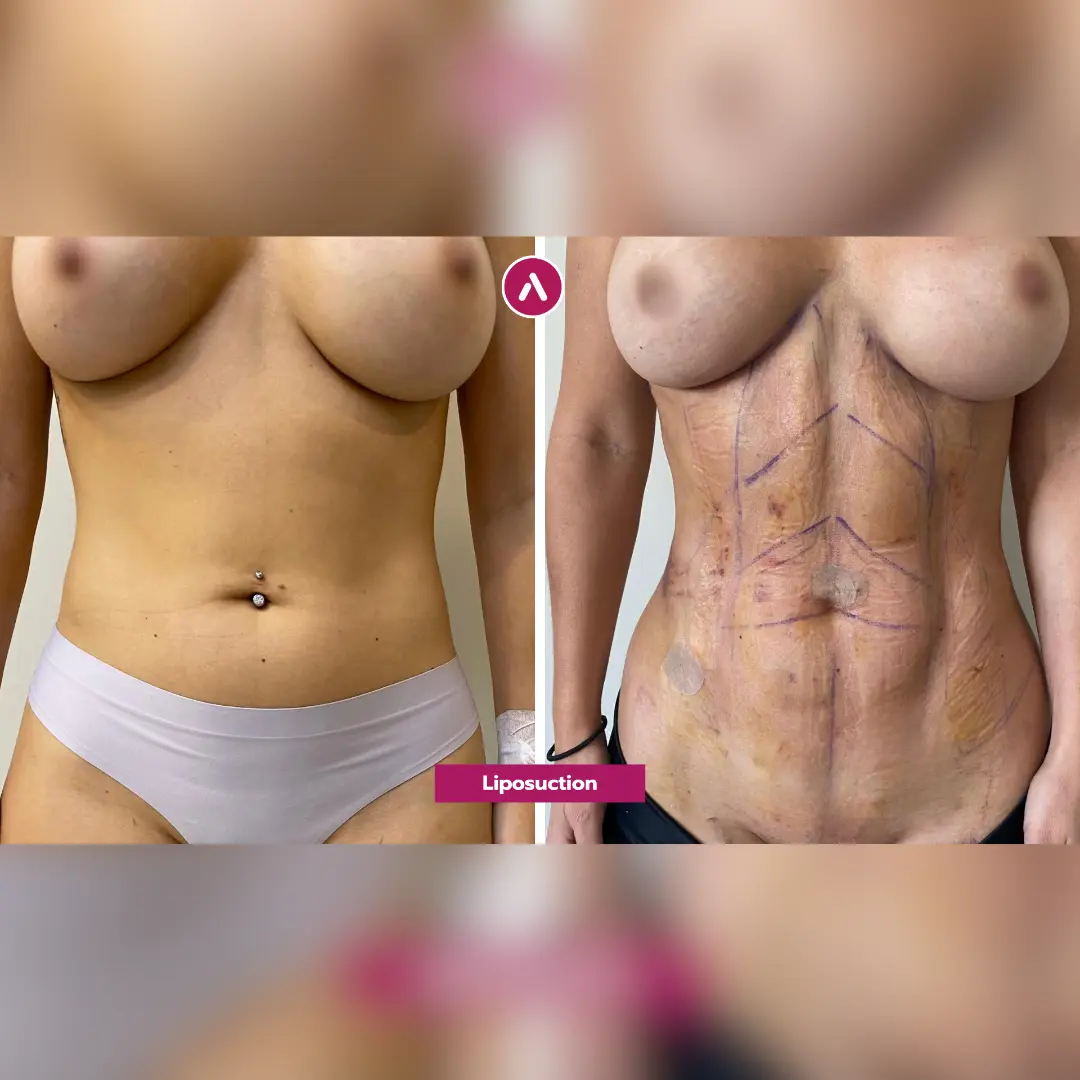
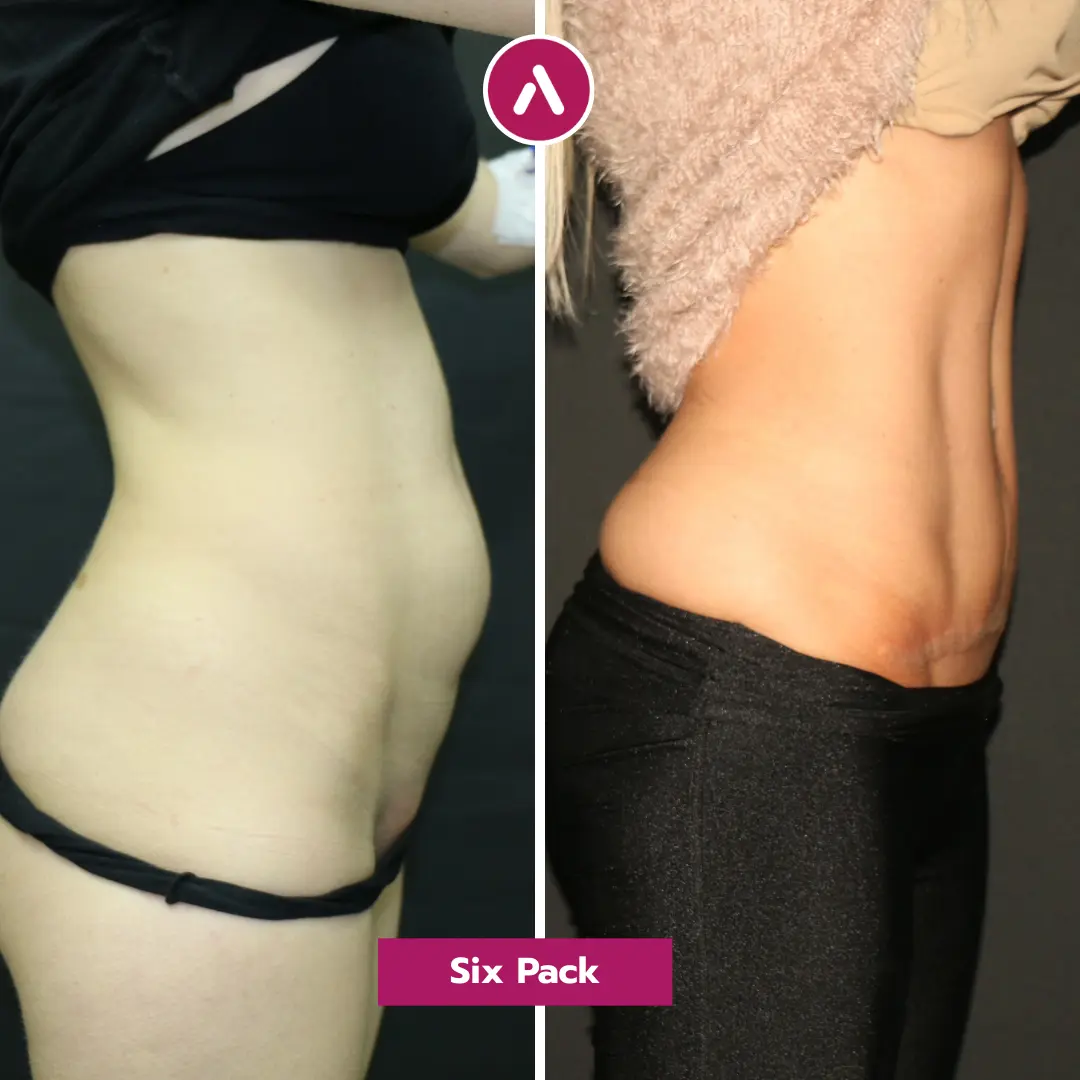
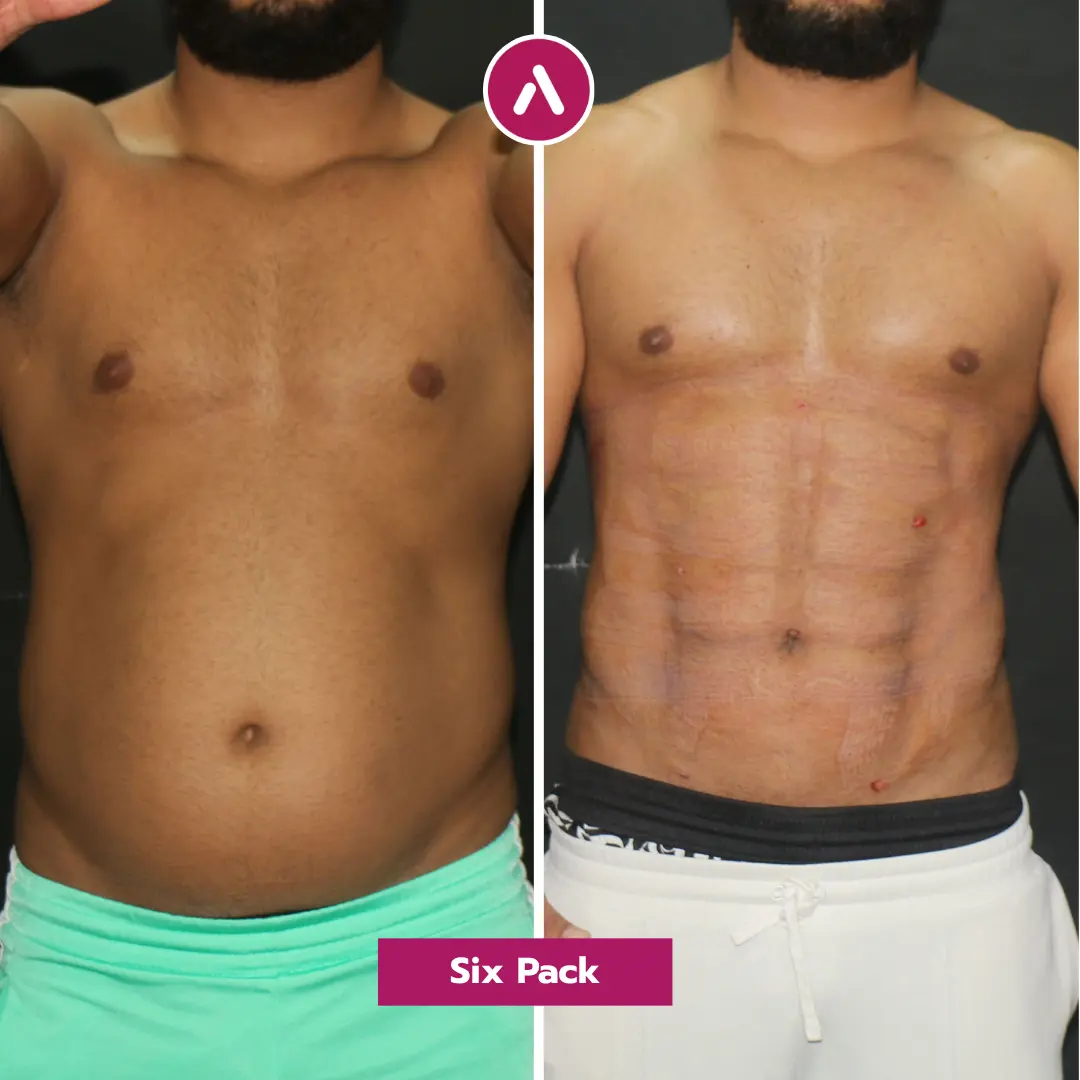
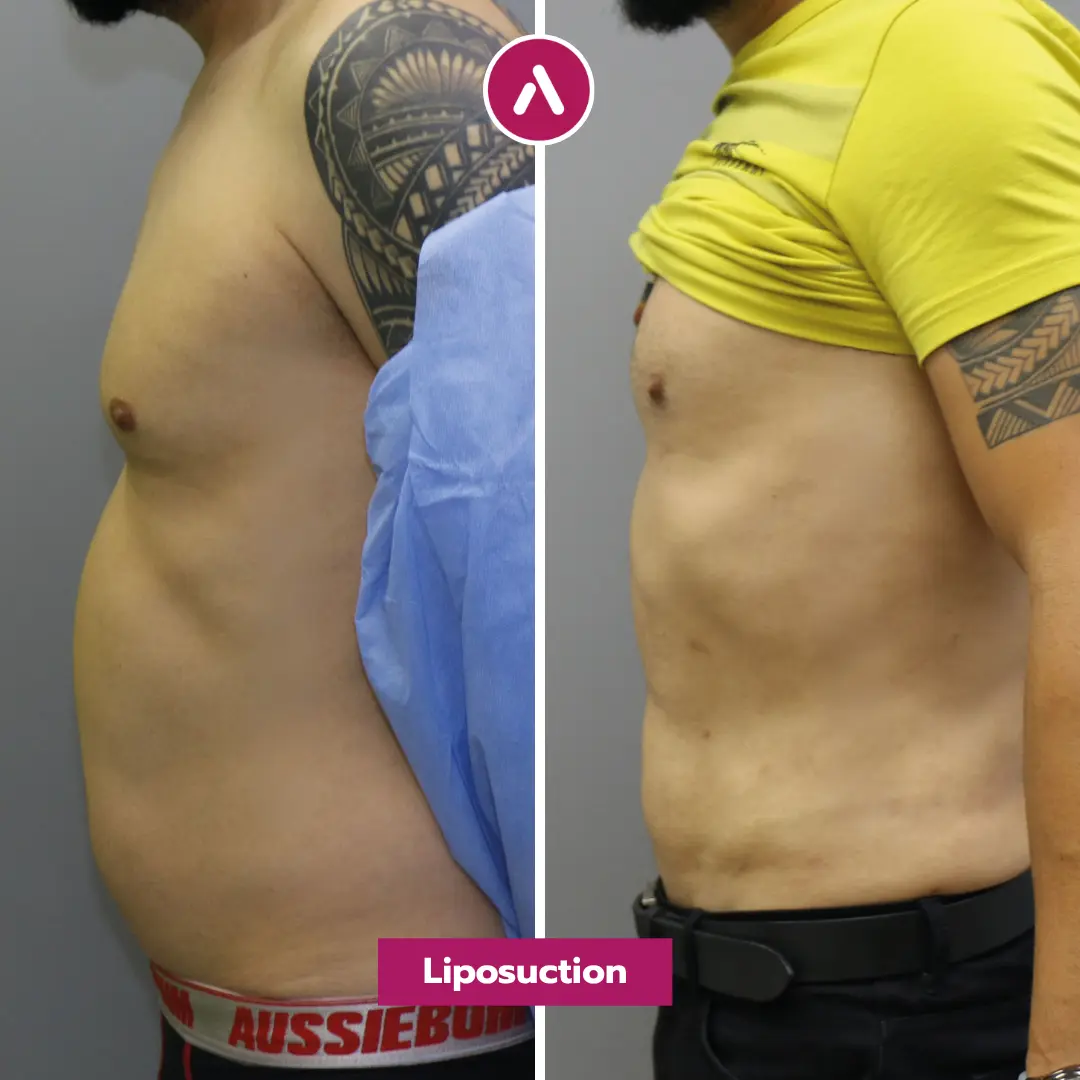
Abdominal Etching is a precision body-contouring procedure designed to reveal natural abdominal definition by selectively sculpting superficial fat. Unlike standard liposuction, it is anatomy-led: we map the midline and muscle intersections to create smooth, believable transitions in any light.
For UK patients travelling to Istanbul, safety and recovery are central. Where appropriate, we use awake or twilight sedation with continuous monitoring, then support healing with structured aftercare and HBOT plus LLLT to reduce swelling. Learn candidacy and realistic timelines here.
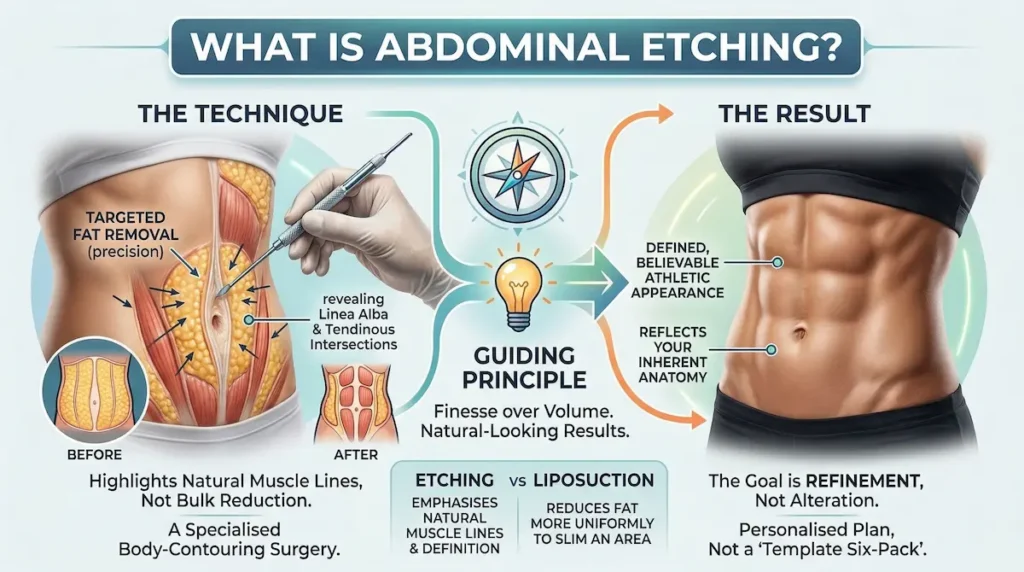
What is Abdominal Etching?
Abdominal etching is a specialised form of body-contouring surgery that highlights the natural lines of the abdominal muscles. We remove and sculpt small layers of fat with precision. The aim is definition, not bulk reduction. Done well, it creates an athletic look that still matches your own anatomy.
Our guiding principle is simple: rejuvenation, not alteration. The goal is a result that looks refined and believable, not “done”.
How does abdominal etching work?
Think of the abdomen as a landscape of gentle rises and shallow valleys. Even fit people can hold thin, stubborn fat over the muscle lines that softens definition. Abdominal etching uses targeted contouring to reveal those natural boundaries.
- High-definition abdominal sculpting focuses on finesse rather than volume.
- We treat different fat layers differently, depending on the area and your skin quality.
- The plan is personalised to your anatomy, not a “template six-pack”.
Abdominal etching vs liposuction: what’s the difference?
Standard liposuction is designed to reduce fullness and improve proportions. Abdominal etching can include liposuction, but the goal shifts from “flat” to “defined”. The technique demands more precision, because small decisions affect the final light-and-shadow effect.
- Abdominal etching: emphasises natural muscle lines and athletic definition.
- Traditional liposuction: reduces fat more uniformly to slim an area.
- Vaser Hi-Def liposuction may be used as part of an etching plan when the aim is sharper definition.
You may also see the term six pack surgery. It describes the same end goal in non-medical language, but “abdominal etching” is the more precise surgical term.
What anatomy actually creates “visible abs”?
Visible abs are not only about muscle size. They come from the relationship between skin, fat thickness, and the natural separations of the rectus abdominis. A careful assessment matters, especially if your aim is definition that still looks natural in normal lighting.
- Linea alba: the central line running down the abdomen.
- Tendinous intersections: the horizontal grooves that create the “block” pattern.
- Skin quality: good elasticity helps the contour show cleanly as swelling settles.
Benefits of Abdominal Etching
The main benefit is controlled definition. When the plan is right, the abdomen looks more athletic without looking artificial. This is why abdominal etching appeals to the “expert patient” who has already trained hard and wants a precise finishing step. It can also suit patients who simply want a sharper waist-to-abdomen transition.
A more defined abdomen that still looks natural
Most people do not want an exaggerated, carved look. They want visible structure when they stand tall, and softer transitions when they sit or bend. That balance is exactly what we plan for.
- Sharper midline definition (where appropriate for your anatomy).
- Smoother transitions at the upper abdomen and flanks.
- A result that reads “fit” rather than “surgical”.
Benefits for men vs women
Male and female anatomy can call for different sculpting priorities. Men often ask for more pronounced segmentation. Women commonly prefer subtle definition with a flatter, smoother overall profile.
- For men: a stronger midline and clearer intersections can be appropriate.
- For women: “soft definition” can enhance shape without harsh grooves.
- For both: the best outcomes are proportional to the ribcage, waist, and hip line.
Practical, day-to-day benefits
Patients often describe the benefit as predictability in how clothes fit and how the midsection photographs. It can also remove frustration when training is strong but abdominal definition remains muted. As with any body-contouring surgery, results still depend on weight stability and sensible aftercare.
- Better definition in fitted clothing and swimwear.
- Improved silhouette from the front and three-quarter angles.
- A clearer “reward” for your training and lifestyle habits.
Am I a Suitable Candidate for Ab Etching?
Abdominal etching is not a “one-size-fits-all” operation. It works best when we can reveal natural muscle lines without forcing an unnatural shape. Your starting point matters. So does your lifestyle after surgery.
Our candidacy checklist (what we look for)
We start with a clinical assessment, then build a plan around your anatomy and goals. This is where an “expert patient” approach helps, because details determine outcomes.
- Stable weight: big weight swings can soften definition and change symmetry.
- Skin quality: good elasticity supports a cleaner contour as swelling settles.
- Fat distribution: thin, stubborn fat over the muscle lines responds best.
- Core anatomy: natural linea alba and intersections guide where definition should sit.
We don’t chase a template “six-pack”. We refine what your anatomy can realistically support, then protect that natural look with careful planning.
When abdominal etching may not be the right first step
Sometimes the abdomen needs tightening more than sculpting. If skin laxity is significant, etching alone can leave definition hidden under loose skin. In those cases, we may discuss a tummy tuck (abdominoplasty) or a combined approach.
- Marked skin looseness (often after pregnancy or major weight loss).
- Pronounced rectus separation that needs structural repair.
- Uncontrolled medical conditions that raise surgical risk.
We also take scars and prior procedures seriously. Previous liposuction can change tissue planes. It does not rule you out, but it can affect strategy.
Fitness level, “bodybuilder” goals, and realistic expectations
Many patients who ask about abdominal etching already train hard. That’s a good sign. Still, surgery cannot replace muscle development. It can only make existing structure easier to read.
- If you want very sharp definition, your body fat level and skin quality must support it.
- If you prefer a softer look, we plan smoother transitions and less aggressive line work.
- If your goal is “competition-level” definition, we talk frankly about what surgery can and cannot do.
We also screen for lifestyle factors that affect healing and scarring. Smoking and nicotine are the common culprits. Compliance is not glamorous, but it is decisive.
Types & Terminology: Abdominal Etching, Ab Etching, Hi-Def Lipo
Online terminology can be messy. Some terms are clinical, others are marketing shorthand. We keep the language precise so you can compare options rationally and ask the right questions.
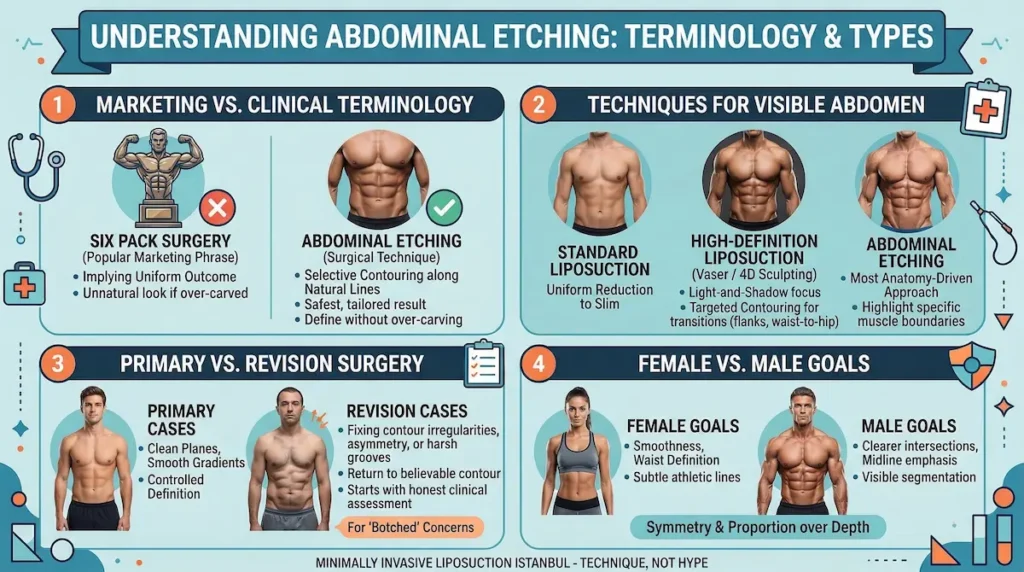
“Abdominal etching” vs “six pack surgery”
“Six pack surgery” is a popular phrase, but it is not a technical description. It implies a uniform outcome. In reality, the safest, most natural result is tailored to your own muscle layout and body shape.
- Six pack surgery: a general, non-medical label for visible abdominal definition.
- Abdominal etching: a surgical technique focused on selective contouring along natural lines.
- Our approach: define without over-carving, so the abdomen still looks normal in day-to-day movement.
How high-definition liposuction fits in (Vaser / 4D sculpting)
High-definition body contouring often blends technologies and techniques. In selected patients, we may use Vaser Hi-Def liposuction principles as part of the sculpting plan, particularly where transitions matter (upper abdomen, flanks, and the waist-to-hip line).
- Standard liposuction: more uniform reduction to slim an area.
- High-definition liposuction: more targeted contouring, with a focus on light-and-shadow.
- Abdominal etching: the most anatomy-driven approach, used to highlight specific muscle boundaries.
If your search includes terms like minimally invasive liposuction Istanbul, we address the same core concern: reducing trauma while improving precision. Technique, not hype, is what makes the difference.
Primary abdominal etching vs revision surgery
Revision work is a different conversation. Tissue behaves differently after prior liposuction or “over-etched” results. The aim is usually correction, balance, and a return to a believable contour.
- Primary cases: we can plan clean planes, smooth gradients, and controlled definition.
- Revision cases: we focus on fixing contour irregularities, asymmetry, or harsh grooves.
- Timing matters: we typically need swelling and scar tissue to mature before making final decisions.
Many revision enquiries arrive via searches like abdominal etching revision or “botched” concerns. We treat those concerns seriously, and we start with an honest clinical assessment rather than promises.
Female vs male abdominal etching (how the plan changes)
Women and men often want different “signals” from the abdomen. Men may prefer more visible segmentation. Women commonly prefer definition that reads athletic without looking carved.
- Female abdominal etching: typically prioritises smoothness, waist definition, and subtle lines.
- Male abdominal etching: often emphasises the midline and clearer intersections.
- Both: symmetry and proportion matter more than depth of grooves.
If you are comparing options, focus on planning and aftercare. The “label” matters less than the surgeon’s judgement and the protocol around your recovery.
Surgical Techniques Explained: How We Create Definition (Not “Carving”)
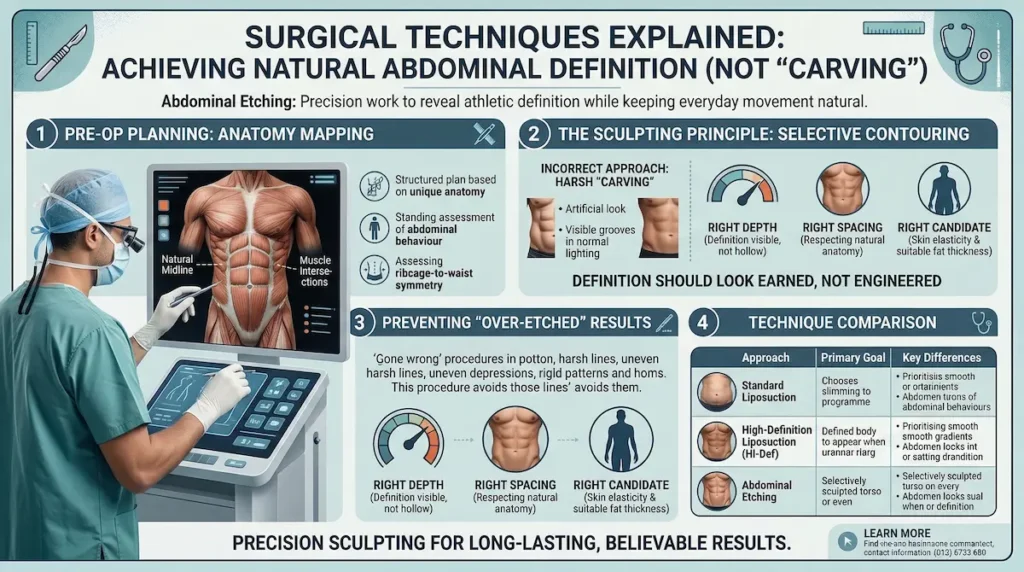
Abdominal etching is precision work. Small choices change the final contour. Our aim is to reveal athletic definition while keeping the abdomen believable in everyday movement.
Pre-op planning: mapping your anatomy before we sculpt
We start with a structured plan, not assumptions. Your natural midline and intersections guide where definition should sit and where it should stay soft.
- Standing assessment: we look at how your abdomen behaves when upright and relaxed.
- Symmetry checks: we assess the ribcage-to-waist ratio and midline balance.
- Planning tools: when appropriate, we use advanced imaging systems to support meticulous pre-operative planning and simulation.
The sculpting principle: selective contouring, smooth transitions
The word “etching” can sound aggressive. It shouldn’t be. The best results are created by controlled, selective fat reduction and carefully blended transitions.
- We focus on where definition is meant to appear (and where it isn’t).
- We avoid harsh grooves that can look artificial in normal lighting.
- We prioritise smooth gradients so the abdomen still looks natural when sitting or bending.
Definition should look earned, not engineered. Our job is to refine what’s already there, then keep it looking natural in real life.
Why “over-etched” results happen (and how we prevent them)
When patients search for “abdominal etching gone wrong”, the themes are consistent: harsh lines, uneven depressions, or a rigid, stamped-on pattern. Prevention starts with judgement and restraint.
- Right depth: definition should be visible without looking hollow.
- Right spacing: we respect your natural anatomy rather than forcing uniform blocks.
- Right candidate: poor skin elasticity or higher fat thickness can hide or distort definition.
Technique comparison (what each approach is designed to do)
| Approach | Primary goal | Best suited for | What it changes | Key trade-offs |
|---|---|---|---|---|
| Standard liposuction | Slim an area | Patients seeking general fat reduction | Overall thickness and proportions | Can look flatter, but not necessarily “defined” |
| High-definition liposuction (Hi-Def) | Sharper contouring | Fit patients wanting more visible lines and transitions | Light-and-shadow effect across the abdomen and waist | Needs precision and careful aftercare to settle evenly |
| Abdominal etching | Anatomy-led definition | Patients seeking targeted ab sculpting with a natural look | Selective definition along natural muscle boundaries | Higher sensitivity to symmetry, skin quality, and swelling patterns |
Combined Procedures: When Abdominal Etching Works Better as a Plan
Sometimes abdominal etching is the final detail. Sometimes it is only one part of a larger contour strategy. We recommend combinations when they improve proportion, not because they add “more surgery”.
Abdominal etching + high-definition body contouring (360 shaping)
Definition on the front can look incomplete if the waist and flanks are untreated. A blended approach can create a more athletic silhouette from every angle.
- We may combine etching with high-definition liposuction to refine the waist-to-abdomen transition.
- For some patients, a broader contour plan can deliver a more balanced result than front-only sculpting.
- We keep the goal consistent: refined shape, natural appearance.
Abdominal etching + tummy tuck (when skin is the real limiting factor)
If your main issue is loose skin, etching alone can disappoint. In those cases, a tummy tuck can be the foundation, and definition becomes the finishing step.
- We discuss this option most often after pregnancy or major weight loss.
- We assess whether the abdomen needs tightening first to show definition clearly.
- Where appropriate, we build a staged or combined plan with realistic recovery timelines.
Abdominal etching + skin tightening (selected cases)
Some patients have borderline laxity rather than major looseness. In carefully selected cases, skin tightening technologies can be considered as an adjunct to improve the way the contour “reads” as swelling settles.
- This is not a substitute for a tummy tuck when significant skin excess is present.
- It can be useful when the goal is a tighter envelope over a refined contour.
- We decide based on skin quality, not marketing trends.
When a 360 body lift may be more appropriate
If laxity and tissue descent affect the abdomen, waist, back, and buttock area together, abdominal etching alone may not address the core issue. In selected patients after major weight loss, a 360 body lift can be considered to tighten and lift circumferentially, with definition added only when the skin envelope can support it.
Additional contour combinations: arm lift and facelift (selected patients)
Some patients want a comprehensive transformation after weight loss or pregnancy. Where appropriate, we may discuss combining abdominal contouring with other procedures, based on safety, timing, and recovery planning.
- Arm lift: considered when upper-arm skin laxity is a primary concern and affects overall proportions.
- Facelift: considered for facial laxity and ageing concerns, typically planned separately or staged depending on total surgery time.
If you want a personalised plan, we can review your goals and photos in a virtual consultation and outline the safest route to the result you’re aiming for.
Anaesthesia: Why We Prefer Awake / Twilight Sedation
Anaesthesia is not a minor detail. It shapes comfort, safety, and how smoothly your early recovery starts. For many UK patients, the biggest barrier is not the procedure itself, but anxiety around general anaesthesia. We understand that concern. Our preference, where clinically appropriate, is to use awake surgery principles with twilight sedation so you can feel calm, comfortable, and closely monitored throughout.
This does not mean “no anaesthesia”. It means a carefully controlled plan that avoids the deeper physiological load of full general anaesthesia when it is not necessary. Suitability depends on your procedure plan, medical history, and the anaesthetist’s assessment.
What does “awake” or “twilight sedation” actually feel like?
Most patients describe it as relaxed and drowsy. You are not “fully alert”, and you should not feel sharp pain. You may drift in and out of sleep, and many people remember very little afterwards. Our team monitors you continuously, adjusts medication in real time, and keeps you comfortable.
- Twilight sedation: you are deeply relaxed and sleepy, but breathing on your own.
- Local anaesthetic is used to numb the treatment area.
- Our goal is steady comfort, not heavy sedation.
Why we prefer it for the right candidate
For the right patient, awake / twilight sedation can reduce the “big anaesthetic fear” and simplify the early hours after surgery. It can also support a smoother transition into recovery because you are less likely to feel groggy for a prolonged period. We still treat it as serious medicine. Monitoring and safety protocols remain strict.
- May reduce anxiety for patients who are uneasy about general anaesthesia.
- Often supports a clearer, more comfortable early recovery period.
- Allows close communication if reassurance is needed during the procedure.
When general anaesthesia may be recommended instead
There are situations where general anaesthesia is the safer, more controlled choice. Complex combined procedures, certain medical histories, or patient comfort needs may shift the balance. We are transparent about that. Our priority is always safety first, and we will recommend the option that best matches your clinical picture.
- Longer or more complex surgical plans that require deeper control.
- Medical considerations identified in your pre-operative screening.
- Patients who are unlikely to tolerate a lighter anaesthesia plan, even with sedation.
We don’t “sell” anaesthesia choices. We select them. The right plan is the one that keeps you safe, comfortable, and well monitored from start to finish.
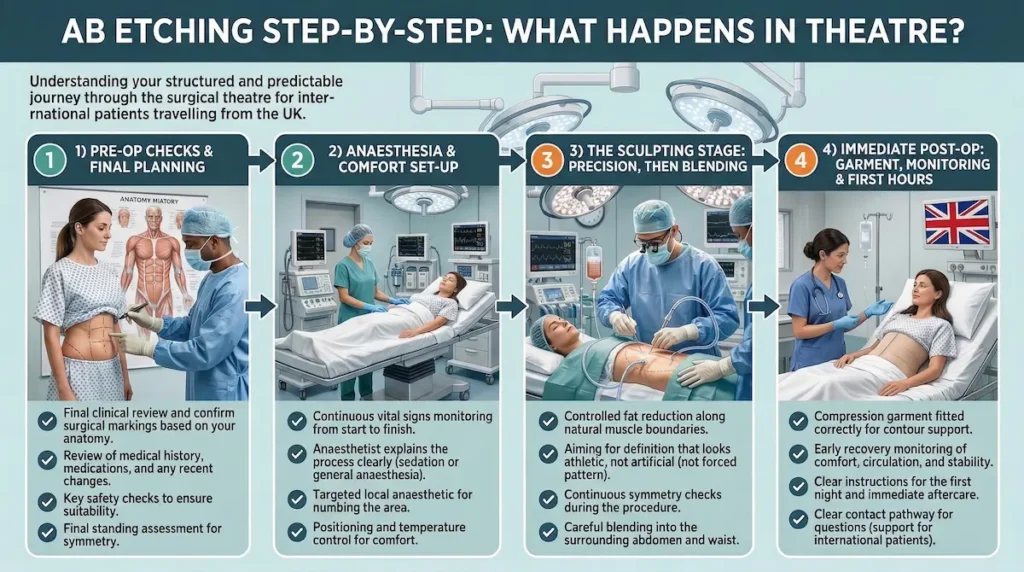
Ab Etching Step-by-Step: What Happens in Theatre?
Most patients feel calmer once they understand the flow of the day. Our process is structured and predictable, especially for international patients travelling from the UK. You will not be rushed. We confirm your plan, complete the necessary checks, and keep you informed at each stage. The procedure itself is only one part of the journey; preparation, monitoring, and immediate aftercare matter just as much.
Below is the typical sequence for an abdominal etching day. Exact steps can vary depending on whether we are combining procedures and which anaesthesia plan is chosen.
1) Pre-op checks and final planning
We begin with a final clinical review. This is where we confirm the surgical markings and the definition plan based on your anatomy. We also repeat key safety checks to ensure you remain a suitable candidate on the day.
- Review of your medical history, medications, and any recent changes.
- Pre-operative tests as required for safe clearance.
- Final standing assessment and markings to guide symmetry and transitions.
2) Anaesthesia and comfort set-up
Once the plan is confirmed, we move into theatre and set up continuous monitoring. If we are using twilight sedation, you will start to feel relaxed and sleepy. Local anaesthetic is then used to keep the area numb. If general anaesthesia is required, the anaesthetist will take you through the process clearly and keep you safely monitored throughout.
- Vitals monitoring from start to finish.
- Positioning and temperature control for comfort.
- A calm, step-by-step approach so you know what to expect.
3) The sculpting stage: precision, then blending
The sculpting phase focuses on controlled fat reduction and smooth gradients. We work with the natural midline and intersections rather than forcing a stamped pattern. The aim is definition that looks athletic, not artificial.
- Targeted contouring along natural muscle boundaries.
- Careful blending into the surrounding abdomen and waist.
- Continuous symmetry checks during the procedure.
4) Immediate post-op: garment, monitoring, and the first hours
After the procedure, we apply your compression garment and begin early recovery monitoring. We check comfort, circulation, and overall stability before you return to your hotel or recovery setting. You will receive clear instructions for the first night, including how to move safely and what is normal versus what needs advice.
- Compression garment fitted correctly (comfort and contour support).
- Early mobilisation guidance to support circulation.
- Clear contact pathway for questions, including support for international patients.
Good outcomes come from good decisions on the day: careful checks, calm execution in theatre, and structured aftercare from the first hour.
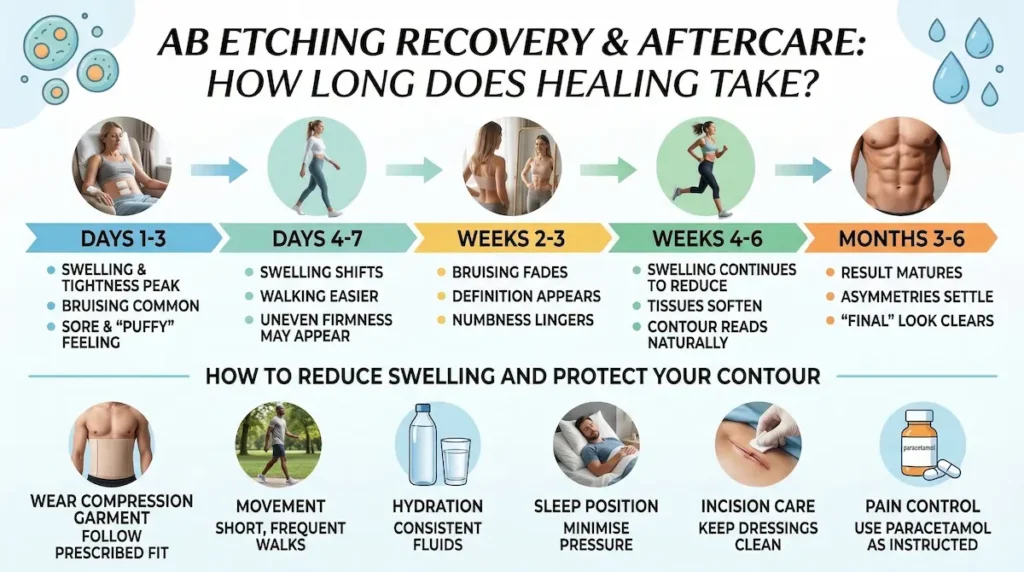
Ab Etching Recovery & Aftercare: How Long Does Healing Take?
Recovery is a process, not a single milestone. After abdominal etching, swelling (oedema), bruising, and firmness are expected, and they settle in phases. The abdomen can look “too smooth” at first, then more defined as fluid shifts and tissues soften. We guide you day-by-day, with clear steps that protect your contour and reduce avoidable downtime. Our aim is simple: steady healing, predictable progress, and a result that stays natural.
Day-by-day recovery timeline (what is normal?)
Every patient heals at a different pace, but the pattern is consistent. The early phase is about comfort and swelling control. The later phase is about tissue settling and definition emerging.
- Days 1–3: swelling and tightness peak; bruising is common; you will feel sore and “puffy”.
- Days 4–7: swelling begins to shift; walking feels easier; you may notice uneven firmness in patches.
- Weeks 2–3: bruising fades; definition starts to appear in good lighting; numbness can linger.
- Weeks 4–6: swelling continues to reduce; tissues soften; your contour reads more naturally in movement.
- Months 3–6: the result matures; minor asymmetries often settle; the “final” look becomes clearer.
How to reduce swelling and protect your contour
Most swelling is not “bad”. It is biology. Still, smart aftercare reduces unnecessary oedema and helps your tissues settle evenly.
- Compression garment: wear it exactly as we prescribe; fit matters more than tightness.
- Movement: short, frequent walks help circulation; avoid long periods in bed.
- Hydration: aim for consistent fluids; dehydration can worsen fatigue and recovery.
- Sleep position: we advise positions that minimise pressure on the treated areas.
- Incision care: keep dressings clean; use plasters and cleaning steps exactly as instructed.
For pain control, we keep language UK-friendly and practical. When appropriate, we may use medications such as Paracetamol as part of your plan, with clear guidance for safe use.
Our Rapid Recovery & Safety Protocol (HBOT + LLLT)
Technique matters in theatre. Recovery support matters after. We integrate a structured protocol designed to reduce inflammation, support tissue healing, and lower risk where possible.
- HBOT (Hyperbaric Oxygen Therapy): we use it to improve tissue oxygenation, support lymphatic drainage, and help reduce inflammation during the early healing phase.
- LLLT (Low-Level Laser Therapy): we use it as a targeted adjunct to support cellular repair, collagen activity, and reduce swelling and redness.
- We treat these as part of a cohesive system of care, not as optional “extras”.
When can I return to work, the gym, and travel back to the UK?
This is where planning matters, especially for international patients. Many people can do desk-based work relatively soon, but we prefer decisions based on how you are healing, not on a date in a calendar. Gym training comes later because strain and sweat can increase swelling and irritate tissues. Flying is possible once you are clinically cleared, and we give you practical steps to stay comfortable during the journey.
- Work: desk-based roles may be feasible sooner than physical jobs; we advise case-by-case.
- Gym: walking first, then gentle training; heavy core work waits until tissues are ready.
- Flying: we clear you clinically, then advise hydration and safe movement during travel.
If your priority is a smooth, “flight-ready” recovery plan, we build your schedule around safe milestones and organise your follow-up so you feel supported after you return home.
Safety & Risks: Is Abdominal Etching Dangerous?
Any surgery carries risk. Honest discussion builds trust, and it helps you make a clear decision. Abdominal etching is generally safe for the right candidate when it is performed in a controlled setting with proper screening and aftercare. Still, “safe” does not mean “risk-free”. We explain what is common, what is less common, and what we do to reduce risk at every step.
Common side effects (expected and temporary)
Most side effects are temporary and improve steadily. They can feel worrying if you are not prepared, so we set expectations clearly.
- Swelling (oedema) and bruising.
- Tightness, firmness, and temporary numbness.
- Mild asymmetry early on due to fluid shift and healing patterns.
- Small incision marks that fade over time with correct care.
Potential complications (what we monitor for)
Complications are less common, but they matter. Precision procedures can be sensitive to small irregularities, and early recognition is key.
- Contour irregularity: unevenness that may improve as swelling settles, or may require correction in some cases.
- Seroma: fluid collection that can need drainage and monitoring.
- Infection: uncommon, but possible; early treatment is important.
- Skin healing issues: higher risk in smokers and in patients with poorer skin quality.
How we reduce risk (screening, sterile theatres, and recovery tech)
Risk reduction is not a slogan. It is a system. We start with strict pre-operative health screening to confirm candidacy, then operate in a controlled environment with continuous monitoring. After surgery, we support healing with structured aftercare and our Rapid Recovery & Safety Protocol, because predictable recovery lowers the chance of avoidable setbacks.
- Pre-op screening: we assess medical history, medications, and safety clearance before we proceed.
- Sterile operating theatre standards: controlled protocols, monitoring, and a safety-first workflow.
- Post-op structure: clear instructions, check-ups, and fast access to advice when something feels “off”.
- HBOT + LLLT support: a macro-to-micro approach designed to support tissue healing and reduce inflammation.
When to contact us urgently (and when to use A&E)
We want you to feel confident at home, not uncertain. If you have a fever of 38°C (100.4°F) or higher, increasing redness, worsening pain, unusual discharge, or any symptom that feels sudden and severe, contact us immediately. If you develop chest pain, shortness of breath, or sudden calf swelling, do not wait. Seek urgent assessment at A&E and inform us straight away.
Is Abdominal Etching Safe in Turkey? (A UK Patient’s Perspective)
If you’re comparing Turkey vs the UK, your real question is usually safety. Not geography. Safety comes down to screening, sterile standards, monitoring, and aftercare structure.
What safety standards should you look for?
We build safety around non-negotiables. That means strict pre-operative screening, rigorous sterilisation standards, and continuous vitals monitoring during every procedure.
- Pre-operative health screening to confirm candidacy.
- Rigorous international sterilisation standards (ISO/TÜV).
- Advanced patient vitals monitoring throughout the procedure.
Accreditation and “Western-standard” quality
Quality should be verifiable. We reinforce that by using the same FDA-approved materials and operating in JCI-accredited hospitals that meet or exceed Western standards.
- Internationally recognised hospital accreditation.
- Materials and protocols aligned with Western expectations.
- A facility design that prioritises privacy and patient comfort.
Why aftercare matters even more for UK travellers
Travelling home is not the end of care. It’s the start of the long-view follow-up. We keep support structured and responsive, so you’re never left guessing once you’re back in the UK.
- Clear discharge planning and “flight-ready” guidance before you leave Istanbul.
- Direct access to your Patient Host for questions during recovery.
- Scheduled virtual follow-ups at key milestones.
Safety is not a promise. It’s a system you can see: screening, sterile standards, monitoring, and care that continues after you fly home.
When Results Go Wrong: Revision Abdominal Etching
Revision enquiries are common. They’re also sensitive. When abdominal etching looks “off”, the fix is rarely quick. We start with diagnosis, not assumptions.
What “gone wrong” can look like
Most concerns fall into a few patterns. Some improve as swelling settles. Others need a structured revision plan.
- Harsh grooves that look stamped or unnatural.
- Asymmetry that persists after the main swelling phase.
- Contour irregularities (dents, ridges, uneven transitions).
- Skin quality issues that hide definition or distort it.
Timing: when can revision realistically be assessed?
Early swelling can mimic problems that aren’t real. Scar tissue also takes time to mature. We usually advise patience before making final decisions.
- Early weeks: focus on healing, garment compliance, and swelling control.
- 2–3 months: clearer view of shape, but tissues can still be firm.
- 6+ months: a more reliable point for revision planning in many cases.
How revision is planned (case-by-case)
Revision is not one technique. It’s a strategy. The approach depends on what went wrong and how your tissues behave now.
- Selective contour refinement to smooth transitions.
- Balancing asymmetry while protecting a natural look.
- Considering skin-tightening or supportive options when laxity is the true limiting factor.
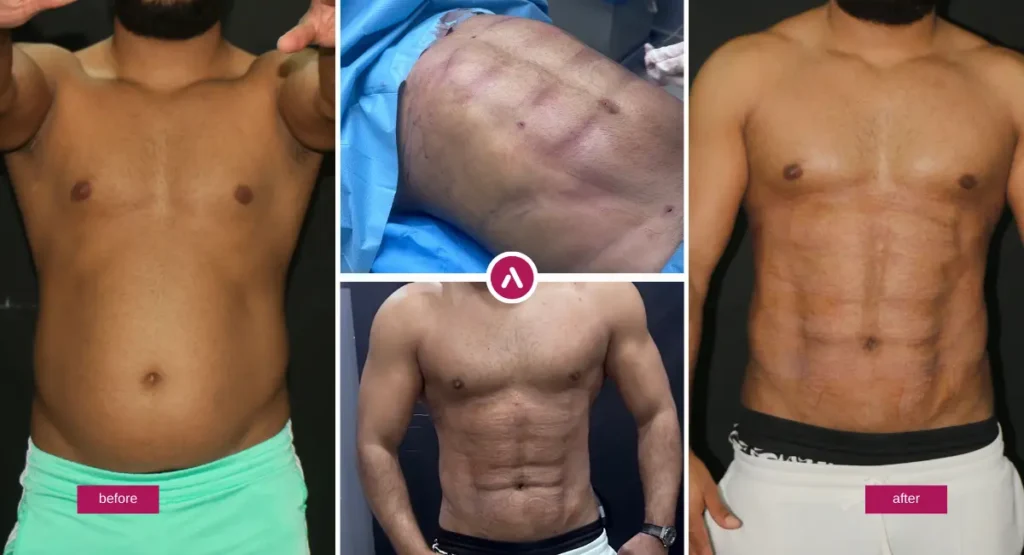
Ab Etching Before and After: Realistic Results
Abdominal etching can be long-lasting. It is not “maintenance-free”. Your result lives in your lifestyle, your weight stability, and your skin quality.
What makes results last?
Weight stability is the biggest factor. Rapid gain can soften definition. Rapid loss can affect skin quality.
- Keep your weight stable and avoid major fluctuations.
- Build and maintain core fitness so definition reads naturally.
- Follow aftercare properly so swelling settles evenly.
When will I see the final result?
Definition appears in layers. Early swelling can hide it. Later, the contour looks smoother and more believable.
- 2–3 weeks: early definition in good lighting.
- 6 weeks: swelling reduces and movement looks more natural.
- 3–6 months: shape matures and firmness softens.
Men vs women: what “good” often means
Men often want clearer segmentation. Women often prefer subtle definition with a flatter profile. Both are valid. We plan based on proportion and realism.
- Men: stronger midline and intersections (when anatomy supports it).
- Women: soft definition and smooth transitions.
- Both: symmetry matters more than depth.
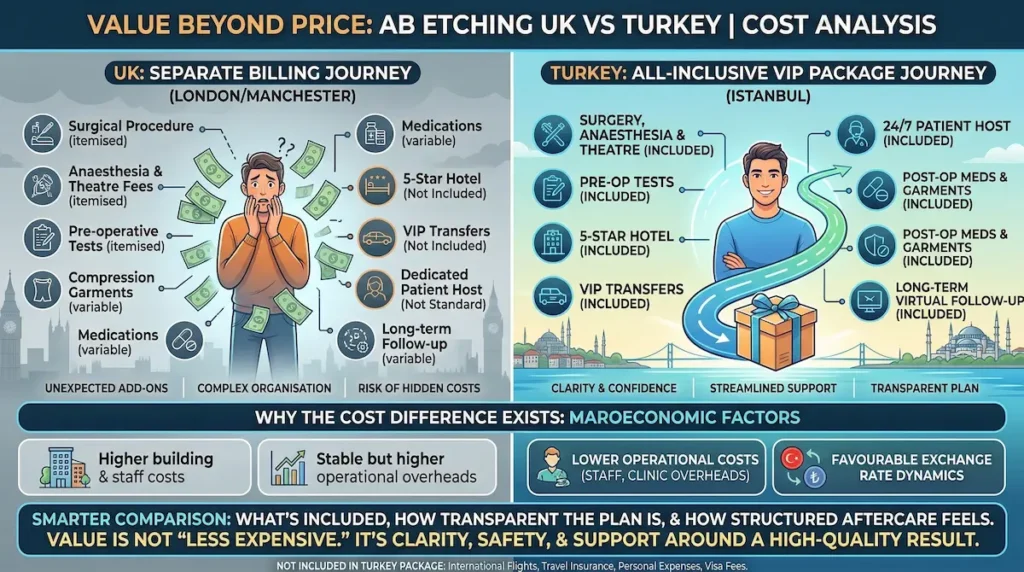
Cost Analysis: Ab Etching Cost 2026 Turkey vs the UK
UK patients often compare London or Manchester prices to Istanbul. Price alone is a blunt tool. The smarter comparison is what is included, how transparent the plan is, and how structured the aftercare feels.
Why the cost difference exists
The cost gap is driven by macroeconomic factors. Not a compromise on quality. Exchange rates and national operational costs are the main reasons procedures can be more cost-effective in Turkey.
- Lower national operational costs (staff, clinic overheads).
- Favourable exchange rate dynamics.
- All-inclusive packaging that reduces “surprise fees”.
What an all-inclusive package changes for UK patients
Separate billing can make comparison difficult. Our VIP approach keeps the plan simple: surgery, logistics, and recovery support are coordinated as one journey.
| Cost/Service Item | UK (Typical separate billing) | Istanbul (Our VIP package approach) |
|---|---|---|
| Surgical procedure | Often itemised | Included |
| Anaesthesia & theatre fees | Often itemised | Included |
| Pre-operative tests | Often billed separately | Included |
| Compression garments & post-op medications | Variable | Included |
| 5-star hotel accommodation | Not included | Included |
| VIP transfers (airport & clinic) | Not included | Included |
| Dedicated Patient Host (24/7 support) | Not standard | Included |
| Long-term virtual follow-up | Variable | Included |
| International flights / travel insurance | N/A | Not included |
What’s included (and what isn’t)
We keep this clear. It reduces stress. It also prevents unpleasant surprises.
- Included: surgical procedure, anaesthesia & theatre fees, pre-op tests, 5-star hotel, VIP transfers, 24/7 Patient Host, post-op medications & garments, first post-op meal, long-term virtual follow-up care.
- Not included: international flights, personal travel insurance, personal expenses, additional hotel nights (if extending), visa fees (if applicable).
Value is not “less expensive”. Value is clarity, safety, and support around a high-quality result.
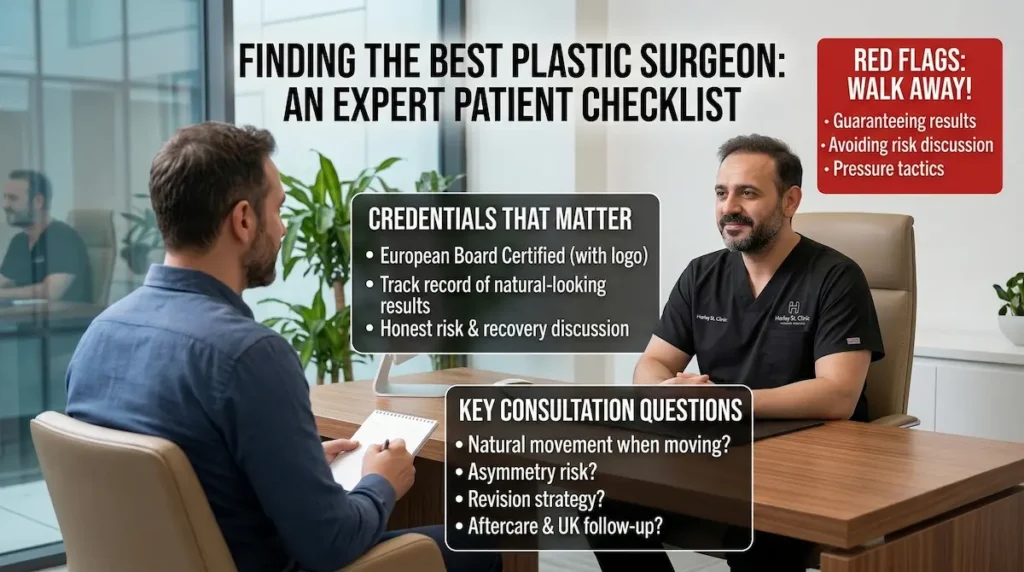
Finding the Best Plastic Surgeon: An Expert Patient Checklist
“Best abdominal etching surgeons in Turkey” is a common search. The right way to choose is not by hype. It’s by evidence, judgement, and the ability to manage risk.
Credentials that matter
Look for verifiable qualifications. For international patients, European board certifications are a strong objective signal.
- European Board Certified Surgeons or specialists registered with international medical boards.
- A track record of natural-looking results, not exaggerated patterns.
- Honest discussion of risk and recovery, not promises.
Questions to ask in your consultation
- “How do you plan definition so it still looks natural when I move?”
- “What is your approach to asymmetry and contour irregularity risk?”
- “If I need revision, what is your timeline and strategy?”
- “What does your aftercare and follow-up look like once I’m back in the UK?”
Red flags (walk away)
- Guaranteeing a specific “six-pack” pattern before seeing your anatomy properly.
- Avoiding discussion of risks or downtime.
- Pressure tactics or urgency that overrides medical judgement.
Your VIP Medical Journey in Istanbul for Six Pack Surgery
Travelling for surgery can feel intimidating. We remove the friction by structuring the journey from the first call to your long-term follow-up.
Step 1: Free virtual consultation and personalised plan
You start from home. We review your goals, assess your suitability, and share a personalised plan with a transparent all-inclusive quote.
Step 2: VIP planning and hotel coordination
Once you decide to proceed, your dedicated Patient Host coordinates logistics. We secure your date, book your 5-star hotel from curated partners, and schedule VIP transfers.
Step 3: Personal airport welcome and transfer
On arrival at Istanbul Airport (IST or SAW), you’re met by a private driver and transferred to your hotel in a private vehicle so you can rest.
Step 4: In-person consultation, tests, and procedure day
Your host arranges your clinic transfer. You meet your surgeon, confirm the plan, complete pre-operative tests, and proceed in a fully accredited environment.
Step 5: Recovery support in Istanbul
After surgery, you’re closely monitored by our medical team. Your Patient Host remains available 24/7 via WhatsApp. Before you depart, you have a final in-person check-up and clinical clearance to fly.
Step 6: Long-term follow-up (back in the UK)
Care continues after you return home. We schedule virtual follow-ups at 1, 3, 6, and 12 months to monitor healing and keep guidance consistent.
The fear of being “left alone” after travel is real. Our follow-up system is built to prevent that.
Six Pack Surgery Frequently Asked Questions (FAQ):
What is abdominal etching vs liposuction?
Liposuction primarily reduces fat volume. Abdominal etching focuses on selective contouring to reveal natural muscle lines and create definition.
Is ab etching permanent?
Results can be long-lasting if your weight is stable. Significant weight gain can soften definition. Significant weight loss can affect skin quality.
How long is the recovery time?
Most swelling improves in the first 4–6 weeks. The result continues to mature for several months as tissues soften and fluid shifts settle.
Does abdominal etching work for women?
Yes. Many women prefer subtle definition rather than deep grooves. We plan for smooth transitions and a natural athletic look.
Can you fix botched abdominal etching?
In many cases, yes. We first assess what is swelling versus what is structural. Revision planning often needs more time for tissues to mature.
Will I have scars after six pack surgery?
Incisions are usually small. They tend to fade with correct care, but any surgery can leave marks. We explain where they sit and how to support healing.
When can I fly back to the UK after six pack surgery?
We clear you clinically before you fly. We also give practical guidance on hydration, safe movement, and comfort during travel.
What does awake / twilight sedation mean?
It means you are relaxed and drowsy, with local anaesthetic (conscious sedation) in the treatment area, and continuous monitoring throughout. Suitability is assessed case-by-case.
What is included in your all-inclusive package?
It includes your procedure, anaesthesia and theatre fees, pre-op tests, 5-star hotel, transfers, a 24/7 Patient Host, post-op medications and garments, and long-term virtual follow-up.
How do I start?
Start with a free virtual consultation. We’ll review your goals, confirm suitability, and share a personalised plan with clear next steps.
Medical disclaimer: This page provides general information and does not replace an in-person medical assessment. Suitability, risks, and recovery vary between individuals. Always follow the advice of your treating medical team.