


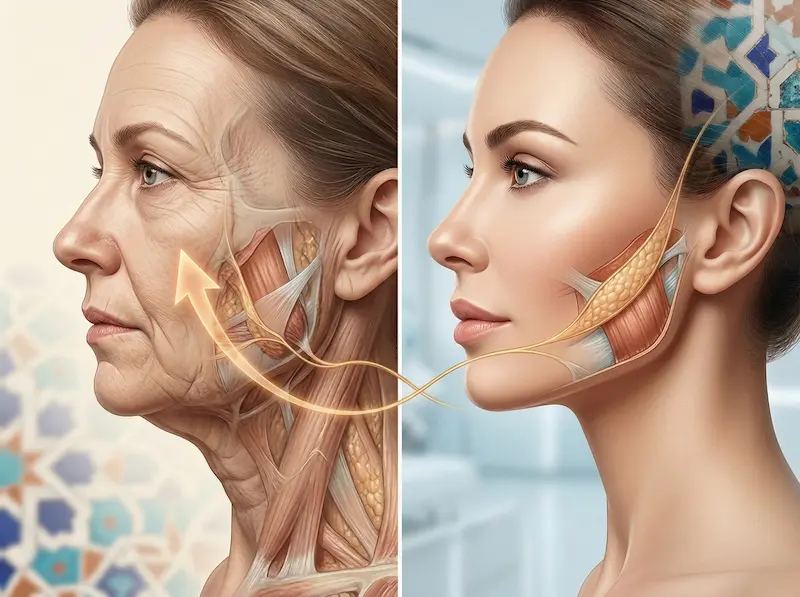
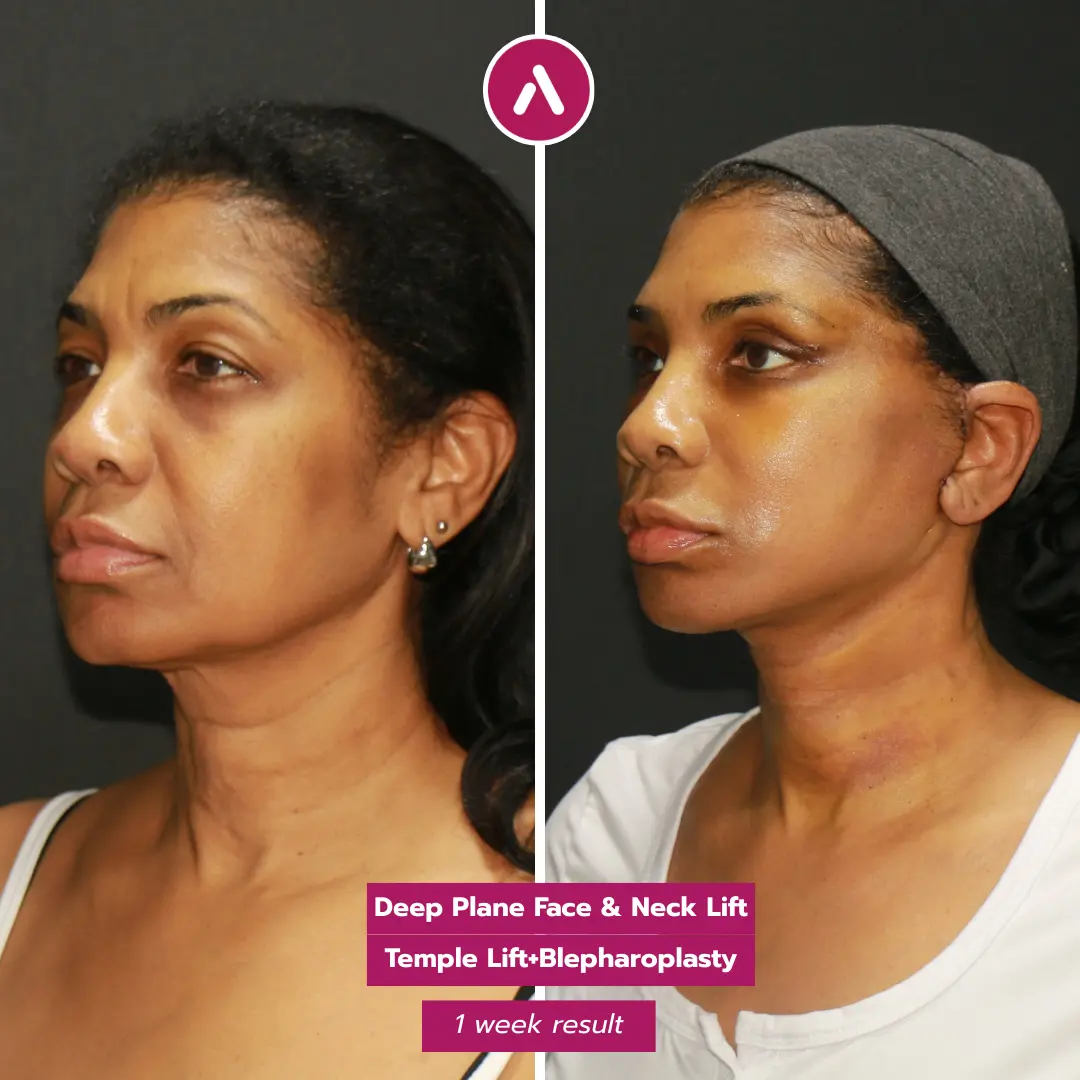
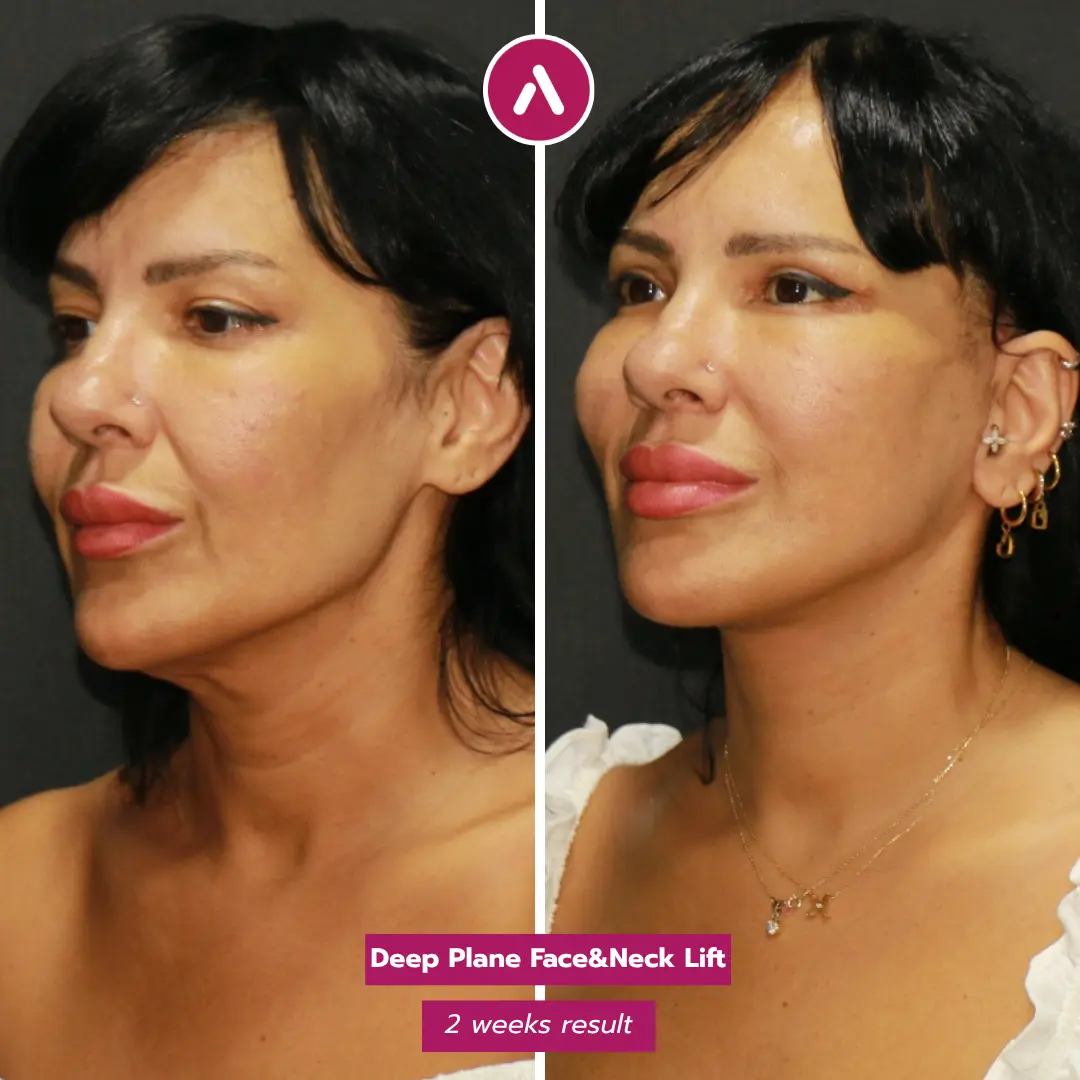
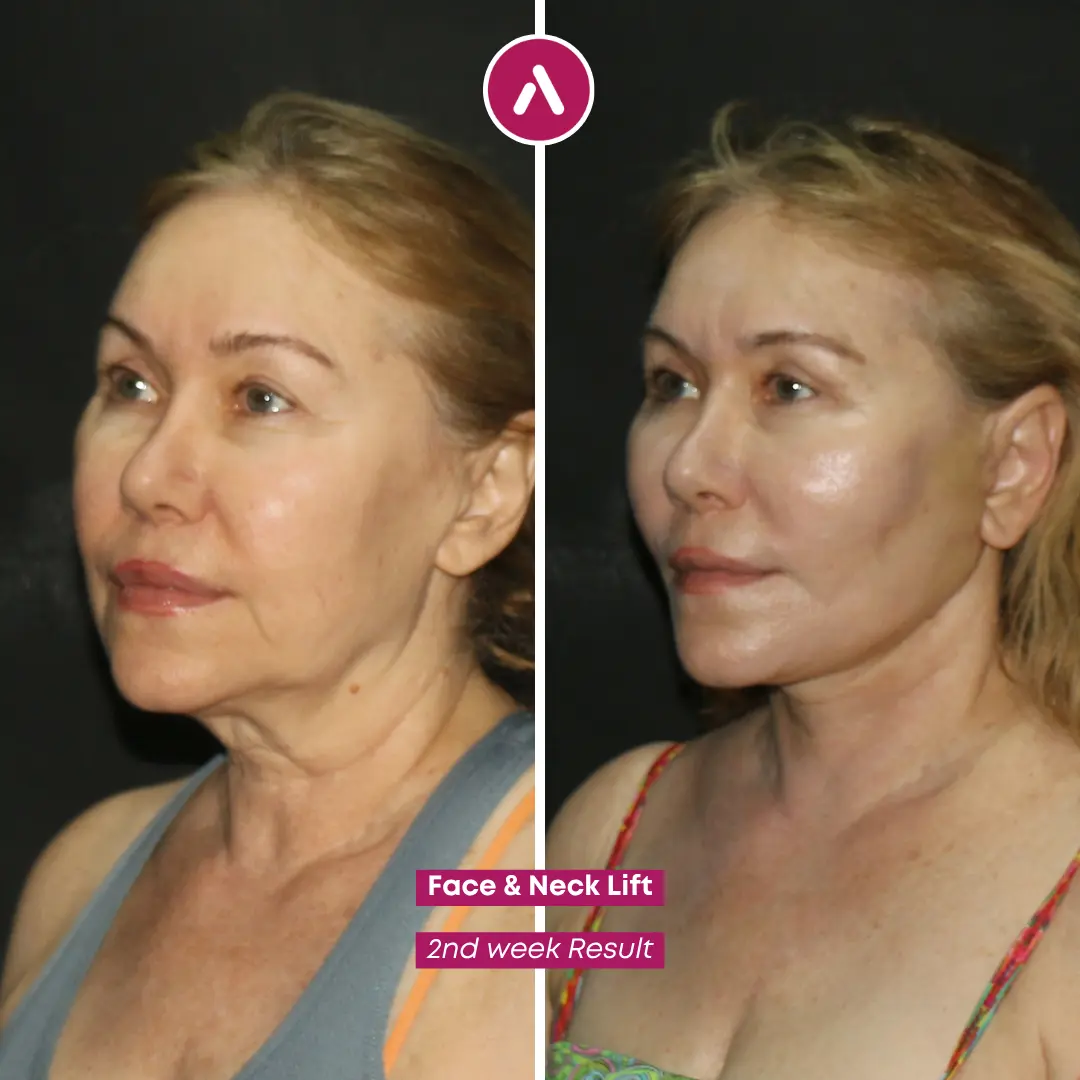
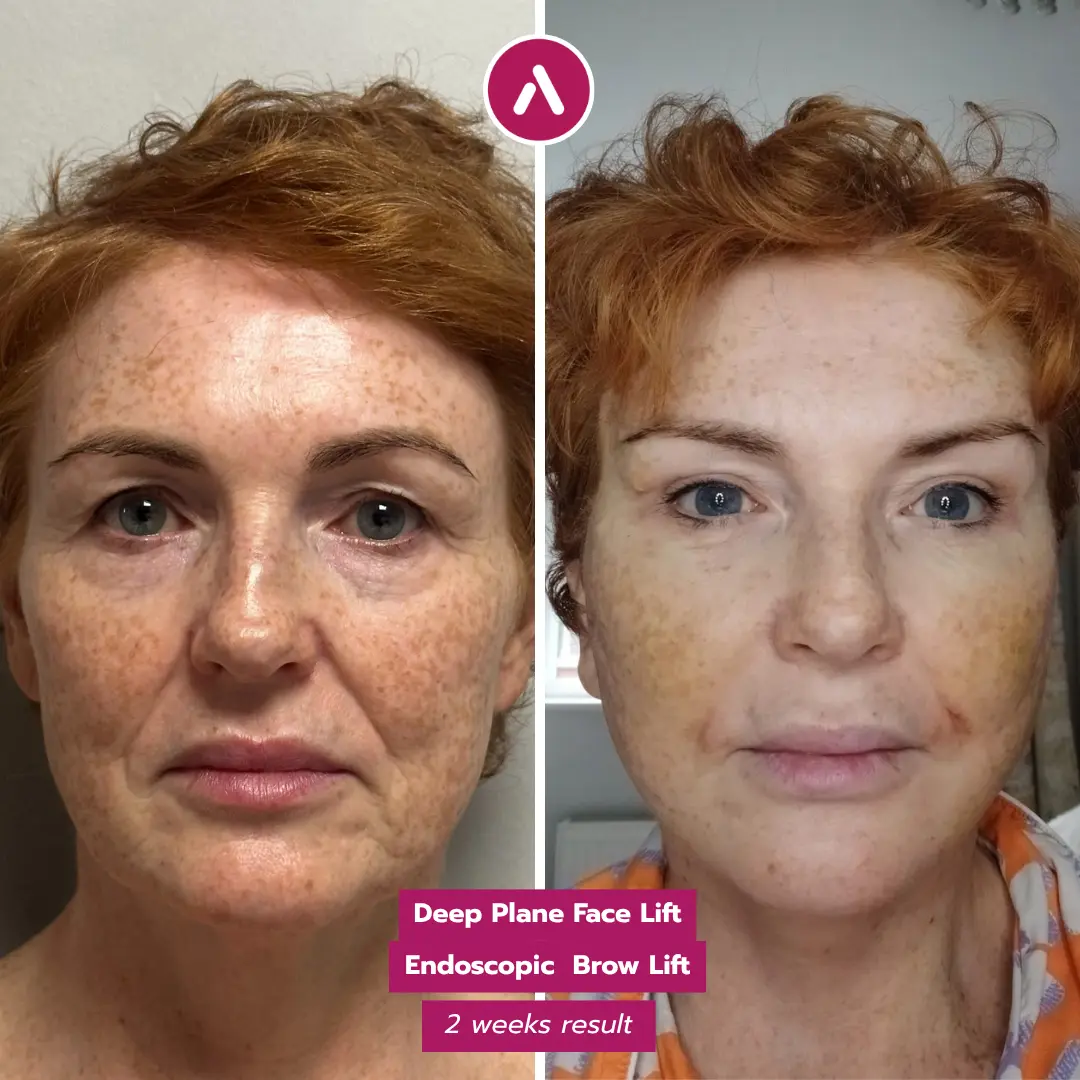
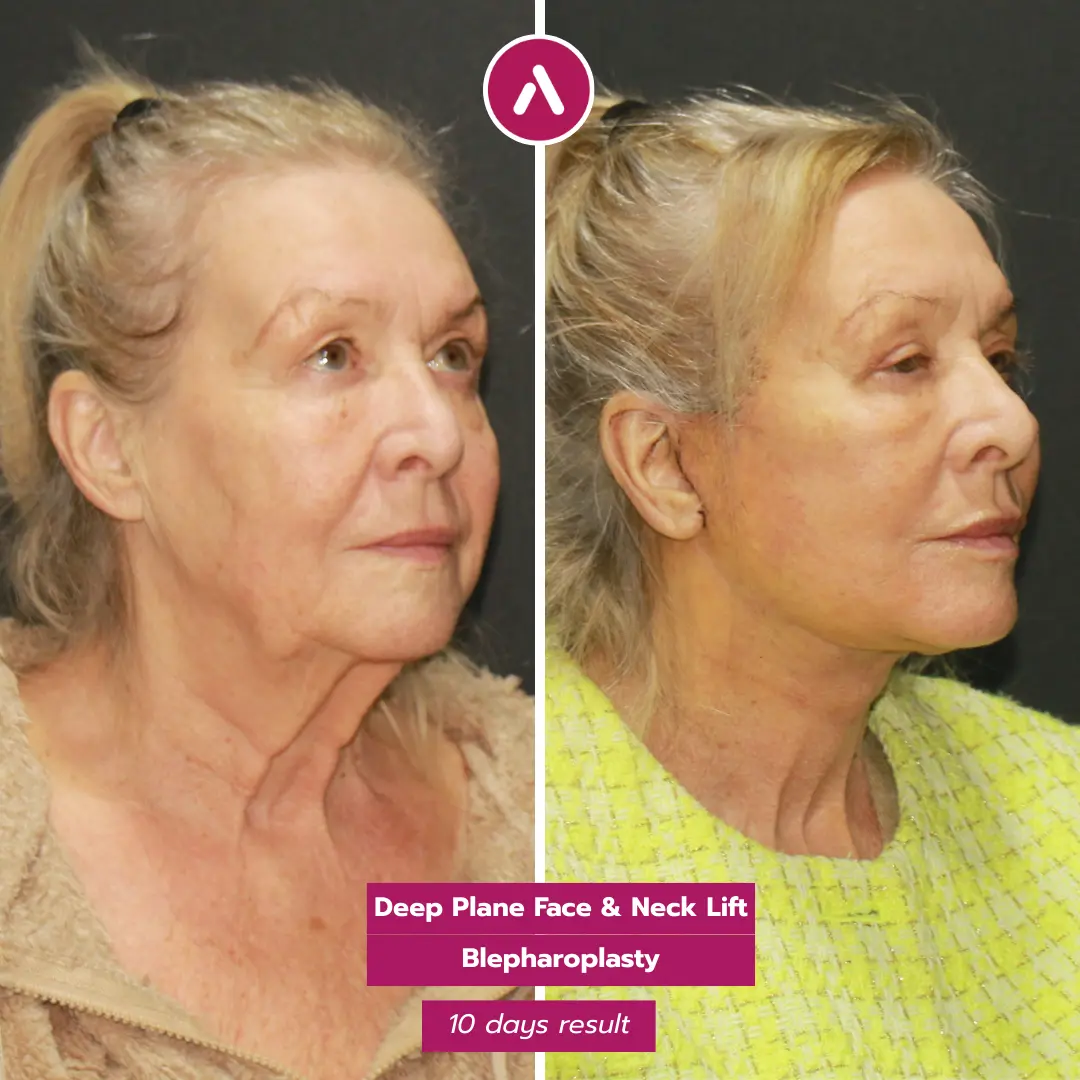
Our approach is simple: rejuvenation, not alteration. A deep plane facelift is not about stretching skin. It is about restoring the deeper architecture that has shifted with time, then letting the skin redrape naturally.
Table of Contents
What is a Deep Plane Facelift?
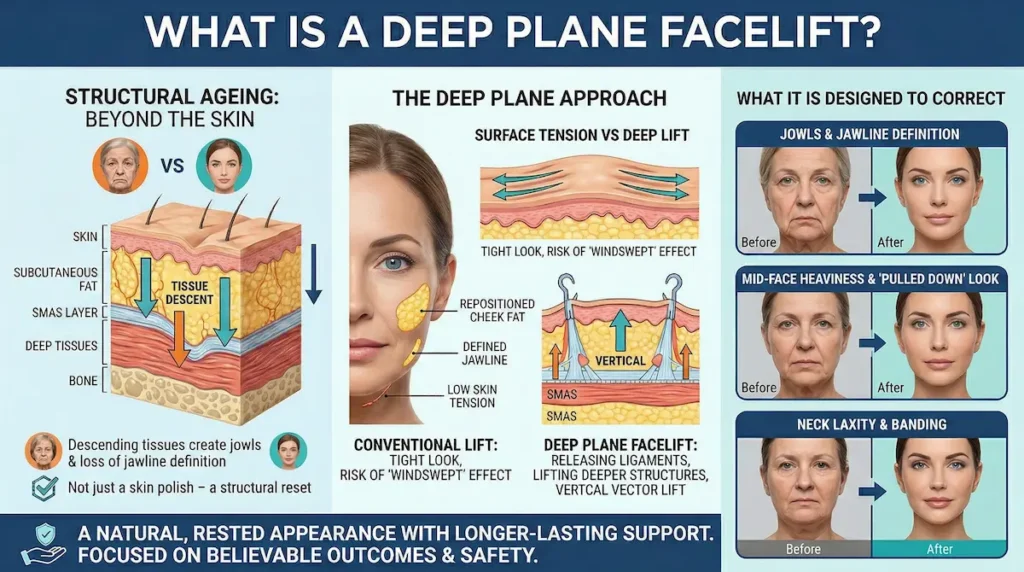
Deep Plane Facelift is an advanced facial rejuvenation procedure that repositions the descended tissues of the mid-face, jawline, and often the neck by working beneath the SMAS layer. Instead of relying on skin tension, we release key retaining ligaments and lift the deeper structures, aiming for a natural, rested appearance with longer-lasting support.
Most people do not “age in the skin” alone. The change you see in the mirror is usually structural: the cheek fat pads descend, the jawline softens, and the neck loses definition. When a lift only pulls the surface, the result can look tight in one direction and tired in another.
Our surgeons focus on the mechanics that create believable outcomes. We plan a lift that respects your existing facial proportions. Subtlety matters. So does safety.
What the deep plane facelift is designed to correct
A deep plane lift is typically considered when the lower face and neck show genuine tissue descent, not just fine lines. It is a structural reset, not a skin polish.
- Jowls and loss of jawline definition
- Mid-face heaviness and a “pulled down” look
- Deepening folds around the mouth (often linked to volume descent)
- Neck laxity and banding, when a neck strategy is included
Deep plane rhytidectomy anatomy: why the “plane” matters
In technical terms, this is a form of deep plane rhytidectomy anatomy-driven surgery. The target is the relationship between the SMAS, retaining ligaments, and the fat pads that define youthful contour.
When these deeper structures descend, surface-only tension has to work harder to create an effect. That is when patients worry about looking “done” or “windswept”. Our intent is the opposite. We aim to lift the deeper tissues and keep skin tension low.
The vertical vector lift: restoring, not dragging
Gravity pulls down. So the most logical correction is typically a vertical vector lift that counters that direction. This is one reason deep plane techniques are sought after by patients who want a natural change without a stretched look.
During planning, we assess which retaining ligaments must be released for safe mobilisation. Then we reposition the descended tissues and secure them with stable support. The skin follows. It is meant to look like you, just well-rested.
Benefits of a Deep Plane Facelift
UK patients often arrive with a clear brief: “I want to look better, but not different.” That is a rational concern. Many traditional lifts over-rely on surface tension, which can change expression and pull landmarks out of place.
A deep plane lift is designed to reduce that trade-off. By lifting deeper structures, we can often create definition without over-tightening the skin. The goal is quiet confidence, not a dramatic reveal.
Results vary by anatomy, age, and healing response. Still, the benefits below are the reasons expert patients shortlist this technique.
A more natural look with lower skin tension
When we elevate the deeper layers, the skin does not need to carry the load. This supports a more natural finish and can reduce the risk of the “pulled” aesthetic patients fear.
- Less reliance on surface traction
- Better preservation of facial expression
- Improved harmony between cheek, jawline, and neck
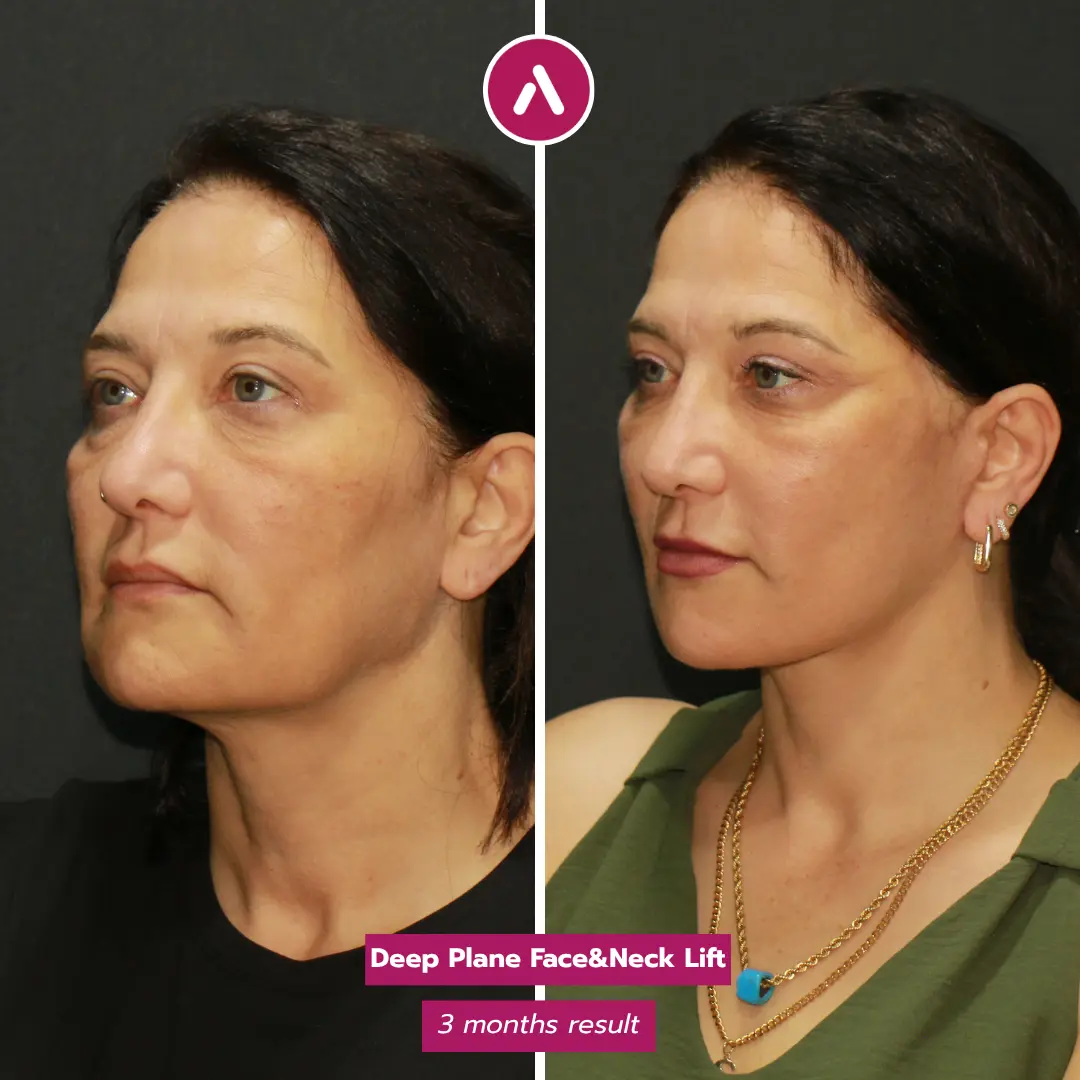
Lower face and neck definition (when planned as one unit)
Many patients are effectively seeking a deep plane lower face and neck lift, even if they do not use those exact words. The jawline and neck age together. Treating them together is often the most coherent strategy.
When a neck component is required, we plan it explicitly. That may involve platysmal management and contouring decisions based on your anatomy. We do not treat the neck as an afterthought.
Structural support that can age more gracefully
A deep plane lift aims to restore the underlying architecture, not just smooth the surface. In practical terms, this can mean the result “settles” in a more believable way over time, because it is based on structure rather than skin tension alone.
Longevity is never guaranteed. Biology is biology. But structural correction is a sensible starting point when your goal is a natural result that does not rely on tightness.
Am I a Suitable Candidate for Deep Plane Facelift?
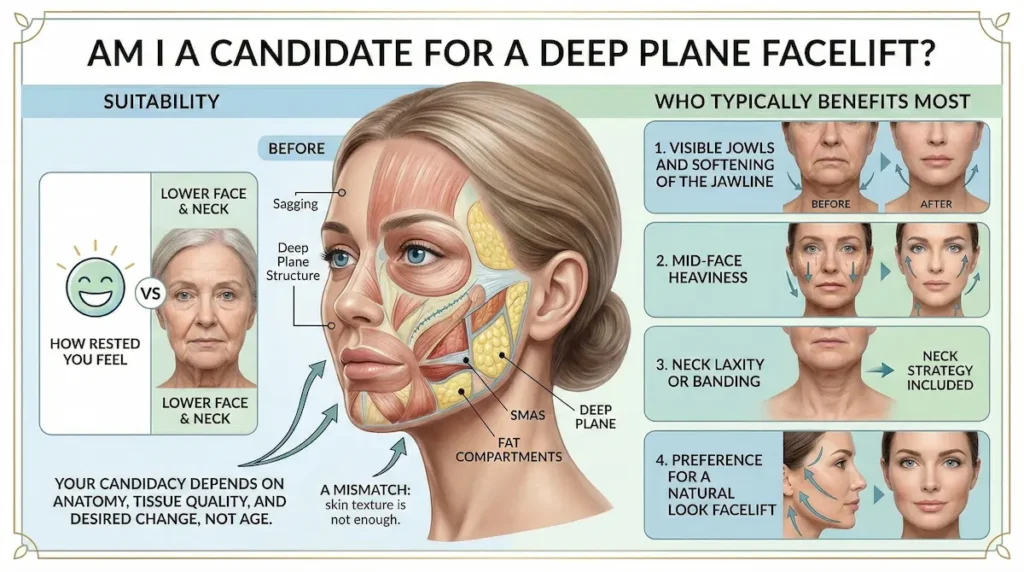
A deep plane lift is not a “one look” procedure. It is a structural operation. Your candidacy depends less on age and more on anatomy, tissue quality, and what you want to change.
We look for a clear mismatch between how rested you feel and what your lower face and neck are showing. If the issue is mostly skin texture or fine lines, a facelift may not be the best first move.
Who typically benefits most
- Visible jowls and softening of the jawline
- Mid-face heaviness that makes the face look “pulled down”
- Neck laxity or banding when a neck strategy is included
- A preference for a natural look facelift rather than a dramatic change
When we may advise you to delay surgery
Safety comes first. Always. We may recommend postponing if key risk factors are not controlled.
- Smoking or nicotine use (because it can compromise healing)
- Uncontrolled blood pressure or diabetes
- Blood-thinning medication that cannot be safely adjusted
- Recent significant weight loss or ongoing weight changes
- Expectations that conflict with “rejuvenation, not alteration”
How to prepare for your consultation
Expert patients tend to do well because they share accurate information early. That makes planning safer and more precise.
- Send clear, natural-light photos (front, both sides, three-quarter angles)
- Share your medical history and any previous facial surgery
- Provide a list of medication and supplements
- Tell us about your work and social schedule so we can plan downtime realistically
“We believe the most successful aesthetic surgery is one that goes unnoticed.”— Our surgical philosophy
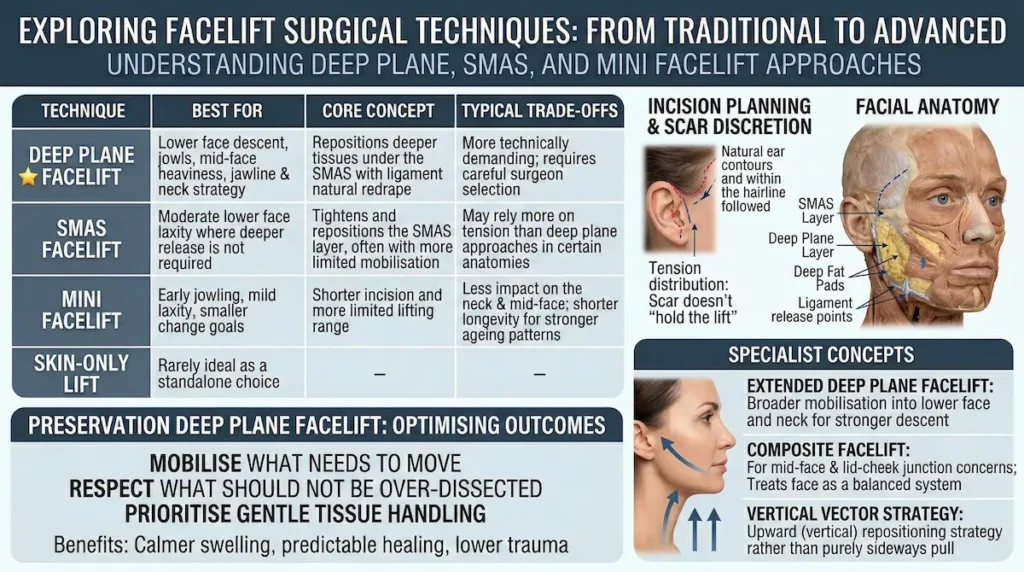
Deep Plane Facelift Surgical Techniques Explained
“Facelift” is a broad term. The technique matters because it determines where the lift is carried: by skin tension, or by deeper structural support.
Our goal is consistent. Restore support. Keep skin tension low. That is how results stay subtle.
Deep Plane vs SMAS vs mini facelift (what actually changes)
The simplest way to compare techniques is to ask one question: what layer is being lifted and stabilised?
| Technique | Best for | Core concept | Typical trade-offs |
|---|---|---|---|
| Deep Plane Facelift | Lower face descent, jowls, mid-face heaviness, jawline and neck strategy | Repositions deeper tissues under the SMAS with ligament release, aiming for a natural redrape | More technically demanding; requires careful surgeon selection and planning |
| SMAS Facelift | Moderate lower face laxity where deeper release is not required | Tightens and repositions the SMAS layer, often with more limited mobilisation | May rely more on tension than deep plane approaches in certain anatomies |
| Mini Facelift | Early jowling, mild laxity, smaller change goals | Shorter incision and more limited lifting range | Less impact on the neck and mid-face; shorter longevity for stronger ageing patterns |
| Skin-only lift | Rarely ideal as a standalone choice for expert patients | Surface tightening without meaningful structural repositioning | Higher risk of a “pulled” look and less durable support |
Preservation deep plane facelift: what “preservation” usually means
You may see the phrase preservation deep plane facelift in modern surgical discussions. In practice, it usually refers to a refined deep plane philosophy: mobilise what needs to move, respect what should not be over-dissected, and prioritise gentle tissue handling.
The intent is not trend-chasing. It is risk management. Lower trauma can mean calmer swelling and more predictable healing, especially when paired with an organised aftercare programme.
Incisions, ear scars, and how we plan for discretion
Scar anxiety is rational. The incision design and closure technique determine how “invisible” the work becomes over time.
- Incisions are typically placed around natural ear contours and within the hairline when appropriate
- We plan tension distribution so the scar is not asked to “hold the lift”
- Aftercare matters: scar maturation is a process, not an event
Extended Deep Plane Facelift
“Extended” usually refers to the surgical reach. It can mean broader mobilisation into the lower face and neck regions for patients with stronger descent patterns or heavier tissues.
This is not about being aggressive. It is about being logical. If the anatomical problem spans the jawline and neck, the surgical plan should match that reality.
Composite Facelift
A composite facelift is often discussed when the mid-face and the lid-cheek junction are a major concern, and when the plan involves deeper repositioning across multiple facial units.
It is a specialist concept. Not every patient needs it. We use it here as a framework: facial rejuvenation works best when the face is treated as a balanced system, not isolated zones.
Vertical Vector Facelift (Auralyft)
You may also come across branded terms such as Vertical Vector Facelift (Auralyft). The useful part is the biomechanics: gravity pulls down, so many natural results rely on an upward (vertical) repositioning strategy rather than a purely sideways pull.
Brand names vary. Principles do not. We focus on vector planning, tissue support, and a result that reads as “rested”, not “operated”.
Combined Procedures with Deep Plane Facelift: Maximising Your Results
A facelift rarely exists in isolation. Ageing affects multiple facial units at once, but not always at the same speed. If we lift one area and ignore another that is clearly contributing to “tiredness”, the result can feel incomplete.
Synergy is not about “doing more”. It is about doing what is coherent. For an expert patient, the question is simple: what combination produces the most natural change with the lowest risk profile?
We plan combinations based on anatomy, not trends. We also plan downtime realistically, because your social and professional schedule matters. If a combined plan increases swelling or recovery complexity without a clear benefit, we will say so.
“Harmony beats intensity. The best result is the one that looks inevitable, not engineered.”— Our facial planning principle
Neck lift / platysmaplasty (when the neck is part of the story)
Many patients asking for a facelift are actually describing a neck problem: softened angle, banding, or skin laxity under the chin. In those cases, treating the neck as a deliberate part of the plan often creates the most believable change.
- Platysmal banding that shows with expression or in photos
- Loss of cervico-mental angle (the “neck line”) despite stable weight
- Skin laxity that will not respond to tightening alone
- A desire for a cleaner jawline-to-neck transition
We decide neck strategy after examination, not assumption. Some patients need deeper platysmal work. Others need a lighter approach. The goal is a balanced, quiet improvement.
Temporal lift / endoscopic brow lift (upper face balance)
It is possible to improve the lower face and still look tired if the upper face is heavy. A temporal lift or endoscopic brow lift can restore a more open, rested appearance without changing your identity.
- Heaviness at the outer brow that creates a “hooded” look
- Upper-face descent that makes the eyes appear smaller
- A wish to improve facial “lightness” without an aggressive brow shift
We keep this conservative. Over-elevation looks obvious. Our bias is subtlety, with vectors that respect how your face naturally moves.
Blepharoplasty, fat transfer, and lip lift (small procedures, big coherence)
Some refinements are small on paper, but meaningful in the mirror. Eyelid surgery can remove the “tired” signal. Fat transfer can restore soft volume in the right places. A lip lift can improve balance when the upper lip length has increased with age.
- Blepharoplasty when eyelid skin or fat pads dominate your expression
- Fat transfer when volume loss is the main driver of ageing, not laxity
- Lip lift when upper-lip length has increased and lipstick disappears
Combination works when each element supports the same aesthetic direction. If a “tweak” will distract from a natural result, we leave it out.
Anaesthesia: Why We Prefer Awake/Twilight Sedation
For many UK patients, anaesthesia is the deciding factor. Not because they fear surgery, but because they want risk to be proportionate. We take that seriously.
Where medically appropriate, we prefer a local anaesthetic approach supported by sedation. It can be a calmer experience, with a smoother early recovery for many patients. It also keeps the focus on safety, not bravado.
That said, this is not ideology. It is a medical decision. Your health history, procedure length, and comfort needs determine the best plan.
“A well-planned anaesthetic is part of the result. Comfort and safety are not extras.”— Our peri-operative standard
Local anaesthesia + twilight sedation: what it means in practice
Twilight sedation is not “being knocked out”. It is a controlled state of deep relaxation, supervised by an anaesthesia team. You can still breathe on your own. Many patients remember little, but they are not under a full general anaesthetic.
- Local anaesthetic provides surgical numbness
- Sedation supports calmness and comfort
- Continuous monitoring throughout the procedure
Some patients search for twilight anaesthesia cosmetic surgery because they want a middle ground. That is exactly how we view it. Lower physiological burden, high comfort, and sensible risk management when you are a good candidate.
When general anaesthesia may be the safer choice
General anaesthesia is not “bad”. It is simply a different tool. In certain situations, it can be the most controlled and safest option.
- Very long combined procedures where comfort becomes a limiting factor
- Airway or reflux considerations that require a protected airway plan
- Medical factors identified by the anaesthesia assessment
- High anxiety that cannot be safely managed with sedation
We do not promise one approach for everyone. We assess. We explain. Then we choose the plan that best matches your risk profile.
UK patient concerns: “deep plane facelift without general anaesthesia”
It is a common search for a reason. Many patients want to avoid the intensity of a full general anaesthetic if there is a safe alternative. For suitable candidates, we can often meet that goal while keeping comfort high.
We also plan your post-operative period around calm recovery: hydration, swelling control, and clear instructions. If you have a history of nausea with anaesthesia, tell us early. If you take regular medication, we review it properly.
If anaesthesia is your main concern, we can review your medical history in a remote consultation and advise on the safest pathway before you book anything.
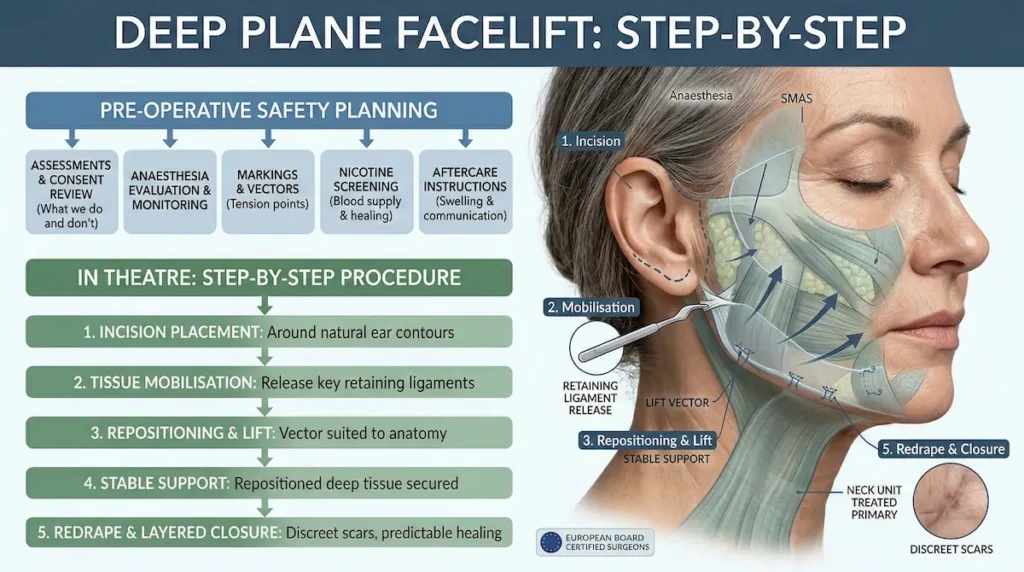
Deep Plane Facelift Step-by-Step: What Happens in Theatre?
Expert patients usually want the same thing: clarity. They do not need theatrics. They want to know what happens, in what order, and why each step exists.
We keep the process structured and calm. Our European Board Certified Surgeons work with an anaesthesia team and a dedicated aftercare programme so the experience is predictable, not improvised.
This walkthrough is a general framework. Your exact plan depends on your anatomy, whether a neck component is included, and whether we are combining procedures.
Pre-op checks and safety planning
Before we step into theatre, we confirm your plan and your safety profile. That includes your medical history, medications, and the details that influence healing.
- Pre-operative assessment and consent review (what we are doing, and what we are not doing)
- Anaesthesia evaluation and monitoring plan
- Photography and surgical markings (vectors, tension points, incision mapping)
- Smoking and nicotine screening (because it affects blood supply and wound healing)
- Clear aftercare instructions for the first 72 hours
We also discuss practical issues that matter to UK patients: travel timing, swelling management, and communication once you are back home. That is part of risk control, not customer service.
In theatre: incision, mobilisation, lift, closure
In a deep plane approach, the goal is structural repositioning with low skin tension. The sequence is deliberate. It is designed to protect natural facial expression while restoring support.
- Incisions are placed around natural ear contours and, where appropriate, within the hairline
- We carefully mobilise the deeper tissues and release key retaining ligaments as planned
- We reposition the descended tissues in a vector that suits your anatomy
- We secure the lift with stable support, then redrape the skin without “pull”
- We close in layers, aiming for discreet scars and predictable healing
If your plan includes the neck, we treat it as a primary unit, not an add-on. That may include platysmal management and contouring decisions based on what we see during surgery.
“When the deeper layers carry the lift, the skin can simply follow. That is where natural results come from.”— Our natural-first surgical logic
The first 24 hours: what is normal, what is not
The first day is about stability: comfort, swelling control, and safe monitoring. You should expect tightness. You should expect bruising. You should not expect “drama”.
- Swelling and bruising start early and typically build over the first few days
- A feeling of firmness around the jawline and neck is common
- We monitor circulation, blood pressure, and overall comfort
- We provide clear guidance on head elevation, hydration, and rest
We also set expectations for follow-up. Many UK patients value a walk-in walk-out facelift Turkey experience, but we never trade safety for speed. If an overnight stay is medically sensible, we plan it.
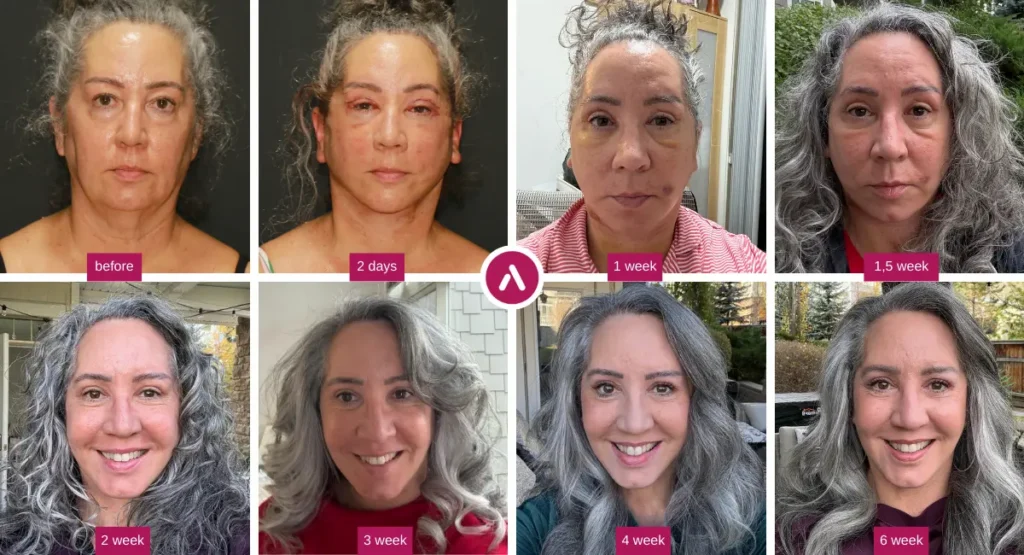
Deep Plane Facelift Recovery & Aftercare: How Long Does Healing Take?
Recovery is not one timeline. It is a series of milestones. The early phase is about swelling and bruising. The later phase is about scar maturation and tissue settling.
We plan recovery with “real life” in mind. When can you be seen in public comfortably? When can you travel safely? When will the result look settled rather than “freshly operated”?
Our approach is proactive. We do not just send you home with generic instructions. We organise aftercare and use technology to reduce inflammation and support scar quality.
Deep Plane Facelift Surgery Day-by-day guide (first 14 days)
Below is a realistic framework we use when planning downtime. You may heal faster or slower. That is normal.
- Days 1–3: Swelling and bruising increase. Tightness is common. Rest, head elevation, calm walking.
- Days 4–7: Bruising often starts to change colour and soften. You may feel “lumpy” as tissues settle.
- Days 8–10: Many patients feel more socially comfortable, depending on bruising and hairstyle choices.
- Days 11–14: You often look “less post-op”. Residual oedema remains, especially around the neck and lower face.
Hydration helps. We typically advise 2–3 litres (approx. 68–100 fl oz) of water daily unless your medical team advises otherwise. If you develop a fever above 38°C (100.4°F), you should contact us promptly.
Our HBOT protocol: rapid recovery support
We utilise Hyperbaric Oxygen Therapy as part of a structured recovery strategy. Many UK patients search for rapid recovery facelift with HBOT because they want swelling and bruising handled logically, not left to chance.
HBOT is delivered in a pressurised chamber. Pressure is measured in ATA (a way of describing “depth/pressure”), and the goal is improved tissue oxygenation during healing. We plan sessions based on your procedure scope and your early recovery signs.
LLLT for scars and inflammation control
Scar care is not just about what the incision looks like at two weeks. It is about how it matures over months. We use Low-Level Laser Therapy to support that process and to calm inflammation when appropriate.
This is why patients look for LLLT scar healing therapy Turkey. The goal is predictable healing, especially for patients who worry about visible ear scars or prolonged redness.
- Supports calmer early healing and comfort
- Targets scar quality and redness management
- Fits into a structured aftercare programme rather than “ad hoc” care
Once you are back in the UK, we continue structured follow-up. Many patients value post-op care in Turkey for British citizens that still feels accessible at home, with planned check-ins rather than reactive messaging.
If you want a precise downtime estimate based on your work and social calendar, we can map it during an online consultation.
Safety & Risks: Is Deep Plane Facelift Dangerous?
No facial surgery is “risk-free”. A Deep Plane Facelift is also a technically demanding operation, which is exactly why planning and protocols matter.
Our principle is straightforward. Reduce avoidable risk. Detect problems early. Support healing actively.
Below is an honest overview of the risks expert patients typically ask about, and how we manage them.
Common risks (and what they can look like)
Most complications are uncommon, but they are real. Knowing what to watch for is part of sensible risk management.
- Haematoma (a collection of blood): sudden swelling, increasing tightness, or one-sided pressure
- Infection: worsening redness, warmth, discharge, or fever above 38°C (100.4°F)
- Delayed wound healing: slow closure, scabbing that persists, or areas that remain tender
- Seroma (fluid collection): a soft, shifting fullness under the skin
- Scarring: usually improves as scars mature, but can be more visible in some skin types
- Asymmetry: early swelling often creates temporary imbalance while tissues settle
- Prolonged swelling (oedema) and bruising: common in the early weeks, especially in the neck
We set expectations early because anxiety often comes from uncertainty. When you know what is “normal post-op”, you recover with more confidence.
Nerve and sensation changes (the questions most patients avoid asking)
Expert patients ask directly about nerves. That is sensible. Temporary numbness around the ear and jawline is common because tissues have been mobilised.
Temporary weakness in facial movement can occur in facelift surgery. It is usually related to traction or swelling around nerve branches. Permanent injury is uncommon, but it is the risk that makes surgeon selection non-negotiable.
- Tingling or “pins and needles” as sensation returns can be normal
- A feeling of tightness often improves gradually over weeks
- We track changes systematically, not casually
“Good results are built on calm mechanics and gentle tissue handling, not force.”— Our safety-first surgical mindset
Our risk mitigation protocol (before, during, and after surgery)
Risk is not something you “hope away”. You reduce it with systems. We treat safety as a process that starts before you arrive and continues after you return to the UK.
- Pre-operative screening to confirm candidacy and optimise medical risk factors
- Medication and supplement review to reduce bleeding risk
- Clear nicotine guidance, because blood supply and wound healing matter
- Structured theatre protocols with continuous monitoring
- Planned aftercare with active swelling and scar-support strategies
Our clinical differentiators are designed around the same goal: safer healing. We often plan Awake Surgery or Twilight Sedation when medically appropriate, and we integrate technology-led aftercare into a defined recovery pathway.
When to contact us urgently
Trust your instincts. If something feels “off”, we would rather you contact us early than wait.
- Rapid swelling, strong one-sided pressure, or a sudden increase in pain
- Fever above 38°C (100.4°F), chills, or feeling unwell
- Shortness of breath, chest pain, or fainting (seek urgent local medical help immediately)
- Worsening redness with discharge or a new bad smell from the incision area
If you are back in the UK and need urgent assessment, we will guide you, but you should also use local services. Your safety comes first.
Is Deep Plane Facelift Safe in Turkey?
UK patients are right to be sceptical. The question is not geography. It is governance, standards, and whether the system around you can manage risk properly.
Our approach is to make “why Istanbul?” a clinical answer, not a marketing one. Safety is built from the environment, the people, and the protocols.
Standards and surgical environment (what matters more than the postcode)
We operate within fully accredited hospital settings and follow strict sterilisation and monitoring standards. That means disciplined infection control, robust peri-operative systems, and the ability to respond quickly if anything deviates from the expected course.
- Hospital-grade theatre standards and continuous patient vitals monitoring
- Strict sterilisation discipline aligned with rigorous international expectations
- Pre-operative screening to confirm safety and suitability
- Use of recognised medical-grade materials and equipment
For the expert patient, this is the core point: “safe” is not a promise. It is a measurable system.
Surgeon governance: credentials, experience, and decision-making
Technique drives outcome. So does judgement. We position your care around European Board Certified Surgeons and specialists registered with international medical boards, supported by a team experienced with high-consideration international patients.
We also do something many patients value: we are conservative with indications. If a deep plane approach is not the right operation for your anatomy, we will say so. That is one of the strongest safety signals we can offer.
“The best complication is the one you prevented at the planning stage.”— Our pre-op planning standard
Continuity of care for UK patients (the ‘fear of abandonment’ problem)
One of the biggest UK concerns is what happens after you fly home. We treat follow-up as part of the procedure, not an optional extra.
- Close post-op monitoring while you are in Istanbul
- 24/7 access to your Patient Host for practical support
- Planned virtual follow-ups at 1, 3, 6, and 12 months to track healing
- Clear guidance you can share with your GP if needed
That structure reduces uncertainty. It also makes recovery more predictable, which is often what expert patients want most.
Why many UK patients see Turkey as “high-value” rather than “low-cost”
We do not frame Istanbul as a budget destination. We frame it as a place where the same clinical standards can be delivered with a more rational cost structure, while investing heavily in surgeon-led planning and recovery support.
That includes our technology-led aftercare pathway and our emphasis on anaesthesia choices that match your risk profile. The intent is always the same: make the experience calmer, safer, and more predictable.
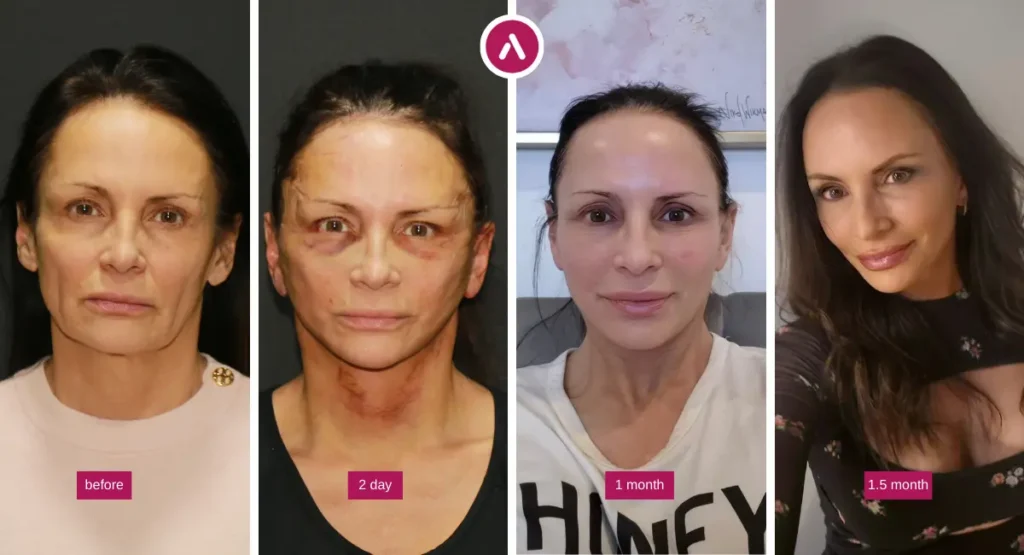
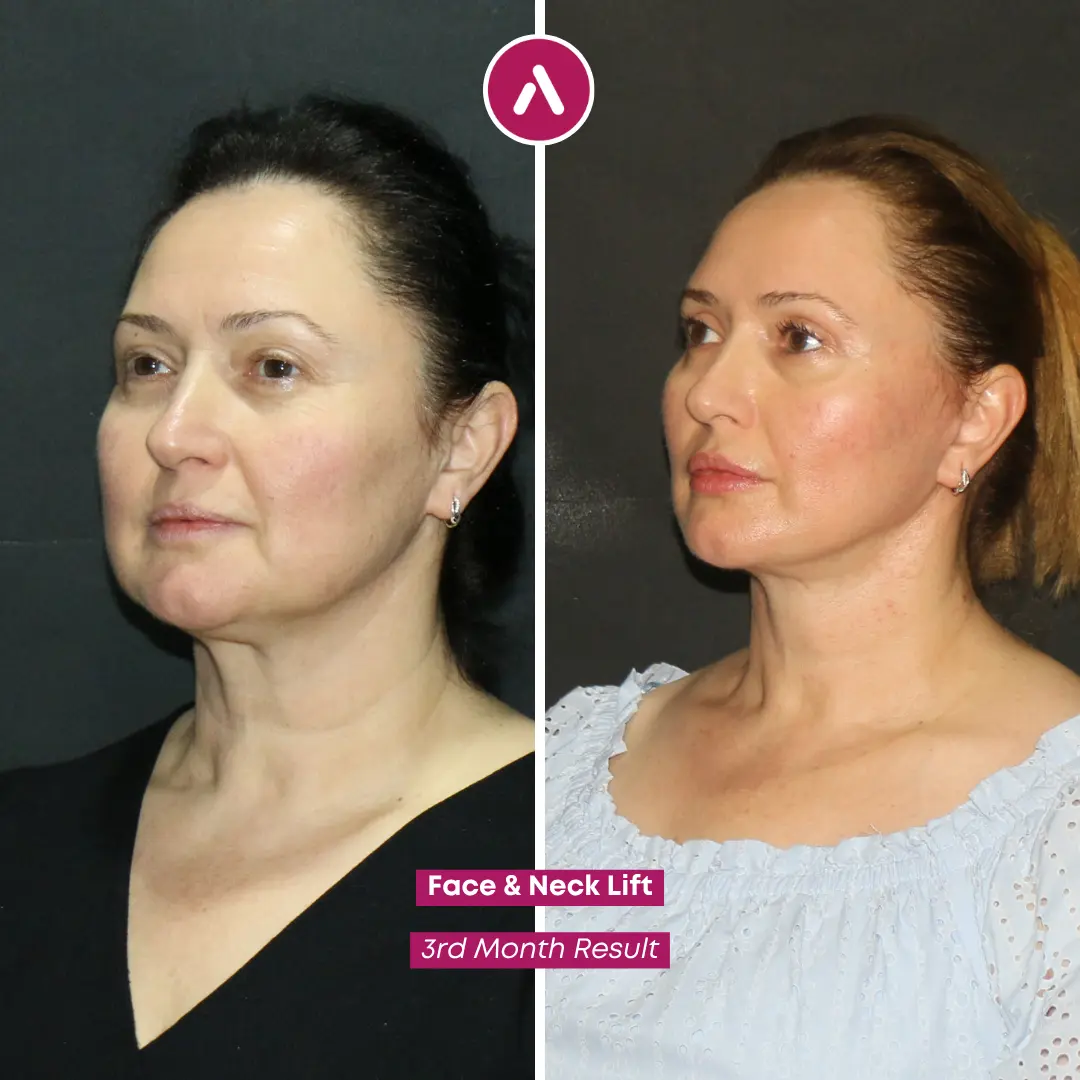
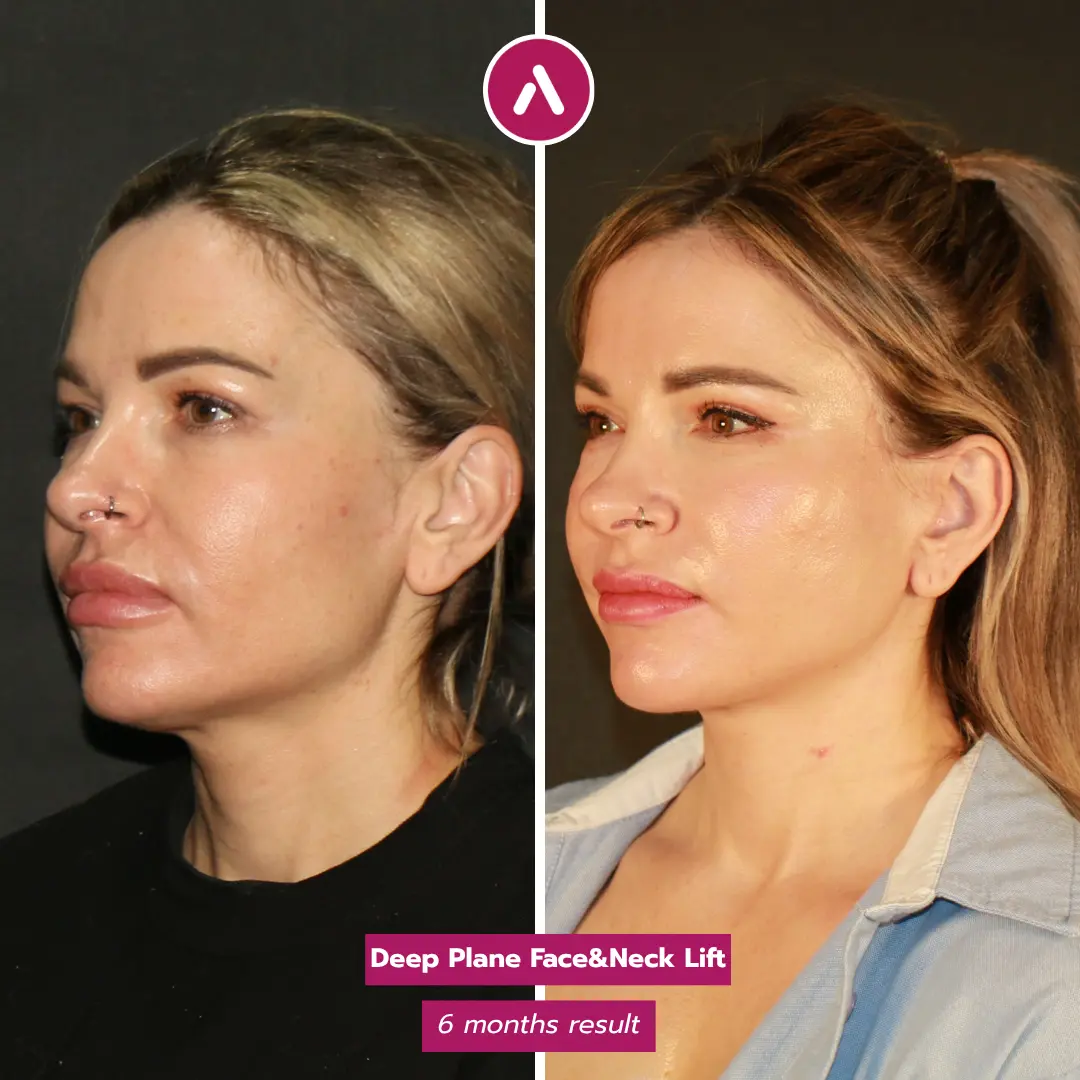
Deep Plane Facelift Before and After: Realistic Expectations & Results
Most patients do not want a “new face”. They want their face back. A deep plane lift is a structural reset, but it is still surgery. Swelling happens. Settling takes time.
We set expectations the way an expert patient prefers: clear, measurable, and calm. You will look better early on. You will look more “like yourself” later. The final quality is usually decided in the months, not the days.
Our philosophy stays consistent: rejuvenation, not alteration. That means preserving expression, avoiding skin tension, and keeping the result believable in motion as well as in photos.
What “rejuvenation, not alteration” looks like in real life
A natural result is usually defined by what doesn’t change. Your identity stays intact. Your facial landmarks stay where they belong. People read you as rested, not “operated”.
- Your jawline looks cleaner, but not sharp in an artificial way
- Your mid-face looks lighter, without a tight “mask” effect
- Your neck looks calmer and more defined, without a strained pull
- Your expression remains familiar when you smile or speak
“If the skin looks like it is holding the lift, we have asked the wrong layer to do the job.”— Our natural-first planning principle
When results look “settled” (and why week two is not the finish line)
Two weeks can look encouraging. It is rarely “final”. Early improvements are real, but tissues are still adapting and oedema can linger, especially in the lower face and neck.
- Weeks 2–4: bruising usually fades; swelling becomes more localised
- Weeks 6–12: firmness softens; facial movement feels more natural
- Months 3–6: scars mature; contour looks more refined in different lighting
- Months 6–12: the result stabilises; subtle asymmetries often resolve
Scar maturation is its own timeline. It is biology. That is why we treat aftercare as part of the procedure, not an afterthought.
Common feedback from expert patients (without the marketing gloss)
Experienced researchers tend to notice the same “tells”. They look for a result that is coherent across the face, not just tight around the ears. They also care about downtime in a practical sense.
- “My face looks less weighted down.” (a common description of tissue descent)
- “I look rested in photos, not pulled.” (the natural-look litmus test)
- “The first fortnight was visible recovery, then it became subtle settling.”
We also see a consistent preference for structure over surface. When the plan addresses deeper descent rather than just skin, the result tends to read as more believable over time.
Cost Analysis: Deep Plane Facelift Cost 2026 (Turkey vs UK)
UK patients do not need a “cheap deal”. They need a rational decision. A deep plane lift is a high-skill operation, and the cost should reflect surgical judgement, anaesthesia safety, and the recovery system around you.
When you compare the UK to Istanbul, the meaningful difference is not postcode. It is cost structure. UK private fees often carry higher facility overheads and staffing costs. Istanbul can deliver a different operational model while maintaining the clinical essentials.
We frame the decision as facelift cost Turkey vs UK through a safety lens: what is included, what is controlled, and what reduces avoidable risk during healing.
Why UK private fees are typically higher (the operational drivers)
In the UK, pricing is shaped by theatre time, staffing ratios, indemnity costs, and facility overheads. This is not “overcharging”. It is the reality of running high-cost healthcare infrastructure.
In Istanbul, the underlying operating costs can be lower. That creates room to invest in surgeon-led planning and a more structured recovery pathway, without framing the work as “budget”. The goal remains high-value, not “low-cost”.
All-inclusive cosmetic surgery in GBP: what is included (and what isn’t)
Expert patients dislike hidden costs. We do too. When we quote, we keep the structure explicit and can organise payments in all-inclusive cosmetic surgery GBP terms where appropriate.
Typically included
- Surgeon-led assessment and surgical planning
- Anaesthesia team and continuous monitoring in theatre
- Hospital / clinic facility fees (as defined in your plan)
- Post-op reviews while you are in Istanbul
- Structured follow-up once you are back in the UK
Typically not included (because needs vary)
- Additional procedures not in your surgical plan (e.g., eyelids, fat transfer)
- Extended hotel stays outside the planned recovery window
- Unexpected medical treatment unrelated to the surgery
The value logic: risk reduction and technology-led recovery
This is where comparisons become honest. A deep plane lift is not just “time in theatre”. It is what happens after. Swelling control. Tissue support. Scar quality. Infection defence.
We integrate Hyperbaric Oxygen Therapy (HBOT) because it supports tissue oxygenation, reduces inflammation, and can reduce “social downtime” in the early recovery window.
We also utilise Low-Level Laser Therapy (LLLT) to support cellular repair, collagen synthesis, and calmer redness and swelling during healing.
“Value is not the headline fee. Value is how predictable your healing becomes when recovery is treated as a protocol.”— Our recovery-led approach
| Decision factor | Typical UK private pathway | Our Istanbul pathway | Why it matters |
|---|---|---|---|
| Theatre & staffing overhead | Higher fixed costs often reflected in fees | Different cost structure can free budget for recovery systems | Cost should support safety, not just branding |
| Anaesthesia strategy | Varies by clinic and surgeon | We prioritise Awake Surgery / Twilight Sedation when medically appropriate | Many UK patients want risk to be proportionate |
| Recovery protocol | Often standard aftercare, limited tech integration | HBOT + LLLT integrated into a structured “rapid recovery & safety” programme | Swelling, bruising, scars, and confidence in downtime planning |
| Follow-up after travel | Local follow-ups are easier by default | Planned digital follow-up pathway for British patients | Reduces the “fear of abandonment” after returning home |
If you want a personalised plan and fee structure, we can review your photos and medical history first. Then we advise on technique, anaesthesia, and realistic downtime before you commit.
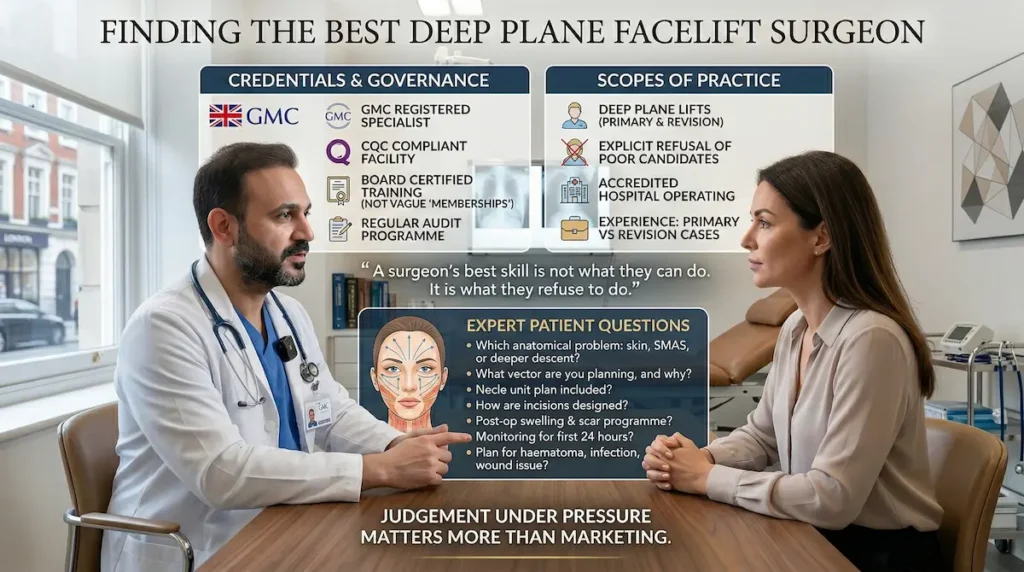
Finding the Best Deep Plane Facelift Surgeon
If you are considering a deep plane lift, the surgeon matters more than the destination. This is a technically demanding procedure with a narrow margin for careless planning.
Expert patients tend to do best when they select a surgeon by governance and decision-making, not by marketing. You are not just choosing a pair of hands. You are choosing judgement under pressure.
Credentials and governance: what to look for
In the UK, patients often anchor on the GMC and CQC context. When you go abroad, you need an equivalent sense of accountability: recognised training, board-level certification, and transparent clinical governance.
- Clear specialist training pathway and scope of practice
- Recognised board-level credentials (not vague “memberships”)
- Operating in accredited hospital settings with anaesthesia support
- Willingness to say “no” when you are not a good candidate
“A surgeon’s best skill is not what they can do. It is what they refuse to do.”— Our selection philosophy
Experience that actually matters: primary vs revision
Primary deep plane surgery is different from revision work. Revisions often involve scar tissue, altered anatomy, and the need for conservative, problem-solving judgement.
- Primary cases: anatomy is more predictable, planning is more standardised
- Revision cases: risks increase, tissue quality varies, goals must be realistic
- Ask directly how often your surgeon performs deep plane lifts (and revision lifts, if relevant)
If you are searching for a top revision deep plane facelift specialist, focus on conservative planning and complication management experience. Revision surgery is rarely about “more lift”. It is about restoring harmony and correcting unwanted tension.
What to ask in a consultation (expert-patient questions)
You do not need to interrogate. You need clarity. These questions reveal whether the surgeon is working from surgical logic or from a generic “facelift package”.
- Which anatomical problem are we treating: skin, SMAS, or deeper descent?
- What vector are you planning for me, and why?
- Will my plan include the neck as a primary unit, or not?
- How do you design incisions to avoid ear distortion and visible scars?
- What is your approach to swelling control and scar support post-op?
- Who monitors me in theatre and in the first 24 hours after surgery?
- What is the plan if I have a haematoma, infection, or wound issue?
If the answers feel rehearsed or vague, treat that as information. Deep plane surgery should be discussed with precision.
Your Medical Journey: What to Expect (UK Patients)
International surgery becomes stressful when logistics are improvised. We reduce that risk by structuring the journey as a clinical pathway: assessment, planning, theatre, recovery, and follow-up.
Below is the typical framework for UK patients travelling to Istanbul. The exact timing depends on procedure scope, anaesthesia plan, and your recovery pace.
Step 1: Remote consultation (before you book flights)
We start with a remote review so you can make a rational decision without pressure. We assess candidacy, discuss technique options, and outline realistic downtime.
- Photo review (front, profile, three-quarter, natural light)
- Medical history and medication review
- Discussion of anaesthesia options: twilight sedation vs general anaesthesia
- Procedure plan (including whether the neck is included)
- High-level recovery milestones and travel timing
If anything in your history raises concern, we address it before you commit. That is part of risk mitigation.
Step 2: Arrival in Istanbul (travel and comfort planning)
Most UK patients prefer a calm arrival day rather than rushing into appointments. We organise a structured schedule so you are not making decisions while tired from travel.
- Airport transfer and hotel check-in
- Pre-op instructions repeated in plain, practical terms
- In-person assessment, surgical marking, and final consent review
Your Patient Host supports the practical side. The clinical side remains surgeon-led.
Step 3: Surgery day and immediate aftercare
On the day, the priority is safety and predictable monitoring. After surgery, the first 24 hours are about swelling control, comfort, and early detection of any deviation from the expected course.
- Anaesthesia plan confirmed and monitoring established
- Procedure performed in theatre under controlled protocols
- Post-op review, wound checks, and clear home instructions
We do not treat aftercare as “rest and hope”. We treat it as a protocol.
Step 4: Recovery window in Istanbul (before you fly)
Most patients want to know one thing: “When can I travel safely?” We plan this with your healing in mind, not with a fixed sales timeline.
- In-person post-op reviews before travel
- Guidance on swelling, bruising, and incision care
- Scar support planning and practical recovery coaching
If your plan includes recovery technologies such as HBOT or LLLT, this is typically when they are integrated into your aftercare schedule.
Step 5: Follow-up back in the UK (continuity of care)
The “fear of abandonment” is real for international patients. We address it with planned check-ins rather than reactive messaging.
- Structured virtual follow-ups (commonly at 1, 3, 6, and 12 months)
- Photo-based healing tracking and scar monitoring
- Clear guidance for what is normal vs what needs assessment
“Travelling for surgery should never mean travelling without follow-up.”— Our continuity standard
If you would like, we can map your exact journey around your work and social calendar, including a realistic ‘return to public’ window based on your bruising risk factors and procedure scope.
A Surgeon-Led Online Consultation
If you are considering a Deep Plane Facelift, the most valuable first step is a surgeon-led plan. Not a package. Not a generic quote. A clear assessment of your anatomy, vectors, neck needs, and your safest anaesthesia pathway.
For UK patients, we also plan the practical details that matter: a realistic “return to public” window, scar-care strategy, and structured follow-up once you are back home. That is how international surgery becomes predictable rather than stressful.
To begin, send clear natural-light photos (front, both profiles, three-quarter angles) and your medical history. We will advise whether deep plane is appropriate, what technique variation fits your anatomy, and what recovery timeline is realistic for your calendar.
Deep Plane Facelift Frequently Asked Questions (FAQ):
How long does a deep plane facelift last?
Longevity depends on your anatomy, skin quality, lifestyle, and how your tissues age. A deep plane approach focuses on structural repositioning rather than skin tension, which many patients feel ages more gracefully. That said, no surgeon can ethically “guarantee” a number of years.
Will I look “pulled” or obviously operated on?
That look is usually linked to excessive skin tension, poor vector planning, or over-correction. Deep plane facelift principles aim to reduce surface traction by lifting deeper structures, helping results read as rested rather than tight. The most natural outcomes come from conservative planning and coherent facial balance.
What is the difference between a deep plane facelift and an SMAS facelift?
Both approaches address deeper layers, but the surgical plane and mobilisation differ. Deep plane facelift techniques typically involve working beneath the SMAS and releasing key retaining ligaments to reposition descended tissues. SMAS approaches may use more limited mobilisation depending on technique and anatomy.
Can a deep plane facelift improve the neck?
Often, yes—especially when planned as a lower face and neck strategy rather than a “face-only” lift. The neck may require its own steps (for example, platysmal management) depending on banding, laxity, and fat distribution. We plan the neck deliberately rather than as an afterthought.
What about deep plane facelift incisions and ear scars?
Incisions are typically designed around natural ear contours and, where appropriate, within the hairline. The key is that the scar should not be asked to “hold the lift”; tension distribution matters. Scar maturation takes months, and structured aftercare supports discretion.
Is twilight sedation safer than general anaesthesia?
Neither is “automatically safer” for everyone. Twilight sedation (with local anaesthesia) can be an excellent option for suitable candidates and is often preferred by UK patients seeking a proportionate anaesthetic approach. The safest plan depends on your medical history, procedure length, and anaesthesia assessment.
What is deep plane facelift recovery really like day by day?
Most visible bruising and swelling tends to peak in the first few days, then gradually improves over the first two weeks. Many patients feel more socially comfortable around days 10–14, although oedema can linger, especially in the neck. If you want a realistic “return to public” plan, we map it to your schedule and risk factors.
Do you have deep plane facelift recovery day by day photos?
We can share relevant recovery examples during consultation, matched to your skin type and procedure scope, because healing varies. A day-by-day timeline is most useful when it is comparable—similar anatomy, similar technique, and similar aftercare. We prioritise realistic context over cherry-picked highlights.
Is a deep plane facelift in Turkey safe for UK patients?
Safety is not a postcode; it is a system. What matters is accredited hospital environment, anaesthesia governance, surgeon judgement, and structured follow-up—especially once you return to the UK. We treat continuity of care as part of the procedure, not an optional extra.
How do I choose the best deep plane facelift surgeon in Turkey?
Look for transparent credentials, a surgeon who can explain anatomy and vectors clearly, and a conservative approach to indications. Ask about experience with both primary and revision cases, complication protocols, and who provides anaesthesia and early post-op monitoring. Precision and honesty are stronger signals than promises.
What is the deep plane facelift price in Turkey?
Fees vary based on procedure scope (face only vs face and neck), anaesthesia plan, hospital setting, and whether additional procedures are included. We keep quotes structured and explicit, so you know what is included and what is not. A personalised estimate is best done after photo review and medical history assessment.
How do I book a deep plane facelift in Istanbul?
We typically start with a remote consultation, photo review, and a medical screening questionnaire. If you are a suitable candidate, we confirm a surgical plan, anaesthesia pathway, and a realistic recovery window before you book travel. This keeps the decision clinical, not rushed.
Medical Disclaimer: This page is provided for general educational purposes only and does not replace a face-to-face medical consultation, diagnosis, or personalised treatment plan. All surgery carries risks and outcomes vary between individuals. Suitability for a deep plane facelift, procedure selection, and anaesthesia choice can only be determined after a full clinical assessment by a qualified surgeon. Always follow your clinician’s instructions and seek urgent medical attention if you develop concerning symptoms during recovery.