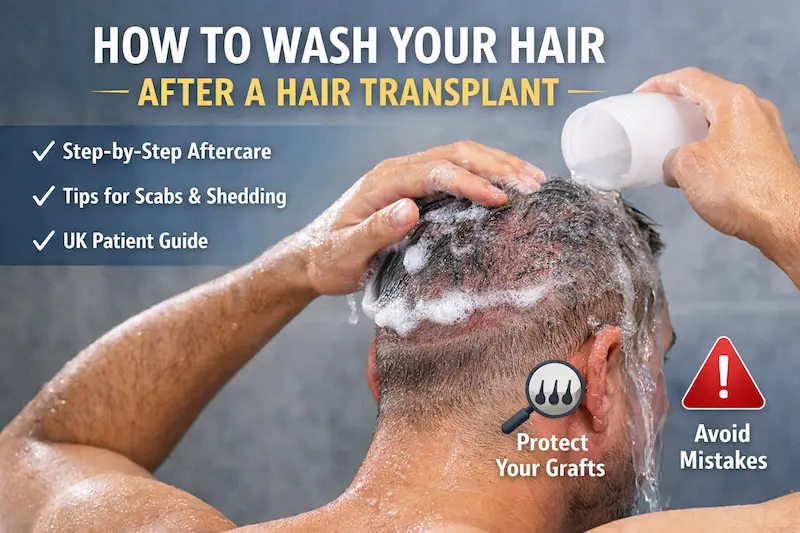
If you’re nervous about how to wash hair after transplant, you’re not alone. The first wash is one of the biggest “make-or-break” moments in hair transplant aftercare—not because washing is dangerous, but because the wrong washing method can cause unnecessary friction, swelling, or irritation when your scalp is still settling.
This guide gives clear, practical hair transplant washing instructions for UK patients—whether you’ve had FUE or DHI. It’s designed to help you clean your scalp safely, protect the grafts, and reduce the chance of avoidable setbacks. If your surgeon has given you a specific protocol, always follow that first—this is a general guide.
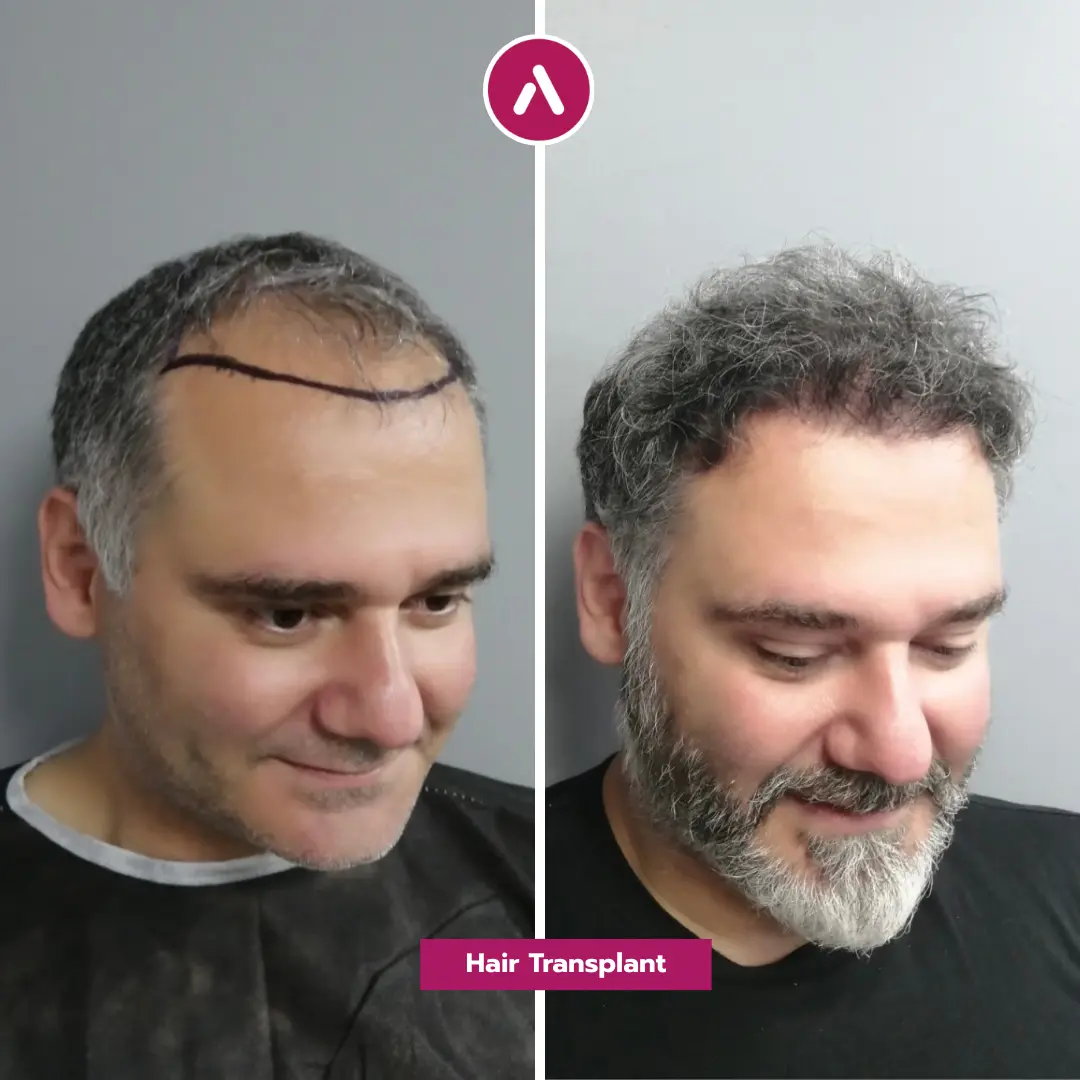
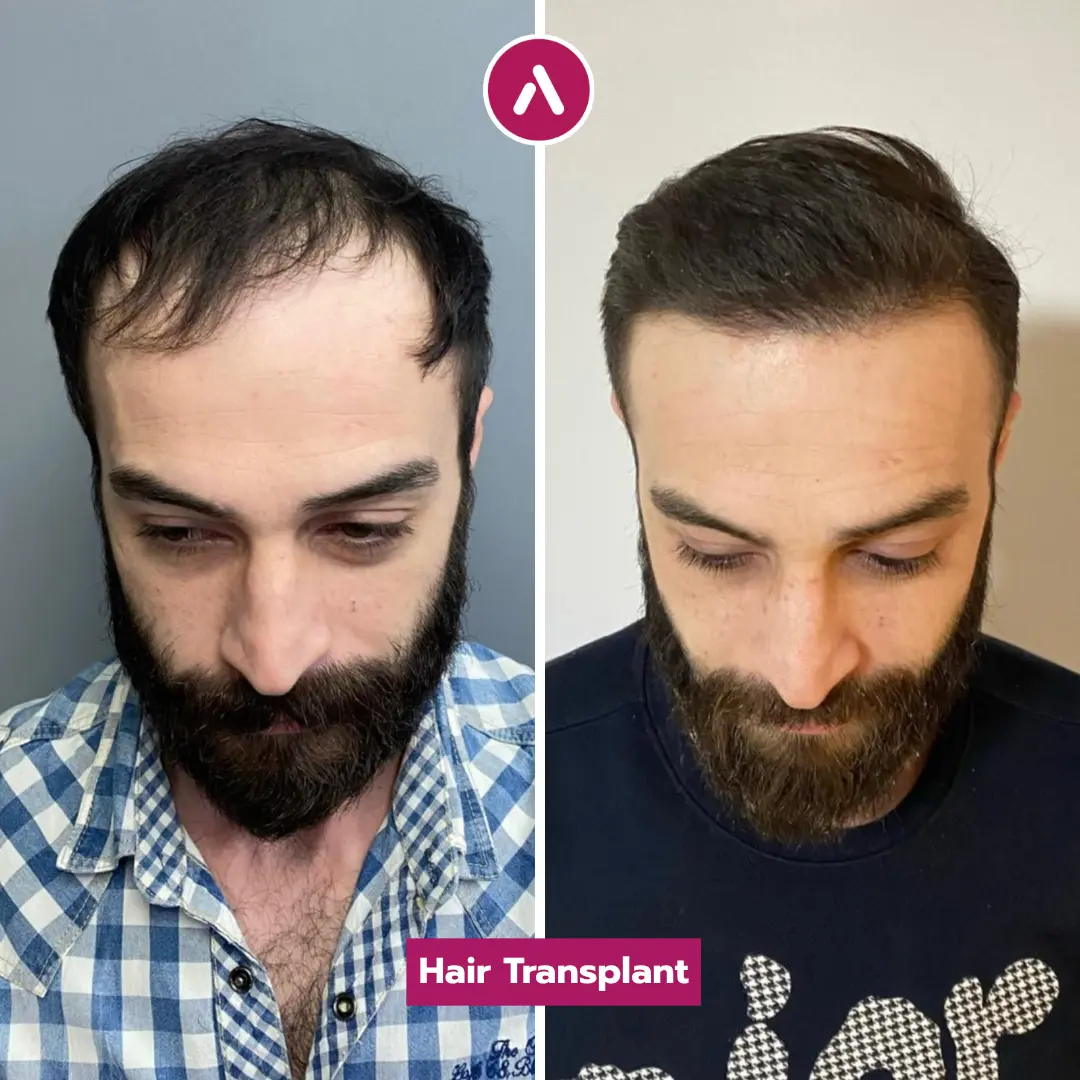
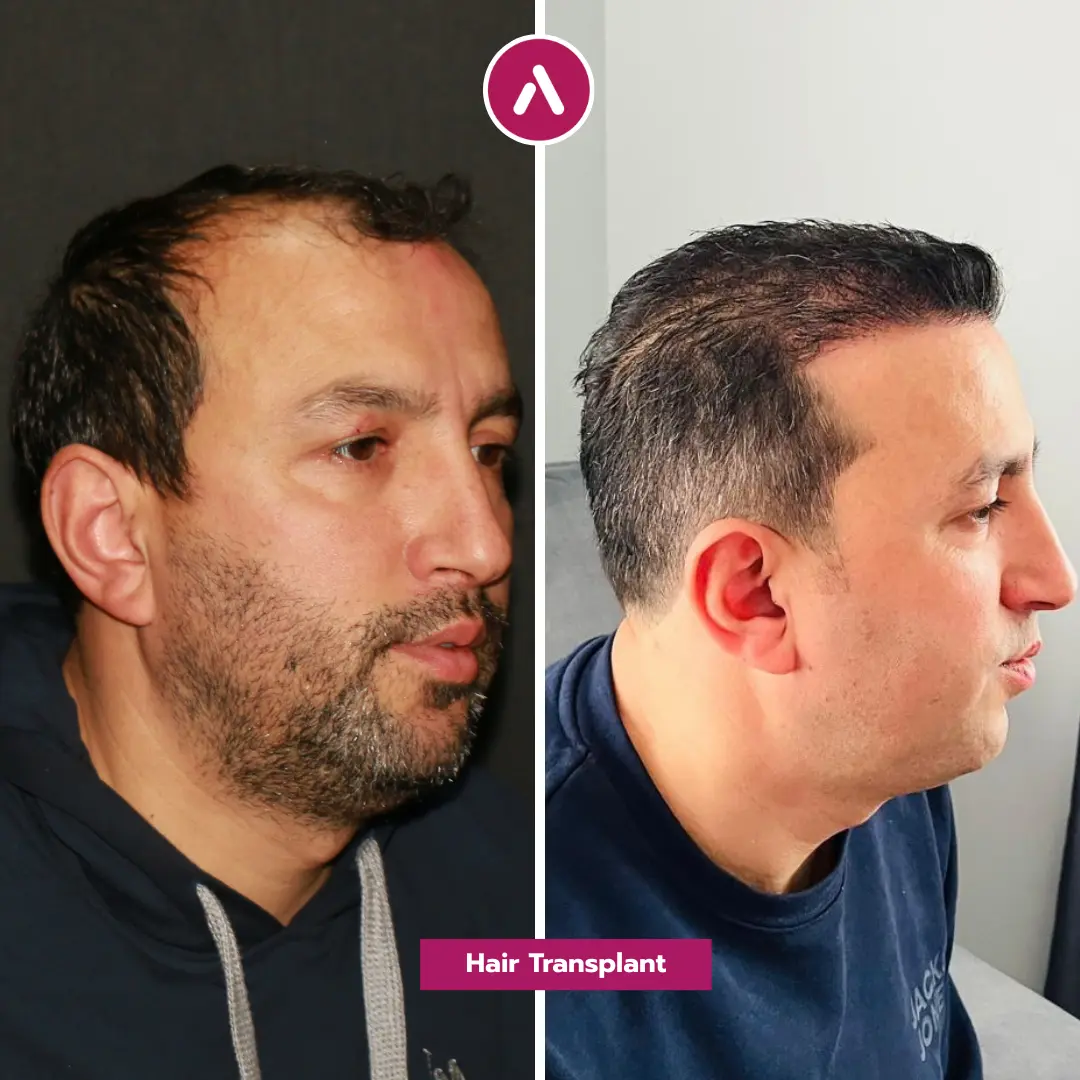
In medical science, early wound care principles are consistent: protect healing tissue, minimise friction, and reduce contamination risk. That’s the logic behind every step below—simple, but grounded in what scientific research has long shown about skin healing and inflammation control.
- Goal #1: Keep grafts stable (especially in the early days).
- Goal #2: Clean the scalp without rubbing or high water pressure.
- Goal #3: Manage crusting/scabs safely—no picking.
| First 72 hours: quick rules | Do | Don’t |
|---|---|---|
| Water | Use lukewarm water (comfortable, not hot) | Hot showers / steam rooms |
| Contact | Light touch only when instructed | Scratching, rubbing, towel “scrubbing” |
| Pressure | Pouring method or very gentle rinse | Direct strong shower stream onto grafts |
| Products | Use only what your clinic approves | Strong anti-dandruff shampoos, harsh actives |
Table of Contents
Why washing matters after a hair transplant (and what you’re protecting)
Washing isn’t just about feeling clean—it’s a controlled part of hair transplant recovery tips. In the early phase, your scalp is healing from tiny incisions and channels. The aim of early washing is to keep the area hygienic, reduce build-up, and support normal healing while avoiding any force that could disturb grafts.
Even when your scalp feels “fine”, the first washes are less about cleansing power and more about technique. This is why clinics give detailed instructions that may differ slightly after a DHI vs FUE hair transplant: the recipient area can be more sensitive depending on how the grafts were placed and how your skin reacts. A gentle, structured routine helps prevent unnecessary inflammation, keeps crusting manageable, and reduces the urge to scratch—protecting both comfort and long-term results.
Graft security in the first critical days
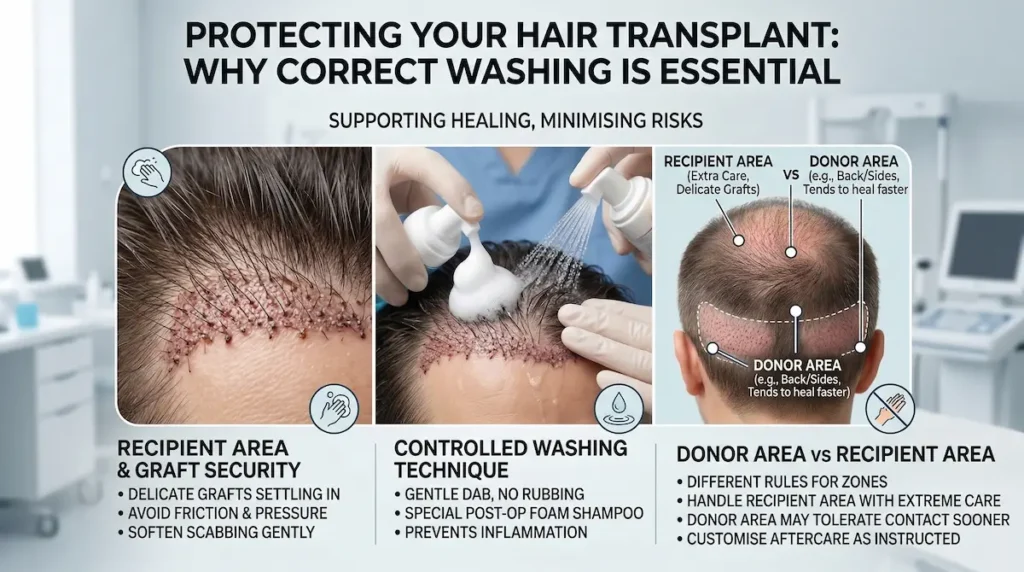
In the first few days, the recipient area is sensitive. Think of grafts as “settling in”—you’re protecting them from unnecessary pressure, friction, and repeated touching. That’s why the first wash (and any cleaning before it) must be gentle, structured, and timed according to your clinic’s plan.
Scabs/crusting and itching: what’s expected vs what’s not
Crusting (small scabs) is common. The mistake many patients make is trying to remove scabs too early or too aggressively. Controlled washing helps soften build-up gradually. Mild itching can be normal; intense itching that makes you want to scratch needs a strategy (cool environment, distraction, approved sprays/lotions)—not nails.
Donor area vs recipient area: different rules, different risks
After FUE or DHI, you effectively have two healing zones. The donor area (usually the back/sides) often tolerates slightly more contact sooner than the recipient area. The recipient area needs the “no friction, no pressure” approach for longer. Good aftercare means treating these areas differently, not washing everything the same way.
What you need before your first wash (UK-friendly checklist)
The first hair wash after hair transplant is smoother when you prepare your set-up in advance. The objective is simple: wash without rushing, avoid accidental bumps, and make sure you can rinse using a controlled method. This preparation also helps if you’re back in the UK and following instructions remotely.
Products & tools: gentle shampoo, saline, clean towels, cup/spray bottle
- Approved gentle shampoo (only what your clinic recommends)
- Saline spray if provided (useful for keeping crusts from drying out too hard)
- Clean cup/jug or a low-pressure bottle for rinsing (more control than a shower)
- Soft, clean towels (for pat-drying only)
If your goal is how to clean scalp after hair transplant safely, control is everything: gentle product, gentle hands, gentle rinse.
Water temperature & pressure basics (include °C and °F)
Use lukewarm water—comfortable to the touch. Avoid hot water, as heat can increase redness and irritation. Keep pressure low: a direct strong shower stream is a common reason patients irritate the recipient zone. If you’re unsure, use the pouring method (cup/jug) for the first washes.
Practical reference: aim for “not hot” rather than chasing an exact number—roughly around body temperature (about 35–37°C / 95–98.6°F) feels safe for most patients.
Hygiene prep: hands, nails, pillowcases, bathroom setup
- Wash hands thoroughly before any scalp contact.
- Keep nails short to reduce accidental scratching.
- Use a fresh pillowcase regularly (especially in the first week).
- Set up good lighting and a clear space so you don’t knock your head.
Clinician tip: Most “problems” after washing aren’t from shampoo—they’re from rushed rubbing, too much pressure, or trying to remove scabs early. Slow, controlled, and consistent wins.
Hair washing timeline: what changes week by week
One of the most common questions in hair transplant aftercare is timing: “When can I wash normally again?” The honest answer is that it changes in phases. Your clinic may customise this based on graft count, skin sensitivity, and whether you had FUE or DHI. Use the timeline below as a practical framework, then match it to your own hair transplant washing instructions.
| Time after surgery | What washing usually looks like | Main goal |
|---|---|---|
| Days 0–2 | Often keep recipient area dry; light cleansing only if instructed | Protect grafts, minimise swelling/irritation |
| Days 3–7 | Gentle “soak + rinse” washing, no rubbing | Hygiene + soften crusts gradually |
| Days 8–14 | Gradual transition towards normal washing; scabs usually lift with gentle care | Reduce crusting safely, avoid picking |
Days 0–2: keeping the area protected and dry (what to avoid)
In the first 48 hours, your job is mostly “protection”. Many protocols advise avoiding direct water on the recipient zone, and avoiding any attempt to actively remove crusts. Even if you feel oily or itchy, resist the temptation to scrub—this phase is about stability and calm healing.
- Avoid hot showers, steam, and anything that increases flushing or sweating.
- Avoid direct shower pressure to the recipient area.
- Do not scratch, rub, or “check” grafts with your fingertips.
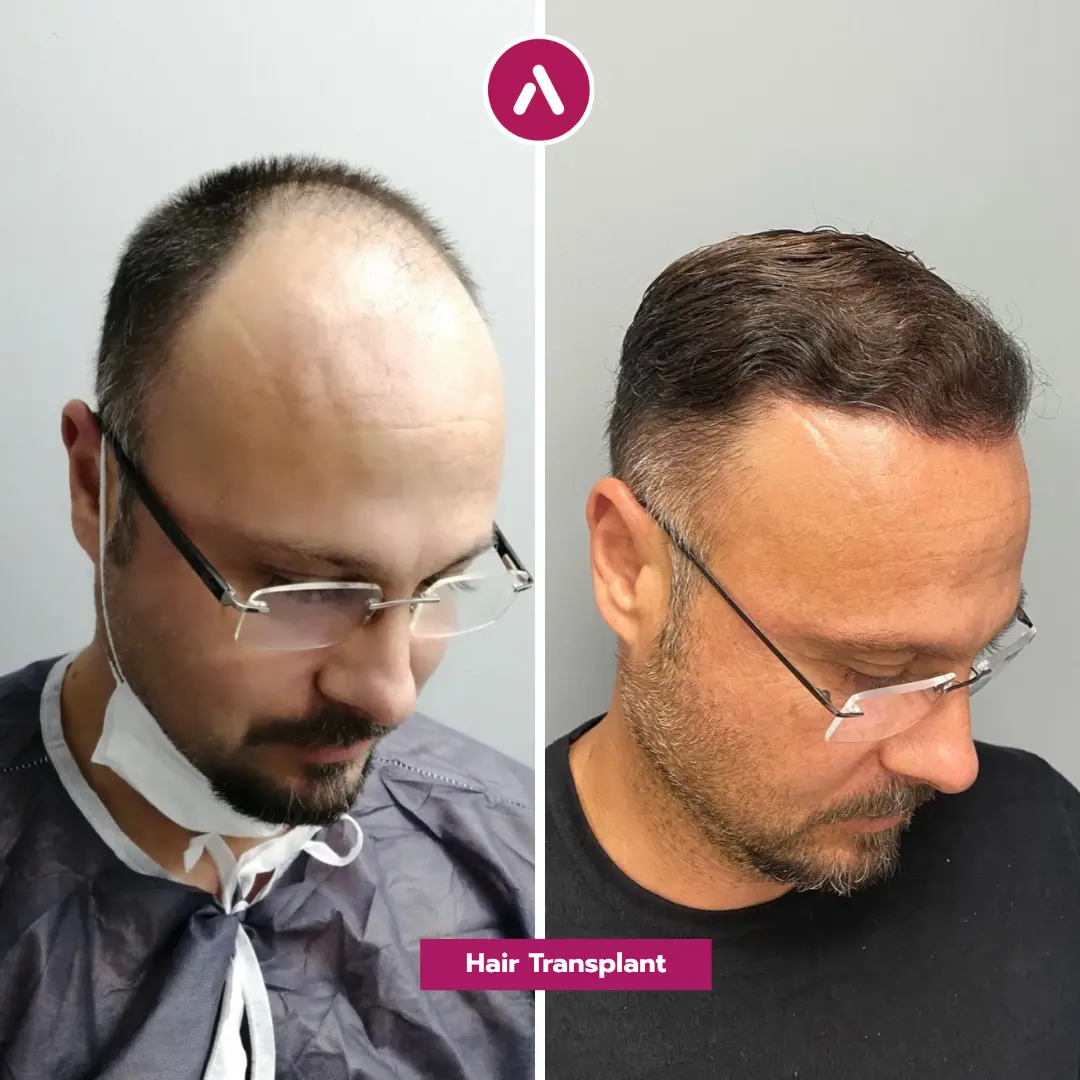
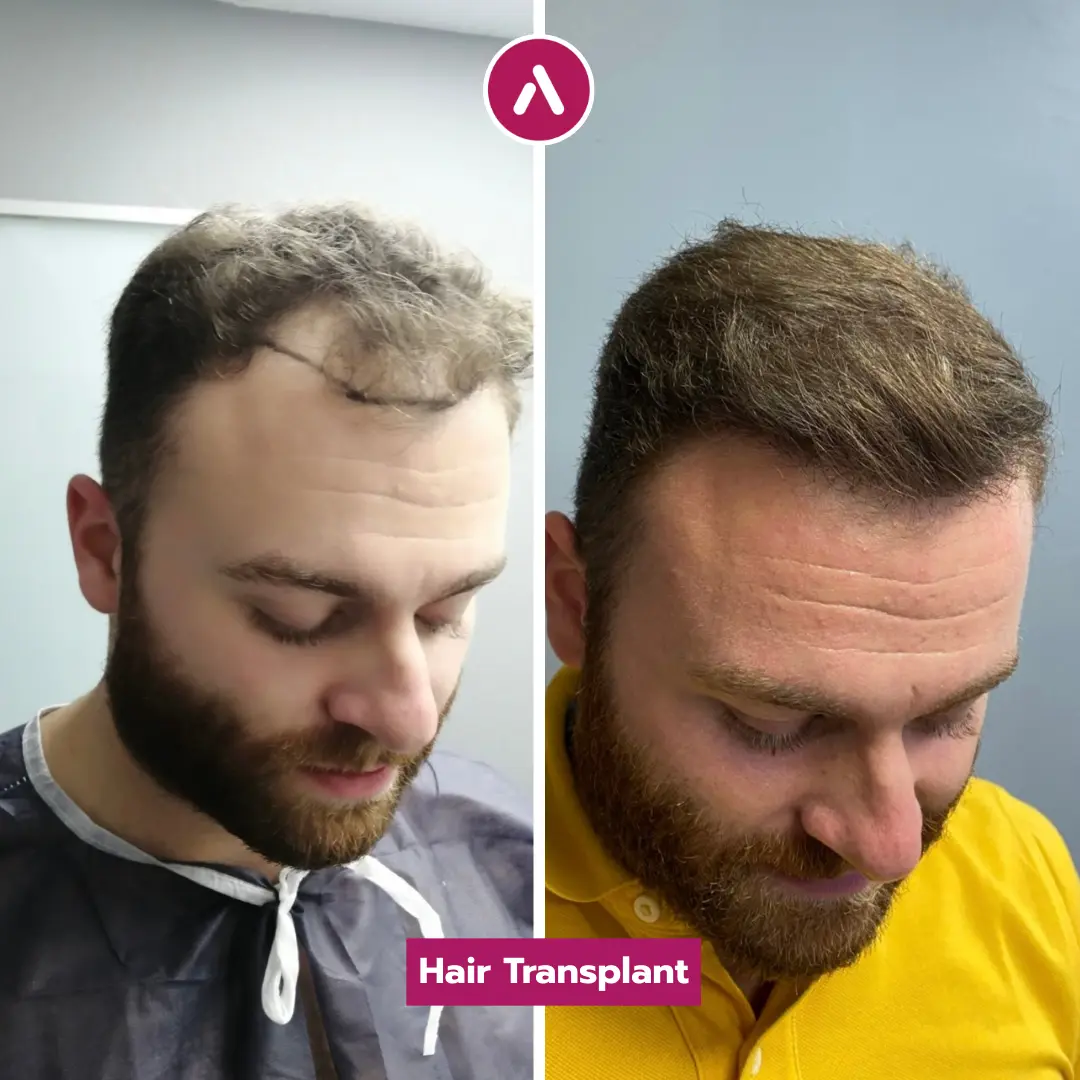
Days 3–7: gentle “soak + rinse” phase (no friction)
This is usually when the first hair wash after hair transplant happens (often around day 2–3, depending on your clinic). The technique is more important than the shampoo. You’re aiming to cleanse the scalp while keeping contact light and controlled.
- Use lukewarm water (around 35–37°C / 95–98.6°F feels comfortable for most).
- Use a pouring method (cup/jug) or very gentle shower flow—never a strong jet.
- Apply shampoo as a foam and let it sit briefly rather than rubbing it in.
Days 8–14: transitioning towards normal washing (scab softening/removal phase)
By week two, crusts should be much easier to manage with gentle washing. This is when patients often ask how to clean scalp after hair transplant properly without “overdoing it”. The key is still the same: soften first, then let scabs lift naturally. If you’re unsure whether you’re ready to increase contact, stay conservative and ask your clinic.
Reminder: Scabs are part of healing. “Forcing” them off early can irritate the skin and create unnecessary inflammation. Slow, steady washing is the safest approach.
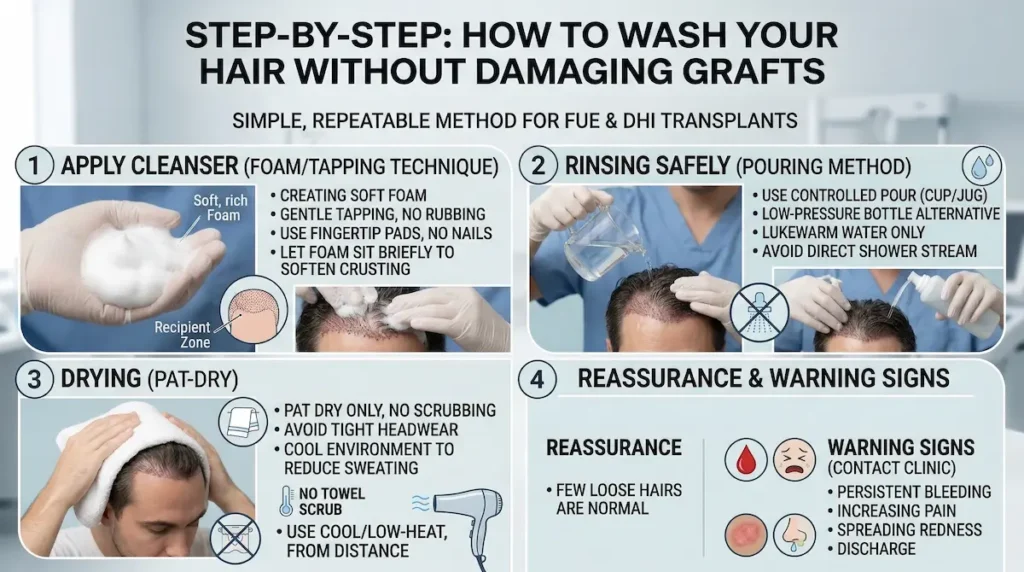
Step-by-step: How to wash your hair without damaging grafts
Below is a simple, repeatable method that works well for most patients and aligns with common hair transplant washing instructions. It’s also flexible enough to apply whether you’re searching for how to wash hair after FUE transplant or how to wash hair after dhi transplant—the principles are identical: low pressure, low friction, and patience.
Even though the core technique is the same, your clinic may fine-tune timings and touch levels depending on your DHI vs FUE hair transplant—particularly if your scalp is more reactive or if crusting is heavier than expected. The safest mindset is to treat every wash as “graft-protective hygiene”: slow movements, no rushing, and zero rubbing. If something feels uncomfortable, don’t push through it—reduce pressure, use the pouring method, and follow the protocol you were given.
Applying cleanser: foam/tapping technique (no rubbing)
Put shampoo in your hands first, add a little water, and create a soft foam. Then apply the foam gently onto the scalp—think “placing” not “scrubbing”. For the recipient zone, use light tapping rather than circular rubbing.
- Use fingertips pads (not nails).
- No circular massage on the graft area in the early phase.
- Let the foam sit briefly to loosen oils and soften crusting.
Rinsing safely: pouring method vs direct shower stream
Rinsing is where many people go wrong. A strong shower stream can be too much early on, so use a controlled pour with a cup/jug or a low-pressure bottle. If you do use the shower, keep the pressure low and avoid aiming directly at the grafts.
- Pour water from a short height to avoid impact force.
- Keep water lukewarm (avoid hot water).
- Rinse longer rather than increasing pressure.
Drying: pat-dry, no towels scrubbing, hairdryer do’s & don’ts
Drying should be gentle and non-abrasive. Use a clean, soft towel and pat-dry. Do not rub. If you use a hairdryer, keep it on a cool or low-heat setting and at a distance. These simple habits are underrated hair transplant recovery tips that reduce irritation and help you stay consistent.
- Pat dry only—no towel “scrub”.
- Avoid tight headwear immediately after washing.
- Keep the environment cool to reduce sweating and itching.
Quick reassurance: A few loose hairs on your hands during washing can happen as the scalp heals. If you see persistent bleeding, increasing pain, spreading redness, or discharge, that’s not “normal washing fallout”—it’s a reason to contact your clinic promptly.
Scabs, shedding, and the “panic moments” British patients ask about
Most worries after the first hair wash after hair transplant are completely understandable—because the scalp can look “worse” before it looks better. Crusting, mild redness, and some shedding can be part of normal healing. The key is knowing what you can manage at home (gently) versus what needs clinical advice as part of proper hair transplant aftercare.
How to soften scabs safely (and what not to pick)
Scabs (crusting) are common and usually temporary. Your aim is to soften them through gentle, repeated washing—not to forcibly remove them. If you’re searching how to clean scalp after hair transplant without damaging grafts, the safest approach is “soften + rinse + patience”.
- Do: Use lukewarm water and approved shampoo foam; allow it to sit briefly before rinsing.
- Do: Consider saline spray if your clinic advised it, to reduce dryness and help crusts soften evenly.
- Don’t: Pick scabs with fingernails, rub with towels, or use exfoliating products.
If scabs feel stubborn around day 8–14, that can still be normal—especially if your skin tends to be dry. Stay gentle and follow your clinic’s hair transplant washing instructions.
Shedding during washing: what it can mean and when it’s normal
Seeing hair in the sink can be alarming, but shedding is often part of the normal post-transplant process. Many patients experience “shock loss” where transplanted hairs shed before regrowth begins. This can happen during washing simply because you’re finally cleansing and loosening hairs that were ready to shed anyway.
| What you notice during washing | Often normal | When to check in |
|---|---|---|
| Some hairs shedding without pain | Yes (can be part of shock loss) | If accompanied by persistent bleeding or sudden worsening pain |
| Small flakes/crusts lifting after day 7+ | Yes (if gentle) | If you’re “forcing” removal or skin looks raw |
| Increasing redness, warmth, swelling | Not usually | Same-day advice recommended |
Itching, tightness, and redness: practical comfort measures
Itching is common as healing progresses. The mistake is scratching. Instead, focus on comfort strategies that fit everyday UK life and reduce the temptation to touch your scalp.
- Keep your bedroom cooler at night (heat can worsen itching).
- Use only clinic-approved sprays/lotions if dryness is a trigger.
- Stay consistent with gentle washing—build-up can worsen itchiness.
If redness is spreading, the scalp is increasingly tender, or there is discharge or an unpleasant smell, that’s beyond “normal healing” and you should contact your clinic.
Common misconception: “If I wash less, I protect grafts more.” In reality, careful cleansing is part of protection—because it supports hygiene and calmer healing. The goal is not no washing, but the right washing technique.
Common mistakes that can compromise results
Whether you’re looking up how to wash hair after FUE transplant or how to wash hair after dhi transplant, the errors tend to be the same: too much pressure, too much friction, or reintroducing “normal routines” too quickly. These are the pitfalls that can turn a straightforward recovery into a stressful one—so consider this section essential hair transplant recovery tips.
Scratching, nail contact, aggressive massage, hot water
These are the most common issues we see in post-op photos and patient check-ins:
- Scratching (even “lightly”) can disrupt scabs and irritate healing skin.
- Nail contact often happens unintentionally—keep nails short and be deliberate with hand placement.
- Aggressive massage is not appropriate early on; keep contact minimal unless your clinic explicitly tells you otherwise.
- Hot water increases redness and irritation—stick to lukewarm (around 35–37°C / 95–98.6°F).
Strong shampoos/active ingredients too early & product overuse
Patients often reach for “stronger” products because they want to feel extra clean. Early on, this can backfire. Avoid introducing harsh anti-dandruff shampoos, fragranced products, or strong actives unless your clinic approves them. Even a gentle shampoo can irritate if you use too much and then try to rinse with higher pressure.
- Use only clinic-approved products during the early healing period.
- Create foam in your hands first, then apply gently—don’t pour concentrated product directly onto the graft area.
- Rinse for longer rather than increasing water pressure.
Early sweating, gym, hats/helmets, and friction from bedding
Many UK patients feel well enough to return to normal routines quickly—especially if they work from home. But sweating, heat, and friction can increase irritation and itching, leading to accidental scratching.
- Gym/exercise: Avoid early heavy sweating if your clinic has advised a rest period.
- Hats/helmets: Friction and pressure matter—only wear what your clinic approves, and not too soon.
- Bedding: Fresh pillowcases and gentle sleeping positions reduce friction and contamination risk.
| Mistake | Why it’s risky | Safer alternative |
|---|---|---|
| Rinsing with a strong shower jet | Mechanical force + irritation | Pouring method / low-pressure rinse |
| Trying to “remove all scabs” in one wash | Inflammation, raw skin, temptation to pick | Soften gradually over several washes |
| Rubbing dry with a towel | Friction on grafts and healing skin | Pat-dry only; cool dryer at a distance if needed |
Returning to normal life in the UK: routines, work, and travel
Once you’re past the very early phase, your focus shifts from “protect at all costs” to “recover sensibly”. Many UK patients want to know when they can go back to work, resume exercise, and wash more normally—especially if they had surgery abroad and are now following hair transplant washing instructions at home. The safest approach is to return to routines step-by-step, keeping friction, sweat, and sun exposure under control while the scalp is still reactive.
Even if you feel “back to normal”, your scalp may still be healing beneath the surface, so it helps to ease into everyday routines with a plan. Recovery can feel slightly different after a DHI vs FUE hair transplant, especially in how quickly the recipient area settles and how much dryness or crusting you experience. Keeping washing gentle, avoiding heavy sweating, and limiting friction from hats or pillows can make your return to work and travel smoother—while protecting comfort and long-term results.
Back to work: office vs active jobs (timing considerations)
For desk-based work, many people feel able to return relatively soon, provided they can keep the scalp clean, avoid accidental knocks, and manage swelling. If your job involves physical activity, heat, dust, helmets, or frequent bending, it may be sensible to extend downtime. This is not just comfort—excess sweat and friction can increase itchiness, and itchiness increases the risk of scratching (a common aftercare setback).
- Office / remote work: often easier to restart sooner, as you can control temperature and hygiene.
- Active / outdoors work: consider more time off to avoid sweat, sun, dust, and headgear friction.
Barber, clippers, hair dye, styling products: when to restart
Be cautious with anything that applies pressure, heat, or chemicals to a healing scalp. If you’re asking how to clean scalp after hair transplant, think “gentle and boring” for the first couple of weeks—no aggressive styling routines.
- Clippers/trimmers: avoid contact with the recipient zone until your clinic confirms it’s safe.
- Hair dye/bleach: avoid early; chemicals can irritate healing skin.
- Styling products (gel, wax, sprays): avoid early; build-up can worsen itching and make washing harder.
If you’ve had DHI or FUE, the timeline may vary slightly, but the principle is the same: protect the scalp barrier first, then reintroduce products gradually. (Many people search how to wash hair after dhi transplant or how to wash hair after FUE transplant expecting different rules—usually it’s technique and healing progress that matter more than the label.)
Sun, swimming, and flying back to the UK: practical precautions
Sun and pool water can be surprisingly irritating during the healing stage. Treat UV exposure as a genuine risk to comfort and inflammation control. Swimming adds additional concerns: chlorine/salt can dry the scalp, and public pools carry contamination risk when skin is still healing.
- Sun: keep the recipient area protected; avoid direct strong sunlight early on.
- Swimming: postpone until your clinic confirms skin is fully settled; avoid early chlorine/salt exposure.
- Flying: follow your clinic’s guidance; keep hydration up and avoid touching/scatching during travel.
| Activity | Why it matters | Safer approach |
|---|---|---|
| Gym / heavy exercise | Sweat + heat can worsen itchiness and irritation | Restart gradually; avoid heavy sweating early |
| Hat / helmet | Friction and pressure on recipient zone | Only if approved; keep it loose and clean |
| Swimming | Chemicals/salt + infection risk with healing skin | Delay until skin is settled and clinic approves |
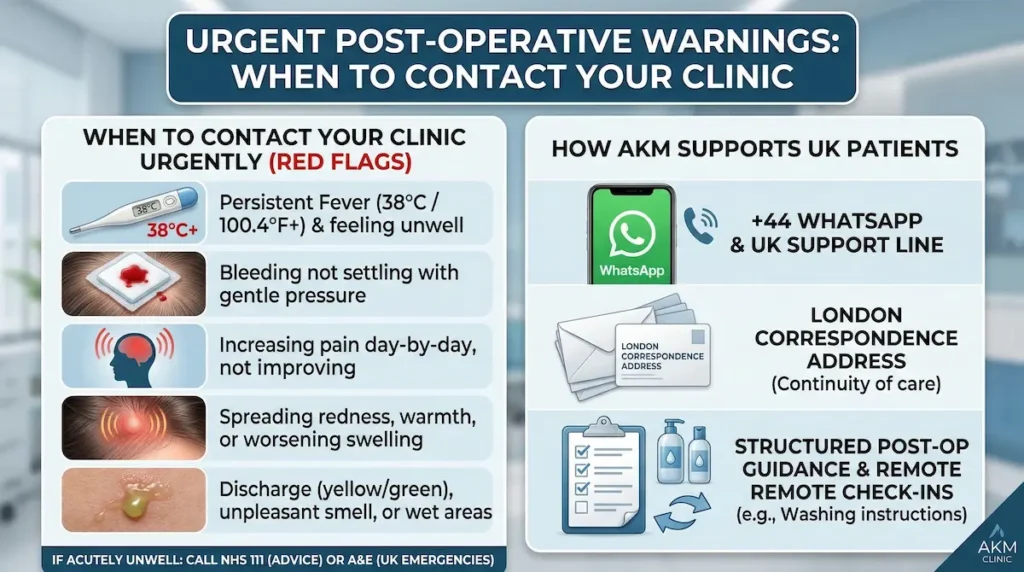
When to contact your clinic urgently (red flags) + how AKM supports UK patients
Good hair transplant aftercare includes knowing what’s normal and what’s not. Mild swelling, mild redness, and some crusting can be expected. What you should not ignore is worsening pain, spreading redness, discharge, or symptoms that suggest infection. When in doubt, it’s safer to ask—especially if you’re trying to balance recovery with work and life in the UK.
Temperature threshold guidance: 38°C (100.4°F) and other warning signs
Seek advice promptly if you have a persistent fever (for example 38°C / 100.4°F or higher), especially if it’s accompanied by increasing scalp tenderness, spreading redness, or feeling unwell. Fever alone does not confirm infection, but combined symptoms should never be dismissed.
Bleeding, swelling, discharge, increasing pain: what needs same-day advice
- Bleeding that doesn’t settle with gentle pressure (as advised by your clinic).
- Increasing pain day-by-day rather than improving.
- Spreading redness, warmth, or swelling that worsens.
- Discharge (yellow/green fluid), unpleasant smell, or “wet” areas that don’t dry.
If you feel acutely unwell, have rapidly worsening swelling, or severe symptoms, seek urgent medical care in the UK (NHS 111 for advice; A&E for emergencies).
UK reassurance: direct +44 WhatsApp, UK support line, and London correspondence address for continuity of aftercare
For UK patients recovering at home, continuity matters. AKM Clinic provides structured post-op guidance and remote check-ins to help you follow your hair transplant washing instructions correctly once you’re back in the UK. If you need support, you can use the clinic’s UK patient communication routes (including +44 WhatsApp support), and you can request documentation and correspondence via the clinic’s London correspondence address for peace of mind and continuity.
Why this matters: In science and medical science more broadly, consistent follow-up improves adherence to aftercare steps—especially for routine actions like washing, where small daily habits add up.
Frequently Asked Questions (FAQ): Wash Hair After Transplant
These FAQs focus on the practical questions UK patients ask most often about wash hair after transplant routines, crusting, and day-to-day recovery. Always prioritise the personalised protocol your clinic has provided.
When can I wash my hair after a hair transplant?
Many patients have their first hair wash after hair transplant around day 2–3, but timing varies by clinic protocol and your individual healing. Follow your surgeon’s instructions, and keep the first washes gentle and low-pressure.
Can I use normal shampoo or should it be a special shampoo?
Use only the shampoo/products your clinic approves during early healing. “Normal” shampoos can contain fragrances or actives that irritate healing skin, and irritation often leads to itching and accidental scratching.
How do I remove scabs without pulling grafts?
Don’t pick. Soften scabs gradually with gentle washing and approved foam application, then let them lift naturally over several washes—this is a core part of safe hair transplant aftercare.
Is it normal to see hairs falling out when I wash (shock loss)?
Yes, some shedding can be normal as part of the post-op cycle. Washing can reveal hairs that were ready to shed. If you also have persistent bleeding, worsening pain, or discharge, contact your clinic.
When can I wear a hat after my transplant?
Only when your clinic approves. Early on, hats can create friction and pressure, and trapped heat can worsen itching. If permitted, choose a clean, loose hat.
When can I go back to the gym or play sports?
Return gradually and avoid heavy sweating early. Sweat and heat can increase irritation and itching, which increases the risk of scratching. Follow your clinic’s timeline and prioritise calm healing.
What if I accidentally touched/bumped the grafts while washing?
Don’t panic. A brief light touch is not automatically a disaster. If there’s bleeding, increasing pain, or you’re worried about a specific incident, take a clear photo in good light and contact your clinic for same-day advice.
Want to go a step further? You may also explore our guides on the Hair Transplant Growth Timeline (what to expect month by month), Hairline Design (how a natural front line is planned), and Sapphire Hair Transplant techniques. If budgeting and planning matter, see our Hair Transplant Cost UK comparison, plus the Surgery Abroad Safety Checklist, Travelling Solo for Surgery tips, and a practical Pre-Surgery Checklist—so you feel fully prepared from consultation to your flight home.
Medical Disclaimer: This page is provided for general educational purposes only and does not replace a face-to-face medical consultation, diagnosis, or personalised treatment plan. All surgery carries risks and outcomes vary between individuals. Suitability for a hair transplant surgery, procedure selection, and anaesthesia choice can only be determined after a full clinical assessment by a qualified surgeon. Always follow your clinician’s instructions and seek urgent medical attention if you develop concerning symptoms during recovery.