If you’re researching a hair transplant growth timeline, you’re usually trying to answer two questions: “What will I look like at each stage?” and “How do I know what’s normal versus a problem?” This guide walks you through the hair transplant timeline month by month, so you can set realistic expectations, plan work and social commitments, and understand the biology behind visible results.
To make this easy to follow, we’ll reference a simple timeline hair transplant growth chart (below), then explain each phase in detail. You’ll also see common “milestones” used in scientific research on hair cycling and wound healing, translated into plain English for UK patients.
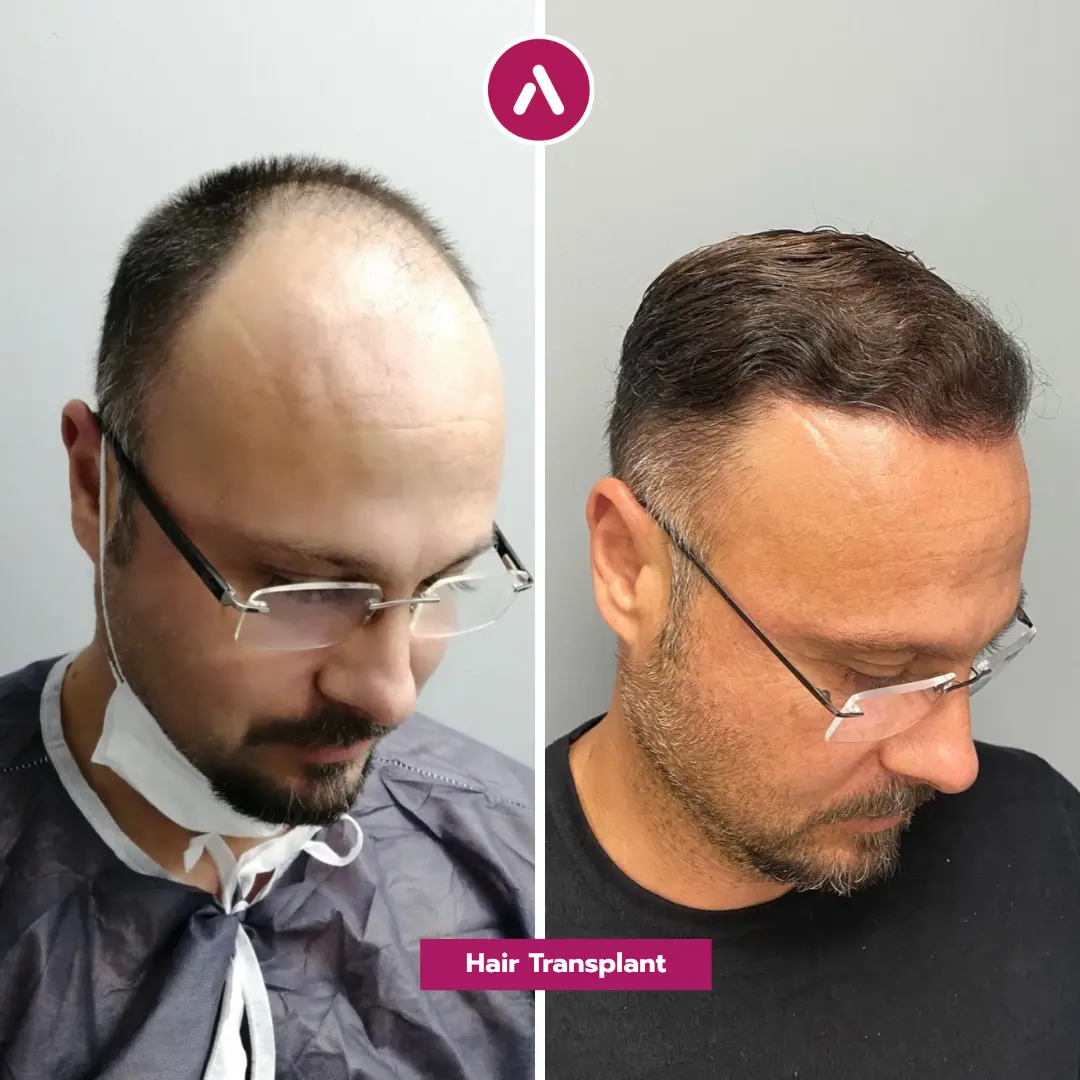
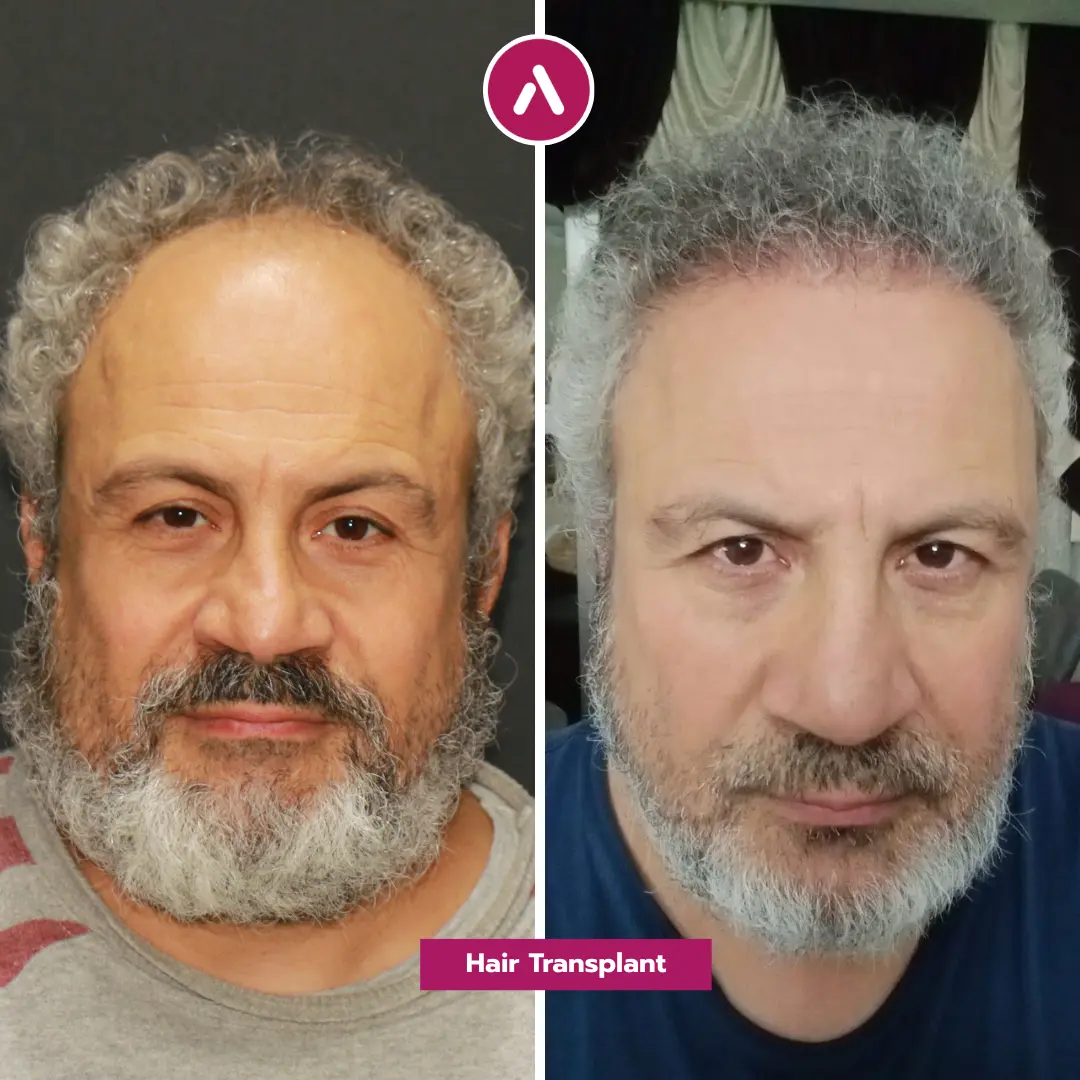
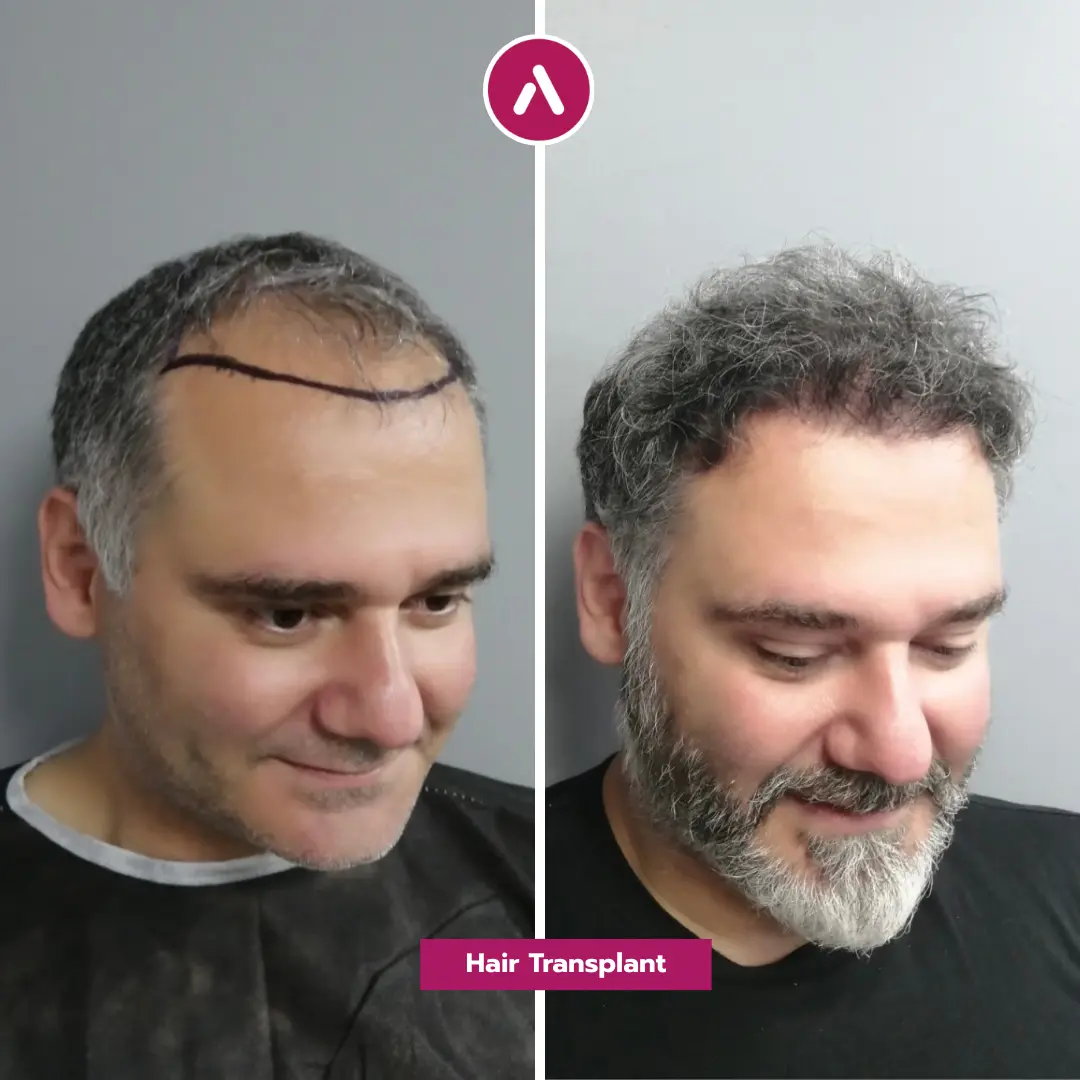
Quick note: timelines vary by individual, technique (FUE/DHI), graft handling, and aftercare. This article is educational and not a substitute for a clinician’s advice.
Table of Contents
Timeline Hair Transplant Growth Chart (Infographic-Style Summary)
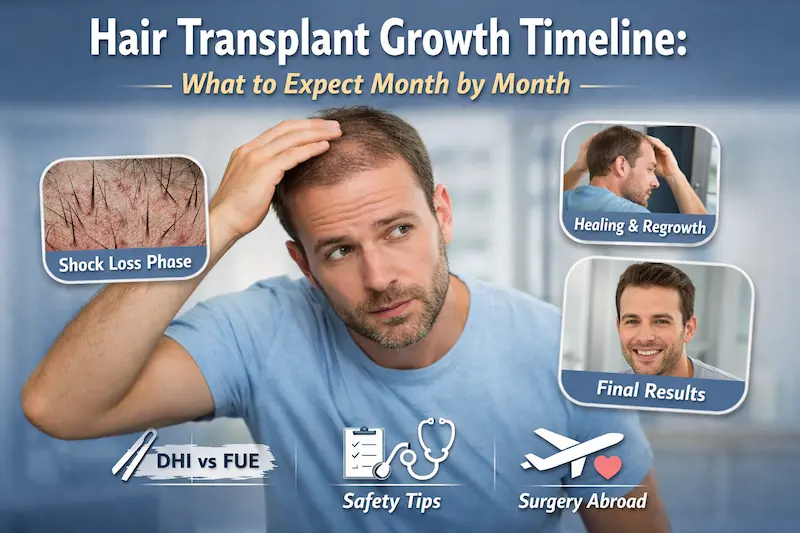
This hair transplant growth timeline infographic-style table summarises what many patients experience. Use it as a compass—your personal journey may sit slightly ahead or behind these averages.
| Time after surgery | What you may see | What it usually means |
|---|---|---|
| Days 1–10 | Scabs/crusting, redness, mild swelling | Normal healing; grafts are settling |
| Weeks 2–4 | Scabs gone; hair shafts may start shedding | Early “shock loss” can be expected |
| Months 2–3 | Patchy, fine regrowth begins | Follicles re-enter the growth cycle |
| Months 4–6 | Visible improvement; gradual density build | Hair thickens and length increases |
| Months 7–12+ | Maturation: thickness, texture, and “settling” | Closer to your final result for most patients |
Now let’s unpack the transplant hair growth timeline properly—starting with what “growth” really means after surgery.
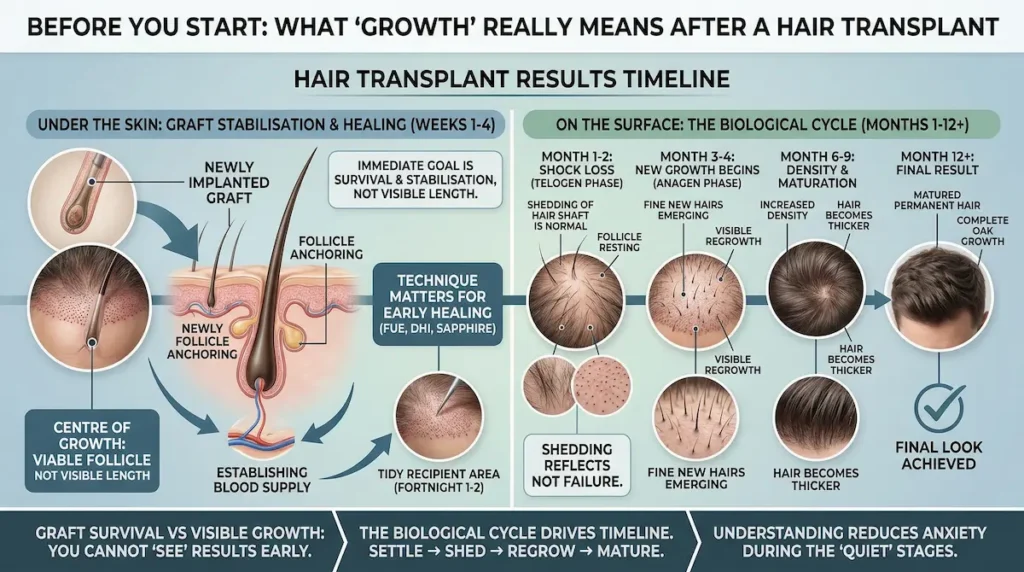
Before You Start: What “Growth” Really Means After a Hair Transplant
Before diving into the hair transplant timeline growth phases, it helps to separate what’s happening under the skin from what you can see in the mirror. In the first weeks, the most important work is graft stabilisation and healing, not visible length. Understanding this upfront reduces anxiety during the early “quiet” stages of the hair transplant results timeline.
Technique can shape the early experience, too: while the biological cycle is similar, the implantation approach may influence how quickly the scalp settles and how tidy the recipient area looks in the first fortnight. If you’re comparing a DHI vs FUE hair transplant, focus less on “instant growth” and more on graft handling, incision strategy, and the aftercare plan—these factors support calm healing, which sets the stage for the visible regrowth that follows in the coming months.
Graft survival vs visible hair growth (why you can’t “see” results early)
Immediately after surgery, the transplanted follicle units need to anchor and establish blood supply in the recipient area. This is why the early stage of a hair transplant new hair growth timeline can feel misleading: you may see short hairs at first, but those hair shafts are not the final story. What matters most is that the follicles remain healthy and secure while the scalp heals.
The hair growth cycle (anagen/catagen/telogen) and why shedding is expected
Hair follicles naturally cycle through growth (anagen), transition (catagen), and rest/shedding (telogen). After transplantation, many follicles temporarily enter a resting phase, which is why “shock loss” (shedding) is so frequently reported in the first month of a hair transplant timeline month by month. This can look dramatic, but it often reflects biology—not failure. In medical science terms, the follicle can remain viable even when the hair shaft sheds.
Does technique matter for timing? (FUE vs DHI vs Sapphire tools)
Technique can influence early healing (for example, incision type, handling time, and implantation approach), but the broader growth pattern usually follows the same rhythm: settle → shed → regrow → mature. In other words, your hair transplant growth timeline is driven largely by follicle biology and healing, though individual variation is normal.
Week 0–2: Healing Phase (Scabs, Redness, and Washing)
The first two weeks are the foundation of your entire hair transplant results timeline. Your goal is to protect grafts, support clean healing, and avoid unnecessary friction, heat, and trauma. Most worries during this period relate to scabs, redness, swelling, and how/when to wash safely—so we’ll be very practical here.
Days 1–3: swelling (oedema), sleeping position, and normal discomfort
Mild to moderate swelling of the forehead (oedema) can occur in the first few days, depending on technique and individual response. Many clinics advise sleeping slightly propped up and avoiding bending forward where possible. Mild soreness is expected; if you’re advised to use pain relief, paracetamol is commonly referenced in UK aftercare guidance (always follow your surgeon’s instructions and avoid medicines you’ve been told not to take).
Days 4–10: scab management and safe washing milestones
Scabs/crusting typically peak and then begin to resolve during this window. Washing protocols vary, but the principles are consistent: gentle cleansing, no aggressive rubbing, and careful drying. This stage can feel like “nothing is happening” on a transplant hair growth timeline, yet it’s one of the most important periods for protecting graft placement and supporting clean healing.
What’s not normal: infection warning signs and when to contact your clinic
Some redness and tenderness can be normal. However, you should contact your clinic promptly if you develop signs that suggest infection or an adverse reaction—such as worsening pain, spreading redness, pus-like discharge, a foul smell, or a persistent high temperature (for example, 38°C or above). Early assessment matters because timely management protects both comfort and outcomes.
Protecting grafts in real life: hats, commuting, and day-to-day routines
During week 0–2, avoid anything that compresses or scrapes the recipient area. If you must travel or commute, plan to minimise friction and keep the scalp clean. Many people ask about hats; the safest approach is to follow your clinic’s specific advice on timing and fit. This practical planning is part of why a clear hair transplant timeline month by month is so useful for UK patients balancing work, travel, and visibility.
Month 1: Shock Loss and the “Nothing’s Happening” Stage
Month 1 is often the most emotionally confusing part of a hair transplant growth timeline. You’ve done the procedure, the scalp looks calmer, and then—just when you expect progress—hair shafts begin shedding. In the hair transplant timeline growth phases, this is usually a predictable transition rather than a setback.
In Month 1, it’s also normal to question whether the technique affects shedding, especially when comparing a DHI vs FUE hair transplant. While both methods can lead to excellent outcomes, the key point is that early shedding is usually driven by the follicles entering a temporary resting phase, not by the procedure “failing”. At this stage, a calm scalp, good hygiene, and avoiding friction matter more than judging results—because the real regrowth typically starts later in the timeline.
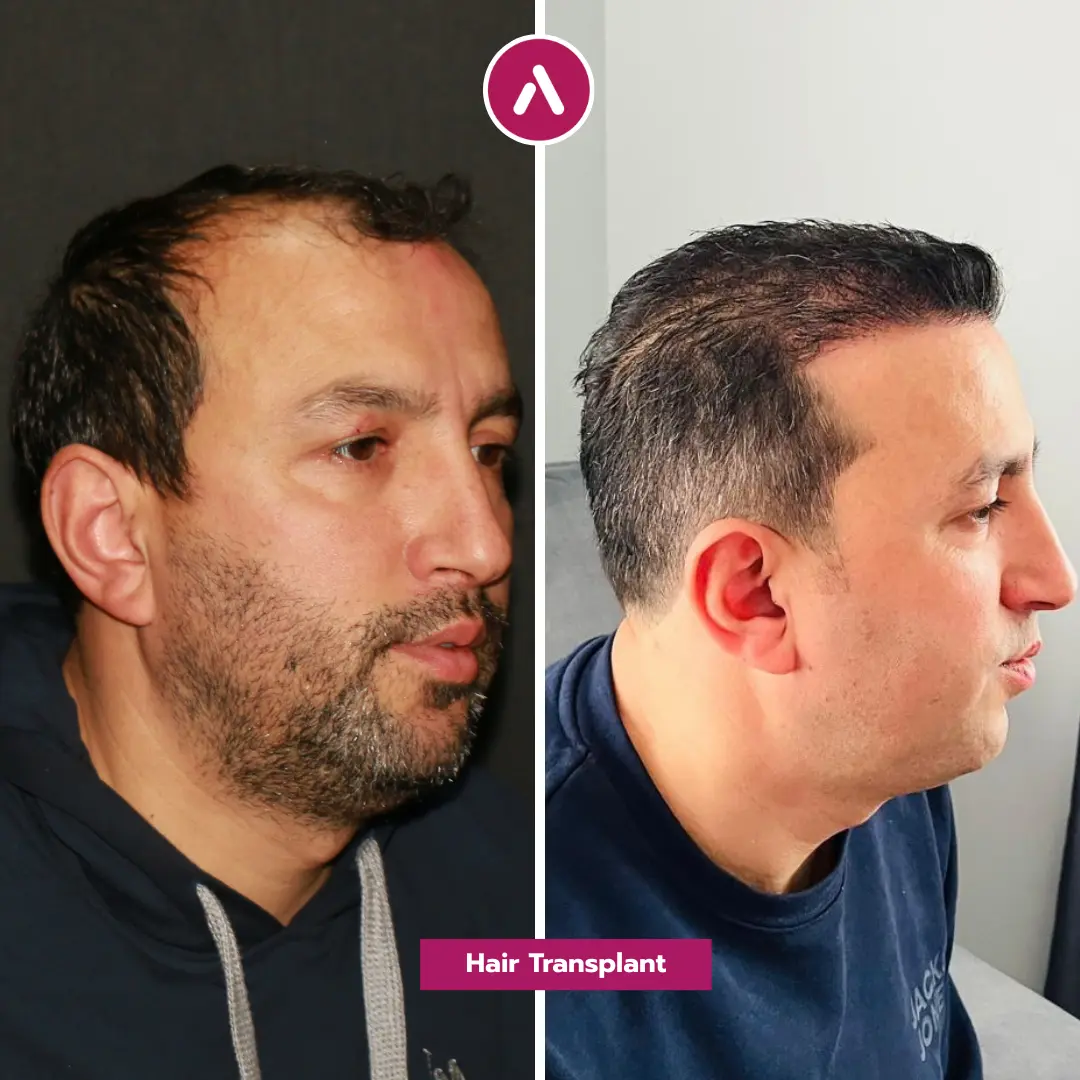
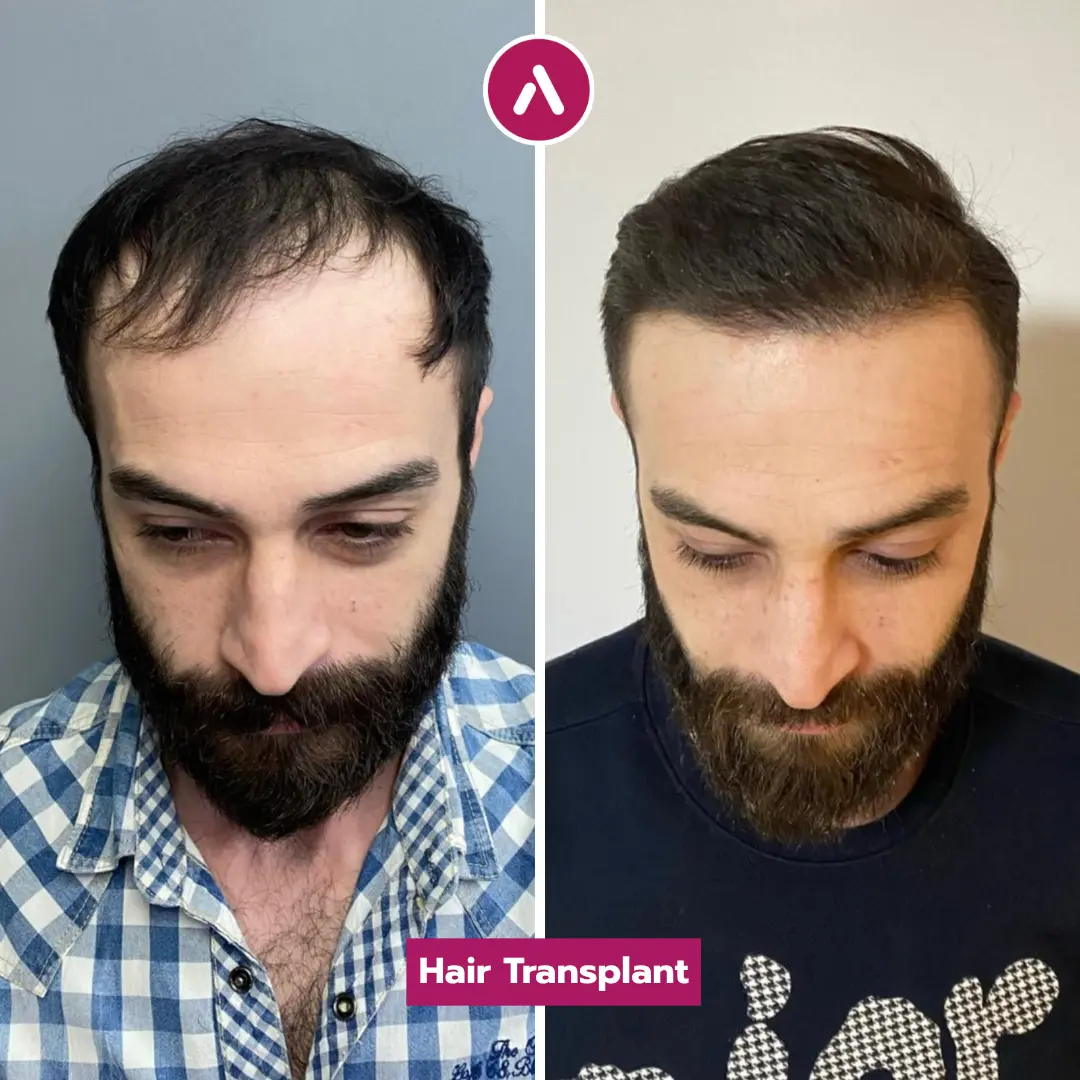
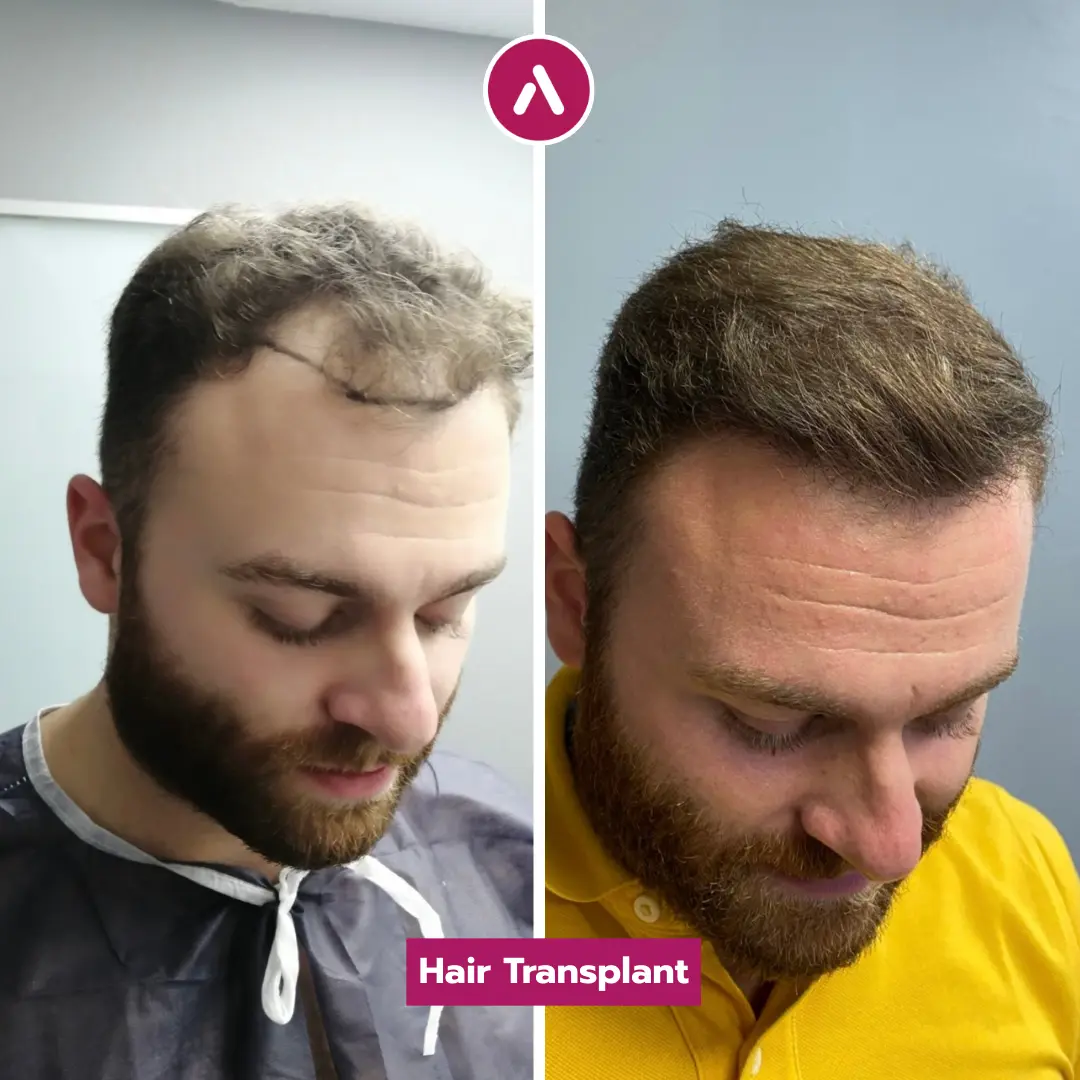
Why transplanted hairs shed (shock loss) but follicles remain
After transplantation, many follicles temporarily “reset” and shift into a resting phase. The visible hairs (shafts) can shed even though the follicle remains alive beneath the skin. This is why shock loss is frequently described in scientific research on postoperative hair restoration outcomes: the biology of cycling follicles often matters more than what you see on the surface in the first month.
What the recipient area may look like by the end of Month 1
By the end of Month 1, scabs should be gone and redness may be fading (though fair skin can remain pink for longer). The scalp can look “similar to before” or even thinner due to shedding—an expected part of the hair transplant results timeline for many patients. This is exactly why month-by-month guidance (and a timeline hair transplant growth chart) is helpful: it stops you judging success too early.
What the donor area should look and feel like by Month 1
The donor area (usually the back/sides) often settles faster than the recipient area. Mild tightness, dryness, or altered sensation can occur and usually improves gradually. If you notice increasing pain, spreading redness, or discharge, it’s sensible to contact your clinic rather than “wait it out”.
Common mistakes that can slow recovery
- Smoking/vaping: can compromise healing and circulation.
- Friction and scratching: especially if itching appears as nerves recover.
- Heat and heavy sweating too early: can irritate the scalp.
- Overusing harsh products: strong styling products can inflame sensitive skin.

Months 2–3: Early Regrowth (Fine, Uneven, and Slow)
Months 2–3 are where many people first notice “new” hairs returning—but often in a form that doesn’t yet match the final look. In a hair transplant timeline month by month, this is the “ugly duckling” phase: regrowth can be fine, patchy, and inconsistent, and it’s still completely compatible with an excellent final result.
What early regrowth looks like (fine hairs, patchiness, slower crown changes)
Early regrowth often appears as thin, wispy hairs that feel softer or lighter than your native hair. Patchiness is common because follicles don’t all re-enter anagen at the same time. The crown/vertex can appear slower to improve than the frontal hairline, which is a well-known pattern in many transplant hair growth timeline discussions.
Texture changes, itching, and folliculitis—what’s common and what isn’t
As hairs begin to emerge, you may experience itching or small spots (sometimes described as folliculitis). Mild, short-lived episodes can happen. However, painful, expanding, or recurrent pustules should be assessed by your clinic to rule out infection or irritation that needs treatment. This is one of the practical “checkpoints” often missed in a basic hair transplant growth timeline infographic, so it’s worth stating clearly.
Haircuts, clippers, hats/helmets: what’s safe and when
Safety depends on your surgeon’s aftercare plan, but the principle is simple: avoid scraping, compressing, or traumatising the recipient area while the skin is still settling. Many patients prefer scissors first, then clippers later once the scalp is comfortable. If you need a hat for commuting or weather, choose a loose, clean option and follow your clinic’s timing advice.
How to judge progress without obsessing over daily changes
Daily mirror checks can be misleading. A better approach is consistent, well-lit photos every 2–4 weeks, taken from the same angle. This method aligns with how outcomes are commonly tracked in clinical settings and medical science publications—consistent documentation is more reliable than memory.
| Common concern (Months 2–3) | Often normal | When to seek advice |
|---|---|---|
| “It’s patchy and thin” | Yes — early regrowth is uneven | If there is no visible change at all by the end of Month 3, ask for a review |
| “I have spots/bumps” | Sometimes — mild folliculitis can occur | If painful, spreading, recurrent, or with discharge |
| “The crown hasn’t improved” | Often — crown can be slower | If crown remains unchanged well beyond expected windows, discuss at follow-up |
Months 4–6: Visible Change (Density Starts to Build)
Months 4–6 are a turning point in the hair transplant new hair growth timeline. Many patients report that this is when friends or colleagues begin to notice improvement—even if you still feel you’re “not finished”. Hair shafts lengthen, calibre increases, and the overall cosmetic impact becomes clearer.
Typical progress range and why your timeline may differ
By this stage, you may see meaningful changes, but the speed varies. Differences can relate to hair calibre, curl pattern, scalp characteristics, the area transplanted, and ongoing native hair loss. This is why any timeline hair transplant growth chart should be treated as a guide rather than a promise.
Hairline vs density: what improves first and how “natural” results are judged
Patients often focus on the hairline first because it frames the face. Early on, you may see coverage without full density. Natural-looking outcomes depend on hairline design, angle and direction of implantation, and gradual maturation over time—not just how much hair is present at Month 4 or 5. In other words, “looking natural” is part of the longer hair transplant results timeline, not a single milestone.
Adjuncts to discuss with your clinician (medication plans, LLLT options)
If you’re using (or considering) medical therapies for pattern hair loss, discuss this with a qualified clinician, especially if you have medical conditions or take regular medicines. Some clinics also use supportive technologies such as LLLT (low-level laser therapy) to help scalp recovery and comfort. Evidence and protocols vary, so treat this as a clinician-led discussion rather than a self-prescribed plan.
Confidence milestones: styling, social events, and work
Many UK patients plan around visibility—meetings, weddings, or returning to a public-facing role. By Months 4–6, you can often style hair more easily, though you may still notice areas that are “catching up”. If you want an at-a-glance reminder, keep referring back to the hair transplant growth timeline infographic table at the top.
Practical mindset tip: Months 4–6 are about momentum, not perfection. If you compare yourself to “final result” photos too early, you’ll almost always feel behind—even when you’re progressing normally.
Months 7–12+: Maturation and the Final Result
By Months 7–12+, the hair transplant results timeline shifts from “new hairs appearing” to “new hairs maturing”. This is where density becomes more convincing, the hairline looks less “new”, and the overall blend with your native hair improves. If you’ve been using a hair transplant growth timeline infographic or a timeline hair transplant growth chart to track progress, this is the period where the chart finally starts to feel real in day-to-day life.
By this stage, differences you read about when comparing a DHI vs FUE hair transplant tend to matter less than the maturation process itself: the follicles are already established, and what you’re seeing is the gradual thickening and refinement of each hair shaft. It’s also the right window to evaluate balance—how the hairline frames the face, how the mid-scalp blends, and whether the crown is catching up—using consistent photos rather than day-to-day mirror checks.
Thickening, colour/texture normalisation, and “settling” of the hairline
In Months 7–12, the hairs that appeared earlier often become thicker and more pigmented. Texture can normalise too—early regrowth can feel wiry or curly, then soften and blend. This maturation phase is a key part of the hair transplant timeline growth phases described in clinical follow-ups: follicles have re-entered a stable growth rhythm, and what you see becomes more representative of the end result.
When it’s fair to assess yield—and when a second session is considered
Most reputable clinicians discourage “final judgement” at Month 3 or Month 4, because biology simply hasn’t finished. A more reasonable assessment window is later in the transplant hair growth timeline—often around Month 9–12—when calibre and coverage have had time to build. If a second session is ever discussed, it should be based on careful examination: the original plan, the area covered (hairline vs crown), donor capacity, and ongoing hair loss in non-transplanted zones.
Long-term maintenance: ongoing hair loss outside transplanted zones
A common surprise in the hair transplant timeline month by month is that “new” gaps can appear in areas that were never transplanted—because a transplant doesn’t stop natural pattern hair loss. This is why many patients plan a long-term approach with a clinician: protecting existing hair can be just as important as growing transplanted hair.
| Stage | What you’re likely to notice | Helpful mindset |
|---|---|---|
| Months 7–9 | Density improves; styling becomes easier | Progress is real, but not “finished” |
| Months 10–12+ | Texture and thickness mature | Assess with photos, not memory |
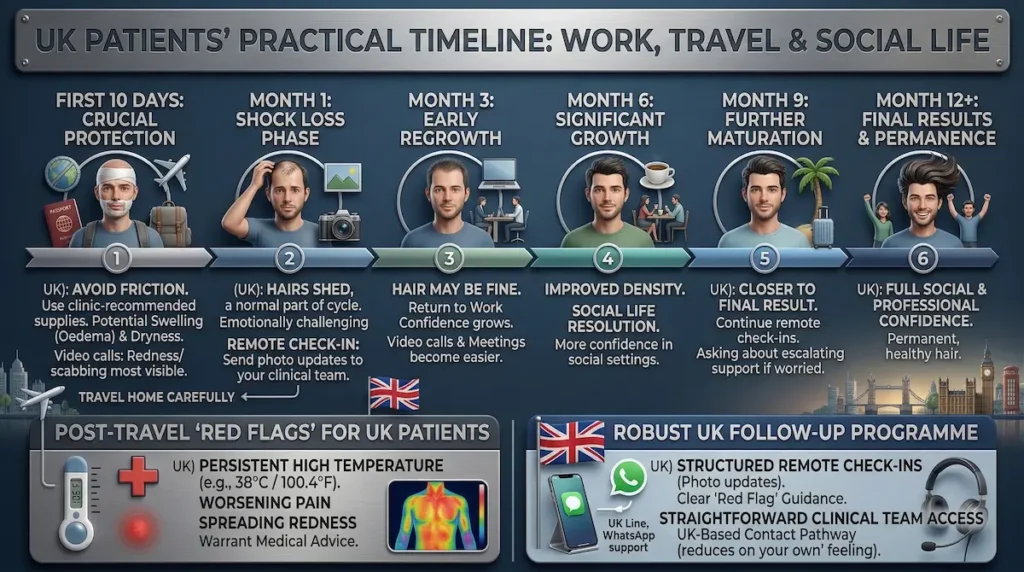
Practical Timeline for UK Patients: Work, Travel, and Social Life
UK patients often choose a month-by-month guide because they’re planning around real-life commitments: commuting, meetings, holidays, and—if travelling for treatment—flying home. This section translates the hair transplant growth timeline into practical “life milestones”, while keeping a clear line between what’s commonly experienced and what needs personalised medical advice.
Return to work and public-facing confidence milestones (video calls, meetings)
Some people feel comfortable on video calls within days; others prefer to wait until redness and scabbing have resolved. In general, the most “visible” stage is the first 10 days, and the most “emotionally challenging” stage is Month 1 (shock loss). If you want to plan conservatively, structure your schedule around those two points in the hair transplant timeline month by month rather than expecting continuous improvement every week.
Flying back to the UK: comfort planning, swelling expectations, protecting grafts
If you’re flying after a hair transplant, your clinician should advise you based on your procedure details and your health history. From a comfort perspective, many patients plan for potential swelling (oedema), dryness, and the practicalities of keeping the scalp protected from friction. Pack gentle cleansing supplies recommended by your clinic, and avoid anything that rubs the recipient area. If you feel unwell after travel, remember that a persistent high temperature such as 38°C (100.4°F) alongside worsening pain or spreading redness warrants medical advice.
Follow-up access: remote check-ins, UK support line/WhatsApp expectations
One of the biggest UK concerns about treatment abroad is aftercare. A robust programme typically includes structured remote check-ins (photo updates), clear “red flag” guidance, and straightforward access to a clinical team if something worries you. For British patients, having a UK-based contact pathway (for example, a UK support line and direct WhatsApp-style support) can reduce the feeling of “being on your own” once you’re back home.
Aftercare matters as much as the procedure. If you’re comparing providers, ask how follow-ups are handled after you return to the UK, and what the escalation pathway is if you’re worried at Month 1, Month 3, or Month 9.
When to Contact Your Clinic: Red Flags Month by Month
A clear hair transplant results timeline should always include safety guidance—because reassurance is only helpful when you also know what isn’t normal. While minor itching, uneven growth, and temporary shedding can be part of a normal hair transplant new hair growth timeline, certain symptoms should be checked promptly.
Even when your healing seems to follow the expected pattern, it helps to know the “non-negotiables” that deserve prompt clinical advice. Whether you chose a DHI vs FUE hair transplant, safety red flags are broadly the same: symptoms that worsen rather than settle, signs of infection, or anything that affects your general wellbeing. If in doubt, contact your clinic early with clear photos and a short day-by-day summary—timely reassurance (or treatment) protects both comfort and outcome.
Early red flags (first 2 weeks)
- Worsening pain rather than gradual improvement
- Spreading redness, heat, or swelling that seems to escalate
- Pus-like discharge or an unpleasant smell
- High temperature around 38°C (100.4°F) or above, especially with increasing scalp tenderness
Mid-phase concerns (Months 1–3)
- Recurrent, painful folliculitis (persistent bumps that don’t settle)
- Severe itching with scratching that risks skin trauma
- No visible change at all by the end of Month 3 (worth a review, especially with consistent photos)
Late concerns (Months 6–12+)
- Growth that remains significantly below expectations beyond the typical maturation window
- Areas that look persistently unnatural (direction/angle concerns)
- Scarring worries in donor or recipient areas that seem to worsen over time
Tip: When you contact your clinic, send a short timeline: “Day X / Month Y”, what changed, whether it’s worsening, and clear photos in consistent lighting. This mirrors how outcomes are tracked in medical science settings and makes remote assessment more accurate.
Summary: Your Month-by-Month Hair Transplant Growth Timeline
To recap the core milestones of the hair transplant growth timeline:
- Weeks 0–2: Healing and protecting grafts (scabs, redness, washing milestones).
- Month 1: Shock loss can happen—often normal.
- Months 2–3: Early regrowth begins (fine, uneven, “ugly duckling” phase).
- Months 4–6: Visible improvement and building density.
- Months 7–12+: Maturation—thickening, texture normalisation, more “finished” look.
Frequently Asked Questions (FAQ): Hair Transplant Growth Timeline
This FAQ section answers the most common UK patient questions about the hair transplant growth timeline. Use it alongside the timeline hair transplant growth chart at the top to keep expectations realistic throughout your hair transplant timeline month by month.
How long until my hair transplant looks “normal”?
Many people feel it looks socially “normal” once scabs are gone and redness settles (often within the first 2 weeks). However, in the hair transplant results timeline, visible cosmetic improvement usually becomes more obvious from Months 4–6, with maturation continuing into Months 7–12+.
Is it normal to lose the transplanted hair in the first month?
Yes—shedding in Month 1 is common and often part of the hair transplant timeline growth phases. The hair shaft can shed while the follicle remains viable beneath the skin. This is one reason transplant hair growth timeline guides emphasise patience early on.
When can I wash my hair normally after a transplant?
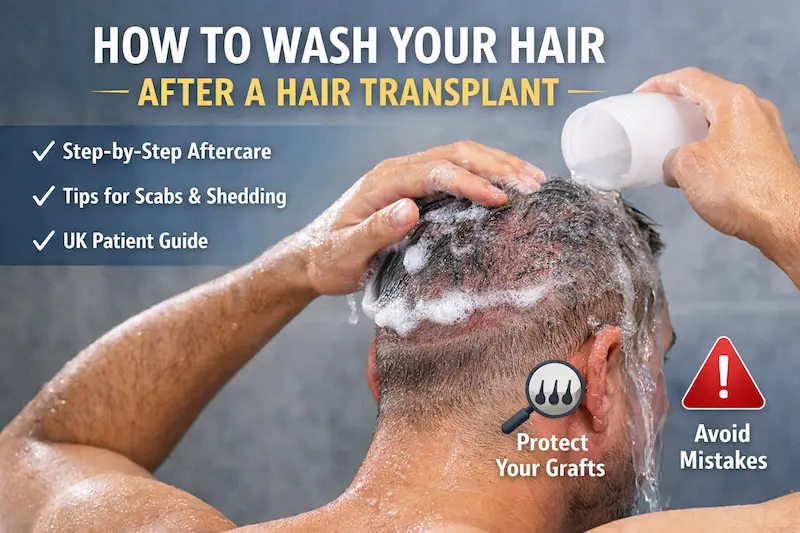
Washing protocols vary by clinic, but the early phase generally involves gentle cleansing and avoiding rubbing the recipient area. Once scabs have resolved and your clinician confirms it’s safe, you can usually transition towards a more normal routine. Always follow your surgeon’s specific instructions, as this affects the early stage of your hair transplant new hair growth timeline.
When can I cut or shave my hair after FUE/DHI?
Many patients start with a careful scissors trim first, then consider clippers later once the scalp is comfortable and fully healed. Because timelines vary, the safest answer is: follow your clinic’s schedule based on how your skin is healing and whether there is lingering tenderness or redness.
When can I wear a hat or helmet after my hair transplant?
A loose, clean hat may be permitted after the most vulnerable early days, but timing depends on your clinic’s protocol and how your grafts are settling. A helmet (especially for motorcycling or cycling) creates more pressure and friction, so you should get explicit clinical guidance before using one. This is a practical detail that can affect your hair transplant growth timeline infographic expectations if ignored.
When can I return to the gym, swimming, and sports?
In the first couple of weeks, heavy sweating, contact risk, and swimming can irritate healing skin and increase infection risk. Many clinics advise a phased return: gentle walking first, then gradual reintroduction of training once the scalp is healed. Confirm your personal timeline with your clinician, particularly if you do high-intensity or contact sports.
What if my growth is slower than expected—when should I worry?
Use consistent photos every 2–4 weeks rather than judging day-to-day. Patchiness in Months 2–3 can be normal, and the crown often lags behind the front. If you have no visible change at all by the end of Month 3, or if you’re concerned later in the hair transplant results timeline (for example, beyond the usual maturation window), request a clinical review. A structured review approach is standard in scientific research and helps separate normal variation from something that needs attention.
If you’d like to go beyond the hair transplant growth timeline, you can also explore related guides on Hair Transplant Cost UK, Hairline Design, Sapphire Hair Transplant, and how to Wash Hair After Transplant. For patients comparing options overseas, we also recommend reading our Surgery Abroad Safety Checklist, plus practical planning advice in the Pre-Surgery Checklist. And if you’re weighing up providers, our overview on choosing a Plastic Surgeon Turkey explains what to look for in surgeon credentials, clinic standards, and aftercare support before you commit.
Medical Disclaimer: This page is provided for general educational purposes only and does not replace a face-to-face medical consultation, diagnosis, or personalised treatment plan. All surgery carries risks and outcomes vary between individuals. Suitability for a hair transplant surgery, procedure selection, and anaesthesia choice can only be determined after a full clinical assessment by a qualified surgeon. Always follow your clinician’s instructions and seek urgent medical attention if you develop concerning symptoms during recovery.