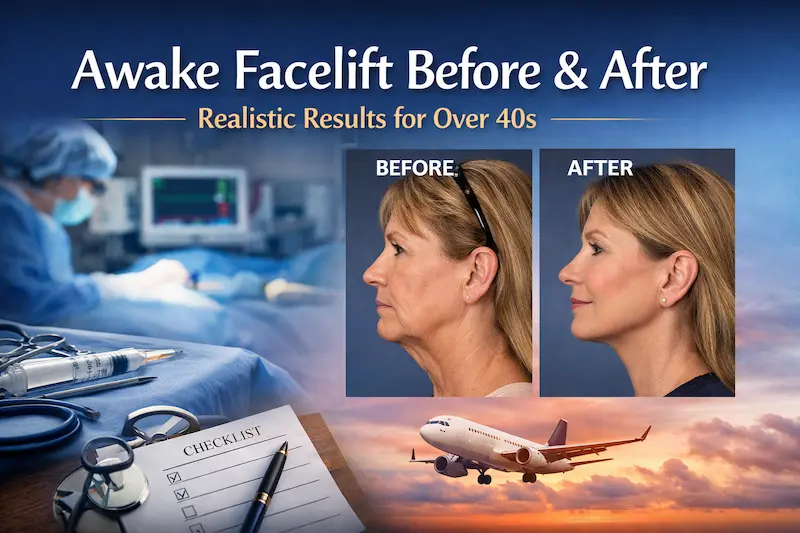
If you’re searching for awake facelift before after photos, you’re probably not looking for “miracle” transformations — you want realistic, believable change that still looks like you. This guide is written for the UK “expert patient” who wants to understand what awake facelift before and after outcomes can genuinely look like in your 40s, 50s and beyond, and how to read images critically so your expectations stay grounded in medical science, not marketing.
Throughout this article, you’ll see the phrases patients commonly search for — such as before and after for awake facelift, twilight sedation facelift before after, and local anaesthesia facelift before after — but the goal is the same: help you interpret awake facelift results with clarity, confidence, and UK-appropriate realism.
Table of Contents

What Subtle Facial Rejuvenation Looks Like in Your 40s
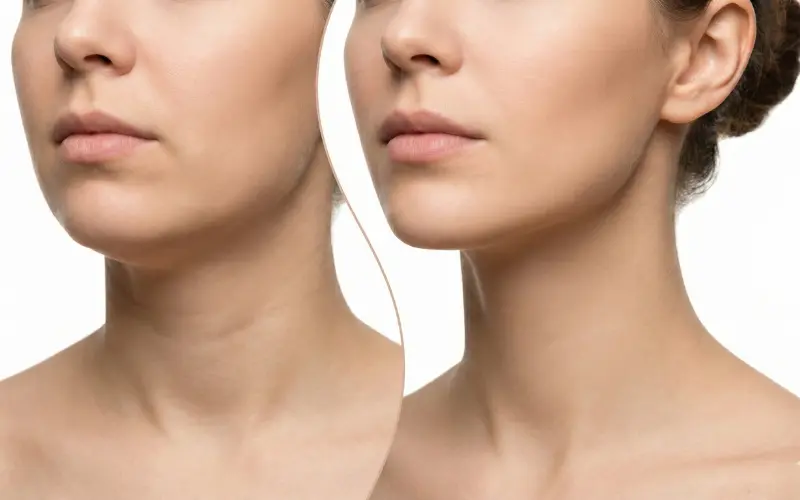
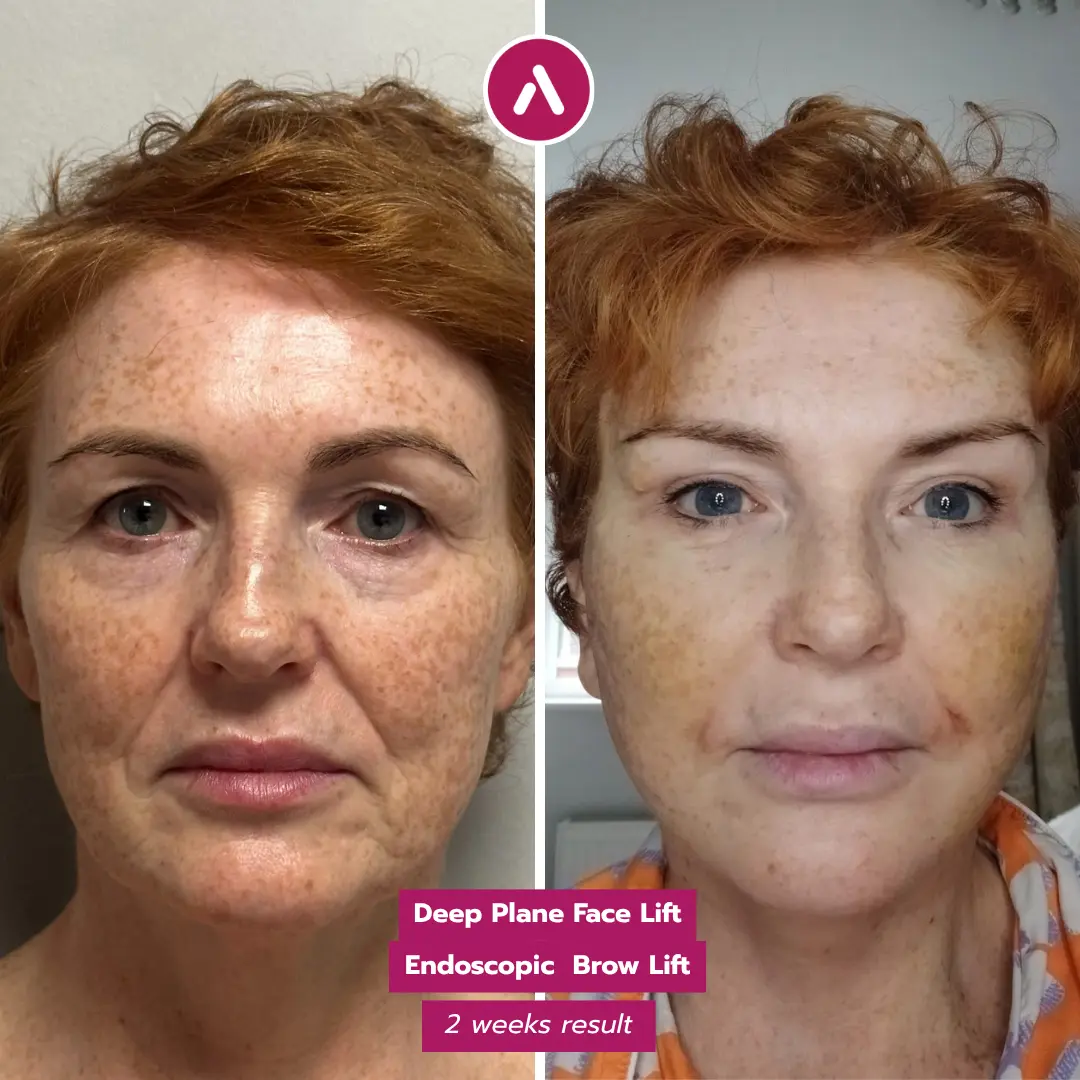
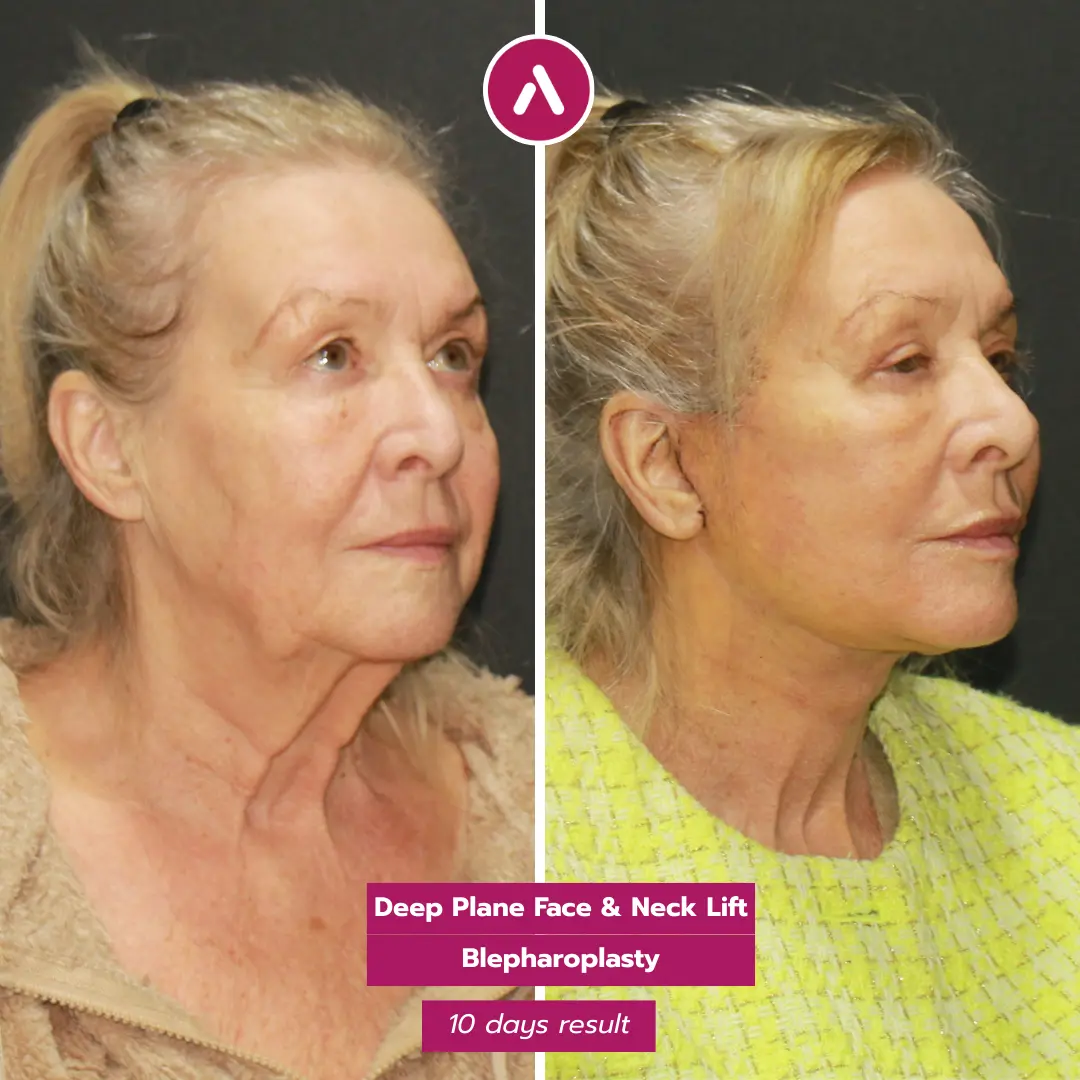
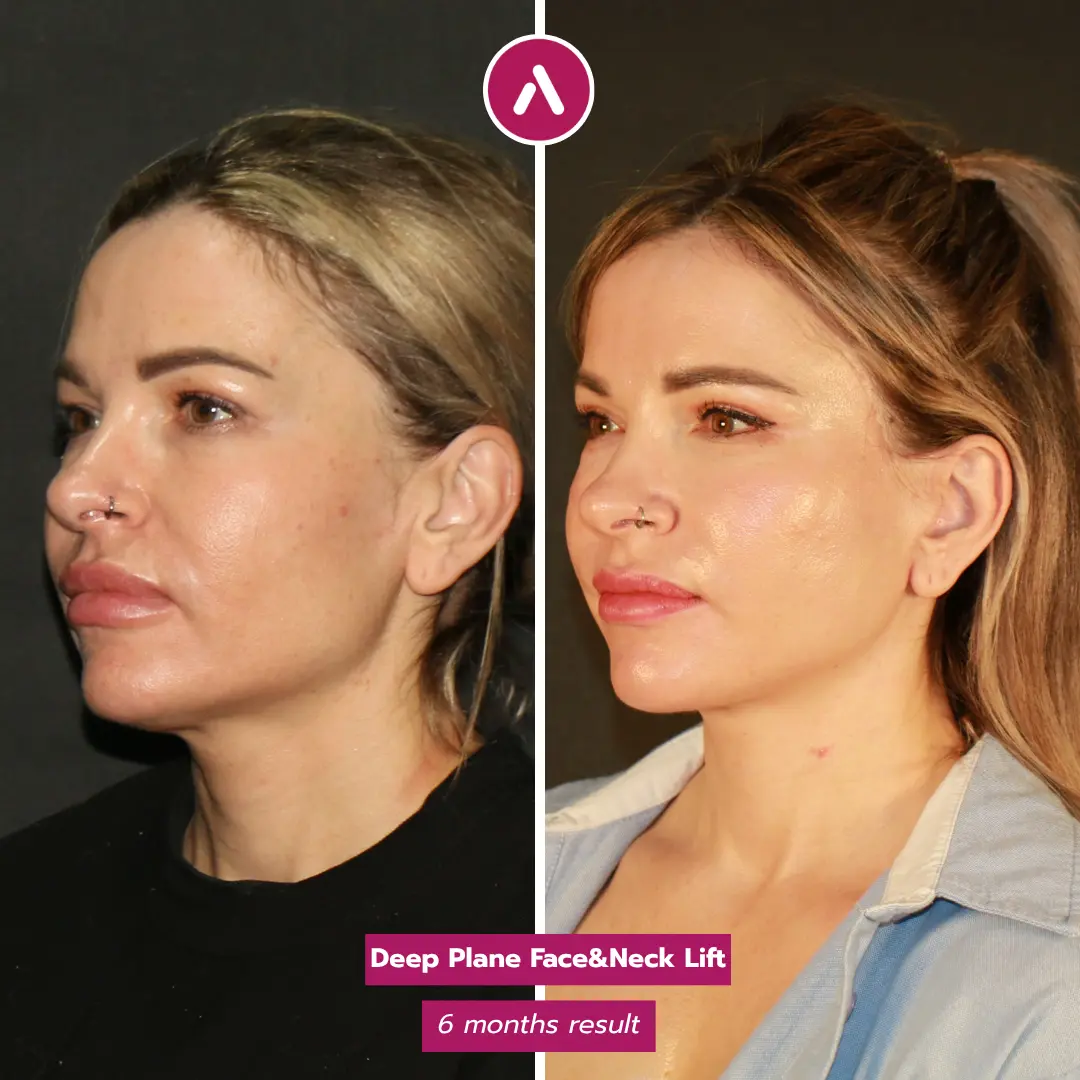
In your 40s, the most satisfying outcomes are usually subtle rather than dramatic. Many UK patients want to look less tired, less heavy around the lower face, and a bit more defined — without friends immediately clocking a procedure. A well-planned awake facelift can support this “refreshed, not changed” aesthetic, but it’s important to understand what the procedure can (and cannot) do at this stage. When reviewing awake facelift before and after over 40s, pay attention to consistency in lighting and timing so you’re judging a true, stable result rather than temporary swelling.
Early ageing correction without looking “overdone”
The “overdone” look often comes from excessive tension or poorly balanced lifting. In a natural plan, the aim is to restore gentle contour — particularly along the jawline — while keeping facial expression soft. This is why realistic awake facelift before and after examples matter: you’re looking for improvement that still feels like your face, just better rested.
What typically improves most over 40
- Jawline definition: early blurring can sharpen without looking tight.
- Early jowls: small folds and heaviness can reduce noticeably.
- Lower-face heaviness: subtle re-balancing can create a lighter, more youthful contour.
These are the changes that tend to show best in awake facelift results for patients in their 40s — especially when photos are taken at consistent angles.
“Refreshed, not changed”: the UK preference for subtle results
Many British patients prioritise naturalness: you want to look like you’ve had a great rest, not a different face. When you’re evaluating awake facelift before and after galleries, favour results where the patient’s identity is preserved — eyes, smile, and facial “character” should remain familiar.
Why “day 10 photos” can mislead (oedema, bruising, lighting, angles)
A key reason people feel disappointed is comparing early recovery photos to final outcomes. In the first 1–3 weeks, oedema (swelling) can distort definition and make the face look either too tight or too puffy. Scientific research into wound healing and soft tissue recovery consistently supports the idea that visible swelling changes over weeks, with refinement continuing for months — meaning you should interpret “early” before and after for awake facelift images with caution.
| Photo timing | What you may still see | What is more reliable to judge |
|---|---|---|
| Days 7–14 | Swelling, bruising, unevenness | Early direction of change (not the final contour) |
| Weeks 4–6 | Residual oedema, firmness | More accurate jawline shape and facial balance |
| Months 3–6 | Minor refinement continues | Best point for “final” before/after judgement |
Results in Your 50s and 60s
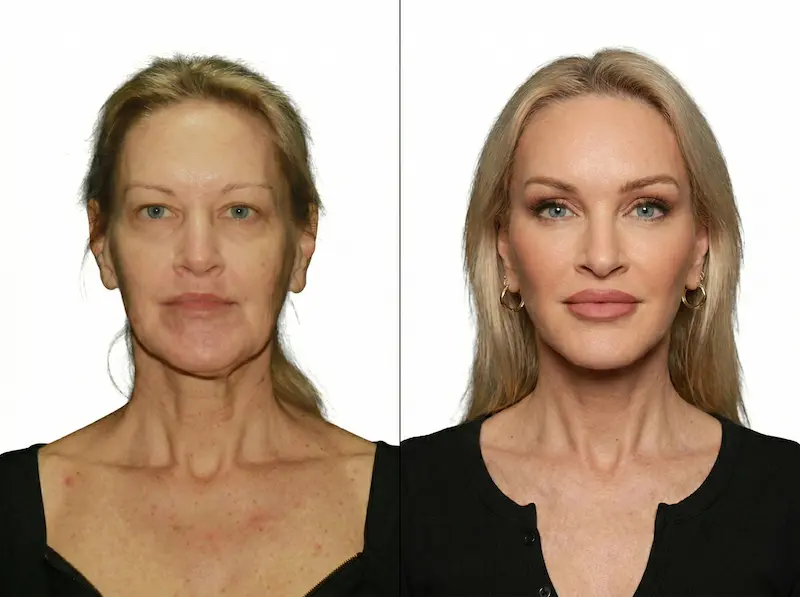
In your 50s and 60s, the “lift” component often becomes more meaningful because structural descent and skin changes are usually more advanced. That said, the most attractive outcomes still look natural — not tight, not shiny, not “windswept”. If you’re reviewing twilight sedation facelift before after or local anaesthesia facelift before after examples at 50+, focus on balanced improvement across the midface and lower face, and be sceptical of images that rely on heavy make-up, different lighting, or altered angles.
Under-eye, jawline, and deeper support: what changes are realistic
Many patients notice improvement in the lower face first — particularly along the jawline and upper neck. Under-eye concerns are more complex: a facelift may soften the overall tired look, but it may not directly fix under-eye hollowing or pigmentation. “Realistic” means understanding which features are driven by volume, skin quality, or deeper support.
Natural vs “wind-swept”: what to look for in before/after evidence
- Natural: smoother jawline, softer folds, normal expression, no stretched hairline.
- Concerning signs: overly tight corners of the mouth, flattened cheeks, visible tension near the ears.
When assessing awake facelift before and after images, try to find sets with neutral expressions and consistent framing so you can judge authenticity.
Skin quality vs structural lift: what a facelift can’t fix alone
Facelift techniques can reposition and support tissues, but skin quality (texture, fine lines, sun damage) may need separate strategies. This is where an evidence-led plan matters: medical science supports combining structural correction with skin-focused care when appropriate — rather than expecting one procedure to do everything.
Case selection: when awake/twilight is suitable — and when it may not be
An “awake” approach (typically local anaesthesia with light IV sedation) can be appropriate for many, but not all, patients. Factors like medical history, anxiety level, and the complexity of changes required influence suitability. So when you see realistic awake facelift before and after examples, remember: the best outcomes usually come from selecting the right approach for the right patient — not forcing one method for everyone.

Before & After You Can Trust: How to Read Facelift Photos Like an Expert Patient
The UK “expert patient” mindset is a strength — but only if you apply it to images properly. The internet is full of awake facelift before and after galleries that look impressive at a glance, yet fall apart under scrutiny. If you want genuinely realistic awake facelift before and after expectations, you’ll need a simple checklist to judge whether photos are comparable and whether the outcome is likely to reflect true tissue healing rather than clever presentation. Think of this as bringing scientific research thinking to aesthetic decision-making: control the variables, look for consistency, and interpret the timeline correctly.
Timing matters: week 1, week 6, and month 6 are not the same result
If a gallery shows “after” photos taken too early, swelling can either artificially enhance tightness or hide definition. In practical terms:
- Weeks 1–2: bruising and oedema can exaggerate heaviness or tightness.
- Weeks 4–6: you start seeing truer contour changes, but tissue can still feel firm.
- Months 3–6: a much more reliable point for judging shape, softness, and scar maturation.
When you’re comparing awake facelift results, try to find photo sets that include at least one “after” image beyond 8–12 weeks.
The “tell-tale” signs of an unnatural facelift (and what subtle looks like)
A subtle result isn’t “no change” — it’s a change that looks believable. Here’s what to look for when assessing before and after for awake facelift outcomes:
- Subtle / natural: improved jawline continuity, softened folds, maintained facial expression, no obvious tension around the ears.
- Potential red flags: over-tight corners of the mouth, flattened cheeks, a “swept” look at the hairline or temples, or a neck that looks unnaturally stretched.
Consistency checks: same lighting, same angle, no filters — what to ask for
If you can’t see whether the “before” and “after” were taken under the same conditions, you can’t accurately judge the change. For credible awake facelift before and after over 40s comparisons, look for:
- Same camera distance (close-up vs zoomed-out can change perceived definition).
- Same angle (even a 10–15° head tilt can “create” a jawline).
- Same lighting (front lighting hides texture; side lighting highlights sagging).
- Neutral expression (smiles can lift the face and mask jowls).
- No beauty filters (skin texture suddenly “disappears” = caution).
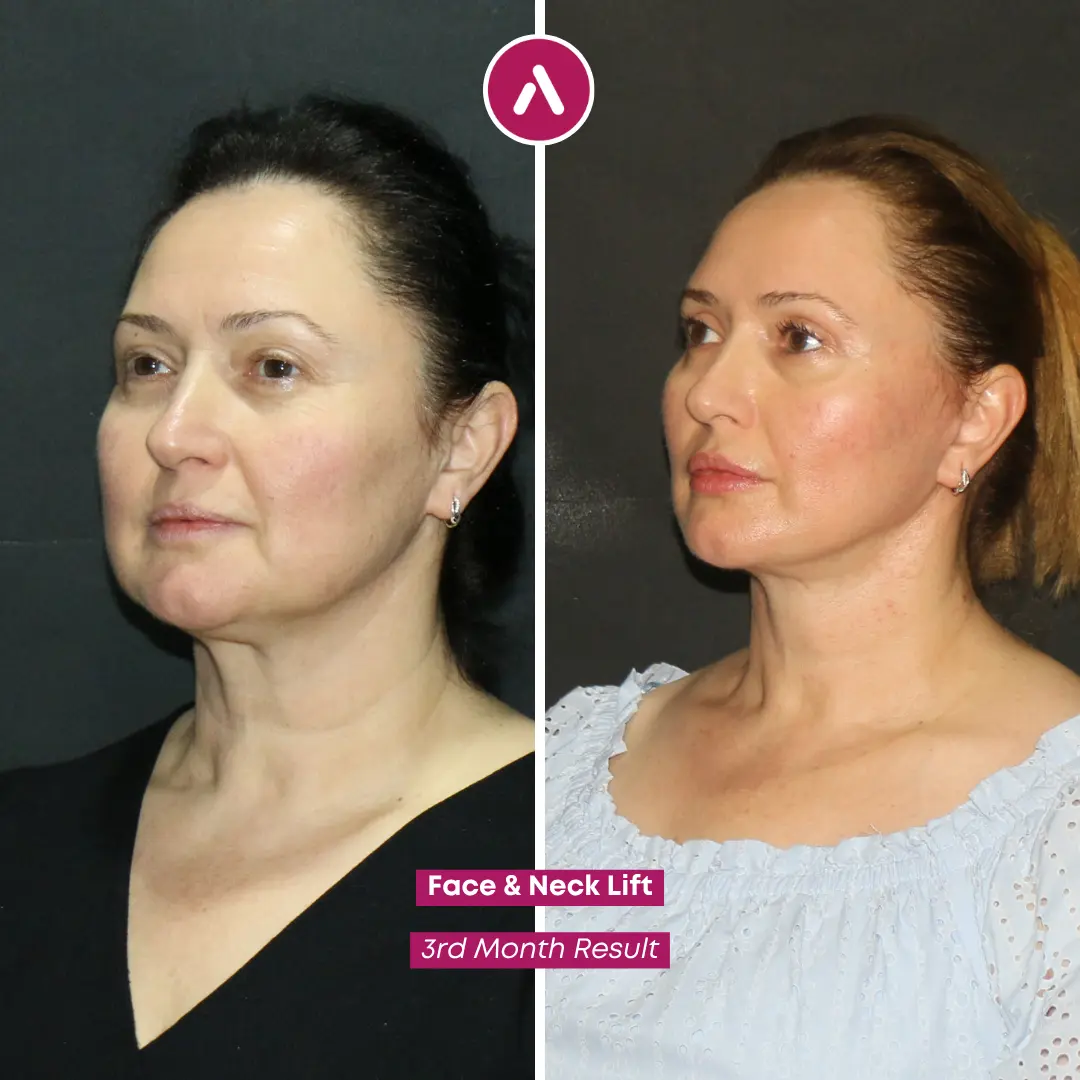
What “subtle facial rejuvenation” means in clinical terms
Subtle rejuvenation is not about pulling skin tighter; it’s about restoring proportion and support in a way that respects your anatomy. In plain language, the goal is to correct descent and heaviness while keeping the face soft and recognisable. That’s why “natural” awake facelift results often look understated in the first glance — and more impressive the longer you study the harmony of the face.
| Question to ask | Why it matters | What a good answer looks like |
|---|---|---|
| When were the “after” photos taken? | Early swelling can mislead | At least 6–12 weeks, ideally 3–6 months |
| Are the angles and lighting the same? | Angles create “fake” improvements | Matched framing, neutral lighting, neutral expression |
| Is skin texture still visible? | Filters hide reality | Natural texture remains; improvement is structural, not airbrushed |
The “Walk-in Walk-out” Facelift Difference
The phrase “walk-in walk-out” can sound like marketing, but for many patients it simply describes the overall experience: a carefully planned procedure carried out with local anaesthesia and typically light IV sedation, followed by early mobilisation and close aftercare. If you’re searching for twilight sedation facelift before after or local anaesthesia facelift before after, it helps to understand what “awake” actually means in theatre — and what safety and comfort measures should be non-negotiable.
What “awake” really means: local anaesthesia + light IV sedation (twilight anaesthesia)
In most settings, an awake facelift is performed using local anaesthesia to numb the surgical area, often paired with light IV sedation (commonly described as twilight sedation). The intention is comfort and calmness, while avoiding the full “deep sleep” of general anaesthesia. So when you see twilight sedation facelift before after claims, the key point is that the result is not created by the sedation — it’s created by technique, planning, and case selection.
Why some UK patients prefer avoiding general anaesthesia
Some patients feel more comfortable with the idea of a lighter anaesthetic approach, particularly if they have concerns about nausea, grogginess, or simply want a smoother immediate recovery experience. Others prefer general anaesthesia — and that can be perfectly appropriate too. The best approach is the one that fits your medical profile and your procedure plan. A good clinical team should explain your options clearly and never oversimplify anaesthesia decisions.
In-theatre comfort & monitoring: what should happen step-by-step
Whether you’re under twilight sedation or not, there are standards you should expect: appropriate monitoring, attentive nursing, careful temperature management, and a team that communicates with you respectfully. This matters for patient confidence — and also because calm, well-managed experiences can support smoother early recovery.
Early mobilisation and the first 72 hours: what’s normal vs what’s not
In the first three days, it’s normal to experience swelling, tightness, mild discomfort, and fatigue. However, red flags should be treated seriously. While this article focuses on outcomes and photo interpretation, the “expert patient” approach includes knowing when to escalate concerns promptly.
- Common: oedema, bruising, firmness, mild asymmetry early on.
- Seek urgent clinical advice: increasing severe pain, sudden swelling on one side, fever, worsening redness, or shortness of breath.
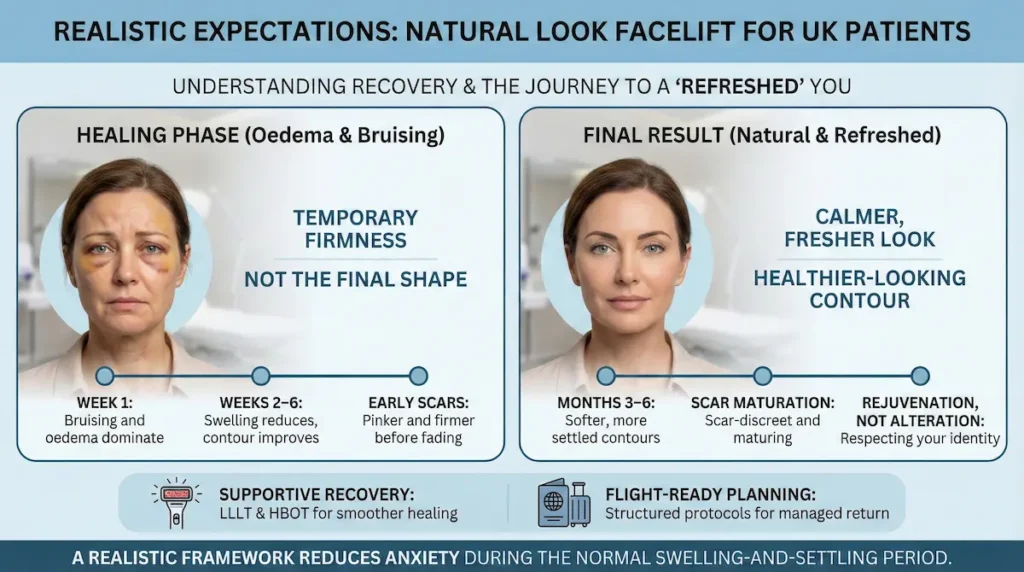
Realistic Expectations: Natural Look Facelift for UK Patients
If you’re comparing awake facelift before and after galleries, the biggest gap is usually expectations around recovery and “final” shape. Results are real — but they evolve. The early phase is not the outcome; it’s healing. A realistic framework, grounded in medical science, helps you interpret awake facelift results fairly, and it also reduces anxiety during the normal swelling-and-settling period.
A realistic recovery timeline: 1 week vs 6 weeks vs 3–6 months
Think of facelift recovery as a gradual refinement:
- Week 1: bruising and oedema dominate your perception.
- Weeks 2–6: swelling reduces, contour improves, but firmness can persist.
- Months 3–6: softer, more settled contours; scars mature further.
This is why the most helpful realistic awake facelift before and after examples are those taken later in recovery.
Scar expectations and incision concealment (and where LLLT may help)
Scars are a natural consequence of surgery, but good planning places incisions in discreet locations and supports healthy healing. Early scars can look pinker and firmer before they fade. In some care pathways, supportive technologies such as low-level light therapy (LLLT) may be used as part of scar and tissue recovery support. The key is not “scar-free” — it’s “scar-discreet and maturing normally”.
HBOT and “flight-ready” recovery: why swelling can settle more smoothly
Some post-operative protocols include supportive recovery methods such as hyperbaric oxygen therapy (HBOT). While individual outcomes vary, the clinical rationale relates to tissue oxygenation and recovery support — a concept commonly discussed in scientific research on healing environments. The practical takeaway for UK patients is that a well-structured recovery plan can make the journey home feel more manageable.
“Rejuvenation, not alteration”: how a natural look is protected
A natural facelift respects your facial identity. The aim is to create a healthier-looking contour and reduce heaviness — not to change who you are. When you’re reading awake facelift before and after over 40s evidence, the best results look like the patient on their best day: calmer, fresher, lighter around the lower face.
Frequently Asked Questions (FAQ): Awake Facelift Before After
This FAQ is designed for UK patients who are comparing awake facelift before and after evidence and want clear, realistic answers. Where relevant, we’ll also reference common search phrases such as awake facelift before and after, before and after for awake facelift, twilight sedation facelift before after, and local anaesthesia facelift before after — but the priority remains safety, credibility, and expectation management grounded in medical science.
How soon do awake facelift results look “presentable” for work or social plans?
Many patients feel comfortable being seen in public within 10–21 days, depending on bruising and swelling. However, “presentable” is not the same as “final”. For truly realistic awake facelift before and after comparison, the more meaningful improvement usually shows over 6–12 weeks, with refinement continuing to 3–6 months.
Is an awake facelift painful during or after surgery?
During surgery, local anaesthesia is used to numb the area, and many patients also have light IV sedation (often described as twilight sedation). After surgery, discomfort is typically described as tightness, pressure, or soreness rather than sharp pain. Patients are usually guided on appropriate pain relief (for example, Paracetamol where suitable) as part of a structured aftercare plan.
How long does swelling (oedema) typically last in your 40s vs 50s/60s?
Swelling patterns vary by person, but it’s common for noticeable oedema to reduce significantly over 2–6 weeks, with ongoing refinement for several months. In your 40s, you may see faster “settling” compared with some patients in their 50s/60s, but individual healing biology matters more than age alone. This is exactly why awake facelift results should be judged at appropriate time points.
What’s the difference between an awake facelift and a traditional facelift under general anaesthesia?
The primary difference is the anaesthetic approach. An awake facelift is typically performed with local anaesthesia and sometimes twilight sedation, whereas a traditional approach may use general anaesthesia. The technique and suitability depend on your anatomy, goals, and medical profile. When reading twilight sedation facelift before after claims, remember: sedation choice doesn’t guarantee a result — the surgical plan and execution do.
How do I know if my results will look natural (not overdone) from the before/after evidence?
Look for consistency: same lighting, same angle, neutral expression, and “after” images taken beyond the early swelling phase. The best before and after for awake facelift sets show improvement without distortion — the person still looks like themselves. Be wary of “after” photos that are heavily styled, filtered, or taken too early.
What aftercare is available once I’m back in the UK?
For many UK patients, aftercare clarity is non-negotiable. Before you proceed, you should understand how follow-up works remotely, who you contact for concerns, and how your clinical team supports you once you’ve returned home. A credible provider will offer a structured pathway for advice and review — not just “message us if you need anything”.
When is it safe to fly back to the UK after an awake facelift?
Fitness to fly depends on how you’re healing, your risk profile, and your surgeon’s advice. Many patients travel home after an appropriate recovery window and a clinical check, but there is no single “one-size-fits-all” day. The safest approach is to plan flights around your personalised recovery milestones, not around bargain tickets. If you’re comparing local anaesthesia facelift before after experiences specifically for travel convenience, prioritise medical suitability and aftercare planning over speed.
If you’d like to explore related topics beyond this article, you can also read our guides on Awake Facelift Cost, what to expect from Facelift Results, and the patient experience in Is Awake Facelift Painful. We also cover safety-focused comparisons such as Local vs General Anaesthesia Facelift, plus practical planning with a detailed Facelift Recovery Timeline and advice on when you can Fly After Facelift. For broader peace of mind, our Surgery Abroad Safety Checklist explains the key questions UK patients should ask before choosing treatment overseas.
Medical Disclaimer: This page is provided for general educational purposes only and does not replace a face-to-face medical consultation, diagnosis, or personalised treatment plan. All surgery carries risks and outcomes vary between individuals. Suitability for an awake facelift, procedure selection, and anaesthesia choice can only be determined after a full clinical assessment by a qualified surgeon. Always follow your clinician’s instructions and seek urgent medical attention if you develop concerning symptoms during recovery.